2 Peter 2:22

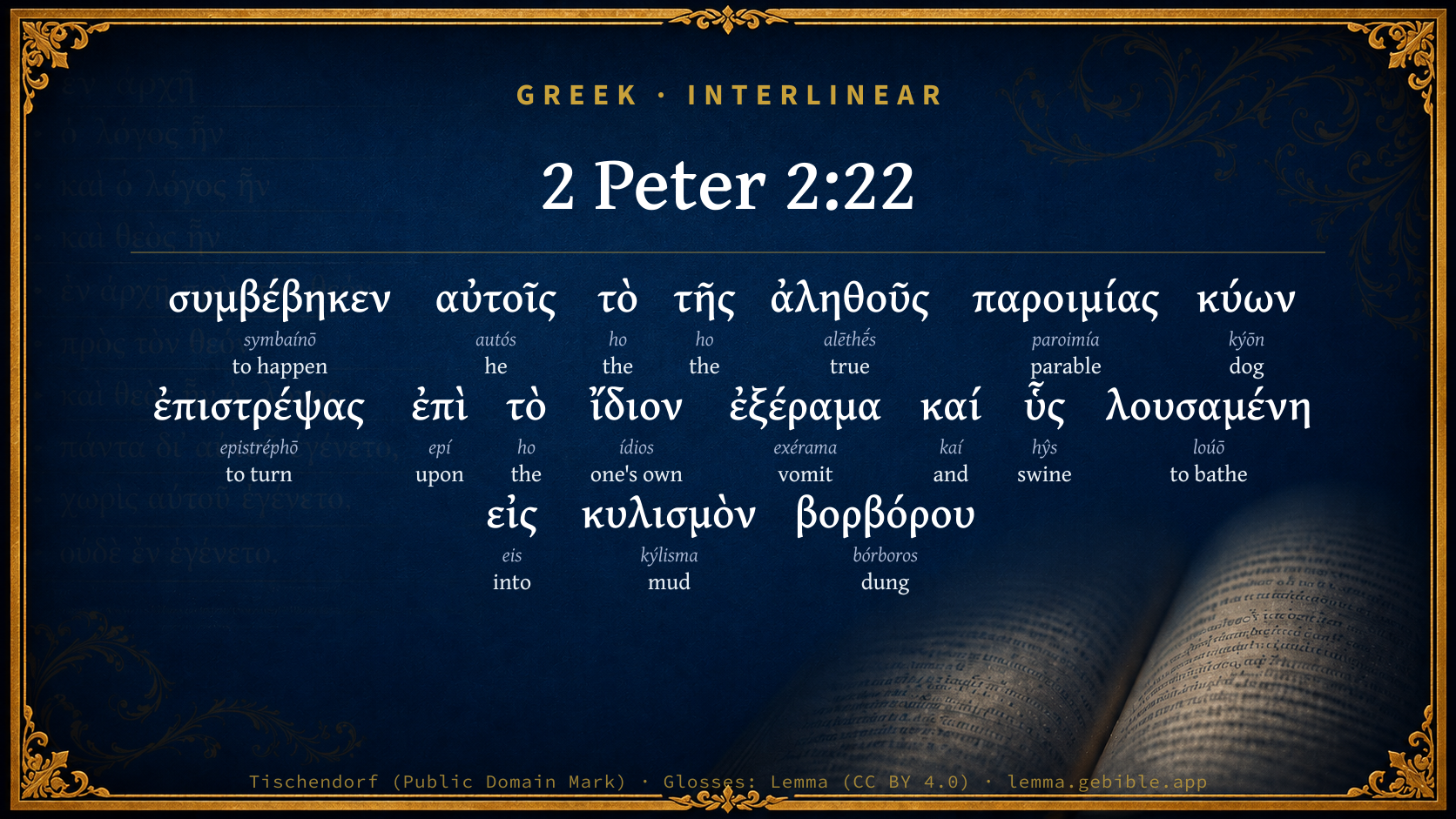
Greek (Tischendorf 8th ed.) 2 Peter 2:22 appears in the Greek New Testament. The text above is from the Tischendorf 8th edition. Each word links to its Strong’s number and a concise gloss. Click any word for its full Thayer’s Greek Lexicon entry.
Download image
Cite this verse

2 Peter 2:22 (World English Bible). Public Domain. Lemma interlinear Bible study tool, https://lemma.gebible.app/v/2-peter/2/22.

Show BibTeX & RIS
BibTeX
RIS
English Translation
But it has happened to them according to the true proverb, "The dog turns to his own vomit again," and "the sow that had washed to wallowing in the mire."
World English Bible · Public Domain
Highlights
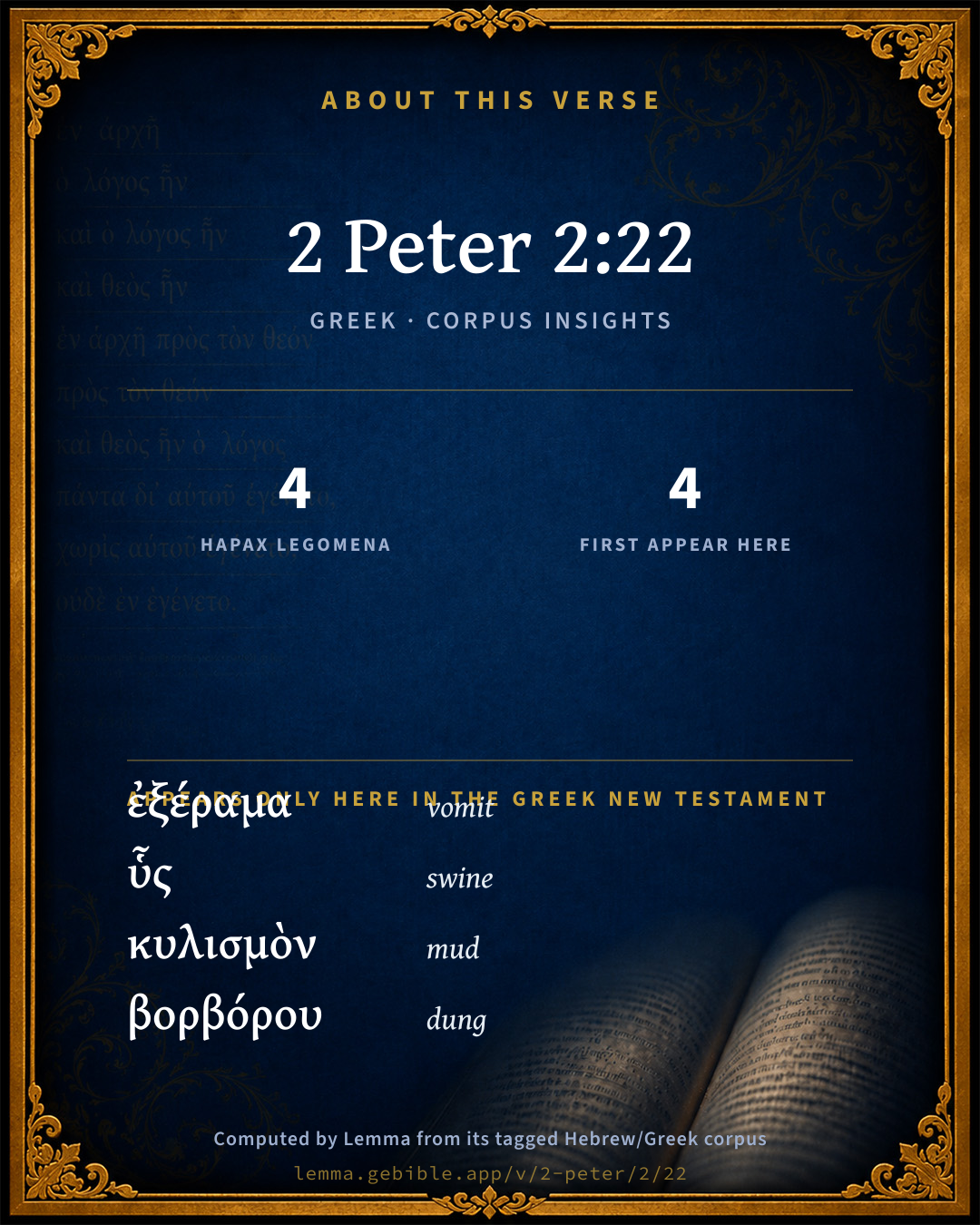
  • 4 hapax legomena — only here in the Greek New Testament
  • 4 first appearances in the Greek New Testament
Full analysis ↓
Download a study sheet

One document with this verse’s original text, its word-by-word gloss line, the meaning frame, cross-references with their text, attributed commentary, and full source and license credits — printable, and it pastes into notes with its structure intact.

This verse Autodidact and up

Study sheet (.html) Plain text (.txt)

A passage Seminary Student

Up to 50 verses in one chapter. A passage sheet keeps up to 6 commentary sources and 12 cross-references per verse, in the order this page ranks them, and says so on the sheet whenever that leaves anything out. Ask for a single verse and you get the Autodidact verse sheet above.

Everything on this page stays free to read, with no account — the sheet is a download of what is already on screen, not access to it.

Want to remove ads? Support Godless Engineer
Compare translations 3

The same verse in 3 English versions, stacked beneath the original-language interlinear above. Click any original word for its lexicon entry.

Each is an independent rendering of the whole verse — the interlinear is not word-aligned to these translations.

Highlighted words mark where these versions differ — a whole-verse word diff, not a word-by-word alignment.

  • World English Bible Public Domain
    But it has happened to them according to the true proverb, "The dog turns to his own vomit again," and "the sow that had washed to wallowing in the mire."
  • King James Version Public Domain
    But it is happened unto them according to the true proverb, The dog is turned to his own vomit again; and the sow that was washed to her wallowing in the mire.
  • unfoldingWord Literal Text CC BY-SA 4.0
    This of the true proverb has happened to them: “A dog returns to its own vomit, and a washed pig to the rolling of mud.”

unfoldingWord Literal Text — © unfoldingWord, licensed CC BY-SA 4.0. Word-aligned USFM3 via Door43 (git.door43.org/unfoldingWord/en_ult).

Versions to compare (up to 4)

3 of 4 selected

Show all 19 translations

Every available English version of this verse, each an independent rendering of the whole verse.

  • World English Bible Public Domain
    But it has happened to them according to the true proverb, "The dog turns to his own vomit again," and "the sow that had washed to wallowing in the mire."
  • Berean Standard Bible Public Domain
    Of them the proverbs are true: “A dog returns to its vomit,” and, “A sow that is washed goes back to her wallowing in the mud.”
  • Majority Standard Bible Public Domain
    Of them the proverbs are true: “A dog returns to its vomit,” and, “A sow that is washed goes back to her wallowing in the mud.”
  • King James Version Public Domain
    But it is happened unto them according to the true proverb, The dog is turned to his own vomit again; and the sow that was washed to her wallowing in the mire.
  • American Standard Version (1901) Public Domain
    It has happened unto them according to the true proverb, The dog turning to his own vomit again, and the sow that had washed to wallowing in the mire.
  • Revised Version (1885) Public Domain
    It has happened unto them according to the true proverb, The dog turning to his own vomit again, and the sow that had washed to wallowing in the mire.
  • Geneva Bible (1599) Public Domain
    But it is come vnto them, according to the true Prouerbe, The dogge is returned to his owne vomit: and, The sowe that was washed, to the wallowing in the myre.
  • Douay-Rheims (1899) Public Domain
    For, that of the true proverb has happened to them: The dog is returned to his vomit: and, The sow that was washed, to her wallowing in the mire.
  • Young's Literal Translation Public Domain
    and happened to them hath that of the true similitude; `A dog did turn back upon his own vomit,' and, `A sow having bathed herself -- to rolling in mire.'
  • Literal Standard Version CC BY-SA 4.0
    and that of the true proverb has happened to them: “A dog turned back on his own vomit,” and, “A sow having bathed herself—to rolling in mire.”
  • Unlocked Literal Bible CC BY-SA 4.0
    This proverb is true for them: “A dog returns to its own vomit, and a washed pig returns to the mud.”
  • unfoldingWord Literal Text CC BY-SA 4.0
    This of the true proverb has happened to them: “A dog returns to its own vomit, and a washed pig to the rolling of mud.”
  • Darby Bible Public Domain
    But that [word] of the true proverb has happened to them: [The] dog [has] turned back to his own vomit; and, [The] washed sow to [her] rolling in mud.
  • World Messianic Bible Public Domain
    But it has happened to them according to the true proverb, “The dog turns to his own vomit again,” and “the sow that has washed to wallowing in the mire.”
  • Webster's Bible Public Domain
    But it hath happened to them according to the true proverb, The dog is turned to his own vomit again; and, The sow that was washed, to her wallowing in the mire.
  • Free Bible Version CC BY-SA 4.0
    This proverb has come true for them: “The dog has returned to its own vomit, and the washed pig has gone back to rolling in the mud.”
  • Bible in Basic English Public Domain
    They are an example of that true saying, The dog has gone back to the food it had put out, and the pig which had been washed to its rolling in the dirty earth.
  • Text-Critical English NT CC BY 4.0
    What the true proverb says has happened to them: “A dog returns to its own vomit,” and, “A sow, after washing herself, returns to wallowing in the mire.”
  • Tyndale New Testament (1534) Public Domain
    It is happened vnto them accordinge to the true proverbe: The dogge is turned to his vomet agayne and the sow that was wesshed to her wallowynge in the myre.

Literal Standard Version (2020), Covenant Press — licensed CC BY-SA 4.0. Text via the HelloAO Bible API (eBible.org). Unlocked Literal Bible (unfoldingWord) — licensed CC BY-SA 4.0. Text via the HelloAO Bible API (eBible.org). unfoldingWord Literal Text — © unfoldingWord, licensed CC BY-SA 4.0. Word-aligned USFM3 via Door43 (git.door43.org/unfoldingWord/en_ult). Free Bible Version, Dr. Jonathan Gallagher — licensed CC BY-SA 4.0. Text via the HelloAO Bible API (eBible.org).

Word by word

More ways to search: Search by grammar → Find every occurrence → Compare this word →

Practice this passage: Drill this verse → Learn its vocabulary →

ἐξέραμα
exérama
G1829
“vomit”
Noun, Accusative, Singular, Neuter
Part of Speech
Noun
Case
Accusative
Number
Singular
Gender
Neuter
Full Thayer's Definition

Origin: from a comparative of G1537 and a presumed erao (to spue)

TDNT: None

1. vomit 2. what is cast out by vomiting
  1. συμβέβηκεν symbaínō G4819 “to happen” Verb, Perfect, Active, Indicative, 3rd person, Singular
  2. αὐτοῖς autós G846 “he” Personal pronoun, Dative, Plural, Masculine
  3. τὸ ho G3588 “the” Article, Nominative, Singular, Neuter
  4. τῆς ho G3588 “the” Article, Genitive, Singular, Feminine
  5. ἀληθοῦς alēthḗs G227 “true” Adjective, Genitive, Singular, Feminine
  6. παροιμίας paroimía G3942 “parable” Noun, Genitive, Singular, Feminine
  7. κύων kýōn G2965 “dog” Noun, Nominative, Singular, Masculine
  8. ἐπιστρέψας epistréphō G1994 “to turn” Verb, Aorist, Active, Participle, Nominative, Singular, Masculine
  9. ἐπὶ epí G1909 “upon” Preposition
  10. τὸ ho G3588 “the” Article, Accusative, Singular, Neuter
  11. ἴδιον ídios G2398 “one's own” Adjective, Accusative, Singular, Neuter
  12. καί kaí G2532 “and” Conjunction
  13. ὗς hŷs G5300 “swine” Noun, Nominative, Singular, Feminine
  14. λουσαμένη loúō G3068 “to bathe” Verb, Aorist, Middle, Participle, Nominative, Singular, Feminine
  15. εἰς eis G1519 “into” Preposition
  16. κυλισμὸν kýlisma G2946 “mud” Noun, Accusative, Singular, Masculine
  17. βορβόρου bórboros G1004 “dung” Noun, Genitive, Singular, Masculine

About this verse

These counts appear in no published source. They are computed here, from the morphology-tagged text and Lemma’s own curated glosses. What Lemma adds →

18
words
16
distinct lemmas
General Epistles
section

Notable vocabulary

4 hapax legomena — words that appear only here in the entire Greek New Testament:

  • ἐξέραμα vomit G1829
  • ὗς swine G5300
  • κυλισμὸν mud G2946
  • βορβόρου dung G1004

First appearance in Scripture

These words make their first canonical appearance in the Greek New Testament here:

  • ἐξέραμα vomit G1829
  • ὗς swine G5300
  • κυλισμὸν mud G2946
  • βορβόρου dung G1004

Shared distinctive vocabulary

παροιμίας parable G3942 occurs in 4 verses of the Greek New Testament. Also found in:

Repetition

A word recurs within this verse:

Cross-references

1

Topical passages linked to 2 Peter 2:22 in the Treasury of Scripture Knowledge — connected by theme and wording, ordered by reader-vote popularity; previews shown in the World English Bible.

  • Proverbs 26:11 As a dog that returns to his vomit, So is a fool who repeats his folly.

Cross-references courtesy of OpenBible.info (CC BY 4.0).

Commentary

Notes on 2 Peter 2:22 from classic Christian and Jewish commentators (each source and its license shown beneath its notes). The classic Christian expositions comment on the surrounding passage and are grouped to its opening verse, so a note may address several verses; the Jewish commentaries on the Tanakh (Rashi and others) are per-verse, so they appear only where the commentator wrote on this verse.

Lemma curates 59 commentaries, every one of them public domain or Creative Commons licensed, each selected and text-cleaned for this edition rather than reprinted as found. About our sources →

Tyndale Open Study Notes

Tyndale Open Resources

2:22 “A dog returns to its vomit”: Dogs were not seen as friendly family pets but as wild and filthy beasts. • “A washed pig returns to the mud”: This proverb might go back to a popular book of sayings called Ahiqar from around 500 BC, which reads, “My son, you have been to me like the pig who went into the hot bath with people of quality, and when it came out of the hot bath, it saw a filthy hole and went down and wallowed in it” (Ahiqar 8:18).

Tyndale Open Study Notes — © Tyndale Open Resources, licensed CC BY-SA 4.0. Text via the HelloAO Bible API.

Bengel's Gnomon

Johann Albrecht Bengel

2Pe 2:22. Δὲ, but) You may wonder that they thus turn back: but there is little room for wonder; for they were before, and they still continue, dogs and swine.—παροιμίας, proverb) משׁלי, Septuagint, παροιμίαι Σολομῶντος, the Proverbs of Solomon, Pro 1:1; also Pro 26:11, ὥσπερ κύων ὅταν ἐπέλθῃ ἐπὶ τὴν ἑαυτοῦ ἔμετον, καὶ μισητὸς γένηται, κ.τ.λ., as a dog, when he returneth to his vomit, and becometh hateful, etc. Peter had frequently quoted the Proverbs of Solomon in his former Epistle, 1Pe 1:7, 1Pe 2:17, 1Pe 4:8; 1Pe 4:18, and now he quotes them also in the other. This may be added to the other arguments, which show that both the Epistles are the production of one and the same writer.—ἐξέραμα, vomit) Animals which live among men more easily contract the stomach [which takes place in the act of vomiting] than those which are wild. It is a word which is rarely met with; and Gataker notices some traces of Iambic verse,—

Κύων ἐτιστρέψας ἐπʼ ἴδιον ἐξέραμʼ,

Ὗς θʼ ἡ λουσαμένη εἰς χύλισμα βορβόρου.

Who would not loathe the vomit of sin?

Bengel's Gnomon of the New Testament — English translation (T&T Clark, Edinburgh, 1860) — public domain. Text from a community e-Sword module.

Meyer's Critical & Exegetical Commentary

Heinrich August Wilhelm Meyer

2Pe_2:22. The two proverbial expressions which form the close bring out how contemptible is the conduct just described.

συμβέβηκε αὐτοῖς] it has happened to them, has befallen them.

τὸ τῆς ἀληθοῦς παροιμίας] The same construction, Mat_21:21 : τὸ τῆς συκῆς; παροιμία denotes a figurative speech or mode of expression generally. ἀληθοῦς is added in order to bring out that the proverb has here too proved true; the author employs the singular παροιμίας, because the two proverbs following have one and the same meaning.

κὑων ἐπιστρέψας … ἐξέραμα] The verse of the O. T. Pro_26:11, LXX., runs: ὥσπερ κύων ὅταν ἐπέλθῃ ἐπὶ τὸν ἑαυτοῦ ἔμετον μισητὸς γενῆται, οὕτως ἄφρων τῇ ἑαυτοῦ κακίᾳ ἀναστρέψας ἐπὶ τὴν ἑαυτοῦ ἁμαρτίαν; in spite of the similarity, it is yet doubtful whether the writer had this passage in his eye; probably he took this παροιμία, like that which follows,which can be traced to no written source,from popular tradition.

ἐπιστρέψας] is not to bo taken as a verb fin., but the predicate is, after the manner of proverbial expression, joined without the copula to the noun (Winer, p. 331 [E. T. 443]): a dog that has returned to its ἐξέραμα (ἅπ. λεγ.: what has been vomited).

ὗς λουσαμένη … βορβόρου] ἐπιστρέψασα may be supplied from what precedes, but thus this second παροιμία would lose its independence; breviloquence is natural to proverbs (Winer, p. 547 [E. T. 735]); εἰς, according to the sense, points sufficiently to a verb of motion to be supplied: a sow that has bathed itself, to the κύλισμα βορβόρου.[83]

κύλισμα (ἅπ. λεγ.), equal to κυλίστρα: the place for wallowing. The genit. βορβὁρου (ἅπ. λεγ.) shows the nature of the κυλίσμα where the swine wallow; the other reading, κυλισμόν, indicates the act of wallowing.

Similar passages are to be found in the Rabbis. Cf. Pott in loc.

[83] Steinfass interprets erroneously: A sow that was bathed, in order the better to wallow in the mire.

Meyer — Critical and Exegetical Commentary on the New Testament — English translation by Peter Christie, edited by Frederick Crombie (T&T Clark, 1880) — public domain. Text from a community e-Sword module.

Expositor's Greek Testament

ed. W. Robertson Nicoll

2Pe 2:22 . τὸ τῆς ἀληθοῦς παροιμίας : “the content of the true proverb” has been “verified,” or “realised” in their case. The first proverb is found in Pro 26:11 . The second is apparently not derived from a Hebrew source. Both are quoted familiarly in an abbreviated form ( cf. WM. p. 443). The interpretation of the second is an exegetical crux. Bigg takes λουσαμένη = “having bathed itself in mud”. The sense is, “not that the creature has washed itself clean in water (so apparently the R.V.), still less that it has been washed clean (as A.V.), and then returns to the mud; but that having once bathed in filth it never ceases to delight in it”. This, however, is to force the meaning of λουσαμένη , which is consistently used of washing with water. Again, the point of the proverb is to illustrate to τὰ ἔσχατα χείρονα τῶν πρώτων . The dupes of the false teachers were cleansed and returned to pollution.

The question is important whether λουσαμένη is Middle or Passive? Dr. Rendel Harris ( Story of Aḥiḳar , p. lxvii.) may have discovered the original proverb in the following, appearing in some texts of Aḥiḳar. “My son, thou hast behaved like the swine which went to the bath with people of quality, and when he came out, saw a stinking drain, and went and rolled himself in it”. If this be the source of the παροιμία . λ . is Middle (Moulton, Proleg. pp. 238 39).

A friend of my own, with a knowledge of animals, tells me that the pig is often washed in certain forms of dishealth, to open the pores of the skin. The animal, being unprotected by hair, finds the sun’s heat disagreeable, and wallows again in the mud for coolness. The dried mud protects the skin from the rays. βόρβορος found only here and in Jer 38:6 . Cf. Acta Thomae, 53. εἶδον βόρβορον … καὶ ψυχὰς ἐκεῖ κυλιομένας . In the Legends of Pelagia , which, though late, are written in good vernacular Greek, both noun and corresponding verb are found. ἐλθοῦσα περιστερὰ μελάνη καὶ βεβορβορωμένη περιεπέτατό μοι , καὶ τὴν δυσωδίαν τοῦ βορβόρου αὐτῆς οὐκ ἠδυνάμην φέρειν . ( Die Pelag. Legend. , ed. Usener, p. 21). Bishop Wordsworth suggested that the double proverb is an inexact quotation of two iambic lines

εἰς ἴδιον ἐξέραμʼ ἐπιστρέψας κύων

λελουμένη θʼ ὗς εἰς κύλισμα βορβόρου .

If he is right, 2 Pet. cannot be charged with the use of the two rare words, βορβόρου and ἐξέραμα . Bigg suggests (ed., p. 228) that the Proverbs of Solomon had been unified by some Jewish paraphrast, and this one of the pig added to the canonical collection.

The Expositor's Greek Testament, edited by W. Robertson Nicoll (1897–1910) — public domain. Text from a community e-Sword module.

Jamieson, Fausset & Brown

Robert Jamieson, A. R. Fausset & David Brown

But--You need not wonder at the event; for dogs and swine they were before, and dogs and swine they will continue. They "scarcely" (Pe2 2:18) have escaped from their filthy folly, when they again are entangled in it. Then they seduce others who have in like manner "for a little time escaped from them that live in error" (Pe2 2:18). Peter often quoted Proverbs in his First Epistle (Pe1 1:7; Pe1 2:17; Pe1 4:8, Pe1 4:18); another proof that both Epistles come from the same writer.

Next: 2 Peter Chapter 3

Jamieson, Fausset & Brown — Commentary Critical and Explanatory on the Whole Bible (1871) — public domain (CC PDM 1.0). Text via the HelloAO Bible API.

Adam Clarke's Commentary

Verse 22. According to the true proverb] This seems to be a reference to Pr 26:11: קאו אל שב ככלב kekeleb shab al keo; as the dog returneth to his vomit, so a fool repeateth his folly. In substance this proverb is found among the rabbins; so Midrash Ruth, in Sohar Chadash, fol. 62: Orphah is returned to her mire, Ruth persevered in spirit; and again, Ibid. fol. 64: "Orphah, which is הבהמית נפש nephesh habbehemith, the bestial soul, is returned to her mire."

The Greeks have something like it; so Arrian, Dissert. Epict. l. iv. c. 11, says: Απελθε και χοιρῳ διαλεγου, ἱν 'εν βορβορῳ μη κυλιηται, "Go and reason with the swine, lest he be rolled in the mire." This is called a true proverb: for it is a fact that a dog will eat up his own vomit; and the swine, howsoever carefully washed, will again wallow in the mire. As applied here it is very expressive: the poor sinner, having heard the Gospel of Christ, was led to loathe and reject his sin; and, on his application to God for mercy, was washed from his unrighteousness. But he is here represented as taking up again what he had before rejected, and defiling himself in that from which he had been cleansed.

Here is a sad proof of the possibility of falling from grace, and from very high degrees of it too. These had escaped from the contagion that was in the world; they had had true repentance, and cast up "their soursweet morsel of sin;" they had been washed from all their filthiness, and this must have been through the blood of the Lamb; yet, after all, they went back, got entangled with their old sins, swallowed down their formerly rejected lusts, and rewallowed in the mire of corruption. It is no wonder that God should say, the latter end is worse with them than the beginning: reason and nature say it must be so; and Divine justice says it ought to be so; and the person himself must confess that it is right that it should be so. But how dreadful is this state! How dangerous when the person has abandoned himself to his old sins! Yet it is not said that it is impossible for him to return to his Maker; though his case be deplorable, it is not utterly hopeless; the leper may yet be made clean, and the dead may be raised. Reader, is thy backsliding a grief and burden to thee? Then thou art not far from the kingdom of God; believe on the Lord Jesus, and thou shalt be saved.

Adam Clarke's Commentary on the Bible (1810–1826) — public domain. Text from a community e-Sword/MySword module.

John Calvin's Commentaries

22. But it has happened unto them. As the example disturbs many, when men who had submitted to the obedience of Christ, rush headlong into vices without fear or shame, the Apostle, in order to remove the offense, says that this happens through their own fault, and that because they are pigs and dogs. It hence follows that no part of the sin can be ascribed to the gospel.

For this purpose he quotes two ancient proverbs, the first of which is found as the saying of Solomon in Proverbs 26:11. But what Peter meant is briefly this, that the gospel is a medicine which purges us by wholesome vomiting, but that there are many dogs who swallow again what they have vomited to their own ruin; and that the gospel is also a laver which cleanses all our uncleanness, but that there are many swine who, immediately after washing, roll themselves again in the mud. At the same time the godly are reminded to take heed to themselves, except they wish to be deemed dogs or swine.

John Calvin's Commentaries (1540-1563) — public domain. Text from the Calvin Translation Society English edition (1840s-50s) via the Christian Classics Ethereal Library (ccel.org). Calvin's coverage is partial (roughly two-thirds of the Bible); uncommented books and verses are honest gaps, never fabricated. The 19th-century editor's footnotes and remarks are omitted so the notes are faithfully Calvin's own voice.

Ellicott's Commentary for English Readers

(22) But it is happened unto them according to the true proverb.—More literally, There has happened to them what the true proverb says; “but” is of very doubtful authority. The word for “proverb” is the one used elsewhere only by St. John in his Gospel, and there translated once “parable” and thrice “proverb.” “Parable,” or “allegory,” would have been best in all four cases (Joh_10:6, where see Note; Joh_16:25; Joh_16:29). The first proverb is found, Pro_26:11, and if that be the source of the quotation, we have here an independent translation of the Hebrew, for the LXX. gives an entirely different rendering, “dog” being the only word in common to the two Greek versions. The word for “vomit” here is possibly formed by the writer himself; that for “wallowing” is also a rare word. The LXX. adds, “and becomes abominable,” which has no equivalent in the existing Hebrew text; and it has been suggested that these words may misrepresent the Hebrew original of the second proverb here. But it is quite possible that both proverbs come from popular tradition, and not from Scripture at all. If, however, the Book of Proverbs be the source of the quotation, it is worth while noting that no less than four times in as many chapters does St. Peter recall passages from the Proverbs in the First Epistle (1Pe_1:7; 1Pe_2:17; 1Pe_4:8; 1Pe_4:18). In the Greek neither proverb has a verb, as so often in such sayings—a dog that has returned to his own vomit; a washed sow to wallowing in the mire; just as we say “the dog in the manger,” “a fool and his money.”

The word for “mire,” not a very common one, is used by Irenæus of the Gnostic false teachers of his day, who taught that their fine spiritual natures could no more be hurt by sensuality than gold by mire. “For in the same way as gold when plunged in mire does not lay aside its beauty, but preserves its own nature, the mire having no power to injure the gold, so they say that they, no matter what kind of material actions they may be involved in, cannot suffer any harm, nor lose their spiritual essence.” (chap. vi. 2). But it is not probable that Irenæus knew our Epistle.

A Bible Commentary for English Readers, edited by Charles John Ellicott (1878–1897) — public domain. Text from a community e-Sword module.

The Cambridge Bible for Schools and Colleges

gen. ed. J. J. S. Perowne

22. it is happened unto them according to the true proverb …] Literally, that (saying) of the true proverb has happened to them … In the words that follow we have another of St Peter’s references, without a formal citation, to the Book of Proverbs (Pro_26:11). See notes on 1Pe_4:8; 1Pe_5:5. The form in which he gives the proverbs is participial. “The dog returned to his own vomit; the washed sow to her wallowing in the mire.” We have, however, the colloquial, allusive form which the proverb had assumed in common speech rather than an actual quotation, and the second part of the proverb is not found in the passage referred to. In both cases stress is laid on the fact that there had been a real change. The dog had ejected what was foul; the sow had washed herself, but the old nature returned in both cases. Those who after their baptism returned to the impurities they had renounced, were, in the Apostle’s eyes, no better than the unclean beasts. In the union of the two types of baseness we may, perhaps, trace a reminiscence of our Lord’s teaching in Mat_7:6.

The Cambridge Bible for Schools and Colleges (gen. ed. J. J. S. Perowne; Cambridge University Press, 1878–1918) — public domain. Text from a community e-Sword module.

John Gill's Exposition

But it is happened unto them, according to the true proverb,.... Which is true, both in fact and in the application of it, and which lies in the Scriptures of truth, at least the first part of it, Pro 26:11.

The dog is turned to his own vomit again, and the sow that was washed to her wallowing in the mire; which expresses the filthy nature of sin, signified by vomit, mire, and dirt, than which nothing is more abominable and defiling; and also the just characters of these apostates, who are filly compared to dogs and swine and likewise their irreclaimable and irrecoverable state and condition, it being impossible they should be otherwise, unless their natures were changed and altered. In the Hebrew language, a "sow" is called from the root which signifies to "return", because that creature, as soon as it is out of the mire and dirt, and is washed from its filthiness, naturally returns to it again: so such apostates return to what they were before, to their former principles and practices: in this manner the Jews explain the proverb,

"Tobiah returns to Tobiah, as it is said, Pro 26:11; as a dog returneth to his vomit (r).''

(r) Vajikra Rabba, sect. 16. fol. 158. 4.

Next: 2 Peter Chapter 3

John Gill's Exposition of the Whole Bible (1746–1763) — public domain (CC PDM 1.0). Text via the HelloAO Bible API.

Trapp's Complete Commentary

John Trapp

22 But it is happened unto them according to the true proverb, The dog is turned to his own vomit again; and the sow that was washed to her wallowing in the mire.

Ver. 22. The dog is turned] Proverbia haec sunt Canonica, quae Christiano nauseam commoverent. God will spew out apostates for ever, teaching them how they should have spewed out their sin.

John Trapp, A Commentary or Exposition upon All the Books of the Old and New Testament (1647–1656) — public domain. Text from a community e-Sword module.

Albert Barnes' Notes on the Bible

But it is happened unto them according to the true proverb - The meaning of the proverbs here quoted is, that they have returned to their former vile manner of life. Under all the appearances of reformation, still their evil nature remained, as really as that of the dog or the swine, and that nature finally prevailed. There was no thorough internal change, any more than there is in the swine when it is washed, or in the dog. This passage, therefore, would seem to demonstrate that there never had been any real change of heart, and of course there had been no falling away from true religion. It should not, therefore, he quoted to prove that true Chrisfinns may fall from grace and perish. The dog and the swine had never been anything else than the dog and the swine, and these persons had never been anything else than sinners.

The dog is turned to his own vomit again - That is, to eat it up. The passage would seem to imply, that whatever pains should be taken to change the habits of the dog, he would return to them again. The quotation here is from Pro 26:11; “As a dog returneth to his vomit, so a feel returneth to his folly.” A similar proverb is found in the Rabbinical writers. Of the truth of the disgusting fact here affirmed of the dog, there can be no doubt. Phaedrus (Fab. 27.) states a fact still more offensive respecting its habits. In the view of the Orientals, the dog was reckoned among the most vile and disgusting of all animals. Compare Deu 23:18; 1Sa 17:43; 2Sa 3:8; 2Sa 9:8; 2Sa 16:9; Mat 7:6; Phi 3:2. See also Horace, II. Epis. 1, 26:

Vixisset canis immundus, vel amica luto sus.

On the use of this proverb, see Wetstein, in loc.

And the sow that was washed ... - This proverb is not found in the Old Testament, but it was common in the Rabbinical writings, and is found in the Greek classics. See Wetstein, in loc. Its meaning is plain, and of the truth of what is affirmed no one can have any doubt. No matter how clean the swine is made by washing, this would not prevent it, in the slightest degree, from rolling in filth again. It will act out its real nature. So it is with the sinner. No external reformation will certainly prevent his returning to his former habits; and when he does return, we can only say that he is acting according to his real nature - a nature which has never been changed, any more than the nature of the dog or the swine. On the characteristics of the persons referred to in this chapter, 2Pe 2:9-19, see the introduction, Section 3.

This passage is often quoted to prove “the possibility of falling from grace, and from a very high degree of it too.” But it is one of the last passages in the Bible that should be adduced to prove that doctrine. The true point of this passage is to show that the persons referred to never “were changed;” that whatever external reformation might have occurred, their nature remained the same; and that when they apostatized from their outward profession, they merely acted out their nature, and showed that in fact there had been “no” real change. This passage will prove - what there are abundant facts to confirm - that persons may reform externally, and then return again to their former corrupt habits; it can never be made to prove that one true Christian will fall away and perish. It will also prove that we should rely on no mere external reformation, no outward cleansing, as certain evidence of piety. Thousands who have been externally reformed have ultimately shown that they. had no religion, and there is nothing in mere outward reformation that can suit us for heaven. God looks upon the heart; and it is only the religion that has its seat there, that can secure our final salvation.

Albert Barnes' Notes on the Bible (1834–1885) — public domain. Text from a community e-Sword/MySword module.

Matthew Poole's English Annotations

But it is happened unto them according to the true proverb: this is added, to prevent the scandal that might arise from their apostacy; q.d. It is not to be wondered at that they are again entangled in and overcome by their former pollutions, when there never was a thorough change wrought in their hearts. Dogs and swine (beasts unclean by the law) they still were, under the greatest appearances of reformation, and such they now show themselves to be by their vile apostacy.

The dog is turned to his own vomit again: as dogs vomit up what is burdensome to them, but, still being dogs, and not having changed their natures by easing their stomachs, lick up their own vomit again; so these, under a fit of conviction, through the power of the word, disgorge those sins which burdened their consciences, but having thereby gotten some ease, and their old nature and love to their former lusts still remaining, they again return to the same sins they had for a time forsaken.

The sow that was washed to her wallowing in the mire: as swine, that naturally love the dirt and mire, if sometimes they be washed from it, yet, still retaining their former disposition, return again to it; so likewise these here mentioned, however they may be washed from the pollutions of the world, and by the preaching of the gospel brought off from their former ways of sin, and brought into a profession of holiness, yet, still retaining their old nature and corrupt dispositions, they are easily prevailed over by them, and so relapse into their former abominations.

Matthew Poole's English Annotations on the Holy Bible (1683–1685) — public domain. Text from a community e-Sword/MySword module.

Whedon's Commentary on the Bible

Daniel D. Whedon

22. Proverb—These fitting illustrations (Pro_26:11) of the brutish sensuality and disgusting moral filthiness into which these apostates had sunk, close the horrible description. Both were probably current sayings.

Daniel D. Whedon (gen. ed.), Commentary on the Old and New Testaments (1874–1909) — public domain. Text from a community e-Sword module.

The Pulpit Commentary

But it is happened unto them according to the true proverb. The conjunction "but" is omitted in the best manuscripts. The literal translation is, "There hath happened unto them that of the true proverb (toav); comp. Mat_21:21, to thv sukhv. The dog is turned to his own vomit again. The construction is participial; literally, a dog having turned. See Wirier (3:45, 6, b), who says that in such proverbial expressions there is no reason for changing the participle into a finite verb: "They are spoken deiktikwv as it were, with reference to a case actually observed." St. Peter may be quoting Pro_26:11; but his words are very different from the Septuagint Version of that passage; perhaps it is more probable that the expression had become proverbial, and that the apostle is referring to a form of it in common use with his readers; like that which follows, which is not in the Book of Proverbs. And the sow that was washed to her wallowing in the mire; literally, the sow that had washed to her wallowing; or, according to some ancient manuscripts, "her wallowing-place." St. Peter compares the lives of the false teachers to the habits of those animals which were regarded as unclean, and were most despised by the Jews (compare our Lord"s words in. (Mat_7:6) The words ejxerama, vomit; kulismov, wallowing; and borborov, mire, are not found elsewhere in the New Testament.

The Pulpit Commentary (1880–1919), ed. H.D.M. Spence-Jones & Joseph S. Exell — public domain. Text from a community e-Sword module.

John Wesley's Explanatory Notes

The dog, the sow - Such are all men in the sight of God before they receive his grace, and after they have made shipwreck of the faith. Prov. xxvi, 11.

John Wesley, Explanatory Notes Upon the Whole Bible (1754–1765) — public domain. Text via the GEBible commentary corpus.

Burkitt's Expository Notes on the New Testament

William Burkitt

Observe here, The odious character given of apostates; the apostle compares them to dogs and swine, who, though washed in the water of baptism externally, yet their natures were never internally renewed by the Holy Ghost, as Christ’s sheep are. All the outward reformation of life which is found in unrenewed persons, is but like the washing of a swine, which you may make clean, but can never make cleanly; upon occasion it will again to the mire; make the swine a sheep, change its nature, and it will never delight in filth more; but whilst it retains its filthy nature, it will delight in filthiness. Dogs that have disgorged their stomachs are dogs still; and swine washed are swine still. No wonder then if temptation draw them to return to their vomit, and mire again.

O our God! as thou hast outwardly washed us in baptism, do thou inwardly renew us, and thoroughly sanctify us by thy Holy Spirit: as we are the workmanship of thine hands, make us also the sheep of thy pasture, that our love to purity may daily more and more increase: That when apostatizing sinners return to their vomit with the dog, and to the mire with the swine, and so draw back unto perdition, we may be of the number of those that persevere to the salvation of ours souls. Amen.

William Burkitt's Expository Notes on the New Testament (1700–1703) — public domain. Text from a community e-Sword module.

The People's New Testament

B. W. Johnson

22. For it is happened. Their relapse is described in the proverbs. See Prov. 1:1; 26:11. Such a repulsive course can be compared only with the most disgusting habits of unclean animals.

B. W. Johnson's The People's New Testament with Notes (1889–1891) — public domain. Electronic text from the Christian Classics Ethereal Library (CCEL) ThML edition.

Cambridge Greek Testament for Schools and Colleges

22. τὸ τῆς ἀληθοῦς παροιμίας: a usual phrase for introducing a proverb, as Lucian, Dialogues of the Dead, viii. 1, τοῦτʼ ἐκεῖνο τὸ τῆς παροιμίας.

Κύων etc. The equivalent is in Pro 26:11, the LXX. has ἔμετον for ἐξέραμα which is a very unusual word.

Ὗς λουσαμένη “after a wash.” In the ancient History of Ahikar (ed. Rendel Harris 1898) which the writer may well have known, there is a proverb of the pig that went to the bath, and on coming out saw some mud and rolled in it.

There may be a second thought in the writer’s mind of the latter end of these men in the βόρβορος of Hell: which figures in the Apocalypse of Peter, as it did also in the Orphic mysteries.

Cambridge Greek Testament for Schools and Colleges (Cambridge University Press, 1896; 21 vols, various authors incl. Carr, Maclear, Plummer, Farrar, Lumby, Moule, M. R. James, Simcox) — public domain. Text from a community e-Sword module.

Alford’s Greek Testament

Henry Alford

22.] Further description of their state by two proverbial expressions. There hath happened to them that of the true proverb (for construction, see reff.: and Lucian, dial. mort. viii. 1, τοῦτο ἐκεῖνο τὸ τῆς παροιμίας, ὁ νεβρὸς τὸν λέοντα), The dog gone back (i. e. “which has gone back:” ἐπιστρέψας is not a finite verb, but simply a predicate of κύων) to his own vomit (in ref. Prov. we have ὥσπερ κύων ὅταν ἐπέλθῃ ἐπὶ τὸν ἑαυτοῦ ἔμετον καὶ μισητὸς γένηται, οὕτως ἄφρων τῇ ἑαυτοῦ κακίᾳ ἀναστρέψας ἐπὶ τὴν ἑαυτοῦ ἁμαρτίαν. It may seem however somewhat doubtful, whether the proverbs, as here cited, be meant to be taken from Scripture, or rather not both of them from the popular parlance, as here expressed.

ἐξέραμα seems hardly to be found elsewhere than here (Schleusner cites Dioscorides vi. 19: adding “et alii,” but qu.?): the verb ἐξεράω occurs in ref., and Aristoph, Vesp. 993, Hippocrates, al. See Lobeck on Phryn. p. 64: and Schleusner in voce): and, The sow after washing (the middle sense must not be pressed: it is the word commonly used of men, transferred to an animal) to (ἐπιστρέψασα is generally understood before εἰς. But it seems better, with Huther, to understand the proverb as self-contained, and elliptical, as in “Sweets to the sweet”: so, “The washed sow to the mire”) wallowing in the mire (if we read κύλισμα, we must render “the place of wallowing.” In either case, the gen. βορβόρου imports that which characterizes the wallowing, and is a possessive gen. It is of, belongs to, mire).

Henry Alford, The Greek Testament (1849–1861) — public domain. Text from a community e-Sword module.

Vincent's Word Studies in the New Testament

Marvin R. Vincent

According to the true proverb [το της αληθους παριοιμιας] . Lit., that of the true proverb, or the matter of the proverb. For a similar construction see Mt 21:21, that of the fig - tree; Mt 8:33, the things of those possessed. On proverb, see notes on Mt 13:3. Vomit [εξεραμα] . Only here in New Testament.

Wallowing [κυλισμον] . Only here in New Testament.

Mire [βορβορου] . Only here in New Testament. This use of dogs and swine together recalls Mt 7:6.

Marvin R. Vincent, Word Studies in the New Testament (1887–1900) — public domain. Text from a community e-Sword/MySword module.

Lesson kit

Teaching starters — assembled from the data on this page, not authored interpretation. Every prompt links to the verse data it draws on. Edit before teaching.

2 Peter, in the General Epistles, opens this verse with 18 words (16 distinct Greek lemmas). Its most distinctive word is exérama (“vomit”). A historical commentator’s framing appears above. Read the whole chapter for the surrounding context.

Discussion questions

  1. What does “vomit” (exérama) contribute to the verse as a whole?
  2. This verse holds 4 words here found nowhere else in the Greek New Testament. What might the rare words draw attention to?
  3. 4 words here appear for the first time in Scripture. What is being introduced at this debut?
  4. John 10:6 shares the word «parable» with this verse. How do the two illuminate each other?
  5. “the” occurs 3× in this one verse. What is the effect of the repetition?
  6. The translations on this page render this verse differently — a whole-verse word diff, not a word-by-word alignment. What might account for the different wordings?
  7. Reading how Tyndale Open Study Notes and Bengel's Gnomon read this verse, where do the two commentators agree and where do they part?

Things to notice

  • 4 words in this verse appear nowhere else in the Greek New Testament.
  • 4 words make their first canonical appearance in Scripture here.
  • These translations choose different wording for 13 words in this verse.
  • “the” occurs 3× in this single verse.
  • 16 distinct Greek lemmas span 18 words in this verse.

Reading settings

Reading text

Shown beneath each verse's original-language words.

Old Testament
Old Testament edition

Read the OT as the Masoretic Hebrew (MT) or the Greek Septuagint (LXX).

English shown for the Greek Septuagint (in the Hebrew ↔ Greek comparison).

Comparing translations? Open the Compare panel on any verse page to stack up to four side by side.