Job 24:12

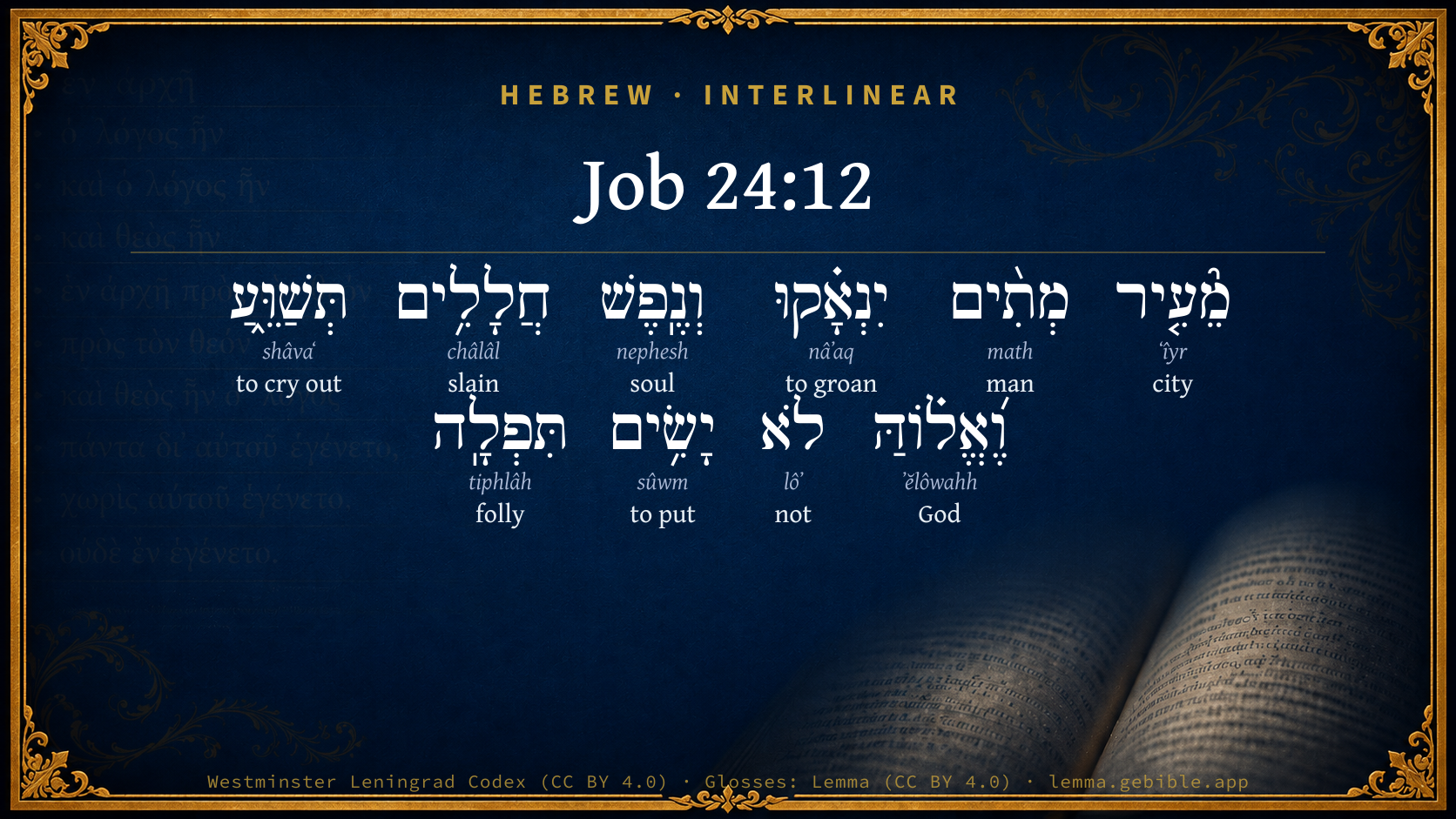
Hebrew (Westminster Leningrad Codex) Job 24:12 appears in the Hebrew Old Testament. The text above is from the Westminster Leningrad Codex. Each word links to its Strong’s number, a concise gloss, and parsing drawn from the Open Scriptures Hebrew Bible morphology. Click any word for its full Brown-Driver-Briggs (BDB) entry.
Download image
Cite this verse

Job 24:12 (World English Bible). Public Domain. Lemma interlinear Bible study tool, https://lemma.gebible.app/v/job/24/12.

Show BibTeX & RIS
BibTeX
RIS
English Translation
From out of the populous city, men groan. The soul of the wounded cries out, Yet God doesn't regard the folly.
World English Bible · Public Domain
Highlights
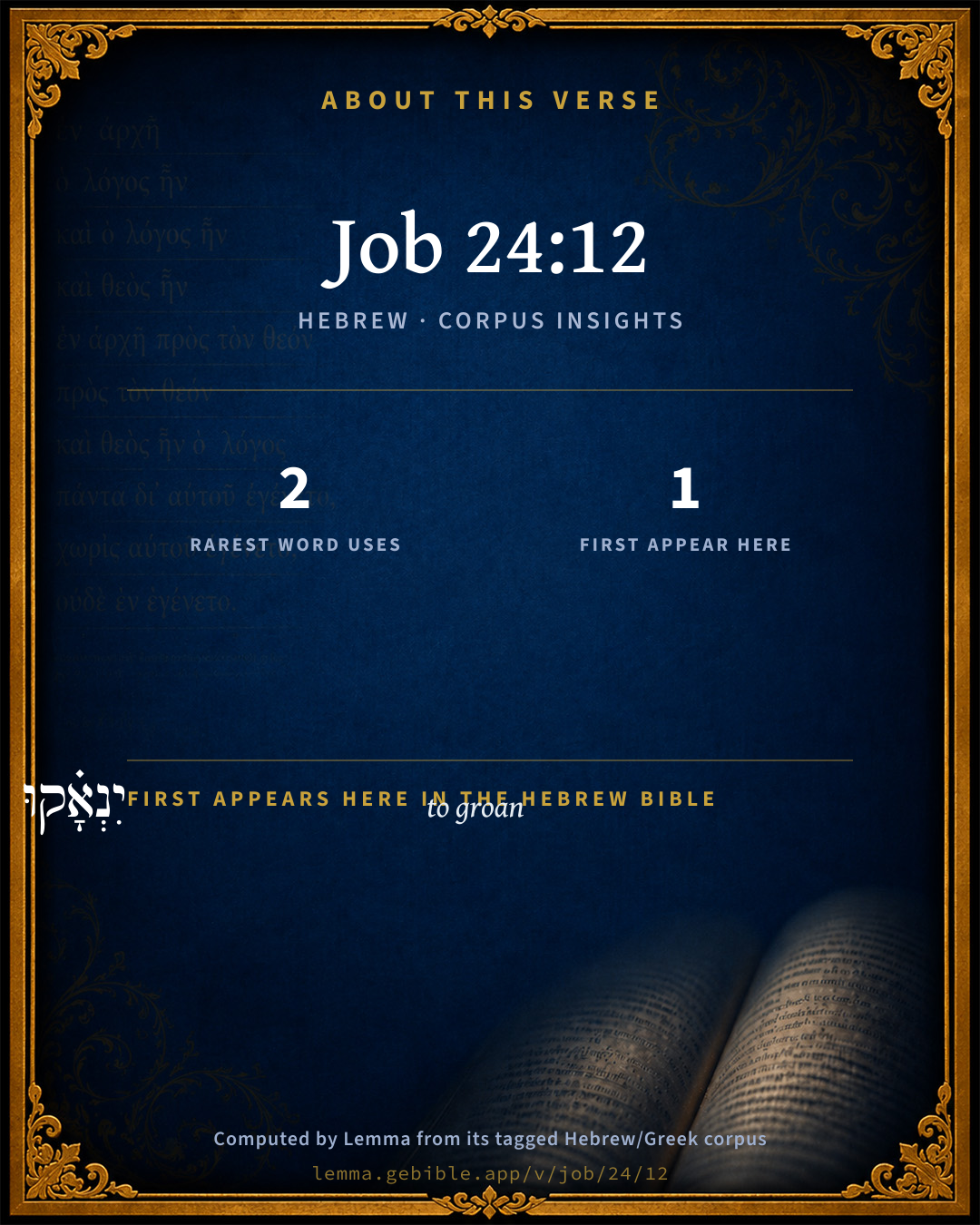
  • 1 first appearance in the Hebrew Bible
Full analysis ↓
Download a study sheet

One document with this verse’s original text, its word-by-word gloss line, the meaning frame, cross-references with their text, attributed commentary, and full source and license credits — printable, and it pastes into notes with its structure intact.

This verse Autodidact and up

Study sheet (.html) Plain text (.txt)

A passage Seminary Student

Up to 50 verses in one chapter. A passage sheet keeps up to 6 commentary sources and 12 cross-references per verse, in the order this page ranks them, and says so on the sheet whenever that leaves anything out. Ask for a single verse and you get the Autodidact verse sheet above.

Everything on this page stays free to read, with no account — the sheet is a download of what is already on screen, not access to it.

Want to remove ads? Support Godless Engineer
Compare translations 3

The same verse in 3 English versions, stacked beneath the original-language interlinear above. Click any original word for its lexicon entry.

Each is an independent rendering of the whole verse — the interlinear is not word-aligned to these translations.

Highlighted words mark where these versions differ — a whole-verse word diff, not a word-by-word alignment.

  • World English Bible Public Domain
    From out of the populous city, men groan. The soul of the wounded cries out, Yet God doesn't regard the folly.
  • King James Version Public Domain
    Men groan from out of the city, and the soul of the wounded crieth out: yet God layeth not folly to them.
  • unfoldingWord Literal Text CC BY-SA 4.0
    From the city, men groan and the soul of the wounded cries out, but God does not ascribe impropriety.

unfoldingWord Literal Text — © unfoldingWord, licensed CC BY-SA 4.0. Word-aligned USFM3 via Door43 (git.door43.org/unfoldingWord/en_ult).

Versions to compare (up to 4)

3 of 4 selected

Show all 18 translations

Every available English version of this verse, each an independent rendering of the whole verse.

  • World English Bible Public Domain
    From out of the populous city, men groan. The soul of the wounded cries out, Yet God doesn't regard the folly.
  • Berean Standard Bible Public Domain
    From the city, men groan, and the souls of the wounded cry out, yet God charges no one with wrongdoing.
  • Majority Standard Bible Public Domain
    From the city, men groan, and the souls of the wounded cry out, yet God charges no one with wrongdoing.
  • King James Version Public Domain
    Men groan from out of the city, and the soul of the wounded crieth out: yet God layeth not folly to them.
  • American Standard Version (1901) Public Domain
    From out of the populous city men groan, And the soul of the wounded crieth out: Yet God regardeth not the folly.
  • Revised Version (1885) Public Domain
    From out of the populous city men groan, and the soul of the wounded crieth out: yet God imputeth it not for folly.
  • Geneva Bible (1599) Public Domain
    Men cry out of the citie, and the soules of the slayne cry out: yet God doth not charge them with follie.
  • Douay-Rheims (1899) Public Domain
    Out of the cities they have made men to groan, and the soul of the wounded hath cried out, and God doth not suffer it to pass unrevenged.
  • Young's Literal Translation Public Domain
    Because of enmity men do groan, And the soul of pierced ones doth cry, And God doth not give praise.
  • Literal Standard Version CC BY-SA 4.0
    Men groan because of enmity, || And the soul of pierced ones cries, || And God does not give praise.
  • Unlocked Literal Bible CC BY-SA 4.0
    From out of the city the dying groan, and the throat of the wounded cries out for help. But God does not ascribe blame
  • unfoldingWord Literal Text CC BY-SA 4.0
    From the city, men groan and the soul of the wounded cries out, but God does not ascribe impropriety.
  • Darby Bible Public Domain
    Men groan from out of the city, and the soul of the wounded crieth out; and +God imputeth not the impiety.
  • World Messianic Bible Public Domain
    From out of the populous city, men groan. The soul of the wounded cries out, yet God doesn’t regard the folly.
  • Webster's Bible Public Domain
    Men groan from out of the city, and the soul of the wounded crieth out: yet God layeth not folly to them.
  • Free Bible Version CC BY-SA 4.0
    In the city the dying groan, and the wounded cry for help, but God ignores their prayers.
  • Bible in Basic English Public Domain
    From the town come sounds of pain from those who are near death, and the soul of the wounded is crying out for help; but God does not take note of their prayer.
  • JPS Tanakh (1917) Public Domain
    From out of the populous city men groan, and the soul of the wounded crieth out; yet God imputeth it not for unseemliness.

Literal Standard Version (2020), Covenant Press — licensed CC BY-SA 4.0. Text via the HelloAO Bible API (eBible.org). Unlocked Literal Bible (unfoldingWord) — licensed CC BY-SA 4.0. Text via the HelloAO Bible API (eBible.org). unfoldingWord Literal Text — © unfoldingWord, licensed CC BY-SA 4.0. Word-aligned USFM3 via Door43 (git.door43.org/unfoldingWord/en_ult). Free Bible Version, Dr. Jonathan Gallagher — licensed CC BY-SA 4.0. Text via the HelloAO Bible API (eBible.org).

Word by word

More ways to search: Search by grammar → Find every occurrence → Compare this word →

Practice this passage: Drill this verse → Learn its vocabulary →

About this verse

These counts appear in no published source. They are computed here, from the morphology-tagged text and Lemma’s own curated glosses. What Lemma adds →

10
words
10
distinct lemmas
Wisdom
section

Notable vocabulary

The rarest word here is יִנְאָ֗קוּ to groan H5008 — appearing just 2 times in the whole Hebrew Bible.

First appearance in Scripture

This word makes its first canonical appearance in the Hebrew Bible here:

  • יִנְאָ֗קוּ to groan H5008

Shared distinctive vocabulary

יִנְאָ֗קוּ to groan H5008 occurs in 2 verses of the Hebrew Bible. Also found in:

Grammatical profile

  • 3 verbs
  • 5 nouns
  • 1 adjective
  • 1 particle

Verb forms

  • יִנְאָ֗קוּ Qal · Imperfect
  • תְּשַׁוֵּ֑עַ Piel · Imperfect
  • יָשִׂ֥ים Qal · Imperfect

Hebrew & Septuagint length

In English translation the verse runs 21 words from the Hebrew and 22 from the Septuagint (LXX English) — closely comparable.

A rough comparison of the two English renderings, which tokenize alike — not a word-level alignment.

Word counts can differ between the Hebrew and the Greek without any difference in meaning — e.g. the Hebrew direct-object marker אֵת has no separate Greek word, and Greek often adds the article ὁ.

Cross-references

16

Topical passages linked to Job 24:12 in the Treasury of Scripture Knowledge — connected by theme and wording, ordered by reader-vote popularity; previews shown in the World English Bible.

  • Ecclesiastes 4:1 Then I returned and saw all the oppressions that are done under the sun: and, behold, the tears of those who were oppressed, and they had no comforter; and on the side of their oppressors there was power; but they had no comforter.
  • Psalms 50:21 You have done these things, and I kept silent. You thought that the "I AM" was just like you. I will rebuke you, and accuse you in front of your eyes.
  • Ecclesiastes 8:11–12 Because sentence against an evil work is not executed speedily, therefore the heart of the sons of men is fully set in them to do evil.
  • Malachi 2:17 You have wearied Yahweh with your words. Yet you say, 'How have we wearied him?' In that you say, 'Everyone who does evil is good in the sight of Yahweh, and he delights in them;' or 'Where is the God of justice?'
  • Malachi 3:15 Now we call the proud happy; yes, those who work wickedness are built up; yes, they tempt God, and escape.'
  • Romans 2:4–5 Or do you despise the riches of his goodness, forbearance, and patience, not knowing that the goodness of God leads you to repentance?
  • Exodus 1:13–14 The Egyptians ruthlessly made the children of Israel serve,
  • Exodus 2:23–24 It happened in the course of those many days, that the king of Egypt died, and the children of Israel sighed because of the bondage, and they cried, and their cry came up to God because of the bondage.
  • Exodus 22:27 for that is his only covering, it is his garment for his skin. What would he sleep in? It will happen, when he cries to me, that I will hear, for I am gracious.
  • Judges 10:16 They put away the foreign gods from among them, and served Yahweh; and his soul was grieved for the misery of Israel.
  • Job 9:23 If the scourge kills suddenly, He will mock at the trial of the innocent.
  • Psalms 12:5 "Because of the oppression of the weak and because of the groaning of the needy, I will now arise," says Yahweh; "I will set him in safety from those who malign him."
  • Psalms 69:26 For they persecute him whom you have wounded. They tell of the sorrow of those whom you have hurt.
  • Psalms 109:22 For I am poor and needy. My heart is wounded within me.
  • Isaiah 52:5 Now therefore, what do I here, says Yahweh, seeing that my people is taken away for nothing? those who rule over them do howl, says Yahweh, and my name continually all the day is blasphemed.
  • 2 Peter 3:15 Regard the patience of our Lord as salvation; even as our beloved brother Paul also, according to the wisdom given to him, wrote to you;

Cross-references courtesy of OpenBible.info (CC BY 4.0).

Hebrew and Greek witnesses Masoretic Hebrew ↔ Greek Septuagint

The same verse in the two great witnesses to the Old Testament, shown verse-for-verse.

These are two independent witnesses, not word-aligned to each other, and the Septuagint is shown in lemma (dictionary) form.

Hebrew Job 24:12 Masoretic · Westminster Leningrad Codex

מֵ֘עִ֤יר מְתִ֨ים יִנְאָ֗קוּ וְנֶֽפֶשׁ חֲלָלִ֥ים תְּשַׁוֵּ֑עַ וֶ֝אֱל֗וֹהַּ לֹא יָשִׂ֥ים תִּפְלָֽה

From out of the populous city, men groan. The soul of the wounded cries out, Yet God doesn't regard the folly.

World English Bible · Public Domain

Greek LXX Job 24:12 Septuagint · lemma form

ὅς ἐκ πόλις καί οἶκος ἴδιος ἐκβάλλω ψυχή δέ νήπιος στενάζω μέγας αὐτός δέ διά τίς οὗτος ἐπισκοπή οὐ ποιέω

Who have cast forth the poor from the city and their own houses, and the soul of the children has groaned aloud.

LXX2012 (modern English Septuagint) · Public Domain

On this verse, Haydock's Catholic Bible Commentary discusses the Septuagint’s reading. Read the note in Commentary ↓

Hebrew: Westminster Leningrad Codex (CC BY 4.0). Greek: Septuagint (public domain); English from LXX2012 (modern English Septuagint) (Public Domain). How the Septuagint differs from the Hebrew →

Commentary

Notes on Job 24:12 from classic Christian and Jewish commentators (each source and its license shown beneath its notes). The classic Christian expositions comment on the surrounding passage and are grouped to its opening verse, so a note may address several verses; the Jewish commentaries on the Tanakh (Rashi and others) are per-verse, so they appear only where the commentator wrote on this verse.

Lemma curates 59 commentaries, every one of them public domain or Creative Commons licensed, each selected and text-cleaned for this edition rather than reprinted as found. About our sources →

Trapp's Complete Commentary

John Trapp

Job 24:12 Men groan from out of the city, and the soul of the wounded crieth out: yet God layeth not folly [to them].

Ver. 12. Men groan from out of the city] viz. Under the pressures of their oppressors. Thus did Jerusalem, that faithful city, when once become a harlot; it was full of judgment, righteousness lodged in it; but now murderers, Isa 1:21. The like did the city of Rome, when, under the government of Marius set up against Sulla, she cried out that the remedy was worse than the disease; and under Pompey, Calamitas nostra magnus est; Our calamity is great, and under the Caesars, that the names of their good emperors might all be set down in the compass of a signet ring; and again under the popes, that for many years together she had not had the happiness to be ruled by any but reprobates; Heu, heu, Domine Deus, saith Fasciculus temporum, bitterly bewailing Rome’s misery under her turbulent tyrants, Hildebrand, Urban II (whom Cardinal Benno worthily calleth Turban), Boniface VIII, and many other such like monsters. Of most great cities it may be said, as of that strange vineyard in Palestine, Isa 5:7, God "looked for judgment, but behold oppression" (Heb. a scab); "for righteousness, but behold a cry."

And the soul of the wounded (of the deadly wounded) crieth out] Anima confossorum voci feratur, sc. For grief; and in prayer to God for ease.

Yet God layeth not folly to them] Deus non ponit prohibitionem, so one of the Rabbis renereth it. God putteth not a stop to the proceedings, he punisheth not those tyrants who do oppress whole cities, making their lust a law, and overbearing all right with their Volumus et iubemus; we will and we judge, nothing at all moved with the groans of the oppressed city, or with the outcries of the wounded. Word for word it is, Deus non interponit insulsum quid, God interposeth not anything senseless or unsavoury; that is, he suffereth not any cross meanwhile to befall them; yea, he so carrieth the matter as if he favoured them; yea, approved and prospered their crafty and cruel practices: for they live happy, obtain victories, are magnified among men, they flatter themselves in their own eyes, until their iniquity be found to be hateful, Psa 36:2. Meanwhile, felix scelus virtus vocatur, as the orator speaketh, their prosperous villany is called virtue (Cicero, de Divin. lib. 2); and if any man mutter against them, yea, if he cry them not up, he is looked upon as a traitor, as Thraseas, that noble Roman, was by Nero (Dio in Ner.).

John Trapp, A Commentary or Exposition upon All the Books of the Old and New Testament (1647–1656) — public domain. Text from a community e-Sword module.

The Biblical Illustrator

Joseph S. Exell

Job_24:12

Men groan from out of the city.

The groans of the city

The truth is, man as he walketh upon the surface of the earth, seeth but the surface of its inhabitants. Well is it that we see no more. Were we able to go under the surface, though it were but slightly, our knowledge might make us go mad. It ought to do so. The thought is terrible in its wonder, and astonishing in its terror of the knowledge which the God of the spirits of all flesh necessarily hath of the mighty aggregate of the earths depravities,--embracing in His boundless vision every iniquity that is, or ever was, meditated or executed, from the first entry of evil into the sphere of His dominions, to the last accent of defiance that shall be hurled at His throne. The shudder of such a thought sometimes affrighteth saintly souls. It seems here to have been laying hold of the patriarch. His plea is that, though men groan in the city, God, the judge of all, appears at present to be calling none of these to account for their misdeeds. With one of the moderns we might exclaim, It is very startling to see so much of sin with so little of sorrow (Dr. Arnold). But is Job altogether sceptical as to their punishment? Far from it. He is leaving Eliphaz to the inference, that if his reasoning be correct that a man must be guilty because he is afflicted, these evil-doers must be innocent because they are not afflicted. Did we, however, know the world as it is, not as it seems,--could we go under the surface of society, we might become acquainted with secrets of wickedness of which some of the wicked never dreamed, and with torments the existence of which the virtuous would scarcely believe. What misery would be revealed, where we see only the emblems of delight! Yea, what an empire of spiritual death in a universe of natural and artificial life! The patriarchs description of the city is as true and as fearful in its truth at this hour as in the day that he uttered it. As true of London or Paris now as of Babylon or Nineveh of old. The city is a place from out of which men groan, and the soul of the wounded cry out. The whole creation, through the apostasy of man, is represented by the great apostle as groaning; but the city being ever a vast concentration of guilt, what is true of the whole earth is preeminently true of it. In the city, transgression is a species of item--an enormous sum, indeed, in its daily concerns. All great cities are guilty of great sins. Those who inhabit the city are denizens of a place in which every day and every night multiplied iniquities are all but sure to be perpetrated, as surely as night and day succeed each other. Dreadful in the city are the groans of conscience. True, the world looks gay and thoughtless. Bright eyes and merry lips offer their enchantments on every side. Notwithstanding, it will be found that the awful verities of the eternal state have a stronger hold upon the majority of men than is generally imagined. Amongst the groans of the city are the groans of such as have dishonoured a Christian profession by open offences; groans these which for years may be without response but their own echoes; wounds inconceivably painful, blushing as they do with the crimson tide of Gods Lamb crucified afresh. Among these groans of the city are the groans of saintly men and holy women for the sins of those around them. Think of the world as it is, and withhold from it a groan, if you can. Hence doth the Christian groan in spirit for the sins of the world; being afflicted for Christ, as Christ was afflicted for him. (Alfred Bowen Evans.)

The Biblical Illustrator, edited by Joseph S. Exell (c. 1880s–1900s) — public domain. Text from a community e-Sword module.

Tyndale Open Study Notes

Tyndale Open Resources

24:12 ignores their moaning: It appeared to Job that contrary to God’s own character (Exod 2:23-24; Ps 12:5), God neither relieved the plight of the wronged (Job 24:2-12) nor hindered the wicked from harming their victims (24:13-17).

Tyndale Open Study Notes — © Tyndale Open Resources, licensed CC BY-SA 4.0. Text via the HelloAO Bible API.

Geneva Bible (1599)

Geneva Bible translators

God doth not condemn the wicked, but seemeth to pass over it by his long silence.

For the great oppression and extortion.

Cry out and call for vengeance.

Geneva Bible (1599) marginal notes — public domain. Text via Bolls.life.

Jamieson, Fausset & Brown

Robert Jamieson, A. R. Fausset & David Brown

Men--rather, "mortals" (not the common Hebrew for "men"); so the Masoretic vowel points read as English Version. But the vowel points are modern. The true reading is, "The dying," answering to "the wounded" in the next clause, so Syriac. Not merely in the country (Job 24:11), but also in the city there are oppressed sufferers, who cry for help in vain. "From out of the city"; that is, they long to get forth and be free outside of it (Exo 1:11; Job 2:23).

wounded--by the oppressor (Eze 30:24).

layeth not folly--takes no account of (by punishing) their sin ("folly" in Scripture; Job 1:22). This is the gist of the whole previous list of sins (Act 17:30). UMBREIT with Syriac reads by changing a vowel point, "Regards not their supplication."

Jamieson, Fausset & Brown — Commentary Critical and Explanatory on the Whole Bible (1871) — public domain (CC PDM 1.0). Text via the HelloAO Bible API.

Adam Clarke's Commentary

Verse 12. Men groan from out of the city] This is a new paragraph. After having shown the oppressions carried on in the country, he takes a view of those carried on in the town. Here the miseries are too numerous to be detailed. The poor in such places are often in the most wretched state; they are not only badly fed, and miserably clothed, but also most unwholesomely lodged. I was once appointed with a benevolent gentleman, J. S., Esq., to visit a district in St. Giles's London, to know the real state of the poor. We took the district in House Row, and found each dwelling full of people, dirt, and wretchedness. Neither old nor young had the appearance of health: some were sick, and others lying dead, in the same place! Several beds, if they might be called such, on the floor in the same apartment; and, in one single house, sixty souls! These were groaning under various evils; and the soul of the wounded, wounded in spirit, and afflicted in body, cried out to God and man for help! It would have required no subtle investigation to have traced all these miseries to the doors, the hands, the lips, and the hearts, of ruthless landlords; or to oppressive systems of public expenditure in the support of ruinous wars, and the stagnation of trade and destruction of commerce occasioned by them: to which must be added the enormous taxation to meet this expenditure.

Yet God layeth not folly to them.] He does not impute their calamities to their own folly. Or, according to the Vulgate, Et Deus inultum abire non patitur; "And God will not leave (these disorders) unpunished." But the Hebrew may be translated And God doth not attend to their prayers. Job's object was to show, in opposition to the mistaken doctrine of his friends, that God did not hastily punish every evil work, nor reward every good one. That vice often went long unpunished, and virtue unrewarded; and that we must not judge of a man's state either by his prosperity or adversity. Therefore, there might be cases in which the innocent oppressed poor were crying to God for a redress of their grievances, and were not immediately heard; and in which their oppressors were faring sumptuously every day, without any apparent mark of the Divine displeasure. These sentiments occur frequently.

Adam Clarke's Commentary on the Bible (1810–1826) — public domain. Text from a community e-Sword/MySword module.

Ellicott's Commentary for English Readers

(12) Men groan from out of the city.—Here a survey of the oppressions wrought within the city walls is taken.

Yet God layeth not folly to them.—That is, to those who are the cause of their wrongs, their oppressors.

A Bible Commentary for English Readers, edited by Charles John Ellicott (1878–1897) — public domain. Text from a community e-Sword module.

The Cambridge Bible for Schools and Colleges

gen. ed. J. J. S. Perowne

12. Men groan from out of the city] Rather, according to the pointing, from out of the populous city they groan. In this, however, there is no parallelism to the “soul of the wounded” in next clause. By a slight change of pointing, and as read by the Syriac, the sense is obtained: from out the city the dying groan. The phrase “from out” means merely “in connexion with” or in the cities, comp. Psa_72:16. Reference is made to the cities in order to indicate that this injustice and cruel oppression suffered by men is universal, in city and country alike.

layeth not folly to them] Rather, regardeth not the folly, or, wrong. The same word occurred in ch. Job_1:22, see note. All this oppression is manifest on the face of the earth among men, but God giveth no heed to the wrong—He appointeth no days (Job_24:1) for doing judgment and staying the injustice.

The Cambridge Bible for Schools and Colleges (gen. ed. J. J. S. Perowne; Cambridge University Press, 1878–1918) — public domain. Text from a community e-Sword module.

John Gill's Exposition

Men groan from out of the city,.... Because of the oppressions and injuries done to them, so that not only the poor in the country that were employed in the fields, and oliveyards, and vineyards, were used exceeding ill; but even in cities, where not only are an abundance of people, and so the outrages committed upon them, which made them groan, were done openly and publicly, with great insolence and impudence, but where also courts of judicature were held, and yet in defiance of law and justice were those evils done, see Ecc 3:16;

and the soul of the wounded crieth out; that is, the persons wounded with the sword, or any other instrument of vengeance, stabbed as they went along the public streets of the city, where they fell, these cried out vehemently as such persons do; so audacious, as well as barbarous, were these wicked men, that insulted and abused them:

yet God layeth not folly to them; it is for the sake of this observation that the whole above account is given of wicked men, as well as what follows; that though they are guilty of such atrocious crimes, such inhumanity, cruelty, and oppression in town and country, unheard of, unparalleled, iniquities, sins to be punished by a judge, yet are suffered of God to pass with impunity. By "folly" is meant sin, not lesser sins only, little, foolish, trifling things, but greater and grosser ones, such as before expressed; all sin is folly, being the breach of a law which is holy, just, and good, and exposes to its penalty and curse; and against God the lawgiver, who is able to save and to destroy; and as it is harmful and prejudicial, either to the characters, bodies, or estates of men, and especially to their immortal souls; and yet God that charges his angels with folly did not charge these men with it; that is, he seemed, in the outward dealings of his providence towards them, as if he took no notice of their sins, but connived at them, or took no account of them, and did not take any methods in his providence to show their folly, and convince them of it, nor discover it to others, and make them public examples, did not punish them, but let them go on in them without control; and this Job observes, in order to prove his point, that wicked men are not always punished in this life.

John Gill's Exposition of the Whole Bible (1746–1763) — public domain (CC PDM 1.0). Text via the HelloAO Bible API.

Albert Barnes' Notes on the Bible

Men groan from out of the city - The evident meaning of this is, that the sorrows caused by oppression were not confined to the deserts and to solitary places; were not seen only where the wandering freebooter seized upon the traveler, or in the comparatively unfrequented places in the country where the poor were compelled to labor in the wine presses and the olive presses of others, but that they extended to cities also. In what way this oppression in cities was practiced, Job does not specify. It might be by the sudden descent upon an unsuspecting city, of hordes of freebooters, who robbed and murdered the inhabitants, and then fled, or it might be by internal oppression, as of the rich ever the poor, or of masters over their slaves. The idea which Job seems to wish to convey is, that oppression abounded. The earth was full of violence. It was in every place, in the city and the country, and yet God did not in fact come forth to meet and punish the oppressor as he deserved. There would be instances of oppression and cruelty enough occurring in all cities to justify all that Job here says, especially in ancient times, when cities were under the control of tyrants. The word which is translated “men” here is מתים mathı̂ym, which is not the usual term to denote men. This word is derived from מוּת mûth, “to die”; and hence, there may be here the notion of “mortals,” or of the “dying,” who utter these groans.

And the soul of the wounded crieth out - This expression appears as if Job referred to some acts of violence done by robbers, and perhaps the whole description is intended to apply to the sufferings caused by the sudden descent of a band of marauders upon the unsuspection and slumbering inhabitants of a city.

Yet God layeth not folly to them - The word rendered “folly” תפלה tı̂phlâh means “folly”; and thence also wickedness. If this reading is to be retained, the passage means that God does not lay to heart, that is, does not regard their folly or wickedness. He suffers it to pass without punishing it; compare Act 17:30. But the same word, by a change of the points, תפלה tephı̂llâh, means “prayer;” and many have supposed that it means, that God does not regard the prayer or cry of those who are thus oppressed. This, in itself, would make good sense, but the former rendering agrees better with the connection. The object of Job is not to show that God does not regard the cry of the afflicted, but that he does not interpose to punish those who are tyrants and oppressors.

Albert Barnes' Notes on the Bible (1834–1885) — public domain. Text from a community e-Sword/MySword module.

Haydock's Catholic Bible Commentary

Suffer. Hebrew, "and God suffers no disorder," according to you. (Calmet) --- Symmachus, "God inspireth not folly: but they have," &c., ver. 13. Septuagint, "But why does he not regard," (Haydock) or punish these things? (Calmet)

George Leo Haydock (1774–1849), Haydock's Catholic Family Bible and Commentary, 1859 edition — public domain. Excludes Psalms (Douay-Rheims chapter numbering differs from Protestant) and Deuterocanonical books (Catholic canon only).

Matthew Poole's English Annotations

Men groan under the burden of injuries and grievous oppressions.

From out of the city; not only in deserts or less inhabited places, where these tyrants have the greater opportunity and advantage to practise their villanies; but even in cities, where there is a face of order and government, and courts of justice, and a multitude of people to observe and restrain such actions; whereby they plainly declare that they neither fear God nor reverence man.

The soul of the wounded; either,

1. Properly, their soul sympathizing with the body, and being grieved for its insupportable miseries, crieth to God and men for help. Or rather,

2. The life or blood (which oft cometh under that name) of those who are there

wounded unto death, as this word properly signifies, Eze 30:24, crieth aloud unto God for vengeance, Gen 4:10; Rev 6:9,10, whereby God might seem in some sort obliged to punish them; and yet he did not, as the next words declare.

Yet God layeth not folly to them: so the sense is, yet God doth not impute or lay to their charge this folly or wickedness, which in Scripture is commonly called folly; i.e. he takes no notice of these horrid oppressions, nor hears the cries of the oppressed, nor punishes the oppressors. Or, yet God (who seeth and permitteth all this) disposeth, or ordereth, or doth, (for all these things this Hebrew verb signifies,) nothing which is absurd, or foolish, or unsavoury, i.e. doth nothing in this permission and connivance unworthy of himself, or which a wise and considerate man cannot relish or approve, or which is not in itself righteous and reasonable, though we do not always discern the reasonableness of it.

Matthew Poole's English Annotations on the Holy Bible (1683–1685) — public domain. Text from a community e-Sword/MySword module.

Whedon's Commentary on the Bible

Daniel D. Whedon

12. Men groan — By changing the pointing of מתים(men) to מתים(the dead,) Ewald, Zockler, etc., read, “Out of the cities the dying groan;” but, against this, is the past participal form mathim, (the dead.)

From out of the city — Like scenes of enormity to those that darken desert and town are enacted within the crowded city, where, on the contrary, might be expected some outflow of sympathy, and not only the power, but the disposition, to redress wrong.

The wounded — The slain, (Furst.) Even cold prose does not disdain to speak of “the cry of the slayers and the slain.” — Thucydides, 7:70, 71.

Crieth out — To heaven for vengeance, (Hitzig.)

Layeth not — Regardeth not. The שׂים is the same as in Job_23:6, which see.

Folly — In the sense of abomination or anomaly, subversive of all moral order in the world. Note on chap. Job_1:22. Omit to them.

Daniel D. Whedon (gen. ed.), Commentary on the Old and New Testaments (1874–1909) — public domain. Text from a community e-Sword module.

The Pulpit Commentary

Men groan from out of the city. It is not only in the wild tracts bordering on the desert (vers. 5-8), or on the large farms of rich landholders (vers. 9-11), that oppression takes place. Men"s groans are heard also "from the city," and in the midst of the city, where murder, robbery, burglary, adultery, and other crimes of the deepest dye abound. Then the soul of the wounded crieth out. In appeals to God for help, or in inarticulate cries, the wounded spirit of the oppressed and injured vents itself. Yet God layeth not folly to them. Yet God seems to take no notice. He gives no sign of disapproval, but allows the oppressors to go on in their foolish courses unchecked.

The bitter cry of the city.

An ominous characteristic of the social condition of modern England is the continuous draining of the population out of the rural districts into the cities. No greater scandal exists than the condition of the crowded multitudes in these great centres. From time to time we are roused by some prophet-voice that draws our attention to the misery and degradation of the city poor, and warns us of the danger that lurks therein. But it is not enough to be periodically startled, and to make occasional spasmodic efforts to remedy the evil. Continuous study and patient, unremitting toil are called for to cope with the dark problem. The bitter cry is shrill and penetrating, and of many voices.

I POVERTY. This is the first visible cause of the misery. The poor regard London as an Eldorado. It seems as though they must get some employment in the vast, busy city. So they pour into it in shoals. There individually they are lost sight of. The very multitude of them drowns their separate claims and appeals. A huge mass of poverty does not touch personal sympathies. It is a horror of misery, but it does not call for the aid that the distress of one person whose exact circumstances and history are known elicits.

II OVERCROWDING. This evil means more than wretchedness. It is a distinct cause of moral deterioration, a direct source of dark vices. Herded like beasts, is it wonderful that men live like beasts? The decencies of life are impossible. All the finer feelings are crushed by coarse surroundings. The gracious influences of silence and privacy are unknown. People are forced to live and move and have their being in the midst of a noisy mob. The certain result is a break-down of civilization, and a corrupt civilization is worse than barbarism. The savagery of city slums is of a more degraded type than that of African forests.

III DRINK. All who have looked carefully into the condition of the miserably poor of great cities are driven to the one conclusion that the most prolific source of evil is intemperance. No doubt the overcrowding, the misery, the absence of all other resources drive people to this one desperate consolation. We must remove the causes of intemperance if we would sweep away the vice. Still, it is a vice. Indulgence in it is morally degrading. So huge a vice demands exceptional treatment. It is the duty of Christian people not merely to enjoy their aesthetic worship, but also to follow Christ in saving the lost. Temperance work must take a prominent place in the activities of the Church.

IV NARROWNESS OF LIFE. The town life is dingy and compressed. The influences of nature are not felt. The School Board has not yet brought the spirit of culture within the horizon of the crowded people in the lower parts of great cities. Religion is little more than a name to too many of these unhappy people. Such a cramped and crushed life cannot grow and bear fruit in the graces of human experience. Here, then, is a bitter cry that all Christians should hearken to for Christ"s sake. It is humiliating to a Christian nation that such a cry should be heard in our land; it will be a sign that our religion is but hypocritical Pharisaism if the cry is unheeded. W.F.A.

The Pulpit Commentary (1880–1919), ed. H.D.M. Spence-Jones & Joseph S. Exell — public domain. Text from a community e-Sword module.

John Wesley's Explanatory Notes

Groan - Under grievous oppressions. Soul - The life or blood of those who are wounded to death, as this word properly signifies, crieth aloud to God for vengeance. Yet - Yet God doth not punish them.

John Wesley, Explanatory Notes Upon the Whole Bible (1754–1765) — public domain. Text via the GEBible commentary corpus.

Rashi

Rabbi Shlomo Yitzchaki (Rashi)

From the city people groan The people and the dignitaries of the city groan because of those robbers.

does not impute it for unseemliness to be strict with them and to take revenge.

Rashi on the Tanakh — English translations: “The Judaica Press complete Tanach with Rashi, translated by A. J. Rosenberg” (CC BY 4.0); “Pentateuch with Rashi's commentary by M. Rosenbaum and A.M. Silbermann, 1929-1934” (public domain); “The Metsudah Tanach series, Lakewood, N.J” (CC BY 4.0); and “The Book of Joshua, Metsudah Publications, 1997” (CC BY 4.0). Text via Sefaria.

Lesson kit

Teaching starters — assembled from the data on this page, not authored interpretation. Every prompt links to the verse data it draws on. Edit before teaching.

Job, in the Wisdom, opens this verse with 10 words (10 distinct Hebrew lemmas). Its most distinctive word is nâʼaq (“to groan”). A historical commentator’s framing appears above. Read the whole chapter for the surrounding context.

Discussion questions

  1. How does “to groan” (nâʼaq) shape what this verse is saying?
  2. The word “to groan” first appears here in Scripture. What is being introduced at this debut?
  3. Ezekiel 30:24 shares the word «to groan» with this verse. How do the two illuminate each other?
  4. The translations on this page render this verse differently — a whole-verse word diff, not a word-by-word alignment. What might account for the different wordings?
  5. The verb «יִנְאָ֗קוּ» is Qal Imperfect. How does its form color the action?
  6. Reading how Trapp's Complete Commentary and The Biblical Illustrator read this verse, where do the two commentators agree and where do they part?

Things to notice

Reading settings

Reading text

Shown beneath each verse's original-language words.

Old Testament
Old Testament edition

Read the OT as the Masoretic Hebrew (MT) or the Greek Septuagint (LXX).

English shown for the Greek Septuagint (in the Hebrew ↔ Greek comparison).

Comparing translations? Open the Compare panel on any verse page to stack up to four side by side.