

Proverbs 27:8

Hebrew (Westminster Leningrad Codex) Proverbs 27:8 appears in the Hebrew Old Testament. The text above is from the Westminster Leningrad Codex. Each word links to its Strong’s number, a concise gloss, and parsing drawn from the Open Scriptures Hebrew Bible morphology. Click any word for its full Brown-Driver-Briggs (BDB) entry.
Download image
Cite this verse

Proverbs 27:8 (World English Bible). Public Domain. Lemma interlinear Bible study tool, https://lemma.gebible.app/v/proverbs/27/8.

Show BibTeX & RIS
BibTeX
RIS
English Translation
As a bird that wanders from her nest, So is a man who wanders from his home.
World English Bible · Public Domain
Download a study sheet

One document with this verse’s original text, its word-by-word gloss line, the meaning frame, cross-references with their text, attributed commentary, and full source and license credits — printable, and it pastes into notes with its structure intact.

This verse Autodidact and up

Study sheet (.html) Plain text (.txt)

A passage Seminary Student

Up to 50 verses in one chapter. A passage sheet keeps up to 6 commentary sources and 12 cross-references per verse, in the order this page ranks them, and says so on the sheet whenever that leaves anything out. Ask for a single verse and you get the Autodidact verse sheet above.

Everything on this page stays free to read, with no account — the sheet is a download of what is already on screen, not access to it.

Want to remove ads? Support Godless Engineer
Compare translations 3

The same verse in 3 English versions, stacked beneath the original-language interlinear above. Click any original word for its lexicon entry.

Each is an independent rendering of the whole verse — the interlinear is not word-aligned to these translations.

Highlighted words mark where these versions differ — a whole-verse word diff, not a word-by-word alignment.

  • World English Bible Public Domain
    As a bird that wanders from her nest, So is a man who wanders from his home.
  • King James Version Public Domain
    As a bird that wandereth from her nest, so is a man that wandereth from his place.
  • unfoldingWord Literal Text CC BY-SA 4.0
    Like a bird wandering from her nest, so a man who wanders from his place.

unfoldingWord Literal Text — © unfoldingWord, licensed CC BY-SA 4.0. Word-aligned USFM3 via Door43 (git.door43.org/unfoldingWord/en_ult).

Versions to compare (up to 4)

3 of 4 selected

Show all 18 translations

Every available English version of this verse, each an independent rendering of the whole verse.

  • World English Bible Public Domain
    As a bird that wanders from her nest, So is a man who wanders from his home.
  • Berean Standard Bible Public Domain
    Like a bird that strays from its nest is a man who wanders from his home.
  • Majority Standard Bible Public Domain
    Like a bird that strays from its nest is a man who wanders from his home.
  • King James Version Public Domain
    As a bird that wandereth from her nest, so is a man that wandereth from his place.
  • American Standard Version (1901) Public Domain
    As a bird that wandereth from her nest, So is a man that wandereth from his place.
  • Revised Version (1885) Public Domain
    As a bird that wandereth from her nest, so is a man that wandereth from his place.
  • Geneva Bible (1599) Public Domain
    As a bird that wandreth from her nest, so is a man that wandreth from his owne place.
  • Douay-Rheims (1899) Public Domain
    As a bird that wandereth from her nest, so is a man that leaveth his place.
  • Young's Literal Translation Public Domain
    As a bird wandering from her nest, So `is' a man wandering from his place.
  • Literal Standard Version CC BY-SA 4.0
    As a bird wandering from her nest, || So [is] a man wandering from his place.
  • Unlocked Literal Bible CC BY-SA 4.0
    Like a bird that wanders from its nest is a man who strays from where he lives.
  • unfoldingWord Literal Text CC BY-SA 4.0
    Like a bird wandering from her nest, so a man who wanders from his place.
  • Darby Bible Public Domain
    As a bird that wandereth from her nest, so is a man that wandereth from his place.
  • World Messianic Bible Public Domain
    As a bird that wanders from her nest, so is a man who wanders from his home.
  • Webster's Bible Public Domain
    As a bird that wandereth from her nest, so is a man that wandereth from his place.
  • Free Bible Version CC BY-SA 4.0
    Having to leave home is like a bird having to leave its nest.
  • Bible in Basic English Public Domain
    Like a bird wandering from the place of her eggs is a man wandering from his station.
  • JPS Tanakh (1917) Public Domain
    As a bird that wandereth from her nest, so is a man that wandereth from his place.

Literal Standard Version (2020), Covenant Press — licensed CC BY-SA 4.0. Text via the HelloAO Bible API (eBible.org). Unlocked Literal Bible (unfoldingWord) — licensed CC BY-SA 4.0. Text via the HelloAO Bible API (eBible.org). unfoldingWord Literal Text — © unfoldingWord, licensed CC BY-SA 4.0. Word-aligned USFM3 via Door43 (git.door43.org/unfoldingWord/en_ult). Free Bible Version, Dr. Jonathan Gallagher — licensed CC BY-SA 4.0. Text via the HelloAO Bible API (eBible.org).

Word by word

More ways to search: Search by grammar → Find every occurrence → Compare this word →

Practice this passage: Drill this verse → Learn its vocabulary →

About this verse

These counts appear in no published source. They are computed here, from the morphology-tagged text and Lemma’s own curated glosses. What Lemma adds →

8
words
7
distinct lemmas
Wisdom
section

Notable vocabulary

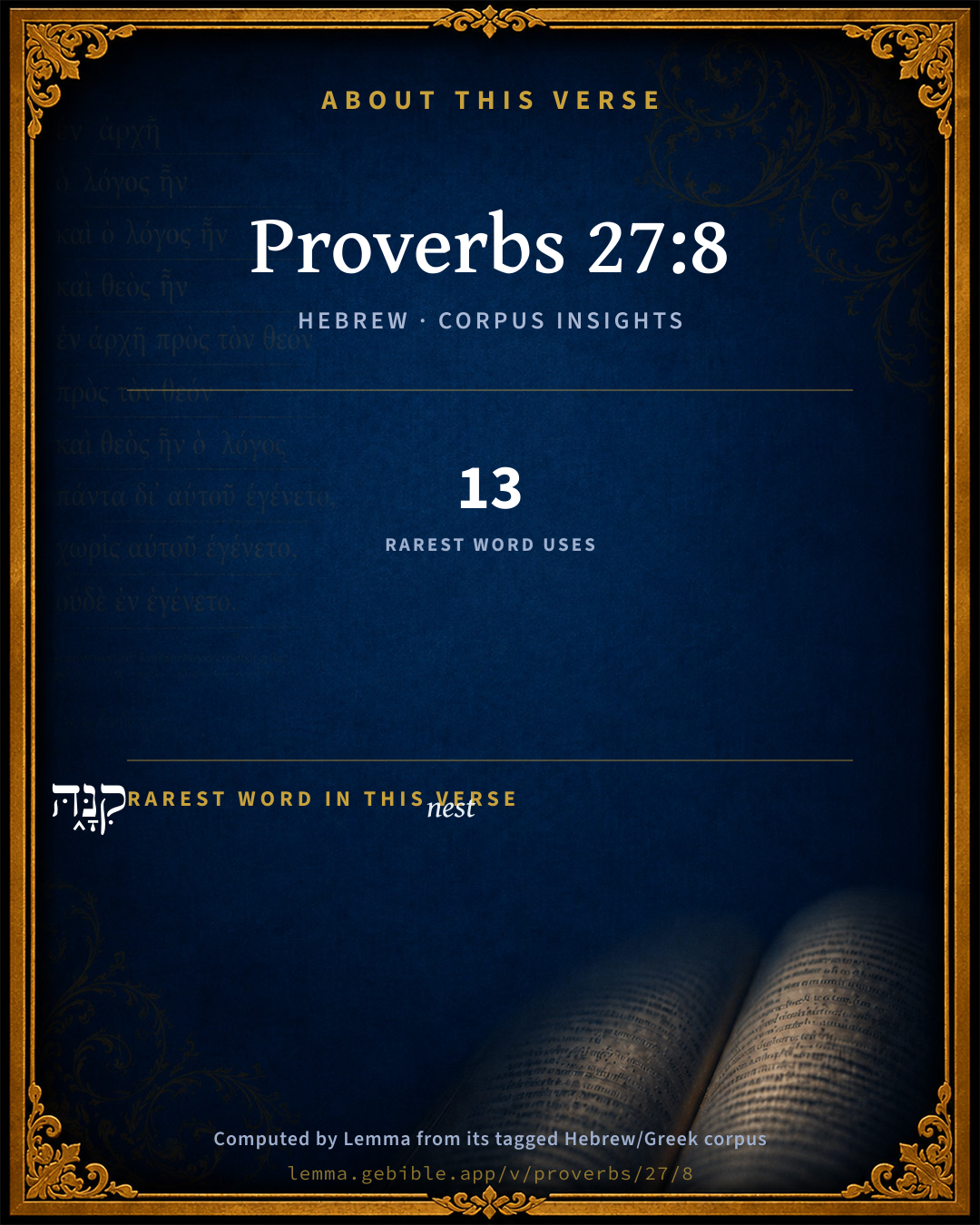
The rarest word here is קִנָּ֑הּ nest H7064 — appearing just 13 times in the whole Hebrew Bible.

Shared distinctive vocabulary

קִנָּ֑הּ nest H7064 occurs in 13 verses of the Hebrew Bible. Also found in:

Grammatical profile

  • 2 verbs
  • 4 nouns
  • 1 preposition
  • 1 particle

Verb forms

  • נוֹדֶ֣דֶת Qal · Participle Active
  • נוֹדֵ֥ד Qal · Participle Active

Repetition

A word recurs within this verse — often emphatic in Hebrew:

  • נוֹדֶ֣דֶת to flee H5074 ×2

Hebrew & Septuagint length

In English translation the verse runs 17 words from the Hebrew and 25 from the Septuagint (LXX English) — the Septuagint runs noticeably longer here. See the side-by-side →

A rough comparison of the two English renderings, which tokenize alike — not a word-level alignment.

Word counts can differ between the Hebrew and the Greek without any difference in meaning — e.g. the Hebrew direct-object marker אֵת has no separate Greek word, and Greek often adds the article ὁ.

Cross-references

14

Topical passages linked to Proverbs 27:8 in the Treasury of Scripture Knowledge — connected by theme and wording, ordered by reader-vote popularity; previews shown in the World English Bible.

  • Proverbs 21:16 The man who wanders out of the way of understanding Shall rest in the assembly of the dead.
  • Isaiah 16:2 For it shall be that, as wandering birds, as a scattered nest, so shall the daughters of Moab be at the fords of the Arnon.
  • Jonah 1:3 But Jonah rose up to flee to Tarshish from the presence of Yahweh. He went down to Joppa, and found a ship going to Tarshish; so he paid its fare, and went down into it, to go with them to Tarshish from the presence of Yahweh.
  • Jonah 1:10–17 Then were the men exceedingly afraid, and said to him, "What is this that you have done?" For the men knew that he was fleeing from the presence of Yahweh, because he had told them.
  • 1 Corinthians 7:20 Let each man stay in that calling in which he was called.
  • Genesis 16:6–8 But Abram said to Sarai, "Behold, your maid is in your hand. Do to her whatever is good in your eyes." Sarai dealt harshly with her, and she fled from her face.
  • 1 Samuel 22:5 The prophet Gad said to David, Don't stay in the stronghold; depart, and get you into the land of Judah. Then David departed, and came into the forest of Hereth.
  • 1 Kings 19:9 He came there to a cave, and lodged there; and, behold, the word of Yahweh came to him, and he said to him, What are you doing here, Elijah?
  • Genesis 4:16 Cain went out from Yahweh's presence, and dwelt in the land of Nod, on the east of Eden.
  • Nehemiah 6:11–13 I said, Should such a man as I flee? and who is there that, being such as I, would go into the temple to save his life? I will not go in.
  • Job 39:14–16 For she leaves her eggs on the earth, Warms them in the dust,
  • Proverbs 26:2 Like a fluttering sparrow, Like a darting swallow, So the undeserved curse doesn't come to rest.
  • Jude 1:13 wild waves of the sea, foaming out their own shame; wandering stars, for whom the blackness of darkness has been reserved forever.
  • 1 Samuel 27:1–12 David said in his heart, I shall now perish one day by the hand of Saul: there is nothing better for me than that I should escape into the land of the Philistines; and Saul will despair of me, to seek me any more in all the borders of Israel: so shall I escape out of his hand.

Cross-references courtesy of OpenBible.info (CC BY 4.0).

Hebrew and Greek witnesses Masoretic Hebrew ↔ Greek Septuagint

The same verse in the two great witnesses to the Old Testament, shown verse-for-verse.

Here the Septuagint runs noticeably longer than the Hebrew — LXX2012 (modern English Septuagint) 25 words vs World English Bible 17. A rough length comparison of the two English translations, not a word-level alignment — read both below.

These are two independent witnesses, not word-aligned to each other, and the Septuagint is shown in lemma (dictionary) form.

Hebrew Proverbs 27:8 Masoretic · Westminster Leningrad Codex

כְּ֭צִפּוֹר נוֹדֶ֣דֶת מִן קִנָּ֑הּ כֵּֽן אִ֝֗ישׁ נוֹדֵ֥ד מִמְּקוֹמֽוֹ

As a bird that wanders from her nest, So is a man who wanders from his home.

World English Bible · Public Domain

Greek LXX Proverbs 27:8 Septuagint · lemma form

ὥσπερ ὅταν ὄρνεον κατα ἀποἐτάζω ἐκ ὁ ἴδιος νοσσιά οὕτως ἄνθρωπος δουλόω ὅταν ἀποξενόω ἐκ ὁ ἴδιος τόπος

As when a bird flies down from its own nest, so a man is brought into bondage whenever he estranges himself from his own place.

LXX2012 (modern English Septuagint) · Public Domain

On this verse, Joseph Benson's Commentary discusses the Septuagint’s reading. Read the note in Commentary ↓

Hebrew: Westminster Leningrad Codex (CC BY 4.0). Greek: Septuagint (public domain); English from LXX2012 (modern English Septuagint) (Public Domain). How the Septuagint differs from the Hebrew →

Commentary

Notes on Proverbs 27:8 from classic Christian and Jewish commentators (each source and its license shown beneath its notes). The classic Christian expositions comment on the surrounding passage and are grouped to its opening verse, so a note may address several verses; the Jewish commentaries on the Tanakh (Rashi and others) are per-verse, so they appear only where the commentator wrote on this verse.

Lemma curates 59 commentaries, every one of them public domain or Creative Commons licensed, each selected and text-cleaned for this edition rather than reprinted as found. About our sources →

Trapp's Complete Commentary

John Trapp

Pro 27:8 As a bird that wandereth from her nest, so [is] a man that wandereth from his place.

Ver. 8. As a bird that wandereth from her nest.] Doth it of inconstancy, and oft meets with misery: whereas God had taken order that none should molest a bird upon her nest. {Deu 22:6-7}

So is a man that wandereth from his place.] A vagrant, an idleby, or a busybody, that keeps not his station, abides not in the calling wherein he was called, {1Co 7:20} exposed to misery and mischief, to ruth and ruin. {Num 16:32 2Sa 6:6-7 2Ch 26:19 Jon 1:1-17 Jdg 1:6 Psa 107:4} An honest man’s heart is the place where his calling is: such a one, when he is abroad, is like a fish in the air, whereinto if it leap for recreation or necessity, yet it soon returns to its own element.

John Trapp, A Commentary or Exposition upon All the Books of the Old and New Testament (1647–1656) — public domain. Text from a community e-Sword module.

The Biblical Illustrator

Joseph S. Exell

Pro_27:8

As a bird that wandereth from her nest, so is a man that wandereth from his place.

The inconvenience and danger of persons being long absent from home

Nothing that affects our religious interests can, properly speaking, be called little. Everything that can influence the present temper and future state of the soul is weighty and important This text is a caution against a rambling spirit in general. A bird that wandereth from her nest leaves her eggs unhatched, or starves her young ones, or exposes them to peril. The evil consequences of restless and prolonged wanderings from home are--

1. They who wander lose many relative comforts. A heathen philosopher observes that wanderers about have many acquaintances, but few friends.

2. The domestic affairs of wanderers greatly suffer. Their work either stands still, or goes on very indifferently.

3. Precious time is lost in wandering from home. Many whose lawful business leads them abroad stay much longer than is needful. They trifle at every place where they come, and must chat with every person who hath as little prudence as themselves.

4. Wanderers are exposed to many temptations which ought to be avoided.

5. This habit is a great hindrance to family religion. Apply these thoughts to ourselves, and inquire how far we are concerned in this admonition. It is important for young people to cultivate a habit of staying at home. It is peculiarly bad in servants to wander from their place. Relations should endeavour to make home agreeable to one another. It is especially bad to wander from the house of God. (J. Orton.)

Wandering birds

Some people are always restless; they must move about. They are like wandering birds. Such people do not know that the right place is always the best place for them. Whatever is our calling in life, let us not be in a hurry to leave it. Depend upon it, where God has placed us is the best for us after all. The right place for us all is where we can best serve Jesus, and where we can glorify Him. A bird that wanders from its nest is one that will get into danger and trouble. A bird that wanders from its nest will lose its nest. Three counsels--

1. Love your own nest, and stay in it.

2. Keep the nest clean, and make your home happy.

3. No nest is so good for you as your own, and therefore do not seek to change it. (J. J. Ellis.)

The wanderer

I. As the bird has its nest, so man has his place. And both are of Divine appointment. Behind the instinct of the bird and the social nature of man we must recognise the purpose of God. Mans place is in--

1. The home. God setteth the solitary in families.

2. In society. Let every soul be subject to the higher powers, for the powers that be are ordained of God.

3. In the Church, its fellowship, worship, work.

II. As the bird needs the nest, so the man needs the place.

III. As the nest needs the bird, so the place needs the man.

IV. Wandering.

V. The consequences of wandering.

VI. Appeal to wanderers. Come back! the place waits for you. Your own heart echoes its cry. (Homiletic Review.)

Unnaturalness

Sin reverses Divine arrangements. It is consequently the most unnatural thing in Gods universe. We speak of natural depravity; it is, properly speaking, un-natural depravity. Sin is earths exotic; the souls nightshade; it has turned the world upside down, and thrust man out of his proper place.

I. Man in his wrong place. Here called a wanderer. Where art thou? God asked Adam; intimating that he was not where he ought to have been. Sin had turned him out of his place. Some things concerning mans original state--the place from which he had wandered.

1. It was a state of conscious Divine approval. Conscience was at rest.

2. A state of Divine illumination. The creature enjoyed the high privilege of companionship with his Creator. Sin has both stained the conscience and darkened the understanding.

3. A state of Divine sympathies. His supreme affections were centred in his Maker. Towards Him his emotions moved like bright constellations round the sun. The fatal mistake sin has introduced into the hearts of men is the vain attempt to meet the wants of the spiritual in the supplies of the material.

II. Man in his right place. Man is as his heart is. The evils which have been enumerated arise from the moral derangement of the affections. The gospel comes to restore the forfeited place by restoring lost confidence. It does so by revealing God in such a way as to inspire confidence. The gospel is the revelation of Divine love putting away sin, and bringing the sinner near to Himself. The souls resting-place is faith and love. (G. Hunt Jackson.)

The wandering bird

Persons of the vagrant kind seldom, if ever, prosper.

1. In the common affairs of life Solomon was correct. The unrest of that mans mind, and the instability of his conduct, who is constantly making a change of his position and purpose, augurs no success for any of his adventures. See cases of eagerness to leave the native country; changing occupation; changing situation and acquaintance. And it is certainly true in changing ones religious service in the cause of God.

2. In spiritual things. There is a tendency in us all to be looking for evidences, signs, marks, experiences, graces, and coincidences of one kind or another. When a Christian wanders from his place--from the simplicity of his faith in Jesus--that moment he departs from his safe shelter in the solid rock. Many believers wander out of their place. A believers place is in the bosom of his Lord, or at the right hand of his Master, or sitting at His feet with Mary. Wandering habits imply a lack of watchfulness. (C. H. Spurgeon.)

The wandering bird

The teaching of the proverb may be, that a man who leaves his own home, his own proper sphere, situation, calling, is strange, awkward, lonely, exposed--he has got away from duty and into danger, and is forlorn as a lost bird that has got away from its nest and cannot find its way back. Our subject is that men, institutions, Churches, are most useful when faithful to their own particular calling, and when true to their own distinctive characteristics. There is some danger lest Christian Churches should wander from their place. Far be it from me to depreciate the importance of social questions and social work. But we are told that we are strong in the degree in which we take in hand social questions, and play the part of social reformers. But our work is supremely spiritual; our work is to the soul of man. To us, the main cause of the misery which is in this world is to be found in the spiritual condition of men, in their alienation from God. The Church of Christ is not to be a food-supply association, nor a banking company, nor a society for the reform of manners. Our work is to bring men to God. The monition of the text may be applied to individuals. There are few things more common than for men to forsake the sphere in which their own peculiar powers have ample scope for a sphere in which those powers are scarcely required at all. An infatuation sometimes leads men to seek positions to which they are not called, and for which they are manifestly unfit. Some of us are not allowed to remain in one place. We are compelled to be wanderers on the face of the earth. The determination to abide in ones own lot, and to be true to ones own gifts and aptitudes, is the secret of power. If a man will prove his own work, he shall have rejoicing in himself. Cultivate a vivid sense of personality and a solemn conviction of our own individual significance. You will not best serve your generation by becoming a washed-out reproduction of some stronger character. If a man honestly does the best with his own powers in his own place, he will not live in vain. We cannot escape from our personal limitations, but we may do good work, and minister much blessing notwithstanding. We also wander from our place when we neglect the things that are about us, and strain after strange and distant things, for satisfaction. The highest and best things are possible to us where we are. In our own place the highest culture of character is possible. Our place has no limitations for spiritual growth. We can be men in Christ Jesus where we are. So let there be no repining and no wandering. He orders our lot; let us stand in it. (James Lewis.)

The Biblical Illustrator, edited by Joseph S. Exell (c. 1880s–1900s) — public domain. Text from a community e-Sword module.

Joseph Benson's Commentary

Pro 27:8. As a bird that wandereth from her nest — That flies very much abroad from place to place, whereby she is exposed to all the arts of fowlers, and to birds of prey; so is a man that wandereth from his place — That, through vanity or lightness, changes the place of his abode or his calling; the ill effects whereof have been frequently observed. The LXX. read, Like as a bird is taken when it leaves its nest, so is a man reduced to servitude when he quits his habitation.

Joseph Benson's Commentary on the Old and New Testaments (1811–1818) — public domain. Text from a community e-Sword module.

The Preacher's Complete Homiletical Commentary

Joseph S. Exell (gen. ed.)

CRITICAL NOTES.—

Pro_27:8. Place, rather “home.”

Pro_27:9. This verse is obscurely rendered in the English version. Delitzsch translates “Oil and frankincense rejoice the heart, and the sweet discourse of a friend from counselling of soul.” Ewald, Elster, Luther, etc., render “The sweetness of the friend springeth from faithful counsel of soul.” Zöckler, “The sweetness of a friend is better than one’s own counsel.”

Pro_27:10. Neighbour that is near, etc. “The near neighbour is he who keeps himself near as one dispensing counsel and help to the distressed, just as the far-off brother is he who, on account of hit unloving disposition, keeps at a distance from the same” (Zöckler.) Most commentators substantially agree with this view of the text

Pro_27:14. As a curse, etc. It is no better than a curse, or it may be regarded as veiling an evil intention.

Pro_27:16. And the ointment of his right hand. Zöckler and Delitzsch translate “And his right hand graspeth, or meeteth oil,” that is, he cannot hold her. Other commentators, retaining the English translation, understand it to refer to the hopelessness of concealing her vexatious disposition.

MAIN HOMILETICS OF Pro_27:8

A MAN AND HIS PLACE

I. It is good for every man to have a place in the world which he can call his home, and work which he feels especially belongs to him. A man should have some spot on earth which is dearer to him than all the world beside, and some calling or profession which he can recognise as his own. It is not by any means desirable that he should always be in that place, or that he should never employ his time in other work. The bird often leaves the nest and flies hither and thither for many hours, and men must and ought not to confine themselves always to one place and to the same employment. Change of scene and occupation is always desirable within certain limits, and is often a necessity with men. But however far the bird flies she returns to her nest, and however much men may be obliged or may choose to wander, they should always have one place to call home; and however many things may occupy their hours of leisure, they should have one kind of work which especially fills up their life.

II. It is not good hastily and often to quit one sphere of work and one mode of life for another. Every honest calling has some advantages connected with it, and almost every sphere in life has something to recommend it; and steady perseverance in one employment, and continuance in one position, is often far more conducive to our material prosperity, and more beneficial to our character and reputation, than constant changes, even although they promise more speedy promotion and a smoother path to some desired end. This much is certain, that change merely for the sake of change is foolish, and change without good and sufficient reason is not wise.

OUTLINES AND SUGGESTIVE COMMENTS

By place, the Holy Ghost understandeth particular callings. Now God had taken care that none should molest a bird in her nest, there she was safe (Deu_22:6-7); but when she begins to wander then she is in danger, either to be shot by the fowler or caught in the snare, or made a prey to other ravenous birds. So a man that is diligent in his calling whilst he is employed therein, is in God’s precincts, and so under God’s protection; but when he wandereth abroad from his calling, going out of his bounds to sit and talk, he is a waif and a stray, and so falleth to the lord of the manor, “the god of this world.” Reader, thou mayest expect to be preserved whilst thou art a-working, but not when thou art wandering. Those soldiers who leave their place in a march and straggle to pilfer, are many times snapt and slain by their enemies, when they who keep their places are safe and secure.—Swinnock.

Change of place is thought of as an evil. The sense of security is lost and cannot be regained. The maxim, it may be noted, is characteristic of the earlier stages of Hebrew history, before exile and travel had made change of country a more familiar thing. We seem to hear an echo of the feeling which made the thought of being “a fugitive and a vagabond” (Gen_4:12-13) the most terrible of all punishments.—Plumptre.

In such a comparison as this, we cannot but suppose there is a reference to the purposes for which the nest is constructed. The allusion is doubtless to the period of incubation—to the hatching of the eggs, and the rearing of the young. If the bird “wanders from her nest” during that period, what is the consequence? Why, that the process is frustrated—the eggs lose their vital warmth; they become cold, addled, and unproductive. Absence, even for a very short time, will produce this effect; and produce it to such a degree, that no subsequent sitting, however constant and prolonged, can ever vivify again the extinct principle of vitality. And then, during the period of early training, when the young are dependent on the brooding breast and wing of the parent bird for their warmth, and on the active quickness of the parent bird, as their purveyor, for their sustenance,—desertion is death. If the mother then “wanders from her nest,” forsaking for any length of time her callow brood—they perish, the hapless victims of a mother’s neglect. They are starved of cold, or they are starved of hunger; or, it may be, their secret retreat is found out by some devouring foe. Such appears to be the apt allusion. Let us now consider to what cases it may with truth and profit be applied.

1. In the first place then, I apply it to a man’s HOME. Home may surely be regarded as most appropriately designated “his place.” It is there he ought to be; not merely enjoying comfort, but imparting it;—not the place of selfish ease and indulgence, but of dutiful and useful occupation. He has a charge there,—committed to him, not by the instincts of nature merely, but by the law of God. His family demand his first interest and his first attention.

2. I apply the proverb to the SITUATION IN LIFE which has been assigned to a man by Providence. As the brooding bird should be found upon her eggs, or with her young, so should every servant, in every department, be found in his own place, and at his own occupation. It should be the aim of every man to have it said of him with truth—Tell me where he ought to be, and I will tell you where he is.

3. I wish to apply the words to the SANCTUARY OF GOD. I think they may be so applied with perfect appropriateness. Every Christian must delight in God’s sanctuary. It is to him, as a worshipper of God, “his place;”—the place where, at stated times, he ought to be, and where he chooses, and desires, and loves to be. How frequently, how strongly, how beautifully, does the Psalmist express this feeling!—and on one occasion with an exquisitely touching allusion to those birds of the air, that built their nests in the vicinity of the temple; and which, when banished from Jerusalem, and kept at a distance from the sacred precincts, he represents himself as envying—coveting their proximity to the altars of Jehovah (Psa_84:3.)—Wardlaw.

The 9th, 10th, 11th, and 14th verses have been considered with the 6th and 7th. For Homiletics on the subject of Pro_27:12 see on chap. Pro_14:15, page 364. Pro_27:13; Pro_27:15-16 are almost a verbal repetition of chaps. Pro_20:16, and Pro_19:13. For Homiletics see pages 589 and 573.

The Preacher's Complete Homiletical Commentary (gen. ed. Joseph S. Exell; Funk & Wagnalls, c. 1892) — public domain (pre-1929). A full-Bible homiletical/sermon-outline anthology covering 65 of 66 books (2 John is absent from the source module). Text from a community e-Sword module.

Tyndale Open Study Notes

Tyndale Open Resources

27:8 A person who forsakes his family and strays from home will more likely find trouble than whatever he was seeking (e.g., Luke 15:11-16).

Tyndale Open Study Notes — © Tyndale Open Resources, licensed CC BY-SA 4.0. Text via the HelloAO Bible API.

Matthew Henry's Commentary

Note, 1. There are many that do not know when they are well off, but are uneasy with their present condition, and given to change. God, in his providence, has appointed them a place fit for them and has made it comfortable to them; but they affect unsettledness; they love to wander; they are glad of a pretence to go abroad, and do not care for staying long at a place; they needlessly absent themselves from their own work and care, and meddle with that which belongs not to them. 2. Those that thus desert the post assigned to them are like a bird that wanders from her nest. It is an instance of their folly; they are like a silly bird; they are always wavering, like the wandering bird that hops from bough to bough and rests nowhere. It is unsafe; the bird that wanders is exposed; a man's place is his castle; he that quits it makes himself an easy prey to the fowler. When the bird wanders from her nest the eggs and young ones there are neglected. Those that love to be abroad leave their work at home undone. Let every man therefore, in the calling wherein he is called, therein abide, therein abide with God.

Matthew Henry's Commentary on the Whole Bible (1708–1710) — public domain (CC PDM 1.0). Text via the HelloAO Bible API.

Jamieson, Fausset & Brown

Robert Jamieson, A. R. Fausset & David Brown

Such are not only out of place, but out of duty and in danger.

Jamieson, Fausset & Brown — Commentary Critical and Explanatory on the Whole Bible (1871) — public domain (CC PDM 1.0). Text via the HelloAO Bible API.

Adam Clarke's Commentary

Verse 8. As a bird that wandereth from her nest] Leaving her own brood, places of retreat, and feeding-ground behind, and going into strange countries, where she is exposed to every kind of danger. So is the man who leaves his family connections and country, and goes into strange parts to find employment, better his circumstances, make a fortune, c. I have seen multitudes of such wanderers from their place come to great misery and wretchedness. God's general advice is, "Do good, and dwell in the land and verily thou shalt be fed."

Adam Clarke's Commentary on the Bible (1810–1826) — public domain. Text from a community e-Sword/MySword module.

Ellicott's Commentary for English Readers

(8) A man that wandereth from his place.—That wandereth forth as an exile that has lost his home. Comp. Gen_12:4, and, on the contrary, Job’s hope that he would “die in his nest” (Pro_29:18). For the spiritual sense comp. Luk_15:13, sqq.

A Bible Commentary for English Readers, edited by Charles John Ellicott (1878–1897) — public domain. Text from a community e-Sword module.

The Cambridge Bible for Schools and Colleges

gen. ed. J. J. S. Perowne

8. “The true bird-life is the life of the woods, of the toilsomely-woven nest, of the mate and the brood and the fledglings.… True human life is the life of our fellows, of the diligent laborious housebuilding, of the home, of the young, of the rising nestlings which are to form the next link in the long chain of the generations.” Horton.

The Cambridge Bible for Schools and Colleges (gen. ed. J. J. S. Perowne; Cambridge University Press, 1878–1918) — public domain. Text from a community e-Sword module.

John Gill's Exposition

Ointment and perfume rejoice the heart,.... Meaning not the holy anointing oil for sacred use, or the perfume or incense offered on the altar of incense; but common oil or ointment used at entertainments, poured on the heads of the guests; and incense in censing of rooms, which were very delightful, pleased the senses, and so exhilarated the heart;

so doth the sweetness of a man's friend by hearty counsel; so the sweet and pleasant words, the wise and cordial counsel of a man's friend, rejoice his heart; he takes it well, he is highly delighted with it; he receives it kindly, and pursues it to advantage: or "by counsel of soul" (c), such as relates to the welfare of the soul here and hereafter; such is the counsel Christ gives, to buy of him gold tried in the fire, white raiment eye salve; and such as the Scriptures give, which, with the saints, are the men of their counsel, as they were David's; and which ministers of the Gospel give, who are therefore like ointment and perfume, "a sweet savour of life unto life": some render the words, and they will bear it, "so the sweetness of a man's friend, more than the counsel of his soul" (d) or than his own; that is, the sweet counsel of a friend is better than his own, and more rejoices his heart, and gives him more pleasure than that does; and this way go the Jewish commentators.

(c) "a consilio animae", Montanus; "propter consilium animae", Pagninus, Gejerus, Michaelis. (d) "Magis quam consilium animae, sub. propriae", Vatablus, Baynus; "quam consilium proprium", Junius & Tremellius, Mercerus, Amama.

John Gill's Exposition of the Whole Bible (1746–1763) — public domain (CC PDM 1.0). Text via the HelloAO Bible API.

Albert Barnes' Notes on the Bible

Change of place is thought of as in itself an evil. It is not easy for the man to find another home or the bird another nest. The maxim is characteristic of the earlier stages of Hebrew history, before exile and travel had made change of country a more familiar thing. Compare the feeling which made the thought of being “a fugitive and a vagabond” Gen 4:12-13 the most terrible of all punishments.

Albert Barnes' Notes on the Bible (1834–1885) — public domain. Text from a community e-Sword/MySword module.

Haydock's Catholic Bible Commentary

Place, or vocation, like the prodigal son, Luke xv. The Israelites were much attached to their own country, where they might practise the true religion. (Calmet)

George Leo Haydock (1774–1849), Haydock's Catholic Family Bible and Commentary, 1859 edition — public domain. Excludes Psalms (Douay-Rheims chapter numbering differs from Protestant) and Deuterocanonical books (Catholic canon only).

Matthew Poole's English Annotations

That wandereth from her nest; that flies very much abroad from place to place, whereby she is exposed to all the arts of fowlers, and to birds of prey, from which she is safe whilst she keeps her nest.

That wandereth from his place; that through vanity or lightness changeth the place of his abode, or his calling and course of life, the ill effects whereof have been frequently observed and noted, even in vulgar proverbs, as when we say, A rolling stone gathers no moss.

Matthew Poole's English Annotations on the Holy Bible (1683–1685) — public domain. Text from a community e-Sword/MySword module.

Whedon's Commentary on the Bible

Daniel D. Whedon

8. Wandereth from her nest, etc. — A caution against hasty, unnecessary changes in life, either in regard to country, home, occupation, or condition. “A rolling stone gathers no moss;” “two removes are equal to a fire,” are like proverbs among ourselves. Some understand it merely of leaving one’s home. “A man from home,” if he has a good one, is like a bird away from its nest, restless, unsatisfied.” — Stuart. True and good, but probably not all that is intended. There is a tendency to dissatisfaction with our present positions, conditions, business, etc. We know their difficulties, cares, vexations, and are apt to imagine that we could be happier in some other place, condition, or business. Thus, some men are perpetually changing and moving; like Noah’s dove, finding no rest for the sole of their feet.

Daniel D. Whedon (gen. ed.), Commentary on the Old and New Testaments (1874–1909) — public domain. Text from a community e-Sword module.

The Pulpit Commentary

As a bird that wandereth from her nest. Jerome"s avis transmigrans conveys to us a notion of a migratory bird taking its annual journey. But the idea here is of a bird which leaves its own nest either wantonly or from some external reason, and thereby exposes itself to d so comfort and danger. (comp. Isa_16:2) So is a man that wandereth from his place; i.e. his own home (comp. Ecc 29:21, etc., and 36:28 in Vet. Lat., "Quis credit ei qui non habet nidum, et deflectens ubicumque obscuraverit, quasi succinctus latro exsil ins de civitate in civitatem?"). The proverb indirectly inculcates love of one"s home and one"s native land. To be "a fugitive and a vagabond" (Gen_4:12) was a terrible punishment, as the Jews have learned by the experience of many centuries. Language and religion placed a barrier against residence in any country but their own (see Psalm 84); and though at the time when this book was probably written they knew little of foreign travel, yet they regarded sojourn in a strange land as an evil, and centred all their ideas of happiness and comfort in a home life surrounded by friends and countrymen. The word "wander" may have the notion of going into exile. Septuagint, "As when a bird flies down from its own nest, so is a man brought into bondage when he is banished (apoxenwyh ) from his own place." Some have reasoned from this expression that the idea of exile had become familiar to the writer, and hence that this portion of the Proverbs is of very late origin (Cheyne) surely a very uncertain foundation for such a conclusion. The love of Orientals for their native soil is a passion which no sordid and miserable surroundings can extinguish, and a man would consider even a change of home an unmixed evil, though such change was not the result of exile. Our view of the fortunes of one who is always shitting his abode is expressed in the adage, "A rolling stone gathers no moss.

A bird wandering from her nest.

Let us consider first in what respects a man may be said to be wandering from his place, and then how the evil of this condition may be illustrated by the metaphor of a bird wandering from its nest.

I HOW A MAN MAY WANDER FROM HIS PLACE.

1. He may leave the work he is suited for. There is no reason why a man should not endeavour to rise in the social scale. Christianity does not consecrate any system of caste. But there are works for which certain men have natural aptitude, or for which they have been trained, and other works for which they are not thus suited. Unhappily, our inclination does not always coincide with our capacity. To follow one"s likings outside the range of one"s powers is to wander from one"s place.

2. He may forsake his duty. Every man"s rightful place is at the post of duty. No danger, no difficulty, no disagreeableness, can justify any one in forsaking that place.

3. He may depart from God. Then indeed will he have wandered from his true place. For the home of the soul is with God. Absence from God is to be out of one"s place,

a. though in a very paradise of delights,

b. though among the most congenial companions,

c. though with an eminently attractive occupation.

4. He may renounce his human status.

(1) In descending to that of an animal. Bestial lust and brutal cruelty are inhuman. He who plunges into such vile things necessarily wanders from himself as a man. He gives up the rank of a human being.

(2) In degrading himself to diabolical living. This happens to one who chooses evil for its own sake, loving wickedness and pursuing it.

II HOW SUCH A MAN MUST SUFFER AS A BIRD THAT WANDERS FROM HER NEST.

1. He loses peace. The nest is typical of quiet and restfulness. To forsake it is to be at large in the noisy, tumultuous world. So one who is out of his place is cast adrift on a homeless waste. He sacrifices peace in pursuit of novelty.

2. He is removed from congenital companionship. The poor young bird leaves her fellows and flies into unknown regions, where she finds hers. If alone among strange creatures. A man who is out of his element will be equally alone and friendless. The very fact that he is in the wrong place implies that he cannot find true sympathy in his new sphere. Perhaps he has been foolishly aiming at entering some higher circle of life than one that he is fitted for. If so, he will only be supremely uncomfortable, perpetually regarded as an intruder or ridiculed as a blunderer. It is better to cultivate the affections of one"s own home circle and true old friends.

3. He is not able to fulfil his mission. It may be that a mother bird is here thought of. In wandering from her nest she forsakes her young. So he who leaves his rightful place neglects his obligations. He fails to do his duty to those naturally dependent on him. Charity begins at home.

4. He is exposed to danger. The poor wandering bird may be lost in the forest; she may starve for want of food; birds of prey may pounce upon her in the darkness. There is no safety off the path of duty. Even unsuitable spheres are dangerous, because a man does not know how to behave himself in them. Away from God there is danger of ruin without hope of escape.

See homily on vers. 23-27. C.

The Pulpit Commentary (1880–1919), ed. H.D.M. Spence-Jones & Joseph S. Exell — public domain. Text from a community e-Sword module.

John Wesley's Explanatory Notes

Wandereth - That flies from place to place, whereby she is exposed to all the arts of fowlers, and to birds of prey. So - So is he who through vanity or lightness changes his abode, or his calling.

John Wesley, Explanatory Notes Upon the Whole Bible (1754–1765) — public domain. Text via the GEBible commentary corpus.

Keil & Delitzsch

C. F. Keil & F. Delitzsch

8 As a bird that wandereth from her nest,

So is a man that wandereth from his home.

It is not a flying out that is meant, from which at any moment a return is possible, but an unwilling taking to flight (lxx 8b: ὅταν ἀποξενωθῇ; Venet.: πλανούμενον ... πλανούμενος); for עוף נודד, Isa 16:2, cf. Jer 4:25, birds that have been frightened; and נדד, Pro 21:15., designates the fugitive; cf. נע ונד, Gen 4:14, and above, Pro 26:2, where נוּד designates aimless roving about. Otherwise Fleischer: "warning against unnecessary roaming about, in journeyings and wanderings far from home: as a bird far from its nest is easily wounded, caught, or killed, so, on such excursions, one easily comes to injury and want. One may think of a journey in the East. The Arabs say, in one of their proverbs: âlsafar ḳaṭ'at man âlklyym (= journeying is a part of the pains of hell)." But נדד here is not to be understood in the sense of a libere vagari. Rightly C. B. Michaelis: qui vagatur extorris et exul a loco suo sc. natali vel habitationis ordinariae. This proverb mediately recommends the love of one's fatherland, i.e., "love to the land in which our father has his home; on which our paternal mansion stands; in which we have spent the years of our childhood, so significant a part of one's whole life; from which we have derived our bodily and intellectual nourishment; and in which home we recognise bone of our bone and flesh of our flesh."

(Note: Gustave Baur's article "Vaterlandsliebe," in Schmid's Pdagogischer Encyklopdie.)

But next it says, that to be in a strange land must be an unhappiness, because a man never feels better than at home, as the bird in its nest. We say: Heimat [home] - this beautiful word becomes the German language, which has also coined the expressive idea of Heimweh [longing for home]; the Heb. uses, to express the idea of home, the word מקומי; and of fatherland, the word ארצי or אדמתי. The Heb. שׁבוּת corresponds

(Note: The translators transfer to this place a note from vol. ii. p. 191f. of the author's larger Comm. . den Psalter, to which Delitzsch refers the reader: - "The modern High German adj. elend, middle High German ellende, old High German alilandi, elilendi, or elilenti, is composed of ali and land. The adj. ali occurs only in old High German in composition. In the Gothic it is found as an independent adj., in the sense of alius and ἄλλυς (vid., Ulfilas, Gal 5:10). The primary meaning of elilenti is consequently: of another country, foreign. In glosses and translations it is rendered by the Lat. words peregrinus, exul, advena, also captivus. In these meanings it occurs very frequently. In the old High German translation of Ammonius, Diatessaron, sive Harmoniae in quatuor Evangelica, the word proselytism, occurring in Mat 23:15, is rendered by elilantan. To the adj. the old High German subst. corresponds. This has the meaning exilium, transmigratio, captivitas. The connection in elilenti or elilentes, used adverbially, is rendered by the Lat. peregre. In the middle High German, however, the proper signification of both words greatly predominates. But as, in the old High German, the idea of miser is often at the same time comprehended in the proper signification: he who is miserable through banishment, imprisonment, or through sojourning in a strange land; thus, in several places of the middle High German, this derived idea begins to separate itself from the fundamental conception, so that ellende comes in general to be called miser. In the new High German this derived conception is almost alone maintained. Yet here also, in certain connections, there are found traces of the original idea, e.g., in's Elend schicken, for to banish. Very early also the word came to be used, in a spiritual sense, to denote our present abode, in contrast to paradise or the heavenly kingdom.... Thus, e.g., in one of Luther's hymns, when we pray to the Holy Ghost:

Das er vns behte, an vnserm ende,

Wenn wir heim farn aus diesem elende."

[That He guard us to our end

When we go home from this world.]

- Rud. von Raumer)

to the German Elend, but = Ellend, elilenti, of another land, strange.

Keil & Delitzsch — Biblical Commentary on the Old Testament (1861–1891) — public domain (CC PDM 1.0). Text via the HelloAO Bible API. (Old Testament only.)

Bridges on Proverbs

Charles Bridges

Instinct teaches the bird, that the nest is the only place of safety or repose. Here God has provided her special cover. (Deu 22:6-7 .) Nothing therefore but danger awaits her in her wanderings. And seldom does she return without some injury to herself or her nestlings. Perhaps her nest is cold and inconvenient. But her wanderings make her more restless and dissatisfied. She is safe and happy only while she keeps her nest.

Not less senseless and dangerous is it lightly to leave the place, society, or calling, which Divine Providence has marked out. Here man is ’in God’s precincts, and so under God’s protection;’†1 and if he will be content to remain in his place, God will bless him with the rich gain of "godly contentment." (1Ti 6:6 .) But the man wandering from his place is ’the rolling stone, that gathers no moss.’ ’He is always restless, as if he had a wind-mill in his head. Every new crotchet puts him into a new course.’†2 His want of fixed principles and employment exposes him to perpetual temptation. (Pro 21:16 .) Always wanting to be something or somewhere different to what and where he is, he only changes imaginary for real troubles. Full of wisdom is it to know and keep our place. The soul, the body, the family, society — all have a claim upon us. This feverish excitement of idleness is the symptom of disease, wholly opposed to religion, the bane both of our comfort and usefulness.

The plain rule cannot ordinarily be broken without sin — "Let every man, wherein he is called, therein abide with God." (1Co 7:24 .) Would we then abide in fellowship with God? We must "abide in our calling." Every step of departure, without a clear Scriptural warrant, is departure from God. We are safe in following Providence. But to go before it; much more to break away from its guidance (Jon 1:1-4 ) — a man thus wanders from his place to his own cost. Never can we put our foot out of God’s ways, but we shall tread the path back with a cross.

It is often the wayward impulse of idle pleasure; but always with the same fruit. Dinah was safe in the bosom of her family, as the bird in her nest. But when she "went out to see the daughters of the land" (Gen 34:1-2 ), the fowler’s snare soon entangled the unsuspecting wanderer.

Let us look at this spirit in the Church. The "idler wandereth about from house to house" (1Ti 5:13 ), neglecting his own duties, and therefore with plenty of time upon his hands to "meddle with what doth not belong to him." (Pro 26:17 .) So busy is the enemy in finding his own work for those, who have no heart to work for God! The discontented professor unhappily is shut up in so obscure a corner, that he will die, before the world knows his worth. He wants a larger sphere. The world is scarcely wide enough for him. Thus he wandereth from his place, "seeking rest, and finding none." The gifted professor is full of zeal for God and his church. His gifts were not intended to run to waste. What he can do, he thinks he ought to do. He sees the minister of God neglecting his flock — Why should not he, as he deems himself well able, step into his room? But is not the man wandering from his place? Our Master’s charge is — "Give an account of thy," not thy neighbor’s, "stewardship." (Luk 16:2 .)

If grace gives the desire for usefulness, Providence must open the path. Our "wisdom is to understand our own way" (Pro 14:8 ); our duty, to "do our own business." (1Th 4:11 .) Not a single talent need be wasted. Every Christian has his own field, large enough for the exercise of his measure of gifts, without "removing the ancient landmark," that separates the sacred office, as the Lord’s consecrated service. Many might be found to perform competently the ambassador’s office; but who would venture upon it without the accredited authority of his sovereign? The unsteady professor has no spiritual home. No church is sound enough for him; none wholly molded to his taste. Like the wandering bird, he is always on the wing. Any one place is too strait for him. The accustomed food, even though coming down from heaven, is "loathed as light bread." (Num 21:5 ) His vitiated appetite leaves him often on the Sabbath morning undecided whom to hear, his own will being his only guide. He is anxious to hear from all; and, as the sure result, he learns from none. (2Ti 3:7 .) In this self-willed delusion the form and substance of the Church is destroyed. It is not a few wandering sheep, but a fold and a shepherd; not a heap of loose scattered stones, but stones cemented, fitted into their several places; and "the building thus fitly framed together groweth unto an holy temple in the Lord." (Eph 2:21-22 .) The Church is "terrible" not in her single members, but "as an army with banners" (Song of Son 6:10 ); close in rank, where each soldier keeps his own place. The individual profession, in the stead of collective unity, is a purely schismatical spirit, the essence of pride and selfishness.

And is not this spiritual vagrancy the history of many, who under the pretense of conscience have separated from the Church, which had "nourished and brought them up as children"? After their own lusts "they heap to themselves teachers, having itching ears." The end of this wandering from their place, like that of the bird from her nest, is the loss of everything valuable — "They shall turn away their ears from the truth, and shall be turned unto fables." (2Ti 4:3-4 .)

Christian professor! Beware of this tampering with simplicity and godly steadfastness. This wandering spirit proves, not expansive love, but latitudinarian indifference; freedom, not from prejudices, but from settled principles. Our Lord restrained his disciples from "forbidding" the man, "who was doing a good work." But he did not direct them to wander from their own place, and follow him. (Mar 9:38-40 .) The rule to "prove all things" is coupled with — "Hold fast that which is good." (1Th 5:21 .) Christian establishment is the result of a scriptural balance. "Order and Steadfastness" — "Beauty and Bands" — are the two staves of the Good Shepherd; the strength of the Church, the "joy" of her ministers. (Col 2:5 . Zec 11:7 .) If the "order" be broken, "the steadfastness" soon fails. Confusion reigns, instead of peace and unity. The enemy’s watchword prevails — ’Divide and conquer.’ Let every man therefore be in his own place in the Church; not weakening his minister’s hands to please his own fancy; but marking carefully "the footsteps of the flock;" and seeking to find "him whom his soul loveth," by "feeding beside the shepherds’ tents." (Song of Son 1:7-8 .)

Footnotes:

†1 Swinnock’s Christian Man’s Calling, i. 346.

†2 Bp. Sanderson’s Sermon on 1Co 7:24 .

Charles Bridges, An Exposition of the Book of Proverbs (1846) — public domain. Text from a community e-Sword module.

Rashi

Rabbi Shlomo Yitzchaki (Rashi)

wandering from its nest that goes and wanders, so is a man who wanders from his place, i.e., a Torah scholar who wanders away from his studies, from reviewing what he learned.

Rashi on the Tanakh — English translations: “The Judaica Press complete Tanach with Rashi, translated by A. J. Rosenberg” (CC BY 4.0); “Pentateuch with Rashi's commentary by M. Rosenbaum and A.M. Silbermann, 1929-1934” (public domain); “The Metsudah Tanach series, Lakewood, N.J” (CC BY 4.0); and “The Book of Joshua, Metsudah Publications, 1997” (CC BY 4.0). Text via Sefaria.

Lesson kit

Teaching starters — assembled from the data on this page, not authored interpretation. Every prompt links to the verse data it draws on. Edit before teaching.

Proverbs, in the Wisdom, opens this verse with 8 words (7 distinct Hebrew lemmas). Its most distinctive word is qên (“nest”). The Greek Septuagint runs longer here. A historical commentator’s framing appears above. Read the whole chapter for the surrounding context.

Discussion questions

  1. The word qên carries the sense “nest.” How does it shape the verse?
  2. Genesis 6:14 shares the word «nest» with this verse. How do the two illuminate each other?
  3. “to flee” occurs 2× in this one verse. What is the effect of the repetition?
  4. Compared with the Hebrew, the Septuagint runs longer here. What questions does that raise?
  5. The translations on this page render this verse differently — a whole-verse word diff, not a word-by-word alignment. What might account for the different wordings?
  6. The verb «נוֹדֶ֣דֶת» is Qal Participle Active. How does its form color the action?
  7. Reading how Trapp's Complete Commentary and The Biblical Illustrator read this verse, where do the two commentators agree and where do they part?

Things to notice

  • These translations choose different wording for 7 words in this verse.
  • “to flee” occurs 2× in this single verse.
  • 7 distinct Hebrew lemmas span 8 words in this verse.

Reading settings

Reading text

Shown beneath each verse's original-language words.

Old Testament
Old Testament edition

Read the OT as the Masoretic Hebrew (MT) or the Greek Septuagint (LXX).

English shown for the Greek Septuagint (in the Hebrew ↔ Greek comparison).

Comparing translations? Open the Compare panel on any verse page to stack up to four side by side.