
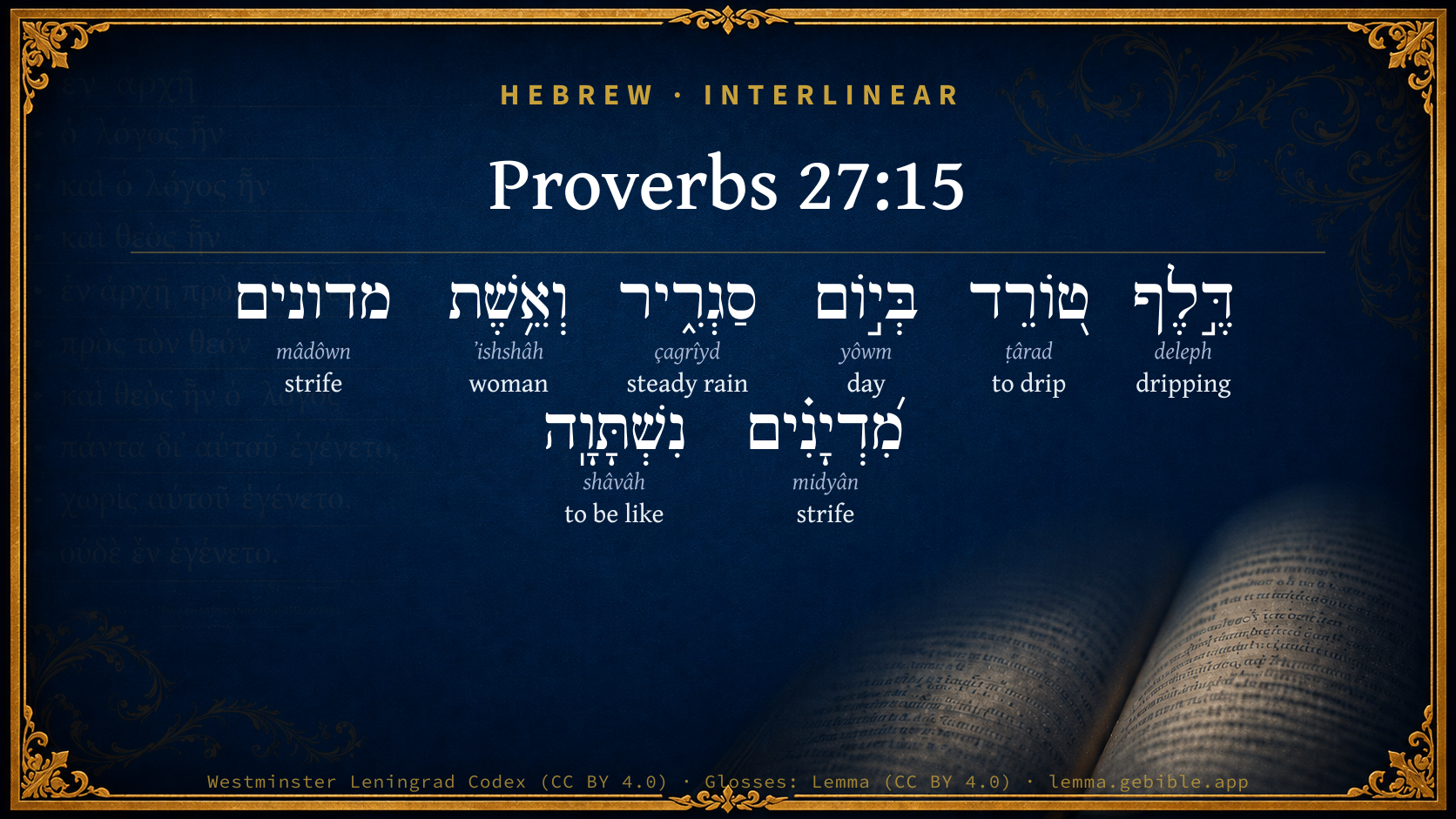

Proverbs 27:15

Hebrew (Westminster Leningrad Codex) Proverbs 27:15 appears in the Hebrew Old Testament. The text above is from the Westminster Leningrad Codex. Each word links to its Strong’s number, a concise gloss, and parsing drawn from the Open Scriptures Hebrew Bible morphology. Click any word for its full Brown-Driver-Briggs (BDB) entry.
Download image
Cite this verse

Proverbs 27:15 (World English Bible). Public Domain. Lemma interlinear Bible study tool, https://lemma.gebible.app/v/proverbs/27/15.

Show BibTeX & RIS
BibTeX
RIS
English Translation
A continual dropping on a rainy day And a contentious wife are alike:
World English Bible · Public Domain
Highlights Full analysis ↓
Download a study sheet

One document with this verse’s original text, its word-by-word gloss line, the meaning frame, cross-references with their text, attributed commentary, and full source and license credits — printable, and it pastes into notes with its structure intact.

This verse Autodidact and up

Study sheet (.html) Plain text (.txt)

A passage Seminary Student

Up to 50 verses in one chapter. A passage sheet keeps up to 6 commentary sources and 12 cross-references per verse, in the order this page ranks them, and says so on the sheet whenever that leaves anything out. Ask for a single verse and you get the Autodidact verse sheet above.

Everything on this page stays free to read, with no account — the sheet is a download of what is already on screen, not access to it.

Want to remove ads? Support Godless Engineer
Compare translations 3

The same verse in 3 English versions, stacked beneath the original-language interlinear above. Click any original word for its lexicon entry.

Each is an independent rendering of the whole verse — the interlinear is not word-aligned to these translations.

Highlighted words mark where these versions differ — a whole-verse word diff, not a word-by-word alignment.

  • World English Bible Public Domain
    A continual dropping on a rainy day And a contentious wife are alike:
  • King James Version Public Domain
    A continual dropping in a very rainy day and a contentious woman are alike.
  • unfoldingWord Literal Text CC BY-SA 4.0
    A continual dripping on a day of steady rain and a woman of quarrels are alike.

unfoldingWord Literal Text — © unfoldingWord, licensed CC BY-SA 4.0. Word-aligned USFM3 via Door43 (git.door43.org/unfoldingWord/en_ult).

Versions to compare (up to 4)

3 of 4 selected

Show all 18 translations

Every available English version of this verse, each an independent rendering of the whole verse.

  • World English Bible Public Domain
    A continual dropping on a rainy day And a contentious wife are alike:
  • Berean Standard Bible Public Domain
    A constant dripping on a rainy day and a contentious woman are alike—
  • Majority Standard Bible Public Domain
    A constant dripping on a rainy day and a contentious woman are alike—
  • King James Version Public Domain
    A continual dropping in a very rainy day and a contentious woman are alike.
  • American Standard Version (1901) Public Domain
    A continual dropping in a very rainy day And a contentious woman are alike:
  • Revised Version (1885) Public Domain
    A continual dropping in a very rainy day and a contentious woman are alike:
  • Geneva Bible (1599) Public Domain
    A continual dropping in the day of raine, and a contentious woman are alike.
  • Douay-Rheims (1899) Public Domain
    Roofs dropping through in a cold day, and a contentious woman are alike.
  • Young's Literal Translation Public Domain
    A continual dropping in a day of rain, And a woman of contentions are alike,
  • Literal Standard Version CC BY-SA 4.0
    A continual dropping in a day of rain, || And a woman of contentions are alike,
  • Unlocked Literal Bible CC BY-SA 4.0
    A quarreling wife is like the constant dripping on a rainy day;
  • unfoldingWord Literal Text CC BY-SA 4.0
    A continual dripping on a day of steady rain and a woman of quarrels are alike.
  • Darby Bible Public Domain
    A continual dropping on a very rainy day and a contentious woman are alike:
  • World Messianic Bible Public Domain
    A continual dropping on a rainy day and a contentious wife are alike:
  • Webster's Bible Public Domain
    A continual dropping in a very rainy day and a contentious woman are alike.
  • Free Bible Version CC BY-SA 4.0
    An argumentative wife is as irritating as constant dripping on a rainy day.
  • Bible in Basic English Public Domain
    Like an unending dropping on a day of rain is a bitter-tongued woman.
  • JPS Tanakh (1917) Public Domain
    A continual dropping in a very rainy day and a contentious woman are alike;

Literal Standard Version (2020), Covenant Press — licensed CC BY-SA 4.0. Text via the HelloAO Bible API (eBible.org). Unlocked Literal Bible (unfoldingWord) — licensed CC BY-SA 4.0. Text via the HelloAO Bible API (eBible.org). unfoldingWord Literal Text — © unfoldingWord, licensed CC BY-SA 4.0. Word-aligned USFM3 via Door43 (git.door43.org/unfoldingWord/en_ult). Free Bible Version, Dr. Jonathan Gallagher — licensed CC BY-SA 4.0. Text via the HelloAO Bible API (eBible.org).

Word by word

More ways to search: Search by grammar → Find every occurrence → Compare this word →

Practice this passage: Drill this verse → Learn its vocabulary →

About this verse

These counts appear in no published source. They are computed here, from the morphology-tagged text and Lemma’s own curated glosses. What Lemma adds →

8
words
8
distinct lemmas
Wisdom
section

Notable vocabulary

1 hapax legomenon — a word that appears only here in the entire Hebrew Bible:

  • סַגְרִ֑יר steady rain H5464

First appearance in Scripture

This word makes its first canonical appearance in the Hebrew Bible here:

  • סַגְרִ֑יר steady rain H5464

Shared distinctive vocabulary

דֶּ֣לֶף dripping H1812 occurs in 2 verses of the Hebrew Bible. Also found in:

Grammatical profile

  • 2 verbs
  • 6 nouns

Verb forms

  • ט֭וֹרֵד Qal · Participle Active
  • נִשְׁתָּוָֽה Nithpael · Perfect

Hebrew & Septuagint length

In English translation the verse runs 13 words from the Hebrew and 28 from the Septuagint (LXX English) — the Septuagint runs noticeably longer here. See the side-by-side →

A rough comparison of the two English renderings, which tokenize alike — not a word-level alignment.

Word counts can differ between the Hebrew and the Greek without any difference in meaning — e.g. the Hebrew direct-object marker אֵת has no separate Greek word, and Greek often adds the article ὁ.

Cross-references

5

Topical passages linked to Proverbs 27:15 in the Treasury of Scripture Knowledge — connected by theme and wording, ordered by reader-vote popularity; previews shown in the World English Bible.

  • Proverbs 19:13 A foolish son is the calamity of his father. A wife's quarrels are a continual dripping.
  • Proverbs 21:9 It is better to dwell in the corner of the housetop, Than to share a house with a contentious woman.
  • Proverbs 21:19 It is better to dwell in a desert land, Than with a contentious and fretful woman.
  • Proverbs 25:24 It is better to dwell in the corner of the housetop, Than to share a house with a contentious woman.
  • Job 14:19 The waters wear the stones; The torrents of it wash away the dust of the earth: So you destroy the hope of man.

Cross-references courtesy of OpenBible.info (CC BY 4.0).

Hebrew and Greek witnesses Masoretic Hebrew ↔ Greek Septuagint

The same verse in the two great witnesses to the Old Testament, shown verse-for-verse.

Here the Septuagint runs noticeably longer than the Hebrew — LXX2012 (modern English Septuagint) 28 words vs World English Bible 13. A rough length comparison of the two English translations, not a word-level alignment — read both below.

These are two independent witnesses, not word-aligned to each other, and the Septuagint is shown in lemma (dictionary) form.

Hebrew Proverbs 27:15 Masoretic · Westminster Leningrad Codex

דֶּ֣לֶף ט֭וֹרֵד בְּי֣וֹם סַגְרִ֑יר וְאֵ֥שֶׁת מדונים מִ֝דְיָנִ֗ים נִשְׁתָּוָֽה

A continual dropping on a rainy day And a contentious wife are alike:

World English Bible · Public Domain

Greek LXX Proverbs 27:15 Septuagint · lemma form

σταγών ἐκβάλλω ἄνθρωπος ἐν ἡμέρα χειμερινός ἐκ ὁ οἶκος αὐτός ὡσαύτως καί γυνή λοίδορος ἐκ ὁ ἴδιος οἶκος

On a stormy day drops of rain drive a man out of his house; so also does a railing woman drive a man out of his own house.

LXX2012 (modern English Septuagint) · Public Domain

On this verse, Whedon's Commentary on the Bible discusses the Septuagint’s reading. Read the note in Commentary ↓

Hebrew: Westminster Leningrad Codex (CC BY 4.0). Greek: Septuagint (public domain); English from LXX2012 (modern English Septuagint) (Public Domain). How the Septuagint differs from the Hebrew →

Commentary

Notes on Proverbs 27:15 from classic Christian and Jewish commentators (each source and its license shown beneath its notes). The classic Christian expositions comment on the surrounding passage and are grouped to its opening verse, so a note may address several verses; the Jewish commentaries on the Tanakh (Rashi and others) are per-verse, so they appear only where the commentator wrote on this verse.

Lemma curates 59 commentaries, every one of them public domain or Creative Commons licensed, each selected and text-cleaned for this edition rather than reprinted as found. About our sources →

Trapp's Complete Commentary

John Trapp

Pro 27:15 A continual dropping in a very rainy day and a contentious woman are alike.

Ver. 15. A continual dropping.] {See Trapp on "Pro 19:13"}

John Trapp, A Commentary or Exposition upon All the Books of the Old and New Testament (1647–1656) — public domain. Text from a community e-Sword module.

Joseph Benson's Commentary

Pro 27:15-16. A continual dropping, &c., and a contentious woman are alike — Are equally troublesome; the first not suffering a man to go abroad with comfort; the latter not permitting him to stay at home with quietness. Whosoever hideth her — That is, attempts to smother her passion, that it may not break forth to her shame, and to her husband’s discomfort and reproach; hideth the wind — Undertakes that which is impossible; and the ointment of his right hand — Which, being the great instrument of action, by its much stirring diffuseth the savour of it. Houbigant renders it, He who will confine her at home may confine the wind, for whatsoever he shall seal with his hand, that is, whatsoever her husband would wish to keep secret, she will bewray or divulge. The Hebrew is very obscure, but the meaning of the verse evidently is, “To attempt to keep such a woman in the house, is to attempt to restrain the wind: and as one cannot touch perfumed oil with the hand but the odour will discover itself, so is it fruitless to endeavour to conceal the bad qualities of a quarrelsome woman; in spite of all endeavours she will discover herself.”

Joseph Benson's Commentary on the Old and New Testaments (1811–1818) — public domain. Text from a community e-Sword module.

Keil & Delitzsch

C. F. Keil & F. Delitzsch

This proverb passes from the complimentarius to its opposite, a shrewish wife:

A continual dropping in a rainy day

And a contentious woman are alike.

Thus we have already translated (vol. i. p. 9), where, when treating of the manifold forms of parabolic proverbs, we began with this least poetic, but at the same time remarked that Pro 27:15 and Pro 27:16 are connected, forming a tetrastich, which is certainly the case according to the text here lying before us. In Pro 27:15, Pro 19:13 is expanded into a distich, and made a complete verse. Regarding דּלף טורד, vid., the explanation there given. The noun סגריר, which the Syr. translates by magyaa', but the Targumist retains, because it is in common use in the post-bibl. Heb. (Bereschith rabba, c. 1) and the Jewish Aramaic, signifies violent rain, after the Jewish interpreters, because then the people remain shut up in their houses; more correctly, perhaps, from the unbroken continuousness and thickness (cf. the Arab. insajara, to go behind each other in close column) with which the rain pours down. Regarding מדונים, Kerı̂ מדינים, vid., Pro 6:14; the genit. connection of 'אושׁת מ we have already at Pro 21:9. The form נשׁתּוה is doubtful. If accented, with Lwenstein and others, as Milra, then we would have a Nithkatal before us, as at Num 1:47, or a Hothkatal - a passive form of the Kal, the existence of which, however, is not fully established. Rather this word is to be regarded as נשׁתּוּה (Nithpa. as Deu 21:8; Eze 23:48) without the dagesh, and lengthened; the form of the word נשׁתּוה, as found in the Cod. Jaman., aims at this. But the form נשׁתּוה is better established, e.g., by Cod. 1294, as Milel. Kimchi, Michlol 131a (cf. Ewald, 132c), regards it as a form without the dagesh, made up the Niph. and Hithpa., leaving the penultima toning unexplained. Bertheau regards it as a voluntative: let us compare (as נשׁתּעה, Isa 41:23); but as he himself says, the reflexive form does not accord with this sense. Hitzig has adopted the right explanation (cf. Olshausen, 275, and Bttcher, 1072, who, however, registers it at random as an Ephraimitism). נשׁתּוה is a Niphal, with a transposition of consonants for נשׁותה, since נשׁותה passes over into נשׁתּוה. Such is now the genus in the arrangement; the Milra form would be as masc. syntactically inaccurate. "The finite following the subjects is regulated by the gender and number of that which is next before it, as at Sa2 3:22; Sa2 20:20; Psa 55:6; Job 19:15" (Hitzig).

Keil & Delitzsch — Biblical Commentary on the Old Testament (1861–1891) — public domain (CC PDM 1.0). Text via the HelloAO Bible API. (Old Testament only.)

Tyndale Open Study Notes

Tyndale Open Resources

27:15 A quarrelsome wife: Cp. 19:13; 21:9, 19; 25:24.

Tyndale Open Study Notes — © Tyndale Open Resources, licensed CC BY-SA 4.0. Text via the HelloAO Bible API.

Matthew Henry's Commentary

Here, as before, Solomon laments the case of him that has a peevish passionate wife, that is continually chiding, and making herself and all about her uneasy. 1. It is a grievance that there is no avoiding, for it is like a continual dropping in a very rainy day. The contentions of a neighbour may be like a sharp shower, troublesome for the time, yet, while it lasts, one may take shelter; but the contentions of a wife are like a constant soaking rain, for which there is no remedy but patience See Pro 19:13. 2. It is a grievance that there is no concealing. A wise man would hide it if he could, for the sake both of his own and his wife's reputation, but he cannot, any more than he can conceal the noise of the wind when it blows or the smell of a strong perfume. Those that are froward and brawling will proclaim their own shame, even when their friends, in kindness to them, would cover it.

Matthew Henry's Commentary on the Whole Bible (1708–1710) — public domain (CC PDM 1.0). Text via the HelloAO Bible API.

Jamieson, Fausset & Brown

Robert Jamieson, A. R. Fausset & David Brown

(Compare Pro 19:13).

very . . . day--literally, "a day of showers."

Jamieson, Fausset & Brown — Commentary Critical and Explanatory on the Whole Bible (1871) — public domain (CC PDM 1.0). Text via the HelloAO Bible API.

Adam Clarke's Commentary

Verse 15. A continual dropping] See Pr 19:13.

Adam Clarke's Commentary on the Bible (1810–1826) — public domain. Text from a community e-Sword/MySword module.

Ellicott's Commentary for English Readers

(15) A continual dropping in a very rainy day.—See above on Pro_19:13.

A Bible Commentary for English Readers, edited by Charles John Ellicott (1878–1897) — public domain. Text from a community e-Sword module.

The Cambridge Bible for Schools and Colleges

gen. ed. J. J. S. Perowne

15. See Pro_19:13.

The Cambridge Bible for Schools and Colleges (gen. ed. J. J. S. Perowne; Cambridge University Press, 1878–1918) — public domain. Text from a community e-Sword module.

John Gill's Exposition

Iron sharpeneth iron,.... A sword or knife made of iron is sharpened by it; so butchers sharpen their knives;

so a man sharpeneth the countenance of his friend; by conversation with him; thus learned men sharpen one another's minds, and excite each other to learned studies; Christians sharpen one another's graces, or stir up each other to the exercise of them, and the gifts which are bestowed on them, and to love and to good works. So Jarchi and Gersom understand it of the sharpening of men's minds to the learning of doctrine; but Aben Ezra, takes it in an ill sense, that as iron strikes iron and sharpens it, so a wrathful man irritates and provokes wrath in another. Some render the words, "as iron delighteth in iron, so a man rejoiceth the countenance of his friend", (i): by his company and conversation.

(i) "laetatur", a "laetari; ferrum in ferro laetatur, et virum laetificant ora socii ejus", Gussetius, p. 242. "ferrum ferro hiluratur, et vir exhilarat vultum sodalis sui", Schultens.

John Gill's Exposition of the Whole Bible (1746–1763) — public domain (CC PDM 1.0). Text via the HelloAO Bible API.

Albert Barnes' Notes on the Bible

Continual dropping - Here, as in the marginal reference, the flat, earthen roof of Eastern houses, always liable to cracks and leakage, supplies the groundwork of the similitude.

Albert Barnes' Notes on the Bible (1834–1885) — public domain. Text from a community e-Sword/MySword module.

Matthew Poole's English Annotations

Are equally troublesome, the first not suffering a man to go abroad with comfort, the latter not permitting him to stay at home with quietness.

Matthew Poole's English Annotations on the Holy Bible (1683–1685) — public domain. Text from a community e-Sword/MySword module.

Whedon's Commentary on the Bible

Daniel D. Whedon

15. A continual dropping… rainy day — A pouring rain. The word occurs only here. “In a winter’s day, or a stormy day.” — Septuagint. “In a day of cold.” — Vulgate. “Such rains as we have had thoroughly soak through the earthen roots of these mountain houses, and the water descends in numberless leaks all over the room. This continual dropping — tuk, tuk — all day and all night, is the most annoying thing in the world, unless it be the ceaseless clatter of a contentious woman.” — THOMSON, Land and Book, ii, p. 453. “He is in an ill case the roof of whose house is so ruinous that in a very rainy day, when he shall be wet if he go abroad, he cannot be dry at home; and he is no better that hath a scolding wife, who torments him if he stay at home, and makes him tormented with jeers if he go abroad.” — Patrick. Comp. Pro_19:13.

Daniel D. Whedon (gen. ed.), Commentary on the Old and New Testaments (1874–1909) — public domain. Text from a community e-Sword module.

The Pulpit Commentary

Vers. 15 and 16 form a tetrastich on the subject of the termagant wife.

The single line of the second clause of Pro_19:13 is here formed into a distich. A continual dropping in a very rainy day. "A day of violent rain," ryrigs (sagrir), which word occurs nowhere else in the Old Testament. And a contentious woman are alike. The word rendered "are alike" (hwTvni) is usually taken to be the third perf. nithp. from hyv; but the best established reading, according to Hitzig, Delitzsch, and Nowack, is hwTvni, which is regarded as a niph. with a transposition of consonants for htwvn. Septuagint, "Drops of rain drive a man out of his house on a stormy day." The ill-constructed roofs of Eastern houses were very subject to leakage, being flat and formed of porous material.

Vers. 15, 16. The quarrelsome wife.

She is compared to the continual dropping of a shower; and the attempt to restrain her is like seeking to fetter the wind or to grasp at oil.

I THE MONOTONY OF ILL TEMPER. It persists in one mood, and dyes all it touches with one colour, and that a dismal one.

II THE CORRODING EFFECT UPON OTHERS" MINDS. Fine tempers cannot resist this perpetual wear and tear; the most buoyant spirits may be in time depressed by this dead weight.

III THE INFLEXIBILITY OF ILL TEMPER. Alas! it is one of those things we are tempted to say cannot be mended. Nothing indeed but that Divine grace which can turn the winter of the soul into summer is able to remedy this ill. In reliance upon this, the exhortation may be given, "Purge out the old leaven! J.

The Pulpit Commentary (1880–1919), ed. H.D.M. Spence-Jones & Joseph S. Exell — public domain. Text from a community e-Sword module.

Bridges on Proverbs

Charles Bridges

15 A continual dropping in a very rainy day and a contentious woman are alike. 16 Whosoever hideth her hideth the wind, and the ointment of his right hand, which bewrayeth itself.†a

The figure of the dropping has been given before. (Pro 19:13 .) The time is here added — a very rainy day, shutting us up at home.†1 There is rain without and within, both alike troublesome; the one preventing us from going abroad with comfort; the other from staying at home in peace. The storm within is however much the most pitiless. Shelter may be found from the other. None from this. The other wets only the skin; this even to the bones. Contention with a neighbor is a sharp shower, over and gone. This is a continual dropping, the bane of a house, even though replete with every luxury.

Whether the woman lusts for rule, or repines under the obligation to submit; either principle breaks the rank, in which God has placed her. Occasions always present themselves for the display of this unhappy temper. After the attempts to soothe and pacify her, the "return of clouds after rain" betokens more showers, and dispels the hope which a passing sunbeam may have raised. Unrestrained by Divine grace, she becomes her husband’s torment, and her own shame. For as soon might we hide the wind that it should not be known, or the ointment of our right hand, that it might not bewray itself; as restrain her tongue, or hide her turbulence. Nay — as the wind pent up howls more frightfully; so the attempt to still her noise only makes her more clamorous.

Such repeated warnings seem to be needful. "Fleshly lusts" too often rule conscience and judgment in the important choice. "Such shall have trouble in the flesh." (1Co 7:28 .) Prudence and prayer, not blind affection, give the only security of happiness and peace.

Footnotes:

†a ’He that refrayneth her, refrayneth the wynde, and holdith oyle fast in hir honde.’ — Bishop Coverdale.

†1 Holden.

Charles Bridges, An Exposition of the Book of Proverbs (1846) — public domain. Text from a community e-Sword module.

unfoldingWord translationNotes

Door43 World Missions Community

quarreling

This means making people angry with each other or causing strong disagreements between people.

the constant dripping

The implied information is that it is rain that is constantly dripping. AT: "the constant dripping of rain" (See: Assumed Knowledge and Implicit Information)

a rainy day

"a day of continual rain"

restraining her is like restraining the wind, or trying to catch oil in your right hand

The implied information is that it is as difficult or useless to try and restrain her as it is to try to restrain the wind or catch oil in your hand (See: Simile and Assumed Knowledge and Implicit Information)

restraining her

"holding her back" or "keeping her under control." The implied information is that it is trying to stop her from quarreling. AT: "restraining her from quarreling" (See: Assumed Knowledge and Implicit Information)

restraining the wind

"holding back the wind" or "keeping the wind under control"

translationWords

oil

unfoldingWord translationNotes — © Distant Shores Media and the Door43 World Missions Community, licensed CC BY-SA 4.0. Source: git.door43.org/Door43/en_tn.

Rashi

Rabbi Shlomo Yitzchaki (Rashi)

A constant dripping Rain that drips from the roof into the house and drives out the inhabitants of the house.

on a rainstormy day Heb. סגריר, a rainy day, when all are shut in their houses.

and a quarrelsome woman, are alike They are both the same...

Rashi on the Tanakh — English translations: “The Judaica Press complete Tanach with Rashi, translated by A. J. Rosenberg” (CC BY 4.0); “Pentateuch with Rashi's commentary by M. Rosenbaum and A.M. Silbermann, 1929-1934” (public domain); “The Metsudah Tanach series, Lakewood, N.J” (CC BY 4.0); and “The Book of Joshua, Metsudah Publications, 1997” (CC BY 4.0). Text via Sefaria.

Lesson kit

Teaching starters — assembled from the data on this page, not authored interpretation. Every prompt links to the verse data it draws on. Edit before teaching.

Proverbs, in the Wisdom, opens this verse with 8 words (8 distinct Hebrew lemmas). Its most distinctive word is çagrîyd (“steady rain”). The Greek Septuagint runs longer here. A historical commentator’s framing appears above. Read the whole chapter for the surrounding context.

Discussion questions

  1. The word çagrîyd carries the sense “steady rain.” How does it shape the verse?
  2. This verse holds 1 word here found nowhere else in the Hebrew Bible. What might the rare word draw attention to?
  3. The word “steady rain” first appears here in Scripture. What is being introduced at this debut?
  4. Proverbs 19:13 shares the word «dripping» with this verse. How do the two illuminate each other?
  5. Compared with the Hebrew, the Septuagint runs longer here. What questions does that raise?
  6. The translations on this page render this verse differently — a whole-verse word diff, not a word-by-word alignment. What might account for the different wordings?
  7. The verb «ט֭וֹרֵד» is Qal Participle Active. How does its form color the action?
  8. Reading how Trapp's Complete Commentary and Joseph Benson's Commentary read this verse, where do the two commentators agree and where do they part?

Things to notice

  • 1 word in this verse appears nowhere else in the Hebrew Bible.
  • 1 word makes its first canonical appearance in Scripture here.
  • These translations choose different wording for 10 words in this verse.
  • 8 distinct Hebrew lemmas span 8 words in this verse.

Reading settings

Reading text

Shown beneath each verse's original-language words.

Old Testament
Old Testament edition

Read the OT as the Masoretic Hebrew (MT) or the Greek Septuagint (LXX).

English shown for the Greek Septuagint (in the Hebrew ↔ Greek comparison).

Comparing translations? Open the Compare panel on any verse page to stack up to four side by side.