
2 Peter 3:16

Greek (Tischendorf 8th ed.) 2 Peter 3:16 appears in the Greek New Testament. The text above is from the Tischendorf 8th edition. Each word links to its Strong’s number and a concise gloss. Click any word for its full Thayer’s Greek Lexicon entry.
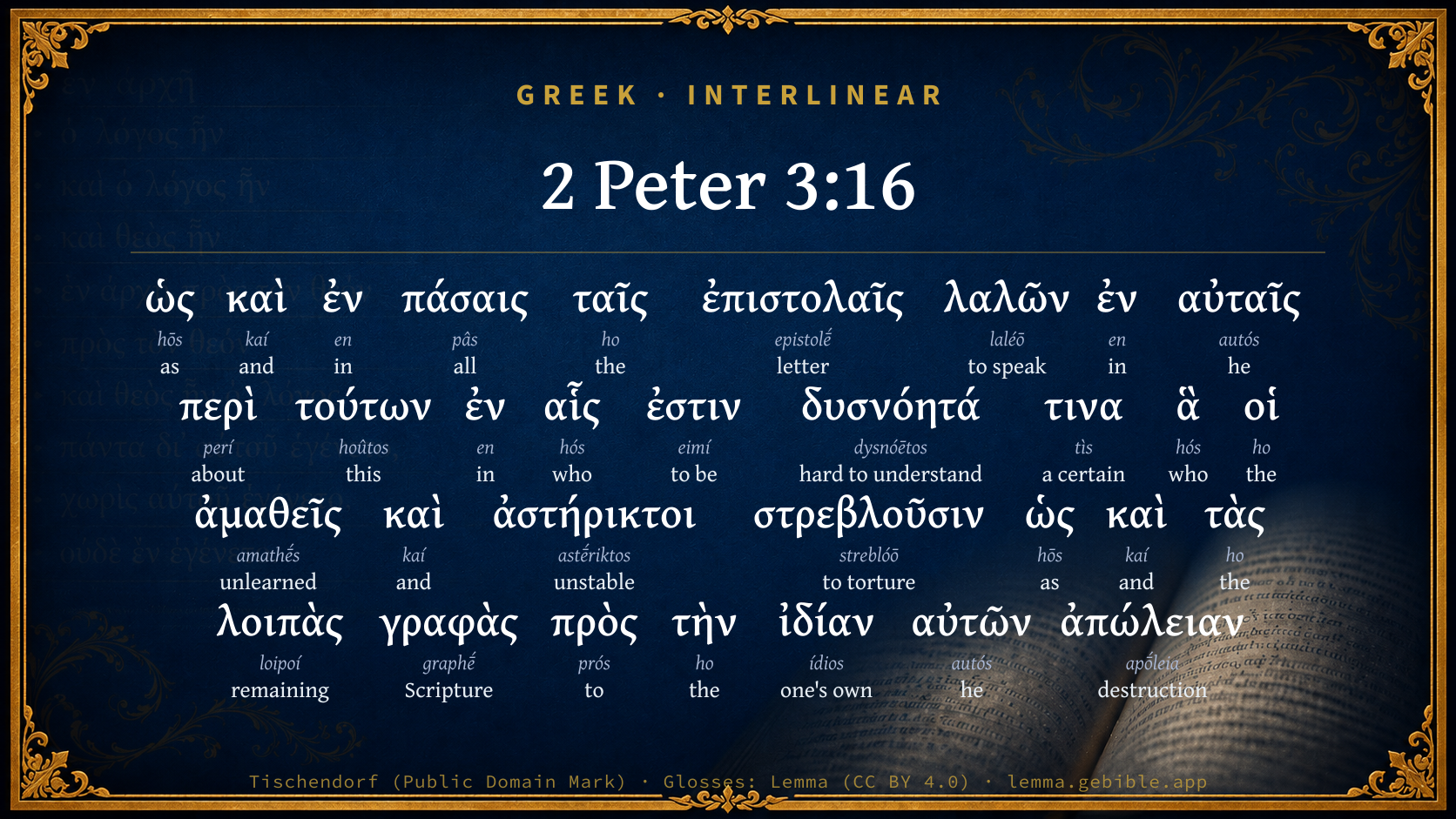
Download image
Cite this verse

2 Peter 3:16 (World English Bible). Public Domain. Lemma interlinear Bible study tool, https://lemma.gebible.app/v/2-peter/3/16.

Show BibTeX & RIS
BibTeX
RIS
English Translation
as also in all of his letters, speaking in them of these things. In those are some things hard to be understood, which the ignorant and unsettled twist, as they also do to the other Scriptures, to their own destruction.
World English Bible · Public Domain
Highlights
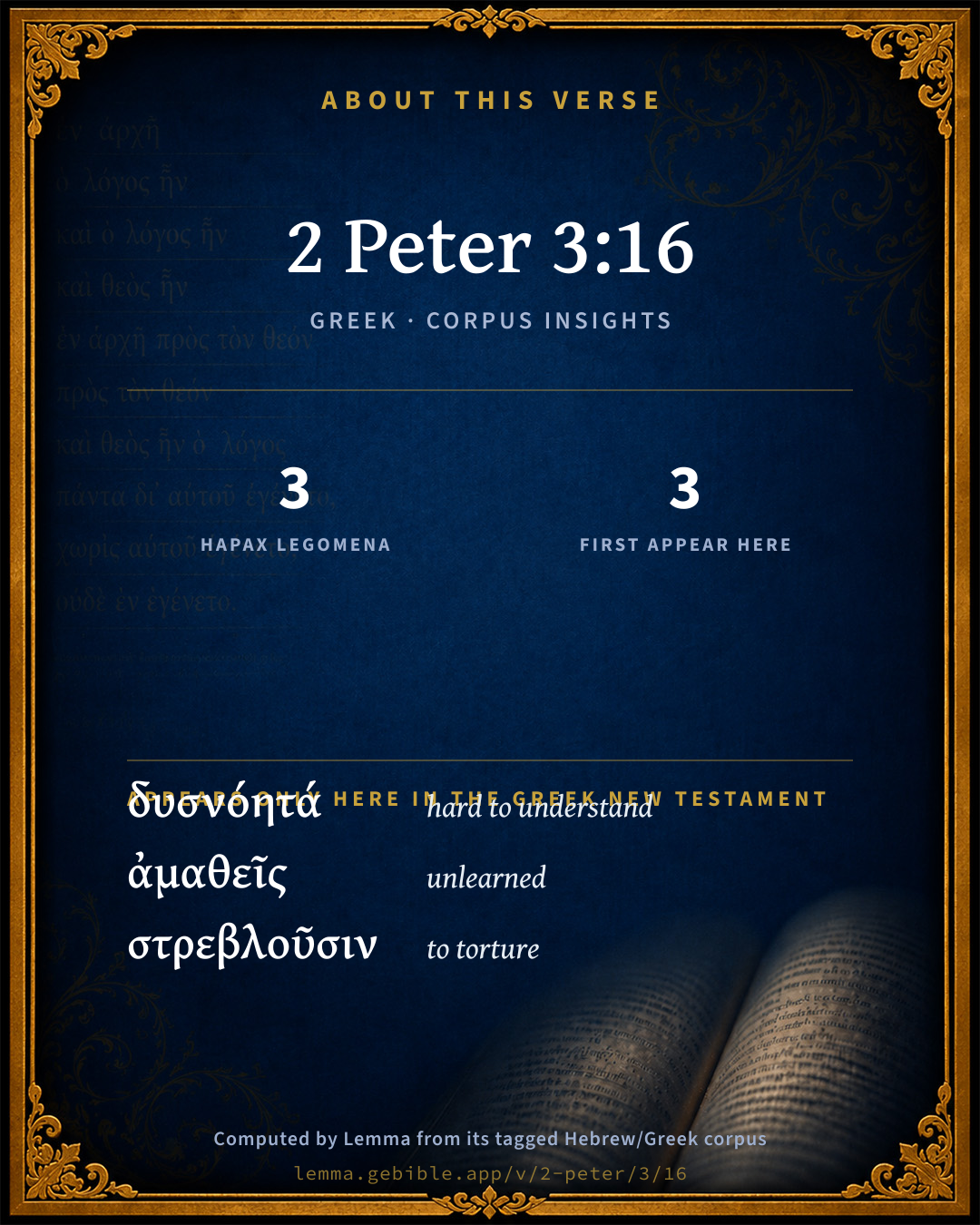
  • 3 hapax legomena — only here in the Greek New Testament
  • 3 first appearances in the Greek New Testament
Full analysis ↓
Download a study sheet

One document with this verse’s original text, its word-by-word gloss line, the meaning frame, cross-references with their text, attributed commentary, and full source and license credits — printable, and it pastes into notes with its structure intact.

This verse Autodidact and up

Study sheet (.html) Plain text (.txt)

A passage Seminary Student

Up to 50 verses in one chapter. A passage sheet keeps up to 6 commentary sources and 12 cross-references per verse, in the order this page ranks them, and says so on the sheet whenever that leaves anything out. Ask for a single verse and you get the Autodidact verse sheet above.

Everything on this page stays free to read, with no account — the sheet is a download of what is already on screen, not access to it.

Want to remove ads? Support Godless Engineer
Compare translations 3

The same verse in 3 English versions, stacked beneath the original-language interlinear above. Click any original word for its lexicon entry.

Each is an independent rendering of the whole verse — the interlinear is not word-aligned to these translations.

Highlighted words mark where these versions differ — a whole-verse word diff, not a word-by-word alignment.

  • World English Bible Public Domain
    as also in all of his letters, speaking in them of these things. In those are some things hard to be understood, which the ignorant and unsettled twist, as they also do to the other Scriptures, to their own destruction.
  • King James Version Public Domain
    As also in all his epistles, speaking in them of these things; in which are some things hard to be understood, which they that are unlearned and unstable wrest, as they do also the other scriptures, unto their own destruction.
  • unfoldingWord Literal Text CC BY-SA 4.0
    as also in all the letters, speaking in them about these things, in which are some difficult to understand things, which the ignorant and unstable distort, as also the other scriptures, to their own destruction.

unfoldingWord Literal Text — © unfoldingWord, licensed CC BY-SA 4.0. Word-aligned USFM3 via Door43 (git.door43.org/unfoldingWord/en_ult).

Versions to compare (up to 4)

3 of 4 selected

Show all 19 translations

Every available English version of this verse, each an independent rendering of the whole verse.

  • World English Bible Public Domain
    as also in all of his letters, speaking in them of these things. In those are some things hard to be understood, which the ignorant and unsettled twist, as they also do to the other Scriptures, to their own destruction.
  • Berean Standard Bible Public Domain
    He writes this way in all his letters, speaking in them about such matters. Some parts of his letters are hard to understand, which ignorant and unstable people distort, as they do the rest of the Scriptures, to their own destruction.
  • Majority Standard Bible Public Domain
    He writes this way in all his letters, speaking in them about such matters. Some parts of his letters are hard to understand, which ignorant and unstable people distort, as they do the rest of the Scriptures, to their own destruction.
  • King James Version Public Domain
    As also in all his epistles, speaking in them of these things; in which are some things hard to be understood, which they that are unlearned and unstable wrest, as they do also the other scriptures, unto their own destruction.
  • American Standard Version (1901) Public Domain
    as also in all `his' epistles, speaking in them of these things; wherein are some things hard to be understood, which the ignorant and unstedfast wrest, as `they do' also the other scriptures, unto their own destruction.
  • Revised Version (1885) Public Domain
    as also in all his epistles, speaking in them of these things; wherein are some things hard to be understood, which the ignorant and unstedfast wrest, as they do also the other scriptures, unto their own destruction.
  • Geneva Bible (1599) Public Domain
    As one, that in all his Epistles speaketh of these thinges: among the which some thinges are hard to be vnderstand, which they that are vnlearned and vnstable, wrest, as they do also other Scriptures vnto their owne destruction.
  • Douay-Rheims (1899) Public Domain
    As also in all his epistles, speaking in them of these things; in which are certain things hard to be understood, which the unlearned and unstable wrest, as they do also the other scriptures, to their own destruction.
  • Young's Literal Translation Public Domain
    as also in all the epistles, speaking in them concerning these things, among which things are certain hard to be understood, which the untaught and unstable do wrest, as also the other Writings, unto their own destruction.
  • Literal Standard Version CC BY-SA 4.0
    as also in all the letters, speaking in them concerning these things, among which are some things [that are] hard to be understood, which the untaught and unstable twist, as also the other Writings, to their own destruction.
  • Unlocked Literal Bible CC BY-SA 4.0
    Paul speaks of these things in all his letters, in which there are things that are difficult to understand. Ignorant and unstable men distort these things, as they also do the other scriptures, to their own destruction.
  • unfoldingWord Literal Text CC BY-SA 4.0
    as also in all the letters, speaking in them about these things, in which are some difficult to understand things, which the ignorant and unstable distort, as also the other scriptures, to their own destruction.
  • Darby Bible Public Domain
    as also in all [his] epistles, speaking in them of these things; among which some things are hard to be understood, which the untaught and ill-established wrest, as also the other scriptures, to their own destruction.
  • World Messianic Bible Public Domain
    as also in all of his letters, speaking in them of these things. In those, there are some things that are hard to understand, which the ignorant and unsettled twist, as they also do to the other Scriptures, to their own destruction.
  • Webster's Bible Public Domain
    As also in all his epistles, speaking in them of these things; in which are some things hard to be understood, which they that are unlearned and unstable wrest, as they do also the other scriptures, to their own destruction.
  • Free Bible Version CC BY-SA 4.0
    He spoke about these things, though some of what he wrote is certainly hard to understand. Some ignorant and unbalanced people have twisted what he wrote to their own loss—just as they do other scriptures.
  • Bible in Basic English Public Domain
    And as he said in all his letters, which had to do with these things; in which are some hard sayings, so that, like the rest of the holy Writings, they are twisted by those who are uncertain and without knowledge, to the destruction of their souls.
  • Text-Critical English NT CC BY 4.0
    He speaks about these things in all his letters. Some of the things he says are hard to understand, which ignorant and unstable people twist to their own destruction, just as they do with the other Scriptures.
  • Tyndale New Testament (1534) Public Domain
    yee almost in very pistle speakynge of soche thynges: amonge which are many thynges harde to be vnderstonde which they that are vnlearned and vnstable pervert as they do other scriptures vnto their awne destruccion.

Literal Standard Version (2020), Covenant Press — licensed CC BY-SA 4.0. Text via the HelloAO Bible API (eBible.org). Unlocked Literal Bible (unfoldingWord) — licensed CC BY-SA 4.0. Text via the HelloAO Bible API (eBible.org). unfoldingWord Literal Text — © unfoldingWord, licensed CC BY-SA 4.0. Word-aligned USFM3 via Door43 (git.door43.org/unfoldingWord/en_ult). Free Bible Version, Dr. Jonathan Gallagher — licensed CC BY-SA 4.0. Text via the HelloAO Bible API (eBible.org).

Word by word

More ways to search: Search by grammar → Find every occurrence → Compare this word →

Practice this passage: Drill this verse → Learn its vocabulary →

δυσνόητά
dysnóētos
G1425
“hard to understand”
Adjective, Nominative, Plural, Neuter
Part of Speech
Adjective
Case
Nominative
Number
Plural
Gender
Neuter
Full Thayer's Definition

Origin: from G1418 and a derivative of G3539

TDNT: 20:03,6

1. hard to be understood
  1. ὡς hōs G5613 “as” Adverb
  2. καὶ kaí G2532 “and” Conjunction
  3. ἐν en G1722 “in” Preposition
  4. πάσαις pâs G3956 “all” Adjective, Dative, Plural, Feminine
  5. ταῖς ho G3588 “the” Article, Dative, Plural, Feminine
  6. ἐπιστολαῖς epistolḗ G1992 “letter” Noun, Dative, Plural, Feminine
  7. λαλῶν laléō G2980 “to speak” Verb, Present, Active, Participle, Nominative, Singular, Masculine
  8. ἐν en G1722 “in” Preposition
  9. αὐταῖς autós G846 “he” Personal pronoun, Dative, Plural, Feminine
  10. περὶ perí G4012 “about” Preposition
  11. τούτων hoûtos G3778 “this” Demonstrative pronoun, Genitive, Plural, Neuter
  12. ἐν en G1722 “in” Preposition
  13. αἷς hós G3739 “who” Relative pronoun, Dative, Plural, Feminine
  14. ἐστιν eimí G1510 “to be” Verb, Present, Active, Indicative, 3rd person, Singular
  15. τινα tìs G5100 “a certain” Indefinite pronoun, Nominative, Plural, Neuter
  16. ἃ hós G3739 “who” Relative pronoun, Accusative, Plural, Neuter
  17. οἱ ho G3588 “the” Article, Nominative, Plural, Masculine
  18. ἀμαθεῖς amathḗs G261 “unlearned” Adjective, Nominative, Plural, Masculine
  19. καὶ kaí G2532 “and” Conjunction
  20. ἀστήρικτοι astḗriktos G793 “unstable” Adjective, Nominative, Plural, Masculine
  21. στρεβλοῦσιν streblóō G4761 “to torture” Verb, Present, Active, Indicative, 3rd person, Plural
  22. ὡς hōs G5613 “as” Adverb
  23. καὶ kaí G2532 “and” Conjunction
  24. τὰς ho G3588 “the” Article, Accusative, Plural, Feminine
  25. λοιπὰς loipoí G3062 “remaining” Adjective, Accusative, Plural, Feminine
  26. γραφὰς graphḗ G1124 “Scripture” Noun, Accusative, Plural, Feminine
  27. πρὸς prós G4314 “to” Preposition
  28. τὴν ho G3588 “the” Article, Accusative, Singular, Feminine
  29. ἰδίαν ídios G2398 “one's own” Adjective, Accusative, Singular, Feminine
  30. αὐτῶν autós G846 “he” Personal pronoun, Genitive, Plural, Masculine
  31. ἀπώλειαν apṓleia G684 “destruction” Noun, Accusative, Singular, Feminine

About this verse

These counts appear in no published source. They are computed here, from the morphology-tagged text and Lemma’s own curated glosses. What Lemma adds →

32
words
22
distinct lemmas
General Epistles
section

Notable vocabulary

3 hapax legomena — words that appear only here in the entire Greek New Testament:

  • δυσνόητά hard to understand G1425
  • ἀμαθεῖς unlearned G261
  • στρεβλοῦσιν to torture G4761

First appearance in Scripture

These words make their first canonical appearance in the Greek New Testament here:

  • δυσνόητά hard to understand G1425
  • ἀμαθεῖς unlearned G261
  • στρεβλοῦσιν to torture G4761

Shared distinctive vocabulary

ἀστήρικτοι unstable G793 occurs in 2 verses of the Greek New Testament. Also found in:
Repetition

Words recur within this verse:

Cross-references

23

Topical passages linked to 2 Peter 3:16 in the Treasury of Scripture Knowledge — connected by theme and wording, ordered by reader-vote popularity; previews shown in the World English Bible.

  • Matthew 15:6 he shall not honor his father or mother.' You have made the commandment of God void because of your tradition.
  • Hebrews 5:11 About him we have many words to say, and hard to interpret, seeing you have become dull of hearing.
  • Philippians 3:19 whose end is destruction, whose god is the belly, and whose glory is in their shame, who think about earthly things.
  • James 1:8 He is a double-minded man, unstable in all his ways.
  • 2 Peter 2:14 having eyes full of adultery, and who can't cease from sin; enticing unsettled souls; having a heart trained in greed; children of cursing;
  • Jeremiah 23:36 The burden of Yahweh shall you mention no more: for every man's own word shall be his burden; for you have perverted the words of the living God, of Yahweh of Hosts our God.
  • Matthew 22:29 But Jesus answered them, "You are mistaken, not knowing the Scriptures, nor the power of God.
  • Romans 8:1–39 There is therefore now no condemnation to those who are in Christ Jesus, who don't walk according to the flesh, but according to the Spirit.
  • Psalms 56:5 All day long they twist my words. All their thoughts are against me for evil.
  • Habakkuk 1:4 Therefore the law is paralyzed, and justice never goes forth; for the wicked surround the righteous; therefore justice goes forth perverted.
  • Matthew 15:3 He answered them, "Why do you also disobey the commandment of God because of your tradition?
  • 2 Timothy 3:5–7 holding a form of godliness, but having denied the power thereof. Turn away from these, also.
  • 1 Peter 2:8 and, "A stone of stumbling, and a rock of offense." For they stumble at the word, being disobedient, whereunto also they were appointed.
  • 2 Peter 2:1 But there also arose false prophets among the people, as among you also there will be false teachers, who will secretly bring in destructive heresies, denying even the Master who bought them, bringing on themselves swift destruction.
  • Jude 1:4 For there are certain men who crept in secretly, even those who were long ago written about for this condemnation: ungodly men, turning the grace of our God into lasciviousness, and denying our only Master, God, and Lord, Jesus Christ.
  • 2 Kings 1:1–18 Moab rebelled against Israel after the death of Ahab.
  • 1 Corinthians 15:1–58 Now I declare to you, brothers, the Gospel which I preached to you, which also you received, in which you also stand,
  • 1 Thessalonians 4:1–5 Finally then, brothers, we beg and exhort you in the Lord Jesus, that as you received from us how you ought to walk and to please God, that you abound more and more.
  • Genesis 49:4 Boiling over as water, you shall not have the pre-eminence; Because you went up to your father's bed; Then defiled it. He went up to my couch.
  • Exodus 23:2 You shall not follow a crowd to do evil; neither shall you testify in court to side with a multitude to pervert justice;
  • Deuteronomy 16:19 You shall not wrest justice: you shall not respect persons; neither shall you take a bribe; for a bribe does blind the eyes of the wise, and pervert the words of the righteous.
  • 1 Kings 10:1 When the queen of Sheba heard of the fame of Solomon concerning the name of Yahweh, she came to prove him with hard questions.
  • 1 Peter 1:1 Peter, an apostle of Jesus Christ, to the chosen ones who are living as strangers in the Dispersion in Pontus, Galatia, Cappadocia, Asia, and Bithynia,

Cross-references courtesy of OpenBible.info (CC BY 4.0).

Commentary

Notes on 2 Peter 3:16 from classic Christian and Jewish commentators (each source and its license shown beneath its notes). The classic Christian expositions comment on the surrounding passage and are grouped to its opening verse, so a note may address several verses; the Jewish commentaries on the Tanakh (Rashi and others) are per-verse, so they appear only where the commentator wrote on this verse.

Lemma curates 59 commentaries, every one of them public domain or Creative Commons licensed, each selected and text-cleaned for this edition rather than reprinted as found. About our sources →

The Cambridge Bible for Schools and Colleges

gen. ed. J. J. S. Perowne

16. as also in all his epistles] The English represents the Greek accurately enough, but the absence of the article in the original should be noted as shewing that there was not yet any complete collection of St Paul’s Epistles. All that can be legitimately inferred from the expression is that St Peter knew of other Epistles (probably 1 and 2 Thessalonians , 1 and 2 Cor., and Romans) besides those—or that—to which he had referred in the preceding verse.

speaking in them of these things] i.e. of the coming of the Lord and of the end of the world. Here, on the assumption made in the previous verse, we may find a reference, as to 1Th_4:5 and 2 Thessalonians 2; so also to Rom_8:19-21; Rom_13:11-12; 1Co_3:13; 1Co_4:5; 1Co_15:51-54.

in which are some things hard to be understood] We are left to conjecture what these were. We might think of the mysterious predictions of “the man of sin” in 2 Thessalonians 2, or the doctrine of the “spiritual body” in 1Co_15:44, 2Co_5:1-4, but it is not easy to see how these elements of St Paul’s teaching could have been perverted to the destruction of men’s spiritual life. On the whole, therefore, it seems more likely that the Apostle finds in the “unlearned and unstable” the party of license in the Apostolic Church, who claimed to be following St Paul’s assertion of his freedom, by eating things sacrificed to idols and indulging in sins of impurity (see note on chap. 2Pe_2:19), or who quoted his words “that a man is justified by faith without the deeds of the law” (Rom_3:28) as sanctioning a profligate Antinomianism.

which they that are unlearned and unstable wrest …] Both words are peculiar to this Epistle in the New Testament. The latter had been used in chap. 2Pe_2:14. The word for “wrest” expresses the action of a windlass that twists what is submitted to its action.

as they do also the other scriptures] Few passages are more important than this in its bearing on the growth of the Canon of the New Testament. It shews (1) that the distinctive term of honour used of the books of the Old Testament was applied without reserve to St Paul’s writings; (2) that probably other books now found in the Canon were also so recognised. The last inference, though it might be said that the “other Scriptures”did not necessarily mean other writings than those of the Old Testament Canon, is confirmed (1) by the use of the term “Scripture” as connected with a quotation from Luk_10:7 in 1Ti_5:18; (2) by St Paul’s reference to “prophetic writings” or “Scriptures” as unfolding the mystery which had been hid from ages and generations in Rom_16:26, and probably by the tests which he gives in 2Ti_3:16 as the notes by which “every inspired Scripture, or writing,” might be distinguished from its counterfeit. See notes bearing on this subject on 1Pe_1:10-12; 1Pe_4:11; 2Pe_1:20-21.

The Cambridge Bible for Schools and Colleges (gen. ed. J. J. S. Perowne; Cambridge University Press, 1878–1918) — public domain. Text from a community e-Sword module.

Joseph Benson's Commentary

2Pe 3:16. As also in all his epistles — From this it appears that Peter had read Paul’s epistles; and, as he speaks not of some but of all of them, it is probable that Paul was dead when St. Peter wrote this, namely, a little before his martyrdom, as appears from 2Pe 1:14. And seeing that Paul, in his epistle to the Rom 2:4, and to the Heb 10:36; Heb 10:38, wrote that the long-suffering of God was intended for salvation, by mentioning that circumstance, Peter intimated that he knew Paul to be the author of the epistles to the Romans, and to the Hebrews. Speaking in them of these things — Paul, in all his epistles, hath spoken of the things written by Peter in this letter. For example: he hath spoken of Christ’s coming to judgment, 1Th 3:13; 1Th 4:14-18; 2Th 1:7-10; Tit 2:13; and of the resurrection from the dead, 1Co 15:22; Php 3:20-21; and of the burning of the earth, 2Th 1:8; and of the heavenly country, 2Co 5:1-10; and of the introduction of the righteous into that country, 1Th 4:17; Heb 4:9; Heb 12:14-24; and of the judgment of all mankind by Christ. In which are some things hard to be understood — According to the greatest number of MSS. the apostle does not say, εν αις, in which epistles, but εν οις, in or among which things; namely, the things which Paul had written concerning Christ’s coming to judgment, the burning of the earth, the heavenly country, and the introduction of the righteous into that country. The Alexandrian, however, and six other MSS. read here, εν αις, in which epistles. This, Beza says, is the true reading, because he thinks it would have been improper in Peter to say that Paul had written obscure ly concerning subjects of which Peter himself had written more things hard to be understood than any Paul had written in any part of his epistles, Nevertheless “the common reading may be retained, because the antecedent to the neuter relative, οις, may be a word not expressed, but understood, namely, γραμμασι, which signifies letters or epistles, Act 28:21. On this supposition Peter’s meaning will be, In which epistles there are some things hard to be understood.” Barclay, in his Apology, explains this of the 9th chapter of Paul’s epistle to the Romans, in which there are some things that seem to be contrary to God’s long-suffering to all, and which are very liable to be perniciously wrested; which they that are unlearned — Who are not taught of God, or are unteachable, as Estius translates the word αμαθεις, here used; namely, persons whose passions blind their understanding, and make them averse to the truth, or whose prejudices, indispose them to admit it: and the unstable — The wavering, unsettled, double-minded, or men of two minds, as St. James’s word, διψυχοι, signifies; who have no real, steady love of piety, but sometimes follow it, sometimes desert it, as good or bad inclinations happen to predominate in them. Whereas the stable are those who have a firm, unshaken, and warm attachment to the religion of Jesus: wrest — “The original word, στρεβλουσιν, signifies to put a person to the torture, to make him confess some crime laid to his charge, or reveal some secret which he knows. Applied to writings it signifies, by far-fetched criticisms and unsupported senses of words, to make a passage speak a meaning different from what the author intended. Hence in our language we have the expression, to torture words. Of this vice they are most commonly guilty who, from pride of understanding, will receive nothing but what they can explain. Whereas, the humble and teachable receive the declarations of revelation according to their plain, grammatical, unconstrained meaning, which it is their only care to attain, by reading the Scriptures frequently and with attention.” — Macknight. As they do also the other scriptures — In this clause Peter expressly acknowledges Paul’s epistles to be a part of the Scriptures, and therefore to have been written by divine inspiration. The affection with which Peter on this occasion speaks of Paul, and the honourable testimony which he bears to his writings, deserves great praise. He had been formerly rebuked by Paul before the brethren at Antioch for refusing to keep company with the Gentile converts; but if at that time he felt any displeasure at Paul for that rebuke, which we nowhere learn that he did, he had long ago laid it aside, and probably, instead of thinking ill of Paul on that account, had for many years admired him for his bold and steady testimony to the truth.

Joseph Benson's Commentary on the Old and New Testaments (1811–1818) — public domain. Text from a community e-Sword module.

Tyndale Open Study Notes

Tyndale Open Resources

3:16 Peter probably knew of all but one or two of Paul’s letters by this time. Peter’s language implies that he considered the letters of Paul to belong in the category of Scripture.

Tyndale Open Study Notes — © Tyndale Open Resources, licensed CC BY-SA 4.0. Text via the HelloAO Bible API.

Bengel's Gnomon

Johann Albrecht Bengel

2Pe 3:16. Ἐν πάσαις, in all) Peter wrote this epistle very shortly before his own martyrdom and that of Paul. Therefore Paul had written nearly all his epistles long before, even the epistles to those to whom Peter writes. Peter therefore read all the epistles of Paul, which were perhaps sent to him by Paul himself: nor did he take it ill, that Paul had written respecting Peter in such terms as he had to the Galatians, ch. 2. Who can doubt, that the epistles of Paul were, at an early period, collected into one body?—περὶ τούτων, concerning these things) Concerning the coming of the Lord, which is delayed through His long-suffering, but yet is near and sudden, and the things which will happen at His coming and before it. When Paul appeared to delay the day of the Lord to a longer period than the other apostles, there were some who either doubted or denied His coming altogether.—ἐν οἷς, in which things)—δυσνοήτα, hard to be understood. It is one thing to be hard to be understood, and another thing to be beyond the reach of the understanding.—τινὰ) some things, not all.—ἃ) which things, which subjects, and so even the writings of Paul. With this corresponds the expression which follows, “they wrest the Scriptures,” and so even the subjects mentioned in them. The one is to be understood as included with the other.—οἱ ἀμαθεῖς, the unlearned) who are without heavenly learning.—στρεβλοῦσιν) twist, whereas they are straight in themselves. There is an instance, 2Ti 2:18.—τὰς λοιπὰς γραφὰς; the other Scriptures) It follows from this that the epistles of Paul already formed part of the Scriptures. Comp. has written, 2Pe 3:15.—προς, to) so that they seem to agree with the abandoned perception of the wicked.—ἰδίαν, their own) without any injury to St Paul.—ἀπώλειαν, destruction) ch. 2Pe 2:1.

Bengel's Gnomon of the New Testament — English translation (T&T Clark, Edinburgh, 1860) — public domain. Text from a community e-Sword module.

Meyer's Critical & Exegetical Commentary

Heinrich August Wilhelm Meyer

2Pe_3:16. ὡς καὶ ἐν πάσαις [ταῖς] ἐπιστολαῖς] sc. ἔγραψεν. By this adjunct the epistle of Paul, referred to in ἔγραψεν ὑμῖν, is definitely distinguished from his other epistles; but what is true of the former is asserted also of the latter, i.e. that they contain the same exhortations, a statement, however, which is more precisely limited by λαλῶν ἐν αὐταῖς περὶ τούτων. The difference in the reading, that is, whether the article is to be put with πάσαις or not, is of trifling importance for the meaning, since it is unwarranted to suppose that πάσαις ταῖς marks the epistles of Paul as forming a formally completed collection (Wiesinger),the article only showing that the epistles of Paul were already known as such.

λαλῶν ἐν αὐταῖς περὶ τούτων] λαλῶν is not for: ἐν αἷς λαλεῖ (Pott), but it means: when in them (i.e. in his epistles) he speaks of these things. περὶ τούτων can only have the same reference as καθώς, 2Pe_3:15; that is, then, not strictly to the teaching as to the Parousia as such, but chiefly to the exhortation given in 2Pe_3:14 f. (Wiesinger), and what is connected with it.

The remark in what follows alludes to that which occasioned the mention of Pauls epistles.

ἐν οἷς or αἷς ἐστι δυσνόητά τινα] It can hardly be decided which is the true reading: οἷς or αἷς. Schott thinks that for the sense it is immaterial, since, if αἷς be read, the τινά must be limited to the passages where Paul happens to speak περὶ τούτων; and if ἐν οἷς, the reference can be to those things or questions not generally, but only in the way in which they are discussed by Paul. Reiche holds a different view; in his opinion, ἐν οἷς refers to those things in themselves, ἐν αἷς to the epistles generally; this can, however, hardly be correct, for it is scarcely conceivable that the author should let fall a remark closely conjoined with what had gone before, which departs so entirely from the connection of thought. Besides, ἐν αἷς deserves the preference not only on account of the external authorities, but because of the following: ὡς τὰς λοιπὰς γραφάς (Wiesinger, Brückner, Reiche, Hofmann; Schott otherwise.) τινά is generally regarded as the subject, and δυσνόητα as the predicate belonging to it; the position of the words, however, decides that δυσν. τινά must be taken together as subject (Schott, Hofmann). By δυσνόητα must not be understood, with Schott, the things which in themselves are opposed to the human mind, but the expressions in which Paul speaks of them; Steinfass correctly: τινά are words, not objects; for to the things the verb στρεβλοῦσιν is not suited. What the apostle meant can only be gathered from the connection; consequently the reference here cannot be to utterances of the Apostle Paul with respect to the Parousia itself (Schott), and therefore not to any statements of his, such as are to be found in 1Th_4:13 ff.; 1Co_15:12-58. Still less does the connection appear to justify the assumption that the Pauline doctrine of freedom (Wiesinger) is meant. Since, however, Pauls statements with regard to Christian freedom stand in close relation to the final completion of salvation, and the idea of it forms such a characteristic feature of Pauls teaching, which could only too easily be distorted by misunderstanding, it is certainly possible, indeed it is probable, that the author had it chiefly in mind in using this somewhat indefinite expression[105].

ἃ οἱ ἀμαθεῖς καὶ ἀστήρικτοι στρεβλοῦσιν] ἀμαθής, ἅπ. λεγ., according to de Wette, equivalent to unteachable, with the implied idea of stubbornness and of unbelief. This is incorrect, ἀμαθής means only ignorant; no doubt the secondary idea given by de Wette may be connected with this (as in the passages quoted, Joseph. Antiq. i. 4. 1, and iii. 14. 4), but here it is not to be presupposed, since the idea ἀστήρικτος connected with ἀμαθής, although denying strength of faith, does not deny faith itself; with ἀστήρικτοι, cf. chap. 2Pe_2:14. Most interpreters assume that the reference here is to the seducers, the Libertines and deniers of the Parousia formerly mentioned; but as a designation of them the expressions are too weak; chap. 2Pe_2:14, too, is opposed to this (Schott).

στρεβλοῦν, ἅπ. λεγ., strictly: to turn with the στρέβλη. Here it means: to distort the words, i.e. to give them a sense other than they actually have; equivalent to διαστρέφειν (cf. Chrysostom on 2Co_10:8 : οὗτοι πρὸς τὰς οἰκείας διέστρεψαν τὰ ῥήματα ἐννοίας); the word is to be found in another figurative sense in 2Sa_22:27, LXX.

ὡς καὶ τὰς λοιπὰς γραφάς] This addition is somewhat surprising, not only because all more precise statement of the γραφαί referred to is wanting, but because by it στρεβλοῦν, which formerly had reference only to the δυσνόητά τινα in the epistles of Paul, is here extended to entire writings; for to interpret γραφαί by passages of Scripture (de Wette), is arbitrary.

It is very improbable that the reference is to the O. T. Scriptures (Wiesinger, Schott, Steinfass), since the author would certainly have defined them more nearly as such[106] (Brückner); probably, then, other writings are meant, which, at the time of the composition of this epistle, served, like the epistles of Paul, for the instruction and edification of the Christian churches; it is possible, therefore, that these included other writings of the N. T.; but that they were only such, cannot be proved. That the words presuppose a collection of N. T. writings properly so called, is without any reason asserted by de Wette (Brückner).

ΠΡῸς ΤῊΝ ἸΔΊΑΝ ΑὐΤῶΝ ἈΠΏΛΕΙΑΝ] ἸΔΊΑΝ serves to intensify ΑὐΤῶΝ: to their own destruction (cf. chap. 2Pe_2:1); the wresting of Scripture has this consequence, inasmuch as they make use of the distorted expressions, in order to harden themselves in their fleshly lust.

[105] According to Hofmann, it is passages such as Eph_2:5 f., Col_2:1, that are meant, for with these and similar statements the teaching of a Hymenaeus and a Philetus could be combined,that the resurrection was already past, and that no other resurrection than that which takes place in regeneration is to be looked for.This doctrine, combined with the other, that the world of sense has nothing related to God, would produce that justification of immorality predicted in chap. 2.

[106] Although in other parts of the N. T. αἱ γραφαί always means the O. T. Scriptures, still the addition of λοιπαί proves that other Scriptures are here referred to; it would be different were λοιπάς not added.

Meyer — Critical and Exegetical Commentary on the New Testament — English translation by Peter Christie, edited by Frederick Crombie (T&T Clark, 1880) — public domain. Text from a community e-Sword module.

Expositor's Greek Testament

ed. W. Robertson Nicoll

2Pe 3:16 . ὡς καὶ ἐν πάσαις ταῖς ἐπιστολαῖς . This statement implies neither the inclusion of all the epistles that have come down to us, nor the formation of a canon. It is much more natural to take it as referring to a collection of letters made not long after Paul’s death, and read in the churches. The term ὁ ἀγαπητὸς ἡμῶν ἀδελφὸς in 2Pe 3:15 would seem to refer to one whose memory is still quite fresh in the hearts of the readers. λαλῶν ἐν αὐταῖς περὶ τούτων : “where he touches on these subjects” (Mayor), περὶ τούτων indicates a widening of the reference to include Paul’s treatment of the whole question of the Second Coming. The mention of Paul’s name here implies a desire on the part of the writer to show that on this point the Pauline and Petrine teaching are at one. The false teachers founded their Antinomian doctrine on Paul’s teaching about the Grace of God. ἐν αἷς , κ . τ . λ . This clearly involves that a collection of letters is meant. δυσνόητά τινα . “What are the δυσνόητά referred to? “Probably St. Paul’s doctrine of God’s free grace (Rom 3:5-8 ), with his apparent disparagement of the law in Rom 3:20-28 ; Rom 4:15 ; Rom 5:20 ; Rom 6:4 ; Rom 7:4-11 ; his teaching with regard to the πνευματικοὶ , 1Co 1:15 ; with regard to the strong, whom he seems to justify in their neglect of the rule made at the Apostolic Council, as to εἰδωλόθυτα (Act 15:29 ; Rom 14 ; 1Co 8 ; 1Co 10:25 ); as regards the Resurrection in baptism (Rom 6:3-11 ; Col 3:1 ; 1Co 15:12 ); perhaps as regards predestination (Rom 9:11-21 ), and the Parousia (2Th 2 .)” (Mayor). οἱ ἀμαθεῖς καὶ ἀστήρικτοι . ἀμαθής is not used elsewhere in the N.T. It signifies not so much “unlearned” as “uneducated”; a mind untrained and undisciplined in habits of thought, lacking in the moral qualities of a balanced judgment. ἀστήρικτοι refers more to conduct, those whose habits are not fully trained and established. The reference of ἀμ . καὶ ἀστηρ . is of course not to the Libertines, but to a class among the readers. In 2Pe 3:17 στηριγμός is used of the readers, in distinction to the False Teachers, who are called ἀθέσμων . στρεβλοῦσιν : of persons, “to torture,” of things, “to wrest” or “twist”.

ὡς καὶ τὰς λοιπὰς γραφάς . (1) There has been much discussion among commentators as to the meaning of γραφάς . Spitta takes γραφάς in sense of “writings,” and concludes that these were by companions of the Apostle Paul; but this is a very unusual sense of γραφή unless the name of an author is given. Mayor and others interpret as the O.T. Scriptures; while some who are prepared to assign a late date in the second century to the epistle, think that both Old and New Testament Scriptures are meant. On every ground the hypothesis of γραφάς = O.T. Scriptures is to be preferred. (2) The difficulty in connexion with the meaning of γραφάς is largely occasioned by the phrase τὰς λοιπὰς γρ . Does this mean that the Epistles of St. Paul are regarded as Scripture? Attempts have been made ( e.g. , by Dr. Bigg) to cite classical and other parallels that would justify the sense for τὰς λοιπὰς , “the Scriptures as well”. In these, certain idiomatic uses of ἄλλος and other words are referred to, but no real parallel to this sense of λοιπός can be found, and the connexion implied in λοιπός is closer than ἄλλος . The result of the whole discussion is practically to compel us to take τὰς λοιπὰς γραφάς in the obvious sense “the rest of the Scriptures,” and we cannot escape the conclusion that the Epistles of Paul are classed with these. The intention of the author of 2 Peter seems to be to regard the Pauline Epistles, or those of them that he knew, as γραφαὶ because they were read in the churches along with the lessons from the O.T.

The Expositor's Greek Testament, edited by W. Robertson Nicoll (1897–1910) — public domain. Text from a community e-Sword module.

Alford’s Greek Testament

Henry Alford

16.] as also in all (his, but not expressed: with the ταῖς it would mean, in all his Epistles as a finished whole: without it, in all Epistles which he writes, leaving room for the possibility that the number of those Epistles was not complete, but still being added to) Epistles, speaking in them (as he does: the pres. part. contains the justification of the assertion: not as Huther, “when he speaks”) of these things (viz. the coming of our Lord, and the end of the world), in which (Epistles, if αἷς be read: if οἷς, “in which sayings of his:” not, “in which things,” “in which subjects,” as some (e. g. Bengel) have rendered by way of escape from the supposed difficulty: for οἷς is correlative with τὰς λοιπὰς γραφάς, and must therefore designate some writings previously mentioned: or else the sentence is stultified) are some things difficult to understand (De W. especially refers to 2Th 2:1 ff.: and it is not improbable that this may have been particularly in the Apostle’s mind. See note on 2Ti 2:18. Grot. is clearly wrong in extending the list to difficulties about faith and works, &c.), which the ignorant (unintelligent, uninformed: hardly, as De W., with an understood meaning of rebellion and unbelief: for that would be too much here. ἀμαθία may arise from many causes: but the misunderstanding of difficult Scriptures is common to the ἀμαθεῖς in general) and unstable (ref.: those who, wanting firm foundation and anchorage, waver and drift about with every wind of doctrine. Such persons are stirred from their Christian stability by every apparent difficulty: are rendered anxious and perplexed by hard texts: and shewing more anxiety to interpret them somehow, than to wait upon God for their solution, rush upon erroneous and dangerous ways of interpretation) distort (στρεβλόω, properly, to twist with a handscrew or windlass, στρέβλη: σκάφος στρέβλαισι ναυτικαῖς προσηγμένον, Æsch. Suppl. 441. Hence to torment with the στρέβλη: and then met., to distort, pervert, strain, in meaning. Œc. gives for it ἐνδιαστρόφως ἐξαγγέλλειν), as also the other Scriptures (or, passages of Scripture having reference to this great subject: as we have ἑτέρα γραφὴ λέγει Joh 19:37, πᾶσα γραφὴ θεόπνευστος (see note) 2Ti 3:16. Whichever be understood, it is plain, 1. that by these words St. Paul’s Epistles are reckoned among the Christian scriptures: 2. that there were at this time besides those Epistles, other writings holding a similar place, known as γραφαί; probably, at least, the three Gospels (and Acts?), and some of the earlier written catholic Epistles. That by τὰς λοιπὰς γραφάς should be meant the O. T. scriptures, is not probable: these would have been more fully designated than by being placed in the same category with the inspired writings of recent or living men), to (as a contribution to—towards,—so as to help towards) their own perdition (τὴν ἰδίαν αὐτῶν, more strongly reflective than with one of these merely).

17,

Henry Alford, The Greek Testament (1849–1861) — public domain. Text from a community e-Sword module.

Geneva Bible (1599)

Geneva Bible translators

That is to say, among the which things: for he disputeth not here whether Paul’s Epistles be plain or dark, but saith, that amongst those things which Paul hath written of his Epistles, and Peter himself in these two of his own, there are some things which cannot be easily understood, and therefore are of some drawn to their own destruction: and this he saith to make us more attentive and diligent, and not remove us from the reading of holy things, for to what end should they have written vain speculations?

There be certain of these things obscure and dark, whereof the unlearned take occasion to overthrow some men that stand not fast, wrestling the testimonies of the Scripture to their own destruction. But this is the remedy against such deceit, to labor that we may daily more and more grow up and increase in the knowledge of Christ.

Geneva Bible (1599) marginal notes — public domain. Text via Bolls.life.

Jamieson, Fausset & Brown

Robert Jamieson, A. R. Fausset & David Brown

also in all his epistles-- Rom 2:4 is very similar to Pe2 3:15, beginning. The Pauline Epistles were by this time become the common property of all the churches. The "all" seems to imply they were now completed. The subject of the Lord's coming is handled in Th1 4:13; Th1 5:11; compare Pe2 3:10 with Th1 5:2. Still Peter distinguishes Paul's Epistle, or Epistles, "TO YOU," from "all his (other) Epistles," showing that certain definite churches, or particular classes of believers, are meant by "you."

in which--Epistles. The oldest manuscripts read the feminine relative (hais); not as Received Text (hois), "in which things."

some things hard to be understood--namely, in reference to Christ's coming, for example, the statements as to the man of sin and the apostasy, before Christ's coming. "Paul seemed thereby to delay Christ's coming to a longer period than the other apostles, whence some doubted altogether His coming" [BENGEL]. Though there be some things hard to be understood, there are enough besides, plain, easy, and sufficient for perfecting the man of God. "There is scarce anything drawn from the obscure places, but the same in other places may be found most plain" [AUGUSTINE]. It is our own prejudice, foolish expectations, and carnal fancies, that make Scripture difficult [JEREMY TAYLOR].

unlearned--Not those wanting human learning are meant, but those lacking the learning imparted by the Spirit. The humanly learned have been often most deficient in spiritual learning, and have originated many heresies. Compare Ti2 2:23, a different Greek word, "unlearned," literally, "untutored." When religion is studied as a science, nothing is more abstruse; when studied in order to know our duty and practice it, nothing is easier.

unstable--not yet established in what they have learned; shaken by every seeming difficulty; who, in perplexing texts, instead of waiting until God by His Spirit makes them plain in comparing them with other Scriptures, hastily adopt distorted views.

wrest--strain and twist (properly with a hand screw) what is straight in itself (for example, Ti2 2:18).

other scriptures--Paul's Epistles were, therefore, by this time, recognized in the Church, as "Scripture": a term never applied in any of the fifty places where it occurs, save to the Old and New Testament sacred writings. Men in each Church having miraculous discernment of spirits would have prevented any uninspired writing from being put on a par with the Old Testament word of God; the apostles' lives also were providentially prolonged, Paul's and Peter's at least to thirty-four years after Christ's resurrection, John's to thirty years later, so that fraud in the canon is out of question. The three first Gospels and Acts are included in "the other Scriptures," and perhaps all the New Testament books, save John and Revelation, written later.

unto their own destruction--not through Paul's fault (Pe2 2:1).

Jamieson, Fausset & Brown — Commentary Critical and Explanatory on the Whole Bible (1871) — public domain (CC PDM 1.0). Text via the HelloAO Bible API.

Adam Clarke's Commentary

Verse 16. As also in all his epistles, speaking in them of these things] Paul, in all his epistles, says Dr. Macknight, has spoken of the things written by Peter in this letter. For example, he has spoken of Christ's coming to judgment; 1Th 3:13; 1Th 4:14-18; 2Th 1:7-10; Tit 2:13. And of the resurrection of the dead, 1Co 15:22; Phil 3:20-21. And of the burning of the earth; 2Th 1:8. And of the heavenly country; 2Co 5:1-10. And of the introduction of the righteous into that country; 1Th 4:17; Heb 4:9; Heb 12:14; Heb 12:18; Heb 12:24. And of the judgment of all mankind by Christ; Ro 14:10.

In which are some things hard to be understood] δυσνοητα τινα. That is, if we retain the common reading ενοις, in or among which things, viz., what he says of the day of judgment, the resurrection of the body c., c., there are some things difficult to be comprehended, and from which a wrong or false meaning may be taken. But if we take the reading of AB, twelve others, with both the Syriac, all the Arabic, and Theophylact, εναις, the meaning is more general, as εναις must refer to επιστολαις, epistles, for this would intimate that there were difficulties in all the epistles of St. Paul and indeed in what ancient writings are there not difficulties? But the papists say that the decision of all matters relative to the faith is not to be expected from the Scriptures on this very account, but must be received from the Church i.e. the Popish or Romish Church. But what evidence have we that that Church can infallibly solve any of those difficulties? We have none! And till we have an express, unequivocal revelation from heaven that an unerring spirit is given to that Church, I say, for example, to the present Church of Rome, with the pope called Pius VII. at its head, we are not to receive its pretensions. Any Church may pretend the same, or any number of equally learned men as there are of cardinals and pope in the conclave; and, after all, it would be but the opinion of so many men, to which no absolute certainty or infallibility could be attached.

This verse is also made a pretext to deprive the common people of reading the word of God; because the unlearned and unstable have sometimes wrested this word to their own destruction: but if it be human learning, and stability in any system of doctrine, that qualifies men to judge of these difficult things, then we can find many thousands, even in Europe, that have as much learning and stability as the whole college of cardinals, and perhaps ten thousand times more; for that conclave was never very reputable for the learning of its members: and to other learned bodies we may, with as much propriety, look up as infallible guides, as to this conclave.

Besides, as it is only the unlearned and the unestablished (that is, young Christian converts) that are in danger of wresting such portions; the learned, that is, the experienced and the established in the knowledge and life of God, are in no such danger; and to such we may safely go for information: and these abound everywhere, especially in Protestant countries; and by the labours of learned and pious men on the sacred writings there is not one difficulty relative to the things which concern our salvation left unexplained. If the members of the Romish Church have not these advantages, let them go to those who have them; and if their teachers are afraid to trust them to the instruction of the Protestants, then let them who pretend to have infallibly written their exposition of these difficult places, also put them, with a wholesome text in the vulgar language, into the hands of their people, and then the appeal will not lie to Rome, but to the Bible, and those interpretations will be considered according to their worth, being weighed with other scriptures, and the expositions of equally learned and equally infallible men.

We find, lastly, that those who wrest such portions, are those who wrest the other scriptures to their destruction; therefore they are no patterns, nor can such form any precedent for withholding the Scriptures from the common people, most of whom, instead of wresting them to their destruction, would become wise unto salvation by reading them. We may defy the Romish Church to adduce a single instance of any soul that was perverted, destroyed, or damned, by reading of the Bible; and the insinuation that they may is blasphemous. I may just add that the verb στρεβλοω, which the apostle uses here, signifies to distort, to put to the rack, to torture, to overstretch and dislocate the limbs; and hence the persons here intended are those who proceed according to no fair plan of interpretation, but force unnatural and sophistical meanings on the word of God: a practice which the common simple Christian is in no danger of following. I could illustrate this by a multitude of interpretations from popish writers.

Adam Clarke's Commentary on the Bible (1810–1826) — public domain. Text from a community e-Sword/MySword module.

John Calvin's Commentaries

16. In which are some things. The relative which does not refer to epistles, for it is in the neuter gender. The meaning is, that in the things which he wrote there was sometimes an obscurity, which gave occasion to the unlearned to go astray to their own ruin. We are reminded by these words, to reason soberly on things so high and obscure; and further, we are here strengthened against this kind of offense, lest the foolish or absurd speculations of men should disturb us, by which they entangle and distort simple truth, which ought to serve for edification.

But we must observe, that we are not forbidden to read Paul's Epistles, because they contain some things hard and difficult to be understood, but that, on the contrary, they are commended to us, provided we bring a calm and teachable mind. For Peter condemns men who are trifling and volatile, who strangely turn to their own ruin what is useful to all. Nay, he says that this is commonly done as to all the Scripture: and yet he does not hence conclude, that we are not to read it, but only shews, that those vices ought to be corrected which prevent improvement, and not only so, but render deadly to us what God has appointed for our salvation.

It may, however, be asked, Whence is this obscurity, for the Scripture shines to us like a lamp, and guides our steps? To this I reply, that it is nothing to be wondered at, if Peter ascribed obscurity to the mysteries of Christ's kingdom, and especially if we consider how hidden they are to the perception of the flesh. However the mode of teaching which God has adopted, has been so regulated, that all who refuse not to follow the Holy Spirit as their guide, find in the Scripture a clear light. At the same time, many are blind who stumble at mid-day; others are proud, who, wandering through devious paths, and flying over the roughest places, rush headlong into ruin.

John Calvin's Commentaries (1540-1563) — public domain. Text from the Calvin Translation Society English edition (1840s-50s) via the Christian Classics Ethereal Library (ccel.org). Calvin's coverage is partial (roughly two-thirds of the Bible); uncommented books and verses are honest gaps, never fabricated. The 19th-century editor's footnotes and remarks are omitted so the notes are faithfully Calvin's own voice.

Ellicott's Commentary for English Readers

(16) As also in all his epistles.—All those known to the writer. The expression does not necessarily Imply that St. Paul was dead, and that his Epistles had been collected into one volume. That each church made a collection of them as they became known to it, and that in the great centres they became known soon after they were written, are conjectures of great probability.

Speaking in them of these things—viz., of the return of Christ and of the destruction of the world. Some, however, understand the words as meaning the exhortations to holiness here given.

Some things hard to be understood.—Certainly the difficulties with which 2 Thessalonians 2 bristles are well described by this expression, and they relate to the very point in question—the time of Christ’s coming. Moreover, scoffers could easily turn them to account by arguing that “the man of sin” had not yet appeared, and that therefore there was no likelihood of the end of the world coming just yet. But in admitting that 2 Thessalonians 2 is among the passages alluded to here, we are not committed to the theory that 1 and 2 Thess. are alluded to in 2Pe_3:15. Many refer these words to St. Paul’s doctrine of justification by faith as wrested to mean “faith without works.” So, again, Eph_2:5-6, and Col_2:12 might be wrested to mean that “the resurrection is past already” (2Ti_2:18). (See Note on Rom_3:8 respecting perversion of his teaching.)

Unlearned and unstable.—The word for “unlearned” here is not the same as that translated “unlearned” in Act_4:13. (See Note there.) That signifies “without special study;” this means “without ordinary instruction.” Ignorance naturally produces instability; those who have no clear principles of Christian doctrine easily fall victims to seductions of all kinds. (Comp. 2Pe_2:14.)

Wrest.—Literally, torture by means of the rack; and hence “strain,” “distort.” That St. Paul’s doctrine of Christian liberty, as opposed to the bondage of the Law, was seen by himself to be liable to great abuse, and had already begun to be abused, we learn from his own writings (1Co_6:12-20; Gal_5:13-26; where see Notes. Comp. Rev_2:20.)

The other scriptures.—The Old Testament cannot well be meant. St. Peter would scarcely have placed the writings of a contemporary side by side with the Scriptures of the Old Testament (the canon of which had long since been closed) without some intimation of a grouping which at that time must have been novel, and probably was quite unknown. It is much more probable that Christian writings of some kind are intended, but we can only conjecture which, any of the canonical writings of the New Testament then in existence, and perhaps some that are not canonical. That an Apostle should speak of the writings of a brother-Apostle in the same terms as the books of the Old Testament—viz., as Scripture—need not surprise us, especially when we remember the large claims made by St. Paul for his own words (1Th_2:13; 2Th_2:15; Eph_3:3-5. Comp. Act_15:28; Rev_22:18-19). In 1Pe_1:12, Evangelists are almost made superior to the Old Testament Prophets—a statement indicating a view which harmonises well both with 2Pe_1:15-19 and with the view set forth here; for in 2Pe_1:15 he assigns to this Epistle much the same purpose as in 2Pe_1:19 he assigns to the Old Testament Prophets. Moreover, we have seen how Clement of Rome uses the term “Scripture” of a passage which comes from some uncanonical book (see above on 2Pe_3:4). See Introduction, I. c. δ. 4.

Unto their own destruction.—The Greek is very emphatic as to its being “their own.” (Comp. “Bring upon themselves swift destruction,” 2Pe_2:1.) It is their own doing—St. Paul and other writers of Scripture are not to blame; and it befits them—they will find the end they deserve. This passage gives no countenance to the Roman doctrine that all Scripture is hard to understand, and therefore not to be read by the people. All that is here said is that some Scripture is hard to understand, and that bad men make a bad use of the fact. The inference drawn from this by St. Peter is not, “Do not read Scripture,” nor even “Pass over what seems to be hard,” but “Be on your guard against being led astray by interpretations contrary to the spirit of the gospel.”

A Bible Commentary for English Readers, edited by Charles John Ellicott (1878–1897) — public domain. Text from a community e-Sword module.

John Gill's Exposition

As also in all his epistles,.... From whence it appears, that the Apostle Paul had, by this time, wrote several of his epistles, if not all of them; and they were all written according to the same wisdom, and under the influence of the same spirit, as his epistle to the Hebrews:

speaking in them of those things; of the same things, Peter had been speaking of, of the coming of Christ, as that he should appear a second time to them that look for him, and would come as a thief in the night, and that the fashion, scheme, and form of this world should pass away, and that saints should look and wait for his coming, and love it: something of this kind is said in all his epistles; see Heb 9:28; and also of mockers, scoffers, seducers, and wicked men that would arise in the last days; see Ti1 4:1,

in which are some things hard to be understood. The phrase, "in which", refers either to the epistles, or the things spoken in them. The Alexandrian manuscript, and three of Robert Stephens's copies, read , "in which" epistles, but the generality of copies read , "in", or "among which things", spoken of in them, concerning the subject here treated of, the coming of Christ; as the time of Christ's coming, which is sometimes represented by the apostle, as if it would be while he was living; and the manner of his coming in person with all his saints, and his mighty angels, with a shout, the voice of the archangel, and trump of God, things not easily understood; and the destruction of antichrist at his coming, which will be with the breath of his mouth, and the brightness of his coming; as also the resurrection of the dead, of the saints that will rise first, and that with spiritual bodies; and likewise the change of the living saints, and the rapture both of living and raised saints together, in the, clouds, to meet the Lord in the air; and the standing of them before the judgment seat of Christ, and the account that everyone must give to him, Th1 4:15 Co1 15:44;

which they that are unlearned; untaught of God, who have never learned of the Father, nor have learned Christ, nor have that anointing which teacheth all things; who, though they may have been in the schools of men, were never in the school of Christ; and though they have been ever learning, yet will never come to the knowledge of the truth; for men may have a large share of human literature, and yet be unlearned men in the sense of the apostle; and very often it is, that such wrest and pervert the Scriptures to the ruin of themselves, and others:

and unstable; unsettled in their principles, who are like children tossed to and fro with every wind of doctrine; the root of the matter is not in them; nor are they rooted and built up in Christ, and so are not established in the faith; they are not upon the foundation Christ, nor do they build upon, and abide by the sure word of God, or form their notions according to it, but according to their own carnal reasonings, and fleshly lusts; and so

wrest the word of God, distort it from its true sense and meaning, and make it speak that which it never designed; dealing with it as innocent persons are sometimes used, put upon a rack, and tortured, and so forced to speak what is contrary to their knowledge and consciences; and so were the words of the Apostle Paul wrested by ill designing men, as about the doctrines of grace and works, so concerning the coming of Christ; see Rom 3:8;

as they do also the other Scriptures; the writings of Moses, and the prophets of the Old Testament, the Gospels, the Acts of the Apostles, and the other epistles of the apostles of the New Testament: and which is eventually

unto their own destruction; for by so doing they either add unto, or detract from the Scriptures, and so bring the curse of God upon them; and they give into doctrines of devils, and into heresies, which are damnable, and bring upon themselves swift destruction, which lingers not, and slumbers not. Now from hence it does not follow, that the Scriptures are not to be read by the common people; for not all the parts of Scripture, and all things in it, are hard to be understood, there are many things very plain and easy, even everything respecting eternal salvation; there is milk for babes, as well as meat for strong men: besides, not the Scriptures in general, but Paul's epistles only, are here spoken of, and not all of them, or anyone whole epistle among them, only some things in them, and these not impossible, only difficult to be understood; and which is no reason why they should be laid aside, but rather why they should be read with greater application and diligence, and be followed with fervent prayer, and frequent meditation; and though unlearned and unstable men may wrest them to their perdition, those that are taught of God, though otherwise illiterate, may read them to great profit and advantage.

John Gill's Exposition of the Whole Bible (1746–1763) — public domain (CC PDM 1.0). Text via the HelloAO Bible API.

Trapp's Complete Commentary

John Trapp

16 As also in all his epistles, speaking in them of these things; in which are some things hard to be understood, which they that are unlearned and unstable wrest, as they do also the other scriptures, unto their own destruction.

Ver. 16. Hard to be understood] See my True Treasure. In things necessary the Scripture is plain and easy; and the very entrance thereinto giveth light, saith David, Psa 119:30; yea, subtilty and sagacity, saith Solomon, Pro 1:4. And for the more dark and difficult places, Legum obscuritates non assignemus culpae scribentium, sed inscitiae non assequentium, saith he in Gellius, the fault is not to be laid upon the Scriptures, but upon our uuskilfulness and inability to understand them.

Which they that are unlearned and unstable] That for want of sacred learning are unsettled, ill-bottomed; and do therefore, like Peter on the water, walk one step and sink another. Our forefathers (saith Speed out of Walsingham) did not without great reason distinguish the people into learned and lewd; because such are commonly lewd who are not learned. Sure we are out of this text, that they are unstable that are unlearned; and that men therefore err because they know not the Scriptures in the right sense of them, Mat 2:2; they err in heart because they know not God’s ways, and become a prey to seducers, because "ever learning, but never come to the knowledge of the truth," 2Ti 3:7; "The simple believeth every word," saith Solomon, Pro 14:1. The blind man swalloweth many a fly, saith our English proverb. The god of this world blinds the minds of his vassals, keeps them ignorant, and then doth what he will with them, as the Philistines did with Samson when they had digged out his eyes. He useth the same method ordinarily to carry on his designs, that he took in the Parlamentum iudoctum, the lack learning Parliament, held here A. D. 1404, in the reign of Henry IV (Speed, 775); or as in the Council of Ariminum. The Arians have procured the exile of the orthodox learned bishops, and perceiving the company that was left, though they were very unlearned, yet they would not be persuaded directly to disannul anything that had been before concluded in the Council of Nice, did abuse their ignorance in proposing the matter, and drawing them to their side. For they demanded of them whether they would worship ομοουσιον, or Christ? These not understanding the Greek word, rejected it with execration, being, as they thought, opposed unto Christ, (Ruffin. Eccles. Hist. lib. x.)

Wrest, as they do, &c.] When we strive to give unto the Scriptures, and not to receive from it the sense, when we factiously contend to fasten our conceits on God, like the harlot, take our dead and putrefied fancies, and lay them in the bosom of the Scriptures, as of a mother, when we compel them to go two miles which of themselves would go but one, when we put words into the mouths of these oracles by mis-inferences or mis-applications, then are we guilty of this sin of wresting the Scriptures. Tertullian speaketh of some that murder the Scriptures to serve their own purposes. And the same author fitly calleth Marcion, the heretic, Murem Ponticum, the rat of Pontus, because of his gnawing and tawing the Scripture to make it serviceable to his errors ( Caedem Scripturarum faciunt); this is a very dangerous sin, when men shall writhe the Scripture, and set it on the tenters to fit it to their fancies, as Scyron and Procrustes are said to have fitted their guests to the bed of brass which they had framed to their own size.

John Trapp, A Commentary or Exposition upon All the Books of the Old and New Testament (1647–1656) — public domain. Text from a community e-Sword module.

Albert Barnes' Notes on the Bible

As also in all his epistles - Not only in those which he addressed to the churches in Asia Minor, but in his epistles generally. It is to be presumed that they might have had an acquaintance with some of the other epistles of Paul, as well as those sent to the churches in their immediate vicinity.

Speaking in them of these things - The things which Peter had dwelt upon in his two epistles. The great doctrines of the cross; of the depravity of man; of the divine purposes; of the new birth; of the consummation of all things; of the return of the Saviour to judge the world, and to receive his people to himself; the duty of a serious, devout and prayerful life, and of being prepared for the heavenly world. These things are constantly dwelt upon by Paul, and to his authority in these respects Peter might appeal with the utmost confidence.

In which - The common reading in this passage is ἐν οἷς en hois, and according to this the reference is to the “subjects” treated of - “in which things” - referring to what he had just spoken of - “speaking of these things.” This reading is found in the common editions of the New Testament, and is supported by far the greater number of mss., and by most commentators and critics. It is found in Griesbach, Tittman, and Hahn, and has every evidence of being the genuine reading. Another reading, however, (ἐν αἷς en hais,) is found in some valuable mss., and is supported by the Syriac and Arabic versions, and adopted by Mill (Prolegomena 1484), and by Beza. According to this, the reference is to the “epistles” themselves - as would seem to be implied in our common version. The true construction, so far as the evidence goes, is to refer it not directly to the “epistles,” but to the “things” of which Peter says Paul wrote; that is, not to the style and language of Paul, but to the great truths and doctrines which he taught. Those doctrines were indeed contained in his epistles, but still, according to the fair construction of the passage before us, Peter should not be understood as accusing Paul of obscurity of style. He refers not to the difficulty of understanding what Paul meant, but to the difficulty of comprehending the great truths which he taught. This is, generally, the greatest difficulty in regard to the statements of Paul. The difficulty is not that the meaning of the writer is not plain, but it is either:

(a)That the mind is overpowered by the grandeur of the thought, and the incomprehensible nature of the theme, or

(b)That the truth is so unpalatable, and the mind is so prejudiced against it, that we are unwilling to receive it.

Many a man knows well enough what Paul means, and would receive his doctrines without hesitation if the heart was not opposed to it; and in this state of mind Paul is charged with obscurity, when the real difficulty lies only in the heart of him who makes the complaint. If this be the true interpretation of this passage, then it should not be adduced to prove that Paul is an obscure writer, whatever may be true on that point. There are, undoubtedly, obscure things in his writings, as there are in all other ancient compositions, but this passage should not be adduced to prove that he had not the faculty of making himself understood. An honest heart, a willingness to receive the truth, is one of the best qualifications for understanding the writings of Paul; and when this exists, no one will fail to find truth that may be comprehended, and that will be eminently adapted to sanctify and save the soul.

Are some things hard to be understood - Things pertaining to high and difficult subjects, and which are not easy to be comprehended. Peter does not call in question the truth of what Paul had written; he does not intimate that he himself would differ from him His language is rather that which a man would use who regarded the writings to which he referred as true, and what he says here is an honorable testimony to the authority of Paul. It may be added,

(1) That Peter does not say that all the doctrines of the Bible, or even all the doctrines of Paul, are hard to be understood, or that nothing is plain.

(2) He says nothing about withholding the Bible, or even the writings of Paul, from the mass of Christians, on the ground of the difficulty of understanding the Scriptures; nor does he intimate that that was the design of the Author of the Bible.

(3) It is perfectly manifest, from this very passage, that the writings of Paul were in fact in the hands of the people, else how could they wrest and pervert them?

(4) Peter says nothing about an infallible interpreter of any kind, nor does he intimate that either he or his “successors” were authorized to interpret them for the church.

(5) With what propriety can the pretended successor of Peter - the pope - undertake to expound those difficult doctrines in the writings of Paul, when even Peter himself did not undertake it, and when he did not profess to be able to comprehend them? Is the Pope more skilled in the knowledge of divine things than the apostle Peter? Is he better qualified to interpret the sacred writings than an inspired apostle was?

(6) Those portions of the writings of Paul, for anything that appears to the contrary, are just as “hard to be understood” now, as they were before the “infallible” church undertook to explain them. The world is Little indebted to any claims of infallibility in explaining the meaning of the oracles of God. It remains yet to be seen that any portion of the Bible has been made clearer by “any” mere authoritative explanation. And,

(7) It should be added, that without any such exposition, the humble inquirer after truth may find enough in the Bible to guide his feet in the paths of salvation. No one ever approached the sacred Scriptures with a teachable heart, who did not find them “able to make him wise unto salvation.” Compare the notes at 2Ti 3:15.

Which they that are unlearned - The evil here adverted to is that which arises in cases where those without competent knowledge undertake to become expounders of the word of God. It is not said that it is not proper for them to attempt to become instructed by the aid of the sacred writings; but the danger is, that without proper views of interpretation, of language, and of ancient customs, they might be in danger of perverting and abusing certain portions of the writings of Paul. Intelligence among the people is everywhere in the Bible presumed to be proper in understanding the sacred Scriptures; and ignorance may produce the same effects in interpreting the Bible which it will produce in interpreting other writings. Every good thing is liable to abuse; but the proper way to correct this evil, and to remove this danger, is not to keep the people in ignorance, or to appoint some one to be an infallible interpreter; it is to remove the ignorance itself by enlightening the people, and rendering them better qualified to understand the sacred oracles. The way to remove error is not to perpetuate ignorance it is to enlighten the mind, so that it may be qualified to appreciate the truth.

And unstable - Who have no settled principles and views. The evil here adverted to is that which arises where those undertake to interpret the Bible who have no established principles. They regard nothing as settled. They have no landmarks set up to guide their inquiries. They have no stability in their character, and of course nothing can be regarded as settled in their methods of interpreting the Bible. They are under the control of feeling and emotion, and are liable to embrace one opinion to-day, and another directly opposite to-morrow. But the way to prevent This evil is not by attempting to give to a community an authoritative interpretation of the Bible; it is to diffuse abroad just principles, that men may obtain from the Bible an intelligent view of what it means.

Wrest - Pervert - στρεβλοῦσιν streblousin. The word here used occurs nowhere else in the New Testament. It is derived from a word meaning a windlass, winch, instrument of torture στρεβλή streblē and means to roll or wind on a windlass; then to wrench, or turn away, as by the force of a windlass; and then to wrest or pervert. It implies a turning out of the way by the application of force. Here the meaning is, that they apply those portions of the Bible to a purpose for which they were never intended. It is doubtless true that this may occur. Men may abuse and pervert anything that is good. But the way to prevent this is not to set up a pretended infallible interpreter. With all the perversities arising from ignorance in the interpretation of the Bible; in all the crude, and weak, and fanciful expositions which could be found among those who have interpreted the Scriptures for themselves - and they are many - if they were all collected together, there would not be found so many adapted to corrupt and ruin the soul, as have come from the interpretations attempted to be palmed upon the world by the one church that claims to be the infallible expounder of the word of God.

As they do also the other scriptures - This is an unequivocal declaration of Peter that he regarded the writings of Paul as a part of the holy Scriptures, and of course that he considered him as inspired. The word “Scriptures,” as used by a Jew, had a technical signification - meaning the inspired writings, and was the common word which was applied to the sacred writings of the Old Testament. As Peter uses this language, it implies that he regarded the writings of Paul as on a level with the Old Testament; and as far as the testimony of one apostle can go to confirm the claim of another to inspiration, it proves that the writings of Paul are entitled to a place in the sacred canon. It should be remarked, also, that Peter evidently speaks here of the common estimate in which the writings of Paul were held. He addresses those to whom he wrote, not in such a way as to declare to them that the writings of Paul were to be regarded as a part of the inspired volume, but as if this were already known, and were an admitted point.

Unto their own destruction - By embracing false doctrines. Error destroys the soul; and it is very possible for a man so to read the Bible as only to confirm himself in error. He may find passages which, by a perverted interpretation, shall seem to sustain his own views; and, instead of embracing the truth, may live always under delusion, and perish at last. It is not to be inferred that every man who reads the Bible, or even every one who undertakes to be its public expounder, will certainly be saved.

Albert Barnes' Notes on the Bible (1834–1885) — public domain. Text from a community e-Sword/MySword module.

Haydock's Catholic Bible Commentary

===============================

[BIBLIOGRAPHY]

Depravant, Greek: streblousin. detorquent. It is a speech, says Mr. Legh, on Greek: strebloo, borrowed from torturers, when they put an innocent man on the rack, and make him speak what he never thought. They deal, says he, with the Scriptures as chemists sometimes deal with natural bodies, torturing them to extract out of them what God and nature never put in them.

====================

George Leo Haydock (1774–1849), Haydock's Catholic Family Bible and Commentary, 1859 edition — public domain. Excludes Psalms (Douay-Rheims chapter numbering differs from Protestant) and Deuterocanonical books (Catholic canon only).

Matthew Poole's English Annotations

As also in all his epistles; to make the sense complete, we must supply here from the former verse, he hath written.

Speaking in them of these things; viz. concerning the second coming of Christ, and end of the world, the patience that should be exercised in waiting for it; about avoiding scoffers that deny these truths, and the other instructions contained in these two Epistles, but especially in the two latter chapters of this Second Epistle.

In which are some things hard to be understood; in which Epistles, or rather, in which things contained in Paul’s Epistles, for the Greek relative is of a different gender, and cannot agree with Epistles: q.d. Some of the doctrines delivered by Paul in his Epistles are hard to be understood. And so this doth not prove Paul’s Epistles, much less the whole Scripture, to be obscure and dark: the style and expression may be as clear as the nature of the things will bear, and yet the things themselves so expressed may be hard to be understood, either by reason of their own obscurity, as prophecies, the excellency and sublimeness of them, as some mysterious doctrines, or the weakness of men’s minds, and their incapacity of apprehending spiritual things, 1Co 2:14, compared with 1Co 13:9,10.

Which they that are unlearned; they that are ignorant of the Scripture, unskilful in the word of righteouness, Heb 5:13; or indocible, that will not be instructed.

And unstable; such as are ill grounded, and therefore unstedfast, and easily deceived, 2Pe 2:14; see Eph 4:14.

Wrest; pervert the Scripture, and offer violence to it, and, as it were, rack and torture it to make it confess what it never meant.

To their own destruction; eternal destruction, viz. while they use the Scriptures to countenance their errors; or stumble at some things in them, which are obscure, thereby taking occasion to deny the truth of God; and so make the Scripture the instrument of their perdition, which God appointed to be the means of salvation.

Matthew Poole's English Annotations on the Holy Bible (1683–1685) — public domain. Text from a community e-Sword/MySword module.

Whedon's Commentary on the Bible

Daniel D. Whedon

16. These things—The second advent and its apparently near approach.

Hard to be understood—Without due explanation as to the law of prophetic time.

Unlearned—Ignorant of the true law.

Unstable—Fickle in moral character, and ready at any difficulty to waver.

Wrest—Twist, as with a windlass or hand-screw. They so put their forcible screws onto the time-words in the predictions of the judgment day as to declare them unfulfilled, and to maintain that no judgment day will ever come, and that Christianity itself is a fiction.

Other scriptures—The same unlearned and fickle perversity will find plenty of other difficulties in scripture to wrest to their own destruction. He who wants a cavil will never fail to find one. And here it is to be noted that Paul’s epistles are ranked by Peter as scriptures, and are held by him to be authoritative scriptures for the Christian Church. Even so early as the writing of this epistle a canon of New Testament scriptures was recognised in the Church of these Hebrews, and St. Paul’s writings were included in it with the express endorsement of St. Peter.

Destruction—The same as the perdition of 2Pe_3:7, and these apostates are of the same class as the ungodly men of that verse.

Daniel D. Whedon (gen. ed.), Commentary on the Old and New Testaments (1874–1909) — public domain. Text from a community e-Sword module.

The Pulpit Commentary

As also in all his Epistles. The true reading is probably ejn pasaiv ejpistolaiv without the article. The words, therefore, do not imply the existence of a complete collection of St. Paul"s Epistles, but mean only "in all Epistles which he writes." Speaking in them of these things; that is, of the day of God, the end of the world, etc. St. Peter was acquainted with other Epistles of St. Paul besides those addressed to the Asiatic Churches. There are evident indications of his knowledge of the Epistles to the Thessalonians and Corinthians, as well as of that to the Romans. In which are some things hard to be understood. The manuscripts vary between ejn oi=v and ejn ai=v. The first reading would refer to the words immediately preceding things;" "among the subjects on which St. Paul wrote there are some things," etc. The second would refer to "all his Epistles," and would mean that there are certain difficulties in St. Paul"s Epistles generally. St. Peter does not tell us what difficulties were in his thoughts whether St. Paul"s teaching about "the man of sin," and "the day of the Lord," or his doctrine of justification by faith, and his assertion of Christian liberty, which might be perverted into anti-nomianism by such men as the false teachers censured in chapter 2. The word dusnohtov, "hard to be understood," occurs nowhere else in the New Testament. Which they that are unlearned and unstable wrest; rather, the ignorant and unsteadfast. Both words are peculiar to this Epistle; the last occurs also in 2Pe_2:14, the first here only in the New Testament. The verb also translated "wrest" (streblousin) is found only here; it means "to twist with a windlass," and so "to strain, to torture, to distort." As they do also the other Scriptures. This passage is of the greatest interest, as showing that some of St. Paul"s Epistles had by this time taken their place in the estimate of Christians by the side of the sacred books of the Old Testament, and were regarded as Holy Scripture. By "the other Scriptures" St. Peter means the Old Testament, and also, perhaps, some of the earlier writings of the New, as the first three Gospels and the Epistle of St. James. St. Paul, in 1Ti_5:18, quotes a passage which seems to come from Luk_10:7 as Scripture. (comp. 1Pe_1:12) Unto their own destruction; literally, their own destruction of themselves. The use of both adjective and pronoun intensifies the meaning (comp. chapter 2:1, 12). As also in all his Epistles. The true reading is probably ejn pasaiv ejpistolaiv without the article. The words, therefore, do not imply the existence of a complete collection of St. Paul"s Epistles, but mean only "in all Epistles which he writes." Speaking in them of these things; that is, of the day of God, the end of the world, etc. St. Peter was acquainted with other Epistles of St. Paul besides those addressed to the Asiatic Churches. There are evident indications of his knowledge of the Epistles to the Thessalonians and Corinthians, as well as of that to the Romans. In which are some things hard to be understood. The manuscripts vary between ejn oi=v and ejn ai=v. The first reading would refer to the words immediately preceding things;" "among the subjects on which St. Paul wrote there are some things," etc. The second would refer to "all his Epistles," and would mean that there are certain difficulties in St. Paul"s Epistles generally. St. Peter does not tell us what difficulties were in his thoughts whether St. Paul"s teaching about "the man of sin," and "the day of the Lord," or his doctrine of justification by faith, and his assertion of Christian liberty, which might be perverted into anti-nomianism by such men as the false teachers censured in chapter 2. The word dusnohtov, "hard to be understood," occurs nowhere else in the New Testament. Which they that are unlearned and unstable wrest; rather, the ignorant and unsteadfast. Both words are peculiar to this Epistle; the last occurs also in 2Pe_2:14, the first here only in the New Testament. The verb also translated "wrest" (streblousin) is found only here; it means "to twist with a windlass," and so "to strain, to torture, to distort." As they do also the other Scriptures. This passage is of the greatest interest, as showing that some of St. Paul"s Epistles had by this time taken their place in the estimate of Christians by the side of the sacred books of the Old Testament, and were regarded as Holy Scripture. By "the other Scriptures" St. Peter means the Old Testament, and also, perhaps, some of the earlier writings of the New, as the first three Gospels and the Epistle of St. James. St. Paul, in 1Ti_5:18, quotes a passage which seems to come from Luk_10:7 as Scripture. (comp. 1Pe_1:12) Unto their own destruction; literally, their own destruction of themselves. The use of both adjective and pronoun intensifies the meaning (comp. chapter 2:1, 12).

The Pulpit Commentary (1880–1919), ed. H.D.M. Spence-Jones & Joseph S. Exell — public domain. Text from a community e-Sword module.

John Wesley's Explanatory Notes

As also in all his epistles - St. Peter wrote this a little before his own and St. Paul's martyrdom. St. Paul therefore had now written all his epistles; and even from this expression we may learn that St. Peter had read them all, perhaps sent to him by St. Paul himself. Nor was he at all disgusted by what St. Paul had written concerning him in the Epistle to the Galatians. Speaking of these things - Namely, of the coming of our Lord, delayed through his longsuffering, and of the circumstances preceding and accompanying it. Which things the unlearned - They who are not taught of God. And the unstable - Wavering, double-minded, unsettled men. Wrest - As though Christ would not come. As they do also the other scriptures - Therefore St. Paul's writings were now part of the scriptures. To their own destruction - But that some use the scriptures ill, is no reason why others should not use them at all.

John Wesley, Explanatory Notes Upon the Whole Bible (1754–1765) — public domain. Text via the GEBible commentary corpus.

The People's New Testament

B. W. Johnson

16. As also in all his epistles. Peter knew of many epistles, then, that Paul had written, and knew also that they contained some very profound argument, which a Jew especially found it difficult to understand (See Galatian Letter). The unlearned and unstable. The ignorant and vacillating wrest. Pervert and give meanings that were never meant. As also the other scriptures. The other scriptures may mean the Old Testament, or New Testament writings already written. The point to be noted is that already when Peter wrote Paul's epistles were accepted as a part of the Scriptures. To their own destruction. This should be a warning to all in our day who twist the Scriptures from their real meaning.

B. W. Johnson's The People's New Testament with Notes (1889–1891) — public domain. Electronic text from the Christian Classics Ethereal Library (CCEL) ThML edition.

Cambridge Greek Testament for Schools and Colleges

16. ἐν πάσαις ἐπιστολαῖς. πάσαις ταῖς is read by אKLP: ABC omit the article, and are followed by Westcott and Hort. The phrase reads very awkwardly without it. There is no great difference in sense, whether we read “in all letters” or “in all his letters.”

ἐν αἷς ἐστὶν δυσνόητά τινα κ.τ.λ. Not specially referring to the subject of μακροθυμία, nor to the end of the world, but, generally, to those parts of Pauline teaching which had been exaggerated or misrepresented, e.g. about things offered to idols (1 Corinthians 8 etc.): utterances about the Law which might form an excuse for men to say that they were not bound by the Decalogue (Rom 3:20; Rom 7:7-11 etc.): of becoming all things to all men: and so on.

ὡς καὶ τὰς λοιπὰς γραφάς. If the phrase occurred in a later document, we should not hesitate to render it “the rest of the Scriptures” and to take it as including both O.T. and N.T. Scriptures. But the fact that we have here a writing under the name of an Apostle, and of early date, causes a difficulty. We shall be overstating the case if we say that the writer here places Paul’s Epistles exactly on a level with the O.T. and implies the existence of a body of Christian Scriptures that were so regarded: but it is fair to say that he knows of the Pauline Epistles as writings read to Christian congregations and on the way to be put upon the level of Canonical Scripture. Cf. p. xxviii.

Cambridge Greek Testament for Schools and Colleges (Cambridge University Press, 1896; 21 vols, various authors incl. Carr, Maclear, Plummer, Farrar, Lumby, Moule, M. R. James, Simcox) — public domain. Text from a community e-Sword module.

Vincent's Word Studies in the New Testament

Marvin R. Vincent

Hard to be understood [δυσνοητα] . Only here in New Testament. They that are unlearned and unstable [οι αμαθεις και αστηρικτοι] . Both words are peculiar to Peter. On the latter, see on ch. 2Pe 2:14.

Wrest (streblousin). Only here in New Testament. Meaning, originally, to hoist with a windless or screw; to twist or dislocate the limbs on a rack. It is a singularly graphic word applied to the perversion of scripture. The other scriptures [τας λοιπας γραφας] . Showing that Paul 's epistles were ranked as scripture. See on Mr 12:10.

Marvin R. Vincent, Word Studies in the New Testament (1887–1900) — public domain. Text from a community e-Sword/MySword module.

Lesson kit

Teaching starters — assembled from the data on this page, not authored interpretation. Every prompt links to the verse data it draws on. Edit before teaching.

2 Peter, in the General Epistles, opens this verse with 32 words (22 distinct Greek lemmas). Its most distinctive word is dysnóētos (“hard to understand”). A historical commentator’s framing appears above. Read the whole chapter for the surrounding context.

Discussion questions

  1. The word dysnóētos carries the sense “hard to understand.” How does it shape the verse?
  2. This verse holds 3 words here found nowhere else in the Greek New Testament. What might the rare words draw attention to?
  3. 3 words here appear for the first time in Scripture. What is being introduced at this debut?
  4. 2 Peter 2:14 shares the word «unstable» with this verse. How do the two illuminate each other?
  5. “the” occurs 4× in this one verse. What is the effect of the repetition?
  6. The translations on this page render this verse differently — a whole-verse word diff, not a word-by-word alignment. What might account for the different wordings?
  7. Reading how The Cambridge Bible for Schools and Colleges and Joseph Benson's Commentary read this verse, where do the two commentators agree and where do they part?

Things to notice

  • 3 words in this verse appear nowhere else in the Greek New Testament.
  • 3 words make their first canonical appearance in Scripture here.
  • These translations choose different wording for 15 words in this verse.
  • “the” occurs 4× in this single verse.
  • 22 distinct Greek lemmas span 32 words in this verse.

Reading settings

Reading text

Shown beneath each verse's original-language words.

Old Testament
Old Testament edition

Read the OT as the Masoretic Hebrew (MT) or the Greek Septuagint (LXX).

English shown for the Greek Septuagint (in the Hebrew ↔ Greek comparison).

Comparing translations? Open the Compare panel on any verse page to stack up to four side by side.