
1 Thessalonians 2:14

Greek (Tischendorf 8th ed.) 1 Thessalonians 2:14 appears in the Greek New Testament. The text above is from the Tischendorf 8th edition. Each word links to its Strong’s number and a concise gloss. Click any word for its full Thayer’s Greek Lexicon entry.
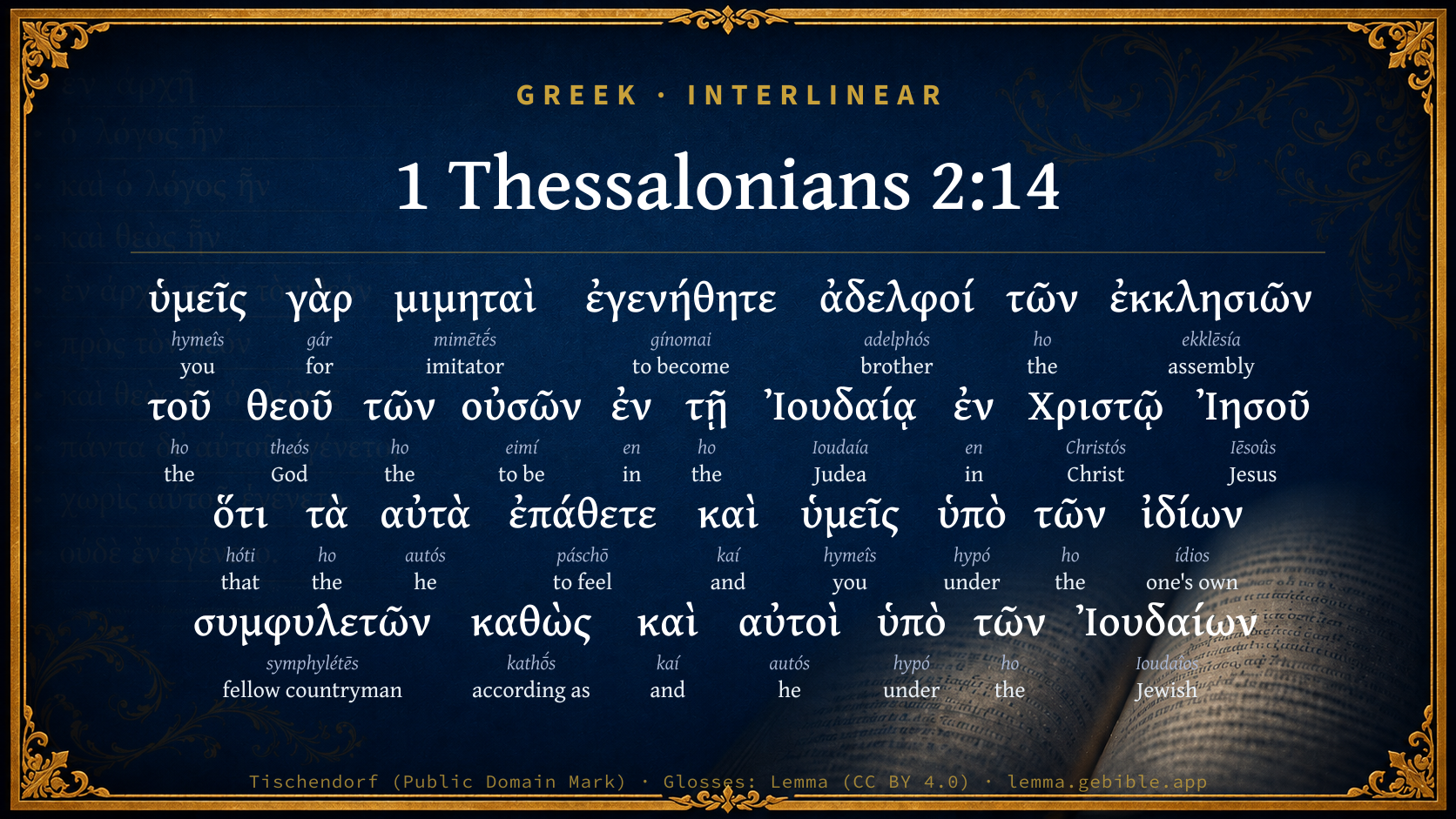
Download image
Cite this verse

1 Thessalonians 2:14 (World English Bible). Public Domain. Lemma interlinear Bible study tool, https://lemma.gebible.app/v/1-thessalonians/2/14.

Show BibTeX & RIS
BibTeX
RIS
English Translation
For you, brothers, became imitators of the assemblies of God which are in Judea in Christ Jesus; for you also suffered the same things from your own countrymen, even as they did from the Jews;
World English Bible · Public Domain
Highlights
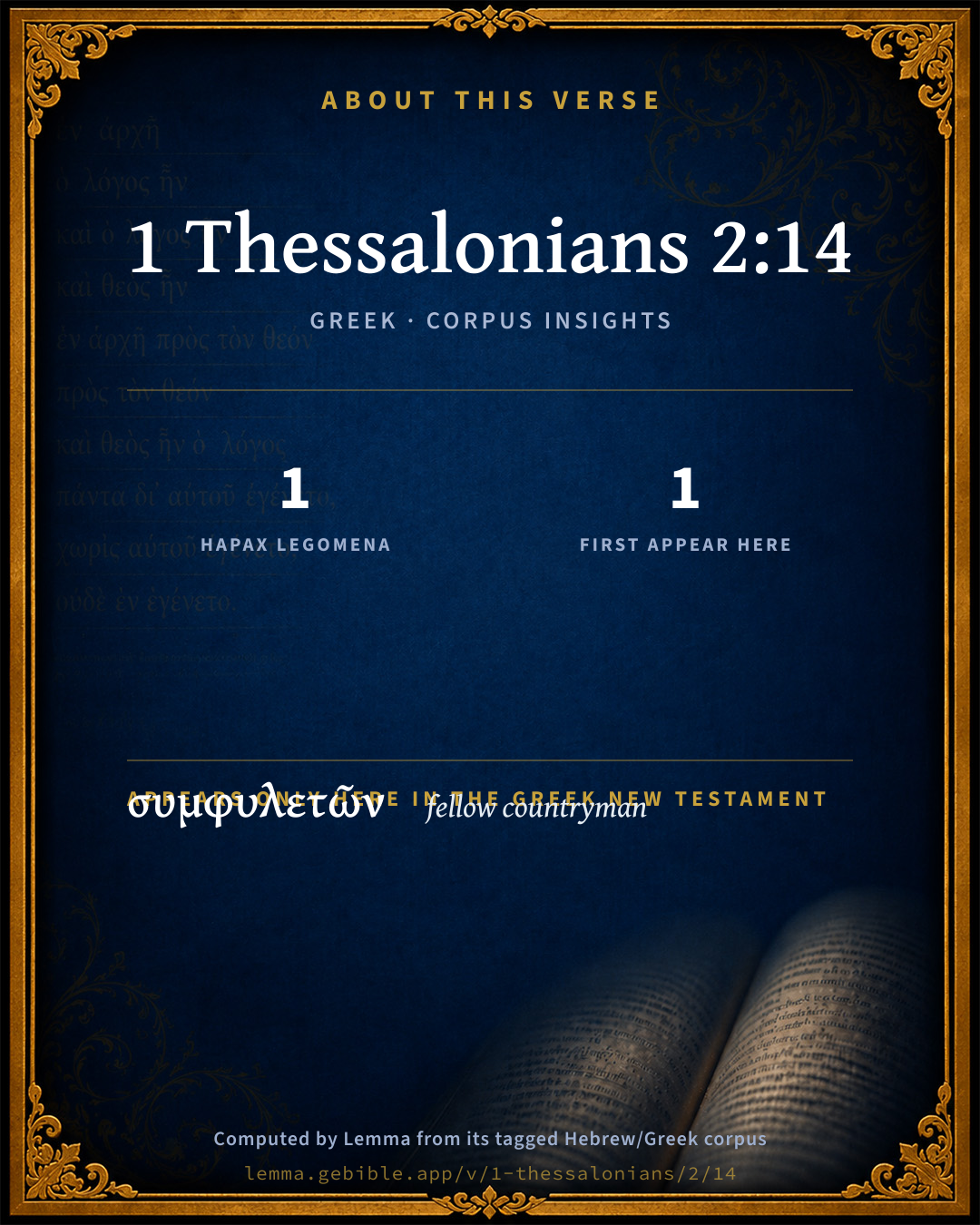
  • 1 hapax legomenon — only here in the Greek New Testament
  • 1 first appearance in the Greek New Testament
Full analysis ↓
Download a study sheet

One document with this verse’s original text, its word-by-word gloss line, the meaning frame, cross-references with their text, attributed commentary, and full source and license credits — printable, and it pastes into notes with its structure intact.

This verse Autodidact and up

Study sheet (.html) Plain text (.txt)

A passage Seminary Student

Up to 50 verses in one chapter. A passage sheet keeps up to 6 commentary sources and 12 cross-references per verse, in the order this page ranks them, and says so on the sheet whenever that leaves anything out. Ask for a single verse and you get the Autodidact verse sheet above.

Everything on this page stays free to read, with no account — the sheet is a download of what is already on screen, not access to it.

Want to remove ads? Support Godless Engineer
Compare translations 3

The same verse in 3 English versions, stacked beneath the original-language interlinear above. Click any original word for its lexicon entry.

Each is an independent rendering of the whole verse — the interlinear is not word-aligned to these translations.

Highlighted words mark where these versions differ — a whole-verse word diff, not a word-by-word alignment.

  • World English Bible Public Domain
    For you, brothers, became imitators of the assemblies of God which are in Judea in Christ Jesus; for you also suffered the same things from your own countrymen, even as they did from the Jews;
  • King James Version Public Domain
    For ye, brethren, became followers of the churches of God which in Judaea are in Christ Jesus: for ye also have suffered like things of your own countrymen, even as they have of the Jews:
  • unfoldingWord Literal Text CC BY-SA 4.0
    For you, brothers, became imitators of the churches of God that are in Judea in Christ Jesus, because the same things you also suffered from your own countrymen, just as they also from the Jews,

unfoldingWord Literal Text — © unfoldingWord, licensed CC BY-SA 4.0. Word-aligned USFM3 via Door43 (git.door43.org/unfoldingWord/en_ult).

Versions to compare (up to 4)

3 of 4 selected

Show all 19 translations

Every available English version of this verse, each an independent rendering of the whole verse.

  • World English Bible Public Domain
    For you, brothers, became imitators of the assemblies of God which are in Judea in Christ Jesus; for you also suffered the same things from your own countrymen, even as they did from the Jews;
  • Berean Standard Bible Public Domain
    For you, brothers, became imitators of the churches of God in Judea that are in Christ Jesus. You suffered from your own countrymen the very things they suffered from the Jews,
  • Majority Standard Bible Public Domain
    For you, brothers, became imitators of the churches of God in Judea that are in Christ Jesus. You suffered from your own countrymen the very things they suffered from the Jews,
  • King James Version Public Domain
    For ye, brethren, became followers of the churches of God which in Judaea are in Christ Jesus: for ye also have suffered like things of your own countrymen, even as they have of the Jews:
  • American Standard Version (1901) Public Domain
    For ye, brethren, became imitators of the churches of God which are in Judaea in Christ Jesus: for ye also suffered the same things of your own countrymen, even as they did of the Jews;
  • Revised Version (1885) Public Domain
    For ye, brethren, became imitators of the churches of God which are in Judaea in Christ Jesus: for ye also suffered the same things of your own countrymen, even as they did of the Jews;
  • Geneva Bible (1599) Public Domain
    For brethren, ye are become folowers of the Churches of God, which in Iudea are in Christ Iesus, because ye haue also suffred the same things of your owne countrey men, euen as they haue of the Iewes,
  • Douay-Rheims (1899) Public Domain
    For you, brethren, are become followers of the churches of God which are in Judea, in Christ Jesus: for you also have suffered the same things from your own coutrymen, even as they have from the Jews,
  • Young's Literal Translation Public Domain
    for ye became imitators, brethren, of the assemblies of God that are in Judea in Christ Jesus, because such things ye suffered, even ye, from your own countrymen, as also they from the Jews,
  • Literal Standard Version CC BY-SA 4.0
    for you became imitators, brothers, of the assemblies of God that are in Judea in Christ Jesus, because you suffered such things, even you, from your own countrymen, as they also from the Jews,
  • Unlocked Literal Bible CC BY-SA 4.0
    For you, brothers, became imitators of the churches of God that are in Judea in Christ Jesus. For you also suffered the same things from your own countrymen, as they did from the Jews.
  • unfoldingWord Literal Text CC BY-SA 4.0
    For you, brothers, became imitators of the churches of God that are in Judea in Christ Jesus, because the same things you also suffered from your own countrymen, just as they also from the Jews,
  • Darby Bible Public Domain
    For *ye*, brethren, have become imitators of the assemblies of God which are in Judaea in Christ Jesus; for *ye* also have suffered the same things of your own countrymen as also *they* of the Jews,
  • World Messianic Bible Public Domain
    For you, brothers, became imitators of the assemblies of God which are in Judea in Messiah Yeshua; for you also suffered the same things from your own countrymen, even as they did from the Judeans
  • Webster's Bible Public Domain
    For ye, brethren, became followers of the churches of God which in Judea are in Christ Jesus: for ye also have suffered like things from your own countrymen, even as they have from the Jews:
  • Free Bible Version CC BY-SA 4.0
    The experience you brothers and sisters have had imitates that of God's churches that belong to Christ Jesus in Judaea. Just like your fellow Jewish Christians you suffered as they did at the hands of the Jewish leaders
  • Bible in Basic English Public Domain
    For you, my brothers, took as your examples the churches of God which are in Judaea in Christ Jesus; because you underwent the same things from your countrymen as they did from the Jews;
  • Text-Critical English NT CC BY 4.0
    For you, brothers, became imitators of the churches of God in Christ Jesus that are in Judea, because you suffered the same things from your own countrymen that they did from the Jews,
  • Tyndale New Testament (1534) Public Domain
    For ye brethren became folowers of the congregacions of god which in Iewry are in Christ Iesu: for ye have suffered lyke thynges of youre kynsmen as we oure selves have suffered of the Iewes.

Literal Standard Version (2020), Covenant Press — licensed CC BY-SA 4.0. Text via the HelloAO Bible API (eBible.org). Unlocked Literal Bible (unfoldingWord) — licensed CC BY-SA 4.0. Text via the HelloAO Bible API (eBible.org). unfoldingWord Literal Text — © unfoldingWord, licensed CC BY-SA 4.0. Word-aligned USFM3 via Door43 (git.door43.org/unfoldingWord/en_ult). Free Bible Version, Dr. Jonathan Gallagher — licensed CC BY-SA 4.0. Text via the HelloAO Bible API (eBible.org).

Word by word

More ways to search: Search by grammar → Find every occurrence → Compare this word →

Practice this passage: Drill this verse → Learn its vocabulary →

συμφυλετῶν
symphylétēs
G4853
“fellow countryman”
Noun, Genitive, Plural, Masculine
Part of Speech
Noun
Case
Genitive
Number
Plural
Gender
Masculine
Full Thayer's Definition

Origin: from G4862 and a derivative of G5443

TDNT: None

1. one who is of the same people, a fellow countryman
  1. ὑμεῖς hymeîs G5210 “you” Personal pronoun, 2nd person, Nominative, Plural
  2. γὰρ gár G1063 “for” Conjunction
  3. μιμηταὶ mimētḗs G3402 “imitator” Noun, Nominative, Plural, Masculine
  4. ἐγενήθητε gínomai G1096 “to become” Verb, Aorist, Passive deponent, Indicative, 2nd person, Plural
  5. ἀδελφοί adelphós G80 “brother” Noun, Vocative, Plural, Masculine
  6. τῶν ho G3588 “the” Article, Genitive, Plural, Feminine
  7. ἐκκλησιῶν ekklēsía G1577 “assembly” Noun, Genitive, Plural, Feminine
  8. τοῦ ho G3588 “the” Article, Genitive, Singular, Masculine
  9. θεοῦ theós G2316 “God” Noun, Genitive, Singular, Masculine
  10. τῶν ho G3588 “the” Article, Genitive, Plural, Feminine
  11. οὐσῶν eimí G1510 “to be” Verb, Present, Active, Participle, Genitive, Plural, Feminine
  12. ἐν en G1722 “in” Preposition
  13. τῇ ho G3588 “the” Article, Dative, Singular, Feminine
  14. Ἰουδαίᾳ Ioudaía G2449 “Judea” Noun, Dative, Singular, Feminine
  15. ἐν en G1722 “in” Preposition
  16. Χριστῷ Christós G5547 “Christ” Noun, Dative, Singular, Masculine
  17. Ἰησοῦ Iēsoûs G2424 “Jesus” Noun, Dative, Singular, Masculine
  18. ὅτι hóti G3754 “that” Conjunction
  19. τὰ ho G3588 “the” Article, Accusative, Plural, Neuter
  20. αὐτὰ autós G846 “he” Personal pronoun, Accusative, Plural, Neuter
  21. ἐπάθετε páschō G3958 “to feel” Verb, Aorist, Active, Indicative, 2nd person, Plural
  22. καὶ kaí G2532 “and” Conjunction
  23. ὑμεῖς hymeîs G5210 “you” Personal pronoun, 2nd person, Nominative, Plural
  24. ὑπὸ hypó G5259 “under” Preposition
  25. τῶν ho G3588 “the” Article, Genitive, Plural, Masculine
  26. ἰδίων ídios G2398 “one's own” Adjective, Genitive, Plural, Masculine
  27. καθὼς kathṓs G2531 “according as” Adverb
  28. καὶ kaí G2532 “and” Conjunction
  29. αὐτοὶ autós G846 “he” Personal pronoun, Nominative, Plural, Masculine
  30. ὑπὸ hypó G5259 “under” Preposition
  31. τῶν ho G3588 “the” Article, Genitive, Plural, Masculine
  32. Ἰουδαίων Ioudaîos G2453 “Jewish” Adjective, Genitive, Plural, Masculine

About this verse

These counts appear in no published source. They are computed here, from the morphology-tagged text and Lemma’s own curated glosses. What Lemma adds →

33
words
22
distinct lemmas
Pauline Epistles
section

Notable vocabulary

1 hapax legomenon — a word that appears only here in the entire Greek New Testament:

  • συμφυλετῶν fellow countryman G4853

First appearance in Scripture

This word makes its first canonical appearance in the Greek New Testament here:

  • συμφυλετῶν fellow countryman G4853

Shared distinctive vocabulary

μιμηταὶ imitator G3402 occurs in 6 verses of the Greek New Testament. Also found in:
Repetition

Words recur within this verse:

Cross-references

19

Topical passages linked to 1 Thessalonians 2:14 in the Treasury of Scripture Knowledge — connected by theme and wording, ordered by reader-vote popularity; previews shown in the World English Bible.

  • 1 Thessalonians 3:4 For most assuredly, when we were with you, we told you beforehand that we are to suffer affliction, even as it happened, and you know.
  • Hebrews 10:33–34 partly, being exposed to both reproaches and oppressions; and partly, becoming partakers with those who were treated so.
  • Hebrews 5:7–8 He, in the days of his flesh, having offered up prayers and petitions with strong crying and tears to him who was able to save him from death, and having been heard for his godly fear,
  • 2 Thessalonians 1:4 so that we ourselves boast about you in the assemblies of God for your patience and faith in all your persecutions and in the afflictions which you endure.
  • 2 Corinthians 8:1–2 Moreover, brothers, we make known to you the grace of God which has been given in the assemblies of Macedonia;
  • Galatians 1:22 I was still unknown by face to the assemblies of Judea which were in Christ,
  • Acts 12:1–3 Now about that time, Herod the king stretched out his hands to oppress some of the assembly.
  • 1 Corinthians 7:17 Only, as the Lord has distributed to each man, as God has called each, so let him walk. So I command in all the assemblies.
  • 1 Thessalonians 1:6 You became imitators of us, and of the Lord, having received the word in much affliction, with joy of the Holy Spirit,
  • Acts 8:1 Saul was consenting to his death. A great persecution arose against the assembly which was in Jerusalem in that day. They were all scattered abroad throughout the regions of Judea and Samaria, except for the apostles.
  • Acts 9:1 But Saul, still breathing threats and slaughter against the disciples of the Lord, went to the high priest,
  • Acts 9:31 So the assemblies throughout all Judea and Galilee and Samaria had peace, and were built up. They were multiplied, walking in the fear of the Lord and in the comfort of the Holy Spirit.
  • Acts 11:19 They therefore who were scattered abroad by the oppression that arose about Stephen traveled as far as Phoenicia, Cyprus, and Antioch, speaking the word to no one except to Jews only.
  • Acts 17:1–8 Now when they had passed through Amphipolis and Apollonia, they came to Thessalonica, where there was a synagogue of the Jews.
  • Acts 17:13 But when the Jews of Thessalonica had knowledge that the word of God was proclaimed by Paul at Beroea also, they came there likewise, agitating the multitudes.
  • 1 Thessalonians 1:1 Paul, Silvanus, and Timothy, to the assembly of the Thessalonians in God the Father and the Lord Jesus Christ: Grace to you and peace from God our Father and the Lord Jesus Christ.
  • 2 Thessalonians 1:1 Paul, Silvanus, and Timothy, to the assembly of the Thessalonians in God our Father, and the Lord Jesus Christ:
  • Acts 8:3 But Saul ravaged the assembly, entering into every house, and dragged both men and women off to prison.
  • Acts 9:13 But Ananias answered, "Lord, I have heard from many about this man, how much evil he did to your saints at Jerusalem.

Cross-references courtesy of OpenBible.info (CC BY 4.0).

Where the printed editions differ

1 variant

Places in this verse where the major printed Greek editions disagree on the wording in a way that affects the translation — a comparison of editions, not a manuscript-by-manuscript collation. The editions are the modern critical texts (Nestlé-Aland 28/27, SBL, Westcott-Hort, Tregelles, Tyndale House) and the traditional texts behind the KJV (the Textus Receptus and the Byzantine/Majority text). It is not a claim about which reading is original.

  1. Editions differ
    τὰ

    “the [same]”

    In NA28NA27TynSBLWHTregTR»1Byz Not in TR

Textual data: Translators Amalgamated Greek New Testament (STEPBible TAGNT) · CC BY 4.0.

Commentary

Notes on 1 Thessalonians 2:14 from classic Christian and Jewish commentators (each source and its license shown beneath its notes). The classic Christian expositions comment on the surrounding passage and are grouped to its opening verse, so a note may address several verses; the Jewish commentaries on the Tanakh (Rashi and others) are per-verse, so they appear only where the commentator wrote on this verse.

Lemma curates 59 commentaries, every one of them public domain or Creative Commons licensed, each selected and text-cleaned for this edition rather than reprinted as found. About our sources →

The Biblical Illustrator

Joseph S. Exell

1Th_2:14

For ye, brethren, became followers of the Churches of God which are in Judaea

I.

Church followers. The Thessalonian believers, acquainted with the important fact that there were several holy brotherhoods in Judaea which were united to Jesus Christ by faith in His truth, strove to imitate them in their spiritual virtues, and thus show that they were one with them--were united to them in and through the same Lord. The union of Church members is not a mere outward adhesion, like the way in which the stones of a building are joined to one another, but it is a living organic union, like the members of one body, possessed of a common life, constituting together one living whole, so that all are parts of one and the same being; hence it is a union which cannot be severed without doing violence to that blessed Spirit by whose act it has been brought about. The Church of Christ, which is His mystical body, cannot be Otherwise than one, wherever it may be--in Judea or Thessalonica, and its members, wherever living, cannot be otherwise than imitators of each other.

II. Church sufferers. The Word preached to the Thessalonians had wrought so effectually in them that they became examples unto others not only in faith and good works, but in patience and suffering, also for the Words sake. With unflinching courage and steady constancy they met the fierce opposition of their own fellow tribe or clansmen, beside that of others--the Jews--all enemies of the Cross of Christ. Christ Himself never used anything like force or violence, except once, and that was to drive ungodly men not into the Temple, but out of it. To ill-treat, and stone, and crucify good men for their religion is not the gospel of Christ, but the direct instigation of the devil. He is the father of lies, and truth is almost invariably on the side of the persecuted. Yet, though believers suffer persecution for it, they are benefitted by persecution, just as the giant of the forest becomes all the stronger and more deeply rooted for the strong blasts which have shaken and tried it. (M. F. Day, D. D.)

Suffering the test of conversion

It often happens that suffering reveals new features of character and awakens powers before dormant. It is said that Agrippa had a dormouse that slumbered so profoundly that it would never wake till cast in a cauldron of boiling lead. So there are some natures which put forth their powers only when in extremity. The piety of Gods people is often tested by affliction. The faith of thousands has sunk, while those who have borne the strain have gained an accession of moral nerve. The Thessalonians imitated the churches of God in facing the storm of persecution with unconquerable firmness.

I. Their suffering had a common origin. Ye of your own countrymen--they of the Jews.

1. It is the unkindest cut of all that comes from the sword of our own people--people with whom we have lived in amity, but from whom conscience compels us to differ (Psa_55:12), when natural love is turned into unnatural enmity.

2. What a revelation this of the devilish nature of persecution. Its insensate malice rudely sunders all bonds of fatherland, friendship, or kindred. The close affinity between Cain and Abel does not arrest the murderers hand. The tender ties between Saul and David avail not to curb the mad cruelty of the king.

3. How deep and changeless is the truth--All that will live godly in Christ Jesus shall suffer persecution. The suffering that tests is still from the same source. A mans foes are they of his own household.

II. Their suffering was borne with exemplary Christian fortitude. The same thought is expressed in 1Th_1:6. At the head of the long line is Jesus, the captain of salvation; and all whom He leads to glory walk in His steps, imitate His example, and so become followers one of another.

1. It is not suffering in itself that purifies, so much as the spirit in which it is borne. It was enough to cool the fiery ambition of the aspiring disciples when Jesus said, Are ye able to drink of the cup that I shall drink of? And yet the following of Christ in suffering is the true test of discipleship. He that taketh not his cross and followeth after Me, is not worthy of Me.

2. It is a proof of the supernatural efficacy of the gospel that it inspires so intense a love of it as to make us willing to endure suffering for its sake. The love of truth becomes supreme. John Huss, lamenting the rupture of an old and valued friendship, said, Paletz is my friend; truth is my friend; and both being my friends, it is my sacred duty to give the first honour to truth.

3. The soul, penetrated with this devotion, will pass unscathed the fiery test. On the destruction of the London Alexandra Palace by fire, it was found that, while many specimens of old English porcelain exhibited there were reduced to a black, shapeless mass, the true porcelain of Bristol, though broken into fragments, still retained its whiteness, and even its most delicate shades of colour uninjured by the fire. So the truly good, though wounded, shall survive the fiercest trial, and retain intact all that distinguishes the Christian character.

Lessons:--

1. Our love of the Gospel is tested by what we suffer for it.

2. The similarity of experience, in all times and places, is a strong evidence of the truth of the Christian religion.

3. Suffering does not destroy, but builds up and perfects. (G. Barlow.)

The secret of persecution

A wolf flies not upon a painted sheep, and men can look upon a painted toad with delight. It is not the soft pace, but the furious march of the soldier that sets men a-gazing and dogs a-barking. Let but a man glide along with the stream of the world, do as others do, he may sit down and take his ease; but if he once strive against the stream, stand up in the cause of God, and act for Christ, then he shall be sure to meet with as much malice as men and devils can possibly throw upon him. (J. Spencer.)

The honour of persecution

One who was persecuted in Queen Marys time wrote thus, A poor prisoner for Christ! What is this for a poor worm! Such honour have not all His saints. Both the degrees I took in the university have not set me so high as the honour of becoming a prisoner of the Lord.

Consolation in persecution

Do they cast us out of the city? They cannot cast us out of that which is in the heavens. If they who hate us could do this, they would be doing something real against us. So long, however, as they cannot do this, they are but pelting us with drops of water or striking us with the wind. (Gregory Nazianzen.)

Persecution elicits sympathy

A coloured man applied to a New York merchant for a subscription, who at once knocked him into the street. The coloured man started on telling the story of his abuse, won sympathy by it, and, before night, collected fifty dollars. The persecutor, hearing the story, desired to silence the man, sent for him, and gave him a liberal subscription,

Benefit of persecution

As frankincense, when it is put into the fire, giveth the greater perfume; as spice, if it be pounded and beaten, smelleth the sweeter; as the earth, when it is torn up by the plough, becometh more fruitful; the seed in the ground, after frost and snow and winter storms, springeth the ranker; the nigher the vine is pruned to the stock, the greater grape it yieldeth; the grape, when it is most pressed and beaten, maketh the sweetest wine; linen, when it is bucked and washed, wrung and beaten, is so made fairer and whiter: even so the children of God receive great benefit by persecution; for by it God washeth and scoureth, schooleth and nurtureth them, that so, through many tribulations, they may enter into their rest. (Cawdray.)

Persecution a stimulus

A certain amount of persecution rouses a mans defiance, stirs his blood for magnificent battle, and makes him fifty times more a man than he would have been without the persecution. So it was with the great reformer when he said, I will not be put down, I will be heard. And so it was with Millard, the preacher, in the time of Louis XI. When that sovereign sent word to him that unless he stopped preaching in that style he would throw him into the river, he replied, Tell the king that I shall reach heaven sooner by water, than he will by fast horses. (T. De Witt Talmage, D. D.)

The Biblical Illustrator, edited by Joseph S. Exell (c. 1880s–1900s) — public domain. Text from a community e-Sword module.

The Preacher's Complete Homiletical Commentary

Joseph S. Exell (gen. ed.)

CRITICAL AND EXPLANATORY NOTES

1Th_2:14. Became followers.—R.V. “imitators.” The usual meaning of imitators hardly seems to obtain in full strength here. We cannot think the Thessalonians consciously copied the Judean Christians, to do which they would have had the superfluous task of raising up opposition. The words seem to mean no more than, “Ye came to resemble.” Of your own countrymen.—Lit. “fellow-tribesmen.” One is reminded of Shylock’s words—

“Sufferance is the badge of all our tribe.”

MAIN HOMILETICS OF 1Th_2:14

Suffering: the Test of Conversion.

It often happens that suffering reveals new features of individual character, and awakens powers that were before dormant. It takes a great deal to thoroughly rouse some people. We are told that Agrippa had a dormouse that slumbered so profoundly that it would never wake till cast into a cauldron of boiling lead. So there are some natures which put forth all their powers only when in suffering and extremity. The piety of God’s people has been most severely tested in the midst of persecution and affliction. The faith of thousands has failed in the hour of trial, while those who have borne the strain have gained an accession of moral nerve and bravery. The Thessalonians imitated the Churches in Judea in boldly facing the storm of malignant opposition, and standing under it with calm, unconquerable firmness.

I. The suffering of the Thessalonians had a common origin.—“For ye also have suffered like things of your own countrymen, even as they have of the Jews.” Just as the Jews who embraced Christianity met with the maddest violence from their own unbelieving countrymen, so the Gentiles found their fiercest foes among their fellow-countrymen, who blindly clung to the worship of the gods. It is the unkindest cut of all that comes from the sword of our own people—people with whom we have lived in amity and concord, but from whom conscience compels us to differ. Who can fathom the deep anguish of the Psalmist sounding in that sharp, bitter cry of startled surprise, “For it was not an enemy that reproached me, then I could have borne it; but it was thou, a man, mine equal, my guide and mine acquaintance”! It was a horrible discovery of nature engaged in a terrible suicidal war with itself! Nature grown monstrously unnatural and savagely retaliating on its own: natural love turned into unnatural enmity! What a revelation, too, is this of the desperate nature of all persecution! Its insensate malice rudely sunders all bonds of fatherland, friendship, and kindred. The close affinity between Cain and Abel does not arrest the murderer’s hand; the tender ties between Saul and David, woven with much reciprocal kindness and affection, avail not to curb the mad cruelty of the infuriate king. Ah! how deep and changeless is the truth, “All that will live godly in Christ Jesus shall suffer persecution.” The suffering that tests is still from the same source, “A man’s foes are they of his own household.”

II. The suffering of the Thessalonians was borne with exemplary Christian fortitude.—“For ye, brethren, became followers of the Churches of God, which in Judea are in Christ Jesus.” The same thought is expressed in the first chapter, where the apostle says, “Ye became followers of us and of the Lord.” For at the head of the long line is Jesus, the Captain of salvation; and all whom He leads to glory walk in His steps, imitate His example, and so become followers one of another. It is not, however, suffering in itself that purifies and exalts Christian character, so much as the spirit in which it is borne. The hardest point of obedience is to obey in suffering. It was enough to cool the fiery ambition of the aspiring disciples when Jesus said, “Are ye able to drink of the cup that I shall drink of?” And yet the following of Christ in suffering is the true test of discipleship. “He that taketh not his cross and followeth Me is not worthy of Me.” It is a grand proof of the supernatural efficacy of gospel truth that it inspires so intense a love of it as to make us willing to endure the most exquisite suffering for its sake. The love of truth becomes supreme. John Huss, lamenting the rupture of an old and valued friendship, said: “Paletz is my friend; truth is my friend; and both being my friends, it is my sacred duty to give the first honour to truth.” The soul, penetrated with this sublime devotion to truth, will pass unscathed the fiery test of suffering. On the destruction by fire of the London Alexandra Palace a few years ago, it was found that, while many specimens of old English porcelain exhibited there were reduced to a black, shapeless mass, the true porcelain of Bristol, though broken into fragments, still retained its whiteness, and even its most delicate shades of colour, uninjured by the fire. So the truly good, though wounded and maimed, shall survive the fiercest trial, and retain intact all that specially distinguishes and beautifies the Christian character.

Lessons.—

1. Our love of the gospel is tested by what we suffer for it.

2. The similarity of experience in all times and places is a strong evidence of the truth of the Christian religion.

3. Suffering does not destroy, but builds up and perfects.

The Preacher's Complete Homiletical Commentary (gen. ed. Joseph S. Exell; Funk & Wagnalls, c. 1892) — public domain (pre-1929). A full-Bible homiletical/sermon-outline anthology covering 65 of 66 books (2 John is absent from the source module). Text from a community e-Sword module.

Tyndale Open Study Notes

Tyndale Open Resources

2:14 The evidence that the Thessalonian believers accepted the word of God was that they suffered persecution (1:6). This followed the pattern of the apostles, the churches in Judea (Acts 8:1), and Christ himself.

Tyndale Open Study Notes — © Tyndale Open Resources, licensed CC BY-SA 4.0. Text via the HelloAO Bible API.

Bengel's Gnomon

Johann Albrecht Bengel

1Th 2:14. Γὰρ, for) Divine working is most of all seen and felt in affliction.—ἐν τῇ Ἰονδαίᾳ, in Judea) The Jewish churches were distinguished examples to all the others.—τὰ αὐτὰ, the same things) So, αὐτὸν, the same [conflict], Php 1:30. The sameness of the fruit, the sameness of the afflictions, the sameness of the experimental proofs and characteristics of believers, in all places and at all times, afford an excellent criterion of the truth of the Gospel.—ἰδίων, your own) Mat 10:36; Luk 13:33, at the end.—συμφυλετῶν, fellow-countrymen) [liter. “persons of the same tribe.”] These were Thessalonians, Jews and Gentiles. Act 17:5.

Bengel's Gnomon of the New Testament — English translation (T&T Clark, Edinburgh, 1860) — public domain. Text from a community e-Sword module.

Meyer's Critical & Exegetical Commentary

Heinrich August Wilhelm Meyer

1Th_2:14 is not designed, as Oecumenius, Calvin, and Pelt think, to prove the sincerity with which the Thessalonians received the gospel, but is a proof of ὃς καὶ ἐνεργεῖται, 1Th_2:13. In not shunning to endure sufferings for the sake of the gospel, the Thessalonians had demonstrated that the word of God had already manifested its activity among them, had already become a life-power, a moving principle in them.

ὑμεῖς γάρ] an emphatic resumption of the previous ὑμῖν τοῖς πιστεύουσιν.

μιμηταί] imitators, certainly not in intention or design, but in actual fact or result.

ἀδελφοί] The frequent repetition of this address (comp. 1Th_1:4, 1Th_2:1; 1Th_2:9; 1Th_2:17) is significant of the ardent love of Paul toward the church. That Paul compares the conduct of the Thessalonians with that of the Palestinian churches is, according to Calvin, whom Calixtus follows, designed to remove the objection which might easily arise to his readers. As the Jews were the only worshippers of the true God outside of Christianity, so the attack on Christianity by the Jews might give rise to a doubt whether it were actually the true religion. For the removal of this doubt, the apostle, in the first place, shows that the same fate which had at an earlier period befallen the Palestinian churches had happened to the Thessalonians; and then, that the Jews were the hardened enemies of God and of all sound doctrine. But evidently such a design of the apostle is indicated by nothing, and its supposition is entirely superfluous, as every Christian must with admiration recognise the heroism of Christian resistance to persecution with which the Palestinian churches had distinguished themselves. Accordingly, it was a great commendation of the Thessalonians if the same heroic Christian stedfastness could be predicated of them. This holds good against the much more arbitrary and visionary opinion of Hofmann, that Paul, by the mention of the Palestinian churches, and the expression concerning the Jews therewith connected, designed to meet the erroneous notion or representation of what happened to the readers. As the conversion of the Thessalonians might in an intelligible manner appear in the eyes of their countrymen as a capture of them in the net of a Jewish doctrine, and hence on that side the reproach might be raised that, on account of this strange matter, they had become hostile to their own people; so it was entirely in keeping to show that the apostolic doctrine was anything but an affair of the Jewish people, that, on the contrary, the Jews were its bitterest enemies! Grotius would understand the present participle τῶν σὐσῶν in the sense of the participle of the preterite; whilst, appealing to Act_8:4; Act_11:19, he thinks that the Palestinian churches had by persecutions ceased to exist as such, only a few members remaining. But neither do the Acts justify such an opinion, nor is it in accordance with the words of Paul in Gal_1:22. The further supposition which Grotius adds is strange and unhistorical, that some Christians expelled from Palestine had betaken themselves to Thessalonica, and that to them mainly a reference in our passage is made.

ἐν Χριστῷ Ἰησοῦ] Oecumenius: εὐφυῶς διεῖλεν· ἐπειδὴ γὰρ καὶ αἱ συναγωγαὶ τῶν Ἰουδαίων ἐν Θεῷ εἶναι δοκοῦσι, τὰς τῶν πιστῶν ἐκκλησίας καὶ ἐν τῷ Θεῷ καὶ ἐν τῷ υἱῷ αὐτοῦ λέγει εἶναι.

ὅτι] for.

τὰ αὐτά] the like things, denotes the general similarity of the sufferings endured. Grotius precariously specifies them by res vestras amisistis, pars fuistis ejecti.

συμφυλέτης] of the same φυλή, belonging to the same natural stock, contribulis, then generally countryman, fellow-countryman, ὁμοεθνής (Hesychius). Comp. Lobeck, ad Phryn. p. 172, 471. By συμφυλέται we are naturally not to understand the Jews (Cornelius a Lapide, Hammond, Joachim Lange); for that the expression is best suited to them, as Braun (with Wolf) thinks, whilst possibly Jews of a particular tribe (perhaps of the tribe of Juda or Benjamin) were resident in Thessalonica, only merits to be mentioned on account of its curiosity. Also συμφυλέται is not, with Calvin, Piscator, Bengel, and others, to be understood both of Jews and Gentiles, but can only be understood of Gentiles. To this we are forced(1) by the sharp contrast of συμφυλετῶν and Ἰουδαίων, which must be considered as excluding each other; (2) by the addition of ἰδιών to συμφυλετῶν, as the great majority of the Thessalonian church consisted of Gentiles; comp. 1Th_1:9. However, although Paul in the expression συμφυλετῶν speaks only of Gentiles as persecutors, yet the strong invective against the Jews which immediately follows (1Th_2:15-16) constrains us to assume that the apostle in 1Th_2:14 had more in his mind than he expressed in words. As we learn from the Acts, it was, indeed, the heathen magistrates by whose authority the persecutions against the Christian church at Thessalonica proceeded, but the proper originators and instigators were here also the Jews; only they could not excite the persecution of the Christians directly, as the Jews in Palestine, but, hemmed in by the existing laws, could only do so indirectly, namely, by stirring up the heathen mob. This circumstance, united with the repeated experience of the inveterate spirit of opposition of the Jews, which Paul had in Asia at a period directly preceding this Epistle (perhaps also shortly before its composition at Corinth), is the natural and easily psychologically explanatory occasion of the polemic in 1Th_2:15-16. Erroneously Olshausen gives the reason; he thinks it added in order to turn the attention of the Christians in Thessalonica to the intrigues of those men with whom the Judaizing Christians stood on a level, as it was to be foreseen that they would not leave this church also undisturbed; against which view de Wette correctly remarks, that there is no trace of such a warning, and that the Thessalonians did not require it, as they had learned sufficiently to know the enmity of the Jews against the gospel.

καθώς] Instead of this, properly ἅ or ἅπερ should have been put, corresponding to τὰ αὐτά (comp. Php_1:30, τὸν αὐτὸν … οἷον). However, even in the classics such inexact connections are very frequently found. See Lobeck, ad Phryn. p. 426 f.; Bremi, ad Demosth. adv. Phil. I. p. 137; Kühner, II. p. 571. The double καί (καὶ ὑμεῖς … καὶ αὐτοί) brings out the comparison.

αὐτοί] denotes not the apostle and his assistants (Erasmus, Musculus, Er. Schmid), as such a prominent incongruity in the comparison is inconceivable; but the masculine as a recognised free construction (comp. Gal_1:22-23) refers to τῶν ἐκκλησιῶν τοῦ Θεοῦ, thus denotes the Palestinian Christians.

Meyer — Critical and Exegetical Commentary on the New Testament — English translation by Peter Christie, edited by Frederick Crombie (T&T Clark, 1880) — public domain. Text from a community e-Sword module.

Expositor's Greek Testament

ed. W. Robertson Nicoll

1Th 2:14 . μιμηταί , and soon helpers (Rom 15:26 ). The fact that they were exposed to persecution, and bore it manfully, proved that the gospel was a power in their lives, and also that they were in the legitimate succession of the churches. Such obstacles would as little thwart their course as they had thwarted that of Jesus or of his immediate followers. συμφ . might include Jews (Act 17:6 ), but Gentiles predominate in the writer’s mind. The καί after καθώς simply emphasises the comparison (as in 1Th 4:5 ; 1Th 4:13 ). As Calvin suggests, the Thessalonians may have wondered why, if this was the true religion, it should be persecuted by the Jews, who had been God’s people. σ . is racial rather than local, but the local persecution may have still been due in part to Jews ( cf. Zimmer, pp. 16 f.).

The Expositor's Greek Testament, edited by W. Robertson Nicoll (1897–1910) — public domain. Text from a community e-Sword module.

Geneva Bible (1599)

Geneva Bible translators

Which Christ hath gathered together.

Even of them which are of the same country, and the same town that you are of.

He confirmeth them in their afflictions which they suffered of their own people, because they were afflicted of their own countrymen: which came as well (saith he) to the Churches of the Jews, as to them: and therefore they ought to take it in good part.

Geneva Bible (1599) marginal notes — public domain. Text via Bolls.life.

Jamieson, Fausset & Brown

Robert Jamieson, A. R. Fausset & David Brown

followers--Greek, "imitators." Divine working is most of all seen and felt in affliction.

in Judea--The churches of Judea were naturally the patterns to other churches, as having been the first founded, and that on the very scene of Christ's own ministry. Reference to them is specially appropriate here, as the Thessalonians, with Paul and Silas, had experienced from Jews in their city persecutions (Act 17:5-9) similar to those which "the churches in Judea" experienced from Jews in that country.

in Christ Jesus--not merely "in God"; for the synagogues of the Jews (one of which the Thessalonians were familiar with, Act 17:1) were also in God. But the Christian churches alone were not only in God, as the Jews in contrast to the Thessalonian idolaters were, but also in Christ, which the Jews were not.

of your own countrymen--including primarily the Jews settled at Thessalonica, from whom the persecution originated, and also the Gentiles there, instigated by the Jews; thus, "fellow countrymen" (the Greek term, according to Herodian, implies, not the enduring relation of fellow citizenship, but sameness of country for the time being), including naturalized Jews and native Thessalonians, stand in contrast to the pure "Jews" in Judea (Mat 10:36). It is an undesigned coincidence, that Paul at this time was suffering persecutions of the Jews at Corinth, whence he writes (Act 18:5-6, Act 18:12); naturally his letter would the more vividly dwell on Jewish bitterness against Christians.

even as they-- (Heb 10:32-34). There was a likeness in respect to the nation from which both suffered, namely, Jews, and those their own countrymen; in the cause for which, and in the evils which, they suffered, and also in the steadfast manner in which they suffered them. Such sameness of fruits, afflictions, and experimental characteristics of believers, in all places and at all times, is a subsidiary evidence of the truth of the Gospel.

Jamieson, Fausset & Brown — Commentary Critical and Explanatory on the Whole Bible (1871) — public domain (CC PDM 1.0). Text via the HelloAO Bible API.

Adam Clarke's Commentary

Verse 14. Ye - became followers of the Churches of God] There is not a word here of the Church of Rome being the model after which the other Churches were to be formed; it had no such pre-eminence: this honour belonged to the Churches of Judea; it was according to them, not the Church at Rome, that the Asiatic Churches were modelled. The purest of all the apostolic Churches was that of the Thessalonians, and this was formed after the Christian Churches in Judea.

Had any pre-eminence or authority belonged to the Church of Rome, the apostle would have proposed this as a model to all those which he formed either in Judea, Asia Minor, Greece, or Italy.

Ye also have suffered-of your own countrymen] It is worthy of remark that, in almost every case, the Jews were the leaders of all persecutions against the apostles and the infant Church. And what they could not do themselves, they instigated others to do; and, by gathering together lewd fellows of the baser sort from among the Gentiles, they made frequent uproars, and especially at Thessalonica, where the opposition to the Gospel was very high, and the persecution of the Christians very hot.

Adam Clarke's Commentary on the Bible (1810–1826) — public domain. Text from a community e-Sword/MySword module.

John Calvin's Commentaries

14 For ye became imitators. If you are inclined to restrict this to the clause in immediate connection with it, the meaning will be, that the power of God, or of his word, shews itself in their patient endurance, while they sustain persecutions with magnanimity and undaunted courage. I prefer, however, to view it as extending to the whole of the foregoing statement, for he confirms what he has stated, that the Thessalonians had in good earnest embraced the gospel, as being presented to them by God, inasmuch as they courageously endured the assaults which Satan made upon them, and did not refuse to suffer anything rather than leave off obedience to it. And, unquestionably, this is no slight test of faith when Satan, by all his machinations, has no success in moving us away from the fear of God.

In the mean time, he prudently provides against a dangerous temptation which might prostrate or harass them; for they endured grievous troubles from that nation which was the only one in the world that gloried in the name of God.

This, I say, might occur to their minds: “If this is the true religion, why do the Jews, who are the sacred people of God, oppose it with such inveterate hostility?” With the view of removing this occasion of offense, he, in the first place, shews them that they have this in common with the first Churches that were in Judea: afterwards, he says that the Jews are determined enemies of God and of all sound doctrine. For although, when he says that they suffered from their own countrymen, this may be explained as referring to others rather than to the Jews, or at least ought not to be restricted to the Jews exclusively, yet as he insists farther in describing their obstinacy and impiety, it is manifest that these same persons are adverted to by him from the beginning. It is probable, that at Thessalonica some from that nation were converted to Christ. It appears, however, from the narrative furnished in the Acts, that there, no less than in Judea, the Jews were persecutors of the gospel. I accordingly take this as being said indiscriminately of Jews as well as of Gentiles, inasmuch as both endured great conflicts and fierce attacks from their own countrymen

John Calvin's Commentaries (1540-1563) — public domain. Text from the Calvin Translation Society English edition (1840s-50s) via the Christian Classics Ethereal Library (ccel.org). Calvin's coverage is partial (roughly two-thirds of the Bible); uncommented books and verses are honest gaps, never fabricated. The 19th-century editor's footnotes and remarks are omitted so the notes are faithfully Calvin's own voice.

Ellicott's Commentary for English Readers

(14) For ye.—“The effectual power of this word upon you is shown in your joining the Church in spite of such difficulties.”

Followers.—Better, imitators. The churches of Judæa are probably selected for example, not only as being the oldest and best-organised churches, but the most afflicted, both by want (Act_11:29; Act_24:17; Rom_15:26), and (chiefly) by persecution from the “Jews.”

Your own countrymen.—See Act_17:8-9. It was always the Jewish policy to persecute by means of others. Evidently the Thessalonian Church is almost entirely Gentile.

A Bible Commentary for English Readers, edited by Charles John Ellicott (1878–1897) — public domain. Text from a community e-Sword module.

The Cambridge Bible for Schools and Colleges

gen. ed. J. J. S. Perowne

14. For ye, brethren, became followers of the churches of God which in Judea are in Christ Jesus] Followers should be imitators (R. V.), just as in ch. 1Th_1:6 : imitators of the apostles and of their Lord, the Thessalonians were imitating the Judæan Churches, and in the same respect, viz. in the willing endurance of suffering for the word’s sake. Silas, be it remembered, had been an active member of the Church at Jerusalem (Act_15:22; Act_15:32), and through him especially the missionary band would be in communication and sympathy at this time with their brethren in Judæa.

More strictly, which are in Judæa in Christ Jesus (R. V.). “In Judæa” is the local, “in Christ Jesus” the spiritual habitat of these Churches. This latter phrase—an expression characteristic of St Paul and frequent in subsequent Epistles—signifies “in union and communion with Him, incorporated with Him who is the Head” of His Body the Church (Ellicott). It distinguishes the Christian from other Judæan communities which also claimed to be “Churches (assemblies) of God.” Comp. note on “Church … in God the Father,” &c., ch. 1Th_1:1.

Observe the order Christ Jesus, a combination almost confined to St Paul, and which he employs when he thinks of Him in His actual Person and official character, as the present Head and Life of His people on earth; whereas Jesus Christ is the historical order, and points to His earthly course and exaltation to Messiahship (see Act_2:36).

“Church of God” is an O.T. expression, found in the Greek rendering of Neh_13:1; Deu_23:1-3 (church of the Lord: congregation, A.V.); it denotes that the Church belongs to God, while it suggests, according to the derivation of ek-klesia, that its members are called out (of the world) by God (comp. 1Th_2:12). In Gal_1:22 the Apostle writes, more simply, “the Churches of Judæa which are in Christ.”

This reference to the Home Churches creates a link between far-off Thessalonica and Judæa. The Thessalonians are not alone in their troubles; they are fighting the same battle as the mother Church and the first disciples of the Lord. Comp. Php_1:30, “having the same conflict which ye saw in me.” Their union with Christ’s persecuted flock in Its native land shewed that the Gospel was working in them to purpose (1Th_2:13), and working everywhere in the same way.

for ye also have suffered like things of your own countrymen, even as they have of the Jews] St Paul says the same, not like things. And this “for” represents a different word from the previous “for;” it is rather in that, not accounting for the Thessalonians imitating Judean example, but explaining wherein the imitation consisted.

The hostility of their fellow-townsmen formed a bitter ingredient in their afflictions (Act_17:5-9). The Apostle tells them that it was the same with the primitive Churches in Judæa—that, indeed, the murder of the Lord Jesus and of the old prophets, and the expulsion of the apostles, were due to feelings precisely similar to those aroused in their own city against themselves. This was a proof that they were in the true succession. Christ had said, “A man’s foes shall be they of his own household.” Such comfort has often to be given to young missionary churches.

But the Apostle has now to add words of awful severity respecting those whom his readers knew to be the prime instigators of persecution, both against themselves and him—the Jews:—

The Cambridge Bible for Schools and Colleges (gen. ed. J. J. S. Perowne; Cambridge University Press, 1878–1918) — public domain. Text from a community e-Sword module.

John Gill's Exposition

For ye, brethren, became followers of the churches of God,.... As of the Lord and of the apostle, Th1 1:6 so of the churches of God that were before them, who were gathered out of the world by the grace of God; and who were united in the fear of God, and assembled together for his worship, to bear a testimony to his truth and ordinances, and for the glory of his name: these they followed in the faith and order of the Gospel, and "became like" them, as the Syriac and Ethiopic versions render the word; or "equal" to them, were upon an equal foot with them, as the Arabic; that is, in suffering reproach and persecution for the Gospel, as the latter part of the verse shows; and their bearing these with patience, courage, and constancy, was a proof that the word of God had a place, and wrought effectually in them; otherwise they would never have endured such things as they did, and as other churches did:

which in Judea are in Christ Jesus; for besides the church at Jerusalem, there were many churches in Judea and Galilee; see Act 9:31 which shows that the primitive churches were not national, but congregational: and these were in Christ Jesus; "in the faith" of Jesus Christ, as the Arabic version renders it; which distinguishes them from the synagogues, or congregations of the Jews, which did not believe in Christ; See Gill on Th1 1:1.

For ye also have suffered like things of your own countrymen; the inhabitants of Thessalonica, the baser sort of them, who were stirred up by the unbelieving Jews of that place, to make an uproar in the city, and assault the house of Jason, in order to seize upon the apostles; see Act 17:6.

Even as they have of the Jews; in like manner as the churches of Judea suffered by the Jews their countrymen; see Act 8:1 Heb 10:32.

John Gill's Exposition of the Whole Bible (1746–1763) — public domain (CC PDM 1.0). Text via the HelloAO Bible API.

Trapp's Complete Commentary

John Trapp

14 For ye, brethren, became followers of the churches of God which in Judaea are in Christ Jesus: for ye also have suffered like things of your own countrymen, even as they have of the Jews:

Ver. 14. Of your own countrymen] Malice against the truth breaks all bonds of nature or amity. Moab was irked because of Israel, or vexed at them, Num 22:3-4, though they were allied to Israel, who passed by them peaceably, and by the slaughter of the Amorites, freed them from evil neighbours, which had taken away part of their country, &c. The English Papists in four years sacrificed 800 of their innocent countrymen in Queen Mary’s days. In the holy war (as they called it) against the Waldenses (those ancient Protestants) in France, the pope’s great army took one great populous city, and put to the sword 60,000, among whom were many of their own Catholics. For, Arnoldus the Cistercian, abbot (being the pope’s envoy in this great war) commanded the captains and soldiers, saying, Caedite eos, novit enim Dominus qui sunt eius, i.e. Down with them all, for God knoweth which of them are his. (Caesarius Heisterbach. Hist. v. 21.) And the issue of this was, ut potius caesi, fugati, bonis ac dignitatibus ubique spoliati sint, quam ut erroris convicti resipuerint, i.e. that they were rather slain, scattered, spoiled of their goods and dignities, than brought by a sight of any error to sound repentance, saith Thuanus, an ingenuous Papist.

John Trapp, A Commentary or Exposition upon All the Books of the Old and New Testament (1647–1656) — public domain. Text from a community e-Sword module.

Albert Barnes' Notes on the Bible

For ye, brethren, became followers of the churches of God which in Judea are in Christ Jesus - Which are united to the Lord Jesus, or which are founded on his truth: that is, which are true churches. Of those churches they became “imitators” - μιμηταὶ mimētai - to wit, in their sufferings. This does not mean that they were founded on the same model; or that they professed to be the followers of those churches, but that they had been treated in the same way, and thus were like them. They had been persecuted in the same manner, and by the same people - the Jews; and they had borne their persecutions with the same spirit. The object of this is to comfort and encourage them, by showing them that others had been treated in the same manner, and that it was to be expected that a true church would be persecuted by the Jews. They ought not, therefore, to consider it as any evidence that they were not a true church that they had been persecuted by those who claimed to be the people of God, and who made extraordinary pretensions to piety.

For ye also have suffered like things of your own countrymen - Literally, “of those who are of your fellow-tribe, or fellowclansmen “ - συμφυλέτων sumphuletōn. The Greek word means “one of the same tribe,” and then a fellow-citizen, or fellowcountryman. It is not elsewhere used in the New Testament. The particular reference here seems not to be to the pagan who were the agents or actors in the scenes of tumult and persecutions, but to the Jews by whom they were led on, or who were the prime movers in the persecutions which they had endured. It is necessary to suppose that they were principally Jews who were the cause of the persecution which had been excited against them, in order to make the parallelism between the church there and the churches in Palestine exact. At the same time there was a propriety in saying that, though the parallelism was exact, it was by the “hands of their own countrymen” that it was done; that is, they were the visible agents or actors by whom it was done - the instruments in the hands of others.

In Palestine. the Jews persecuted the churches directly; out of Palestine, they did it by means of others. They were the real authors of it, as they were in Judea, but they usually accomplished it by producing an excitement among the pagan, and by the plea that the apostles were making war on civil institutions. This was the case in Thessalonica. “The Jews which believed not, moved with envy, set all the city on an uproar.” “They drew Jason and certain brethren unto the rulers of the city, crying, ‘Those that have turned the world up side down have come hither also;’” Act 17:5-6. The same thing occurred a short time after at Berea. “When the Jews of Thessalonica had knowledge that the word of God was preached of Paul at Berea, they came thither also and stirred up the people;” Act 17:13; compare Act 14:2. “The unbelieving Jews stirred up the Gentiles, and made their minds evil-affected against the brethren.” “The Epistle, therefore, represents the case accurately as the history states it. It was the Jews always who set on foot the persecutions against the apostles and their followers;” Paley, Hor. Paul. in loc. It was, therefore, strictly true, as the apostle here states it:

(1) That they were subjected to the same treatment from the Jews as the churches in Judea were, since they were the authors of the excitement against them; and,

(2) That it was carried on, as the apostle states, “by their own countrymen;” that is, that they were the agents or instruments by which it was done. This kind of undesigned coincidence between the Epistle and the history in the Acts of the Apostles, is one of the arguments from which Paley (Hor. Paul.) infers the genuineness of both.

As they have of the Jews - Directly. In Palestine there were no others but Jews who could be excited against Christians, and they were obliged to appear as the persecutors themselves.

Albert Barnes' Notes on the Bible (1834–1885) — public domain. Text from a community e-Sword/MySword module.

Matthew Poole's English Annotations

This proves the assertion of the foregoing verse, as the illative for doth show. They were

followers of the churches in Judea, which showed the word wrought in them effectually. Though the greatest part of the Jews believed not, yet many did, and hereupon we read of churches in Judea. Though there was before but one national church, yet now in gospel times the churches were many. And believing in Christ they are called churches in him, gathered together in his name, into his institutions, and by his Spirit; and these Thessalonians became followers or imitators of them, or in the same circumstances with them. The churches among the Jews were the first planted, and the Gentile churches followed them, conforming to the faith, worship, and order that was first in them, yea, and imitating their faith and patience in suffering.

For ye also have suffered like things of your own countrymen; the Jews that believed suffered from the unbelieving Jews of their own country; so did these Thessalonians. But whether the apostle means only the Gentiles of Thessalonica, or the Jews that dwelt there and were born among them, is uncertain; for the persecution mentioned Act 17:1-34, was chiefly from the Jewish synagogue, though the Gentiles might also join with them therein.

Even as they have of the Jews: they suffered as the churches of Judea, namely, in the same kind, as Heb 10:32-34; and in the same cause, and with the same joy, constancy, and courage. And here Christ’s words are fulfilled, that a man’s enemies shall be those of his own house, Mat 10:36.

Matthew Poole's English Annotations on the Holy Bible (1683–1685) — public domain. Text from a community e-Sword/MySword module.

Whedon's Commentary on the Bible

Daniel D. Whedon

14. Churches… in Judea—Paul’s memory now runs from his European experience back to his Palestinean experience. The conversion of his Thessalonians, and their perseverance against persecution, reminds him of the earlier conversion of Churches in Judea, and the terrible contest they suffered from their Jewish kindred. And he now ranks his young Church here on the same footing with those suffering saints of the early day, whose work had already become historical. These young converts were true followers, imitators of the true primitive models.

Have suffered—Your sufferings for Christ are the true badge of your identity with the earlier sufferers.

Own countrymen—Kindred Gentiles.

They… of the Jews— Gentiles were persecuted by Gentiles, as Jews by Jews. Generally, the earliest persecutions were by Jews. More slowly did the Romans pass edicts against Christianity.

Daniel D. Whedon (gen. ed.), Commentary on the Old and New Testaments (1874–1909) — public domain. Text from a community e-Sword module.

The Pulpit Commentary

For ye, brethren, became followers; or rather, imitators, namely, in the endurance of suffering for the sake of the gospel, not in intention only, but in reality. Of the Churches Of God which in Judaea are in Christ Jesus. These Churches arc mentioned as being at this early period the most prominent. The special mention of persecution by the Jews has its origin in the fact that it was by the unbelieving Jews that Paul was persecuted at Thessalonica. For ye also have suffered like things of your own countrymen. One of the proofs that the Church of Thessalonica was Gentile in its origin; as these countrymen were evidently Gentiles, being here distinguished from the Jews. From this it would seem that, after Paul and his companions had left Thessalonica, the persecution which arose against the Christians continued, and the Gentiles combined with the Jews in opposing the gospel. Even as they the Churches of God in Judaea have of the Jews. We learn from the Acts of the Apostles that the Jewish Christians in Judaea were exposed to severe persecution from their unbelieving countrymen: Stephen was put to death, and Paul himself, in his unconverted state, was a chief among the persecutors.

Vers. 14-16.

The evidence of the effectual working of the Divine Word.

They were able to imitate the patience and constancy of the Judaean Churches under great persecutions. These Churches were referred to probably because they were the oldest Churches, and the most severely persecuted.

I IT IS A HIGH HONOR AS WELL AS PRIVILEGE FOR CHURCHES TO BE SELECTED AS PATTERNS OF PATIENCE TO OTHER CHURCHES. "For ye, brethren, became followers of the Churches of God which in Judaea are in Christ Jesus." We are first to be imitators of Christ, then of all who follow in his steps, who keep on "looking to Jesus". (Heb_12:2) There were many Churches in Judaea, for Christianity was founded by Jews; its first converts were Jews; its first martyrs were Jews; and the Churches among them rejoiced in the fellowship of Christ, as the Source of their life and comfort.

II THE PATH OF THE THESSALONIANS WAS ONE OF SEVERE TRIAL AND CONTINUOUS PERSECUTION. "For ye also have suffered like things from your own countrymen, even as they from the Jews.

1. They had received the Word "in much affliction." (1Th_1:6) The first outbreak of violence against them occurred after their conversion. (Act_17:5) They belonged to one of those Churches of Macedonia of which the apostle long afterwards wrote to the Corinthians as "enduring a great trial of affliction." It came from their heathen countrymen.

2. Their trials attested the genuineness of their conversion. The heathen would have had no quarrel with a dead faith. The Thessalonians did not "sleep as did others." They discovered by sharp experience that "all that will live godly in Christ Jesus shall suffer persecution". (2Ti_3:12)

1. Their trials involved the precious experience of a fellowship in Christs sufferings." (Php_3:10)

2. Their trials manifested at once the strength of their faith and their Christian constancy.

III IT WAS SOME COMFORT TO THE THESSALONIANS TO KNOW THAT THEY WERE NOT THE ONLY SUFFERERS FROM THE FURY OF PERSECUTORS. "Even as they have of the Jews: who both killed the Lord Jesus, and their own prophets, and drave us out." This terrible invective against the Jews illustrates the saying that the apostle often "goes off at a word." It recalls the language of Stephen before his murderers. (Act_7:52) The malignity of the Jews against their believing countrymen was extreme.

1. The Jews were murderers of Jesus and the prophets. Though the Savior was executed by the Romans, the responsibility of the terrible deed rests on the Jews, who "fur envy" delivered him up, and "killed the Prince of life." They likewise killed their own prophets, whose very sepulchers they afterwards built and garnished. What wonder, then, that the Thessalonian converts should escape!

2. The Jews, though zealous for God, did not please him. "They pleased not God," but rather provoked him to anger by their unbelief and their wickedness.

3. They were at cross-purposes with all mankind. They were "contrary to all men." They were anti-social, exclusive, and bitter, so that the heathen Tacitus could describe them as "holding an attitude of hostility and hatred to the human race." But it was specially manifest in their resistance to the calling of the Gentiles us to speak to the Gentiles that they may be saved. The Acts of the Apostles supply abundant evidence of this fact.

4. The end to which all this wickedness toward God and man was tending. To fill up their sins at all times.

(1) God often allows nations to complete the sum of their wickedness before bringing upon them final retribution. "The iniquity of the Amorites was not yet full". (Gen_15:16)

(2) The judgment upon the Jews was at hand the wrath is come upon them to the uttermost." "There is now nothing between it and them." The destruction of Jerusalem was still future, but "the days of vengeance were already come." The fire was already burning, which would never be quenched till the vengeance was complete. The apostle seems to regard the moment of the rejection of the Messiah as marking the outpouring of the Divine wrath. The history of the Jews from that moment is a significant commentary on the passage. T.C.

The Pulpit Commentary (1880–1919), ed. H.D.M. Spence-Jones & Joseph S. Exell — public domain. Text from a community e-Sword module.

John Wesley's Explanatory Notes

Ye suffered the same things - The same fruit, the same afflictions, and the same experience, at all times, and in all places, are an excellent criterion of evangelical truth. As they from the Jews - Their countrymen.

John Wesley, Explanatory Notes Upon the Whole Bible (1754–1765) — public domain. Text via the GEBible commentary corpus.

Godbey's Commentary on the New Testament

William B. Godbey

ARGUMENT 3

SIN ALWAYS FIGHTS

14-16. Sin, like its symbol, the rattlesnake, always fights for its life. The Christians in Palestine were cruelly persecuted by the Jews. The Thessalonian Gentiles were most malignantly persecuted by the Gentile tribes. Graceless always fight the grace of God, that seeks to save them. The Gentiles were the apostate Patriarchal Church; the Jews, the fallen Mosaic Church, having retrogressed into formality and hypocrisy. So the devil had them both, and they were ready to unite against God. Fallen Churchism has always been Satan’s organized opposition. “But wrath cometh on them in the extreme.” Paul’s prophetic eye saw the awful storm of Roman castigation coming on the Jews. Within a score of years from this writing, the army of Titus laid siege to Jerusalem. Josephus says that a sword suspended high in the air hung over Jerusalem a whole year preceding her destruction. The horrors of the siege beggar all description. A solid million perished by sword, pestilence, and famine, and a million were sold into slavery; while the scathed and peeled remnant were driven to the ends of the earth, prohibited, on pain of death, to return to the home of their race and the land of their love. The Roman emperors hated the religion, both of Jews and Christians. Therefore they did their utmost to obliterate the very memory of Jerusalem, the Emperor Adrian even dropping the name, and founding a Roman colony on the site under the name of Elia Capitolina. It retained this name two hundred years, till the conversion of Constantine, A.D. 325, when he and his royal mother, Queen Helena, went to Palestine, rebuilt Jerusalem, restoring the name after an interregnum of two hundred years. Still the curse of expatriation is on the Jews. Methinks I see the day dawning on the wandering children of Abraham. Certainly the signs of the times portend the speedy fulfillment of the wonderful latter-day prophecies in reference to the hope of Israel.

Terrible has been their retribution. Correspondingly glorious will be their redemption when they shall come from their wanderings in the ends of the earth, and again take their place at the front of the world, to fall and wander no more.

17. We see here Paul’s “hour” indefinitely denoted simply a short period of time.

18. Satan is constantly maneuvering, especially through human instrumentality, to hinder God’s saints in their soul-saving enterprises. Blessed consolation amid all, God is infinitely stronger than the devil, and actually his assaults are a blessing to his true people.

19. The saints are Paul’s hope, joy, and crown, in presence of the Lord Jesus Christ at his coming. In this and all other epistles, Paul keeps the second coming of the Lord constantly before the people, thus inspiring them to get ready. Parousia, the Greek translated coming, is from para, along with, and ousa, being. Hence, it means to come and stay, perfectly harmonizing with the pre-millennial view of his glorious reign on the earth after his coming. It literally means his presence.

William B. Godbey, Commentary on the New Testament (1896–1900) — public domain. Text from a community e-Sword module.

McGarvey & Pendleton's Commentaries

J. W. McGarvey

For ye, brethren, became imitators of the churches of God which are in Judaea in Christ Jesus: for ye also suffered the same things of your own countrymen, even as they did of the Jews [their countrymen];

J. W. McGarvey (with Philip Y. Pendleton), Commentaries on the New Testament (The Fourfold Gospel, 1914; Acts; and the epistles) — public domain. Text from a community e-Sword/MySword module.

The People's New Testament

B. W. Johnson

14. Became followers. Imitators of the churches in Judea, enduring persecution faithfully. Ye also have suffered. As the Jews persecuted the churches in Judea, so you have been persecuted by your own countrymen. The persecution at Thessalonica was first stirred up by unbelieving Jews, but they induced the heathen to join in it. They “stirred up the people” (Acts 17:13).

B. W. Johnson's The People's New Testament with Notes (1889–1891) — public domain. Electronic text from the Christian Classics Ethereal Library (CCEL) ThML edition.

unfoldingWord translationNotes

Door43 World Missions Community

brothers

Here this means fellow Christians, including both men and women.

became imitators of the churches

The Thessalonian believers endured persecutions similar to the Judean believers. "became like the churches"

from your own countrymen

"from other Thessalonians"

They forbid us to speak

"They try to make us stop speaking"

they always fill up their own sins

Paul speaks as though someone can fill a container with their own sins as with liquid. (See: Metaphor)

Wrath must come on them in the end

This refers to God finally judging and punishing people for their sins.

translationWords

brother

church

God

Judea

Jesus

suffer

Jew

lord

prophet

Gentile

save

sin

wrath

unfoldingWord translationNotes — © Distant Shores Media and the Door43 World Missions Community, licensed CC BY-SA 4.0. Source: git.door43.org/Door43/en_tn.

Cambridge Greek Testament for Schools and Colleges

14. A and a few minn. write the Attic ταὐτὰ for τα αυτα.

G reads απο twice, D* in the first instance, instead of υπο.

14. The effective power of the readers’ faith in God’s word was shown in that which it enabled them to suffer (cf. Col 1:11):—

ὑμεῖς γὰρ μιμηταὶ ἐγενήθητε, ἀδελφοί, τῶν ἐκκλησιῶν τοῦ θεοῦ κ.τ.λ. These “believers” had “become imitators” of the Apostles and their Lord through “receiving the word in much affliction with joy” (1Th 1:6); they were thus identified with the original believers: for you became imitators, brothers, of the churches of God that are in Judœa in Christ Jesus. Silvanus belonged to the Jerusalem Church, of which he would be often thinking and speaking: this allusion may, possibly, be due to him (see Introd. to § 4 above). “The churches … in Judæa”—in the plural, as in Gal 1:22, “the churches of Judæa that are in Christ”: the Palestinian Christian communities, as we gather from the notices of the Acts, formed a unity under the direct oversight in the first instance of the Apostles. They are identified with the Thessalonian Christians (1Th 1:1; see note) as “churches of God … in Christ Jesus”; this adjunct differentiates them from the Synagogue. A “church of God” is a sacred and august fellowship: cf. 2Th 1:4; 1Co 1:1; Gal 1:13. For the double ἐν, of local and spiritual sphere, both depending on τῶν οὐσῶν, cf. Php 1:1; Php 1:13; Col 1:2, &c. In this connexion “Christ” or “Christ Jesus”—not “Jesus Christ”—is appropriate, pointing to the living Head of the Church; 1Th 5:18 (where the reading, however, is doubtful) supplies the only other example in these Epistles of the familiar Pauline combination “Christ Jesus.”

ὅτι τὰ αὐτὰ ἐπάθετε καὶ ὑμεῖς ὑπό κ.τ.λ., in that you also suffered the same things from your fellow-countrymen. Ὅτι defines μιμηταί (cf. 1Th 1:5), showing in what specifically the resemblance lay,—it was a συμπάσχειν: cf. Php 1:29 f., τὸν αὐτὸν ἀγῶνα ἔχοντες; 2Co 1:6 f.; 2Ti 2:3; 1Pe 5:9, &c. συμφυλέτης (cf., for the from of compound, συμπολίτης, Eph 2:19), contribulis (Vulg.), fellow-tribes-man, replaces the older φυλέτης (Plato, Legg. 955 d; Aristophanes, Acharn. 568); signifying properly a member of the same φυλή, sept or clan, it grew wider in use; hap. leg. for N.T. Greek. Πάσχειν ὑπό is the regular construction (so in Mat 17:12; Mar 5:26), ἀπό in Mat 16:21. Τῶν ἰδίων, antithetical to αὐτοί of the next clause.

καθὼς καὶ αὐτοὶ ὑπὸ τῶν Ἰουδαίων. The doubled καί in comparisons is an emphasizing idiom characteristic of St Paul: cf. Rom 1:13; Col 3:13. Αὐτοί refers, by a constructio ad sensum, to the men of “the churches of God which are in Judæa.” From Act 17:5 ff. it appears that the native Thessalonian mob were the actual persecutors, and used a violence similar to that directed against the Judæan Christians at the time of Stephen (Acts 6-8); but the Jews prompted the attack. Hence it is against their own συμφυλέται, not those of the readers, that the anger of the Apostles is directed. This is the earliest example, and the only instance in St Paul, of the designation “the Jews” applied in the sense made familiar afterwards by the Gospel of St John, as opposed to Christians—“the disciples,” “the believers,” &c.; in Gal 2:13-15, Rev 3:9, it has no such connotation. Τῶν Ἰουδαίων is qualified by the following participial clauses, showing how the nation is fixed in its hostility to God’s purpose in the Gospel; 1Th 2:15 f. justify the use of the phrase “the Jews” in its anti-Gentile and anti-Christian sense.

Cambridge Greek Testament for Schools and Colleges (Cambridge University Press, 1896; 21 vols, various authors incl. Carr, Maclear, Plummer, Farrar, Lumby, Moule, M. R. James, Simcox) — public domain. Text from a community e-Sword module.

Alford’s Greek Testament

Henry Alford

14.] Proof of this ἐνεργεῖται,—that they had imitated in endurance the Judæan churches.

ὑμεῖς γάρ resumes ὑμῖν above.

μιμηταί] not in intention, but in fact. (On ἐγενήθητε, see on ch. 1:5.) Calvin suggests the following reason for his here introducing the conflict of the Judæan churches with the Jews: ‘Poterat illis hoc venire in mentem: Si hæc vera est religio, cur eam tam infestis animis oppugnant Judæi, qui sunt sacer Dei populus? Ut hoc offendiculum tollat, primum admonet, hoc eos commune habere cum primis Ecclesiis, quæ in Judæa erant: postea Judæos dicit obstinatos esse Dei et omnis sacræ doctrinæ hostes.’ But manifestly this is very far-fetched, and does not naturally lie in the context: as neither does Olsh.’s view, that he wishes to mark out the judaizing Christians, as persons likely to cause mischief in the Thessalonian church. The reason for introducing this character of the Jews here was because (Act 17:5 ff.) they had been the stirrers up of the persecution against himself and Silas at Thessalonica, to which circumstance he refers below. By the mention of them as the adversaries of the Gospel in Judæa he is carried on to say that there, as well as at Thessalonica, they had ever been its chief enemies. And this is a remarkable concidence with the history in the Acts, where we find him at this time, in Corinth, in more than usual conflict with the Jews (Act 18:5, Act 18:6, Act 18:12).

On ἐν χριστῷ Ἰησοῦ Œc. remarks, εὐφυῶς διεῖλεν· ἐπειδὴ γὰρ καὶ αἱ συναγωγαὶ τῶν Ἰουδαίων ἐν θεῷ εἶναι δοκοῦσι, τὰς τῶν πιστῶν ἐκκλησίας καὶ ἐν τῷ θεῷ καὶ ἐν τῷ υἱῷ αὐτοῦ λέγει εἶναι.

συμφυλέτης, ὁμοεθνής, Hesych. Herodian says, πολίτης, δημότης, φυλέτης, ἄνευ τῆς σύν, συνέφηβος δὲ καὶ συνθιασώτης κ. συμπότης μετὰ τῆς σύν· ὅτι καὶ πρόσκαιρος αὐτῶν ἡ κοινωνία, ἐπὶ δὲ τῶν προτέρων οὐχ ὁμοίως. And this criticism seems just: the Latins also using civis meus not concivis, of the enduring relation of fellow-citizen,—but commilito meus, not miles meus, of the temporary relation of fellow-soldier. See Scaliger, in Lobeck on Phrynichus, p. 471 (also p. 172). Ellicott would regard these words merely as supererogatory compounds belonging to later Greek. These συμφυλέται were not Jews wholly nor in part, but Gentiles only. For they are set in distinct contrast here to οἱ Ἰουδαῖοι.

τὰ αὐτὰ … καθώς] The proper apodosis to τὰ αὐτά would be ἅ, or ἅπερ. But such inaccuracies are found in the classics: Kühner (ii. 571) cites from Plato, Phæd. p. 86 a, εἴ τις διϊσχυρίζοιτο τῷ αὐτῷ λόγῳ ὥσπερ σύ: so also Legg. p. 671 c; Xen. An. i. 10. 10.

αὐτοί, not ‘we ourselves,’ as Erasm., al.: but the members of the Judæan churches mentioned above. The same construction occurs in Gal 1:22, Gal 1:23.

15,

Henry Alford, The Greek Testament (1849–1861) — public domain. Text from a community e-Sword module.

International Critical Commentary

14. ὑμεῖς γὰρ μιμηται … ὅτι ἐπάθετ. “For you became imitators, brothers, of the Christian congregations in Judæa in that you suffered.” γά connects the points of welcome and steadfastness under persecution, and at the same time illustrates and confirms the reality of the indwelling word of God. The ὑπομονὴ ἐν θλίψε of 1:6 is obviously resumed; but the persons imitated are not the missionaries and the Lord Jesus, but the Jewish Christians in Palestine, the analogy between them and the Thessalonians being that the former suffered (ἐπάθετ) at the hands of the Jews as the latter at the hands of the Gentiles. The reason for referring to the persecutions in Judæa is unknown. It may be that the older churches are selected as pertinent examples of steadfastness to the younger communities; or that, and with greater probability (cf. Calv.), the Jews in Thessalonica had insinuated that Christianity was a false religion, inasmuch as the Jews, the holy people of God, were constrained to oppose it. If the latter surmise be correct, the force of Paul’s allusion is that the Jews persecute the Christians because they always persecute the true followers of the divine will, and that it is the Jews who incite the Gentiles to harass the believers. ἐπάθετ may refer to a single event in the remoter (Gal 1:13, 1Co 15:9) or nearer (Dob.) past, or to a series of persecutions, considered collectively (BMT 39c). In the latter case, the reference would include not only the case of Jason (Act 17:9), but the persecutions which continued since Paul’s departure (3:3), the Jews being the real cause of Gentile oppression in Thessalonica, as they were the actual persecutors in Judæa. The defence of his failure to return (2:17-3:13), which follows immediately after the prophetic outburst against the Jews, confirms the probability that the Jews are at the bottom of Gentile persecutions in Thessalonica after Paul’s departure, as well as during his visit, and makes unnecessary the rejection of vv. 15-16 (Schmiedel) or of vv. 14-16 (Holtzmann, Einl 214) as interpolation. τῶν ἐκκλησιῶν τοῦ θεου This phrase, mainly Pauline (II 1:4, 1Co 11:16), might of itself denote Jewish assemblies or congregations; hence the distinctively Pauline ἐν Χριστῷ Ἰησου (see on ἐν θεῷ 1:1) is added here, as in Gal 1:22, to specify the communities as Christian.

ἐκκλησί, the Greek term for the assembly of citizens (cf. Deiss. Light, 112 ff.), is used by Lxx regularly for קהל and rarely for עדה; συναγωγη on the other hand usually renders the latter, and rarely the former. The terms are virtually synonymous in Jewish usage; cf. ἐκκλησία κυρίο (Deu 23:1 ff. Mic 2:5, Neh 13:1 (א AB θεου) 1Ch 28:8); συναγωγὴ κυρίο (Num 16:3, Num 20:4); also Pro 5:14: ἐν μέσῳ ἐκκλησίας καί συναγωγῆ (see Toy, ad loc. in ICC) and I Mac. 3:13 ἄθροισμα καί ἐκκλησίαν πιστῶ How early the Christians began to restrict συναγωγη to the Jewish and ἐκκλησί to the Christian assembly is uncertain (cf. Jas 2:2 and Zahn, Introd. I, 94 f.). The plural αἱ ἐκκλησίαι τοῦ Χριστου occurs once in N. T. (Rom 16:16), but the singular ἡ ἐκκλησία τοῦ Χριστου (αὐτου) does not appear, except Mat 16:18 (μο), before Ignatius (Trall. init. and 1:2). On τῶν οὔσων ἐ, cf. 1Co 1:2, 2Co 1:1.

τὰ αὐτά κτλ. “In that you suffered from your own fellowcitizens the same as they did from the Jews.” The point of imitation, introduced by ὅτ, is obviously not the fact of παθεῖ but the steadfast endurance manifested under persecution. The comparison τὰ αὐτὰ και … καθὼς και is intended to express not identity but similarity. συμφυλέτα are Gentiles as Ἰουδαίω shows.

After τὰ αὐτα (Rom 2:1, 2Co 1:6, Php 3:1, Eph 6:9) we have not the expected α (2Co 1:6) but the looser καθώ Ell. cites Plato, Phaed. 86 A: τῷ αὐτῷ λόγῳ ὥσπερ συ; cf. also Sap. 18:11 ὁμοίᾳ δὲ δίκῃ δοῦλος ἅμα δεσπότη κολασθείς, καὶ δημότης βασιλεῖ τὰ αὐτὰ πάσχω—For the correlative και in καί ὑμεῖ … καὶ αὐτοι, cf. Rom 1:13 and Bl 78:1.—αὐτοι is constructio ad sensum for αὐται; cf. Gal 1:23 ἐκκλησία … ἀκούοντε—πάσχει is a kind of passive of ποιεῖ (Bl 54:2); hence ὑπο (D ἀπο cf. Ep. Jer_33, Mar 5:26, Mat 17:12—D omits καὶ ὑμεῖ

Like φυλέτη, a classic word not found in Gk. Bib., συμφυλέτη, only here in Gk. Bib., means either “tribesman” or “countryman” (cf. Hesychius: ὁμόεθνο); it is similar to συνπολίτη (Eph 2:19). The tendency in later Gk. to prefix prepositions without adding to the original force was condemned, as Ell. remarks, by the second-century grammarian Herodianus: πολίτης δημότης φυλέτης ἅνευ τῆς σύ Paul, however, is fond of such compounds with σύ even when they do not appear in the Lxx (e.g. Php 2:2, Php 2:3:10. Php 2:17, 2Co 6:15, Gal 1:14, etc.).—ἴδιο, common in Gk. Bib., may in later Gk. mean either proprius (Vulg) or vester.

The term Ἰουδαῖο (see Zahn, Introd. II, 306 ff.) is not of itself disparaging. It is frequently employed by Jews as a self-designation (Rom 2:17, Jer 39:12, 45:19, etc.). Paul, however, while he speaks of himself as of the seed of Abraham, of the tribe of Benjamin, a Hebrew and an Israelite (Rom 11:1, 2Co 11:22, Php 3:5), rarely if ever employs Ἰουδαῖο as a self-designation (Gal 2:15), but uses it of the Jew who finds in Christ the fulfilment of the law (Rom 2:28), of the Jew contrasted with the Greek (so regularly as here), and of Judaism in contrast with Christianity (1Co 10:32, Gal 1:13 f.), no disparagement being intended by the word itself.

International Critical Commentary — older volumes (1896–1929), various authors — public domain. Text from a community e-Sword module.

Vincent's Word Studies in the New Testament

Marvin R. Vincent

In Christ Jesus. Seems to be added to distinguish the Christian churches in Judaea from the synagogues of the Jews, which would claim to be churches of God. Comp. Gal 1:22, and see on ch. 1Th 1:1. In Christ Jesus, in Christ, in Jesus, in the Lord, in him, are common Pauline formulas to denote the most intimate communion with the living Christ. These phrases are not found in the Synoptic Gospels. En ejmoi in me (Christ) is frequent in the Fourth Gospel. The conception is that of a sphere or environment in which a Christian or a church lives, as a bird in the air, or the roots of a tree in the soil. 20 Countrymen [συμφυλετων] . N. T. o. o LXX Not in pre - Christian Greek writers. Lit. belonging to the same tribe or clan. The reference is to the Gentile persecutors who were instigated by the Jews.

Marvin R. Vincent, Word Studies in the New Testament (1887–1900) — public domain. Text from a community e-Sword/MySword module.

Lesson kit

Teaching starters — assembled from the data on this page, not authored interpretation. Every prompt links to the verse data it draws on. Edit before teaching.

1 Thessalonians, in the Pauline Epistles, opens this verse with 33 words (22 distinct Greek lemmas). Its most distinctive word is symphylétēs (“fellow countryman”). A historical commentator’s framing appears above. Read the whole chapter for the surrounding context.

Discussion questions

  1. How does “fellow countryman” (symphylétēs) shape what this verse is saying?
  2. This verse holds 1 word here found nowhere else in the Greek New Testament. What might the rare word draw attention to?
  3. The word “fellow countryman” first appears here in Scripture. What is being introduced at this debut?
  4. 1 Corinthians 4:16 shares the word «imitator» with this verse. How do the two illuminate each other?
  5. “under” occurs 2× in this one verse. What is the effect of the repetition?
  6. The translations on this page render this verse differently — a whole-verse word diff, not a word-by-word alignment. What might account for the different wordings?
  7. Reading how The Biblical Illustrator and The Preacher's Complete Homiletical Commentary read this verse, where do the two commentators agree and where do they part?

Things to notice

  • 1 word in this verse appears nowhere else in the Greek New Testament.
  • 1 word makes its first canonical appearance in Scripture here.
  • These translations choose different wording for 17 words in this verse.
  • “under” occurs 2× in this single verse.
  • 22 distinct Greek lemmas span 33 words in this verse.

Reading settings

Reading text

Shown beneath each verse's original-language words.

Old Testament
Old Testament edition

Read the OT as the Masoretic Hebrew (MT) or the Greek Septuagint (LXX).

English shown for the Greek Septuagint (in the Hebrew ↔ Greek comparison).

Comparing translations? Open the Compare panel on any verse page to stack up to four side by side.