2 Peter 3:17

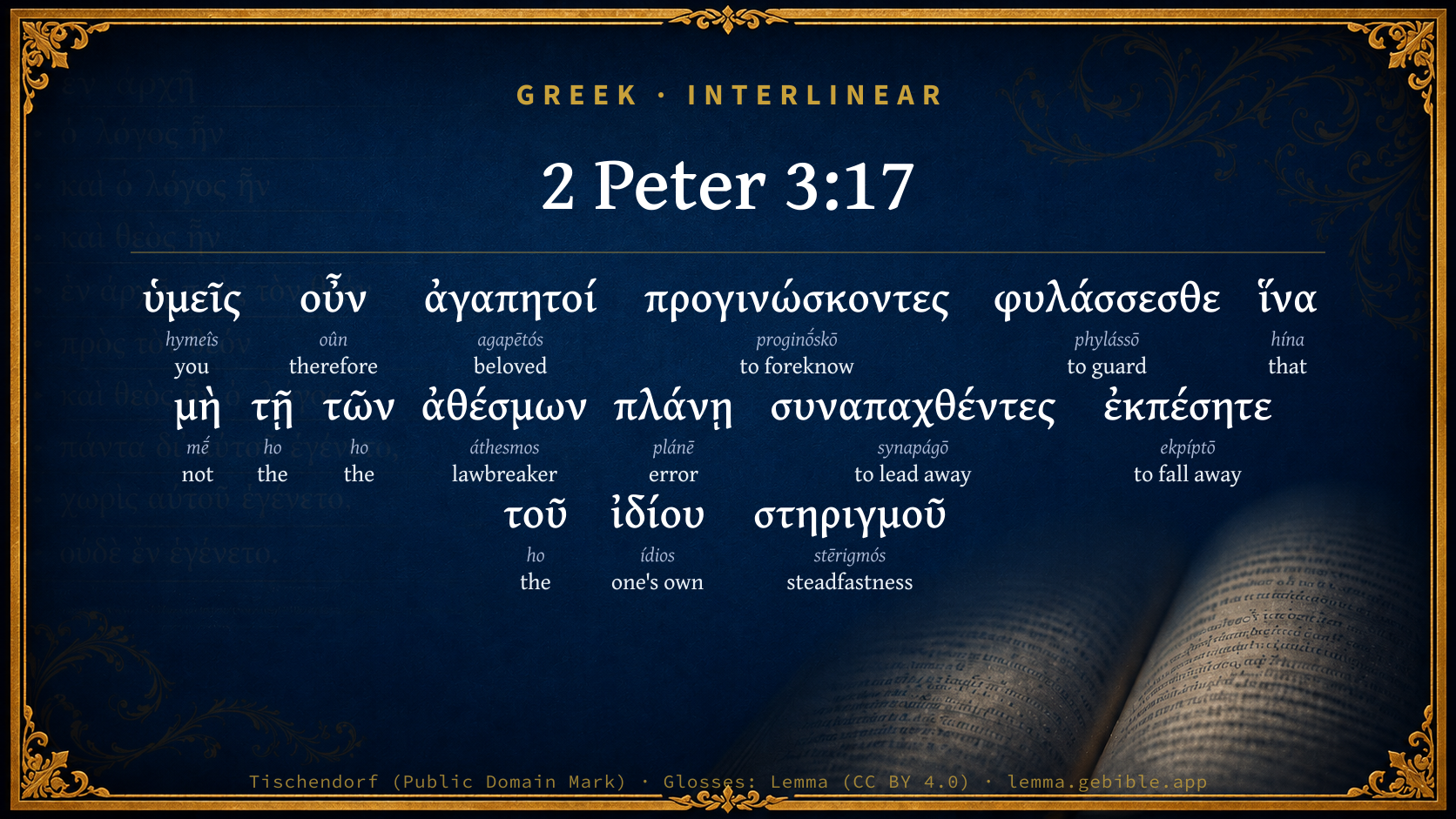
Greek (Tischendorf 8th ed.) 2 Peter 3:17 appears in the Greek New Testament. The text above is from the Tischendorf 8th edition. Each word links to its Strong’s number and a concise gloss. Click any word for its full Thayer’s Greek Lexicon entry.
Download image
Cite this verse

2 Peter 3:17 (World English Bible). Public Domain. Lemma interlinear Bible study tool, https://lemma.gebible.app/v/2-peter/3/17.

Show BibTeX & RIS
BibTeX
RIS
English Translation
You therefore, beloved, knowing these things beforehand, beware lest, being carried away with the error of the wicked, you fall from your own steadfastness.
World English Bible · Public Domain
Highlights
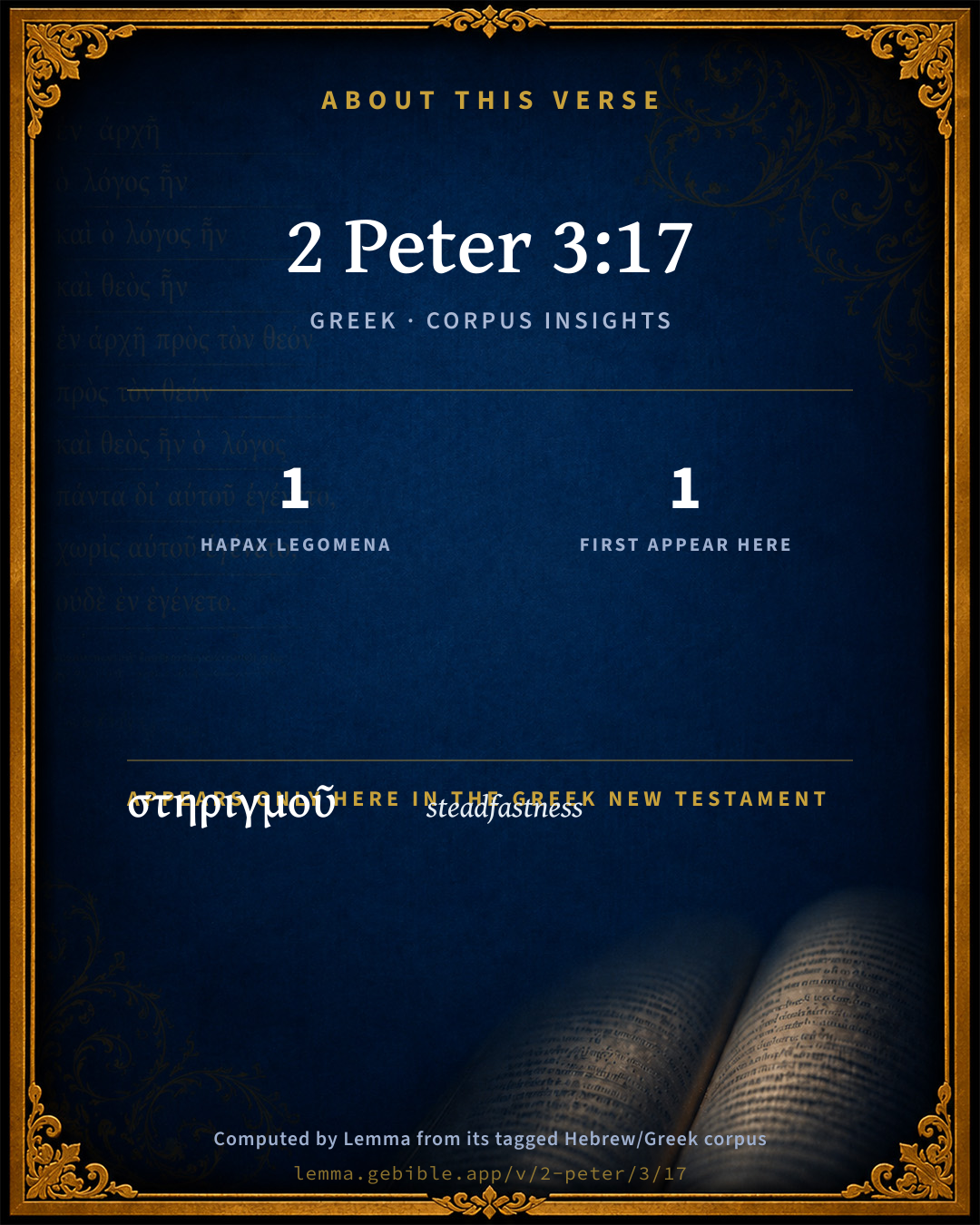
  • 1 hapax legomenon — only here in the Greek New Testament
  • 1 first appearance in the Greek New Testament
Full analysis ↓
Download a study sheet

One document with this verse’s original text, its word-by-word gloss line, the meaning frame, cross-references with their text, attributed commentary, and full source and license credits — printable, and it pastes into notes with its structure intact.

This verse Autodidact and up

Study sheet (.html) Plain text (.txt)

A passage Seminary Student

Up to 50 verses in one chapter. A passage sheet keeps up to 6 commentary sources and 12 cross-references per verse, in the order this page ranks them, and says so on the sheet whenever that leaves anything out. Ask for a single verse and you get the Autodidact verse sheet above.

Everything on this page stays free to read, with no account — the sheet is a download of what is already on screen, not access to it.

Want to remove ads? Support Godless Engineer
Compare translations 3

The same verse in 3 English versions, stacked beneath the original-language interlinear above. Click any original word for its lexicon entry.

Each is an independent rendering of the whole verse — the interlinear is not word-aligned to these translations.

Highlighted words mark where these versions differ — a whole-verse word diff, not a word-by-word alignment.

  • World English Bible Public Domain
    You therefore, beloved, knowing these things beforehand, beware lest, being carried away with the error of the wicked, you fall from your own steadfastness.
  • King James Version Public Domain
    Ye therefore, beloved, seeing ye know these things before, beware lest ye also, being led away with the error of the wicked, fall from your own stedfastness.
  • unfoldingWord Literal Text CC BY-SA 4.0
    Therefore, you beloved ones, knowing beforehand, guard yourselves, so that you might not lose your own steadfastness, having been led astray by the error of the lawless ones.

unfoldingWord Literal Text — © unfoldingWord, licensed CC BY-SA 4.0. Word-aligned USFM3 via Door43 (git.door43.org/unfoldingWord/en_ult).

Versions to compare (up to 4)

3 of 4 selected

Show all 19 translations

Every available English version of this verse, each an independent rendering of the whole verse.

  • World English Bible Public Domain
    You therefore, beloved, knowing these things beforehand, beware lest, being carried away with the error of the wicked, you fall from your own steadfastness.
  • Berean Standard Bible Public Domain
    Therefore, beloved, since you already know these things, be on your guard so that you will not be carried away by the error of the lawless and fall from your secure standing.
  • Majority Standard Bible Public Domain
    Therefore, beloved, since you already know these things, be on your guard so that you will not be carried away by the error of the lawless and fall from your secure standing.
  • King James Version Public Domain
    Ye therefore, beloved, seeing ye know these things before, beware lest ye also, being led away with the error of the wicked, fall from your own stedfastness.
  • American Standard Version (1901) Public Domain
    Ye therefore, beloved, knowing `these things' beforehand, beware lest, being carried away with the error of the wicked, ye fall from your own stedfastness.
  • Revised Version (1885) Public Domain
    Ye therefore, beloved, knowing these things beforehand, beware lest, being carried away with the error of the wicked, ye fall from your own stedfastness.
  • Geneva Bible (1599) Public Domain
    Ye therefore beloued, seeing ye know these thinges before, beware, lest ye be also plucked away with the errour of the wicked, and fall from your owne stedfastnesse.
  • Douay-Rheims (1899) Public Domain
    You therefore, brethren, knowing these things before, take heed, lest being led aside by the error of the unwise, you fall from your own steadfastness.
  • Young's Literal Translation Public Domain
    Ye, then, beloved, knowing before, take heed, lest, together with the error of the impious being led away, ye may fall from your own stedfastness,
  • Literal Standard Version CC BY-SA 4.0
    You, then, beloved, knowing before, take heed, lest, together with the error of the impious being led away, you may fall from your own steadfastness,
  • Unlocked Literal Bible CC BY-SA 4.0
    Therefore, beloved, since you know about these things beforehand, guard yourselves so that you are not led astray by the deceit of lawless people and you lose your own faithfulness.
  • unfoldingWord Literal Text CC BY-SA 4.0
    Therefore, you beloved ones, knowing beforehand, guard yourselves, so that you might not lose your own steadfastness, having been led astray by the error of the lawless ones.
  • Darby Bible Public Domain
    *Ye* therefore, beloved, knowing [these] things before, take care lest, being led away along with the error of the wicked, ye should fall from your own stedfastness:
  • World Messianic Bible Public Domain
    You therefore, beloved, knowing these things beforehand, beware, lest being carried away with the error of the wicked, you fall from your own steadfastness.
  • Webster's Bible Public Domain
    Ye therefore, beloved, seeing ye know these things before, beware lest ye also, being led away with the error of the wicked, fall from your own steadfastness.
  • Free Bible Version CC BY-SA 4.0
    My friends, since you already know this, make sure that these errors of the wicked don't lead you astray, and you don't fall from your firm position.
  • Bible in Basic English Public Domain
    For this reason, my loved ones, having knowledge of these things before they take place, take care that you are not turned away by the error of the uncontrolled, so falling from your true faith.
  • Text-Critical English NT CC BY 4.0
    Therefore, beloved, since you have been forewarned, be on your guard so that you will not be led astray by the error of these lawless men and fall from your own secure position.
  • Tyndale New Testament (1534) Public Domain
    Ye therfore beloved seynge ye knowe it before hande beware lest ye be also plucked a waye with the erroure of the wicked and fall from youre awne stedfastnes:

Literal Standard Version (2020), Covenant Press — licensed CC BY-SA 4.0. Text via the HelloAO Bible API (eBible.org). Unlocked Literal Bible (unfoldingWord) — licensed CC BY-SA 4.0. Text via the HelloAO Bible API (eBible.org). unfoldingWord Literal Text — © unfoldingWord, licensed CC BY-SA 4.0. Word-aligned USFM3 via Door43 (git.door43.org/unfoldingWord/en_ult). Free Bible Version, Dr. Jonathan Gallagher — licensed CC BY-SA 4.0. Text via the HelloAO Bible API (eBible.org).

Word by word

More ways to search: Search by grammar → Find every occurrence → Compare this word →

Practice this passage: Drill this verse → Learn its vocabulary →

στηριγμοῦ
stērigmós
G4740
“steadfastness”
Noun, Genitive, Singular, Masculine
Part of Speech
Noun
Case
Genitive
Number
Singular
Gender
Masculine
Full Thayer's Definition

Origin: from G4741

TDNT: 17:53,1

1. firm condition, steadfastness: of mind
  1. ὑμεῖς hymeîs G5210 “you” Personal pronoun, 2nd person, Nominative, Plural
  2. οὖν oûn G3767 “therefore” Conjunction
  3. ἀγαπητοί agapētós G27 “beloved” Adjective, Vocative, Plural, Masculine
  4. προγινώσκοντες proginṓskō G4267 “to foreknow” Verb, Present, Active, Participle, Nominative, Plural, Masculine
  5. φυλάσσεσθε phylássō G5442 “to guard” Verb, Present, Middle, Imperative, 2nd person, Plural
  6. ἵνα hína G2443 “that” Conjunction
  7. μὴ mḗ G3361 “not” Particle, Negative
  8. τῇ ho G3588 “the” Article, Dative, Singular, Feminine
  9. τῶν ho G3588 “the” Article, Genitive, Plural, Masculine
  10. ἀθέσμων áthesmos G113 “lawbreaker” Adjective, Genitive, Plural, Masculine
  11. πλάνῃ plánē G4106 “error” Noun, Dative, Singular, Feminine
  12. συναπαχθέντες synapágō G4879 “to lead away” Verb, Aorist, Passive, Participle, Nominative, Plural, Masculine
  13. ἐκπέσητε ekpíptō G1601 “to fall away” Verb, Aorist, Active, Subjunctive, 2nd person, Plural
  14. τοῦ ho G3588 “the” Article, Genitive, Singular, Masculine
  15. ἰδίου ídios G2398 “one's own” Adjective, Genitive, Singular, Masculine

About this verse

These counts appear in no published source. They are computed here, from the morphology-tagged text and Lemma’s own curated glosses. What Lemma adds →

16
words
14
distinct lemmas
General Epistles
section

Notable vocabulary

1 hapax legomenon — a word that appears only here in the entire Greek New Testament:

  • στηριγμοῦ steadfastness G4740

First appearance in Scripture

This word makes its first canonical appearance in the Greek New Testament here:

  • στηριγμοῦ steadfastness G4740

Shared distinctive vocabulary

ἀθέσμων lawbreaker G113 occurs in 2 verses of the Greek New Testament. Also found in:

Repetition

A word recurs within this verse:

Cross-references

23

Topical passages linked to 2 Peter 3:17 in the Treasury of Scripture Knowledge — connected by theme and wording, ordered by reader-vote popularity; previews shown in the World English Bible.

  • Colossians 2:8 Be careful that you don't let anyone rob you through his philosophy and vain deceit, after the tradition of men, after the elements of the world, and not after Christ.
  • Hebrews 3:14 For we have become partakers of Christ, if we hold fast the beginning of our confidence firm to the end:
  • 2 Corinthians 11:13–15 For such men are false apostles, deceitful workers, masquerading as Christ's apostles.
  • 1 Corinthians 15:58 Therefore, my beloved brothers, be steadfast, immovable, always abounding in the Lord's work, because you know that your labor is not in vain in the Lord.
  • 1 Corinthians 10:12 Therefore let him who thinks he stands be careful that he doesn't fall.
  • Ephesians 4:14 that we may no longer be children, tossed back and forth and carried about with every wind of doctrine, by the trickery of men, in craftiness, after the wiles of error;
  • Matthew 7:15 "Beware of false prophets, who come to you in sheep's clothing, but inwardly are ravening wolves.
  • 2 Peter 2:18–22 For, uttering great swelling words of emptiness, they entice in the lusts of the flesh, by licentiousness, those who are indeed escaping from those who live in error;
  • Proverbs 1:17 For in vain is the net spread in the sight of any bird:
  • Romans 16:18 For those who are such don't serve our Lord, Jesus Christ, but their own belly; and by their smooth and flattering speech, they deceive the hearts of the innocent.
  • 2 Corinthians 11:3 But I am afraid that somehow, as the serpent deceived Eve in his craftiness, so your minds might be corrupted from the simplicity that is in Christ.
  • 2 Peter 1:10–12 Therefore, brothers, be more diligent to make your calling and election sure. For if you do these things, you will never stumble.
  • Matthew 16:6 Jesus said to them, "Take heed and beware of the yeast of the Pharisees and Sadducees."
  • Matthew 24:24–25 For there will arise false christs, and false prophets, and they will show great signs and wonders, so as to lead astray, if possible, even the chosen ones.
  • Mark 13:22–23 For there will arise false christs and false prophets, and will show signs and wonders, that they may lead astray, if possible, even the chosen ones.
  • 2 Timothy 4:15 of whom you also must beware; for he greatly opposed our words.
  • Matthew 16:11 How is it that you don't perceive that I didn't speak to you concerning bread? But beware of the yeast of the Pharisees and Sadducees."
  • Acts 2:42 They continued steadfastly in the apostles' teaching and fellowship, in the breaking of bread, and prayer.
  • John 16:4 But I have told you these things, so that when the time comes, you may remember that I told you about them. I didn't tell you these things from the beginning, because I was with you.
  • Philippians 3:2 Beware of the dogs, beware of the evil workers, beware of the false circumcision.
  • Colossians 2:5 For though I am absent in the flesh, yet am I with you in the spirit, rejoicing and seeing your order, and the steadfastness of your faith in Christ.
  • 1 Peter 5:9 Withstand him steadfast in your faith, knowing that your brothers who are in the world are undergoing the same sufferings.
  • Revelation 2:5 Remember therefore from where you have fallen, and repent and do the first works; or else I am coming to you swiftly, and will move your lampstand out of its place, unless you repent.

Cross-references courtesy of OpenBible.info (CC BY 4.0).

Commentary

Notes on 2 Peter 3:17 from classic Christian and Jewish commentators (each source and its license shown beneath its notes). The classic Christian expositions comment on the surrounding passage and are grouped to its opening verse, so a note may address several verses; the Jewish commentaries on the Tanakh (Rashi and others) are per-verse, so they appear only where the commentator wrote on this verse.

Lemma curates 59 commentaries, every one of them public domain or Creative Commons licensed, each selected and text-cleaned for this edition rather than reprinted as found. About our sources →

The Biblical Illustrator

Joseph S. Exell

2Pe_3:17-18

Beware lest ye also … fall

Seducers of faith

1.

Let us shun the society of idolatrous seducers, and hate the very air they breathe. We shall hardly win them to goodness; their familiarity will easily possess us of their wickedness.

2. The greater show of sanctity that error puts on, the more suspicious let us be of the intended mischief.

3. Let us consider that these seducers help to overthrow us, but what help is there in them to raise us up? (Thos. Adams.)

Christian perseverance

I. The nature of that duty which is here recommended. The apostle does not address himself here to such as were unacquainted with the ways of godliness, but those who had been initiated in the Christian profession. It is not enough for us to begin well, and to set out hopefully in the exercises of religion, but we must run till we have reached the goal.

II. Arguments which may reasonably incline us to the practice of this duty.

1. The easiness of proceeding in a virtuous course when once we are made familiar with it, should powerfully persuade us to persevere in goodness, and not to fall from our own stedfastness.

2. The great advantages which will redound to us from the performance of this duty should powerfully persuade us to persevere in godliness and not to fall from our own stedfastness.

3. The dangers and inconveniences of a contrary proceeding should powerfully persuade us to persevere in goodness and not to fall from our own stedfastness.

III. Such rules and instructions as may duly qualify us for the performance of this duty.

1. Let us endeavour to strengthen our good resolutions.

2. Let us be perpetually upon our guard, and keep a vigilant eye over all our actions.

3. Let us be frequent in the exercises of religious duties, especially in such as are more solemn and public.

4. Let us be fervent in private prayer to Almighty God; that He will assist us with His Holy Spirit, and give us grace to proceed without danger of falling. (N. Brady.)

Young Christians

Your little child hangs over the taffrail of the steamboat and says, Father, what is that black thing in the water? You say, That is a buoy, showing there is a rock underneath, and danger there. So the Apostle Peter in the text points out the perils of the Christian voyage. It would be a strange thing if all our anxiety about men ceased the moment they were converted. You would almost doubt the sanity of that farmer who, having planted the corn and seen it just sprout above ground, should say, My work is all done. I have no more anxiety for the crop. You have only just been launched; the voyage is to be made. Earth, and heaven, and hell are watching to see how fast you will sail, how well you will weather the tempest, and whether at last, amid the shouting of angels, you shall come into the right harbour.

I. Hold before your soul a very high model. Do not say, I wish I could pray like that man, or speak or have the consecration of this one. Say, Here is the Lord Jesus Christ a perfect pattern. By Him, with Gods grace, I mean to shape all my life. You have a right to aspire to the very highest style of Christian character. I admit that a man cannot become a Christian like that without a struggle; but what do you get without fighting for it? In the strength of Christ go forward. God is for you, and if God be for you, who can be against you? Remember that God never puts you in battle but He gives you weapons with which to fight.

II. Abstain from all pernicious associations, and take only those that are useful and beneficent. I know young people who have meant well enough, but they have floated off into evil influences, and they have associated day by day with those who hated God and despised His commandments, and their characters are all depleted. I can see they are changed for the worse, but they are not aware of it. Oh, young man, come out of that bad association. Stand back from that furnace in which so many young Christians have been destroyed.

III. Be actively employed. Who are the happy people in the Church to-day? The busy people. The very first prescription that I give to a man when I find him full of doubts and fears about his eternal interest is to go to work for God. Here is a wood full of summer insects. An axeman goes into the wood to cut firewood. The insects do not bother him very much, and every stroke of the axe makes them fly about. But let a man go and lie down there and he is bitten, and thinks it is a horrible thing to stay in that wood. So there are thousands of Christians now in the Church who go out amid great annoyances in life--they are not perplexed, they are all the time busy; while there are others who do nothing, and they are stung, and covered from head to foot with the blotches of indolence, and inactivity, and spiritual death.

IV. Be faithful in prayer. You might as well, business man, start out in the morning without food and expect to be strong all that day--you might as well abstain from food all the week and expect to be strong physically, as to be strong without prayer. And the only difference between this Christian who is getting along very fast in the holy life, and this one who is only getting along tolerably, is that the first prays more than the last.

V. Be faithful in bible research. A great many good books are now coining out. Glorious books they are. But I have thought that perhaps the followers of Christ sometimes allow this religious literature to take their attention from Gods Word, and that there may not be as much Bible reading as there ought to be. You go to the drug store and you get the mineral waters; but you have noticed that the waters are not so fresh or sparkling or healthful as when you get these very waters at Saratoga and Sharon--getting them right where they bubble from the rock. And I have noticed the same thing in regard to the truth of the gospel. While there is a good deal of the refreshment and health of the gospel of God as it comes through good books, I find it is better when I come to the eternal rock of Gods Word, and drink from that fountain that bubbles up fresh and pure to the life, the refreshment, the health of the soul. (T. de Witt Talmage.)

Spiritual steadfastness

I. A spiritual steadfastness may be obtained. The Prophet David commands it, prays for it, and confesseth that some did obtain it, possess it. And doth not the apostle also persuade to the same, crying, Be steadfast, immovable? Who, then, hath cause to question the truth of this doctrine? If any shall, reason may relieve him. For, is not a man a subject capable of it, may he not be fitted to receive it? Is not the faculty of his understanding, in respect of its essence, sound? His will of power, strongly, since his fall, bent to action? And hath he not affections, violent, passionate? Again, shall we think anything impossible with God? And if this were not thus, for what end was preaching appointed, sacraments ordained, and prayer commanded? Are these given in vain? Finally, let me ask thee a question, Shall not Christ be of ability to recover what Adam of imbecility lost? The Holy Ghost to build what the unclean spirit did destroy? Spiritual steadfastness is a firm retention of the degree of grace received. Observe further that this steadfastness is habitual, practical. Again, habitual steadfastness is in the understanding, will, and affections. As for practical steadfastness, that is external, internal.

II. The cause of these declinings. And they be within us, without us. First, melancholy, for it is a true axiom that the soul follows the disposition and temperature of the body. Secondly, some raging lust, unmortified affection. When such a passenger is in the ship of mans soul, like another Jonah it will unsettle all. If the reins hang under his feet, the strongest, readiest footed beast may stumble. Cut all the feet equal the table stands steadfast, else not. Thirdly, unbelief, what mists will this raise in our understandings. How subtly will this sophister argue, dispute, what? Where is the promise of Christs coming? Fourthly, carnal confidence, that is, whatsoever we trust in except Christ Jesus. Fifthly, weakness of grace, to speak properly this is not a real or positive cause of declining, yet by occasion may have a finger in the business. Sixthly, want of knowledge experimental. Now the contrary of all these we have mentioned will be excellent helps for the firm retention of grace received. Wherefore keep thy body in good plight, feed on choice meats, walk in pure air, use moderate labour, recreation. Mortify also fleshly lusts, crucify the whole body of sin, for in so doing thou shalt remove rubs out of the way, curb the old man, and bind him to good behaviour. See in like sort thou increase thy faith, and that will expel infidelity--consume it as fire doth stubble. And shall not hope in Christ make the new man lusty, arm him against fear, foil despair, and in all assaults cheer up his spirits? Be sure to grow in grace, for is not a feeble person subject to trip, to stumble when able bodies hold out, march valiantly, win the field? And thus much of the inward causes of declining; the other, from without us, follow. First, wavering minded companions. He who walks with such will in time walk as such. Secondly, the fierce trial of affliction. Thirdly, personal wrongs, undeserved injuries. Fourthly, public scandal. Fifthly, example of supposed great ones. For some are like a strong poison that dispatcheth its patient quickly, others a lingering disease which killeth certainly though not suddenly. These things being inserted let us proceed. First, when we have not so clear an apprehension of the worth of grace, and the means to procure it, increase it, as in former time. If the glory thereof be darkened, and we account faith, love, hope, but as common favours, in some degree we are declined. Secondly, if we want an eager appetite after the doctrine of sound words, the bread and water of life, feed on them more for fear and fashion than love and affection, we have just cause to suspect ourselves. Thirdly, a neglect of our particular calling. For a diligent hand maketh rich, as well in spiritual as corporal things. Unthrifts and loiterers always die beggars. Fourthly, when we feebly perform holy actions, or fearfully omit them. Fifthly, a fifth symptom is a quiet concoction of what heretofore we have distasted, spued out, holding the same, as then, for loathsome meats. A soul in her best plight, as she abhors the greatest so hates the least known evil. Sixthly, finally, when men offend, and will not endure reproof. And may a spiritual steadfastness be fallen from? Then try thyself if thou be or not revolted. Tradesmen keep a register of all their proceedings, cast up their accounts yearly, take a strict view how they have decreased or increased their substance; and should not Christians be as wise in their generation? First, we must call to remembrance what truths in the understanding or in our conversation, we have fallen from, and so return unto them. Secondly, we are to consider what sin we have embraced, whether it be an error in judgment or practice, and if we clearly discern any, then to cease from it. First, cast in thy mind what an uncomfortable condition thou art fallen into, compare it often with the times of old. Do not slavish fears upon the least occasion arise in thy soul? Secondly, consider that greater evils than these may attend thee. This may suffice to have spoken of the last branch of our text, the other succeedeth. Lest ye also being led away with the error of the wicked. Error leadeth from steadfastness. He who is led with error is always unsettled. For error leads from God. And is not He the best stay, and very centre whereupon all the creatures are settled, established. Again, whither leads error to any constant object? Is it to the world? Doth not the fashion of it pass away? Think it not strange, then, if they who err from the doctrine of godliness be unstable in all their ways. What marvel is it that men walking on craggy rocks, steep mountains, and unequal ways, trip, stumble, and catch a fall? Whereas the apostle calls it the error of the wicked, we may collect, that the way of error, by a peculiar prerogative, is the way of the wicked. True it is that error is called a way, but a crooked, wandering, and evil one. For as the commandments of God are styled ways, so are the doctrines of men. Thus far we are agreed; but what may be the reasons hereof?

1. Because the wicked invent them, are the prime authors of them. For what a man effecteth is properly said to be his own.

2. Again, in regard they conserve and support them.

3. This way is not from God; He disclaims it. For all His paths are holy, and good, and true. Beware lest ye also, etc. The note which issueth out of this phrase is this, that by one error many may be seduced. As first, from the quality of error, for it is of a spreading nature. Besides, error is easy, pleasant; and what is agreeable to the flesh of multitudes is followed. The way of truth is straight, narrow. Moreover men are wonderfully prone to follow examples, the worst, not the best. And by one error may many be seduced; then get a good eye, a sound judgment; exercise thy wits, that thou mayest discern between truth and falsehood. Error being discovered is to be avoided. (John Barlow, D. D.)

Beware

It is a word for trespassers, and God puts it up in all the by-ways of temptation. (J. R. Macduff, D. D.)

Salutary warnings

There are evils which give warning of their coming. Drunkenness does not seize upon a man suddenly. It gives warnings often and many. Avarice, and a number of other vices, can be detected long before we are within their reach. There are infallible indications by which we may be warned. The approach of vice is like the approach of the rattlesnake. This horrible reptile, one of the most venomous of serpents, warns man involuntarily against its formidable presence. At the end of its tail there is placed a rattle, which consists of a string of hollow, dry, trod semi transparent bones, which constantly clatter against each other as the reptile moves, with a hoarse, dull, echoing sound. The bony rings increase in number with the reptiles age, and it gains an additional one, it is said, at each casting of the skin. The warning which it is thus compelled to give of its approach enables those who hear to escape an awful death. Happy are those men whose ears are open to the warnings which social monsters, far more horrid than even the rattlesnake, in like manner invariably give of their presence and movements, and, profiting thereby, manage to escape. (Scientific Illustrations.)

Stop the beginnings of sin

I have seen the little pearls of a spring sweat through the bottom of a bank, and penetrate the stubborn pavement, till it hath made it fit for the impression of a childs foot, and it was dispersed like the descending dews of a misty morning, till it had opened its way and made a stream large enough to carry away the ruins of the undermined strand, and to invade the neighbouring gardens; but then the despised drops were grown into an artificial river, and an intolerable mischief. So are the first entrances of sin stopped with the antidotes of a hearty prayer, and checked into sobriety by the eye of a reverent man, or the counsel of a single sermon; but when such beginnings are neglected, and our religion hath not in it so much philosophy as to think anything evil so long as we can endure it, they grow up to ulcers and pestilential evils; they destroy the soul by their abode which, at the first entry, might have been killed by the pressure of a little finger. (Jeremy Taylor.)

The Biblical Illustrator, edited by Joseph S. Exell (c. 1880s–1900s) — public domain. Text from a community e-Sword module.

Joseph Benson's Commentary

2Pe 3:17-18. Therefore, seeing ye know these things before — Respecting the coming of the Lord to judgment, in what an awful manner the scene will close, and what dreadful vengeance will be executed on all the wicked, and especially on those that pollute the Church of Christ, into which they have professed to enter; and that scoffers will arise and ridicule the promise of Christ’s coming, as also the danger there is of misunderstanding and misinterpreting the Scriptures, and so of being seduced and perverted thereby. Here St. Peter teaches that one great purpose for which the prophets were inspired to foretel the corruptions which were to arise in the church, and the evils which were to befall the sincere disciples of Christ, was to put them on their guard against these corruptions, and to arm them with fortitude to bear persecutions. Beware — Be on your guard; lest ye also, being led away with the error of the wicked, (αθεσμων, the lawless,) fall from your own steadfastness — In the faith and practice of the gospel; that steadfastness which, by God’s assistance, you have hitherto retained. But — To prevent this falling away; grow in grace — In every Christian temper; and in order thereto, conscientiously and diligently use the means appointed. And in the knowledge of Christ — That is, in faith, the root of all piety and virtue; faith implying that knowledge of him which is communicated by the Spirit of wisdom and revelation, mentioned Eph 1:17, and promised Joh 16:14. To him be glory, εις ημεραν αιωνος, to the day of eternity — An expression naturally flowing from that sense which the apostle had felt in his soul throughout this whole chapter. Eternity is a day without night, without interruption, without end. Amen — Dr. Benson remarks, that when this word is placed at the beginning of a sentence, it is an earnest asseveration. In the conclusion of a sentence, it imports an earnest wish that it may be so. The doxology, with which this epistle concludes, is evidently directed to Christ, as are some of the other doxologies in Scripture.

Joseph Benson's Commentary on the Old and New Testaments (1811–1818) — public domain. Text from a community e-Sword module.

Tyndale Open Study Notes

Tyndale Open Resources

3:17-18 Peter restates his purpose: to protect his readers from false teachers so that they can grow in grace. He ends with a doxology to our Lord and Savior Jesus Christ.

Tyndale Open Study Notes — © Tyndale Open Resources, licensed CC BY-SA 4.0. Text via the HelloAO Bible API.

Bengel's Gnomon

Johann Albrecht Bengel

2Pe 3:17. Ὑμεῖς) ye, warned by the injury of others.—προγινώσκοντες) knowing the danger beforehand.—στηριγμοῦ, from your defence) [“Stedfastness”] Comp. 2Pe 3:16; 2Pe 1:12. This defence is grace. Comp. Jud 1:21.

Bengel's Gnomon of the New Testament — English translation (T&T Clark, Edinburgh, 1860) — public domain. Text from a community e-Sword module.

Meyer's Critical & Exegetical Commentary

Heinrich August Wilhelm Meyer

2Pe_3:17-18. Concluding exhortation and doxology.

ὑμεῖς οὖν] Conclusion from what goes before.

προγινώσκοντες] since ye know it beforehand; i.e. that such false teachers as have been described will come; not: that the advent of Christ will take place, nor: that the consequences of the στρεβλοῦν will be the ἀπώλεια (Schott).

φυλάσσεσθε, ἵνα μή] Since φυλάσσεσθε is nowhere else construed with ἵνα μή, ἵνα κ.τ.λ. is not to be taken as an objective clause, but as one expressive of purpose; consequently special emphasis lies on φυλάσσεσθε (Schott).

τῇ τῶν ἀθέσμων πλάνῃ συναπαχθέντες] The ἄθεσμοι (cf. chap. 2Pe_2:7) are the aforementioned ἐμπαῖκται and Libertines.

πλάνη is not: seduction (Dietlein: leading astray of others), for the word never has this meaning (not even in Eph_4:14); nor would the συν in the verb agree with this, but, as in chap. 2Pe_2:18 : moral-religious error; with συναπαχθέντες, carried away along with, cf. Gal_2:13, and Meyer on Rom_12:16.

ἐκπέσητε τοῦ ἰδίου στηριγμοῦ] With ἐκπίπτειν, cf. Gal_5:4, and Meyer in loc.

στηριγμός, ἅπ. λεγ., is the firm position which any one possesses (not: the fortress; Luther); here, therefore, the firm position which the readers as believing Christians take up; cf. 2Pe_1:12; antithesis to the ἀμαθεῖς καὶ ἀστήρικτοι, 2Pe_3:16. Dietlein explains the word quite arbitrarily of the remaining at peace in the church.2Pe_3:18. αὐξάνετε δέ] Antithesis to the ἐκπέσητε; the remaining in the firm position can take place only where the αὐξάνειν is not lacking. Calvin: ad profectum etiam hortatur, quia haec unica est perseverandi ratio, si assidue progredimur. Hofmann incorrectly connects this imperative with φυλάσσεσθε, to which it is supposed to be related as a further addition; this view is opposed by δέ.

ἐν χάριτι καὶ γνώσει τοῦ κυρίου κ.τ.λ.] does not state the means and the origin of the growing (Schott), but that in which they should grow or increase; αὐξάνειν, without any nearer definition, would be too bald in presence of the ἵνα μὴ … ἐκπέσητε κ.τ.λ. With regard to the two ideas: χάρις and γνῶσις, Aretius says: illud ad conversationem inter homines refero, quae gratiosa esse debet; hoc vero ad Dei cultum, qui consistit in cognitione Christi; this explanation is wrong; χάρις can be only either the grace of God, so that the sense of the exhortation would be, that they should seek to acquire the grace of God in ever richer measure (Hornejus, etc.); orand this is preferablethe state of grace of the Christians (according to Calvin, etc.: the sum of the divine gifts of grace).

The γνῶσις is here specially mentioned, because the author regarded it as the living origin of all Christian activity.

The genitive: τοῦ κυρίου κ.τ.λ., is taken by de Wette, Brückner agreeing with him, with reference to χάρις, as the subjective, with reference to γνῶσις, as the objective genitive; in like manner Hofmann. This twofold reference of the same genitive is inconceivable;[1] if it belong to both ideas, it can only be the gen. auctoris (Dietlein, Steinfass); but since it is more natural to explain it in connection with γνῶσις as gen. objec., ΧΆΡΙς must be taken as an independent conception.

Finally, the doxology, applied to Christ; Hemming: testimonium de divinitate Christi, nam cum tribuit Christo aeternam gloriam, ipsum verum Deum absque omni dubio agnoscit.

The expression: ΕἸς ἩΜΈΡΑΝ ΑἸῶΝΟς, is to be found only here; Bengel takes ἩΜΈΡΑ in contrast to the night: aeternitas est dies, sine nocte, merus et perpetuus; this is hardly correct; most interpreters explain the expression as equivalent to tempus aeternum, synonymous with εἰς τὸν αἰῶνα, 1Pe_1:25, or with ΕἸς ΤΟῪς ΑἸῶΝΑς, Rom_16:27; this is too inexact; ἩΜΈΡΑ ΑἸῶΝΟς is the day on which eternity, as contrasted with time, begins, which, however, at the same time is eternity itself.

ἈΜΉΝ] cf. Jud_1:25.

[1] Hofmann, indeed, appeals to Rom_15:4; Tit_2:13; 1Pe_1:2; but these passages do not prove what they are meant to prove.

Meyer — Critical and Exegetical Commentary on the New Testament — English translation by Peter Christie, edited by Frederick Crombie (T&T Clark, 1880) — public domain. Text from a community e-Sword module.

Expositor's Greek Testament

ed. W. Robertson Nicoll

2Pe 3:17-18 . Final exhortation . “Having then, brethren, been forewarned, be on your guard lest you fall from your own foundation, carried away by the error of lawless men. Grow in the grace and knowledge of Our Lord and Saviour Jesus Christ. To Him be glory both now and in the day of eternity.”

2Pe 3:17 . This verse gathers up various thoughts that appear elsewhere in the epistle. Προγινώσκοντες repeats ταῦτα πρῶτον γινώσκοντες of 2Pe 1:20 , 2Pe 3:1 ; ἀθέσμων occurs 2Pe 2:7 ; πλάνη 2Pe 2:18 . συναπαχθέντες ( cf. Gal 2:13 ), “carried away”. ἀθέσμων , see note 2Pe 2:7 . στηριγμοῦ , “steadfastness”; perhaps “foundation” is better, although in this sense we would expect στήριγμα . There is, however, a tendency in N.T. to confuse words in - μα - μος . Cf. κύλισμα (2Pe 2:22 ). ἁρπαγμός (Phi 2:6 ). The foundation is the χάρις and γνῶσις of 2Pe 3:18 . ἰδίου is in emphatic contrast to the untrustworthy basis of the Libertine teaching.

The Expositor's Greek Testament, edited by W. Robertson Nicoll (1897–1910) — public domain. Text from a community e-Sword module.

Jamieson, Fausset & Brown

Robert Jamieson, A. R. Fausset & David Brown

Ye--warned by the case of those "unlearned and unstable" persons (Pe2 3:16).

knowing . . . before--the event.

led away with--the very term, as Peter remembers, used by Paul of Barnabas' being "carried," Greek, "led away with" Peter and the other Jews in their hypocrisy.

wicked--"lawless," as in Pe2 2:7.

fall from--(grace, Gal 5:4 : the true source of) "steadfastness" or stability in contrast with the "unstable" (Pe2 3:16): "established" (Pe2 1:12): all kindred Greek terms. Compare Jde 1:20-21.

Jamieson, Fausset & Brown — Commentary Critical and Explanatory on the Whole Bible (1871) — public domain (CC PDM 1.0). Text via the HelloAO Bible API.

Adam Clarke's Commentary

Verse 17. Seeing ye know - before] Seeing that by prophets and apostles you have been thus forewarned, beware, φυλασσεσθε, keep watch, be on your guard; cleave to God and the word of his grace, lest ye be led away from the truth delivered by the prophets and apostles, by the error of the wicked, αθεσμων, of the lawless- those who wrest the Scriptures to make them countenance their lusts, exorbitant exactions, and lawless practices.

Fall from your own steadfastness.] From that faith in Christ which has put you in possession of that grace which establishes the heart.

Adam Clarke's Commentary on the Bible (1810–1826) — public domain. Text from a community e-Sword/MySword module.

John Calvin's Commentaries

17. Ye, therefore, beloved. After having shewn to the faithful the dangers of which they were to beware, he now concludes by admonishing them to be wise. But he shews that there was need of being watchful, lest they should be overwhelmed. And, doubtless, the craft of our enemy, the many and various treacheries which he employs against us, the cavils of ungodly men, leave no place for security. Hence, vigilance must be exercised, lest the devices of Satan and of the wicked should succeed in circumventing us. It, however seems that we stand on slippery ground, and the certainty of our salvation is suspended, as it were, on a thread, since he declares to the faithful, that they ought to take heed lest they should fall from their own steadfastness.

What, then, will become of us, if we are exposed to the danger of falling? To this I answer, that this exhortation, and those like it, are by no means intended to shake the firmness of that faith which recumbs on God, but to correct the sloth of our flesh. If any one wishes to see more on this subject, let him read what has been said on the tenth chapter of the First Epistle to the Corinthians.

The meaning is this, that as long as we are in the flesh, our tardiness must be roused, and that this is fitly done by having our weakness, and the variety of dangers which surround us, placed before our eyes; but that the confidence which rests on God's promises ought not to be thereby shaken.

John Calvin's Commentaries (1540-1563) — public domain. Text from the Calvin Translation Society English edition (1840s-50s) via the Christian Classics Ethereal Library (ccel.org). Calvin's coverage is partial (roughly two-thirds of the Bible); uncommented books and verses are honest gaps, never fabricated. The 19th-century editor's footnotes and remarks are omitted so the notes are faithfully Calvin's own voice.

Ellicott's Commentary for English Readers

(17) Know these things before.—Seeing that I have forewarned you of the certain appearance, conduct, and success of these false teachers and scoffers. “Forewarned, forearmed.”

Being led away with.—The Greek word occurs only thrice in the New Testament—here, Rom_12:16, and Gal_2:13. In Rom_12:16 its meaning is a good deal different (see Note there). In Gal_2:13 it has the same meaning as here; and, strangely enough, it is of Barnabas being “carried away with” the dissimulation of Peter and his associates.

The error of the wicked.—Better, the error of the lawless (2Pe_2:7), but not “the seduction” or “deceit of the lawless,” as some would render it. It is the same word as occurs at the end of 2Pe_2:18, and it implies wandering from the path, but not leading others astray. The context, not the word itself, shows that there was seduction. “The lawless” are the false teachers and scoffers.

Fall from your own stedfastness.—Referring back to 2Pe_1:10-12, just as 2Pe_3:18 refers back to 2Pe_1:5-8; showing how complete is the coherence between the beginning and ending of the Epistle. (Comp. Gal_5:4.) This “steadfastness” will be based on belief in Christ’s coming, and on the hope of entering into His kingdom, and thus will be in marked contrast to the unbelief of the “unstable” in 2Pe_3:16. The word for “steadfastness” occurs nowhere else.

The entire absence of directions—which St. Jude gives rather elaborately—as to how these evil men and their victims are to be treated by sound Christians is in favour of the priority of this Epistle. When evil men begin to arise, the first impulse is to avoid them and their ways, and to this course St. Peter exhorts his readers. When such men have established themselves and gained proselytes, people begin to consider how to deal with the seducers and to win back the seduced, and to these points St. Jude directs his readers.

A Bible Commentary for English Readers, edited by Charles John Ellicott (1878–1897) — public domain. Text from a community e-Sword module.

The Cambridge Bible for Schools and Colleges

gen. ed. J. J. S. Perowne

17. beware lest ye also, being led away with the error of the wicked] Better, of the lawless ones, as in chap. 2Pe_2:7. It is noticeable that while St Paul had used the word for being “led away” of Barnabas as being influenced by the Judaizing teachers at Antioch (Gal_2:13), St Peter here applies it to those who were persuaded by teachers at the opposite pole of error. Comp. note on chap. 2Pe_2:1. The word for “error” is prominent in the Epistles to which St Peter has referred in the preceding verses (Eph_4:14; 1Th_2:3; 2Th_2:11).

fall from your own stedfastness] The “steadfastness” of the readers of the Epistle as contrasted with the unstable or unsteadfast of 2Pe_3:16 is acknowledged; but they are warned that it requires care and watchfulness to preserve it. He does not assume any indefectible grace of perseverance. The tense of the verb in “lest ye fall” indicates that it would be a single and decisive act.

The Cambridge Bible for Schools and Colleges (gen. ed. J. J. S. Perowne; Cambridge University Press, 1878–1918) — public domain. Text from a community e-Sword module.

John Gill's Exposition

Ye therefore, beloved, seeing ye know these things before,.... As that there will be such mockers and scoffers in the last days, and such unlearned and unstable men that will deprave the Scriptures, and wrest them in such a miserable manner:

beware lest ye also, being led away with the error of the wicked; from the simplicity of the Gospel, along with such wicked men, that wax worse and worse, deceivers and being deceived, by giving into any of their errors which respect the grace of God, or the person and offices of Christ, or particularly his second coming; be upon the watch and guard against them, having previous notice of them, for they lie in wait to deceive: lest ye

fall from your own steadfastness; which was proper to them, and which, by the grace of God, they had, and retained, both in the faith of Christ and doctrine of the Gospel; for though the saints can never finally and totally fall into sin, or from the truth, yet they may fall from their steadfastness, both as to the exercise of the grace of faith, and as to their profession of the doctrine of faith; and to be fluctuating, hesitating, and doubting in either respect, must be very uncomfortable and dishonourable.

John Gill's Exposition of the Whole Bible (1746–1763) — public domain (CC PDM 1.0). Text via the HelloAO Bible API.

Trapp's Complete Commentary

John Trapp

17 Ye therefore, beloved, seeing ye know these things before, beware lest ye also, being led away with the error of the wicked, fall from your own stedfastness.

Ver. 17. Beware lest] Cavebis autem si pavebis. Let him that stands take heed lest he fall. Be not high minded, but fear. Fear a snake under every flower, a snare under every new truth. Try the spirits whether they be of God or not, because many false prophets are abroad, who deceive the hearts of the simple, and make them fall from their own stedfastness. Try therefore before ye trust; look before ye leap. Alioqui saliens antequam videas, casuals es antequam debeas, i.e. If ye look not before ye leap, ye will fall before ye would. (Bernard.) Therefore walk circumspectly, tread gingerly, step warily, lift not up one foot till ye have found sure footing for the other, as those, Psa 35:6. Take the apostle’s counsel here: never more needed than today, quando facta est fided Evangeliorum fides temporum. Nam aut scrb buntur tides ut volumus; aut, ut volumus intelliguntur, as Hilary complains of those better times, {a} It is grown a witty thing now among such variety of opinions to hold the truth, and to be a sound believer, as Erasmus once said. Beware therefore (every man for himself) lest ye also, swimming down the stream of the times, "and led away with the error of the wicked, fall from your own stedfastness." And (for a sovereign preservative) "grow in grace, and in the knowledge," &c.: grow downward howsoever; grow in humility, and God will both teach and "save the humble person," Psa 25:1-22 Job 22:2.

Fall] As leaves fall from the trees in autumn.

{a} Hil. ad Constant. in libro, quem illi exhibuit.

John Trapp, A Commentary or Exposition upon All the Books of the Old and New Testament (1647–1656) — public domain. Text from a community e-Sword module.

Albert Barnes' Notes on the Bible

Seeing that ye know these things before - Being aware of this danger, and knowing that such results may follow. People should read the Bible with the feeling that it is possible that they may fall into error, and be deceived at last. This apprehension will do much to make them diligent, and candid, and prayerful, in studying the Word of God.

With the error of the wicked - Wicked men. Such as he had referred to in 2 Pet. 2, who became public teachers of religion.

Fall from your own steadfastness - Your firm adherence to the truth. The particular danger here referred to is not that of falling from grace, or from true religion, but from the firm and settled principles of religious truth into error.

Albert Barnes' Notes on the Bible (1834–1885) — public domain. Text from a community e-Sword/MySword module.

Haydock's Catholic Bible Commentary

Being forewarned, therefore, and knowing these things before, take heed not to be led away by the errors of such false and unwise teachers, whatever knowledge they boast of, as did the Gnostics. But make it your serious endeavour to increase in grace by God’s assistance, in the true knowledge of our Lord God and Saviour, Jesus Christ, to whom, as being one God with his eternal Father and the Holy Ghost, be glory now, and for all eternity. Amen. (Witham)

George Leo Haydock (1774–1849), Haydock's Catholic Family Bible and Commentary, 1859 edition — public domain. Excludes Psalms (Douay-Rheims chapter numbering differs from Protestant) and Deuterocanonical books (Catholic canon only).

Matthew Poole's English Annotations

Seeing ye know these things, which I have been now writing to you of, viz. That the Judge will certainly come; or, that heretics, deceivers, and scoffers will come; or both may be comprehended.

Beware lest ye also; as well as others have been.

Fall from your own stedfastness; the stedfastness of your faith. This admonition he gives them, not to discourage them with fear of apostacy, but to awaken them to that holy care which would be a means to prevent it; and so to keep them from security, and trust in themselves, not to weaken their faith, and reliance on the promise.

Matthew Poole's English Annotations on the Holy Bible (1683–1685) — public domain. Text from a community e-Sword/MySword module.

Whedon's Commentary on the Bible

Daniel D. Whedon

17. Know… before—The same as knowing this first, of 2Pe_3:3; namely, the law by which the judgment-day time is to be interpreted.

Ye also—Like the scoffers of 2Pe_3:3.

Daniel D. Whedon (gen. ed.), Commentary on the Old and New Testaments (1874–1909) — public domain. Text from a community e-Sword module.

The Pulpit Commentary

Ye therefore, beloved, seeing that ye know these things before. The pronoun "ye" is emphatic; others have gone astray; "continue ye faithful." The construction is participial, and there is no expressed object; literally, "knowing before," i.e., that false teachers will arise. Beware lest ye also, being led away with the error of the wicked, fall from your own steadfastness; rather, as in the Revised Version, lest, being carried away ye fall. It is interesting to notice that the word rendered "led or carried away" is used by St. Paul, in Gal_2:13, of St. Barnabas, who, along with St. Peter himself, was then "carried away" with the dissimulation of the Judaizers. The word rendered "wicked," rather "lawless," is used elsewhere in the New Testament only in chapter 2:7. The word for "steadfastness" (sthrigmov) occurs only here. Ye therefore, beloved, seeing that ye know these things before. The pronoun "ye" is emphatic; others have gone astray; "continue ye faithful." The construction is participial, and there is no expressed object; literally, "knowing before," i.e., that false teachers will arise. Beware lest ye also, being led away with the error of the wicked, fall from your own steadfastness; rather, as in the Revised Version, lest, being carried away ye fall. It is interesting to notice that the word rendered "led or carried away" is used by St. Paul, in Gal_2:13, of St. Barnabas, who, along with St. Peter himself, was then "carried away" with the dissimulation of the Judaizers. The word rendered "wicked," rather "lawless," is used elsewhere in the New Testament only in chapter 2:7. The word for "steadfastness" (sthrigmov) occurs only here.

The Pulpit Commentary (1880–1919), ed. H.D.M. Spence-Jones & Joseph S. Exell — public domain. Text from a community e-Sword module.

Burkitt's Expository Notes on the New Testament

William Burkitt

Our apostle concludes his epistle with an exhortation to watch against the errors and false doctrines of seducers, lest we, being led away thereby, do fall from our own stedfastness in the faith of the gospel. It ought to be our care not only to be sound in the faith, but stedfast in the faith; and, that we may be so, we are here directed.

1. To grow in grace, in all grace, in faith, hope, and love; for grace establishes the heart, and, accordingly, stedfastness and increase of grace are here joined together.

2. To grow in knowledge; the way to be kept stedfast is to grow in grace; and the best way to grow in grace, is to grow in the knowledge of Jesus Christ, to know him in his person, in his offices, in his undertaking, in his doctrine, in his example; such a knowledge as this is of Jesus Christ, is fundamental to all graces. They all begin in knowledge, and are increased by knowledge. Grow in grace and in the knowedge of Jesus Christ; behold how these two keep equal pace in the soul of a Christian, namely, grace and knowledge; in what degree one increases, the other increases proportionably. To the author and finisher of which grace, to the fountain and foundation of which knowledge, be ascribed all honour and glory both now and forevermore. Amen.

William Burkitt's Expository Notes on the New Testament (1700–1703) — public domain. Text from a community e-Sword module.

Godbey's Commentary on the New Testament

William B. Godbey

ARGUMENT 6

GROWTH IN GRACE

17. “Therefore, you beloved, knowing beforehand watch, lest having been led away by the delusion of the ungodly, you may fall from your own establishment.”

18. “But grow in grace and in the knowledge of our Lord and Savior Jesus Christ.” It is much to be lamented that a subject so transcendently important as growth in grace is so little understood, involved in fogs and clouds of theological heresies, superinducing incalculable popular bewilderment, and filling our pulpits with nonsensical twaddle. While the commandment to be holy rings throughout the inspired volume, we have but this one instance of a direct literal commandment “to grow in grace.” The solution of this problem becomes easy when we consider that sanctification is the one great and indispensable condition of growth. If the farmer wants his crop to grow he must clean all the filth out of it. Then it will do its own growing. 1Pe 5:10. We have perfection, followed by establishment, confirmation and settlement in holiness. The growth of a tree comes on after it has been transplanted, established, rooted, and settled in the soil, so the winds, instead of blowing it down, will only loosen the roots and prepare them with greater vigor to interpenetrate the deep interior and coil round the everlasting rocks, bidding defiance to howling tempests. Meanwhile the tree rises in his majesty, towering above his comrades, the monarch of the forest. In perfect harmony with these great facts, fundamental in the plan of salvation, Peter here administers this commandment, “Grow in grace,” not to the people who have the grace to grow in, but to those who have been born again, sanctified wholly and established in holiness. Now they are in fix to grow rapidly, continuously and perpetually. All this you see follows as a legitimate sequence from the statement, “Grow in grace lest ye may fall from your own steadfastness,” i.e., establishment, which Peter locates after entire sanctification. God save the preachers from misrepresenting Peter. This they do when they use this text, preaching “growth in grace”, to the unsanctified. We must first meet the conditions before we can make headway in enlargement, i.e., get regenerated, sanctified and established in holiness. Then growth will follow with ever-increasing rapidity through time and all eternity.

William B. Godbey, Commentary on the New Testament (1896–1900) — public domain. Text from a community e-Sword module.

The People's New Testament

B. W. Johnson

17. Seeing ye know these things before. That there shall be false teachers; hence beware of them.

B. W. Johnson's The People's New Testament with Notes (1889–1891) — public domain. Electronic text from the Christian Classics Ethereal Library (CCEL) ThML edition.

unfoldingWord translationNotes

Door43 World Missions Community

Connecting Statement:

Peter finishes instructing the believers and ends his letter.

since you know about these things

"These things" refers to the truths about the patience of God and the teachings of these false teachers.

guard yourselves

"protect yourselves"

so that you are not led astray by the deceit of lawless people

Here "led astray" is a metaphor for being persuaded to do something wrong. This can be stated in active form. AT: "so that lawless people do not deceive you and cause you do something wrong" (See: Metaphor and Active or Passive)

you lose your own faithfulness

Faithfulness is spoken of as if it were a possession that believers could lose. AT: "you stop being faithful" (See: Metaphor)

grow in the grace and knowledge of our Lord and Savior Jesus Christ

Here growing in the grace and knowledge of the Lord represents experiencing his grace more and knowing him more. The abstract noun "grace" can be expressed with the phrase "act kindly." AT: "receive more of the grace of our Lord and Savior Jesus Christ, and know him more" or "be more aware of how our Lord and Savior Jesus Christ acts kindly toward you, and know him better" (See: Metaphor and Abstract Nouns)

translationWords

beloved

know

astray

deceive

lawful

faithful

grace

lord

Savior

Jesus

glory

eternity

amen

unfoldingWord translationNotes — © Distant Shores Media and the Door43 World Missions Community, licensed CC BY-SA 4.0. Source: git.door43.org/Door43/en_tn.

Cambridge Greek Testament for Schools and Colleges

17. ἀθέσμων, πλάνῃ, 2Pe 2:7; 2Pe 2:18.

συναπαχθέντες as Gal 2:13, Βαρνάβας συναπήχθη αὐτῶν τῇ ὑποκρίσει.

Cambridge Greek Testament for Schools and Colleges (Cambridge University Press, 1896; 21 vols, various authors incl. Carr, Maclear, Plummer, Farrar, Lumby, Moule, M. R. James, Simcox) — public domain. Text from a community e-Sword module.

Alford’s Greek Testament

Henry Alford

17.] Ye therefore, beloved, knowing (as ye do) beforehand (viz. the whole announcement of which this chapter has been full; the certainty that such false teachers will arise, and the course which they will take), take heed (be on your guard) lest (ἵνα μή aft. φυλάσσομαι, here only. In Xen. Mem. i. 2. 37, we have, in Charicles’s famous answer to Socrates, φυλάττου ὅπως μὴ καὶ σὺ ἐλάττους τοὺς βοῦς ποιήσῃς) being led away together with (it is a remarkable coincidence, that St. Peter, well acquainted as he was with St. Paul’s writings, should have written this word, which is the very one used by that Apostle (ref. Gal.) of Barnabas, at Antioch, when he συναπήχθη with the hypocrisy of Peter and the other Jews) the error (not, the deceit, act., deceiving others: but the aberration, wandering out of the right way, so as to follow it and become partakers with it) of the lawless (reff.) ye fall from (reff.: aor., because the fall would be one and decisive) your own steadfastness (contrast to ἀστήρικτοι above: see note there):

Henry Alford, The Greek Testament (1849–1861) — public domain. Text from a community e-Sword module.

Vincent's Word Studies in the New Testament

Marvin R. Vincent

Being led away [συναπαχθεντες] . Better, Rev., carried away. It is the word used by Paul of Barnabas, when he dissembled with Peter at Antioch. "Barnabas was carried away with their dissimulation" (Gal 2:13).

Of the wicked [αθεσμων] . See on ch. 2Pe 2:7.

Fall from [εκπεσητε] . Lit., "fall out of." Compare Gal 5:4. Steadfastness [στηριγμου] . Only here in New Testament. See on ch. 2Pe 1:12. ===1Jo1

CHAPTER I

The term [καθολικη] , catholic or general, applied to the Epistles of James, Peter, John, and Jude, was used from the second century onward in the sense of something addressed to the faithful generally, as distinguished from Christians of particular nations or cities, as the Galatians or Ephesians. Hence, Clement of Alexandria speaks of the letter of Acts 15 as "the catholic letter of all the Apostles, given to the faithful." The term was also used of letters specially addressed, but with a general application, which made no claim to canonical authority.

In the later Western Church the group of letters known as catholic was called canonical through a mistaken interpretation of the words of Junilius, who referred to the letters of James, 2 Peter, Jude, 2 and 3Jo 1 as added by many to the collection of canonical books. This was understood to mean that the term canonical applied to those books peculiarly.

Marvin R. Vincent, Word Studies in the New Testament (1887–1900) — public domain. Text from a community e-Sword/MySword module.

Lesson kit

Teaching starters — assembled from the data on this page, not authored interpretation. Every prompt links to the verse data it draws on. Edit before teaching.

2 Peter, in the General Epistles, opens this verse with 16 words (14 distinct Greek lemmas). Its most distinctive word is stērigmós (“steadfastness”). A historical commentator’s framing appears above. Read the whole chapter for the surrounding context.

Discussion questions

  1. The word stērigmós carries the sense “steadfastness.” How does it shape the verse?
  2. 1 word here appears nowhere else in the Greek New Testament. Why might the author reach for such rare wording?
  3. This is the first place “steadfastness” appears in Scripture (first appears here). What does its debut here establish?
  4. How does 2 Peter 2:7, which shares the word «lawbreaker», read alongside this verse?
  5. What does the repetition of “the” (3× in this one verse) do in this verse?
  6. These translations render this verse differently; the difference is in the English rendering, not the original. What questions does that raise?
  7. Compare how The Biblical Illustrator and Joseph Benson's Commentary read this verse. Where do they agree or differ?

Things to notice

  • 1 word in this verse appears nowhere else in the Greek New Testament.
  • 1 word makes its first canonical appearance in Scripture here.
  • These translations choose different wording for 27 words in this verse.
  • “the” occurs 3× in this single verse.
  • 14 distinct Greek lemmas span 16 words in this verse.

Reading settings

Reading text

Shown beneath each verse's original-language words.

Old Testament
Old Testament edition

Read the OT as the Masoretic Hebrew (MT) or the Greek Septuagint (LXX).

English shown for the Greek Septuagint (in the Hebrew ↔ Greek comparison).

Comparing translations? Open the Compare panel on any verse page to stack up to four side by side.