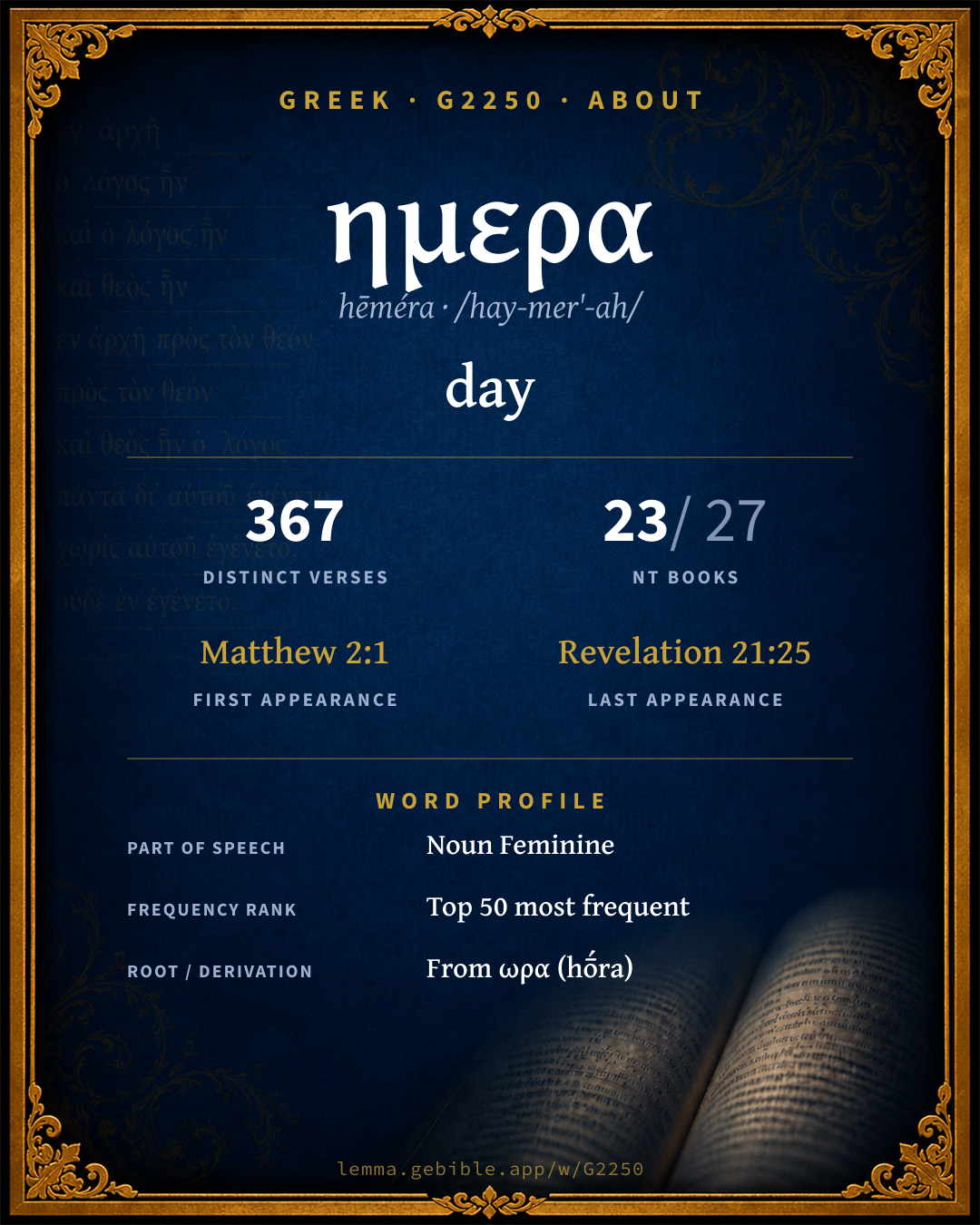
ἡμέρα
day
‘day’ is one of 4 main senses fuller range ↓
Full lexicon entry — Thayer's Greek Lexicon
From Thayer's Greek Lexicon
Where this word appears
See every Dative-case word in the Greek New Testament →
Grammar key — what these labels mean
Part of speech
- Noun
- A naming word — a person, place, thing, or idea.
Case
- Dative
- The case of the indirect object, means, or location — “to / for / with / in.”
- Accusative
- The case of the direct object and of extent.
- Genitive
- The case of source, possession, or “of” — answers “whose / from what.”
- Nominative
- The case of the subject (and the predicate nominative).
Gender
- Feminine
- Grammatically feminine.
Number
- Singular
- One.
- Plural
- More than one.
37 verses where G2250 appears in the Dative case in the Book of Luke. Filtered view — show all forms. Click any verse to open its interlinear word-by-word view. Verse text shown in the World English Bible for context — . Each verse’s Greek form is shown with its reference; the English is not keyword-highlighted, since the data carries no word-level English alignment. Use “Compare translations” on any verse to read it across multiple English versions. This concordance covers the Greek New Testament; Septuagint (Greek Old Testament) occurrences of this word are not indexed here.
Luke
- Luke 1:5 ἡμέραις n dat pl fem There was in the days of Herod, the king of Judea, a certain priest named Zacharias, of the priestly division of Abijah. He had a wife of the daughters of Aaron, and her name was Elizabeth.
- Luke 1:7 ἡμέραις n dat pl fem But they had no child, because Elizabeth was barren, and they both were well advanced in years.
- Luke 1:18 ἡμέραις n dat pl fem Zacharias said to the angel, "How can I be sure of this? For I am an old man, and my wife is well advanced in years."
- Luke 1:25 ἡμέραις n dat pl fem "Thus has the Lord done to me in the days in which he looked at me, to take away my reproach among men."
- Luke 1:39 ἡμέραις n dat pl fem Mary arose in those days and went into the hill country with haste, into a city of Judah,
- Luke 1:59 ἡμέρᾳ n dat sg fem It happened on the eighth day, that they came to circumcise the child; and they would have called him Zacharias, after the name of the father.
- Luke 2:1 ἡμέραις n dat pl fem Now it happened in those days, that a decree went out from Caesar Augustus that all the world should be enrolled.
- Luke 2:36 ἡμέραις n dat pl fem There was one Anna, a prophetess, the daughter of Phanuel, of the tribe of Asher (she was of a great age, having lived with a husband seven years from her virginity,
- Luke 4:2 ἡμέρας ἡμέραις n acc pl fem n dat pl fem for forty days, being tempted by the devil. He ate nothing in those days. Afterward, when they were completed, he was hungry.
- Luke 4:16 ἡμέρᾳ n dat sg fem He came to Nazareth, where he had been brought up. He entered, as was his custom, into the synagogue on the Sabbath day, and stood up to read.
- Luke 4:25 ἡμέραις n dat pl fem But truly I tell you, there were many widows in Israel in the days of Elijah, when the sky was shut up three years and six months, when a great famine came over all the land.
- Luke 5:35 ἡμέραι ἡμέραις n nom pl fem n dat pl fem But the days will come when the bridegroom will be taken away from them. Then they will fast in those days."
- Luke 6:12 ἡμέραις n dat pl fem It happened in these days, that he went out to the mountain to pray, and he continued all night in prayer to God.
- Luke 6:23 ἡμέρᾳ n dat sg fem Rejoice in that day, and leap for joy, for behold, your reward is great in heaven, for their fathers did the same thing to the prophets.
- Luke 9:22 ἡμέρᾳ n dat sg fem saying, "The Son of Man must suffer many things, and be rejected by the elders, chief priests, and scribes, and be killed, and the third day be raised up."
- Luke 9:36 ἡμέραις n dat pl fem When the voice came, Jesus was found alone. They were silent, and told no one in those days any of the things which they had seen.
- Luke 9:37 ἡμέρᾳ n dat sg fem It happened on the next day, when they had come down from the mountain, that a great multitude met him.
- Luke 10:12 ἡμέρᾳ n dat sg fem I tell you, it will be more tolerable in that day for Sodom than for that city.
- Luke 12:46 ἡμέρᾳ n dat sg fem then the lord of that servant will come in a day when he isn't expecting him, and in an hour that he doesn't know, and will cut him in two, and place his portion with the unfaithful.
- Luke 13:14 ἡμέραι ἡμέρᾳ n nom pl fem n dat sg fem The ruler of the synagogue, being indignant because Jesus had healed on the Sabbath, said to the multitude, "There are six days in which men ought to work. Therefore come on those days and be healed, and not on the Sabbath day!"
- Luke 13:16 ἡμέρᾳ n dat sg fem Ought not this woman, being a daughter of Abraham, whom Satan had bound eighteen long years, be freed from this bondage on the Sabbath day?"
- Luke 14:5 ἡμέρᾳ n dat sg fem He answered them, "Which of you, if your son or an ox fell into a well, wouldn't immediately pull him out on a Sabbath day?"
- Luke 17:24 ἡμέρᾳ n dat sg fem for as the lightning, when it flashes out of the one part under the sky, shines to the other part under the sky; so will the Son of Man be in his day.
- Luke 17:26 ἡμέραις ἡμέραις n dat pl fem n dat pl fem As it happened in the days of Noah, even so will it be also in the days of the Son of Man.
- Luke 17:28 ἡμέραις n dat pl fem Likewise, even as it happened in the days of Lot: they ate, they drank, they bought, they sold, they planted, they built;
- Luke 17:29 ἡμέρᾳ n dat sg fem but in the day that Lot went out from Sodom, it rained fire and sulfur from the sky, and destroyed them all.
- Luke 17:30 ἡμέρᾳ n dat sg fem It will be the same way in the day that the Son of Man is revealed.
- Luke 17:31 ἡμέρᾳ n dat sg fem In that day, he who will be on the housetop, and his goods in the house, let him not go down to take them away. Let him who is in the field likewise not turn back.
- Luke 18:33 ἡμέρᾳ n dat sg fem They will scourge and kill him. On the third day, he will rise again."
- Luke 19:42 ἡμέρᾳ n dat sg fem saying, "If you, even you, had known today the things which belong to your peace! But now, they are hidden from your eyes.
- Luke 21:23 ἡμέραις n dat pl fem Woe to those who are pregnant and to those who nurse infants in those days! For there will be great distress in the land, and wrath to this people.
- Luke 23:7 ἡμέραις n dat pl fem When he found out that he was in Herod's jurisdiction, he sent him to Herod, who was also in Jerusalem during those days.
- Luke 23:12 ἡμέρᾳ n dat sg fem Herod and Pilate became friends with each other that very day, for before that they were enemies with each other.
- Luke 24:7 ἡμέρᾳ n dat sg fem saying that the Son of Man must be delivered up into the hands of sinful men, and be crucified, and the third day rise again?"
- Luke 24:13 ἡμέρᾳ n dat sg fem Behold, two of them were going that very day to a village named Emmaus, which was sixty stadia from Jerusalem.
- Luke 24:18 ἡμέραις n dat pl fem One of them, named Cleopas, answered him, "Are you the only stranger in Jerusalem who doesn't know the things which have happened there in these days?"
- Luke 24:46 ἡμέρᾳ n dat sg fem He said to them, "Thus it is written, and thus it was necessary for the Christ to suffer and to rise from the dead the third day,
About this entry
At a glance — auto-summarized from this page’s data, not written by a person. Every figure links to its source below. This summary describes the numbers; it doesn’t interpret them.
At its core, ημερα (hēméra) means “day.” Ranging over 4 senses, it is not a single-sense word. It turns up in 367 verses across 23 books, a common footprint. The word gravitates to Acts (25%), then Luke and Matthew. It first appears in Matthew 2:1. Dig into 367-verse concordance and the renderings breakdown below.
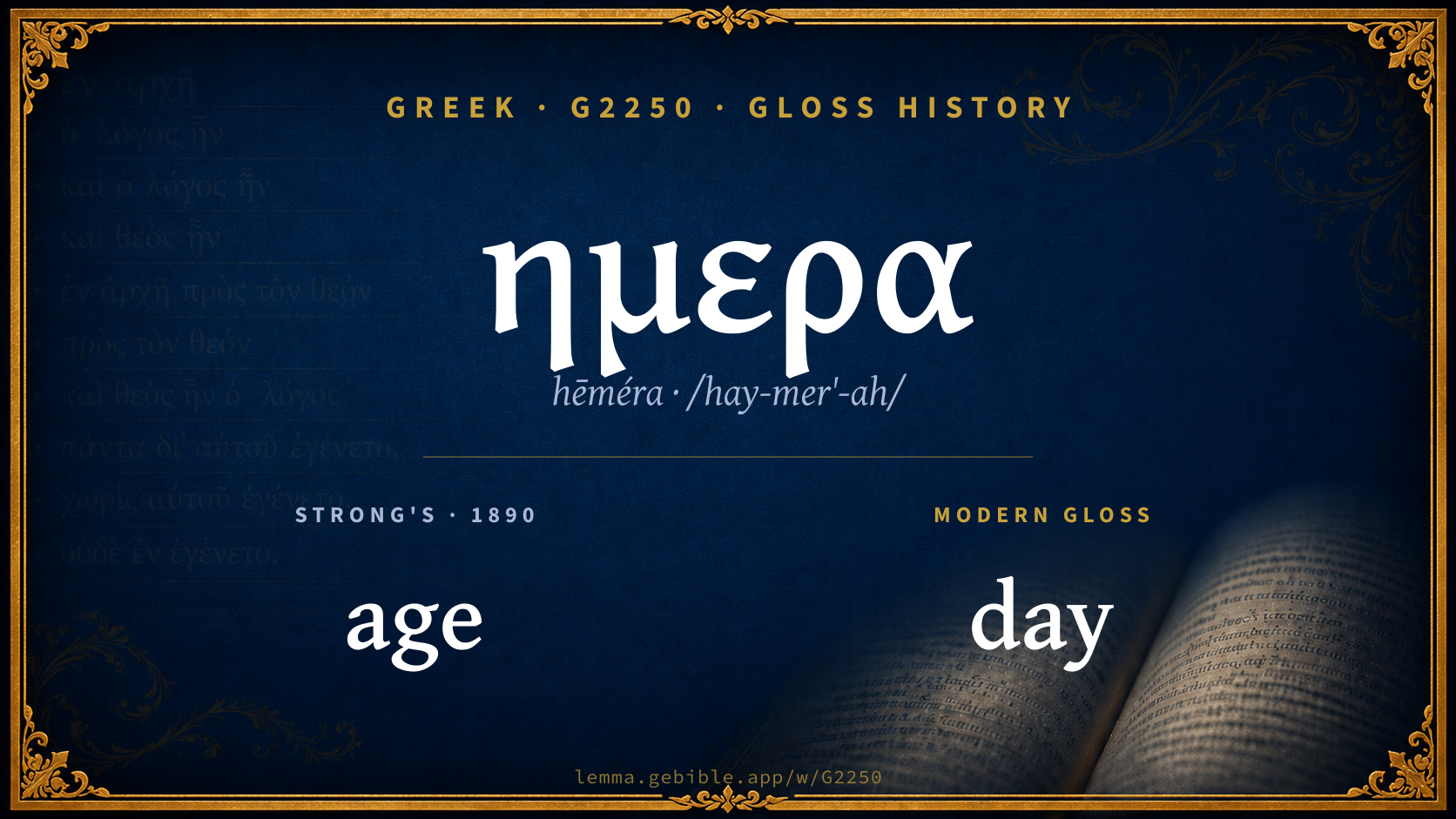
Gloss history
Strong's 1890 vs modern scholarship
About this word
Strong's G2250 catalogs a Greek word from the Greek New Testament.
These counts are not copied from any lexicon or concordance. They are computed here, from the morphology-tagged Greek New Testament. What Lemma adds →
- 367
- distinct verses
- The word appears in 367 distinct verses.
- 23 / 27
- NT books
- The word appears in 23 of 27 New Testament books.
- #47
- by frequency
- Top 50 most frequent Greek words (rank 47 of 5,347 Greek words by occurrence).
View all 367 occurrences in the concordance →
By section of the New Testament
By traditional corpus
Conventional, traditional groupings — biblical authorship is debated, so this is a traditional corpus grouping, not an authorship claim. Some books belong to more than one corpus (Luke is in both the Gospels and the Lukan corpus, and so on), so these shares overlap and need not total 100%. Each figure is a share of the word’s 367 distinct verses.
- Gospels 174 verses · 47%
- Lukan (Luke–Acts) 168 verses · 46%
- Johannine 52 verses · 14%
- Pauline corpus 47 verses · 13%
- Revelation 21 verses · 6%
- Hebrews 18 verses · 5%
- General (Catholic) Epistles 17 verses · 5%
How translations render this word
Counts come from each version’s own published word-to-Strong’s tagging or interlinear alignment — an approximate guide to how each version renders this word, not a word-level alignment the data otherwise carries. Because each total is that version’s own tagged count, the per-version totals vary from one another and need not match the appearance or distinct-verse counts above. These counts may also differ from a printed concordance because Lemma counts each distinctly tagged rendering and does not collapse phrase taggings into a single head-word total. This is a fixed set of word-tagged versions (KJV, ASV, BSB, ULT) and does not change with the reading translation you choose elsewhere. Each version’s license is shown beside its name below (and on Sources).
- King James Version: Day 192×, Days 153×, Daily 9×
- American Standard Version: Day 188×, Days 156×, The 14×
- Berean Standard Bible: Day 186×, Days 131×, Time 19×
- unfoldingWord Literal Text: Day 214×, Days 164×, The 20×
King James Version Public Domain
Renders G2250 across 376 tagged occurrences — most commonly:
Plus 9 renderings that appear only once — usually multi-word phrases or single function words the recovered tagging swept in, not distinct renderings. Not rendered by a distinct English word in 13 further occurrences.
American Standard Version Public Domain
Renders G2250 across 398 tagged occurrences — most commonly:
Plus 23 renderings that appear only once — usually multi-word phrases or single function words the recovered tagging swept in, not distinct renderings.
Berean Standard Bible Public Domain
Renders G2250 across 368 tagged occurrences — most commonly:
Plus 8 renderings that appear only once — usually multi-word phrases or single function words the recovered tagging swept in, not distinct renderings. Not rendered by a distinct English word in 19 further occurrences.
unfoldingWord Literal Text CC BY-SA 4.0
Renders G2250 across 441 tagged occurrences — most commonly:
Plus 11 renderings that appear only once — usually multi-word phrases or single function words the recovered tagging swept in, not distinct renderings.
Senses in Thayer's
The 4 senses Thayer's distinguishes for this word, in lexicon order (not ranked by frequency or importance). The full entry — with sub-senses — is in the Lexicon Entry tab.
- the day, used of the natural day, or the interval between sunrise and sunset, as distinguished from and contrasted with…
- of the civil day, or the space of twenty four hours (thus including the night)
- of the last day of this present age…
- used of time in general, i.e. the days of his life.
Word origin
Derived from ωρα (hṓra) (G5610) — hour.
Feminine (with G5610 implied) of a derivative of ἧμαι hē mai (to sit ; akin to the base of G1476 ) meaning tame that is gentle ; day that is (literally) the time space between dawn and dark or the whole 24 hours (but several days were usually reckoned by the Jews as inclusive of the parts of both extremes); figuratively a period (always defined more or less clearly by the context): - age + alway (mid-) day (by day [-ly]) + for ever judgment (day) time while years.
— Strong’s Exhaustive Concordance (1890), public domain.
Forms in the corpus
The 9 distinct written forms G2250 takes in the Greek New Testament, most frequent first — each parse links to that case’s occurrences in the concordance.
| Form | Parsing | Example | Uses |
|---|---|---|---|
| ἡμέρας hēméras | Noun, Accusative, Plural, Feminine | Matthew 4:2 | 126 |
| ἡμέρᾳ hēméra | Noun, Dative, Singular, Feminine | Matthew 6:34 | 84 |
| ἡμέραν hēméran | Noun, Accusative, Singular, Feminine | Matthew 20:2 | 58 |
| ἡμέραις hēmérais | Noun, Dative, Plural, Feminine | Matthew 2:1 | 48 |
| ἡμέραι hēmérai | Noun, Nominative, Plural, Feminine | Matthew 9:15 | 26 |
| ἡμέρα hēméra | Noun, Nominative, Singular, Feminine | Luke 6:13 | 23 |
| ἡμερῶν hēmerō̂n | Noun, Genitive, Plural, Feminine | Matthew 11:12 | 21 |
| Ἡμέρας Hēméras | Noun, Genitive, Singular, Feminine | Acts 16:35 | 1 |
| Ἡμερῶν Hēmerō̂n | Noun, Genitive, Plural, Feminine | Acts 25:13 | 1 |
Same root — word family
Other Thayer's entries built from the same root as G2250, grouped by Strong’s listed origin. These share a root / origin per the lexicon — not necessarily a shared meaning. Each links to that word’s own entry.
Derives from
Shares the same root
Compare all same-root words → They share a root, not necessarily a meaning.
Septuagint usage
The same Greek word ημερα appears 2,052 times in the Greek Old Testament (Septuagint), across 1,732 verses in 38 books.
- 2,052
- LXX occurrences
- Tagged occurrences of this Greek word in the Septuagint.
- 1,732
- verses
- Distinct Septuagint verses containing this word.
- 38 / 39
- OT books
- The word appears in 38 of the 39 Old Testament books.
Sample Septuagint occurrences
- Genesis 1:5 ἡμέρα
- Exodus 2:11 ἡμέρα
- Leviticus 5:24 ἡμέρα
- Numbers 3:1 ἡμέρα
- Deuteronomy 1:2 ἡμέρα
- Joshua 1:5 ἡμέρα
- Judges 1:21 ἡμέρα
- Ruth 4:5 ἡμέρα
- 1 Samuel 1:3 ἡμέρα
- 2 Samuel 1:1 ἡμέρα
- 1 Kings 1:1 ἡμέρα
- 2 Kings 1:18 ἡμέρα
Septuagint occurrences (same lexeme)
Every verse where the same Strong’s number (G2250) appears in the Greek Septuagint — showing the first 50 of 1,732. Verse text shown in the World English Bible for context; the Greek form is the matched word — the English is not keyword-highlighted.
- Genesis 1:5 ἡμέρα God called the light Day, and the darkness he called Night. There was evening and there was morning, one day.
- Genesis 1:8 ἡμέρα God called the expanse sky. There was evening and there was morning, a second day.
- Genesis 1:13 ἡμέρα There was evening and there was morning, a third day.
- Genesis 1:14 ἡμέρα God said, "Let there be lights in the expanse of sky to divide the day from the night; and let them be for signs, and for seasons, and for days and years;
- Genesis 1:16 ἡμέρα God made the two great lights: the greater light to rule the day, and the lesser light to rule the night. He also made the stars.
- Genesis 1:18 ἡμέρα and to rule over the day and over the night, and to divide the light from the darkness. God saw that it was good.
- Genesis 1:19 ἡμέρα There was evening and there was morning, a fourth day.
- Genesis 1:23 ἡμέρα There was evening and there was morning, a fifth day.
- Genesis 1:31 ἡμέρα God saw everything that he had made, and, behold, it was very good. There was evening and there was morning, the sixth day.
- Genesis 2:2 ἡμέρα On the seventh day God finished his work which he had made; and he rested on the seventh day from all his work which he had made.
- Genesis 2:3 ἡμέρα God blessed the seventh day, and made it holy, because he rested in it from all his work which he had created and made.
- Genesis 2:4 ἡμέρα This is the history of the generations of the heavens and of the earth when they were created, in the day that Yahweh God made earth and the heavens.
- Genesis 2:17 ἡμέρα but of the tree of the knowledge of good and evil, you shall not eat of it: for in the day that you eat of it you will surely die."
- Genesis 3:5 ἡμέρα for God knows that in the day you eat it, your eyes will be opened, and you will be like God, knowing good and evil."
- Genesis 3:14 ἡμέρα Yahweh God said to the serpent, "Because you have done this, cursed are you above all cattle, and above every animal of the field. On your belly shall you go, and you shall eat dust all the days of your life.
- Genesis 3:17 ἡμέρα To Adam he said, "Because you have listened to your wife's voice, and have eaten of the tree, of which I commanded you, saying, 'You shall not eat of it,' cursed is the ground for your sake. In toil you will eat of it all the days of your life.
- Genesis 4:3 ἡμέρα As time passed, it happened that Cain brought an offering to Yahweh from the fruit of the ground.
- Genesis 5:1 ἡμέρα This is the book of the generations of Adam. In the day that God created man, he made him in God's likeness.
- Genesis 5:2 ἡμέρα He created them male and female, and blessed them, and called their name Adam, in the day when they were created.
- Genesis 5:4 ἡμέρα The days of Adam after he became the father of Seth were eight hundred years, and he became the father of sons and daughters.
- Genesis 5:5 ἡμέρα All the days that Adam lived were nine hundred thirty years, then he died.
- Genesis 5:8 ἡμέρα All the days of Seth were nine hundred twelve years, then he died.
- Genesis 5:11 ἡμέρα All the days of Enosh were nine hundred five years, then he died.
- Genesis 5:14 ἡμέρα and all the days of Kenan were nine hundred ten years, then he died.
- Genesis 5:17 ἡμέρα All the days of Mahalalel were eight hundred ninety-five years, then he died.
- Genesis 5:20 ἡμέρα All the days of Jared were nine hundred sixty-two years, then he died.
- Genesis 5:23 ἡμέρα all the days of Enoch were three hundred sixty-five years.
- Genesis 5:27 ἡμέρα All the days of Methuselah were nine hundred sixty-nine years, then he died.
- Genesis 5:31 ἡμέρα All the days of Lamech were seven hundred seventy-seven years, then he died.
- Genesis 6:3 ἡμέρα Yahweh said, "My Spirit will not strive with man forever, because he also is flesh; yet will his days be one hundred twenty years."
- Genesis 6:4 ἡμέρα The Nephilim were in the earth in those days, and also after that, when God's sons came to men's daughters. They bore children to them: the same were the mighty men who were of old, men of renown.
- Genesis 6:5 ἡμέρα Yahweh saw that the wickedness of man was great in the earth, and that every imagination of the thoughts of his heart was only evil continually.
- Genesis 7:4 ἡμέρα In seven days, I will cause it to rain on the earth for forty days and forty nights. Every living thing that I have made, I will destroy from the surface of the ground."
- Genesis 7:10 ἡμέρα It happened after the seven days, that the waters of the flood came on the earth.
- Genesis 7:11 ἡμέρα In the six hundredth year of Noah's life, in the second month, on the seventeenth day of the month, on the same day all the fountains of the great deep were burst open, and the sky's windows were opened.
- Genesis 7:12 ἡμέρα The rain was on the earth forty days and forty nights.
- Genesis 7:13 ἡμέρα In the same day Noah, and Shem, Ham, and Japheth, the sons of Noah, and Noah's wife, and the three wives of his sons with them, entered into the ark;
- Genesis 7:17 ἡμέρα The flood was forty days on the earth. The waters increased, and lifted up the ark, and it was lifted up above the earth.
- Genesis 7:24 ἡμέρα The waters prevailed on the earth one hundred fifty days.
- Genesis 8:3 ἡμέρα The waters receded from off the earth continually. After the end of one hundred fifty days the waters decreased.
- Genesis 8:6 ἡμέρα It happened at the end of forty days, that Noah opened the window of the ark which he had made,
- Genesis 8:10 ἡμέρα He stayed yet another seven days; and again he sent forth the dove out of the ark.
- Genesis 8:12 ἡμέρα He stayed yet another seven days, and sent forth the dove; and she didn't return to him any more.
- Genesis 8:22 ἡμέρα While the earth remains, seed time and harvest, and cold and heat, and summer and winter, and day and night shall not cease."
- Genesis 9:29 ἡμέρα All the days of Noah were nine hundred fifty years, then he died.
- Genesis 10:25 ἡμέρα To Eber were born two sons. The name of the one was Peleg, for in his days was the earth divided. His brother's name was Joktan.
- Genesis 11:32 ἡμέρα The days of Terah were two hundred five years. Terah died in Haran.
- Genesis 15:18 ἡμέρα In that day Yahweh made a covenant with Abram, saying, "To your seed have I given this land, from the river of Egypt to the great river, the river Euphrates:
- Genesis 17:12 ἡμέρα He who is eight days old will be circumcised among you, every male throughout your generations, he who is born in the house, or bought with money of any foreigner who is not of your seed.
- Genesis 17:14 ἡμέρα The uncircumcised male who is not circumcised in the flesh of his foreskin, that soul shall be cut off from his people. He has broken my covenant."
These are occurrences of the same Greek lexeme (G2250) in the Septuagint — not a translation of any one Hebrew word. The store carries no word-level Hebrew↔Greek alignment, so no Hebrew original is asserted here. Counts come from the recovered LXX Strong's tagging — high-frequency vocabulary is well covered, while rare or late forms may be untagged — so they reflect tagged occurrences and may slightly undercount.