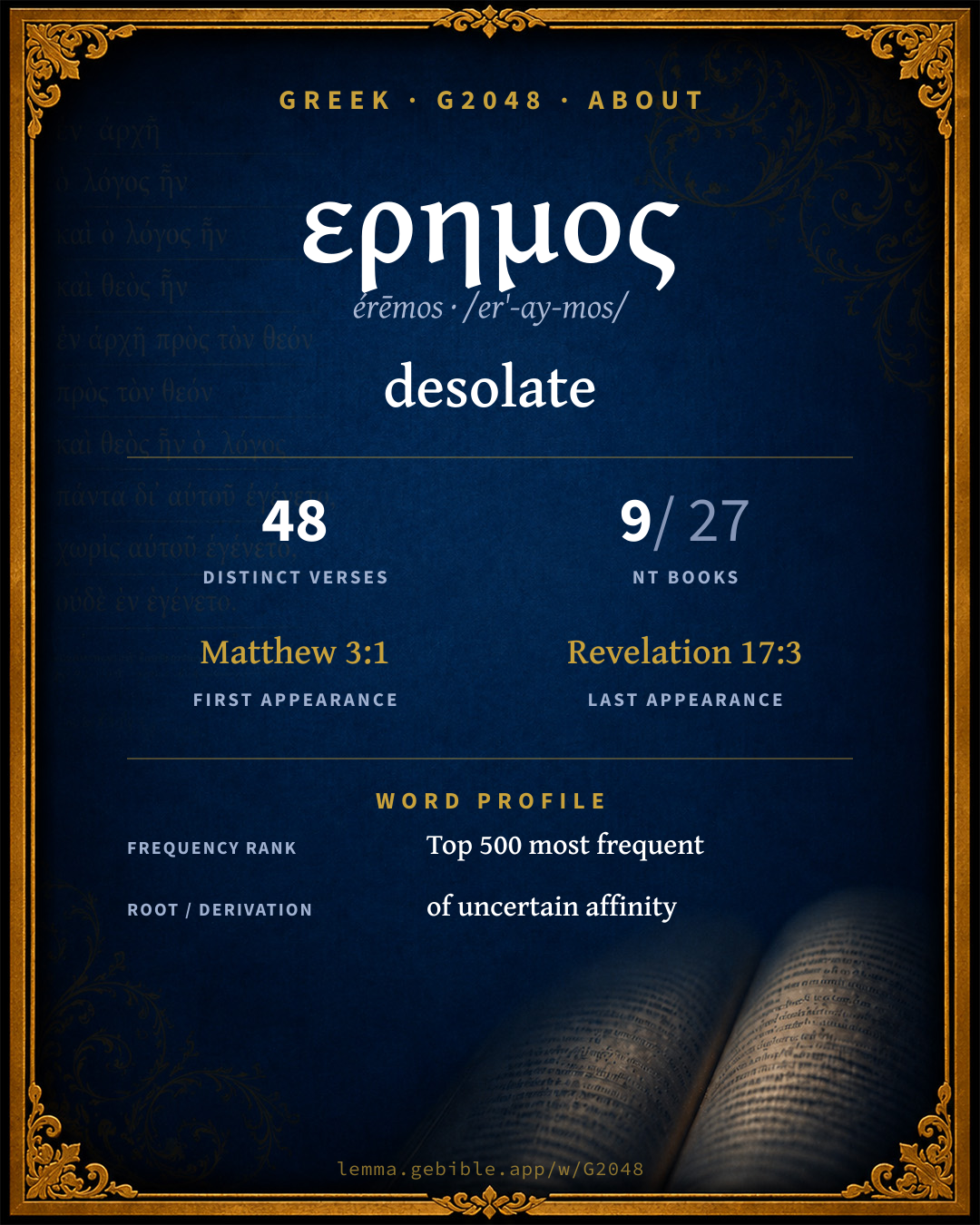
ἔρημος
desolate
Full lexicon entry — Thayer's Greek Lexicon
From Thayer's Greek Lexicon
Where this word appears
See every Dative-case word in the Greek New Testament →
Grammar key — what these labels mean
Part of speech
- Adjective
- A word that describes or qualifies a noun.
Case
- Dative
- The case of the indirect object, means, or location — “to / for / with / in.”
- Accusative
- The case of the direct object and of extent.
- Nominative
- The case of the subject (and the predicate nominative).
- Genitive
- The case of source, possession, or “of” — answers “whose / from what.”
Gender
- Feminine
- Grammatically feminine.
- Masculine
- Grammatically masculine.
Number
- Singular
- One.
- Plural
- More than one.
Grammatical forms 10 distinct
- Adjective, Dative, Singular, Feminine 23 times (48%)
- Adjective, Accusative, Singular, Feminine 7 times (15%)
- Adjective, Accusative, Singular, Masculine 6 times (13%)
- Adjective, Nominative, Singular, Masculine 3 times (6%)
- Adjective, Dative, Plural, Feminine 2 times (4%)
- Adjective, Genitive, Singular, Feminine 2 times (4%)
- Adjective, Nominative, Singular, Feminine 2 times (4%)
- Adjective, Accusative, Plural, Feminine 1 time (2%)
+2 more forms (2 occurrences)
Parsed forms decoded from the imported morphology (Robinson–Tischendorf, public domain), counted across 48 parsed occurrences — not distinct verses.
Every verse where G2048 appears — 48 distinct verses across 9 books. Click any verse to open its interlinear word-by-word view. Verse text shown in the World English Bible for context — . Each verse’s Greek form is shown with its reference; the English is not keyword-highlighted, since the data carries no word-level English alignment. Use “Compare translations” on any verse to read it across multiple English versions. This concordance covers the Greek New Testament; Septuagint (Greek Old Testament) occurrences of this word are not indexed here.
Matthew 8 verses
- Matthew 3:1 ἐρήμῳ adj dat sg fem In those days, John the Baptizer came, preaching in the wilderness of Judea, saying,
- Matthew 3:3 ἐρήμῳ adj dat sg fem For this is he who was spoken of by Isaiah the prophet, saying, "The voice of one crying in the wilderness, Make ready the way of the Lord, Make his paths straight."
- Matthew 4:1 ἔρημον adj acc sg fem Then Jesus was led up by the Spirit into the wilderness to be tempted by the devil.
- Matthew 11:7 ἔρημον adj acc sg fem As these went their way, Jesus began to say to the multitudes concerning John, "What did you go out into the wilderness to see? A reed shaken by the wind?
- Matthew 14:13 ἔρημον adj acc sg masc Now when Jesus heard this, he withdrew from there in a boat, to a deserted place apart. When the multitudes heard it, they followed him on foot from the cities.
- Matthew 14:15 ἔρημός adj nom sg masc When evening had come, his disciples came to him, saying, "This place is deserted, and the hour is already late. Send the multitudes away, that they may go into the villages, and buy themselves food."
- Matthew 23:38 ἔρημος adj nom sg masc Behold, your house is left to you desolate.
- Matthew 24:26 ἐρήμῳ adj dat sg fem If therefore they tell you, 'Behold, he is in the wilderness,' don't go out; 'Behold, he is in the inner chambers,' don't believe it.
Mark 9 verses
- Mark 1:3 ἐρήμῳ adj dat sg fem The voice of one crying in the wilderness, 'Make ready the way of the Lord! Make his paths straight!'"
- Mark 1:4 ἐρήμῳ adj dat sg fem John came baptizing in the wilderness and preaching the baptism of repentance for forgiveness of sins.
- Mark 1:12 ἔρημον adj acc sg fem Immediately the Spirit drove him out into the wilderness.
- Mark 1:13 ἐρήμῳ adj dat sg fem He was there in the wilderness forty days tempted by Satan. He was with the wild animals; and the angels were ministering to him.
- Mark 1:35 ἔρημον adj acc sg masc Early in the night, he rose up and went out, and departed into a deserted place, and prayed there.
- Mark 1:45 ἐρήμοις adj dat pl masc But he went out, and began to proclaim it much, and to spread about the matter, so that Jesus could no more openly enter into a city, but was outside in desert places: and they came to him from everywhere.
- Mark 6:31 ἔρημον adj acc sg masc He said to them, "You come apart into a deserted place, and rest awhile." For there were many coming and going, and they had no leisure so much as to eat.
- Mark 6:32 ἔρημον adj acc sg masc They went away in the boat to a desert place by themselves.
- Mark 6:35 ἔρημός adj nom sg masc When it was late in the day, his disciples came to him, and said, "This place is deserted, and it is late in the day.
Luke 10 verses
- Luke 1:80 ἐρήμοις adj dat pl fem The child was growing, and becoming strong in spirit, and was in the desert until the day of his public appearance to Israel.
- Luke 3:2 ἐρήμῳ adj dat sg fem in the high priesthood of Annas and Caiaphas, the word of God came to John, the son of Zacharias, in the wilderness.
- Luke 3:4 ἐρήμῳ adj dat sg fem As it is written in the book of the words of Isaiah the prophet, "The voice of one crying in the wilderness, 'Make ready the way of the Lord. Make his paths straight.
- Luke 4:1 ἐρήμῳ adj dat sg fem Jesus, full of the Holy Spirit, returned from the Jordan, and was led by the Spirit into the wilderness
- Luke 4:42 ἔρημον adj acc sg masc When it was day, he departed and went into an uninhabited place, and the multitudes looked for him, and came to him, and held on to him, so that he wouldn't go away from them.
- Luke 5:16 ἐρήμοις adj dat pl fem But he withdrew himself into the desert, and prayed.
- Luke 7:24 ἔρημον adj acc sg fem When John's messengers had departed, he began to tell the multitudes about John, "What did you go out into the wilderness to see? A reed shaken by the wind?
- Luke 8:29 ἐρήμους adj acc pl fem For Jesus was commanding the unclean spirit to come out of the man. For the unclean spirit had often seized the man. He was kept under guard, and bound with chains and fetters. Breaking the bands apart, he was driven by the demon into the desert.
- Luke 9:12 ἐρήμῳ adj dat sg masc The day began to wear away; and the twelve came, and said to him, "Send the multitude away, that they may go into the surrounding villages and farms, and lodge, and get food, for we are here in a deserted place."
- Luke 15:4 ἐρήμῳ adj dat sg fem "Which of you men, if you had one hundred sheep, and lost one of them, wouldn't leave the ninety-nine in the wilderness, and go after the one that was lost, until he found it?
John 5 verses
- John 1:23 ἐρήμῳ adj dat sg fem He said, "I am the voice of one crying in the wilderness, 'Make straight the way of the Lord,' as Isaiah the prophet said."
- John 3:14 ἐρήμῳ adj dat sg fem As Moses lifted up the serpent in the wilderness, even so must the Son of Man be lifted up,
- John 6:31 ἐρήμῳ adj dat sg fem Our fathers ate the manna in the wilderness. As it is written, 'He gave them bread out of heaven to eat.'"
- John 6:49 ἐρήμῳ adj dat sg fem Your fathers ate the manna in the wilderness, and they died.
- John 11:54 ἐρήμου adj gen sg fem Jesus therefore walked no more openly among the Jews, but departed from there into the country near the wilderness, to a city called Ephraim. He stayed there with his disciples.
Acts 9 verses
- Acts 1:20 ἔρημος adj nom sg fem For it is written in the book of Psalms, 'Let his habitation be made desolate, Let no one dwell therein,' and, 'Let another take his office.'
- Acts 7:30 ἐρήμῳ adj dat sg fem "When forty years were fulfilled, an angel of the Lord appeared to him in the wilderness of Mount Sinai, in a flame of fire in a bush.
- Acts 7:36 ἐρήμῳ adj dat sg fem This man led them out, having worked wonders and signs in Egypt, in the Red Sea, and in the wilderness for forty years.
- Acts 7:38 ἐρήμῳ adj dat sg fem This is he who was in the assembly in the wilderness with the angel that spoke to him on Mount Sinai, and with our fathers, who received living oracles to give to us,
- Acts 7:42 ἐρήμῳ adj dat sg fem But God turned, and gave them up to serve the host of the sky, as it is written in the book of the prophets, 'Did you offer to me slain animals and sacrifices Forty years in the wilderness, O house of Israel?
- Acts 7:44 ἐρήμῳ adj dat sg fem "Our fathers had the tent of the testimony in the wilderness, even as he who spoke to Moses commanded him to make it according to the pattern that he had seen;
- Acts 8:26 ἔρημος adj nom sg fem But an angel of the Lord spoke to Philip, saying, "Arise, and go toward the south to the way that goes down from Jerusalem to Gaza. This is a desert."
- Acts 13:18 ἐρήμῳ adj dat sg fem For a period of about forty years he put up with them in the wilderness.
- Acts 21:38 ἔρημον adj acc sg fem Aren't you then the Egyptian, who before these days stirred up to sedition and led out into the wilderness the four thousand men of the Assassins?"
1 Corinthians 1 verse
Galatians 1 verse
Hebrews 2 verses
Revelation 3 verses
- Revelation 12:6 ἔρημον adj acc sg fem The woman fled into the wilderness, where she has a place prepared by God, that there they may nourish her one thousand two hundred sixty days.
- Revelation 12:14 ἔρημον adj acc sg fem Two wings of the great eagle were given to the woman, that she might fly into the wilderness to her place, so that she might be nourished for a time, and times, and half a time, from the face of the serpent.
- Revelation 17:3 ἔρημον adj acc sg masc He carried me away in the Spirit into a wilderness. I saw a woman sitting on a scarlet-colored animal, full of blasphemous names, having seven heads and ten horns.
About this entry
At a glance — auto-summarized from this page’s data, not written by a person. Every figure links to its source below. This summary describes the numbers; it doesn’t interpret them.
The Greek word ερημος centers on the idea of “desolate.” Its earliest occurrence is Matthew 3:1. Spanning 48 verses in 9 books, it ranks among the moderately common words of the Greek New Testament. Related forms include ερημια, ερημοω and ηρεμος. For the data behind this summary, explore the sense tree and the renderings breakdown below.
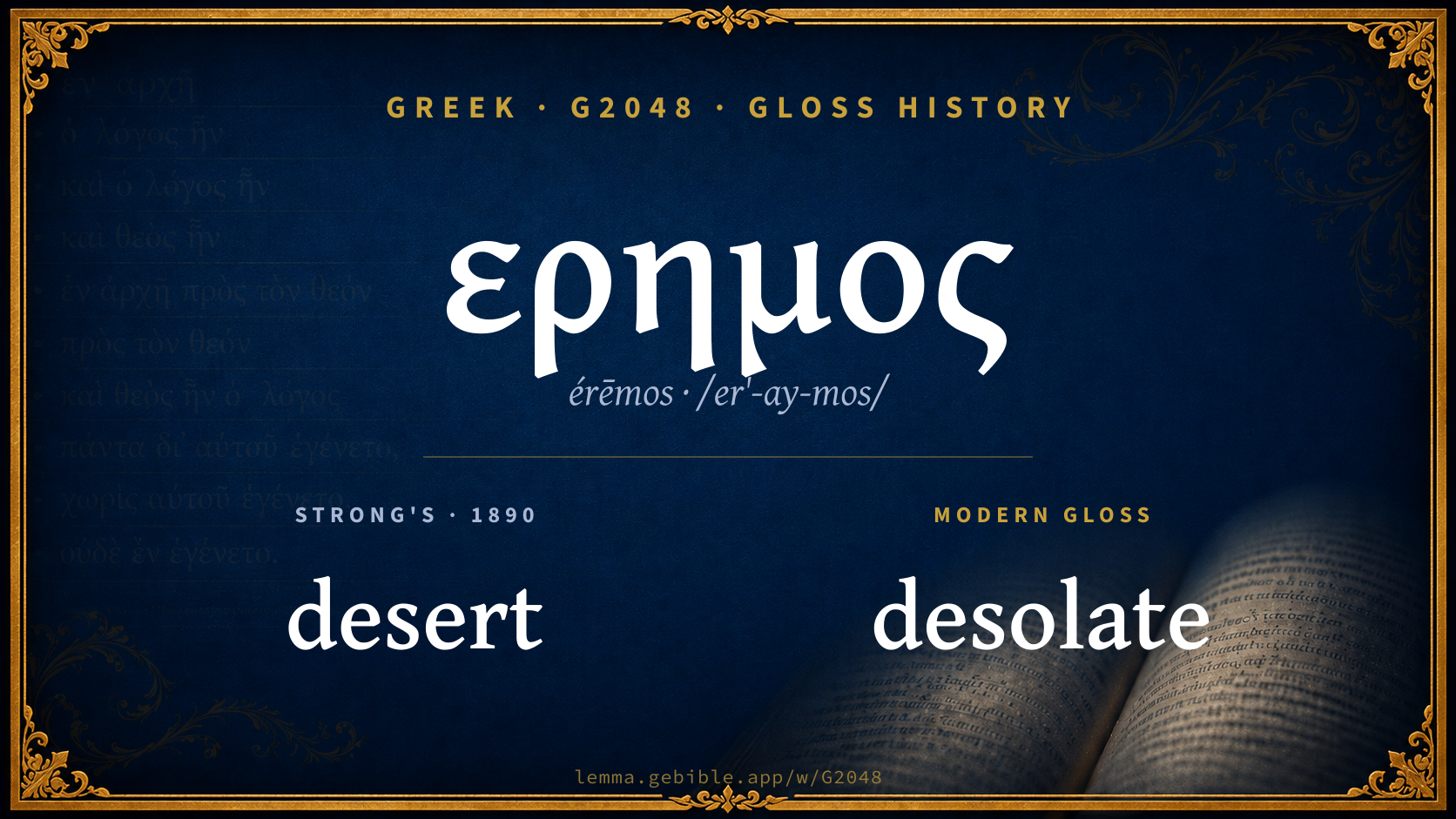
Gloss history
Strong's 1890 vs modern scholarship
About this word
Strong's G2048 catalogs a Greek word from the Greek New Testament.
These counts are not copied from any lexicon or concordance. They are computed here, from the morphology-tagged Greek New Testament. What Lemma adds →
- 48
- distinct verses
- The word appears in 48 distinct verses.
- 9 / 27
- NT books
- The word appears in 9 of 27 New Testament books.
- #322
- by frequency
- Top 500 most frequent Greek words (rank 322 of 5,347 Greek words by occurrence).
View all 48 occurrences in the concordance →
By section of the New Testament
By traditional corpus
Conventional, traditional groupings — biblical authorship is debated, so this is a traditional corpus grouping, not an authorship claim. Some books belong to more than one corpus (Luke is in both the Gospels and the Lukan corpus, and so on), so these shares overlap and need not total 100%. Each figure is a share of the word’s 48 distinct verses.
- Gospels 32 verses · 67%
- Lukan (Luke–Acts) 19 verses · 40%
- Johannine 8 verses · 17%
- Revelation 3 verses · 6%
- Pauline corpus 2 verses · 4%
- Hebrews 2 verses · 4%
How translations render this word
Counts come from each version’s own published word-to-Strong’s tagging or interlinear alignment — an approximate guide to how each version renders this word, not a word-level alignment the data otherwise carries. Because each total is that version’s own tagged count, the per-version totals vary from one another and need not match the appearance or distinct-verse counts above. These counts may also differ from a printed concordance because Lemma counts each distinctly tagged rendering and does not collapse phrase taggings into a single head-word total. This is a fixed set of word-tagged versions (KJV, ASV, BSB, ULT) and does not change with the reading translation you choose elsewhere. Each version’s license is shown beside its name below (and on Sources).
- King James Version: Wilderness 32×, Desert 12×, Desolate 4×
- American Standard Version: Wilderness 31×, Desert 10×, Deserts 3×
- Berean Standard Bible: Wilderness 31×, Solitary 6×, Desolate 4×
- unfoldingWord Literal Text: Wilderness 34×, Desolate 11×
King James Version Public Domain
Renders G2048 across 50 tagged occurrences — most commonly:
Plus 2 renderings that appear only once — usually multi-word phrases or single function words the recovered tagging swept in, not distinct renderings.
American Standard Version Public Domain
Renders G2048 across 48 tagged occurrences — most commonly:
Plus 2 renderings that appear only once — usually multi-word phrases or single function words the recovered tagging swept in, not distinct renderings.
Berean Standard Bible Public Domain
Renders G2048 across 47 tagged occurrences — most commonly:
Plus 4 renderings that appear only once — usually multi-word phrases or single function words the recovered tagging swept in, not distinct renderings. Not rendered by a distinct English word in 1 further occurrence.
unfoldingWord Literal Text CC BY-SA 4.0
Renders G2048 across 48 tagged occurrences — most commonly:
Plus 3 renderings that appear only once — usually multi-word phrases or single function words the recovered tagging swept in, not distinct renderings.
Senses in Thayer's
The 1 sense Thayer's distinguishes for this word, in lexicon order (not ranked by frequency or importance). The full entry — with sub-senses — is in the Lexicon Entry tab.
- solitary, lonely, desolate, uninhabited
Word origin
Origin: of uncertain affinity
Of uncertain affinity; lonesome that is (by implication) waste (usually as a noun G5561 being implied): - desert desolate solitary wilderness.
— Strong’s Exhaustive Concordance (1890), public domain.
Forms in the corpus
The 7 distinct written forms G2048 takes in the Greek New Testament, most frequent first — each parse links to that case’s occurrences in the concordance.
| Form | Parsing | Example | Uses |
|---|---|---|---|
| ἐρήμῳ erḗmō | Adjective, Dative, Singular, Feminine | Matthew 3:1 | 24 |
| ἔρημον érēmon | Adjective, Accusative, Singular, Feminine | Matthew 4:1 | 13 |
| ἐρήμοις erḗmois | Adjective, Dative, Plural, Feminine | Luke 1:80 | 3 |
| ἔρημος érēmos | Adjective, Nominative, Singular, Feminine | Acts 1:20 | 3 |
| ἐρήμου erḗmou | Adjective, Genitive, Singular, Feminine | John 11:54 | 2 |
| ἔρημός érēmós | Adjective, Nominative, Singular, Masculine | Matthew 14:15 | 2 |
| ἐρήμους erḗmous | Adjective, Accusative, Plural, Feminine | Luke 8:29 | 1 |
Same root — word family
Other Thayer's entries built from the same root as G2048, grouped by Strong’s listed origin. These share a root / origin per the lexicon — not necessarily a shared meaning. Each links to that word’s own entry.
Derived from this word
Compare all same-root words → They share a root, not necessarily a meaning.
Septuagint usage
The same Greek word ερημος appears 340 times in the Greek Old Testament (Septuagint), across 318 verses in 30 books.
- 340
- LXX occurrences
- Tagged occurrences of this Greek word in the Septuagint.
- 318
- verses
- Distinct Septuagint verses containing this word.
- 30 / 39
- OT books
- The word appears in 30 of the 39 Old Testament books.
Sample Septuagint occurrences
- Genesis 12:9 ἔρημος
- Exodus 3:1 ἔρημος
- Leviticus 7:38 ἔρημος
- Numbers 1:1 ἔρημος
- Deuteronomy 1:1 ἔρημος
- Joshua 1:4 ἔρημος
- Judges 1:16 ἔρημος
- 1 Samuel 4:8 ἔρημος
- 2 Samuel 2:24 ἐρῆμος
- 1 Kings 2:34 ἔρημος
- 2 Kings 2:8 ἔρημος
- 1 Chronicles 5:9 ἔρημος
Septuagint occurrences (same lexeme)
Every verse where the same Strong’s number (G2048) appears in the Greek Septuagint — showing the first 50 of 318. Verse text shown in the World English Bible for context; the Greek form is the matched word — the English is not keyword-highlighted.
- Genesis 12:9 ἔρημος Abram traveled, going on still toward the South.
- Genesis 13:1 ἔρημος Abram went up out of Egypt: he, his wife, all that he had, and Lot with him, into the South.
- Genesis 13:3 ἔρημος He went on his journeys from the South even to Bethel, to the place where his tent had been at the beginning, between Bethel and Ai,
- Genesis 14:6 ἔρημος and the Horites in their Mount Seir, to Elparan, which is by the wilderness.
- Genesis 16:7 ἔρημος The angel of Yahweh found her by a fountain of water in the wilderness, by the fountain in the way to Shur.
- Genesis 21:14 ἔρημος Abraham rose up early in the morning, and took bread and a bottle of water, and gave it to Hagar, putting it on her shoulder, and gave her the child, and sent her away. She departed, and wandered in the wilderness of Beersheba.
- Genesis 21:20 ἔρημος God was with the boy, and he grew. He lived in the wilderness, and became, as he grew up, an archer.
- Genesis 21:21 ἔρημος He lived in the wilderness of Paran. His mother took a wife for him out of the land of Egypt.
- Genesis 24:62 ἔρημος Isaac came from the way of Beer Lahai Roi. For he lived in the land of the South.
- Genesis 36:24 ἔρημος These are the children of Zibeon: Aiah and Anah. This is Anah who found the hot springs in the wilderness, as he fed the donkeys of Zibeon his father.
- Genesis 37:22 ἔρημος Reuben said to them, "Shed no blood. Throw him into this pit that is in the wilderness, but lay no hand on him"-- that he might deliver him out of their hand, to restore him to his father.
- Exodus 3:1 ἔρημος Now Moses was keeping the flock of Jethro, his father-in-law, the priest of Midian, and he led the flock to the back of the wilderness, and came to God's mountain, to Horeb.
- Exodus 3:18 ἔρημος They will listen to your voice, and you shall come, you and the elders of Israel, to the king of Egypt, and you shall tell him, 'Yahweh, the God of the Hebrews, has met with us. Now please let us go three days' journey into the wilderness, that we may sacrifice to Yahweh, our God.'
- Exodus 4:27 ἔρημος Yahweh said to Aaron, "Go into the wilderness to meet Moses." He went, and met him on God's mountain, and kissed him.
- Exodus 5:1 ἔρημος Afterward Moses and Aaron came, and said to Pharaoh, "This is what Yahweh, the God of Israel, says, 'Let my people go, that they may hold a feast to me in the wilderness.'"
- Exodus 5:3 ἔρημος They said, "The God of the Hebrews has met with us. Please let us go three days' journey into the wilderness, and sacrifice to Yahweh, our God, lest he fall on us with pestilence, or with the sword."
- Exodus 7:16 ἔρημος You shall tell him, 'Yahweh, the God of the Hebrews, has sent me to you, saying, "Let my people go, that they may serve me in the wilderness:" and, behold, until now you haven't listened.
- Exodus 8:16 ἔρημος Yahweh said to Moses, "Tell Aaron, 'Stretch out your rod, and strike the dust of the earth, that it may become lice throughout all the land of Egypt.'"
- Exodus 8:23 ἔρημος I will put a division between my people and your people: by tomorrow shall this sign be."'"
- Exodus 8:24 ἔρημος Yahweh did so; and there came grievous swarms of flies into the house of Pharaoh, and into his servants' houses: and in all the land of Egypt the land was corrupted by reason of the swarms of flies.
- Exodus 13:18 ἔρημος but God led the people around by the way of the wilderness by the Red Sea; and the children of Israel went up armed out of the land of Egypt.
- Exodus 13:20 ἔρημος They took their journey from Succoth, and encamped in Etham, in the edge of the wilderness.
- Exodus 14:3 ἔρημος Pharaoh will say of the children of Israel, 'They are entangled in the land. The wilderness has shut them in.'
- Exodus 14:11 ἔρημος They said to Moses, "Because there were no graves in Egypt, have you taken us away to die in the wilderness? Why have you treated us this way, to bring us forth out of Egypt?
- Exodus 14:12 ἔρημος Isn't this the word that we spoke to you in Egypt, saying, 'Leave us alone, that we may serve the Egyptians?' For it were better for us to serve the Egyptians, than that we should die in the wilderness."
- Exodus 15:22 ἔρημος Moses led Israel onward from the Red Sea, and they went out into the wilderness of Shur; and they went three days in the wilderness, and found no water.
- Exodus 16:1 ἔρημος They took their journey from Elim, and all the congregation of the children of Israel came to the wilderness of Sin, which is between Elim and Sinai, on the fifteenth day of the second month after their departing out of the land of Egypt.
- Exodus 16:3 ἔρημος and the children of Israel said to them, "We wish that we had died by the hand of Yahweh in the land of Egypt, when we sat by the flesh-pots, when we ate our fill of bread, for you have brought us out into this wilderness, to kill this whole assembly with hunger."
- Exodus 16:10 ἔρημος It happened, as Aaron spoke to the whole congregation of the children of Israel, that they looked toward the wilderness, and, behold, the glory of Yahweh appeared in the cloud.
- Exodus 16:14 ἔρημος When the dew that lay had gone, behold, on the surface of the wilderness was a small round thing, small as the hoar-frost on the ground.
- Exodus 16:32 ἔρημος Moses said, "This is the thing which Yahweh has commanded, 'Let an omer-full of it be kept throughout your generations, that they may see the bread with which I fed you in the wilderness, when I brought you forth from the land of Egypt."
- Exodus 17:1 ἔρημος All the congregation of the children of Israel traveled from the wilderness of Sin, by their journeys, according to Yahweh's commandment, and encamped in Rephidim; but there was no water for the people to drink.
- Exodus 18:5 ἔρημος Jethro, Moses' father-in-law, came with his sons and his wife to Moses into the wilderness where he was encamped, at the Mountain of God.
- Exodus 19:1 ἔρημος In the third month after the children of Israel had gone forth out of the land of Egypt, on that same day they came into the wilderness of Sinai.
- Exodus 19:2 ἔρημος When they had departed from Rephidim, and had come to the wilderness of Sinai, they encamped in the wilderness; and there Israel encamped before the mountain.
- Exodus 23:29 ἔρημος I will not drive them out from before you in one year, lest the land become desolate, and the animals of the field multiply against you.
- Exodus 23:31 ἔρημος I will set your border from the Red Sea even to the sea of the Philistines, and from the wilderness to the River; for I will deliver the inhabitants of the land into your hand, and you shall drive them out before you.
- Leviticus 7:38 ἔρημος which Yahweh commanded Moses in Mount Sinai, in the day that he commanded the children of Israel to offer their offerings to Yahweh, in the wilderness of Sinai.
- Leviticus 16:10 ἔρημος But the goat, on which the lot fell for the scapegoat, shall be presented alive before Yahweh, to make atonement for him, to send him away for the scapegoat into the wilderness.
- Leviticus 16:21 ἔρημος Aaron shall lay both his hands on the head of the live goat, and confess over him all the iniquities of the children of Israel, and all their transgressions, even all their sins; and he shall put them on the head of the goat, and shall send him away into the wilderness by the hand of a man who is in readiness.
- Leviticus 16:22 ἔρημος The goat shall carry all their iniquities on himself to a solitary land, and he shall let the goat go in the wilderness.
- Leviticus 26:31 ἔρημος I will lay your cities waste, and will bring your sanctuaries to desolation, and I will not take delight in the sweet fragrence of your offerings.
- Leviticus 26:33 ἔρημος I will scatter you among the nations, and I will draw out the sword after you: and your land will be a desolation, and your cities shall be a waste.
- Numbers 1:1 ἔρημος Yahweh spoke to Moses in the wilderness of Sinai, in the Tent of Meeting, on the first day of the second month, in the second year after they had come out of the land of Egypt, saying,
- Numbers 1:19 ἔρημος As Yahweh commanded Moses, so he numbered them in the wilderness of Sinai.
- Numbers 3:4 ἔρημος Nadab and Abihu died before Yahweh, when they offered strange fire before Yahweh, in the wilderness of Sinai, and they had no children. Eleazar and Ithamar ministered in the priest's office in the presence of Aaron their father.
- Numbers 3:14 ἔρημος Yahweh spoke to Moses in the wilderness of Sinai, saying,
- Numbers 9:1 ἔρημος Yahweh spoke to Moses in the wilderness of Sinai, in the first month of the second year after they had come out of the land of Egypt, saying,
- Numbers 9:5 ἔρημος They kept the Passover in the first month, on the fourteenth day of the month, at evening, in the wilderness of Sinai. According to all that Yahweh commanded Moses, so the children of Israel did.
- Numbers 10:12 ἔρημος The children of Israel set forward according to their journeys out of the wilderness of Sinai; and the cloud abode in the wilderness of Paran.
These are occurrences of the same Greek lexeme (G2048) in the Septuagint — not a translation of any one Hebrew word. The store carries no word-level Hebrew↔Greek alignment, so no Hebrew original is asserted here. Counts come from the recovered LXX Strong's tagging — high-frequency vocabulary is well covered, while rare or late forms may be untagged — so they reflect tagged occurrences and may slightly undercount.