Leviticus 26:31

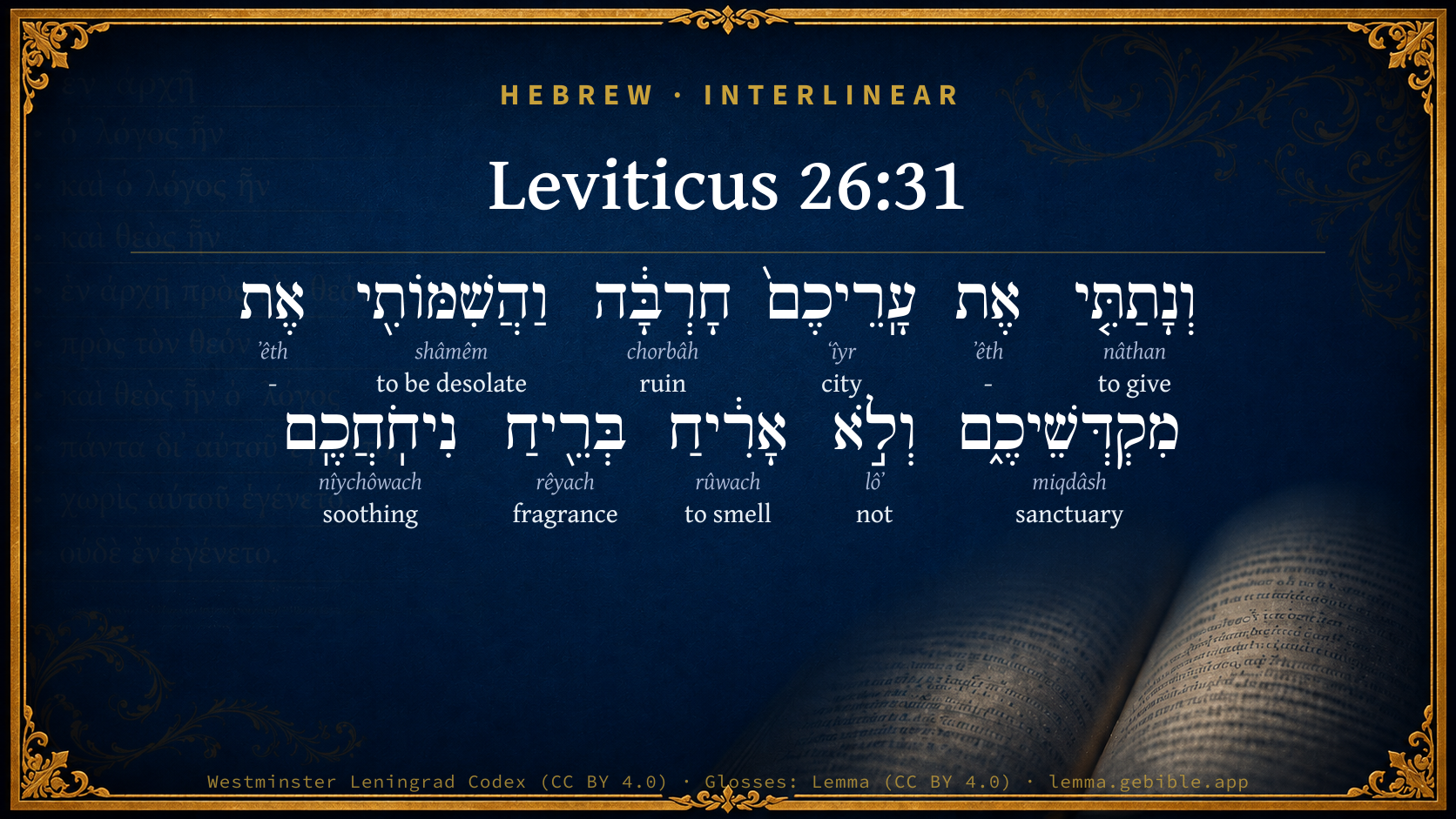
Hebrew (Westminster Leningrad Codex) Leviticus 26:31 appears in the Hebrew Old Testament. The text above is from the Westminster Leningrad Codex. Each word links to its Strong’s number, a concise gloss, and parsing drawn from the Open Scriptures Hebrew Bible morphology. Click any word for its full Brown-Driver-Briggs (BDB) entry.
Download image
Cite this verse

Leviticus 26:31 (World English Bible). Public Domain. Lemma interlinear Bible study tool, https://lemma.gebible.app/v/leviticus/26/31.

Show BibTeX & RIS
BibTeX
RIS
English Translation
I will lay your cities waste, and will bring your sanctuaries to desolation, and I will not take delight in the sweet fragrence of your offerings.
World English Bible · Public Domain
Highlights
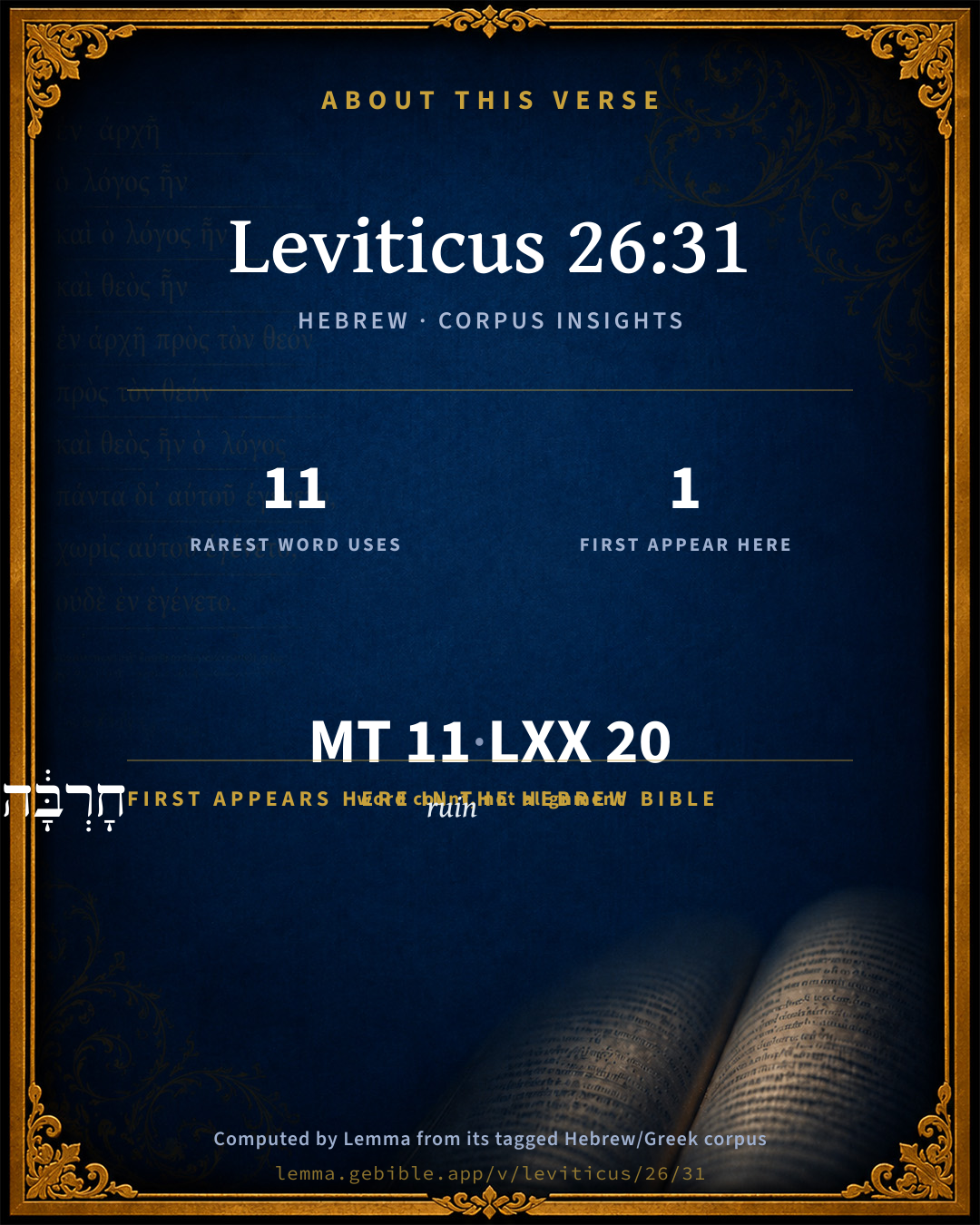
  • 1 first appearance in the Hebrew Bible
Full analysis ↓
Download a study sheet

One document with this verse’s original text, its word-by-word gloss line, the meaning frame, cross-references with their text, attributed commentary, and full source and license credits — printable, and it pastes into notes with its structure intact.

This verse Autodidact and up

Study sheet (.html) Plain text (.txt)

A passage Seminary Student

Up to 50 verses in one chapter. A passage sheet keeps up to 6 commentary sources and 12 cross-references per verse, in the order this page ranks them, and says so on the sheet whenever that leaves anything out. Ask for a single verse and you get the Autodidact verse sheet above.

Everything on this page stays free to read, with no account — the sheet is a download of what is already on screen, not access to it.

Want to remove ads? Support Godless Engineer
Compare translations 3

The same verse in 3 English versions, stacked beneath the original-language interlinear above. Click any original word for its lexicon entry.

Each is an independent rendering of the whole verse — the interlinear is not word-aligned to these translations.

Highlighted words mark where these versions differ — a whole-verse word diff, not a word-by-word alignment.

  • World English Bible Public Domain
    I will lay your cities waste, and will bring your sanctuaries to desolation, and I will not take delight in the sweet fragrence of your offerings.
  • King James Version Public Domain
    And I will make your cities waste, and bring your sanctuaries unto desolation, and I will not smell the savor of your sweet odors.
  • unfoldingWord Literal Text CC BY-SA 4.0
    And I will make your cities a waste, and I will make desolate your holy places, and I will not smell your pleasing aromas.

unfoldingWord Literal Text — © unfoldingWord, licensed CC BY-SA 4.0. Word-aligned USFM3 via Door43 (git.door43.org/unfoldingWord/en_ult).

Versions to compare (up to 4)

3 of 4 selected

Show all 18 translations

Every available English version of this verse, each an independent rendering of the whole verse.

  • World English Bible Public Domain
    I will lay your cities waste, and will bring your sanctuaries to desolation, and I will not take delight in the sweet fragrence of your offerings.
  • Berean Standard Bible Public Domain
    I will reduce your cities to rubble and lay waste your sanctuaries, and I will refuse to smell the pleasing aroma of your sacrifices.
  • Majority Standard Bible Public Domain
    I will reduce your cities to rubble and lay waste your sanctuaries, and I will refuse to smell the pleasing aroma of your sacrifices.
  • King James Version Public Domain
    And I will make your cities waste, and bring your sanctuaries unto desolation, and I will not smell the savor of your sweet odors.
  • American Standard Version (1901) Public Domain
    And I will make your cities a waste, and will bring your sanctuaries unto desolation, and I will not smell the savor of your sweet odors.
  • Revised Version (1885) Public Domain
    And I will make your cities a waste, and will bring your sanctuaries unto desolation, and I will not smell the savour of your sweet odours.
  • Geneva Bible (1599) Public Domain
    And I will make your cities desolate, and bring your Sanctuarie vnto nought, and will not smelll the sauour of your sweete odours.
  • Douay-Rheims (1899) Public Domain
    Insomuch that I will bring your cities to be a wilderness, and I will make your sanctuaries desolate, and will receive no more your sweet odours.
  • Young's Literal Translation Public Domain
    and I have made your cities a waste, and have made desolate your sanctuaries, and I smell not at your sweet fragrances;
  • Literal Standard Version CC BY-SA 4.0
    and I have made your cities a ruin, and have made your sanctuaries desolate, and I do not smell your refreshing fragrance;
  • Unlocked Literal Bible CC BY-SA 4.0
    I will turn your cities into ruins and destroy your sanctuaries. I will not be pleased with the aroma of your offerings.
  • unfoldingWord Literal Text CC BY-SA 4.0
    And I will make your cities a waste, and I will make desolate your holy places, and I will not smell your pleasing aromas.
  • Darby Bible Public Domain
    And I will lay waste your cities and desolate your sanctuaries; and I will not smell your sweet odours.
  • World Messianic Bible Public Domain
    I will lay your cities waste, and will bring your sanctuaries to desolation. I will not take delight in the sweet fragrance of your offerings.
  • Webster's Bible Public Domain
    And I will make your cities waste, and bring your sanctuaries to desolation, and I will not smell the savor of your sweet odors.
  • Free Bible Version CC BY-SA 4.0
    I will demolish your towns and destroy your pagan sanctuaries, and I will refuse to accept your sacrifices.
  • Bible in Basic English Public Domain
    And I will make your towns waste and send destruction on your holy places; I will take no pleasure in the smell of your sweet perfumes;
  • JPS Tanakh (1917) Public Domain
    And I will make your cities a waste, and will bring your sanctuaries unto desolation, and I will not smell the savour of your sweet odours.

Literal Standard Version (2020), Covenant Press — licensed CC BY-SA 4.0. Text via the HelloAO Bible API (eBible.org). Unlocked Literal Bible (unfoldingWord) — licensed CC BY-SA 4.0. Text via the HelloAO Bible API (eBible.org). unfoldingWord Literal Text — © unfoldingWord, licensed CC BY-SA 4.0. Word-aligned USFM3 via Door43 (git.door43.org/unfoldingWord/en_ult). Free Bible Version, Dr. Jonathan Gallagher — licensed CC BY-SA 4.0. Text via the HelloAO Bible API (eBible.org).

Word by word

More ways to search: Search by grammar → Find every occurrence → Compare this word →

Practice this passage: Drill this verse → Learn its vocabulary →

אָרִ֔יחַ
rûwach
H7306
“to smell”
Verb, Hiphil, Imperfect, 1st Person, Common, Singular
Part of Speech
Verb
Stem
Hiphil
Form
Imperfect
Person
1st Person
Gender
Common
Number
Singular
Full BDB Definition

Origin: a primitive root

TWOT: 2131

(Hiphil) to smell, scent, perceive odour, accept - of horse - of delight (metaphorically)
  1. וְנָתַתִּ֤י nâthan H5414 “and · to give” Conjunction + Verb, Qal, Sequential Perfect, 1st Person, Common, Singular
  2. אֶת ʼêth H853 “-” Particle, Direct Object
  3. עָֽרֵיכֶם֙ ʻîyr H5892 “cities · your” Noun, Common, Feminine, Plural, Construct + Suffix, Personal, 2nd Person, Masculine, Plural
  4. חָרְבָּ֔ה chorbâh H2723 “ruin” Noun, Common, Feminine, Singular, Absolute
  5. וַהֲשִׁמּוֹתִ֖י shâmêm H8074 “and · to be desolate” Conjunction + Verb, Hiphil, Sequential Perfect, 1st Person, Common, Singular
  6. אֶת ʼêth H853 “-” Particle, Direct Object
  7. מִקְדְּשֵׁיכֶ֑ם miqdâsh H4720 “sanctuaries · your” Noun, Common, Masculine, Plural, Construct + Suffix, Personal, 2nd Person, Masculine, Plural
  8. וְלֹ֣א lôʼ H3808 “and · not” Conjunction + Particle, Negative
  9. בְּרֵ֖יחַ rêyach H7381 “in/at · fragrance of” Preposition + Noun, Common, Masculine, Singular, Construct
  10. נִיחֹֽחֲכֶֽם nîychôwach H5207 “soothing · your” Noun, Common, Masculine, Singular, Construct + Suffix, Personal, 2nd Person, Masculine, Plural

About this verse

These counts appear in no published source. They are computed here, from the morphology-tagged text and Lemma’s own curated glosses. What Lemma adds →

11
words
10
distinct lemmas
Pentateuch
section

Notable vocabulary

The rarest word here is אָרִ֔יחַ to smell H7306 — appearing just 11 times in the whole Hebrew Bible.

First appearance in Scripture

This word makes its first canonical appearance in the Hebrew Bible here:

  • חָרְבָּ֔ה ruin H2723

Shared distinctive vocabulary

אָרִ֔יחַ to smell H7306 occurs in 11 verses of the Hebrew Bible. Also found in:

Grammatical profile

  • 3 verbs
  • 5 nouns
  • 3 particles

Verb forms

  • וְנָתַתִּ֤י Qal · Sequential Perfect
  • וַהֲשִׁמּוֹתִ֖י Hiphil · Sequential Perfect
  • אָרִ֔יחַ Hiphil · Imperfect

Hebrew & Septuagint length

In English translation the verse runs 26 words from the Hebrew and 24 from the Septuagint (LXX English) — closely comparable.

A rough comparison of the two English renderings, which tokenize alike — not a word-level alignment.

Word counts can differ between the Hebrew and the Greek without any difference in meaning — e.g. the Hebrew direct-object marker אֵת has no separate Greek word, and Greek often adds the article ὁ.

In the original languages it is 11 Hebrew tokens and 20 Greek tokens — but the two are counted differently (Hebrew bundles its prefixes and suffixes into one token; the Greek is in lemma form), so that isn’t a like-for-like length.

Cross-references

31

Topical passages linked to Leviticus 26:31 in the Treasury of Scripture Knowledge — connected by theme and wording, ordered by reader-vote popularity; previews shown in the World English Bible.

  • Nehemiah 2:3 I said to the king, Let the king live forever: why should not my face be sad, when the city, the place of my fathers' tombs, lies waste, and the gates of it are consumed with fire?
  • Genesis 8:21 Yahweh smelled the sweet savor. Yahweh said in his heart, "I will not again curse the ground any more for man's sake, because the imagination of man's heart is evil from his youth; neither will I ever again strike everything living, as I have done.
  • 2 Kings 25:4–10 Then a breach was made in the city, and all the men of war [fled] by night by the way of the gate between the two walls, which was by the king's garden (now the Chaldeans were against the city round about); and [the king] went by the way of the Arabah.
  • Isaiah 1:11–14 "What are the multitude of your sacrifices to me?," says Yahweh. "I have had enough of the burnt offerings of rams, And the fat of fed animals. I don't delight in the blood of bulls, Or of lambs, Or of male goats.
  • Jeremiah 4:7 A lion is gone up from his thicket, and a destroyer of nations; he is on his way, he is gone forth from his place, to make your land desolate, that your cities be laid waste, without inhabitant.
  • Lamentations 1:10 The adversary has spread out his hand on all her pleasant things: For she has seen that the nations are entered into her sanctuary, Concerning whom you did command that they should not enter into your assembly.
  • Lamentations 2:7 The Lord has cast off his altar, he has abhorred his sanctuary; He has given up into the hand of the enemy the walls of her palaces: They have made a noise in the house of Yahweh, as in the day of a solemn assembly.
  • Ezekiel 9:6 kill utterly the old man, the young man and the virgin, and little children and women; but don't come near any man on whom is the mark: and begin at my sanctuary. Then they began at the old men that were before the house.
  • Amos 5:21–23 I hate, I despise your feasts, And I can't stand your solemn assemblies.
  • Hebrews 10:26 For if we sin willfully after we have received the knowledge of the truth, there remains no more a sacrifice for sins,
  • 2 Chronicles 36:19 They burnt the house of God, and broke down the wall of Jerusalem, and burnt all the palaces of it with fire, and destroyed all the goodly vessels of it.
  • Nehemiah 2:17 Then said I to them, You see the evil case that we are in, how Jerusalem lies waste, and the gates of it are burned with fire: come, and let us build up the wall of Jerusalem, that we be no more a reproach.
  • Psalms 74:3–8 Lift up your feet to the perpetual ruins, All the evil that the enemy has done in the sanctuary.
  • Isaiah 1:7 Your country is desolate. Your cities are burned with fire. Strangers devour your land in your presence, And it is desolate, As overthrown by strangers.
  • Isaiah 24:10–12 The waste city is broken down; every house is shut up, that no man may come in.
  • Isaiah 66:3 He who kills an ox is as he who kills a man; he who sacrifices a lamb, as he who breaks a dog's neck; he who offers an offering, [as he who offers] pig's blood; he who burns frankincense, as he who blesses an idol. Yes, they have chosen their own ways, and their soul delights in their abominations:
  • Jeremiah 9:11 I will make Jerusalem heaps, a dwelling-place of jackals; and I will make the cities of Judah a desolation, without inhabitant.
  • Jeremiah 22:5 But if you will not hear these words, I swear by myself, says Yahweh, that this house shall become a desolation.
  • Jeremiah 26:6 then will I make this house like Shiloh, and will make this city a curse to all the nations of the earth.
  • Jeremiah 26:9 Why have you prophesied in the name of Yahweh, saying, This house shall be like Shiloh, and this city shall be desolate, without inhabitant? All the people were gathered to Jeremiah in the house of Yahweh.
  • Jeremiah 52:13 and he burned the house of Yahweh, and the king's house; and all the houses of Jerusalem, even every great house, burned he with fire.
  • Lamentations 1:1 How does the city sit solitary, that was full of people! She has become as a widow, who was great among the nations! She who was a princess among the provinces is become tributary!
  • Ezekiel 6:6 In all your dwelling-places the cities shall be laid waste, and the high places shall be desolate; that your altars may be laid waste and made desolate, and your idols may be broken and cease, and your sun-images may be hewn down, and your works may be abolished.
  • Ezekiel 21:7 It shall be, when they tell you, Why do you sigh? that you shall say, Because of the news, for it comes; and every heart shall melt, and all hands shall be feeble, and every spirit shall faint, and all knees shall be weak as water: behold, it comes, and it shall be done, says the Lord Yahweh.
  • Ezekiel 21:15 I have set the threatening sword against all their gates, that their heart may melt, and their stumblings be multiplied: ah! it is made as lightning, it is pointed for slaughter.
  • Ezekiel 24:21 Speak to the house of Israel, Thus says the Lord Yahweh: Behold, I will profane my sanctuary, the pride of your power, the desire of your eyes, and that which your soul pities; and your sons and your daughters whom you have left behind shall fall by the sword.
  • Micah 3:12 Therefore Zion for your sake will be plowed like a field, And Jerusalem will become heaps of rubble, And the mountain of the temple like the high places of a forest.
  • Matthew 24:1–2 Jesus went out from the temple, and was going on his way. His disciples came to him to show him the buildings of the temple.
  • Luke 21:5–6 As some were talking about the temple and how it was decorated with beautiful stones and gifts, he said,
  • Luke 21:24 They will fall by the edge of the sword, and will be led captive into all the nations. Jerusalem will be trampled down by the Gentiles, until the times of the Gentiles are fulfilled.
  • Acts 6:14 For we have heard him say that this Jesus of Nazareth will destroy this place, and will change the customs which Moses delivered to us."

Cross-references courtesy of OpenBible.info (CC BY 4.0).

Hebrew and Greek witnesses Masoretic Hebrew ↔ Greek Septuagint

The same verse in the two great witnesses to the Old Testament, shown verse-for-verse.

These are two independent witnesses, not word-aligned to each other, and the Septuagint is shown in lemma (dictionary) form.

Hebrew Leviticus 26:31 Masoretic · Westminster Leningrad Codex

וְנָתַתִּ֤י אֶת עָֽרֵיכֶם֙ חָרְבָּ֔ה וַהֲשִׁמּוֹתִ֖י אֶת מִקְדְּשֵׁיכֶ֑ם וְלֹ֣א אָרִ֔יחַ בְּרֵ֖יחַ נִיחֹֽחֲכֶֽם

I will lay your cities waste, and will bring your sanctuaries to desolation, and I will not take delight in the sweet fragrence of your offerings.

World English Bible · Public Domain

Greek LXX Leviticus 26:31 Septuagint · lemma form

καί τίθημι ὁ πόλις σύ ἔρημος καί ἐκἐρημόω ὁ ἅγιος σύ καί οὐ μή ὀσφραίνομαι ὁ ὀσμή ὁ θυσία σύ

And I will lay your cities waste, and I will make your sanctuaries desolate, and I will not smell the savor of your sacrifices.

LXX2012 (modern English Septuagint) · Public Domain

Hebrew: Westminster Leningrad Codex (CC BY 4.0). Greek: Septuagint (public domain); English from LXX2012 (modern English Septuagint) (Public Domain). How the Septuagint differs from the Hebrew →

Targum (Aramaic paraphrase)

2

The Targum is the ancient Jewish Aramaic paraphrase of the Hebrew Scriptures — an interpretive translation, not the Hebrew text itself. Onkelos (literal) and Pseudo-Jonathan (expansive) render the Torah, and Jonathan the Prophets. Coverage is partial: where no permissively-licensed English translation exists for a verse, only the Aramaic is shown. This is verse-level text, not a word-by-word alignment to the Hebrew.

  1. Targum Onkelos Torah (Genesis–Deuteronomy)
    וְאֶתֵּן יָת קִרְוֵיכוֹן צָדָא וְאֶצְדֵי יָת מַקְדְשֵׁיכוֹן וְלָא אֲקַבֵּל בְּרַעֲוָא קֻרְבַּן כְּנִשָׁתְכוֹן

    (no public-domain English translation for this verse)

    Targum Onkelos — Aramaic: “Onkelos Genesis” (public domain); “Onkelos Exodus” (public domain); “Onkelos Leviticus” (public domain); “Onkelos Numbers” (public domain); “Onkelos Deuteronomy” (public domain). English: “Sefaria Community Translation” (CC0 1.0 (public-domain dedication)); “J.W. Etheridge. The Targums of Onkelos and Jonathan Ben Uzziel on the Pentateuch. London: Longmans, Green, 1862” (public domain). Text via Sefaria.

  2. Targum Pseudo-Jonathan Torah (Genesis–Deuteronomy)
    וְאֶתֵּן יַת קוּרְיֵיכוֹן צַדְיָין וַאֲשַׁעְמֵם יַת מוּקְדָשֵׁיכוֹן וְלָא אֲקַבֵּל בְּרַעֲוָא רֵיחַ קוּרְבָּנֵיכוֹן

    And I will make your cities desert places, and desolate your sanctuary; nor will I receive with acceptance the odour of your oblations.

    Targum Pseudo-Jonathan — Aramaic: “Targum Jonathan on Genesis” (public domain); “Targum Jonathan on Exodus” (public domain); “Targum Jonathan on Leviticus” (public domain); “Targum Jonathan on Numbers” (public domain); “Targum Jonathan on Deuteronomy” (public domain). English: “The Targum of Jonathan ben Uzziel, trans. J. W. Etheridge, London, 1862” (public domain). Text via Sefaria.

Commentary

Notes on Leviticus 26:31 from classic Christian and Jewish commentators (each source and its license shown beneath its notes). The classic Christian expositions comment on the surrounding passage and are grouped to its opening verse, so a note may address several verses; the Jewish commentaries on the Tanakh (Rashi and others) are per-verse, so they appear only where the commentator wrote on this verse.

Lemma curates 59 commentaries, every one of them public domain or Creative Commons licensed, each selected and text-cleaned for this edition rather than reprinted as found. About our sources →

Trapp's Complete Commentary

John Trapp

Lev 26:31 And I will make your cities waste, and bring your sanctuaries unto desolation, and I will not smell the savour of your sweet odours.

Ver. 31. I will not smell.] I will show myself implacable, inexorable.

John Trapp, A Commentary or Exposition upon All the Books of the Old and New Testament (1647–1656) — public domain. Text from a community e-Sword module.

Joseph Benson's Commentary

Lev 26:31. Your sanctuaries into desolation — The sanctuary of God, though but one, is expressed in the plural number here, as it is also Psa 73:17; and Psa 84:7; Jer 51:51; and Eze 28:18; because there were divers apartments in it, each of which was a sanctuary, or holy place. God vouchsafes not to call it his own, but theirs, to show that by their wickedness it would be polluted and rendered unworthy of him, and that therefore he would disown and abhor it, and all the services which they should perform in it; which was most awfully fulfilled. The savour of your sweet odours — The incense made of several sweet spices, which was daily offered to God in the sanctuary. These, though when offered to God with faith and obedience they were sweet and acceptable to him, he here threatens he will not smell, or accept, as being presented in hypocrisy and unbelief. The expression is metaphorical, and signifies that neither their prayers nor sacrifices should be accepted.

Joseph Benson's Commentary on the Old and New Testaments (1811–1818) — public domain. Text from a community e-Sword module.

Geneva Bible (1599)

Geneva Bible translators

I will not accept your sacrifices.

Geneva Bible (1599) marginal notes — public domain. Text via Bolls.life.

Jamieson, Fausset & Brown

Robert Jamieson, A. R. Fausset & David Brown

I will make your cities waste--This destruction of its numerous and flourishing cities, which was brought upon Judea through the sins of Israel, took place by the forced removal of the people during, and long after, the captivity. But it is realized to a far greater extent now.

bring your sanctuaries unto desolation, and I will not smell the savour of your sweet odours--the tabernacle and temple, as is evident from the tenor of the subsequent clause, in which God announces that He will not accept or regard their sacrifices.

Jamieson, Fausset & Brown — Commentary Critical and Explanatory on the Whole Bible (1871) — public domain (CC PDM 1.0). Text via the HelloAO Bible API.

Ellicott's Commentary for English Readers

(31) I will make your cities waste.—Not only will the elevated spots outside the cities with their idols be destroyed, and the carcases of the deluded worshippers be scattered among their remains, but the cities themselves will be converted into ruins and desolations (Jer_4:7; Jer_9:11; Eze_6:6; Eze_12:20; Neh_2:17, &c.).

And bring your sanctuaries unto desolation.—Even the sanctuary with all its holy places (Jer_51:51; Eze_21:7; Amo_7:9; Pss. 68:36, Psa_74:7. &c.), sacred edifices, synagogues, &c. (Lev_21:23), will not be spared, God thus reversing the promise which He made to the Israelites, that He will set up His dwelling place in the midst of them (see Lev_26:11) if they will walk according to His commandments.

I will not smell the savour of your sweet odours.—When this awful destruction of the sanctuary is to take place God will not regard the fact that the odour of sweet sacrifices is there being offered up. (See Lev_1:9.) The service which may then be performed to Him will not hinder Him from executing this judgment.

A Bible Commentary for English Readers, edited by Charles John Ellicott (1878–1897) — public domain. Text from a community e-Sword module.

The Cambridge Bible for Schools and Colleges

gen. ed. J. J. S. Perowne

31. I will not smell, etc.] Cp. Isa_1:11 ff.; Amo_5:21 f.

The Cambridge Bible for Schools and Colleges (gen. ed. J. J. S. Perowne; Cambridge University Press, 1878–1918) — public domain. Text from a community e-Sword module.

John Gill's Exposition

And I will bring the land into desolation,.... The whole country of Judea, cities, towns, villages, fields, vineyards, &c. through the ravage and plunder of the enemy; and they being driven out of it, and carried captive from it, and so the land left untilled, and become barren and unfruitful:

and your enemies which dwell therein; having destroyed them, or cast them out, and sent them into other countries, and took possession of theirs in their room:

shall be astonished at it; at the desolation of the land, that such a fruitful country, a land flowing with milk and honey, should be turned into barrenness, for the wickedness of its inhabitants, and shall be amazed at the judgments of God upon them and that.

John Gill's Exposition of the Whole Bible (1746–1763) — public domain (CC PDM 1.0). Text via the HelloAO Bible API.

Haydock's Catholic Bible Commentary

Odours. Even the sanctuary of the Lord shall be destroyed, as you will be unworthy to have it among you, or to offer sacrifices to me. (Haydock)

George Leo Haydock (1774–1849), Haydock's Catholic Family Bible and Commentary, 1859 edition — public domain. Excludes Psalms (Douay-Rheims chapter numbering differs from Protestant) and Deuterocanonical books (Catholic canon only).

Matthew Poole's English Annotations

Your sanctuaries; either,

1. God’s sanctuary, called sanctuaries here, as also Psa 73:17; 74:7; Jer 51:51; Eze 28:18, because there were divers apartments in it, each of which was a sanctuary, or, which is all one, a holy place, as they are severally called. And your emphatically, not mine, for I disown and abhor it, and all the services you do in it, because you have defiled it. Or,

2. The temples built by you to idols, therefore called

their sanctuaries, in opposition to God’s. Or,

3. Your synagogues. But the first is most probable, because he speaks of the place where they used to offer their sweet odours here following.

I will not smell, i.e. not own or accept them. See Gen 8:21; Isa 1:11, &c.

Of your sweet odours; either of the incense, or of your sacrifices, which when offered with faith and obedience, are very sweet and acceptable to me.

Matthew Poole's English Annotations on the Holy Bible (1683–1685) — public domain. Text from a community e-Sword/MySword module.

Whedon's Commentary on the Bible

Daniel D. Whedon

31. I will make your cities waste — Palestine is filled with ruined cities. Says Porter, in his Giant Cities of Bashan: “Every opening to the right and left revealed ruins; now a tomb in a quiet nook; now a temple in a lonely forest glade; now a shapeless and nameless heap of stones and fallen columns; and now, through a long green vista, the shattered walls and towers of an ancient city. The country is filled with ruins. In every direction to which the eye turns, in every spot on which it rests, ruins are visible — so truly, so wonderfully, have the prophecies been fulfilled. Every view we got in Bashan was an ocular demonstration of the literal fulfilment of the curse pronounced on the land by Moses more than three thousand years ago. One day I climbed a peak which commands the sea of Galilee and the Jordan valley up to the waters of Merom. I was able to distinguish, by the aid of a glass, in a region thirty miles long by ten wide, every spot celebrated in sacred history. My eye swept the sea from north to south, from east to west; not a single sail, not a solitary boat, was there. My eye swept the great Jordan valley, the little plains, the glens, the mountain sides from base to summit — not a city, not a village, not a house, not a sign of settled habitation was there, except a few huts at Magdala and the shattered houses of Tiberias. Desolation keeps unbroken sabbath in Galilee now. Nature has lavished on the country some of her choicest gifts — a rich soil, a genial climate — but the curse of Heaven has come upon it because of the sin of man.” Keith, after enumerating a large number of celebrated cities in the Holy Land lying in utter desolation, exclaims: “How marvellously are the predictions of their desolation verified, when, in general, nothing but ruined ruins form the most distinguished remnants of the cities of Israel; and when the multitude of its towns are almost all left, with many a vestige to testify of their number, but without a mark to tell their name.”

Your sanctuaries — By the use of the plural number there may be an implied reference to idolatrous temples, but it is more probable that the future sanctuary cities, Bethel, Shiloh, and Jerusalem, are proleptically referred to, including the numerous synagogues scattered over the land.

I will not smell the savour — In other words, “I will not smell with pleasure, 1 will not enjoy, the savour of your sweet odours.” Only the penitent, obedient, and devout heart can please God or appropriate spiritual good. The mere mechanical performance of sacrifice and burning of incense, dissevered from the appropriate state of the moral and religious sensibilities, is a solemn mockery and abomination. See Introductory notes 7 and 8. Isa_1:11-15.

Daniel D. Whedon (gen. ed.), Commentary on the Old and New Testaments (1874–1909) — public domain. Text from a community e-Sword module.

John Wesley's Explanatory Notes

Sanctuaries - God's sanctuary, called sanctuaries here, as also Psalm 7iii, 17; 7iv, 7 Jer. li, 51 Ezek. xxviii, 18, because there were divers apartments in it, each of which was a sanctuary, or, which is all one, an holy place, as they are severally called. And yours emphatically, not mine, for I disown and abhor it, and all the services you do in it, because you have defiled it. I will not smell - Not own or accept them. Your sweet odours - Either of the incense, or of your sacrifices, which when offered with faith and obedience, are sweet and acceptable to me.

John Wesley, Explanatory Notes Upon the Whole Bible (1754–1765) — public domain. Text via the GEBible commentary corpus.

Keil & Delitzsch

C. F. Keil & F. Delitzsch

Their towns and their sanctuaries He would destroy, because He took no pleasure in their sacrificial worship. מקדּשׁים are the holy things of the worship of Jehovah, the tabernacle and temple, with their altars and the rest of their holy furniture, as in Ps. 68:36; Psa 74:7. ניחח ריח (Lev 1:9) is the odour of the sacrifice; and ריח, to smell, an anthropomorphic designation of divine satisfaction (cf. Amo 5:21; Isa 11:3).

Keil & Delitzsch — Biblical Commentary on the Old Testament (1861–1891) — public domain (CC PDM 1.0). Text via the HelloAO Bible API. (Old Testament only.)

unfoldingWord translationNotes

Door43 World Missions Community

I will turn your cities into ruins and destroy your sanctuaries

Because God would send armies to do these things, he speaks as if he would do them. AT: "I will send enemy armies to turn your cities into ruins and destroy your sanctuaries" (See: Metonymy)

your sanctuaries

These were places where people worshiped idols instead of God.

I will not be pleased with the aroma of your offerings

Normally the Lord's pleasure with the aroma represents his pleasure with those who burn the offering. But in this case, people would burn offerings, but God would not be pleased with them. AT: "You will burn offerings, but I will not be pleased with you" (See: Metaphor)

I will draw out my sword and follow you

This represents sending armies to attack them. AT: "I will send enemy armies to attack you" or "I will send enemy armies to attack you with their swords" (See: Metonymy)

Your land will be abandoned, and your cities will be ruined

This can be stated in active form. AT: "You will abandon your land, and your enemies will destroy your cities" (See: Active or Passive)

translationWords

ruin

sanctuary

sacrifice

devastate

nation

unfoldingWord translationNotes — © Distant Shores Media and the Door43 World Missions Community, licensed CC BY-SA 4.0. Source: git.door43.org/Door43/en_tn.

Rashi

Rabbi Shlomo Yitzchaki (Rashi)

ונתתי את עריכם חרבה AND I WILL MAKE YOUR CITIES WASTE — I might think that this means that they will be so waste that there will be no human being there (no inhabitants)! But when Scripture states (v. 32) “I will bring the land into desolation” its becoming desolate of human beings is expressed there. How, then, must I explain the words "[and I will make your cities] waste”? That there will not even be occasional passers to and fro — no occasional visitors (cf. Sifra, Bechukotai, Section 1 4).

והשמותי את מקדשיכם AND I WILL BRING YOUR SANCTUARIES UNTO DESOLATION — I might think that this means they will be desolate of sacrifices! But when Scripture states, “and I will not smell [your pleasing odors]”, their being desolate of sacrifices is expressed there! How then must I explain והשמותי את מקדשיכם? As referring to their being abandoned by the bands of pilgrims — by the caravans of Israelites which used to prepare and to band together in order to pilgrim there (Sifra, Bechukotai, Section 1 4). Thus again you have seven punishments: the eating of the flesh of their sons and daughters, the destruction of the high places, these make two. — The cutting off of the sun-images, however, is not reckoned as a separate punishment, for that statement means that through the destruction of the high places the sun-images which were placed on the top of the roofs would fall and so be destroyed. — “I will cast your carcasses etc.”, three; the departure of the Shechinah, four; the laying waste of the cities, the desertion of the Sanctuary by the pilgrim bands and “I shall not smell the pleasing odor of the sacrifices” — make altogether seven.

Rashi on the Tanakh — English translations: “The Judaica Press complete Tanach with Rashi, translated by A. J. Rosenberg” (CC BY 4.0); “Pentateuch with Rashi's commentary by M. Rosenbaum and A.M. Silbermann, 1929-1934” (public domain); “The Metsudah Tanach series, Lakewood, N.J” (CC BY 4.0); and “The Book of Joshua, Metsudah Publications, 1997” (CC BY 4.0). Text via Sefaria.

Sforno

Rabbi Ovadia Sforno

I will turn your cities into ruins. By means of the king of Babylon and his ministers.

And bring your Sanctuaries into desolation. By means of Nebuzaradan (the chief executioner).

I will no longer scent the fragrance of your offerings. At that time there were Kohanim, the sons of Tzaddok, who undoubtedly offered sacrifices with a scent of fragrance (favorably). Nevertheless, it was not acceptable due to the people’s guilt.

Sforno on the Tanakh — English translation: “Yalkut, Sifsei Chachomim Chumash, Metsudah Publications, 2009” (CC BY 4.0). Text via Sefaria.

Lesson kit

Teaching starters — assembled from the data on this page, not authored interpretation. Every prompt links to the verse data it draws on. Edit before teaching.

Leviticus, in the Pentateuch, opens this verse with 11 words (10 distinct Hebrew lemmas). Its most distinctive word is rûwach (“to smell”). A historical commentator’s framing appears above. Read the whole chapter for the surrounding context.

Discussion questions

  1. How does “to smell” (rûwach) shape what this verse is saying?
  2. The word “ruin” first appears here in Scripture. What is being introduced at this debut?
  3. Genesis 8:21 shares the word «to smell» with this verse. How do the two illuminate each other?
  4. These translations render this verse differently. What is at stake in choosing one wording over another?
  5. The verb «וְנָתַתִּ֤י» is Qal Sequential Perfect. How does its form color the action?
  6. Reading how Trapp's Complete Commentary and Joseph Benson's Commentary read this verse, where do the two commentators agree and where do they part?

Things to notice

Reading settings

Reading text

Shown beneath each verse's original-language words.

Old Testament
Old Testament edition

Read the OT as the Masoretic Hebrew (MT) or the Greek Septuagint (LXX).

English shown for the Greek Septuagint (in the Hebrew ↔ Greek comparison).

Comparing translations? Open the Compare panel on any verse page to stack up to four side by side.