
Acts 13:18

Greek (Tischendorf 8th ed.) Acts 13:18 appears in the Greek New Testament. The text above is from the Tischendorf 8th edition. Each word links to its Strong’s number and a concise gloss. Click any word for its full Thayer’s Greek Lexicon entry.
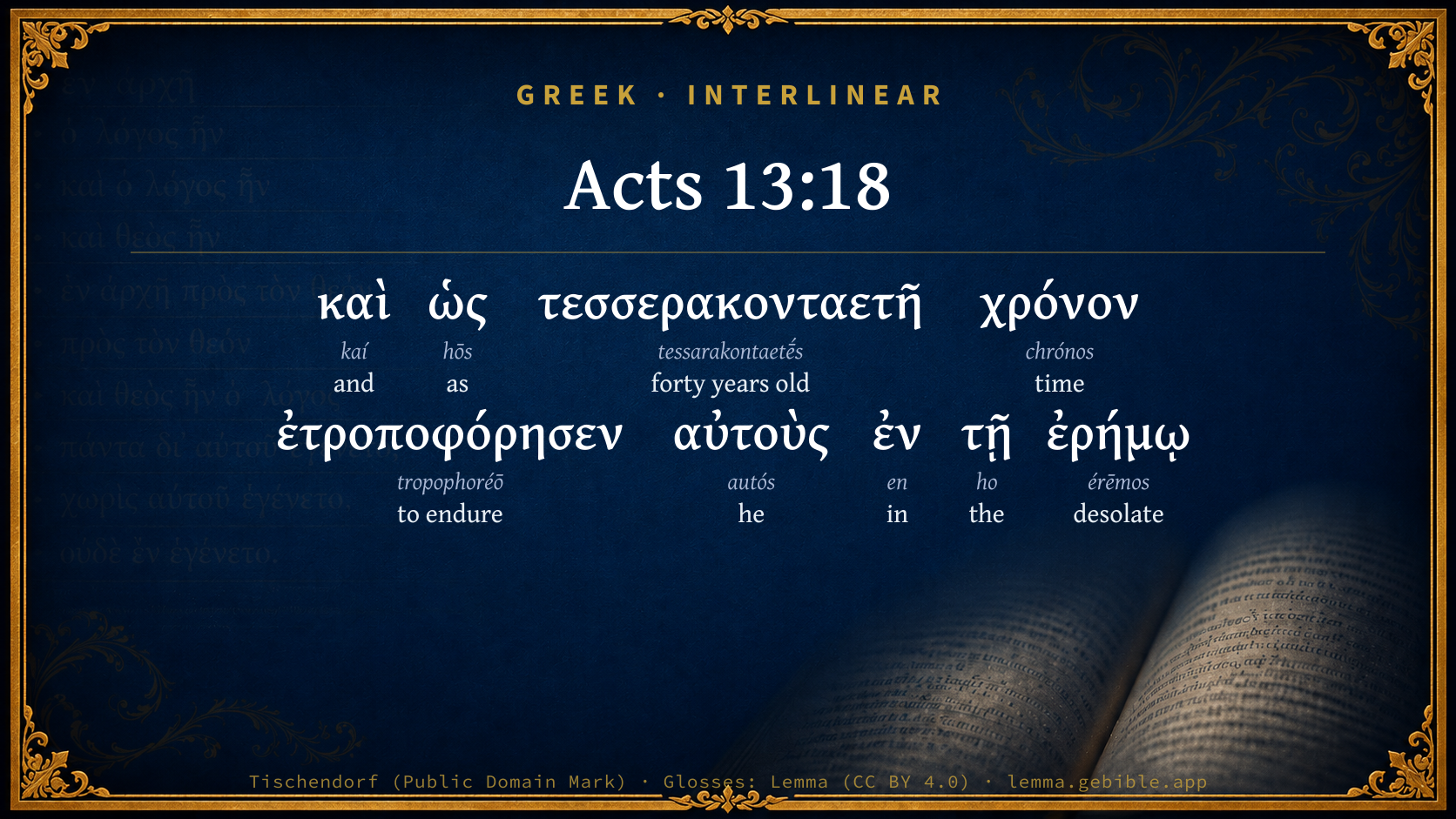
Download image
Cite this verse

Acts 13:18 (World English Bible). Public Domain. Lemma interlinear Bible study tool, https://lemma.gebible.app/v/acts/13/18.

Show BibTeX & RIS
BibTeX
RIS
English Translation
For a period of about forty years he put up with them in the wilderness.
World English Bible · Public Domain
Highlights
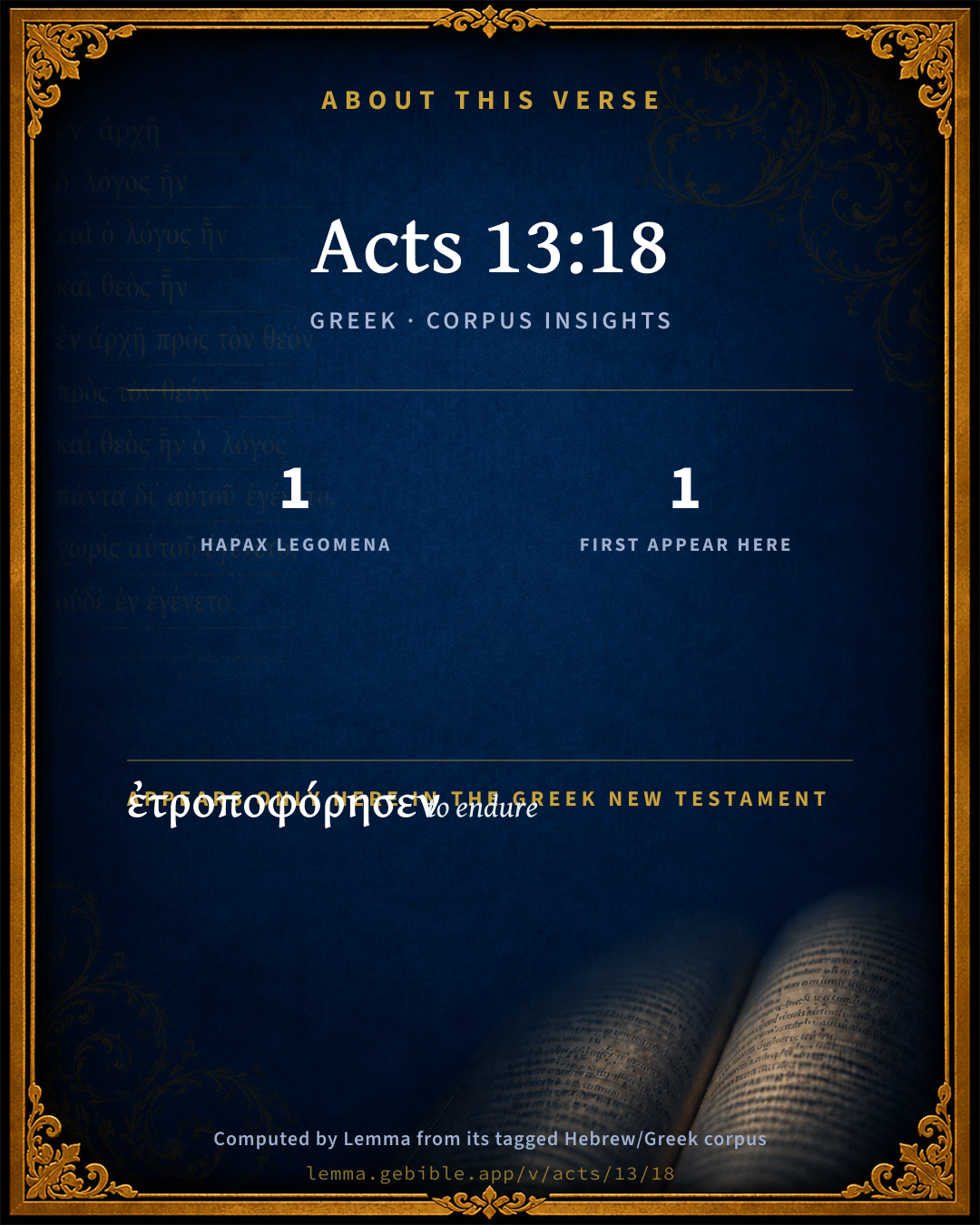
  • 1 hapax legomenon — only here in the Greek New Testament
  • 1 first appearance in the Greek New Testament
Full analysis ↓
Download a study sheet

One document with this verse’s original text, its word-by-word gloss line, the meaning frame, cross-references with their text, attributed commentary, and full source and license credits — printable, and it pastes into notes with its structure intact.

This verse Autodidact and up

Study sheet (.html) Plain text (.txt)

A passage Seminary Student

Up to 50 verses in one chapter. A passage sheet keeps up to 6 commentary sources and 12 cross-references per verse, in the order this page ranks them, and says so on the sheet whenever that leaves anything out. Ask for a single verse and you get the Autodidact verse sheet above.

Everything on this page stays free to read, with no account — the sheet is a download of what is already on screen, not access to it.

Want to remove ads? Support Godless Engineer
Compare translations 3

The same verse in 3 English versions, stacked beneath the original-language interlinear above. Click any original word for its lexicon entry.

Each is an independent rendering of the whole verse — the interlinear is not word-aligned to these translations.

Highlighted words mark where these versions differ — a whole-verse word diff, not a word-by-word alignment.

  • World English Bible Public Domain
    For a period of about forty years he put up with them in the wilderness.
  • King James Version Public Domain
    And about the time of forty years suffered he their manners in the wilderness.
  • unfoldingWord Literal Text CC BY-SA 4.0
    And for about a 40-year time, he endured them in the wilderness.

unfoldingWord Literal Text — © unfoldingWord, licensed CC BY-SA 4.0. Word-aligned USFM3 via Door43 (git.door43.org/unfoldingWord/en_ult).

Versions to compare (up to 4)

3 of 4 selected

Show all 19 translations

Every available English version of this verse, each an independent rendering of the whole verse.

  • World English Bible Public Domain
    For a period of about forty years he put up with them in the wilderness.
  • Berean Standard Bible Public Domain
    He endured their conduct for about forty years in the wilderness.
  • Majority Standard Bible Public Domain
    He endured their conduct for about forty years in the wilderness.
  • King James Version Public Domain
    And about the time of forty years suffered he their manners in the wilderness.
  • American Standard Version (1901) Public Domain
    And for about the time of forty years as a nursing-father bare he them in the wilderness.
  • Revised Version (1885) Public Domain
    And for about the time of forty years suffered he their manners in the wilderness.
  • Geneva Bible (1599) Public Domain
    And about the time of fourtie yeeres, suffered he their maners in the wildernesse.
  • Douay-Rheims (1899) Public Domain
    And for the space of forty years endured their manners in the desert.
  • Young's Literal Translation Public Domain
    and about a period of forty years He did suffer their manners in the wilderness,
  • Literal Standard Version CC BY-SA 4.0
    and about a period of forty years He endured their conduct in the wilderness,
  • Unlocked Literal Bible CC BY-SA 4.0
    For about forty years he put up with them in the wilderness.
  • unfoldingWord Literal Text CC BY-SA 4.0
    And for about a 40-year time, he endured them in the wilderness.
  • Darby Bible Public Domain
    and for a time of about forty years he nursed them in the desert.
  • World Messianic Bible Public Domain
    For a period of about forty years he put up with them in the wilderness.
  • Webster's Bible Public Domain
    And about the time of forty years he suffered their manners in the wilderness.
  • Free Bible Version CC BY-SA 4.0
    and he patiently dealt with them in the desert for about forty years.
  • Bible in Basic English Public Domain
    And for about forty years he put up with their ways in the waste land.
  • Text-Critical English NT CC BY 4.0
    For about forty years, he put up with them in the wilderness,
  • Tyndale New Testament (1534) Public Domain
    and aboute the tyme of.xl. yeares suffred he their maners in the wyldernes.

Literal Standard Version (2020), Covenant Press — licensed CC BY-SA 4.0. Text via the HelloAO Bible API (eBible.org). Unlocked Literal Bible (unfoldingWord) — licensed CC BY-SA 4.0. Text via the HelloAO Bible API (eBible.org). unfoldingWord Literal Text — © unfoldingWord, licensed CC BY-SA 4.0. Word-aligned USFM3 via Door43 (git.door43.org/unfoldingWord/en_ult). Free Bible Version, Dr. Jonathan Gallagher — licensed CC BY-SA 4.0. Text via the HelloAO Bible API (eBible.org).

Word by word

More ways to search: Search by grammar → Find every occurrence → Compare this word →

Practice this passage: Drill this verse → Learn its vocabulary →

About this verse

These counts appear in no published source. They are computed here, from the morphology-tagged text and Lemma’s own curated glosses. What Lemma adds →

9
words
9
distinct lemmas
Acts
section

Notable vocabulary

1 hapax legomenon — a word that appears only here in the entire Greek New Testament:

  • ἐτροποφόρησεν to endure G5159

First appearance in Scripture

This word makes its first canonical appearance in the Greek New Testament here:

  • ἐτροποφόρησεν to endure G5159

Shared distinctive vocabulary

τεσσερακονταετῆ forty years old G5063 occurs in 2 verses of the Greek New Testament. Also found in:
Cross-references

18

Topical passages linked to Acts 13:18 in the Treasury of Scripture Knowledge — connected by theme and wording, ordered by reader-vote popularity; previews shown in the World English Bible.

  • Acts 7:36 This man led them out, having worked wonders and signs in Egypt, in the Red Sea, and in the wilderness for forty years.
  • Exodus 16:2 The whole congregation of the children of Israel murmured against Moses and against Aaron in the wilderness;
  • Exodus 16:35 The children of Israel ate the manna forty years, until they came to an inhabited land. They ate the manna until they came to the borders of the land of Canaan.
  • Numbers 14:22 because all those men who have seen my glory, and my signs, which I worked in Egypt and in the wilderness, yet have tempted me these ten times, and have not listened to my voice;
  • Numbers 14:33–34 Your children shall be wanderers in the wilderness forty years, and shall bear your prostitution, until your dead bodies be consumed in the wilderness.
  • Deuteronomy 1:31 and in the wilderness, where you have seen how that Yahweh your God bore you, as a man does bear his son, in all the way that you went, until you came to this place.
  • Deuteronomy 9:7 Remember, don't forget, how you provoked Yahweh your God to wrath in the wilderness: from the day that you went forth out of the land of Egypt, until you came to this place, you have been rebellious against Yahweh.
  • Deuteronomy 9:21–24 I took your sin, the calf which you had made, and burnt it with fire, and stamped it, grinding it very small, until it was as fine as dust: and I cast the dust of it into the brook that descended out of the mountain.
  • Nehemiah 9:16–21 But they and our fathers dealt proudly and hardened their neck, and didn't listen to your commandments,
  • Psalms 78:17–42 Yet they still went on to sin against him, To rebel against the Most High in the desert.
  • Psalms 95:8–11 Don't harden your heart, as at Meribah, As in the day of Massah in the wilderness,
  • Psalms 106:13–29 They soon forgot his works. They didn't wait for his counsel,
  • Ezekiel 20:10–17 So I caused them to go forth out of the land of Egypt, and brought them into the wilderness.
  • Amos 5:25–26 "Did you bring to me sacrifices and offerings in the wilderness forty years, house of Israel?
  • Acts 7:39–43 to whom our fathers wouldn't be obedient, but rejected him, and turned back in their hearts to Egypt,
  • Hebrews 3:7–10 Therefore, even as the Holy Spirit says, "Today if you will hear his voice,
  • Hebrews 3:16–19 For who, when they heard, rebelled? No, didn't all those who came out of Egypt by Moses?
  • 1 Corinthians 10:1–10 Now I would not have you ignorant, brothers, that our fathers were all under the cloud, and all passed through the sea;

Cross-references courtesy of OpenBible.info (CC BY 4.0).

Commentary

Notes on Acts 13:18 from classic Christian and Jewish commentators (each source and its license shown beneath its notes). The classic Christian expositions comment on the surrounding passage and are grouped to its opening verse, so a note may address several verses; the Jewish commentaries on the Tanakh (Rashi and others) are per-verse, so they appear only where the commentator wrote on this verse.

Lemma curates 59 commentaries, every one of them public domain or Creative Commons licensed, each selected and text-cleaned for this edition rather than reprinted as found. About our sources →

The Biblical Illustrator

Joseph S. Exell

Act_13:18

And about the time of forty years suffered He their manners in the wilderness.

Divine forbearance toward human perverseness retraced

The goodness of God to man and the ingratitude of man to God form a very striking and affecting contrast. No one can seriously review his own history or that of the Church of God for any given period without being impressed with these two thoughts. How man tries God! how God bears with maul Consider--

I. The period of time. How long? About the time of forty years. This was the period during which Israel was wandering in the wilderness. This time was appointed by God Himself. Modern travellers go the whole distance in some two or three weeks.

1. Thus we see how more or less of time may be spent in the same journey. The journey of life occupies sometimes a shorter, sometimes a longer period of time. The little infant sometimes accomplishes, in a few hours, all the space which lies for man between the cradle and the grave, while others are forty years, or sometimes forty years twice told, in completing the same journey. There is a strange diversity as to the length of life. Certainty and uncertainty are here wonderfully intermingled. The certainty, as to any number of persons of the same age, that they will on an average live so long--the utter uncertainty, as to individuals, how long this or that person may live--are very instructive. Our conclusion ought to be, My times are in Thy hand. It is for God to determine the limits of our wanderings; it is for us to use the space allotted us with fidelity.

2. For the time allotted is also throughout a season of responsibility. We surely see this in our text. Throughout that period the Jews were observed by God, as persons responsible to Him for their use or abuse of their privileges. And it is so with us. Our birth in a Christian country, in one age of the world rather than another, with certain advantages and opportunities more or less favourable--all form part of the circumstances of our responsibility. And this responsibility goes with us throughout our life, although some may carelessly forget, and others presumptuously deny it. There is a book of remembrance with our God, in which is recorded a faithful history of our lives. We cannot blot out a letter in that book. There is One, who can. I have blotted out as a cloud thy transgression, etc.

3. The time is also a time of mercies.

(1) Those forty years with Israel were years of mercies. There were mercies in their deliverance from Egypt, in the provisions of the wilderness, in their education by the moral law showing the holiness of God, and by the ceremonial law showing forth His mercies in Christ Jesus--in their guidance by that pillar of a cloud by day and that pillar of fire by night--in their preservation amid hostile nations, etc., etc.

(2) But are not our years years of mercies?

(a) If Christians indeed, have there not been mercies of conviction, conversion, justification, regeneration? Mercies in our education by the law leading to Christ, and by Christ writing the law by His Spirit upon our hearts--mercies also in our guidance by the Word and Spirit, and Providence, mercies too in our recoveries from sickness, etc., etc.

(b) But if some of you are not Christians, yet your past years have also been years of mercies. God has dealt very mercifully with you, in sparing you so long. Seek then that Gods mercies of forbearance may lead you to know His mercies of loving kindness in saving you also through His dear Son.

II. The fact. Suffered He their manners.

1. They provoked God in the wilderness. Harden not your heart, says the psalmist, as in the provocation, etc. Scarcely had they entered the wilderness, when they began to murmur at Marah. They go but a little further, when again they murmur for bread. Soon after at Massah and at Meribah for water. They come to Sinai, and there they fall into idolatry. Then at Taberah again they complained. Then how badly the spies behaved. After this was the rebellion of Korah, and murmurings again and again. Is not the term used in our text exceedingly appropriate and expressive? Could any people have behaved much worse than this called the people of God?

2. Thus then He had to suffer their manners, and He did suffer them with a patience that is truly wonderful. Yet, observe, it was not with the weak patience of one who gives up the rod of government, and leaves a people to do what is right in their own eyes. His patience was that of one who yet showed Himself just and holy. He sent repeated punishments; He gave many warnings; He plied them with remonstrance and expostulation.

III. The instruction for us. They were very like us, and we have been very like them. Let any one of you review any definite portion of his life and he will be alike humbled and surprised to see how like he has been to those, whose manners God suffered in the wilderness. More indeed has been expected from us, because more has been given.

1. They murmured repeatedly, and so displeased God. Neither murmur ye, says the apostle, as some of them also murmured. And yet what fault more common? Many murmur if their bread and their water be scarce, when they had much better be praying, Give us our daily bread, and be trusting to Him who has said, bread shall be given them and their water shall be sure. There are who murmur for the flesh pots of Egypt, and complain because they are debarred from some of the pleasures of the world.

2. The Israelites were guilty of idolatry, and Christians are exhorted, Little children, keep yourselves from idols. Nor is the exhortation needless. To love riches as the world do, is to be an idolater of Mammon. To love pleasure is to be an idolater of pleasure. To love sin is to give to sin what belongs to God. Who of us can review life for any term of years, and not now own that in some or in many or in all of these ways we have been idolaters? (J. Hambleton, M. A.)

The Biblical Illustrator, edited by Joseph S. Exell (c. 1880s–1900s) — public domain. Text from a community e-Sword module.

Bengel's Gnomon

Johann Albrecht Bengel

Act 13:18-19. Καὶ—ἐτροφοφόρησεν, and—bore like a nurse [τροφὸς]) The beginning of this discourse, Act 13:17-19, has three Greek verbs, which are partly rare, partly altogether peculiar to the sacred writings, ὕψεσεν, ἐτροποφόρησεν, and κατεκληρονόμησεν; of which the first occurs in Isa 1:2, the second and third in Deu 1:31; Deu 1:38. And moreover these two chapters, Deuteronomy 1 and Isaiah 1, are to the present day read on the one Sabbath: whence it is established with sufficient certainty that both were read on that very Sabbath, and that too in Greek, and that Paul referred especially to that reading of Moses and of the prophets spoken of in Act 13:15. For even the mention of the Judges, Act 13:20, accords with the Haphtara, or lesson read, Isa 1:26, “I will restore thy judges as at the first:” and it is customary with the Jews to take their discourses, or the beginnings of them, from the Sabbath lesson read in the synagogue. [It was also at that time the same part of the year in which the temple, along with the city, both had been formerly desolated by the Chaldeans, and was subsequently to be desolated by the Romans.—V. g.] Now, as relates to the verb ἐτροποφόρησεν, instead of which valuable MSS. have ἐτροφοφόρησεν, it is already put beyond dispute that the passage referred to in it is Deu 1:31, ἐν τῇ ἐρήμῳ ταύτῃ ἐτροφοφόρησέ σε Κύριος ὁ Θεός σου, ὡς εἴ τις τροφοφορήσαι ἄνθρωπος τὸν υἱὸν αὐτοῦ. The Hebrew נשא, bore, expresses the simple notion: how did he bear with them? In endurance (tolerance) or in beneficence (kindness)? Answer: God bore, not merely led, the people of Israel in the wilderness, in a way most beneficent and altogether peculiar, such as would properly suit (apply to) that tender age, in which the people did not bear its own self as an adult man, but God bore it as a little child not yet able to help itself, so as that they were exempted from all anxiety concerning food, concerning raiment, and concerning their goings forth. Accordingly Scripture, in speaking of the people in the wilderness, distinguishes this peculiar way of their being borne from everything else of the kind. See Deu 8:2; Deu 8:5; Deu 8:15; Deu 32:10, etc.; Isa 63:9, at the end; Hos 11:1, etc.; Amo 2:10; Nehem. Act 9:21, in which passage the conjugate διέθρεψας also comp. Num 11:12, ὡσεὶ ἄραι τιθηνὸς τὸν θηλάζοντα. And it is to this that the passage also in Deuteronomy 1 has reference, and Paul here: whence Laud. 3, along with Æth. Arab. and Syr.[72] versions, has rendered the word nourished. For God bore with the manners (ἐτροποφόρησε) of the people even previously, Eze 20:9, when bringing them forth out of the land of Egypt; and afterwards, Psa 106:43-44, “Many times did He deliver them, but they provoked Him with their counsel.” Wherefore if τροποφορεῖν always had a different meaning from ΤΡΟΦΟΦΟΡΕῖΝ, ἘΤΡΟΦΟΦΌΡΗΣΕ should be by all means read; a verb which occurs also in 2Ma 7:27, and in Macar. homil. 46, § 3. But ἘΤΡΟΠΟΦΌΡΗΣΕΝ is used in the same sense. For this verb has a double force, according as it is derived from ΤΡΌΠΟς or ΤΡΟΦῸς (not from ΤΡΟΦῊ): for Φ before Φ passes into Π, as in writing the forms used are, not ἉΦῊ, ΘΑΦῊ, ἘΧΕΧΕΙΡΊΑ, ὈΧΕΘΗΓΊΑ, ΦΈΦΥΚΑ, ΧΙΘῺΝ, ἝΧΩ, ἈΜΦΈΧΩ (from which however come ἝΞΕ, ἈΜΦΈΞΩ), but ἈΦῊ, ΤΑΦῊ, ἘΚΕΧΕΙΡΊΑ, ὈΧΕΤΗΓΊΑ, ΠΈΦΥΚΑ, ΚΙΘῺΝ or ΧΙΤῺΝ, ἜΧΩ, ἈΜΠΈΧΩ, from a wish to avoid aspirates, a feeling which goes so far that the transcribers wrote everywhere, ΟἹ ΦΑΡΙΣΑῖΟΙ, ΑἹ ἩΜΈΡΑΙ, ΕἾς Ὁ, Κ.Τ.Λ. The Scholiast on Aristophanes employs it in the sense derived from ΤΡΌΠΟς: commenting on the verses,—

[72] Syr. the Peschito Syriac Version: second cent.: publ. and corrected by Cureton, from MS. of fifth cent.

Οὐ χρὴ λέοντος σκύμνον ἐκ πόλει τρέφειν,

Μάλιστα μὲν λέοντα μὴ ʼν πόλει τρέφειν.

Ἤν δʼ ἐκτραφῇ τίς, τοῖς τρόποις ὑπηρετεῖν—

Ranæ, Acts 5, Scene 4, 185 f.—

he renders the last phrase by the verb τροποφορεῖν. Also Tully, l. 13, ad Att. Epist. 29, τὸν τύφον μου τροποφόρησον. But in Scripture, even those who write τροποφορεῖν, nevertheless mean τροφοφορεῖν. The Cod. Cantabrigiensis has in the Greek ἐτροποφόρησεν, and yet in the Latin, “ac si nutrix aluit.” The Apost. Constit. have ἐτροποφόρησεν αὐτοὺς ἐν παντοίοις ἀγαθοῖς, I. vii. c. 36. And so clearly Ephraim Syrus, ὥσπερ νήπιον,—οὕτω καὶ αἱ ψυχαὶ αἱ χάριτος θείας μέτοχοι γενόμεναι, τροποφοροῦνται ἐν τῇ γλυκύτητι καὶ ἀναπαύσει τοῦ πνεύματος, κ.τ.λ., fol. υκς. ed. Oxon. On the contrary, τροποφορεῖν from τρόπος, at least in the testimonies just quoted, implies some degree of consent (approval): but God by no means approved of the manners of the people in the wilderness. He says προσώχθισα, I was grieved, Heb 3:10; with which comp. Exo 23:21, “Provoke Him not, for He will not pardon your transgressions;” Exo 32:10; Psa 106:23; Isa 63:10; Eze 20:13. Then, even though it may be understood of an unobjectionable toleration of bad manners, yet in this passage, as Mill says, “perhaps it is not even true. For how can it be said that God bore their manners for forty years in the wilderness, seeing that He destroyed them all, excepting one and a second (Joshua and Caleb), in the wilderness?” Nor would that notion accord with the design of the apostle: for he would thus, by implication, be accusing the Israelites; which it is not probable that he wished to do immediately at the beginning of his address, especially as that beginning was so mild a one. Procopius Gazæus joins τρέπω and τρέφω in the derivation of this verb, explaining that ἐτροποφόρησεν, Deuteronomy 1, ὁ σύμμαχος ἐβάστασε, φησί. Κυρίως δὲ σημαίνει τὸ τοὺς παῖδας δυσκολαίνοντας τρέπειν καὶ μεταφέρειν διὰ συμψελλισμῶν καὶ συγκαταβάσεως. See Hoeschel on Orig. c. Cels., p. 480. At all events, whatever of good the notion has in it from the term τρόπος, still remains: for evidently a τροφὸς, nurse, also performs as well the other offices of kindness, as also especially tolerates patiently the manners (temper and ways) of a peevish little child: and God tolerated the manners of the Israelites, but He also, in many other ways, ἐτροφοφορησε: see the whole of Psalms 78. Comp. App. Crit. Ed. ii. on this passage.[73] We must say something also of the ΚΑΤΕΚΛΗΡΟΝΟΜΗΣΕΝ. It denotes not merely, to take an inheritance, but also to give an inheritance; Jdg 11:24, “That which Chemosh shall give thee to possess,” κληρονομήσει, and ΚΛΗΡΟΝΟΜΉΣΟΜΕΝ, “we will possess as an inheritance.” And in this passage of Luke it rests on the best MSS. A very few have κατεκληροδότησεν.[74] The same variety of reading is found in Deu 1:38, LXX.—Ὡς ΤΕΣΣΑΡΑΚΟΝΤΑΕΤῆ ΧΡΌΝΟΝ, about the space of four hundred years) Paul, in recounting the benefits of GOD towards the people in chronological method, at the same time furnishes to his hearers occasion (handle) for thinking about the length of the ages from the Exodus down to Christ, and invites his hearers on that account the rather to acknowledge that Jesus is the Christ. Comp. Mat 1:17, note (as to the three periods of fourteen generations from Abraham to Christ).

[73] AC corrected, E, have ἐτροφοφόρηοεν. Nutrivit in e: ac si nutrix aluit in d. But B (judging from the silence of the collators) D Vulg. have ἐτροποφόμησεν.—E. and T.

[74] ABCDE support κατεκληρονόμησεν. None of the oldest authorities support the κατεκληροδότησεν of the Rec. Text.—E. and T.

Bengel's Gnomon of the New Testament — English translation (T&T Clark, Edinburgh, 1860) — public domain. Text from a community e-Sword module.

Meyer's Critical & Exegetical Commentary

Heinrich August Wilhelm Meyer

Act_13:18-19. Ὡς] might be the as of the protasis, so that καί, Act_13:19, would then be the also of the apodosis (so Buttmann, neut. Gr. p. 311 [E. T. p. 362]). But the common rendering circiter is simpler and more suitable to the non-periodic style of the entire context, as well as corresponding to the ὡς of Act_13:20.

On the accentuation of τεσσαρακονταέτη (so Lachmann and Tischendorf), see Ellendt, Lex. Soph. I. p. 405 f.

ἐτροφοφόρ.] He bore them as their nourisher (as it were in his arms), i.e. he nourished and cherished them. There is here a reminiscence of the LXX. Deu_1:31, according to which passage God bore (נָשָׂא) the Israelites in the wilderness as a man (אִישׁ) beareth his son. The LXX. has rendered this נשׂא by ἐτροφοφ., whence it is evident, as the image is borrowed from a man, that it is based on the derivation from ὁ τροφός and not from ἡ τροφός. So also Cyril, in Oseam, p. 182, in Deut. p. 415. In the few other passages where the word is still preserved, women are spoken ofnamely, 2Ma_7:27, and Macar. Hom. 46. 3 (where of a mother it is said: ἀναλαμβάνει καὶ περιθάλπει καὶ τροφοφορεῖ ἐν πολλῇ στοργῇ). But as in this place and in Deu_1:31 the notion of a male τροφός is quite as definitely presented (comp. Plat. Polit. p. 268 A B, Eur. Herc. f. 45, El. 409; usually τροφεύς, see Lobeck, ad Phryn. p. 316), it follows that the two references, the male and the female, are linguistically justified in an equal degree; therefore Hesychius explains ἐτροφοφόρησεν, entirely apart from sex, by ἔθρεψεν. From misapprehension of this, the word ἐτροποφ. was at an early period (among the Fathers, Origen already has it) introduced in Deut. l.c.; he bore their manners (Cic. ad Att. xiii. 29, Constitutt. ap. vii. 36, Schol. Arist. Ran. 1432), because the comparison of God to a nourishing mother or nurse, ἡ τροφός, was regarded as unsuitable,[10] and following this reading in Deut. l.c., ἐτροποφ. was also adopted in our passage for the same reason.

ἔθνη ἑπτά] see Deu_7:1. He destroyed them, i.e. καθελών; see Thuc. i. 4, and Krüger in loc.

κατεκληρον.] He distributed to them for an inheritance. LXX. Jdg_11:24; 1Ki_2:8; Isa_14:2-3; Isaiah 3 Esdr. Act_8:35. This compound is foreign to other Greek writers, but common in the LXX. in an active and neuter signification. The later Greeks have κατακληρουχεῖν.

[10] With the Greeks their fatherland is often represented under this image. See Stallb. ad Plat. Rep. p. 470 D.

Meyer — Critical and Exegetical Commentary on the New Testament — English translation by Peter Christie, edited by Frederick Crombie (T&T Clark, 1880) — public domain. Text from a community e-Sword module.

Expositor's Greek Testament

ed. W. Robertson Nicoll

Act 13:18 . ἐτροποφόρησεν , see critical notes. ἐτροπ ., “suffered he their manners,” so A. and R.V. ἐτροφ ., “bare he them as a nursing father,” R.V. margin. This latter rendering is supported by Bengel, Alford, Bethge, Nösgen, Hackett, Page, Farrar, Plumptre, etc., as more agreeable to the conciliatory drift of the Apostle’s words, but see above, cf. 2Ma 7:27 .

The Expositor's Greek Testament, edited by W. Robertson Nicoll (1897–1910) — public domain. Text from a community e-Sword module.

Jamieson, Fausset & Brown

Robert Jamieson, A. R. Fausset & David Brown

forty years suffered he their manners--rather, according to what appears the true reading, "cherished he them" (as a nurse the infant in her bosom).

Jamieson, Fausset & Brown — Commentary Critical and Explanatory on the Whole Bible (1871) — public domain (CC PDM 1.0). Text via the HelloAO Bible API.

Adam Clarke's Commentary

Verse 18. About the time of forty years] The space of time between their coming out of Egypt, and going into the promised land.

Suffered he their manners] ετροποφορησεναυτους; He dealt indulgently with them: howsoever they behaved towards him, he mercifully bore with, and kindly treated them. But instead of ετροποφορησεν, ACE, some others, with the Syriac, Arabic, Coptic, AEthiopic, and some of the fathers, read ετροφοφορησεν, which signifies, he nourished and fed them, or bore them about in his arms as a tender nurse does her child. This reading confirms the marginal conjecture, and agrees excellently with the scope of the place, and is a reading at least of equal value with that in the commonly received text. Griesbach has admitted it, and excluded the other. Both, when rightly understood, speak nearly the same sense; but the latter is the most expressive, and agrees best with Paul's discourse, and the history to which he alludes. See the same form of expression, Nu 11:12; Ex 19:4; Isa 46:3-4; Isa 63:9.

Adam Clarke's Commentary on the Bible (1810–1826) — public domain. Text from a community e-Sword/MySword module.

John Calvin's Commentaries

18. He suffered their manners. The compound verb hath greater force and grace in the Greek, whereby the mercifulness of God is expressed in suffering the people, whom he knew to be stubborn and disobedient. And Paul giveth us to understand again, that the election of God was the cause that his goodness did strive with the wickedness of the people. Notwithstanding, we must note that God did so take pity upon his elect people, whilst that he will continue firm in his purpose, that he did, notwithstanding, sharply punish the rebellious and wicked. He spared the people indeed, so that he did not quite destroy them, as he might by good right; but he found also means that their wickedness might not remain unpunished. And so that of Isaiah was fulfilled,

“If the multitude shall be as the sand of the sea, a remnant shall be saved,” (Isaiah 10:22.)

John Calvin's Commentaries (1540-1563) — public domain. Text from the Calvin Translation Society English edition (1840s-50s) via the Christian Classics Ethereal Library (ccel.org). Calvin's coverage is partial (roughly two-thirds of the Bible); uncommented books and verses are honest gaps, never fabricated. The 19th-century editor's footnotes and remarks are omitted so the notes are faithfully Calvin's own voice.

Ellicott's Commentary for English Readers

(18) Suffered he their manners.—The Greek word so rendered differs by a single letter only from one which signifies “to nurse, to carry, as a father carries his child.” Many of the better MSS. versions and early writers give the latter reading, and it obviously falls in far better with the conciliatory drift of St. Paul’s teaching than one which implied reproach. The word is found in the Greek of Deu_1:31 (“bare thee, as a man doth bear his son”), where also some MSS. give the other word, and suggests the inference, already mentioned, that this chapter, as well as Isaiah 1, had been read as one of the lessons for the day.

A Bible Commentary for English Readers, edited by Charles John Ellicott (1878–1897) — public domain. Text from a community e-Sword module.

The Cambridge Bible for Schools and Colleges

gen. ed. J. J. S. Perowne

18. suffered he their manners in the wilderness] This expression has the highest MSS. support. Yet the change of one letter in the Greek verb (reading ἐτροφοφόρησεν for ἐτροποφόρησεν) introduces a sense so much more beautiful, and at the same time so thoroughly in accord with the O. T. history and language, that it commends itself for acceptance above the Received Text. The rendering of the modified reading which has the support of many ancient authorities would be “he bare them as a nursing father in the wilderness.” This is the expression in Deu_1:31, where the LXX. have the Greek verb which this slight change would bring in here. There is no such close parallel found in the books of Moses for “he suffered their manners.”

The Cambridge Bible for Schools and Colleges (gen. ed. J. J. S. Perowne; Cambridge University Press, 1878–1918) — public domain. Text from a community e-Sword module.

John Gill's Exposition

And about the time of forty years,.... From their coming out of Egypt, to their entrance into the land of Canaan:

suffered he their manners in the wilderness; which were very perverse and provoking; as their murmuring for water, their rebellion against Moses and Aaron, their idolatry and the ill report brought on the good land by their spies; and yet the Lord fed them, and led them, and kept them as the apple of his eye: some think the true reading is "he bore", or "fed them", as a nurse bears and feeds her children; and so the Syriac, Arabic, and Ethiopic versions render it, "he nourished them"; rained manna, and gave them quails from heaven, and furnished a table for them in the wilderness: and indeed, though there were instances of God's patience and forbearance with them, yet certain it is, that as he was tempted and proved by them, so he was grieved with them during the forty years in the wilderness; and often let fall his vengeance upon them, by cutting off great numbers of them; and even the carcasses of all that generation that came out of Egypt fell in the wilderness; nor did any of them enter into the land of Cannan, but Joshua and Caleb.

John Gill's Exposition of the Whole Bible (1746–1763) — public domain (CC PDM 1.0). Text via the HelloAO Bible API.

Trapp's Complete Commentary

John Trapp

18 And about the time of forty years suffered he their manners in the wilderness.

Ver. 18. Suffered he their manners] ετροποφορησεν, As a mother bears with her child’s frowardness; or as a husband bears with his wife’s crossness, which yet he liketh not, Uxoris vitium, aut tollendum nut tolerandum, saith Varro in Agellius.

John Trapp, A Commentary or Exposition upon All the Books of the Old and New Testament (1647–1656) — public domain. Text from a community e-Sword module.

Albert Barnes' Notes on the Bible

And about the time of forty years - They were this time going from Egypt to the land of Canaan. Exo 16:35; Num 33:38.

Suffered he their manners - This passage has been very variously rendered. See the margin. Syriac, “He nourished them,” etc. Arabic, “He blessed them, and nourished them,” etc. The Greek word is not elsewhere used in the New Testament. It properly means to tolerate, or endure the conduct of anyone, implying that that conduct is evil, and tends to provoke to punishment. This is doubtless its meaning here. Probably Paul referred to the passage in Deu 1:31, “The Lord thy God bare thee.” But instead of this word, ἐτροποφόρησεν etropophorēsen to bear with, many mss. read ἐτροφοφόρησεν etrofoforēsen), “he sustained or nourished.” This reading was followed by the Syriac, Arabic, and has been admitted by Griesbach into the text. This is also found in the Septuagint, in Deu 1:31, which place Paul doubtless referred to. This would well suit the connection of the passage; and a change of a single letter might easily have occurred in a ms. It adds to the probability that this is the true reading, that it accords with Deu 1:31; Num 11:12; Deu 32:10. It is furthermore not probable that Paul would have commenced a discourse by reminding them of the obstinacy and wickedness of the nation. Such a course would rather tend to exasperate than to conciliate; but by reminding them of the mercies of God to them, and showing them that He had been their protector, he was better fitting them for his main purpose - that of showing them the kindness of the God of their fathers in sending to them a Saviour.

In the wilderness - The desert through which they passed in going from Egypt to Canaan.

Albert Barnes' Notes on the Bible (1834–1885) — public domain. Text from a community e-Sword/MySword module.

Matthew Poole's English Annotations

This is recorded, Psa 95:10, and remembered by the apostle, Heb 3:8,9, and to be admired through all ages, that God should be so patient, or a people could be so perverse. Some instead of ετροποφορησεν, read ετροφοφορησεν, there being but one letter difference, (and such as are usually changed into one another), and then it speaks God’s providing for this people all that while, and carrying them as in his bosom, as a nurse bears the sucking child, Num 11:12; Deu 1:31; or as an eagle beareth her young ones on her wings, Deu 32:11,12. But it seems God did not bear with their fathers, but destroyed them in the wilderness, 1Co 10:5. First, God bare long with those that perished. Secondly, The succeeding generation took not that warning which did become them, but followed their fathers’ steps; and whilst one generation was wearing away, and another coming, this space of forty years was spent, through the abundant compassion of God towards them, who did not consume them, as they tempted him to do, in a moment.

Matthew Poole's English Annotations on the Holy Bible (1683–1685) — public domain. Text from a community e-Sword/MySword module.

Whedon's Commentary on the Bible

Daniel D. Whedon

18. Suffered he their manners—Instead of the reading ετροποφορησεν, suffered he their manners, the reading preferred by modern scholars, ετροφοφορησεν, he bore them as a nurse.

Daniel D. Whedon (gen. ed.), Commentary on the Old and New Testaments (1874–1909) — public domain. Text from a community e-Sword module.

The Pulpit Commentary

For about for about, A.V. Suffered he their manners (ejtropoforhsen). This word tropoforew, to bear or put up with any one"s (perverse) manners, is found nowhere else in the New Testament. But in the Cod. Alex. of the LXX it is the rendering ofrhsen Deu_1:31, instead of ejtrofo he bare or carried, as a nursing father carries his child, which is the read of the Cod. Vat. and of the margin of the R.T. here. The Hebrew acn is capable of either sense. From this quotation from Deuteronomy it is conjectured that the Par-ashah on this occasion was from De 1, and if the uywsen of ver. 17 is taken from Isa 1, that would seem to have been the Haphtorah, and it is curious that De 1 and Isa 1 are read in the synagogues now on the same sabbath (but see note on ver. 17). Forty years is invariably the time assigned to the dwelling in the wilderness (Exo_16:35; Num_14:33, 34 32:13 33:38; Deu_1:3; Psa_95:10, etc.)

The Pulpit Commentary (1880–1919), ed. H.D.M. Spence-Jones & Joseph S. Exell — public domain. Text from a community e-Sword module.

John Wesley's Explanatory Notes

Deut. i, 31.

John Wesley, Explanatory Notes Upon the Whole Bible (1754–1765) — public domain. Text via the GEBible commentary corpus.

McGarvey & Pendleton's Commentaries

J. W. McGarvey

See notes one verse 17

J. W. McGarvey (with Philip Y. Pendleton), Commentaries on the New Testament (The Fourfold Gospel, 1914; Acts; and the epistles) — public domain. Text from a community e-Sword/MySword module.

Cambridge Greek Testament for Schools and Colleges

18. ἐτροφοφόρησεν for ἐτροποφόρησεν with ACE. Vulg. ‘mores eorum sustinuit.’

18. ἐτροφοφόρησεν αὐτούς, He bare them as a nursing father. This is the expression in Deu 1:31, where the LXX. have rendered, καὶ ἐν τῇ ἐρήμῳ ταύτῃ … ὡς τροφοφορήσει σε κύριος ὁ θεός σου ὡς εἴ τις τροφοφορήσαι ἄνθρωπος τὸν υἱὸν αὐτοῦ. The allusion of St Paul is so clearly to this passage that there can be no hesitation about the choice of reading. ἐτροποφόρησεν is well supported by MS. authority, and is represented in the A.V., and in the text of the Revised Version, ‘he suffered their manners.’ But for this reading, true as it is to the facts, there is no such close parallel to be found in the books of Moses, while the other is equally true to fact, much more beautiful, and borne out by the words of the LXX., with which we can have no doubt that St Paul was very familiar.

Cambridge Greek Testament for Schools and Colleges (Cambridge University Press, 1896; 21 vols, various authors incl. Carr, Maclear, Plummer, Farrar, Lumby, Moule, M. R. James, Simcox) — public domain. Text from a community e-Sword module.

Alford’s Greek Testament

Henry Alford

18. ἐτροφοφόρησεν] That this is the right reading, is rendered highly probable by manuscript authority here and still more in the LXX of ref. Deut., and, I conceive, decided by the Heb. of that passage, and by the expansion of the same image in Num 11:12. The compound verb (from ὁ, not ἡ, τροφός, as the similitude is that of a man (אִישׁ) bearing his son) implies carrying and caring for, as a nurse: see ref. Macc.

Henry Alford, The Greek Testament (1849–1861) — public domain. Text from a community e-Sword module.

Vincent's Word Studies in the New Testament

Marvin R. Vincent

Suffered he their manners [ετροποφορησεν] . From propov, fashion or manner, and forew, to bear or suffer. The preferable reading, however, is ejtrofoforhsen; from trofov, a nurse; and the figure is explained by, and probably was drawn from, Deu 1:31. The American revisers properly insist on the rendering, as a nursing - father bare he them.

Marvin R. Vincent, Word Studies in the New Testament (1887–1900) — public domain. Text from a community e-Sword/MySword module.

Lesson kit

Teaching starters — assembled from the data on this page, not authored interpretation. Every prompt links to the verse data it draws on. Edit before teaching.

Acts, in the Acts, opens this verse with 9 words (9 distinct Greek lemmas). Its most distinctive word is tropophoréō (“to endure”). A historical commentator’s framing appears above. Read the whole chapter for the surrounding context.

Discussion questions

  1. The word tropophoréō carries the sense “to endure.” How does it shape the verse?
  2. This verse holds 1 word here found nowhere else in the Greek New Testament. What might the rare word draw attention to?
  3. The word “to endure” first appears here in Scripture. What is being introduced at this debut?
  4. Acts 7:23 shares the word «forty years old» with this verse. How do the two illuminate each other?
  5. These translations render this verse differently. What is at stake in choosing one wording over another?
  6. Reading how The Biblical Illustrator and Bengel's Gnomon read this verse, where do the two commentators agree and where do they part?

Things to notice

  • 1 word in this verse appears nowhere else in the Greek New Testament.
  • 1 word makes its first canonical appearance in Scripture here.
  • These translations choose different wording for 10 words in this verse.
  • 9 distinct Greek lemmas span 9 words in this verse.

Reading settings

Reading text

Shown beneath each verse's original-language words.

Old Testament
Old Testament edition

Read the OT as the Masoretic Hebrew (MT) or the Greek Septuagint (LXX).

English shown for the Greek Septuagint (in the Hebrew ↔ Greek comparison).

Comparing translations? Open the Compare panel on any verse page to stack up to four side by side.