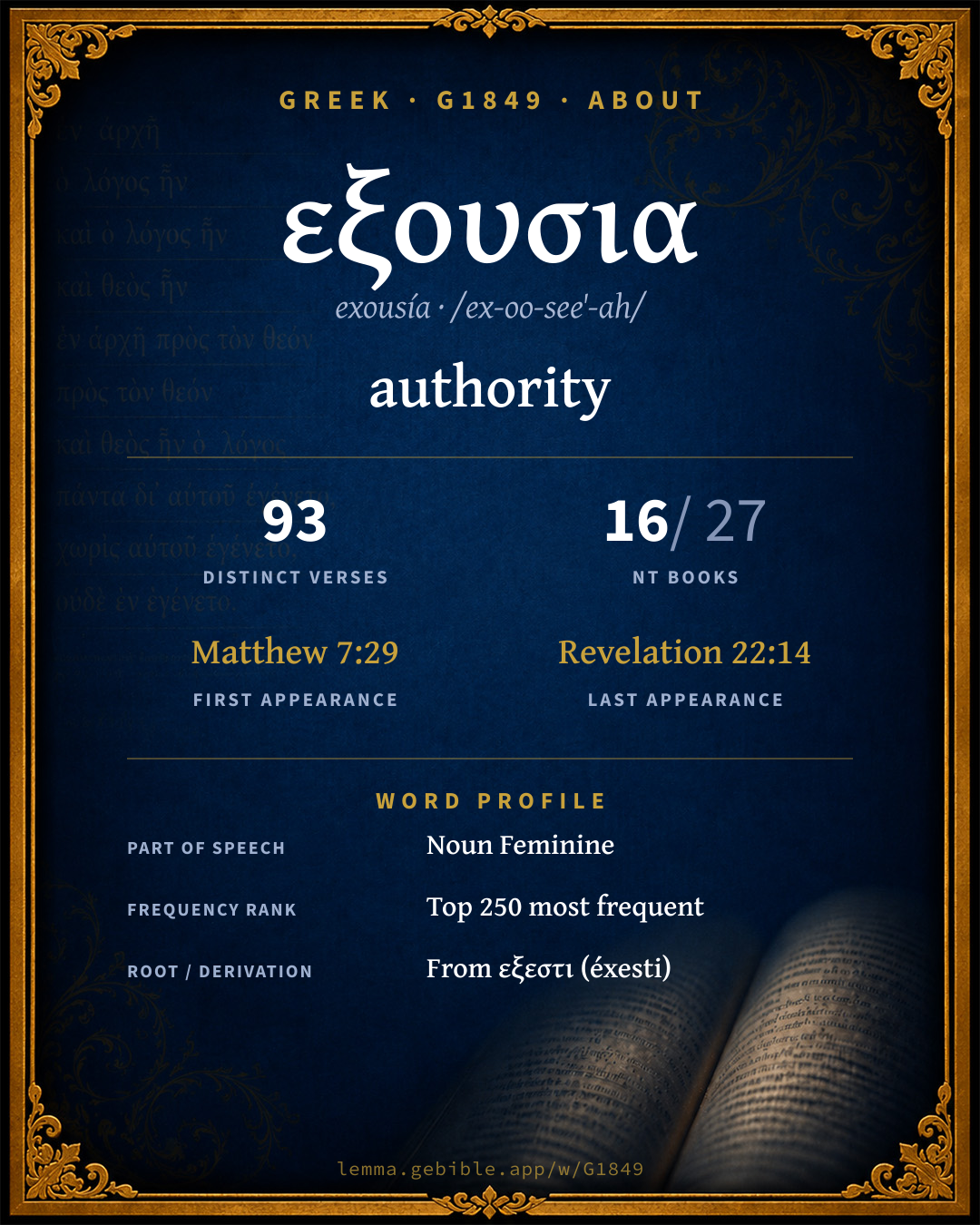
ἐξουσία
authority
‘authority’ is one of 4 main senses fuller range ↓
Full lexicon entry — Thayer's Greek Lexicon
From Thayer's Greek Lexicon
Where this word appears
See every Accusative-case word in the Greek New Testament →
Grammar key — what these labels mean
Part of speech
- Noun
- A naming word — a person, place, thing, or idea.
Case
- Accusative
- The case of the direct object and of extent.
- Dative
- The case of the indirect object, means, or location — “to / for / with / in.”
- Nominative
- The case of the subject (and the predicate nominative).
- Genitive
- The case of source, possession, or “of” — answers “whose / from what.”
Gender
- Feminine
- Grammatically feminine.
Number
- Singular
- One.
- Plural
- More than one.
Grammatical forms
- Noun, Accusative, Singular, Feminine 56 times (55%)
- Noun, Dative, Singular, Feminine 16 times (16%)
- Noun, Nominative, Singular, Feminine 13 times (13%)
- Noun, Genitive, Singular, Feminine 9 times (9%)
- Noun, Accusative, Plural, Feminine 3 times (3%)
- Noun, Dative, Plural, Feminine 3 times (3%)
- Noun, Genitive, Plural, Feminine 1 time (1%)
- Noun, Nominative, Plural, Feminine 1 time (1%)
Parsed forms decoded from the imported morphology (Robinson–Tischendorf, public domain), counted across 102 parsed occurrences — not distinct verses.
Every verse where G1849 appears — 93 distinct verses across 16 books. Click any verse to open its interlinear word-by-word view. Verse text shown in the World English Bible for context — . Each verse’s Greek form is shown with its reference; the English is not keyword-highlighted, since the data carries no word-level English alignment. Use “Compare translations” on any verse to read it across multiple English versions. This concordance covers the Greek New Testament; Septuagint (Greek Old Testament) occurrences of this word are not indexed here.
Matthew 9 verses
- Matthew 7:29 ἐξουσίαν n acc sg fem for he taught them with authority, and not like the scribes.
- Matthew 8:9 ἐξουσίαν n acc sg fem For I am also a man under authority, having under myself soldiers. I tell this one, 'Go,' and he goes; and tell another, 'Come,' and he comes; and tell my servant, 'Do this,' and he does it."
- Matthew 9:6 ἐξουσίαν n acc sg fem But that you may know that the Son of Man has authority on earth to forgive sins..." (then he said to the paralytic), "Get up, and take up your mat, and go up to your house."
- Matthew 9:8 ἐξουσίαν n acc sg fem But when the multitudes saw it, they marveled and glorified God, who had given such authority to men.
- Matthew 10:1 ἐξουσίαν n acc sg fem He called to himself his twelve disciples, and gave them authority over unclean spirits, to cast them out, and to heal every disease and every sickness.
- Matthew 21:23 ἐξουσίᾳ ἐξουσίαν n dat sg fem n acc sg fem When he had come into the temple, the chief priests and the elders of the people came to him as he was teaching, and said, "By what authority do you do these things? Who gave you this authority?"
- Matthew 21:24 ἐξουσίᾳ n dat sg fem Jesus answered them, "I also will ask you one question, which if you tell me, I likewise will tell you by what authority I do these things.
- Matthew 21:27 ἐξουσίᾳ n dat sg fem They answered Jesus, and said, "We don't know." He also said to them, "Neither will I tell you by what authority I do these things.
- Matthew 28:18 ἐξουσία n nom sg fem Jesus came to them and spoke to them, saying, "All authority has been given to me in heaven and on earth.
Mark 9 verses
- Mark 1:22 ἐξουσίαν n acc sg fem They were astonished at his teaching, for he taught them as having authority, and not as the scribes.
- Mark 1:27 ἐξουσίαν n acc sg fem They were all amazed, so that they questioned among themselves, saying, "What is this? A new teaching? For with authority he commands even the unclean spirits, and they obey him!"
- Mark 2:10 ἐξουσίαν n acc sg fem But that you may know that the Son of Man has authority on earth to forgive sins"--he said to the paralytic--
- Mark 3:15 ἐξουσίαν n acc sg fem and to have authority to heal sicknesses and to cast out demons:
- Mark 6:7 ἐξουσίαν n acc sg fem He called to himself the twelve, and began to send them out two by two; and he gave them authority over the unclean spirits.
- Mark 11:28 ἐξουσίᾳ ἐξουσίαν n dat sg fem n acc sg fem and they began saying to him, "By what authority do you do these things? Or who gave you this authority to do these things?"
- Mark 11:29 ἐξουσίᾳ n dat sg fem Jesus said to them, "I will ask you one question. Answer me, and I will tell you by what authority I do these things.
- Mark 11:33 ἐξουσίᾳ n dat sg fem They answered Jesus, "We don't know." Jesus said to them, "Neither do I tell you by what authority I do these things."
- Mark 13:34 ἐξουσίαν n acc sg fem "It is like a man, traveling to another country, having left his house, and given authority to his servants, and to each one his work, and also commanded the doorkeeper to keep watch.
Luke 15 verses
- Luke 4:6 ἐξουσίαν n acc sg fem The devil said to him, "I will give you all this authority, and their glory, for it has been delivered to me; and I give it to whomever I want.
- Luke 4:32 ἐξουσίᾳ n dat sg fem and they were astonished at his teaching, for his word was with authority.
- Luke 4:36 ἐξουσίᾳ n dat sg fem Amazement came on all, and they spoke together, one with another, saying, "What is this word? For with authority and power he commands the unclean spirits, and they come out!"
- Luke 5:24 ἐξουσίαν n acc sg fem But that you may know that the Son of Man has authority on earth to forgive sins" (he said to the paralyzed man), "I tell you, arise, and take up your cot, and go to your house."
- Luke 7:8 ἐξουσίαν n acc sg fem For I also am a man placed under authority, having under myself soldiers. I tell this one, 'Go!' and he goes; and to another, 'Come!' and he comes; and to my servant, 'Do this,' and he does it."
- Luke 9:1 ἐξουσίαν n acc sg fem He called the twelve together, and gave them power and authority over all demons, and to cure diseases.
- Luke 10:19 ἐξουσίαν n acc sg fem Behold, I give you authority to tread on serpents and scorpions, and over all the power of the enemy. Nothing will in any way hurt you.
- Luke 12:5 ἐξουσίαν n acc sg fem But I will warn you whom you should fear. Fear him, who after he has killed, has power to cast into Gehenna. Yes, I tell you, fear him.
- Luke 12:11 ἐξουσίας n acc pl fem When they bring you before the synagogues, the rulers, and the authorities, don't be anxious how or what you will answer, or what you will say;
- Luke 19:17 ἐξουσίαν n acc sg fem "He said to him, 'Well done, you good servant! Because you were found faithful with very little, you shall have authority over ten cities.'
- Luke 20:2 ἐξουσίᾳ ἐξουσίαν n dat sg fem n acc sg fem They asked him, "Tell us: by what authority do you do these things? Or who is giving you this authority?"
- Luke 20:8 ἐξουσίᾳ n dat sg fem Jesus said to them, "Neither will I tell you by what authority I do these things."
- Luke 20:20 ἐξουσίᾳ n dat sg fem They watched him, and sent out spies, who pretended to be righteous, that they might trap him in something he said, so as to deliver him up to the power and authority of the governor.
- Luke 22:53 ἐξουσία n nom sg fem When I was with you in the temple daily, you didn't stretch out your hands against me. But this is your hour, and the power of darkness."
- Luke 23:7 ἐξουσίας n gen sg fem When he found out that he was in Herod's jurisdiction, he sent him to Herod, who was also in Jerusalem during those days.
John 6 verses
- John 1:12 ἐξουσίαν n acc sg fem But as many as received him, to them he gave the right to become God's children, to those who believe in his name:
- John 5:27 ἐξουσίαν n acc sg fem He also gave him authority to execute judgment, because he is a son of man.
- John 10:18 ἐξουσίαν ἐξουσίαν n acc sg fem n acc sg fem No one takes it away from me, but I lay it down by myself. I have power to lay it down, and I have power to take it again. I received this commandment from my Father."
- John 17:2 ἐξουσίαν n acc sg fem even as you gave him authority over all flesh, he will give eternal life to all whom you have given him.
- John 19:10 ἐξουσίαν ἐξουσίαν n acc sg fem n acc sg fem Pilate therefore said to him, "Aren't you speaking to me? Don't you know that I have power to release you, and have power to crucify you?"
- John 19:11 ἐξουσίαν n acc sg fem Jesus answered, "You would have no power at all against me, unless it were given to you from above. Therefore he who delivered me to you has greater sin."
Acts 7 verses
- Acts 1:7 ἐξουσίᾳ n dat sg fem He said to them, "It isn't for you to know times or seasons which the Father has set within His own authority.
- Acts 5:4 ἐξουσίᾳ n dat sg fem While you kept it, didn't it remain your own? After it was sold, wasn't it in your power? How is it that you have conceived this thing in your heart? You haven't lied to men, but to God."
- Acts 8:19 ἐξουσίαν n acc sg fem saying, "Give me also this power, that whoever I lay my hands on may receive the Holy Spirit."
- Acts 9:14 ἐξουσίαν n acc sg fem Here he has authority from the chief priests to bind all who call on your name."
- Acts 26:10 ἐξουσίαν n acc sg fem This I also did in Jerusalem. I both shut up many of the saints in prisons, having received authority from the chief priests, and when they were put to death I gave my vote against them.
- Acts 26:12 ἐξουσίας n gen sg fem "Whereupon as I traveled to Damascus with the authority and commission from the chief priests,
- Acts 26:18 ἐξουσίας n gen sg fem to open their eyes, that they may turn from darkness to light and from the power of Satan to God, that they may receive remission of sins and an inheritance among those who are sanctified by faith in me.'
Romans 4 verses
- Romans 9:21 ἐξουσίαν n acc sg fem Or hasn't the potter a right over the clay, from the same lump to make one part a vessel for honor, and another for dishonor?
- Romans 13:1 ἐξουσίαις ἐξουσία n dat pl fem n nom sg fem Let every soul be in subjection to the higher authorities, for there is no authority except from God, and those who exist are ordained by God.
- Romans 13:2 ἐξουσίᾳ n dat sg fem Therefore he who resists the authority, withstands the ordinance of God; and those who withstand will receive to themselves judgment.
- Romans 13:3 ἐξουσίαν n acc sg fem For rulers are not a terror to the good work, but to the evil. Do you desire to have no fear of the authority? Do that which is good, and you will have praise from the same,
1 Corinthians 9 verses
- 1 Corinthians 7:37 ἐξουσίαν n acc sg fem But he who stands steadfast in his heart, having no necessity, but has power over his own heart, to keep his own virgin, does well.
- 1 Corinthians 8:9 ἐξουσία n nom sg fem But be careful that by no means does this liberty of yours become a stumbling block to the weak.
- 1 Corinthians 9:4 ἐξουσίαν n acc sg fem Have we no right to eat and to drink?
- 1 Corinthians 9:5 ἐξουσίαν n acc sg fem Have we no right to take along a wife who is a believer, even as the rest of the apostles, and the brothers of the Lord, and Cephas?
- 1 Corinthians 9:6 ἐξουσίαν n acc sg fem Or have only Barnabas and I no right to not work?
- 1 Corinthians 9:12 ἐξουσίας ἐξουσίᾳ n gen sg fem n dat sg fem If others partake of this right over you, don't we yet more? Nevertheless we did not use this right, but we bear all things, that we may cause no hindrance to the Gospel of Christ.
- 1 Corinthians 9:18 ἐξουσίᾳ n dat sg fem What then is my reward? That, when I preach the Gospel, I may present the Gospel of Christ without charge, so as not to abuse my authority in the Gospel.
- 1 Corinthians 11:10 ἐξουσίαν n acc sg fem For this cause the woman ought to have authority on her head, because of the angels.
- 1 Corinthians 15:24 ἐξουσίαν n acc sg fem Then the end comes, when he will deliver up the Kingdom to God, even the Father; when he will have abolished all rule and all authority and power.
2 Corinthians 2 verses
- 2 Corinthians 10:8 ἐξουσίας n gen sg fem For though I should boast somewhat abundantly concerning our authority, (which the Lord gave for building you up, and not for casting you down) I will not be disappointed,
- 2 Corinthians 13:10 ἐξουσίαν n acc sg fem For this cause I write these things while absent, that I may not deal sharply when present, according to the authority which the Lord gave me for building up, and not for tearing down.
Ephesians 4 verses
- Ephesians 1:21 ἐξουσίας n gen sg fem far above all rule, and authority, and power, and dominion, and every name that is named, not only in this age, but also in that which is to come.
- Ephesians 2:2 ἐξουσίας n gen sg fem in which you once walked according to the course of this world, according to the prince of the powers of the air, the spirit who now works in the children of disobedience;
- Ephesians 3:10 ἐξουσίαις n dat pl fem to the intent that now through the assembly the manifold wisdom of God might be made known to the principalities and the powers in the heavenly places,
- Ephesians 6:12 ἐξουσίας n acc pl fem For our wrestling is not against flesh and blood, but against the principalities, against the powers, against the world's rulers of the darkness of this age, and against the spiritual hosts of wickedness in the heavenly places.
Colossians 4 verses
- Colossians 1:13 ἐξουσίας n gen sg fem who delivered us out of the power of darkness, and translated us into the Kingdom of the Son of his love;
- Colossians 1:16 ἐξουσίαι n nom pl fem For by him were all things created, in the heavens and on the earth, things visible and things invisible, whether thrones or dominions or principalities or powers; all things have been created through him, and for him.
- Colossians 2:10 ἐξουσίας n gen sg fem and in him you are made full, who is the head of all principality and power;
- Colossians 2:15 ἐξουσίας n acc pl fem having stripped the principalities and the powers, he made a show of them openly, triumphing over them in it.
2 Thessalonians 1 verse
Titus 1 verse
Hebrews 1 verse
1 Peter 1 verse
Jude 1 verse
Revelation 19 verses
- Revelation 2:26 ἐξουσίαν n acc sg fem He who overcomes, and he who keeps my works to the end, to him I will give authority over the nations.
- Revelation 6:8 ἐξουσία n nom sg fem And behold, a pale horse, and he who sat on it, his name was Death. Hades followed with him. Authority over one fourth of the earth, to kill with the sword, with famine, with death, and by the wild animals of the earth was given to him.
- Revelation 9:3 ἐξουσία ἐξουσίαν n nom sg fem n acc sg fem Then out of the smoke came forth locusts on the earth, and power was given to them, as the scorpions of the earth have power.
- Revelation 9:10 ἐξουσία n nom sg fem They have tails like those of scorpions, and stings. In their tails they have power to harm men for five months.
- Revelation 9:19 ἐξουσία n nom sg fem For the power of the horses is in their mouths, and in their tails. For their tails are like serpents, and have heads, and with them they harm.
- Revelation 11:6 ἐξουσίαν ἐξουσίαν n acc sg fem n acc sg fem These have the power to shut up the sky, that it may not rain during the days of their prophecy. They have power over the waters, to turn them into blood, and to strike the earth with every plague, as often as they desire.
- Revelation 12:10 ἐξουσία n nom sg fem I heard a loud voice in heaven, saying, "Now is come the salvation, the power, and the Kingdom of our God, and the authority of his Christ; for the accuser of our brothers has been thrown down, who accuses them before our God day and night.
- Revelation 13:2 ἐξουσίαν n acc sg fem The beast which I saw was like a leopard, and his feet were like those of a bear, and his mouth like the mouth of a lion. The dragon gave him his power, his throne, and great authority.
- Revelation 13:4 ἐξουσίαν n acc sg fem They worshiped the dragon, because he gave his authority to the beast, and they worshiped the beast, saying, "Who is like the beast? Who is able to make war with him?"
- Revelation 13:5 ἐξουσία n nom sg fem A mouth speaking great things and blasphemy was given to him. Authority to make war for forty-two months was given to him.
- Revelation 13:7 ἐξουσία n nom sg fem It was given to him to make war with the saints, and to overcome them. Authority over every tribe, people, language, and nation was given to him.
- Revelation 13:12 ἐξουσίαν n acc sg fem He exercises all the authority of the first beast in his presence. He makes the earth and those who dwell in it to worship the first beast, whose fatal wound was healed.
- Revelation 14:18 ἐξουσίαν n acc sg fem Another angel came out from the altar, he who has power over fire, and he called with a great voice to him who had the sharp sickle, saying, "Send forth your sharp sickle, and gather the clusters of the vine of the earth, for the earth's grapes are fully ripe!"
- Revelation 16:9 ἐξουσίαν n acc sg fem People were scorched with great heat, and people blasphemed the name of God who has the power over these plagues. They didn't repent and give him glory.
- Revelation 17:12 ἐξουσίαν n acc sg fem The ten horns that you saw are ten kings who have received no kingdom as yet, but they receive authority as kings, with the beast, for one hour.
- Revelation 17:13 ἐξουσίαν n acc sg fem These have one mind, and they give their power and authority to the beast.
- Revelation 18:1 ἐξουσίαν n acc sg fem After these things, I saw another angel coming down out of the sky, having great authority. The earth was illuminated with his glory.
- Revelation 20:6 ἐξουσίαν n acc sg fem Blessed and holy is he who has part in the first resurrection. Over these, the second death has no power, but they will be priests of God and of Christ, and will reign with him one thousand years.
- Revelation 22:14 ἐξουσία n nom sg fem Blessed are those who do his commandments, that they may have the right to the tree of life, and may enter in by the gates into the city.
About this entry
At a glance — auto-summarized from this page’s data, not written by a person. Every figure links to its source below. This summary describes the numbers; it doesn’t interpret them.
At its core, εξουσια (exousía) means “authority.” Ranging over 4 senses, it is not a single-sense word. It appears 93 verses across 16 books of the Greek New Testament, among its moderately common vocabulary. Scripture first uses it in Matthew 7:29. It clusters with εξεστι and εξουσιαζω under a shared root. Each statement above links to its evidence; the full detail follows below.
Gloss history
Strong's 1890 vs modern scholarship
About this word
Strong's G1849 catalogs a Greek word from the Greek New Testament.
These counts are not copied from any lexicon or concordance. They are computed here, from the morphology-tagged Greek New Testament. What Lemma adds →
- 93
- distinct verses
- The word appears in 93 distinct verses.
- 16 / 27
- NT books
- The word appears in 16 of 27 New Testament books.
- #160
- by frequency
- Top 250 most frequent Greek words (rank 160 of 5,347 Greek words by occurrence).
View all 93 occurrences in the concordance →
Most concentrated in
- Revelation 19 verses 20%
- Luke 15 verses 16%
- Matthew 9 verses 10%
By section of the New Testament
By traditional corpus
Conventional, traditional groupings — biblical authorship is debated, so this is a traditional corpus grouping, not an authorship claim. Some books belong to more than one corpus (Luke is in both the Gospels and the Lukan corpus, and so on), so these shares overlap and need not total 100%. Each figure is a share of the word’s 93 distinct verses.
- Gospels 39 verses · 42%
- Johannine 25 verses · 27%
- Pauline corpus 25 verses · 27%
- Lukan (Luke–Acts) 22 verses · 24%
- Revelation 19 verses · 20%
- General (Catholic) Epistles 2 verses · 2%
- Hebrews 1 verse · 1%
How translations render this word
Counts come from each version’s own published word-to-Strong’s tagging or interlinear alignment — an approximate guide to how each version renders this word, not a word-level alignment the data otherwise carries. Because each total is that version’s own tagged count, the per-version totals vary from one another and need not match the appearance or distinct-verse counts above. These counts may also differ from a printed concordance because Lemma counts each distinctly tagged rendering and does not collapse phrase taggings into a single head-word total. This is a fixed set of word-tagged versions (KJV, ASV, BSB, ULT) and does not change with the reading translation you choose elsewhere. Each version’s license is shown beside its name below (and on Sources).
- King James Version: Power 60×, Authority 27×, Powers 8×
- American Standard Version: Authority 51×, Power 26×, Right 9×
- Berean Standard Bible: Authority 63×, Power 10×, Right 9×
- unfoldingWord Literal Text: Authority 81×, Authorities 8×, Power 6×
King James Version Public Domain
Renders G1849 across 102 tagged occurrences — most commonly:
Plus 5 renderings that appear only once — usually multi-word phrases or single function words the recovered tagging swept in, not distinct renderings. Not rendered by a distinct English word in 1 further occurrence.
American Standard Version Public Domain
Renders G1849 across 100 tagged occurrences — most commonly:
Plus 4 renderings that appear only once — usually multi-word phrases or single function words the recovered tagging swept in, not distinct renderings.
Berean Standard Bible Public Domain
Renders G1849 across 100 tagged occurrences — most commonly:
Plus 11 renderings that appear only once — usually multi-word phrases or single function words the recovered tagging swept in, not distinct renderings. Not rendered by a distinct English word in 2 further occurrences.
unfoldingWord Literal Text CC BY-SA 4.0
Renders G1849 across 105 tagged occurrences — most commonly:
Plus 4 renderings that appear only once — usually multi-word phrases or single function words the recovered tagging swept in, not distinct renderings.
Senses in Thayer's
The 4 senses Thayer's distinguishes for this word, in lexicon order (not ranked by frequency or importance). The full entry — with sub-senses — is in the Lexicon Entry tab.
- power of choice, liberty of doing as one pleases
- physical and mental power
- the power of authority (influence) and of right (privilege)
- the power of rule or government (the power of him whose will and commands must be submitted to by others and obeyed)
Word origin
Derived from εξεστι (éxesti) (G1832) — it is lawful.
From G1832 (in the sense of ability ); privilege that is (subjectively) force capacity competency freedom or (objectively) mastery (concretely magistrate superhuman potentate token of control ) delegated influence : - authority jurisdiction liberty power right strength.
— Strong’s Exhaustive Concordance (1890), public domain.
Forms in the corpus
The 7 distinct written forms G1849 takes in the Greek New Testament, most frequent first — each parse links to that case’s occurrences in the concordance.
| Form | Parsing | Example | Uses |
|---|---|---|---|
| ἐξουσίαν exousían | Noun, Accusative, Singular, Feminine | Matthew 7:29 | 56 |
| ἐξουσίᾳ exousía | Noun, Dative, Singular, Feminine | Matthew 21:23 | 16 |
| ἐξουσία exousía | Noun, Nominative, Singular, Feminine | Matthew 28:18 | 13 |
| ἐξουσίας exousías | Noun, Genitive, Singular, Feminine | Luke 23:7 | 12 |
| ἐξουσίαις exousíais | Noun, Dative, Plural, Feminine | Romans 13:1 | 3 |
| ἐξουσίαι exousíai | Noun, Nominative, Plural, Feminine | Colossians 1:16 | 1 |
| ἐξουσιῶν exousiō̂n | Noun, Genitive, Plural, Feminine | 1 Peter 3:22 | 1 |
Same root — word family
Other Thayer's entries built from the same root as G1849, grouped by Strong’s listed origin. These share a root / origin per the lexicon — not necessarily a shared meaning. Each links to that word’s own entry.
Derives from
Derived from this word
Compare all same-root words → They share a root, not necessarily a meaning.
Septuagint usage
The same Greek word εξουσια appears 28 times in the Greek Old Testament (Septuagint), across 21 verses in 5 books.
- 28
- LXX occurrences
- Tagged occurrences of this Greek word in the Septuagint.
- 21
- verses
- Distinct Septuagint verses containing this word.
- 5 / 39
- OT books
- The word appears in 5 of the 39 Old Testament books.
Sample Septuagint occurrences
- 2 Kings 20:13 ἐξουσία
- Psalms 113:2 ἐξουσία
- Proverbs 17:14 ἐξουσία
- Ecclesiastes 8:8 ἐξουσία
- Daniel 3:2 ἐξουσία
Septuagint occurrences (same lexeme)
Every verse where the same Strong’s number (G1849) appears in the Greek Septuagint. Verse text shown in the World English Bible for context; the Greek form is the matched word — the English is not keyword-highlighted.
- 2 Kings 20:13 ἐξουσία Hezekiah listened to them, and shown them all the house of his precious things, the silver, and the gold, and the spices, and the precious oil, and the house of his armor, and all that was found in his treasures: there was nothing in his house, nor in all his dominion, that Hezekiah didn't show them.
- Psalms 113:2 ἐξουσία Blessed be the name of Yahweh, From this time forth and forevermore.
- Psalms 135:8 ἐξουσία Who struck the firstborn of Egypt, Both of man and animal;
- Psalms 135:9 ἐξουσία Who sent signs and wonders into the midst of you, Egypt, On Pharaoh, and on all his servants;
- Proverbs 17:14 ἐξουσία The beginning of strife is like breaching a dam, Therefore stop contention before quarreling breaks out.
- Ecclesiastes 8:8 ἐξουσία There is no man who has power over the spirit to contain the spirit; neither does he have power over the day of death. There is no discharge in war; neither shall wickedness deliver those who practice it.
- Daniel 3:2 ἐξουσία Then Nebuchadnezzar the king sent to gather together the satraps, the deputies, and the governors, the judges, the treasurers, the counselors, the sheriffs, and all the rulers of the provinces, to come to the dedication of the image which Nebuchadnezzar the king had set up.
- Daniel 3:97 ἐξουσία
- Daniel 4:10 ἐξουσία Thus were the visions of my head on my bed: I saw, and, behold, a tree in the midst of the earth; and the height of it was great.
- Daniel 4:20 ἐξουσία The tree that you saw, which grew, and was strong, whose height reached to the sky, and the sight of it to all the earth;
- Daniel 4:24 ἐξουσία this is the interpretation, O king, and it is the decree of the Most High, which is come on my lord the king:
- Daniel 4:29 ἐξουσία At the end of twelve months he was walking in the royal palace of Babylon.
- Daniel 5:4 ἐξουσία They drank wine, and praised the gods of gold, and of silver, of brass, of iron, of wood, and of stone.
- Daniel 5:7 ἐξουσία The king cried aloud to bring in the enchanters, the Chaldeans, and the soothsayers. The king spoke and said to the wise men of Babylon, Whoever shall read this writing, and show me the interpretation of it, shall be clothed with purple, and have a chain of gold about his neck, and shall be the third ruler in the kingdom.
- Daniel 5:14 ἐξουσία I have heard of you, that the spirit of the gods is in you, and that light and understanding and excellent wisdom are found in you.
- Daniel 5:18 ἐξουσία You king, the Most High God gave Nebuchadnezzar your father the kingdom, and greatness, and glory, and majesty:
- Daniel 6:4 ἐξουσία Then the presidents and the satraps sought to find occasion against Daniel as touching the kingdom; but they could find no occasion nor fault, because he was faithful, neither was there any error or fault found in him.
- Daniel 7:12 ἐξουσία As for the rest of the animals, their dominion was taken away: yet their lives were prolonged for a season and a time.
- Daniel 7:14 ἐξουσία There was given him dominion, and glory, and a kingdom, that all the peoples, nations, and languages should serve him: his dominion is an everlasting dominion, which shall not pass away, and his kingdom that which shall not be destroyed.
- Daniel 7:26 ἐξουσία But the judgment shall be set, and they shall take away his dominion, to consume and to destroy it to the end.
- Daniel 7:27 ἐξουσία The kingdom and the dominion, and the greatness of the kingdoms under the whole the sky, shall be given to the people of the saints of the Most High: his kingdom is an everlasting kingdom, and all dominions shall serve and obey him.
These are occurrences of the same Greek lexeme (G1849) in the Septuagint — not a translation of any one Hebrew word. The store carries no word-level Hebrew↔Greek alignment, so no Hebrew original is asserted here. Counts come from the recovered LXX Strong's tagging — high-frequency vocabulary is well covered, while rare or late forms may be untagged — so they reflect tagged occurrences and may slightly undercount.