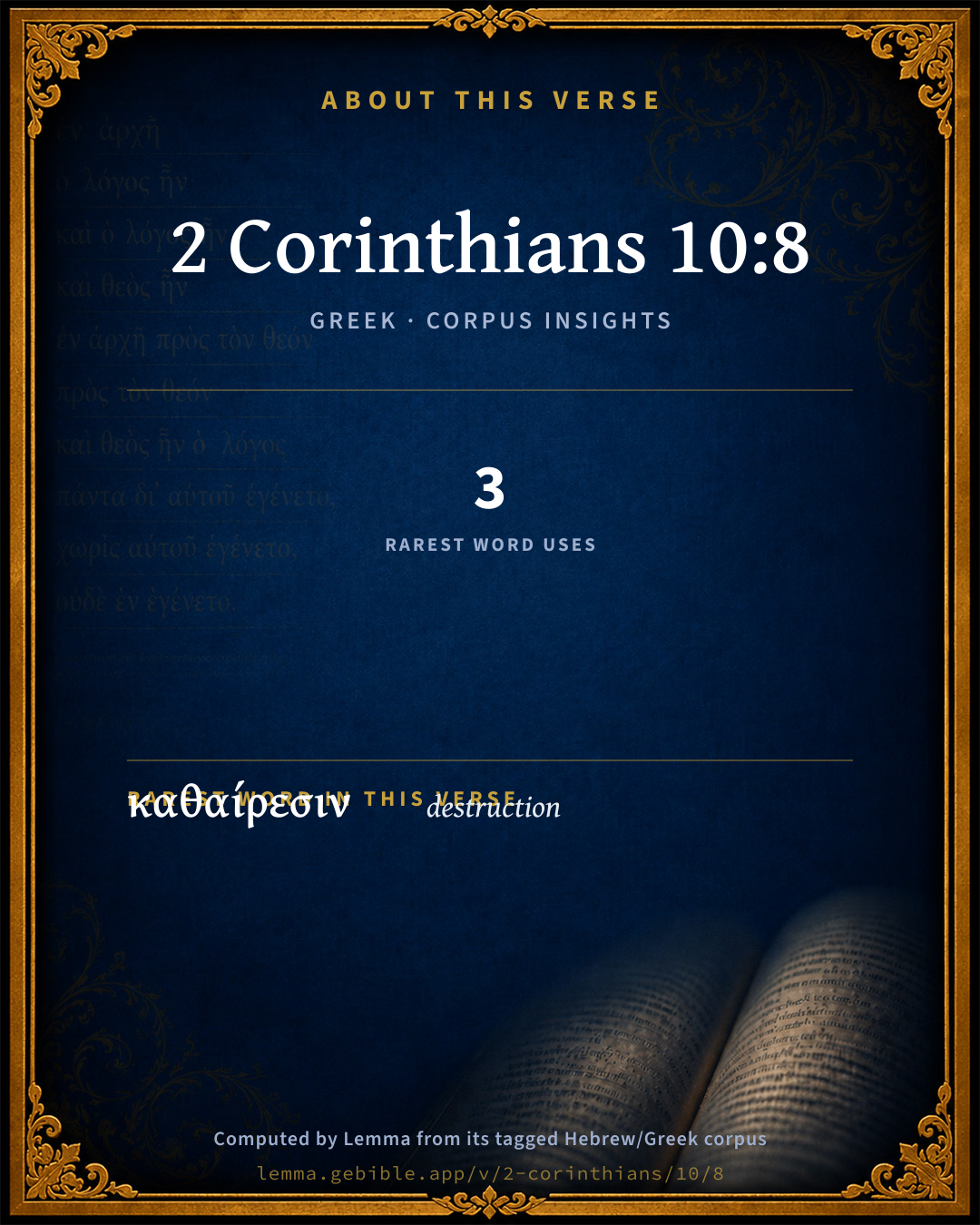
2 Corinthians 10:8

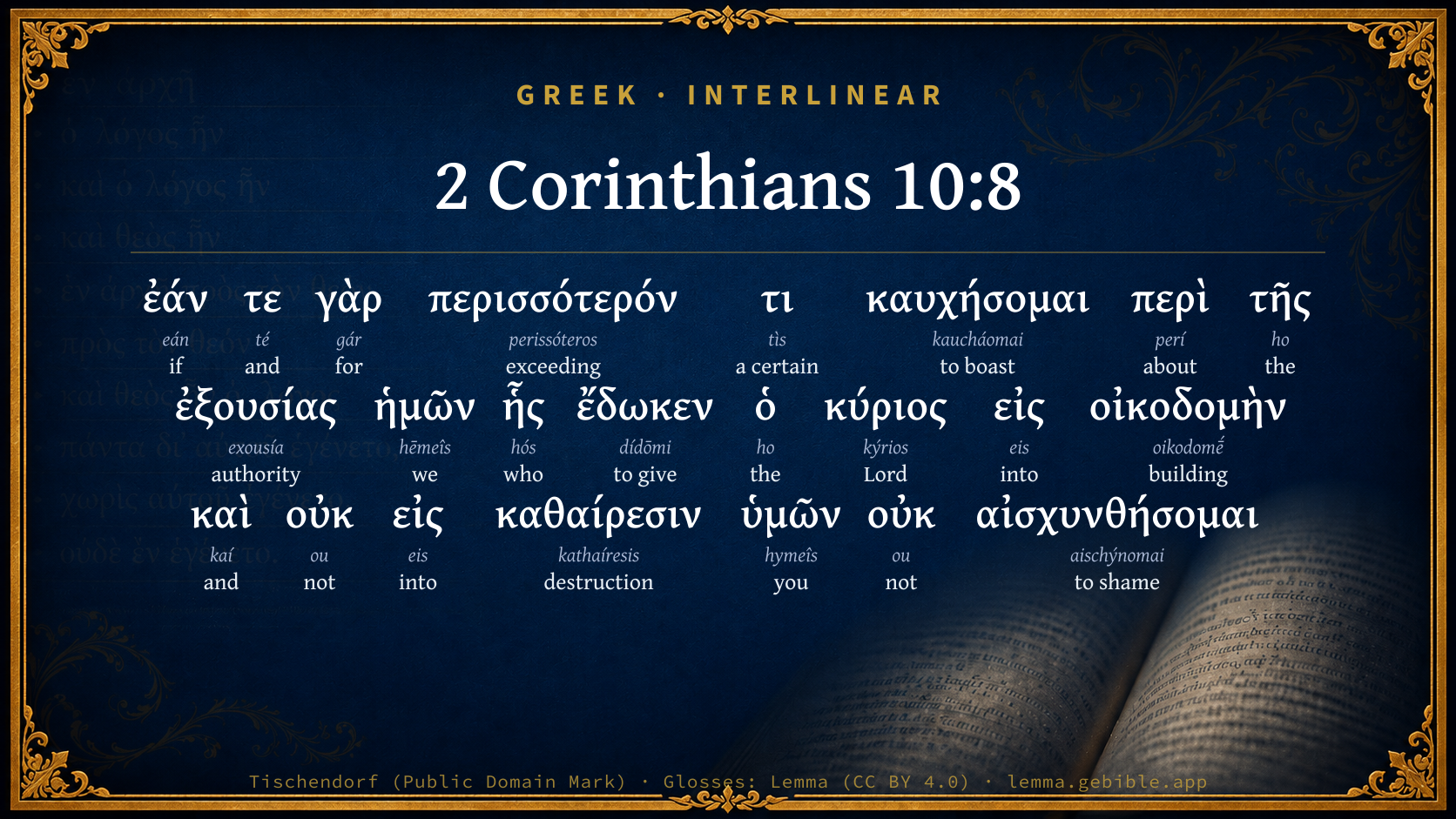
Greek (Tischendorf 8th ed.) 2 Corinthians 10:8 appears in the Greek New Testament. The text above is from the Tischendorf 8th edition. Each word links to its Strong’s number and a concise gloss. Click any word for its full Thayer’s Greek Lexicon entry.
Download image
Cite this verse

2 Corinthians 10:8 (World English Bible). Public Domain. Lemma interlinear Bible study tool, https://lemma.gebible.app/v/2-corinthians/10/8.

Show BibTeX & RIS
BibTeX
RIS
English Translation
For though I should boast somewhat abundantly concerning our authority, (which the Lord gave for building you up, and not for casting you down) I will not be disappointed,
World English Bible · Public Domain
Download a study sheet

One document with this verse’s original text, its word-by-word gloss line, the meaning frame, cross-references with their text, attributed commentary, and full source and license credits — printable, and it pastes into notes with its structure intact.

This verse Autodidact and up

Study sheet (.html) Plain text (.txt)

A passage Seminary Student

Up to 50 verses in one chapter. A passage sheet keeps up to 6 commentary sources and 12 cross-references per verse, in the order this page ranks them, and says so on the sheet whenever that leaves anything out. Ask for a single verse and you get the Autodidact verse sheet above.

Everything on this page stays free to read, with no account — the sheet is a download of what is already on screen, not access to it.

Want to remove ads? Support Godless Engineer
Compare translations 3

The same verse in 3 English versions, stacked beneath the original-language interlinear above. Click any original word for its lexicon entry.

Each is an independent rendering of the whole verse — the interlinear is not word-aligned to these translations.

Highlighted words mark where these versions differ — a whole-verse word diff, not a word-by-word alignment.

  • World English Bible Public Domain
    For though I should boast somewhat abundantly concerning our authority, (which the Lord gave for building you up, and not for casting you down) I will not be disappointed,
  • King James Version Public Domain
    For though I should boast somewhat more of our authority, which the Lord hath given us for edification, and not for your destruction, I should not be ashamed:
  • unfoldingWord Literal Text CC BY-SA 4.0
    For even if I might boast somewhat excessively about our authority, which the Lord gave for building up and not for your tearing down, I will not be ashamed,

unfoldingWord Literal Text — © unfoldingWord, licensed CC BY-SA 4.0. Word-aligned USFM3 via Door43 (git.door43.org/unfoldingWord/en_ult).

Versions to compare (up to 4)

3 of 4 selected

Show all 19 translations

Every available English version of this verse, each an independent rendering of the whole verse.

  • World English Bible Public Domain
    For though I should boast somewhat abundantly concerning our authority, (which the Lord gave for building you up, and not for casting you down) I will not be disappointed,
  • Berean Standard Bible Public Domain
    For even if I boast somewhat excessively about the authority the Lord gave us for building you up rather than tearing you down, I will not be ashamed.
  • Majority Standard Bible Public Domain
    For even if I boast somewhat excessively about the authority the Lord gave us for building you up rather than tearing you down, I will not be ashamed.
  • King James Version Public Domain
    For though I should boast somewhat more of our authority, which the Lord hath given us for edification, and not for your destruction, I should not be ashamed:
  • American Standard Version (1901) Public Domain
    For though I should glory somewhat abundantly concerning our authority (which the Lord gave for building you up, and not for casting you down), I shall not be put to shame:
  • Revised Version (1885) Public Domain
    For though I should glory somewhat abundantly concerning our authority (which the Lord gave for building you up, and not for casting you down), I shall not be put to shame:
  • Geneva Bible (1599) Public Domain
    For though I shoulde boast somewhat more of our authoritie, which the Lord hath giuen vs for edification, and not for your destruction, I should haue no shame.
  • Douay-Rheims (1899) Public Domain
    For if also I should boast somewhat more of our power, which the Lord hath given us unto edification, and not for your destruction, I should not be ashamed.
  • Young's Literal Translation Public Domain
    for even if also anything more abundantly I shall boast concerning our authority, that the Lord gave us for building up, and not for casting you down, I shall not be ashamed;
  • Literal Standard Version CC BY-SA 4.0
    for even if I will also boast anything more abundantly concerning our authority, that the LORD gave us for building up, and not for casting you down, I will not be ashamed,
  • Unlocked Literal Bible CC BY-SA 4.0
    For even if I boast a little too much about our authority, which the Lord gave for us to build you up and not to destroy you, I will not be ashamed.
  • unfoldingWord Literal Text CC BY-SA 4.0
    For even if I might boast somewhat excessively about our authority, which the Lord gave for building up and not for your tearing down, I will not be ashamed,
  • Darby Bible Public Domain
    For and if I should boast even somewhat more abundantly of our authority, which the Lord has given [to us] for building up and not for your overthrowing, I shall not be put to shame;
  • World Messianic Bible Public Domain
    For even if I boast somewhat abundantly concerning our authority, which the Lord gave for building you up and not for casting you down, I will not be ashamed,
  • Webster's Bible Public Domain
    For though I should boast somewhat more of our authority, which the Lord hath given us for edification, and not for your destruction, I should not be ashamed:
  • Free Bible Version CC BY-SA 4.0
    Even though I may seem to be boasting a little too much about our authority, I'm not embarrassed about it. The Lord gave this authority to us to build you up, not to knock you down.
  • Bible in Basic English Public Domain
    For though I might take pride in our authority (which the Lord gave for building you up, and not for your destruction), it will not be a cause of shame to me:
  • Text-Critical English NT CC BY 4.0
    For even if I boast somewhat further about our authority (which the Lord has given us for building you up and not for tearing you down), I will not be ashamed.
  • Tyndale New Testament (1534) Public Domain
    And though I shuld bost my silfe somewhat moare of oure auctorite which the lorde hath geven vs to edifie and not to destroye you it shulde not be to my shame.

Literal Standard Version (2020), Covenant Press — licensed CC BY-SA 4.0. Text via the HelloAO Bible API (eBible.org). Unlocked Literal Bible (unfoldingWord) — licensed CC BY-SA 4.0. Text via the HelloAO Bible API (eBible.org). unfoldingWord Literal Text — © unfoldingWord, licensed CC BY-SA 4.0. Word-aligned USFM3 via Door43 (git.door43.org/unfoldingWord/en_ult). Free Bible Version, Dr. Jonathan Gallagher — licensed CC BY-SA 4.0. Text via the HelloAO Bible API (eBible.org).

Word by word

More ways to search: Search by grammar → Find every occurrence → Compare this word →

Practice this passage: Drill this verse → Learn its vocabulary →

καθαίρεσιν
kathaíresis
G2506
“destruction”
Noun, Accusative, Singular, Feminine
Part of Speech
Noun
Case
Accusative
Number
Singular
Gender
Feminine
Full Thayer's Definition

Origin: from G2507

TDNT: 09:52,4

1. a pulling down, destruction, demolition
  1. ἐάν eán G1437 “if” Conditional
  2. τε té G5037 “and” Particle
  3. γὰρ gár G1063 “for” Conjunction
  4. περισσότερόν perissóteros G4055 “exceeding” Adjective, Accusative, Singular, Neuter, Comparative
  5. τι tìs G5100 “a certain” Indefinite pronoun, Accusative, Singular, Neuter
  6. καυχήσομαι kaucháomai G2744 “to boast” Verb, Future, Middle deponent, Indicative, 1st person, Singular
  7. περὶ perí G4012 “about” Preposition
  8. τῆς ho G3588 “the” Article, Genitive, Singular, Feminine
  9. ἐξουσίας exousía G1849 “authority” Noun, Genitive, Singular, Feminine
  10. ἡμῶν hēmeîs G2249 “we” Personal pronoun, 1st person, Genitive, Plural
  11. ἧς hós G3739 “who” Relative pronoun, Genitive, Singular, Feminine
  12. ἔδωκεν dídōmi G1325 “to give” Verb, Aorist, Active, Indicative, 3rd person, Singular
  13. ὁ ho G3588 “the” Article, Nominative, Singular, Masculine
  14. κύριος kýrios G2962 “Lord” Noun, Nominative, Singular, Masculine
  15. εἰς eis G1519 “into” Preposition
  16. οἰκοδομὴν oikodomḗ G3619 “building” Noun, Accusative, Singular, Feminine
  17. καὶ kaí G2532 “and” Conjunction
  18. οὐκ ou G3756 “not” Particle, Negative
  19. εἰς eis G1519 “into” Preposition
  20. ὑμῶν hymeîs G5210 “you” Personal pronoun, 2nd person, Genitive, Plural
  21. οὐκ ou G3756 “not” Particle, Negative
  22. αἰσχυνθήσομαι aischýnomai G153 “to shame” Verb, Future, Passive, Indicative, 1st person, Singular

About this verse

These counts appear in no published source. They are computed here, from the morphology-tagged text and Lemma’s own curated glosses. What Lemma adds →

23
words
20
distinct lemmas
Pauline Epistles
section

Notable vocabulary

The rarest word here is καθαίρεσιν destruction G2506 — appearing just 3 times in the whole Greek New Testament.

Shared distinctive vocabulary

καθαίρεσιν destruction G2506 occurs in 3 verses of the Greek New Testament. Also found in:

Repetition

Words recur within this verse:

Cross-references

8

Topical passages linked to 2 Corinthians 10:8 in the Treasury of Scripture Knowledge — connected by theme and wording, ordered by reader-vote popularity; previews shown in the World English Bible.

  • 2 Corinthians 13:10 For this cause I write these things while absent, that I may not deal sharply when present, according to the authority which the Lord gave me for building up, and not for tearing down.
  • 2 Timothy 1:12 For this cause I suffer also these things. Yet I am not ashamed, for I know him whom I have believed, and I am persuaded that he is able to guard that which I have committed to him against that day.
  • 2 Corinthians 1:24 Not that we have lordship over your faith, but are fellow workers with you for your joy. For you stand firm in faith.
  • 2 Corinthians 12:6 For if I would desire to boast, I will not be foolish; for I will speak the truth. But I forbear, so that no man may account of me above that which he sees in me, or hears from me.
  • 2 Corinthians 13:2–3 I have said beforehand, and I do say beforehand, as when I was present the second time, so now, being absent, I write to those who have sinned before now, and to all the rest, that, if I come again, I will not spare;
  • 2 Corinthians 13:8 For we can do nothing against the truth, but for the truth.
  • Galatians 1:1 Paul, an apostle (not from men, neither through man, but through Jesus Christ, and God the Father, who raised him from the dead),
  • 2 Corinthians 7:14 For if in anything I have boasted to him on your behalf, I was not disappointed. But as we spoke all things to you in truth, so our glorying also which I made before Titus was found to be truth.

Cross-references courtesy of OpenBible.info (CC BY 4.0).

Commentary

Notes on 2 Corinthians 10:8 from classic Christian and Jewish commentators (each source and its license shown beneath its notes). The classic Christian expositions comment on the surrounding passage and are grouped to its opening verse, so a note may address several verses; the Jewish commentaries on the Tanakh (Rashi and others) are per-verse, so they appear only where the commentator wrote on this verse.

Lemma curates 59 commentaries, every one of them public domain or Creative Commons licensed, each selected and text-cleaned for this edition rather than reprinted as found. About our sources →

The Biblical Illustrator

Joseph S. Exell

2Co_10:8-10

For though I should boast somewhat more of our authority.

Gods gift of special power to man

The authority of which the apostle here speaks was, in all probability, a supernatural endowment (Act_13:8-11; Act_14:8-10; Act_15:9-12). Having this power, he was superior even to the ablest of his censors, and he felt that should he boast somewhat of this there was no reason for him to be ashamed. Note that such special gift--

I. Is under mans control. Pauls language seems to imply that he might or might not use his authority; it did not infringe in any way his freedom of action. God has given exceptional power to some men, to Moses, Elijah, Elisha, Peter, etc.; but in all cases it seemed to leave them free to use it or not, to use it in this direction or in that. The Maker and Manager of the universe respects evermore the free agency of His rational and moral offspring. We may enslave ourselves, but He will not, and will always treat us as responsible for all we do.

II. Its design is usefulness. The Lord has given us for edification, etc.

not to pull down, but to build up. Usefulness is the grand end of our existence! We are formed not to injure, but to bless. Alas, how extensively men pervert these high gifts of heaven!

II. It is no protection from malice. Though Paul was so distinguished by signal endowments, he was nevertheless the subject of envy and slander (2Co_10:10). So with Moses and the prophets. The more distinguished a man is for gifts and graces, the more he is exposed to the detraction and hatred of others. It was so with Christ Himself. (D. Thomas, D. D.)

For his letters, say they, are weighty and powerful; but his bodily presence is weak.--

The Corinthian criticism of St. Paul

is really of moral import, although it has been read in a physical sense. It does not say anything at all about the apostles physique, or about his eloquence or want of eloquence; it tells us that (according to these critics), when he was actually present at Corinth, he was somehow or other ineffective, and when he spoke there people simply disregarded him. An uncertain tradition no doubt represents Paul as an infirm and meagre person, and it is easy to believe that to Greeks he must sometimes have seemed embarrassed and incoherent in speech to the last degree (what, e.g., could have seemed more formless to a Greek than 2Co_10:12-18?). Nevertheless, it is nothing like this which is in view here. It is simply this--as a man bodily present he could get nothing done; he talked, and nobody listened. It is implied that this criticism is false, and Paul bids any one who makes it consider that what he is in word by letters when be is absent, that he will also be in deed when he is present. The double role of potent pamphleteer and ineffective pastor is not for him. To this kind of criticism every preacher is obnoxious. An epistle is, so to speak, the mans words without the man, and such is human weakness that they are often stronger than the man speaking in bodily presence. The character of the speaker, as it were, discounts all he says, and when he is there and delivers his message in person, the message itself suffers an immense depreciation. This ought not to be, and with a man who cultivates sincerity will not be. He will be as good as his words; his effectiveness will be the same whether he writes or speaks. Nothing ultimately counts in the work of a Christian minister but what he can say and do and get done when in direct contact with living men. In many cases the modern sermon really answers to the epistle as it is referred to in this sarcastic comment; in the pulpit, people say, the minister is impressive and memorable; but in the ordinary intercourse of life, and even in the pastoral relation, where he has to meet people on an equal footing, his power quite disappears. He is an ineffective person, and his words have no weight. When this is true, there is something very far wrong; and though it was not true in the case of Paul, there are cases in which it is. To bring the pastoral up to the level of pulpit work--the care of individual souls and characters to the intensity and earnestness of study and preaching--would be the saving of many a minister and many a congregation. (J. Denney, B. D.)

The Biblical Illustrator, edited by Joseph S. Exell (c. 1880s–1900s) — public domain. Text from a community e-Sword module.

Joseph Benson's Commentary

2Co 10:8-10. For though I should boast somewhat more — Than I do, or they can do; of our apostolical authority, which the Lord hath given us for edification — To bring sinners to repentance and faith in Christ, and so to promote holiness; and not for your destruction — To drive any one to despair by excessive severity, or to the injury of any particular person; I should not be ashamed — By my power failing me when I should try it on the disobedient among you. In saying that his power had been given him not for their destruction, the apostle intimated to them, that when he had ordered them to cut off the incestuous person from their communion, he had not done it for the purpose of destroying him, but to preserve them from the contagion of his evil example. That I may not, &c. — That is, I say this that I may not seem as if I would, by any means, terrify you by letters — Threatening more than I can perform. For his letters, say they, are weighty and powerful — In respect of boasting and threatening: or are convincing and affecting, manifesting great strength of reason, and power of persuasion. It cannot be hence concluded that St. Paul had written more than one epistle to them before this; for nothing is more common than this enallage or change of numbers. Indeed, the Greeks and Romans gave the name of letters to one letter: and that here referred to, and said to be weighty, was his first to the Corinthians, a letter in which he had sharply reproved the offenders, and threatened them in a very firm tone, particularly 2Co 4:18-18, and through the whole of chap. 5. But his bodily presence is weak — From this it would appear that St. Paul was either a man of small stature, or that there was something in his countenance or address which was ungraceful. Indeed, Chrysostom, Nicephorus, and Lucian, (or rather the author of the Philopatris,) relate of him, not only that his stature was low, but that his body was crooked, and his head bald, which probably are the infirmities here referred to. Some have thought that he had also an impediment in his speech, but of that there does not appear to be any proof from the testimony of any ancient author. And his speech contemptible — Εξουθενημενος, literally, contemned. Here, however, the word seems intended to signify worthy of being contemned, which may refer to his manner of speaking.

Joseph Benson's Commentary on the Old and New Testaments (1811–1818) — public domain. Text from a community e-Sword module.

Whedon's Commentary on the Bible

Daniel D. Whedon

8. For—In support of his assertion that, to say the least, he is as much Christ’s as they are, he now says that he need not be ashamed to boast much more decidedly of the authority received direct from the Lord than he ever has done. If they could claim to belong to a set who had even seen Christ and heard him preach, he had seen Christ, and had received from him a personal commission as an apostle.

Not for… destruction—As the Christines are daring him to, 2Co_10:9-11. We here prefer the punctuation which places a period at close of 2Co_10:8, encloses 2Co_10:10 in a parenthesis, and makes a complete sentence of these three verses. The meaning is then clear: That I may not, according to their taunts, seem to try to frighten you by my letters, please assume that my presence will soon prove quite as powerful as my letters. What he lacks in personal presence will be supplied by apostolic authority.

Daniel D. Whedon (gen. ed.), Commentary on the Old and New Testaments (1874–1909) — public domain. Text from a community e-Sword module.

Bengel's Gnomon

Johann Albrecht Bengel

2Co 10:8. Γὰρ, for) This word makes an emphatic addition to the previous enunciation [epitasis].—καὶ περισσότερον τι, even somewhat more exceedingly [excellently]) for they were not only Christians, but apostles, etc.—ἐξουσίας, of the power) 2Co 10:6; 2Co 13:10.—ὁ Κυρίος, the Lord) Christ.—οὐκ αἰσχυνθήσομαι, I shall not be ashamed) It will not be mere flashes of lightning from a basin;[67] I shall not shrink from exercising my authority.

[67] A figurative expression for, a man must not be ashamed to assert his authority, if he wishes to make it of avail to correcting abuses.—ED.

Bengel's Gnomon of the New Testament — English translation (T&T Clark, Edinburgh, 1860) — public domain. Text from a community e-Sword module.

Meyer's Critical & Exegetical Commentary

Heinrich August Wilhelm Meyer

2Co_10:8. Proof of the οὕτω καὶ ἡμεῖς from his apostolic authority, which was yet greater than he had already represented i.

τὲ γάρ] etenim, as in Rom_1:26; Rom_7:7. See on these passages, and Hermann, ad Soph. Trach. 1015; regarding the independent usage frequent in the later Attic, see Klotz, ad Devar. p. 750 f.

ἐάν] is not used concessively (Rückert; not even 1Co_4:15; 1Co_13:1 ff.), but puts a case as a conception of the speaker, in which the realization remains left to experience: for, in case that I shall have boasted myself yet something more (than has been already done by me in 2Co_10:3-6) of the authority, etc., I shall not be put to shame, it will be apparent that I have not been practising empty boasting of which I should have to be ashamed. περισσότ. τι is accusative of object, like τί, 2Co_7:11. See on 2Co_9:2. The reference of the comparative to what was said in 2Co_10:7 (Osiander, Hofmann, following older commentators) has against it the fact that Paul, in 2Co_10:7, has not spoken of an ἐξουσία; and to take περὶ τ. ἐξουσ. ἡμ. as an element added only by way of supplement, would be all the more arbitrary, since, in fact, what follows is attached to it significantly. It is taken too generally by Grotius and others: plus quam alii possent, or as: somewhat more amply (Ewald; comp. Billroth and Olshausen). On τ. ἐξουσίας κ.τ.λ., comp. 2Co_13:10.

ἧς ἔδωκεν ὁ κύριος εἰς οἰκοδομὴν κ.τ.λ.] significant more precise definition of the previous ἡμῶν, with a double side-glance at the false apostles, whose power neither was from Christ nor redounded to edification (perfection of the Christian life), but rather to the destruction of the church. Paul conceives of the church as a temple of God, which the apostolic teachers are building (1Co_3:16; comp. on Rom_14:19); and he is conscious that he will, in the event of his making a still greater boast of that, not be put to shame, but see himself justified by the result of his work. Observe the interchange of plural (ἐξουσ. ἡμ.) and singular. Olshausen, in an arbitrary and involved way, connects εἰς οἰκοδ. with καυχήσωμαι, holding that there is an anticipation of the thought, so that, according to the meaning, it ought to have run: οὐκ αἰσχυνθήσομαι, ἐγένετο γὰρ εἰς κ.τ.λ.

οὐκ αἰσχυνθ.] when? in every case of the future generally. There is no indication in the text of a limitation to the last day (Ewald). Even on his arrival at Corinth he expected that he should experience no cause for shame.

Meyer — Critical and Exegetical Commentary on the New Testament — English translation by Peter Christie, edited by Frederick Crombie (T&T Clark, 1880) — public domain. Text from a community e-Sword module.

Expositor's Greek Testament

ed. W. Robertson Nicoll

2Co 10:8 . ἐάν τε γὰρ καὶ περισσότερόν κ . τ . λ .: for even if I should glory somewhat abundantly (or, perhaps, “somewhat more abundantly,” sc. , than I have already done in 2Co 10:3-6 ; but the comparative need not be pressed; cf. 2Co 2:4 ), concerning our authority ( which the Lord gave for building you up, and not for casting you down ), I shall not be put to shame, i.e. , my confident words can be amply justified. He returns here to the image of 2Co 10:4 ; his authority (and he repeats this again in the same words at 2Co 13:10 ) extends not solely or chiefly to the overthrow of the fortresses of misguided imagination, but also to the positive and more congenial work of construction, of “building up” ( cf. Jer 1:10 ).

The Expositor's Greek Testament, edited by W. Robertson Nicoll (1897–1910) — public domain. Text from a community e-Sword module.

Jamieson, Fausset & Brown

Robert Jamieson, A. R. Fausset & David Brown

"For even if I were to boast somewhat more exceedingly (than I do, Co2 10:3-6) of our (apostolic) authority (Co2 10:6; Co2 13:10) . . . I should not be put to shame (by the fact; as I should be if my authority proved to be without foundation: my threats of punishment not being carried into effect)."

for edification . . . not for . . . destruction--Greek, "for building up . . . not for . . . CASTING DOWN" (the same Greek as in Co2 10:5): the image of a building as in Co2 10:4-5. Though we "cast down reasonings," this is not in order to destroy, but really to build up ("edify"), by removing those things which are hindrances to edification, and testing what is unsound, and putting together all that is true in the building [CHRYSOSTOM].

Jamieson, Fausset & Brown — Commentary Critical and Explanatory on the Whole Bible (1871) — public domain (CC PDM 1.0). Text via the HelloAO Bible API.

Adam Clarke's Commentary

Verse 8. For, though I should boast, c.] I have a greater authority and spiritual power than I have yet shown, both to edify and to punish but I employ this for your edification in righteousness, and not for the destruction of any delinquent. "This," says Calmet, "is the rule which the pastors of the Church ever propose to themselves in the exercise of their authority; whether to enjoin or forbid, to dispense or to oblige, to bind or to loose. They should use this power only as Jesus Christ used it-for the salvation, and not for the destruction, of souls."

Adam Clarke's Commentary on the Bible (1810–1826) — public domain. Text from a community e-Sword/MySword module.

John Calvin's Commentaries

8. For though I should boast more largely of my authority. It was a sign of modesty, that he put himself into the number of those, whom he greatly excelled. At the same time, he was not disposed to show such modesty, as not to retain his authority unimpaired. He accordingly adds, that he has said less than his authority entitled him to say; for he was not one of the ordinary class of ministers, but was even distinguished among the Apostles. Hence he says: “Though I should boast more, I should not be ashamed, for there will be good ground for it.” He anticipates an objection, because he does not fail to speak of his own glory, while at the same time he refrains from making farther mention of it, that the Corinthians may understand, that, if he boasts, it is against his will, as in truth the false Apostles constrained him to it; otherwise he would not have done so.

By the term power he means — the authority of his Apostleship, which he had among the Corinthians for, through all the ministers of the word have the same office in common, there are nevertheless, degrees of honor. Now God had placed Paul on a higher eminence than others, inasmuch as he had made use of his endeavors for founding that Church, and had in many ways put honor upon his Apostleship. Lest, however, malevolent persons should stir up odium against him, on the ground of his making use of the term power, he adds the purpose for which it was given him — the salvation of the Corinthians. Hence it follows, that it ought not to be irksome to them, or grievous, for who would not bear patiently, nay more, who would not love what he knows to be of advantage to him? In the mean time, there is an implied contrast between his power, and that in which the false apostles gloried — which was of such a nature that the Corinthians received no advantage from it, and experienced no edification. There can, however, be no doubt, that all the ministers of the word are also, furnished with power; for of what sort were a preaching of the word, that was without power? Hence it is said to all —

He that heareth you, heareth me; he that rejecteth you, rejecteth me. (Luke 10:16.)

As however, many, on false grounds, claim for themselves what they have not, we must carefully observe, how far Paul extends his power — so as to be to the edification of believers. Those, then, who exercise power in the way of destroying the Church, prove themselves to be tyrants, and robbers — not pastors. In the second place, we must observe, that he declares, that it was given to him by God. He, therefore, that is desirous to have any thing in his power to do, must have God as the Author of his power. Others, it is true, will boast of this also, as the Pope with full mouth thunders forth, that he is Christ’s vicar. But what evidence does he give of this? For Christ has not conferred power of this kind upon dumb persons, but upon the Apostles, and his other ministers, that the doctrine of his Gospel might not be without defense. Hence the whole power of ministers is included in the word — but in such a way, nevertheless, that Christ may always remain Lord and Master. Let us, therefore, bear in mind, that in lawful authority these two things are required — that it be given by God, and that it be exercised for the welfare of the Church. It is well known, who they are, on whom God has conferred this power, and in what way he has limited the power he has given. Those exercise it in a proper manner, who faithfully obey his commandment.

Here, however, a question may be proposed. “God says to Jeremiah,

Behold, I set thee over the nations, and kingdoms, to plant, and to pluck up, to build and to destroy. (Jeremiah 1:10.)

We have, also, found it stated a little before, (2 Corinthians 10:5) that the Apostles were set apart on the same footing — that they might destroy every thing that exalted itself against Christ. Nay more, the teachers of the gospel cannot build up in any other way, than by destroying the old man. Besides, they preach the gospel to the condemnation and destruction of the wicked.” I answer that, what Paul says here, has nothing to do with the wicked, for he addresses the Corinthians, to whom he wished his Apostleship to be beneficial. With regard to them, I say, he could do nothing but with a view to edification. We have already observed, also, that this was expressly stated, that the Corinthians might know, that the authority of this holy man was not assailed by any one but Satan, the enemy of their salvation, while the design of that authority was their edification.

At the same time, it is in other respects true in a general way, that the doctrine of the gospel has in its own nature a tendency to edification — not to destruction. For as to its destroying, that comes from something apart from itself — from the fault of mankind, while they stumble at the stone that was appointed form as a foundation (1 Peter 2:8.) As to the fact, that we are renewed after the image of God by the destruction of the old man — that is not at all at variance with Paul’s words, for in that case destruction is taken in a good sense, but here in a bad sense, as meaning the ruin of what is God’s, or as meaning the destruction of the soul — as if he had said, that his power was not injurious to them, for instead of this the advantage of it for their salvation was manifested.

John Calvin's Commentaries (1540-1563) — public domain. Text from the Calvin Translation Society English edition (1840s-50s) via the Christian Classics Ethereal Library (ccel.org). Calvin's coverage is partial (roughly two-thirds of the Bible); uncommented books and verses are honest gaps, never fabricated. The 19th-century editor's footnotes and remarks are omitted so the notes are faithfully Calvin's own voice.

Ellicott's Commentary for English Readers

(8) For though I should boast somewhat more of our authority.—Literally, somewhat too much—perhaps as quoting a word that had been used of him. In referring to his “authority,” it scarcely admits of question that he claims—as in 1Co_5:5; 1Ti_5:20, and by implication in 2Co_10:6—the power to enforce that authority by a supernatural chastisement, as, e.g., in the case of Elymas. He is anxious, however, having used the word “pulling down,” or “destruction,” to qualify his threat by the assertion that the power had been given him with a view, not “for destruction,” but “for edification,” or, to express the force of the antithesis more adequately, for building up. (Comp. 1Co_14:12-26; Eph_4:12-16; and Notes on 2Co_13:10.)

I should not be ashamed.—Better, I shall not be ashamed. He was quite sure, without any shadow of misgiving, that if he proceeded to the extreme step of delivering his opponents to Satan, the result which he contemplates will follow.

A Bible Commentary for English Readers, edited by Charles John Ellicott (1878–1897) — public domain. Text from a community e-Sword module.

The Cambridge Bible for Schools and Colleges

gen. ed. J. J. S. Perowne

8. boast] The word is translated ‘glory,’ ‘rejoice,’ elsewhere. See note on ch. 2Co_1:12.

somewhat more] Literally, somewhat in excess.

edification] Literally, building up. The English word comes from two Latin words signifying to build a house. See note on 1Co_8:1, and cf. 1Co_6:12; 1Co_10:23; 1Co_10:33; 1Co_14:5-6; 1Co_14:12.

and not for your destruction] The word is translated pulling down in 2Co_10:4, and the verb from which it is derived casting down in 2Co_10:5. Cf. ch. 2Co_2:2, 2Co_7:8-11.

I should not be ashamed] Literally, I shall not be ashamed, or perhaps shamed, i.e. brought to shame. “Shall not be pointed out as a liar or a vain boaster.” Chrysostom. See note on last verse.

The Cambridge Bible for Schools and Colleges (gen. ed. J. J. S. Perowne; Cambridge University Press, 1878–1918) — public domain. Text from a community e-Sword module.

John Gill's Exposition

For though I should boast somewhat more of our authority,.... Than as yet he had done, or used to do; or rather the sense is, should he boast of a greater authority than the false apostles, or even than the true ministers of the Gospel in common had, he should not exceed the bounds of truth and modesty; for as an apostle he not only had an authority from Christ to preach the Gospel, and administer ordinances, but also had an extraordinary power of punishing offenders, as before observed:

which the Lord hath given us for edification, and not for destruction; a power which no mere man, no creature, though ever so exalted, could have given; none but Christ, who is Lord of heaven and earth, and who has all power in his hands, could clothe with such authority as this; and which is given by him, though for the destruction of the flesh, or punishment of the body, yet for the salvation and good of the soul or spirit, as in the case of the incestuous person; and though sometimes for the destruction of the individual person or persons punished by it, as in the case of Ananias and Sapphira, yet for the edification, spiritual instruction, and welfare of the whole community or church, of which these were a part. So this authority was exercised on Hymenaeus and Philetus, that either they themselves might not learn to blaspheme, or cease to blaspheme Christ, or his apostles, or the truths of the Gospel; or that others might be deterred from such a practice; and so was for the edification of the one, or the other, and the preservation of the whole.

I should not be ashamed; as one that has told an untruth, or as a vain glorious man, who has made his boast of what he has not. The apostle signifies, that he should be able to make good such an assertion, should he think fit to mention it.

John Gill's Exposition of the Whole Bible (1746–1763) — public domain (CC PDM 1.0). Text via the HelloAO Bible API.

Trapp's Complete Commentary

John Trapp

8 For though I should boast somewhat more of our authority, which the Lord hath given us for edification, and not for your destruction, I should not be ashamed:

Ver. 8. And not for destruction] If it prove so, it is by accident, and not as we intend it. {See Trapp on "2Co 2:16"}

John Trapp, A Commentary or Exposition upon All the Books of the Old and New Testament (1647–1656) — public domain. Text from a community e-Sword module.

Albert Barnes' Notes on the Bible

For though I should boast ... - If I should make even higher claims than I have done to a divine commission. I could urge higher evidence than I have done that I am sent by the Lord Jesus.

Of our authority - Of my authority as an apostle, my power to administer discipline, and to direct the affairs of the church.

Which the Lord hath given us for edification - A power primarily conferred to build up his people and save them and not to destroy.

I should not be ashamed - It would be founded on good evidence and sustained by the nature of my commission. I should also have no occasion to be ashamed of the manner in which it has been exercised - a power that has in fact been employed in extending religion and edifying the church, and not in originating and sustaining measures suited to destroy the soul.

Albert Barnes' Notes on the Bible (1834–1885) — public domain. Text from a community e-Sword/MySword module.

Matthew Poole's English Annotations

Here is a remarkable maxim, a rule from which all ecclesiastical superiors ought to measure their actions: God hath given to no superiors a power for

destruction of the flock, but only for

edification; so as that no such can pretend to a power received from God, to do or exact any thing which may any ways hinder the salvation of the souls put under their trust; they ought to command or exact nothing, nor to do any thing, but what may probably tend to the promoting of people’s faith, and holiness, and eternal salvation. This maxim the apostle puts in in a parenthesis in this verse, to sweeten what he had before spoken, concerning his readiness to revenge the disobedience of such who should appear to be stubborn and contumacious. But he tells them, he

should not be ashamed if he did boast somewhat more of a just and due authority than the false apostles and teachers had, who vilifled him; for he was an apostle, and had a more immediate authority than they who were ordinary teachers.

Matthew Poole's English Annotations on the Holy Bible (1683–1685) — public domain. Text from a community e-Sword/MySword module.

The Pulpit Commentary

Vers. 8-11. Assertion of his intentions.

Should boast. In this section St. Paul is thoroughly haunted by this word. The fact that a word could thus possess and dominate over his style and imagination shows how deeply he was moved. The Corinthian Church, with its inflated factions and their fuglemen, recked with beasting, and St. Paul is driven, with utter distaste, to adopt in self-defence language which, to the uncandid and indiscriminating, might seem to wear the same aspect. The word, which is unfrequent in other Epistles, occurs eighteen times in these chapters alone. Other haunting words are "tolerate," "bear with", (2Co_11:1, 2Co_11:4, 2Co_11:19, 2Co_11:20) and "senseless," "fool"; (2Co_11:16, 19 12:6, 11) see note on 2Co_1:3. Somewhat more; something more abundantly. For edification, and not for your destruction; for building you up, not pulling you down. The word kathairesin is from the same root as the verb in ver. 5. I should not be ashamed; rather, I shall not be ashamed. No shame shall ever accrue to me from my "boast" being proved false.

Vers. 8-10.

God"s gift of special power to man.

though I should boast," etc. These verses present to our attention Gods gift of special Power to man. The "authority" of which the apostle here speaks was, in all probability, a supernatural endowment. Such an endowment be both claimed and manifested. (see Act_13:8-11 Act_14:8-10 Act_15:9-12) Having this power he was superior even to the ablest of his censors in Corinth, and he felt that should he "boast somewhat" of this there was no reason for him to be ashamed. The words suggest three remarks concerning such special gift of power to man.

I IT IS UNDER MAN"S CONTROL. Paul"s language seems to imply that he might or might not use his "authority" or power; it did not coerce him; it did not make him a mere instrument; it did not overbear his will or infringe in any way his freedom of action. God has given exceptional power to some men to Moses, Elijah, Elisha, Peter, etc.; but in all cases it seemed to leave them free free to use it or not, to use it in this direction or in that. The Maker and Manager of the universe respects evermore the free agency with which he has endowed his rational and moral offspring. We may enslave ourselves, but he will not. He will always treat us as responsible for all we do.

II ITS GREAT DESIGN IS USEFULNESS. "The Lord hath given us for edification, and not for your destruction." He gives power to men, not to pull down, but to build up. Usefulness is the grand end of our existence. We are formed, not to injure, but to bless our fellow creatures. Whatever endowments we have, be they ordinary or transcendent, all are given by our Maker to promote truth and virtue and human happiness through the world. Alas! how extensively men pervert these high gifts of Heaven!

III IT IS NO PROTECTION FROM MALICE. Though Paul was thus so distinguished by signal endowments, he was nevertheless the subject of bitter envy and cruel slander. "For his letters, say they, are weighty and powerful; but his bodily presence is weak, and his speech contemptible," Did the supernatural power with which some of the old Hebrew prophets were endowed shield men from the malice of men? How were Moses, Elisha, and Elijah treated? The fact is, the higher gifts a man has the more he is exposed to the malice of others; the more distinguished a man is in gifts and graces, the more he will arouse among his contemporaries the spirit of detraction and hate. It was so with Christ himself.

Vers. 8-11.

Continuation of his defence.

What he had just claimed was no more than other apostles claimed. If he were to boast in stronger terms of the authority the Lord had conferred upon him, there would be no risk of personal shame by his overstating the matter. Power had been given, not for their destruction, but for their edification. It is his favourite figure once more edification, building up, and that power should be used for this object. To terrify them by letters was not his aim; edification, not destruction, led him to write. By the admission of his enemies, the letters from him were "weighty and powerful." On the other hand, his "bodily presence" was "weak," and his "speech contemptible." This is the only notice we have in the New Testament of an apostle"s personal appearance. Had it occurred in the case of St. Peter or St. John, we should have been surprised, but it falls in naturally with the order of events and the play of circumstances connected with St. Paul"s apostleship. His call, position, and career were singular; the individuality gives a colouring to the minutest details of his life; and accordingly, as he was subjected to an exceptional kind and degree of criticism, even his bodily infirmities came under inspection and were made matters of public notoriety. By itself, this reference to his appearance would not attract more than a passing notice. Yet it has a broader meaning, since it serves to illustrate the fact that nothing about him escaped the closest scrutiny. Enemies in the Church, enemies out of the Church, officials, centurions, proconsuls, procurators, find something in the man to study, and their opinions of him come into the public thought of the day. The plan of Providence, we may infer, was that St. Paul should be well known, thoroughly well known, and that we should hear from both sides friends and foes all that could be known of him, even to his"presence" and "speech." He thought the matter of sufficient importance to recognize it so far as to say that, what he was in his letters, he would be in his deeds. Beyond this he has no concern about it. L.

Apostolic authority.

Paul had to contend with difficulties, not only from without, but also from within, the Churches. There were rivals to his authority and claims. It happened that sometimes these rivals met with a certain measure of success. And this drove the apostle into the assertion of his rightful position and demands.

I THE SOURCE OF APOSTOLIC POWER AND AUTHORITY.

1. It was not in himself, in any personal gifts and qualifications, that thispower lay. Paul was indeed by nature a highly gifted man; but he laid no stress upon his abilities. He was by education a man of learning and culture; but he did not rely upon his knowledge for his influence.

2. It was not in any human commission that Paul confided. A kingcommissions an ambassador; a university confers a degree and right to teach; a Church licenses and authorizes a ministry. But the apostles were forward to declare that they had not received their commission from man.

3. It was by the Lord Jesus himself that the apostles were empowered andappointed to fulfil their high office. If Paul was the latest thus to be commissioned, none the less did he receive his authorization from the Divine Lord himself.

II THE SCOPE AND PURPOSE OF APOSTOLIC POWER AND AUTHORITY,

1. As negatively described, it was not for casting down, for destruction.The power of the warrior is too often employed for this end. And even religious leaders and rulers popes, defenders of the faith, and others have too often bent their energies rather to destroy than to save. The apostle had occasion sometimes to threaten that he would put forth his power to silence and crush the rebellious. But he had no delight in "casting down," neither did he regard this as the ultimate end of his ministry.

2. As positively described, it was for edification. We must understand bythis the rearing of the structure of Christian doctrine, and at the same time the building up of Church life. And as doctrine is intended to produce results in character, and as every true Church is built up of renewed natures and holy lives, obviously edification is a moral and personal process.

APPLICATION. Apostolic power and authority give an assured basis for the faith of a Christian believer and for the teaching of a Christian minister. For the foundation is laid, not by human ignorance, but by Divine wisdom. T.

The Pulpit Commentary (1880–1919), ed. H.D.M. Spence-Jones & Joseph S. Exell — public domain. Text from a community e-Sword module.

John Wesley's Explanatory Notes

I should not be ashamed - As having said more than I could make good.

John Wesley, Explanatory Notes Upon the Whole Bible (1754–1765) — public domain. Text via the GEBible commentary corpus.

Burkitt's Expository Notes on the New Testament

William Burkitt

As if the apostle had said. I have not only an equal power and authority with those which despise me (the false teachers) but I have an authority and power which they cannot, dare not, will not pretend unto; namely, the power to inflict corporal punishments upon obstinate and contumacious offenders, and delivering them up to Satan: which power, if at any time I make use of, it is for edification, not for destruction. This rod is not to be used rashly, but discreetly, by me.

Observe we, and learn from hence, an excellent rule, Never to handle the censures of the church (those edge-tools) but with care and caution, with an intention to reform, not to ruin; to save, not destroy: The church’s power is for edification, not for destruction.

William Burkitt's Expository Notes on the New Testament (1700–1703) — public domain. Text from a community e-Sword module.

McGarvey & Pendleton's Commentaries

J. W. McGarvey

For though I should glory somewhat abundantly concerning our authority (which the Lord gave for building you up, and not for casting you down), I shall not be put to shame:

J. W. McGarvey (with Philip Y. Pendleton), Commentaries on the New Testament (The Fourfold Gospel, 1914; Acts; and the epistles) — public domain. Text from a community e-Sword/MySword module.

The People's New Testament

B. W. Johnson

8. Though I should boast, etc. A comparison of claims to privilege and authority would not put him to shame. Not for your destruction. His power and authority were given to save men; he desires not to have to use them to fulminate censures.

B. W. Johnson's The People's New Testament with Notes (1889–1891) — public domain. Electronic text from the Christian Classics Ethereal Library (CCEL) ThML edition.

Cambridge Greek Testament for Schools and Colleges

8. It is not easy to decide between ἐάν τε (אCDKLP, f Vulg.) and ἐάν (BFG 17, Chrys.).

8. Evidence, put hypothetically (ἐάν), but with confidence (indic. apodosis), that he is a minister of Christ, at least as much as his critics are. Supposing that his language were still stronger, it will not prove empty self-assertion. With τε γάρ comp. Rom 7:7: the τε looks forward to another τε (which after all does not come) and has been omitted in some texts as superfluous: see critical note. For though I should glory somewhat more abundantly about our authority, which the Lord gave for building you up, and not for casting you down (2Co 10:4), I shall not be put to shame (by being shown to be a pretentious impostor): οὐ δειχθήσομαι ψευδόμενος, οὐδὲ ἀλαζονευόμενος (Chrys.). The περισσότερον probably refers to 2Co 10:3-6, in which he makes large claims to authority, authority which might have to be used εἰς καθαίρεσιν, but was not given for that purpose. Strong as his language is, it might be somewhat stronger and be justified. There may be a hint that the work of his opponents is εἰς καθαίρεσιν, and not at all εἰς οἰκοδομήν. No limit must be placed to οὐκ αἰσχυνθήσομαι, such as ‘at the Day of Judgment’: never at any time will he be convicted of empty self-assertion.

Cambridge Greek Testament for Schools and Colleges (Cambridge University Press, 1896; 21 vols, various authors incl. Carr, Maclear, Plummer, Farrar, Lumby, Moule, M. R. James, Simcox) — public domain. Text from a community e-Sword module.

Alford’s Greek Testament

Henry Alford

8.] This is shewn to be so. Even more boasting than he had ever yet made of his apostolic power, would not disgrace him, but would be borne out by the fact. For if we were to boast (ἐάν is not concessive, but hypothetical, as in 1Co 13:1.

τε γάρ generally has a corresponding clause following, with τε, καί, δέ, or ἤ, as Eur. Phoen. 1313, ἐμός τε γὰρ παῖς γῆς ὄλωλʼ ὑπερθανών, … βοᾷ δὲ δῶμα πᾶν, so in reff. and Thucyd. i. 12 bis,—but sometimes the corresponding clause is wanting, being understood, or, as apparently here and in Heb 2:11, allowed to pass out of mind while following out the thought of the first clause. See Hartung, Partikellehre, i. 115. 5) somewhat more abundantly (than we have ever done: or than in vv. 3-6) concerning our power which the Lord has given for building you up and not for pulling you down (καὶ πῶς φησι, λογισμοὺς καθαιροῦντες; ὅτι αὐτὸ τοῦτο μάλιστα οἰκοδομῆς εἶδός ἐστι, τὸ τὰ κωλύματα ἀναιρεῖν, καὶ τὰ σαθρὰ διελέγχειν, καὶ τὰ ἀληθῆ συντιθέναι ἐν οἰκοδομῇ. Chrys. Hom. xxii. p. 589), I shall not be put to shame (οὐ δειχθήσομαι ψευδόμενος οὐδὲ ἀλαζονευόμενος, Chrys. ib.).

Henry Alford, The Greek Testament (1849–1861) — public domain. Text from a community e-Sword module.

International Critical Commentary

8. ἐάν τε γὰρ … Confirmatory evidence that he is Christ’s minister in as true a sense as his opponents are. Cf. Rom 14:8. He begins with an ‘if,’ but he ends with a confident assertion. Even if he should use stronger language than he has done about his authority, there is not the least prospect that he will be put to shame as a convicted impostor. There will be ample justification of his claims. It is not certain that περισσότερον refers to vv. 3-6, ‘more abundantly than I have just done’: it may mean no more than ‘somewhat abundantly.’ In any case we notice here his abstention from denying that his opponents are in any sense Christ’s ministers. All he says is that he can give ample evidence that he is a minister of Christ, invested with His authority. Contrast 11:13-15. In this verse we have the transition from the plur. to the sing. It is still ‘our authority,’ but the glorying is his own. The mixture of sing. and plur. continues for a while, and then in 11., 12., 13. the sing. prevails.

ἧς ἔδωκεν ὁ κύριος εἰς οἰκοδομὴν καὶ οὐκ εἰς καθαίρεσιν ὑμῷν. ‘Which the Lord gave me for your up building and not for your demolition.’ We must have the same rendering of καθαίρ here and in vv. 4 and 5. Here ‘building you up and not casting you down’ seems more effective; but we talk of ‘demolishing’ arguments (λογισμούς) rather than of ‘casting them down. Exactly the same expression is found again 13:10, and in both places it fits the context so well that there is no need to suspect an editorial insertion from either place to the other. The aor. refers to the commission given at Saul’s conversion (Act 9:6, Act 9:15, Act 9:22:15, Act 9:26:16). The clause may intimate that his critics said that his teaching was destructive, or that he holds that theirs is destructive. But we cannot be sure of either; it may be a plain statement of fact.

οὐκ αἰσχυνθήσομαι. ‘I shall not be put to shame,’ by being exposed as a pretentious boaster. The change from subjunctive to indicative (‘shall not,’ not ‘should not’) marks his confidence. That will never happen. Some commentators here add, as to be understood, ‘and I do not say anything stronger than this,’ in order to account for the ἵνα which follows. The constr., thought not quite regular, is intelligible enough.

B G 17, Syr-Pesh. Copt. omit τε after ἐάν. We may safely omit καί before περισσότερον with (א* B C D* E* G P, Latt. Copt. Syr-Hark. καυχήσωμαι (B C D F K) rather than καυχήσομαι (א L P). C* P, Syr-Pesh. Copt. omit ἡμῶν after ἐξουσίας, perhaps as apparently out of harmony with the sing. verb. D3 E G K L ins. ἡμῖν after ὁ κύριος, P before it; א B C D* 17, d e omit. Note the divergence between E and e, which usually agrees with d independently of the Greek of E.

International Critical Commentary — older volumes (1896–1929), various authors — public domain. Text from a community e-Sword module.

Lesson kit

Teaching starters — assembled from the data on this page, not authored interpretation. Every prompt links to the verse data it draws on. Edit before teaching.

2 Corinthians, in the Pauline Epistles, opens this verse with 23 words (20 distinct Greek lemmas). Its most distinctive word is kathaíresis (“destruction”). A historical commentator’s framing appears above. Read the whole chapter for the surrounding context.

Discussion questions

  1. What does “destruction” (kathaíresis) contribute to the verse as a whole?
  2. How does 2 Corinthians 10:4, which shares the word «destruction», read alongside this verse?
  3. What does the repetition of “into” (2× in this one verse) do in this verse?
  4. These translations render this verse differently; the difference is in the English rendering, not the original. What questions does that raise?
  5. Compare how The Biblical Illustrator and Joseph Benson's Commentary read this verse. Where do they agree or differ?

Things to notice

Reading settings

Reading text

Shown beneath each verse's original-language words.

Old Testament
Old Testament edition

Read the OT as the Masoretic Hebrew (MT) or the Greek Septuagint (LXX).

English shown for the Greek Septuagint (in the Hebrew ↔ Greek comparison).

Comparing translations? Open the Compare panel on any verse page to stack up to four side by side.