Colossians 1:13

Greek (Tischendorf 8th ed.) Colossians 1:13 appears in the Greek New Testament. The text above is from the Tischendorf 8th edition. Each word links to its Strong’s number and a concise gloss. Click any word for its full Thayer’s Greek Lexicon entry.
Download image
Cite this verse

Colossians 1:13 (World English Bible). Public Domain. Lemma interlinear Bible study tool, https://lemma.gebible.app/v/colossians/1/13.

Show BibTeX & RIS
BibTeX
RIS
English Translation
who delivered us out of the power of darkness, and translated us into the Kingdom of the Son of his love;
World English Bible · Public Domain
Download a study sheet

One document with this verse’s original text, its word-by-word gloss line, the meaning frame, cross-references with their text, attributed commentary, and full source and license credits — printable, and it pastes into notes with its structure intact.

This verse Autodidact and up

Study sheet (.html) Plain text (.txt)

A passage Seminary Student

Up to 50 verses in one chapter. A passage sheet keeps up to 6 commentary sources and 12 cross-references per verse, in the order this page ranks them, and says so on the sheet whenever that leaves anything out. Ask for a single verse and you get the Autodidact verse sheet above.

Everything on this page stays free to read, with no account — the sheet is a download of what is already on screen, not access to it.

Want to remove ads? Support Godless Engineer
Compare translations 3

The same verse in 3 English versions, stacked beneath the original-language interlinear above. Click any original word for its lexicon entry.

Each is an independent rendering of the whole verse — the interlinear is not word-aligned to these translations.

Highlighted words mark where these versions differ — a whole-verse word diff, not a word-by-word alignment.

  • World English Bible Public Domain
    who delivered us out of the power of darkness, and translated us into the Kingdom of the Son of his love;
  • King James Version Public Domain
    Who hath delivered us from the power of darkness, and hath translated us into the kingdom of his dear Son:
  • unfoldingWord Literal Text CC BY-SA 4.0
    He rescued us from the authority of the darkness and transferred to the kingdom of his beloved Son,

unfoldingWord Literal Text — © unfoldingWord, licensed CC BY-SA 4.0. Word-aligned USFM3 via Door43 (git.door43.org/unfoldingWord/en_ult).

Versions to compare (up to 4)

3 of 4 selected

Show all 19 translations

Every available English version of this verse, each an independent rendering of the whole verse.

  • World English Bible Public Domain
    who delivered us out of the power of darkness, and translated us into the Kingdom of the Son of his love;
  • Berean Standard Bible Public Domain
    He has rescued us from the dominion of darkness and brought us into the kingdom of His beloved Son,
  • Majority Standard Bible Public Domain
    He has rescued us from the dominion of darkness and brought us into the kingdom of His beloved Son,
  • King James Version Public Domain
    Who hath delivered us from the power of darkness, and hath translated us into the kingdom of his dear Son:
  • American Standard Version (1901) Public Domain
    who delivered us out of the power of darkness, and translated us into the kingdom of the Son of his love;
  • Revised Version (1885) Public Domain
    who delivered us out of the power of darkness, and translated us into the kingdom of the Son of his love;
  • Geneva Bible (1599) Public Domain
    Who hath deliuered vs from the power of darkenesse, and hath translated vs into the kingdome of his deare Sonne,
  • Douay-Rheims (1899) Public Domain
    Who hath delivered us from the power of darkness, and hath translated us into the kingdom of the Son of his love,
  • Young's Literal Translation Public Domain
    who did rescue us out of the authority of the darkness, and did translate `us' into the reign of the Son of His love,
  • Literal Standard Version CC BY-SA 4.0
    who rescued us out of the authority of the darkness, and translated [us] into the kingdom of the Son of His love,
  • Unlocked Literal Bible CC BY-SA 4.0
    He has rescued us from the dominion of darkness and transferred us to the kingdom of his beloved Son.
  • unfoldingWord Literal Text CC BY-SA 4.0
    He rescued us from the authority of the darkness and transferred to the kingdom of his beloved Son,
  • Darby Bible Public Domain
    who has delivered us from the authority of darkness, and translated [us] into the kingdom of the Son of his love:
  • World Messianic Bible Public Domain
    who delivered us out of the power of darkness, and translated us into the Kingdom of the Son of his love,
  • Webster's Bible Public Domain
    Who hath delivered us from the power of darkness, and hath translated us into the kingdom of his beloved Son:
  • Free Bible Version CC BY-SA 4.0
    He rescued us from the tyranny of darkness and brought us into the kingdom of the Son he loves,
  • Bible in Basic English Public Domain
    Who has made us free from the power of evil and given us a place in the kingdom of the Son of his love;
  • Text-Critical English NT CC BY 4.0
    He has rescued us from the dominion of darkness and transferred us into the kingdom of his beloved Son,
  • Tyndale New Testament (1534) Public Domain
    Which hath delivered vs from the power of dercknes and hath translated vs in to the kyngdome of his dere sone

Literal Standard Version (2020), Covenant Press — licensed CC BY-SA 4.0. Text via the HelloAO Bible API (eBible.org). Unlocked Literal Bible (unfoldingWord) — licensed CC BY-SA 4.0. Text via the HelloAO Bible API (eBible.org). unfoldingWord Literal Text — © unfoldingWord, licensed CC BY-SA 4.0. Word-aligned USFM3 via Door43 (git.door43.org/unfoldingWord/en_ult). Free Bible Version, Dr. Jonathan Gallagher — licensed CC BY-SA 4.0. Text via the HelloAO Bible API (eBible.org).

Word by word

More ways to search: Search by grammar → Find every occurrence → Compare this word →

Practice this passage: Drill this verse → Learn its vocabulary →

μετέστησεν
methístēmi
G3179
“to transfer”
Verb, Aorist, Active, Indicative, 3rd person, Singular
Part of Speech
Verb
Tense
Aorist
Voice
Active
Mood
Indicative
Person
3rd person
Number
Singular
Full Thayer's Definition

Origin: from G3326 and G2476

TDNT: None

1. to transpose, transfer, remove from one place to another a. of change of situation or place b. to remove from the office of a steward c. to depart from life, to die
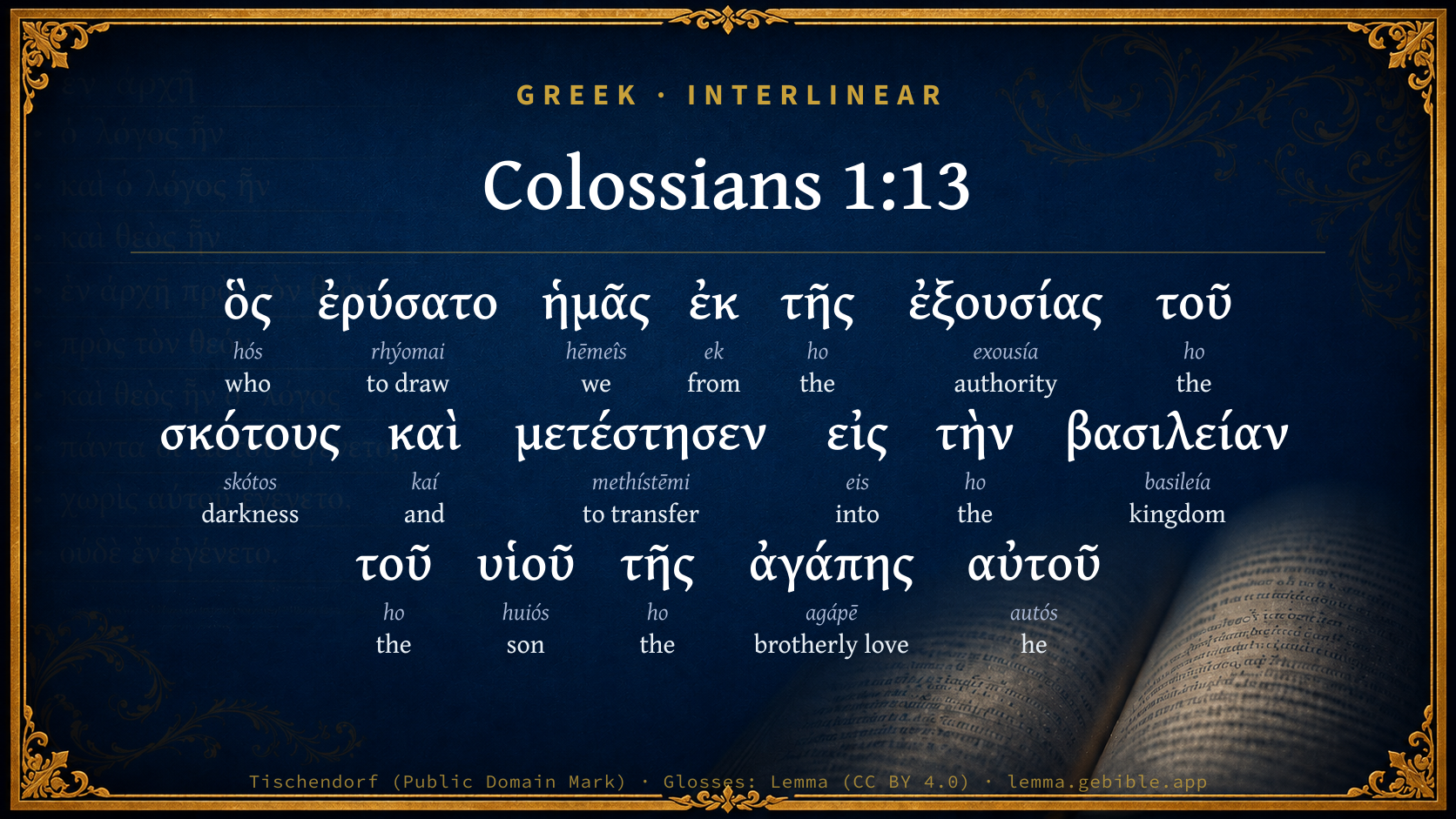
  1. ὃς hós G3739 “who” Relative pronoun, Nominative, Singular, Masculine
  2. ἐρύσατο rhýomai G4506 “to draw” Verb, Aorist, Middle or Passive deponent, Indicative, 3rd person, Singular
  3. ἡμᾶς hēmeîs G2249 “we” Personal pronoun, 1st person, Accusative, Plural
  4. ἐκ ek G1537 “from” Preposition
  5. τῆς ho G3588 “the” Article, Genitive, Singular, Feminine
  6. ἐξουσίας exousía G1849 “authority” Noun, Genitive, Singular, Feminine
  7. τοῦ ho G3588 “the” Article, Genitive, Singular, Neuter
  8. σκότους skótos G4655 “darkness” Noun, Genitive, Singular, Neuter
  9. καὶ kaí G2532 “and” Conjunction
  10. εἰς eis G1519 “into” Preposition
  11. τὴν ho G3588 “the” Article, Accusative, Singular, Feminine
  12. βασιλείαν basileía G932 “kingdom” Noun, Accusative, Singular, Feminine
  13. τοῦ ho G3588 “the” Article, Genitive, Singular, Masculine
  14. υἱοῦ huiós G5207 “son” Noun, Genitive, Singular, Masculine
  15. τῆς ho G3588 “the” Article, Genitive, Singular, Feminine
  16. ἀγάπης agápē G26 “brotherly love” Noun, Genitive, Singular, Feminine
  17. αὐτοῦ autós G846 “he” Personal pronoun, Genitive, Singular, Masculine

About this verse

These counts appear in no published source. They are computed here, from the morphology-tagged text and Lemma’s own curated glosses. What Lemma adds →

18
words
14
distinct lemmas
Pauline Epistles
section

Notable vocabulary

The rarest word here is μετέστησεν to transfer G3179 — appearing just 5 times in the whole Greek New Testament.

Shared distinctive vocabulary

μετέστησεν to transfer G3179 occurs in 5 verses of the Greek New Testament. Also found in:

Repetition

A word recurs within this verse:

Cross-references

37

Topical passages linked to Colossians 1:13 in the Treasury of Scripture Knowledge — connected by theme and wording, ordered by reader-vote popularity; previews shown in the World English Bible.

  • Ephesians 5:8 For you were once darkness, but are now light in the Lord. Walk as children of light,
  • Acts 26:18 to open their eyes, that they may turn from darkness to light and from the power of Satan to God, that they may receive remission of sins and an inheritance among those who are sanctified by faith in me.'
  • 1 Peter 2:9 But you are a chosen race, a royal priesthood, a holy nation, a people for God's own possession, that you may show forth the excellencies of him who called you out of darkness into his marvelous light:
  • Titus 3:3–6 For we were also once foolish, disobedient, deceived, serving various lusts and pleasures, living in malice and envy, hateful, and hating one another.
  • 1 Thessalonians 2:12 to the end that you should walk worthily of God, who calls you into his own Kingdom and glory.
  • Ephesians 6:12 For our wrestling is not against flesh and blood, but against the principalities, against the powers, against the world's rulers of the darkness of this age, and against the spiritual hosts of wickedness in the heavenly places.
  • 1 Corinthians 6:9–11 Or don't you know that the unrighteous will not inherit the Kingdom of God? Don't be deceived. Neither the sexually immoral, nor idolaters, nor adulterers, nor male prostitutes, nor homosexuals,
  • Ephesians 4:18 being darkened in their understanding, alienated from the life of God, because of the ignorance that is in them, because of the hardening of their hearts;
  • Romans 14:17 for the Kingdom of God is not eating and drinking, but righteousness, peace, and joy in the Holy Spirit.
  • 1 John 3:14 We know that we have passed out of death into life, because we love the brothers. He who doesn't love his brother remains in death.
  • 2 Corinthians 4:4 in whom the god of this world has blinded the minds of the unbelieving, that the light of the Gospel of the glory of Christ, who is the image of God, should not dawn on them.
  • 1 John 3:8 He who sins is of the devil, for the devil has been sinning from the beginning. To this end the Son of God was revealed, that he might destroy the works of the devil.
  • John 5:24 "Most assuredly I tell you, he who hears my word, and believes him who sent me, has eternal life, and doesn't come into judgment, but has passed out of death into life.
  • Romans 6:17–22 But thanks be to God, that, whereas you were bondservants of sin, you became obedient from the heart to that form of teaching whereunto you were delivered.
  • 1 Corinthians 15:23–25 But each in his own order: Christ the first fruits, then those who are Christ's, at his coming.
  • Daniel 7:13–14 I saw in the night-visions, and, behold, there came with the clouds of the sky one like a son of man, and he came even to the ancient of days, and they brought him near before him.
  • 1 John 2:8 Again, I write a new commandment to you, which is true in him and in you; because the darkness is passing away, and the true light already shines.
  • 2 Peter 1:11 For thus will be richly supplied to you the entrance into the eternal Kingdom of our Lord and Savior, Jesus Christ.
  • Isaiah 42:1 Behold, my servant, whom I uphold; my chosen, in whom my soul delights: I have put my Spirit on him; he will bring forth justice to the Gentiles.
  • Matthew 12:29–30 Or how can one enter into the house of the strong man, and plunder his goods, unless he first bind the strong man? Then he will plunder his house.
  • Luke 13:24 "Strive to enter in by the narrow door, for many, I tell you, will seek to enter in, and will not be able.
  • Matthew 3:17 Behold, a voice out of the heavens said, "This is my beloved Son, with whom I am well pleased."
  • Luke 22:53 When I was with you in the temple daily, you didn't stretch out your hands against me. But this is your hour, and the power of darkness."
  • Hebrews 2:14 Since then the children have shared in flesh and blood, he also himself in like manner partook of the same, that through death he might bring to nothing him who had the power of death, that is, the devil,
  • Psalms 2:6–7 "Yet I have set my king on my holy hill of Zion."
  • Isaiah 53:12 Therefore will I divide him a portion with the great, and he shall divide the spoil with the strong; because he poured out his soul to death, and was numbered with the transgressors: yet he bore the sin of many, and made intercession for the transgressors.
  • Zechariah 9:9 Rejoice greatly, daughter of Zion! Shout, daughter of Jerusalem! Behold, your king comes to you! He is righteous, and having salvation; Lowly, and riding on a donkey, Even on a colt, the foal of a donkey.
  • John 12:31–32 Now is the judgment of this world. Now the prince of this world will be cast out.
  • John 17:24 Father, I desire that they also whom you have given me be with me where I am, that they may see my glory, which you have given me, for you loved me before the foundation of the world.
  • 2 Corinthians 6:17–18 Therefore, "'Come out from among them, And be separate,' says the Lord, 'Touch no unclean thing. I will receive you.
  • Ephesians 2:3–10 among whom we also all once lived in the lust of our flesh, doing the desires of the flesh and of the mind, and were by nature children of wrath, even as the rest.
  • Isaiah 9:6–7 For to us a child is born, to us a son is given; and the government shall be on his shoulder: and his name shall be called Wonderful, Counselor, Mighty God, Everlasting Father, Prince of Peace.
  • Matthew 25:34 Then the King will tell those on his right hand, 'Come, blessed of my Father, inherit the Kingdom prepared for you from the foundation of the world;
  • Ephesians 1:6 to the praise of the glory of his grace, by which he freely bestowed favor on us in the Beloved,
  • Isaiah 49:24–25 Shall the prey be taken from the mighty, or the lawful captives be delivered?
  • Matthew 17:5 While he was still speaking, behold, a bright cloud overshadowed them. Behold, a voice came out of the cloud, saying, "This is my beloved Son, in whom I am well pleased. Listen to him."
  • John 3:35 The Father loves the Son, and has given all things into his hand.

Cross-references courtesy of OpenBible.info (CC BY 4.0).

Commentary

Notes on Colossians 1:13 from classic Christian and Jewish commentators (each source and its license shown beneath its notes). The classic Christian expositions comment on the surrounding passage and are grouped to its opening verse, so a note may address several verses; the Jewish commentaries on the Tanakh (Rashi and others) are per-verse, so they appear only where the commentator wrote on this verse.

Lemma curates 59 commentaries, every one of them public domain or Creative Commons licensed, each selected and text-cleaned for this edition rather than reprinted as found. About our sources →

Ellicott's Commentary for English Readers

(13) Who hath delivered us from the power of darkness.—“Delivered” is “rescued,” properly applied to dragging a person out of battle or the jaws of danger. “The power of darkness” (see Luk_22:53) is, of course, the power of evil, permitted (see Luk_4:6) to exist, but in itself a usurped tyranny (as Chrysostom expresses it), not a true “kingdom. Salvation is, first of all, rescue from the guilt and bondage of sin, to which man has given occasion by his own choice, but which, once admitted, he cannot himself break. It is here described in its first origination from the love of the Father. “God so loved the world, that He gave His only begotten Son.”

And hath translated us . . .—The word “translated” is a word properly applied to the transplanting of races, and the settlement of them in a new home. Salvation, begun by rescue, is completed by the settlement of the rescued captives in the new kingdom of Christ. The two acts, indeed, are distinct, but inseparable. Thus baptism is at once “for the remission of sins” and an “entrance into the kingdom of God.”

His dear Son.—The original is far more striking and beautiful. It is, “The Son of His love,” corresponding to “the beloved” of the parallel passage in the Ephesian Epistle (Col_1:6), but perhaps going beyond it. God is love; the Son of God is, therefore, the “Son of His love,” partaking of and manifesting this His essential attribute.

In whom we have . . .—This verse corresponds verbally with Eph_1:7, where see Note. From the love of the Father, the first cause of salvation, we pass to the efficient cause in the redemption and propitiation of the Son.

Col_1:15-17 pass from Christ as our Mediator to Christ as He is in Himself from all eternity, “the image of the invisible God,” and as He is from the beginning of time, the creator and sustainer of all things in heaven and earth. What was before implied is now explicitly asserted; what was before emphatic ally asserted is now taken for granted, and made the stepping-stone to yet higher and more mysterious truth.

(13, 14) We enter on this great passage, as is natural, and accordant with St. Paul’s universal practice, through that living and practical truth of our redemption in Christ Jesus, which in the earlier Epistles he had taught as the one thing needful (1Co_2:2).

[2. The Doctrine of Christ.

(1) His SALVATION AND REDEMPTION of us all (Col_1:13-14).

(2) His NATURE AS THE IMAGE OF THE INVISIBLE GOD, the creator and sustainer of all things heavenly and earthly (Col_1:15-17).

(3) His HEADSHIP OF THE CHURCH (Col_1:18).

(4) His MEDIATION, reconciling all to God, first generally stated, then applied especially to the Colossians (Col_1:19-23).]

(13-23) In this we have the great characteristic section of this Epistle, distinguished from corresponding parts of the Epistle to the Ephesians by the explicit and emphatic stress laid upon the divine majesty of Christ. It corresponds very closely with the remarkable passage opening the Epistle to the Hebrews. In the Epistles of the preceding group, to the Corinthians, Galatians, and Romans, chief and almost exclusive prominence is given to the universal mediation of Christ, as justifying and sanctifying all the souls of men. In these Epistles (this truth being accepted) we pass on to that which such universal mediation necessitates—the conception of Christ as the Head of all created being, and as the perfect manifestation of the Godhead. The former is the key-note of the Ephesian Epistle; the latter is dominant here, although the former remains as an undertone; as also in the great passage of the Epistle to the Philippians (Col_2:6-11), speaking of Him as “in the form of God,” and having “the Name which is above every name.” The especial reason for St. Paul’s emphatic assertion of the great truth here we see in the next chapter. But it is clear that it comes naturally in the order of revelation, leading up to the full doctrine of, “the Word” in St. John. As the spiritual meaning of the Resurrection, the great subject of the first preaching, had to be sought in the Atonement, so the inquiry into the possibility of an universal Atonement led back to the Incarnation, and to Christ as pre-existent from “the beginning” in God.

A Bible Commentary for English Readers, edited by Charles John Ellicott (1878–1897) — public domain. Text from a community e-Sword module.

The Biblical Illustrator

Joseph S. Exell

Col_1:13-14

Who hath delivered us from the power of darkness.

The great moral translation

I. Involves our enfranchisement from a state of dark captivity.

1. The unrenewed are in a realm of moral darkness.

(1) Darkness denotes ignorance--moral blindness about the great mysteries of being, of sin and suffering, the deep significance of life. It is possible to know much about religion, to hold religious ideas at second hand; yet be totally in the dark as to the experience of these ideas.

(2) Darkness denotes danger and misery.

2. In this realm the unrenewed are held in captivity.

3. From this realm God graciously liberates. Who hath delivered us.

(1) For the slaves of sin there is no help but in God. It is the nature of sin to incapacitate its victim for self-enfranchisement. He is unwilling to be free.

(2) The word deliver means to snatch, or rescue from danger, even though the person seized may at first be unwilling to escape, as Lot from Sodom. God does not force the human will.

(3) Our enfranchisement may be painful.

II. Places us in a condition of highest moral freedom and privilege.

1. We are transferred to a kingdom. Hath translated us into the kingdom. Power detains captives; a kingdom fosters willing citizens. Tyranny has no law but the will of a despot; a kingdom implies good government, based on law. The kingdom of God has an earthly and heavenly aspect, both of which are governed by one and the same sceptre. It resembles a city divided by a river, but both parts controlled by the same municipal authority, and having one common franchise. There is no middle state between the power of darkness and the kingdom of grace: all who breathe are either in the one or the other.

2. We are placed under the rule of a beneficent and glorious King. The Son of His love. The manifestation of Christ is the manifestation of Divine love (1Jn_4:9). The kingdom into which believers are translated is founded on love: its entire government is carried on by love. The acts of suffering and death, by which Christ won his kingly dignity, were revelations of love. Under such a monarch we are sure of protection, guidance, support, and final victory.

III. Is effected by redemption.

1. The means. Through His blood.

2. The effects.

3. The Author. (G. Barlow.)

The great spiritual change

I. The momentous change.

1. Is from the power of darkness. Darkness is thus personified as a monarch, not a mere force. Under this the Colossians were living till they received the gospel. Neither the light of their Gentile philosophy nor the fitful course of their culture could rescue them. The very light that was in them was darkness. This is the condition of all men naturally. Darkness is--

(1) Ignorance. Men are ignorant of God and themselves (1Co_2:14). They may learn lessons of Gods power and wisdom in creation, admire the literature and poetry of revelation, and believe in a future state; but they have no true knowledge of their moral condition, of God as their Father, Christ as their Saviour, or of the blessedness of holiness.

(2) It leads to error. In the absence of light the traveller mistakes his way. Men think they are in the road to heaven as they wander up and down the bye-paths of religious formality, of their own resolutions, or of some superstition. Deluded by this darkness they make no effort to live for God and work out their own salvation.

(3) Such a condition must be one of danger. The belated traveller cannot distinguish friend from foe, land from water. Unconscious of peril, and perhaps thinking of home, he draws near a precipice, falls over and is killed.

(4) Darkness promotes discomfort and fear. There is a gloomy uncertainty and dread of the future, a bondage of the soul through the fear of death. He cannot be happy who knows not God as his Friend, and has no meetness for the future.

2. The process of deliverance.

(1) It may involve not a little that is painful. To a man soundly asleep the sudden cry of fire is not welcome. So this deliverance involves a distressing inward struggle and the abandonment of many a pleasure.

(2) Whither is the delivered soul brought? He is not rescued and left to wander in search of a home, but has a title and guidance to the kingdom of Gods Son.

(a) This kingdom is so called because it belongs to Him by right, who founded, formed, and rules over it.

(b) Something of its character may be learned from His: the Son of Gods love (Joh_3:35). Who can tell the peace and blessedness of those subjects on whom Gods boundless love rests.

3. This deliverance is the most important and wonderful event in a mans history. It is a present privilege and prepares for, and is a pledge of the future inheritance.

4. It is exclusively the work of God.

II. The Divine means for the accomplishment of this end.

1. A putting forth of power on the part of the deliverer manifested by the mediation of Christ. Although the words, through His blood, are not found in the earlier MSS., and may have been borrowed from Eph_1:7; yet the text involves their meaning. Men are sold under sin and condemned; from this state deliverance comes by redemption; redemption implies a price paid; the ransom is the precious blood of Christ. In His Cross there was a vindication of Gods righteousness and power to rescue from sin (1Pe_3:18; 1Pe_2:14; Gal_3:13; Eph_5:2).

2. This redemption is in Christ. His blood was the ransom, but He is the Redeemer, and it is only in living union with Him that we can receive its blessing. Just as we rest and walk in Him have we evidence that we are amongst the redeemed.

3. It is easy to see how this redemption must, in effect, be the raising of the soul to obedience and purity (2Co_5:17). The blessing character istic of redemption: forgiveness. This--

(1) is its first blessing (Rom_5:1).

(2) Its most urgent and momentous blessing.

(3) The most direct, flowing immediately from Christ and reaching us directly through His expiation.

(4) The blessing which opens the way for all others. (J. Spence, D. D.)

Redemption

I. Who? The Father. And no one else ought to, or could, deliver man, but God.

1. None other ought, because (as Tertullian observes) by this act he would forcibly take away from the Creator His own servant. For so great is this benefit of deliverance, that it binds us more than the benefit of creation.

2. But neither could any other deliver. For he must necessarily be stronger than the devil who could wrest his prey from him (Mat_12:29). But who could overcome and bind this prince of darkness except the mighty God alone? It was He, therefore, who plucked us from him.

II. Whom, or what sort of persons God delivered? And this consideration may be twofold.

1. Of those who were to be delivered. Previous to our deliverance we were not only diseased and weak, but opposed to our own deliverance (Rom_5:1-21.).

(1) Observe the immeasurable love of God, who would deliver such persons: for no one cares to redeem a thing of no value.

(2) The infinite power of God who delivered man in spite of the devil.

2. As to those who have been delivered; after that they are faithful and holy, who before were rebels and unholy. Us refers to verses 4-6. Hence it is manifest--

(1) The dreams of carnal men of deliverance are vain. The Israelites, while serving Pharaoh and lusting after the fleshpots, were not in the enjoyment of liberty; so Christians while obeying the devil and delighting in sin are not delivered.

(2) Hence, also, we infer for the consolation of the godly that they alone are free; the ungodly, although they glitter in the eyes of men, are slaves.

III. From what? The power of darkness.

1. From the power of the devil who is the prince of darkness. We all are born under his kingdom, so that he worketh in us according to his own will. But this prince of darkness is bruised under the feet of the faithful (Rom_16:20), to whom, by the Spirit of God, new strength is administered to trample upon this unclean spirit.

2. From the power of sin, which hath blinded the understanding, corrupted the will, and placed us in a condition of darkness both as to knowledge and to spiritual and saving practice (Eph_5:8; Joh_1:5; Joh_3:19). Now from this darkness God has rescued us. He pours in the light of faith and imparts the Spirit of holiness; which blessings being bestowed, this power and dominion of sin is dissolved (Rom_6:14).

3. From the power of hell, i.e., from the miseries and calamities which arise from the guilt of reigning sin. From the power of this they are delivered by the Divine mercy (Rom_8:1). Observe--

(1) For instruction. The whole world is involved in darkness under the devil, neither is there a spark of saving light before deliver ance; for we are in the power of darkness.

(2) For caution. The redeemed ought to have no fellowship with the works of darkness; for they are rescued from the power of the devil and of sin, and, therefore, by serving these they show them selves to be deserters (Rom_13:12).

(3) For consolation. Although the godly are often troubled yet they are delivered from a misery compared with which all external evils are trifling.

IV. To what?

1. The nature of the translation.

(1) The word is borrowed from those who plant colonies and compel persons to migrate to inhabit some new region. So God has translated us from the kingdom of darkness, which is the native soil of us all.

(2) How hath He translated us? We may under stand that from the context. God translates us when He illuminates our hearts by pouring into them faith, when He changes our will by imparting grace; for, being enlightened and sanctified, a man is by that very act translated from the power of darkness into the kingdom of His Son; because He cannot possibly be at the same time a citizen of two cities which observe contrary laws. Here observe, To be delivered it is not enough that we be called to this kingdom, and admonished to desert that other.

(3) Therefore He is to be regarded with the highest honour, for so colonies are accustomed to regard their founder.

2. What is intended by this word kingdom? The Kingdom of God, Christ, heaven.

(1) Is put for the state of glory (Mat_6:33; 1Co_6:9). This the saints have by right, and hope, but not m possession.

(2) For the promulgation and knowledge of the gospel (Mat_13:11; Mat_21:43). But this the saints have only in common with other professors.

(3) For a state of grace, remission of sins, renovation, and Divine favour on account of Christ, the Mediator; and for the whole multitude of those who are in this state (Luk_18:21; Rom_14:17). I deem this to be the proper sense of this expression.

3. Why the apostle calls it the kingdom of the Son, and not of heaven, or of light. Because--

(1) God admits no one to it except through His Son as Mediator. He is the channel of grace. Through Him its streams flow to us, and we are planted in the kingdom (Eph_1:3; Eph_1:8).

(2) Christ, the Mediator, received it from the Father to govern it to the end of time (Luk_22:29).

(3) Paul wished to open the way and make an easy transition for discoursing on the person of the Son. For he immediately enters upon that doctrine, which he could not so aptly have proceeded to unless he had expressly named the Son.

(4) Christ is rightly called the Son of the Fathers love, because He hath the Fathers whole and entire love communicated to Him, even as He had His essence. This is a great consolation to the godly man, when he calls to mind that he is not merely a subject, but a member of Christ so beloved of God. For hence he derives the hope of obtaining from God whatever is necessary to salvation. (Bp. Davenant.)

I. Man is now in soul misery.

1. Naturally. We are children of wrath by nature.

2. Judiciarily. We are under condemnation.

3. Universally. Soul death hath passed over all men.

II. Man needs deliverance.

1. We are sensible enough of bodily misery, but insensible to soul misery; yet the former is but to make us sensible of the latter. Tis God pulling the rope without to make the bell speak within.

2. Without our sense of the need of deliverance, that deliverance will never come.

3. What temporal and eternal horrors are there for the unsaved.

III. Man may be delivered. Christ snatched souls out of darkness and danger.

1. He moves strongly to save. Snatching speaks an act of force; Christ overturns all that stands in His way when He puts forth to deliver a soul.

2. He moves swiftly to save. Snatching notes swift motion. There is but a step between hell and that soul that is under the power of darkness; what, therefore, is done must be done speedily or the soul is lost.

3. Christ moves thoroughly to save. Snatching, speaks a full assuming of that which was wholly anothers. That which I snatch from my enemy in war is wholly mine own, and Christ, having plucked us out of the hands of Satan, claims us as his own.

4. Christ moves preventingly. Snatching speaks an act unthought of, force surprising, the surprised dreaming nothing. Christ catcheth sinners in a dead sleep. Soldiers are sometimes so caught; the devils soldiers are all so.

5. Christ moves ravishingly. This is love smiling, and the soul is taken.

IV. The delivered.

1. Love the Redeemer.

2. Obey Him. (N. Lockyer, M. A.)

The power of darkness

I. Look at the state of nature and sin as one of darkness. Sin is as opposed to holiness as darkness is to light, and as different from holiness as midnight from noonday. Our state by nature is one of double darkness. We have neither light nor sight. That we may be saved we require two things--a medium to see by, and eyes to see with; the revelation of the gospel, and regeneration of the Holy Spirit; Christ as an object for faith to see, faith as an eye to see Christ. As inhabitants of a Christian land we already possess one of these. There is fulness of light, and yet multitudes are wrecked and perish, and unless He, who gave sight to the blind, touch your eyes their fate will be yours. There are animals that are born blind; but after a few days their eyelids are unsealed and they are delivered from the power of darkness. But not ten years will do for us such friendly office. Not that we shall be always blind. Eternity opens the darkest eyes, but when too late, He lift up his eyes, being in torment.

1. Darkness is a state of indolence. Night is the proper period for rest. Yet in its hours of darkness and repose, this city presents no true picture of our state by nature. We see it where a city sleeps, while eager angels point Lots eyes to the break of day, and urge his tardy steps through the doomed streets of Sodom. Rouse thee, then, and betake thee to the Saviour. The plague of Egyptian darkness is, perhaps, the best illustration. They saw not one another, neither rose any from his place for three days. Many a man has not risen from his place for ten times three years and more. He is no nearer heaven than he was long, long ago. Give diligence to make your calling and election sure.

2. Darkness is a state of ignorance. Ugliness and beauty, friend and foe, are all one in the dark, and so are the solid ground and the yawning precipice. Many a gallant ship has perished in a fog, and many a sinner in guilty ignorance. The greatest of mistakes is to miss the path of heaven, and yet how many, turning from Christ, are missing it? Some think that their charities and duties will save them; others a routine of outward services; others that they may go on a little longer in sin and then turn.

3. Darkness is a state of danger.

(1) As locks and bars prove neither life nor property is safe at night. The prowling thief, the hiding assassin, the gaudy tempter, are but types of the great enemy who takes advantage of spiritual darkness to ruin sinners.

(2) Such danger is there in darkness that people have perished almost at their own doors: and many die at the gate of salvation, and by the very door of heaven (2Co_4:4).

(3) In respect of its power over men what can be compared to mental, moral, and spiritual darkness?

(a) Look at Popery! She immures her votaries in a gloomier dungeon than ever held her victims. God sends them His blessed Word, but they dare not open it; and, greatest triumph of darkness, they refuse instruction. If the light that is in thee be darkness, how great is that darkness?

(b) But how many among ourselves lie under the delusion that though the happiness they seek in the world has eluded their grasp, they will yet embrace the mocking phantom! How many are putting away the claims of Christ and their souls to a more convenient season? Many fancy themselves safe who are ready to perish.

II. Even Gods people remain in more or less darkness, so long as they are. Here.

1. They may be in darkness through ignorance.

(1) Having abandoned the works of darkness, and become children of light, yet all do not enjoy the same measure of light, nor possess equal powers of sight; hence those conflicting views which have separated brother from brother.

(2) While some saints enjoy a clear assurance of their salvation, others pass their days in despondency. By the help of Gods Word, their compass, they succeed in steering their way to heaven, but it is over a troubled sea, and under a cloudy sky.

2. They may be in darkness through sin. So long as you walk in the path of Gods commandments you walk in the light; but in turning aside from that we have withdrawn from it. He that descends into a pit leaves the light, not the light him. And the deeper the saint sinks in sin, the darker it grows. God will not smile on His child sinning; and that which would befall our world were the sun withdrawn, befalls his soul; a chilling cold follows on the darkness, and but for restoring grace death would ensue.

3. They may be in more or less darkness as to their spiritual state. It is easy to account for such a case as Davids; but there are cases of religious desertion that do not admit of being thus explained. Hear that My God, My God, why hast Thou forsaken Me. In such cases, however, God does not leave you comfortless. You may retain your hold when you lose your sight of Him; and the sun, which has struggled through clouds all day long, often breaks forth into golden splendour at his setting. Not seldom have hopes that never brighten life broken forth to gild the departing hour. (T. Guthrie, D. D.)

The unconsciousness of the sinner under the mower of darkness

If we lay in some darksome prison leaden with irons, as many as we could bear, committed to the custody of some Cerberus-like keeper; how would we lament our hard fortune? but to lie in such a condition wherein is no light of knowledge of God, leaden with chains of darkness, hellish lusts of wrath, covetousness, pride, filthiness, in the custody of the devil himself, this none bewaileth. (P. Bayne, B. D.)

The kingdom of Christ

I. The importance which Christ himself attaches to His kingly claims.

1. There are crowns worn by living monarchs of which it would be difficult to estimate the value. The price paid for their jewels is the least part of it. They cost thousands of lives. And yet in His esteem, and in ours, Christs crown outweighs them all. He gave his life for it.

2. The connection between our Lords sufferings and these claims marks some of the most touching scenes in His history. The people rejected Him in His kingly character. We will not have this King to reign over us. The soldiers reviled Him as a King; and His claim to be such was the crime for which He was crucified. It was a kingly inscription that stood above His dying head.

3. Our Lord had the strongest temptation to abandon these claims; and if He refused to give them up in the desert when tempted by the devil, when He had not a morsel to eat, and at the bar, when to have parted with them would have saved His life, He is not likely to yield them now. He has now no inducement to do so. A friendless prisoner no more, He stands at the right hand of God, and claims to reign over all whom He has conquered by love and redeemed by blood.

4. Would God we could live up to that truth. How often is it forgotten! each of us doing what is right in his own eyes, as though there were no King in Israel. Oh, that we were all as anxious to be delivered from the power as we are to escape the punishment of sin.

II. From whom Christ received His kingdom.

1. Not from the Jews. His own received Him not. Once they tried to thrust royal honours on Him: afterwards they bore Him in royal state to the capital, and then they crucified Him. The only crown our Lord gets from man is woven with thorns. Had Christ consented to rule on their terms the Jews would have made Him king. Now to-day how many would accept Jesus if He would allow them to retain their sins. But He accepts not the crown if sin is to wield the sceptre.

2. Not from His own people. The sceptre which a female hand sways so gracefully over the greatest, freest empire in the world was wrenched two hundred years ago from the grasp of a poor popish bigot; and his successor was borne to the vacant throne on the arms of a people who considered crowned heads less sacred than their liberties and religion. Is it by any such act that Christ is crowned? Is He a popular monarch in this sense? No. Here the king elects His subjects, not the subjects their king; and in that and other senses His kingdom is not of this world. Aliens from the commonwealth of Israel, and enemies to God, it is necessary that Christ should first choose you as His subjects, before you can choose Him as your King. Christ reigns by conquest, but His reign is not one of terror. He reigns as He conquered, by love. Enthroned in the heart He rules through the affections.

3. From God. When we look at the two great occasions on which our Lord was crowned, what a contrast do they present. The scene of the first is laid on earth. Behold Him stripped of His garments, tied to a post, scourged, clothed with an old purple robe, a wreath of thorns upon His head. Some in bitter mockery bend the knee as to a Caesar and shout, Hail, King of the Jews. Turn now to the other. The cross is vacant, the court empty, and from the vine-covered sides of Olivet a band of men are joyfully descending. While the disciples come down to the world, Jesus goes up to heaven escorted by a host of angels. His battle over, and the great victory won, the Conqueror is now to be crowned. Behold the scene as revealed by anticipation to the rapt eyes of Daniel (Dan_7:13).

III. In what character Jesus holds this kingdom. Not as God or as man, but as God-man. Our Lord appeared in both these characters at the grave of Lazarus. Jesus wept, and yet Death cowers before His eye. So on the Sea of Galilee, the Son of Mary sleeps, but raising His hand He said to the rude storm, Peace, be still. Those two natures He still retains. As both God and man He occupies the thrones of grace and providence--holding under His dominion all worlds; for in Him dwelleth all the fulness of the Godhead bodily, and He has been made Head over all things to His Church. Simply as God there could be no addition to His possessions, nor could He receive them simply as man.

IV. Seek an interest in this kingdom. Your eternal welfare turns on that. You must be crowned in heaven or cursed in hell.

1. Are you poor? That is no bar. Blessed are the poor in spirit.

2. Are you degraded? That does not exclude you from the mercy and grace of God.

3. Have you done nothing to merit this kingdom? Who has?

4. Though you are not saved by obedience, remember that submission to Christs commandment is required of all who belong to His kingdom.

5. In a general sense we are all His subjects; but in a saving sense Christs kingdom is not without, but within. Unless the heart be right with Christ, all is wrong. (T. Guthrie, D. D.)

His dear Son

Or more correctly, the Son of His love. Christ is so because--

I. He is most worthy of all others to be loved. As Judas is the Son of Perdition, i.e., most worthy to be condemned.

II. He was from everlasting begotten of the love of His Father. He is Gods own Son.

III. He is infinitely filled with a sense of His love. I always do the things that please Him.

IV. It is He by whom love is derived into others. He makes all other sons beloved. They are all loved because of Him and through Him. He imparts the lowest graces. This is all very comfortable.

1. He is like to speed anything He requests the Father for us, and will be sure to preserve us.

2. He is a Kings Son, and infinitely beloved of His Father. How excellent a thing, then, to be Christs member. (N. Byfield.)

Religion a great change

In an early period of the ministry of the Rev. John Wesley, he visited Epworth, in Lincolnshire, where his father had formerly been minister, but found the people greatly opposed to what they considered his new notions. He tells us, in his journal, that many persons were convinced of the importance of the truths he delivered from the tombstone of his father, some of whom were conveyed in a waggon to a neighbouring justice of the peace, to answer for the heresy with which they were charged. Mr. Wesley rode over also. When the magistrate asked what these persons had done, there was a deep silence; for that was a point their conductors had forgotten. At length, one of them said, Why, they pretend to be better than other people; and, besides, they pray from morning to night. He asked, But have they done anything besides? Yes, sir, said an old man, Ant please your worship, they have convarted my wife. Till she went among them, she had such a tongue, and now she is as quiet as a lamb. Carry them back, carry them back, replied the justice, and let them convert all the scolds in the town. (Arvine.)

Translated us

The word is a metaphor, and the comparison is taken from plants in nature, and there are divers things signified unto us in the similitude. As trees are translated in winter, not in the spring, so commonly our redemption is applied in the days of special affliction and sorrow: and as the plant is not first fruitful and then translated, but therefore translated that it may bear fruit, so we are not therefore redeemed because God was in love with our fruits; but therefore translated out of the kingdom of darkness, that we might bring forth fruit unto God. And as a tree may be truly removed, and new planted, and yet not presently bear fruit, so may a Christian be truly translated, and yet in the first instant of his conversion he may not show forth all the fruit he doth desire. In particular, translating hath two things in it.

I. Pulling up. The pulling up of a tree shadows out three things in the conversion of a sinner.

1. Separation from the world: he cannot be in Christ tahat hath his heart rooted in the earth, and keeps his old standing amongst these trees, the wicked of the world.

2. Deliverance both from original sin in the reign of it (which is the moisture of the old earth), and also from hardness of heart (for translating hath removing of the mould and stones that were about the root).

3. Godly sorrow raised by the sense of the strokes of the axe of Gods threatenings, and by the loss of many sprouts and branches that were hidden in the earth. A Christian cannot escape without sorrow; for he hath many an unprofitable sprout of vanity, and sinful profit and pleasure he must part with.

II. The setting of the tree notes--

1. Our engrafting into Christ by the Spirit of God through faith.

2. Our communion with the saints (the fruitful trees in Gods orchard), as also it notes our preservation by the infusion of the sap of holy graces. Conclusion: And it is worthy to be noted that He saith translated us, to teach us that there remains in man the same nature after calling that was before; for our natures are not destroyed in conversion, but translated: there remains the same faculties in the soul, and the same powers in the body; yea, the constitution and complexion of man is not destroyed, as the melancholy man doth not cease to be so after conversion, only the humour is sanctified unto a fitness for godly sorrow, and holy meditation, and the easy renouncing of the world, etc., and the like may be said of other humours in mans nature. (N. Byfield.)

The translation

I. In delivering His people from the power of darkness, Christ saves them from eternal perdition. People talk about the mercy of God in a way for which they have no warrant in His Word: and ignoring His holiness, justice, and truth, they lay this and the other vain hope as a flattering unction to their souls.

II. How we are brought into Christs kingdom.

1. By translation.

(1) There is a difference between being transformed and translated. The first describes a change of character, the second of state. These changes are coincident; but the transformation is not complete until the time for the second translation. Then those who were translated at conversion into a state of grace, are translated at death into a state of glory.

(2) It is a great mistake to suppose that God is only active and man passive in this work. You may translate a man from one earthly kingdom into another while he is asleep, and at death a man may be translated to glory in a state of unconsciousness; but it is not in this placid way that sinners pass out of darkness into Christs kingdom.

2. This translation is attended by suffering and self-denial. Killed by a blow, or deprived of existence and consciousness by an opiate, a man may die to natural life unconsciously, but never to sin. Hence those striking figures of crucifixion. But the crown is worthy of the cross. True there is much more pain in going to hell than to heaven, and although this were not, one hour of glory will recompense all the sufferings of earth. But be assured that as it is among pangs and birth struggles that a man is born the first time, so when he is born again, Christ baptizes with fire. How often has water fallen on the calm brow of a sleeping infant who has been translated thus into the visible Church. But a fiery baptism! Can a man take fire into his bosom and not be burned? God is a consuming fire to His peoples sins, and He cannot be so without them knowing it.

3. In this translation God and man are active. Our Lord ascended from earth to heaven without effort; not so His people from nature unto grace. We receive salvation, still we must put forth our hand to take it, as a drowning man clutches the saving rope. God works in grace as in nature; helps the man who helps himself. The reason why men are not saved is not that God hath forgotten to be gracious, or that the blood of Christ has lost its efficacy; but because men will take no pains to be saved. (T. Guthrie, D. D.)

The duty of thankfulness for the deliverance

If we had some grievous tyrant ruling over us, and God should take him away and set a prince of singular clemency over us, should not the blessing of all the kingdom come upon Him for so singular a change? But when He taketh the devils iron yokes off our necks and bringeth us under the kingdom of that most meek King who will not bruise a broken reed, nor quench the smoking flax, here none in comparison is thankful. (P. Bayne, B. D.)

God is the Deliverer

King Theodore kept two or three British subjects in prison, and no entreaty, expostulation, threat, could induce him to release them. At last the British nation arose and said, At all costs the prisoners must be released; and so General Napier led his army along the defiles over the mountains. At length he came to Magdala, the capital of Abyssinia. King Theodore was conquered and slain, and so General Napier ascended to the capital. But perhaps some of you do not know that as General Napier rode into the city, those captives, bowed down with their long imprisonment, came near to him, and laid their hands upon his horses saddle and thanked him as their deliverer. He said to them, Do not thank me; God is the deliverer. The Christians in England have been praying for you. (J. L. Nye.)

The Biblical Illustrator, edited by Joseph S. Exell (c. 1880s–1900s) — public domain. Text from a community e-Sword module.

The Preacher's Complete Homiletical Commentary

Joseph S. Exell (gen. ed.)

CRITICAL AND EXPLANATORY NOTES

Col_1:13. Who hath delivered us from the power of darkness.—The metaphor commenced in the previous verse is carried on here. The settlement in the land flowing with milk and honey is preceded by deliverance with a high hand from the house of bondage—the land of thick darkness. And hath translated us.—The same word by which the Jewish historian describes the carrying over of the Israelites to Assyria by Tiglath-Pileser. The apostle regards the deliverance, so far as the Deliverer is concerned, as a thing accomplished. His dear Son.—The A.V. margin has become the R.V. text, “The Son of His love.” We do not again find this expression; but as there is “no darkness at all” in God, who “is love,” so His Son, into whose kingdom we come, reveals the love of the Father.

Col_1:14. In whom we have redemption.—A release effected in consideration of a ransom. See on the verse Eph_1:7. The forgiveness of our sins—lit. “the dismissal of our sins.”

MAIN HOMILETICS OF THE PARAGRAPH.—Col_1:13-14

The Great Moral Translation.

These words amplify the truth unfolded in the preceding verse, and describe the great change that must take place in order to obtain a meetness for the saintly inheritance—the translation of the soul from the powerful dominion of darkness into the glorious kingdom of the Son of God.

I. This translation involves our enfranchisement from a state of dark captivity.—“Who hath delivered us from the power of darkness” (Col_1:13).

1. The unrenewed are in a realm of moral darkness.—This was the condition of the Colossians and of the whole Gentile world before the times of the gospel. “Darkness covered the earth, and gross darkness the people.” Darkness denotes ignorance, moral blindness. Man is in darkness about the great mysteries of being, the mystery of sin and suffering, the deep significance of life, the distressing question of human duty, the destiny of the universe, the character and operations of God, and His relation to the race. It is possible to know much about religion, to hold religious ideas at second-hand as a group of poetic conceptions—fancy pictures from the book of Revelation, like the pictures of the poets from the book of Nature—and yet be totally in the dark as to the religious experience of those ideas. May be intellectually light, and spiritually dark. Darkness denotes danger and misery. Like a traveller in a strange country overtaken by the night, stumbling along in uncertainty and fear, until one fatal step—and he lies helpless in the rocky abyss, into the bottom of which he falls.

2. In this realm of moral darkness the unrenewed are held in captivity.—They are slaves in the land of darkness, tyrannised over by an arbitrary and capricious ruler. Slavery distorts and defaces the illustrious image in which man was originally created, darkens the understanding, paralyses the intellect, and stunts the growth of intelligence; it robs him of his self-respect, poisons his sense of rectitude and honour, blunts his sensibilities, imbrutes his entire nature, and brands him with unutterable infamy. The “power of darkness” is that tyranny which sin exercises over its captives, filling their minds with deadly errors or brutish ignorance, their consciences with terror or indifference, and dragging them onwards under its dismal yoke into all the horrors of eternal darkness. The tyrant of this gloomy realm is Satan; and his domination is founded and conducted on imposture, error, ignorance, and cruelty. He is the arch-deceiver.

3. From this realm of moral darkness God graciously liberates.—“Who hath delivered us.” For the slaves of sin there is no help but in God. It is the nature of sin to incapacitate its victim for making efforts after self-enfranchisement. He is unwilling to be free. To snap the fetters from a nation of slaves yearning for liberty is a great and noble act. Our deliverance is mightier than that. The word “deliver” in the text means to snatch or rescue from danger, even though the person seized may at first be unwilling to escape, as Lot from Sodom. God does not force the human will. The method of deliverance was devised and executed independent of our will; its personal benefits cannot be enjoyed without our will.

II. This translation places us in a condition of highest moral freedom and privilege.—

1. We are transferred, to a kingdom. “Hath translated us into the kingdom” (Col_1:13). Power detains captives; a kingdom fosters willing citizens. Tyranny has no law but the capricious will of a despot; a kingdom implies good government, based on universally recognised and authoritative law. “The image is presented of the wholesale transportation of a conquered people, of which the history of Oriental monarchies furnishes many examples” (Josephus, Ant., IX. xi.). They were translated from a bad to a better ruling power. So the believer is moved from the realm and power of darkness and bondage to the kingdom of light and freedom. The laws of this kingdom are prescribed by Christ, its honours and privileges granted by Him, and its future history and triumphs will ever be identified with His own transcendent glory.

2. We are placed under the rule of a beneficent and glorious King.—“The kingdom of God’s dear Son,” more accurately “the Son of His love.” As love is the essence of the Father, so is it also of the Son. The manifestation of the Son to the world is a manifestation by Him of divine love (1Jn_4:9). The kingdom into which believers are translated is founded on love; its entire government is carried on under the same beneficent principle. The acts of suffering and death, by which Christ won His kingly dignity and power, were revelations of love in its most heroic and self-sacrificing forms. When we believe in Christ, we are translated from the tyranny and darkness of sin into the kingdom of which the Son of God—the Son infinitely beloved of the Father—is King. As willing subjects we share with Him the Father’s love, and are being prepared for more exalted service and sublimer experiences in the endless kingdom of the future.

III. The divine method by which the translation is effected.—It is effected by redemption.

1. The means of redemption.—“Through His blood” (Col_1:14). The image of a captive and enslaved people is still continued. But the metaphor is changed from the victor who rescues the captive by force of arms to the philanthropist who releases him by the payment of a ransom (Lightfoot). All men are under the condemnation of a violated law, and sink in the bondage of sin. There is no release but by paying a ransom; this is involved in the idea of redemption. The ransom-price paid for the enfranchisement of enslaved humanity was “not corruptible things, as silver and gold, but the precious blood of Christ.” The mode of redemption is to us a deep mystery; the reasons influencing the divine Mind in its adoption we cannot fathom. But the fact is plainly revealed (1Pe_3:18; 1Pe_2:24; Gal_3:13). This was God’s method of translating from bondage to liberty.

2. The effect of redemption.—“Even the forgiveness of sins” (Col_1:14). The ransom-price is paid, and the slave is free. The first blessing of redemption is pardon. It is this the penitent soul most urgently needs; it does not exclude all other redemptive blessings, but opens and prepares the soul for their reception. Sin is the great obstacle between the soul and God; the monster sluice that shuts off the flow of divine blessing. Redemption lifts the sluice, and the stream of divine goodness pours its tide of benediction into the enraptured soul. An earthly king may forgive the felon, but he cannot give him a better disposition. God never forgives without at the same time giving a new heart. Pardon involves every other blessing—peace, purity, glory; it is the pledge and foundation for the bestowal of all we can need in time or in eternity.

3. The Author of redemption.—“In whom we have redemption” (Col_1:14). Christ, the Son of God’s love, by the sacrifice of Himself, accomplished our redemption; and it is only as we are in Him by faith that we actually partake of the freedom He purchased for us. His blood is not merely the ransom paid for our deliverance, but He is Himself the personal, living source of redemption. The deliverance of humanity is not simply in the work of Christ, through what He did and suffered, but in Himself.—“the strong Son of God,” the crucified, risen, and living Saviour. It is not only a rescue from condemnation and punishment, but a deliverance from the power and bondage of evil. The words “in whom we have redemption” teach much and imply more. They describe a continuous gift enjoyed, a continuous process realised by all who have been translated into the kingdom of the Saviour. In them the power of redemption is being carried on, so that they die unto sin, and live unto God, and experience a growing meetness for the inheritance of the saints in light (Spence). Christ only could be the Redeemer of men; He combined in one person the divine and human natures: He could therefore meet the demands of God and the necessities of man.

Lessons.—

1. Sin is a dark, enslaving power.

2. The kingdom of the Redeemer is one of light and freedom.

3. Moral translation by redemption is a divine work.

4. The forgiveness of sin can be obtained only by faith in the Son of God.

GERM NOTES ON THE VERSES

Col_1:13. From Darkness to Light.

I. Man is naturally in a state of darkness, held captive by sin and Satan.

II. A kingdom of freedom and light is provided by the intervention of the Son of God.

III. The translation from darkness to light is a divine act.

Col_1:14. The Great Blessing of Redemption—

I. Is the forgiveness of sins.

II. The blessing of forgiveness is through the agency of Christ.

III. Redemption is purchased at a great cost and sacrifice.—“Through His blood.”

The Preacher's Complete Homiletical Commentary (gen. ed. Joseph S. Exell; Funk & Wagnalls, c. 1892) — public domain (pre-1929). A full-Bible homiletical/sermon-outline anthology covering 65 of 66 books (2 John is absent from the source module). Text from a community e-Sword module.

Bengel's Gnomon

Johann Albrecht Bengel

Col 1:13. Ὃς, who) the Father.—ἐξουσίας, from the power) The antithesis is kingdom: power detains captives; a kingdom fosters willing citizens; comp. Eph 2:2; Eph 5:5; Eph 6:12.—σκότους, of darkness) the darkness of blindness, of hatred, of misery.—τοῦ Υἱοῦ τῆς ἀγάπης αὐτοῦ, the Son of His love) [His dear Son, Engl. Vers.] Joh 17:26; Eph 1:6. This is treated in the 15th and following verses.

Bengel's Gnomon of the New Testament — English translation (T&T Clark, Edinburgh, 1860) — public domain. Text from a community e-Sword module.

Meyer's Critical & Exegetical Commentary

Heinrich August Wilhelm Meyer

Col_1:13. A more precise elucidation of the divine benefit previously expressed by τῷ ἱκανώσαντι … φωτί. This verse forms the transition, by which Paul is led on to the instructions as to Christ, which he has it in view to give down to Col_1:20.[21]

ἐκ τῆς ἐξουσ. τοῦ σκοτ.] τοῦ σκοτ. is not genitive of apposition (Hofmann), but, corresponding to the εἰς τὴν βασιλείαν that follows, genitive of the subject: out of the power, which darkness has. The latter, as the influential power of non-Christian humanity (of the κόσμος, which is ruled by the devil, Eph_2:2), is personified; its essence is the negation of the intellectual and ethical divine ἀλήθεια, and the affirmation of the opposite. Comp. Luk_22:53; Mat_4:16; Act_26:18; Rom_13:12; Eph_5:8; Eph_6:12, et al. The act of the ἑῤῥύσατο has taken place by means of the conversion to Christ, which is the work of God, Rom_8:29 f.; Eph_2:4 ff. It is to be observed, that the expression ἐκ τ. ἐξουσ. τ. σκότους is chosen as the correlative of ἐν τῷ φωτί in Col_1:12.

καὶ μετέστησεν] The matter is to be conceived locally (εἰς ἕτερον τόπον, Plat. Legg. vi. p. 762 B), so that the deliverance from the power of darkness appears to be united with the removing away into the kingdom, etc. Comp. Plat. Rep. p. 518 A: ἔκ τε φωτὸς εἰς σκότος μεθισταμένων καὶ ἐκ σκότους εἰς φῶς.

εἰς τὴν βασιλ. κ.τ.λ., that is, into the kingdom of the Messiah, Eph_5:5; 2Pe_1:11; for this and nothing else is meant by ἡ βασιλεία Χριστοῦ (τοῦ Θεοῦ, τῶν οὐρανῶν) in all passages of the N. T. Comp. Col_4:11; and see on Rom_14:17; 1Co_4:20; Mat_3:2; Mat_6:10. The aorist μετέστ. is to be explained by the matter being conceived proleptically (τῇ γὰρ ἐλπίδι ἐσώθημεν, Rom_8:24), as something already consummated (comp. on ἐδόξασε, Rom_8:30). Thus the kingdom which is nigh is, by means of their fellowship of life with their Lord (Eph_2:6), as certain to the redeemed as if they were already translated into it. The explanation which refers it to the Christian church (so still Heinrichs, Bähr, Huther, and most expositors) as contrasted with the κόσμος, is just as unhistorical as that which makes it the invisible inward, ethical kingdom (see especially Olshausen, following an erroneous view of Luk_17:21), to which also Bleek and Hofmann ultimately come. Certainly all who name Christ their Lord are under this king (Hofmann); but this is not yet his βασιλεία; that belongs to the future αἰών, Eph_5:5; 1Co_6:9 f., 1Co_15:24; 1Co_15:50; Gal_5:21, et al.; Joh_18:36.

τῆς ἀγάπης αὐτοῦ] in essential meaning, indeed, nothing else than τοῦ υἱοῦ αὐτοῦ τοῦ ἀγαπητοῦ (Mat_3:17; Mat_17:5, et al.), or τοῦ υἱοῦ τοῦ ἀγαπητοῦ αὐτοῦ (Mat_12:18; Mar_12:6), but more prominently singling out the attribute (Buttmann, Neut. Gr. p. 141 [E. T. 162]): of the Son of His love, that is, of the Son who is the object of His love, genitive of the subject. Comp. Gen_35:18 : υἱὸς ὀδύνης μου. Entirely parallel is Eph_1:6 f.: ἐν τῷ ἠγαπημένῳ, ἐν ᾧ ἔχομεν κ.τ.λ. Augustine, de Trin. xv. 19, understood it as genitive of origin, making ἀγάπη αὐτοῦ denote the divine substantia.[22] So again Olshausen, in whose view the expression is meant to correspond to the Johannine ΜΟΝΟΓΕΝΉς. This is entirely without analogy in the N. T. mode of conception, according to which not the procreation (Col_1:15), but the sending of the Son is referred to the divine love as its act; and the love is not the essence of God (in the metaphysical sense), but His essential disposition (the essence in the ethical sense), even in 1Jn_4:8; 1Jn_4:16. Consequently it might be explained: of the Son, whom His love has sent, if this were suggested by the context; so far, however, from this being the case, the language refers to the exalted Christ who rules (βασιλείαν). The expression itself, Ὁ ΥἹῸς Τῆς ἈΓΆΠ. ΑὐΤΟῦ, is found in the N. T. only here, but could not he chosen more suitably or with deeper feeling to characterize the opposite of the God-hated element of σκότος, which in its nature is directly opposed to the divine love. The view, that it is meant to be intimated that the sharing in the kingdom brings with it the ΥἹΟΘΕΣΊΑ (Huther, de Wette), imports what is not expressed, and anticipates the sequel. Holtzmann without ground, and unfairly, asserts that in comparison with Eph_1:6 our passage presents stereotyped modes of connection and turns of an ecclesiastical orator, under which he includes the Hebraizing Ὁ ΥἹῸς Τῆς ἈΓΆΠΗς ΑὐΤ. as being thoroughly un-Paulineas if the linguistic resources of the apostle could not even extend to an expression which is not indeed elsewhere used by him, but is in the highest degree appropriate to a specially vivid sense of the divine act of love; something sentimental in the best sense.

[21] This Chiristological outburst runs on in the form of purely positive statement, although having already in view doctrinal dangers of the kind in Colossae. According to Holtzmann, the Christology belongs to the compiler; the whole passage, vv. 1420, is forced and without motive, and it is only in ver. 21 that we find the direct sequel to ver. 13. The latter statement is incorrect. And why should this excursus, as a grand basis for all the exhortations and warnings that follow, be held without due motive? Holtzmann forms too harsh a judgment as to the whole passage Col_1:9-23, when he declares it incompatible with any strict exegetical treatment.

[22] Theodore of Mopsuestia finds in the expression the contrast that Christ was the Son of God οὐ φύσει, ἀλλʼ ἀγάπῃ τῆς υἱοθεσίας.

Meyer — Critical and Exegetical Commentary on the New Testament — English translation by Peter Christie, edited by Frederick Crombie (T&T Clark, 1880) — public domain. Text from a community e-Sword module.

Expositor's Greek Testament

ed. W. Robertson Nicoll

Col 1:13 . Paul now explains how God has qualified them for their share in the heavenly inheritance. On this passage Act 26:18 should be compared; the parallels extend to Col 1:12 ; Col 1:14 also. ἐρύσατο . The aorist refers to the time of conversion. The metaphor implies the miserable state of those delivered and the struggle necessary to deliver them. ἐξουσίας : “ubi τῇ βασιλείᾳ opponitur, est tyrannis” (Wetstein, so also Chrys., Lightf., Kl [6] ). This would heighten the contrast between the power of darkness and the “kingdom of the son of His love”. But Abbott argues forcibly against this view, especially with relation to the N.T. usage. He quotes Rev 12:10 , ἡ βασιλεία τοῦ Θεοῦ ἡμῶν καὶ ἐξουσία τοῦ Χριστοῦ αὐτοῦ , where the contrast obviously cannot be maintained. Grimm takes the term as a collective expression for the demoniacal powers; and Klöpper says that in Paul ἐξ . is not a mere abstract term, but signifies the possessors of power. Here, however, he rightly sees that the contrast to βας . makes this meaning inappropriate, and that for it ἐρύς . ἀπό would have been expected rather than ἐρύς . ἐκ . Accordingly he interprets it as the dominion possessed by the (personified) darkness. τοῦ σκότους : taken by Hofmann as a genitive of apposition, but the obvious interpretation is to take it as a subjective genitive, the dominion which darkness exercises. We should have expected simply “out of darkness” to correspond to “in light,” but Paul changes the form, partly to insist that the darkness is not a mere state but exercises an active authority, partly to secure a parallel with the kingdom of God’s Son. But we are not justified (with Mey., Kl [7] ) in personifying σκότος , for the primary contrast is with φωτί not υἱοῦ . μετέστησεν . Wetstein quotes Jos., Ant. , ix., 11, 1 (Tiglath-Pileser’s deportation of N.E. Israel), and Lightfoot thinks that this use of the word suggested the choice of it here, and this is made more probable by the addition of εἰς τ . βας . Meyer, however, quotes a striking parallel from Plato, where no such reference is present: ἔκ τε φωτὸς εἰς σκότος μεθισταμένων καὶ ἐκ σκότους εἰς φῶς ( Rep. , p. 518 A). βασιλείαν . Meyer insists that this is the Messianic kingdom, and as the realisation of this lay in the future to Paul the clause must have a proleptic reference, citizenship in the kingdom being guaranteed by their conversion. But the argument rests on a false premiss, for in 1Co 4:20 , Rom 14:17 , the sense is not eschatological. Nor, indeed, can it be so here, for the translation into the kingdom must have taken place at the same time as the deliverance. υἱοῦ τῆς ἀγάπης αὐτοῦ . Augustine, followed by Olshausen and Lightfoot, takes ἀγάπης as a genitive of origin, and interprets, the Son begotten of the essence of the Father, which is love. This has no parallel in the N.T., and rests, as Meyer points out, on a confusion of the metaphysical with the ethical essence of God. The phrase is practically equivalent to His beloved Son, but is chosen for the sake of emphasis to indicate His greatness and the excellence of His kingdom. There is, perhaps, the further thought that the love which rests on the Son must rest also on those who are one with Him.

[6] Klöpper.

[7] Klöpper.

The Expositor's Greek Testament, edited by W. Robertson Nicoll (1897–1910) — public domain. Text from a community e-Sword module.

Jamieson, Fausset & Brown

Robert Jamieson, A. R. Fausset & David Brown

from--Greek, "out of the power," out of the sphere in which his power is exercised.

darkness--blindness, hatred, misery [BENGEL].

translated--Those thus translated as to state, are also transformed as to character. Satan has an organized dominion with various orders of powers of evil (Eph 2:2; Eph 6:12). But the term "kingdom" is rarely applied to his usurped rule (Mat 12:26); it is generally restricted to the kingdom of God.

his dear Son--rather as Greek, "the Son of His love": the Son on whom His love rests (Joh 17:26; Eph 1:6): contrasted with the "darkness" where all is hatred and hateful.

Jamieson, Fausset & Brown — Commentary Critical and Explanatory on the Whole Bible (1871) — public domain (CC PDM 1.0). Text via the HelloAO Bible API.

Adam Clarke's Commentary

Verse 13. Delivered us from the power of darkness] Darkness is here personified, and is represented as having εξουσια, power, authority, and sway; all Jews and Gentiles, which had not embraced the Gospel, being under this authority and power. And the apostle intimates here that nothing less than the power of God can redeem a man from this darkness, or prince of darkness, who, by means of sin and unbelief, keeps men in ignorance, vice, and misery.

Translated us into the kingdom, c.] He has thoroughly changed our state, brought us out of the dark region of vice and impiety, and placed us in the kingdom under the government of his dear Son, υιου της αγαπης αυτου, the Son of his love the person whom, in his infinite love, he has given to make an atonement for the sin of the world.

Adam Clarke's Commentary on the Bible (1810–1826) — public domain. Text from a community e-Sword/MySword module.

John Calvin's Commentaries

13. Who hath delivered us. Mark, here is the beginning of our salvation — when God delivers us from the depth of ruin into which we were plunged. For wherever his grace is not, there is darkness, as it is said in Isaiah 60:2

Behold darkness shall cover the earth, and thick darkness the nations; but the Lord shall arise upon thee, and his glory shall be seen upon thee.

In the first place, we ourselves are called darkness, and afterwards the whole world, and Satan, the Prince of darkness, under whose tyranny we are held captive, until we are set free by Christ’s hand. From this you may gather that the whole world, with all its pretended wisdom and righteousness, is regarded as nothing but darkness in the sight of God, because, apart from the kingdom of Christ, there is no light.

Hath translated us into the kingdom. These form already the beginnings of our blessedness — when we are translated into the kingdom of Christ, because we pass from death into life. (1 John 3:14.) This, also, Paul ascribes to the grace of God, that no one may imagine that he can attain so great a blessing by his own efforts. As, then, our deliverance from the slavery of sin and death is the work of God, so also our passing into the kingdom of Christ. He calls Christ the Son of his love, or the Son that is beloved by God the Father, because it is in him alone that his soul takes pleasure, as we read in Matthew 17:5, and in whom all others are beloved. For we must hold it as a settled point, that we are not acceptable to God otherwise than through Christ. Nor can it be doubted, that Paul had it in view to censure indirectly the mortal enmity that exists between men and God, until love shines forth in the Mediator.

John Calvin's Commentaries (1540-1563) — public domain. Text from the Calvin Translation Society English edition (1840s-50s) via the Christian Classics Ethereal Library (ccel.org). Calvin's coverage is partial (roughly two-thirds of the Bible); uncommented books and verses are honest gaps, never fabricated. The 19th-century editor's footnotes and remarks are omitted so the notes are faithfully Calvin's own voice.

The Cambridge Bible for Schools and Colleges

gen. ed. J. J. S. Perowne

13–14. The thought pursued: the greatness of their Redemption, and of their Redeemer

13. hath delivered] Better, delivered, rescued. The time-reference is the same as that of “qualified us,” explained in the last note but one. The verb is that used in the Lord’s Prayer (Mat_6:13), and e.g. 1Th_1:10; 2Ti_3:11; 2Ti_4:17-18.

the power of darkness] Lit., the authority of the darkness; Latin Versions, de potestate tenebrarum. The exact phrase recurs, in our blessed Lord’s lips, and in the very crisis of His work for our “rescue,” Luk_22:53.—The word rendered “authority” (exousia) is distinguished from mere “force” (dunamis), and denotes some sort of recognized dominion, whether lawful (e.g. Mat_10:1; Rom_13:1, &c.) or unlawful. In secular Greek (as Lightfoot shews) it has a slight tendency to denote excessive or tyrannous dominion. This must not be pressed in the N.T., as a Concordance will shew; but in this Epistle (Col_1:16, Col_2:15) and its Ephesian companion (Eph_2:2, Eph_3:10, Eph_6:12), it certainly takes that direction, referring to evil spiritual powers and their sphere of dominion.

Man, in the Fall, so surrendered himself to the Usurper that, but for the action of his Divine King and Deliverer, he would now lie not merely under the force but under the dominion of his enemy. Cp. Eph_6:12 and our note.

“The darkness:”—cp. again Eph_6:12. Here the idea presented is the antithesis to that of the holy “light” of Col_1:12; a (moral) region of delusion, woe, pollution, and death, in which the “Antipathist of Light”[80] rules over those who “are darkness” (Eph_5:8) and “do its works” (Eph_5:11; cp. 1Jn_1:6). On the whole expression here, cp. 1Pe_2:9.

[80] So Coleridge, Ne plus Ultra.

hath translated] Lit. and better (as above) translated, or transferred.

the kingdom] Rescued from a tyranny, they stepped not into a “no man’s land” but at once under the righteous, beneficent sovereignty and protection of the true King. The “kingdom” here is, immediately, our present subjection, in grace, to the Son of God; to be developed hereafter into the life of glorified order and service (Rev_22:3). See on Eph_5:5 in this Series.

Lightfoot, in an interesting note here, says that St Paul uses this positive language about the actual deliverance of the Colossians, inasmuch as “they are [in St Paul’s view] potentially saved, because the knowledge of God is itself salvation, and this knowledge is within their reach … He hopes to make them saints by dwelling on their calling as saints.” True; but the meaning put on the word “calling” is, we think, inadequate. On the general phenomenon of “inclusive” apostolic language see above on Col_1:2.

his dear Son] Lit. and far better, the Son of His love. Lightfoot, following Augustine, takes this most precious phrase to mean, in effect, the Son of the Father who is (1Jn_4:8; 1Jn_4:16) Love; the Son who accordingly manifests and as it were embodies the Father’s Love (1Jn_4:9-10). But surely the more probable meaning is that the Son is the blessed Object of the Father’s love (so Ellicott); the supremely Beloved One (cp. the parallel passage, Eph_1:6, where see our note). Far from “destroying the whole force of the expression” (Lightfoot), this interpretation is full of ideas in point here. The “kingdom” is what it is to its happy subjects because its King is the Beloved Son, in whom the subjects are therefore not subjects only but sons, and beloved. See Eph_1:6-7, in connexion, for a strong suggestion in this direction.

The Cambridge Bible for Schools and Colleges (gen. ed. J. J. S. Perowne; Cambridge University Press, 1878–1918) — public domain. Text from a community e-Sword module.

John Gill's Exposition

Who hath delivered us from the power of darkness,.... That is, from the power of Satan; see Act 26:18, who, though once an angel of light, is now darkness itself, and is reserved in chains of darkness; he is a ruler of the darkness of this world; his kingdom is a kingdom of darkness; and he blinds the minds of them that believe not, keeps them in darkness, and increases the natural darkness of their minds; he delights in works of darkness, and tempts men to them; and his everlasting state and portion will be blackness of darkness: his power over men, in a state of unregeneracy, which he usurps, and is suffered to exercise, is very great; he works effectually in them, and leads them captive at his will; and nothing less than the power of God, who is stronger than the strong man armed, can deliver out of his hands; and which is at least one part of the mercy for which thanks are here given; See Gill on Luk 22:53; with the Jews, one of the names of Satan is "darkness" (e). Moreover, the darkness of sin, ignorance, and unbelief, with which God's elect, while in a state of nature, are surrounded, and, as it were shut up and imprisoned, so that they have not the least spark of true spiritual light and knowledge, may be also meant; under the power of which they are to such a degree, that they know nothing of God in Christ, of the way of salvation by him, or of the work of the Spirit on their souls, or of the doctrines of the Gospel in an experimental manner; and so they continue, till, by an almighty power, they are turned from darkness to light; when, by powerful grace, they are plucked as brands out of the burning, and delivered from wrath to come, and from that utter darkness of misery and destruction their ways of sin and darkness led and exposed them to. This deliverance is wrought out for them in the effectual calling, when they are internally called, and powerfully brought out of this darkness, by introducing light into them, revealing Christ in them, causing the prince of darkness to flee from them, and the scales of darkness and blindness to fall from their eyes; and which is both an instance or the wonderful grace of God, and of his almighty power, and in which lies in part the saints' meetness for the inheritance; for these words are, in some sort, explanative of the former; for so long as a person is under the power of darkness, he cannot be meet for an inheritance which is in light: it follows, as another branch of this mercy, for which thanks are given,

and hath translated us into the kingdom of his dear Son; not into the kingdom of glory; for though the saints are heirs of it, and rejoice in hope of it, they have not yet an entrance into it; which they will have abundantly when Christ shall introduce them into it, not only as his Father's, but as his own kingdom and glory: but the kingdom of grace is here meant, or that state of grace, light, and life, which such are brought into, when rescued out of Satan's hands, and recovered out of their former state of ignorance and infidelity; when they are by the drawings of the Father, by his powerful and efficacious grace, brought to Christ, and, in the day his power on their souls, are made willing to submit to his righteousness, and to embrace him as the alone Saviour and Redeemer, and be subject to him as King of saints, observing his commands, keeping his ordinances, and walking in his statutes and judgments with other saints, in a Gospel church state; which is Christ's kingdom here on earth, where he reigns as King over God's holy hill of Zion, being set there by his Father, from whom he has received this kingdom, and will deliver it to him, when it is complete and perfect. Now those whom Jehovah the Father snatches out of Satan's hands, and breaks in upon their souls with divine light and knowledge, he brings into such a state, and into this kingdom of Christ, who is called "his dear Son": or "the Son of his love"; or "his Son of love"; who being his Son by nature, of the same nature with him, and equal to him, always was, is, and will be, the object of his love, complacency, and delight; as he cannot be otherwise, since he is the brightness of his glory, and the express image of his person; and even as this Son of his is in an office capacity, as the Mediator between God and man, he is his elect, in whom his soul delights; and he is always well pleased with all the chosen ones in him, who are the sons of God through him, and always beloved in him. This clause is added, partly to distinguish the kingdom of Christ, into which the saints are brought in this life, from the kingdom of the Father, or the ultimate glory they shall possess hereafter; and partly to express the security of the saints, and their continuance in the love of God, being in the kingdom, and under the care and government of the Son of his love; and also to make way for what the apostle has further to discourse concerning the person, office, and grace of Christ, in the following verses,

(e) Shirhashirim Rabba, fol. 25. 4.

John Gill's Exposition of the Whole Bible (1746–1763) — public domain (CC PDM 1.0). Text via the HelloAO Bible API.

Trapp's Complete Commentary

John Trapp

13 Who hath delivered us from the power of darkness, and hath translated us into the kingdom of his dear Son:

Ver. 13. And hath translated us] A word taken from those that plant colonies, and cause the people to translate their dwellings into another country, μετεστησεν. (Bishop Davenant.)

From the power of darkness] Every natural man is under the power of darkness, nay, of the devil, Act 26:18; as the malefactor that goes bound and pinioned up the ladder is under the power of the executioner. Imagine (saith one) a man driven out of the light by devils, where he should see nothing but his tormentors, and that he were made to stand upon snares and gins with iron teeth ready to strike up and grind him to pieces, and that he had gall poured down to his belly, and an instrument raking in his bowels, and the pains of a travailing woman upon him, and a hideous noise of horror in his ears, and a great giant with a spear running upon his neck, and a flame burning upon him round about. Alas, alas, this is the state of every one that is out of Christ, as these places show, whence these comparisons are taken, Job 18:7-8; Job 20:24; Job 20:15; Job 15:20-21; Job 15:26; Job 15:30.

John Trapp, A Commentary or Exposition upon All the Books of the Old and New Testament (1647–1656) — public domain. Text from a community e-Sword module.

Albert Barnes' Notes on the Bible

Who hath delivered us from the power of darkness - The power exerted over us in that dark kingdom to which we formerly belonged - the kingdom of Satan. The characteristic of this empire is darkness - the emblem of:

(1)Sin;

(2)Error;

(3)Misery and death.

Over us, by nature, these things had uncontrollable power; but now we are delivered from them, and brought to the enjoyment of the privileges of those who are connected with the kingdom of light. Darkness is often used to represent the state in which men are by nature; compare Luk 1:79; Act 26:18; Rom 13:12; 1Pe 2:9; 1Jo 2:8.

And hath translated us - The word rendered here “translated” is often used in the sense of removing a people from one country to another; see Josephus, Ant. ix. 11. 1. It means, here, that they who are Christians have been transferred from one kingdom to another, as if a people were thus removed. They become subjects of a new kingdom, are under different laws, and belong to a different community. This change is made in regeneration, by which we pass from the kingdom of darkness to the kingdom of light; from the empire of sin, ignorance, and misery, to one of holiness, knowledge, and happiness. No change, therefore, in a man’s life is so important as this; and no words can suitably express the gratitude which they should feel who are thus transferred from the empire of darkness to that of light.

Albert Barnes' Notes on the Bible (1834–1885) — public domain. Text from a community e-Sword/MySword module.

Matthew Poole's English Annotations

The power of darkness, which signifies the sadness and despair of the damned, Eph 6:12; Jud 1:8, that they who are made meet to walk in the light as children of the light, Eph 5:8, are eternally freed from. The word which the apostle useth to express God’s delivering of believers from the power of sin and Satan is very emphatical, signifying a gratuitous freedom, where a stranger hath delivered him from slavery who did not deserve it, nor then desire it, Mar 3:27; Luk 1:74,79; Eph 2:2,5,6; Heb 2:14,15, though he was held fast as in fetters of iron. And which is more, he adds another word,

hath translated us into the kingdom of his dear Son; intimating he did not leave us as Adam was before the fall, but transport us without any precedent will of ours, by the effectual call of his insuperable grace, Joh 6:44; 1Th 2:12; 1Pe 2:9, from the dominion of Satan, into that of his own Son, the Son of his love, Mat 3:17; 17:5; Eph 1:6, amongst his subjects and servants, where he reigns, in his kingdom of grace, Mat 13:11, where Christ dwells in the heart by his Spirit, that is united to him by faith, Eph 3:17; Eph 4:12,13; Heb 12:22,23; and of glory indeed in our Head, Col 1:24, with Eph 2:6, by right of adoption, Rom 8:17, and hope of salvation through him promised by the omnipotent and true God, Rom 8:24; 1Th 5:23,24; Tit 1:2; who may well call it the kingdom of his dear Son, in that he admits none into it but by the mediation of his Son, who makes his subjects willing, Psa 110:3, and received this government of his Father, Mat 28:18; Luk 22:29; Eph 1:6,7; of whose dear Son Paul hath more to say, to the comfort of his faithful subjects at Colosse, and every where.

Matthew Poole's English Annotations on the Holy Bible (1683–1685) — public domain. Text from a community e-Sword/MySword module.

Whedon's Commentary on the Bible

Daniel D. Whedon

13. Who hath delivered—This verse is in explication of the preceding statement of the Father’s work. Darkness is the element of evil and sin in which sinners are, and from which they have no power of self-deliverance. It is as if an inexorable tyrant held them in bondage. The Father is their deliverer. At the same time he transfers them into another realm, where holiness is predominant, namely, the kingdom of his Son. The transition is wholly moral, of course, but as marked as if it were from one territory to another.

His dear Son—Rather, the Son of his love, as in the margin, the only-begotten of the Father, upon whom his love rests.

Daniel D. Whedon (gen. ed.), Commentary on the Old and New Testaments (1874–1909) — public domain. Text from a community e-Sword module.

The Pulpit Commentary

Vers. 13 and 14 proceed to show how this qualification has been gained.

Who (sc. the Father) rescued us from the dominion of the darkness, and translated us into the kingdom of the Son of his love (Eph_5:8 Eph_6:12; Rom_7:14-25; Rom_8:1-4; 1Co_15:56, 1Th_1:9, 1Th_1:10; 1Pe_2:9; 1Jn_1:5-7 1Jn_2:7-11) To "rescue" (rJuomai: 1Th_1:10; Rom_7:24; 2Co_1:10; 2Ti_4:17, 2Ti_4:18, to be carefully distinguished from other Greek verbs rendered "deliver implies the evil state of the rescued, the superior power of the rescuer, and a conflict issuing in deliverance. St. Paul repeatedly associates the figure of darkness with the language of warfare Eph_6:12; Rom_13:12; 1Th_5:8; comp. Joh_1:5, R.V margin) "Dominion of darkness same as "dominion of Satan". (Act_26:18) Exousia, as distinguished from dunamiv ("power," vers. 11, 29), is "right," "authority": (1Co_9:4-6; Joh_1:12 Joh_17:2) the power of Satan is not mere external force, but takes the form of established and (as it were) legalized dominion (1Co_15:56; Luk_4:6; Joh_12:31) "The darkness" is precisely opposed to "the light" (ver. 12), being the region of falsehood and hatred, whether in this world or outside of it, where Satan rules (Eph_6:12 Eph_5:8, Eph_5:11; 2Co_4:4; 1Jn_2:8-11; Mat_8:12; Luk_22:53; Joh_3:19, 20 12:35) To "translate" (meqisthmi) is to remove from one place, office, etc., to another; Josephus ("Ant.," 9:11, 1) uses it of the deportation of the Israelites by the Assyrian king. The Father, rescuing his captive children, brings them "into the kingdom of the Son of his love." Here we touch the central and governing idea of this Epistle, that of the supreme lordship of Christ (vers. 15-20; Col_2:6, Col_2:10, Col_2:19, etc.) and this passage affords a clue which will, we trust, guide us through some of the greatest difficulties which follow. (On "the kingdom of the Son," (Eph_1:20-23; Php_2:6-11; Rom_14:9; 1Co_8:6 1Co_15:24-28; Heb_1:1-4 Heb_2:5-10; Rev_1:5-7, 18 5., etc.; Joh_5:22-27 Joh_17:2 Joh_18:36; Mat_25:31-46 Mat_28:18-20) Only here and in Eph_5:5; 2Ti_4:1, 2Ti_4:18; 1Co_15:24, 1Co_15:25, does the apostle speak of the kingdom as Christ"s; otherwise as God"s (and future) The "Son of his love" is not simply the "beloved Son" (Eph_1:6; Mat_3:17, etc.) but the representative and depositary of his love: "Who is his love made manifest". (Augustine, Lightfoot; see ver. 2, note; Joh_3:16 Joh_17:26; 1Jn_4:8, 1Jn_4:9, 1Jn_4:14-16; Eph_2:4; Tit_3:4-6; Rom_5:8) being at once our "Redeemer King "(ver. 13, 14) and the" Image of the invisible God" (ver. 15).

Translation into Christ"s kingdom.

The apostle now proceeds to show how the Father makes us meet for the inheritance of saints. "Who delivered us from the power of darkness, and translated us into the kingdom of the Son of his love.

I THE ORIGINAL CONDITION OF ALL MEN. They are under "the power of darkness.

1. Consider the meaning of this darkness. There is a darkness that is seasonable; which, in the economy of nature, brings rest and recovery to man. This darkness is far different.

(1) It is the darkness of ignorance apart from "the light of life". (Eph_5:13)

(2) It is the darkness of sin (Rom_13:12; 2Co_3:14) blinding men against the truth.

(3) It is the darkness of misery. (Isa_8:22)

(4) It is the darkness of death. (Psa_88:12)

(5) It is the darkness of hell utter darkness.

2. . It is darkness organized for the ruin of men. It is "the power of darkness an arbitrary, usurped power, and not "a true kingdom." The prince of darkness is at the head of this dreary realm and strives to keep all his slaves in darkness, lest "the light of the knowledge of the glory of God in the face of Christ Jesus should shine into them". (2Co_4:4)

II THE RESCUE FROM THIS POWER OF DARKNESS. "Who delivered us." None but God can do this work. The strong man will keep his own till the stronger come. (Luk_11:22) He delivers us in our effectual calling.

1. He enlightens our minds in the knowledge of Christ, who is "the trite Light. (Joh_8:12)

2. He persuades and enables us to embrace Christ as offered in the gospel. (Joh_6:44; Php_2:13)

3. He renews our wills and causes as to "walk in the light as he is in the light. (1Jn_1:7)

4. He clothes us "with the armour of light. (Rom_13:12)

III THE NEW KINGDOM OF THE RESCUED CAPTIVES AND ITS NEW RELATIONS, "And translated us into the kingdom of the Son of his love." The word usually suggests the transplanting of races and the settlement of them in a new territory.

1. The significance of the translation.

(1) It implies separation

(a) from the world,

(b) from sin,

(c) from the devil. "Go out from among them, and be ye separate". (2Co_6:17)

(2) It implies the assumption of entirely new relations. The believer is a member of a new society the kingdom of grace;" is "a fellow-citizen with the saints;" is heir of the kingdom of glory. He has a new name, new hopes, new friends, and works for a new heaven.

2. The new kingdom of the saints. "The kingdom of the Son of his love.

(1) It is not the kingdom of inferior angels, as errorists might fancy, (Col_2:8) but that of God"s own Son.

(2) It is a kingdom already in existence.

(3) It is a kingdom that cannot be shaken like the kingdoms of earth. (Heb_12:28)

(4) It is a kingdom that will endure to the end. (Luk_1:33)

(5) It is a kingdom in which the number of the possessors will not diminish the blessings enjoyed by each.

(6) It is a kingdom in which Christ now reigns by his Word and Spirit; the saints rejoicing to have him reigning over them.

(7) All the subjects of this kingdom are kings. T.C. (Rev_1:6)

The Pulpit Commentary (1880–1919), ed. H.D.M. Spence-Jones & Joseph S. Exell — public domain. Text from a community e-Sword module.

John Wesley's Explanatory Notes

Power detains reluctant captives, a kingdom cherishes willing subjects. His beloved Son - This is treated of in the fifteenth and following verses.

John Wesley, Explanatory Notes Upon the Whole Bible (1754–1765) — public domain. Text via the GEBible commentary corpus.

Burkitt's Expository Notes on the New Testament

William Burkitt

In these words our apostle declares how God makes his children and people meet for the inheritance of heaven and eternal glory, namely, by bringing them out of that dark state of heathenism, sin and misery, in which they lay, and translating them into a state of grace, called here the kingdom of God’s dear Son.

Who hath delivered us from the power of darkness: Here we have the deliverer, God the Father,

Col 1:12 he delivered us; all that are made meet for the inheritance in light, were once under the power of spiritual darkness:

The deliverance itself, and the manner of the deliverance; he hath rescued us by a strong hand, as the word imports, as Lot was delivered out of Sodom.

Note, 1. That the state which every soul is in by nature, is a state of darkness: sin originally springs from darkness, it naturally delights in darkness, it ultimately leads to eternal darkness.

Note, 2. That it is God, and God alone, that can deliver a soul from the power of spiritual darkness.

3. That no power, short of Almighty power in God, is able to deliver a sinner from the dominion of sin, and the power of spiritual darkness; such is the ignorance and blindness of the understanding, such is the rebellion that is found in the sinner’s will, so great the irregularity and disorder of the affections, and indeed of the whole soul, that the sinner is not only unable to deliver himself, but stands in a direct opposition to the grace of God, which offers to work deliverance for him, till, of unwilling, he is made willing, in the day of Christ’s power, And translated us into the kingdom of his dear Son Psa 110:3; that is, brought us into a gospel state, made us members and subjects of his kingdom of grace and heirs of his kingdom of glory.

Learn, 1. That Christ was God’s Son, his dear and only Son, the Son of himself, and the Son of his bosom-love: He is called his Son, being so by an eternal and ineffable generation; not upon the account of his miraculous conception only, nor in regard of his sanctification and mission only, nor in regard of his resurrection chiefly, nor in regard of the dignity of his person, nor in regard of the dearness of his person; but he is very God of very God, begotten of his Father, by whom all things were made; and accordingly he is, for nature, co-essential, for dignity, co-equal, and for duration, co-eternal with the Father, and consequently truly and really God; and he that denieth the divinity of the Son, in God’s account, denieth the Father also.

Learn, 2. That Christ, as God’s dear Son, is a Spiritual King, and exercises a kingly power in and over the souls of those whom he hath delivered from the power of darkness.

Learn, 3. That such as are subjects of his kingdom of grace, shall certainly be translated into his kingdom of glory.

William Burkitt's Expository Notes on the New Testament (1700–1703) — public domain. Text from a community e-Sword module.

Godbey's Commentary on the New Testament

William B. Godbey

ARGUMENT 4

GOD’S TREE

13. “Who delivered us from the power of darkness, and transplanted us into the kingdom of the Son of his love.” This transplanting (not translating, as E.V., which takes the body) includes sanctification. We are all born into this world mere seedlings of Adam the First, and utterly incompetent to bear good fruit (a fact well-known to all fruit-growers). Conversion puts us in the Lord’s nursery, and regeneration grafts the Divine nature in us. If we abide in the nursery indefinitely, we will be too much crowded up and encumbered to ever bear fruit. The frugiculturist in due time spades us up by the roots, trims all of our limbs off, and many of the roots; i.e., sanctifies us wholly (on the negative side); then he carries us out into a ‘large place,” where we will have plenty of room, as trees in the orchard are forty feet apart. Then follows the great fruit-bearing period after we are transplanted into the kingdom of the Son of His love. The unsanctified Christians are like the tree, spending its life in the nursery, no place to bear fruit. We must be closely trimmed, put out in the rich soil, unprotected, if we would be truly fruitful.

14,15. —”First begotten of all creation,” as we see from Col 1:18; this means the first to enter the transfigured state. A number had been raised from the dead before Christ, but none transfigured. As the transfiguration is the consummation of the resurrection out of mortality, it is referred to in these Scriptures, thus confirming the actual precedence and pre-eminence of Christ.

William B. Godbey, Commentary on the New Testament (1896–1900) — public domain. Text from a community e-Sword module.

The People's New Testament

B. W. Johnson

13, 14. Who hath delivered us. The language implies that we were captive. We were under the power of darkness. Compare Luke 22:53. Satan is the power of darkness. Those in sin are held under his power. Hath translated us into the kingdom of his dear Son. God, through the gospel, had rescued them, and has translated them into Christ's kingdom. This was effected when they were converted. Some teach that Christ's kingdom is yet future, but this passage shows that it already had an existence. The church was its visible form. It was inaugurated on Pentecost.

B. W. Johnson's The People's New Testament with Notes (1889–1891) — public domain. Electronic text from the Christian Classics Ethereal Library (CCEL) ThML edition.

unfoldingWord translationNotes

Door43 World Missions Community

Connecting Statement:

Paul talks about the ways in which Christ is excellent.

He has rescued

"God the Father has rescued"

the dominion of darkness

"Darkness" here is a metaphor for evil. AT: "the evil forces that controlled us" (See: Metaphor)

his beloved Son

"God the Father's beloved Son, Jesus Christ"

In his Son we have redemption

Paul often speaks as if the believers were "in" Jesus Christ or "in" God. AT: "By means of his Son we have redemption" (See: Metaphor)

redemption, the forgiveness of sins

"redemption; his Son forgives our sins" or "redemption; the Father forgives us through his Son"

translationWords

dominion

darkness

kingdom

redeem

forgive

sin

unfoldingWord translationNotes — © Distant Shores Media and the Door43 World Missions Community, licensed CC BY-SA 4.0. Source: git.door43.org/Door43/en_tn.

Cambridge Greek Testament for Schools and Colleges

13. δς κ.τ.λ. = ὁ πατήρ, Col 1:12. “Appositional relative sentence (Win. § lx. 7), introducing a contrasted amplification of the preceding clause, and preparing for a transition to the doctrine of the Person, the glory, and the redeeming love of Christ, Col 1:14-20” (Ell.).

ἐρύσατο … ἐκ. When believers pray to be delivered from the attacks of the Evil One they say ῥῦσαι ἡμᾶς ἀπὸ τοῦ πονηροῦ, but when, as here, stress is laid on the persons delivered having been actually within the grasp of the enemy, ἐκ is naturally used. So Luk 1:74; 2Ti 3:11; 2Ti 4:17. For a full discussion of the use of ἐκ and ἀπό with verbs expressing deliverance, both in the LXX. and in the N.T., see Chase, The Lord’s Prayer, 1891, pp. 71–86. Theophylact remarks that in itself the verb implies our having been in servitude, οὐκ εἶπε δὲ ἐξέβαλεν, ἀλλʼ ἐρρύσατο, δεικνὺς ὅτι ὡς αἰχμάλωτοι ἐταλαιπωρούμεθα.

ἡμᾶς. When it is a matter of enumerating God’s mercies to sinners St Paul readily falls back into using the first person, cf. Col 2:13, Col 3:4.

τῆς ἐξουσίας. (1) In the LXX. ἐξουσία occasionally concrete, “dominion,” “domain”; 2Ki 20:13, οὐκ ἦν λόγος ὅν οὐκ ἔδειξεν αὐτοῖς Ἐζεκίας ἐν τῷ αἴκῳ αὐτοῦ καὶ ἐν πάσῃ τῇ ἐξουσίᾳ αὐτοῦ: Psalms 113(114):2, ἐγενήθη ἡ Ἰουδαία ἁγίασμα αὐτοῦ, Ἰσραὴλ ἡ ἐξουσία αὐτοῦ: perhaps also Dan 3:3 (LXX. and Theod.). So too apparently Luk 23:7 (hardly Col 4:6).

It would be a suitable meaning here, especially by way of contrast to the ordinary interpretation of βασιλεία, if there were more examples of such a use in the N.T. But there, with the above exception, it is, as it seems, either abstract or at most personified (Col 1:16, Col 2:10; Col 2:15). Personification (as though it = “Prince of darkness”) is most improbable here. We therefore understand it as “authority,” the active ruling principle which finds its source in darkness. Compare Act 26:18.

(2) Possibly ἐξουσία in itself here means lawless, arbitrary, power in contrast to a well-ordered sovereignty. See Lightfoot, and cf. perhaps Sir 9:13; Sir 25:25; Sir 30:23 (= Sir 33:20).

τοῦ σκότους. Not personified, but regarded as a state of existence in which, and so under which, unbelievers live, 1Th 5:4-5; cf. Rom 2:19. In Luk 22:53, αὕτη ἐστὶν ὑμῶν ἡ ὥρα καὶ ἡ ἐξουσία τοῦ σκότους we have a verbal parallel, primarily, as it seems, referring to the darkness of night, which, by making our Lord’s arrest easy, gave the Jews power to carry it out, yet also hinting at their love for “darkness” (Joh 3:19), and the spiritual forces over it (Eph 6:12). For the moral contrast of darkness to light see note on ἐν τῷ φωτί, Col 1:12.

καὶ μετέστησεν, “and transferred us.” So Josephus, Antt. IX. 11. 1; cf. Tiglath-Pileser’s conquest of the northern parts of Israel, τούς οἰκήτορας αἰχυαλωτίσας μετέστησεν εἰς τὴν αὑτοῦ βασιλείαν. There is no exact parallel in the LXX. or the N.T. The nearest is 1Co 13:2, πίστιν ὤστε ὄρη μεθιστάνειν, compare Isa 54:10, but it is classical, e.g. Thuc. IV. 57.

εἰς τήν βασιλείαν, cf. Col 4:11. Generally understood as “kingdom,” “realm” (Rev 1:6; Rev 5:10). But since Dalman (The Words of Jesus, 1902, pp. 91 sqq., 134 sqq.) has shown that ἡ βασιλεία τῶν οὐρανῶν (Matt.), or ἡ βασ. τ. θεοῦ (Mark and Luke), properly means the “sovereignty” of God, i.e. His rule, not His realm, it seems probable that we must so interpret ἡ βασιλεία here. Observe the contrast to ἐκ τῆς ἐξουσίας τοῦ σκότους—“out of the power,” “into the sovereignty.” Many other passages in the N.T. in which βασιλεία occurs lend themselves to this interpretation (e.g. 1Co 15:24; Eph 5:5).

τοῦ υἱοῦ. Here at last the idea of “the Father” (Col 1:12) is elaborated. There is probably a tacit contrast to angels (Col 2:18), such as we find explicitly brought out in Hebrews 1, 2.

Observe, by the way, how curiously local as regards number are the references to Christ as the Son. In the Gospels, Rom., Gal., Heb., 1 John they occur often; in each of the other books only once or twice. Our passage and Eph 4:13 are the only places where Christ is so called in the Third Group of St Paul’s Epistles.

τῆς ἀγάπης αὐτοῦ. (1) An attractive theory, originated, as it seems, by St Augustine, and followed by Lightfoot, understands ἀγάπης as the genitive of origin, arguing that as love is the essence of God the phrase here refers to the Eternal Generation of the Son. It thus serves, it is said, to introduce the following passage, particularly the phrases ὅς ἐστιν εἰκὼν τοῦ θεοῦ τοῦ ἀοράτου (Col 1:15), and ἐν αὐτῷ εὐδόκησεν πᾶν τὸ πλήρωμα κατοικῆσαι (Col 1:19). The phrase thus approaches the word μονογενής.

St Augustine’s words are “Quod autem dictum est, Filii charitatis suae, nihil aliud intelligatur, quam Filii sui dilecti, quam Filii postremo substantiae suae. Charitas quippe Patris quae in natura ejus est ineffabiliter simplici, nihil est aliud quam ejus ipsa natura atque substantia.… Ac per hoc Filius charitatis ejus nullus est alius, quam qui de substantiâ ejus est genitus” (De Trin. XV. 19 § 37).

But interesting though this interpretation undoubtedly is it is extremely precarious, in view of the fact that St John’s words ὁ θεὸς ἀγάπη ἐστίν (1Jn 4:8) probably describe not the essence of God (if we may so speak) but rather the sum of His attributes. Besides, St Paul himself does not so use ἀγάπη of God. Also, there appears to be no parallel expression in the N.T. ascribing the origin of the Eternal Son to the Godhead in any other term than “of the Father” or “of God.”

(2) P. Ewald strangely understands it as a kind of genitivus autoris in the sense that He is the Son whom God’s love to us gave us. But there seems to be no parallel for such a phrase.

(3) Hence it is easier to understand the genitive as possessive—the Son who is the object of His love, the Son who belongs to the love of God as its eternal personal object. “The phrase fixes our attention on the relation of the Son to this unique attribute of the Father” (Beet).

Observe that St Paul chooses the Semitic mode of expression rather than the Greek (ἀγαπητός or ἠγαπημένος, Eph 1:6), because the former is more vivid and concentrates the thought more strongly on love, thus suggesting more clearly the relation of love in which even those who are in Christ’s kingdom stand towards the Father (cf. Eph 2:4-5, Rom 5:8). Gen 35:18, υἱὸς ὀδύνης μου, is often adduced as a similar use of the genitive. But there it is probably objective as regards υἱός, “the son that has brought me sorrow.”

Cambridge Greek Testament for Schools and Colleges (Cambridge University Press, 1896; 21 vols, various authors incl. Carr, Maclear, Plummer, Farrar, Lumby, Moule, M. R. James, Simcox) — public domain. Text from a community e-Sword module.

Alford’s Greek Testament

Henry Alford

13.] Transition, in the form of a laying out into its negative and positive sides, of the ἱκάνωσεν above, to the doctrine concerning Christ, which the Apostle has it in his mind to lay down. Who rescued us out of the power (i.e. region where the power extends—as in the territorial use of the words ‘kingdom,’ ‘country,’ &c.) of darkness (as contrasted with light above: not to be understood of a person, Satan, but of the whole character and rule of the region of unconverted human nature where they dwelt), and translated (add to reff. Plato, Legg. vi. p. 762 b, πιστεύοντες τῷ μεθίστασθαι κατὰ μῆνας εἰς ἕτερον ἀεὶ τόπον φεύγοντες, and a very striking parallel noticed by Mey., Plato Rep. vii. p. 518 a, ἔκ τε φωτὸς εἰς σκότος μεθισταμένων κ. ἐκ σκότους εἰς φῶς. The word is strictly local in its meaning) into the kingdom (not to be referred, as Mey. always so pertinaciously maintains, exclusively to the future kingdom, nor is μετέστησεν proleptic, but a historical fact, realized at our conversion) of the Son of His Love (genitive subjective: the Son upon whom His Love rests: the strongest possible contrast to that darkness, the very opposite of God’s Light and Love, in which we were. The Commentators compare Benoni, ‘the son of my sorrow,’ Gen 35:18. Beware of the hendiadys, adopted in the text of the E. V. On the whole, see Ellicott’s note):

Henry Alford, The Greek Testament (1849–1861) — public domain. Text from a community e-Sword module.

International Critical Commentary

13. ὃς ἐρρύσατο (ἐρύσατο, B* G P Lightf.) ἡμᾶς ἐκ τῆς ἐξουσίας τοῦ σκότους. “Who rescued us from the power of darkness.” ἐρρύσατο, δεικνὺς ὅτι ὣς αἰχμάλωτοι ἐταλαιπωρούμεθα. Theoph. ἐξουσία (from ἔξεστι), properly means “liberty of action,” as in 1Co 9:5; hence in relation to others, “authority,” generally “delegated authority” (but not always; see Jud 1:25). Lightfoot, following Wetstein, maintains that the word here means “arbitrary power, tyranny.” But the instances he cites seem quite insufficient to support this. In Demosth., for example, De Falsa Leg. p. 428, τὴν ἄγαν ταύτην ἐξουσίαν, it is the word ἄγαν that introduces the idea of excess, just as we might speak of the “excessive exercise of authority.” From the etymology of the word it is applicable, whether the ἐξεῖναι is assumed or rightfully derived. Whatever its use, however, in Plutarch or other writers, the usage of the N.T. gives no support to Lightfoot’s view. It is a word of very frequent occurrence (being found nearly one hundred times), and always in the simple sense of “authority” (abstract or concrete). If the “idea of disorder is involved” in ἡ ἐξουσία τοῦ σκότους here and in Luk 22:53, it is suggested by σκότους, not by ἐξουσία. When Chrysostom, after explaining τῆς ἐξουσίας by τῆς τυραννίδος, adds: χαλεπὸν· καὶ τὸ ἁπλῶς εἶναι ὑπὸ τῷ διαβόλῳ· τὸ δὲ καὶ μετʼ ἐξουσίας, τοῦτο χαλεπώτερον, his meaning seems to be: “It is hard to be simply under the power of the devil; but that he should also have authority is still harder.” This gives much more force to his words. That ἐξουσια is not opposed to βασιλεία, as an arbitary tyranny to a well-ordered sovereignty, see Rev 12:10, ἡ βασιλεία τοῦ Θεοῦ ἡμῶν καὶ ἡ ἐξουσία τοῦ Χριστοῦ αὐτοῦ. The whole passage is strikingly parallel to Act 26:18, τοῦ ἐπιοτρέψαι ἀπὸ σκότους εἰς φῶς καὶ τῆς ἐξουσίας τοῦ Σατανᾶ ἐπὶ τὸν Θεόν, τοῦ λαβεῖν αὐτοὺς ἄφεσιν ἁμαρτιῶν καὶ κλῆρον ἐν τοῖς ἡγιασμένοις. σκότος here is not to be regarded as personified as if it were equivalent to “the devil” (Augustine); it is rather the characteristic and ruling principle of the region in which they dwelt before conversion to Christ.

καὶ μετέστησεν. The verb is appropriate, being that which is employed by classical writers to signify the removal of whole bodies of men. Yet it is doubtful whether such an idea is present here; cf. Plato, Rep. vii. p. 518 A, ἔκ τε φωτὸς εἰς σκότος μεθιοσταμένων καὶ ἐκ σκότους εἰς φῶς.

τοῦ υἱοῦ τῆς ἀγάπης αὐτοῦ. Not of angels, as the false teachers would have it. ὑπὸ τὸν κληρόνομον ἐσμέν; οὐχ ὑπὸ τοὺς οἰκέτας Severianus.

τῆς ἀγάπης αὐτοῦ. Augustine understands this as a genitive “auctoris.” “Caritas quippe Patris … nihil est quam ejus ipsa natura atque substantia … ac per hoc filius caritatis ejus nullus est alius quam qui de ejus substantia est genitus” (De Trin. xv. 19). He is followed by Olshausen and Lightfoot. But such a form of expression has no analogy in the N.T. Love is not the “substantia” or “nature” of God, but not the generation of a person.

Theodore of Mopsuestia interpreted the exepression in an opposite way: υἱὸν ἀγάπης αὐτὸν ἐκάλεσεν ὡς οὐ φύσει τοῦ Πατρὸς ὄντα υἱὸν ἀλλʼ ἀλάπῃ τῆς υἱοθεσίας ἀξιωθέτα τούτων. But an explanation of the nature of the Sonship would be alien to the context. The simplest interpretation is, “the sun who is the object of His love.” It corresponds exactly with Eph 1:6, ἐν τῷ ἠγαπημένῳ ἐν ᾧ ἔχομεν, κ. τ. λ., only is not merely bestowed upon Him, but makes Him its own. υἱὸς ὀδύνης μου in Gen 35:18 (Meyer, Ellicortt) is not parallel.

Lightfoot thinks this interpretation destroys the whole force of the expression; but it is not so. It is because Christ is the central object of God’s love that who have been translated into His kingdom are assured of the promised blessings thereof.

International Critical Commentary — older volumes (1896–1929), various authors — public domain. Text from a community e-Sword module.

Vincent's Word Studies in the New Testament

Marvin R. Vincent

Power [εξουσιας] . See on Mr 2:10. 18 5 Translated [μετεστησεν] . The word occurs five times in the New Testament : of putting out of the stewardship, Luk 16:4; of the removal of Saul from the kingdom, Act 13:22; of Paul turning away much people, Act 19:26; and of removing mountains, 1Co 13:2. A change of kingdoms is indicated.

Kingdom. Hence God 's kingdom is in the present, no less than in heaven. See on Luk 6:20.

Of His dear Son [του υιου της αγαπης αυτου] . Lit., of the Son of His love. So Rev. The Son who is the object of His love, and to whom, therefore, the kingdom is given. See Psa 2:7, 8; Heb 1:3 - 9. It is true that love is the essence of the Son as of the Father; also, that the Son's mission is the revelation of the Father 's love; but, as Meyer correctly says, "the language refers to the exalted Christ who rules."

Marvin R. Vincent, Word Studies in the New Testament (1887–1900) — public domain. Text from a community e-Sword/MySword module.

Lightfoot's Colossians and Philemon

J. B. Lightfoot

τὴν μερίδα τοῦ κλήρου] ‘the parcel of the lot,’ ‘the portion which consists in the lot,’ τοῦ κλήρου being the genitive of apposition: see Winer § lix. p. 666 sq., and comp. Ps. xv (xvi). 5 Κύριος μερὶς τῆς κληρονομίας μου. In Acts viii. 21 μερὶς and κλῆρος are coordinated; in Gen. xxxi. 14, Num. xviii. 20, Is. lvii. 6, μερὶς and κληρονομία. The inheritance of Canaan, the allotment of the promised land, here presents an analogy to, and supplies a metaphor for, the higher hopes of the new dispensation, as in Heb. iii. 7-iv. 11. See also below, iii. 24 τὴν ἀνταπόδοσιν τῆς κληρονομίας, and Ephes. i. 18. St Chrysostom writes, διὰ τί κλῆρον καλεῖ· δεικνὺς ὅτι οὐδὲις ἀπὸ κατορθωμάτων οἰκείων βασιλείας τυγχάνει, referring to Luke xvii. 10. It is not won by us, but allotted to us.

ἐν τῷ φωτί] best taken with the expression τὴν μερίδα κ.τ.λ. For the omission of the definite article, [τὴν] ἐν τῷ φωτὶ, see above, vv. 2, 4, 8. The portion of the saints is situated in the kingdom of light. For the whole context compare St Paul’s narrative in Acts xxvi. 18 τοῦ ἐπιστρέψαι ἀπὸ σκότους εἰς φῶς καὶ τῆς ἐξουσίας τοῦ Σατανᾶ ἐπὶ τὸν Θεόν, τοῦ λαβεῖν αὐτοὺς ἄφεσιν ἁμαρτιῶν καὶ κλῆρον ἐν τοῖς ἡγιασμένοις , where all the ideas and many of the expressions recur. See also Acts xx. 32, in another of St Paul’s later speeches. As a classical parallel, Plato Resp. vii. p. 518 A, ἔκ τε φωτὸς εἰς σκότος μεθισταμένων καὶ ἐκ σκότους εἰς φῶς, is quoted.

13. ‘We were slaves in the land of darkness. God rescued us from this thraldom. He transplanted us thence, and settled us as free colonists and citizens in the kingdom of His Son, in the realms of light.’

ἐρύσατο] ‘rescued, delivered us’ by His strong arm, as a mighty conqueror: comp. ii. 15 θριαμβεύσας. On the form ἐρύσατο see A. Buttmann, p. 29: comp. Clem. Rom. 55, and see the note on ἐξερίζωσεν, ib. 6.

ἐξουσίας] here ‘arbitrary power, tyranny.’ The word ἐξουσία properly signifies ‘liberty of action’ (ἔξεστι), and thence, like the corresponding English word ‘license,’ invokes two secondary ideas, of which either may be so prominent as to eclipse the other; (1) ‘authority,’ ‘delegated power’ (e.g. Luke xx. 2); or (2) ‘tyranny,’ ‘lawlessness,’ ‘unrestrained or arbitrary power.’ For this second sense comp. e.g. Demosth. F.L. p. 428 τὴν ἄγαν ταύτην ἐξουσίαν, Xenoph. Hiero 5 τῆς εἰς τὸ παρὸν ἐξουσίας ἕνεκα (speaking of tyrants), Plut. Vit. Eum. 13 ἀνάγωγοι ταῖς ἐξουσίαις καὶ μαλακοὶ ταῖς διαίταις, Vit. Alex. 33 τὴν ἐξουσίαν καὶ τὸν ὄγκον τῆς Ἀλεξάνδρου δυνάμεως, Herodian ii. 4 καθαίρεσιν τῆς ἀνέτου ἐξουσίας. This latter idea of a capricious unruly rule is prominent here. The expression ἡ ἐξουσία τοῦ σκότους occurs also in Luke xxii. 53, where again the idea of disorder is involved. The transference from darkness to light is here represented as a transference from an arbitrary tyranny, an ἐξουσία, to a well-ordered sovereignty, a βασιλεία. This seems also to be St Chrysostom’s idea; for he explains τῆς ἐξουσίας by τῆς τυραννίδος, adding χαλεπὸν καὶ τὸ ἀπλῶς εἶναι ὑπὸ τῷ διαβόλῳ· τὸ δὲ καὶ μετ’ ἐξουσίας, τοῦτο χαλεπώτερον.

μετέστησεν] ‘removed,’ when they were baptized, when they accepted Christ. The image of μετέστησεν is supplied by the wholesale transportation of peoples (ἀναστάτους or ἀνασπάστους ποιεῖν), of which the history of oriental monarchies supplied so many examples. See Joseph. Ant. ix. 11. 1 τοὺς οἰκήτορας αἰχμαλωτίσας μετέστησεν εἰς τὴν αὐτοῦ βασιλείαν, speaking of Tiglath-Pileser and the Transjordanic tribes.

τοῦ υἱοῦ] Not of inferior angels, as the false teachers would have it (ii. 18), but of His own Son. The same contrast between a dispensation of angels and a dispensation of the Son underlies the words here, which is explicitly brought out in Heb. i. 1-ii. 8; see especially i. 2 ἐλάλησεν ἡμῖν ἐν υἱῷ, compared with ii. 5 οὐ γὰρ ἀγγέλοις ὑπέταξεν τὴν οἰκουμένην τὴν μέλλουσαν. Severianus has rightly caught the idea underlying τοῦ υἱοῦ here; ὑπὸ τὸν κληρονόμον ἐσμέν, οὐχ ὑπὸ τοὺς οἰκέτας.

τῆς ἀγάπης αὐτοῦ] ‘of His love.’ As love is the essence of the Father (1 Joh. iv. 8, 16), so is it also of the Son. The mission of the Son is the revelation of the Father’s love; for as He is the μονογενής, the Father’s love is perfectly represented in Him (see 1 Joh. iv. 9). St Augustine has rightly interpreted St Paul’s words here, de Trin. XV. 19 (VIII. p. 993) ‘Caritas quippe Patris ... nihil est quam ejus ipsa natura atque substantia ... ac per hoc filius caritatis ejus nullus est alius quam qui de ejus substantia est genitus.’ Thus these words are intimately connected with the expressions which follow, εἰκὼν τοῦ Θεοῦ τοῦ ἀοράτου (ver. 15), and ἐν αὐτῷ εὐδόκησεν πᾶν τὸ πλήρωμα κατοικῆσαι (ver. 19). The loose interpretation, which makes τοῦ υἱοῦ τῆς ἀγάπης equivalent to τοῦ υἱοῦ τοῦ ἠγαπημένου, destroys the whole force of the expression.

In the preceding verses we have a striking illustration of St Paul’s teaching in two important respects. First. The reign of Christ has already begun. His kingdom is a present kingdom. Whatever therefore is essential in the kingdom of Christ must be capable of realisation now. There may be some exceptional manifestation in the world to come, but this cannot alter its inherent character. In other words the sovereignty of Christ is essentially a moral and spiritual sovereignty, which has begun now and will only be perfected hereafter. Secondly. Corresponding to this, and equally significant, is his language in speaking of individual Christians. He regards them as already rescued from the power of darkness, as already put in possession of their inheritance as saints. They are potentially saved, because the knowledge of God is itself salvation, and this knowledge is within their reach. Such is St Paul’s constant mode of speaking. He uses the language not of exclusion, but of comprehension. He prefers to dwell on their potential advantages, rather than on their actual attainments. He hopes to make them saints by dwelling on their calling as saints. See especially Ephes. ii. 6 συνήγειρεν καὶ συνεκάθισεν ἐν τοῖς ἐπουρανίοις ἐν Χριστῷ Ἰησοῦ κ.τ.λ.

J. B. Lightfoot, St Paul's Epistles to the Colossians and Philemon: a revised text with introductions, notes and dissertations (London: Macmillan, 1875) — public domain. Electronic text from Project Gutenberg (ebook #50857). Covers Colossians and Philemon only (the verse-by-verse notes; introductions and dissertations are omitted); Lightfoot's companion Galatians and Philippians volumes are not included, as the available public-domain scans carry garbled Greek that cannot be faithfully reproduced.

Lesson kit

Teaching starters — assembled from the data on this page, not authored interpretation. Every prompt links to the verse data it draws on. Edit before teaching.

Colossians, in the Pauline Epistles, opens this verse with 18 words (14 distinct Greek lemmas). Its most distinctive word is methístēmi (“to transfer”). A historical commentator’s framing appears above. Read the whole chapter for the surrounding context.

Discussion questions

  1. How does “to transfer” (methístēmi) shape what this verse is saying?
  2. How does Luke 16:4, which shares the word «to transfer», read alongside this verse?
  3. What does the repetition of “the” (5× in this one verse) do in this verse?
  4. These translations render this verse differently; the difference is in the English rendering, not the original. What questions does that raise?
  5. Compare how Ellicott's Commentary for English Readers and The Biblical Illustrator read this verse. Where do they agree or differ?

Things to notice

Reading settings

Reading text

Shown beneath each verse's original-language words.

Old Testament
Old Testament edition

Read the OT as the Masoretic Hebrew (MT) or the Greek Septuagint (LXX).

English shown for the Greek Septuagint (in the Hebrew ↔ Greek comparison).

Comparing translations? Open the Compare panel on any verse page to stack up to four side by side.