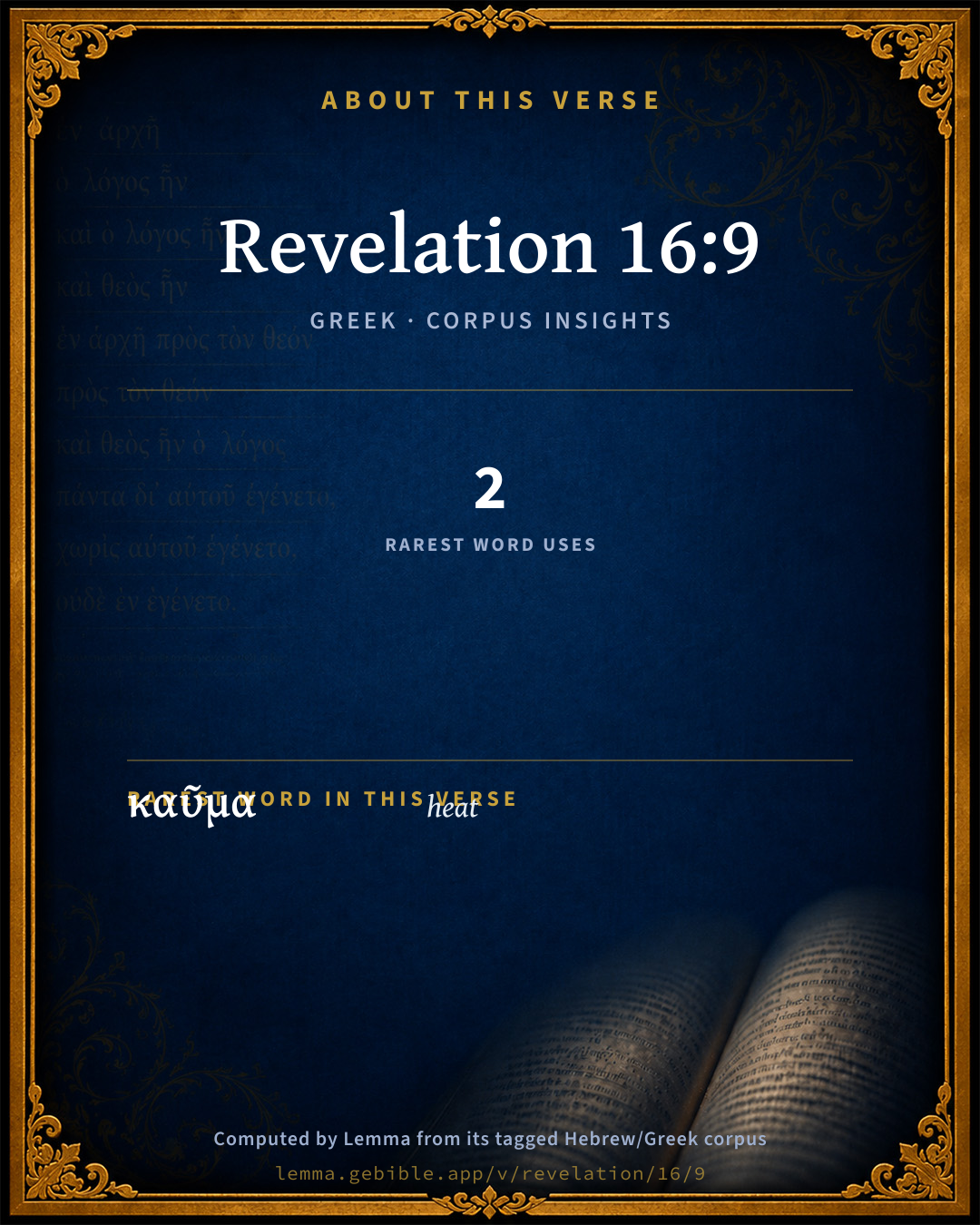
Revelation 16:9

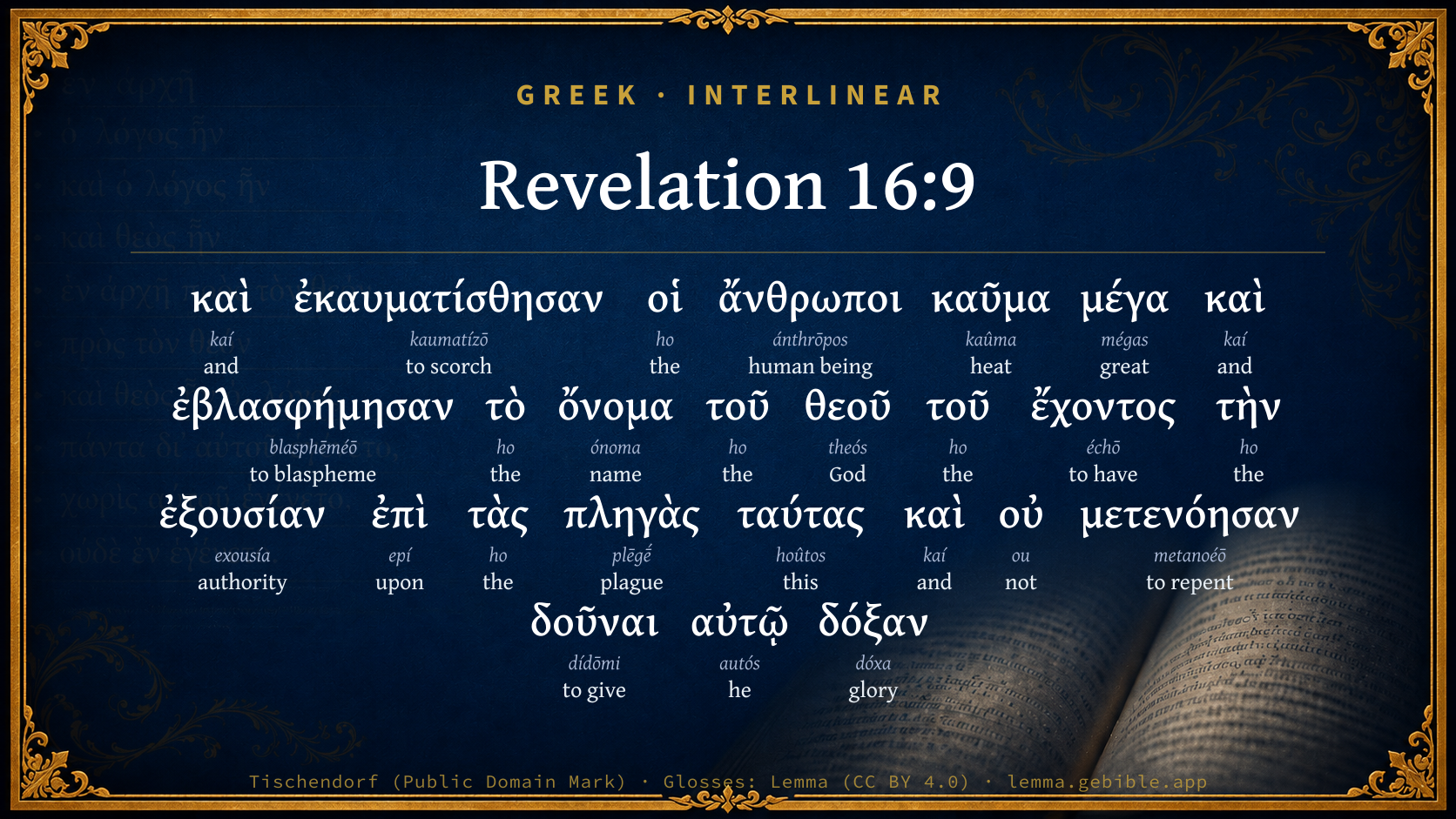
Greek (Tischendorf 8th ed.) Revelation 16:9 appears in the Greek New Testament. The text above is from the Tischendorf 8th edition. Each word links to its Strong’s number and a concise gloss. Click any word for its full Thayer’s Greek Lexicon entry.
Download image
Cite this verse

Revelation 16:9 (World English Bible). Public Domain. Lemma interlinear Bible study tool, https://lemma.gebible.app/v/revelation/16/9.

Show BibTeX & RIS
BibTeX
RIS
English Translation
People were scorched with great heat, and people blasphemed the name of God who has the power over these plagues. They didn't repent and give him glory.
World English Bible · Public Domain
Download a study sheet

One document with this verse’s original text, its word-by-word gloss line, the meaning frame, cross-references with their text, attributed commentary, and full source and license credits — printable, and it pastes into notes with its structure intact.

This verse Autodidact and up

Study sheet (.html) Plain text (.txt)

A passage Seminary Student

Up to 50 verses in one chapter. A passage sheet keeps up to 6 commentary sources and 12 cross-references per verse, in the order this page ranks them, and says so on the sheet whenever that leaves anything out. Ask for a single verse and you get the Autodidact verse sheet above.

Everything on this page stays free to read, with no account — the sheet is a download of what is already on screen, not access to it.

Want to remove ads? Support Godless Engineer
Compare translations 3

The same verse in 3 English versions, stacked beneath the original-language interlinear above. Click any original word for its lexicon entry.

Each is an independent rendering of the whole verse — the interlinear is not word-aligned to these translations.

Highlighted words mark where these versions differ — a whole-verse word diff, not a word-by-word alignment.

  • World English Bible Public Domain
    People were scorched with great heat, and people blasphemed the name of God who has the power over these plagues. They didn't repent and give him glory.
  • King James Version Public Domain
    And men were scorched with great heat, and blasphemed the name of God, which hath power over these plagues: and they repented not to give him glory.
  • unfoldingWord Literal Text CC BY-SA 4.0
    And men were scorched a great scorch and they blasphemed the name of the God having authority over these plagues, but they did not repent to give him glory.

unfoldingWord Literal Text — © unfoldingWord, licensed CC BY-SA 4.0. Word-aligned USFM3 via Door43 (git.door43.org/unfoldingWord/en_ult).

Versions to compare (up to 4)

3 of 4 selected

Show all 19 translations

Every available English version of this verse, each an independent rendering of the whole verse.

  • World English Bible Public Domain
    People were scorched with great heat, and people blasphemed the name of God who has the power over these plagues. They didn't repent and give him glory.
  • Berean Standard Bible Public Domain
    And the people were scorched by intense heat, and they cursed the name of God, who had authority over these plagues; yet they did not repent and give Him glory.
  • Majority Standard Bible Public Domain
    And the people were scorched by intense heat, and men cursed the name of God, who had authority over these plagues. Yet they did not repent and give Him glory.
  • King James Version Public Domain
    And men were scorched with great heat, and blasphemed the name of God, which hath power over these plagues: and they repented not to give him glory.
  • American Standard Version (1901) Public Domain
    And men were scorched men with great heat: and they blasphemed the name of God who hath the power over these plagues; and they repented not to give him glory.
  • Revised Version (1885) Public Domain
    And men were scorched with great heat: and they blasphemed the name of the God which hath the power over these plagues; and they repented not to give him glory.
  • Geneva Bible (1599) Public Domain
    And men boyled in great heate, and blasphemed the Name of God, which hath power ouer these plagues, and they repented not, to giue him glorie.
  • Douay-Rheims (1899) Public Domain
    And men were scorched with great heat, and they blasphemed the name of God, who hath power over these plagues, neither did they penance to give him glory.
  • Young's Literal Translation Public Domain
    and men were scorched with great heat, and they did speak evil of the name of God, who hath authority over these plagues, and they did not reform -- to give to Him glory.
  • Literal Standard Version CC BY-SA 4.0
    and men were scorched with great heat, and they slandered the Name of God, who has authority over these plagues, and they did not convert—to give to Him glory.
  • Unlocked Literal Bible CC BY-SA 4.0
    They were scorched by the terrible heat, and they blasphemed the name of God, who has the power over these plagues. They did not repent or give him glory.
  • unfoldingWord Literal Text CC BY-SA 4.0
    And men were scorched a great scorch and they blasphemed the name of the God having authority over these plagues, but they did not repent to give him glory.
  • Darby Bible Public Domain
    And the men were burnt with great heat, and blasphemed the name of God, who had authority over these plagues, and did not repent to give him glory.
  • World Messianic Bible Public Domain
    People were scorched with great heat, and people blasphemed the name of God who has the power over these plagues. They didn’t repent and give him glory.
  • Webster's Bible Public Domain
    And men were scorched with great heat, and blasphemed the name of God, who hath power over these plagues: and they repented not to give him glory.
  • Free Bible Version CC BY-SA 4.0
    They were scorched by intense heat, and they cursed the name of God who controlled these plagues. They did not repent and give him glory.
  • Bible in Basic English Public Domain
    And men were burned with great heat: and they said evil things against the name of the God who has authority over these punishments; and they were not turned from their evil ways to give him glory.
  • Text-Critical English NT CC BY 4.0
    People were scorched with intense heat, and they blasphemed the name of God, who had authority over these plagues, but they did not repent and give him glory.
  • Tyndale New Testament (1534) Public Domain
    And the men raged in gret heate and spake evyll of the name of God which had power over those plages and they repented not to geve him glory.

Literal Standard Version (2020), Covenant Press — licensed CC BY-SA 4.0. Text via the HelloAO Bible API (eBible.org). Unlocked Literal Bible (unfoldingWord) — licensed CC BY-SA 4.0. Text via the HelloAO Bible API (eBible.org). unfoldingWord Literal Text — © unfoldingWord, licensed CC BY-SA 4.0. Word-aligned USFM3 via Door43 (git.door43.org/unfoldingWord/en_ult). Free Bible Version, Dr. Jonathan Gallagher — licensed CC BY-SA 4.0. Text via the HelloAO Bible API (eBible.org).

Word by word

More ways to search: Search by grammar → Find every occurrence → Compare this word →

Practice this passage: Drill this verse → Learn its vocabulary →

καῦμα
kaûma
G2738
“heat”
Noun, Accusative, Singular, Neuter
Part of Speech
Noun
Case
Accusative
Number
Singular
Gender
Neuter
Full Thayer's Definition

Origin: from G2545

TDNT: 13:42,4

1. heat a. of painful and burning heat
  1. καὶ kaí G2532 “and” Conjunction
  2. ἐκαυματίσθησαν kaumatízō G2739 “to scorch” Verb, Aorist, Passive, Indicative, 3rd person, Plural
  3. οἱ ho G3588 “the” Article, Nominative, Plural, Masculine
  4. ἄνθρωποι ánthrōpos G444 “human being” Noun, Nominative, Plural, Masculine
  5. μέγα mégas G3173 “great” Adjective, Accusative, Singular, Neuter
  6. καὶ kaí G2532 “and” Conjunction
  7. ἐβλασφήμησαν blasphēméō G987 “to blaspheme” Verb, Aorist, Active, Indicative, 3rd person, Plural
  8. τὸ ho G3588 “the” Article, Accusative, Singular, Neuter
  9. ὄνομα ónoma G3686 “name” Noun, Accusative, Singular, Neuter
  10. τοῦ ho G3588 “the” Article, Genitive, Singular, Masculine
  11. θεοῦ theós G2316 “God” Noun, Genitive, Singular, Masculine
  12. τοῦ ho G3588 “the” Article, Genitive, Singular, Masculine
  13. ἔχοντος échō G2192 “to have” Verb, Present, Active, Participle, Genitive, Singular, Masculine
  14. τὴν ho G3588 “the” Article, Accusative, Singular, Feminine
  15. ἐξουσίαν exousía G1849 “authority” Noun, Accusative, Singular, Feminine
  16. ἐπὶ epí G1909 “upon” Preposition
  17. τὰς ho G3588 “the” Article, Accusative, Plural, Feminine
  18. πληγὰς plēgḗ G4127 “plague” Noun, Accusative, Plural, Feminine
  19. ταύτας hoûtos G3778 “this” Demonstrative pronoun, Accusative, Plural, Feminine
  20. καὶ kaí G2532 “and” Conjunction
  21. οὐ ou G3756 “not” Particle, Negative
  22. μετενόησαν metanoéō G3340 “to repent” Verb, Aorist, Active, Indicative, 3rd person, Plural
  23. δοῦναι dídōmi G1325 “to give” Verb, Aorist, Active, Infinitive
  24. αὐτῷ autós G846 “he” Personal pronoun, Dative, Singular, Masculine
  25. δόξαν dóxa G1391 “glory” Noun, Accusative, Singular, Feminine

About this verse

These counts appear in no published source. They are computed here, from the morphology-tagged text and Lemma’s own curated glosses. What Lemma adds →

26
words
19
distinct lemmas
Revelation
section

Notable vocabulary

The rarest word here is καῦμα heat G2738 — appearing just 2 times in the whole Greek New Testament.

Shared distinctive vocabulary

καῦμα heat G2738 occurs in 2 verses of the Greek New Testament. Also found in:

Repetition

Words recur within this verse:

Cross-references

20

Topical passages linked to Revelation 16:9 in the Treasury of Scripture Knowledge — connected by theme and wording, ordered by reader-vote popularity; previews shown in the World English Bible.

  • Revelation 2:21 I gave her time to repent, but she refuses to repent of her sexual immorality.
  • Revelation 16:21 Great hailstones, about the weight of a talent, came down out of the sky on people. People blasphemed God because of the plague of the hail, for this plague is exceedingly severe.
  • Jeremiah 5:3 O Yahweh, don't your eyes look on truth? you have stricken them, but they were not grieved; you have consumed them, but they have refused to receive correction: they have made their faces harder than a rock; they have refused to return.
  • Luke 13:5 I tell you, no, but, unless you repent, you will all perish in the same way."
  • Revelation 11:13 In that day there was a great earthquake, and a tenth of the city fell. Seven thousand people were killed in the earthquake, and the rest were terrified, and gave glory to the God of heaven.
  • Revelation 16:10–11 The fifth poured out his bowl on the throne of the beast, and his kingdom was darkened. They gnawed their tongues because of the pain,
  • Luke 13:3 I tell you, no, but, unless you repent, you will all perish in the same way.
  • Daniel 5:22–23 You his son, Belshazzar, have not humbled your heart, though you knew all this,
  • Amos 4:6–12 "I also have given you cleanness of teeth in all your cities, And lack of bread in every town; Yet you haven't returned to me," says Yahweh.
  • Revelation 9:20 The rest of mankind, who were not killed with these plagues, didn't repent of the works of their hands, that they wouldn't worship demons, and the idols of gold, and of silver, and of brass, and of stone, and of wood; which can neither see, nor hear, nor walk.
  • Isaiah 8:21 They shall pass through it, sore distressed and hungry; and it shall happen that when they shall be hungry, they shall fret themselves, and curse by their king and by their God, and turn their faces upward:
  • Revelation 14:7 He said with a loud voice, "Fear the Lord, and give him glory; for the hour of his judgment has come. Worship him who made the heaven, the earth, the sea, and the springs of waters!"
  • Joshua 7:19 Joshua said to Achan, My son, please give glory to Yahweh, the God of Israel, and make confession to him; and tell me now what you have done; don't hide it from me.
  • 2 Kings 6:33 While he was yet talking with them, behold, the messenger came down to him: and he said, Behold, this evil is of Yahweh; why should I wait for Yahweh any longer?
  • 2 Chronicles 28:22 In the time of his distress did he trespass yet more against Yahweh, this same king Ahaz.
  • Isaiah 1:5 Why should you be beaten more, That you revolt more and more? The whole head is sick, And the whole heart faint.
  • Jeremiah 6:29–30 The bellows blow fiercely; the lead is consumed of the fire: in vain do they go on refining; for the wicked are not plucked away.
  • Ezekiel 24:13 In your filthiness is lewdness: because I have cleansed you and you weren't cleansed, you shall not be cleansed from your filthiness any more, until I have caused my wrath toward you to rest.
  • 2 Corinthians 12:21 that again when I come my God would humble me before you, and I would mourn for many of those who have sinned before now, and not repented of the uncleanness and sexual immorality and lustfulness which they committed.
  • Jeremiah 13:6 It happened after many days, that Yahweh said to me, Arise, go to the Euphrates, and take the belt from there, which I commanded you to hide there.

Cross-references courtesy of OpenBible.info (CC BY 4.0).

Where the printed editions differ

1 variant

Places in this verse where the major printed Greek editions disagree on the wording in a way that affects the translation — a comparison of editions, not a manuscript-by-manuscript collation. The editions are the modern critical texts (Nestlé-Aland 28/27, SBL, Westcott-Hort, Tregelles, Tyndale House) and the traditional texts behind the KJV (the Textus Receptus and the Byzantine/Majority text). It is not a claim about which reading is original.

  1. Extra text
    οἱ ἄνθρωποι

    “the people”

    In Byz Not in NA28NA27TynSBLWHTregTR

    οἱ ἄνθρωποι (hoi anthrōpoi) 'the people' is only in a few manuscripts (Byz)

Textual data: Translators Amalgamated Greek New Testament (STEPBible TAGNT) · CC BY 4.0.

Commentary

Notes on Revelation 16:9 from classic Christian and Jewish commentators (each source and its license shown beneath its notes). The classic Christian expositions comment on the surrounding passage and are grouped to its opening verse, so a note may address several verses; the Jewish commentaries on the Tanakh (Rashi and others) are per-verse, so they appear only where the commentator wrote on this verse.

Lemma curates 59 commentaries, every one of them public domain or Creative Commons licensed, each selected and text-cleaned for this edition rather than reprinted as found. About our sources →

Bengel's Gnomon

Johann Albrecht Bengel

Rev 16:9. Ἐβλασφήμησαν, they blasphemed) A dreadful sin, blasphemy: but yet even against the will of the wicked it turns out to the honour of GOD: for they confess, that they succumb.

Bengel's Gnomon of the New Testament — English translation (T&T Clark, Edinburgh, 1860) — public domain. Text from a community e-Sword module.

Expositor's Greek Testament

ed. W. Robertson Nicoll

Rev 16:9 . Failure to honour the true God, a note of the heathen spirit (as in Rev 11:13 , Rev 14:7 ; Rom 1:28 ). See Introd., § 6. For the general idea, cf. 2 Clem. ix.: “while we have opportunity of being healed, let us give ourselves over to God the healer, giving him a recompense. And what recompense? Repentance from a sincere heart.… Let us give him eternal praise.”

The Expositor's Greek Testament, edited by W. Robertson Nicoll (1897–1910) — public domain. Text from a community e-Sword module.

Jamieson, Fausset & Brown

Robert Jamieson, A. R. Fausset & David Brown

men--Greek, "the men."

repented not to give him glory-- (Rev 9:20). Affliction, if it does not melt, hardens the sinner. Compare the better result on others, Rev 11:13; Rev 14:7; Rev 15:4.

Jamieson, Fausset & Brown — Commentary Critical and Explanatory on the Whole Bible (1871) — public domain (CC PDM 1.0). Text via the HelloAO Bible API.

Adam Clarke's Commentary

Verse 9. They repented not] No moral national amendment has taken place in consequence of the above calamities in that unhappy country, nor indeed any of those nations engaged against her in that long and ruinous contest, which has now terminated, (1817,) without producing one political, moral, or religious advantage to herself or to Europe.

Adam Clarke's Commentary on the Bible (1810–1826) — public domain. Text from a community e-Sword/MySword module.

The Cambridge Bible for Schools and Colleges

gen. ed. J. J. S. Perowne

9. repented not to give him glory] Contrast Rev_11:13, which therefore cannot refer to the same judgements as here, nor (probably) to judgements on the same place or people.

The Cambridge Bible for Schools and Colleges (gen. ed. J. J. S. Perowne; Cambridge University Press, 1878–1918) — public domain. Text from a community e-Sword module.

John Gill's Exposition

And the fifth angel poured out his vial upon the seat of the beast,.... The beast is the same with that in Rev 13:1 and which again shows that to be one and the same: the seat or throne of the beast is Rome, which, when the empire was Pagan, was the seat of Satan, or the dragon, Rev 2:13 and when the beast or antichrist was risen, the dragon gave this seat, as well as his authority to him, Rev 13:2 and is that city which is so often called, in this book, the great city, and is manifestly pointed out by its seven mountains, on which the city of Rome stood, Rev 17:9 and the pouring out of this vial upon it denotes the destruction of it, when it will be burnt down, and become desolate, an habitation of devils, of every foul spirit, and hateful bird, Rev 18:2 and this corresponds with the fifth trumpet; for as that brings in the rise of antichrist, both eastern and western, who rose much about the same time, so this vial affects him particularly; the western antichrist, his seat and kingdom. Mr. Daubuz refers this plague to the expulsion of the western and eastern emperors from their capital cities, Rome and Constantinople, and to the mischiefs caused by the antipopes in the west, and to the quarrels and schism in the Greek churches in the fourteenth century.

And his kingdom was full of darkness; not only of the darkness of false doctrine and superstition, for so it was always, being filled with the smoke of the bottomless pit; nor only of judicial blindness and darkness, which the subjects of the antichristian state are given up unto; but rather of a discovery of all this, with all their hidden works of darkness, which will now be brought to light; though it seems chiefly to design the great affliction and distress the antichristian state will be in at this time, which darkness sometimes signifies; see Isa 9:1 it having lost its sun, the pope, under the preceding vial, and its seat, the city of Rome, under this: the sense is, that it will be greatly obscured in its glory and magnificence, in its traffic and riches, Rev 18:11 its power and authority will be greatly diminished, and it will be had in contempt by the princes of the earth; though it will not as yet be utterly destroyed, for its utter destruction is reserved for the seventh and last vial. The allusion is to the plague of darkness in Egypt, Exo 10:21. And they gnawed their tongues for pain; these are the men of the antichristian party, the subjects of the antichristian kingdom, now become full of darkness, the worshippers of the beast, and his image; these will gnaw their tongues, which expresses their inward anguish and distress, their anger, wrath, and fury, their being filled with revenge, and yet in an incapacity to execute it, and will even be afraid to express it; and therefore will bite their tongues in madness; and this for pain, for the pain of their mind, at the sad and low estate of the antichristian kingdom.

John Gill's Exposition of the Whole Bible (1746–1763) — public domain (CC PDM 1.0). Text via the HelloAO Bible API.

Trapp's Complete Commentary

John Trapp

9 And men were scorched with great heat, and blasphemed the name of God, which hath power over these plagues: and they repented not to give him glory.

Ver. 9. And men were scorched] Or parched, scalded, roasted, εκαυματισθησαν. This is by accident in regard of the Scriptures; for the Lord speaketh peace to his people; and his word is good to those that are good, Mic 2:7. But as Origen saith of devils, so may we say of Papists; there is no greater torment to them than the word of God. In hoc eorum omnis flamma est, in hoc uruntur incendio. Hence they burn up Bibles, tanquam doctrinam peregrinam, as strange doctrine. (Spec. Europ.) Hence they censure St Paul as savouring of heresy, and could find in their hearts to purge his Epistles. Eckius is not afraid to say, that Christ did never command his disciples to write, but to preach only. (Enchirid. loc. com. cap. Eccles.) Bellarmine saith, the Bible is no more than commonitorium, a kind of storehouse for advice. Hosius saith that the pope’s interpretation, though it seem never so repugnant to the Scripture, is nevertheless ipsissimum Dei verbura, the very word of God. The Council of Basil answered the Hussites (requiring Scripture proofs for such doctrines as were thrust upon them), that the Scriptures were not of the being of the Church, but of the well being only; that traditions were the touchstone of doctrine and foundation of faith.

And blasphemed the name of God] The truth of God contained in the Scriptures. What a devil made thee to meddle with the Scripture said Stephen Gardiner to Marbeck. They tell us of several that have been possessed by that means; and assure us that our condemnation is so expressly set down in our own Bibles, and is so clear to all the world, that nothing more needs hereto than that we know to read, and to have our eyes in our heads at the opening thereof. (Alex. Cook.)

John Trapp, A Commentary or Exposition upon All the Books of the Old and New Testament (1647–1656) — public domain. Text from a community e-Sword module.

Albert Barnes' Notes on the Bible

And men were scorched with great heat - That is, as above expressed, calamity came upon them which would be well represented by such heat. It is said that this calamity would come upon people, and we are to suppose that it would be such that human life would be particularly affected; and as that heat of the sun must be exceedingly intense which would cut down people, we are to suppose that the judgment here referred to would be intensely severe.

And blasphemed the name of God - The effect would be to cause them to blaspheme God or to reproach him as the author of these calamities; and in the fulfillment of this we are to look for a state of things when there would be augmented wickedness and irreligion, and when people would become worse and worse, notwithstanding the woes that had come upon them.

Which hath power over these plagues - Who had brought these plagues upon them, and who had power to remove them.

And they repented not - The effect was not to produce repentance, though it was manifest that these judgments had come upon them on account of their sins. Compare the notes on Rev 9:21.

To give him glory - To turn from sin; to honor him by lives of obedience. Compare the notes on Joh 9:24.

In regard to the “application” of this the following things may be remarked:

That the calamity here referred to was one of the series of events which would precede the overthrow of the “beast,” and contribute to that, for to this all these judgments tend. In the order in which it stands it is to follow, and apparently to follow soon, the third judgment - the pouring of the vial upon the fountains and streams. It would be a calamity such as if the sun, the source of light and comfort to mankind, were smitten, and became a source of torment. This would be attended by a great destruction of people, and we should naturally look in such an application for calamities in which multitudes of people would be, as it were, consumed. This would not be followed, as it might be hoped it would, by repentance, but would be attended with reproaches of God, with profaneness, with a great increase of wickedness.

Now, on the supposition that the explanation of the previous passages is correct, there can be no great difficulty in supposing that this refers to the wars of Europe following the French revolution, the wars that preceded the direct attack on the papacy and the overthrow of the papal government, for these events had all the characteristics here referred to:

(a) They were one of a series in weakening the papal power in Europe - heavy blows that will yet be seen to have been among the means preliminary to its final overthrow.

(b) They followed in their order the invasion of Northern Italy, for one of the purposes of that invasion was to attack the Austrian power there, and ultimately through the Tyrol to attack Austria itself. Napoleon, after his victories in Northern Italy, above referred to (compare chapter xx of Alison’s History of Europe), thus writes to the French Directory: “Coni, Ceva, and Alexandria are in the hands of our army; if you do not ratify the convention I will keep these fortresses and march upon Turin. Meanwhile I shall march tomorrow against Beaulieu, and drive him across the Po; I shall follow close at his heels, overrun all Lombardy, and in a month be in the Tyrol, join the army of the Rhine, and carry our united forces into Bavaria. That design is worthy of you, of the army, and of the destinies of France” (Alison, i. 401).

(c) The campaign in Germany in 1796 followed immediately this campaign in Italy. Thus, in chapter xx. of Alison’s History, we have an account of the campaign in Italy; in chapter xxi. we have the account of the campaign in Germany; and the other wars in Europe that continued so long, and that were so fierce and bloody, followed in quick succession - all tending, in their ultimate results, to weaken the papal power and to secure its final overthrow.

(d) It is hardly necessary to say here that these wars had all the characteristics here supposed. It was as if the sun were smitten in the heavens and power were given to scorch people with fire. Europe seemed to be on fire with musketry and artillery, and presented almost the appearance of the broad blaze of a battlefield. The number that perished was immense. These wars were attended with the usual consequences - blasphemy, profaneness, and reproaches of God in every form. And yet there was another effect wholly in accordance with the statement here, that none of these judgments brought people to “repentance, that they might give God the glory.” Perhaps these remarks, which might be extended to great length, will show that, on the supposition that it was intended to refer to those scenes by the outpouring of this vial, the symbol was well chosen and appropriate.

Albert Barnes' Notes on the Bible (1834–1885) — public domain. Text from a community e-Sword/MySword module.

Matthew Poole's English Annotations

What the damned do in hell, where the wrath of God is poured out upon men to the utmost, that reprobates do upon earth, they are

scorched with great heat, the vengeance of God cometh upon them; they are mad and enraged, and speak evil of a just and righteous God, who bringeth such plagues on them; but they have no sense of their sins, nor any thoughts of turning to God, confessing their sins, and giving him glory. This will be the upshot of God’s lesser judgments upon the papacy: they will be mad at them, and rage, and reproach God’s justice, but prove a hardened generation, given over to ruin, that will never be sensible that these judgments come upon them for their idolatries and superstitions, and for their persecutions, and the shedding the blood of God’s holy ones. Not that all adhering to that church will be so, (many, probably, will convert, and be brought to acknowledge the truth), but there will be a great party of them, whom nothing but the wrath of God come upon them in the bottomless pit to the utmost, will ever make sensible that they have done amiss, being given up to strong delusions, to a blind mind, and a hard heart, and a reprobate judgment.

Matthew Poole's English Annotations on the Holy Bible (1683–1685) — public domain. Text from a community e-Sword/MySword module.

Whedon's Commentary on the Bible

Daniel D. Whedon

9. Blasphemed—Penalty sometimes admonishes and reforms, as in Rev_11:13; but it aggravates the hardened, as here and in Rev_9:21. Like the hardened Israelites of Isa_8:21, these sun-scorched sinners could only “curse their God and look upward.”

From the four creation points the avenger now approaches nearer and nearer the beast. Clearly, (notwithstanding Dusterdieck’s denial,) there is a distinct transition from the previous four vials, poured upon points of inanimate nature, on account of man, and the three directly poured upon the bestial throne, his Euphratean population, and his metropolis.

Daniel D. Whedon (gen. ed.), Commentary on the Old and New Testaments (1874–1909) — public domain. Text from a community e-Sword module.

The Pulpit Commentary

And men were scorched with great heat, and blasphemed the Name of God. The men (see on ver. 8). (On the meaning of the first clause, see on ver. 8) This is the first mention in the vials of men blaspheming. As with Pharaoh and the Egyptians, the judgments of God, instead of awakening them to repentance, only serve to harden their hearts. This again occurs under the fifth and seventh vials. So also in the sixth trumpet, we are told, men repented not a statement also made in the subsequent part of this verse. As before pointed out, (Rev_13:1) the two things are identical; non repentance, continuance in the service of the dragon, is blasphemy against God; though we generally reserve the name "blasphemy" for the open avowal of infidelity to God. Which hath power over these plagues. This is what is implied in the words of ver. 8, "it was given to it?" In this visitation men distinctly recognize the hand of God. And they repented not to give him glory. Vide supra, on the "blasphemy;" and contrast with Rev_11:13 another example of the sense in which these vials are the "last plagues". (Rev_15:1)

The hardened heart.

"They repented not to give him glory." This impenitence is told of in Rev_9:20, and in this chapter again at vers. 11 and 21. This repeated reference is designed to, as it well may, impress our minds with a fact at once so sinful, so solemn, and so sad. For such impenitence is

I A VERY CERTAIN FACT. The late Mr. Kingsley, in his book, "The Roman and the Teuton," draws out at length the evidence both of the horrible sufferings and the yet more horrible impenitence of the Roman people in the days of their empire"s fall. He refers to these very verses as accurately describing the condition of things in those awful days, when the people of Rome "gnawed their tongues for pain, and blasphemed," etc. (ver. 11). And it is to Rome and her fall that St. John is here alluding. There can hardly be doubt of that. But the sinners at Rome were not the only ones who, in spite of the judgments of God resting upon them, have, nevertheless, hardened their hearts. Who has not known of such things?

II AND VERY WONDERFUL. We say a burnt child dreads the fire, but it is evident that they who have been "scorched with great heat" (ver. 9) by the righteous wrath of God are yet not afraid to incur that wrath again. Nothing strikes us more than the persistent way in which, in the "day of provocation in the wilderness," the Israelites went on sinning, notwithstanding all that it brought upon them in the way of punishment. There was every reason and motive for them to obey God, and yet they did scarce anything but provoke him. And it is so still.

III AND VERY AWFUL. "Ephraim is joined to idols: let him alone." "Why should ye be stricken any more? no good comes of it, punishment does not make any difference. Such are the despairing words of the prophets of God. There are few surer signs of perdition than when a man is hardened in sin and more set in enmity against God by reason of his righteous judgments. What can even God do then? If what is designed to lead us to repentance only drive us into more sin, what hope is there? See those told of here; what a description of unspeakable distress their tongues for pain," but blaspheming God the while and repenting not! "From hardness of heart,... good Lord, deliver us.

IV BUT YET NOT INEXPLICABLE. For:

1. Times of such distress as are told of here are just the most unfavourable times of all others for that serious, earnest thought which would lead to repentance. Distress distracts the mind, drags it hither and thither, so that it cannot stay itself upon God. To trust to the hour of death to turn unto God is, indeed, to build upon the sand.

2. Resentment against their ill treatment holds their mind more than aught else. Thrice are we told how the men who "gnawed their tongues for pain" blasphemed God. Burning rage against him enwrapped their souls. As if he were to blame, and not they! They explain that difficult verse in the ninetieth psalm, "Who regardeth the power of thy wrath? even according to thy fear, so is thy wrath." It is only they who have a holy fear of God who will regard his wrath; according to the measure of that fear will be the measure of right regard of the wrath of God. Where that fear is not, God"s wrath will exasperate, enrage, and harden, but there will be no repentance.

3. They attribute their sufferings to every cause but the true one. How easy it is to do this! how commonly it is done! How men snatch at every suggestion that will help them to lay the blame upon other men or things! It is part of "the deceitfulness of sin" to make men do this. But until a man is led to cry, with him of old, "God be merciful to me, the sinner!", (Luk_18:13) he may groan in agony of body or mind, but he will never turn in heart to God.

4. Sin has such hold on them that they cannot give it up. Yes, deeper than the dread of its punishment is the love of the sin. Once it might have been broken through as easily as the cobweb that stretches across the garden path; but, indulged and indulged, it has become a cable that holds the man in spite of all the storm of God"s judgments and the tempest of his wrath. Cries and tears, protestations and prayers, may be extorted from the man through his terror and pain; but they are but surface sounds, and touch not the depth or reality of the man"s soul.

5. Because sentence against an evil work is not executed speedily, therefore the hearts of the sons of men is fully set in them to do evil". (Ecc_8:11) The interval between the sentence and its being carried out is given for repentance; but men have made it a means of greater sin. Such are some of the reasons that explain the seemingly wonderful fact we are considering.

V AND IT IS FULL OF WARNING. Even torture does not turn a man, nor suffering save. That old and awful puritanic cry to sinners, "Turn or burn! a cry which, we believe, never yet turned one heart to God, for it is not the nature of terror to do that has a yet more dread sequel; that if a man will not now, in "the day of salvation," turn to God, he may burn and yet not turn. Such is the teaching, not of our text alone, but of all experience too. O God, fill our hearts with the fear and love of thee! S.C.

The Pulpit Commentary (1880–1919), ed. H.D.M. Spence-Jones & Joseph S. Exell — public domain. Text from a community e-Sword module.

John Wesley's Explanatory Notes

And the men blasphemed God, who had power over these plagues - They could not but acknowledge the hand of God, yet did they harden themselves against him.

John Wesley, Explanatory Notes Upon the Whole Bible (1754–1765) — public domain. Text via the GEBible commentary corpus.

Cambridge Greek Testament for Schools and Colleges

9. τὸ ὄνομα. A reads ἐνώπιον.

9. ἐβλασφήμησαν. Contrast Rev 15:4. This, which marks a new and intenser stage of suffering, is henceforth repeated after every vial but the sixth, which describes preparations for active rebellion.

τοῦ ἔχοντος. Must refer to God: it would be yet more forced to interpret it (with Winer?) “they blasphemed the name of the God of (the angel) who had power &c.,” than to interpret αὐτῷ of the Angel.

τὴν ἐξουσίαν. Here, as in St Luk 12:5, Rom 9:21, it is impossible to find any trace of the common sense of a committed authority. Probably also in St Mat 7:29, St Mar 1:22, St Luk 4:32, the contrast is between the inherent independent authority of Christ, and those who sat in Moses’ seat and had the best right to be believed when they were content to quote their predecessors.

οὐ μετενόησαν δοῦναι αὐτῷ δόξαν. Contrast Rev 11:13, which therefore cannot refer to the same judgements as here, nor probably to judgements on the same place or people.

Cambridge Greek Testament for Schools and Colleges (Cambridge University Press, 1896; 21 vols, various authors incl. Carr, Maclear, Plummer, Farrar, Lumby, Moule, M. R. James, Simcox) — public domain. Text from a community e-Sword module.

Alford’s Greek Testament

Henry Alford

9.] And the fourth poured out his vial upon (no longer εἰς) the sun: and it was given to it (the sun: not “to him,” the angel, as, strangely enough, Bengel and Hengstb., and Elliott, iii. 361. The angels throughout this vision are simply the pourers out of the vials, not the executors of the plagues. Besides which, the verb καυματίζω, in a sentence where the sun is mentioned, can have but one reference: see reff.) to scorch men (the τούς is probably generic merely. If it is to be assigned a meaning, it may be, the men who have received the mark and number of the beast. But the other is more likely) with (the ἐν of investiture: the element in which the scorching takes place) fire (not, as Hengstb., understanding αὐτῷ of the angel, some fire other than the sun: but the glowing increased heat of the sun itself), and men were scorched with great heat (on the accus. after the passive verb which takes a double accus. in active, see reff., and Winer, edn. 6, § 32. 5), and blasphemed the name of God who hath power over these plagues, and did not repent to give Him glory (on the inf. epexegetic, see Winer, edn. 6, § 44.1).

10,

Henry Alford, The Greek Testament (1849–1861) — public domain. Text from a community e-Sword module.

Vincent's Word Studies in the New Testament

Marvin R. Vincent

Repent to give Him glory. Glorify Him by repentance.

His kingdom was darkened. Compare Exo 10:21, 22.

They gnawed [εμασσωντο] . Only here in the New Testament.

For pain [εκ του πονου] . Strictly, from their pain. Their, the force of the article tou.

Marvin R. Vincent, Word Studies in the New Testament (1887–1900) — public domain. Text from a community e-Sword/MySword module.

Lesson kit

Teaching starters — assembled from the data on this page, not authored interpretation. Every prompt links to the verse data it draws on. Edit before teaching.

Revelation, in the Revelation, opens this verse with 26 words (19 distinct Greek lemmas). Its most distinctive word is kaûma (“heat”). A historical commentator’s framing appears above. Read the whole chapter for the surrounding context.

Discussion questions

  1. How does “heat” (kaûma) shape what this verse is saying?
  2. How does Revelation 7:16, which shares the word «heat», read alongside this verse?
  3. What does the repetition of “the” (6× in this one verse) do in this verse?
  4. These translations render this verse differently. What is at stake in choosing one wording over another?
  5. Compare how Bengel's Gnomon and Expositor's Greek Testament read this verse. Where do they agree or differ?

Things to notice

Reading settings

Reading text

Shown beneath each verse's original-language words.

Old Testament
Old Testament edition

Read the OT as the Masoretic Hebrew (MT) or the Greek Septuagint (LXX).

English shown for the Greek Septuagint (in the Hebrew ↔ Greek comparison).

Comparing translations? Open the Compare panel on any verse page to stack up to four side by side.