Daniel 7:12

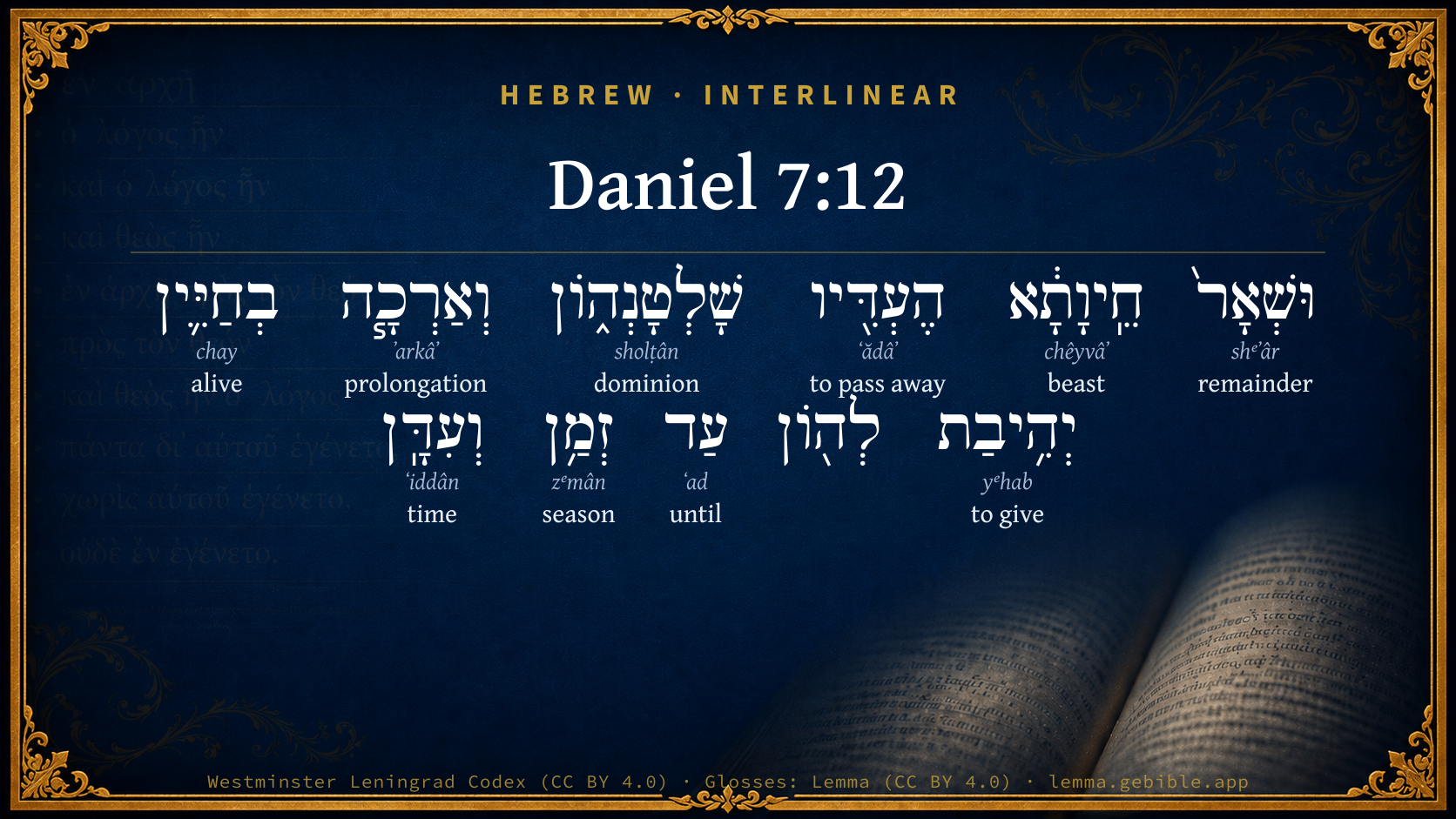
Hebrew (Westminster Leningrad Codex) Daniel 7:12 appears in the Hebrew Old Testament. The text above is from the Westminster Leningrad Codex. Each word links to its Strong’s number, a concise gloss, and parsing drawn from the Open Scriptures Hebrew Bible morphology. Click any word for its full Brown-Driver-Briggs (BDB) entry.
Download image
Cite this verse

Daniel 7:12 (World English Bible). Public Domain. Lemma interlinear Bible study tool, https://lemma.gebible.app/v/daniel/7/12.

Show BibTeX & RIS
BibTeX
RIS
English Translation
As for the rest of the animals, their dominion was taken away: yet their lives were prolonged for a season and a time.
World English Bible · Public Domain
Download a study sheet

One document with this verse’s original text, its word-by-word gloss line, the meaning frame, cross-references with their text, attributed commentary, and full source and license credits — printable, and it pastes into notes with its structure intact.

This verse Autodidact and up

Study sheet (.html) Plain text (.txt)

A passage Seminary Student

Up to 50 verses in one chapter. A passage sheet keeps up to 6 commentary sources and 12 cross-references per verse, in the order this page ranks them, and says so on the sheet whenever that leaves anything out. Ask for a single verse and you get the Autodidact verse sheet above.

Everything on this page stays free to read, with no account — the sheet is a download of what is already on screen, not access to it.

Want to remove ads? Support Godless Engineer
Compare translations 3

The same verse in 3 English versions, stacked beneath the original-language interlinear above. Click any original word for its lexicon entry.

Each is an independent rendering of the whole verse — the interlinear is not word-aligned to these translations.

Highlighted words mark where these versions differ — a whole-verse word diff, not a word-by-word alignment.

  • World English Bible Public Domain
    As for the rest of the animals, their dominion was taken away: yet their lives were prolonged for a season and a time.
  • King James Version Public Domain
    As concerning the rest of the beasts, they had their dominion taken away: yet their lives were prolonged for a season and time.
  • unfoldingWord Literal Text CC BY-SA 4.0
    As for the rest of the beasts, their dominion was taken away, but an extension in life was given to them for a season and a time.

unfoldingWord Literal Text — © unfoldingWord, licensed CC BY-SA 4.0. Word-aligned USFM3 via Door43 (git.door43.org/unfoldingWord/en_ult).

Versions to compare (up to 4)

3 of 4 selected

Show all 18 translations

Every available English version of this verse, each an independent rendering of the whole verse.

  • World English Bible Public Domain
    As for the rest of the animals, their dominion was taken away: yet their lives were prolonged for a season and a time.
  • Berean Standard Bible Public Domain
    As for the rest of the beasts, their dominion was removed, but they were granted an extension of life for a season and a time.
  • Majority Standard Bible Public Domain
    As for the rest of the beasts, their dominion was removed, but they were granted an extension of life for a season and a time.
  • King James Version Public Domain
    As concerning the rest of the beasts, they had their dominion taken away: yet their lives were prolonged for a season and time.
  • American Standard Version (1901) Public Domain
    And as for the rest of the beasts, their dominion was taken away: yet their lives were prolonged for a season and a time.
  • Revised Version (1885) Public Domain
    And as for the rest of the beasts, their dominion was taken away: yet their lives were prolonged for a season and a time.
  • Geneva Bible (1599) Public Domain
    As concerning the other beastes, they had taken away their dominion: yet their liues were prolonged for a certaine time and season.
  • Douay-Rheims (1899) Public Domain
    And that the power of the other beasts was taken away: and that times of life were appointed them for a time, and time.
  • Young's Literal Translation Public Domain
    and the rest of the beasts have caused their dominion to pass away, and a prolongation in life is given to them, till a season and a time.
  • Literal Standard Version CC BY-SA 4.0
    and the rest of the beasts have caused their dominion to pass away, and a prolongation in life is given to them, until a season and a time.
  • Unlocked Literal Bible CC BY-SA 4.0
    As for the rest of the four animals, their authority to rule was taken away, but their lives were prolonged for a period of time.
  • unfoldingWord Literal Text CC BY-SA 4.0
    As for the rest of the beasts, their dominion was taken away, but an extension in life was given to them for a season and a time.
  • Darby Bible Public Domain
    As for the rest of the beasts, their dominion was taken away; but their lives were prolonged for a season and a time.
  • World Messianic Bible Public Domain
    As for the rest of the animals, their dominion was taken away; yet their lives were prolonged for a season and a time.
  • Webster's Bible Public Domain
    As concerning the rest of the beasts, they had their dominion taken away: yet their lives were prolonged for a season and time.
  • Free Bible Version CC BY-SA 4.0
    The rest of the beasts were allowed to go on living for a season and a time, but their power to rule had been taken away.
  • Bible in Basic English Public Domain
    As for the rest of the beasts, their authority was taken away: but they let them go on living for a measure of time.
  • JPS Tanakh (1917) Public Domain
    And as for the rest of the beasts, their dominion was taken away; yet their lives were prolonged for a season and a time.

Literal Standard Version (2020), Covenant Press — licensed CC BY-SA 4.0. Text via the HelloAO Bible API (eBible.org). Unlocked Literal Bible (unfoldingWord) — licensed CC BY-SA 4.0. Text via the HelloAO Bible API (eBible.org). unfoldingWord Literal Text — © unfoldingWord, licensed CC BY-SA 4.0. Word-aligned USFM3 via Door43 (git.door43.org/unfoldingWord/en_ult). Free Bible Version, Dr. Jonathan Gallagher — licensed CC BY-SA 4.0. Text via the HelloAO Bible API (eBible.org).

Word by word

More ways to search: Search by grammar → Find every occurrence → Compare this word →

Practice this passage: Drill this verse → Learn its vocabulary →

וְאַרְכָ֧ה
ʼarkâʼ
H754
“and · prolongation”
Adjective, C + Noun, Common, Feminine, Singular, Absolute
Part of Speech
Adjective + Noun
Type
Common
Gender
Feminine
Number
Singular
State
Absolute
Full BDB Definition

Origin: from H749

TWOT: 2609

prolongation, lengthening, prolonging
  1. וּשְׁאָר֙ shᵉʼâr H7606 “and · remainder of” Adjective, C + Noun, Common, Masculine, Singular, Construct
  2. חֵֽיוָתָ֔א chêyvâʼ H2423 “beasts · the” Adjective, N, Common + Particle, Definite Article
  3. הֶעְדִּ֖יו ʻădâʼ H5709 “to pass away” Adjective, V, Plural
  4. שָׁלְטָנְה֑וֹן sholṭân H7985 “dominion · their” Adjective, N, Common + Suffix, Personal, 3rd Person, Masculine, Plural
  5. בְחַיִּ֛ין chay H2417 “in/at · living ones” Adjective, R + Noun, Common, Masculine, Plural, Absolute
  6. יְהִ֥יבַת yᵉhab H3052 “to give” Adjective, V, Plural
  7. עַד ʻad H5705 “until” Adjective, R
  8. זְמַ֥ן zᵉmân H2166 “season” Adjective, N, Common
  9. וְעִדָּֽן ʻiddân H5732 “and · time” Adjective, C + Noun, Common, Masculine, Singular, Absolute

About this verse

These counts appear in no published source. They are computed here, from the morphology-tagged text and Lemma’s own curated glosses. What Lemma adds →

11
words
10
distinct lemmas
Prophets
section

Notable vocabulary

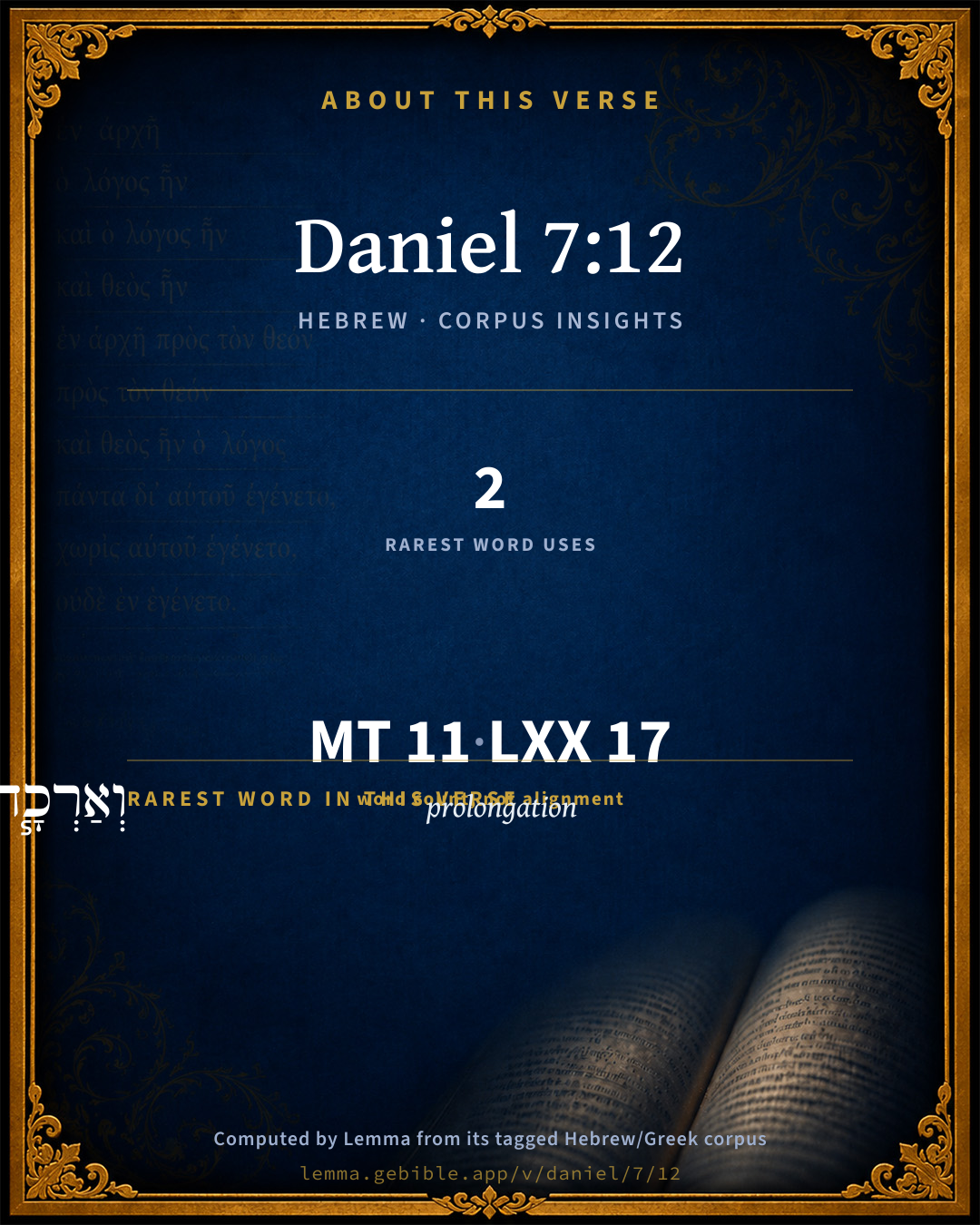
The rarest word here is וְאַרְכָ֧ה prolongation H754 — appearing just 2 times in the whole Hebrew Bible.

Shared distinctive vocabulary

וְאַרְכָ֧ה prolongation H754 occurs in 2 verses of the Hebrew Bible. Also found in:

Grammatical profile

  • 4 nouns
  • 6 adjectives
  • 1 particle

Hebrew & Septuagint length

In English translation the verse runs 23 words from the Hebrew and 24 from the Septuagint (LXX English) — closely comparable.

A rough comparison of the two English renderings, which tokenize alike — not a word-level alignment.

Word counts can differ between the Hebrew and the Greek without any difference in meaning — e.g. the Hebrew direct-object marker אֵת has no separate Greek word, and Greek often adds the article ὁ.

In the original languages it is 11 Hebrew tokens and 17 Greek tokens — but the two are counted differently (Hebrew bundles its prefixes and suffixes into one token; the Greek is in lemma form), so that isn’t a like-for-like length.

Cross-references

1

Topical passages linked to Daniel 7:12 in the Treasury of Scripture Knowledge — connected by theme and wording, ordered by reader-vote popularity; previews shown in the World English Bible.

  • Daniel 8:7 I saw him come close to the ram, and he was moved with anger against him, and struck the ram, and broke his two horns; and there was no power in the ram to stand before him; but he cast him down to the ground, and trampled on him; and there was none who could deliver the ram out of his hand.

Cross-references courtesy of OpenBible.info (CC BY 4.0).

Hebrew and Greek witnesses Masoretic Hebrew ↔ Greek Septuagint

The same verse in the two great witnesses to the Old Testament, shown verse-for-verse.

These are two independent witnesses, not word-aligned to each other, and the Septuagint is shown in lemma (dictionary) form.

Hebrew Daniel 7:12 Masoretic · Westminster Leningrad Codex

וּשְׁאָר֙ חֵֽיוָתָ֔א הֶעְדִּ֖יו שָׁלְטָנְה֑וֹן וְאַרְכָ֧ה בְחַיִּ֛ין יְהִ֥יבַת לְה֖וֹן עַד זְמַ֥ן וְעִדָּֽן

As for the rest of the animals, their dominion was taken away: yet their lives were prolonged for a season and a time.

World English Bible · Public Domain

Greek LXX Daniel 7:12 Septuagint · lemma form

καί ὁ κύκλος αὐτός ἀποἵστημι ὁ ἐξουσία αὐτός καί χρόνος ζωή δίδωμι αὐτός ἕως χρόνος καί καιρός

And the dominion of the rest of the wild beasts was taken away; but a prolonging of life was given them for certain times.

LXX2012 (modern English Septuagint) · Public Domain

On this verse, The Pulpit Commentary discusses the Septuagint’s reading. Read the note in Commentary ↓

Hebrew: Westminster Leningrad Codex (CC BY 4.0). Greek: Septuagint (public domain); English from LXX2012 (modern English Septuagint) (Public Domain). How the Septuagint differs from the Hebrew →

Commentary

Notes on Daniel 7:12 from classic Christian and Jewish commentators (each source and its license shown beneath its notes). The classic Christian expositions comment on the surrounding passage and are grouped to its opening verse, so a note may address several verses; the Jewish commentaries on the Tanakh (Rashi and others) are per-verse, so they appear only where the commentator wrote on this verse.

Lemma curates 59 commentaries, every one of them public domain or Creative Commons licensed, each selected and text-cleaned for this edition rather than reprinted as found. About our sources →

Trapp's Complete Commentary

John Trapp

Dan 7:12 As concerning the rest of the beasts, they had their dominion taken away: yet their lives were prolonged for a season and time.

Ver. 12. As concerning the rest of the beasts.] The four great monarchies, as was before noted, had their times and their turns - their rise and their ruin.

Yet their lives were prolonged for a season.] Such is the Lord’s lenity, respiting his enemies for a time. {1Ki 21:29} The Persian and Turk are yet puissant princes. The success that the Antichristian rout yet hath in some places maketh good that which was sometimes said of dying Carthage, Morientium nempe bestiarum violentiores esse morsus, i.e., The bites of dying beasts are more violent than ordinary.

John Trapp, A Commentary or Exposition upon All the Books of the Old and New Testament (1647–1656) — public domain. Text from a community e-Sword module.

Keil & Delitzsch

C. F. Keil & F. Delitzsch

In this verse it is in addition remarked, that the dominion of the other beasts was also destroyed, because the duration of their lives was determined for a time and an hour. The construction of the words forbids us (with Luther) to regard the first part of Dan 7:12 as dependent on דּי עד of Dan 7:11. The object חיותא וּשׁאר (the rest of the beasts) is presented in the form of an absolute nominative, whereby the statement of Dan 7:12 is separated from the preceding. העדּיו, impersonal, instead of the passive, as דּקוּ in Dan 2:35 : "their dominion was made to perish," for "their dominion was destroyed." "The other beasts" are not those that remained of the seven horns of the fourth beast, which were not uprooted by the horn coming up amongst them, the remaining kingdoms of the fourth monarchy after the destruction by that horn, for with the death of the beast the whole fourth world-monarchy is destroyed; nor are they the other kingdoms yet remaining at the time of the overthrow of the fourth world-monarchy or the destruction of the fourth beast (J. D. Mich., v. Leng.), which only lose their political power, but first of all would become subject to the new dominant people (Hitzig), for such other kingdoms have no existence in the prophetic view of Daniel, since the beasts represent world-kingdoms whose dominion stretches over the whole earth. The "remaining beasts" are much rather the first three beasts which arose out of the sea before the fourth, as is rightly acknowledged by Chr. B. Mich., Ros., Hv., Hofm., Maur., Klief., and Kran., with the old interpreters. Although the four world-kingdoms symbolized by those beasts follow each other in actual history, so that the earlier is always overthrown by that which comes after it, yet the dominion of the one is transferred to the other; so in the prophetic representation the death or the disappearance of the first three beasts is not expressly remarked, but is here first indicated, without our needing for that reason to regard העדּיו as the pluperfect. For the exposition of this verse also we may not appeal to Daniel 2, where all the four world-kingdoms are represented in one human image, and the stone which rolled against the feet of this image broke not only the feet, but with them the whole image to pieces (Dan 2:34.), which in Dan 2:44 is explained as meaning that the kingdom of God will bring to an end all those kingdoms. From this we cannot conclude that those kingdoms had long before already perished at the hour appointed for them, but that a remainder (שׁאר) of them yet continued to exist (Hv.), for the representation in this chapter is different; and the rest of the beasts cannot possibly mean that which remained of the beasts after their destruction, but only the beasts that remained after the death of the fourth beast. The mas. suff. to שׁלטנהון (their dominion) and להון refer ad sensum to the possessor or ruler of the world-kingdom represented by the beasts. With that interpretation of "the rest of the beasts" the statement also of the second half of the verse does not agree, for it proves that the subject is the destruction of the dominion of all the beasts which arose up before the fourth. The length or duration of life is the time of the continuance of the world-kingdoms represented by the beasts, and thus the end of life is the destruction of the kingdom. The passive pret. יהיבת is not to be taken thus as the imperf.: "a period of life was appointed to them," but as the pluperf.: "had been granted to them," and the passage formally connected by the simple וis to be taken as confirming the preceding statement. ועדּן זמן (placed together as Dan 2:21 in the meaning there explained) is not to be identified with זמנא, Dan 7:22 (v. Leng., Kran.). The form (stat. absol., not emphat.) shows that not a definite time, the time of the divine judgment of the fourth beast, is meant, but the time of the continuance of the power and dominion for each of the several beasts (kingdoms), foreseen only in the counsel of the Most High, and not further defined. In accordance with this, the statement of Dan 7:12 is that the first three beasts also had their dominion taken away one after another, each at its appointed time; for to each God gave its duration of life, extending to the season and time appointed by Him. Thus Kliefoth, with the older interpreters, correctly regards the connecting of the end of the first three beasts with that of the last as denoting that in the horn not merely the fourth kingdom, but also the first three kingdoms, the whole world-power, is brought to an end by the last judgment. This thought, right in itself, and distinctly announced in the destruction of the image (Daniel 2), appears, however, to lie less in the altogether loose connection of Dan 7:12 with Dan 7:11 than in the whole context, and certainly in this, that with the fourth beast in general the unfolding of the world-power in its diverse phases is exhausted, and with the judgment of this kingdom the kingdom of God is raised to everlasting supremacy.

Keil & Delitzsch — Biblical Commentary on the Old Testament (1861–1891) — public domain (CC PDM 1.0). Text via the HelloAO Bible API. (Old Testament only.)

Tyndale Open Study Notes

Tyndale Open Resources

7:12 a while longer: God, the Judge of the nations, can extend the lives of nations and individuals (cp. 4:27). Defeated nations who have lost their political and military hegemony can continue to live on culturally and ethnically, and can retain their national identities. This happened with the Assyrians, the Babylonians, the Persians, and the Greeks.

Tyndale Open Study Notes — © Tyndale Open Resources, licensed CC BY-SA 4.0. Text via the HelloAO Bible API.

Geneva Bible (1599)

Geneva Bible translators

As the three former Monarchies had an end at the time that God appointed, although they flourished for a time, so shall this fourth have, and they that patiently abide God’s appointment, shall enjoy the promises.

Geneva Bible (1599) marginal notes — public domain. Text via Bolls.life.

Jamieson, Fausset & Brown

Robert Jamieson, A. R. Fausset & David Brown

the rest of the beasts--that is, the three first, had passed away not by direct destroying judgments, such as consumed the little horn, as being the finally matured evil of the fourth beast. They had continued to exist but their "dominion was was taken away"; whereas the fourth beast shall cease utterly, superseded by Messiah's kingdom.

for a season . . . time--Not only the triumph of the beasts over the godly, but their very existence is limited to a definite time, and that time the exactly suitable one (compare Mat 24:22). Probably a definite period is meant by a "season and time" (compare Dan 7:25; Rev 20:3). It is striking, the fourth monarchy, though Christianized for fifteen hundred years past, is not distinguished from the previous heathen monarchies, or from its own heathen portion. Nay, it is represented as the most God-opposed of all, and culminating at last in blasphemous Antichrist. The reason is: Christ's kingdom now is not of this world (Joh 18:36); and only at the second advent of Christ does it become an external power of the world. Hence Daniel, whose province it was to prophesy of the world powers, does not treat of Christianity until it becomes a world power, namely, at the second advent. The kingdom of God is a hidden one till Jesus comes again (Rom 8:17; Col 3:2-3; Ti2 2:11-12). Rome was worldly while heathen, and remains worldly, though Christianized. So the New Testament views the present æon or age of the world as essentially heathenish, which we cannot love without forsaking Christ (Rom 12:2; Co1 1:20; Co1 2:6, Co1 2:8; Co1 3:18; Co1 7:31; Co2 4:4; Gal 1:4; Eph 2:2; Ti2 4:10; compare Jo1 2:15, Jo1 2:17). The object of Christianity is not so much to Christianize the present world as to save souls out of it, so as not to be condemned with the world (Co1 11:32), but to rule with Him in His millennium (Mat 5:5; Luk 12:32; Luk 22:28-30; Rom 5:17; Co1 6:2; Rev 1:6; Rev 2:26-28; Rev 3:21; Rev 20:4). This is to be our hope, not to reign in the present world course (Co1 4:8; Co2 4:18; Phi 3:20; Heb 13:14). There must be a "regeneration" of the world, as of the individual, a death previous to a resurrection, a destruction of the world kingdoms, before they rise anew as the kingdoms of Christ (Mat 19:28). Even the millennium will not perfectly eradicate the world's corruption; another apostasy and judgment will follow (Rev 20:7-15), in which the world of nature is to be destroyed and renewed, as the world of history was before the millennium (Pe2 3:8-13); then comes the perfect earth and heaven (Rev 21:1). Thus there is an onward progress, and the Christian is waiting for the consummation (Mar 13:33-37; Luk 12:35-36, ; Th1 1:9-10), as His Lord also is "expecting" (Heb 10:13).

Jamieson, Fausset & Brown — Commentary Critical and Explanatory on the Whole Bible (1871) — public domain (CC PDM 1.0). Text via the HelloAO Bible API.

John Calvin's Commentaries

Without doubt the Prophet refers to what ought to come first in order, as the empires of which he is speaking were extinct before the Roman. Hence these verbs ought to be taken in the pluperfect tense, because the power had been already removed from the other three beasts. For the Hebrews were, accustomed to repeat afterwards anything which had been omitted, and they do not always observe the order of time in their narratives. Thus, after he had said the fourth beast was slain and consumed by burning, he now adds what he had omitted concerning the remaining three, namely, their dominion had been take, from them. He adds also what is worthy of notice, Length, or continuance, in life was granted to them even for a time and a time. There are two different words used here, but they signify one and the same thing, namely, a convenient time. Here the Prophet understands how nothing happens accidentally, but all things are carried on in the world in their own time, as God has decreed them in heaven. Perhaps when the subject-matter of the discourse is length of life, it signifies the protracted period of these afflictions, as they should not pass away suddenly like clouds. Not only severe but lengthened trials are said to await the faithful, which must afflict their minds with weariness, unless the hope of a better issue propped them up. Thus, the Holy Spirit predicts how God would at length deliver his Church when he had exercised its patience for a length of time. From the rest of the beasts power was taken away. The copula in the word ארכה, ve-arkeh, “and length,” may be resolved in this way — “because length in life;” as if he had said, The trials by which the sons of God were to be oppressed should not be perpetual, because God had prescribed and defined a fixed period. A continuance, therefore, in life was granted to them, namely, for a time and a time. The copula may be treated as “an adversative particle” as if he had said, “although a continuance,” that is, although the people should not immediately escape from those sorrowful cares which oppressed them, yet God’s opportunity would at length arrive, that is, the time at which it pleased God to redeem his own Church. But the former exposition seems more genuine and more consistent, because length of time has its own limits and boundaries. There is also a contrast between, the words ארכה, arkeh, “length,” and זמן, zemen, “time,” and עדן, gneden, “time,” because length or “prolonging” has reference to our perceptions; for when we are suffering pain, the greatest speed seems delay. Thus, any one in anxiety for an improved state of things counts every moment, and is so flagrant in his desires as to call the Almighty in question for any delay. As, then, the impatience of men is so great, when they are expecting with anxiety this freedom from adversity, the Prophet says, in the ordinary acceptation of the phrase, length of time was granted to the beasts; but he opposes a fit time; as if he had said — They act preposterously who thus indulge their own passions. Since God has fixed his own time, they require patience, and need not reckon the years; but this one thing must be concluded, when the Lord pleases he will not delay his help. This, therefore, is the full sense of the verse. It follows: —

John Calvin's Commentaries (1540-1563) — public domain. Text from the Calvin Translation Society English edition (1840s-50s) via the Christian Classics Ethereal Library (ccel.org). Calvin's coverage is partial (roughly two-thirds of the Bible); uncommented books and verses are honest gaps, never fabricated. The 19th-century editor's footnotes and remarks are omitted so the notes are faithfully Calvin's own voice.

Ellicott's Commentary for English Readers

(12) The rest of the beasts—i.e., the three first beasts which Daniel had seen coming out of the sea. He now learns what had befallen them. Their dominions had passed away, and their lives had been prolonged up to that definite point and time which had seemed fit to God, and no further. The period of life allotted to them by God was only a little while. (On “times” and “seasons,” see Note on Dan_2:21.)

A Bible Commentary for English Readers, edited by Charles John Ellicott (1878–1897) — public domain. Text from a community e-Sword module.

The Cambridge Bible for Schools and Colleges

gen. ed. J. J. S. Perowne

12. the rest of the beasts] Commentators are divided as to whether the three beasts of Dan_7:4-6, or the seven horns left after the three had been rooted up (Dan_7:8), are intended: but the expression used (‘beasts’) strongly favours the former interpretation. In the abstract, it is true, the latter interpretation might be deemed the more probable; for, as the ‘beasts’ represent successive kings, or kingdoms (Dan_7:17; Dan_7:23), the dominion of the first three would naturally be at an end long before the period of the judgement on the fourth, whereas the seven ‘horns’ might well be conceived as subsisting still. In point of fact, however, the kingdoms, though in reality successive, are in the vision represented as contemporaneous: nothing is said in Dan_7:3-7 about the disappearance of one beast when a second appears; all continue visible, side by side. So in ch. 2 the four kingdoms represented by the image are destroyed simultaneously: the entire image remains intact until the stone falls upon the feet (representing the fourth and last kingdom), when the whole of it breaks up together.

they (indef.) took away their dominion] i.e. (see on Dan_4:25) their dominion was taken away (R.V.).

but a prolonging in life was given them (A.V. marg.)] The three first beasts are humbled, but not, like the fourth beast, destroyed; their dominion was taken away from them, but they were permitted to remain alive; i.e. the Gentile powers, represented by the beasts, were to survive for a while as nations, though deprived of empire.

until a time and a season (Dan_2:21)] i.e. until the unspecified time, determined for each in the counsel of the Most High (Keil).

The Cambridge Bible for Schools and Colleges (gen. ed. J. J. S. Perowne; Cambridge University Press, 1878–1918) — public domain. Text from a community e-Sword module.

John Gill's Exposition

As concerning the rest of the beasts..... The other three which represent the Babylonian, Persian and Grecian monarchies:

they had their dominion taken away; not at this time when the fourth beast, or Roman empire, is destroyed, but long ago; and not together, but successively; the dominion was taken away from the Babylonians, and given to the Persians; and then their dominion was taken away, and given to the Grecians; and after that the dominion of the Grecians was taken away from them, and given to the Romans: the prophet having observed what became of the fourth beast, he was most intent upon, just in a few words takes notice of the fate of the other three, before this:

yet their lives were prolonged for a season and time: these monarchies did not at once become extinct, as the fourth beast or monarchy will, but by degrees; and the kingdoms of which they consisted are still in being, though in another form of government, and in different hands; whereas, when the fourth monarchy is destroyed, all rule and authority will be put down, and the kingdom be given to Christ and his saints, as follow:

John Gill's Exposition of the Whole Bible (1746–1763) — public domain (CC PDM 1.0). Text via the HelloAO Bible API.

Albert Barnes' Notes on the Bible

As concerning the rest of the beasts - They had been superseded, but not destroyed. It would seem that they were still represented in vision to Daniel, as retaining their existence, though their power was taken away, and their fierceness subdued, or that they still seemed to remain alive for a time, or while the vision was passing. They were not cut down, destroyed, and consumed as the fourth beast was.

They had their dominion taken away - They were superseded, or they no longer exercised power. They no more appeared exerting a control over the nations. They still existed, but they were subdued and quiet. It was possible to discern them, but they no longer acted the conspicuous part which they had done in the days of their greatness and grandeur. Their power had passed away. This cannot be difficult of interpretation. We should naturally look for the fulfillment of this in the fact that the nations referred to by these first three beasts were still in being, and could be recognized as nations, in their boundaries, or customs, or languages; but that the power which they had wielded had passed into other hands.

Yet their lives were prolonged - Margin, as in Chaldee, “a prolonging in life was given them.” That is, they were not utterly destroyed and consumed as the power of the fourth beast was after the solemn judgment. The meaning is, that in these kingdoms there would be energy for a time. They had life still; and the difference between them and the kingdom represented by the fourth beast was what would exist between wild animals subdued but still living, and a wild animal killed and burned. We should look for the fulfillment of this in some state of things where the kingdoms referred to by the three beasts were subdued and succeeded by others, though they still retained something of their national character; while the other kingdom had no successor of a civil kind, but where its power wholly ceased, and the dominion went wholly into other hands - so that it might be said that that kingdom, as such, had wholly ceased to be.

For a season and time - Compare the notes at Dan 7:25. The time mentioned here is not definite. The phrase used (ועדן עד־זמן ‛ad-zeman ve‛ı̂ddân) refers to a definite period, both the words in the original referring to a designated or appointed time, though neither of them indicates anything about the length of the time, anymore than our word time does. Luther renders this, “For there was a time and an hour appointed to them how long each one should continue.” Grotius explains this as meaning, “Beyond the time fixed by God they could not continue.” The true meaning of the Chaldee is probably this: “For a time, even a definite time.” The mind of the prophet is at first fixed upon the fact that they continue to live; then upon the fact, somehow apparent, that it is for a definite period. Perhaps in the vision he saw them one after another die or disappear. In the words used here, however, there is nothing by which we can determine how long they were to continue. The time that the power represented by the little horn is to continue explained in Dan 7:25, but there is no clue by which we can ascertain how long the existence of the power represented by the first three beasts was to continue. All that is clear is, that it was to be lengthened out for some period, but that that was a definite and fixed period.

Albert Barnes' Notes on the Bible (1834–1885) — public domain. Text from a community e-Sword/MySword module.

Haydock's Catholic Bible Commentary

Time. Each of the four empires had its period assigned. That of Rome attracted the prophet’s attention most, and is mentioned first. (Menochius)

George Leo Haydock (1774–1849), Haydock's Catholic Family Bible and Commentary, 1859 edition — public domain. Excludes Psalms (Douay-Rheims chapter numbering differs from Protestant) and Deuterocanonical books (Catholic canon only).

Matthew Poole's English Annotations

They had their dominion taken away; the prophet chiefly intends the fourth empire, and therein the proud, blasphemous horn; yet did not wholly omit to speak of the three first empires, and what became of them. He saith they were wholly taken away, that is, successively, as histories tell us. The beast and the horn perish together, for the Holy Ghost tells us that the horn shall prevail against the saints till the

Ancient of days come to sit in judgment, and because the session of judgment in Daniel’s vision was principally to pluck up by the roots that wicked horn, Dan 7:26 following, Daniel’s expectation had failed him, if the horn had not perished with the beast. Besides, the state of the beast under the horn was to be a time, times, and the dividing of time, Dan 7:25, of which more when we come to it.

Matthew Poole's English Annotations on the Holy Bible (1683–1685) — public domain. Text from a community e-Sword/MySword module.

Whedon's Commentary on the Bible

Daniel D. Whedon

12. The prophet sees that while all the beasts had been destroyed really by divine fire, the destruction of the fourth beastly kingdom (the Syrian) was much quicker and more complete than the others.

Daniel D. Whedon (gen. ed.), Commentary on the Old and New Testaments (1874–1909) — public domain. Text from a community e-Sword module.

The Pulpit Commentary

As concerning the rest of the beasts, they had their dominion taken away: yet their lives were prolonged for a season and time. The version of the LXX has a different reference, "And those about him he took away from their dominion, and time of life was given them for a time and a season." Here, as in the seventh verse, we have sh e ar. The reference then would be to the horns that still remained after the one blaspheming horn was destroyed. Theodotion agrees with the Massoretic. The Peshitta differs, but only slightly. As the Massoretic text stands, there is difficulty in maintaining that the reference here cannot be to any other than to the other three beasts. They should still occupy a place, but possess no dominion, even after they were removed from supreme authority. After Babylon lost imperial power, it still continued for a time a highly important province in the Persian Empire, and the sensibilities of the inhabitants were considered throughout the whole period of the Persian rule. After the Persian Empire was overturned by Alexander, there was still the province of Persis; and from the remains of the Persian Empire sprang up Parthia, and then the second Persian Empire; and after the rule of the caliphs had been broken, Persia revived as a Mohammedan power. When the Greek Empire fell, Greece still survived, not independent, but still influential. It is difficult to see what meaning this verse could have to one living at the time of the Maccabees, especially it" he thought the Greek Empire was the fourth. Parthia certainly might represent Persia, but where was Media? "For a season and a time" does not refer to any definite time. Jephet-ibn-Ali regards the reference till the end of the rule of the fourth beast. This militates against the idea that iddan must always mean "a year."

The Pulpit Commentary (1880–1919), ed. H.D.M. Spence-Jones & Joseph S. Exell — public domain. Text from a community e-Sword module.

Rashi

Rabbi Shlomo Yitzchaki (Rashi)

But as for the other beasts, their dominion was removed And from the other kingdoms, their dominion was removed by Heaven.

and they were given an extension of life And He gave them time to live until a set day in the future, the wars of Gog and Magog.

an extension Aram. אַרְכָה, waiting.

Rashi on the Tanakh — English translations: “The Judaica Press complete Tanach with Rashi, translated by A. J. Rosenberg” (CC BY 4.0); “Pentateuch with Rashi's commentary by M. Rosenbaum and A.M. Silbermann, 1929-1934” (public domain); “The Metsudah Tanach series, Lakewood, N.J” (CC BY 4.0); and “The Book of Joshua, Metsudah Publications, 1997” (CC BY 4.0). Text via Sefaria.

Lesson kit

Teaching starters — assembled from the data on this page, not authored interpretation. Every prompt links to the verse data it draws on. Edit before teaching.

Daniel, in the Prophets, opens this verse with 11 words (10 distinct Hebrew lemmas). Its most distinctive word is ʼarkâʼ (“prolongation”). A historical commentator’s framing appears above. Read the whole chapter for the surrounding context.

Discussion questions

  1. How does “prolongation” (ʼarkâʼ) shape what this verse is saying?
  2. How does Daniel 4:27, which shares the word «prolongation», read alongside this verse?
  3. These translations render this verse differently; the difference is in the English rendering, not the original. What questions does that raise?
  4. Compare how Trapp's Complete Commentary and Keil & Delitzsch read this verse. Where do they agree or differ?

Things to notice

Reading settings

Reading text

Shown beneath each verse's original-language words.

Old Testament
Old Testament edition

Read the OT as the Masoretic Hebrew (MT) or the Greek Septuagint (LXX).

English shown for the Greek Septuagint (in the Hebrew ↔ Greek comparison).

Comparing translations? Open the Compare panel on any verse page to stack up to four side by side.