
Revelation 9:10

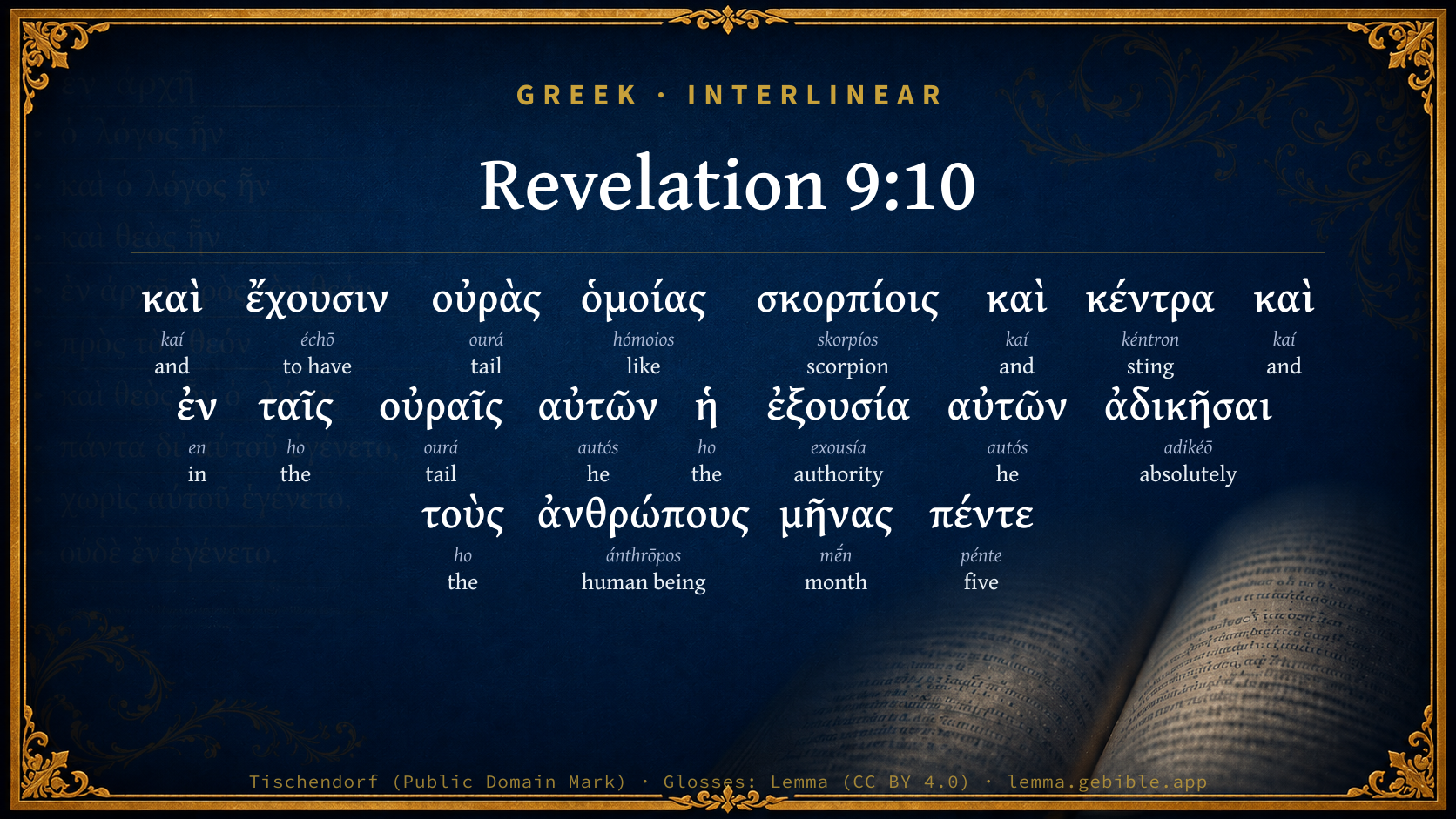
Greek (Tischendorf 8th ed.) Revelation 9:10 appears in the Greek New Testament. The text above is from the Tischendorf 8th edition. Each word links to its Strong’s number and a concise gloss. Click any word for its full Thayer’s Greek Lexicon entry.
Download image
Cite this verse

Revelation 9:10 (World English Bible). Public Domain. Lemma interlinear Bible study tool, https://lemma.gebible.app/v/revelation/9/10.

Show BibTeX & RIS
BibTeX
RIS
English Translation
They have tails like those of scorpions, and stings. In their tails they have power to harm men for five months.
World English Bible · Public Domain
Highlights
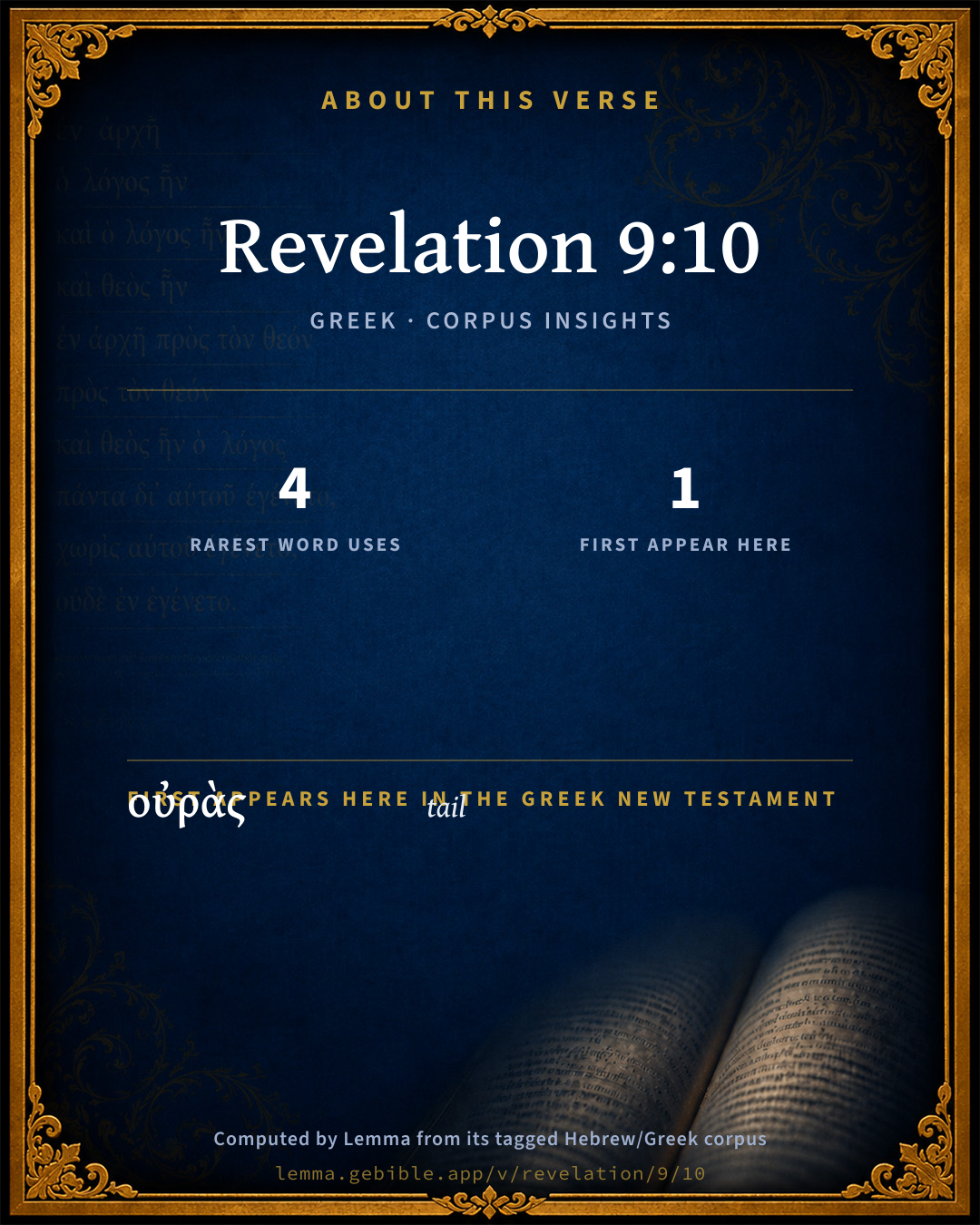
  • 1 first appearance in the Greek New Testament
Full analysis ↓
Download a study sheet

One document with this verse’s original text, its word-by-word gloss line, the meaning frame, cross-references with their text, attributed commentary, and full source and license credits — printable, and it pastes into notes with its structure intact.

This verse Autodidact and up

Study sheet (.html) Plain text (.txt)

A passage Seminary Student

Up to 50 verses in one chapter. A passage sheet keeps up to 6 commentary sources and 12 cross-references per verse, in the order this page ranks them, and says so on the sheet whenever that leaves anything out. Ask for a single verse and you get the Autodidact verse sheet above.

Everything on this page stays free to read, with no account — the sheet is a download of what is already on screen, not access to it.

Want to remove ads? Support Godless Engineer
Compare translations 3

The same verse in 3 English versions, stacked beneath the original-language interlinear above. Click any original word for its lexicon entry.

Each is an independent rendering of the whole verse — the interlinear is not word-aligned to these translations.

Highlighted words mark where these versions differ — a whole-verse word diff, not a word-by-word alignment.

  • World English Bible Public Domain
    They have tails like those of scorpions, and stings. In their tails they have power to harm men for five months.
  • King James Version Public Domain
    And they had tails like unto scorpions, and there were stings in their tails: and their power was to hurt men five months.
  • unfoldingWord Literal Text CC BY-SA 4.0
    And they have tails and stingers as scorpions do, and in their tails their power to harm men for five months.

unfoldingWord Literal Text — © unfoldingWord, licensed CC BY-SA 4.0. Word-aligned USFM3 via Door43 (git.door43.org/unfoldingWord/en_ult).

Versions to compare (up to 4)

3 of 4 selected

Show all 19 translations

Every available English version of this verse, each an independent rendering of the whole verse.

  • World English Bible Public Domain
    They have tails like those of scorpions, and stings. In their tails they have power to harm men for five months.
  • Berean Standard Bible Public Domain
    They had tails with stingers like scorpions, which had the power to injure people for five months.
  • Majority Standard Bible Public Domain
    They had tails with stingers like scorpions, which had the power to injure people for five months.
  • King James Version Public Domain
    And they had tails like unto scorpions, and there were stings in their tails: and their power was to hurt men five months.
  • American Standard Version (1901) Public Domain
    And they have tails like unto scorpions, and stings; and in their tails is their power to hurt men five months.
  • Revised Version (1885) Public Domain
    And they have tails like unto scorpions, and stings; and in their tails is their power to hurt men five months.
  • Geneva Bible (1599) Public Domain
    And they had tailes like vnto scorpions, and there were stings in their tailes, and their power was to hurt men fiue moneths.
  • Douay-Rheims (1899) Public Domain
    And they had tails like to scorpions, and there were stings in their tails; and their power was to hurt men five months. And they had over them
  • Young's Literal Translation Public Domain
    and they have tails like to scorpions, and stings were in their tails; and their authority `is' to injure men five months;
  • Literal Standard Version CC BY-SA 4.0
    and they have tails like to scorpions, and stings were in their tails; and their authority [is] to injure men five months;
  • Unlocked Literal Bible CC BY-SA 4.0
    They had tails with stingers like scorpions; in their tails they had power to harm people for five months.
  • unfoldingWord Literal Text CC BY-SA 4.0
    And they have tails and stingers as scorpions do, and in their tails their power to harm men for five months.
  • Darby Bible Public Domain
    and they have tails like scorpions, and stings; and their power [was] in their tails to hurt men five months.
  • World Messianic Bible Public Domain
    They have tails like those of scorpions, with stingers. In their tails they have power to harm men for five months.
  • Webster's Bible Public Domain
    And they had tails like scorpions, and there were stings in their tails: and their power was to hurt men five months.
  • Free Bible Version CC BY-SA 4.0
    They had tails like scorpions, complete with stingers. They had the power to hurt people for five months with their tails.
  • Bible in Basic English Public Domain
    And they have pointed tails like scorpions; and in their tails is their power to give men wounds for five months.
  • Text-Critical English NT CC BY 4.0
    They have tails and stingers like scorpions, and in their tails they have the power to harm people for five months.
  • Tyndale New Testament (1534) Public Domain
    And they had tayles lyke vnto scorpions and there were stinges in their tayles. And their power was to hurt men v. monethes.

Literal Standard Version (2020), Covenant Press — licensed CC BY-SA 4.0. Text via the HelloAO Bible API (eBible.org). Unlocked Literal Bible (unfoldingWord) — licensed CC BY-SA 4.0. Text via the HelloAO Bible API (eBible.org). unfoldingWord Literal Text — © unfoldingWord, licensed CC BY-SA 4.0. Word-aligned USFM3 via Door43 (git.door43.org/unfoldingWord/en_ult). Free Bible Version, Dr. Jonathan Gallagher — licensed CC BY-SA 4.0. Text via the HelloAO Bible API (eBible.org).

Word by word

More ways to search: Search by grammar → Find every occurrence → Compare this word →

Practice this passage: Drill this verse → Learn its vocabulary →

κέντρα
kéntron
G2759
“sting”
Noun, Accusative, Plural, Neuter
Part of Speech
Noun
Case
Accusative
Number
Plural
Gender
Neuter
Full Thayer's Definition

Origin: from kenteo (to prick)

TDNT: 14:03,4

1. a sting, as that of bees, scorpions, locusts. Since animals wound by their sting and even cause death, Paul attributes death, personified as a sting, i.e. a deadly weapon 2. an iron goad, for urging on oxen, horses and other beasts of burden a. hence the proverb, "to kick against the goad", i.e. to offer vain and perilous or ruinous resistance
  1. καὶ kaí G2532 “and” Conjunction
  2. ἔχουσιν échō G2192 “to have” Verb, Present, Active, Indicative, 3rd person, Plural
  3. οὐρὰς ourá G3769 “tail” Noun, Accusative, Plural, Feminine
  4. ὁμοίας hómoios G3664 “like” Adjective, Accusative, Plural, Feminine
  5. σκορπίοις skorpíos G4651 “scorpion” Noun, Dative, Plural, Masculine
  6. καὶ kaí G2532 “and” Conjunction
  7. καὶ kaí G2532 “and” Conjunction
  8. ἐν en G1722 “in” Preposition
  9. ταῖς ho G3588 “the” Article, Dative, Plural, Feminine
  10. οὐραῖς ourá G3769 “tail” Noun, Dative, Plural, Feminine
  11. αὐτῶν autós G846 “he” Personal pronoun, Genitive, Plural, Feminine
  12. ἡ ho G3588 “the” Article, Nominative, Singular, Feminine
  13. ἐξουσία exousía G1849 “authority” Noun, Nominative, Singular, Feminine
  14. αὐτῶν autós G846 “he” Personal pronoun, Genitive, Plural, Feminine
  15. ἀδικῆσαι adikéō G91 “absolutely” Verb, Aorist, Active, Infinitive
  16. τοὺς ho G3588 “the” Article, Accusative, Plural, Masculine
  17. ἀνθρώπους ánthrōpos G444 “human being” Noun, Accusative, Plural, Masculine
  18. μῆνας mḗn G3376 “month” Noun, Accusative, Plural, Masculine
  19. πέντε pénte G4002 “five” Adjective, Numeral (indeclinable)

About this verse

These counts appear in no published source. They are computed here, from the morphology-tagged text and Lemma’s own curated glosses. What Lemma adds →

20
words
14
distinct lemmas
Revelation
section

Notable vocabulary

The rarest word here is κέντρα sting G2759 — appearing just 4 times in the whole Greek New Testament.

First appearance in Scripture

This word makes its first canonical appearance in the Greek New Testament here:

  • οὐρὰς tail G3769

Shared distinctive vocabulary

κέντρα sting G2759 occurs in 4 verses of the Greek New Testament. Also found in:
Repetition

Words recur within this verse:

  • οὐρὰς tail G3769 ×2
  • καὶ and G2532 ×3
  • ταῖς the G3588 ×3
  • αὐτῶν he G846 ×2

Cross-references

3

Topical passages linked to Revelation 9:10 in the Treasury of Scripture Knowledge — connected by theme and wording, ordered by reader-vote popularity; previews shown in the World English Bible.

  • Revelation 9:5 They were given power not to kill them, but to torment them for five months. Their torment was like the torment of a scorpion, when it strikes a person.
  • Revelation 9:3 Then out of the smoke came forth locusts on the earth, and power was given to them, as the scorpions of the earth have power.
  • Revelation 9:19 For the power of the horses is in their mouths, and in their tails. For their tails are like serpents, and have heads, and with them they harm.

Cross-references courtesy of OpenBible.info (CC BY 4.0).

Where the printed editions differ

2 variants

Places in this verse where the major printed Greek editions disagree on the wording in a way that affects the translation — a comparison of editions, not a manuscript-by-manuscript collation. The editions are the modern critical texts (Nestlé-Aland 28/27, SBL, Westcott-Hort, Tregelles, Tyndale House) and the traditional texts behind the KJV (the Textus Receptus and the Byzantine/Majority text). It is not a claim about which reading is original.

  1. Extra text
    ἔχουσιν

    “they have”

    In Byz Not in NA28NA27TynSBLWHTregTR

    ἔχουσιν (echousin) 'they have' is only in a few manuscripts (Byz)

  2. Different wording
    αὐτῶν

    “of them”

    In NA28NA27TynSBLWHTregTR Not in Byz

    τοῦ (tou) 'of it' occurs in a few manuscripts (Byz) instead of αὐτῶν (autōn) 'of them' in older manuscripts (NA28+NA27+Tyn+SBL+WH+Treg+TR)

Textual data: Translators Amalgamated Greek New Testament (STEPBible TAGNT) · CC BY 4.0.

Commentary

Notes on Revelation 9:10 from classic Christian and Jewish commentators (each source and its license shown beneath its notes). The classic Christian expositions comment on the surrounding passage and are grouped to its opening verse, so a note may address several verses; the Jewish commentaries on the Tanakh (Rashi and others) are per-verse, so they appear only where the commentator wrote on this verse.

Lemma curates 59 commentaries, every one of them public domain or Creative Commons licensed, each selected and text-cleaned for this edition rather than reprinted as found. About our sources →

Joseph Benson's Commentary

Rev 9:10-11. They had tails like unto scorpions — They are thrice compared to scorpions, namely, Rev 9:3; Rev 9:5, as well as in this verse. But whether these tails and stings, as of scorpions, were designed to express that these Saracens should spread the poison of error and delusion where they came, or only to signify the great pain and uneasiness their invasion should occasion, seems doubtful. Bishop Newton, however, interprets the metaphor in the former sense, as intended to signify, that wherever they carried their arms, there also they should distil the venom of a false religion. And their power was to hurt men five months — “One difficulty,” says Bishop Newton, “and the greatest of all, remains yet to be explained; and that is the period of five months assigned to these locusts, which being twice mentioned, merits the more particular consideration. They tormented men five months, Rev 9:5; and again here, their power was to hurt men five months. It is said, without doubt, in conformity to the type; for locusts are observed to live about five months; that is, from April to September. Scorpions, too, as Bochart asserts, are noxious for no longer a term, the cold rendering them torpid and inactive. But of these locusts it is said, not that their duration or existence was only for five months, but their power of hurting and tormenting men continued five months. Now, these months may either be months commonly so taken; or prophetic months, consisting each of thirty days, as St. John reckons them, and so making one hundred and fifty years, at the rate of each day for a year; or the number being repeated twice, the sums may be thought to be doubled, and five months and five months, in prophetic computation, will amount to three hundred years. If these months be taken for common months, then, as the natural locusts live and do hurt only in the five summer months, so the Saracens, in the five summer months too, made their excursions, and retreated again in the winter. It appears that this was their usual practice, and particularly when they first besieged Constantinople in the time of Constantine Pogonatus. For from the month of April to September, they pertinaciously continued the siege, and then, despairing of success, departed to Cyzicum, where they wintered, and in spring again renewed the war: and this course they held for seven years, as the Greek annals tell us. If these months be taken for prophetic months, or one hundred and fifty years, it was within that space of time that the Saracens made their principal conquests. Their empire might subsist much longer, but their power of hurting and tormenting men was exerted chiefly within that period. Read the history of the Saracens, and you will find that their greatest exploits were performed, their greatest conquests were made, between the year 612, when Mohammed first opened the bottomless pit, and began publicly to teach and propagate his imposture, and the year 762, when the Calif Almansor built Bagdad, to fix there the seat of his empire, and called it the city of peace. Syria, Persia, India, and the greatest part of Asia; Egypt, and the greatest part of Africa; Spain, and some parts of Europe, were all subdued in the intermediate time. But when the califs, who before had removed from place to place, fixed their habitation at Bagdad, then the Saracens ceased from their incursions and ravages, like locusts, and became a settled nation; then they made no more such rapid and amazing conquests as before, but only engaged in common and ordinary wars, like other nations; then their power and glory began to decline, and their empire by little and little to moulder away; then they had no longer, like the prophetic locusts, one king over them; Spain having revolted in the year 736, and set up another calif in opposition to the reigning house of Abbas. If these months be taken doubly, or for three hundred years, then, according to Sir Isaac Newton, ‘the whole time that the califs of the Saracens reigned with a temporal dominion at Damascus and Bagdad together, was three hundred years; namely, from the year 637 to the year 936 inclusive; when their mighty empire was broken and divided into several principalities or kingdoms. So that, let these five months be taken in any possible construction, the event will still answer, and the prophecy will still be fulfilled; though the second method of interpretation and application appears much more probable than either the first or the third. And they had a king over them — By this is signified that the same person should exercise temporal as well as spiritual sovereignty over them; and the califs were their emperors, as well as the heads of their religion. The king is the same as the star or angel of the bottomless pit, whose name is Abaddon in Hebrew, and Apollyon in Greek; that is, the destroyer. Mede imagines that this is some allusion to the name of Obodas, the common name of the kings of that part of Arabia from whence Mohammed came, as Pharaoh was the common name of the kings of Egypt, and Cesar of the emperors of Rome; and such allusions are not unusual in the style of Scripture. However that be, the name agrees perfectly well with Mohammed, and the califs his successors, who were the authors of all those horrid wars and desolations, and openly taught and professed their religion was to be propagated and established by the sword.

Joseph Benson's Commentary on the Old and New Testaments (1811–1818) — public domain. Text from a community e-Sword module.

Jamieson, Fausset & Brown

Robert Jamieson, A. R. Fausset & David Brown

tails like unto scorpions--like unto the tails of scorpions.

and there were stings--There is no oldest manuscript for this reading. A, B, Aleph, Syriac, and Coptic read, "and (they have) stings: and in their tails (is) their power (literally, 'authority': authorized power) to hurt."

Jamieson, Fausset & Brown — Commentary Critical and Explanatory on the Whole Bible (1871) — public domain (CC PDM 1.0). Text via the HelloAO Bible API.

Adam Clarke's Commentary

Verse 10. They had tails like unto scorpions] This may refer to the consequences of their victories. They infected the conquered with their pernicious doctrines.

Their power was to hurt men five months.] The locusts make their principal ravages during the five summer months. But probably these may be prophetic months, as above, in Re 9:5-150 years.

Adam Clarke's Commentary on the Bible (1810–1826) — public domain. Text from a community e-Sword/MySword module.

Ellicott's Commentary for English Readers

(10)And they had tails . . .—Better, And they have tails like to scorpions, and stings, and in their tails is their power to hurt men five months. In this verse the secret of their power is mentioned: they have tails like scorpions’ tails, and stings which wound and so cause agony to men. On the period of five months, see Rev_9:5. In the exposition of this passage it is utterly vain to look for features of the ordinary natural locust corresponding to the several particulars set forth by the sacred seer: this is admitted even by those who seem anxious to find such counterparts. “We must regard the comparison as rather belonging to the supernatural portion of our description.” The rule is a good one. Like the description of the Divine Presence in Revelation 4, most of the visions of the book are incapable of pictorial realisation without incongruities which would be grotesque and profane; nor need we be surprised, since the principles and truths are the main points with the writer. This general rule must be kept in mind if we would avoid the danger of dwelling too much on the bearing of details. It is not in the locust that we shall find even the suggestive basis of the details in the description here. The smoke rises from the pit of the abyss; the heaven is darkened, and out of the smoke emerges the pitchy cloud of locusts. The seer then adds certain characteristics of this locust plague, partly drawn from the earlier prophets, but, as his custom is, with some original additions. They are locusts, but they have the malice of scorpions; they advance like horse-soldiers to battle; they wear crowns; they bear a resemblance to men; there is something womanlike also in their appearance, and in their voracity they are as lions. The exigencies of the symbolism are quite beyond the features of the ordinary locust: the sacred writer shows us a plague in which devastation, malice, kinglike authority, intelligence, seductiveness, fierceness, strength, meet together under one directing spirit, to torment men. Some parts may be purely graphic, as Alford says, but surely the vision shows us a great symbolical army multitudinous as locusts, malicious as scorpions, ruling as kings, intelligent as men, wily as womanhood, bold and fierce as lions, resistless as those clad in iron armour. The symbolism of course must not be pressed too closely, but its meaning must be allowed to widen as new elements are added, especially when those elements are not suggested by anything in the locust itself, but are additions clearly designed to give force to the symbol employed. The locust-like army has characteristics partly human, partly diabolical, partly civilised, partly barbarous. They have been variously interpreted: the historical school have seen in them the Saracens under Mohammed, who gave to them a religion which was “essentially a military system;” others are inclined to refer them to “the hordes of Goths and others whose unkempt locks and savage ferocity” resemble this locust host. There is a good ground for taking the vision to prefigure the hosts of a fierce invading army. Even those who believe that Joel’s prophecy foretold a plague of literal locusts, yet acknowledge that these “may in a subsidiary manner” represent “the northern, or Assyrian enemies of Judah” (Introduction to Joel, Speaker’s Commentary). But, as the writer there says, these were “themselves types of still future scourges;” so may we see here a vision which neither the history of the Zealots, nor that of Gothic hordes, nor of Saracens, have exhausted, but one which draws our thoughts mainly to its spiritual and moral bearing, and teaches us that in the history of advancing truth there will come times when confused ideas will darken simple truth and right, and out of the darkness will emerge strange and mongrel teachings, with a certain enforced unity, but without moral harmony, a medley of fair and hideous, reasonable and barbarous, dignified and debased, which enslave and torment mankind. The outcome of these teachings is oftentimes war and tyrannous oppression; but the sacred seer teaches us distinctly that those who hold fast by the seal of God are those who cannot be injured, for he would have us remember that the true sting of false conceptions is not in the havoc of open war, but in the wounded soul and conscience. Nor is it altogether out of place to notice (by way of one example) that the power of Mohammed was more in a divided and debased Christendom than in his own creed or sword; the smoke of ill-regulated opinions and erroneous teachings preceded the scourge. Here, as in other parts of the book, we may notice that subtle, plausible errors pave the way for dire troubles and often sanguinary revolutions. Falsehoods and false worships that have been diffused over the world become “the forerunners and foretellers of a conflict between the powers of good and evil.” Yet as the trumpet sounds we know that every battle is a step towards the end of a victorious war.

A Bible Commentary for English Readers, edited by Charles John Ellicott (1878–1897) — public domain. Text from a community e-Sword module.

The Cambridge Bible for Schools and Colleges

gen. ed. J. J. S. Perowne

10. And they had … in their tails] Read, And they have tails like unto scorpions, and stings: and in their tails [is] their power, to hurt,” &c.

The Cambridge Bible for Schools and Colleges (gen. ed. J. J. S. Perowne; Cambridge University Press, 1878–1918) — public domain. Text from a community e-Sword module.

John Gill's Exposition

And they had tails like unto scorpions,.... Locusts are said to have the tail of a serpent, and of the vipers of the earth (u); See Gill on Rev 9:3, Rev 9:5. And there were stings in their tails; either in the baser sort of them, the Saracens and Papists; or in their doctrines, the prophet being the tail, Isa 9:15; with which both Mahomet, who set himself up for a prophet, and the Romish clergy, who set up their decrees and unwritten traditions above the word of God, have poisoned and destroyed multitudes of souls:

and their power was to hurt men five months; See Gill on Rev 9:5.

(u) Scriptores Arab.

John Gill's Exposition of the Whole Bible (1746–1763) — public domain (CC PDM 1.0). Text via the HelloAO Bible API.

Trapp's Complete Commentary

John Trapp

10 And they had tails like unto scorpions, and there were stings in their tails: and their power was to hurt men five months.

Ver. 10. And they had tails] This may be well meant of their surrogates, officials, chancellors, registrars, apparitors, the fag end of their execrable train. See Isa 9:15.

John Trapp, A Commentary or Exposition upon All the Books of the Old and New Testament (1647–1656) — public domain. Text from a community e-Sword module.

Albert Barnes' Notes on the Bible

And they had tails like unto scorpions - The fancy of an Arab now often discerns a resemblance between the tail of the locust and the scorpion. See the remark of Niebuhr, quoted in the notes on Rev 9:7.

And there were stings in their tails - Like the stings of scorpions. See the notes on Rev 9:3. This made the locusts which appeared to John the more remarkable, for though the fancy may imagine a resemblance between the tail of a locust and a scorpion, yet the locusts have properly no sting. The only thing which they have resembling a sting is a hard bony subsubstance like a needle, with which the female punctures the bark and wood of trees in order to deposit her eggs. It has, however, no adaptation, like a sting, for conveying poison into a wound. These, however, appeared to be armed with stings properly so called.

And their power was to hurt men - Not primarily to kill people, but to inflict on them various kinds of tortures. See the notes on Rev 9:5. The word used here - ἀδικῆσαι adikēsai, rendered “to hurt” - is different from the word in Rev 9:5 - βασανισθῶσιν basanisthōsin, rendered “should be tormented.” This word properly means “to do wrong, to do unjustly, to injure, to hurt”; and the two words would seem to convey the idea that they would produce distress by doing wrong to others, or by deeding unjustly with them. It does not appear that the wrong would be by inflicting bodily torments, but would be characterized by that injustice toward others which produces distress and anguish.

Five months - See the notes on Rev 9:5; (also Editor’s Preface).

Albert Barnes' Notes on the Bible (1834–1885) — public domain. Text from a community e-Sword/MySword module.

Haydock's Catholic Bible Commentary

And their power was to hurt men for five months. The duration of their power is here limited, but we dare not venture to explain what is meant by the dark expression, five months; time to come must clear up the difficulty. (Haydock)

George Leo Haydock (1774–1849), Haydock's Catholic Family Bible and Commentary, 1859 edition — public domain. Excludes Psalms (Douay-Rheims chapter numbering differs from Protestant) and Deuterocanonical books (Catholic canon only).

Matthew Poole's English Annotations

And they had tails like unto scorpions; a kind of venomous serpents that have their

stings in their tails, with which they presently kill both men and beasts.

And their power was to hurt men five months; what these five months mean is very hard to say; certainly it is a certain number for an uncertain, and mentioned rather than any other time, because it is (as they say) the usual time of the life of locusts; though some observe, that five months have in them (counting as the Hebrews, thirty days to the month) one hundred and fifty days, and a day standing for a year, as in prophetical writings, it denoteth the just time the Saracens raged in Italy, from the year 830 to the year 980; as to which I refer my reader to search histories.

Matthew Poole's English Annotations on the Holy Bible (1683–1685) — public domain. Text from a community e-Sword/MySword module.

Whedon's Commentary on the Bible

Daniel D. Whedon

10. Tails—The secret of their power of harming without killing. The consequences left behind by error are the stings in their tails. Their faces are fair and seductive; their tails are pointed with poison and pangs.

Daniel D. Whedon (gen. ed.), Commentary on the Old and New Testaments (1874–1909) — public domain. Text from a community e-Sword module.

The Pulpit Commentary

And they had tails like unto scorpions, and there were stings in their tails; and they have tails like unto scorpions, and stings (Revised Version). The next words are included in the following clause. Not that their tails possessed the appearance of scorpions (as Bengel, Hengstenberg, and others), but that their tails were like the tails of scorpions in respect of having stings in them. Cf. 2Sa_22:34 Psa_18:33, "He maketh my feet like hands" (omit "feet"); also Rev_13:11, "Two horns like a lamb" (see the description of the scorpion quoted above, under ver. 3). And their power was to hurt men five months; and in their tails is their power to hurt, etc. (Revised Version) (see the preceding clause). As no Greek manuscript gives the reading of the Textus Receptus followed by the Authorized Version, the probability is that this is an example of a passage in which the Greek of his edition was supplied by Erasmus, by the simple process of retranslating into Greek the Vulgate Version. By the possession of the noxious sting, the locusts here described are represented as being yet more terrible than the natural locusts. (See the description of the locusts given under ver. 3. For the signification of the "five months," see on ver. 5) They limit the period of this judgment to the time of man"s existence on this earth.

The Pulpit Commentary (1880–1919), ed. H.D.M. Spence-Jones & Joseph S. Exell — public domain. Text from a community e-Sword module.

John Wesley's Explanatory Notes

And they have tails like scorpions - That is, each tail is like a scorpion, not like the tail of a scorpion. To hurt the unsealed men five months - Five prophetic months; that is, seventy-nine common years So long did these calamities last.

John Wesley, Explanatory Notes Upon the Whole Bible (1754–1765) — public domain. Text via the GEBible commentary corpus.

The People's New Testament

B. W. Johnson

10. And they had tails. They stung terribly, and left a string in their path.

B. W. Johnson's The People's New Testament with Notes (1889–1891) — public domain. Electronic text from the Christian Classics Ethereal Library (CCEL) ThML edition.

unfoldingWord translationNotes

Door43 World Missions Community

They had tails

The word "They" refers to the locusts.

with stingers like scorpions

A scorpion is a small insect with a poisonous stinger at the end of its long tail. The sting can cause severe pain or even death. See how you translated a similar phrase in Revelation 9:6. AT: "with stingers like scorpion stingers" or "with stingers that could cause terrible pain as scorpion stingers can" (See: Simile)

in their tails they had power to harm people for five months

Possible meanings are 1) they had power for five months to harm people or 2) they could sting people and the people would be in pain for five months.

the bottomless pit

This is an extremely deep narrow hole. Possible meanings are 1) the pit has no bottom; it continues to go down further forever or 2) the pit is so deep that it is as if it had no bottom. See how you translated this in Revelation 9:1.

Abaddon ... Apollyon

Both names mean "Destroyer." (See: How to Translate Names and Copy or Borrow Words)

there are still two disasters to come

Existing in the future is spoken of as coming. (See: Metaphor)

translationWords

power

king

angel

pit

name

Hebrew

Greek

woe

unfoldingWord translationNotes — © Distant Shores Media and the Door43 World Missions Community, licensed CC BY-SA 4.0. Source: git.door43.org/Door43/en_tn.

Cambridge Greek Testament for Schools and Colleges

10. ὁμοίας. אA read ὁμοίοις; W. H[320] propose ὅμοια as an adverb.

[320] H. Westcott aud Hort.

καὶ κέντρα καὶ. 1. 36 and vg[321] arm[322] æth[323] transpose the second καὶ, and begin a new clause with καὶ ἡ ἐξουσία; the later vg[324] and Text. Rec[325] read καὶ κέντρα ἦν … καὶ ἡ ἐξ.

[321] Vulgate.

[322] Armenian.

[323] Aethiopic Version.

[324] Vulgate.

[325] Rec. Textus Receptus as printed by Scrivener.

ἡ ἐξουσία … ἀδικῆσαι. B2 reads ἐξουσίαν ἔχουσιν τοῦ ἀδικῆασι.

Cambridge Greek Testament for Schools and Colleges (Cambridge University Press, 1896; 21 vols, various authors incl. Carr, Maclear, Plummer, Farrar, Lumby, Moule, M. R. James, Simcox) — public domain. Text from a community e-Sword module.

Lesson kit

Teaching starters — assembled from the data on this page, not authored interpretation. Every prompt links to the verse data it draws on. Edit before teaching.

Revelation, in the Revelation, opens this verse with 20 words (14 distinct Greek lemmas). Its most distinctive word is kéntron (“sting”). A historical commentator’s framing appears above. Read the whole chapter for the surrounding context.

Discussion questions

  1. The word kéntron carries the sense “sting.” How does it shape the verse?
  2. This is the first place “tail” appears in Scripture (first appears here). What does its debut here establish?
  3. How does Acts 26:14, which shares the word «sting», read alongside this verse?
  4. What does the repetition of “tail” (2× in this one verse) do in this verse?
  5. These translations render this verse differently; the difference is in the English rendering, not the original. What questions does that raise?
  6. Compare how Joseph Benson's Commentary and Jamieson, Fausset & Brown read this verse. Where do they agree or differ?

Things to notice

  • 1 word makes its first canonical appearance in Scripture here.
  • These translations choose different wording for 9 words in this verse.
  • “tail” occurs 2× in this single verse.
  • 14 distinct Greek lemmas span 20 words in this verse.

Reading settings

Reading text

Shown beneath each verse's original-language words.

Old Testament
Old Testament edition

Read the OT as the Masoretic Hebrew (MT) or the Greek Septuagint (LXX).

English shown for the Greek Septuagint (in the Hebrew ↔ Greek comparison).

Comparing translations? Open the Compare panel on any verse page to stack up to four side by side.