Daniel 5:4

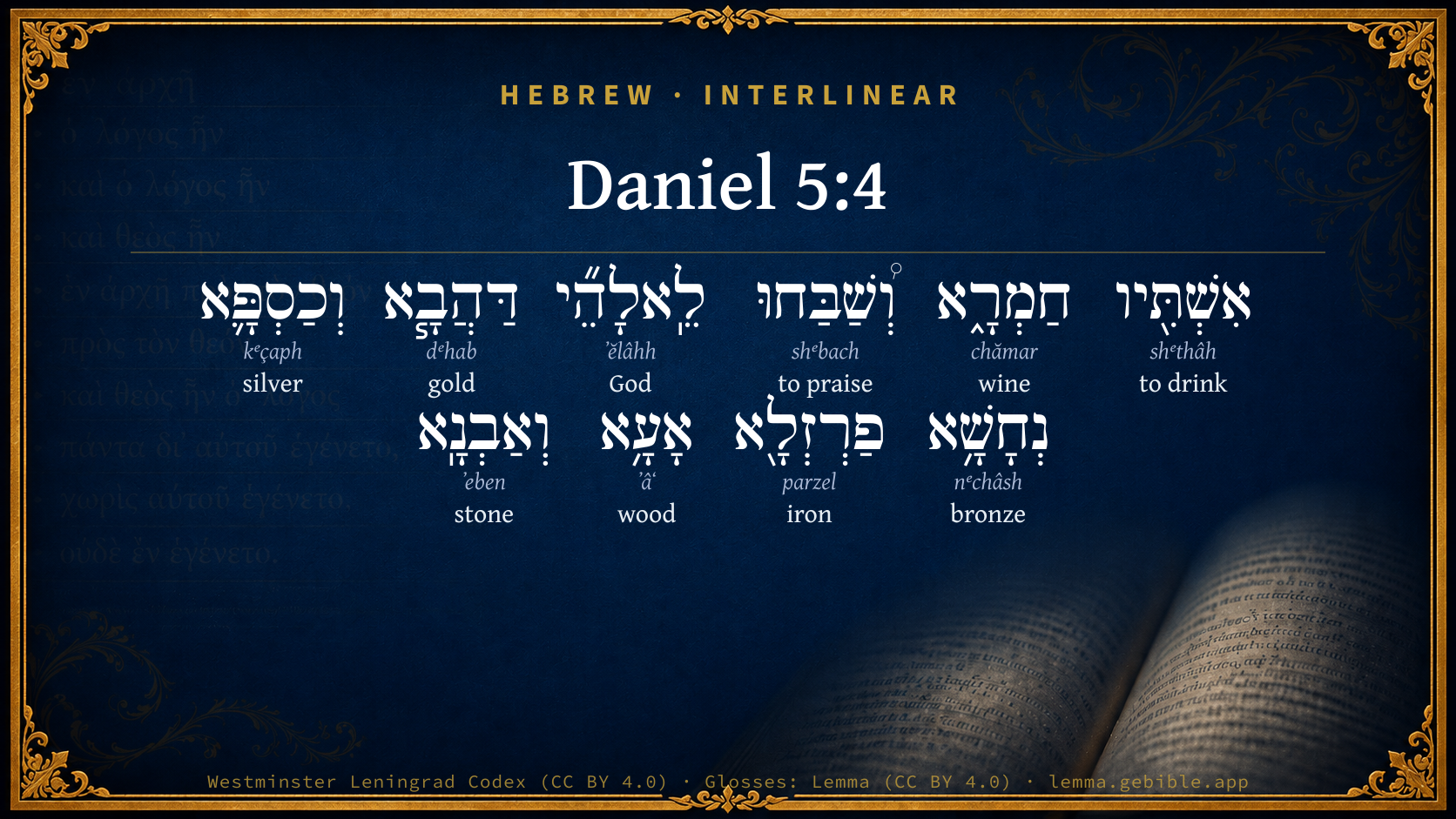
Hebrew (Westminster Leningrad Codex) Daniel 5:4 appears in the Hebrew Old Testament. The text above is from the Westminster Leningrad Codex. Each word links to its Strong’s number, a concise gloss, and parsing drawn from the Open Scriptures Hebrew Bible morphology. Click any word for its full Brown-Driver-Briggs (BDB) entry.
Download image
Cite this verse

Daniel 5:4 (World English Bible). Public Domain. Lemma interlinear Bible study tool, https://lemma.gebible.app/v/daniel/5/4.

Show BibTeX & RIS
BibTeX
RIS
English Translation
They drank wine, and praised the gods of gold, and of silver, of brass, of iron, of wood, and of stone.
World English Bible · Public Domain
Download a study sheet

One document with this verse’s original text, its word-by-word gloss line, the meaning frame, cross-references with their text, attributed commentary, and full source and license credits — printable, and it pastes into notes with its structure intact.

This verse Autodidact and up

Study sheet (.html) Plain text (.txt)

A passage Seminary Student

Up to 50 verses in one chapter. A passage sheet keeps up to 6 commentary sources and 12 cross-references per verse, in the order this page ranks them, and says so on the sheet whenever that leaves anything out. Ask for a single verse and you get the Autodidact verse sheet above.

Everything on this page stays free to read, with no account — the sheet is a download of what is already on screen, not access to it.

Want to remove ads? Support Godless Engineer
Compare translations 3

The same verse in 3 English versions, stacked beneath the original-language interlinear above. Click any original word for its lexicon entry.

Each is an independent rendering of the whole verse — the interlinear is not word-aligned to these translations.

Highlighted words mark where these versions differ — a whole-verse word diff, not a word-by-word alignment.

  • World English Bible Public Domain
    They drank wine, and praised the gods of gold, and of silver, of brass, of iron, of wood, and of stone.
  • King James Version Public Domain
    They drank wine, and praised the gods of gold, and of silver, of brass, of iron, of wood, and of stone.
  • unfoldingWord Literal Text CC BY-SA 4.0
    They drank the wine and praised the gods of gold and silver, bronze, iron, wood, and stone.

unfoldingWord Literal Text — © unfoldingWord, licensed CC BY-SA 4.0. Word-aligned USFM3 via Door43 (git.door43.org/unfoldingWord/en_ult).

Versions to compare (up to 4)

3 of 4 selected

Show all 18 translations

Every available English version of this verse, each an independent rendering of the whole verse.

  • World English Bible Public Domain
    They drank wine, and praised the gods of gold, and of silver, of brass, of iron, of wood, and of stone.
  • Berean Standard Bible Public Domain
    As they drank the wine, they praised their gods of gold and silver, bronze and iron, wood and stone.
  • Majority Standard Bible Public Domain
    As they drank the wine, they praised their gods of gold and silver, bronze and iron, wood and stone.
  • King James Version Public Domain
    They drank wine, and praised the gods of gold, and of silver, of brass, of iron, of wood, and of stone.
  • American Standard Version (1901) Public Domain
    They drank wine, and praised the gods of gold, and of silver, of brass, of iron, of wood, and of stone.
  • Revised Version (1885) Public Domain
    They drank wine, and praised the gods of gold, and of silver, of brass, of iron, of wood, and of stone.
  • Geneva Bible (1599) Public Domain
    They drunke wine and praysed the gods of golde, and of siluer, of brasse, of yron, of wood and of stone.
  • Douay-Rheims (1899) Public Domain
    They drank wine, and praised their gods of gold, and of silver, of brass, of iron, and of wood, and of stone.
  • Young's Literal Translation Public Domain
    they have drunk wine, and have praised the gods of gold, and of silver, of brass, of iron, of wood, and of stone.
  • Literal Standard Version CC BY-SA 4.0
    they have drunk wine, and have praised the gods of gold, and of silver, of bronze, of iron, of wood, and of stone.
  • Unlocked Literal Bible CC BY-SA 4.0
    They drank the wine and praised their idols made of gold and silver, bronze, iron, wood, and stone.
  • unfoldingWord Literal Text CC BY-SA 4.0
    They drank the wine and praised the gods of gold and silver, bronze, iron, wood, and stone.
  • Darby Bible Public Domain
    They drank wine, and praised the gods of gold and of silver, of brass, of iron, of wood, and of stone.
  • World Messianic Bible Public Domain
    They drank wine, and praised the gods of gold, and of silver, of bronze, of iron, of wood, and of stone.
  • Webster's Bible Public Domain
    They drank wine, and praised the gods of gold, and of silver, of brass, of iron, of wood, and of stone.
  • Free Bible Version CC BY-SA 4.0
    As they drank wine they praised their gods—idols made of gold, silver, bronze, iron, wood, and stone.
  • Bible in Basic English Public Domain
    They took their wine and gave praise to the gods of gold and silver, of brass and iron and wood and stone.
  • JPS Tanakh (1917) Public Domain
    They drank wine, and praised the gods of gold, and of silver, of brass, of iron, of wood, and of stone.

Literal Standard Version (2020), Covenant Press — licensed CC BY-SA 4.0. Text via the HelloAO Bible API (eBible.org). Unlocked Literal Bible (unfoldingWord) — licensed CC BY-SA 4.0. Text via the HelloAO Bible API (eBible.org). unfoldingWord Literal Text — © unfoldingWord, licensed CC BY-SA 4.0. Word-aligned USFM3 via Door43 (git.door43.org/unfoldingWord/en_ult). Free Bible Version, Dr. Jonathan Gallagher — licensed CC BY-SA 4.0. Text via the HelloAO Bible API (eBible.org).

Word by word

More ways to search: Search by grammar → Find every occurrence → Compare this word →

Practice this passage: Drill this verse → Learn its vocabulary →

אִשְׁתִּ֖יו
shᵉthâh
H8355
“to drink”
Adjective, V, Plural
Part of Speech
Adjective
Number
Plural
Full BDB Definition

Origin: corresponding to H8354

TWOT: 3051

(Peal) to drink
  1. חַמְרָ֑א chămar H2562 “wine · the” Adjective, N, Common + Particle, Definite Article
  2. וְ֠שַׁבַּחוּ shᵉbach H7624 “and · to praise” Adjective, C + Verb, Piel, Perfect, 3rd Person, Masculine, Plural
  3. לֵֽאלָהֵ֞י ʼĕlâhh H426 “to/for · gods of” Adjective, T + Noun, Common, Masculine, Plural, Construct
  4. דַּהֲבָ֧א dᵉhab H1722 “gold · the” Adjective, N, Common + Particle, Definite Article
  5. וְכַסְפָּ֛א kᵉçaph H3702 “and · silver · the” Adjective, C + Noun, Common, Masculine, Singular, Determined + Particle, Definite Article
  6. נְחָשָׁ֥א nᵉchâsh H5174 “bronze · the” Adjective, N, Common + Particle, Definite Article
  7. פַרְזְלָ֖א parzel H6523 “iron · the” Adjective, N, Common + Particle, Definite Article
  8. אָעָ֥א ʼâʻ H636 “wood · the” Adjective, N, Common + Particle, Definite Article
  9. וְאַבְנָֽא ʼeben H69 “and · stone · the” Adjective, C + Noun, Common, Feminine, Singular, Determined + Particle, Definite Article

About this verse

These counts appear in no published source. They are computed here, from the morphology-tagged text and Lemma’s own curated glosses. What Lemma adds →

10
words
10
distinct lemmas
Prophets
section

Notable vocabulary

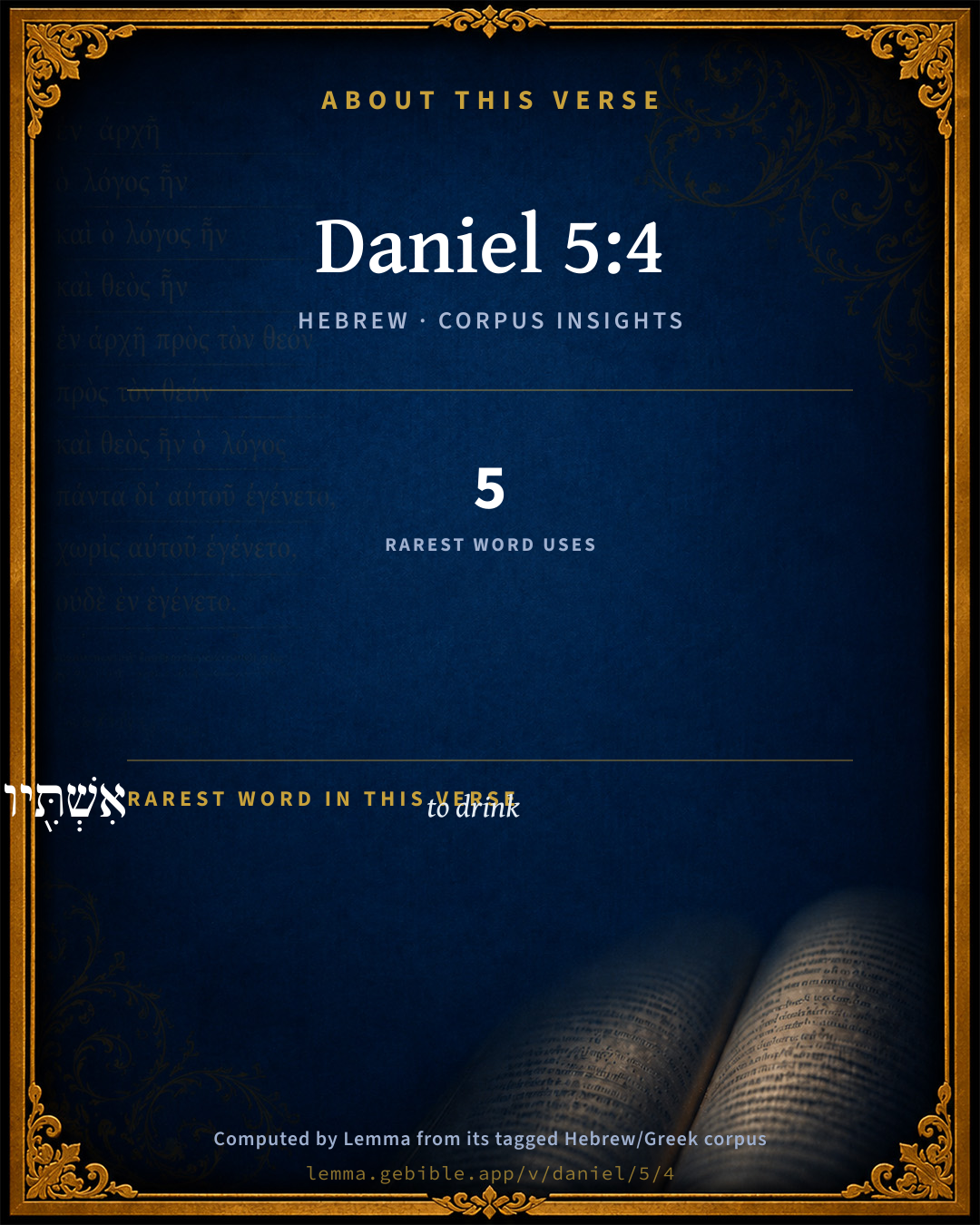
The rarest word here is אִשְׁתִּ֖יו to drink H8355 — appearing just 5 times in the whole Hebrew Bible.

Shared distinctive vocabulary

אִשְׁתִּ֖יו to drink H8355 occurs in 5 verses of the Hebrew Bible. Also found in:

Grammatical profile

  • 1 verb
  • 1 noun
  • 1 adjective
  • 7 particles

Verb forms

  • וְ֠שַׁבַּחוּ Piel · Perfect

Hebrew & Septuagint length

In English translation the verse runs 21 words from the Hebrew and 24 from the Septuagint (LXX English) — closely comparable.

A rough comparison of the two English renderings, which tokenize alike — not a word-level alignment.

Word counts can differ between the Hebrew and the Greek without any difference in meaning — e.g. the Hebrew direct-object marker אֵת has no separate Greek word, and Greek often adds the article ὁ.

Cross-references

16

Topical passages linked to Daniel 5:4 in the Treasury of Scripture Knowledge — connected by theme and wording, ordered by reader-vote popularity; previews shown in the World English Bible.

  • Daniel 5:23 but have lifted up yourself against the Lord of heaven; and they have brought the vessels of his house before you, and you and your lords, your wives and your concubines, have drunk wine from them; and you have praised the gods of silver and gold, of brass, iron, wood, and stone, which don't see, nor hear, nor know; and the God in whose hand your breath is, and whose are all your ways, you have not glorified.
  • Habakkuk 2:19 Woe to him who says to the wood, 'Awake!' or to the mute stone, 'Arise!' Shall this teach? Behold, it is overlaid with gold and silver, and there is no breath at all in the midst of it.
  • Psalms 135:15–18 The idols of the nations are silver and gold, The work of men's hands.
  • Revelation 9:20–21 The rest of mankind, who were not killed with these plagues, didn't repent of the works of their hands, that they wouldn't worship demons, and the idols of gold, and of silver, and of brass, and of stone, and of wood; which can neither see, nor hear, nor walk.
  • Psalms 115:4–8 Their idols are silver and gold, The work of men's hands.
  • Isaiah 40:19–20 The image, a workman has cast [it], and the goldsmith overlays it with gold, and casts [for it] silver chains.
  • Isaiah 42:8 I am Yahweh, that is my name; and my glory will I not give to another, neither my praise to engraved images.
  • Isaiah 46:6–7 Some pour out gold from the bag, and weigh silver in the balance. They hire a goldsmith, and he makes it a god. They fall down--yes, they worship.
  • Jeremiah 10:4–9 They deck it with silver and with gold; they fasten it with nails and with hammers, that it not move.
  • Acts 17:29 Being then the offspring of God, we ought not to think that the Divine Nature is like gold, or silver, or stone, engraved by art and design of man.
  • Judges 16:23–24 The lords of the Philistines gathered them together to offer a great sacrifice to Dagon their god, and to rejoice; for they said, Our god has delivered Samson our enemy into our hand.
  • Isaiah 42:17 They shall be turned back, they shall be utterly disappointed, who trust in engraved images, who tell molten images, You are our gods.
  • Daniel 3:1–18 Nebuchadnezzar the king made an image of gold, whose height was sixty cubits, and the breadth of it six cubits: he set it up in the plain of Dura, in the province of Babylon.
  • Daniel 4:37 Now I, Nebuchadnezzar, praise and extol and honor the King of heaven; for all his works are truth, and his ways justice; and those who walk in pride he is able to abase.
  • Hosea 2:8–13 For she did not know that I gave her the grain, the new wine, and the oil, And multiplied to her silver and gold, which they used for Baal.
  • Acts 19:24–28 For a certain man named Demetrius, a silversmith, who made silver shrines of Artemis, brought no little business to the craftsmen,

Cross-references courtesy of OpenBible.info (CC BY 4.0).

Hebrew and Greek witnesses Masoretic Hebrew ↔ Greek Septuagint

The same verse in the two great witnesses to the Old Testament, shown verse-for-verse.

These are two independent witnesses, not word-aligned to each other, and the Septuagint is shown in lemma (dictionary) form.

Hebrew Daniel 5:4 Masoretic · Westminster Leningrad Codex

אִשְׁתִּ֖יו חַמְרָ֑א וְ֠שַׁבַּחוּ לֵֽאלָהֵ֞י דַּהֲבָ֧א וְכַסְפָּ֛א נְחָשָׁ֥א פַרְזְלָ֖א אָעָ֥א וְאַבְנָֽא

They drank wine, and praised the gods of gold, and of silver, of brass, of iron, of wood, and of stone.

World English Bible · Public Domain

Greek LXX Daniel 5:4 Septuagint · lemma form

καί εὐλογέω ὁ εἴδωλον ὁ χειροποίητος αὐτός καί ὁ θεός ὁ αἰών οὐ εὐλογέω ὁ ἔχω ὁ ἐξουσία ὁ πνεῦμα αὐτός

They drank wine, and praised the gods of gold, and of silver, and of brass, and of iron, and of wood, and of stone.

LXX2012 (modern English Septuagint) · Public Domain

Hebrew: Westminster Leningrad Codex (CC BY 4.0). Greek: Septuagint (public domain); English from LXX2012 (modern English Septuagint) (Public Domain). How the Septuagint differs from the Hebrew →

Commentary

Notes on Daniel 5:4 from classic Christian and Jewish commentators (each source and its license shown beneath its notes). The classic Christian expositions comment on the surrounding passage and are grouped to its opening verse, so a note may address several verses; the Jewish commentaries on the Tanakh (Rashi and others) are per-verse, so they appear only where the commentator wrote on this verse.

Lemma curates 59 commentaries, every one of them public domain or Creative Commons licensed, each selected and text-cleaned for this edition rather than reprinted as found. About our sources →

Trapp's Complete Commentary

John Trapp

Dan 5:4 They drank wine, and praised the gods of gold, and of silver, of brass, of iron, of wood, and of stone.

Ver. 4. They drank wine.] To the honour of their goddess Shac; for so these feast days were called σακεαι ημεραι, being like the Roman saturnalia.

And praised the gods of silver and of gold.] As if these their dung hill deities had mastered and spoiled the God of Israel, who either would not, or could not defend his temple and people from falling into the power of their invincible conqueror. This was blasphemy in a high degree, and therefore presently punished by God.

John Trapp, A Commentary or Exposition upon All the Books of the Old and New Testament (1647–1656) — public domain. Text from a community e-Sword module.

Keil & Delitzsch

C. F. Keil & F. Delitzsch

The warning signs, the astonishment of Belshazzar, the inability of the wise men to give counsel, and the advice of the queen.

Dan 5:4

Unexpectedly and suddenly the wanton mad revelry of the king and his guests was brought to a close amid terror by means of a warning sign. The king saw the finger of a man's hand writing on the plaster of the wall of the festival chamber, and he was so alarmed that his whole body shook. The בּהּ־שׁעתא places the sign in immediate connection with the drinking and the praising of the gods. The translation, in the self-same hour, is already shown to be inadmissible (see under Dan 3:6). The Kethiv נפקוּ (came forth) is not to be rejected as the indefinite determination of the subject, because the subject follows after it; the Keri נפקה is to be rejected, because, though it suits the gender, it does not in respect of number accord with the subject following. The king does not see the whole hand, but only ידא פּס, the end of the hand, that is, the fingers which write. This immediately awakened the thought that the writing was by a supernatural being, and alarmed the king out of his intoxication. The fingers wrote on the plaster of the wall over against the candlestick which stood on the table at which the king sat, and which reflected its light perceptibly on the white wall opposite, so that the fingers writing could be distinctly seen. The feast had been prolonged into the darkness of the night, and the wall of the chamber was not wainscotted, but only plastered with lime, as such chambers are found in the palaces of Nimrud and Khorsabad covered over only with mortar (cf. Layard's Nineveh and Babylon).

Keil & Delitzsch — Biblical Commentary on the Old Testament (1861–1891) — public domain (CC PDM 1.0). Text via the HelloAO Bible API. (Old Testament only.)

Geneva Bible (1599)

Geneva Bible translators

In contempt of the true God, they praise their idols, not that they thought that the gold or silver were gods, but that there was a certain virtue and power in them to do them good, which is also the opinion of all idolaters.

Geneva Bible (1599) marginal notes — public domain. Text via Bolls.life.

Jamieson, Fausset & Brown

Robert Jamieson, A. R. Fausset & David Brown

praised--sang and shouted praises to "gods," which being of gold, "are their own witnesses" (Isa 44:9), confuting the folly of those who fancy such to be gods.

Jamieson, Fausset & Brown — Commentary Critical and Explanatory on the Whole Bible (1871) — public domain (CC PDM 1.0). Text via the HelloAO Bible API.

Adam Clarke's Commentary

Verse 4. And praised the gods of gold] They had gods of all sorts, and of all metals; with wooden gods, and stone gods, beside!

Adam Clarke's Commentary on the Bible (1810–1826) — public domain. Text from a community e-Sword/MySword module.

John Calvin's Commentaries

Here the Prophet shews more distinctly and clearly how the king insulted the true and only God, by ordering his vessels to be brought to him. For when they had been brought forth, they praised, says he, all their gods of gold and silver; meaning in defiance of the true God they celebrated the praises of their false deities, and thanked them, as we find in Habakkuk. (Habakkuk 1:16.) Although there is no doubt they sacrificed heartily the produce of their industry, as the Prophet there expresses it, yet they exalted their own gods, and thus obliterated the glory of the true God. And this is the reason why the Prophet now takes pains to state those vessels to have been brought from the temple of God’s house For he here strengthens the impiety of the king and his nobles for erecting their horns against the God of Israel. There is then a great contrast, between God who commanded his temple to be built at Jerusalem, and sacrifices to be offered to him and false gods. And this was the head and front of Belshazzar’s offending, because he thus purposely rose up against God, and not only tyrannically and miserably oppressed the Jews, but triumphed over their God — the Creator of heaven and earth. This madness accelerated his ultimate destruction, and it occurred for the purpose of hastening the time of their deliverance. Hence I have represented him to have been drawn by God’s great instinct to such madness that vengeance might be ripened.

They drank, says he, wine, and praised their gods. The Prophet does not ascribe the praise of their gods to drunkenness, but he obliquely shews their petulance to have been increased by drink. For if each had been sober at home, he would not have thus rashly risen up against God; but when impiety exists in the heart, intemperance becomes an additional stimulus. The Prophet seems to me to mean this, when he repeats, they were drinking; for he had said, the king and his nobles, his wife, and concubines, were drinking He now inculcates the same thing in similar words, but adds, they drank wine, — meaning their madness was the more inflamed by the excitement of the wine. Then they praised the gods of silver, etc. The Prophet here reproachfully mentions gods of gold, silver, brass, wood, and stone, since we know God to have nothing in common with either gold or silver. His true image cannot be expressed in corruptible materials; and this is, the reason why the Prophet calls all the gods which the Babylonians worshipped, golden, silver, brazen, wooden, and stone. Clearly enough the heathen never were so foolish as to suppose the essence of Deity to reside in gold, or silver, or stone; they only called them images of their deities; but because in their opinion the power and majesty of the deity was included within the material substance, the Prophet is right in so completely condemning their criminality, because we hear how carefully idolaters invent every kind of subtlety. In the present times, the Papacy is a glaring proof how men cling to gross superstitions when they desire to excuse their errors; hence the Prophet does not here admit those vain pretenses by which the Babylonians and other heathens disguise their baseness, but he says, their gods were of silver and gold And why so? for although they orally confessed that gods reign in heaven, (so great was the multitude and crowd of their deities that the supreme God was quite shrouded in darkness,) although therefore the Babylonians confessed their gods to have dwelt in heaven, yet they fled to statues and pictures. Hence the Prophet deservedly chides them for adoring gods of gold and silver. As to his saying, then the vessels were brought, it shews how the slaves of tyrants obey them in the worst actions, because no delay intervened in bringing the vessels from the treasury. Daniel therefore signifies how all the king’s servants were obedient to his nod, and desirous of pleasing a person brutish and drunken; at the same time he shews the shortness of that intemperate intoxication; for he says, —

John Calvin's Commentaries (1540-1563) — public domain. Text from the Calvin Translation Society English edition (1840s-50s) via the Christian Classics Ethereal Library (ccel.org). Calvin's coverage is partial (roughly two-thirds of the Bible); uncommented books and verses are honest gaps, never fabricated. The 19th-century editor's footnotes and remarks are omitted so the notes are faithfully Calvin's own voice.

John Gill's Exposition

They drunk wine,.... That is, out of the vessels of the temple at Jerusalem, and perhaps till they were drunk:

and praised the gods of gold, and of silver, of brass, of iron, of wood, and of stone; for they had gods of all these materials; See Gill on Dan 1:2, and these they praised by offering sacrifices unto them; or rather by singing songs, and drinking healths, and by ascribing all their victories over the nations of the world to them; as that by their means they had got such large dominions, and such great wealth and treasures, and particularly these vessels of gold and silver; and so insulted and triumphed over the God of Israel, and defied the prophecies and promises of the deliverance of them that went under his name.

John Gill's Exposition of the Whole Bible (1746–1763) — public domain (CC PDM 1.0). Text via the HelloAO Bible API.

Albert Barnes' Notes on the Bible

They drank wine, and praised the gods of gold, and of silver, ... - Compare the note at Dan 5:1. Idols were made among the pagan of all the materials here mentioned. The word praised here means that they spake in praise of these gods; of their history, of their attributes, of what they had done. Nothing can well be conceived more senseless and stupid than what it is said they did at this feast, and yet it is a fair illustration of what occurs in all the festivals of idolatry. And is what occurs in more civilized Christian lands, in the scenes of carousal and festivity, more rational than this? It was not much worse to lavish praises on idol gods in a scene of revelry than it is to lavish praises on idol men now; not much less rational to “toast” gods than it is to “toast” men.

Albert Barnes' Notes on the Bible (1834–1885) — public domain. Text from a community e-Sword/MySword module.

Matthew Poole's English Annotations

At the same time insulting the great God of heaven and earth. The name of God is never more profaned than among drunkards and epicures.

Matthew Poole's English Annotations on the Holy Bible (1683–1685) — public domain. Text from a community e-Sword/MySword module.

John Wesley's Explanatory Notes

And praised the gods of gold - At the same time insulting the great God of heaven and earth.

John Wesley, Explanatory Notes Upon the Whole Bible (1754–1765) — public domain. Text via the GEBible commentary corpus.

Lesson kit

Teaching starters — assembled from the data on this page, not authored interpretation. Every prompt links to the verse data it draws on. Edit before teaching.

Daniel, in the Prophets, opens this verse with 10 words (10 distinct Hebrew lemmas). Its most distinctive word is shᵉthâh (“to drink”). A historical commentator’s framing appears above. Read the whole chapter for the surrounding context.

Discussion questions

  1. What does “to drink” (shᵉthâh) contribute to the verse as a whole?
  2. Daniel 5:1 shares the word «to drink» with this verse. How do the two illuminate each other?
  3. These translations render this verse differently. What is at stake in choosing one wording over another?
  4. The verb «וְ֠שַׁבַּחוּ» is Piel Perfect. How does its form color the action?
  5. Reading how Trapp's Complete Commentary and Keil & Delitzsch read this verse, where do the two commentators agree and where do they part?

Things to notice

Reading settings

Reading text

Shown beneath each verse's original-language words.

Old Testament
Old Testament edition

Read the OT as the Masoretic Hebrew (MT) or the Greek Septuagint (LXX).

English shown for the Greek Septuagint (in the Hebrew ↔ Greek comparison).

Comparing translations? Open the Compare panel on any verse page to stack up to four side by side.