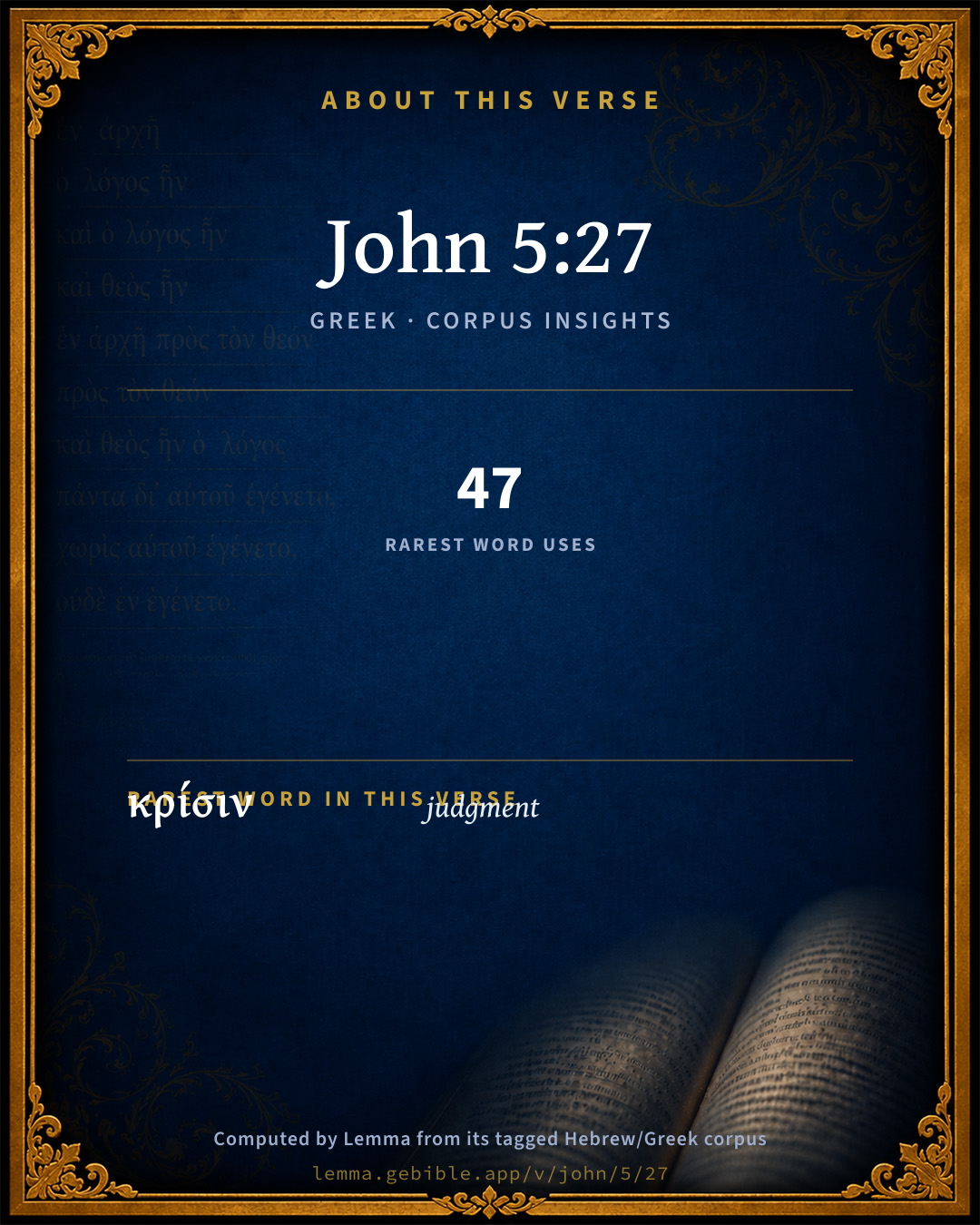
John 5:27

Greek (Tischendorf 8th ed.) John 5:27 appears in the Greek New Testament. The text above is from the Tischendorf 8th edition. Each word links to its Strong’s number and a concise gloss. Click any word for its full Thayer’s Greek Lexicon entry.
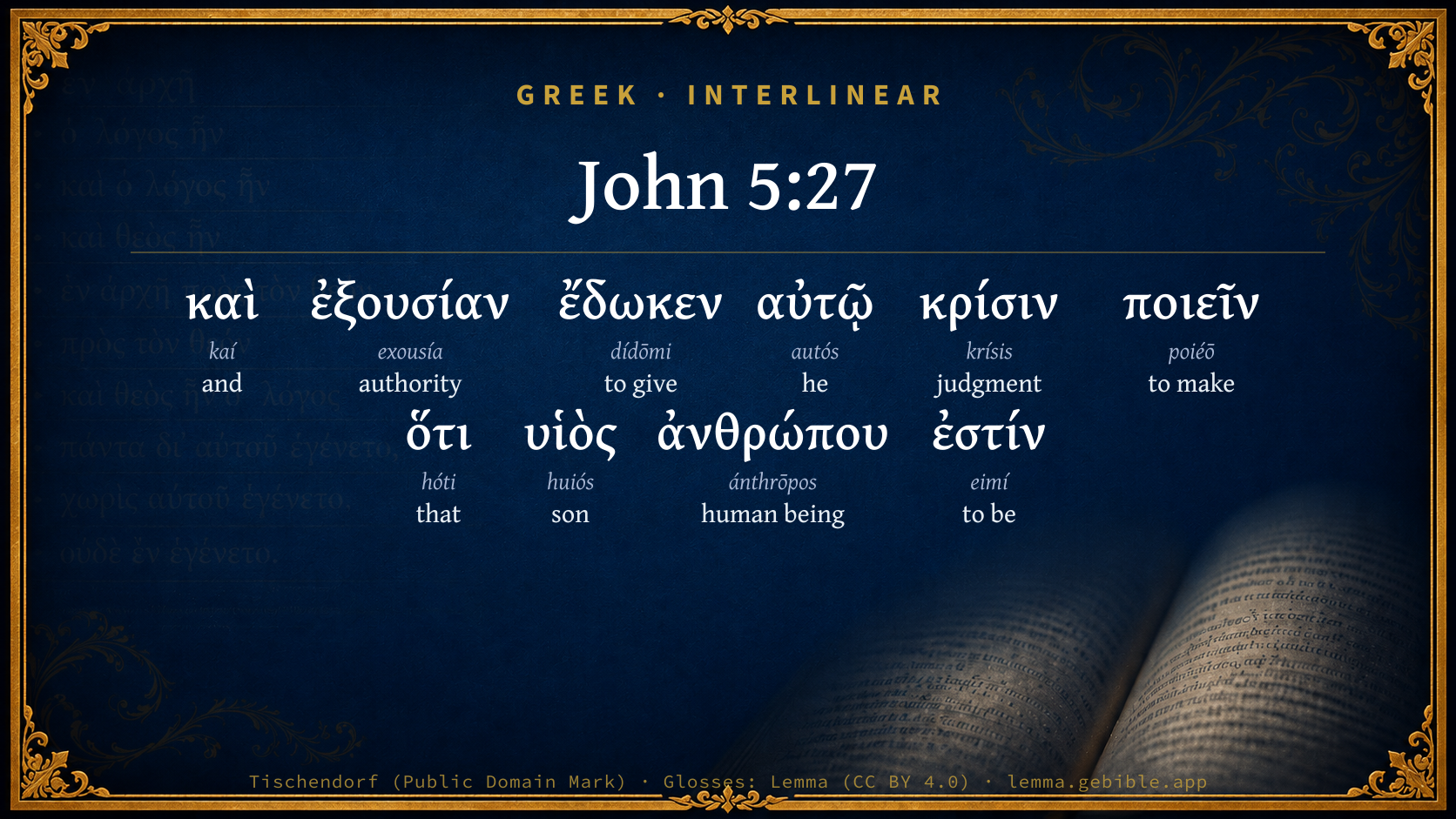
Download image
Cite this verse

John 5:27 (World English Bible). Public Domain. Lemma interlinear Bible study tool, https://lemma.gebible.app/v/john/5/27.

Show BibTeX & RIS
BibTeX
RIS
English Translation
He also gave him authority to execute judgment, because he is a son of man.
World English Bible · Public Domain
Download a study sheet

One document with this verse’s original text, its word-by-word gloss line, the meaning frame, cross-references with their text, attributed commentary, and full source and license credits — printable, and it pastes into notes with its structure intact.

This verse Autodidact and up

Study sheet (.html) Plain text (.txt)

A passage Seminary Student

Up to 50 verses in one chapter. A passage sheet keeps up to 6 commentary sources and 12 cross-references per verse, in the order this page ranks them, and says so on the sheet whenever that leaves anything out. Ask for a single verse and you get the Autodidact verse sheet above.

Everything on this page stays free to read, with no account — the sheet is a download of what is already on screen, not access to it.

Want to remove ads? Support Godless Engineer
Compare translations 3

The same verse in 3 English versions, stacked beneath the original-language interlinear above. Click any original word for its lexicon entry.

Each is an independent rendering of the whole verse — the interlinear is not word-aligned to these translations.

Highlighted words mark where these versions differ — a whole-verse word diff, not a word-by-word alignment.

  • World English Bible Public Domain
    He also gave him authority to execute judgment, because he is a son of man.
  • King James Version Public Domain
    And hath given him authority to execute judgment also, because he is the Son of man.
  • unfoldingWord Literal Text CC BY-SA 4.0
    and he gave him authority to do judgment, because he is the Son of Man.

unfoldingWord Literal Text — © unfoldingWord, licensed CC BY-SA 4.0. Word-aligned USFM3 via Door43 (git.door43.org/unfoldingWord/en_ult).

Versions to compare (up to 4)

3 of 4 selected

Show all 19 translations

Every available English version of this verse, each an independent rendering of the whole verse.

  • World English Bible Public Domain
    He also gave him authority to execute judgment, because he is a son of man.
  • Berean Standard Bible Public Domain
    And He has given Him authority to execute judgment, because He is the Son of Man.
  • Majority Standard Bible Public Domain
    And He has given Him authority to execute judgment, because He is the Son of Man.
  • King James Version Public Domain
    And hath given him authority to execute judgment also, because he is the Son of man.
  • American Standard Version (1901) Public Domain
    and he gave him authority to execute judgment, because he is a son of man.
  • Revised Version (1885) Public Domain
    and he gave him authority to execute judgment, because he is the Son of man.
  • Geneva Bible (1599) Public Domain
    And hath giuen him power also to execute iudgement, in that he is the Sonne of man.
  • Douay-Rheims (1899) Public Domain
    And he hath given him power to do judgment, because he is the Son of man.
  • Young's Literal Translation Public Domain
    and authority He gave him also to do judgment, because he is Son of Man.
  • Literal Standard Version CC BY-SA 4.0
    and authority He gave Him also to do judgment, because He is Son of Man.
  • Unlocked Literal Bible CC BY-SA 4.0
    and the Father has given the Son authority to carry out judgment because he is the Son of Man.
  • unfoldingWord Literal Text CC BY-SA 4.0
    and he gave him authority to do judgment, because he is the Son of Man.
  • Darby Bible Public Domain
    and has given him authority to execute judgment [also], because he is Son of man.
  • World Messianic Bible Public Domain
    He also gave him authority to execute judgment, because he is a son of man.
  • Webster's Bible Public Domain
    And hath given him authority to execute judgment also, because he is the Son of man.
  • Free Bible Version CC BY-SA 4.0
    The Father also granted the authority for judgment to him, for he is the Son of man.
  • Bible in Basic English Public Domain
    And he has given him authority to be judge because he is the Son of man.
  • Text-Critical English NT CC BY 4.0
    And he has given the Son authority to execute judgment, because he is the Son of Man.
  • Tyndale New Testament (1534) Public Domain
    and hath geven him power also to iudge in that he is the sonne of man.

Literal Standard Version (2020), Covenant Press — licensed CC BY-SA 4.0. Text via the HelloAO Bible API (eBible.org). Unlocked Literal Bible (unfoldingWord) — licensed CC BY-SA 4.0. Text via the HelloAO Bible API (eBible.org). unfoldingWord Literal Text — © unfoldingWord, licensed CC BY-SA 4.0. Word-aligned USFM3 via Door43 (git.door43.org/unfoldingWord/en_ult). Free Bible Version, Dr. Jonathan Gallagher — licensed CC BY-SA 4.0. Text via the HelloAO Bible API (eBible.org).

Word by word

More ways to search: Search by grammar → Find every occurrence → Compare this word →

Practice this passage: Drill this verse → Learn its vocabulary →

κρίσιν
krísis
G2920
“judgment”
Noun, Accusative, Singular, Feminine
Part of Speech
Noun
Case
Accusative
Number
Singular
Gender
Feminine
Full Thayer's Definition

Origin: perhaps a primitive word

TDNT: 18:41,5

1. a separating, sundering, separation a. a trial, contest 2. selection 3. judgment a. opinion or decision given concerning anything 1. esp. concerning justice and injustice, right or wrong b. sentence of condemnation, damnatory judgment, condemnation and punishment 4. the college of judges (a tribunal of seven men in the several cities of Palestine; as distinguished from the Sanhedrin, which had its seat at Jerusalem) 5. right, justice
  1. καὶ kaí G2532 “and” Conjunction
  2. ἐξουσίαν exousía G1849 “authority” Noun, Accusative, Singular, Feminine
  3. ἔδωκεν dídōmi G1325 “to give” Verb, Aorist, Active, Indicative, 3rd person, Singular
  4. αὐτῷ autós G846 “he” Personal pronoun, Dative, Singular, Masculine
  5. ποιεῖν poiéō G4160 “to make” Verb, Present, Active, Infinitive
  6. ὅτι hóti G3754 “that” Conjunction
  7. υἱὸς huiós G5207 “son” Noun, Nominative, Singular, Masculine
  8. ἀνθρώπου ánthrōpos G444 “human being” Noun, Genitive, Singular, Masculine
  9. ἐστίν eimí G1510 “to be” Verb, Present, Active, Indicative, 3rd person, Singular

About this verse

These counts appear in no published source. They are computed here, from the morphology-tagged text and Lemma’s own curated glosses. What Lemma adds →

10
words
10
distinct lemmas
Gospels
section

Cross-references

11

Topical passages linked to John 5:27 in the Treasury of Scripture Knowledge — connected by theme and wording, ordered by reader-vote popularity; previews shown in the World English Bible.

  • Acts 10:42 He charged us to preach to the people and to testify that this is he who is appointed by God as the Judge of the living and the dead.
  • John 5:22 For the Father judges no one, but he has given all judgment to the Son,
  • Acts 17:31 because he has appointed a day in which he will judge the world in righteousness by the man whom he has ordained; of which he has given assurance to all men, in that he has raised him from the dead."
  • Daniel 7:13–14 I saw in the night-visions, and, behold, there came with the clouds of the sky one like a son of man, and he came even to the ancient of days, and they brought him near before him.
  • 1 Corinthians 15:25 For he must reign until he has put all his enemies under his feet.
  • 1 Peter 3:22 who is at the right hand of God, having gone into heaven, angels and authorities and powers being made subject to him.
  • Psalms 110:6 He will judge among the nations. He will heap up dead bodies. He will crush the ruler of the whole earth.
  • Ephesians 1:20–23 which he worked in Christ, when he raised him from the dead, and made him to sit at his right hand in the heavenly places,
  • Hebrews 2:7–9 You made him a little lower than the angels; You crowned him with glory and honor.
  • Psalms 110:1–2 Yahweh says to my Lord, "Sit at my right hand, Until I make your enemies your footstool for your feet."
  • Philippians 2:7–11 but emptied himself, taking the form of a servant, being made in the likeness of men.

Cross-references courtesy of OpenBible.info (CC BY 4.0).

Commentary

Notes on John 5:27 from classic Christian and Jewish commentators (each source and its license shown beneath its notes). The classic Christian expositions comment on the surrounding passage and are grouped to its opening verse, so a note may address several verses; the Jewish commentaries on the Tanakh (Rashi and others) are per-verse, so they appear only where the commentator wrote on this verse.

Lemma curates 59 commentaries, every one of them public domain or Creative Commons licensed, each selected and text-cleaned for this edition rather than reprinted as found. About our sources →

Bengel's Gnomon

Johann Albrecht Bengel

Joh 5:27. Ὅτι Υἱὸς ἀνθρώπου) No article is added in this passage: because He is Son of Man, power has been given Him of judging. He, a man. saves men: He, a man, judges men: Dan 7:13, etc., “I saw in the night visions, and, behold, one like the Son of Man came with the clouds of heaven, and came to the Ancient of Days—and there was given Him dominion, and glory, and a kingdom.” Act 17:31; Heb 2:5, etc., “Unto the angels hath He not put in subjection the world to come—but—‘what is man, that Thou art mindful of him? or the son of man, that thou visitest him? Thou madest Him a little lower than the angels; Thou crownedst Him with glory and honour,—Thou hast put ail things in subjection under His feet.’ ”

Bengel's Gnomon of the New Testament — English translation (T&T Clark, Edinburgh, 1860) — public domain. Text from a community e-Sword module.

Expositor's Greek Testament

ed. W. Robertson Nicoll

Joh 5:27 . Not only has the Father given to the Son this great prerogative, but καὶ ἐξουσίαν … ἀνθρώπου ἐστί . κρίσιν ποιεῖν , like judicium facere , and our do judgment , is used by Demosthenes, Xenophon, Polybius, etc., in the sense “to judge,” “to act as judge”. This climax of authority [although καὶ is omitted before κρίσιν by recent editors on good authority] is based upon the fact ὅτι υἱὸς ἀνθρώπου ἐστί . [Strangely enough, Chrysostom ascribes this punctuation to Paul of Samosata, and declares it to be an inconsequence. He himself begins Joh 5:28 with this clause, and reads “marvel not at this, that He is the Son of Man”.] The absence of the article condemns all interpretations which render these words “the Son of Man” and understands that Jesus claims the prerogative of judgment as the Messiah. Where “the Son of Man” means the Messiah the articles regularly appear. Besides, direct allusion to the Messianic functions would here be out of place. The words must be rendered “because He is a son of man,” that is, a man. How is this a reason for His being Judge of men? Various explanations are given: the Judge must be visible since the judgment is to take place with human publicity (Luther Maldonatus, Witsius), because as man the Son carries out the whole work of redemption (Meyer, etc.), because men should be judged by the lowliest and most loving of men (Stier), because the Judge must share the nature of those who are brought before Him (Westcott), because only as man could Jesus enter into the sphere in which the judicial office moves or have the compassion which a judge of men should possess (Baur), because the judgment of humanity is to be a homage rendered to the holiness of God, a true act of adoration, a worship; and therefore the act must go forth from the bosom of humanity itself (Godet). But undoubtedly Beyschlag is right when he says: “The eternal love condemns no one because he is a sinner; as such it does not at all condemn; it leaves it to men to judge themselves, through rejection of the Saviour who is presented to them. The Son of Man is the judge of the world, just because He presents the eternal life, the kingdom of heaven to all, and urges all to the eternal decision, and thus urges those who continue unbelieving to a continuing self-judgment” ( Neutest. Theol. , i. 290). By His appearing in human form as God’s messenger, and by His offer of life eternal, He necessarily judges men. As His offer of life to the impotent man tested him and showed whether he would abide in death or pass into life: so are all men judged precisely by that appearance among them in human form which stumbles them and tempts them to think His claims absurd, and which yet as the embodied love and life of God necessarily judges men. Therefore μὴ θαυμάζετε τοῦτο .

The Expositor's Greek Testament, edited by W. Robertson Nicoll (1897–1910) — public domain. Text from a community e-Sword module.

Godet's Commentaries

Frédéric Louis Godet

Ver. 27. “And he hath given him power also to execute judgment, because he is son of man.”

Jesus had said in Joh 5:22, in an indefinite way, that all judgment is committed to Him. This word all judgment included, of course, both the present moral, internal judgment and the final, external judgment. It is under these two aspects, taken together, that this idea is reproduced in Joh 5:27, which thus forms the transition from the work of the spiritual resurrection and judgment (Joh 5:24-26), to that of the outward resurrection and judgment (Joh 5:28-29). Jesus adds to the idea of Joh 5:22 a new limitation: that the function of judge is committed to Him inasmuch as He is Son of man. The second καί also, although omitted by B, is perhaps authentic. It emphasizes the relation between the character of judge and that of Son of man. What is this relation? It has been understood in a great variety of ways. According to Lucke the meaning is: Because He is the Messiah and judging is (according to Daniel 7) a Messianic function. But in that case the article before the words Son of man could not be wanting. Without the article, this expression signifies simply: a son of man. Keil denies this and thinks that the absence of the article may be explained by the fact that the words are here the predicate, designating a quality, rather than a person. He explains therefore: Because He is mediator between God and man, author of salvation and consequently judge; for judgment forms a part of the salvation. But the absence of the article is not justified by this, and the idea of salvation is arbitrarily introduced here. Beyschlag understands: Because He is the perfect man, the ideal man, fitted to serve as the standard for the moral worth of all others. But the article could not, any more than in the other case, be wanting with this meaning. The term, Son of man, without the article sets forth simply the quality of man which He shares with all other men. Lange: Because, as a son of man, He can have compassion on our weakness. But this would be to deny to God the feeling of compassion, while the Scriptures say expressly: “Like as a Father pitieth...., so the Lord pitieth.... for he knoweth our frame” (Psa 102:13).

Heb 2:18 cannot be cited as parallel, since the question there is of intercession, not of judgment. De Wette: Because the Father, as being the hidden God, cannot judge. Reuss, nearly the same: “In the system. God, in Himself, does not place Himself in contact with the world which He is to judge; He makes Himself man for this.” This reason would apply to the God of Philo not to the God of Jesus Christ and of St. John; the latter is a Father, who is in direct relations with the world and humanity; He begets children for life (Joh 1:13); He loves the world (Joh 3:16); He eventestifies by outward miracles in favor of the Son; He draws souls to Christ, etc. Such a God might also, if He wished, judge the world. Besides, as Luthardt observes, the opposite of the hidden God would not be the Son of man, but the revealed God, the Word, the Son of God, or, speaking absolutely, the Son. Meyer and Weiss: Because Jesus is, as man, the executor and proclaimer of salvation, on which depends the decision of each man’s destiny. There is the same reason against this explanation, as against that of Keil. The quality of man is made prominent here for the purpose of explaining, not the dignity of Saviour, but that of judge. Holtzmann: Because He can make the revelation of the divine holiness shine forth before the eyes of men through the fact of His human appearance. But God is able directly to manifest His holiness to the human conscience, as is many times seen in the Old Testament.Hengstenberg: to recompense Him for becoming man. Strange reward! In this embarrassment, the Peschito (Syr sch), some Mjj. (E. M Δ .), and Chrysostom have recourse to a desperate expedient; they connect these words: “because he is son...” with the following verse: “Because He is a Son of man, marvel not.” But what is there in the context leading us to suppose an astonishment respecting this point? Is it then so difficult to grasp the thought of Jesus? The judgment of humanity is a homage rendered to the holiness of God; but this homage, in order really to make reparation for the outrage committed, must proceed from the race itself which has committed the offense. Judgment, in this view, is exactly on the same line with expiation, of which it serves as the complement. Expiation is the reparation freely offered by believing humanity; judgment is the satisfaction which God takes from humanity which has refused Him this reparation. In the one, as in the other, of these acts, a man must preside.

Frédéric Louis Godet — Commentaries on Luke, John, Romans, and 1 Corinthians — English translation (T&T Clark, Edinburgh, 1870s–1890s) — public domain. Text from a community e-Sword module.

Geneva Bible (1599)

Geneva Bible translators

That is, he shall not only judge the world as he is God, but also as he is man, he received this of his Father to be judge of the world.

That is, high and sovereign power to rule and govern all things, insomuch that he hath power of life and death.

Geneva Bible (1599) marginal notes — public domain. Text via Bolls.life.

Jamieson, Fausset & Brown

Robert Jamieson, A. R. Fausset & David Brown

because he is the Son of man--This seems to confirm the last remark, that what Christ had properly in view was the indwelling of the Son's essential life in humanity as the great theater and medium of divine display, in both the great departments of His work--life-giving and judgment. The appointment of a Judge in our own nature is one of the most beautiful arrangements of divine wisdom in redemption.

Jamieson, Fausset & Brown — Commentary Critical and Explanatory on the Whole Bible (1871) — public domain (CC PDM 1.0). Text via the HelloAO Bible API.

Adam Clarke's Commentary

Verse 27. Because he is the Son of man.] Because he is the Messiah; for in this sense the phrase, Son of man, is often to be understood. But some join this to the next verse thus:- Marvel not at this, because he is the Son of man.

Adam Clarke's Commentary on the Bible (1810–1826) — public domain. Text from a community e-Sword/MySword module.

John Calvin's Commentaries

27. And hath given him power. He again repeats that the Father hath given him dominion, that he may have full power over all things in heaven and in the earth. The word (ἐξουσία) here denotes authority Judgment is here put for rule and government, as if he had said, that the Father had appointed him to be King, to govern the world, and exercise the power of the Father himself.

Because he is the Son of man. This reason, which is immediately added, deserves particularly to be observed, for it means that he comes forth to men, adorned with such magnificence of power, that he may impart to them what he has received from the Father. Some think that this passage contains nothing else than what is said by Paul, that Christ,

having been in the form of God emptied himself by taking upon him the form of a servant, and humbled himself even to the death of the cross; and therefore God hath exalted him, and given him a name more illustrious than any name, that every knee may bow before him (Philippians 2:7-10.)

But for my own part, I regard the meaning as more extensive: that Christ, so far as he is man, was appointed by the Father to be the Author of life, that it may not be necessary for us to go far to seek it; for Christ did not receive it for himself, as if he needed it, but in order to enrich us by his wealth. It may be summed up thus: “What had been hidden in God is revealed to us in Christ as man, and life, which was formerly inaccessible, is now placed before our eyes.” There are some who separate this argument from its immediate connection, and join it to the following clause; but this is a forced interpretation, and is at variance with Christ’s meaning.

John Calvin's Commentaries (1540-1563) — public domain. Text from the Calvin Translation Society English edition (1840s-50s) via the Christian Classics Ethereal Library (ccel.org). Calvin's coverage is partial (roughly two-thirds of the Bible); uncommented books and verses are honest gaps, never fabricated. The 19th-century editor's footnotes and remarks are omitted so the notes are faithfully Calvin's own voice.

Ellicott's Commentary for English Readers

(27) Hath given.—As above, gave. The “also” after judgment should be omitted. In these verses, as before, the two relations of Father—Son, Life—Judgment, are emphatic. Both Life and Judgment can belong to God only, but both are the Father’s gift to the Son.

The Son of man.—Render, a son of man. The term differs by the striking omission of articles from the usual term for the Messiah, and occurs again in Rev_1:13; Rev_14:14. It is here in contrast to the “Son of God” in Joh_5:25. The explanation is, once more, to be found in the thought of the Incarnation as an emptying Himself of the attributes which are the glories of the divine nature. It is not because He is Messiah (the Son of Man), but human (a son of man), that the Father gave Him the power to have life in Himself, and the authority to execute judgment. (See Note on Joh_5:26.) Still His humanity is not here dwelt upon as a qualification for the office of judge, because it is of the same nature as that of those He judges. This thought and the thoughts which flow from it (comp. Act_17:31) are full of beauty and truth, but the side of truth prominent in this verse, and all those which follow Joh_5:17, is not His relation to man, but His relation to God. All are a sermon on the text, “My Father worketh hitherto, and I work.”

A Bible Commentary for English Readers, edited by Charles John Ellicott (1878–1897) — public domain. Text from a community e-Sword module.

The Cambridge Bible for Schools and Colleges

gen. ed. J. J. S. Perowne

27. Hath given him authority to execute judgment also] Better, gave Him authority to execute judgment, when He sent Him into the world. ‘Also’ is not genuine. See on Joh_1:12, and comp. Joh_10:18.

because he is the Son of man] Rather, because He is a son of man; i.e. not because He is the Messiah, but because He is a human being. In the Greek neither ‘son’ nor ‘man’ has the article. Where ‘the Son of Man,’ i.e. the Messiah, is meant, both words have the article: comp. Joh_1:51, Joh_3:13-14, Joh_6:27; Joh_6:53; Joh_6:62, Joh_8:28, &c. Because the Son emptied Himself of all His glory and became a man, therefore the Father endowed Him with these two powers; to have life in Himself, and to execute judgment.

Before passing on to the last section of this half of the discourse we may remark that “the relation of the Son to the Father is seldom alluded to in the Synoptic Gospels. But a single verse in which it is, seems to contain the essence of the Johannean theology, Mat_11:27 : ‘All things are delivered unto Me of My Father; and no man knoweth the Son but the Father; neither knoweth any man the Father, save the Son, and he to whomsoever the Son will reveal Him.’ This passage is one of the best authenticated in the Synoptic Gospels. It is found in exact parallelism both in S. Matthew and S. Luke … And yet once grant the authenticity of this passage, and there is nothing in the Johannean Christology that it does not cover.” S. p. 109. The theory, therefore, that this discourse is the composition of the Evangelist, who puts forward his own theology as the teaching of Christ, has no basis. If the passage in S. Matthew and S. Luke represents the teaching of Christ, what reason have we for doubting that this discourse does so? To invent the substance of it was beyond the reach even of S. John; how far the precise wording is his we cannot tell. This section of it (21–27) bears very strong impress of his style.

The Cambridge Bible for Schools and Colleges (gen. ed. J. J. S. Perowne; Cambridge University Press, 1878–1918) — public domain. Text from a community e-Sword module.

John Gill's Exposition

And hath given him authority to execute judgment also,.... Both in his church and kingdom, in the present state of things, and at the last day, when all shall stand before his judgment seat: and that

because he is the son of man; truly and properly man; because though he was in the form of God, and equal to him, yet became man, and was in the form of a servant: and so reads the Ethiopic version, "because the Son of God is the son of man"; and therefore the authority of executing judgment, according to the council and covenant of peace, is committed to him; or that men might have a visible judge, or be judged by one in their own nature: agreeably the Persic version renders it, "because the Son himself is he who judges the sons of men"; or rather because he is that son of man spoken of in prophecy, especially in Dan 7:13; by whom is meant the Messiah, as the Jews themselves allow (f), and who was not a mere man, but the man God's fellow; and so being omniscient and omnipotent, was equal to such a work, which otherwise he would not have been; See Gill on Joh 5:22. The Syriac version joins this clause to the beginning of Joh 5:28, and reads it thus, "because he is the son of man, marvel not at this"; let this be no obstruction to your faith of his quickening the dead, and having authority to execute judgment on all; since, though the son of man, he is not a mere man, but God over all, as what is next ascribed to him manifestly shows.

(f) Zohar in Gen. fol. 85. 4. Bemidbar Rabba, sect. 13. fol. 209. 4. Jarchi & Saadiah Gaon in Dan. vii. 13. & R. Jeshuah in Aben Ezra in ib.

John Gill's Exposition of the Whole Bible (1746–1763) — public domain (CC PDM 1.0). Text via the HelloAO Bible API.

Trapp's Complete Commentary

John Trapp

27 And hath given him authority to execute judgment also, because he is the Son of man.

Ver. 27. Because he is the Son of man] Or, as he is the Son of man. {a} By virtue of the hypostatical union, his manhood came as near to God as could be. He had the best natural parts both of mind, Isa 11:2-3, and body, Psa 45:2; and the best supernatural, whereby he found favour also with God, Luk 2:52, for he had more near familiarity with the Godhead than ever had any creature, together with a partner-agency with his Godhead, in the works of mediation, 1Ti 2:5. In the state of exaltation, the manhood hath, 1. Excess of glory. 2. The grace of adoration together with the Godhead. 3. Judiciary power, as here and Act 17:31.

{a} οτε, id est καθοτι. Beza.

John Trapp, A Commentary or Exposition upon All the Books of the Old and New Testament (1647–1656) — public domain. Text from a community e-Sword module.

Albert Barnes' Notes on the Bible

Hath given him authority - Hath appointed him to do this. Has made him to be judge of all. This is represented as being the appointment of the Father, Act 17:31. The word “authority” here (commonly rendered “power”) implies all that is necessary to execute judgment - all the physical power to raise the dead, and to investigate the actions and thoughts of the life; and all the “moral right” or authority to sit in judgment on the creatures of God, and to pronounce their doom.

To execute judgment - To do judgment - that is, to judge. He has appointment to “do justice;” to see that the universe suffers no wrong, either by the escape of the guilty or by the punishment of the innocent.

Because be is the Son of man - The phrase “Son of man” here seems to be used in the sense of “because he is a man,” or because he has human nature. The term is one which Jesus often gives to himself, to show his union with man and his interest in man. See the notes at Mat 8:19-20. It is to be remarked here that the word “son” does not have the article before it in the original: Because he is A son of man - that is, because he is a man. It would seem from this that there is a propriety that one in our nature should judge us. What this propriety is we do not certainly know. It may be:

Because one who has experienced our infirmities, and who possesses our nature, may be supposed by those “who are judged” to be better qualified than one in a different nature. Because he is to decide between “man” and “God,” and it is proper that our feelings, and nature, and views should be represented in the judge, as well as those of God. Because Jesus has all the feelings of compassion we could ask - all the benevolence we could desire in a judge; because he has ShowN his disposition to defend us by giving his life, and it can never be alleged by those who are condemned that their judge was a distant, cold, and unfriendly being.

Some have supposed that the expression “Son of man” here means the same as “Messiah” (see Dan 7:13-14), and that the meaning is that God hath made him judge because he was the Messiah. Some of the ancient versions and fathers connected this with the following verse, thus: “Marvel not because I am a man, or because this great work is committed to a man apparently in humble life. You shall see greater things than these.” Thus, the Syriac version reads it, and Chrysostom, Theophylact, and some others among the fathers.

Albert Barnes' Notes on the Bible (1834–1885) — public domain. Text from a community e-Sword/MySword module.

Haydock's Catholic Bible Commentary

To execute judgment, because he is the Son of man; or, because, he is God made man, and is to come to judgment in a visible manner, to judge all men. (Witham)

George Leo Haydock (1774–1849), Haydock's Catholic Family Bible and Commentary, 1859 edition — public domain. Excludes Psalms (Douay-Rheims chapter numbering differs from Protestant) and Deuterocanonical books (Catholic canon only).

Matthew Poole's English Annotations

To execute judgment also; to have the power of life and death, the keys of both; to rule and govern the world, and to judge it at the last day.

Because he is the Son of man: Act 17:31, He hath appointed a day, in the which he will judge the world in righteousness by that man whom he hath ordained, &c. So Phi 2:8, Being found in fashion as a man, he humbled himself, and became obedient unto death, even, the death of the cross. Wherefore God also hath highly exalted him, & c. Some think that the sense is, because he was that Son of man, who was the Seed of the woman, promised Gen 3:15; the Son of man prophesied of by Daniel, Dan 7:13,14. And that the term, Son of man, here, signifieth his office as Mediator.

Matthew Poole's English Annotations on the Holy Bible (1683–1685) — public domain. Text from a community e-Sword/MySword module.

Whedon's Commentary on the Bible

Daniel D. Whedon

The final universal resurrection of the body, Joh_5:26-30.

27. Judgment also—In addition to the resurrection of the body. And now we have in the present passage a brief but most explicit description of the simultaneous resurrection and universal judgment of mankind.

Because he is the Son of man—As the dying Son of man he is our atoning Redeemer; and so as the living Son of man he is our just Judge. As by man was our death, so by man is our life and our judgment. The cross and the judgment throne bear the same Son of man.

Daniel D. Whedon (gen. ed.), Commentary on the Old and New Testaments (1874–1909) — public domain. Text from a community e-Sword module.

The Pulpit Commentary

Vers. 27-29. (2) Second greater workjudgment of the world.

And he gave him (i.e. the Son, the God-Man) authority to execute judgment, because he is Son of man. He has vindicated his power to confer life upon the dead by asserting the possession by "the Son" of the Divine Sonship. He now adds, so far as the relation to man is concerned, his fitness and authority to administer justice, to preside over the entire juridical process, to lift the scales, to determine the destiny of the human race. The fitness is seen in this, that he, "the Son," is "the Son of man." The one term, "THE SON," entirely covers the twofold Sonship. The proof of his humanity is assumed to be complete. The fact of it is the ground that he who knows what is in man should be the Judge of men. By personal experience of man"s temptations and frailties; by knowing every palliation of our sins, every extenuation of our failures, every aggravation of our weakness; by gazing through human eyes with human consciousness upon our mysterious destiny, he is competent to judge; whereas by being Son of God as well as Son of man, he is entrusted with power to execute the judgment of the Eternal. The principle involved is based upon perfect justice. The honour thus conferred on the God-Man is infinite, the consolation thus held out to man unspeakable. We are being judged by Christ, not by impersonal law. The entire incidence upon every individual of the Law is in the hands of the Redeemer. The Saviour, the Life-giver, the Voice which quickens the dead, assigns the judgment. We must be careful, in any inference we draw from this grand utterance, to avoid all suspicion of schism or rivalry between the Father and the Son. The Son is not more merciful than the Father. For the Father of the Old Testament pitieth his children, and knoweth their frame, (Psa_103:13, Psa_103:14) and the Father of Jesus Christ loves the world, and counts the very hairs of our heads. The Son will not exercise this judgment with less regard to the claims of eternal justice than the Father; but his knowledge of humanity is, by the nature of the case, a guarantee of such application of the justice of God to the case of every individual, that man"s knowledge of himself will be able personally to justify and verify it. The Divine judgment will go forth from the heart of man himself.

The Pulpit Commentary (1880–1919), ed. H.D.M. Spence-Jones & Joseph S. Exell — public domain. Text from a community e-Sword module.

John Wesley's Explanatory Notes

Because he is the Son of man - He is appointed to judge mankind because he was made man.

John Wesley, Explanatory Notes Upon the Whole Bible (1754–1765) — public domain. Text via the GEBible commentary corpus.

Cambridge Greek Testament for Schools and Colleges

27. ἐξουσίαν ἔδωκεν. Gave Him authority (Joh 1:12, Joh 10:18), when He sent Him into the world. Aorists mark what was done once for all.

ὅτι υἱὸς ἀνθρ. ἐστίν. Because He is a son of man, i.e. not because He is the Messiah, but because He is a human being. Neither ‘son’ nor ‘man’ has the article. Where ‘the Son of Man,’ i.e. the Messiah, is meant, both words have the article: comp. Joh 1:51, Joh 3:13-14, Joh 6:27; Joh 6:53; Joh 6:62, Joh 8:28, &c. Because the Son emptied Himself of His glory and became a man, therefore the Father endowed Him with these two powers; to have life in Himself, and to execute judgment.

Before passing on to the last section of this half of the discourse we may remark that “the relation of the Son to the Father is seldom alluded to in the Synoptic Gospels. But a single verse in which it is, seems to contain the essence of the Johannean theology, Mat 11:27: ‘All things are delivered unto Me of My Father; and no man knoweth the Son but the Father; neither knoweth any man the Father, save the Son, and he to whomsoever the Son will reveal Him.’ This passage is one of the best authenticated in the Synoptic Gospels. It is found in exact parallelism both in S. Matthew and S. Luke.… And yet once grant the authenticity of this passage, and there is nothing in the Johannean Christology that it does not cover.” Sanday. The theory, therefore, that this discourse is the composition of the Evangelist, who puts forward his own theology as the teaching of Christ, has no basis. If the passage in S. Matthew and S. Luke represents the teaching of Christ, what reason have we for doubting that this discourse does so? To invent the substance of it was beyond the reach even of S. John; how far the precise wording is his we cannot tell. This section (21–27) bears strong impress of his style.

Cambridge Greek Testament for Schools and Colleges (Cambridge University Press, 1896; 21 vols, various authors incl. Carr, Maclear, Plummer, Farrar, Lumby, Moule, M. R. James, Simcox) — public domain. Text from a community e-Sword module.

Alford’s Greek Testament

Henry Alford

27.] We have here again ζωοποιεῖν and κρίνειν bound together as the two great departments of the Son’s working;—the former, as substantiating the ζήσουσιν just uttered; the latter, as leading on to the great announcement of the next verse. But the two departments spring from two distinct sources, united in the Person of the Incarnate Son of God. The Father hath given Him to have life in Himself, as He is the Son of God. We have none of us life in ourselves: in Him we live and move and have our being. But He, as the Father is, is the source of Life. Then again the Father hath given Him power to pass judgment, because He is the Son of Man; man is to be judged by Man,—by that Man whom God hath appointed, who is the inclusive Head of humanity, and to whom mankind, and man’s world, pertain by right of covenant-purchase. This κρίσιν ποιεῖν leads the thought to the great occasion when judgment shall be executed; which accordingly is treated of in the next verse.

28,

Henry Alford, The Greek Testament (1849–1861) — public domain. Text from a community e-Sword module.

International Critical Commentary

27. The rec., supported by DΓΔΘ and some O.L. texts, has καί before κρίσιν; but om. אcABLW.

ἐξουσίαν ἔδωκεν αὐτῷ: see v. 22. The ἐξουσία is that of 17:2; cf. also Mat 28:18. The Father “gave to Him authority to pass judgment, because He is the Son of Man,”1 to whom, as we have seen,2 the tremendous office of Judge is assigned in Jewish apocalyptic.

It has been suggested that the absence of the article before υἱὸς ἀνθρώπου here is significant, and that we should render “because He is a son of man,” the meaning being that the office of the Judge of men is committed to Christ because He is Man, an affinity of nature between Judge and him who is judged being essential for just judgment. But the title “Son of Man” occurs repeatedly in Jn. (see on 1:51), and several times in connexion with the thought of Him as Judge. It would be strange if in the present passage, where His office as Judge is emphasised, another explanation of the phrase should be necessary.

The absence of the article before υἱὸς ἀνθρώπου is not to be pressed. Official titles have a tendency to become anarthrous, and this has happened here, although elsewhere in Jn. we have ὁ υἱὸς τοῦ ἀνθρώπου. If we are right in regarding vv. 20-29 as, in part, a commentary by the evangelist on what Jesus actually said to the Jews, then it is the less surprising to find υἱὸς ἀνθρώπου instead of ὁ υἱὸς τοῦ ἀνθρώπου, which never occurs in narrative. The latter is a designation of Himself used by Jesus in all four Gospels, but is not employed by the evangelists when referring to Him.

International Critical Commentary — older volumes (1896–1929), various authors — public domain. Text from a community e-Sword module.

Vincent's Word Studies in the New Testament

Marvin R. Vincent

Authority. See on 1 12.

Also. Omit.

The Son of man. Better, a son of man. The article is wanting. The authority is assigned to Him as being very man. John uses the article everywhere with this phrase, except here and Rev 1:13; Rev 14:14. See on Luk 6:22.

Marvin R. Vincent, Word Studies in the New Testament (1887–1900) — public domain. Text from a community e-Sword/MySword module.

Lesson kit

Teaching starters — assembled from the data on this page, not authored interpretation. Every prompt links to the verse data it draws on. Edit before teaching.

John, in the Gospels, opens this verse with 10 words (10 distinct Greek lemmas). Its most distinctive word is krísis (“judgment”). A historical commentator’s framing appears above. Read the whole chapter for the surrounding context.

Discussion questions

  1. The word krísis carries the sense “judgment.” How does it shape the verse?
  2. How does Matthew 5:21, which shares the word «judgment», read alongside this verse?
  3. The translations on this page render this verse differently — a whole-verse word diff, not a word-by-word alignment. What might account for the different wordings?
  4. Compare how Bengel's Gnomon and Expositor's Greek Testament read this verse. Where do they agree or differ?

Things to notice

Reading settings

Reading text

Shown beneath each verse's original-language words.

Old Testament
Old Testament edition

Read the OT as the Masoretic Hebrew (MT) or the Greek Septuagint (LXX).

English shown for the Greek Septuagint (in the Hebrew ↔ Greek comparison).

Comparing translations? Open the Compare panel on any verse page to stack up to four side by side.