Revelation 13:5

Greek (Tischendorf 8th ed.) Revelation 13:5 appears in the Greek New Testament. The text above is from the Tischendorf 8th edition. Each word links to its Strong’s number and a concise gloss. Click any word for its full Thayer’s Greek Lexicon entry.
Download image
Cite this verse

Revelation 13:5 (World English Bible). Public Domain. Lemma interlinear Bible study tool, https://lemma.gebible.app/v/revelation/13/5.

Show BibTeX & RIS
BibTeX
RIS
English Translation
A mouth speaking great things and blasphemy was given to him. Authority to make war for forty-two months was given to him.
World English Bible · Public Domain
Download a study sheet

One document with this verse’s original text, its word-by-word gloss line, the meaning frame, cross-references with their text, attributed commentary, and full source and license credits — printable, and it pastes into notes with its structure intact.

This verse Autodidact and up

Study sheet (.html) Plain text (.txt)

A passage Seminary Student

Up to 50 verses in one chapter. A passage sheet keeps up to 6 commentary sources and 12 cross-references per verse, in the order this page ranks them, and says so on the sheet whenever that leaves anything out. Ask for a single verse and you get the Autodidact verse sheet above.

Everything on this page stays free to read, with no account — the sheet is a download of what is already on screen, not access to it.

Want to remove ads? Support Godless Engineer
Compare translations 3

The same verse in 3 English versions, stacked beneath the original-language interlinear above. Click any original word for its lexicon entry.

Each is an independent rendering of the whole verse — the interlinear is not word-aligned to these translations.

Highlighted words mark where these versions differ — a whole-verse word diff, not a word-by-word alignment.

  • World English Bible Public Domain
    A mouth speaking great things and blasphemy was given to him. Authority to make war for forty-two months was given to him.
  • King James Version Public Domain
    And there was given unto him a mouth speaking great things and blasphemies; and power was given unto him to continue forty and two months.
  • unfoldingWord Literal Text CC BY-SA 4.0
    And to it was given a mouth speaking great and blasphemies, and authority was given to it to act for 42 months.

unfoldingWord Literal Text — © unfoldingWord, licensed CC BY-SA 4.0. Word-aligned USFM3 via Door43 (git.door43.org/unfoldingWord/en_ult).

Versions to compare (up to 4)

3 of 4 selected

Show all 19 translations

Every available English version of this verse, each an independent rendering of the whole verse.

  • World English Bible Public Domain
    A mouth speaking great things and blasphemy was given to him. Authority to make war for forty-two months was given to him.
  • Berean Standard Bible Public Domain
    The beast was given a mouth to speak arrogant and blasphemous words, and authority to act for 42 months.
  • Majority Standard Bible Public Domain
    The beast was given a mouth to speak arrogant and blasphemous words, and authority to make war for 42 months.
  • King James Version Public Domain
    And there was given unto him a mouth speaking great things and blasphemies; and power was given unto him to continue forty and two months.
  • American Standard Version (1901) Public Domain
    and there was given to him a mouth speaking great things and blasphemies; and there was given to him authority to continue forty and two months.
  • Revised Version (1885) Public Domain
    and there was given to him a mouth speaking great things and blasphemies; and there was given to him authority to continue forty and two months.
  • Geneva Bible (1599) Public Domain
    And there was giuen vnto him a mouth, that spake great things and blasphemies, and power was giuen vnto him, to doe two and fourtie moneths.
  • Douay-Rheims (1899) Public Domain
    And there was given to him a mouth speaking great things, and blasphemies: and power was given to him to do two and forty months.
  • Young's Literal Translation Public Domain
    And there was given to it a mouth speaking great things, and evil-speakings, and there was given to it authority to make war forty-two months,
  • Literal Standard Version CC BY-SA 4.0
    And there was given to it a mouth speaking great things, and slanders, and there was given to it authority to make war forty-two months,
  • Unlocked Literal Bible CC BY-SA 4.0
    The beast was given a mouth that could speak proud words and blasphemies. It was permitted to exercise authority for forty-two months.
  • unfoldingWord Literal Text CC BY-SA 4.0
    And to it was given a mouth speaking great and blasphemies, and authority was given to it to act for 42 months.
  • Darby Bible Public Domain
    And there was given to it a mouth, speaking great things and blasphemies; and there was given to it authority to pursue its career forty-two months.
  • World Messianic Bible Public Domain
    A mouth speaking great things and blasphemy was given to him. Authority to make war for forty-two months was given to him.
  • Webster's Bible Public Domain
    And there was given to him a mouth speaking great things and blasphemies; and power was given to him to continue forty and two months.
  • Free Bible Version CC BY-SA 4.0
    He was given the ability to make great boasts and speak blasphemies, and he was also given the authority to do this for forty-two months.
  • Bible in Basic English Public Domain
    And there was given to him a mouth to say words of pride against God; and there was given to him authority to go on for forty-two months.
  • Text-Critical English NT CC BY 4.0
    The beast was given a mouth to utter great boasts and blasphemy, and he was given authority to wage war for forty-two months.
  • Tyndale New Testament (1534) Public Domain
    And ther was a mouth geve vnto him that spake great thinges and blasphemies and power was geve vnto him to do xlii. monethes

Literal Standard Version (2020), Covenant Press — licensed CC BY-SA 4.0. Text via the HelloAO Bible API (eBible.org). Unlocked Literal Bible (unfoldingWord) — licensed CC BY-SA 4.0. Text via the HelloAO Bible API (eBible.org). unfoldingWord Literal Text — © unfoldingWord, licensed CC BY-SA 4.0. Word-aligned USFM3 via Door43 (git.door43.org/unfoldingWord/en_ult). Free Bible Version, Dr. Jonathan Gallagher — licensed CC BY-SA 4.0. Text via the HelloAO Bible API (eBible.org).

Word by word

More ways to search: Search by grammar → Find every occurrence → Compare this word →

Practice this passage: Drill this verse → Learn its vocabulary →

βλασφημίας
blasphēmía
G988
“blasphemy”
Noun, Accusative, Plural, Feminine
Part of Speech
Noun
Case
Accusative
Number
Plural
Gender
Feminine
Full Thayer's Definition

Origin: from G989

TDNT: 11:21,1

1. slander, detraction, speech injurious, to another's good name 2. impious and reproachful speech injurious to divine majesty
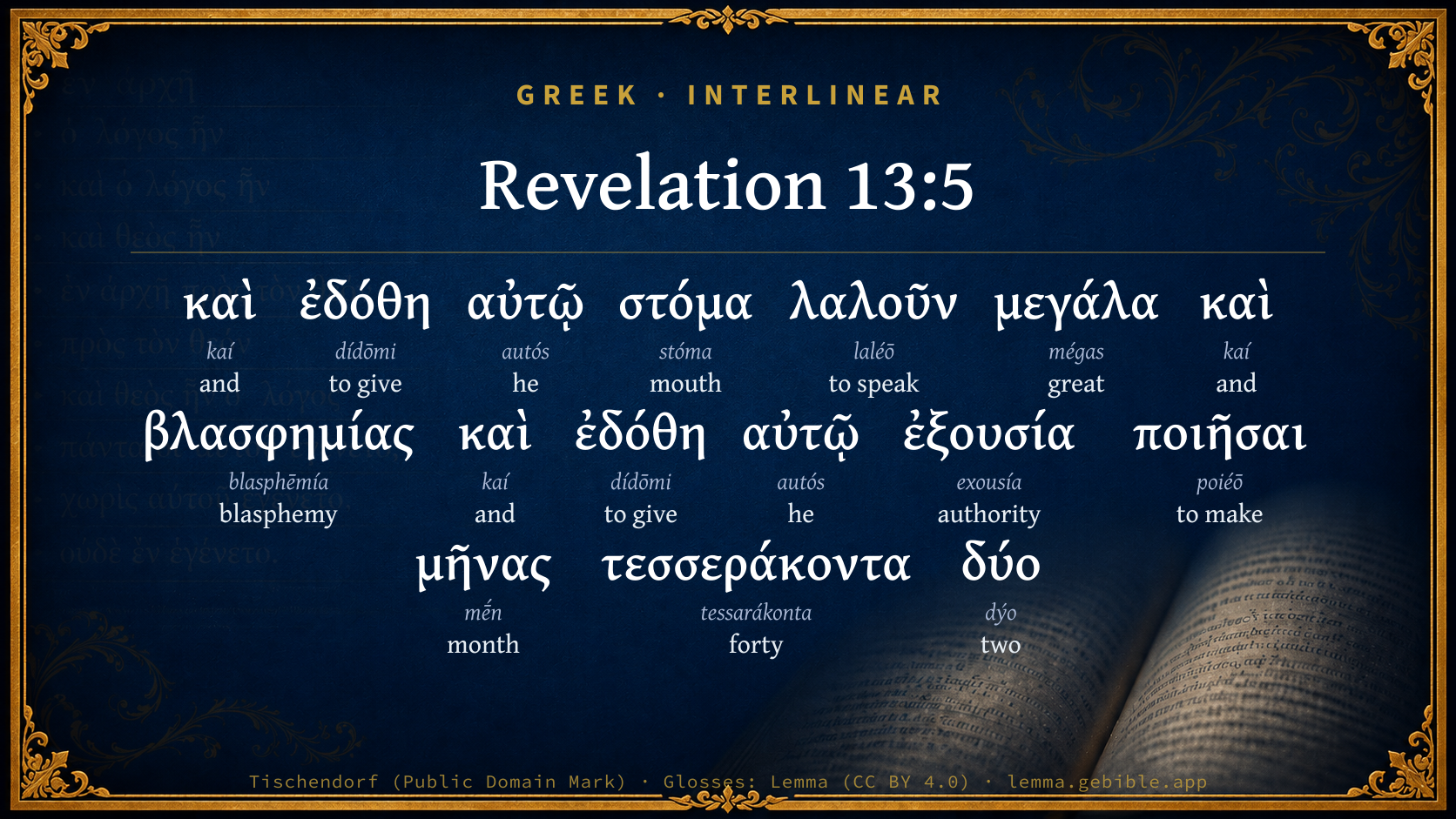
  1. καὶ kaí G2532 “and” Conjunction
  2. ἐδόθη dídōmi G1325 “to give” Verb, Aorist, Passive, Indicative, 3rd person, Singular
  3. αὐτῷ autós G846 “he” Personal pronoun, Dative, Singular, Neuter
  4. στόμα stóma G4750 “mouth” Noun, Nominative, Singular, Neuter
  5. λαλοῦν laléō G2980 “to speak” Verb, Present, Active, Participle, Nominative, Singular, Neuter
  6. μεγάλα mégas G3173 “great” Adjective, Accusative, Plural, Neuter
  7. καὶ kaí G2532 “and” Conjunction
  8. καὶ kaí G2532 “and” Conjunction
  9. ἐδόθη dídōmi G1325 “to give” Verb, Aorist, Passive, Indicative, 3rd person, Singular
  10. αὐτῷ autós G846 “he” Personal pronoun, Dative, Singular, Neuter
  11. ἐξουσία exousía G1849 “authority” Noun, Nominative, Singular, Feminine
  12. ποιῆσαι poiéō G4160 “to make” Verb, Aorist, Active, Infinitive
  13. μῆνας mḗn G3376 “month” Noun, Accusative, Plural, Masculine
  14. τεσσεράκοντα tessarákonta G5062 “forty” Adjective, Numeral (indeclinable)
  15. δύο dýo G1417 “two” Adjective, Numeral (indeclinable)

About this verse

These counts appear in no published source. They are computed here, from the morphology-tagged text and Lemma’s own curated glosses. What Lemma adds →

16
words
12
distinct lemmas
Revelation
section

Notable vocabulary

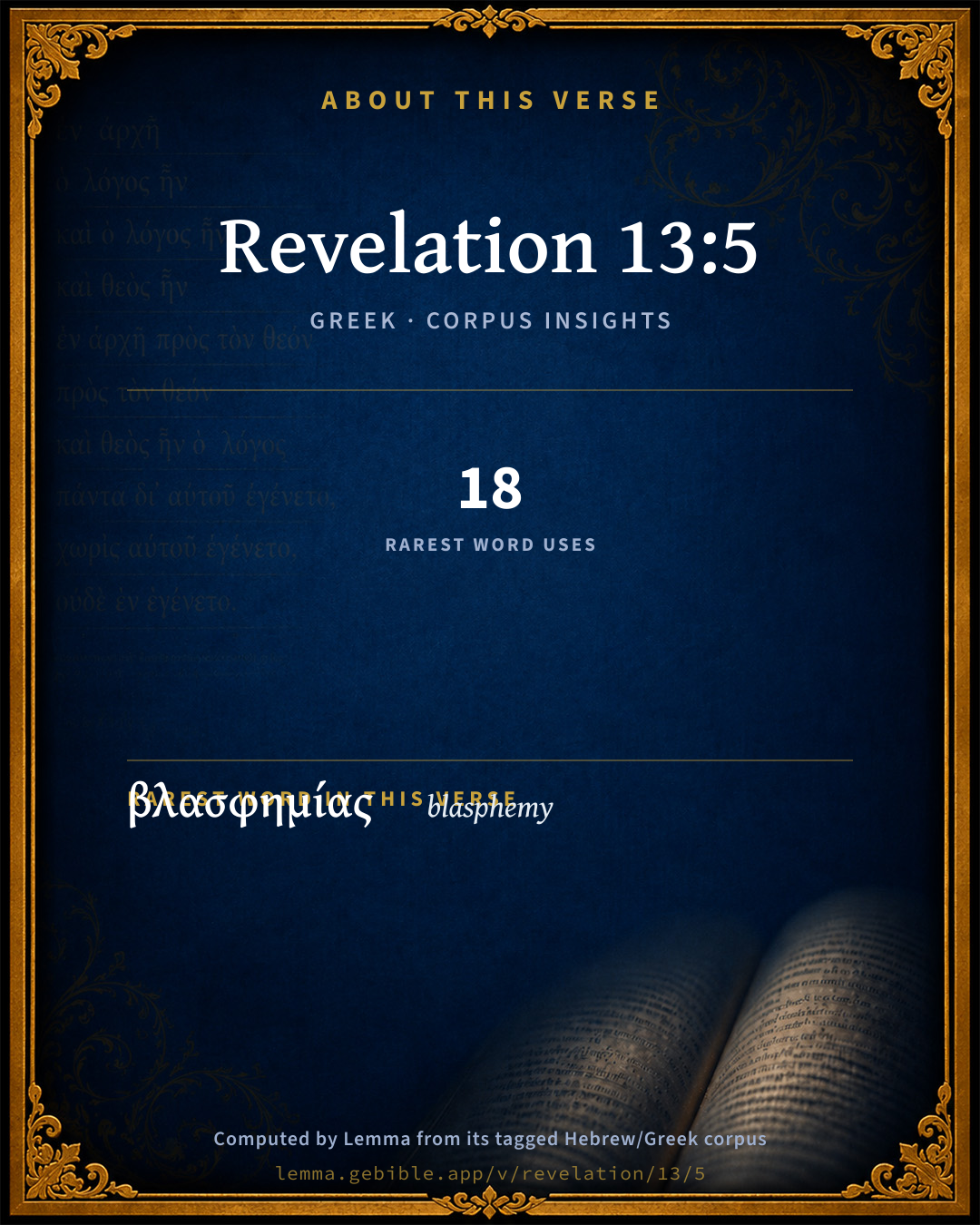
The rarest word here is βλασφημίας blasphemy G988 — appearing just 18 times in the whole Greek New Testament.

Shared distinctive vocabulary

βλασφημίας blasphemy G988 occurs in 17 verses of the Greek New Testament. Also found in:

Repetition

Words recur within this verse:

  • ἐδόθη to give G1325 ×2
  • καὶ and G2532 ×3
  • αὐτῷ he G846 ×2

Cross-references

11

Topical passages linked to Revelation 13:5 in the Treasury of Scripture Knowledge — connected by theme and wording, ordered by reader-vote popularity; previews shown in the World English Bible.

  • Daniel 7:8 I considered the horns, and, behold, there came up among them another horn, a little one, before which three of the first horns were plucked up by the roots: and, behold, in this horn were eyes like the eyes of a man, and a mouth speaking great things.
  • Daniel 7:25 He shall speak words against the Most High, and shall wear out the saints of the Most High; and he shall think to change the times and the law; and they shall be given into his hand until a time and times and half a time.
  • Daniel 11:36 The king shall do according to his will; and he shall exalt himself, and magnify himself above every god, and shall speak marvelous things against the God of gods; and he shall prosper until the indignation be accomplished; for that which is determined shall be done.
  • Revelation 12:6 The woman fled into the wilderness, where she has a place prepared by God, that there they may nourish her one thousand two hundred sixty days.
  • Daniel 7:11 I saw at that time because of the voice of the great words which the horn spoke; I saw even until the animal was slain, and its body destroyed, and it was given to be burned with fire.
  • Daniel 7:20 and concerning the ten horns that were on its head, and the other [horn] which came up, and before which three fell, even that horn that had eyes, and a mouth that spoke great things, whose look was more stout than its fellows.
  • 2 Thessalonians 2:4 he who opposes and exalts himself against all that is called God or that is worshiped; so that he sits as God in the temple of God, setting himself up as God.
  • Revelation 11:2–3 Leave out the court which is outside of the temple, and don't measure it, for it has been given to the gentiles. They will tread the holy city under foot for forty-two months.
  • Revelation 12:14 Two wings of the great eagle were given to the woman, that she might fly into the wilderness to her place, so that she might be nourished for a time, and times, and half a time, from the face of the serpent.
  • Revelation 11:7 When they have finished their testimony, the beast that comes up out of the abyss will make war with them, and overcome them, and kill them.
  • Revelation 13:7 It was given to him to make war with the saints, and to overcome them. Authority over every tribe, people, language, and nation was given to him.

Cross-references courtesy of OpenBible.info (CC BY 4.0).

Where the printed editions differ

1 variant

Places in this verse where the major printed Greek editions disagree on the wording in a way that affects the translation — a comparison of editions, not a manuscript-by-manuscript collation. The editions are the modern critical texts (Nestlé-Aland 28/27, SBL, Westcott-Hort, Tregelles, Tyndale House) and the traditional texts behind the KJV (the Textus Receptus and the Byzantine/Majority text). It is not a claim about which reading is original.

  1. Extra text
    πόλεμον

    “war”

    In Byz Not in NA28NA27TynSBLWHTregTR

    πόλεμον (polemon) 'war' is only in a few manuscripts (Byz)

Textual data: Translators Amalgamated Greek New Testament (STEPBible TAGNT) · CC BY 4.0.

Commentary

Notes on Revelation 13:5 from classic Christian and Jewish commentators (each source and its license shown beneath its notes). The classic Christian expositions comment on the surrounding passage and are grouped to its opening verse, so a note may address several verses; the Jewish commentaries on the Tanakh (Rashi and others) are per-verse, so they appear only where the commentator wrote on this verse.

Lemma curates 59 commentaries, every one of them public domain or Creative Commons licensed, each selected and text-cleaned for this edition rather than reprinted as found. About our sources →

Joseph Benson's Commentary

Rev 13:5-8. And there was given unto him a mouth speaking great things — This expression seems to be taken from the description of the little horn in Daniel’s vision, (Dan 7:8,) and is explained, Rev 13:11, by the voice of the great words which the horn spake. It must be observed, however, that it is of the secular empire that this is spoken, which empire is here considered as under the influence of the ecclesiastical power of Rome, and as being merely its agent, and especially the agent of the pope, the speaking image of the beast. And it is well known what blasphemous and extravagant claims of authority and power have been made by him, who has been styled, His Holiness — Infallible — Sovereign of kings and kingdoms — Christ’s Vicegerent — yea, God upon earth. Power also has been given unto him to continue — Greek, ποιησαι, to practise, prevail, and prosper, forty and two months — It doth not follow from this that the beast is to continue to exist for no longer a term, but he is to practise, to prosper, and prevail, for that term: as the holy city (chap. Rev 11:2) is to be trodden under foot of the Gentiles forty and two months, which are the twelve hundred and sixty days, or years, of the reign of antichrist. But if by the beast were understood the heathen Roman empire, that empire, instead of subsisting twelve hundred and sixty, did not subsist four hundred years after the date of this prophecy. And he opened his mouth in blasphemy, &c. — This newly-erected government of Rome used the authority it had obtained in making and publishing constitutions for the establishment of idolatry, in contempt of God and his true worship, and by all methods of oppression and persecution, forcing the church to comply with them, and yield obedience to them. “Any acts of idolatrous worship,” says Lowman, “may well be expressed by blaspheming God and his name, as they deny to the true God his distinguishing honour, and give it to creatures, whether to images, saints, or angels. The church, as it is called the temple of God, the place of God’s presence, is properly also called his tabernacle.” By them that dwell in heaven, Grotius understands all saints, all Christians, whose conversation is in heaven. The Christian Church is called, the Jerusalem which is above, Gal 4:26; and the governors of it are styled angels, Rev 1:20. To blaspheme them, therefore, that dwell in heaven, will signify the contempt and injurious manner with which the new government of Rome shall treat the true worshippers of God, as well as God himself and his name. So much for his blasphemies; nor are his exploits less extraordinary. It was given unto him to make war with the saints, and to overcome them — The power of this new Roman government became so great, by divine permission, that it prevailed against the worshippers of God, either to force them to a compliance with the corruptions established by its authority, or to persecute them for their constancy; and this oppressive power was extended far and wide, even over all, or many, kindreds, and tongues, and nations — Even in all the countries of the western Roman empire. And who can make any computation, or even frame any conception of the numbers of pious Christians who have fallen a sacrifice to the bigotry and cruelty of Rome, or this new Roman government? Mede, upon the place, hath observed from good authority, that in the war with the Albigenses and Waldenses, there perished of these poor creatures in France alone a million! From the first institution of the Jesuits to A.D. 1480, that is, in little more than thirty years, nine hundred thousand orthodox Christians were slain. In the Netherlands alone the duke of Alva boasted that within a few years he had despatched to the amount of thirty thousand persons, and those all by the hands of the common executioner. In the space of scarce thirty years, the inquisition destroyed, by various kinds of torture, one hundred and fifty thousand Christians. Sanders himself confesses that an innumerable multitude of Lollards and Sacramentarians were burned throughout all Europe, who yet, he says, were not put to death by the pope and bishops, but by the civil magistrates; which perfectly agrees with this prophecy, for it is of the secular beast that it is said, He shall make war with the saints, and overcome them. No wonder that by these means he should obtain a kind of universal authority over all kindreds, and tongues, and nations. Let the Romanists boast, therefore, that theirs is the catholic church, and universal empire: this is so far from being any evidence of the truth, that it is the very brand infixed by the Spirit of prophecy. And all that dwell upon the earth shall worship him — All the inhabitants of the earth, to which this new power shall reach, shall be prevailed upon to receive his idolatrous constitutions, and yield obedience to his tyrannical authority: whose names are not written in the book of life, &c. — Except such true and faithful servants of God as are enrolled in the registers of heaven, according to the promises of Christ’s gospel, who from the beginning was the true propitiation and mediator of acceptance with God, and of the blessings consequent thereon. It has been justly observed by Mr. Faber, that there is a great inaccuracy in Bishop Newton’s exposition of the above paragraph, in that he seems to confound this beast, or the secular empire, in all the ten kingdoms, with the little horn predicted by Daniel, which accords with the second beast afterward mentioned. As the secular power, however, executed the persecuting decree of the ecclesiastical power, and gave its power to that beast, the things represented by Bishop Newton as accomplishing this prophecy did indeed accomplish it, though he has not marked the manner in which this was done.

Joseph Benson's Commentary on the Old and New Testaments (1811–1818) — public domain. Text from a community e-Sword module.

Tyndale Open Study Notes

Tyndale Open Resources

13:5-8 The four characteristics of the beast are that he (1) blasphemes God, (2) has authority for a limited time, (3) makes war against God’s people, and (4) rules the world. But God is in control.

13:5 The forty-two months are the three and a half years of persecution and evil domination (see study note on 11:2-3).

Tyndale Open Study Notes — © Tyndale Open Resources, licensed CC BY-SA 4.0. Text via the HelloAO Bible API.

Bengel's Gnomon

Johann Albrecht Bengel

Rev 13:5. Καὶ ἐδόθη αὐτῷ ἐξουσία μῆνας τεσσαράκοντα δύο) This ancient, short, middle reading is the genuine one:[146] so that the accusative μῆνας, months, answers to the question, how long. Others have supplied ποιῆσαι: more, πόλεμον ποιῆσαι. Both of them from Rev 13:7. One important point is marked out in Rev 13:5; another, the calamity increasing, Rev 13:7. A fuller consideration of these months will follow at Rev 13:18: by the use of which, there will be no doubt as to the meaning of the close of the power of the beast. Many persons, when they hear anything of this kind for the first time, wonder at it, as news of future events, instead of reverencing it as the word of God: they say, in short, that the matter is worthy of consideration, and yet they do not consider it in such a manner, as to lay aside for a little time lighter subjects (and what subject is not light in comparison with these of such great magnitude?), and examine into the truth: and then, when they have once or twice heard and related it, having lost the taste of novelty, they loathe it; and with the character which they always had, they rush into the Divine judgments, whether known or unknown, regarding neither things past, nor things present, nor things future. Let them take care what they are about. We do not write for them: we will not be silent out of regard for them. See ch. Rev 22:10-11. The close of the power of the beast is therefore approaching nearer and nearer: and matters of the greatest importance will precede that close, which matters remain from ch. 13 and 14, and which are contained in ch. 15 and 16. But the Non-being of the beast will follow the same close, and so will many other things, which are described in ch. 17 and those which follow.

[146] So Iren. But ACh Vulg. Syr. read ποιῆσαι after ἐξουσία; and B prefixes πόλεμον before ποιῆσαι; which, however, Tisch. and Lachm. with the weightier authorities omit.—E.

Bengel's Gnomon of the New Testament — English translation (T&T Clark, Edinburgh, 1860) — public domain. Text from a community e-Sword module.

Meyer's Critical & Exegetical Commentary

Heinrich August Wilhelm Meyer

Rev_13:5-7. As the conception of the form of the beast in general (Rev_13:1-2) is conditioned by the Danielian prototype, so also the individual chief features which describe the activity of the beast are in conformity with what Daniel says of antichrist. Not only the schematical determination of time for the antichristian activity of the beast, forty-two months,[3302] is derived from Dan_7:25; Dan_12:7; but also the characteristic representation of the presumptuous, blasphemous speech,[3303] and of his conflict with the saints,[3304] makes the beast appear in the same way as the concretion of the antichristian world-power withstanding the N. T. communion of saints, as in Daniels view Antiochus Epiphanes arrayed himself against the O. T. Church. But Züll. finds incorrectly also in 7b an analogy with Dan_7:14, in that the sense that what is there ascribed to Christ, is here declared concerning the antichristian universal monarchy of the beast, as the contrary of the Messiah; for the ἐξουσία of the beast, i.e., the definite supreme power thereof, adapted to its position and task, corresponds neither to the kingly glory over all nations granted to the Son of man,[3305] nor to his peculiar ἐξουσία, which, as the βασιλεία itself, is marked as one that is eternal.[3306] The ἘΔΌΘΗ, Rev_13:5; Rev_13:7,[3307] which refers to the ultimate ground of divine authority, contains for believers a consolatory determination which belongs to the ἜΔΩΚΕΝ, Rev_13:2; for only in accordance with Gods order can the dragon equip his beast, and only within the limits fixed by God can the beast work in virtue of the ἘΞΟΥΣΊΑ ascribed to him.

ΣΤΌΜΑ ΛΑΛΟῦΝ ΜΕΓΆΛΑ ΚΑῚ ΒΛΑΣΦΗΜΊΑς. The supercilious speaking of great things is already in itself the testimony of an egotistic boasting of one despising the living God, and then becomes openly blasphemous when the presumptuous speeches have such definite reference to God as is expressed, e.g., in Rev_13:6; cf. also the declaration put, in Rev_13:4, into the mouth of the adherents of the beast. The historical foundation for the description, Rev_13:5 a, is formed by the declarations repeated in various ways, in which Roman insolence not only ascribed to itself absolute dominion over the world, but also expressly gave divine names and divine honor to the city, the empire, and the emperor.[3308]

ΠΟΙῆΣΑΙ. In the following accus., the express object to ΠΟΙῆΣΑΙ may be found,[3309] and with Luther, Ewald, etc., the explanation may be rendered: Power was given him to bring in forty-two months besides; viz., in the manner described in Rev_13:5 a. But this mere determination of time appears too circumstantial for the Apoc.; hence it is explained better by Vitr., Züll., De Wette, Hengstenb., etc., after the analogy of Dan_8:24; Dan_11:28; Dan_11:30; Dan_11:32; Psa_37:5, where the ποιεῖν likewise occurs without any express designation of the object: power was given him to work, to ply his business, for forty-two months. In connection with this it is to be observed,[3310] that thus the two parts of Rev_13:5 briefly designate what is more fully described in Rev_13:6 (cf. Rev_13:5 a) and Rev_13:7 (cf. Rev_13:5 b).

The prefixed βλασφημίας πρὸς τὸν θεόν (Rev_13:6) is more definitely specialized in a threefold way, to which already the plural ΒΛΑΣΦΗΜΊΑς ΠΡ. Τ. Θ., which is here certain, points, viz., first, βλασφημῆσαι τὸ ὄνομα αὐτοῦ, whereby is designated the calumniation directed immediately against God himself, which is especially fulfilled by the beast usurping for himself the divine names and honor; secondly, καὶ τὴν σκηνὴν αὐτοῦ, i.e., as it is also made manifest from the following words,[3311] heaven, which, as Gods tabernacle, is an object of the blasphemous speeches of the beast; and, finally, καὶ τοὺς ἐν τῷ οὐρανῷ σκηνοῦντας, because it is Gods gracious work, that he has opened heaven as his tabernacle for those who now dwell with him therein. The two last kinds of blasphemy are mediate, but they have place just as certainly as the world-power, represented by the beast, speaks only with mockery of that which was to believers the home towards which their entire hope was directed; and accordingly the world-power stood in opposition to the inexhaustible source of their consolation and patience.

ΠΌΛΕΜΟΝ ΠΟΙῆΣΑΙ ΜΕΤᾺ Τ. ἉΓ. To the instrument of the dragon it is givenon Gods partto fulfil what the dragon had in mind when he prepared the beast.[3312]

ΚΑῚ ΝΙΚῆΣΑΙ ΑὐΤΟΎς; viz., in so far as the saints must succumb to the power of the beast, and suffer imprisonment, banishment, death, and all kinds of ΘΛῖΨΙς.[3313] Besides, it is just in this that the true victory of saints consists.[3314]

Κ. ἘΔ. ΑὐΤ. ἘΞΟΥΣΊΑ ἘΠῚ ΠᾶΣΑΝ ΦΥΛῊΝ ΚΑῚ

ἜΘΝΟς. Ewald, by determining the ἘΞΟΥΣΊΑ according to the measure of what immediately precedes,[3315] reaches the erroneous conception that the ἘΠῚ ΠᾶΣ. ΦΥΛῊΝ, Κ.Τ.Λ., is to be referred to Christians[3316] But the expression designates, by its four specifications,[3317] the entire number of the inhabitants of the earth who easily appear in opposition to the saints; hence the ἘΞΟΥΣΊΑ ἘΠῚ ΠΑΣ. ΦΥΛῊΝ, Κ.Τ.Λ., is the great and sovereign power[3318] which is granted to the beast with his empire. Because of this ἘΞΟΥΣΊΑ he is in a position to war victoriously against the saints. But as in Rev_13:5 a, so also here, where there is a definitive designation of the ἐξουσία on which the entire dreadful activity of the beast depends, the consolatory thought lies in the background, that even though the supreme power, which the dragon has given (Rev_13:2) to the beast, is so great that it extends over the whole world, yet it is at last only by the Divine bestowment, and therefore beneath the Divine order and limitation, that the beast possesses, and can exercise, his ἐξουσία.

[3302] Cf. Rev_11:2, Rev_12:14.

[3303] στόμα λαλοῦν μεγάλα κ. βλασφ. Cf. Dan_7:8; Dan_7:20; Dan_7:25.

[3304] Cf. Dan_7:21.

[3305] καἰ ἐδόθη αὐτῷ ἡ ἀρχὴ καὶ ἡ τιμὴ καὶ ἡ βασιλεια, καὶ πάντες οἱ λαοὶ φυλαὶ καὶ γλῶσσαι αὐτῷ δουλεύσουσιν.

[3306] ἡ ἐξ. αὐτοῦ ἐξουσία αἱώνιος, ἥτις οὑ παρελεύσεται, κ.τ.λ.

[3307] Cf. Rev_6:4; Rev_6:8, Rev_7:2, Rev_9:5.

[3308] Cf. Introduction, p. 51.

[3309] Cf. Act_15:33; 2Co_11:25; Jam_4:13.

[3310] Vitr., Hengstenb.

[3311] Cf. Rev_21:3.

[3312] Cf. Rev_12:17, Rev_13:2.

[3313] Cf. Rev_11:7.

[3314] Cf. Rev_12:11, Rev_2:10 sq.

[3315] It is allowed to perpetrate this slaughter throughout all lands and nations.

[3316] From the nature of the topic and thought, it is apparent that only Christians dwelling everywhere throughout the world are to be here understood.

[3317] Cf. Rev_5:9, Rev_11:9, Rev_14:6, Rev_17:15.

[3318] Also Ew. ii.

Meyer — Critical and Exegetical Commentary on the New Testament — English translation by Peter Christie, edited by Frederick Crombie (T&T Clark, 1880) — public domain. Text from a community e-Sword module.

Expositor's Greek Testament

ed. W. Robertson Nicoll

Rev 13:5 . “Big and blasphemous (or abusive; 2Pe 2:11 ) words.” So Apoc. Bar. lxvii. 7: “surget rex Babylonis qui destruxit nunc Sionem et gloriabitur super populo et loquetur magna in corde suo coram Altissimo”.

The Expositor's Greek Testament, edited by W. Robertson Nicoll (1897–1910) — public domain. Text from a community e-Sword module.

Geneva Bible (1599)

Geneva Bible translators

The second member containing an history of the acts of the beast, as I said verse 1. The history of them is concluded in two points, the beginning and the manner of them. The beginning is the gift of the Dragon, who put and inspired into the beast both his impiety against God and his eminity and injustice against all men, especially against the godly and those that were of the household of faith, the fifth verse. The manner of the acts or actions done, is of two sorts both impious in mind, and blasphemous in speech against God, his Church and the godly, verse six, and also most cruel and injurious in deeds, even such as were done of most raging enemies and of most insolent and proud conquerors, the seventh verse.

Namely his actions and manner of dealing. As concerning those two and forty months, I have spoken of them before in the twelfth Chapter and second verse.

Geneva Bible (1599) marginal notes — public domain. Text via Bolls.life.

Jamieson, Fausset & Brown

Robert Jamieson, A. R. Fausset & David Brown

blasphemies--So ANDREAS reads. B reads "blasphemy." A, "blasphemous things" (compare Dan 7:8; Dan 11:25).

power--"authority"; legitimate power (Greek, "exousia").

to continue--Greek, "poiesai," "to act," or "work." B reads, "to make war" (compare Rev 13:4). But A, C, Vulgate, Syriac, and ANDREAS omit "war."

forty . . . two month--(See on Rev 11:2-3; Rev 12:6).

Jamieson, Fausset & Brown — Commentary Critical and Explanatory on the Whole Bible (1871) — public domain (CC PDM 1.0). Text via the HelloAO Bible API.

Adam Clarke's Commentary

Verse 5. And there was given unto him a mouth speaking great things] That is, There was given to the rulers of the Latin empire, who are the mouth of the beast, (and particularly the Roman emperors of Germany,) power to assume great and pompous titles, indicative of their mighty sway over many subjugated countries, (see the imperial instruments of the middle centuries in the Corps Diplomatique,) and also to utter against their opponents the most terrible edicts.

And blasphemies] The system of worship supported by the beast is a system of blasphemy, as there will be occasion to show presently.

And power was given unto him to continue forty and two months.] As these forty-two months are prophetic, they must mean so many years as there are days contained in them; viz., 1260, each month containing 30 days. The beast, therefore, will continue in existence at least 1260 years; but when the termination of this period will take place is difficult to say, as the beginning cannot be at present indubitably ascertained.

Adam Clarke's Commentary on the Bible (1810–1826) — public domain. Text from a community e-Sword/MySword module.

Ellicott's Commentary for English Readers

(5) And there was given . . .—In these verses the words and the works of the wild beast are described. The 5th verse tells us that the liberty to speak and work was given to him. There is consolation in the words: he has no power beyond what is given; behind his reckless and apparently irresistible power there stands the veiled but real power of God. “Thou couldest have no power” (the saints may take up their Lord’s words) “against me, except it were given thee from above.” He speaks great things, and blasphemy. And there was given him authority to act (literally, to do) forty-two months. Again the familiar period, the limited time of the world-power.

A Bible Commentary for English Readers, edited by Charles John Ellicott (1878–1897) — public domain. Text from a community e-Sword module.

The Cambridge Bible for Schools and Colleges

gen. ed. J. J. S. Perowne

5. a mouth &c.] Dan_7:8.

to continue] Literally, to make or do. This may mean “to spend,” so that the text will give the right sense: but perhaps rather, as in Dan_8:24; Dan_11:28; Dan_11:30; Dan_11:32, “do” is used absolutely for “do exploits.”

forty and two months] See on Rev_11:2.

The Cambridge Bible for Schools and Colleges (gen. ed. J. J. S. Perowne; Cambridge University Press, 1878–1918) — public domain. Text from a community e-Sword module.

John Gill's Exposition

And there was given unto him a mouth,.... The beast is said to have a mouth before, like the mouth of a lion, Rev 13:2; but now he was moved and stirred up by the dragon, the devil, to open it, not only in a cruel and voracious way, but in a haughty, lying, and blasphemous manner: and this was given him, it was at the instigation of Satan, and by divine permission; his coming, speaking, and acting, were after the working of Satan, but not without the will of God; who, as he gave up many to a judicial blindness, to believe his lies and blasphemies, gave up him to speak them, as follows:

speaking great things, and blasphemies; great swelling words of vanity; calling himself by high and lofty titles, as Christ's vicar, Peter's successor, head of the church, universal bishop, &c. promising great things to his followers, riches, honours, pleasures, pardons, and heaven itself; and uttering things of a blasphemous kind, or great blasphemies, the particulars of which are mentioned in Rev 13:6; so the little horn, who is the same with the Romish antichrist, is said to have a mouth speaking great things, very great things, and his look more stout than his fellows, Dan 7:8.

And power was given unto him to continue forty and two months; to continue in being, or to continue blaspheming and speaking great things; and indeed, as long as he continues, he will continue blaspheming; as soon as he arose he had a name of blasphemy on his heads, and his mouth was immediately opened in blasphemy, and so it continues, and will to the end of this date. The Ethiopic version reads it, "and power was given to him to do signs, whatsoever he would"; miracles, lying signs and wonders; see Rev 13:13. Some copies read, and so the Arabic version, "and power was given him to make war"; but he did not make war as soon as he arose, and so not all the time that is here allotted him; and the word "war" seems to be transcribed from Rev 13:7. The phrase rather intends his being, and the continuance and duration of it; which is the same period of time in which the holy city is trodden under foot by this beast, and the same with the 1260 days or years, in which the witnesses prophesy in sackcloth, and the woman, the church, is in the wilderness, Rev 11:2; for forty two months, reckoning thirty days to a month, as the eastern people did, make just 1260 days, for these things are all contemporary: hence it appears, that 1260 prophetic days, that is, years, contain the whole period of antichrist's reign and continuance; so that could we tell where they began, it might be exactly known when his reign will end; but for want of knowing the former, the best of calculators have failed in the latter: but seeing the time when he was made universal bishop by Phocas bids fair for the time of his open appearance, and the beginning of his reign, and of his blasphemy, which was in the year 859, to which, if we add 1260, the expiration of his reign will fall in the year 1866; so that he may have upwards of an hundred and twenty years yet to continue; but of this we cannot be certain; however, the conjecture is not improbable.

John Gill's Exposition of the Whole Bible (1746–1763) — public domain (CC PDM 1.0). Text via the HelloAO Bible API.

Trapp's Complete Commentary

John Trapp

5 And there was given unto him a mouth speaking great things and blasphemies; and power was given unto him to continue forty and two months.

Ver. 5. And there was given unto him] As once was to Antiochus, that little antichrist, Dan 7:25. What cracks the pope makes of his unlimited power and prerogatives; who knows not? what blasphemies he belcheth out of the fable of Christ, of eating his pork, Al despito di Die, in despite of God; of suffering himself to be styled "the Lamb of God that taketh away the sins of the world," as Pope Martin IV did; of drinking a health to the devil, as another of them did, who hath not heard? Baronius, in the year 964, reckoning up certain of the popes, calleth them monsters, an abomination of desolation in God’s temple, &c. Cardinal Benno saith of Pope Hildebrand, that he was a blasphemer, a murderer, a whore master, a necromancer, a heretic, and all that is naught. The Church of Rome (saith another of their own writers) had deserved now for a long time no better of God than to be ruled by reprobates. Marcellus II, pope of Rome, said, that he could not see how any pope could be saved. (Jac. Revius, p. 275.)

Forty and two months] Here Mr Brightman calculates and pitches the ruin of Antichrist upon the year 1686, or thereabouts.

John Trapp, A Commentary or Exposition upon All the Books of the Old and New Testament (1647–1656) — public domain. Text from a community e-Sword module.

Albert Barnes' Notes on the Bible

And there was given unto him a mouth speaking great things - John does not say by whom this was given; but we may suppose that it was by the “dragon,” who is said Rev 13:2 to have given him his power, and seat, and authority. The fulfillment of this is found in the claims set up by the princes and rulers here referred to - that mighty secular power that sustained the papacy, and that was, in some sort, a part of the papacy itself. These arrogant claims consisted in the assertion of a divine right; in the power assumed over the liberty, the property, and the consciences of the people; in the arbitrary commands that were issued; and in the right asserted of giving absolute law. The language used here is the same as what is found in Dan 7:8 when speaking of the “little horn:” “In this horn were eyes like the eyes of a man, and a mouth speaking great things.” For an illustration of the meaning of this, see the notes on that passage. Compare notes on Dan 7:25.

And blasphemies - That is, the whole power represented by the “beast” will be blasphemous. See the notes on Rev 13:1. Compare the notes on Dan 7:25.

And power was given unto him to continue forty and two months - Three years and a half, reckoned as months; or twelve hundred and sixty days, reckoning thirty days for a month; or twelve hundred and sixty years, regarding the days as prophetic days. For the evidence that this is to be so regarded, see the notes on Dan 7:25. This is the same period that we meet with in chap. Rev 11:2, and in chap. Rev 12:6. See the notes on those places. This fact proves that the same power is referred to in these places and in Daniel; and this fact may be regarded as a confirmation of the views here taken, that the power here referred to is designed to have a connection in some form with the papacy. The duration of the existence of this power is the same as what is everywhere ascribed to the papacy, in the passages which refer to it; and all the circumstances, as before remarked, show that the same general power is referred to by the two “beasts” which are described in this chapter. If so, the continuance or duration may be supposed to be the same; and this is indicated in the passage before us, where it is said that it would be twelve hundred and sixty years. In regard to the application of this to the papal power, and the manner in which the calculation is to be made of the duration of that power, see the notes on Dan 7:25, and the remarks at the end of that chapter. The meaning in the passage before us I take to be, that the papal power, considered as a civil or secular institution, will have, from the time when that properly commenced, a duration of twelve hundred and sixty years. In the Scriptures there is nothing more definite in regard to any future event than this.

Albert Barnes' Notes on the Bible (1834–1885) — public domain. Text from a community e-Sword/MySword module.

Matthew Poole's English Annotations

And there was given unto him a mouth speaking great things and blasphemies: by him here must be meant antichrist, (as appears by the forty-two months, his period, being the same with one thousand two hundred and sixty days), both the secular power of the emperors of Rome at this time, and the ecclesiastical power of the bishops of Rome concurred to make one antichrist. God permitted, and the devil influenced, this beast to speak great things, as Dan 7:11, which is interpreted by the term blasphemies. Blasphemies against God signifies strictly any reproachful speeches against him, whether attributing to him the creature’s imperfections, or denying him the perfection proper to him, or giving to the creature what belongs to God only, which blasphemy must be in all idolatry; for adoration is due unto God alone, and when this is given to any creature, there is both blasphemy in the doctrine which teacheth the lawfulness of it, and idolatry in the practice of it.

And power was given unto him to continue forty and two months: these forty-two months are (as hath been before showed) the same term of time with one thousand two hundred and sixty days, and must be the term of antichrist, which was given him to tread down the outward court in; so as the beast here spoken of must be the antichrist, who began in the civil power of the Roman empire, but was quickly metamorphosed into the ecclesiastical power of the bishop of Rome; in comparison of whose power (after he had obtained the primacy) indeed the emperor’s power was very small.

Matthew Poole's English Annotations on the Holy Bible (1683–1685) — public domain. Text from a community e-Sword/MySword module.

Whedon's Commentary on the Bible

Daniel D. Whedon

5. Speaking great things—Words from Dan_7:8, spoken of the fourth, or Roman beast, here claiming to be the sole Church of God on earth, out of which is no salvation; and in the person of its spokesman and pontiff claiming to be God on earth.

Forty and two months—Or 1260 days. See note on Rev_12:14. Elliott measures this beast-period from the year A.D. 529, when the Emperor Justinian conferred the title and power of universal bishop on the pope. This starting-point will bring the close of the period at 1789. That year was the birth-year of the French Revolution, by which the despoliation of the power of the pope was inaugurated. The Church properties in France were confiscated, the monasteries were suppressed, and the clergy were compelled to a solemn abjuration of their allegiance to the pope. The other countries of Europe followed the French example. When Bonaparte came into power he deprived Pope Pius VII. of his territories, and imprisoned him. The pope continued stripped of his powers until the restoration of the old regimen on the downfall of Bonaparte. Popery never recovered its ancient persecuting supremacy. Since that day the decline of the politico-ecclesiastical power of the papacy has been constant, under the growth of the primitive principles of Christian toleration. The Protestant States have increased in intelligence and power, and the Romanistic have waned. The battle of Sadowa humbled the power of Austria, and the battle of Sedan prostrated France. The creation of the kingdom of Italy deprived the pope of his temporal kingdom, and Protestant missions are defying the pontiff in sight of the Vatican.

Daniel D. Whedon (gen. ed.), Commentary on the Old and New Testaments (1874–1909) — public domain. Text from a community e-Sword module.

The Pulpit Commentary

And there was given unto him a mouth speaking great things and blasphemies. So the horn which sprang from the fourth beast of Dan_7:8 had given to it "a mouth speaking great things." The power of the beast is, after all, only held by the consent of God, who for his own good purpose permits him to exercise it for a time. The "great things" are the promises of superior power and good, with which the devil seeks to allure men, as he did Adam and Eve at the first. All attempts to decry God"s omnipotence and the power of Christ are blasphemies. And power was given unto him to continue forty and two months; or, to work forty and two months. Again note the power is given to him; that is, he holds it only subject to the will of God. The "forty and two months," or three years and a half, signify the period of the world"s existence. (For a full discussion of the subject, see on Rev_11:2) It is the "little time" of Rev_6:10, Rev_6:11, during which will be fulfilled the number of the saints. It is the "little season" of Rev_20:3, during which Satan is "loosed," that is, during which he has this power to work given to him. (cf. Rev_11:2, 3 12:14) The different readings in this passage, though resting on insufficient authority, serve to amplify the meaning. a reads pouihsai o yelei , "to do what he willeth." Poihsai with polemon , "to wage war," is found in 13 and others, and is the marginal reading of the Authorized Version, but is rightly omitted in the Revised Version.

The Pulpit Commentary (1880–1919), ed. H.D.M. Spence-Jones & Joseph S. Exell — public domain. Text from a community e-Sword module.

John Wesley's Explanatory Notes

And there was given him - By the dragon, through the permission of God. A mouth speaking great things and blasphemy - The same is said of the little horn on the fourth beast in Daniel. Nothing greater, nothing more blasphemous, can be conceived, than what the Popes have said of themselves, especially before the Reformation. And authority was given him forty-two months - The beginning of these is not to be dated immediately from his ascent out of the sea, but at some distance from it.

John Wesley, Explanatory Notes Upon the Whole Bible (1754–1765) — public domain. Text via the GEBible commentary corpus.

Kretzmann's Popular Commentary

Paul E. Kretzmann

The power of the first beast:

v. 5. And there was given unto him a mouth speaking great things and blasphemies, and power was given unto him to continue forty and two months.

v. 6. And he opened his mouth in blasphemy against God, to blaspheme His name, and His tabernacle, and them that dwell in heaven.

v. 7. And it was given unto him to make war with the saints and to overcome them; and power was given him over all kindreds and tongues and nations.

v. 8. And all that dwell upon the earth shall worship him, whose names are not written in the Book of Life of the Lamb slain from the foundation of the world.

v. 9. If any man have an ear, let him hear.

v. 10. He that leadeth into captivity shall go into captivity; he that killeth with the sword must be killed with the sword. Here is the patience and the faith of the saints.

From these words it is plain that the old heathen Roman Empire is continuing in the form of the papacy, for the description is so clear and unmistakable: And there was given to him a mouth speaking great things and blasphemies, and there was given to him power to do so forty-two months; and he opened his mouth for blasphemy against God, to blaspheme His name and His dwelling, those that dwell in heaven; and there was given to him to wage war with the saints and to conquer them, and there was given to him power over every tribe and people and tongue and nation. Here the rise of Anti-Christ’s kingdom is depicted in a few masterful strokes. For it is characteristic of him that he speaks great and vaunting blasphemies, not only with regard to his own position in the Church, but also in the doctrines which place him in the temple of God as a god, and give him power over the Godhead Himself, as in the Mass, where the priest is said to have power to create the person of Christ by his blessing of the bread. By God’s permission, Anti-Christ had only a limited time for the unrestricted indulgence in this behavior, but he made the most of this time. The blasphemies which are contained in the official declarations of the Roman Church, especially as to the power of the Pope, are such as to make a Bible Christian shudder. There can incidentally be no greater folly than to underestimate the power which Anti-Christ possessed in the past and which he wields today. Not only does he wage war against the saints, the believers, but he also had overcome untold thousands, getting them into his power and poisoning their souls with his idolatrous poison. Not only over a single city, state, or nation does his authority extend, but his officials are found in all tribes and peoples and tongues and nations. The power of Anti-Christ is a scourge of God visited upon the nations, and many a person that did not want to accept the simple doctrine of the atonement of Christ, of the justification of a poor sinner without the deeds of the Law, by grace alone, has been enmeshed in the net of Rome and in the blasphemous doctrine of salvation by works.

For that reason St. John continues: And there will worship him all those that dwell upon the earth, every one whose name is not written in the Book of Life of the Lamb that was slain from the foundation of the world. The power of Anti-Christ is not confined to those that actually are members of His Church. There are thousands and millions outside of his kingdom that secretly or openly worship him, because they admire the wonderful perfection of the system which he has built up in the last fifteen centuries, or because they fear his power. But by the grace of God such worshipers are only those whose names are not written in God’s Book of Life, that is, in that of the Lamb, Jesus Christ, whose death for all sinners was a fact established by the counsel of God from the foundation of the world. In the very first prophecies and types Christ was revealed as the Savior of the world, Gen 3:15-21; Exo 12:6; 1Co 5:7. This is such an important thought and it must be kept in mind so continually by all Christians that the seer calls out: If anyone has ears, let him hear. And he adds the warning: If anyone leads into captivity (or: is destined for captivity), he leads into captivity (or: into captivity he goes); if anyone kills with the sword, by the sword he must be killed; here is the patience and the faith of the saints. These words contain a warning for the enemies and a consolation for the believers. The latter must expect martyrdom: that is inevitable where enemies of Christ come into power. But the wrath of God will find these and will give them the punishment which their transgression merits. But he who loses liberty and life for the sake of Christ will at the same time gain eternal liberty and life. It is here that the patience and the faith of the saints, of the true believers, come into their own; for they will inherit the promise through the grace of God, Heb 6:12.

Paul E. Kretzmann, Popular Commentary of the Bible (1921–1924) — public domain. Text from a community e-Sword module.

The People's New Testament

B. W. Johnson

5–7. And there was given … a mouth speaking great things. He would make blasphemous claims. Daniel affirms the same of the beast seen in his vision (Dan. 7:25). Forty and two months. The same period named in in 12:6, in 11:2, in 11:3, and in Dan. 7:25. The period referred to here, when the beast shall prevail against the Church, is one of 1260 years. This is evidently the period of the world's dominion over the Church.

B. W. Johnson's The People's New Testament with Notes (1889–1891) — public domain. Electronic text from the Christian Classics Ethereal Library (CCEL) ThML edition.

unfoldingWord translationNotes

Door43 World Missions Community

The beast was given ... It was permitted

This can be stated in active form. AT: "God gave the beast ... God permitted the beast" (See: Active or Passive)

The beast was given a mouth that could speak

Being given a mouth refers to being allowed to speak. AT: "The beast was allowed to speak" (See: Metonymy)

forty-two months

"42 months" (See: Numbers)

to speak blasphemies against God

"to say disrespectful things about God"

blaspheming his name, the place where he lives, and those who live in heaven

These phrases tell how the beast spoke blasphemies against God.

translationWords

beast

proud

authority

blasphemy

heaven

unfoldingWord translationNotes — © Distant Shores Media and the Door43 World Missions Community, licensed CC BY-SA 4.0. Source: git.door43.org/Door43/en_tn.

Cambridge Greek Testament for Schools and Colleges

5. βλασφημίας. A reads βλάσφημα; B2 βλασφημίαν. The first half of the verse is wanting in 1 and in Primasius.

ποιῆσαι. א adds ὃ θέλει, B2 prefixes πόλεμον. Dionysius and Iren[446] int. omit the words.

[446] St Irenaeus in the old Latin Version.

5. στόμα.… Dan 7:8.

ποιῆσαι. This may mean to “spend,” so that “to continue” (A. V[463]) will give the right sense: but perhaps rather, as in Dan 8:24; Dan 11:28; Dan 11:30; Dan 11:32, “do” is used absolutely for “do exploits.”

[463] Authorised Version.

μῆνας τεσσεράκοντα δύο. See on Rev 11:2.

Cambridge Greek Testament for Schools and Colleges (Cambridge University Press, 1896; 21 vols, various authors incl. Carr, Maclear, Plummer, Farrar, Lumby, Moule, M. R. James, Simcox) — public domain. Text from a community e-Sword module.

Vincent's Word Studies in the New Testament

Marvin R. Vincent

To continue forty and two months [ποιησαι μηνας τεσσερακοντα δυο] . Lit., to make forty and two months. Similarly, Act 14:33, poihsantev cronon having tarried a space; lit., having made a time. See on continued there a year, Jas 4:13. The best expositors, however, render poihsai absolutely, to work, and the following accusative as the accusative of duration, "during forty and two months." Rev., margin to do his works during, etc. See Dan 11:28.

Marvin R. Vincent, Word Studies in the New Testament (1887–1900) — public domain. Text from a community e-Sword/MySword module.

Lesson kit

Teaching starters — assembled from the data on this page, not authored interpretation. Every prompt links to the verse data it draws on. Edit before teaching.

Revelation, in the Revelation, opens this verse with 16 words (12 distinct Greek lemmas). Its most distinctive word is blasphēmía (“blasphemy”). A historical commentator’s framing appears above. Read the whole chapter for the surrounding context.

Discussion questions

  1. The word blasphēmía carries the sense “blasphemy.” How does it shape the verse?
  2. Matthew 12:31 shares the word «blasphemy» with this verse. How do the two illuminate each other?
  3. “to give” occurs 2× in this one verse. What is the effect of the repetition?
  4. These translations render this verse differently; the difference is in the English rendering, not the original. What questions does that raise?
  5. Reading how Joseph Benson's Commentary and Tyndale Open Study Notes read this verse, where do the two commentators agree and where do they part?

Things to notice

Reading settings

Reading text

Shown beneath each verse's original-language words.

Old Testament
Old Testament edition

Read the OT as the Masoretic Hebrew (MT) or the Greek Septuagint (LXX).

English shown for the Greek Septuagint (in the Hebrew ↔ Greek comparison).

Comparing translations? Open the Compare panel on any verse page to stack up to four side by side.