
Colossians 2:10

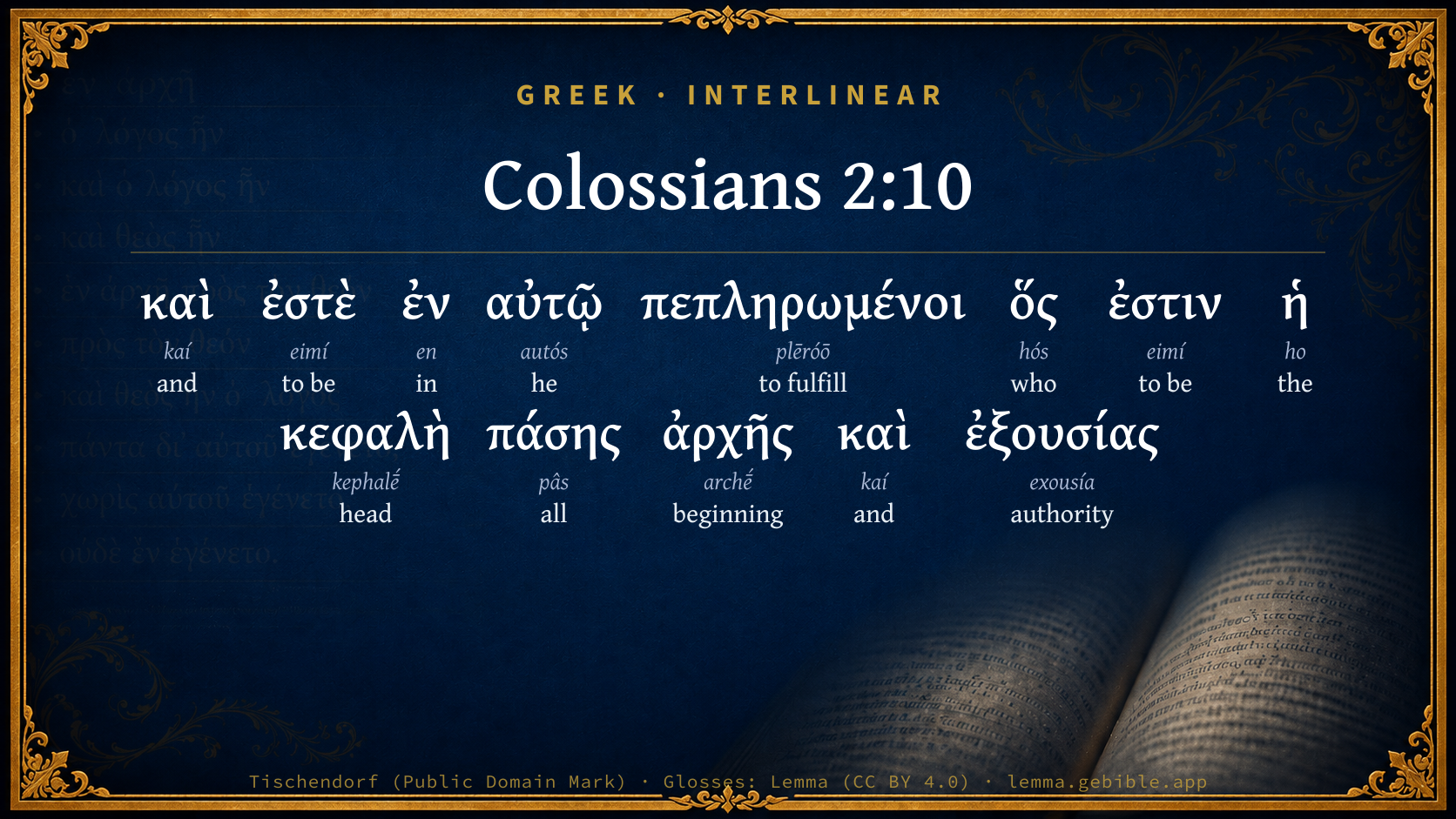
Greek (Tischendorf 8th ed.) Colossians 2:10 appears in the Greek New Testament. The text above is from the Tischendorf 8th edition. Each word links to its Strong’s number and a concise gloss. Click any word for its full Thayer’s Greek Lexicon entry.
Download image
Cite this verse

Colossians 2:10 (World English Bible). Public Domain. Lemma interlinear Bible study tool, https://lemma.gebible.app/v/colossians/2/10.

Show BibTeX & RIS
BibTeX
RIS
English Translation
and in him you are made full, who is the head of all principality and power;
World English Bible · Public Domain
Download a study sheet

One document with this verse’s original text, its word-by-word gloss line, the meaning frame, cross-references with their text, attributed commentary, and full source and license credits — printable, and it pastes into notes with its structure intact.

This verse Autodidact and up

Study sheet (.html) Plain text (.txt)

A passage Seminary Student

Up to 50 verses in one chapter. A passage sheet keeps up to 6 commentary sources and 12 cross-references per verse, in the order this page ranks them, and says so on the sheet whenever that leaves anything out. Ask for a single verse and you get the Autodidact verse sheet above.

Everything on this page stays free to read, with no account — the sheet is a download of what is already on screen, not access to it.

Want to remove ads? Support Godless Engineer
Compare translations 3

The same verse in 3 English versions, stacked beneath the original-language interlinear above. Click any original word for its lexicon entry.

Each is an independent rendering of the whole verse — the interlinear is not word-aligned to these translations.

Highlighted words mark where these versions differ — a whole-verse word diff, not a word-by-word alignment.

  • World English Bible Public Domain
    and in him you are made full, who is the head of all principality and power;
  • King James Version Public Domain
    And ye are complete in him, which is the head of all principality and power:
  • unfoldingWord Literal Text CC BY-SA 4.0
    and you are filled in him, who is the head of all rule and authority,

unfoldingWord Literal Text — © unfoldingWord, licensed CC BY-SA 4.0. Word-aligned USFM3 via Door43 (git.door43.org/unfoldingWord/en_ult).

Versions to compare (up to 4)

3 of 4 selected

Show all 19 translations

Every available English version of this verse, each an independent rendering of the whole verse.

  • World English Bible Public Domain
    and in him you are made full, who is the head of all principality and power;
  • Berean Standard Bible Public Domain
    And you have been made complete in Christ, who is the head over every ruler and authority.
  • Majority Standard Bible Public Domain
    And you have been made complete in Christ, who is the head over every ruler and authority.
  • King James Version Public Domain
    And ye are complete in him, which is the head of all principality and power:
  • American Standard Version (1901) Public Domain
    and in him ye are made full, who is the head of all principality and power:
  • Revised Version (1885) Public Domain
    and in him ye are made full, who is the head of all principality and power:
  • Geneva Bible (1599) Public Domain
    And yee are complete in him, which is the head of all principalitie and power.
  • Douay-Rheims (1899) Public Domain
    And you are filled in him, who is the head of all principality and power:
  • Young's Literal Translation Public Domain
    and ye are in him made full, who is the head of all principality and authority,
  • Literal Standard Version CC BY-SA 4.0
    and you are made full in Him, who is the head of all principality and authority,
  • Unlocked Literal Bible CC BY-SA 4.0
    You have been filled in him, who is the head over every power and authority.
  • unfoldingWord Literal Text CC BY-SA 4.0
    and you are filled in him, who is the head of all rule and authority,
  • Darby Bible Public Domain
    and ye are complete in him, who is the head of all principality and authority,
  • World Messianic Bible Public Domain
    and in him you are made full, who is the head of all principality and power.
  • Webster's Bible Public Domain
    And ye are complete in him, who is the head of all principality and power:
  • Free Bible Version CC BY-SA 4.0
    and you have been made full in him. He is supreme over every ruler and authority.
  • Bible in Basic English Public Domain
    And you are complete in him, who is the head of all rule and authority:
  • Text-Critical English NT CC BY 4.0
    and you have been filled by him, who is the head over every ruler and authority.
  • Tyndale New Testament (1534) Public Domain
    and ye are complete in him which is the heed of all rule and power

Literal Standard Version (2020), Covenant Press — licensed CC BY-SA 4.0. Text via the HelloAO Bible API (eBible.org). Unlocked Literal Bible (unfoldingWord) — licensed CC BY-SA 4.0. Text via the HelloAO Bible API (eBible.org). unfoldingWord Literal Text — © unfoldingWord, licensed CC BY-SA 4.0. Word-aligned USFM3 via Door43 (git.door43.org/unfoldingWord/en_ult). Free Bible Version, Dr. Jonathan Gallagher — licensed CC BY-SA 4.0. Text via the HelloAO Bible API (eBible.org).

Word by word

More ways to search: Search by grammar → Find every occurrence → Compare this word →

Practice this passage: Drill this verse → Learn its vocabulary →

ἀρχῆς
archḗ
G746
“beginning”
Noun, Genitive, Singular, Feminine
Part of Speech
Noun
Case
Genitive
Number
Singular
Gender
Feminine
Full Thayer's Definition

Origin: from G756

TDNT: 08:59,8

1. beginning, origin 2. the person or thing that commences, the first person or thing in a series, the leader 3. that by which anything begins to be, the origin, the active cause 4. the extremity of a thing a. of the corners of a sail 5. the first place, principality, rule, magistracy a. of angels and demons
  1. καὶ kaí G2532 “and” Conjunction
  2. ἐστὲ eimí G1510 “to be” Verb, Present, Active, Indicative, 2nd person, Plural
  3. ἐν en G1722 “in” Preposition
  4. αὐτῷ autós G846 “he” Personal pronoun, Dative, Singular, Masculine
  5. πεπληρωμένοι plēróō G4137 “to fulfill” Verb, Perfect, Passive, Participle, Nominative, Plural, Masculine
  6. ὅς hós G3739 “who” Relative pronoun, Nominative, Singular, Masculine
  7. ἐστιν eimí G1510 “to be” Verb, Present, Active, Indicative, 3rd person, Singular
  8. ἡ ho G3588 “the” Article, Nominative, Singular, Feminine
  9. κεφαλὴ kephalḗ G2776 “head” Noun, Nominative, Singular, Feminine
  10. πάσης pâs G3956 “all” Adjective, Genitive, Singular, Feminine
  11. καὶ kaí G2532 “and” Conjunction
  12. ἐξουσίας exousía G1849 “authority” Noun, Genitive, Singular, Feminine

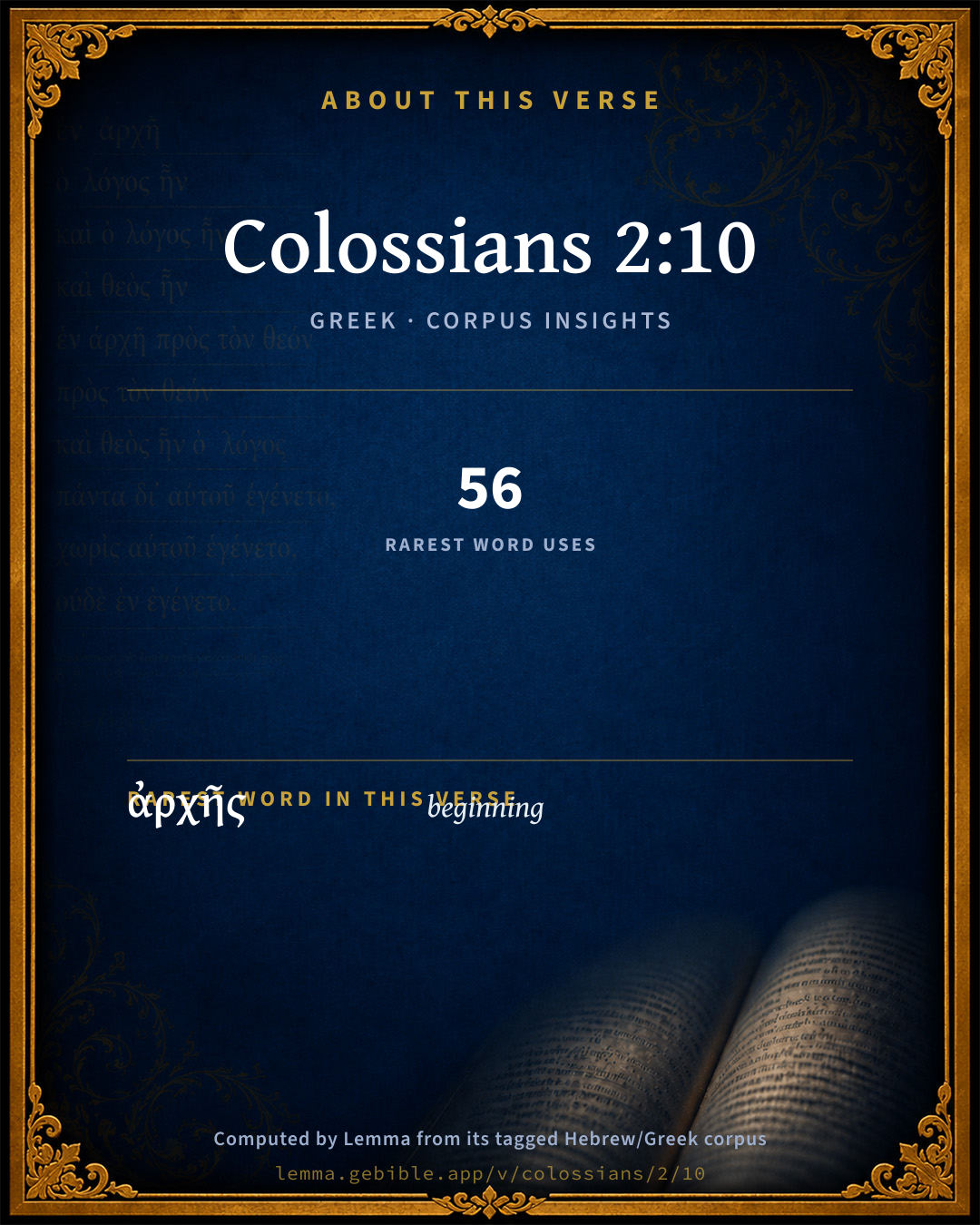
About this verse

These counts appear in no published source. They are computed here, from the morphology-tagged text and Lemma’s own curated glosses. What Lemma adds →

13
words
11
distinct lemmas
Pauline Epistles
section

Shared distinctive vocabulary

ἀρχῆς beginning G746 occurs in 55 verses of the Greek New Testament. Also found in:
Repetition

Words recur within this verse:

  • ἐστὲ to be G1510 ×2
  • καὶ and G2532 ×2

Cross-references

12

Topical passages linked to Colossians 2:10 in the Treasury of Scripture Knowledge — connected by theme and wording, ordered by reader-vote popularity; previews shown in the World English Bible.

  • Ephesians 3:19 and to know Christ's love which surpasses knowledge, that you may be filled with all the fullness of God.
  • Colossians 1:16–18 For by him were all things created, in the heavens and on the earth, things visible and things invisible, whether thrones or dominions or principalities or powers; all things have been created through him, and for him.
  • 1 Corinthians 1:30–31 But of him, you are in Christ Jesus, who was made to us wisdom from God, and righteousness and sanctification, and redemption:
  • Ephesians 1:20–23 which he worked in Christ, when he raised him from the dead, and made him to sit at his right hand in the heavenly places,
  • 1 Peter 3:22 who is at the right hand of God, having gone into heaven, angels and authorities and powers being made subject to him.
  • Philippians 2:9–11 Therefore God also highly exalted him, and gave to him the name which is above every name;
  • Hebrews 5:9 Having been made perfect, he became to all of those who obey him the author of eternal salvation,
  • John 1:16 From his fullness we all received grace upon grace.
  • Galatians 3:26–29 For you are all children of God, through faith in Christ Jesus.
  • Ephesians 4:15–16 but speaking truth in love, we may grow up in all things into him, who is the head, Christ;
  • Colossians 3:11 where there can't be Greek and Jew, circumcision and uncircumcision, barbarian, Scythian, bondservant, freeman; but Christ is all, and in all.
  • Revelation 5:9–13 They sang a new song, saying, "You are worthy to take the book, And to open its seals: For you were killed, And bought us for God with your blood, Out of every tribe, language, people, and nation,

Cross-references courtesy of OpenBible.info (CC BY 4.0).

Commentary

Notes on Colossians 2:10 from classic Christian and Jewish commentators (each source and its license shown beneath its notes). The classic Christian expositions comment on the surrounding passage and are grouped to its opening verse, so a note may address several verses; the Jewish commentaries on the Tanakh (Rashi and others) are per-verse, so they appear only where the commentator wrote on this verse.

Lemma curates 59 commentaries, every one of them public domain or Creative Commons licensed, each selected and text-cleaned for this edition rather than reprinted as found. About our sources →

The Biblical Illustrator

Joseph S. Exell

Col_2:10

Ye are complete in Him.

The false teachers at Colossae were Jews, but not Judaizers. They were philosophers. They designed to substitute philosophy for Christianity, not by denying the latter, but by explaining it. They distinguished between faith and knowledge. Faith was for the people, knowledge for the educated few. The objects of faith were the historical and doctrinal statements of the Bible. The objects of knowledge were the speculative truths underlying those statements, and into which they were to be sublimated. Pauls object is to prove

I. That philosophy was an utter failure. He pronounces it--

1. Vain, i.e., void

(1) of truth;

(2) of reality;

(3) of worth and power.

2. Deceit. It disappointed expectation, and betrayed those who trusted to its guidance. This was no slight matter, and so he warned his readers lest any man in this way should make a prey of them to their utter destruction.

II. That all the objects which philosophy vainly attempted were effectually accomplished in Christ.

1. What does Paul mean by philosophy? Some say heathen as opposed to Christian philosophy; others that particular system that prevailed at Colossae--the Gnostic. Every one would say false and not true, yours and not mine. There must be some way of deciding this question. The apostle decides for us.

(1) By what he says of the system he opposes. By philosophy he means systems of that nature. This system undertook to determine a priori and from the principles of reason.

(a) The nature of God, or of absolute Being.

(b) His relation to the world, or what the world was in relation to Him.

(c) What the origin, nature, and destiny of man.

(d) What Christ is, and how he effects the restoration of man.

(2) By the arguments he uses against it. He includes in philosophy every system against which those arguments legitimately bear.

(a) He argues that these are matters about which, from the nature of the case, we can know nothing. They are matters of revelation (1Co_2:9-11; Joh_1:18).

(b) He shows that God in the Scriptures has declared the wisdom of this world to be folly (1Co_1:20).

(c) Experience has proved that the world by wisdom knows not God.

(d) God has determined to save man not by philosophy, but by the gospel.

2. Paul does not depreciate reason. The senses have their sphere; so has reason. But there is a supernatural or spiritual sphere into which reason cannot enter. We might as well judge of a syllogism by the tongue. This conclusion is sustained by consciousness. What do you know? There lies the grave! Where does it lead to?

3. We see, therefore, that Paul by philosophy does not mean--

(1) Exclusively the Oriental philosophy; for what he says here he says to the Corinthians.

(2) Not natural, mental, or moral philosophy.

(3) But any attempt to solve the great problems above mentioned a priori.

III. All that philosophy vainly pretends to do is done in Christ.

1. As to knowledge. That is necessary, even of these supreme problems. In Christ are all the treasures of wisdom and knowledge, and He is the only source of knowledge. The knowledge He gives is sure, satisfying, sanctifying.

2. Redemption.

(1) It is objective--pardon, reconciliation. This is accomplished by Christs atoning work.

(2) It is subjective--delivery from inward sin and restoration of Divine life. This Christ does because in Him dwells the fulness of the Godhead, etc. We are filled with God in Him.

3. Restoration to our former status, to the kingdom of light: it is exaltation. This is done by being made partakers of the glory of Christ.

4. All this depends on our union with Him, which is--

(1) Representative.

(2) Spiritual.

(3) Voluntary, by faith.

Lessons:

1. We must not trust to our own reason or to that of others for instruction in these great points.

2. We have sure knowledge in the gospel, and to reject it is certain perdition. (C. Hodge, D. D.)

Ye are complete in Him

1. Christ is the one infallible Teacher of the Church. Elsewhere you tread on the deceptive sand or treacherous marsh which by an appearance of solidity lures you to proceed and then sinks under your weight. His teaching alone places you on the rock. Ancient mariners sailed by the light of the stars, but when clouds intervened they were beset with dangers. Taking the words of Jesus you shall cross the sea of life with safety, but if you allow human philosophy, tradition, priesthoods, etc., to intervene, your course must be perilous.

2. He is the Head of the Church, and alone has a right to command in spiritual things. We honour the Fathers, love the names of saints and reformers, but we must not make them lords. One is your Master.

(1) The constitution of His Person qualifies Him for this spiritual throne. Divine knowledge, wisdom, power, dwell in Him, united to tenderest human sympathies.

(2) Moreover He purchased us with His own blood, and His people are made willing subjects by the power of His Spirit.

3. The spiritual increase of the Church is derived from Him. Religious progress is a growing up into Him in all things. Christ is our life. Reject Him, and you are cast forth as a severed branch and burned; but united to Him a Divine virtue shall pass into your soul, and you shall be made perfect and entire, wanting nothing.

4. These things being so, the teaching that has a tendency to draw us away from Christ is to be rejected. The apostle warns the Colossians against errors which would have this effect. The things he names are still in the world under different forms, and his advice is as needful as ever. They were in danger from--

I. Philosophy.

1. St. Paul does not speak against love of knowledge, for this is as natural as the desire for food. Nor did he suppose that the gospel had anything to fear from it. False religions may thrive in ignorance as bats in the dark, but: pure Christianity, like the eagle, delights to look the sun in the face. Be philosophers if you will, explore the wonders of nature, and the gospel will no more suffer than the finding of new planets will extinguish the sun.

2. But the Colossian philosophy was the vain and bewildering theories of men. Speculations concerning God are of little value, for He is found not by our searching, but by his revealing, and that in Him in whom dwelleth all the fulness of the Godhead. Extinguish this light and hold in your hand the torch of philosophy, and what do you make of the black expanse before you--the many gods of the heathen, the no-God of the atheist, the blind necessity of the fatalist, or nothing but matter with the materialist, or nothing bat God with the pantheist?

3. Three things are certain.

(1) Man must have a religion.

(2) He cannot discover a satisfying one by himself.

(3) He should receive thankfully that provided by Christ, who is our life and in whom we are complete.

II. The traditions of men.

1. By tradition we mean doctrine, precept, custom not named in the Word of God. Jewish traditions, embodied in the Talmud, were mingled at Colossae with mental philosophy and the truths of the gospel. This Paul regarded as injurious to spiritual life.

2. The belief in tradition is not extinct. The Greek and Roman Churches receive it as a rule of faith co-ordinate with the Bible. And other Churches, more pure and enlightened, are not entirely free.

(1) There are traditional systems of spiritual truth. Men of other days melted the Divine doctrines and cast them in human moulds. The gospel bears the same relation to these forms as a painting to its frame. We may change the frame, but must not efface a single feature of the picture.

(2) There is a traditional mode of speech with which you must clothe the truth or be suspected of heresy.

3. Tradition is at best an uncertain guide. It may be a pillar of fire, or an ignis fatuus. But we have the words of Jesus, the glorious and everlasting gospel; and our faith should rest in that, and not in fairy tales of Jewish, Roman, or Protestant tradition. Ye are complete in Him.

III. The sacred sites and seasons of a former dispensation (verse 16). Many are still Jewish in their feelings.

1. To many the Lords day is still the Jewish Sabbath. Yet its very name shews it to be a different day, and can we fear for its sancitity while we regard it as commemorative of the resurrection. Moreover, it is necessary for rest and devotion. Keep it, then, as given, not by Moses, but by Christ.

2. Baptism as set forth in the New Testament is beautiful and instructive. It acknowledges our sinfulness, symbolizes the purification of the Spirit, and puts a seal on the baptized that he belongs to Christ. But when it is regarded as regenerative, and as creating a relation which it only recognizes, the sign is mistaken for the thing signified, and a simple ordinance converted into a fruitful error.

3. The Lords Supper, in its simplicity, is an impressive representation of Christs sufferings, a vivid expression of His love, an historical evidence for the gospel. Men have built monuments to keep their names in human memory, but time has blotted them out. Therefore our Saviour ordained for His memorials productions of nature that will last as long as the world. Penetrate their meaning, and you will understand what Christ is to you. But when the idea of spiritual magic is introduced, instead of being helpful to piety, it becomes a stumbling-block and an offence.

IV. The worship of angels (verse 18). This old error still lives. The honour paid by Rome to angels exceeds that paid to Christ. It was an error to think that we in England had done with her for ever. She is very busy in this land, and wherever her teaching is received angels are worshipped. We should avoid her and repudiate her claims. Begone, spirit of error; that we may behold God in Jesus Christ. We are complete in Him. (T. Jones, D. D.)

Complete in Christ

Complete is carried on from verse 9. The fulness of the Godhead, and ye are full (same word) in Him.

I. Fulness in Christ. If you had heard Christ speak you would have said nothing can be taken away or added to those words without diminishing their force or beauty. If you had seen Christ act you would have felt that His action came up to the fulness of which that action was capable. His heart was nothing but love; and His work, although confined to a few years, fulfilled the infinite counsel of the Trinity. The Father looked down and saw no flaw and was satisfied.

II. This fulness was to be the one treasure-house of the Church for ever (Joh_1:16; Eph_4:7). And every believer being separately endowed, the whole Church is made His body, the fulness of Him that filleth all in all. So we are filled, complete; and the Church is the complement of Jesus.

III. The process by which the completeness is effected is union with Christ.

1. The union is a simple, positive fact once for all. The Holy Spirit enters a mans mind and unites his thoughts, feelings, desires, etc., with those of Christ, and that Spirit in both is union.

2. If there be union the completeness will follow, just as a vessel must fill itself from the fountain with which it is connected.

IV. We naturally yearn and strive for completeness, but fail everywhere.

1. No man ever yet came up to the point of which he knew his powers were capable.

2. None of those sources of gratification with which God has furnished us ever gave entire satisfaction.

3. There is not a man who has not his weak points; but above all men the Christian feels his incompleteness. The better he prays the more he feels his prayer deficient. The higher his attainments the farther off he seems from what he wants. And no Christian friend, no Church, no ordinance, no grace, is all he once expected they would be.

4. Life is one vast incompleteness.

V. We are complete in Him.

1. From His cross our Lord said It is finished. From the time of creation down to that hour those words could not have been spoken about any human undertaking. But He said it, and mark the consequence. You have to do with a salvation which is perfectly complete. If you think you are to do anything you detract from the completeness of Christ.

2. We have a twofold completeness.

(1) That which we draw from Christ. The whole disposal of Gods gifts is delegated to Christ. In Him all things are treasured up for our sakes. Hence He will supply

(a) our temporal needs. The Christian, therefore, must not be anxious about them.

(b) Strength and wisdom for every work we have to do. The Christian, then, must not despair about his weakness and ignorance.

(c) Grace for Christian growth and comfort. The Christian must not despond when deprived of outward means and help.

(2) That in which we stand in Christ. God sees all who believe in Christ, and accepts Christ for them. Hence everything we do in faith loses itself in some corresponding thing that Christ has done. Our prayer, e.g., mingles with Christs intercession. What is wanting He supplies, what is redundant He deducts. His perfume gives it sweetness, and so it goes to the throne, how different from when it left us, complete. He is made unto us wisdom and righteousness, etc. (J. Vaughan, M. A.)

Complete in Christ

1. Every valuable mechanism represents a principle peculiar to itself. It may have many important adjuncts, but there must be one principle which imparts its force to all the rest.

2. In the same manner men are of large or small account as they recognize their individuality. Each stone is hewed for its special place, and to fail to appreciate our purpose is to degrade our manhood and to insult the prescience of the Divine Architect.

3. The claim of Christianity to be is that it, in like manner, embodies one distinctive fact. Ethically considered it has much in common with other systems; but its central feature or force is, as its name indicates, the Christ element. The degree in which Christ is present in the heart marks the purity of the Christianity.

4. The declaration, Ye are complete in Him, goes much further than the recognition of Christ as an historic character as we associate Mahomet with Islam, etc. It is Christ interpenetrating Christianity at every point. The Scriptures assert for Christ comprehensive, all-filling character and capacities. I am the Way, etc. Without Me ye can do nothing. In Him dwelleth all the fulness of the Godhead, etc. Observe--

I. This completeness in Christ in contrast with all others.

I. No life is or can be in itself alone. We sustain a multitude of important relations, family, civil, He., but it would not be possible to apply the language of the text to them. Of no relation, even the most valuable, can it be said, This is essential. It seems to be the destiny of man to grow out of existing states, and use them only as the oar employs the water that it dips as a leverage for progress. And we may thank God that in a world where death spares nothing that there is no person or condition wherein our completeness lies. The king, hero, father dies; the nation, community, family mourns as if nature had stopped in its courses; but to-morrow the world moves on unchanged save that one grave more has furrowed its surface. That any of us is essential to the place he occupies is but a fiction of his own weakness or a flattering adulation of his admirers. Only in God all things consist.

2. The reason of this, and as marking the essential difference between our relations to any other and to Christ, is that the former are in a sense conventional. We found them, we have become habituated to them, nevertheless they are not essential. Of one only can this be said. That we are complete in Christ renders necessary the preceding declaration which shows that what God can do for us Christ can do.

II. That we are complete in Christ necessarily implies that apart from Him we have no moral standing place.

1. I care not to argue the question of degrees. Incompleteness where perfection is demanded, where the judgment is by an infinitely holy standard, is as condemnatory and destructive of our moral basis as any degree of sin. Some years ago a large object glass was prepared for a telescope. With all the care employed, a single defective spot was found upon the otherwise perfect lens. It was not broken, there was no flaw, but it was condemned. Its purpose was to be a clear undeviating eye turned towards the heavens accurately to determine localities, etc. That single imperfection was its entire condemnation. This is the idea of human depravity. The defect in the web of the cloth renders the whole piece unmarketable. Slight incompleteness is still incompleteness, and when the judgment is upon righteousness the ground is taken from our feet.

2. It would be curious to investigate by what process so many cooly conclude to risk the great ordeal upon their personal moral standing, which even their fellow-men pronounce defective. A principle that may well command this easy-going complacency to halt is that the nature of sincere virtue is ever discontent with attainments. As eminence with the pencil or chisel leads to the detection of manifold deficiencies and desire for a higher ideal, so the advance towards holiness, instead of satisfying, always reveals a disheartening lack, and as invariably leads to a search for some other mode of satisfying the requirement of conscience.

3. May it not be that this failure to perceive our own incompleteness, and the necessity of a better justifying righteousness, is rather to be ascribed to moral blindness than accepted as an evidence of superior virtue? For if once our incompleteness out of Christ be admitted, then the neglect to obey the gospel is reduced to a childish trifling with our eternal interest.

4. Yet how can one more fully commend the completeness there is in Christ than to point to that spotless life consummated by the sacrificial death of the cross? For all the way through--where the suffering by innocence must either mean injustice on the part of God, or justice receiving satisfaction for us--there is not a step or act which is not eloquent with the perfection of that sacrifice. You are asked to trust a Saviour of whom it is asked, Who is he that condemneth, etc. Here is your completeness. It pleads no weak abandonment by God of His holiness. Redemption in Christ is the crown of that holiness as it is the expression of Gods love.

III. This completeness gathers in the circle of its embrace every conscious want. It keeps as well as saves. Christs intercessory prayer is not a supplication such as we offer, but a claim and recapitulation of what had been secured by His expiation. And in virtue of that Christ will bring with Him His saints, and stand at heavens gates claiming for them admission by His victory over the grave. Christs completeness must be one which does not exhaust itself on a past forgiveness. It must not only cleanse, but keep me clean.

2. The independence of God of every human condition, for the success of Christs kingdom, and the completeness for all its requirements, is found in Christ. Men have come and gone; some have seemed so important that hope almost expired in their departure, as Melancthon felt when Luther died. Yet how local are all such influences. God uses men, and so do we; but even with us how inconsiderable is a man. How quickly is the gap filled. Gods Church is not complete in man, but in Christ. (E. P. Terhune, D. D.)

Christians complete in Christ

I. What is meant by Christians being complete?

1. The word means full, wanting nothing; and as applied to Christians, it means that they have everything necessary for life and godliness, happiness and immortality.

2. The things needed in order to being complete.

(1) Wisdom and knowledge--meeting natural ignorance of, and conflicting theories about, God and the way of salvation.

(2) Pardon and righteousness. As sinners men cannot stand before God in judgment. They are unclean in His sight, and without forgiveness and acceptance they must perish.

(3) Holiness and purity. The heart is naturally evil, and by habit and indulgence acquires strength for evil. Unless this is cleansed there can be no meetness for heaven.

(4) Consolation and peace. Forgiveness is not enough, there must be a consciousness of it, so that the sense of shame, the deepest of our discomforts, may be banished, and the sense of reconciliation with God take its place.

(5) Support and strength in view of trials, labours, enemies.

(6) Deliverance from the power of death and the grave.

II. How Christians become complete. In Christ. Because being God and man all fulness dwells in Him, and out of this fulness all our need is supplied.

1. In Him are hid all the treasures of wisdom and knowledge. By His Word He instructs, by His providence He guides, and by His Spirit He opens the mind to instruct both.

2. He is the propitiation for our sins, and has thus brought in an everlasting righteousness, by means of which believers are accepted.

3. His grace creates the heart anew, subdues sin, and developes in holiness.

4. He brings peace to the troubled conscience and consolation to the broken heart.

5. He is the strength, defence, and support of His people.

6. He hath abolished death. (E. Cooper, M. A.)

Believers complete in Christ

I. On earth.

1. In their union to Christ.

2. In their justification.

3. In Christs fulness.

4. In their title to heaven.

II. In heaven.

1. As regards their persons--the union of body and soul with the perfection of nature and grace.

2. As regards their mental faculties--in receptivity and memory.

3. As regards the graces of the Spirit- faith lost to sight, hope in fruition, love in God.

4. As regards their fellowship- undivided, uninterrupted, with our predecessors, contemporaries, followers, God.

5. As regards their happiness--perfect enjoyment, perfect service. (A. Fletcher, D. D.)

Completed life

We are to look to Christ alone.

I. For the freeing of our spirit from all evil. But how shall this great purification and perfecting be attained? The appeal is to Omnipotent Grace. And Gods response is made known in Jesus Christ: It pleased the Father that in Him should all fulness dwell of pardoning and cleansing grace. In Him who is the head of all principality and power are we to look for the sin-expelling force--the force to correct, to purify our deepest life.

1. And we must not call in any foreign aid; we are complete in Him. These Colossians were tempted by Gentile philosophy on one side, and Jewish ecclesiasticism on the other, but the apostle reminds them that everything they wanted was in Christ, and they were to confine themselves severely to His fellowship.

2. And Christ can save us completely, Whiter than snow. Let us remember that Christ aims at our completeness, and let us not rest short of that ideal. It is a present blessing.

II. For the perfecting of our nature in all its powers. It pleased the Father that in Him should all fulness dwell. In Christ we behold the fulness of the Godhead bodily, and also the fulness of humanity.

1. We need not travel beyond Christ--He is the ideal and the perfecter of the race. All colours are in the sun, and all the infinite differentiations of colour found on the landscapes of nature, in the vapours of the firmament, in the play of the sea--all are in the light. And in Jesus we have the full-orbed humanity, all the graces by which man can be adorned. When we study the character of ordinary men it is like entering an ordinary garden, in which are a few fair flowers with an unfortunate admixture of weeds; when we study the moral character of extraordinary men it is like entering the grounds of some great rose-grower or orchid connoisseur--many delightful things greeting our eyes. But on beholding Christ, it is like being set down in Kew Gardens, where the vegetation of the whole earth blooms. In these days certain critics are very anxious to send us to the sacred writings of China, India, Arabia, Persia. Very valuable indeed are those writings from certain points of view, but they have nothing to add to the ideal of humanity given in Christ.

2. In Christ we are to attain the perfection of our nature. We have not only completeness in Him, but we arc to become complete in Him. Men talk about the narrowness of Christianity, its commandments and prohibitions; they want a system of religion, wider, freer. Now, the tree on the heath or in the street may rebel against the iron bars which girdle it. Says the grumbling sapling, I dont like this iron cage; I want liberty, I want room. Room l it has plenty of room at the top. It has room for its branches to stir with every wind of heaven, to catch all the dew of the morning, all the light of the sun, all the wealth of the shower; room for the singing birds, room to leaf, to blossom, to fruit. Room! The iron bars protect you from beneath, but a whole sky is waiting for you up above. So, whilst the New Testament rings us round with protective prohibitions, Jesus Christ stands over us like a sky, pouring down upon us richest influence, and drawing forth all the powers of our nature to their fullest perfection. There is room for our whole personality, our bodily instincts, mental faculties, imagination, wit, judgment, logic, speculation; for our social instincts, all the sensibilities of kinship, friendship, patriotism; for our ethical sense, for our heart with all its wealth of affection. Christianity is not wide enough for a theatre at one end and a prize ring at the other, but wide enough for whatever is true and pure in knowledge, science, art, pleasure, patriotism, business, love. We are not straitened in Christ; let us not be straitened in ourselves, but so live in the faith of the Lord Jesus that all the riches of our nature may be realized, that we may come to the measure of the stature of the fulness of Christ.

III. For the strengthening of our life in all righteousness.

1. In Christ we attain completeness alike in spiritual and in practical virtue. Holiness is that side of goodness which looks towards God; morality is that side which looks towards society. And in both Christ perfects us--filling us with reverence, admiration, love toward God, and strengthening us to fulfil all practical virtue.

2. In Christ we attain completeness in universal virtue. If we have the Spirit of Christ, it will display itself in every possible virtue--that Spirit being the essence of universal virtue. Just as in the doctrine of the convertibility of force, we are taught that heat may become light, and light electricity, and electricity magnetism, and magnetism chemical affinity, and chemical affinity be changed into motion--one force with many manifestations--so the Spirit of Christ displays itself, now as meekness, now as courage, now as temperance, now as purity, just as circumstances require, but yet is all the time the one same Divine force. It makes of one a good master, another a good servant; one a good prince, another a good subject; one a good husband, another a good wife; one a good parent, another a good child. The Spirit of Christ fits men for every rank, adorns them with every grace. Ye are complete in Him. Conclusion: We must feel condemned for our incompleteness; and yet from time to time how near we come to a life altogether full, rich, glorious 1 One of our magazines had a striking paragraph, entitled, I have touched the gold, and it went on to relate how a diver uttered these words on coming up from a sunken gold ship, and the writer proceeded to show how in religion we often touch the gold and yet never quite realize it. Oh! how often have we touched the gold--the strength that more than overcomes, the perfect peace, the faith which asks and receives, the love that many waters cannot quench, the purity that keeps itself pure, the joy that is unspeakable, the hope full of glory--we touch the gold, we always know when we touch gold it is such a pleasant feeling, and yet fail to possess it. Let us trust in Christ- with all our heart; let us do it now, so shall every man be presented perfect in Him. (W. L. Watkinson.)

The completing of the soul

If we are only to be complete in Christ, then we must be incomplete without Him. It follows then that a soul after being made is still to be completed. It may be a germ to be developed, or a blasted germ to be restored. Here then is the true work of Christs salvation, the completing of the soul.

I. What do we mean by the completing of the soul?

1. We constantly assume the necessity of a great afterwork to be done on the soul of our child to make it the complete man or woman we desire it to be. What we call education is only our attempt to bring it to completeness. The result is a being in higher quantity and finer quality, and of enlarged capacity for action and enjoyment.

2. But it is not to be assumed that we are right in all our conceptions of what takes place in the training of minds.

(1) They will not be complete if only fully educated intellectually. Sometimes they will be hampered by scholarly attainments, drugged by great authorities, and incapacitated by the overload they have taken. Perhaps one hour with God would have done more in the widening of consciousness and the kindling of divinist fires than whole years of school drill.

(2) Sometimes we think our child is only going to be complete when educated away from certain ranges of employment. If he can only be a blacksmith, or a school teacher even, we think that we have not made enough of him. Were he a qualified commander, physician, lawyer, etc., we should think him more nearly up to the measure of his possibilities. But God does not grade our completeness by any such law. He may have rated Bezaleel the brazier far above Aaron the priest. Whoever came nearer to being mated with Shakespeare than the tinker Bunyan? A great soul can be fashioned anywhere if only God is with him. God nowhere allows that souls are kept back from completeness by their employments.

3. No mere schooling, to whatever grade of life or social estimation it may lead, is any but the faintest approximation to the completion of the soul.

II. How does it appear to need any such completion? If this were a question relating to Adam in his innocence, we should say that he was a full-grown, beautiful child, but yet a child; that his perceptions are all to be gotten, his will trained, habits formed, etc. Until then he is so incomplete that he will not stand fast in good, but plunge into wrong. Our first man, commonly thought so grandly perfect, is put on probation only that he may get his nature so matured in good that he will come out able to stand. Our question after this relates to him under the conditions of moral disaster into which he has fallen.

1. The soul scarcely at all answers its true end. There is a feeling everywhere that souls are going wide of the mark. A watch is complete when it keeps time, not when it quarrels with the notations of suns and dials and almanacks. A vintage process is complete when it makes wine, not when it makes vinegar. Souls in like manner are complete when they make the good they were made for.

2. Their enjoyment is not full, but confessedly a great way short of it. Their instincts are unfulfilled, their wants unsupplied, their objects not found. They are tormented with a general unrest. It would not be so if they were complete. They would be exactly full of enjoyment, just as by their inborn necessity they crave to be. No bee misses the shape of its cells, no bird the direction of its flight, no plant the colour and kind of its flower. No more will a soul its enjoyment unless incomplete, sweltering in some torment of inbred disorder.

3. Souls do not fulfil the standards of beauty, truth, and right. These are standards we all admit, just as all flowers and fruits have standard colours and figures of their kind. An apple is not complete when it comes out a gourd; nor a rose when it comes forth blue. When a soul, then, misses its kind, and puts forth itself in deformity, falsity, and wrong, it is a witness to its incompleteness.

4. Take a more surface view, and let the question settle itself under mere first impressions. How then is it that there is so much meanness, passion, want of self-government in individuals; and so many quarrels, acts of injustice, and bloodshed in society? Who can imagine mere creatures complete in their order? Suppose all the grains in a bushel of wheat were to act on themselves and towards one another thus! And the reason why they do not do so is because they are complete creatures, resting in their own perfect mould, and in harmony with each other--they that are at the top lying just as heavily, and those at the bottom supporting the weight just as bravely as they must. Souls completed in their order would do the same, just as all Gods finished worlds and societies in glory do, without one rasping of a bad thought, or pang of mutual accusation.

5. We have a way of saying concerning a man that he is rained or blasted by his vices: in which we refer mentally to the incomplete state of the flower which we say is blasted when it does not come to fruit. And the figure is rightly chosen. Such men are incomplete.

6. It is a very curious distinction of souls that, being finite, they have yet infinite wants and aspirations; their very longing is to be completed in the outspreading of some infinite possession. What a falling short, therefore, is it when they fall short of God.

III. How in Christ they can be made complete. Here we discover three great agencies provided for the purpose.

1. Inspirations.

(1) Separated from God man is nothing. Existing in mere self-hood he cannot push himself out in any way so as to be complete as from himself. A sponge might as well complete itself in dry air; it must let in and possess the sea. Just so a soul must have Gods properties flowing in and through--liberty and life in His life, power in His power; it must be true in His truth, righteous in His righteousness.

(2) Now, it is in this inspiration force that Christ arranges for in His gift of the Spirit. He enters the soul to fill out every lack, configuring it inwardly to all that is most perfect in Himself, turning its very liberty towards all it wants and needs to receive.

2. We have ideals in Christ, who lives God in human figure and relation, so that we have in Him all that requires to be completed in us. Christ is the mirror that glasses Gods image before us, and the Spirit is the plastic force within that transfers and photographs that image, so that beholding as in an image, etc. (2Co_4:6).

3. To make the provision perfect, we are set in a various scheme of relations that we may have a training in duties and qualities, and be perfected by means of them. And we have as our remarkable advantage Christ the Divine man with us in these relations, so that trying to do the exact Christly thing in them all we are to get benefit in so many forms and degrees, and be brought when all is done and suffered to a completeness in the will of God. In this wondrous mill every blemish is to be removed, till at last there will be no spot or wrinkle or any such thing.

IV. The gospel of Christ is the only power able to bring men thus forward.

1. We try education, getting much from it, but never anything which approaches a standard of completeness.

2. What we call self-improvement is a poor desultory affair, polishing one thing, while another goes rough by neglect, and all issuing in a great self-consciousness painful to behold, and in itself how dry.

3. We try self-government under the standards of morality, but the most we obtain is to pile up what we think good acts on one another, as a man piles his days wages, but then they will be as dry and with as little continuity.

4. There is another way greatly praised--philosophy. But its ideals are for ever out-running its possible attainments, and the fine philosophic consciousness will be only a kind of equilibrium under dryness and felt limitation. And the wars of the mind are perhaps kenneled by it but not composed.

5. There is nothing, in short, but religion that can be looked to for the completing of the soul; because as nothing else does--

(1) It takes hold of the soul s eternity and its sin, to raise up, harmonize, purify, and settle it in a rest of everlasting equilibrium in God.

(2) It takes hold of all possible conditions, completing as truly the menial as the employer, the unlettered as the scholar.

(3) It completes one degree of capacity as certainly as another, preparing the feeblest to fill out his measure as roundly and blissfully as the highest. (H. Bushnell, D. D.)

Every need of man supplied in Christ

I. The errors Paul desires to counteract. These were the current philosophy of the day. There were many forms of thought which preceded Christianity. For hundreds of years men had been indulging in speculation, groping after light, and weaving systems; and the Colossian philosophy seems to have been an amalgamation of the four principal.

1. The philosophy of Plato, with its mystic doctrine of everything having an archetypal model.

2. Jewish fables and endless genealogies picked up by the exiles in Babylon.

3. Ceremonialism and the observing of days, etc.

4. Gnosticism, the affectation of superior knowledge.

II. The doctrine with which he would counteract these errors. Ye are complete in Him.

1. Note who and what Christ is. The glory of Christ is set over against these speculations.

(1) He possesses the loftiest ideal--All the fulness of the Godhead, not one of His emanations, and that fulness bodily, brought within the comprehension of man.

2. He has done a great work (Col_1:20). It is not matter that is sinful, but man, and from this Christ redeems him.

(3) He sustains a glorious relation to the universe (Col_1:15; Col_1:18; Col_2:19). He is not one of an illustrious order, but Creator and Head of all.

4. He maintains a close union to the man who accepts Him (Col_1:27).

2. If Christ is all this to a man, then that man is complete in Him.

(1) If a man be striving after the knowledge of God, he is complete in Christ. This has been the problem of philosophy from Thales till now. What is the first principle? Water, air, fire, mind, love, have each in turn been the answer. And now a philosophy is confessing the problem insoluble, calling God by a name more hopeless than that on the Athenian altar--the Unknowable. But who that knows Christ can ever be thus in the dark (Joh_14:9).

(2) If a man would approach God he is complete in Christ. Afar from God man cannot rest, but sin keeps him away. But through Christ we have access (Joh_14:6; Heb_10:19) and close fellowship.

(3) If a man is anxious about his standing before God he is complete in Christ. Through Him we may have a better and firmer one than Adams. In Christ a man stands accepted and welcomed with nought wanting to the fulness of his redemption.

(4) If a man wants to lead a holy life he is complete in Christ. This was the aim of the Gnostics; not holiness indeed, but freedom from the impurities of matter. Hence they tried asceticism. But sin is not to be purged by scourging the body. Christ however can kill it by the power of a new life which His Spirit implants.

(5) If a man is longing for light on the great questions of destiny he is complete in Christ, who has brought life and immortality to light.

(6) Do we ask for a bond of brotherhood in the human race? We are complete in Christ in whom there is neither Jew nor Greek, etc.

(7) Do we ask for a redemption that shall perfect body, as well as soul and spirit? We are complete in Him who is the Saviour of the body and the resurrection and the life.

III. The suitability of this doctrine for counteracting modern errors. The true method of meeting false doctrine is to show that all our nature craves is to be found in Christ. But since Christ is enough in Himself He must be accepted as being so, and not as the mere complement of some other system.

1. Are you in peril of Rationalism? Learn what Jesus is, and you will find reason and conscience to say, Here is one at whose feet we can sit to be their enlightener and lord.

2. Are you attracted by Positivism? Here in Christ is all that is attractive in its assertions, and nought of its dismal negations. They worship they know not what in worshipping Humanity. But no one who has ever caught a glimpse of Christ can ever barter a living Saviour for that. One in the race and yet over it. Over it, that He might redeem, educate, and glorify it; and yet who can give to each member eternal life.

3. Do the claims of a so-called priesthood attract you? If you knew what Christ is you would let no one have the impertinence to come between you and Him. We need a mediator between God and man; but none between us and Jesus. Con clusion: This doctrine is grand enough for the philosopher, yet simple enough for us all. We are complete in Christ for living or dying; for time or eternity. (C. Clemance, D. D.)

Completely furnished

Manton says He that is in a journey to heaven must be provided for all weathers: for though it be sunshine when ha first sets forth, a storm will overtake him before he cometh to his journeys end. Have faith in Christ and you are ready for anything, thankful for everything, afraid of nothing. Ye are complete in him. (C. H. Spurgeon.)

Which is the head of all principality and power.

Angels

I. In themselves. For their excellency of nature, as they are here called principalities, so elsewhere they are called stars of the morning, sons of God, yea, Gods.

II. In relation to Christ so they are implied to be of the body, and Christ to be their Head. Now we may not marvel at it, that Christ should be the head of angels, for there be divers distinct benefits, which angels from thence do receive, which by natural creation they had not.

1. They are vouchsafed a place in the mystical body under Christ, that they might be received, as it were into the new order in Christ.

2. A peace is made between them and man in Christ.

3. The room of angels fallen is supplied by the elect, the society of angels being much maimed by their fall.

4. They are refreshed with singular joy for the conversion of the elect; besides the enlarging of their knowledge, that they are vouchsafed the understanding of the secrets of the gospel.

5. They receive from Christ confirming grace, and so assurance that they shall never fall: which is their chief benefit.

6. Their obedience in its own nature is imperfect, though not sinful, and therefore may need to be covered by Christs perfections.

III. In relation to the body of Christ.

1. They are like masters and tutors, to whom the great King of heaven sends out His children to nurse. God doth adopt children, and after commit them to be kept by those most noble citizens of heaven.

2. They execute judgment upon the enemies of the Church. They attend us at the hour of death, and carry our souls to heaven. They shall gather our bodies together at the last day.

3. For the accomplishment of all designments for our good, they stand always looking on the face of God to receive commandments.

Conclusion: Inasmuch as Christ is the head of all principalities and powers, we may comfort ourselves divers ways.

1. If Christ fill the angels, how much more can He out of His fulness fill us in the supply of all our wants.

2. Shall we not rejoice in the grace here is done to us, in that we are united into communion with angels under our Head? yea, and that such glorious creatures, are appointed to be our attendants, why should we fear when Christ and His angels will be so ready about us.

3. This may also instruct us, we need not be ashamed of Christs service, seeing the very angels follow Him and depend upon Him. A prince that kept great princes to be his domestic servants, were like to be much sought to for preferment of such as would follow him. Oh! how should we long after Christ who is Head over such glorious creatures as the angels are! (N. Byfield.)

The Biblical Illustrator, edited by Joseph S. Exell (c. 1880s–1900s) — public domain. Text from a community e-Sword module.

The Pulpit Commentary

And (because) ye are in him made complete; or fulfilled (Eph_1:3, Eph_1:7-11, 23 3:18, 19 4:13; Php_4:19; Gal_3:14, 24 5:1, 4; 1Co_1:30 1Co_2:2) A complete Christ makes his people complete; his pleroma is our plerosis. Finding the whole fulness of God brought within our reach and engaged in our behalf (Php_2:7; Mat_20:28) in him, we need not resort elsewhere to supply our spiritual needs. (Php_4:19) "In him" is the primary predicate (see Alford, Ellicott, against Meyer: comp. ver. 3): "Ye are in him" is the assumption; (Rom_8:1 Rom_16:7) "(ye are) made complete" is the inference. (On the verb plhrow (the basis of pleroma), used in perfect participle of abiding result, see notes, (Col_1:9, Col_1:19) This completeness includes the furnishing of men with all that is required for their present and final salvation as individuals (vers. 11-15; Col_1:21, Col_1:22, Col_1:28) and for their collective perfection as forming the Church, the body of Christ (vers. 2, 19; Col_1:19; Eph_1:23 Eph_5:26, Eph_5:27) for this twofold completeness, comp. Eph_4:12-16. Who is the Head of all principality and dominion (vers. 15, 18; Col_1:16; Eph_1:21; Php_2:10, 11; 1Co_15:24; Heb_1:6, 14 1Pe_3:22) (On "principality," etc., see note, Col_1:16) The Colossians were being taught to replace or supplement Christ"s offices by those of angel powers (see notes, vers. 15, 18). Philo ("Concerning Dreams," 1. 23) writes thus of the angels: "Free from all bodily encumbrance, endowed with larger and diviner intellect, they are lieutenants of the All ruler, eyes and ears of the great King. Philosophers in general call them demons (daimonev); the sacred Scripture angels, for they report (diaggellousi) the injunctions of the Father to his children, and the wants of the children to their Father. Angels, the Divine words, walk about comp. (2Co_6:16) in the souls of those who have not yet completely washed off the (old) life, foul and stained through their cumbersome bodies, making them bright to the eyes of virtue." In such a strain the Colossian "philosopher" may have been talking. But if Christ is the Maker and Lord of these invisible powers , (Col_1:15, Col_1:16) and we are in him, then we must no longer look to them as our saviours.

The fulness of humanity.

I WHEREIN THE FULNESS OF HUMANITY CONSISTS. St: Paul has been writing of the fulness of the Godhead. He now turns his thoughts to our poor, naked, hungry humanity, and he shows how there is a completion and a satisfaction that may be called our fulness, in some way corresponding to the fulness of God.

1. The full satisfaction of our wants. We are empty, hungry, and needy. We require pardon for sin; strength for trouble, temptation, and toil; light in darkness; innumerable graces for innumerable distresses. Our fulness must be the quenching of the soul"s thirst, the satisfaction of the aching void within.

2. The full attainment of the perfection of humanity. We may have every known desire satisfied and may be full up to the measure of our present capacity, and yet not have attained to the fulness of humanity. Our capacity may be enlarged, new aspirations may be inspired in us. To attain to the stature of the perfect man, to he quite like Christ, is to reach our spirit"s prime and to have our human fulness. This will be a fulness of knowledge, of goodness, of power for spiritual service.

II FROM WHAT THE FULNESS OF HUMANITY IS DERIVED. By the word "fulness" St. Paul means that which fills as well as that which is perfected in itself. Christ alone can fill and perfect us.

1. We must find the fulness in Christ. Because he is filled with the fulness of God he is himself a perfected Man and the Source of the same grace for us. We have to learn, then, that to reach our fulness we must have what is in Christ. Perfect humanity is not possible without God. When we become possessed by the Spirit of God we become true men. This true religious life does not make us less human; it perfects our humanity. Not by science, nor by learning, nor by energy in affairs of the world, nor by any purely human effort, though all these things have their missions, but through Christ, we may attain the true ideal of humanity.

2. We can attain to this fulness by personal union with Christ. We must not simply learn the method from Christ, nor seek the blessing as a gift of his, but derive it from close, living fellowship with him. The secret is to be "in Christ," "rooted" as the tree by being rooted in the soil derives nourishment therefrom, and "builded up in him" as the temple stands firm when erected on a solid foundation. W.F.A.

The Pulpit Commentary (1880–1919), ed. H.D.M. Spence-Jones & Joseph S. Exell — public domain. Text from a community e-Sword module.

Bengel's Gnomon

Johann Albrecht Bengel

Col 2:10. Καὶ) and therefore.—ἐστὲ) ye are.—πεπληρωμένοι, filled up, made full [complete]) Joh 1:16. The fulness of Christ redounds to the Church; Psa 133:2. Therefore His fulness is infinitely more abundant. He Himself is full; we are filled [by and from Him] with wisdom and power.—ἡ κεφαλὴ πάσης, the head of all) Eph 1:10.—πάσης ἀρχῆς, of all principality) Therefore we ought to present our petitions to Christ, not to angels.

Bengel's Gnomon of the New Testament — English translation (T&T Clark, Edinburgh, 1860) — public domain. Text from a community e-Sword module.

Meyer's Critical & Exegetical Commentary

Heinrich August Wilhelm Meyer

Col_2:10. Καί ἐστε ἐν αὐτῷ πεπληρ.] still depending on ὅτι: and (since) ye are filled in Him, i.e. and since the πληρότης which ye possess rests on Him, the bodily Bearer of the divine πλήρωμα. The two are correlative: from the πλήρωμα τῆς θεότητος, which dwells in the exalted Christ, flows the πεπληρωμένον εἶναι of the Christian, which has its basis, therefore, in no other than in Christ, and in nothing else than just in fellowship with Him. Filled with what? was self-evident to the consciousness of the reader. It is the dynamic, charismatic πλήρωσις, which Christians, in virtue of their union of life with the Lord, whose Spirit and ζωή are in them, have received, and continuously possess, out of the metaphysical πλήρωμα dwelling in Christ, out of the πλήρωμα τῆς θεότητος.

The emphasis is not upon ἐστέ, but, as shown by the subsequent relative definitions, upon ἐν αὐτῷ. If the πεπληρωμένον εἶναι depends on Him, on nothing and on no one but on Him, then everything else which men may teach you, and with which they may wish to seize you and conduct you in leading strings, is οὐ κατὰ Χριστόν. With due attention to this emphasis of ἐν αὐτῷ, we should neither have expected ὑμεῖς (in opposition to de Wette; comp. Estius and others: et vos) nor have explained ἐστέ in an imperative sense (in opposition to Grotius, Bos, Heumann); which latter view is to be rejected, because the entire connection is not paraenetic, and generally because, whilst a πληροῦσθε (Eph_5:18) or γίνεσθε πεπληρ. may, ἐστε πεπληρ. cannot, logically be enjoined.[94] There is, moreover (comp. also Hofmann), nothing to be supplied with πεπληρ. (usually: τῆς θεότητος, see Theophylact and Huther; de Wette, Bleek: τοῦ πληρώμ. τ. θεότ.), since the specifically ontological sense of the purposely-chosen θεότητος would not even be consistent with the supposed equalization of the Christians with Christ (οὐδὲν ἔλαττον ἔχετε αὐτοῦ, ἀλλὰ πεπληρωμένοι καὶ ὑμεῖς ἐστε τῆς θεότητος, Theophylact), and this equalization does not exist at all, because Paul has not written καὶ ὑμεῖς. In what their being filled consisted, was known to the readers from their own experience, without further explanation; their thoughts, however, were to dwell upon the fact that, since their being full depended on Christ, those labours of the false teachers were of quite another character than κατὰ Χριστόν.

ὅς ἐστιν ἡ κεφαλὴ κ.τ.λ.] This, as also Col_2:11, now supplies confirmatory information regarding the fact that they have their being filled not otherwise than just in Christ; namely, neither through ἀρχαὶ κ. ἐξουσίαι, since Christ is the head of every ἀρχή and ἐξουσία; nor yet through circumcision, since they have received in Christ the real ethical circumcision.

πάσης ἀρχ. κ. ἐξουσ.] is not more precisely defined as in Eph_3:10; hence, in virtue of the munus regium of the Lord quite generally: every principality and power, but with the tacit apologetic reference: consequently also of the angelic powers (Col_1:16) belonging to these categories and bearing these names, to whose mediation, to be attained through θρησκεία, the false teachers direct you,a reference which Hofmann, understanding the expressions in the sense of spiritual beings ruling arbitrarily and in opposition to God especially over the Gentile world (notwithstanding the fact that Christ is their Head!), groundlessly denies; see Col_2:18. If Christ be the Head of every ἀρχή and ἐξουσία, i.e. their governing sovereign, the Christian cannot have anything to expect from any angelic powers subordinate to Christ,a result involved in the union in which He stands to the Higher, to Christ Himself.

With the reading ὅ ἐστιν (see the critical remarks), which is also preferred by Ewald,[95] Lachmann has placed καί ἐστε ἐν αὐτῷ πεπληρ. in a parenthesis. But, while this important thought would neither have motive nor be appropriate as a mere parenthesis, it would also be improper that the neuter subject ΤῸ ΠΛΉΡΩΜΑ Τ. ΘΕΌΤ. should be designated as Ἡ ΚΕΦΑΛῊ Κ.Τ.Λ., which applies rather to the personal possessor of the ΠΛΉΡΩΜΑ, to Christ.

[94] Calovius has well said: Beneficium Christi, non nostrum officium; comp. Wolf. In complete opposition to the context, Grotius brings out the sense: illo contenti estote, which he supports by the remark: quia quod plenum est, nihil aliud desiderat.

[95] Inasmuch as he takes ὅ ἐστιν directly as scilicet, utpote, and regards this usage as a linguistic peculiarity of this Epistle. But this rendering is not required either in Col_1:24 or in Col_3:17; and respecting Col_1:27, see the critical remarks.

Meyer — Critical and Exegetical Commentary on the New Testament — English translation by Peter Christie, edited by Frederick Crombie (T&T Clark, 1880) — public domain. Text from a community e-Sword module.

Expositor's Greek Testament

ed. W. Robertson Nicoll

Col 2:10 . καὶ ἐστὲ ἐν αὐτῷ πεπληρωμένοι . This still depends on ὅτι . ἐστὲ is obviously not an imperative. We should, perhaps, reject the view of Ellicott and Lightfoot that there are two predicates. The thoughts thus obtained that they are in Him, and that they are made full, are true in themselves. But, as Abbott points out, the context requires the emphasis to be thrown on the αὐτῷ , so that the sense is “and it is in Him that ye are made full”. πεπλ . is chosen on account of πλήρωμα in Col 2:9 , but we cannot explain it as filled with the Godhead, because such an equalising of Christians with their Lord would have been impossible to Paul, and would have required καὶ ὑμεῖς to express it. This meets Oltramare’s objection to the translation adopted. He says that if πεπλ . means filled, they must be filled with something, but since the most obvious explanation that they are filled with the fulness of the Godhead is so largely rejected, it is clear that the translation breaks down. He translates “in Him you are perfect,” and urges that this also overthrows the usual interpretation of πλήρ . τ . θεότ . But apart from the fact that πλήρωμα does not mean moral perfection, τῆς θεότ . cannot be supplied. What Paul means is that in Christ they find the satisfaction of every spiritual want. It therefore follows of itself that they do not need the angelic powers. ὅς ἐστιν ἡ κεφαλὴ πάσης ἀρχῆς καί ἐξουσίας : cf. Col 1:18 . That Christ is the Head of every principality and power is a further reason why they should not seek to them. All they need they have in Christ. Paul does not mention here the thrones or lordships as in Col 1:16 . But it is a questionable inference that they, unlike the principalities and powers, had no place in the false teaching. The latter are probably adduced only as examples.

The Expositor's Greek Testament, edited by W. Robertson Nicoll (1897–1910) — public domain. Text from a community e-Sword module.

Jamieson, Fausset & Brown

Robert Jamieson, A. R. Fausset & David Brown

And--And therefore; and so. Translate in the Greek order, "Ye are in Him (by virtue of union with Him) filled full" of all that you need (Joh 1:16). Believers receive of the divine unction which flows down from their Divine Head and High Priest (Psa 133:2). He is full of the "fulness" itself; we, filled from Him. Paul implies, Therefore ye Colossians need no supplementary sources of grace, such as the false teachers dream of. Christ is "the Head of all rule and authority" (so the Greek), Eph 1:10; He, therefore, alone, not these subject "authorities" also, is to be adored (Col 2:18).

Jamieson, Fausset & Brown — Commentary Critical and Explanatory on the Whole Bible (1871) — public domain (CC PDM 1.0). Text via the HelloAO Bible API.

Adam Clarke's Commentary

Verse 10. And ye are complete in him] και εστε εν αυτω πεπληρωμενοι. And, ye are filled with him. Our word complete quite destroys the connection subsisting in the apostle's ideas. The philosophy of the world was empty, κενη, but there was a πληρωμα, or fulness, in Christ; the Colossians were empty-spoiled and deprived of every good, while following the empty philosophy and groundless traditions of Jewish and Gentile teachers; but since they had received Christ Jesus they were πεπληρωμενοι, filled with him. This is the true meaning of the word, and by this the connection and assemblage of ideas in the apostle's mind are preserved. No fanciful completeness in Christ, of a believer, while incomplete in himself, is either expressed or intended by St. Paul. It is too bad a doctrine to exist in the oracles of God.

The head of all principality] See the notes on Col 1:16; Col 1:17.

Adam Clarke's Commentary on the Bible (1810–1826) — public domain. Text from a community e-Sword/MySword module.

John Calvin's Commentaries

10. And ye are complete in him. He adds, that this perfect essence of Deity, which is in Christ, is profitable to us in this respect, that we are also perfect in him. “As to God’s dwelling wholly in Christ, it is in order that we, having obtained him, may posses in him an entire perfection.” Those, therefore, who do not rest satisfied with Christ alone, do injury to God in two ways, for besides detracting from the glory of God, by desiring something above his perfection, they are also ungrateful, inasmuch as they seek elsewhere what they already have in Christ. Paul, however, does not mean that the perfection of Christ is transfused into us, but that there are in him resources from which we may be filled, that nothing may be wanting to us.

Who is the head. He has introduced this clause again on account of the angels, meaning that the angels, also, will be ours, if we have Christ. But of this afterwards. In the mean time, we must observe this, that we are hemmed in, above and below, with railings, that our faith may not deviate even to the slightest extent from Christ.

John Calvin's Commentaries (1540-1563) — public domain. Text from the Calvin Translation Society English edition (1840s-50s) via the Christian Classics Ethereal Library (ccel.org). Calvin's coverage is partial (roughly two-thirds of the Bible); uncommented books and verses are honest gaps, never fabricated. The 19th-century editor's footnotes and remarks are omitted so the notes are faithfully Calvin's own voice.

Ellicott's Commentary for English Readers

(10) Ye are complete.—Literally, ye have been filled up in His fulness, as in Joh_1:16. So St. Paul had prayed for the Ephesians that they might be “filled with (or rather, up to) all the fulness of God,” and “grow into the measure of the stature of the fulness of Christ” (Eph_3:19; Eph_4:13). To partake of the divine plerorna is not the special privilege of the initiated; it belongs to all who are united to the Lord Jesus Christ.

Principality and power.—See Col_1:16. His headship over all angelic natures is dwelt upon (as in Heb_1:1-14) with obvious reference to the worshipping of angels. They are our fellowservants under the same Head. (See Rev_22:8-9.)

A Bible Commentary for English Readers, edited by Charles John Ellicott (1878–1897) — public domain. Text from a community e-Sword module.

The Cambridge Bible for Schools and Colleges

gen. ed. J. J. S. Perowne

10. And ye are complete in him] Lit. and better And ye are (emphatic) in Him filled full; or perhaps, with Lightfoot, And ye are in Him, filled full—two statements in one; you are in Him, and you are filled full in Him. You are in immediate union with Him, and in that union you possess, potentially and as you need it, all grace, as possessing Him in whom is all the Fulness. Cp. Eph_1:23 and our notes.—The word rendered “complete” is a grammatical echo of the word just above rendered “Fulness” or “Plenitude.”

Such are the resources of the believer, and of the Church, in their wonderful union with the Lord. What need then of alien and lower secrets of succour and strength?

which is the head &c.] See on Col_1:19 above. All the personal Powers of the Unseen, however real and glorious, are but limbs (in their order of being) of this Head; therefore no nearer to Him than you are, and no less dependent on Him. Live then on the Fountain, not on Its streams; use to the full the fulness which in Christ is yours.

The Cambridge Bible for Schools and Colleges (gen. ed. J. J. S. Perowne; Cambridge University Press, 1878–1918) — public domain. Text from a community e-Sword module.

John Gill's Exposition

And ye are complete in him,.... Or "filled up", or "filled full" in him; that is, are perfect in him: saints are in Christ, and all fulness being in him, they are full too, of as much as they stand in need, and are capable of containing: for these words are not an exhortation to perfection, as the Arabic version reads then, be ye complete in him, like those in Gen 17:1; but are an affirmation, asserting not what the saints shall be hereafter, or in heaven, but what they now are; not in themselves, for in themselves none are perfect, not even those who are truly sanctified; for though all grace is seminally implanted in them, and they have a perfection of parts, of all the parts of the new man, or new creature, and are perfect in comparison of what they sometimes were, and of profane persons and hypocrites, and with respect to weaker believers, yet none are absolutely perfect; the good work of grace is not yet finished in them, sin dwells in them, they are full of wants and complaints; the best of them disclaim perfection as attained to by them, and express their desires of it; but they are perfect in Christ their head, who has all fulness in him, in whom they are chosen and blessed: they are complete and perfect in him as to sanctification; he having all fulness of grace and holiness for them, they have it in him; and he is made perfect sanctification to them: and as to justification, he has perfectly fulfilled the law for them, he has made full atonement for sin, has obtained eternal redemption, brought in a complete and perfect righteousness, by which they are justified from all things; are freed from sin, and made perfectly comely, without spot or wrinkle, or any such thing: and as to knowledge, though it is imperfect in them in their present state, yet in Christ all the treasures of it are, and they have no need to go elsewhere for any; they are filled with the knowledge of God and of his will, and are complete therein in Christ; and what knowledge they have, is eternal life, the beginning, pledge, and earnest of it; so that they have no reason to be beholden to angels or men, only to Christ:

which is the head of all principality and power; not only of the body the church, and who is to be held unto as such, from whom all light, life, grace, and strength, are to be derived; but of all others, though in a different sense; and not only of the kings, princes, and potentates of this world, who hold their kingdoms, and receive their crowns from him, and rule by him; but also of the angels, good and bad, often called principalities and powers; especially the former is here meant, of whom Christ is head, being their Creator, Governor, and upholder; who not only maintains them in their beings, but has confirmed them in their state of holiness; so that they are dependent upon him, and beholden to him for all they have and are: with the Jews, "Metatron", which with them is the name of the angel in Exo 23:20 and seems to be a corruption of the word "mediator", and to design the Messiah, is said (w) to be King over all the angels. This is mentioned, partly to set forth the glory and excellency of Christ; and partly against worshipping of angels, making use of them as mediators, or applying to them on any account, since Christ is the head of these, and of every creature; therefore no creature is to be looked and applied unto, trusted and depended on: unless rather should be meant the Jewish rulers, Scribes, and Pharisees, their doctors, wise men, and Rabbins, called the princes of this world; the Jews' tutors and governors, to whom Christ is superior; he is the only master and Father, and in whom perfection of wisdom is, and not in them; and therefore should not regard them, their vain philosophy, worldly rudiments and traditions,

(w) Zohar in Deut. fol. 120. 8.

John Gill's Exposition of the Whole Bible (1746–1763) — public domain (CC PDM 1.0). Text via the HelloAO Bible API.

Trapp's Complete Commentary

John Trapp

10 And ye are complete in him, which is the head of all principality and power:

Ver. 10. And ye are complete] Ye have that true happiness of a man, which philosophers hunted after in the thicket of earthly vanities, and lost themselves in the chase. Varro makes report of 288 different opinions that they had about this subject, and were out in all, while they caught at the shadow of fruits in a hedge of thorns, but could not come at the Tree of Life, Christ Jesus, in whom we are complete.

John Trapp, A Commentary or Exposition upon All the Books of the Old and New Testament (1647–1656) — public domain. Text from a community e-Sword module.

Albert Barnes' Notes on the Bible

And ye are complete in him - Having no need, for the purposes of salvation, of any aid to be derived from the philosophy of the Greeks, or the traditions of the Jews. All that is necessary to secure your salvation is to be found in the Lord Jesus. There is a completion, or a filling up, in him, so as to leave nothing wanting. This is true in respect:

(1)To the wisdom which is needful to guide us;

(2)The atonement to be made for sin;

(3)The merit by which a sinner can be justified; and,

(4)The grace which is needful to sustain us in the trials, and to aid us in the duties, of life; compare the notes at 1Co 1:30.

There is no necessity, therefore, that we should look to the aid of philosophy, as if there was a defect in the teachings of the Saviour; or to human strength, as if he were unable to save us; or to the merits of the saints, as if those of the Redeemer were not sufficient to meet all our wants. The sentiment advanced in this verse would overthrow the whole papal doctrine of the merits of the saints, and, of course, the whole doctrine of papal “indulgences.”

Which is the head - See the notes at Eph 1:21-22.

Albert Barnes' Notes on the Bible (1834–1885) — public domain. Text from a community e-Sword/MySword module.

Matthew Poole's English Annotations

And ye; ye saints and holy brethren, Col 1:2, who have received Christ, Col 2:6,7, and so are mystically united to him, in whom dwelleth all fulness (as you have heard); being in him, having one Spirit with him, as members with the head, Rom 8:1,9; Eph 1:23,

are complete; are implete, or filled, and so mediately and causally complete from the all-fulness that is in your Head, yet not immediately and properly complete with it (as some have been apt to think). But

in him ye have that completeness and perfection which is reckoned and made over to you and accepted for you to justification, so that of his fulness ye receive, and grace for grace, Joh 1:16; 1Co 1:30; 2Co 5:21; Eph 1:6; Phi 3:9; derive in and from him all spiritual blessings, Eph 1:3; so that every one hath grace sufficient, 2Co 12:9, to do all things incrumbent on him, through Christ strengthening him, Phi 4:13. It is true there is here in this state no being complete or perfect actually, as to glorification, yet, virtually and seminally, that may in a sort be said of true believers not only in regard of their Head, but in regard of their certain hope of being saved in Christ, yea, and indeed as to the earnest, the seed and root of it, having already that life which shall never have an end, Joh 3:36; 4:14; Rom 5:2; Eph 4:30; 2Th 2:13; Heb 9:15; 10:14; 1Pe 1:3,4; 1Jo 5:12.

Which is the head of all principality and power: the apostle, for consolation of the saints, and in opposition to those who did endeavour a withdrawing from Christ to the worshipping of angels. Col 2:18, doth further infer, from the personal union, the dignity of the human nature of Christ, in regard of the good angels, which are here meant by

principality and power, by reason of their excellency by nature and grace, and their authority delegated to them by God over other creatures, Mat 24:36; 2Co 11:14; 1Ti 5:21. Christ having the fulness of the Godhead dwelling in him bodily, is Head unto the good angels in regard of his excellency and eminency above them, who are far below him in perfection, Eph 1:21; Heb 1:4; the best of them are ministering spirits and subject to him, and so under his authority and at his command, Mat 13:41; 16:27; 24:31; Eph 3:10; Heb 1:14; 1Pe 3:22; Rev 1:1; 22:16.

Matthew Poole's English Annotations on the Holy Bible (1683–1685) — public domain. Text from a community e-Sword/MySword module.

Whedon's Commentary on the Bible

Daniel D. Whedon

10. Complete—The statement is double. First, Ye are in union with him; second, in virtue of that union, ye are filled full, as the word complete means, with all the plenitude of his gracious gifts. An empty philosophy can add nothing to this, and is therefore needless. Perfectly conclusive as this is, it is confirmed by the relation of Christ to the angels whom it is proposed to worship. He is the head of every order of them. As the unincarnate Son, he created them, Col_1:16; through his death (Col_2:15) he has brought them under the Headship of the divine-human Christ. He is their Lord, and alone to be adored, and they depend on him.

Daniel D. Whedon (gen. ed.), Commentary on the Old and New Testaments (1874–1909) — public domain. Text from a community e-Sword module.

John Wesley's Explanatory Notes

And ye - Who believe. Are filled with him - John i, 16. Christ is filled with God, and ye are filled with Christ. And ye are filled by him. The fulness of Christ overflows his church, Psalm cxxxiii, 3. He is originally full. We are filled by him with wisdom and holiness. Who is the head of all principality and power - Of angels as well as men Not from angels therefore, but from their head, are we to ask whatever we stand in need of.

John Wesley, Explanatory Notes Upon the Whole Bible (1754–1765) — public domain. Text via the GEBible commentary corpus.

The People's New Testament

B. W. Johnson

10. Ye are complete in him. You need nothing more. He supplies every want. Head of all principality and power. He is over and ruler of those ranks of angels that some are trying to lead you to worship.

B. W. Johnson's The People's New Testament with Notes (1889–1891) — public domain. Electronic text from the Christian Classics Ethereal Library (CCEL) ThML edition.

unfoldingWord translationNotes

Door43 World Missions Community

You have been filled in him

Paul speaks of people as though they were containers into which God has placed Christ. AT: "You are made complete in Christ" (See: Metaphor)

who is the head over every power and authority

Christ is the ruler over every other ruler (See: Metaphor)

In him you were also circumcised

Paul is speaking of those who belong to Christ as if they were inside Christ's body. This can also be made active. AT: "When you joined the church in baptism, God circumcised you" (See: Metaphor and Active or Passive)

a circumcision not done by humans

With this metaphor, Paul says that God has made Christian believers acceptable to himself in a way that reminded him of circumcision, the ceremony through which Hebrew male babies were added to the community of Israel. (See: Metaphor)

You were buried with him in baptism

Paul speaks of being baptized and joining the assembly of believers as if it were being buried with Christ. This can be made active. AT: "God buried you with Christ when you joined the church in baptism" (See: Metaphor and Active or Passive)

in him you were raised up

With this metaphor, Paul speaks of the new spiritual life of believers that God made possible by making Christ come alive again. This can be made active. AT: "because you have joined yourself to Christ, God raised you up" or "in him God caused you to live again" (See: Metaphor and Active or Passive)

you were raised up

Here to raise up is an idiom for causing someone who has died to become alive again. This can be stated in active form. AT: "God raised you up" or "God caused you to live again" (See: Active or Passive and Idiom)

translationWords

head

authority

circumcise

baptize

faith

power

God

die

unfoldingWord translationNotes — © Distant Shores Media and the Door43 World Missions Community, licensed CC BY-SA 4.0. Source: git.door43.org/Door43/en_tn.

Cambridge Greek Testament for Schools and Colleges

10. ὅς ἐστιν. So אACHKLP Chrys. qui est efg Vulg. Ambrst.

ὅ ἐστιν is read by BDG, quod est caput d. Hilary988. Possibly the similarity of the letters ⲞⲤⲈⲤ led to the omission of the c.

10. καὶ ἐστὲ ἐν αὐτῷ πεπληρωμένοι. Probably still under the government of ὅτι (Col 2:9). A second reason why they should not be led away by “teaching not according to Christ.” Therefore ἐν αὐτῷ repeated.

ἐστὲ … πεπληρωμένοι. It is possible to take the ἐστέ primarily with ἐν αὐτῷ, “ye are in Him—filled,” but the thought of being in Christ (cf. Joh 17:21) is not suggested by the context, whereas being filled arises naturally out of Col 2:9. It is, therefore, preferable to translate it simply, “and in Him ye are filled,” and accent καί ἐστε.

For a similar periphrastic perfect cf. Act 25:10; Act 26:26. See Gildersleeve, Syntax, §§ 286, 287. You need no pretended πλήρωσις from this new philosophy.

Observe (1) St Paul does not say that Christ was filled, but ἐν αὐτῷ κατοικεῖ τὸ πληρ. τοῦ θ., for “to be filled” implies a time when the filled was empty. (2) St Paul does not define that with which believers are filled. This is certainly not τὸ πλήρωμα τ. θεότητος, as Theophyl. understands it, and even Chrys., as it seems, καί ἐστε ἐν αὐτῷ πεπληρωμένοι. τί οὗν ἐστιν; ὅτι οὐδὲν ἔλαττον ἔχετε αὐτοῦ· ὥσπερ ἐν ἐκείνῳ ᾤκησεν, οὔτω καὶ ἐν ὑμῖν. For this, strictly interpreted, is to attribute to the believer much too great an equality to Christ. St Paul purposely gives no definition, because he wishes to include everything that the believer needs. Yes, and even more than that; the Colossians are so completely filled “that there is no room left, if they have Christ they have all that anyone not only can need, but also can have” (Meyer-Haupt). Cf. Joh 1:16, ἐκ τοῦ πληρώματος αὐτοῦ ἡμεῖς πάντες ἐλάβομεν.

Thus although “complete” (Tyndale, A.V.) fails to show the connexion of thought with Col 2:9 (contrast “and ye ben fillid,” Wyclif, “made full,” R.V.) in itself it is essentially correct.

ὅς ἐστιν. See notes on Textual Criticism. The impossible reading ὅ suggests that ἐν αὐτῷ was understood to refer to πλήρωμα. But this is never called ἡ κεφαλή.

ἡ κεφαλὴ, cf. Col 1:18 and infra, Col 2:19, including the thought both of His supremacy in power and of His being the source of life.

πάσης ἀρχῆς καὶ ἐξουσίας, cf. Col 1:16 and infra, Col 2:15. Under these summary terms (cf. 1Co 15:24) St Paul includes all heavenly beings however high. Even over them Christ is supreme, even to them He is the source of their original and continued existence (cf. Col 1:16-17). How then can you fall back from Him to them as your false teachers would fain persuade you? “All the personal Powers of the Unseen, however real and glorious, are but limbs (in their order of being) of this Head; therefore no nearer Him than you are, and no less dependent on Him. Live then on the Fountain, not on Its streams; use to the full the fulness which in Christ is yours” (Moule).

Yet observe that, strictly speaking, St Paul does not apply the image of the body to the relation of the heavenly beings to Christ. He keeps it for the relation of believers to Him.

Cambridge Greek Testament for Schools and Colleges (Cambridge University Press, 1896; 21 vols, various authors incl. Carr, Maclear, Plummer, Farrar, Lumby, Moule, M. R. James, Simcox) — public domain. Text from a community e-Sword module.

International Critical Commentary

10. καὶ ἐστὲ ἐν αὐτῷ πεπληρωμένοι. “And ye are in Him made full.” Alford, Ellicott, and Lightfoot render, “ye are in Him, made full,” regarding the clause as containing two predications. But the connexion seems to require the fact to be emphasised, that it is “in Him” that the πεπληρωμένον εἶναι rests; for on this depends the inference that nothing more is lacking in our relation to God. The πεπληρωμένοι obviously corresponds with the πλήρωμα. Christ is πεπληρωμένος: ye being in Him share in His πλήρωμα, and are therefore yourselves πεπληρωμένοι. Compare Joh 1:16, ἐκ τοῦ πληρώματος αὐτοῦ ἡμεῖς πάντες ἐλάβομεν: Eph 3:9, ἴνα πληρωθῆτε εἰς πᾶν τὸ πλήρωμα τοῦ Θεοῦ, also ibid. 4:13 and 1:23.

ὃς ἐστιν. So א A C K L P and nearly all MSS. with the Latin e f g Vulg. and Chrys., Theodoret, al. But B D G 47* with d have ὅ ἐστιν, perhaps a correction made on the supposition that αὐτῷ referred to πλήρωμα, or by oversight c was lost before e c. Lachmann adopts it, placing καὶ to ἐν αὐτῷ in a parenthesis. The image, however, would be quite confused if the πλήρωμα were represented as the head; ἡ κεφαλή is always Christ. Besides, we should be obliged to refer ἐν ὧ also to πλήρωμα, and this would not yield any tolerable sense. Ewald, adopting ὅ ἑστιν, takes it as= “scilicet,” comparing 1:24, 27 and 3:17; but this would require τῇ κεφαλῇ.

ἡ κεφαλὴ πάσης ἀρχῆ καὶ ἐξουσίας. He is the head of all those angelic powers to whose mediation the false teachers would teach you to seek. As they are subordinate to Christ, ye have nothing to expect from them which is not given you in full completeness in Christ.

International Critical Commentary — older volumes (1896–1929), various authors — public domain. Text from a community e-Sword module.

Vincent's Word Studies in the New Testament

Marvin R. Vincent

Ye are complete in Him [εστε εν αυτω πεπληρωμενοι] . Rev., made full. Compare Joh 1:16; Eph 1:23; Eph 3:19; Eph 4:13. Not, ye are made full in Him, but ye are in Him, made full. In Him dwells the fullness; being in Him, ye are filled. Compare Joh 17:21; Act 17:28. 19 7

Marvin R. Vincent, Word Studies in the New Testament (1887–1900) — public domain. Text from a community e-Sword/MySword module.

Lightfoot's Colossians and Philemon

J. B. Lightfoot

10. καὶ ἐστὲ ἐν αὐτῷ] ‘and ye are in Him’, where ἐστὲ should be separated from the following πεπληρωμένοι; comp. John xvii. 21, Acts xvii. 28. True life consists in union with Him, and not in dependence on any inferior being; comp. ver. 19 οὐ κρατῶν τὴν κεφαλήν, ἐξ ὁῦ κ.τ.λ.

πεπληρωμένοι] ‘being fulfilled’, with a direct reference to the preceding πλήρωμα; ‘Your fulness comes from His fulness; His πλήρωμα is transfused into you by virtue of your incorporation in Him’. So too John i. 16 ἐκ τοῦ πληρώματος αὐτοῦ ἡμεῖς πάντες ἐλάβομεν, Ephes. iii. 19 ἵνα πληρωθῆτε εἰς πᾶν τὸ πλήρωμα τοῦ Θεοῦ, iv. 13 εἰς μέτρον ἡλικίας τοῦ πληρώματος τοῦ Χριστοῦ, comp. Ign. Ephes. init. τῇ εὐλογημένῃ ἐν μεγέθει Θεοῦ πατρὸς πληρώματι. Hence also the Church, as ideally regarded, is called the πλήρωμα of Christ, because all His graces and energies are communicated to her; Ephes. i. 23 ἥτις ἐστὶν τὸ σῶμα αὐτοῦ, τὸ πλήρωμα τοῦ τὰ πάντα ἐν πᾶσιν πληρουμένου.

ὅς] For the various reading ὅ see the detached note. It was perhaps a correction made on the false supposition that ἐν αὐτῷ referred to the πλήρωμα. At all events it must be regarded as an impossible reading; for the image would be altogether confused and lost, if the πλήρωμα were represented as the head. And again ἡ κεφαλὴ is persistently said elsewhere of Christ; i. 18, ii. 19, Ephes. i. 22, iv. 15, v. 23. Hilary de Trin. ix. 8 (II. p. 264) explains the ὅ as referring to the whole sentence τὸ εἶναι ἐν αὐτῷ πεπληρωμένους, but this also is an inconceivable sense. Again it has been suggested that ὅ ἐστιν (like τουτέστιν) may be taken as equivalent to scilicet (comp. Clem. Hom. viii. 22); but this would require τῇ κεφαλῇ, even if it were otherwise admissible here.

J. B. Lightfoot, St Paul's Epistles to the Colossians and Philemon: a revised text with introductions, notes and dissertations (London: Macmillan, 1875) — public domain. Electronic text from Project Gutenberg (ebook #50857). Covers Colossians and Philemon only (the verse-by-verse notes; introductions and dissertations are omitted); Lightfoot's companion Galatians and Philippians volumes are not included, as the available public-domain scans carry garbled Greek that cannot be faithfully reproduced.

Lesson kit

Teaching starters — assembled from the data on this page, not authored interpretation. Every prompt links to the verse data it draws on. Edit before teaching.

Colossians, in the Pauline Epistles, opens this verse with 13 words (11 distinct Greek lemmas). Its most distinctive word is archḗ (“beginning”). A historical commentator’s framing appears above. Read the whole chapter for the surrounding context.

Discussion questions

  1. The word archḗ carries the sense “beginning.” How does it shape the verse?
  2. How does Matthew 19:4, which shares the word «beginning», read alongside this verse?
  3. What does the repetition of “to be” (2× in this one verse) do in this verse?
  4. These translations render this verse differently. What is at stake in choosing one wording over another?
  5. Compare how The Biblical Illustrator and The Pulpit Commentary read this verse. Where do they agree or differ?

Things to notice

Reading settings

Reading text

Shown beneath each verse's original-language words.

Old Testament
Old Testament edition

Read the OT as the Masoretic Hebrew (MT) or the Greek Septuagint (LXX).

English shown for the Greek Septuagint (in the Hebrew ↔ Greek comparison).

Comparing translations? Open the Compare panel on any verse page to stack up to four side by side.