2 Corinthians 8:14

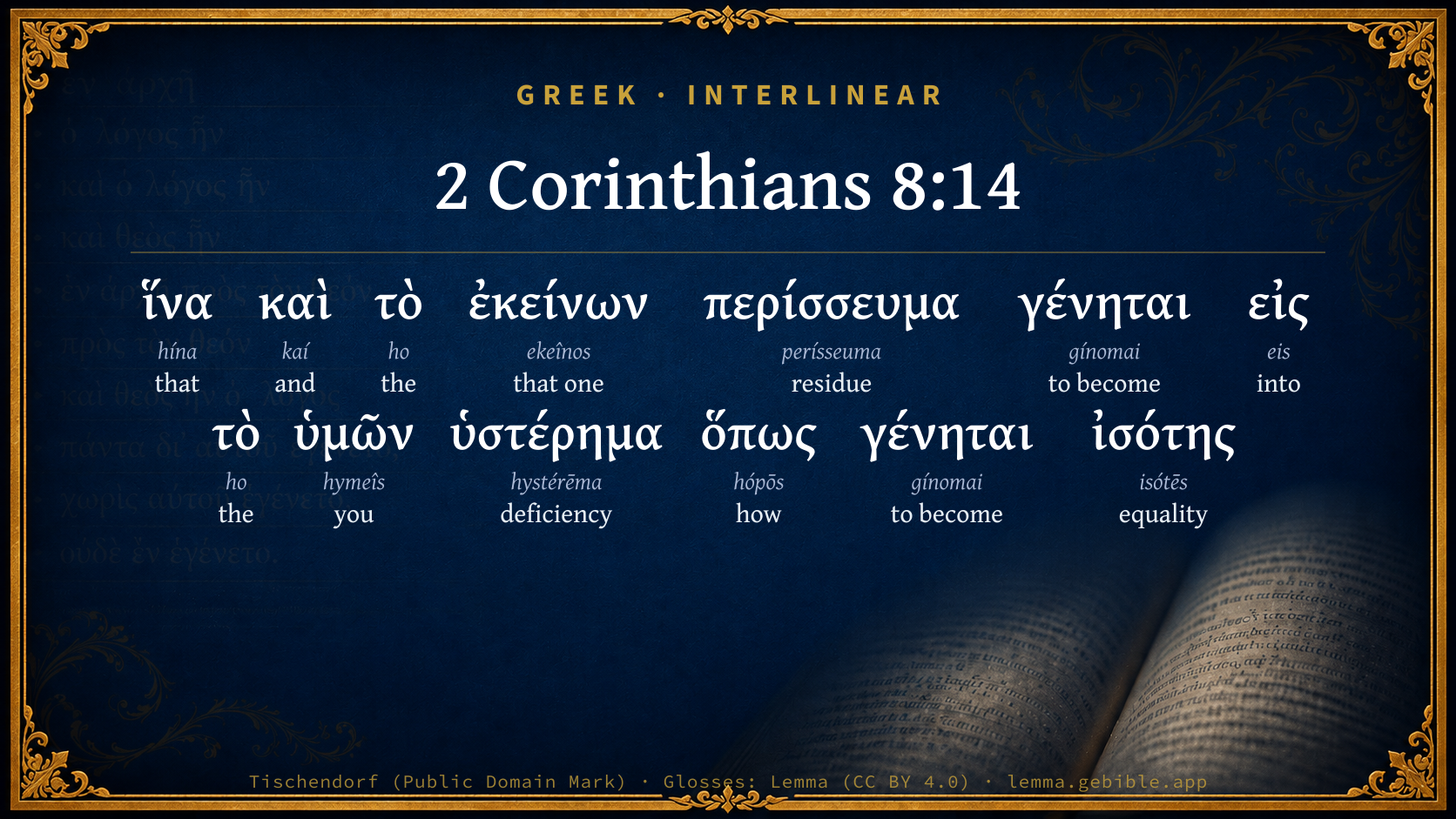
Greek (Tischendorf 8th ed.) 2 Corinthians 8:14 appears in the Greek New Testament. The text above is from the Tischendorf 8th edition. Each word links to its Strong’s number and a concise gloss. Click any word for its full Thayer’s Greek Lexicon entry.
Download image
Cite this verse

2 Corinthians 8:14 (World English Bible). Public Domain. Lemma interlinear Bible study tool, https://lemma.gebible.app/v/2-corinthians/8/14.

Show BibTeX & RIS
BibTeX
RIS
English Translation
but for equality. Your abundance at this present time supplies their lack, that their abundance also may become a supply for your lack; that there may be equality.
World English Bible · Public Domain
Download a study sheet

One document with this verse’s original text, its word-by-word gloss line, the meaning frame, cross-references with their text, attributed commentary, and full source and license credits — printable, and it pastes into notes with its structure intact.

This verse Autodidact and up

Study sheet (.html) Plain text (.txt)

A passage Seminary Student

Up to 50 verses in one chapter. A passage sheet keeps up to 6 commentary sources and 12 cross-references per verse, in the order this page ranks them, and says so on the sheet whenever that leaves anything out. Ask for a single verse and you get the Autodidact verse sheet above.

Everything on this page stays free to read, with no account — the sheet is a download of what is already on screen, not access to it.

Want to remove ads? Support Godless Engineer
Compare translations 3

The same verse in 3 English versions, stacked beneath the original-language interlinear above. Click any original word for its lexicon entry.

Each is an independent rendering of the whole verse — the interlinear is not word-aligned to these translations.

Highlighted words mark where these versions differ — a whole-verse word diff, not a word-by-word alignment.

  • World English Bible Public Domain
    but for equality. Your abundance at this present time supplies their lack, that their abundance also may become a supply for your lack; that there may be equality.
  • King James Version Public Domain
    But by an equality, that now at this time your abundance may be a supply for their want, that their abundance also may be a supply for your want: that there may be equality:
  • unfoldingWord Literal Text CC BY-SA 4.0
    At the present time, your abundance for the lack of those ones, so that also the abundance of those ones may be for your need, so that there may be equality,

unfoldingWord Literal Text — © unfoldingWord, licensed CC BY-SA 4.0. Word-aligned USFM3 via Door43 (git.door43.org/unfoldingWord/en_ult).

Versions to compare (up to 4)

3 of 4 selected

Show all 19 translations

Every available English version of this verse, each an independent rendering of the whole verse.

  • World English Bible Public Domain
    but for equality. Your abundance at this present time supplies their lack, that their abundance also may become a supply for your lack; that there may be equality.
  • Berean Standard Bible Public Domain
    At the present time, your surplus will meet their need, so that in turn their surplus will meet your need. Then there will be equality.
  • Majority Standard Bible Public Domain
    At the present time, your surplus will meet their need, so that in turn their surplus will meet your need. This way there will be equality.
  • King James Version Public Domain
    But by an equality, that now at this time your abundance may be a supply for their want, that their abundance also may be a supply for your want: that there may be equality:
  • American Standard Version (1901) Public Domain
    but by equality: your abundance `being a supply' at this present time for their want, that their abundance also may become `a supply' for your want; that there may be equality:
  • Revised Version (1885) Public Domain
    but by equality; your abundance being a supply at this present time for their want, that their abundance also may become a supply for your want; that there may be equality:
  • Geneva Bible (1599) Public Domain
    That also their aboundance may bee for your lacke, that there may be equalitie:
  • Douay-Rheims (1899) Public Domain
    In this present time let your abundance supply their want, that their abundance also may supply your want, that there may be an equality,
  • Young's Literal Translation Public Domain
    but by equality, at the present time your abundance -- for their want, that also their abundance may be for your want, that there may be equality,
  • Literal Standard Version CC BY-SA 4.0
    but by equality, at the present time your abundance—for their want, that also their abundance may be for your want, that there may be equality,
  • Unlocked Literal Bible CC BY-SA 4.0
    Your abundance at the present time will supply what they need. This is also so that their abundance may supply your need, and so that there may be fairness.
  • unfoldingWord Literal Text CC BY-SA 4.0
    At the present time, your abundance for the lack of those ones, so that also the abundance of those ones may be for your need, so that there may be equality,
  • Darby Bible Public Domain
    but [on the principle] of equality; in the present time your abundance for their lack, that their abundance may be for your lack, so that there should be equality.
  • World Messianic Bible Public Domain
    but for equality. Your abundance at this present time supplies their lack, that their abundance also may become a supply for your lack, that there may be equality.
  • Webster's Bible Public Domain
    But by an equality, that now at this time your abundance may be a supply for their want, that their abundance also may be a supply for your want: that there may be equality:
  • Free Bible Version CC BY-SA 4.0
    At the moment you have more than enough and can meet their needs, and in turn when they have more than enough they can meet your needs. In that way everyone is treated fairly.
  • Bible in Basic English Public Domain
    But so that things may be equal; that from those things of which you have more than enough at the present time their need may be helped, and that if you are in any need they may be a help to you in the same way, making things equal.
  • Text-Critical English NT CC BY 4.0
    so that in turn their abundance may provide for your need, and thus there may be equality.
  • Tyndale New Testament (1534) Public Domain
    but that ther be egalnes now at this tyme that youre aboundaunce sucker their lacke: that their aboundaunce maye supplie youre lacke: that ther maye be equalite

Literal Standard Version (2020), Covenant Press — licensed CC BY-SA 4.0. Text via the HelloAO Bible API (eBible.org). Unlocked Literal Bible (unfoldingWord) — licensed CC BY-SA 4.0. Text via the HelloAO Bible API (eBible.org). unfoldingWord Literal Text — © unfoldingWord, licensed CC BY-SA 4.0. Word-aligned USFM3 via Door43 (git.door43.org/unfoldingWord/en_ult). Free Bible Version, Dr. Jonathan Gallagher — licensed CC BY-SA 4.0. Text via the HelloAO Bible API (eBible.org).

Word by word

More ways to search: Search by grammar → Find every occurrence → Compare this word →

Practice this passage: Drill this verse → Learn its vocabulary →

About this verse

These counts appear in no published source. They are computed here, from the morphology-tagged text and Lemma’s own curated glosses. What Lemma adds →

13
words
11
distinct lemmas
Pauline Epistles
section

Notable vocabulary

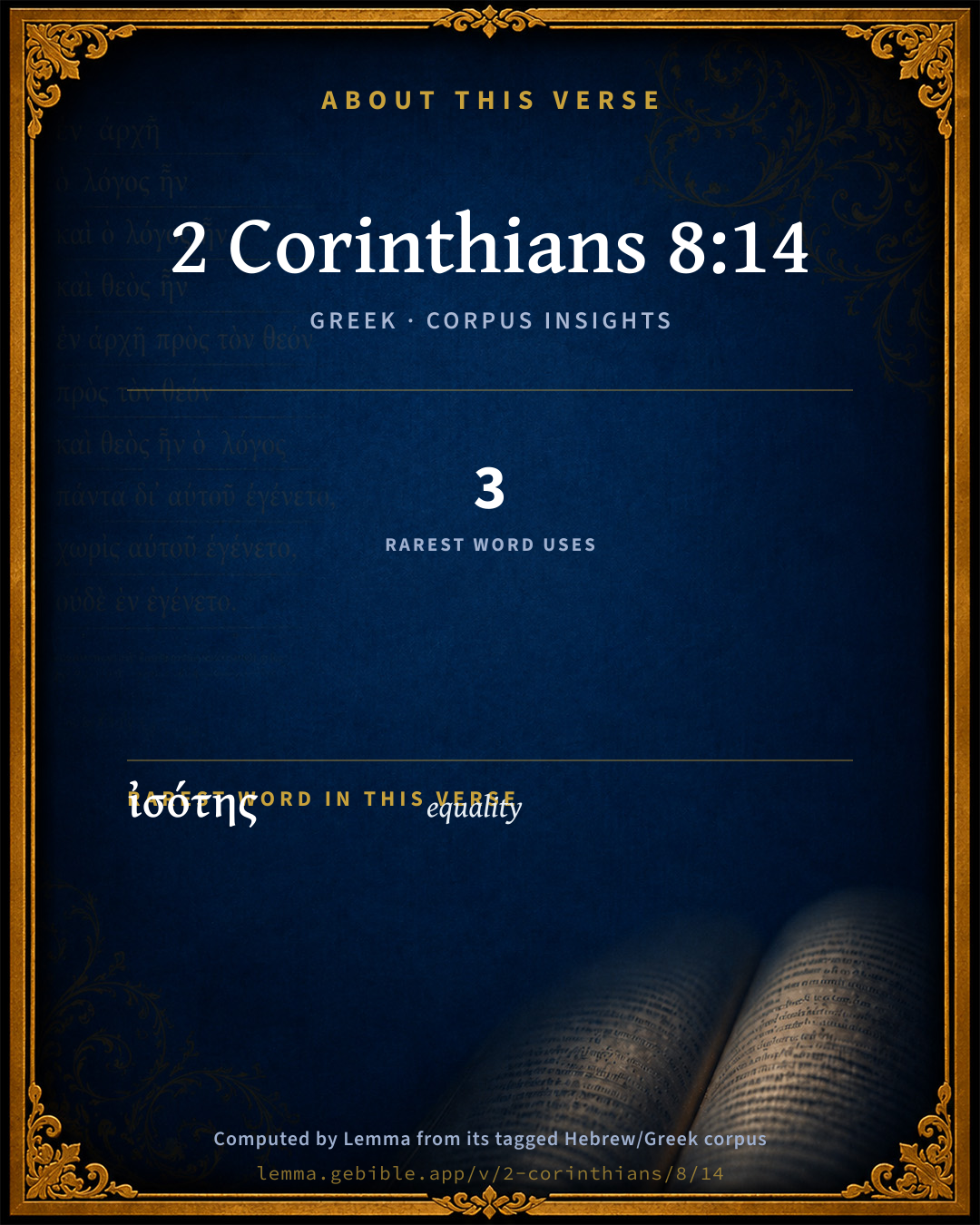
The rarest word here is ἰσότης equality G2471 — appearing just 3 times in the whole Greek New Testament.

Shared distinctive vocabulary

ἰσότης equality G2471 occurs in 3 verses of the Greek New Testament. Also found in:

Repetition

Words recur within this verse:

  • γένηται to become G1096 ×2
  • τὸ the G3588 ×2

Cross-references

2

Topical passages linked to 2 Corinthians 8:14 in the Treasury of Scripture Knowledge — connected by theme and wording, ordered by reader-vote popularity; previews shown in the World English Bible.

  • 2 Corinthians 9:12 For this service of giving that you perform not only makes up for lack among the saints, but abounds also through many givings of thanks to God;
  • Acts 4:34 For neither was there among them any who lacked, for as many as were owners of lands or houses sold them, and brought the proceeds of the things that were sold,

Cross-references courtesy of OpenBible.info (CC BY 4.0).

Commentary

Notes on 2 Corinthians 8:14 from classic Christian and Jewish commentators (each source and its license shown beneath its notes). The classic Christian expositions comment on the surrounding passage and are grouped to its opening verse, so a note may address several verses; the Jewish commentaries on the Tanakh (Rashi and others) are per-verse, so they appear only where the commentator wrote on this verse.

Lemma curates 59 commentaries, every one of them public domain or Creative Commons licensed, each selected and text-cleaned for this edition rather than reprinted as found. About our sources →

Bengel's Gnomon

Johann Albrecht Bengel

2Co 8:14. Καὶ τὸ—περίσσευμα, that also their abundance) in spiritual things.[47]—γένηται εἰς) We have the same expression at Gal 3:14.—τὸ ὑμῶν ὑστέρημα, your [spiritual] want) inasmuch as ye were Gentiles. Their [spiritual] abundance had already begun to supply the want of the Corinthians; he is therefore speaking of continuation, increase, and reward [in spiritual things]. Nor yet would I venture to deny, that the corporeal abundance also of the Jews would sometimes supply the corporeal want of the Gentiles; for the limitation is omitted, 2Co 8:13, note. Although [the view that the reference is to] the spiritual abundance of Israel is supported by the parallel passage, Rom 15:27.—ἰσότης, equality) in spiritual things.

[47] As Jews. Eng. Ver. evidently takes it of temporal abundance, i.e., that if hereafter ye be in want, their abundance may supply you, as you now supply them. But Beng. takes both “your abundance” (temporal) and theirs (spiritual) of the present time.—ED.

Bengel's Gnomon of the New Testament — English translation (T&T Clark, Edinburgh, 1860) — public domain. Text from a community e-Sword module.

Meyer's Critical & Exegetical Commentary

Heinrich August Wilhelm Meyer

2Co_8:14 f. In order that (divine purpose), if the circumstances change, the converse case may also set in, and the superfluity of those be imparted to your lack. On account of 2Co_8:13 we must, in accordance with the context, think also here of something earthly, not (as Jerome, Chrysostom, Theodoret, Theophylact, Anselm, the Catholics,[278] Bengel, Michaelis, Schrader wish) of spiritual blessingswhich would be unhistorical, and quite opposed to the standpoint of the apostle to the Gentiles. According to Paul, the participation of the Gentiles in the spiritual blessings of the Jewish Christians had already taken place through the conversion of the former, Rom_15:27.

ὅπως γένηται ἰσότης] in order that (according to the divine purpose) equality might set in, since, namely, then they will not have too much and you too little, if their superfluity shall come to the help of your lack. According to Hofmann, ἰσότης amounts here to the idea of the inversion of the relation, which, however, does not agree with 2Co_8:15, and has against it the clear reference of the meaning of ἐξ ἰσότ. in 2Co_8:13. The idea of brotherly equalization, which Paul had expressed by ἐξ ἰσότ. as regulative for the present case in 2Co_8:13, he repeats also for the eventual future case in 2Co_8:14 : it is to him of so much importance. And so important was it to the primitive church generally, that it even produced at first in Jerusalem the community of good.

ΚΑΘῺς ΓΈΓΡΑΠΤΑΙ] A confirmation from Scripture of this idea, which is to realize itself in the two cases, 2Co_8:13 and 2Co_8:14. It is already typically presented in the gathering of the manna, Exo_16:18 (freely quoted after the LXX.). The quotation refers therefore not simply to 2Co_8:14, but to 2Co_8:13-14, since in both there prevails the same fundamental though.

Ὁ ΤῸ ΠΟΛΎ] he who much, namely, had gathered, as in Ex. l.c., we must supply from the context (2Co_8:17). Paul presupposes that his readers are aware of the reference and of the connection of the passag.

οὐκ ἐπλεόνασε] had not too much, not more than was appointed by God for his needs; τὸ γὰρ μέτρον ὁ μεγαλόδωρος τῷ δώρῳ συνέζευξε, Theodoret. See Exo_16:16 f. In the same way: ΟὐΚ ἨΛΑΤΤΌΝΗΣΕ, he had not too little. The word, frequent in the LXX., is foreign to Greek writers.

The articles denote the two definite and well-known cases which occurred in the gathering.

[278] These misused the passage against Protestants in this way: Locus hic apostoli contra nostrae aetatis haereticos ostendit, posse Christianos minus sanctos meritis sanctorum adjuvari etiam in futuro saeculo, Estius. See, on the contrary, Calovius. Bisping also thinks of prayers, merits of good works, and the like, which love may give for temporal gifts received.

Meyer — Critical and Exegetical Commentary on the New Testament — English translation by Peter Christie, edited by Frederick Crombie (T&T Clark, 1880) — public domain. Text from a community e-Sword module.

Jamieson, Fausset & Brown

Robert Jamieson, A. R. Fausset & David Brown

by an equality--"by the rule of equality" [ALFORD]: literally, "Out of equality."

now at this time--Greek, "at the present juncture" or season.

that their abundance also--The Greek being distinct from the previous "that," translate, "in order that," namely, at another season, when your relative circumstances may be reversed. The reference is solely to temporal wants and supplies. Those, as BENGEL, who quote Rom 15:27 for interpreting it of spiritual supplies from the Jews to the Gentiles, forget that Rom 15:27 refers to the past benefit spiritually, which the Jews have conferred on the Gentiles, as a motive to gratitude on the part of the latter, not to a prospective benefit to be looked for from the former, which the text refers to.

Jamieson, Fausset & Brown — Commentary Critical and Explanatory on the Whole Bible (1871) — public domain (CC PDM 1.0). Text via the HelloAO Bible API.

Adam Clarke's Commentary

Verse 14. But by an equality] That you may do to those who are distressed now, as, on a change of circumstances, you would wish them to do to you. And I only wish that of your abundance you would now minister to their wants; and it may be that there abundance may yet supply your wants; for so liable are all human affairs to change, that it is as possible that you rich Corinthians should need the charitable help of others as it is that those Jews, who once had need of nothing, should now be dependent on your bounty.

That there may be equality] That ye may exert yourselves so in behalf of those poor people that there may be between you an equality in the necessaries of life; your abundance supplying them with that of which they are utterly destitute.

Adam Clarke's Commentary on the Bible (1810–1826) — public domain. Text from a community e-Sword/MySword module.

John Calvin's Commentaries

14. And their abundance It is uncertain, what sort of abundance he means. Some interpret it as meaning, that this had been the case, inasmuch as the Gospel had flowed out to them from the Church at Jerusalem, from which source they had, in their penury, been assisted by their spiritual riches. This, I think, is foreign to Paul’s intention. It ought rather, in my opinion, to be applied to the communion of saints, which means, that whatever duty is discharged to one member, redounds to the advantage of the entire body. “If it is irksome to you to help your brethren with riches that are of no value, consider how many blessings you are destitute of, and these too, far more precious, with which you may be enriched by those who are poor as to worldly substance. This participation, which Christ has established among the members of his body, should animate you to be more forward, and more active in doing good.” The meaning may, also, be this. “You now relieve them according to the necessity of the occasion, but they will have an opportunity given them at another time of requiting you.” I approve rather of the other sentiment, which is of a more general nature, and with this accords what he again repeats in reference to equality. For the system of proportional right in the Church is this — that while they communicate to each other mutually according to the measure of gifts and of necessity, this mutual contribution produces a befitting symmetry, though some have more, and some less, and gifts are distributed unequally.

John Calvin's Commentaries (1540-1563) — public domain. Text from the Calvin Translation Society English edition (1840s-50s) via the Christian Classics Ethereal Library (ccel.org). Calvin's coverage is partial (roughly two-thirds of the Bible); uncommented books and verses are honest gaps, never fabricated. The 19th-century editor's footnotes and remarks are omitted so the notes are faithfully Calvin's own voice.

Ellicott's Commentary for English Readers

(14) But by an equality.—The meaning of the word is obvious. The Church of Jerusalem was at this time suffering from poverty, and, therefore, St. Paul exhorts the Corinthians to come to its assistance. A time might come in which their relative position would be inverted, and then he would plead not less earnestly that Jerusalem should assist Corinth. It is reading too much between the lines to see in the words the thought which the Apostle expresses elsewhere (Rom_15:27), that the equality of which he speaks consisted in the Corinthians giving money and receiving spiritual privileges. But for the fact that controversial ingenuity is “capable of anything,” it might have been thought impossible to see in them the doctrine that men are to give to the poor in order that, in their time of need, in the hour of death, and in the day of judgment, they might receive from them a transfer of their superfluous merits. And yet this has actually been done by Roman Catholic commentators—even by such as Estius.

A Bible Commentary for English Readers, edited by Charles John Ellicott (1878–1897) — public domain. Text from a community e-Sword module.

The Cambridge Bible for Schools and Colleges

gen. ed. J. J. S. Perowne

14. but by an equality] Cf. 1 Corinthians 12 and Act_2:41-47; Act_4:32-37. Dean Stanley remarks on the similarity between this passage and several in the 5th book of Aristotle’s Ethics, and no doubt St Paul here uses the word in Aristotle’s sense of fairness, reciprocal advantage. Many of the English translators connect these words with those that succeed, but by an equality at the present time.

your abundance] i.e. as we should now say, superabundance. See note on ch. 2Co_7:4, where the word in the Greek is derived from the same root. The English word abundance is derived from the Latin unda, a wave, and signifies originally an overflowing quantity.

that their abundance also may be a supply for your want] Literally, might be. There are two interpretations of this passage. The first, which is supported by the ancient interpreters, refers it to the spiritual return made by the Jews in the fact that it was men of their nation who preached the Gospel to the heathen. Cf. ch. 2Co_9:14. The second, which has found favour with the moderns, is that the allusion is to earthly gifts. The chief difficulty which besets the latter interpretation is the impossibility of conceiving of what those earthly gifts could consist, unless, with De Wette, we regard it as referring to a communication of earthly goods “at another time, and under other possible circumstances.” But Estius refers to Luk_14:12-14, as decisive against any reference to temporal recompense.

The Cambridge Bible for Schools and Colleges (gen. ed. J. J. S. Perowne; Cambridge University Press, 1878–1918) — public domain. Text from a community e-Sword module.

John Gill's Exposition

As it is written,.... In Exo 16:18

he that gathered much had nothing over, and he that gathered little had no lack; respect is had to the history of the manna, a sort of food God prepared for the Israelites in the wilderness; and which were gathered by them every morning, by some more, by others less; and yet when it came to be measured, every man had his "omer" and no more, one had nothing over, and the other not at all deficient; each man had his proper and equal quantity; and which, by the Jews (w), is looked upon as a miracle that was wrought: many useful instructions may be learned from this history, as that as there was a general provision made by God for the Israelites, good and bad, and the mixed multitude that came from Egypt with them; so there is an universal providence of God which reaches to all creatures, even to the vegetable, to the birds of the air, and beasts of the field, to all the individuals of human nature, and to the bad among them as well as the good; though to the latter it is more special, who of all men have the least reason to be distrustful and uneasy: and as that provision was daily, so is that providential supply which all creatures have from God; he is to be trusted to, and depended on daily; application is to be made to him every day for daily bread; nor should there be any anxious concern for the morrow. Moreover, as the Israelites, though the manna was prepared for them, were to rise in the morning and gather it before the sun waxed hot; so notwithstanding the providence of God, and the daily care he takes of men, yet diligence, industry, and the use of means are highly commendable. And as some gathered more and others less, yet upon measuring it with the "omer", there was an entire equality, one had not more nor less than another; so upon the winding up of things in Providence, such as have gathered much riches in the morning of life, in the evening of death will have nothing over, nor anything to show more than others; and they that have gathered little will appear to have had no lack; both will have had food and raiment, and no more, only with this difference, some will have enjoyed a richer diet and clothing, and others a meaner, and both suitable to their circumstances in life; which may instruct us to depend upon divine Providence, daily to be content with such things as we have, and to make a proper use of what is gathered, whether more or less, and not only for ourselves, but for the good of others. This discovers the egregious folly of such, who are anxiously concerned for the gathering and amassing much worldly riches together; which when they have done, they lay it up for themselves, and do not make use of it for common good, neither for the good of civil society, nor the interest of religion. Let it be observed, that those Israelites who from a selfish covetous disposition, and distrust of divine Providence, left of their manna till the morning, "it bred worms and stank": which was by the just judgment of God inflicted as a punishment; for otherwise it was capable of being kept longer. So when covetous mortals lay up for themselves for time to come, and do not communicate to the necessities of others, such a practice breeds and produces worms, moth, and rottenness in their estates, which gradually decrease, or are suddenly taken from them, or they from them: such an evil disposition is the root and cause of many immoralities in life; it greatly prejudices professors of religion in things spiritual; and it tends to their everlasting ruin, to breed that worm of an evil conscience that will never die, and to render their persons stinking and abominable, both in the sight of God and men.

(w) Jarchi & Aben Ezra in Exod. xvi. 18. Tzeror Hammor, fol. 76. 3.

John Gill's Exposition of the Whole Bible (1746–1763) — public domain (CC PDM 1.0). Text via the HelloAO Bible API.

Trapp's Complete Commentary

John Trapp

14 But by an equality, that now at this time your abundance may be a supply for their want, that their abundance also may be a supply for your want: that there may be equality:

Ver. 14. Your abundance] That your cup may overflow into their lesser dishes, that your superfluities both in respect of the necessity of nature and exigency of estate (as the schoolmen speak) may supply the wants of God’s poor afflicted.

A supply for your want] Those that lend mercy may have need to borrow. The Shunammite that refused once to be spoken for to the king by the prophet, little thought she should afterwards have craved that courtesy of his man Gehazi. Those that stand fastest upon earth have but slippery footing. No man can say that he shall not need friends. Pythias was so wealthy a man, that he was able to entertain Xerxes’ whole army, consisting of a million of men; yet afterwards he became so poor that he lacked bread.

John Trapp, A Commentary or Exposition upon All the Books of the Old and New Testament (1647–1656) — public domain. Text from a community e-Sword module.

Albert Barnes' Notes on the Bible

But by an equality - On just and equal principles. “That now at this time,” etc. That at the present time your abundance may be a supply for their needs, so that at some future time, if there should be occasion for it, their abundance may be a supply for your needs. The idea is this. Corinth was then able to give liberally, but many of the other churches were not. They were poor, and perhaps persecuted and in affliction. But there might be great reverses in their condition. Corinth might be reduced from its affluence, and might itself from its affluence, and might itself become dependent on the aid of others, or might be unable to contribute any considerable amount for the purposes of charity. The members of the church in Corinth, therefore, should so act in their circumstances of prosperity, that others would be disposed to aid them should their condition ever be such as to demand it. And the doctrine here taught is:

(1) That the support of the objects of benevolence should be on equal principles. The rich should bear an equal and fair proportion, and if more frequent demands are made on their benefaction than on others they should not complain.

(2) Christians should contribute liberally while they have the means. In the vicissitudes of life no one can tell how soon he may be unable to contribute, or may even be dependent on the charity of others himself. A change in the commercial world; losses by fire or at sea; lack of success in business; loss of health, and the failure of his plans, may soon render him unable to aid the cause of benevolence. While he is prospered he should embrace every opportunity to do good to all. Some of the most painful regrets which people ever have, arise from the reflection that when prospered they were indisposed to give to benefit others, and when their property is swept away they become unable. God often sweeps away the property which they were indisposed to contribute to aid others, and leaves them to penury and want. Too late they regret that they were not the liberal patrons of the objects of benevolence when they were able to be.

That there may be equality - That all may be just and equal. That no unjust burden should be borne by anyone portion of the great family of the redeemed. Every Christian brother should bear his due proportion.

Albert Barnes' Notes on the Bible (1834–1885) — public domain. Text from a community e-Sword/MySword module.

Haydock's Catholic Bible Commentary

This present time, let your abundance, &c. The sense, according to some interpreters is, that the time may perhaps come, when they in Judea may supply the wants of those in Achaia in the same kind. Others rather understand it of a communication of spiritual for temporal goods, that your alms, by the assistance of those who will pray for you, and your charities, may obtain for your the spiritual riches of grace, which every one stands chiefly in need of. (Witham)

George Leo Haydock (1774–1849), Haydock's Catholic Family Bible and Commentary, 1859 edition — public domain. Excludes Psalms (Douay-Rheims chapter numbering differs from Protestant) and Deuterocanonical books (Catholic canon only).

Matthew Poole's English Annotations

But by an equality; but only to bring you and them to some equality, that they might not starve while you have plenty, and what you may well enough spare.

That now at this time your abundance may be a supply for their want; I do not urge you to make your necessaries a supply for others’ wants; I would only have a supply for their wants out of your abundance.

That their abundance also may be a supply for your want: some by their abundance understand their aboundings in the good things of this life: they are now in distress by reason of the great famine that is in Judea, or by reason of the great storm of persecution that is there raised against Christians; yet God may turn the scales, he may send a famine in those parts where you live, and there may be plenty in Judea; then their abundance may supply your wants. Others interpret their abundance of the aboundings of their grace, which may quicken them up to pray for you, for the supply of such grace to you as you stand in need of.

That so there may be an equality, they being instruments of spiritual blessings to you, as you are instruments of temporal blessings and good things to them.

Matthew Poole's English Annotations on the Holy Bible (1683–1685) — public domain. Text from a community e-Sword/MySword module.

Whedon's Commentary on the Bible

Daniel D. Whedon

14. An equality—A mutual equalization of subsistence. The surplus of the prosperous was ever to overflow to supply the needs of the unfortunate. Thus should the great Christian republic become a mutual aid association. This was, in fact, an essential extension, over the whole Church, of the primitive, falsely so called, community of goods, first existing at Jerusalem. See notes on Act_2:4. Lucian, the pagan satirist, keenly describes the Christian readiness of mutual aid.

Daniel D. Whedon (gen. ed.), Commentary on the Old and New Testaments (1874–1909) — public domain. Text from a community e-Sword module.

The Pulpit Commentary

But by an equality, etc. The verse, like so many in this chapter, is expressed very elliptically: "But by a reciprocal fairness in the present case, your superabundance to their lack, that also their superabundance may be in proportion to your lack, that there may come to be reciprocal fairness." St. Paul may possibly be thinking of the reciprocity of spiritual and temporal benefits, as in Rom_15:27; but if so he leaves the thought unexpressed. The application of the text to "works of supererogation" (Art. XIV), as forming a fund at the disposal of the hierarchy in the way of indulgences, pardons, etc., is a singular perversion. The passage has been pointed out by Dean Stanley as one which indicates a possible acquaintance with the writings of Aristotle.

The Pulpit Commentary (1880–1919), ed. H.D.M. Spence-Jones & Joseph S. Exell — public domain. Text from a community e-Sword module.

John Wesley's Explanatory Notes

That their abundance - If need should so require. May be - At another time. A supply to your want: that there may be an equality - No want on one side, no superfluity on the other. It may likewise have a further meaning:-that as the temporal bounty of the Corinthians did now supply the temporal wants of their poor brethren in Judea, so the prayers of these might be a means of bringing down many spiritual blessings on their benefactors: so that all the spiritual wants of the one might be amply supplied; all the temporal of the other.

John Wesley, Explanatory Notes Upon the Whole Bible (1754–1765) — public domain. Text via the GEBible commentary corpus.

McGarvey & Pendleton's Commentaries

J. W. McGarvey

but by equality: your abundance being a supply at this present time for their want, that their abundance also may become a supply for your want; that there may be equality [The apostle did not take money from the Corinthians for the purpose of impoverishing them and enriching the church at Jerusalem: his idea was that the abundance enjoyed by the Corinthians might be withdrawn from their side of the scales and placed in the Jerusalem side, so that the scales might balance--not a literal balancing, but such a one as would insure that those at Jerusalem would not suffer because of their poverty. And he did this with the expectation and understanding that whenever conditions were reversed, those at Jerusalem would donate their superfluity to the support of Corinth. That such equality is approved of God, was shown by the manner in which he meted out his manna, as appears by the citation in the next verse]:

J. W. McGarvey (with Philip Y. Pendleton), Commentaries on the New Testament (The Fourfold Gospel, 1914; Acts; and the epistles) — public domain. Text from a community e-Sword/MySword module.

The People's New Testament

B. W. Johnson

14. But by an equality. There is a lack at Jerusalem; let your abundance supply it. So, too, if you be in want, they must supply it if they have abundance. The church is a band of loving brethren. Where one lacks others should supply, that all may be equally provided.

B. W. Johnson's The People's New Testament with Notes (1889–1891) — public domain. Electronic text from the Christian Classics Ethereal Library (CCEL) ThML edition.

Alford’s Greek Testament

Henry Alford

14.] but that by the rule of equality (ἐξ as in ἐκ τοῦ ἔχειν, above), at this present time (of their need: the stress is on ἐν τῷ νῦν καιρῷ as suggesting that this relation may hereafter be altered) your abundance may subserve (γένηται, see next clause. γίνεσθαι εἰς, ‘to be extended to,’ see ref. Gal.) their deficiency; that also (supposing circumstances changed) their abundance may subserve your want. The reference is still, as is evident from the next verse, to the supply of temporal wants, in respect of which there should be a mutual relieving and sharing among Christians. But the passage has been curiously misunderstood to mean, ‘that their (the Jewish Christians’) abundance in spiritual things may be imparted to you to supply your deficiency.’ Thus Chrys., al.,—the ancients regarding this imparting as the Gospel-benefit received from them by the Gentiles (which however was past, not future, and is urged as a motive for gratitude, see Rom 15:27), and the modern Romanists introducing the monstrous perversion of the attribution of the merits of the saints to others in the next world. So Estius: “Locus hic apostoli contra nostræ ætatis hæreticos ostendit, posse Christianos minus sanctos meritis sanctorum adjuvari etiam in futuro sæculo. Denique notanda virtus eleemosynæ, quæ facit hominem participem meritorum ejus in quem confertur.”

Henry Alford, The Greek Testament (1849–1861) — public domain. Text from a community e-Sword module.

Vincent's Word Studies in the New Testament

Marvin R. Vincent

By an equality [εξ ισοτητος] . Ex as in ver. 11, according to. I speak on the principle that your abundance should go to equalize the difference created by their want.

Marvin R. Vincent, Word Studies in the New Testament (1887–1900) — public domain. Text from a community e-Sword/MySword module.

Lesson kit

Teaching starters — assembled from the data on this page, not authored interpretation. Every prompt links to the verse data it draws on. Edit before teaching.

2 Corinthians, in the Pauline Epistles, opens this verse with 13 words (11 distinct Greek lemmas). Its most distinctive word is isótēs (“equality”). A historical commentator’s framing appears above. Read the whole chapter for the surrounding context.

Discussion questions

  1. How does “equality” (isótēs) shape what this verse is saying?
  2. How does 2 Corinthians 8:13, which shares the word «equality», read alongside this verse?
  3. What does the repetition of “to become” (2× in this one verse) do in this verse?
  4. These translations render this verse differently; the difference is in the English rendering, not the original. What questions does that raise?
  5. Compare how Bengel's Gnomon and Meyer's Critical & Exegetical Commentary read this verse. Where do they agree or differ?

Things to notice

  • These translations choose different wording for 9 words in this verse.
  • “to become” occurs 2× in this single verse.
  • 11 distinct Greek lemmas span 13 words in this verse.

Reading settings

Reading text

Shown beneath each verse's original-language words.

Old Testament
Old Testament edition

Read the OT as the Masoretic Hebrew (MT) or the Greek Septuagint (LXX).

English shown for the Greek Septuagint (in the Hebrew ↔ Greek comparison).

Comparing translations? Open the Compare panel on any verse page to stack up to four side by side.