

Psalms 7:4

Hebrew (Westminster Leningrad Codex) Psalms 7:4 appears in the Hebrew Old Testament. The text above is from the Westminster Leningrad Codex. Each word links to its Strong’s number, a concise gloss, and parsing drawn from the Open Scriptures Hebrew Bible morphology. Click any word for its full Brown-Driver-Briggs (BDB) entry.
Download image
Cite this verse

Psalms 7:4 (World English Bible). Public Domain. Lemma interlinear Bible study tool, https://lemma.gebible.app/v/psalms/7/4.

Show BibTeX & RIS
BibTeX
RIS
English Translation
If I have rewarded evil to him who was at peace with me (Yes, I have delivered him who without cause was my adversary),
World English Bible · Public Domain
Download a study sheet

One document with this verse’s original text, its word-by-word gloss line, the meaning frame, cross-references with their text, attributed commentary, and full source and license credits — printable, and it pastes into notes with its structure intact.

This verse Autodidact and up

Study sheet (.html) Plain text (.txt)

A passage Seminary Student

Up to 50 verses in one chapter. A passage sheet keeps up to 6 commentary sources and 12 cross-references per verse, in the order this page ranks them, and says so on the sheet whenever that leaves anything out. Ask for a single verse and you get the Autodidact verse sheet above.

Everything on this page stays free to read, with no account — the sheet is a download of what is already on screen, not access to it.

Want to remove ads? Support Godless Engineer
Compare translations 3

The same verse in 3 English versions, stacked beneath the original-language interlinear above. Click any original word for its lexicon entry.

Each is an independent rendering of the whole verse — the interlinear is not word-aligned to these translations.

Highlighted words mark where these versions differ — a whole-verse word diff, not a word-by-word alignment.

  • World English Bible Public Domain
    If I have rewarded evil to him who was at peace with me (Yes, I have delivered him who without cause was my adversary),
  • King James Version Public Domain
    If I have rewarded evil unto him that was at peace with me; (yea, I have delivered him that without cause is mine enemy:)
  • unfoldingWord Literal Text CC BY-SA 4.0
    if I have repaid evil one peace with me, or senselessly rescued my adversary,

unfoldingWord Literal Text — © unfoldingWord, licensed CC BY-SA 4.0. Word-aligned USFM3 via Door43 (git.door43.org/unfoldingWord/en_ult).

Versions to compare (up to 4)

3 of 4 selected

Show all 18 translations

Every available English version of this verse, each an independent rendering of the whole verse.

  • World English Bible Public Domain
    If I have rewarded evil to him who was at peace with me (Yes, I have delivered him who without cause was my adversary),
  • Berean Standard Bible Public Domain
    if I have rewarded my ally with evil, if I have plundered my foe without cause,
  • Majority Standard Bible Public Domain
    if I have rewarded my ally with evil, if I have plundered my foe without cause,
  • King James Version Public Domain
    If I have rewarded evil unto him that was at peace with me; (yea, I have delivered him that without cause is mine enemy:)
  • American Standard Version (1901) Public Domain
    If I have rewarded evil unto him that was at peace with me; (Yea, I have delivered him that without cause was mine adversary;)
  • Revised Version (1885) Public Domain
    If I have rewarded evil unto him that was at peace with me; (yea, I have delivered him that without cause was mine adversary:)
  • Geneva Bible (1599) Public Domain
    If I haue rewarded euill vnto him that had peace with mee, (yea I haue deliuered him that vexed me without cause)
  • Douay-Rheims (1899) Public Domain
    O Lord my God, if I have done this thing, if there be iniquity in my hands:
  • Young's Literal Translation Public Domain
    If I have done my well-wisher evil, And draw mine adversary without cause,
  • Literal Standard Version CC BY-SA 4.0
    If I have done my well-wisher evil, || And draw my adversary without cause,
  • Unlocked Literal Bible CC BY-SA 4.0
    if I have done evil to him who was at peace with me, or senselessly harmed my enemy without cause, then hear my words.
  • unfoldingWord Literal Text CC BY-SA 4.0
    if I have repaid evil one peace with me, or senselessly rescued my adversary,
  • Darby Bible Public Domain
    If I have rewarded evil to him that was at peace with me; (indeed I have freed him that without cause oppressed me;)
  • World Messianic Bible Public Domain
    if I have rewarded evil to him who was at peace with me (yes, I have plundered him who without cause was my adversary),
  • Webster's Bible Public Domain
    \\7:3\\O LORD my God, if I have done this; if there is iniquity in my hands;
  • Free Bible Version CC BY-SA 4.0
    If I have paid back a friend with evil, if I have robbed my enemy for no reason,
  • Bible in Basic English Public Domain
    If I have given back evil to him who did evil to me, or have taken anything from him who was against me without cause;
  • JPS Tanakh (1917) Public Domain
    (7-5) If I have requited him that did evil unto me, or spoiled mine adversary unto emptiness;

Literal Standard Version (2020), Covenant Press — licensed CC BY-SA 4.0. Text via the HelloAO Bible API (eBible.org). Unlocked Literal Bible (unfoldingWord) — licensed CC BY-SA 4.0. Text via the HelloAO Bible API (eBible.org). unfoldingWord Literal Text — © unfoldingWord, licensed CC BY-SA 4.0. Word-aligned USFM3 via Door43 (git.door43.org/unfoldingWord/en_ult). Free Bible Version, Dr. Jonathan Gallagher — licensed CC BY-SA 4.0. Text via the HelloAO Bible API (eBible.org).

Word by word

More ways to search: Search by grammar → Find every occurrence → Compare this word →

Practice this passage: Drill this verse → Learn its vocabulary →

About this verse

These counts appear in no published source. They are computed here, from the morphology-tagged text and Lemma’s own curated glosses. What Lemma adds →

7
words
7
distinct lemmas
Wisdom
section

Notable vocabulary

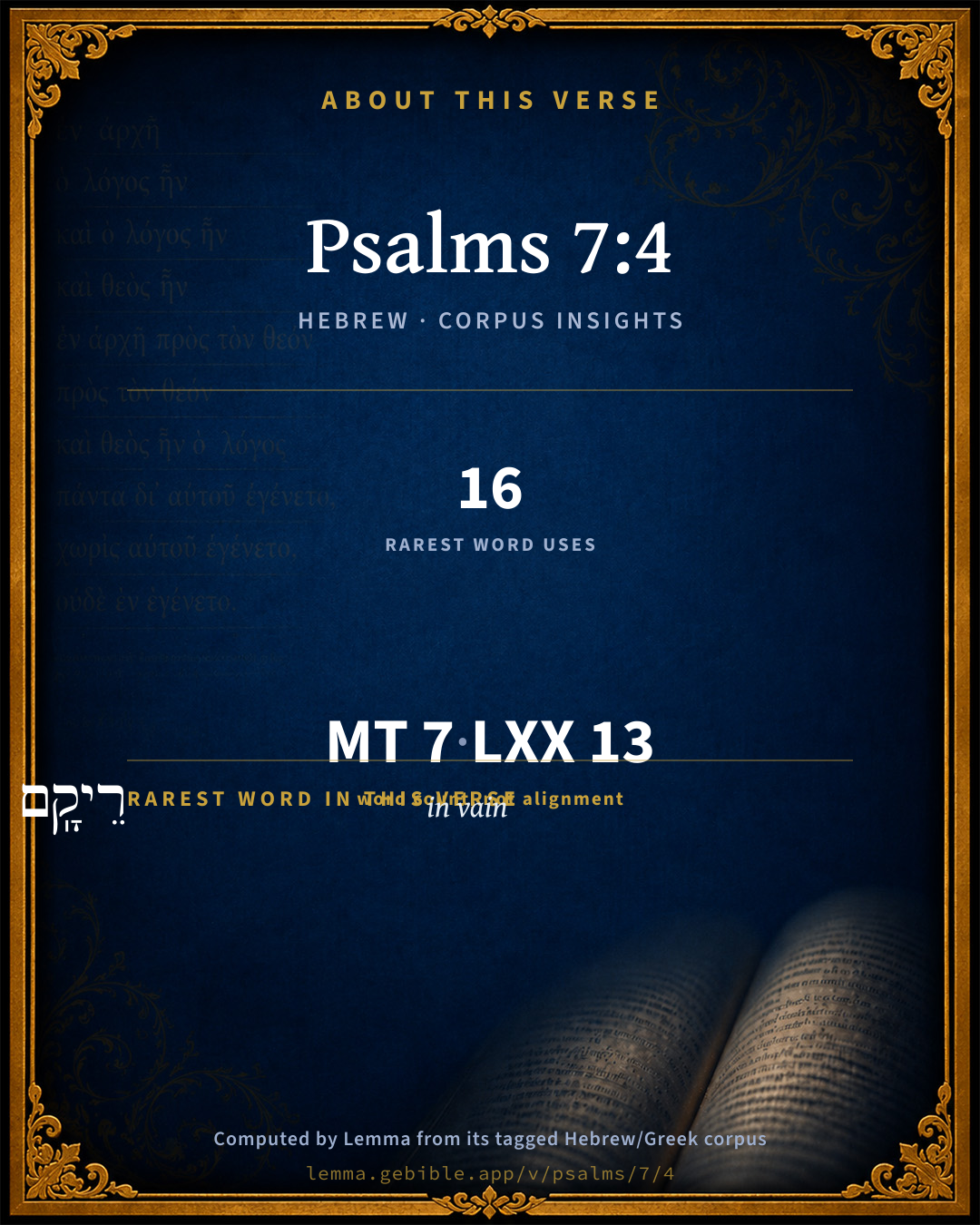
The rarest word here is רֵיקָֽם in vain H7387 — appearing just 16 times in the whole Hebrew Bible.

Shared distinctive vocabulary

רֵיקָֽם in vain H7387 occurs in 16 verses of the Hebrew Bible. Also found in:

Grammatical profile

  • 4 verbs
  • 1 adjective
  • 1 conjunction
  • 1 adverb

Verb forms

  • גָּ֭מַלְתִּי Qal · Perfect
  • שֽׁוֹלְמִ֥י Qal · Participle Active
  • וָאֲחַלְּצָ֖ה Piel · Sequential Imperfect
  • צוֹרְרִ֣י Qal · Participle Active

Hebrew & Septuagint length

In English translation the verse runs 24 words from the Hebrew and 22 from the Septuagint (LXX English) — closely comparable.

A rough comparison of the two English renderings, which tokenize alike — not a word-level alignment.

Word counts can differ between the Hebrew and the Greek without any difference in meaning — e.g. the Hebrew direct-object marker אֵת has no separate Greek word, and Greek often adds the article ὁ.

In the original languages it is 7 Hebrew tokens and 13 Greek tokens — but the two are counted differently (Hebrew bundles its prefixes and suffixes into one token; the Greek is in lemma form), so that isn’t a like-for-like length.

Cross-references

15

Topical passages linked to Psalms 7:4 in the Treasury of Scripture Knowledge — connected by theme and wording, ordered by reader-vote popularity; previews shown in the World English Bible.

  • 1 Samuel 24:17–19 He said to David, You are more righteous than I; for you have rendered to me good, whereas I have rendered to you evil.
  • Psalms 55:20 He raises his hands against his friends. He has violated his covenant.
  • Psalms 109:5 They have rewarded me evil for good, And hatred for my love.
  • Jeremiah 18:20–21 Shall evil be recompensed for good? for they have dug a pit for my soul. Remember how I stood before you to speak good for them, to turn away your wrath from them.
  • Genesis 44:4 When they had gone out of the city, and were not yet far off, Joseph said to his steward, "Up, follow after the men. When you overtake them, ask them, 'Why have you rewarded evil for good?
  • 1 Samuel 19:4–5 Jonathan spoke good of David to Saul his father, and said to him, Don't let the king sin against his servant, against David; because he has not sinned against you, and because his works have been very good toward you:
  • 1 Samuel 20:1 David fled from Naioth in Ramah, and came and said before Jonathan, "What have I done? What is my iniquity?" and "What is my sin before your father, that he seeks my life?"
  • 1 Samuel 22:14 Then Ahimelech answered the king, and said, Who among all your servants is so faithful as David, who is the king's son-in-law, and is taken into your council, and is honorable in your house?
  • 1 Samuel 24:7 So David checked his men with these words, and didn't allow them to rise against Saul. Saul rose up out of the cave, and went on his way.
  • 1 Samuel 24:10–15 Behold, this day your eyes have seen how that Yahweh had delivered you today into my hand in the cave: and some bade me kill you; but [my eye] spared you; and I said, I will not put forth my hand against my lord; for he is Yahweh's anointed.
  • 1 Samuel 25:28–29 Please forgive the trespass of your handmaid: for Yahweh will certainly make my lord a sure house, because my lord fights the battles of Yahweh; and evil shall not be found in you all your days.
  • 1 Samuel 26:9–17 David said to Abishai, Don't destroy him; for who can put forth his hand against Yahweh's anointed, and be guiltless?
  • 1 Samuel 26:24 Behold, as your life was much set by this day in my eyes, so let my life be much set by in the eyes of Yahweh, and let him deliver me out of all oppression.
  • Proverbs 17:3 The refining pot is for silver, and the furnace for gold, But Yahweh tests the hearts.
  • 1 Samuel 26:21 Then said Saul, I have sinned: return, my son David; for I will no more do you harm, because my life was precious in your eyes this day: behold, I have played the fool, and have erred exceedingly.

Cross-references courtesy of OpenBible.info (CC BY 4.0).

Hebrew and Greek witnesses Masoretic Hebrew ↔ Greek Septuagint

The same verse in the two great witnesses to the Old Testament, shown verse-for-verse.

You’re reading Greek Psalm 7 (Hebrew Psalm 7). The Septuagint counts the superscription, so verse numbers can differ from the Hebrew — chapter-level alignment, not verse-by-verse. Numbering follows Rahlfs.

These are two independent witnesses, not word-aligned to each other, and the Septuagint is shown in lemma (dictionary) form.

Hebrew Psalms 7:4 Masoretic · Westminster Leningrad Codex

אִם גָּ֭מַלְתִּי שֽׁוֹלְמִ֥י רָ֑ע וָאֲחַלְּצָ֖ה צוֹרְרִ֣י רֵיקָֽם

If I have rewarded evil to him who was at peace with me (Yes, I have delivered him who without cause was my adversary),

World English Bible · Public Domain

Greek LXX Greek Psalm 7:4 Septuagint · lemma form

κύριος ὁ θεός ἐγώ εἰ ποιέω οὗτος εἰ εἰμί ἀδικία ἐν χείρ ἐγώ

if I have requited with evil those who requited me with good; may I then perish empty by means of my enemies.

LXX2012 (modern English Septuagint) · Public Domain

On this verse, Ellicott's Commentary for English Readers discusses the Septuagint’s reading. Read the note in Commentary ↓

Hebrew: Westminster Leningrad Codex (CC BY 4.0). Greek: Septuagint (public domain); English from LXX2012 (modern English Septuagint) (Public Domain). How the Septuagint differs from the Hebrew →

Commentary

Notes on Psalms 7:4 from classic Christian and Jewish commentators (each source and its license shown beneath its notes). The classic Christian expositions comment on the surrounding passage and are grouped to its opening verse, so a note may address several verses; the Jewish commentaries on the Tanakh (Rashi and others) are per-verse, so they appear only where the commentator wrote on this verse.

Lemma curates 59 commentaries, every one of them public domain or Creative Commons licensed, each selected and text-cleaned for this edition rather than reprinted as found. About our sources →

Trapp's Complete Commentary

John Trapp

Psa 7:4 If I have rewarded evil unto him that was at peace with me; (yea, I have delivered him that without cause is mine enemy:)

Ver. 4. If I have rewarded evil, &c.] If I have broke the conditions of our reconciliation, or betrayed my trust.

Yea, I have delivered him that, &c.] This was true Christianity, to overcome evil with good, Mat 5:44, &c.; Rom 12:17, &c. O quam hoc non est omnium! O how few can skill of this! Elisha made the Syrians a feast who came to make him a grave. David spared Saul, and delivered him, not without the hazard of his own life. Bradford conducted Bourn from the pulpit at Paul’s Cross (where he had cried up Popery at the coming in of Queen Mary) safe to his lodging. A certain gentleman said unto him, Ah, Bradford, Bradford, thou savest him that will help to burn thee. I give thee his life; if it were not for thee I would run him through with my sword. And it proved as the gentleman had prophesied. There he sits, I mean my lord of Bath, Mr Bourn (said Bradford in his third examination before Stephen Gardiner), which desired me himself for the passion of Christ, I would speak to the people. Upon whose words I, coming into the pulpit, I had like to have been slain with a dagger which was hurled at him, I think, for it touched my sleeve, he then prayed me I would not leave him, and I promised that as long as I lived I would take hurt before him that day. And so went I out of the pulpit, and entreated with the people, and at length brought him myself into a house. Besides this, in the afternoon I preached in Bow Church, and there, going up into the pulpit, one willed me not to reprove the people; for, quoth he, you shall never come down alive if you do it. And yet in that sermon I did reprove their fact, and called it sedition at least twenty times. For all which my doing I have received this recompense, prison for a year and half and more, and death now, which you (my lord of Bath among the rest) go about. Let all men be judge where conscience is. Thus Master Bradford, like another David, in his own defence.

John Trapp, A Commentary or Exposition upon All the Books of the Old and New Testament (1647–1656) — public domain. Text from a community e-Sword module.

Joseph Benson's Commentary

Psa 7:4. If I have rewarded evil unto him that was at peace with me — He probably means to Saul, when he was peaceable and friendly toward him; for David was charged with evil designs against Saul, before Saul broke out into open enmity against him. Yea — I have been so far from doing this that I have done the contrary; I have delivered him — When it was in my power to destroy him; that without cause — Without any provocation on my part, is mine enemy — It is probable that David alludes here to his preserving the life of Saul when he was pressed by his attendants to suffer them to take it away, 1Sa 24:6; 1Sa 26:8, &c.

Joseph Benson's Commentary on the Old and New Testaments (1811–1818) — public domain. Text from a community e-Sword module.

J. A. Alexander on Psalms

Joseph Addison Alexander

5. (Psa 7:4). If I have repaid my friend, one at peace with me, evil, and spoiled, plundered, (one) distressing me, acting as my enemy, without a cause. There seems to be an allusion here to the two periods of David's connection with Saul, that of their friendly intercourse, and that of their open enmity. During neither of these had David been guilty of the sins charged upon him. He had not conspired against Saul while in his service (1Sa 22:7-8), and when persecuted by him he had spared his life (1Sa 24:10-11). Some suppose this last fact to be here referred to, and translate the second clause, yea, I have delivered him that without cause is mine enemy. The Hebrew verb is certainly used elsewhere in this sense (2Sa 22:20, Psa 6:5), but its primary meaning seems to be that of stripping or spoilng a conquered enemy. The first construction above given is moreover much more natural, and agrees better with the grammatical dependence of the second verb upon the first.

Joseph Addison Alexander, The Psalms Translated and Explained (1850) — public domain. Text from a community e-Sword module.

Geneva Bible (1599)

Geneva Bible translators

If I reverenced not Saul for affinities sake and preserved his life, 1 Sam. 26:8,9.

Geneva Bible (1599) marginal notes — public domain. Text via Bolls.life.

Jamieson, Fausset & Brown

Robert Jamieson, A. R. Fausset & David Brown

If I have injured my friend.

yea, I have delivered, &c.--This makes a good sense, but interrupts the course of thought, and hence it is proposed to render, "if I have spoiled my enemy"--in either case (compare Sa1 24:4-17; Sa1 31:8, Sa1 31:11).

Jamieson, Fausset & Brown — Commentary Critical and Explanatory on the Whole Bible (1871) — public domain (CC PDM 1.0). Text via the HelloAO Bible API.

Adam Clarke's Commentary

Verse 4. Yea, I have delivered him] When, in the course of thy providence, thou didst put his life in my hand in the cave, I contented myself with cutting off his skirt, merely to show him the danger he had been in, and the spirit of the man whom he accused of designs against his life; and yet even for this my heart smote me, because it appeared to be an indignity offered to him who was the Lord's anointed. This fact, and my venturing my life frequently for his good and the safety of the state, sufficiently show the falsity of such accusations, and the innocence of my life.

Adam Clarke's Commentary on the Bible (1810–1826) — public domain. Text from a community e-Sword/MySword module.

John Calvin's Commentaries

In the second clause of the fourth verse, he proceeds farther, and states, that he had been a friend, not only to the good, but also to the bad, and had not only restrained himself from all revenge, but had even succoured his enemies, by whom he had been deeply and cruelly injured. It would certainly not be very illustrious virtue to love the good and peaceable, unless there were joined to this self-government and gentleness in patiently bearing with the bad. But when a man not only keeps himself from revenging the injuries which he has received, but endeavours to overcome evil by doing good, he manifests one of the graces of a renewed and sanctified nature, and in this way proves himself to be one of the children of God; for such meekness proceeds only from the Spirit of adoption. With respect to the words: as the Hebrew word חלץ chalats, which I have translated to delivers signifies to divide and to separate, some, to prevent the necessity of supplying any word to make out the sense, In the clause, “And have NOT delivered him that persecuted me without cause,” the word not is a supplement, there being nothing for it in the Hebrew text.

John Calvin's Commentaries (1540-1563) — public domain. Text from the Calvin Translation Society English edition (1840s-50s) via the Christian Classics Ethereal Library (ccel.org). Calvin's coverage is partial (roughly two-thirds of the Bible); uncommented books and verses are honest gaps, never fabricated. The 19th-century editor's footnotes and remarks are omitted so the notes are faithfully Calvin's own voice.

Ellicott's Commentary for English Readers

(4) Yea, I have—i.e., on the contrary, so far from returning evil for good, I have returned good for evil. With allusion, there can be little doubt, to the incidents referred to in the last Note. From metrical reasons, and also to avoid the abruptness of the change of construction, Ewald conjectures that two clauses have dropped out of the text, and restores as follows—

“If I have rewarded evil unto him that dealt friendly with me

(And cunning unto him that was at peace with me,

Yea, if I have not rewarded his soul with good).

And delivered him that without cause is my enemy.”

Milton’s translation gives yet another colour to the passage—

“If I have wrought

Ill to him that meant me peace,

Or to him have rendered less,

And not freed my foe for nought.”

The conjecture of a corruption of the text is supported by the rendering of the LXX. and Vulg., and a very slight change gives the probable rendering: “If I have returned evil to him that dealt friendly with me, and injured my enemy without cause.”

A Bible Commentary for English Readers, edited by Charles John Ellicott (1878–1897) — public domain. Text from a community e-Sword module.

The Cambridge Bible for Schools and Colleges

gen. ed. J. J. S. Perowne

4. If I have rewarded evil &c.] If I have been guilty of unprovoked outrage, such, it is perhaps implied, as that of which Saul is guilty toward me (1Sa_24:17). This is probably right; but another possible rendering deserves mention: If I have requited him that rewarded me evil; i.e. taken revenge into my own hands. Cp. David’s solemn disclaimer of such conduct in 1Sa_24:12.

Yea, I have delivered him that without cause is mine enemy] R.V., him that without cause was mine adversary, as in Psa_7:6. See on Psa_6:7. The clause is a parenthesis, asserting that his conduct had been the very opposite of that which was attributed to him. Far from committing unprovoked outrages, he had saved the life of his enemy, and that though the enemy’s hostility to him was causeless. The words refer to the occasions in the cave and in the camp, when David prevented his followers from taking Saul’s life (1Sa_24:4 ff; 1Sa_26:8 ff.). The construction is bold, but it is thoroughly in keeping with the style of the Psalm, with its passionate protestations of innocence; and there is no need to adopt an unsupported meaning of the word for ‘deliver,’ and render, not as a parenthesis but in direct continuation of the preceding clause, and have spoiled him that without cause was mine adversary, with a supposed reference to 1Sa_24:4-5, or Psa_26:11 : or to alter the text by transposing two letters, so as to mean: and oppressed mine adversary without cause.

The Cambridge Bible for Schools and Colleges (gen. ed. J. J. S. Perowne; Cambridge University Press, 1878–1918) — public domain. Text from a community e-Sword module.

John Gill's Exposition

If I have rewarded evil unto him that was at peace with me,.... That is, when Saul was at peace with him; when he lived at his court, and ate at his table his meaning is, that he did not conspire against him, nor form schemes to deprive him of his crown nor of his life: or, as it may be rendered, "if I have rewarded to him that rewarded me evil" (u); that is, as Jarchi explains it, if I rewarded him as he rewarded me, evil for evil. This David did not; and it is eminently true of Christ his antitype, Pe1 2:23; and in it he ought to be imitated by every believer, Rom 12:17;

yea, I have delivered him that without cause is mine enemy; meaning Saul, who persecuted David without any just reason, and whom David delivered without any obligation to do it; not for any benefit and kindness he had received from him; for the phrase "without cause" may be read in connection either with the word "delivered" (w); for the deliverance was wrought without any cause or merit on Saul's part, or profit to David; or with the word "enemy", for Saul was David's enemy without any just cause on David's part: and the deliverance referred to was when he cut off Saul's skirt, in the cave at Engedi, and spared his life; and when he took away his spear from him, as he was sleeping in the trench, and did not destroy him, nor suffer those that would to do it, Sa1 24:4. The words may be rendered, "only I stripped him" (x). The sense is, that he cut off the skirt of his coat, and took away his spear, and so in part stripped him both of his clothes and armour, at two different times; not to do him any hurt, but to let him know, as Jarchi observes, that he was delivered into his hands, and he could have slain him, but did not. The same Jewish writer interprets the word used "of stripping of garments"; and Aben Ezra observes, from R. Moses, that the "vau", rendered "yea", signifies "only", as in Gen 42:10.

(u) "Si malum malo rependi", Castalio. (w) "absque emolumento ullo ad me inde redeunte", Gussetius. (x) Verbum "proprie extrahere, &c. significat, et de vestibus quae alieui exuuntur et eripiuntur proprie dicitur", De Dieu.

John Gill's Exposition of the Whole Bible (1746–1763) — public domain (CC PDM 1.0). Text via the HelloAO Bible API.

Albert Barnes' Notes on the Bible

If I have rewarded evil unto him that was at peace with me - If I have done evil; or if I have requited him that was friendly by some unjust and evil conduct. If I have come upon him wantonly and unprovoked, and have done him wrong. This seems to have been the substance of the accusation; and, as remarked above, it is most probable that the accuser (Cush) referred to himself.

Yea, I have delivered him that without cause is mine enemy - So far is this from being true, that the very reverse is true. So far from taking advantage of another that was at peace with me, and depriving him of his just rights by fraud or force, it is a fact that I have rescued from impending danger the man that was at war with me, and that was an avowed enemy. It would seem probable that in this he refers to this very Cush, and means to say that there had been some occasion in which he, who was long hostile to him, was wholly in his power, and when he had not only declined to take advantage of him, but had actually interposed to rescue him from danger. An instance of this kind actually occurred in the life of David, in his treatment of Saul 1Sa 24:10-11; and it is “possible” that David referred to that case, and meant to say that that was an indication of his character, and of his manner of treating others. Those who suppose that the whole psalm refers to Saul (see the introduction, Section 2), of course regard this as the specific case referred to. There may have been other instances of the same kind in the life of David, and there is no improbability in supposing that on some occasion he had treated this very man, “Cush,” in this way, and that he refers here to that fact.

Albert Barnes' Notes on the Bible (1834–1885) — public domain. Text from a community e-Sword/MySword module.

Matthew Poole's English Annotations

Unto him that was at peace with me, i.e. to Saul, when he was peaceable and friendly towards me; for David was charged with evil designs against Saul before Saul broke out into open enmity against him.

Yea: this particle is here used by way of correction or opposition, as it is also Psa 2:6; Pro 6:16. So far have I been from doing this, that I have done the contrary.

I have delivered him, when it was in my power to destroy him, as 1Sa 24; 1Sa 26;.

Without cause; without any provocation on my part.

Matthew Poole's English Annotations on the Holy Bible (1683–1685) — public domain. Text from a community e-Sword/MySword module.

The Treasury of David

Charles H. Spurgeon

Ver. 4. Yea, I have delivered him that without cause is mine enemy. Meaning Saul, whose life he twice preserved, once in Engedi, and again when he slept on the plain. John Gill.

Ver. 4. If I have rewarded evil unto him that was at peace with me. To do evil for good, is human corruption; to do good for good, is civil retribution; but to good for evil, is Christian perfection. Though this be not the grace of nature, yet it is the nature of grace. William Secker.

Ver. 4. Then is grace victorious, and then hath a man a noble and brave spirit, not when he is overcome by evil (for that argueth weakness), but when he can overcome evil. And it is God's way to shame the party that did the wrong, and to overcome him too; it is the best way to get the victory over him. When David had Saul at an advantage in the cave, and cut off the lap of his garment, and did forbear any act of revenge against him, Saul was melted, and said to David, "Thou art more righteous than I." 1Sa 24:17. Though he had such a hostile mind against him, and chased and pursued him up and down, yet when David forbear revenge when it was in his power, it overcame him, and he falls a-weeping. Thomas Manton.

Ver. 4. The best revenge. Evil for good is devil-like, evil for evil is beast-like, good for good is man-like, good for evil is God-like.

Ver. 3-5. The second part of this wandering hymn contains a protestation of innocence, and an invocation of wrath upon his own head, if he were not clear from the evil imputed to him. So far from hiding treasonable intentions in his hands, or ungratefully requiting the peaceful deeds of a friend, he had even suffered his enemy to escape when he had him completely in his power. Twice had he spared Saul's life; once in the cave of Adullam, and again when he found him sleeping in the midst of his slumbering camp: he could, therefore, with a clear conscience, make his appeal to heaven. He needs not fear the curse whose soul is clear of guilt. Yet is the imprecation a most solemn one, and only justifiable through the extremity of the occasion, and the nature of the dispensation under which the Psalmist lived. We are commanded by our Lord Jesus to let our yea be yea, and our nay, nay: "for whatsoever is more than this cometh of evil." If we cannot be believed on our word, we are surely not to be trusted on our oath; for to a true Christian his simple word is as binding as another man's oath. Especially beware, O unconverted men! of trifling with solemn imprecations. Remember the woman at Devizes, who wished she might die if she had not paid her share in a joint purchase, and who fell dead there and then with the money in her hand.

Selah. David enhances the solemnity of this appeal to the dread tribunal of God by the use of the usual pause.

From these verses we may learn that no innocence can shield a man from the calumnies of the wicked. David had been scrupulously careful to avoid any appearance of rebellion against Saul, whom he constantly styled "the Lord's anointed;" but all this could not protect him from lying tongues. As the shadow follows the substance, so envy pursues goodness. It is only at the tree laden with fruit that men throw stones. If we would live without being slandered we must wait till we get to heaven. Let us be very heedful not to believe the flying rumors which are always harassing gracious men. If there are no believers in lies there will be but a dull market in falsehood, and good men's characters will be safe. Ill-will never spoke well. Sinners have an ill-will to saints, and therefore, be sure they will not speak well of them.

EXPLANATORY NOTE AND QUAINT SAYINGS

Charles H. Spurgeon's The Treasury of David (1869–1885) — public domain. Psalms only. Text from a community e-Sword/MySword module.

Whedon's Commentary on the Bible

Daniel D. Whedon

4. Yea, I have delivered him, etc.—A plain allusion to the events of 1Sa_24:6-7; 1Sa_26:8-11

Daniel D. Whedon (gen. ed.), Commentary on the Old and New Testaments (1874–1909) — public domain. Text from a community e-Sword module.

The Pulpit Commentary

If I have rewarded evil unto him that was at peace with me. This is probably the true meaning. David denies that he has wantonly attacked and injured any one with whom he was on friendly and peaceable terms. No doubt he was accused of having estranged Saul by plotting to take the crown from him. (Yea, I have delivered him that without cause is mine enemy.) This translation, which is retained by our Revisers, has the support also of Ewald, Hupfeld, Mr. Aglen, and the "Speaker"s Commentary." If accepted, it must be considered as a reference to 1Sa_24:7, or else to 1Sa_26:9, or both, and as a sort of parenthetic protest, "Nay, not only have I not injured a friend, but I have gone so far as to let my enemy escape me." A different meaning is, however, given to the passage by many critics, as Rosenmuller, Hengstenberg, Bishop Horsley, Cheyne, etc., who regard the sense as running on without any parenthesis, and translate, "If I have oppressed him who without cause is mine enemy." David, according to this view, denies that he has either injured a friend or requited evil to a foe.

The Pulpit Commentary (1880–1919), ed. H.D.M. Spence-Jones & Joseph S. Exell — public domain. Text from a community e-Sword module.

John Wesley's Explanatory Notes

Deliver - When it was in my power to destroy him, as 1 Sam. xxiv, 2-6.

John Wesley, Explanatory Notes Upon the Whole Bible (1754–1765) — public domain. Text via the GEBible commentary corpus.

Rashi

Rabbi Shlomo Yitzchaki (Rashi)

if I have done this What is delineated after it.

Rashi on the Tanakh — English translations: “The Judaica Press complete Tanach with Rashi, translated by A. J. Rosenberg” (CC BY 4.0); “Pentateuch with Rashi's commentary by M. Rosenbaum and A.M. Silbermann, 1929-1934” (public domain); “The Metsudah Tanach series, Lakewood, N.J” (CC BY 4.0); and “The Book of Joshua, Metsudah Publications, 1997” (CC BY 4.0). Text via Sefaria.

Radak

Rabbi David Kimhi (Radak)

O Lord my God, if I have done this; If there be iniquity in my hands: – If I have done this – that he does to me. And what this is he specifies: if I have requited evil unto him that was at peace with me, if I have done by my hand evil to a man in iniquity or in violence.

Radak on the Tanakh — English translations: “Sefaria Community Translation” (CC0 1.0 (public-domain dedication)); “Eliyahu Munk, HaChut Hameshulash” (CC BY 4.0); “Rabbi Mike Feuer, Jerusalem Anthology” (CC BY 4.0); and “R. David Kimhi on the first book of Psalms, Translated by R.G. Finch, London, 1919” (public domain). Text via Sefaria.

Lesson kit

Teaching starters — assembled from the data on this page, not authored interpretation. Every prompt links to the verse data it draws on. Edit before teaching.

Psalms, in the Wisdom, opens this verse with 7 words (7 distinct Hebrew lemmas). Its most distinctive word is rêyqâm (“in vain”). A historical commentator’s framing appears above. Read the whole chapter for the surrounding context.

Discussion questions

  1. What does “in vain” (rêyqâm) contribute to the verse as a whole?
  2. How does Genesis 31:42, which shares the word «in vain», read alongside this verse?
  3. The translations on this page render this verse differently — a whole-verse word diff, not a word-by-word alignment. What might account for the different wordings?
  4. «גָּ֭מַלְתִּי» is a Qal Perfect verb. How does that grammatical form shape the action described?
  5. Compare how Trapp's Complete Commentary and Joseph Benson's Commentary read this verse. Where do they agree or differ?

Things to notice

Reading settings

Reading text

Shown beneath each verse's original-language words.

Old Testament
Old Testament edition

Read the OT as the Masoretic Hebrew (MT) or the Greek Septuagint (LXX).

English shown for the Greek Septuagint (in the Hebrew ↔ Greek comparison).

Comparing translations? Open the Compare panel on any verse page to stack up to four side by side.