John 15:25

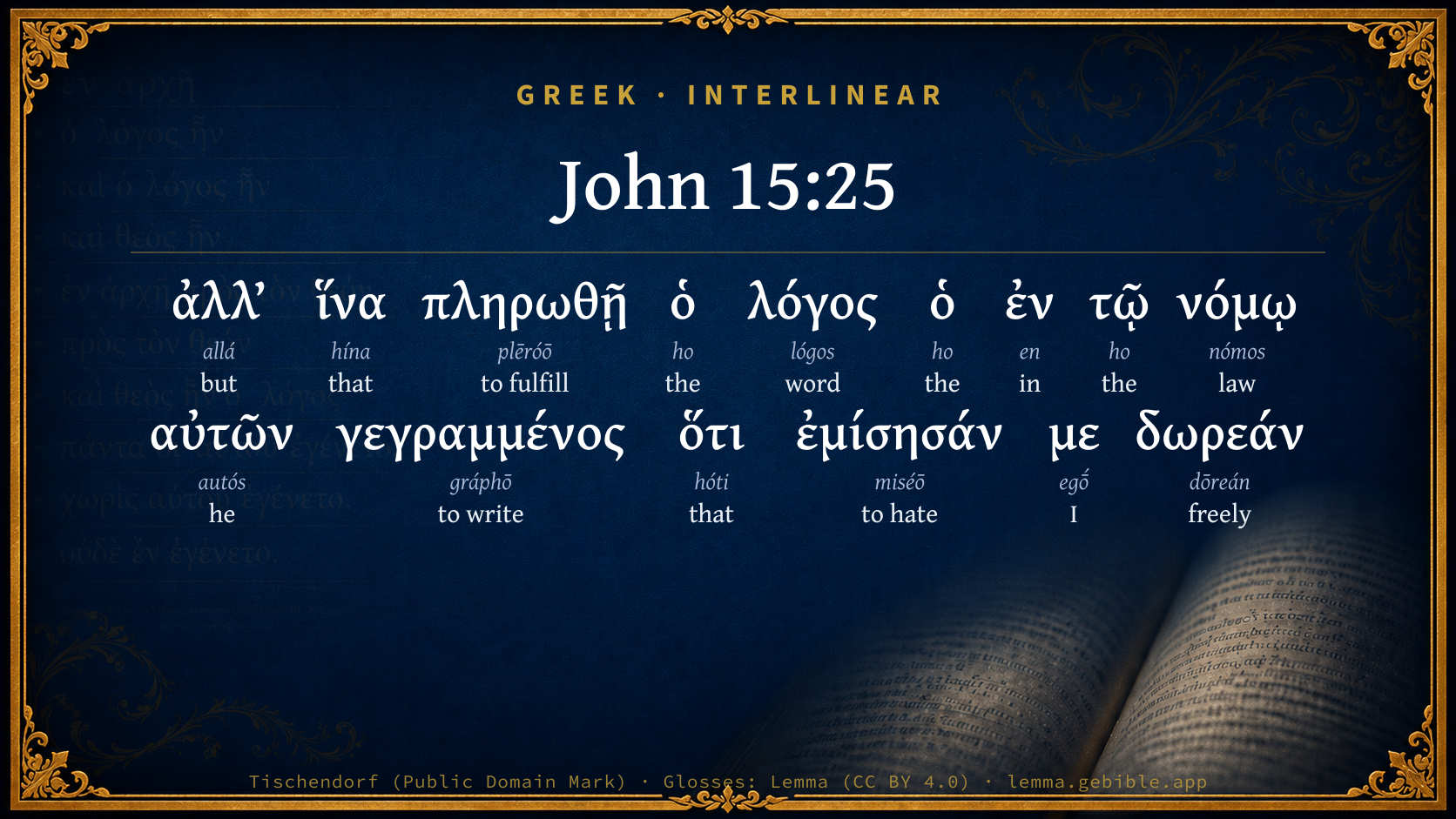
Greek (Tischendorf 8th ed.) John 15:25 appears in the Greek New Testament. The text above is from the Tischendorf 8th edition. Each word links to its Strong’s number and a concise gloss. Click any word for its full Thayer’s Greek Lexicon entry.
Download image
Cite this verse

John 15:25 (World English Bible). Public Domain. Lemma interlinear Bible study tool, https://lemma.gebible.app/v/john/15/25.

Show BibTeX & RIS
BibTeX
RIS
English Translation
But this happened so that the word may be fulfilled which was written in their law, 'They hated me without a cause.'
World English Bible · Public Domain
Download a study sheet

One document with this verse’s original text, its word-by-word gloss line, the meaning frame, cross-references with their text, attributed commentary, and full source and license credits — printable, and it pastes into notes with its structure intact.

This verse Autodidact and up

Study sheet (.html) Plain text (.txt)

A passage Seminary Student

Up to 50 verses in one chapter. A passage sheet keeps up to 6 commentary sources and 12 cross-references per verse, in the order this page ranks them, and says so on the sheet whenever that leaves anything out. Ask for a single verse and you get the Autodidact verse sheet above.

Everything on this page stays free to read, with no account — the sheet is a download of what is already on screen, not access to it.

Want to remove ads? Support Godless Engineer
Compare translations 3

The same verse in 3 English versions, stacked beneath the original-language interlinear above. Click any original word for its lexicon entry.

Each is an independent rendering of the whole verse — the interlinear is not word-aligned to these translations.

Highlighted words mark where these versions differ — a whole-verse word diff, not a word-by-word alignment.

  • World English Bible Public Domain
    But this happened so that the word may be fulfilled which was written in their law, 'They hated me without a cause.'
  • King James Version Public Domain
    But this cometh to pass, that the word might be fulfilled that is written in their law, They hated me without a cause.
  • unfoldingWord Literal Text CC BY-SA 4.0
    But this is so that the word that is written in their law might be fulfilled, ‘They hated me without a cause.’

unfoldingWord Literal Text — © unfoldingWord, licensed CC BY-SA 4.0. Word-aligned USFM3 via Door43 (git.door43.org/unfoldingWord/en_ult).

Versions to compare (up to 4)

3 of 4 selected

Show all 19 translations

Every available English version of this verse, each an independent rendering of the whole verse.

  • World English Bible Public Domain
    But this happened so that the word may be fulfilled which was written in their law, 'They hated me without a cause.'
  • Berean Standard Bible Public Domain
    But this is to fulfill what is written in their Law: ‘They hated Me without reason.’
  • Majority Standard Bible Public Domain
    But this is to fulfill what is written in their Law: ‘They hated Me without reason.’
  • King James Version Public Domain
    But this cometh to pass, that the word might be fulfilled that is written in their law, They hated me without a cause.
  • American Standard Version (1901) Public Domain
    But `this cometh to pass', that the word may be fulfilled that is written in their law, They hated me without a cause.
  • Revised Version (1885) Public Domain
    But this cometh to pass, that the word may be fulfilled that is written in their law, They hated me without a cause.
  • Geneva Bible (1599) Public Domain
    But it is that the worde might be fulfilled, that is written in their Lawe, They hated me without a cause.
  • Douay-Rheims (1899) Public Domain
    But that the word may be fulfilled which is written in their law: They hated me without cause.
  • Young's Literal Translation Public Domain
    but -- that the word may be fulfilled that was written in their law -- They hated me without a cause.
  • Literal Standard Version CC BY-SA 4.0
    but—that the word may be fulfilled that was written in their law—They hated Me without a cause.
  • Unlocked Literal Bible CC BY-SA 4.0
    But this is in order to fulfill the word that is written in their law, 'They hated me without a cause.'
  • unfoldingWord Literal Text CC BY-SA 4.0
    But this is so that the word that is written in their law might be fulfilled, ‘They hated me without a cause.’
  • Darby Bible Public Domain
    But that the word written in their law might be fulfilled, They hated me without a cause.
  • World Messianic Bible Public Domain
    But this happened so that the word may be fulfilled which was written in their law, ‘They hated me without a cause.’
  • Webster's Bible Public Domain
    But this cometh to pass, that the word might be fulfilled that is written in their law, They hated me without a cause.
  • Free Bible Version CC BY-SA 4.0
    But this just fulfilled what Scripture says, ‘They hated me for no reason at all.’
  • Bible in Basic English Public Domain
    This comes about so that the writing in their law may be made true, Their hate for me was without cause.
  • Text-Critical English NT CC BY 4.0
    But this has happened to fulfill what is written in their law: ‘They hated me for no reason.’
  • Tyndale New Testament (1534) Public Domain
    even that the sayinge myght be fulfilled that is written in theyr lawe: they hated me wtout a cause.

Literal Standard Version (2020), Covenant Press — licensed CC BY-SA 4.0. Text via the HelloAO Bible API (eBible.org). Unlocked Literal Bible (unfoldingWord) — licensed CC BY-SA 4.0. Text via the HelloAO Bible API (eBible.org). unfoldingWord Literal Text — © unfoldingWord, licensed CC BY-SA 4.0. Word-aligned USFM3 via Door43 (git.door43.org/unfoldingWord/en_ult). Free Bible Version, Dr. Jonathan Gallagher — licensed CC BY-SA 4.0. Text via the HelloAO Bible API (eBible.org).

Word by word

More ways to search: Search by grammar → Find every occurrence → Compare this word →

Practice this passage: Drill this verse → Learn its vocabulary →

About this verse

These counts appear in no published source. They are computed here, from the morphology-tagged text and Lemma’s own curated glosses. What Lemma adds →

15
words
13
distinct lemmas
Gospels
section

Notable vocabulary

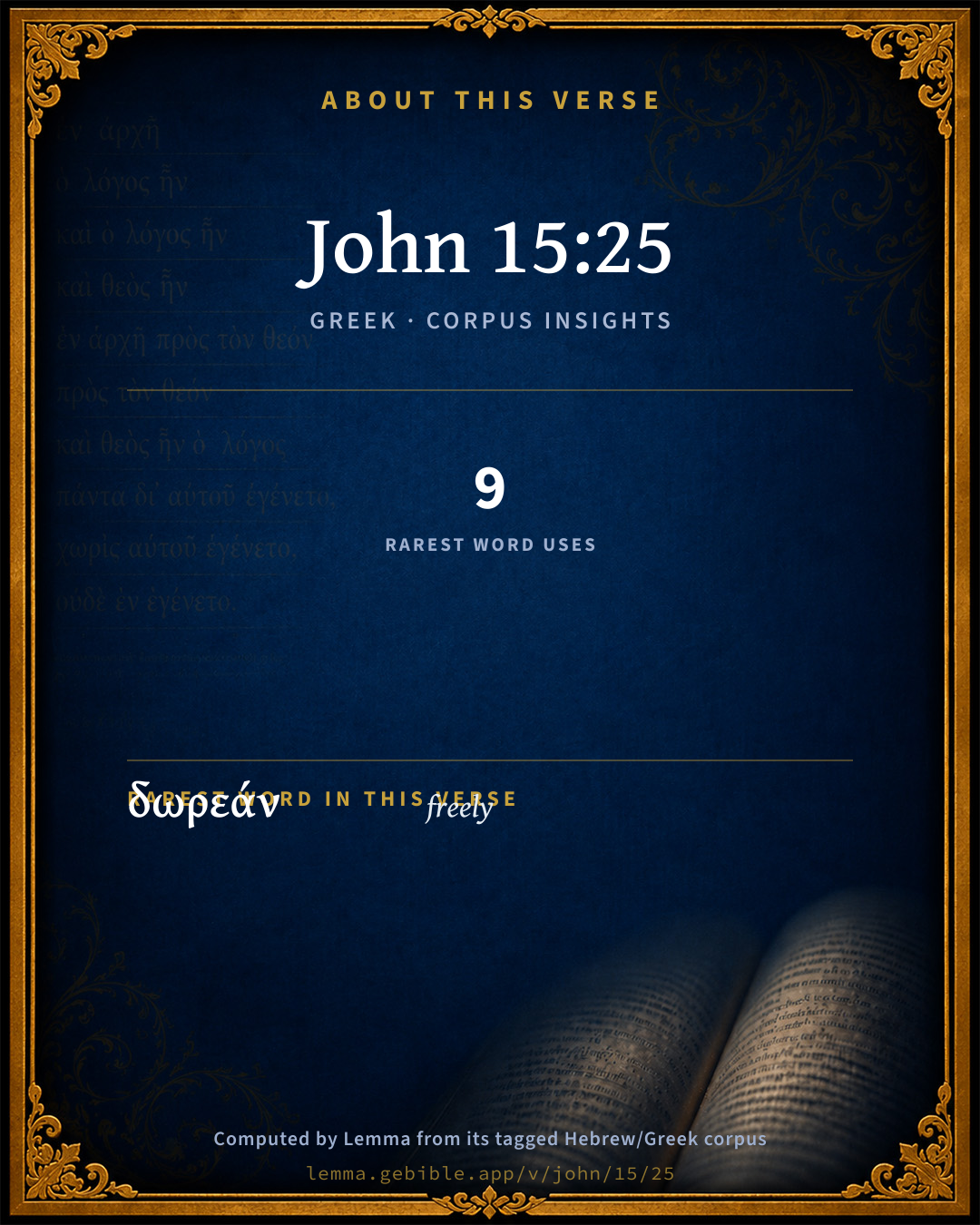
The rarest word here is δωρεάν freely G1432 — appearing just 9 times in the whole Greek New Testament.

Shared distinctive vocabulary

δωρεάν freely G1432 occurs in 8 verses of the Greek New Testament. Also found in:

Repetition

A word recurs within this verse:

Cross-references

14

Topical passages linked to John 15:25 in the Treasury of Scripture Knowledge — connected by theme and wording, ordered by reader-vote popularity; previews shown in the World English Bible.

  • Psalms 109:3 They have also surrounded me with words of hatred, And fought against me without a cause.
  • Psalms 69:4 Those who hate me without a cause are more than the hairs of my head. Those who want to cut me off, being my enemies wrongfully, are mighty. I have to restore what I didn't take away.
  • Psalms 35:19 Don't let those who are my enemies wrongfully rejoice over me; Neither let them wink with the eye who hate me without a cause.
  • Luke 24:44 He said to them, "This is what I told you, while I was still with you, that all things which are written in the law of Moses, the prophets, and the psalms, concerning me must be fulfilled."
  • 2 Corinthians 11:7 Or did I commit a sin in humbling myself that you might be exalted, because I preached to you God's Gospel free of charge?
  • Psalms 7:4 If I have rewarded evil to him who was at peace with me (Yes, I have delivered him who without cause was my adversary),
  • John 10:34 Jesus answered them, "Isn't it written in your law, 'I said, you are gods?'
  • Romans 3:19 Now we know that whatever things the law says, it speaks to those who are under the law, that every mouth may be closed, and all the world may be brought under the judgment of God.
  • Romans 3:24 being justified freely by his grace through the redemption that is in Christ Jesus;
  • Galatians 2:21 I don't make void the grace of God. For if righteousness is through the law, then Christ died for nothing!"
  • 2 Thessalonians 3:8 neither did we eat bread from anyone's hand without paying for it, but in labor and travail worked night and day, that we might not burden any of you;
  • Revelation 21:6 He said to me, "It is done! I am the Alpha and the Omega, the Beginning and the End. I will give freely to him who is thirsty from the spring of the water of life.
  • Revelation 22:17 The Spirit and the bride say, "Come!" He who hears, let him say, "Come!" He who is thirsty, let him come. He who desires, let him take the water of life freely.
  • John 19:36 For these things happened, that the Scripture might be fulfilled, "A bone of him will not be broken."

Cross-references courtesy of OpenBible.info (CC BY 4.0).

Commentary

Notes on John 15:25 from classic Christian and Jewish commentators (each source and its license shown beneath its notes). The classic Christian expositions comment on the surrounding passage and are grouped to its opening verse, so a note may address several verses; the Jewish commentaries on the Tanakh (Rashi and others) are per-verse, so they appear only where the commentator wrote on this verse.

Lemma curates 59 commentaries, every one of them public domain or Creative Commons licensed, each selected and text-cleaned for this edition rather than reprinted as found. About our sources →

The Cambridge Bible for Schools and Colleges

gen. ed. J. J. S. Perowne

25. in their law] ‘Law’ is used in the wide sense for the O.T. generally. Comp. Joh_10:34, Joh_12:34, Joh_15:25; Rom_3:19.

without a cause] The passage may be from either Psa_69:4 or Psa_35:19 : there are similar passages Psa_109:3 and Psa_119:161. ‘Without a cause,’ gratuitously; so that here again they are without excuse.

The Cambridge Bible for Schools and Colleges (gen. ed. J. J. S. Perowne; Cambridge University Press, 1878–1918) — public domain. Text from a community e-Sword module.

Tyndale Open Study Notes

Tyndale Open Resources

15:25 They hated me without cause: This Old Testament citation reveals the unwarranted anger of those who belong to the darkness.

Tyndale Open Study Notes — © Tyndale Open Resources, licensed CC BY-SA 4.0. Text via the HelloAO Bible API.

Bengel's Gnomon

Johann Albrecht Bengel

Joh 15:25. Ἀλλʼ ἵνα, but that) But, viz. this cometh to pass.—λόγος, the word) the word of prophecy, the true word.—ἐν τῷ νόμῳ αὐτῶν, in their law) which they read over and over again, and make their boast of. The Psalms constitute a portion of the law in the wide sense of that term. Comp. Mat 5:18; Mat 5:17, “One tittle shall in nowise pass from the law” (including the prophets, etc., as appears from Joh 15:17), etc., “Think not that I am come to destroy the law or the prophets.” We say the Bible.

Bengel's Gnomon of the New Testament — English translation (T&T Clark, Edinburgh, 1860) — public domain. Text from a community e-Sword module.

Meyer's Critical & Exegetical Commentary

Heinrich August Wilhelm Meyer

Joh_15:25. Yet this hatred against me stands in connection with the divine destiny,[169] according to which the word of Scripture must be fulfilled by their hatred: they have hated me groundlessly. The passage is Psa_69:4, or Psa_35:19, where the theocratic sufferer (David?) utters that saying which has reached its antitypical Messianic destination in the hatred of the unbelieving against Christ (comp. on Joh_13:18). The passage Psa_109:3, which Hengstenberg further adduces, does not correspond so literally, as is also the case with Psa_119:161 (Ewald).

ἀλλʼ] sc. μεμισήκασίν μΕ, as the ground-thought of what precedes.

ΔΩΡΕΆΝ] חִוָּם immerito, according to the LXX., but opposed to the Greek signification (gratis). Comp. 1Sa_19:5; Psa_34:7 (where Symmachus has ἈΝΑΙΤΊΩς); Sir_20:21; Sir_29:6-7.

The irony which De Wette discovers in ἐν τῷ νόμῳ αὐτῶν: they comply faithfully with what stands in their law, is an erroneous assumption, since ἵνα πληρ. is the usual formula for the fulfilment of prophecies, and since ΝΌΜΟς here, as in Joh_10:34, stands in a wider sense, while ΑὐΤῶΝ is to be taken as Τῷ ὙΜΕΤΈΡῼ, Joh_8:17 (see in loc.), comp. ὑμῶν, Joh_10:34. Bengel well says: in lege eorum, quam assidue terunt et jactant.

[169] Which, as a matter of course, and according to vv. 2224, does not do away with responsibility. Comp. Weiss, Lehrbegr. p. 151.

Meyer — Critical and Exegetical Commentary on the New Testament — English translation by Peter Christie, edited by Frederick Crombie (T&T Clark, 1880) — public domain. Text from a community e-Sword module.

Expositor's Greek Testament

ed. W. Robertson Nicoll

Joh 15:25 . This almost incredible blindness and obduracy is accounted for, as in Joh 12:37 , by the purpose of God disclosed in O.T. Scripture. “Their law” is here, as in Joh 10:34 , etc., used of O.T. Scripture as a whole. αὐτῶν is inserted, as ὑμετέρῳ in Joh 8:17 , to suggest that the very Scripture in which they had prided themselves would condemn them; see also Joh 5:45 , Joh 5:39 . The words ἐμίσησάν με δωρεάν do not occur in O.T.; but similar expressions are found in Psa 34:19 , οἱ μισοῦντές με δωρεάν , and Psa 108:3 , ἐπολέμησάν με δωρεάν . Entirely gratuitous was their hatred and rejection of Christ, so that they were inexcusable.

The Expositor's Greek Testament, edited by W. Robertson Nicoll (1897–1910) — public domain. Text from a community e-Sword module.

Geneva Bible (1599)

Geneva Bible translators

Sometime by this word, Law, are meant the five books of Moses, but in this place, the whole Scripture: for the place alleged is in the Psalms.

Geneva Bible (1599) marginal notes — public domain. Text via Bolls.life.

Jamieson, Fausset & Brown

Robert Jamieson, A. R. Fausset & David Brown

that the word might be fulfilled . . . They hated me without a cause--quoted from the Messianic Psa 69:4, applied also in the same sense in Joh 2:17; Act 1:20; Rom 11:9-10; Rom 15:3.

Jamieson, Fausset & Brown — Commentary Critical and Explanatory on the Whole Bible (1871) — public domain (CC PDM 1.0). Text via the HelloAO Bible API.

Adam Clarke's Commentary

Verse 25. Written in their law] See Clarke on Joh 10:34. These words are taken from Ps 69:4. This psalm is applied to Christ, Joh 2:17; Joh 19:28; to the vengeance of God against Judea, Ac 1:20. The psalm seems entirely prophetic of Christ. His deep abasement is referred to, Ps 69:2-5; his prayer for his disciples and followers, Ps 69:6; that for himself, in the garden of Gethsemane, Ps 69:15-19; his crucifixion, Ps 69:20-22; the vengeance of God against the Jews, from Ps 69:23-29; the glorious manner in which he gets out of all his sufferings, Ps 69:30; the abolition of the Mosaic rites and ceremonies, Ps 69:31, compared with Isa 66:3; and, finally, the establishment of the Gospel through the whole world, in Ps 69:33 and following verses. The reader will do well to consult the psalm before he proceeds.

Adam Clarke's Commentary on the Bible (1810–1826) — public domain. Text from a community e-Sword/MySword module.

John Calvin's Commentaries

25. But that the word may be fulfilled. What is contrary to nature appears to be incredible. But nothing is more contrary to reason than to hate God; and, therefore, Christ says that so great was the malice with which their minds were envenomed, that they hated him without a cause Christ quotes a passage from Psalm 35:19, which, he says, is now fulfilled Not that the same thing did not happen, formerly, to David, but to reprove the obstinate malice of the nation, which reigned perpetually from age to age, being continued from grandfathers to grandchildren in unbroken succession; as if he had said, that they were in no respect better than their fathers, who hated David without a cause.

Which is written in their Law. By the word Law, he means the Psalms; for the whole doctrine of the Prophets was nothing else than an appendage to the Law; and we know that the ministry of Moses lasted till the time of Christ. He calls it their Law, not as an expression of respect for them, but to wound them more deeply by a designation which was well known among them; as if he had said, “They have a Law transmitted to them by hereditary right, in which they see their morals painted to the life.”

John Calvin's Commentaries (1540-1563) — public domain. Text from the Calvin Translation Society English edition (1840s-50s) via the Christian Classics Ethereal Library (ccel.org). Calvin's coverage is partial (roughly two-thirds of the Bible); uncommented books and verses are honest gaps, never fabricated. The 19th-century editor's footnotes and remarks are omitted so the notes are faithfully Calvin's own voice.

Ellicott's Commentary for English Readers

(25) But this cometh to pass, that the word might be fulfilled . . .—The words in italics are not found in the original, but they rightly complete the sense. For the phrase, “might be fulfilled,” comp. Notes on Joh_12:38; Joh_13:18.

That is written in their law.—Comp. Note on Joh_10:34.

They hated me without a cause.—The passage immediately referred to is probably that of the Messianic Psalm (69:4). The words are found also in Psa_35:19 (see marg. ref.), and less distinctly in Psa_109:3; Psa_119:161. (Comp. especially Note on the quotation from this same Psalm in Joh_2:17.)

The words, “without a cause,” rightly express the meaning of the Hebrew word in the Psalm. The Greek follows the LXX., which expresses the thought “to no purpose,” or “in vain.” This is, however, not the idea of the context here. They had no reason for their sin, and therefore they hated Him without a cause. True were these words of many an earlier sufferer; but they were in their fulness true, they were “fulfilled,” only in the one sinless Sufferer.

A Bible Commentary for English Readers, edited by Charles John Ellicott (1878–1897) — public domain. Text from a community e-Sword module.

Trapp's Complete Commentary

John Trapp

25 But this cometh to pass, that the word might be fulfilled that is written in their law, They hated me without a cause.

Ver. 25. They hated me without a cause] So they dealt by David, so by Christ, and so still by his members. There is but the same pageant acted over again as of old. In moribus compositi, et modesti sunt, was the worst the persecutors could say of the Waldenses, those ancient Protestants. They are good in their lives, true in their speeches, hearty in their affections. (Bp. Ussher.) Sed fides eorum est incorrigibilis et pessima, But the faith of those is reformed and corrupt, saith the Dominican Inquisitor, concerning the Hussites. So the Bishop of Aliff, in the Trent Council, said that as the faith of the Catholics was better, so the heretics exceeded them in good life. Hominis vita magno omnium consensu probatur, said Erasmus of Luther, Tanta est morum integritas, ut nec hostes reperiant quod calumnientur. Such is the integrity of of their conduct that neither their enemies may discover what they condmen them of. And yet a friar of Antwerp wished that Luther were there that he might bite out his throat with his teeth, as the same Erasmus testifieth.

John Trapp, A Commentary or Exposition upon All the Books of the Old and New Testament (1647–1656) — public domain. Text from a community e-Sword module.

Albert Barnes' Notes on the Bible

In their law - Psa 35:19. All the Old Testament was sometimes called the law. The meaning here is that the same thing happened to him which did to the psalmist. The same words which David used respecting his enemies would express, also, the conduct of the Jews and their treatment of the Messiah. In both cases it was without cause. Jesus had broken no law, he had done no injury to his country or to any individual. It is still true that sinners hate him in the same way. He injures no one, but, amid all their hatred, he seeks their welfare; and, while they reject him in a manner for which they “can give no reason in the day of judgment,” he still follows them with mercies and entreats them to return to him. Who has ever had any reason to hate the Lord Jesus? What injury has he ever done to any one of the human race? What evil has he ever said or thought of any one of them? What cause or reason had the Jews for putting him to death? What reason has the sinner for hating him now? What reason for neglecting him? No one can give a reason for it that will satisfy his own conscience, none that has the least show of plausibility. Yet no being on earth has ever been more hated, despised, or neglected, and in every instance it has been “without a cause.” Reader, do you hate him? If so, I ask you why? Wherein has he injured you? or why should you think or speak reproachfully of the benevolent and pure Redeemer?

Albert Barnes' Notes on the Bible (1834–1885) — public domain. Text from a community e-Sword/MySword module.

Matthew Poole's English Annotations

The particle that here again denotes not the final cause, but only the consequent; and the law here signifieth not strictly the law of Moses, but the whole Scripture, in which sense we have once and again met with the term. Saith our Saviour, This is no more than was prophesied of me by the prophet David; or no more than was fulfilled in me, being first done to David as my type: which also hath the force of another argument to uphold and encourage his disciples under their sufferings, that they were but the fulfilling of prophecies, no more than was foretold in holy writ.

Matthew Poole's English Annotations on the Holy Bible (1683–1685) — public domain. Text from a community e-Sword/MySword module.

Whedon's Commentary on the Bible

Daniel D. Whedon

25. Without a cause—Psa_69:9. For what cause was all this hatred? What plea for this malignity? And still might we ask, Why does the world hate religion, and the Church, and the Bible, and God? Why do so many of the scientific world so often ignore the God of Christ? It is all without reason or excuse. It is a pure gratuitous unholy temper.

Daniel D. Whedon (gen. ed.), Commentary on the Old and New Testaments (1874–1909) — public domain. Text from a community e-Sword module.

The Pulpit Commentary

Strange is it that even here the ancient psalmist, in portraying the ideal Sufferer, (Psa_69:4 Psa_35:19) bad seized this feature, and thus anticipated the treatment of the Son of God. But this cometh to pass (some clause of this kind must be introduced to give true force to alla and ina) that the word might be fulfilled that has been written in their Law. Not only here but elsewhere Jesus speaks of the Psalms as a part of the Law. (see note, Joh_10:34) Other passages may, from their similarity, have been in Christ"s mind, as receiving fulfillment or abundant illustration in their conduct. The use of the expression, "the Law," has been pressed by many as proof that the writer of this Gospel did not regard himself as a Jew at all. Such numerous indications occur of the opposite conclusion, that this expression must receive the more rational interpretation the Law in which they pride themselves, the Law which is ever in their mouths, the Law which itself contains the portraiture of their spirit: They hated me gratuitously; causelessly. The true Christ was, when he came, the object of reason-less, causeless hate and opposition. Jesus knew, when he claimed to be the Christ, that he would have to complete and fulfill the solemn portraiture of the suffering, burden-bearing, and rejected Christ, as well as that of the triumphant Christ and King.

The Pulpit Commentary (1880–1919), ed. H.D.M. Spence-Jones & Joseph S. Exell — public domain. Text from a community e-Sword module.

John Wesley's Explanatory Notes

Psalm lxix, 4.

John Wesley, Explanatory Notes Upon the Whole Bible (1754–1765) — public domain. Text via the GEBible commentary corpus.

Cambridge Greek Testament for Schools and Colleges

25. τ. νόμφ. In the wide sense for the O. T. as a whole (Joh 10:34, Joh 12:34; Rom 3:19). The passage may be from Psa 69:4 or Psa 35:19: there are similar passages Psa 109:3 and Psa 119:161. That their hatred is gratuitous is again inexcusable.

Cambridge Greek Testament for Schools and Colleges (Cambridge University Press, 1896; 21 vols, various authors incl. Carr, Maclear, Plummer, Farrar, Lumby, Moule, M. R. James, Simcox) — public domain. Text from a community e-Sword module.

Alford’s Greek Testament

Henry Alford

25.] ἀλλʼ,—but all this not as an accidental thwarting of My word and work among them, but as a matter predicted in Scripture.

ἵνα, with the fullest sense of purpose, as always, and most especially in this formula. Beware of the evasive ecbatic sense.

ἐν τῷ νόμῳ αὐτῶν] See ch. 10:34 and note. To suppose any irony in these words, as De W. does (“they are true followers-out of their law”), is manifestly against the whole spirit of our Lord’s reference to the law. It is ‘their law,’—“quem assidue terunt et jactant,” Bengel,—as condemning them, though their boast and pride.

δωρεάν, not, “to no purpose,” as Bengel (vergeblich), but as E. V., without a cause, answering to πρόφασιν οὐκ ἔχουσιν, ver. 22.

The citation is probably from the Messianic Psa_69.

Henry Alford, The Greek Testament (1849–1861) — public domain. Text from a community e-Sword module.

International Critical Commentary

25. For the ellipse ἀλλʼ ἵνα, cf. 9:3; and see on 13:18.

ἵνα πληρωθῇ ὁ λόγος κτλ. The hatred of the Jews for Jesus was part of the mysterious purpose of God, disclosed in the O.T. scriptures. See Introd., p. clv.

The phrase “their law” has already been discussed in the note on 8:17. “The law” is used for the whole of Scripture (see on 12:34); but although a Greek Christian might readily say “their law,” to suppose that Jesus thus separated Himself from the Jewish race is hard of credence. Two of His Words from the Cross are quotations from the Psalms, which, if the phrase “their law” be His, He declines to recognise as having any special value for Him.

The allusion is either to Psa 35:19 or Psa 69:4 (most probably from Psa_69, as this was regarded as a Messianic Psalm; see on 2:17), in both of which οἱ μισοῦντές με δωρεάν faithfully reproduces the Hebrew. The hatred of the Jews for Jesus was gratuitous and without cause (δωρεάν; cf. πρόφασιν οὐκ ἔχουσιν of v. 22).

Introductory Note on Παράκλητος (v. 26)

The term παράκλητος does not occur in the Greek Bible outside the Johannine writings. On the other hand, Jn does not use παρακαλεῖν or παράκλησις, the latter word being specially Lucan and Pauline, while the former is common to most of the N.T. writers.

Etymologically, παράκλητος is a passive form, and is equivalent to the Latin aduocatus, signifying one who is “called in” to give help or advice, and being especially used of the counsel for the defence.1 In classical writers this is always the meaning. Demosthenes (de falsa leg. 341) has αἱ τῶν παρακλήτων δεήσεις καὶ σπουδαί, and in Diog. Laert. iv. 50, Bion is made to say, “I will do what is sufficient for you if you will send παράκλητοι (sc. representatives) and don’t come yourself.” The term is used in the same way in Philo. Thus the city of Alexandria is called the παράκλητος by whom the emperor might be propitiated (in Flaccum, 4; cf. also de Josepho, 40). In de opif. mundi, 6, Philo says that God employed no παράκλητος (i.e. helper) in the work of creation. Again, in Vit. Mos. iii. 14, speaking of the high priest, “one consecrated to the Father of the world,” Philo says that it was necessary that he should employ as his παράκλητος, “a son most perfect in virtue.”2 In like manner, Barnabas (§ 20) has πλουσίων παράκλητοι, “advocates of the wealthy”; and in 2 Clem. 6 we have the question, “Who shall be our παράκλητος, i.e. our advocate, if we are not found doing what is right?” So in the Letter of the Churches of Lyons and Vienne (about 177 a.d., Eus. H.E. v. 1), it is said that Vettius Epagathus, confessing that he was a Christian, was taken into the order of martyrs (εἰς τὸν κλῆρον τῶν μαρτυρῶν), being called παράκλητος Χριστιανῶν, having the Paraclete within himself.

It may be added that the word was borrowed from the Greek by the Jews, and appears in Talmudic writings (see Wetstein on Joh 14:16) as פרקלט in the sense of aduocatus.

Although the verb παρακαλεῖν does not appear in Jn., an examination of its usage throws some additional light on the meaning of παράκλητος.

παρακαλεῖν is to call a person to stand by one (παρά), and hence to help in various ways, e.g.

a. as a witness, to be present when a thing is done. Cf. Demosthenes, c. Phorm. § 29.

b. as an adviser. Cf. Xenophon, Anab. I. vi. 5, Κλεάρχον δὲ καὶ εἴσω παρεκάλεσε σύμβουλον.

c. as an advocate. Cf. Æschines, Fals. Leg., § 184: παρακαλῶ δʼ Εὔβουλον μὲν ἐκ τῶν πολιτικῶν καὶ σωφρόνων ἄνδρα συνήγορον.

The verb is specially applied to the invoking of a god, and calling him in to help: e.g. Thucydides, i. 118 fin., αὐτὸς ἔφη ξυλλήψεσθαι καὶ παρακαλούμενος καὶ ἅκλητος; Epictetus, Diss. III. xxi. 12, τοὺς θεοὺς παρακαλεῖν βοηθούς; Plutarch, Alexander, 33, παρεκάλει τοὺς θεούς.

It appears from these passages that παράκλητος is naturally used for a Divine helper called in, either as a witness (15:26), or as an advocate (16:8), or as an adviser (16:13). παρακαλεῖν is also used in the sense of encourage, e.g. Polybius, III. xix. 4, οἱ περὶ τὸν Δημήτριον συναθροίσαντες σφᾶς αὐτοὺς καὶ παρακαλέσαντες; but παράκλητος, being a passive form, cannot be equivalent to “one who encourages.”

The familiar rendering “Comforter” was introduced into our English versions by Wyclif, who meant by it “confortator,” i.e. strengthener, not consoler (see his rendering of Php 4:13). But there is some patristic authority for the translation “consoler.” Origen (de princ. II. vii. 4) says distinctly that while in 1Jn 2:1 παράκλητος means intercessor, in the Fourth Gospel it means consoler. So, too, Cyril of Jerusalem says (Cat. xvi. 20) that the Spirit is called παράκλητος from παρακαλεῖν, “to console,” as well as because He “helps our infirmities” and “makes intercession” for us (Rom 8:26). Gregory of Nyssa (c. Eunom. ii. 14) also calls attention to the two meanings of the verb παρακαλεῖν. It is perhaps in consequence of an early interpretation of παράκλητος in Joh_14 as “consoler,” that Aquila and Theodotion render נָחַם in Job 16:2 by παράκλητος, where the LXX has παρακλήτωρ. But the weight of evidence is undoubtedly in favour of “advocate” rather than “comforter” as the rendering of παράκλητος in Jn.; and the notes on 14:16, 26, 16:7 will show also that this rendering is more in accordance with the contexts in which it occurs. At 1Jn 2:1 “advocate” is the only possible rendering.

The R. V. margin suggests “Helper” as an alternative, and this is adopted by Moffatt. This might include the idea of consoling as well as of pleading one’s cause; but its vagueness veils the meaning here and at 16:7.

Witness to Christ in the Future Will Be Borne by the Paraclete as Well as by Christian Disciples (vv. 26, 27)

International Critical Commentary — older volumes (1896–1929), various authors — public domain. Text from a community e-Sword module.

Vincent's Word Studies in the New Testament

Marvin R. Vincent

Without a cause [δωρεαν] . Gratuitously. Akin to didwmi, to give. Their hatred was a voluntary gift.

Marvin R. Vincent, Word Studies in the New Testament (1887–1900) — public domain. Text from a community e-Sword/MySword module.

Godet's Commentaries

Frédéric Louis Godet

Ver. 25. ᾿Αλλά : “But there is nothing astonishing in this.” The righteous man of the old covenant had already complained by the mouth of David (Psa 35:19; Psa 69:5) of being the object of the gratuitous hatred of the enemies of God. If their hatred was wholly laid to their own charge, notwithstanding the faults of the imperfectly righteous man, with how much stronger reason can the perfectly righteous One appropriate to Himself this complaint, which is, at the same time, His consolation and that of those who suffer like Him and for Him!— Weissasserts here, as with reference to the other quotations of this kind, that the evangelist puts in the mouth of even the Messiah these words of the Old Testament. The evangelist would then imagine the Messiah as also uttering these words of Joh 15:6 from Psalms 69 : O God, Thou knowest my foolishness, and my sins are not hid from Thee; or he could never have read them! As for Psalms 35, it is impossible to find in it a line which could have led any reader whatever of the Old Testament to the Messianic application.

In order that depends on a “This has happened,” or “This must have happened,” understood, as in so many other cases (Joh 9:3, Joh 13:18, 1Jn 2:19, Mar 14:49, etc.). On the term “their law,” see on Joh 8:17. De Wette finds irony in these words: “They practise faithfully their law.” This meaning seems far-fetched.

Frédéric Louis Godet — Commentaries on Luke, John, Romans, and 1 Corinthians — English translation (T&T Clark, Edinburgh, 1870s–1890s) — public domain. Text from a community e-Sword module.

Lesson kit

Teaching starters — assembled from the data on this page, not authored interpretation. Every prompt links to the verse data it draws on. Edit before teaching.

John, in the Gospels, opens this verse with 15 words (13 distinct Greek lemmas). Its most distinctive word is dōreán (“freely”). A historical commentator’s framing appears above. Read the whole chapter for the surrounding context.

Discussion questions

  1. How does “freely” (dōreán) shape what this verse is saying?
  2. Matthew 10:8 shares the word «freely» with this verse. How do the two illuminate each other?
  3. “the” occurs 3× in this one verse. What is the effect of the repetition?
  4. These translations render this verse differently; the difference is in the English rendering, not the original. What questions does that raise?
  5. Reading how The Cambridge Bible for Schools and Colleges and Tyndale Open Study Notes read this verse, where do the two commentators agree and where do they part?

Things to notice

Reading settings

Reading text

Shown beneath each verse's original-language words.

Old Testament
Old Testament edition

Read the OT as the Masoretic Hebrew (MT) or the Greek Septuagint (LXX).

English shown for the Greek Septuagint (in the Hebrew ↔ Greek comparison).

Comparing translations? Open the Compare panel on any verse page to stack up to four side by side.