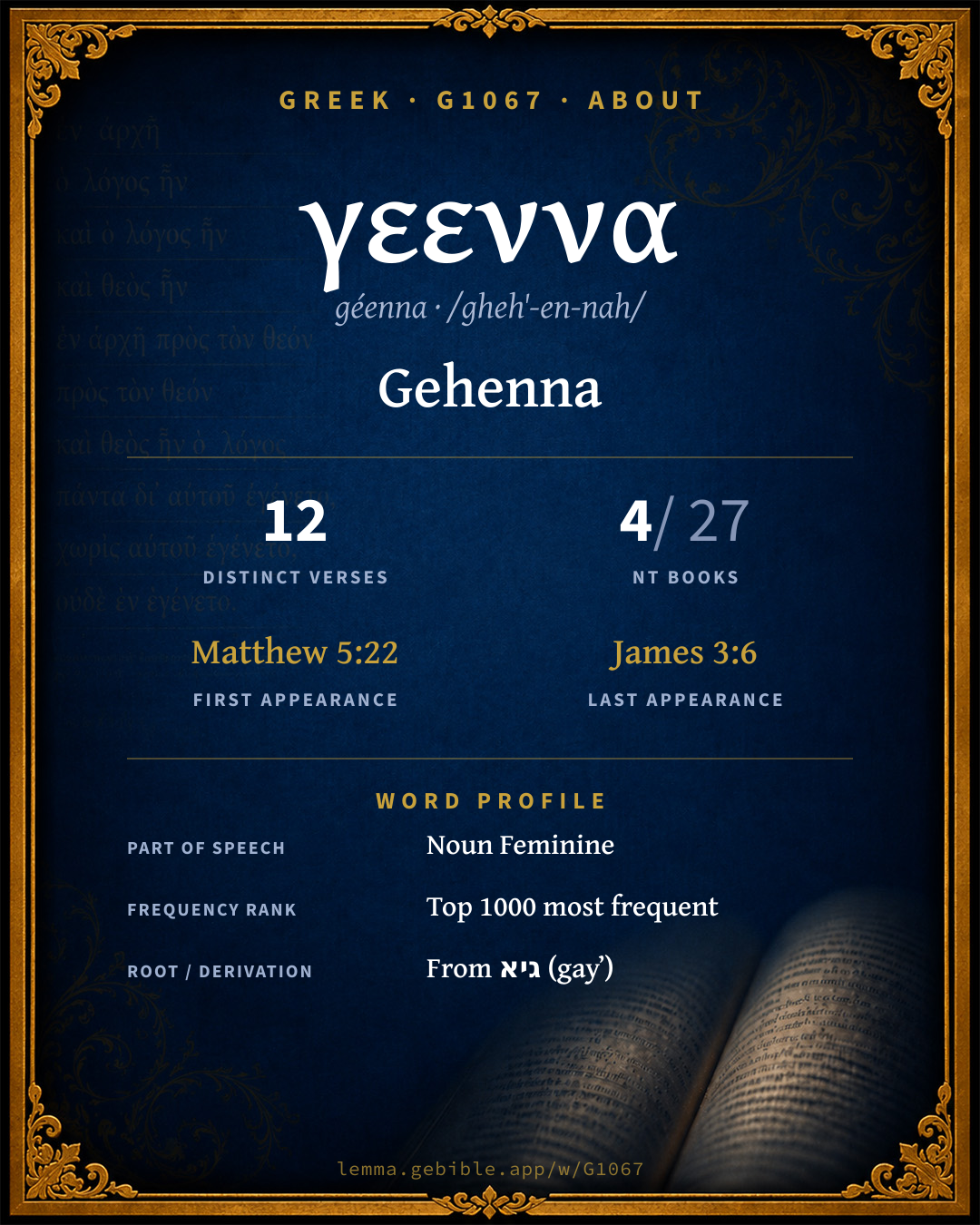
γέεννα
Gehenna
Full lexicon entry — Thayer's Greek Lexicon
From Thayer's Greek Lexicon
Where this word appears
See every Accusative-case word in the Greek New Testament →
Grammar key — what these labels mean
Part of speech
- Noun
- A naming word — a person, place, thing, or idea.
Case
- Accusative
- The case of the direct object and of extent.
- Genitive
- The case of source, possession, or “of” — answers “whose / from what.”
- Dative
- The case of the indirect object, means, or location — “to / for / with / in.”
Gender
- Feminine
- Grammatically feminine.
Number
- Singular
- One.
Grammatical forms
- Noun, Accusative, Singular, Feminine 8 times (67%)
- Noun, Genitive, Singular, Feminine 3 times (25%)
- Noun, Dative, Singular, Feminine 1 time (8%)
Parsed forms decoded from the imported morphology (Robinson–Tischendorf, public domain), counted across 12 parsed occurrences — not distinct verses.
Every verse where G1067 appears — 12 distinct verses across 4 books. Click any verse to open its interlinear word-by-word view. Verse text shown in the World English Bible for context — . Each verse’s Greek form is shown with its reference; the English is not keyword-highlighted, since the data carries no word-level English alignment. Use “Compare translations” on any verse to read it across multiple English versions. This concordance covers the Greek New Testament; Septuagint (Greek Old Testament) occurrences of this word are not indexed here.
Matthew 7 verses
- Matthew 5:22 γέενναν n acc sg fem But I tell you, that everyone who is angry with his brother without a cause shall be in danger of the judgment; and whoever shall say to his brother, 'Raca!' shall be in danger of the council; and whoever shall say, 'You fool!' shall be in danger of the fire of Gehenna.
- Matthew 5:29 γέενναν n acc sg fem If your right eye causes you to stumble, pluck it out and throw it away from you. For it is more profitable for you that one of your members should perish, than for your whole body to be cast into Gehenna.
- Matthew 5:30 γέενναν n acc sg fem If your right hand causes you to stumble, cut it off, and throw it away from you: for it is profitable for you that one of your members should perish, and not your whole body be thrown into Gehenna.
- Matthew 10:28 γεέννῃ n dat sg fem Don't be afraid of those who kill the body, but are not able to kill the soul. Rather, fear him who is able to destroy both soul and body in Gehenna.
- Matthew 18:9 γέενναν n acc sg fem If your eye causes you to stumble, pluck it out, and cast it from you. It is better for you to enter into life with one eye, rather than having two eyes to be cast into the Gehenna of fire.
- Matthew 23:15 γεέννης n gen sg fem Woe to you, scribes and Pharisees, hypocrites! For you travel around by sea and land to make one proselyte; and when he becomes one, you make him twice as much of a son of Gehenna as yourselves.
- Matthew 23:33 γεέννης n gen sg fem You serpents, you offspring of vipers, how will you escape the judgment of Gehenna?
Mark 3 verses
- Mark 9:43 γέενναν n acc sg fem If your hand causes you to stumble, cut it off. It is better for you to enter into life maimed, rather than having your two hands to go into Gehenna, into the unquenchable fire,
- Mark 9:45 γέενναν n acc sg fem If your foot causes you to stumble, cut it off. It is better for you to enter into life lame, rather than having your two feet to be cast into Gehenna, into the fire that will never be quenched--
- Mark 9:47 γέενναν n acc sg fem If your eye causes you to stumble, cast it out. It is better for you to enter into the Kingdom of God with one eye, rather than having two eyes to be cast into the Gehenna of fire,
Luke 1 verse
James 1 verse
About this entry
At a glance — auto-summarized from this page’s data, not written by a person. Every figure links to its source below. This summary describes the numbers; it doesn’t interpret them.
The Greek name γεεννα centers on the idea of “Gehenna.” Matthew dominates its distribution — 7 of 12 verses. Spanning 12 verses in 4 books, it ranks among the uncommon words of the Greek New Testament. Debuting at Matthew 5:22, it then recurs through the corpus. Dig into 12-verse concordance and the renderings breakdown below.
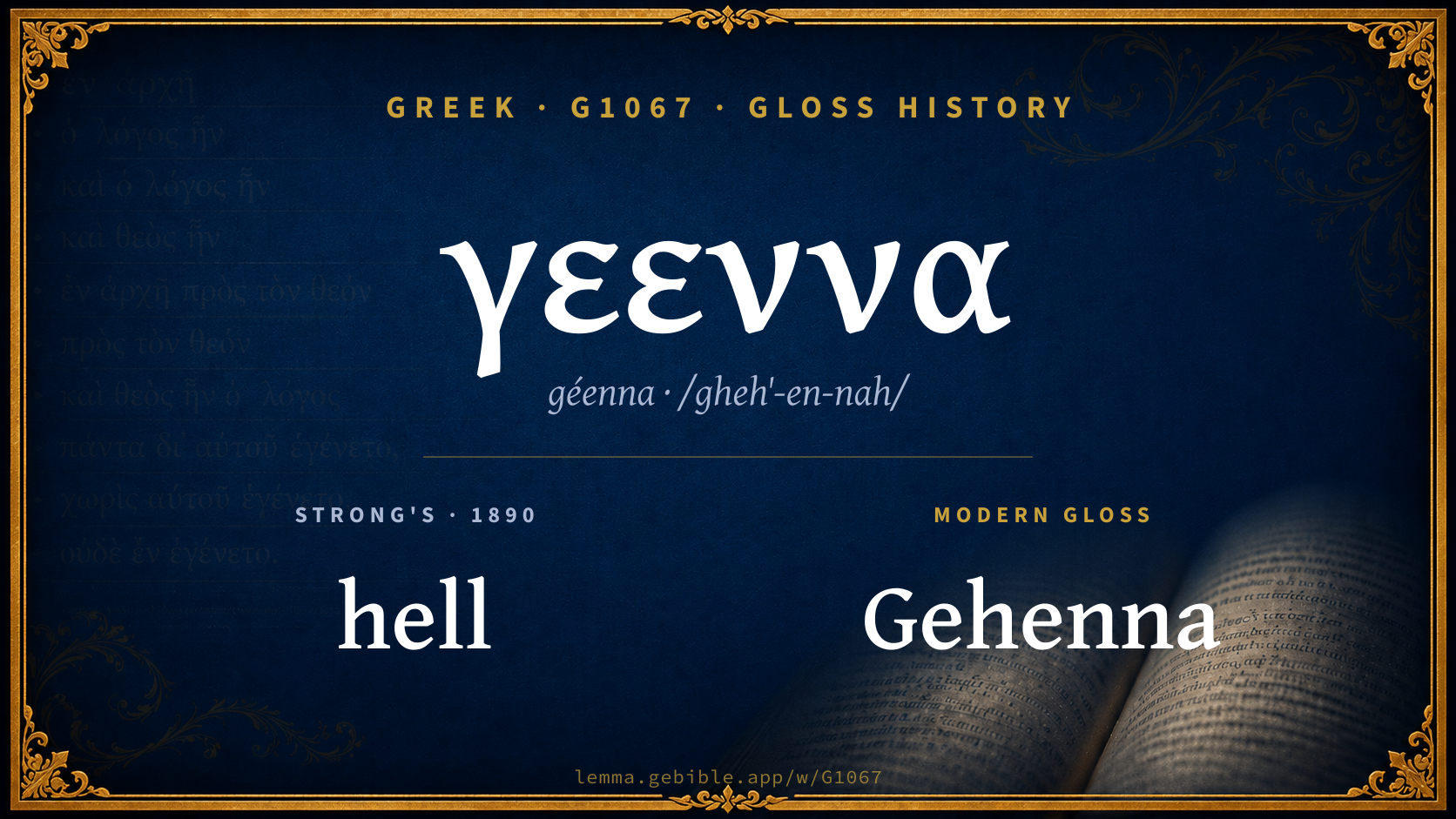
Gloss history
Strong's 1890 vs modern scholarship
About this word
Strong's G1067 catalogs a Greek word from the Greek New Testament.
These counts are not copied from any lexicon or concordance. They are computed here, from the morphology-tagged Greek New Testament. What Lemma adds →
- 12
- distinct verses
- The word appears in 12 distinct verses.
- 4 / 27
- NT books
- The word appears in 4 of 27 New Testament books.
- #904
- by frequency
- Top 1000 most frequent Greek words (rank 904 of 5,347 Greek words by occurrence).
View all 12 occurrences in the concordance →
By section of the New Testament
By traditional corpus
Conventional, traditional groupings — biblical authorship is debated, so this is a traditional corpus grouping, not an authorship claim. Some books belong to more than one corpus (Luke is in both the Gospels and the Lukan corpus, and so on), so these shares overlap and need not total 100%. Each figure is a share of the word’s 12 distinct verses.
- Gospels 11 verses · 92%
- Lukan (Luke–Acts) 1 verse · 8%
- General (Catholic) Epistles 1 verse · 8%
How translations render this word
Counts come from each version’s own published word-to-Strong’s tagging or interlinear alignment — an approximate guide to how each version renders this word, not a word-level alignment the data otherwise carries. Because each total is that version’s own tagged count, the per-version totals vary from one another and need not match the appearance or distinct-verse counts above. These counts may also differ from a printed concordance because Lemma counts each distinctly tagged rendering and does not collapse phrase taggings into a single head-word total. This is a fixed set of word-tagged versions (KJV, ASV, BSB, ULT) and does not change with the reading translation you choose elsewhere. Each version’s license is shown beside its name below (and on Sources).
- King James Version: Hell 12×
- American Standard Version: Hell 12×
- Berean Standard Bible: Hell 12×
- unfoldingWord Literal Text: Gehenna 12×
King James Version Public Domain
Renders G1067 across 12 tagged occurrences — most commonly:
American Standard Version Public Domain
Renders G1067 across 12 tagged occurrences — most commonly:
Berean Standard Bible Public Domain
Renders G1067 across 12 tagged occurrences — most commonly:
unfoldingWord Literal Text CC BY-SA 4.0
Renders G1067 across 12 tagged occurrences — most commonly:
Senses in Thayer's
The 1 sense Thayer's distinguishes for this word, in lexicon order (not ranked by frequency or importance). The full entry — with sub-senses — is in the Lexicon Entry tab.
- Hell is the place of the future punishment call "Gehenna" or "Gehenna of fire". This was originally the valley of Hinnom…
Word origin
Derived from גיא (gayʼ) (H1516) — valley.
Forms in the corpus
The 3 distinct written forms G1067 takes in the Greek New Testament, most frequent first — each parse links to that case’s occurrences in the concordance.
| Form | Parsing | Example | Uses |
|---|---|---|---|
| γέενναν géennan | Noun, Accusative, Singular, Feminine | Matthew 5:22 | 8 |
| γεέννης geénnēs | Noun, Genitive, Singular, Feminine | Matthew 23:15 | 3 |
| γεέννῃ geénnē | Noun, Dative, Singular, Feminine | Matthew 10:28 | 1 |
Same root — word family
Other Thayer's entries built from the same root as G1067, grouped by Strong’s listed origin. These share a root / origin per the lexicon — not necessarily a shared meaning. Each links to that word’s own entry.
Derives from
Proper names from this root
People and places named from this root — a name, not an additional meaning of the word.
Compare all same-root words → 1 of the same-root words is a proper name (a person or place). They share a root, not necessarily a meaning.
Bible dictionary
Public-domain dictionary articles matched to this entry by name (Gehenna). A biblical name can be shared by more than one person or place, so an article may treat several.
Easton's Bible Dictionary · M. G. Easton, 1897
(originally Ge bene Hinnom; i.e., "the valley of the sons of Hinnom"), a deep, narrow glen to the south of Jerusalem, where the idolatrous Jews offered their children in sacrifice to Molech (2 Chr. 28:3; 33:6; Jer. 7:31; 19:2-6). This valley afterwards became the common receptacle for all the refuse of the city. Here the dead bodies of animals and of criminals, and all kinds of filth, were cast and consumed by fire kept always burning. It thus in process of time became the image of the place of everlasting destruction. In this sense it is used by our Lord in Matt. 5:22, 29, 30; 10:28; 18:9; 23:15, 33; Mark 9:43, 45, 47; Luke 12:5. In these passages, and also in James 3:6, the word is uniformly rendered "hell," the Revised Version placing "Gehenna" in the margin. (See HELL; HINNOM.)
Smith's Bible Dictionary · William Smith, 1863
[Hinnom]
Classic public-domain reference works; full attribution on Sources.