
1 Thessalonians 4:6

Greek (Tischendorf 8th ed.) 1 Thessalonians 4:6 appears in the Greek New Testament. The text above is from the Tischendorf 8th edition. Each word links to its Strong’s number and a concise gloss. Click any word for its full Thayer’s Greek Lexicon entry.
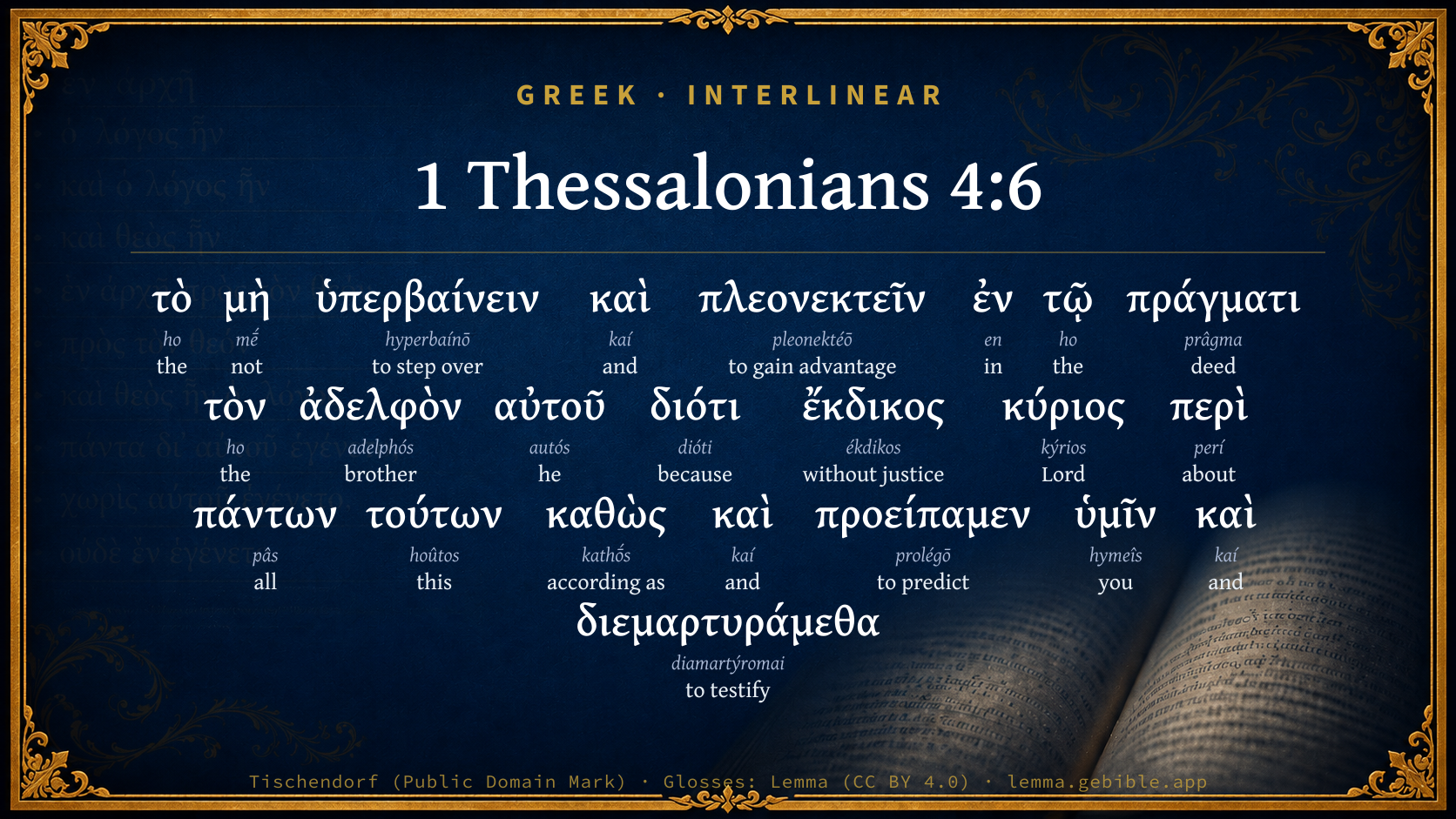
Download image
Cite this verse

1 Thessalonians 4:6 (World English Bible). Public Domain. Lemma interlinear Bible study tool, https://lemma.gebible.app/v/1-thessalonians/4/6.

Show BibTeX & RIS
BibTeX
RIS
English Translation
that no one should take advantage of and wrong a brother or sister in this matter; because the Lord is an avenger in all these things, as also we forewarned you and testified.
World English Bible · Public Domain
Highlights
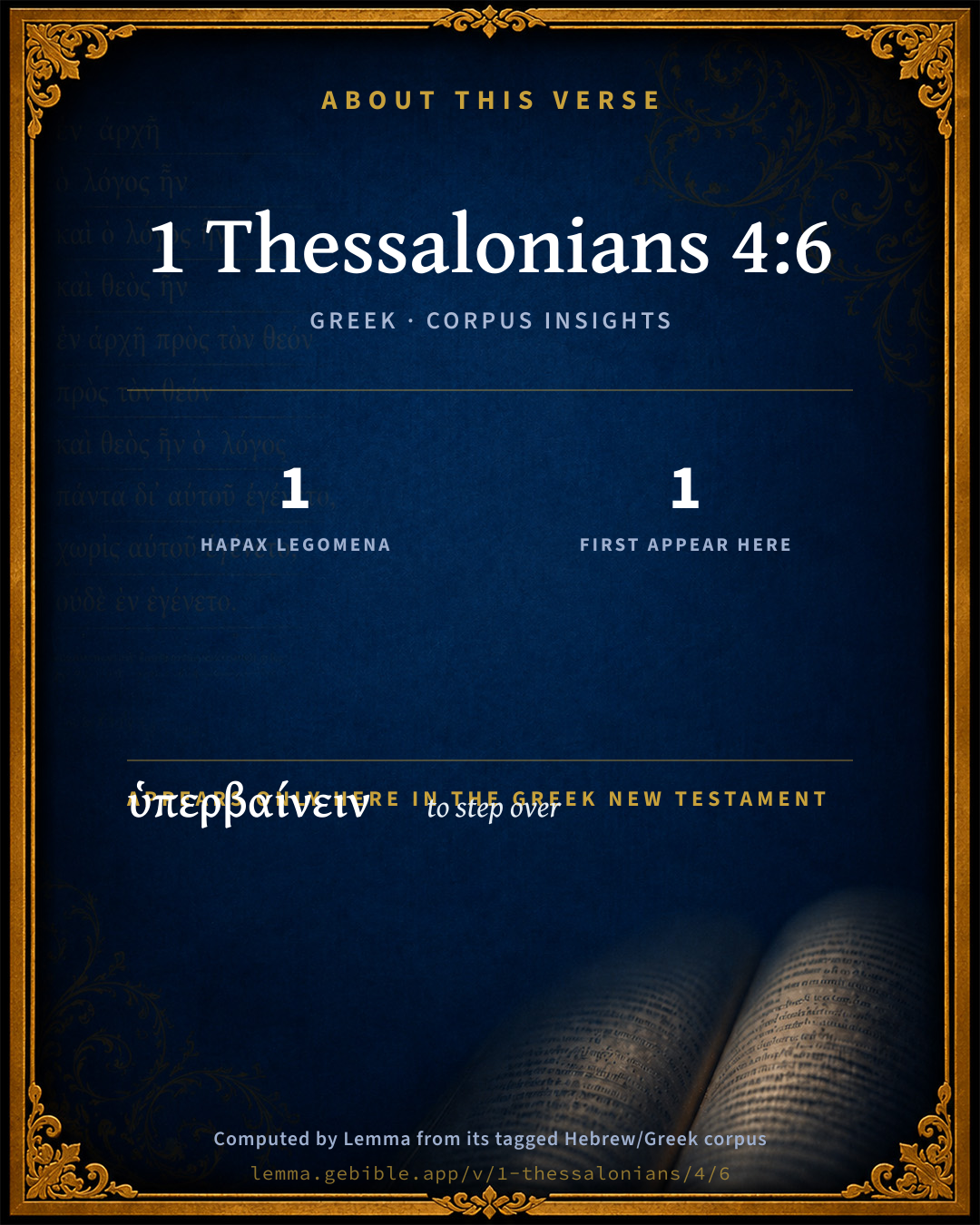
  • 1 hapax legomenon — only here in the Greek New Testament
  • 1 first appearance in the Greek New Testament
Full analysis ↓
Download a study sheet

One document with this verse’s original text, its word-by-word gloss line, the meaning frame, cross-references with their text, attributed commentary, and full source and license credits — printable, and it pastes into notes with its structure intact.

This verse Autodidact and up

Study sheet (.html) Plain text (.txt)

A passage Seminary Student

Up to 50 verses in one chapter. A passage sheet keeps up to 6 commentary sources and 12 cross-references per verse, in the order this page ranks them, and says so on the sheet whenever that leaves anything out. Ask for a single verse and you get the Autodidact verse sheet above.

Everything on this page stays free to read, with no account — the sheet is a download of what is already on screen, not access to it.

Want to remove ads? Support Godless Engineer
Compare translations 3

The same verse in 3 English versions, stacked beneath the original-language interlinear above. Click any original word for its lexicon entry.

Each is an independent rendering of the whole verse — the interlinear is not word-aligned to these translations.

Highlighted words mark where these versions differ — a whole-verse word diff, not a word-by-word alignment.

  • World English Bible Public Domain
    that no one should take advantage of and wrong a brother or sister in this matter; because the Lord is an avenger in all these things, as also we forewarned you and testified.
  • King James Version Public Domain
    That no man go beyond and defraud his brother in any matter: because that the Lord is the avenger of all such, as we also have forewarned you and testified.
  • unfoldingWord Literal Text CC BY-SA 4.0
    not to transgress and take advantage of his brother in this matter, for the Lord an avenger concerning all these things, just as we also said before to you and testified.

unfoldingWord Literal Text — © unfoldingWord, licensed CC BY-SA 4.0. Word-aligned USFM3 via Door43 (git.door43.org/unfoldingWord/en_ult).

Versions to compare (up to 4)

3 of 4 selected

Show all 19 translations

Every available English version of this verse, each an independent rendering of the whole verse.

  • World English Bible Public Domain
    that no one should take advantage of and wrong a brother or sister in this matter; because the Lord is an avenger in all these things, as also we forewarned you and testified.
  • Berean Standard Bible Public Domain
    and no one should ever violate or exploit his brother in this regard, because the Lord will avenge all such acts, as we have already told you and solemnly warned you.
  • Majority Standard Bible Public Domain
    and no one should ever violate or exploit his brother in this regard, because the Lord will avenge all such acts, as we have already told you and solemnly warned you.
  • King James Version Public Domain
    That no man go beyond and defraud his brother in any matter: because that the Lord is the avenger of all such, as we also have forewarned you and testified.
  • American Standard Version (1901) Public Domain
    that no man transgress, and wrong his brother in the matter: because the Lord is an avenger in all these things, as also we forewarned you and testified.
  • Revised Version (1885) Public Domain
    that no man transgress, and wrong his brother in the matter: because the Lord is an avenger in all these things, as also we forewarned you and testified.
  • Geneva Bible (1599) Public Domain
    That no man oppresse or defraude his brother in any matter: for the Lord is auenger of all such thinges, as we also haue tolde you before time, and testified.
  • Douay-Rheims (1899) Public Domain
    And that no man overreach, nor circumvent his brother in business: because the Lord is the avenger of all these things, as we have told you before, and have testified.
  • Young's Literal Translation Public Domain
    that no one go beyond and defraud in the matter his brother, because an avenger `is' the Lord of all these, as also we spake before to you and testified,
  • Literal Standard Version CC BY-SA 4.0
    that no one goes beyond and defrauds his brother in the matter, because the LORD [is] an avenger of all these, as we also spoke to you before and testified,
  • Unlocked Literal Bible CC BY-SA 4.0
    Let no man transgress and wrong his brother in this matter. For the Lord is an avenger in all these things, just as we forewarned you and testified.
  • unfoldingWord Literal Text CC BY-SA 4.0
    not to transgress and take advantage of his brother in this matter, for the Lord an avenger concerning all these things, just as we also said before to you and testified.
  • Darby Bible Public Domain
    not overstepping the rights of and wronging his brother in the matter, because the Lord [is] the avenger of all these things, even as we also told you before, and have fully testified.
  • World Messianic Bible Public Domain
    that no one should take advantage of and wrong a brother or sister in this matter; because the Lord is an avenger in all these things, as also we forewarned you and testified.
  • Webster's Bible Public Domain
    That no man go beyond and defraud his brother in any matter: because the Lord is the avenger of all such, as we also have forewarned you and testified.
  • Free Bible Version CC BY-SA 4.0
    Don't cheat or take advantage of another Christian in these matters, for the Lord is the one who executes justice in all such things, as we've already clearly explained to you, and warned you about.
  • Bible in Basic English Public Domain
    And that no man may make attempts to get the better of his brother in business: for the Lord is the judge in all these things, as we said to you before and gave witness.
  • Text-Critical English NT CC BY 4.0
    In this matter no one should wrong or take advantage of his brother, because the Lord is an avenger in all these things, as we told you before and solemnly warned you.
  • Tyndale New Testament (1534) Public Domain
    that noman goo to farre and defraude his brother in bargayninge: because the lorde is a venger of all suche thinges as we tolde you before tyme and testified.

Literal Standard Version (2020), Covenant Press — licensed CC BY-SA 4.0. Text via the HelloAO Bible API (eBible.org). Unlocked Literal Bible (unfoldingWord) — licensed CC BY-SA 4.0. Text via the HelloAO Bible API (eBible.org). unfoldingWord Literal Text — © unfoldingWord, licensed CC BY-SA 4.0. Word-aligned USFM3 via Door43 (git.door43.org/unfoldingWord/en_ult). Free Bible Version, Dr. Jonathan Gallagher — licensed CC BY-SA 4.0. Text via the HelloAO Bible API (eBible.org).

Word by word

More ways to search: Search by grammar → Find every occurrence → Compare this word →

Practice this passage: Drill this verse → Learn its vocabulary →

ὑπερβαίνειν
hyperbaínō
G5233
“to step over”
Verb, Present, Active, Infinitive
Part of Speech
Verb
Tense
Present
Voice
Active
Mood
Infinitive
Full Thayer's Definition

Origin: from G5228 and the base of G939

TDNT: 17:23,8

1. to step over, beyond 2. metaph. a. to transgress b. to overstep the proper limits c. trespass, do wrong, sin 1. of one who defrauds another in business d. overreaches
  1. τὸ ho G3588 “the” Article, Accusative, Singular, Neuter
  2. μὴ mḗ G3361 “not” Particle, Negative
  3. καὶ kaí G2532 “and” Conjunction
  4. πλεονεκτεῖν pleonektéō G4122 “to gain advantage” Verb, Present, Active, Infinitive
  5. ἐν en G1722 “in” Preposition
  6. τῷ ho G3588 “the” Article, Dative, Singular, Neuter
  7. πράγματι prâgma G4229 “deed” Noun, Dative, Singular, Neuter
  8. τὸν ho G3588 “the” Article, Accusative, Singular, Masculine
  9. ἀδελφὸν adelphós G80 “brother” Noun, Accusative, Singular, Masculine
  10. αὐτοῦ autós G846 “he” Personal pronoun, Genitive, Singular, Masculine
  11. διότι dióti G1360 “because” Conjunction
  12. ἔκδικος ékdikos G1558 “without justice” Adjective, Nominative, Singular, Masculine
  13. κύριος kýrios G2962 “Lord” Noun, Nominative, Singular, Masculine
  14. περὶ perí G4012 “about” Preposition
  15. πάντων pâs G3956 “all” Adjective, Genitive, Plural, Masculine
  16. τούτων hoûtos G3778 “this” Demonstrative pronoun, Genitive, Plural, Masculine
  17. καθὼς kathṓs G2531 “according as” Adverb
  18. καὶ kaí G2532 “and” Conjunction
  19. προείπαμεν prolégō G4302 “to predict” Verb, Aorist, Active, Indicative, 1st person, Plural
  20. ὑμῖν hymeîs G5210 “you” Personal pronoun, 2nd person, Dative, Plural
  21. καὶ kaí G2532 “and” Conjunction
  22. διεμαρτυράμεθα diamartýromai G1263 “to testify” Verb, Aorist, Middle deponent, Indicative, 1st person, Plural

About this verse

These counts appear in no published source. They are computed here, from the morphology-tagged text and Lemma’s own curated glosses. What Lemma adds →

23
words
19
distinct lemmas
Pauline Epistles
section

Notable vocabulary

1 hapax legomenon — a word that appears only here in the entire Greek New Testament:

  • ὑπερβαίνειν to step over G5233

First appearance in Scripture

This word makes its first canonical appearance in the Greek New Testament here:

  • ὑπερβαίνειν to step over G5233

Shared distinctive vocabulary

ἔκδικος without justice G1558 occurs in 2 verses of the Greek New Testament. Also found in:
Repetition

Words recur within this verse:

Cross-references

46

Topical passages linked to 1 Thessalonians 4:6 in the Treasury of Scripture Knowledge — connected by theme and wording, ordered by reader-vote popularity; previews shown in the World English Bible.

  • Hebrews 13:4 Let marriage be held in honor among all, and let the bed be undefiled: but God will judge the sexually immoral and adulterers.
  • Exodus 20:17 "You shall not covet your neighbor's house. You shall not covet your neighbor's wife, nor his man-servant, nor his maid-servant, nor his ox, nor his donkey, nor anything that is your neighbor's."
  • Exodus 20:15 "You shall not steal.
  • Romans 12:19 Don't seek revenge yourselves, beloved, but give place to God's wrath. For it is written, "Vengeance belongs to me; I will repay, says the Lord."
  • Proverbs 28:24 Whoever robs his father or his mother, and says, "It's not wrong." He is a partner with a destroyer.
  • Romans 1:18 For the wrath of God is revealed from heaven against all ungodliness and unrighteousness of men, who suppress the truth in unrighteousness,
  • Deuteronomy 32:35 Vengeance is mine, and recompense, At the time when their foot shall slide: For the day of their calamity is at hand, The things that are to come on them shall make haste.
  • Ezekiel 22:13 Behold, therefore, I have struck my hand at your dishonest gain which you have made, and at your blood which has been in the midst of you.
  • Malachi 3:5 I will come near to you to judgment; and I will be a swift witness against the sorcerers, and against the adulterers, and against the perjurers, and against those who oppress the hireling in his wages, the widow, and the fatherless, and who deprive the foreigner of justice, and don't fear me," says Yahweh of Hosts.
  • Luke 12:5 But I will warn you whom you should fear. Fear him, who after he has killed, has power to cast into Gehenna. Yes, I tell you, fear him.
  • Romans 13:4 for he is a servant of God to you for good. But if you do that which is evil, be afraid, for he doesn't bear the sword in vain; for he is a minister of God, an avenger for wrath to him who does evil.
  • Galatians 5:21 envyings, murders, drunkenness, orgies, and things like these; of which I forewarn you, even as I also forewarned you, that those who practice such things will not inherit the Kingdom of God.
  • James 2:6 But you have dishonored the poor man. Don't the rich oppress you, and personally drag you before the courts?
  • James 5:4 Behold, the wages of the laborers who mowed your fields, which you have kept back by fraud, cry out, and the cries of those who reaped have entered into the ears of the Lord of Hosts.
  • Leviticus 19:11 "'You shall not steal; neither shall you deal falsely, nor lie to one another.
  • Leviticus 19:13 "'You shall not oppress your neighbor, nor rob him. The wages of a hired servant shall not remain with you all night until the morning.
  • Leviticus 25:14 "'If you sell anything to your neighbor, or buy from your neighbor, you shall not wrong one another.
  • Leviticus 25:17 You shall not wrong one another; but you shall fear your God: for I am Yahweh your God.
  • Deuteronomy 24:7 If a man be found stealing any of his brothers of the children of Israel, and he deal with him as a slave, or sell him; then that thief shall die: so shall you put away the evil from the midst of you.
  • 1 Samuel 12:3–4 Here I am: witness against me before Yahweh, and before his anointed: whose ox have I taken? or whose donkey have I taken? or whom have I defrauded? whom have I oppressed? or of whose hand have I taken a ransom to blind my eyes therewith? and I will restore it you.
  • Job 31:13–14 "If I have despised the cause of my man-servant Or of my maid-servant, When they contended with me;
  • Psalms 94:1 Yahweh, you God to whom vengeance belongs, You God to whom vengeance belongs, shine forth.
  • Psalms 140:12 I know that Yahweh will maintain the cause of the afflicted, And justice for the needy.
  • Proverbs 11:1 A false balance is an abomination to Yahweh, But accurate weights are his delight.
  • Proverbs 20:14 "It's no good, it's no good," says the buyer; But when he is gone his way, then he boasts.
  • Proverbs 20:23 Yahweh detests differing weights, And dishonest scales are not pleasing.
  • Proverbs 22:22–23 Don't exploit the poor, because he is poor; And don't crush the needy in court;
  • Ecclesiastes 5:8 If you see the oppression of the poor, and the violent taking away of justice and righteousness in a district, don't marvel at the matter: for one official is eyed by a higher one; and there are officials over them.
  • Isaiah 5:7 For the vineyard of Yahweh of Hosts is the house of Israel, And the men of Judah his pleasant plant: And he looked for justice, but, behold, oppression; For righteousness, but, behold, a cry of distress.
  • Jeremiah 7:6 if you don't oppress the foreigner, the fatherless, and the widow, and don't shed innocent blood in this place, neither walk after other gods to your own hurt:
  • Jeremiah 9:4 Take you heed everyone of his neighbor, and don't you trust in any brother; for every brother will utterly supplant, and every neighbor will go about with slanders.
  • Ezekiel 45:9–14 Thus says the Lord Yahweh: Let it suffice you, princes of Israel: remove violence and spoil, and execute justice and righteousness; dispossessing my people, says the Lord Yahweh.
  • Amos 8:5–6 Saying, 'When will the new moon be gone, that we may sell grain? And the Sabbath, that we may market wheat, Making the ephah small, and the shekel large, And dealing falsely with balances of deceit;
  • Zephaniah 3:1 Woe to her who is rebellious and polluted, the oppressing city!
  • Zephaniah 3:5 Yahweh, in the midst of her, is righteous. He will do no wrong. Every morning he brings his justice to light. He doesn't fail, but the unjust know no shame.
  • Mark 10:19 You know the commandments: 'Do not murder,' 'Do not commit adultery,' 'Do not steal,' 'Do not give false testimony,' 'Do not defraud,' 'Honor your father and mother.'"
  • 1 Corinthians 6:7–9 Therefore it is already altogether a defect in you, that you have lawsuits one with another. Why not rather be wronged? Why not rather be defrauded?
  • Ephesians 4:17 This I say therefore, and testify in the Lord, that you no longer walk as the rest of the Gentiles also walk, in the futility of their mind,
  • Ephesians 5:6 Let no one deceive you with empty words. For because of these things, the wrath of God comes on the children of disobedience.
  • 2 Thessalonians 1:8 giving vengeance to those who don't know God, and to those who don't obey the Gospel of our Lord Jesus,
  • Proverbs 16:11 Honest balances and scales are Yahweh's; All the weights in the bag are his work.
  • Isaiah 1:23–24 Your princes are rebellious, and companions of thieves. Everyone loves bribes, and follows after rewards. They don't judge the fatherless, Neither does the cause of the widow come to them.
  • Isaiah 59:4–7 None sues in righteousness, and none pleads in truth: they trust in vanity, and speak lies; they conceive mischief, and bring forth iniquity.
  • Micah 2:2 They covet fields, and seize them; And houses, and take them away: And they oppress a man and his house, Even a man and his heritage.
  • Ephesians 4:28 Let him who stole steal no more; but rather let him labor, working with his hands the thing that is good, that he may have something to give to him who has need.
  • Deuteronomy 25:13–16 You shall not have in your bag diverse weights, a great and a small.

Cross-references courtesy of OpenBible.info (CC BY 4.0).

Commentary

Notes on 1 Thessalonians 4:6 from classic Christian and Jewish commentators (each source and its license shown beneath its notes). The classic Christian expositions comment on the surrounding passage and are grouped to its opening verse, so a note may address several verses; the Jewish commentaries on the Tanakh (Rashi and others) are per-verse, so they appear only where the commentator wrote on this verse.

Lemma curates 59 commentaries, every one of them public domain or Creative Commons licensed, each selected and text-cleaned for this edition rather than reprinted as found. About our sources →

Albert Barnes' Notes on the Bible

That no man go beyond - ὑπερβαίνειν huperbainein. This word means, “to make to go over,” as, e. g., a wall or mountain; then, to overpass, to wit, certain limits, to transgress; and then to go too far, i. e., to go beyond right - hence to cheat or defraud. It is not used elsewhere in the New Testament. The idea of overreaching is that which is implied in its use here.

And defraud - πλεονεκτεῖν pleonektein Margin, “oppress,” or “overreach.” This word properly means, to have more than another; then to have an advantage; and then to take advantage of any one, to circumvent, defraud, cheat. It is rendered “got an advantage,” 2Co 2:11; “defraud,” 2Co 7:2; 1Th 4:6; “make a gain,” 2Co 12:17-18. Compare for the use of the adjective, 1Co 5:10-11; 1Co 6:10; Eph 5:5; and the noun, Mar 7:22; Luk 12:15; Rom 1:29; 2Co 9:5; Eph 5:3; Col 3:5; 1Th 2:5; 2Pe 2:3, 2Pe 2:14. It is the word commonly used to denote covetousness. Taking advantage of, is the idea which it conveys here.

In any matter - Margin, “or the.” According to the reading in the margin, this would refer to the particular matter under discussion 1Th 4:3-5, to wit, concupiscence. and the meaning then would be, that no one should be guilty of illicit intercourse with the wife of another. Many expositors - as Hammond Whitby, Macknight, Rosenmuller, and others, suppose that this is a prohibition of adultery, and there can be no doubt that it does include this. But there is no reason why it should be confined to it. The Greek is so general that it may prohibit all kinds of fraud, overreaching, or covetousness, and may refer to any attempt to deprive another of his rights, whether it be the right which he has in his property, or his rights as a husband, or his rights in any other respect. It is a general command not to defraud; in no way to take advantage of another; in no way to deprive him of his rights.

Because that the Lord is the avenger of all such - Of all such as are guilty of fraud; that is, he will punish them; compare Rom 12:19 note; Eph 6:9 note.

As we also have forewarned - Doubtless when he was with them.

Albert Barnes' Notes on the Bible (1834–1885) — public domain. Text from a community e-Sword/MySword module.

Bengel's Gnomon

Johann Albrecht Bengel

1Th 4:6. Τὸ μὴ ὑπερβαίνειν καὶ πλεονεκτεῖν) The article τὸ makes an emphatic addition [Epitasis], which falls upon the verb ὑπερβαίνειν. Eustathius explains ὑπερβῆναι as, τὸ καθʼ ὑπερβολὴν ἀστοχῆσαι τοῦ δέοντος, to miss the mark as to what is in the highest degree necessary. Therefore Paul does not seem to be speaking here of avarice, which however is joined to sins of impurity in Eph 5:5 and Col 3:5 (whence also the article makes an Epitasis or emphatic addition), and which, as being a capital transgression, is called idolatry; but of the deceptions and arts of adulterers, Heb 13:4; for the Asyndeton [no copula between εἰδέναι, 1Th 4:4, and τὸ μὴ ὑπερβαίνειν, 1Th 4:6] indicates that the same subject is continued; and he is speaking of a ‘matter’ of such a kind, as that the blame attached to it is greater than that attached to theft, Pro 6:30: and in 1Th 4:7 he returns to the mention of impurity and holiness alone. It is by a Euphemism that the apostle does not call it adultery.—ἑν τῷ πράγματι, in the matter or business) The article points out the particular business in hand at this or that time, 2Co 7:11.—ἀδελφὸν, brother) The reason assigned (Ætiology) for avoiding the transgression [τὸ ὑπερβαίνειν, viz. adultery].—ἔκδικος, avenger) Heb 13:4, note.—ὁ Κύριος, the Lord) Christ, the Judge.

Bengel's Gnomon of the New Testament — English translation (T&T Clark, Edinburgh, 1860) — public domain. Text from a community e-Sword module.

Meyer's Critical & Exegetical Commentary

Heinrich August Wilhelm Meyer

1Th_4:6. The second chief point which the apostle subordinates to the θέλημα τοῦ Θεοῦ (1Th_4:3), adding to the prohibition of unchastity the further prohibition of covetousness and overreaching our neighbour (Nicolas Lyrensis, Faber Stapulus, Zwingli, Calvin, Bullinger, Zanchius, Hunnius, Luc. Osiander, Balduin, Aretius, Vorstius, Gomarus, Grotius, Calovius, Clericus, Wolf, Koppe, Flatt, de Wette, Koch, Bouman, supra, p. 82; Bisping, Ewald, Hofmann, Riggenbach, and others). It is true Chrysostom, Theodoret, John Damascenus, Oecumenius, Theophylact, Jerome on Eph_5:5, Erasmus, Clarius, Zeger, Estius, Cornelius a Lapide, Heinsius, Whitby, Benson, Wetstein, Kypke, Bengel, Baumgarten, Zachar., Michaelis, Pelt, Schott, Olshausen, Bloomfield, Alford, and others, refer it still to the prohibition of unchastity given in 1Th_4:4-5, whilst they find in 1Th_4:6 a particular form of it designated, namely, adultery, and consider the sentence as dependent on εἰδέναι (Pelt), or as in apposition to 1Th_4:4-5. But this is without justification. For(1) the expressions ὑπερβαίνειν and πλεονεκτεῖν most naturally denote a covetous, deceitful conduct in common social intercourse. (2) If the discourse had been only of πορνεία, the words περὶ πάντων τούτων would scarcely have been put. Different kinds of πορνεία must at least have been previously enumerated. But not even this could be the case, as then to the dissuasion from πορνεία in general, the dissuasion from a special kind of πορνεία would be united. (3) Lastly, the article imperatively requires us to consider τὸ … αὐτοῦ as parallel to ὁ ἁγιασμὸς ὑμῶν, 1Th_4:3, and, accordingly, as a second object different from the first. If Pelt objects against our view that a mention of covetousness (1Th_4:6) would occur plane inexspectato, he does not consider that lust and covetousness were the two cardinal vices of the heathen world, and that Paul was accustomed elsewhere to mention them together; comp. Eph_4:19; Eph_5:3; Eph_5:5; Col_3:5. Also, the further objection which is insisted on, that on account of 1Th_4:7 an exhortation to chastity must be contained in 1Th_4:6, is not convincing, as there is nothing to prevent us taking ἀκαθαρσία and ἁγιασμός, 1Th_4:7 (see on passage), in the wider sense.

τό] not equivalent to ὥστε (Baumgarten-Crusius), but a second exponent of the object-matter of θέλημα τοῦ Θεοῦ (1Th_4:3).

ὑπερβαίνειν] here only in the N. T., stands absolutely: justos fines migrare, to grasp too far (Luther). Comp. Eurip. Alc. 1077: μὴ νῦν ὑπέρβαινʼ, ἀλλʼ ἐναισίμως φέρε, Il. ix. 501: ὅτε κέν τις ὑπερβήῃ καὶ ἁμάρτῃ. The idea of an oppressio violenti, qualis tyrannorum et potentium est, qui inferiores injustis exactionibus aut aliis illicitis modis premunt (Hemming) is inserted, and every supplement, as that of Piscator, excedere mordum in augendis rerum pretiis, is to be rejected. What Paul particularly understood by the entirely general μὴ ὑπερβαίνειν he himself indicates by καὶ πλεονεκτεῖν … αὐτοῦ, which latter words, as μή is not repeated before πλεονεκτεῖν, can contain no independent requirement, but must be an explanatory specification of ὑπερβαίνειν. καί is accordingly to be understood in the sense of and indeed. Others, as Beza, Koppe, Pelt, Baumgarten-Crusius, Alford, Hofmann, Riggenbach, have united both verbs with τὸν ἀδελφόν. But the union of ὑπερβαίνειν with a personal object is objectionable, and also in the two passages adduced for it by Kypke (Plutarch, de amore prolis, p. 496, and Demosthenes, adv. Aristocrat. p. 439) the meaning opprimere is at least not demonstrable. Moreover, not ἕκαστον, from 1Th_4:4 (Baumgarten-Crusius, Alford), but τινά, is to be considered as the subject to τὸ μὴ ὑπερβαίνειν κ.τ.λ.

πλεονεκτεῖν] expresses the overreaching, the fraudulent pursuit of our own gain springing from covetousness (comp. 2Co_7:2; 2Co_12:17-18), not the covetous encroaching upon the possession of a brother, as a figurative expression for adultery.

ἐν τῷ πράγματι] is not verecunde pro concubitu (Estius and those mentioned above), but means in the business (now, or at any time in hand). Too narrow a sense, Piscator: in emendo et vendendo. Rittershus. Polyc. Leyser (in Wolf), and Koppe consider the article as enclitic (ἔν τῳ instead of ἔν τινι); unnecessary, and without any analogy in the New Testament. Comp. Winer, p. 50 [E. T. 61]. But also erroneously, Macknight, Schott, Olshausen, and others, ἐν τῷ πράγματι is equivalent to ἐν τούτῳ τῷ πράγματι.

τὸν ἀδελφὸν αὐτοῦ] is not equivalent to τὸν πλησίον (Schott, Koch, and others), but denotes fellow-Christians; comp. 1Th_4:10. This limitation of the prohibition to Christians is not surprising (Schrader), as there is no emphasis on τὸν ἀδελφὸν αὐτοῦ (for otherwise it must have been written τὸ τὸν ἀδελφὸν αὐτοῦ μὴ κ.τ.λ.), and accordingly the misinterpretation that the conduct of Christians to those who are not Christians is to be different, could not possibly arise. Paul simply names the circle which stood nearest to the Christians, but without intending to exclude thereby the wider circles.

ἔκδικος] an avenger; comp. Rom_13:4. The same reason for prohibition in Eph_5:5-6; Col_3:6; Gal_5:21. Compare the saying: ἔχει Θεὸς ἔκδικον ὄμμα (Homer, Batrachom.), which has become a proverb.

καθὼς καί] refers back to διότι.

προείπομεν] foretold; the προ refers to the time preceding the future judgment, and the preterite to the time of the apostles presence among the Thessalonians.

διεμαρτυράμεθα] an intensifying of προείπομεν.

Meyer — Critical and Exegetical Commentary on the New Testament — English translation by Peter Christie, edited by Frederick Crombie (T&T Clark, 1880) — public domain. Text from a community e-Sword module.

Expositor's Greek Testament

ed. W. Robertson Nicoll

1Th 4:6 . Compare the saying of rabbi Simon ben Zoma (on Deu 23:25 ): “Look not on thy neighbour’s vineyard. If thou hast looked, enter not; if thou hast entered, regard not the fruits; if thou hast regarded them, touch them not; if thou hast touched them, eat them not. But if thou hast eaten, then thou dost eject thyself from the life of this world and of that which is to come” (quoted in Bacher’s Agada der Tannaiten , 2nd ed., 1903, i. 430). There is no change of subject, from licentiousness to dishonesty. The asyndeton and the euphemistic ἐν τῷ πράγματι (not τῳ = τινί , Win. § 6 4 d ) show that Paul is still dealing with the immorality of men, but now as a form of social dishonesty and fraud. The metaphors are drawn from trade, perhaps as appropriate to a trading community. While ὑπερβαίνειν may be intransitive (in its classical sense of “transgress”), it probably governs ἀδελφόν in the sense of “get the better of,” or “overreach;” πλεονεκτεῖν similarly = “overreach,” “defraud,” “take advantage of” (2Co 7:2 ; 2Co 12:17-18 ; Xen., Mem. , iii. 5, 2; Herod. viii. 112). Compare ἀκαθαρσίας πάσης ἐν πλεονεξίᾳ (Eph 4:19 ). The passage (with 1Th 4:8 ) sounds almost like a vague reminiscence of Test. Asher, ii. 6: ὁ πλεονεκτῶν τὸν πλησίον παροργίζει τὸν Θεόν … τὸν ἐντολέα τοῦ νόμου Κύριον ἀθετεῖ . Only τὸν ἀνθ . here is not the wronged party but the apostles who convey God’s orders. διότι κ . τ . λ . = “since ( cf. 1Th 2:8 ) the Lord is the avenger (from Deu 32:35 ; cf. Sap. 12:12; Sir 30:6 ; 1Ma 13:6 , ἐκδικήσω περὶ ; 4Ma 15:29 ) in all these matters” (of impurity). How, Paul does not explain ( cf. Col 3:5-6 ). By a premature death (1Co 11:30 )? Or, at the last judgment (1Th 1:10 )? not in the sense of Sap. 3:16, 1Th 4:6 (illegitimate children evidence at last day against their parents) at any rate.

The Expositor's Greek Testament, edited by W. Robertson Nicoll (1897–1910) — public domain. Text from a community e-Sword module.

Geneva Bible (1599)

Geneva Bible translators

Secondly, he reprehendeth all violent oppression and immoderate desire, and showeth most severely as the Prophet of God, that God will revenge such wickedness.

Geneva Bible (1599) marginal notes — public domain. Text via Bolls.life.

Jamieson, Fausset & Brown

Robert Jamieson, A. R. Fausset & David Brown

go beyond--transgress the bounds of rectitude in respect to his "brother."

defraud--"overreach" [ALFORD]; "take advantage of" [EDMUNDS].

in any matter--rather as Greek, "in the matter"; a decorous expression for the matter now in question; the conjugal honor of his neighbor as a husband, Th1 4:4; Th1 4:7 also confirms this view; the word "brother" enhances the enormity of the crime. It is your brother whom you wrong (compare Pro 6:27-33).

the Lord--the coming Judge (Th2 1:7-8).

avenger--the Righter.

of all such--Greek, "concerning all these things;" in all such cases of wrongs against a neighbor's conjugal honor.

testified--Greek, "constantly testified [ALFORD].

Jamieson, Fausset & Brown — Commentary Critical and Explanatory on the Whole Bible (1871) — public domain (CC PDM 1.0). Text via the HelloAO Bible API.

Adam Clarke's Commentary

Verse 6. That no man go beyond and defraud his brother] That no man should by any means endeavour to corrupt the wife of another, or to alienate her affections or fidelity from her husband; this I believe to be the apostle's meaning, though some understand it of covetousness, overreaching, tricking, cheating, and cozenage in general.

The Lord is the avenger of all such] He takes up the cause of the injured husband wherever the case has not been detected by man, and all such vices he will signally punish. Every species of uncleanness was practised among the heathens, nor were they reputed as vices. Their gods, their emperors, their philosophers, and their great men in general, gave them examples of every species of impurity; and they had no system of ethics which forbade these abominations. The Christian religion not only discountenances these things, but forbids them on the most awful penalties; therefore wherever Christianity prevails, these vices, if practised at all, are obliged to seek the deepest gloom of midnight to cover them from the eyes of men. On this account they are comparatively rare, even among the mere professors of Christianity; they exist, but do not flourish.

Adam Clarke's Commentary on the Bible (1810–1826) — public domain. Text from a community e-Sword/MySword module.

John Calvin's Commentaries

6 Let no man oppress. Here we have another exhortation, which flows, like a stream, from the doctrine of sanctification. “God,” says he, “has it in view to sanctify us, that no man may do injury to his brother.” For as to Chrysostom’s connecting this statement with the preceding one, and explaining ὑπερβαίνειν καὶ πλεονεκτεῖν to mean — neighing after the wives of others, (Jeremiah 5:8) and eagerly desiring them, is too forced an exposition. Paul, accordingly, having adduced one instance of unchastity in respect of lasciviousness and lust, teaches that this also is a department of holiness — that we conduct ourselves righteously and harmlessly towards our neighbors. The former verb refers to violent oppressions — where the man that has more power emboldens himself to inflict injury. The latter includes in it all immoderate and unrighteous desires. As, however, mankind, for the most part, indulge themselves in lust and avarice, he reminds them of what he had formerly taught — that God would be the avenger of all such things. We must observe, however, what he says — we have solemnly testified; for such is the sluggishness of mankind, that, unless they are wounded to the quick, they are touched with no apprehension of God’s judgment.

John Calvin's Commentaries (1540-1563) — public domain. Text from the Calvin Translation Society English edition (1840s-50s) via the Christian Classics Ethereal Library (ccel.org). Calvin's coverage is partial (roughly two-thirds of the Bible); uncommented books and verses are honest gaps, never fabricated. The 19th-century editor's footnotes and remarks are omitted so the notes are faithfully Calvin's own voice.

Ellicott's Commentary for English Readers

(6) That no man.—The form of the Greek shows that this is not exactly parallel with the preceding clauses, as if it ran, “this is God’s will, your sanctification, for you to abstain, for you to know how to possess, for you not to go beyond,” &c. It is a final clause, expressing the purpose of such continence as has just been described. Men are to be chaste and self-possessed, not only for their own salvation’s sake, but in justice to their brethren. In 1Th_3:12-13, they were to love for the sake of becoming holy; here they are to be holy for the sake of charity—a blessed action and reaction.

Defraud his brother.—The original word implies a rapacious dishonesty, of which any person is guilty who gives the rein to his lusts, especially the adulterer. The substantive formed from it is usually translated covetousness, and is generally thought to be used in this special sense in Eph_5:3; Col_3:5. When all men are brethren the sin becomes worse.

In any matter should undoubtedly be in the matter. St. Paul chooses the phrase for delicacy’s sake, both here and in 2Co_7:11.

Because that the Lord.—Again an anticipation of the Advent, for the vengeance meant is that of the Judgment Day, not the natural retribution which carnal sin brings with it. The “Lord,” therefore, in this context probably means more particularly the Incarnate Son, who has a special claim upon men’s bodies (1Co_6:13).

Have forewarned.—Rather, did forewarn. It was part of the Apostles’ original teaching at Thessalonica.

A Bible Commentary for English Readers, edited by Charles John Ellicott (1878–1897) — public domain. Text from a community e-Sword module.

The Cambridge Bible for Schools and Colleges

gen. ed. J. J. S. Perowne

6. that no man go beyond and defraud his brother in any matter] More exactly, that none overreach and take advantage of his brother in the matter. “The matter” is obviously that which occupies the last two verses. Acts of Impurity are social wrongs, as well as sins against the offender’s person. The warning may include any injury done to another touching the affections and engagements that belong to marriage,—“the matter” concerned in the present charge—which is expressly violated by “fornication.” The Apostle sets the wrong in the strongest light: it is to “cheat one’s brother,” and that in what touches most nearly the sanctities of life. Hence the stern warning that follows:—

because that the Lord is the avenger of all such] Rather, an avenger; and concerning all these things—in everything that concerns the honour of the human person and the sacredness of wedded life. Comp. Heb_13:4, “Let marriage be had in honour … Fornicators and adulterers God will judge.” It is written that “Vengeance belongs to God;” and in this matter He is peculiarly bound to exercise it.

as we also have forewarned you and testified] or, solemnly attested: the latter verb implies reference to God, as it is expressed in 2Ti_4:1, “before God and Christ Jesus.” On this subject it appears—as to the moral consequences of faith in Christ and the social purity that belongs to the sanctified life—the apostles at Thessalonica had spoken very plainly and solemnly from the first.

The Cambridge Bible for Schools and Colleges (gen. ed. J. J. S. Perowne; Cambridge University Press, 1878–1918) — public domain. Text from a community e-Sword module.

John Gill's Exposition

That no man go beyond, and defraud his brother in any matter,.... Or "in this matter", as the Syriac version. This is commonly understood of transgressing the bounds of justice and equity between men and men; and of cheating and defrauding in trade and business, by increasing or lessening the value and prices of goods by the buyer and seller, by not keeping to the bargain, contract, covenant, or sample, by false weights and measures, and by taking the advantage of the weakness and ignorance of men; all which is aggravated by dealing thus with a brother; see Co1 6:8 and this hint is thought the rather necessary, since Thessalonica was a place of great trade and business. But the matter, or business referred to, is not trade, but the subject of chastity or uncleanness the apostle is speaking of, both before and after; and the phrases used either design the act of adultery, coveting a brother's wife, and lying with her, and so a defrauding and wronging of him by defiling his bed; or rather sodomitical practices, an unnatural lust and desire in men after men, and copulation with them; for rendered, "go beyond", answers to , "to go upon", or "lie with", so often used in Jewish writings for lying with women, men, and beasts, in an unlawful way. Thus, for instance (y),

"these are to be burned, , "he that lies with a woman", and her daughter, &c.''

And again (z),

"these are to be beaten, , "he that lies with" his sister, or his father's sister, &c.''

And the word translated "defraud", signifies a greedy, insatiable, and unnatural lust and desire after a man, a brother, or the committing of sodomitical practices with greediness: see Eph 4:19 which abominable iniquities are dissuaded from by the following reasons,

because that the Lord is the avenger of all such; or "with respect to all these things", as the Vulgate Latin and Syriac versions render it; or "for all these things", as the Arabic and Ethiopic versions; as fornication, adultery, lasciviousness, and all sorts of abominable uncleanness. The person that commits these things the Lord avenges, either in this life, by the hand of the civil magistrate, who is the minister of God, a revenger to execute wrath on him that does evil; or by a violent death, as in the case of Zimri and Cozbi, and twenty four thousand more at the same time; or by some awful judgment from heaven, as in the case of Sodom and Gomorrah; or in the world to come; for the law of God is made and lies against such persons; these living and dying in such sins God will judge, to whom vengeance belongs; these shall not inherit the kingdom of God, but have their part and portion in the lake which burns with fire and brimstone.

As we have also forewarned you and testified; not by a former epistle, as if this was the second to them, and what follows the first, as Grotius thought; but they did this when they were in person with them, knowing that these abominable vices greatly prevailed in their city; therefore they bore their testimony against them, and exposed the evil of them, and warned them of the danger by them, so that they could not now plead ignorance. The Ethiopic version reads in the first person singular, "as I have before said unto you, and testified to you".

(y) Misna Sanhedrim, c. 9. sect. 1. (z) Misna Maccot, c. 3. sect. 1.

John Gill's Exposition of the Whole Bible (1746–1763) — public domain (CC PDM 1.0). Text via the HelloAO Bible API.

Trapp's Complete Commentary

John Trapp

6 That no man go beyond and defraud his brother in any matter: because that the Lord is the avenger of all such, as we also have forewarned you and testified.

Ver. 6. That no man go beyond or defraud] Or, oppress or cheat. Theft by unjust getting is either επιβολη or επιβουλη, by violence or cunning contrivance. What else is this but crimen stellionatus, criminal lizard, the very sin of deception.

The Lord is the avenger] Though haply they lie out of the walk of human justice, as not coming under man’s cognizance.

John Trapp, A Commentary or Exposition upon All the Books of the Old and New Testament (1647–1656) — public domain. Text from a community e-Sword module.

Haydock's Catholic Bible Commentary

That no man overreach, nor deceive his brother in business.[1] The Protestant and Mr. N. even in their translations, add, in any matter, because some expound it of frauds and circumventions in any kind of business. But this addition of any, should be left out, seeing the best interpreters expound it of a prohibition of adultery, and the injury thereby done to another, and of sins of that kind only, which is confirmed by what follows and what goes before. See St. Jerome in chap. iv. ad Ephes. tom. 4. p. 369.; St. John Chrysostom serm. 3 on this place. Here, says he, he speaks of adultery, as before of fornication, &c. See Theodoret, Theophylactus, Estius, Menochius, A. Lapide, &c. (Witham)

===============================

[BIBLIOGRAPHY]

Ne quis supergrediatur, neque circumveniat in negotio fratrem, Greek: en to pragmati. See St. Jerome: diligenter observa, quia ad castitatem nos provocans, et volens uxoribus tantum esse contentos, dixerit, ne quis supergrediatur, &c. St. John Chrysostom, (Greek: log. e. p. 186.) Greek: entautha peri moicheias phesin, anotero de peri porneias pases.

George Leo Haydock (1774–1849), Haydock's Catholic Family Bible and Commentary, 1859 edition — public domain. Excludes Psalms (Douay-Rheims chapter numbering differs from Protestant) and Deuterocanonical books (Catholic canon only).

Matthew Poole's English Annotations

This some understand to be another part of sanctification, mentioned before, 1Th 4:3, taking the word sanctification in a more general sense. And as before he spake of chastity, so here of commutative justice in commerce and traffic; and the rather because Thessalonica was a city of great trade and merchandise, and it is true that sanctification doth comprehend this righteousness in it, and will restrain men from that which is opposite to it, which, as the apostle speaks, is going beyond and defrauding his brother. To

go beyond, is that which we call overreaching; when in buying or selling we keep not a just measure, when we observe not a due proportion between the price and the commodity, considering it either in its natural worth, or in such circumstances as make it more or less valuable: or, to take advantage of another’s ignorance or necessities, to take unreasonable profit: or, to break covenant with another, answering to the Hebrew word Gnabhar, used in this sense, Deu 17:2; the original word signifies to transgress, or go above the due bounds. And to defraud is, when, out of a covetous mind, we exact upon another beyond what is meet. Some refer the former word to injustice by force, and the latter by fraud, 2Co 7:2. And the evil is the greater because done to a brother. There is a brother by a common relation, and so all men that partake of human nature are brethren; or by special relation, which is either natural, civil, or spiritual. We may understand the word in all these senses, especially the last, that those that are brethren in Christ and in the faith, should not defraud one another. And when the apostle adds, in any matter, the word any not being in the Greek, we may better read it, in dealing, or doing; the word is general, and is to be restrained by the subject matter spoken of. There is another sense of the words, agreeable to the former verses, and the verse that follows, and so some understand the apostle as still speaking of chastity; and so here he forbids the invading another’s bed, transgressing the bounds of marriage, whereby men go beyond or defraud their brother, usurping the use of another man’s wife, whom he hath no right to. And then in any matter we must read, in that matter which he had been speaking of before, or it is a modest expression of the act of adultery. The Hebrew Bo is often used in the Old Testament for carnal copulation, and thence the Greek βαινω and υψερβαινω, here used; and the other word, ψλεονεκτειν, denotes excessiveness in it, Eph 4:19. And the reason he adds is: because the Lord is the avenger of all such. Vengeance is mine; I will repay, saith the Lord, Deu 32:35; Rom 12:19. Whether we understand it of fraud, or overreaching in dealings, when man cannot right and relieve himself, the righteous God will avenge the unrighteousness of men; or of the fraud of the marriage bed, which is done in secret, and man cannot avenge himself, Heb 13:4.

As we also have forewarned you and testified: and this the apostle saith he had forewarned them of, and testified. Though the light of nature told the heathen that God was an avenger of wickedness, Act 28:4, and the heathen could say, ’Eχει θεος εκδικον ομμα. God hath a revengeful eye; yet the apostle had in his preaching assured it. He had told them of Christ’s coming to judge the world, when he would execute vengeance, Jud 1:15; and this they were before ignorant of: and though God sometimes takes vengeance in this world, yet he seems to refer to this last vengeance, because he speaks of it as that which he had forewarned them of, and testified in his ministry, and whereof they had not so clear a testimony in natural conscience.

Matthew Poole's English Annotations on the Holy Bible (1683–1685) — public domain. Text from a community e-Sword/MySword module.

Whedon's Commentary on the Bible

Daniel D. Whedon

6. The verbs go and beyond, here, know, 1Th_4:4, and abstain, 1Th_4:3, are three co-ordinates, all unfolding the branches of sanctification of 1Th_4:3. This third branch implies purity from business frauds.

Go beyond— Overrun, or overreach his brother. That is, his brother Christian: but Lunemann well remarks, that St. Paul applies the precept to the treatment of Christians, not because he would not include all other men, but the Christian circle is what he has in his present view.

In any—Rather, the.

Matter—The business matter at any time in hand. See Winer’s New Testament Grammar on the phrase. We prefer, with Lunemann, against Alford, to interpret this verse of business fraud, rather than overreaching, etc., in sexual matters, because the Greek words lie in the former line of thought; because it supposes a less arbitrary complication of iniquity than the other; and because, in a community so full of commercial greed as well as license as Thessalonica, we can hardly suppose that St. Paul’s reproof would be confined to the last alone.

Avenger—Punisher of all such as are guilty of fornication and fraud.

Forewarned—The fore, says Lunemann, means before the execution of the judgment; the past tense warned places the utterance of the warning at St. Paul’s first visit.

Daniel D. Whedon (gen. ed.), Commentary on the Old and New Testaments (1874–1909) — public domain. Text from a community e-Sword module.

The Pulpit Commentary

That no man go beyond; or, transgress. And defraud; or, as it is in the margin of our Bibles, oppress, or, overreach; wrong (R.V). His brother. Not an exhortation against dishonesty, or prohibition against all attempts to overreach in usual mutual intercourse, as the words would at first sight seem to imply, and as some consider it (Hofmann, Lunemann, Riggenbach); but, as is evident from the context, a continuation of the former exhortation, a prohibition against impurity. In any matter; or, more properly, in the matter, namely, that about which I have been discoursing. "An example of the modest reserve and refined delicacy which characterize the holy apostle"s language in speaking of things which the Gentiles did without shame, and thus, by a chaste bashfulness of words, commending the duty of unblemished purity in deeds" (Wordsworth). Because the Lord is the Avenger of all such ; either of all such as are thus defrauded or of all such sinful practices. As we also have forewarned you and testified.

The Pulpit Commentary (1880–1919), ed. H.D.M. Spence-Jones & Joseph S. Exell — public domain. Text from a community e-Sword module.

John Wesley's Explanatory Notes

In this matter - By violating his bed. The things forbidden, here are three: fornication, ver. 3; the passion of desire, or inordinate affection in the married state, ver. 5; and the breach of the marriage contract.

John Wesley, Explanatory Notes Upon the Whole Bible (1754–1765) — public domain. Text via the GEBible commentary corpus.

Kretzmann's Popular Commentary

Paul E. Kretzmann

A warning against covetousness:

v. 6. That no man go beyond and defraud his brother in any matter, because that the Lord is the avenger of all such, as we also have forewarned you and testified.

v. 7. For God hath not called us unto uncleanness, but unto holiness.

v. 8. He, therefore, that despiseth, despiseth not man, but God, who hath also given unto us His Holy Spirit.

The apostle here points to a second vice, one which is often mentioned together with uncleanness, See Eph 4:19; Eph 5:3-5; Col 3:5, that of avarice, of greed: That no one overreach and defraud his brother in business, because that the Lord is an avenger concerning all these things, as we have said to you before and testified. The description given in these words fitly characterizes the sin of covetousness; for the greedy person goes beyond the limits set by the Law of God; he resorts to trickery and cheating. This will invariably result in fraud, in the deliberate attempt to get the better of every deal, to enrich oneself at the expense of one’s neighbor. Undoubtedly this vice was common in the great Aegean seaport and was not regarded as anything reprehensible, just as the average businessman in our day deems it an evidence of extraordinary astuteness if he can indulge in profiteering without being detected. But the apostle holds up a warning finger, saying that the Lord is an avenger with respect to all these things. The sin may not become manifest before the eyes of men, but before the eyes of God nothing is hidden, and His punishment will strike the wicked in due time. The Christians being subject to the same sinful desires as all other men by reason of their evil flesh, Paul had included this warning in his instructions to the Thessalonians; he had, before, in an earnest testimony, told them the same thing,

With reference to both vices he therefore adds: For not has God called us for uncleanness, but in sanctification. The holy God wants clean hearts; to that end and object He called the believers, working faith and love in their hearts by His call. A Christian cannot live in any form of uncleanness with regard to any of the commandments; if that had been God’s purpose in calling him, He would become a servant of sin. The apostle, therefore, extends his warning: Wherefore, then, he that despises does not despise man, but God, who gave His Holy Spirit to you, To disregard the precept and warning which Paul here issues does not mean a mere despising of men. That in itself may be bad enough, but could at least be condoned. No, it is God’s will which the apostle has proclaimed with regard to these sins, and every one that despises his instructions thereby becomes guilty of despising God. Such a person is all the more culpable in the sight of God because the Lord, in issuing the call, in working conversion, gave His Holy Spirit, thereby granting the power to walk in newness of life. Any person that has once been converted and then deliberately indulges in such sins as here mentioned by the apostle, drives the Holy Spirit out of his heart and thus receives to himself damnation, unless he repents of his sin before it is too late. This fact cannot be emphasized too strongly in our days when indifference and worldliness is raising its head in the midst of the Christian Church.

Paul E. Kretzmann, Popular Commentary of the Bible (1921–1924) — public domain. Text from a community e-Sword module.

Burkitt's Expository Notes on the New Testament

William Burkitt

Here we have another positive duty pressed upon the Thessalonians, in which a great part of their sanctification or holiness would discover itself, namely, justice and equity in all their dealings, man with man. Thessalonica was a city of great trade and merchandise; therefore, the apostle directs them, in their traffic and commerce, neither by fraud nor force, to over-reach and go beyond one another: and the apostle saying, let none go beyond or defraud his brother, that is, his fellow Christian, doth not suppose if lawful to defraud such as were not their brethren, but only lets them see, that for Christians to defraud and cheat, to over-reach and go beyond one another, would be a very great aggravation of their crime, seeing the laws of their religion, as well as the light of nature, condemns all such injustice and dishonesty: and accordingly, the apostle adds a reason to enforce his exhortation, drawn from the dreadful effect of all such sins; namely, that it exposes and lays open the guilty person to the direful vengeance of God: The Lord is the avenger of all such.

Learn hence, 1. That the wisdom of God has variously dispensed the gifts of providence to mankind; to some more, to others less; to some in one kind, to others in another: so that men cannot live without mutual commerce one with another.

Learn, 2. That there is such a covetous and insatiable desire of wealth in the heart of man, that little regarding the measure of worldly things, which God has dispensed unto him, he lies at catch to take all advantages of his neighbour in matters of commerce, and, by defrauding and over-reaching him, seeks to increase his own worldly estate with impairing that of others; Let no man go beyond his brother: The apostle, by forbidding this evil, plainly supposes man to be very prone and ready to fall into it.

Learn, 3. That the sin of injustice in traffic and commerce, is so very heinous in the sight of God, that such men as are guilty of it, without repentance, must never expect to escape the vengeance of God, either here or hereafter; God is the avenger of all such.

Observe next, the reasons urged by St. Paul to enforce his foregoing exhortations to purity and justice.

The first is taken from the design of God in their vocation; when called out of their heathenish state to Christianity, they were called not to uncleanness, but out of uncleanness unto holiness.

The second is taken from the heinousness of their sin, who shall despise or reject the commands here given for holiness and sanctification; he that despiseth, despiseth not man, but God.

To despise the minister of God in a command which he delivers from God, is to despise God himself; the apostle gave these commands by the direction of the Holy Spirit, which was given him for that end; Who hath also given unto us his Holy Spirit: Therefore, says he, he that despiseth, despiseth not man, but God.

Where note, that although the reason here given, why such as despised the apostle, despised God himself, be peculiar to St. Paul, who had the Holy Spirit to guide him infallibly; yet so far as the ordinary ministers of Christ do follow the apostle’s steps, and deliver nothing but what is agreeable to the word of God, the contempt of their message is a despising of God himself: He that despiseth, despiseth not man, but God.

William Burkitt's Expository Notes on the New Testament (1700–1703) — public domain. Text from a community e-Sword module.

McGarvey & Pendleton's Commentaries

J. W. McGarvey

that no man transgress [literally, overreach] , and wrong his brother in the matter [Because the word "overreach" is usually associated with bargaining, trading, and other business transactions, able commentators have thought that Paul here introduced covetousness, that it might be rebuked together with lust. But Paul's language is not to be so contorted. The thought flows smoothly on to the end of verse 8. Lust has its deceptions, its overreachings, its covetousness, as well as commercialism. "Thou shalt not covet thy neighbor's wife"]: because the Lord is an avenger in all these things, as also we forewarned you and testified . [God punishes all such crimes-- Rom_13:4 ; Eph_5:5-6 ; Col_3:6 ]

J. W. McGarvey (with Philip Y. Pendleton), Commentaries on the New Testament (The Fourfold Gospel, 1914; Acts; and the epistles) — public domain. Text from a community e-Sword/MySword module.

The People's New Testament

B. W. Johnson

6. That no man go beyond. Beyond the bounds of purity, so as to wrong his brother. In our age, to assail the purity of wife or daughter is counted as a fearful crime against the family. The Lord is the avenger. He will punish the adulterer, or libertine.

B. W. Johnson's The People's New Testament with Notes (1889–1891) — public domain. Electronic text from the Christian Classics Ethereal Library (CCEL) ThML edition.

Cambridge Greek Testament for Schools and Colleges

6. κυριος, anarthrous, א*ABD*H 17; ο is a Syrian addition.

-ειπαμεν becomes -ειπομεν passim in the T. R. These 1st, for 2nd, aorist endings, in certain verbs of common occurrence, were characteristic of the vernacular; they occur to a limited extent in the literary κοινή, and prevail in contemporary Papyri.

Cambridge Greek Testament for Schools and Colleges (Cambridge University Press, 1896; 21 vols, various authors incl. Carr, Maclear, Plummer, Farrar, Lumby, Moule, M. R. James, Simcox) — public domain. Text from a community e-Sword module.

Alford’s Greek Testament

Henry Alford

6.] I cannot help regarding it as most unnatural, to interpret this verse of a new subject introduced, viz. the not wronging one another in the business of life. How such Commentators as De Wette and Lünem. can have entertained this view, I am at a loss to imagine. For (1) the sense is carried on from vv. 4, 5, without even the repetition of ἕκαστον ὑμῶν to mark the change of topic: and (2) when the Apostle sums up the whole in ver. 7, he mentions merely impurity, without the slightest allusion to the other. To say that more than one kind of sin must be mentioned because of περὶ πάντων τούτων, is mere trifling: the πάντα ταῦτα (not ταῦτα πάντα, which would collect many individuals into a whole) generalizes from the sin mentioned to a wider range. The interpretation which I impugn, is also that of Zwingle, Calv., Grot., Calov., Le Clerc, Wolf, Koppe, Flatt. I understand the verse, with Chrys., Thdrt., Œc., Thl., Jer., Erasm., Est., Corn.-a-lap., Heins., Whitby, Wetst., Kypke, Beng., Michaelis, Pelt, Olsh., all., to refer to the sins of uncleanness, and continue vv. 4, 5:—that he should not (viz. τινά, contained in the αὐτοῦ following: so that τὸ μὴ … is a further specification of ὁ ἁγιασμός, rather than parallel with εἰδέναι) set at nought (the order of the sentence requires that ὑπερβ. should not stand absolutely, as De W., Lün., al., for ‘transgress’ (μὴ νῦν ὑπέρβαινʼ, ἀλλʼ ἐναισίμως φέρε, Eur. Alc. 1077: ὅτε κέν τις ὑπερβήῃ κ. ἁμάρτῃ, Il. ι. 497), but transitively: otherwise τινα would have occurred after ὑπερβαίνειν to mark the distinction of construction: and ὑπερβ with an accusative of person signifies either ‘to pass by’ or ‘take no notice,’ ‘posthabere,’ as Herod. iii. 89, ὑπερβαίνων τοὺς προσεχέας: or ‘to go beyond’ or ‘surpass,’ as Plato, Tim. 24 d, πάσῃ πάντας ἀνθρώπους ὑπερβεβηκότες ἀρετῇ. Of these, the former seems most applicable here: see below) or overreach his brother in the matter (viz of τὸ ἑαυτοῦσκεῦος κτᾶσθαι—that there should be among you none of those strifes on account of the πάθη ἐπιθυμίας, the ‘teterrima belli causa’ in the heathen world. As Jowett rightly observes, “It is not necessary to suppose that any idea of unchastity is conveyed by the term πλεονεκτεῖν, any more than in the tenth commandment, ‘Thou shalt not covet thy neighbour’s wife.’ The meaning exclusively arises from the connexion and application of the word.” How τῷ πράγματι can ever signify τοῖς πράγμασιν, ‘business affairs’ (De W., alt.), I cannot imagine; and it is equally futile (with E. V. arm.) to take τῷ for τῳ = τινι in the N. T. “It is probable that the obscurity of the passage arises partly from the decency in which the Apostle clothes it.” Jowett), because God is the avenger (‘righter,’ in such cases of setting at nought and overreaching) of all these things (viz. cases of ὑπερβασία and πλεονεξία, and by inference, lustful sins like them) as also (see on ver. 5) we before told you and constantly testified.

Henry Alford, The Greek Testament (1849–1861) — public domain. Text from a community e-Sword module.

International Critical Commentary

6. τὸ μὴ ὑπερβαίνειν καὶ πλεονεκτεῖ. “To prevent (τὸ μη) any one of you (sc. τινὰ ὑμῶ from ἕκαστον ὑμῶ, v. 4) from disregarding and taking advantage of his brother in the matter.” Just as appreciation of the wife (εἰδένα) is tacitly regarded as a preventive of fornication (ἀπέχεσθα), so pure and honourable marriage (κτᾶσθα) is expressly (τὸ μη) regarded as preventing the invasion (ὑπερβαίνει) of the sanctity of the brother’s home.

The meaning of τὸ μη is uncertain. Many take it as final in the sense of τοῦ μη (Schmiedel) or ὥστ (Lft.); others regard it as not merely parallel to the anarthrous είδένα but as reverting “to the preceding ἁγιασμό, of which it presents a specific exemplification more immediately suggested by the second part of v. 4” (Ell.); Dob., who inclines to the view of Ell., concludes that the article indicates the beginning of a new and second main point, the matter of dishonesty in business; Dibelius suggests that the article is merely a cæsura in delivery, designed to show that the μη is not parallel to the μη in v. 5, but the beginning of a new clause. On the other hand, τὸ μη (cf. 3:3) may be due to the idea of hindering implied in the clause with κτᾶσθα, a clause thus to be closely connected with τὸ μὴ ὑπερβαίνειν κτλ, as indeed the asyndetical construction itself suggests. In classical Greek, τὸ μη is used with many verbs and expressions which denote or even imply hindrance or prevention (GMT 811, where inter alia the following are noted: Æschylus, Agam. 15: φόβος παραστατεῖ τὸ μὴ βλέγφαρα συμβαλεῖν ὕπνῳ (“stands by to prevent my closing my eyes in sleep”); and Soph. Antig. 544: μήτοι, μʼ ἀτιμάσης τὸ μὴ οὐ θανεῖ). In this case there is no reason for assuming a change of subject in v. 6.—ὑπερβαίνει, only here in N. T., is used in the Lxx literally, “cross over” (2 Reg. 22:30, Pro 9:18 A), “pass by” (2 Reg. 18:23, Job 9:11); and metaphorically “surpass” (3 Mac. 6:24), “leave unnoticed,” “disregard” (Mic 7:18: ἐξαίρων ἀνομίας καὶ ὑπερβαίνων ἀσεβεία). Since the meaning “disregard” suits perfectly here (cf. Ell. who notes Isæus 38:6 43:34 and other passages), it is unnecessary to take ὑπερβαίνει absolutely, or to supply, instead of the natural object τὸν ἀδελφὸν αὐτου, either ὅριο or νόμο or (see Wetstein, who also quotes Jerome: concessos fines praetergrediens nuptiarum). πλεονεκτεῖ occurs elsewhere in Gk. Bib. apart from Paul (2Co 2:11, 2Co 7:2, 2Co 12:17 f.) only Jdg 4:11, Eze 22:27, Hab 2:9; it means “get the advantage of,” “defraud,” the context not the word itself indicating the nature of the advantage taken, whether in money, as usually in Paul, or not (2Co 2:11). Here the object of greediness (cf. πλεονεξί, 2:5) is the brother’s wife as the context as a whole and ἐν τῷ πράγματ particularly suggest.

ἐν τῷπράγματ. “In the matter,” “the meaning of which is sufficiently defined by the context” (Lft.), as in 2Co 7:11. It is probable that the phrase is not a specific reference either to πορνεί, as if the article were anaphoristic, or to μοιχεί, as if the article referred to the matter immediately in hand, but is “a euphemistic generalisation for all sorts of uncleanness” (Lillie), as περὶ πάντων τούτω in this clause and ἀκαθαρσί in v. 7 suggest.

τῷ not the enclitic τῳ, which is without parallel in the N. T., is to be read.—πρᾶγμ like res and ובר is a euphemism for anything abominable. Wetstein cites in point not only 2Co 7:11, but also Æschines, Timarch, 132 ff. and Isæus, de haered. Cironis, 44; cf. also Pirque Aboth 5:23 and Taylor’s note.—In this connection it may be noted that many commentators (e. g. Calv., Grot., De W., Lün., Born, Vincent, Wohl., Dob.) deny the view of Chrys., Th. Mops., Bengel, and most English interpreters (see the names in Lillie) that Paul in vv. 3b-8 is referring solely to impurity, and assert, either on the ground that Vulg translates ἐν τῷ πράγματ by in negotio or that Paul frequently associates uncleanness with avarice (cf. Test. xii, Benj. 5:1 ἄσωτο and οἱ πλεονεκτοῦντε), that with τὸ μη a new point begins, dishonesty in business (cf. especially Dob. Die urchristlichen Gemeinden, 1902, 283). In this view, πρᾶγμ = “business”; and the article is either anaphoristic, if with Born and Vincent κτᾶσθα = “to do business,” or generic, business in general. Against this opinion is the consideration that “no other adequate example of πρᾶγμ in this sense in the singular has been produced” (Mill.). To obviate this consideration, Dibelius looks beyond 1Co 6:1 (πρᾶγμα ἔχει) to the papyri for πρᾶγμ in the sense of “case” at court, without explaining τῷ, and refers v. 6 to disputes: “nicht Uebergriffe machen und beim Zwist den Bruder übervorteilen.”—To interpret v. 6 of sexual immorality is considered forced exegesis by Calv. and Dob. On the other hand, Ell. pertinently remarks: “To regard the verse as referring to fraud and covetousness in the general affairs of life is to infringe on the plain meaning of τῷ πράγματ; to obscure the reference to the key-word of the paragraph ἀκαθαρσί (v. 7); to mar the contextual symmetry of the verses; and to introduce an exegesis so frigid and unnatural as to make us wonder that such good names should be associated with an interpretation seemingly so improbable.”

τὸν ἀδελφὸν αὐτου. Not neighbour in general, not both neighbour and Christian brother, but simply the Christian brother is meant. Obviously the point is not that it is permissible thus to wrong an outsider, but that it is unspeakable thus to wrong a brother in Christ. Zanchius (apud Poole) compares aptly 1Co 6:8: ἀδικεῖτε καὶ τοῦτο ἀδελφού

6b-8. With διότι, γάρ (v. 7) and τοιγαροῦ (v. 8), Paul passes to motives for obeying these commands, not his but God’s commands. First he appeals, as he had done before when he was with them, to the sanction of the judgment when Christ will punish all these sins of the flesh (v. 6b). Next he reminds them that God’s call had a moral end in view, holiness (v. 7). Finally he points out that the indwelling, consecrating Spirit, the gift of God, is the resident divine power in the individual, so that disobedience strikes not at the human but at the divine (v. 8).

διότι ἔκδικος κτλ. διότ = “because” as in 2:8. As a sanction for present obedience to the will of God as specified in vv. 3b-6a, Paul points to the future judgment (2Co 5:10, Rom 14:10). κύριο is not θεό (GF) but Christ (3:12), as the emphatic ὁ θεό (vv. 7-8) intimates. He is the one who inflicts punishment directly or indirectly (cf. II 1:8), the avenger (ἔκδικο) “for all these things,” that is, for fornication, adultery, and all such uncleanness.

ἔκδικο means here, as always in Gk. Bib. (Rom 13:4, Sir. 30:6 Sap. 12:12, 4 Mac. 15:29; cf. ἐκδικητή Psa 8:3), “avenger.” This characterisation of God is so common in the Lxx (ἐκδικῶ or ποιῶν ἐκδίκησι, Psa 98:8, Nah 1:2, Mic 5:15, etc.), that the phrase ἔκδικος κύριο here need not be a literary allusion to Psa 93:1: ὁ θεὸς ἐκδικήσεων κύριος, ὁ θεὸς ἐκδικήσεω

καθὼς καὶ προείπαμεν κτλ. Paul tactfully reminds them, as in vv. 1-2, that this eschatological sanction is not new to them. When he was with them he had “predicted” and “solemnly affirmed” that Christ would avenge all manner of unchastity. Apparently neither the temptation nor the exhortation was new. But whether Timothy had brought news of the yielding to temptation in some case or cases, since Paul’s departure, as ὁ ἀθετῶ (v. 8) rather strongly intimates, or whether the exhortation is simply prophylactic, is uncertain.

On the comparative και (A omits) after καθώς see 3:4; the και after ὑμῖ is the simple copula; on the position of ὑμῖ, cf. v. 1 ἐρωτῶμεν ὑμᾶ προείπαμε (cf. Gal 5:21 where it is contrasted with προλέγ), is predictive as in 3:4; on the mixed aorist (AKL read προείπομεν) see Bl 21:1. διαμαρτύρεσθαι only here in Paul but common elsewhere in Gk. Bib., is possibly stronger than μαρτύρεσθα (2:12; but cf. Kennedy, Sources, 37); it means either “call to witness” (Jer 39:10, 44, Deu 4:26, Deu 31:28) or “solemnly affirm or protest”; etiam apud Att. notio testes invocandi evanescit (Blass on Act 2:40).

International Critical Commentary — older volumes (1896–1929), various authors — public domain. Text from a community e-Sword module.

Vincent's Word Studies in the New Testament

Marvin R. Vincent

That no man go beyond [το μη υπερβαινειν] . Lit. the not going beyond. Dependent on this is the will of Glod, ver. 3. The verb N. T.. Often in LXX, mostly in the literal sense of overpassing limits. Also of overtaking, passing by, surpassing, as in wickedness or cruelty. It is an expansion of the preceding thought. Pursue your business as holy men : do not overreach or defraud.

It is the overstepping of the line between mine and thine. It is used absolutely, being defined by the succeeding clause. The A. V. is literal, go beyond. Rev. renders tranegress. Weizsacker and Bornemann "ubergreife overreach." So. Rev. margin. This last is the best.

Defraud [πλεονεκτειν] . P o. See on 2Co 2:11, and covetousness, Rom 1:29. It emphasises gain as the motive of fraud. Three times in LXX, Jud 4:11; Hab 2:9; Eze 22:27. Often in Class.

In any matter [εν τω πραγματι] . Rev. correctly, in the matter. Comp. 2Co 7:11. The sense is the business in hand, whatever it be. The tw does not stand for tini any. For pragmati, matter, see on Mt 18:19. Those who connect this clause with the preceding, explain tw as the matter just mentioned - adultery.

Avenger [εκδικος] . P o. Here and Rom 13:4. In LXX rarely, and in the same sense as here. In this sense it occurs only in late Greek. For the warning comp. Eph 5:6; Col 3:6; Rom 13:4; Gal 5:21.

Marvin R. Vincent, Word Studies in the New Testament (1887–1900) — public domain. Text from a community e-Sword/MySword module.

Lesson kit

Teaching starters — assembled from the data on this page, not authored interpretation. Every prompt links to the verse data it draws on. Edit before teaching.

1 Thessalonians, in the Pauline Epistles, opens this verse with 23 words (19 distinct Greek lemmas). Its most distinctive word is hyperbaínō (“to step over”). A historical commentator’s framing appears above. Read the whole chapter for the surrounding context.

Discussion questions

  1. The word hyperbaínō carries the sense “to step over.” How does it shape the verse?
  2. 1 word here appears nowhere else in the Greek New Testament. Why might the author reach for such rare wording?
  3. This is the first place “to step over” appears in Scripture (first appears here). What does its debut here establish?
  4. How does Romans 13:4, which shares the word «without justice», read alongside this verse?
  5. What does the repetition of “the” (3× in this one verse) do in this verse?
  6. The translations on this page render this verse differently — a whole-verse word diff, not a word-by-word alignment. What might account for the different wordings?
  7. Compare how Albert Barnes' Notes on the Bible and Bengel's Gnomon read this verse. Where do they agree or differ?

Things to notice

  • 1 word in this verse appears nowhere else in the Greek New Testament.
  • 1 word makes its first canonical appearance in Scripture here.
  • These translations choose different wording for 21 words in this verse.
  • “the” occurs 3× in this single verse.
  • 19 distinct Greek lemmas span 23 words in this verse.

Reading settings

Reading text

Shown beneath each verse's original-language words.

Old Testament
Old Testament edition

Read the OT as the Masoretic Hebrew (MT) or the Greek Septuagint (LXX).

English shown for the Greek Septuagint (in the Hebrew ↔ Greek comparison).

Comparing translations? Open the Compare panel on any verse page to stack up to four side by side.