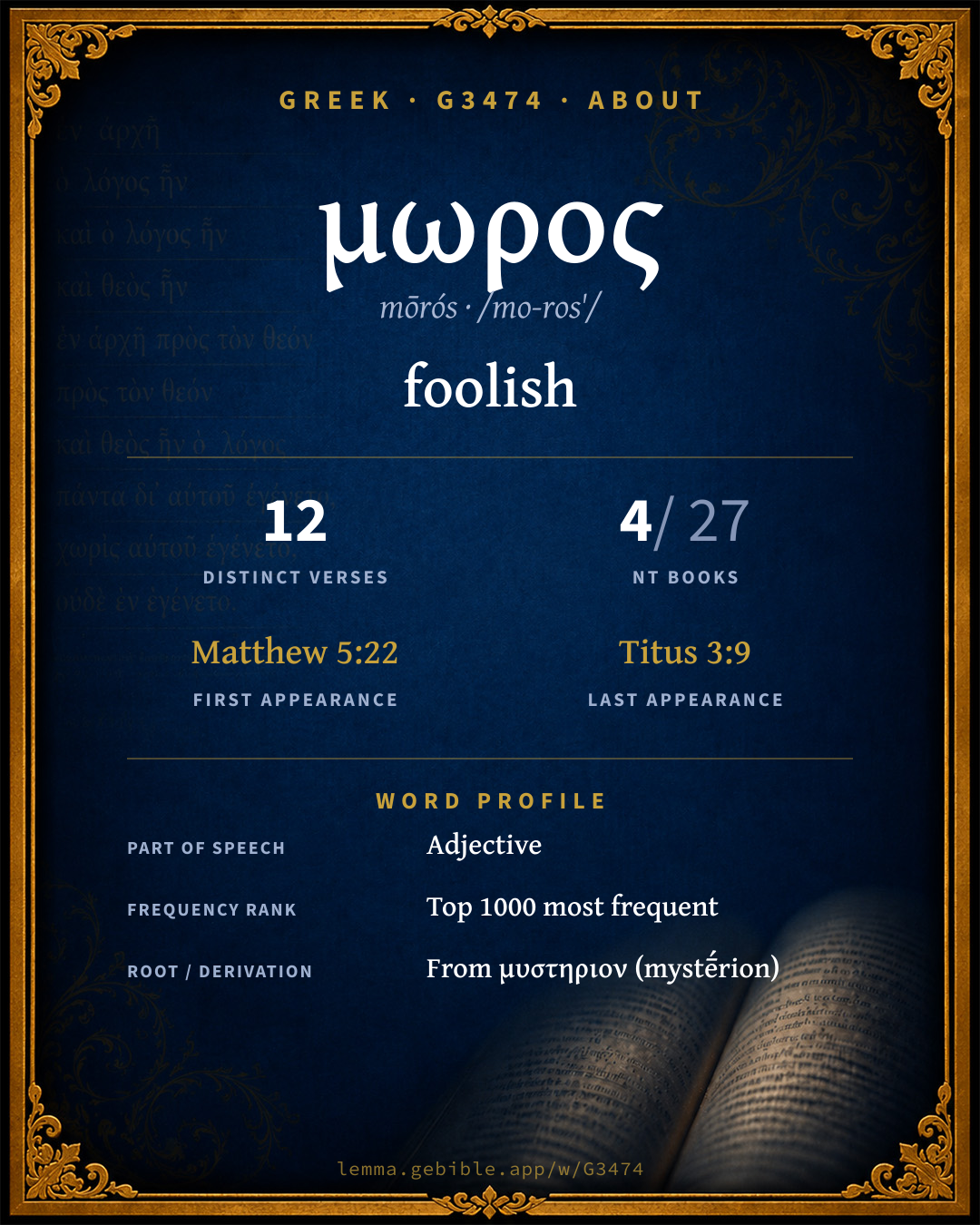
μωρός
foolish
‘foolish’ is one of 2 main senses fuller range ↓
Full lexicon entry — Thayer's Greek Lexicon
From Thayer's Greek Lexicon
Where this word appears
See every Nominative-case word in the Greek New Testament →
Grammar key — what these labels mean
Part of speech
- Adjective
- A word that describes or qualifies a noun.
Case
- Nominative
- The case of the subject (and the predicate nominative).
- Accusative
- The case of the direct object and of extent.
- Dative
- The case of the indirect object, means, or location — “to / for / with / in.”
- Vocative
- The case of direct address (“O Lord”).
Gender
- Feminine
- Grammatically feminine.
- Neuter
- Grammatically neuter.
- Masculine
- Grammatically masculine.
Number
- Plural
- More than one.
- Singular
- One.
Grammatical forms 9 distinct
- Adjective, Nominative, Plural, Feminine 3 times (25%)
- Adjective, Accusative, Plural, Feminine 2 times (17%)
- Adjective, Accusative, Plural, Neuter 1 time (8%)
- Adjective, Dative, Singular, Masculine 1 time (8%)
- Adjective, Nominative, Plural, Masculine 1 time (8%)
- Adjective, Nominative, Singular, Masculine 1 time (8%)
- Adjective, Nominative, Singular, Neuter 1 time (8%)
- Adjective, Vocative, Plural, Masculine 1 time (8%)
+1 more form (1 occurrence)
Parsed forms decoded from the imported morphology (Robinson–Tischendorf, public domain), counted across 12 parsed occurrences — not distinct verses.
Every verse where G3474 appears — 12 distinct verses across 4 books. Click any verse to open its interlinear word-by-word view. Verse text shown in the World English Bible for context — . Each verse’s Greek form is shown with its reference; the English is not keyword-highlighted, since the data carries no word-level English alignment. Use “Compare translations” on any verse to read it across multiple English versions. This concordance covers the Greek New Testament; Septuagint (Greek Old Testament) occurrences of this word are not indexed here.
Matthew 6 verses
- Matthew 5:22 μωρέ adj voc sg masc But I tell you, that everyone who is angry with his brother without a cause shall be in danger of the judgment; and whoever shall say to his brother, 'Raca!' shall be in danger of the council; and whoever shall say, 'You fool!' shall be in danger of the fire of Gehenna.
- Matthew 7:26 μωρῷ adj dat sg masc Everyone who hears these words of mine, and doesn't do them will be like a foolish man, who built his house on the sand.
- Matthew 23:17 μωροὶ adj voc pl masc You blind fools! For which is greater, the gold, or the temple that sanctifies the gold?
- Matthew 25:2 μωραὶ adj nom pl fem Five of them were foolish, and five were wise.
- Matthew 25:3 μωραὶ adj nom pl fem Those who were foolish, when they took their lamps, took no oil with them,
- Matthew 25:8 μωραὶ adj nom pl fem The foolish said to the wise, 'Give us some of your oil, for our lamps are going out.'
1 Corinthians 4 verses
- 1 Corinthians 1:25 μωρὸν adj nom sg neut Because the foolishness of God is wiser than men, and the weakness of God is stronger than men.
- 1 Corinthians 1:27 μωρὰ adj acc pl neut but God chose the foolish things of the world that he might put to shame those who are wise. God chose the weak things of the world, that he might put to shame the things that are strong;
- 1 Corinthians 3:18 μωρὸς adj nom sg masc Let no one deceive himself. If anyone thinks that he is wise among you in this world, let him become a fool, that he may become wise.
- 1 Corinthians 4:10 μωροὶ adj nom pl masc We are fools for Christ's sake, but you are wise in Christ. We are weak, but you are strong. You have honor, but we have dishonor.
2 Timothy 1 verse
Titus 1 verse
About this entry
At a glance — auto-summarized from this page’s data, not written by a person. Every figure links to its source below. This summary describes the numbers; it doesn’t interpret them.
The Greek adjective μωρος centers on the idea of “foolish.” The word gravitates to Matthew (50%), then 1 Corinthians and 2 Timothy. It appears 12 verses across 4 books of the Greek New Testament, among its uncommon vocabulary. Debuting at Matthew 5:22, it then recurs through the corpus. Thayer's distinguishes 2 senses for it. Dig into 12-verse concordance and the renderings breakdown below.
Gloss history
Strong's 1890 vs modern scholarship
About this word
Strong's G3474 catalogs a Greek word from the Greek New Testament.
These counts are not copied from any lexicon or concordance. They are computed here, from the morphology-tagged Greek New Testament. What Lemma adds →
- 12
- distinct verses
- The word appears in 12 distinct verses.
- 4 / 27
- NT books
- The word appears in 4 of 27 New Testament books.
- #904
- by frequency
- Top 1000 most frequent Greek words (rank 904 of 5,347 Greek words by occurrence).
View all 12 occurrences in the concordance →
Most concentrated in
- Matthew 6 verses 50%
- 1 Corinthians 4 verses 33%
- 2 Timothy 1 verse 8%
By section of the New Testament
By traditional corpus
Conventional, traditional groupings — biblical authorship is debated, so this is a traditional corpus grouping, not an authorship claim. Some books belong to more than one corpus (Luke is in both the Gospels and the Lukan corpus, and so on), so these shares overlap and need not total 100%. Each figure is a share of the word’s 12 distinct verses.
- Gospels 6 verses · 50%
- Pauline corpus 6 verses · 50%
How translations render this word
Counts come from each version’s own published word-to-Strong’s tagging or interlinear alignment — an approximate guide to how each version renders this word, not a word-level alignment the data otherwise carries. Because each total is that version’s own tagged count, the per-version totals vary from one another and need not match the appearance or distinct-verse counts above. These counts may also differ from a printed concordance because Lemma counts each distinctly tagged rendering and does not collapse phrase taggings into a single head-word total. This is a fixed set of word-tagged versions (KJV, ASV, BSB, ULT) and does not change with the reading translation you choose elsewhere. Each version’s license is shown beside its name below (and on Sources).
- King James Version: Foolish 4×, Were foolish 2×, Ye fools 2×
- American Standard Version: Foolish 6×
- Berean Standard Bible: Foolish 5×, Fools 2×
- unfoldingWord Literal Text: Foolish 8×
King James Version Public Domain
Renders G3474 across 13 tagged occurrences — most commonly:
Plus 5 renderings that appear only once — usually multi-word phrases or single function words the recovered tagging swept in, not distinct renderings.
American Standard Version Public Domain
Renders G3474 across 12 tagged occurrences — most commonly:
Plus 6 renderings that appear only once — usually multi-word phrases or single function words the recovered tagging swept in, not distinct renderings.
Berean Standard Bible Public Domain
Renders G3474 across 12 tagged occurrences — most commonly:
Plus 5 renderings that appear only once — usually multi-word phrases or single function words the recovered tagging swept in, not distinct renderings.
unfoldingWord Literal Text CC BY-SA 4.0
Renders G3474 across 14 tagged occurrences — most commonly:
Plus 6 renderings that appear only once — usually multi-word phrases or single function words the recovered tagging swept in, not distinct renderings.
Senses in Thayer's
The 2 senses Thayer's distinguishes for this word, in lexicon order (not ranked by frequency or importance). The full entry — with sub-senses — is in the Lexicon Entry tab.
- foolish
- impious, godless
Word origin
Derived from μυστηριον (mystḗrion) (G3466) — mystery.
Probably form the base of G3466 ; dull or stupid (as if shut up) that is heedless (morally) blockhead (apparently) absurd : - fool (-ish X -ishness).
— Strong’s Exhaustive Concordance (1890), public domain.
Forms in the corpus
The 8 distinct written forms G3474 takes in the Greek New Testament, most frequent first — each parse links to that case’s occurrences in the concordance.
| Form | Parsing | Example | Uses |
|---|---|---|---|
| μωραὶ mōraì | Adjective, Nominative, Plural, Feminine | Matthew 25:2 | 3 |
| μωροὶ mōroì | Adjective, Nominative, Plural, Masculine | 1 Corinthians 4:10 | 2 |
| μωρὰς mōràs | Adjective, Accusative, Plural, Feminine | 2 Timothy 2:23 | 2 |
| μωρέ mōré | Adjective, Vocative, Singular, Masculine | Matthew 5:22 | 1 |
| μωρὰ mōrà | Adjective, Accusative, Plural, Neuter | 1 Corinthians 1:27 | 1 |
| μωρὸν mōròn | Adjective, Nominative, Singular, Neuter | 1 Corinthians 1:25 | 1 |
| μωρὸς mōròs | Adjective, Nominative, Singular, Masculine | 1 Corinthians 3:18 | 1 |
| μωρῷ mōrō̂ | Adjective, Dative, Singular, Masculine | Matthew 7:26 | 1 |
Same root — word family
Other Thayer's entries built from the same root as G3474, grouped by Strong’s listed origin. These share a root / origin per the lexicon — not necessarily a shared meaning. Each links to that word’s own entry.
Derives from
Shares the same root
Derived from this word
- μωραινω mōraínō G3471 to be foolish
- μωρια mōría G3472 foolishness
- μωρολογια mōrología G3473 foolish talk
Compare all same-root words → Showing 4 of 7 — not the complete family. They share a root, not necessarily a meaning.
Septuagint usage
The same Greek word μωρος appears 8 times in the Greek Old Testament (Septuagint), across 7 verses in 5 books.
- 8
- LXX occurrences
- Tagged occurrences of this Greek word in the Septuagint.
- 7
- verses
- Distinct Septuagint verses containing this word.
- 5 / 39
- OT books
- The word appears in 5 of the 39 Old Testament books.
Sample Septuagint occurrences
- Deuteronomy 32:6 μωρός
- Job 16:7 μωρός
- Psalms 93:8 μωρός
- Isaiah 19:11 μωρός
- Jeremiah 5:21 μωρός
Septuagint occurrences (same lexeme)
Every verse where the same Strong’s number (G3474) appears in the Greek Septuagint. Verse text shown in the World English Bible for context; the Greek form is the matched word — the English is not keyword-highlighted.
- Deuteronomy 32:6 μωρός Do you thus requite Yahweh, Foolish people and unwise? Isn't he your father who has bought you? He has made you, and established you.
- Job 16:7 μωρός But now, God, you have surely worn me out. You have made desolate all my company.
- Psalms 93:8 μωρός
- Isaiah 19:11 μωρός The princes of Zoan are utterly foolish; the counsel of the wisest counselors of Pharaoh is become brutish: how do you say to Pharaoh, I am the son of the wise, the son of ancient kings?
- Isaiah 32:5 μωρός The fool shall be no more called noble, nor the scoundrel be highly respected.
- Isaiah 32:6 μωρός For the fool will speak folly, and his heart will work iniquity, to practice profanity, and to utter error against Yahweh, to make empty the soul of the hungry, and to cause the drink of the thirsty to fail.
- Jeremiah 5:21 μωρός Hear now this, foolish people, and without understanding; who have eyes, and don't see; who have ears, and don't hear:
These are occurrences of the same Greek lexeme (G3474) in the Septuagint — not a translation of any one Hebrew word. The store carries no word-level Hebrew↔Greek alignment, so no Hebrew original is asserted here. Counts come from the recovered LXX Strong's tagging — high-frequency vocabulary is well covered, while rare or late forms may be untagged — so they reflect tagged occurrences and may slightly undercount.