Titus 3:2

Greek (Tischendorf 8th ed.) Titus 3:2 appears in the Greek New Testament. The text above is from the Tischendorf 8th edition. Each word links to its Strong’s number and a concise gloss. Click any word for its full Thayer’s Greek Lexicon entry.
Download image
Cite this verse

Titus 3:2 (World English Bible). Public Domain. Lemma interlinear Bible study tool, https://lemma.gebible.app/v/titus/3/2.

Show BibTeX & RIS
BibTeX
RIS
English Translation
to speak evil of no one, not to be contentious, to be gentle, showing all humility toward all men.
World English Bible · Public Domain
Download a study sheet

One document with this verse’s original text, its word-by-word gloss line, the meaning frame, cross-references with their text, attributed commentary, and full source and license credits — printable, and it pastes into notes with its structure intact.

This verse Autodidact and up

Study sheet (.html) Plain text (.txt)

A passage Seminary Student

Up to 50 verses in one chapter. A passage sheet keeps up to 6 commentary sources and 12 cross-references per verse, in the order this page ranks them, and says so on the sheet whenever that leaves anything out. Ask for a single verse and you get the Autodidact verse sheet above.

Everything on this page stays free to read, with no account — the sheet is a download of what is already on screen, not access to it.

Want to remove ads? Support Godless Engineer
Compare translations 3

The same verse in 3 English versions, stacked beneath the original-language interlinear above. Click any original word for its lexicon entry.

Each is an independent rendering of the whole verse — the interlinear is not word-aligned to these translations.

Highlighted words mark where these versions differ — a whole-verse word diff, not a word-by-word alignment.

  • World English Bible Public Domain
    to speak evil of no one, not to be contentious, to be gentle, showing all humility toward all men.
  • King James Version Public Domain
    To speak evil of no man, to be no brawlers, but gentle, shewing all meekness unto all men.
  • unfoldingWord Literal Text CC BY-SA 4.0
    to revile no one, to be uncontentious, gentle, showing all humility toward all men.

unfoldingWord Literal Text — © unfoldingWord, licensed CC BY-SA 4.0. Word-aligned USFM3 via Door43 (git.door43.org/unfoldingWord/en_ult).

Versions to compare (up to 4)

3 of 4 selected

Show all 19 translations

Every available English version of this verse, each an independent rendering of the whole verse.

  • World English Bible Public Domain
    to speak evil of no one, not to be contentious, to be gentle, showing all humility toward all men.
  • Berean Standard Bible Public Domain
    to malign no one, and to be peaceable and gentle, showing full consideration to everyone.
  • Majority Standard Bible Public Domain
    to malign no one, and to be peaceable and gentle, showing full consideration to everyone.
  • King James Version Public Domain
    To speak evil of no man, to be no brawlers, but gentle, shewing all meekness unto all men.
  • American Standard Version (1901) Public Domain
    to speak evil of no man, not to be contentious, to be gentle, showing all meekness toward all men.
  • Revised Version (1885) Public Domain
    to speak evil of no man, not to be contentious, to be gentle, shewing all meekness toward all men.
  • Geneva Bible (1599) Public Domain
    That they speake euill of no man, that they be no fighters, but soft, shewing all meekenesse vnto all men.
  • Douay-Rheims (1899) Public Domain
    To speak evil of no man, not to be litigious, but gentle: shewing all mildness towards all men.
  • Young's Literal Translation Public Domain
    of no one to speak evil, not to be quarrelsome -- gentle, showing all meekness to all men,
  • Literal Standard Version CC BY-SA 4.0
    to speak evil of no one, not to be quarrelsome—gentle, showing all meekness to all men,
  • Unlocked Literal Bible CC BY-SA 4.0
    to revile no one, to not be eager to fight, and to be gentle, showing all humility toward everyone.
  • unfoldingWord Literal Text CC BY-SA 4.0
    to revile no one, to be uncontentious, gentle, showing all humility toward all men.
  • Darby Bible Public Domain
    to speak evil of no one, not to be contentious, [to be] mild, shewing all meekness towards all men.
  • World Messianic Bible Public Domain
    to speak evil of no one, not to be contentious, to be gentle, showing all humility toward all men.
  • Webster's Bible Public Domain
    To speak evil of no man, to be no brawlers, but gentle, showing all meekness to all men.
  • Free Bible Version CC BY-SA 4.0
    They should not speak badly about anyone, and they should not be argumentative. Tell them to show gentleness and kindness to everyone.
  • Bible in Basic English Public Domain
    To say no evil of any man, not to be fighters, to give way to others, to be gentle in behaviour to all men.
  • Text-Critical English NT CC BY 4.0
    to slander no one, and to be peaceable and considerate, always showing gentleness toward everyone.
  • Tyndale New Testament (1534) Public Domain
    that they speake evyll of no man that they be no fyghters but softe shewynge all meknes vnto all men.

Literal Standard Version (2020), Covenant Press — licensed CC BY-SA 4.0. Text via the HelloAO Bible API (eBible.org). Unlocked Literal Bible (unfoldingWord) — licensed CC BY-SA 4.0. Text via the HelloAO Bible API (eBible.org). unfoldingWord Literal Text — © unfoldingWord, licensed CC BY-SA 4.0. Word-aligned USFM3 via Door43 (git.door43.org/unfoldingWord/en_ult). Free Bible Version, Dr. Jonathan Gallagher — licensed CC BY-SA 4.0. Text via the HelloAO Bible API (eBible.org).

Word by word

More ways to search: Search by grammar → Find every occurrence → Compare this word →

Practice this passage: Drill this verse → Learn its vocabulary →

ἀμάχους
ámachos
G269
“uncontentious”
Adjective, Accusative, Plural, Masculine
Part of Speech
Adjective
Case
Accusative
Number
Plural
Gender
Masculine
Full Thayer's Definition

Origin: from G1 (as a negative particle) and G3163

TDNT: 12:47,6

1. not to be withstood, invincible 2. not contentious 3. abstaining from fighting
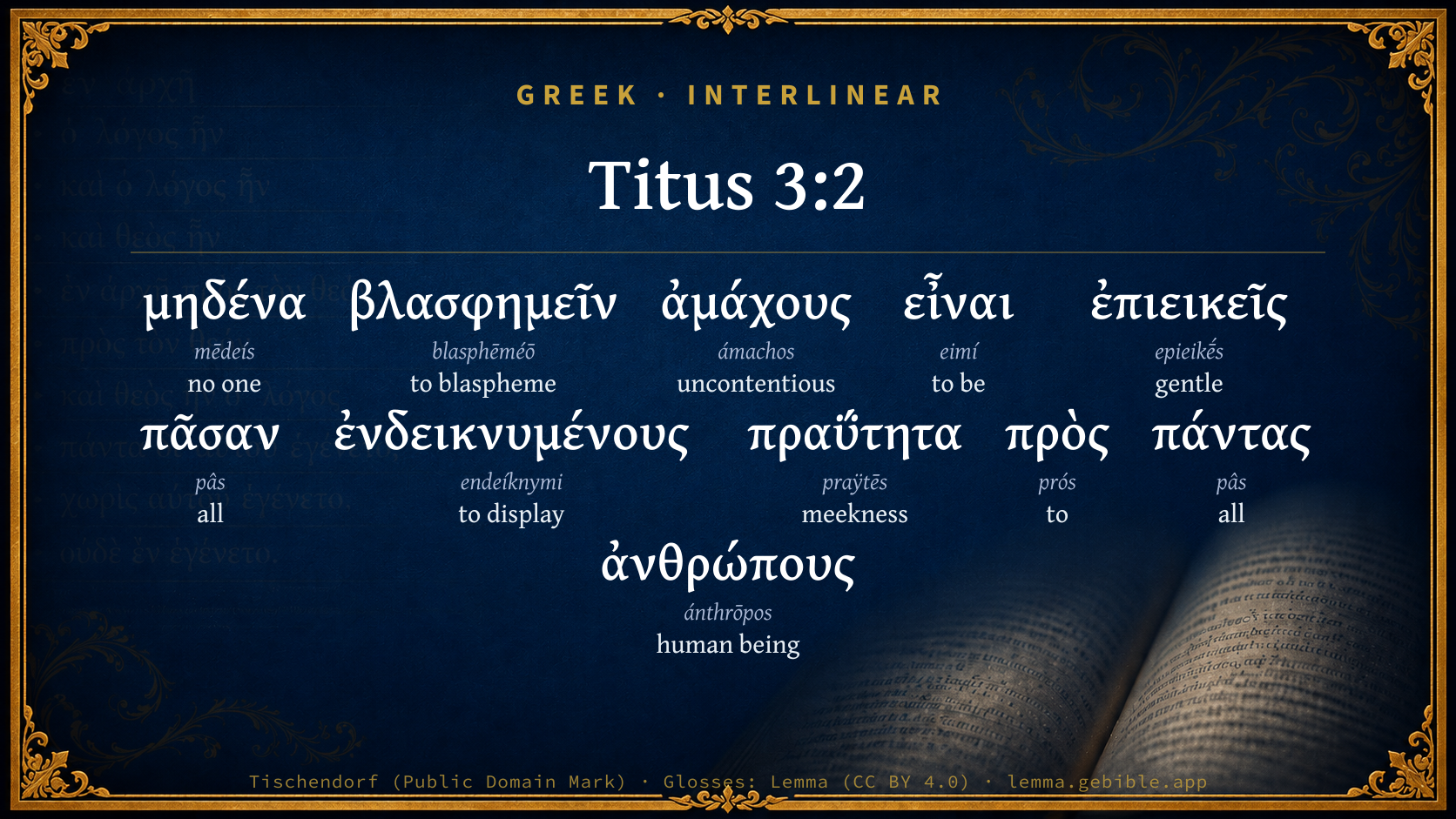
  1. μηδένα mēdeís G3367 “no one” Adjective, Accusative, Singular, Masculine, Negative
  2. βλασφημεῖν blasphēméō G987 “to blaspheme” Verb, Present, Active, Infinitive
  3. εἶναι eimí G1510 “to be” Verb, Present, Active, Infinitive
  4. ἐπιεικεῖς epieikḗs G1933 “gentle” Adjective, Accusative, Plural, Masculine
  5. πᾶσαν pâs G3956 “all” Adjective, Accusative, Singular, Feminine
  6. ἐνδεικνυμένους endeíknymi G1731 “to display” Verb, Present, Middle, Participle, Accusative, Plural, Masculine
  7. πραΰτητα praÿtēs G4240 “meekness” Noun, Accusative, Singular, Feminine
  8. πρὸς prós G4314 “to” Preposition
  9. πάντας pâs G3956 “all” Adjective, Accusative, Plural, Masculine
  10. ἀνθρώπους ánthrōpos G444 “human being” Noun, Accusative, Plural, Masculine

About this verse

These counts appear in no published source. They are computed here, from the morphology-tagged text and Lemma’s own curated glosses. What Lemma adds →

11
words
10
distinct lemmas
Pauline Epistles
section

Notable vocabulary

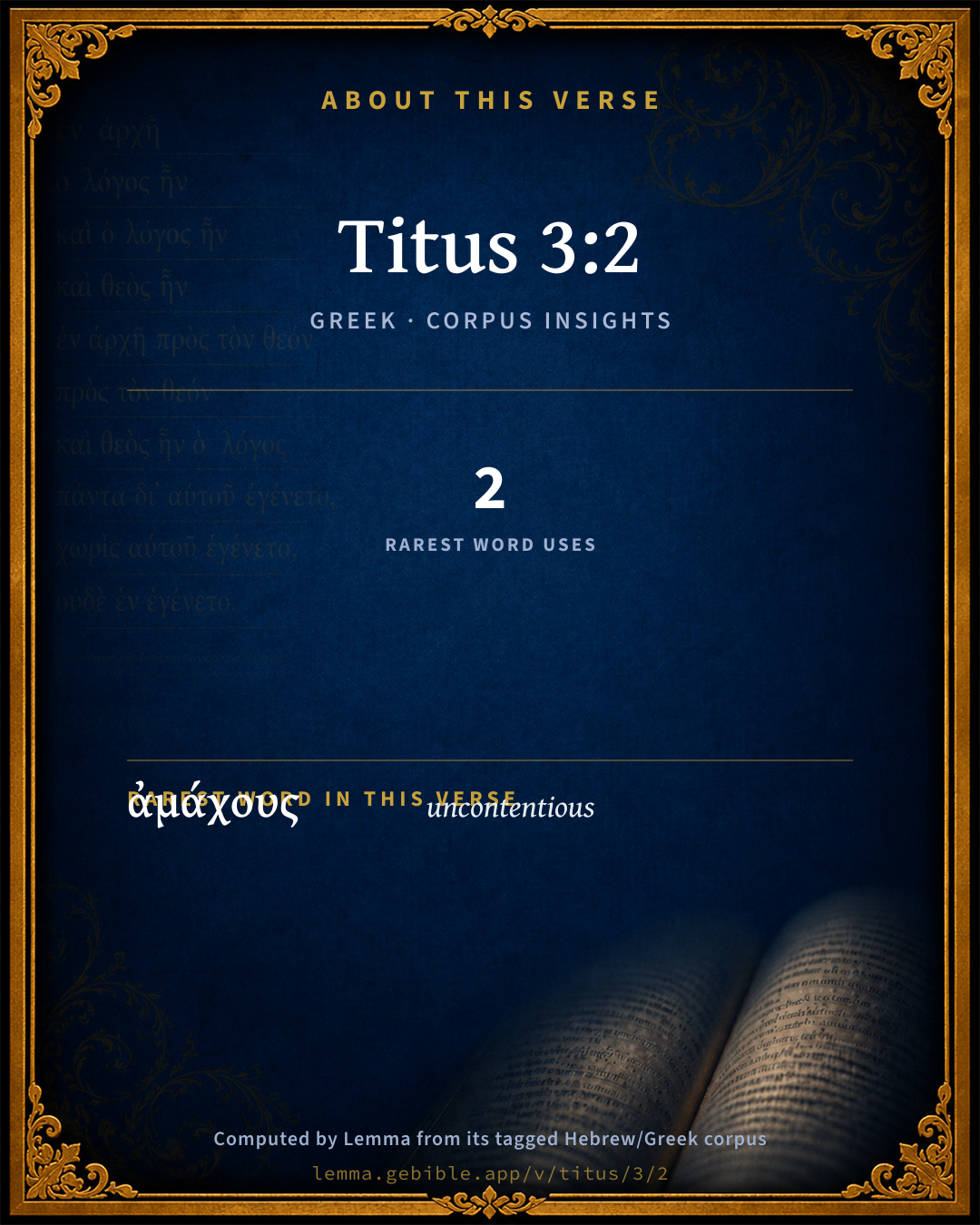
The rarest word here is ἀμάχους uncontentious G269 — appearing just 2 times in the whole Greek New Testament.

Shared distinctive vocabulary

ἀμάχους uncontentious G269 occurs in 2 verses of the Greek New Testament. Also found in:

Repetition

A word recurs within this verse:

  • πᾶσαν all G3956 ×2

Cross-references

28

Topical passages linked to Titus 3:2 in the Treasury of Scripture Knowledge — connected by theme and wording, ordered by reader-vote popularity; previews shown in the World English Bible.

  • Ephesians 4:31 Let all bitterness, wrath, anger, outcry, and slander, be put away from you, with all malice.
  • 2 Timothy 2:24–25 The Lord's servant must not quarrel, but be gentle towards all, able to teach, patient,
  • Ephesians 4:2 with all lowliness and humility, with patience, bearing with one another in love;
  • Colossians 3:12–13 Put on therefore, as God's chosen ones, holy and beloved, a heart of compassion, kindness, lowliness, humility, and perseverance;
  • 1 Timothy 3:3 not a drinker, not violent, not greedy for money, but gentle, not quarrelsome, not covetous;
  • 1 Peter 3:10 For, "He who would love life, And see good days, Let him keep his tongue from evil, And his lips from speaking deceit.
  • 1 Peter 3:8 Finally, be all like-minded, compassionate, loving as brothers, tenderhearted, courteous,
  • Matthew 11:29 Take my yoke upon you, and learn from me, for I am gentle and lowly in heart; and you will find rest for your souls.
  • Galatians 5:22 But the fruit of the Spirit is love, joy, peace, patience, kindness, goodness, faithfulness,
  • 1 Peter 2:17–18 Honor all men. Love the brotherhood. Fear God. Honor the king.
  • Galatians 6:10 So then, as we have opportunity, let's do what is good toward all men, and especially toward those who are of the household of the faith.
  • 1 Thessalonians 5:14–15 We exhort you, brothers, admonish the disorderly, encourage the fainthearted, support the weak, be patient toward all.
  • James 3:17 But the wisdom that is from above is first pure, then peaceful, gentle, reasonable, full of mercy and good fruits, without partiality, and without hypocrisy.
  • James 4:11 Don't speak against one another, brothers. He who speaks against a brother and judges his brother, speaks against the law and judges the law. But if you judge the law, you are not a doer of the law, but a judge.
  • 1 Peter 2:1 Putting away therefore all wickedness, all deceit, hypocrisies, envies, and all evil speaking,
  • 2 Samuel 22:36 You have also given me the shield of your salvation; Your gentleness has made me great.
  • James 1:19–20 So, then, my beloved brothers, let every man be swift to hear, slow to speak, and slow to anger;
  • Psalms 140:11 An evil speaker won't be established in the earth. Evil will hunt the violent man to overthrow him.
  • Galatians 6:1 Brothers, even if a man is caught in some fault, you who are spiritual must restore such a one in a spirit of gentleness; looking to yourself so that you also aren't tempted.
  • 1 Corinthians 9:19 For though I was free from all, I brought myself under bondage to all, that I might gain the more.
  • Philippians 4:5 Let your gentleness be known to all men. The Lord is at hand.
  • 1 Thessalonians 2:7 But we were gentle among of you, as when a nurse cherishes her own children.
  • 1 Timothy 3:11 Their wives in the same way must be reverent, not slanderers, temperate, faithful in all things.
  • Proverbs 6:19 A false witness who utters lies, And he who sows discord among brothers.
  • Proverbs 25:24 It is better to dwell in the corner of the housetop, Than to share a house with a contentious woman.
  • Acts 23:5 Paul said, "I didn't know, brothers, that he was high priest. For it is written, 'You shall not speak evil of a ruler of your people.'"
  • 2 Corinthians 10:1 Now I Paul, myself, entreat you by the humility and gentleness of Christ; I who in your presence am lowly among you, but being absent am of good courage toward you.
  • 2 Corinthians 12:20 For I am afraid that by any means, when I come, I might find you not the way I want to, and that I might be found by you as you don't desire; that by any means there would be strife, jealousy, outbursts of anger, factions, slander, whisperings, proud thoughts, riots;

Cross-references courtesy of OpenBible.info (CC BY 4.0).

Commentary

Notes on Titus 3:2 from classic Christian and Jewish commentators (each source and its license shown beneath its notes). The classic Christian expositions comment on the surrounding passage and are grouped to its opening verse, so a note may address several verses; the Jewish commentaries on the Tanakh (Rashi and others) are per-verse, so they appear only where the commentator wrote on this verse.

Lemma curates 59 commentaries, every one of them public domain or Creative Commons licensed, each selected and text-cleaned for this edition rather than reprinted as found. About our sources →

Bengel's Gnomon

Johann Albrecht Bengel

Tit 3:2. Ἀμάχους, no brawlers) Such as do not attack.—ἐπιεικεῖς, gentle) Such as yield to any one attacking them.—πάντας, all) Crete was an island much frequented by men engaged in mercantile transactions); and they were generally such as are described, Tit 3:3.

Bengel's Gnomon of the New Testament — English translation (T&T Clark, Edinburgh, 1860) — public domain. Text from a community e-Sword module.

Expositor's Greek Testament

ed. W. Robertson Nicoll

Tit 3:2 . ἀμάχους … ἐπιεικεῖς : coupled as qualifications of the episcopus, 1Ti 3:3 .

πᾶσαν πραΰτητα : the greatest possible meekness . Compare Eph 4:2 ; 1Pe 3:15 .

The Expositor's Greek Testament, edited by W. Robertson Nicoll (1897–1910) — public domain. Text from a community e-Sword module.

Cambridge Greek Testament for Schools and Colleges

2. πραὒτητα. This is the orthography of ACP (see crit. note on 2Ti 2:25); the spelling of the rec. text πραότητα is supported here by אcD2EGKL &c.

2. μηδένα βλασφημεῖν, to speak ill of no man (cp. Jud 1:8); not an easy precept to observe, if we are surrounded by persons whose principles of faith and conduct we believe to be quite unsound and mistaken. see on 2Ti 3:2.

ἀμάχους εἶναι, ἐπιεικεῖς, not to be contentious, to be forbearing. These two adjectives are coupled again among the qualifications of the ἐπίσκοπος at 1Ti 3:3, where see the note.

πᾶσαν ἐνδεικνυμένους πραὒτητα πρὸς πάντας ἀνθρώπους, shewing all meekness to all men. For the form of the sentence cp. ch. Tit 2:10 above; and for πραὖτης see on 2Ti 2:25. We see here that the exhibition of this grace is not to be reserved for the intercourse of fellow Christians; it is to be displayed to all men, as a mark of the followers of Him who was Himself πραὖς (Mat 11:29).

Cambridge Greek Testament for Schools and Colleges (Cambridge University Press, 1896; 21 vols, various authors incl. Carr, Maclear, Plummer, Farrar, Lumby, Moule, M. R. James, Simcox) — public domain. Text from a community e-Sword module.

Jamieson, Fausset & Brown

Robert Jamieson, A. R. Fausset & David Brown

To speak evil of no man--especially, not of "dignities" and magistrates.

no brawlers--"not quarrelsome," not attacking others.

gentle--towards those who attack us. Yielding, considerate, not urging one's rights to the uttermost, but forbearing and kindly (see on Phi 4:5). Very different from the innate greediness and spirit of aggression towards others which characterized the Cretans.

showing--in acts.

all--all possible.

meekness--(See on Co2 10:1); the opposite of passionate severity.

unto all men--The duty of Christian conduct towards all men is the proper consequence of the universality of God's grace to all men, so often set forth in the pastoral Epistles.

Jamieson, Fausset & Brown — Commentary Critical and Explanatory on the Whole Bible (1871) — public domain (CC PDM 1.0). Text via the HelloAO Bible API.

Adam Clarke's Commentary

Verse 2. To speak evil of no man] μηδενα βλασφημειν. To blaspheme no person, to reproach none, to speak nothing to any man's injury; but, on the contrary, bearing reproach and contumely with patience and meekness.

Adam Clarke's Commentary on the Bible (1810–1826) — public domain. Text from a community e-Sword/MySword module.

John Calvin's Commentaries

2 To speak evil of no one He now lays down the method of maintaining peace and friendship with all men. We know that there is nothing to which the disposition of every man is more prone than to despise others in comparison of himself. The consequence is, that many are proud of the gifts of God; and this is accompanied by contempt for their brethren, which is immediately followed by insult. He therefore forbids Christians to glory over others, or to reproach them, whatever may be their own superior excellence. Yet he does not wish them to flatter the vices of wicked men; he only condemns the propensity to slander.

Not given to fighting As if he had said, “Quarrels and contentions must be avoided.” The old translation has therefore rendered it better, Not quarrelsome; for there are other ways of fighting than the sword or the fist. And from what follows it is evident that this is the meaning; for he points out the remedies for the evil, when he enjoins them to be kind, and to shew all meekness towards all men; for “kindness” is contrasted with the utmost rigor of law, and “meekness” with bitterness. If, therefore, we are disposed to avoid every kind of contentions and fighting, let us learn, first, to moderate many things by gentleness, and next to bear with many things; for they who are excessively severe and ill-tempered carry with them a fire to kindle strife.

He says, towards all men, in order to intimate that he should bear with even the lowest and meanest persons. Believers, holding wicked men in contempt, did not think them worthy of any forbearance. Such severity, which arises from nothing else than pride, Paul wished to correct.

John Calvin's Commentaries (1540-1563) — public domain. Text from the Calvin Translation Society English edition (1840s-50s) via the Christian Classics Ethereal Library (ccel.org). Calvin's coverage is partial (roughly two-thirds of the Bible); uncommented books and verses are honest gaps, never fabricated. The 19th-century editor's footnotes and remarks are omitted so the notes are faithfully Calvin's own voice.

Ellicott's Commentary for English Readers

(2) To speak evil of no man.—These commands of St. Paul to the Church of Crete breathe throughout the spirit of Christ, who “when He was reviled, reviled not again;” who said “Love your enemies, do good to them that hate you, and pray for them which despitefully use you and persecute you.” The Christian in the days of St. Paul, and for “many days” after St. Paul had borne that gallant witness of his outside the gates of Rome, would indeed often be called in sad earnestness to put in practice these charges of the Apostle. In days of persecution, in times of suspicion, when the Christian profession exposed men to hatred and to sore danger, when all men spoke evil of them, these words of St. Paul were remembered and acted upon, and not only in Crete.

To be no brawlers, but gentle, shewing all meekness unto all men.—Or better, not contentious, but, &c. These characteristics were not common virtues in Crete, then the resort and mart of so many different nationalities. Its singular situation in the Mediterranean, midway between Europe, Africa, and Asia, has been noticed, as have been the dispositions and vices of the inhabitants. Surely, St. Paul urges, the professed followers of the Crucified among the Cretans should aim at a nobler standard of life than was common among these rough and often selfish traders. These things charged here by St. Paul were new virtues to men. They are held up to admiration by no heathen moralists. The meekness signifies kindly forbearance. This Christian feeling, which looks lovingly on all sorts and conditions of men, on the stranger and the outcast, even on the vilest sinner, is especially enjoined here. It is the same sweet spirit of love which desires, in 1Ti_2:1, that prayer and supplication be made in the public Christian assembly for all men.

A Bible Commentary for English Readers, edited by Charles John Ellicott (1878–1897) — public domain. Text from a community e-Sword module.

The Cambridge Bible for Schools and Colleges

gen. ed. J. J. S. Perowne

2. to speak evil of no man] Cf. 1Ti_1:20; 1Ti_6:1; Tit_2:5. In the first place used absolutely ‘to blaspheme,’ as Act_26:11, ‘I strove to make them blaspheme.’

to be no brawlers, but gentle] Better, as R.V., not to be contentious; the word only occurs in N. T., 1Ti_3:3, where it is joined, as here, with ‘gentle’ or ‘forbearing’; see note there.

shewing all meekness] The compound form of the word has occurred 1Ti_6:11, coupled with ‘patience,’ see note. The distinction between ‘gentleness’ above and ‘meekness’ is given by Aquinas (quoted in N. T. Syn. p. 152), as twofold, (1) ‘gentleness,’ clementia, is ‘lenitas superioris ad inferiorem’; meekness, mansuetudo, is ‘cuiuslibet ad quemlibet’: (2) ‘gentleness’ is in outward acts, ‘est moderativa exterioris punitionis’; ‘meekness’ is in the inner spirit, ‘proprie diminuit passionem irae.’ But besides its separateness of force in combination with ‘gentleness,’ the ‘meekness’ here is especially fitted to lead on to the argument of the next verse from its own proper sense. ‘It is an inwrought grace of the soul; and the exercises of it are first and chiefly towards God, when we accept His dealings with us without disputing. He that is meek indeed will know himself a sinner amongst sinners; or if there was One who could not know Himself such, yet He too bore a sinner’s doom and endured therefore the contradiction of sinners, Mat_11:29, “I am meek and lowly of heart;” and this knowledge of his own sin will teach him to endure meekly the provocations with which they may provoke him, and not to withdraw himself from the burdens which their sin may impose upon him (Gal_6:1; 2Ti_2:25).’ N. T. Syn. p. 150.

The Cambridge Bible for Schools and Colleges (gen. ed. J. J. S. Perowne; Cambridge University Press, 1878–1918) — public domain. Text from a community e-Sword module.

John Gill's Exposition

To speak evil of no man,.... As not of one another, so not of the men of the world, to the prejudice of their names and characters, which are tender things, and ought to be gently touched; nor of magistrates, principalities, and powers, of persons in dignity and authority, which the false teachers were not afraid to speak evil of, and by their principles and practices taught others to do the same:

to be no brawlers; or "fighters", either by blows or words; not litigious and quarrelsome, wrangling and striving about things to no profit, and to the detriment and disturbance of civil government, churches, neighbourhood, and families; which is very unbecoming the followers of Jesus, who strove not, nor cried, nor was his voice heard in the streets. But gentle, showing all meekness to all men; yielding and giving way, rather choosing to suffer wrong than to brawl, contend, and litigate a point; taking the advice of Christ in Mat 5:39, carrying it in a meek and humble manner to men of all ranks and degrees, whether superior or inferior, rich or poor, bond or free, Jews or Gentiles, members of the church, or men of the world.

John Gill's Exposition of the Whole Bible (1746–1763) — public domain (CC PDM 1.0). Text via the HelloAO Bible API.

Trapp's Complete Commentary

John Trapp

2 To speak evil of no man, to be no brawlers, but gentle, shewing all meekness unto all men.

Ver. 2. To speak evil of no man] Unless it be in an ordinance, for the reformation of the unruly; pleasing all in that which is good to edifying.

John Trapp, A Commentary or Exposition upon All the Books of the Old and New Testament (1647–1656) — public domain. Text from a community e-Sword module.

Albert Barnes' Notes on the Bible

To speak evil of no man - Greek, “to blaspheme (βλασφημεῖν blasphēmein, compare the notes at Mat 9:3) no one.” Doddridge renders it, “calumniate no one.” The idea is, that we are not to slander, revile, or defame anyone. We are not to say anything to anyone, or of anyone, which will do him injury. We are never to utter anything which we know to be false about him or to give such a coloring to his words or conduct as to do him wrong in any way. We should always so speak to him and of him in such a way that he will have no reason to complain that he is an injured man. It may be necessary, when we are called to state what we know of his character, to say things which are not at all in his favor, or things which he has said or done that were wrong; but,

(1)We should never do this for the purpose of doing him injury, or so as to find a pleasure in it; and,

(2)Where it is necessary to make the statement, it should be so as to do him no injustice.

We should give no improper coloring. We should exaggerate no circumstances. We should never attempt to express ourselves about his motives, or charge on him bad motives - for we know not what his motives were. We should state every palliating circumstance of which we have knowledge, and do entire justice to it. We should not make the bad traits of his character prominent, and pass over all that is good. In a word, we should show that we would rather find him to be a good man than a bad man - even if the result should be that we had been mistaken in our opinions. It is better that we should have been mistaken, than that he should be a bad man.

To be no brawlers - See the notes at 1Ti 3:3. The same Greek word occurs in both places. It is not elsewhere found in the New Testament.

But gentle - The word here used is rendered “moderation” in Phi 4:5, “patient” in 1Ti 3:3, and elsewhere “gentle;” see the notes at 1Ti 3:3.

Showing all meekness unto all men - In the reception of injuries; see the Mat 5:5 note; Eph 4:2 note.

Albert Barnes' Notes on the Bible (1834–1885) — public domain. Text from a community e-Sword/MySword module.

Matthew Poole's English Annotations

To speak evil of no man; Greek, to blaspheme no man. Blasphemy is a speaking evil, whether it be applied to God or man, though use hath so obtained, that we only in common discourse speak of blaspheming God.

To be no brawlers; to be no fighters, (αμαχους) neither with hands nor tongues.

But gentle; to be modest, fair, equitable men.

Showing all meekness unto all men; forbearing wrath and passion in their converse with all.

Matthew Poole's English Annotations on the Holy Bible (1683–1685) — public domain. Text from a community e-Sword/MySword module.

Whedon's Commentary on the Bible

Daniel D. Whedon

2. The apostle, it must be noted, is not laying down rules for political equity, but of individual Christian demeanour. He is not deciding that it was wrong for orderly Cretan statesmen to organize an equitable revolution for the overthrow of Roman domination, and the establishment of a free, well-regulated self-government of the island. He is simply deciding that Christianity does not abolish civil government, and requiring the Christian man to obey a legitimate law and magistracy in the interests of peace and good morals. Note, Rom_13:1-7.

2. Speak evil—Literally, blaspheme; that is, revile or insult no one; prohibiting that style of obloquy usually exchanged in the rude Cretan neighbourhood.

All men—In order to inspire the tone of a commencing Christian civilization in Crete.

Daniel D. Whedon (gen. ed.), Commentary on the Old and New Testaments (1874–1909) — public domain. Text from a community e-Sword module.

The Pulpit Commentary

Not to be contentious for to be no brawlers, A.V; to be for but, A.V; toward for unto, A.V To speak evil of no man (mhdena blasfhmein). Probably especially pointed in the first place at a natural tendency of oppressed Christians to speak evil of their rulers, (2Pe_2:10 Jud_1:10) but extended into a general precept which might be especially needful for the rough and turbulent Cretans. Not to be contentious (amacouv einai); as 1Ti_3:3, note. To be gentle (epieikeiv); coupled, as here, with amacouv in 1Ti_3:3. Showing (endeiknumenouv); a word of frequent occurrence in St. Paul"s vocabulary. (Rom_2:15 Rom_9:17, 22 Eph_2:7, etc.; see Tit_2:10, note) Meekness (praothta); another Pauline. (1Co_4:21 2Co_10:1 Gal_5:23, 1Ti_6:11 2Ti_2:25) The precept is given its widest extension by the double addition of "all" and "to all men." The roughness, or want of courtesy, of others is no excuse for the want of meekness in those who are the disciples of him who was meek and lowly in. (Mat_11:29) All men, whatever their station, the highest or the lowest, are to receive meek and gentle treatment from the Christian.

The right deportment of Christians toward all men.

It is described first negatively, then positively.

I THEY MUST NOT BE REVILERS. "To speak evil of no man.

1. What evils spring from the wrong use of the tongue! "It is an unruly. (Jam_3:8)

2. If the evil we speak of others is false, we are slanderers; if it is true, we sin against charity. It usually betokens a malignant spirit.

3. It is to forget the example of Christ- "who, when he was reviled, reviled not again;" and the precepts of Christ, who taught us "to love our enemies." Let Christians, therefore, guard their tongues, and let their words be few and well-ordered.

II THEY MUST NOT BE CONTENTIOUS. "No brawlers.

1. Such a disposition mars the influence of Christian people.

2. It is inconsistent with the spirit of him who did not strive, nor was his voice heard in the streets.

3. It leads to unseemly retaliations from the world, to the dishonor of Christ.

III THEY MUST BE FORBEARING. "But gentle." It suggests the idea of giving way, of taking wrong rather than of revenging the injuries we receive.

IV THEY MUST BE MEEK TO ALL MEN. "Showing all meekness to all men.

1. Meekness is a fruit of the Spirit. (Gal_5:22)

2. It is precious in Gods sight. (1Pe_3:4)

3. It is a characteristic of true wisdom. (Jam_3:17)

4. It is necessary to a Christian walk. (Eph_4:1, Eph_4:2)

5. It is specially needed in our conduct toward our fellow-men; (Jam_3:13) in our efforts to restore the erring (Gal_6:1) and to instruct opposers. T.C. (2Ti_2:24, 2Ti_2:25)

The Pulpit Commentary (1880–1919), ed. H.D.M. Spence-Jones & Joseph S. Exell — public domain. Text from a community e-Sword module.

John Wesley's Explanatory Notes

To speak evil - Neither of them nor any man. Not to be quarrelsome - To assault none. To be gentle - When assaulted. Toward all men - Even those who are such as we were.

John Wesley, Explanatory Notes Upon the Whole Bible (1754–1765) — public domain. Text via the GEBible commentary corpus.

Fairbairn on Ezekiel, Jonah & the Pastoral Epistles

Patrick Fairbairn

Ver. 2. A quiet, inoffensive demeanour in the more private relations of life is now inculcated: to revile no man, to be not contentious, forbearing, showing all meekness unto all men. The first verb, βλασφημεῖν, imports more than to speak evil in the ordinary sense; it is to act the part of a reviler or slanderer; and when used of conduct from one man toward another, always betokens the exercise of a very bitter and malignant spirit. Titus was to charge the Christians of Crete to give no exhibition toward any one of such a spirit, nor to show a quarrelsome disposition, but, on the contrary, to cultivate a mild, placable, and gentle temper.

Patrick Fairbairn — An Exposition of Ezekiel (1851), Jonah (1849), and The Pastoral Epistles (1874) — public domain. Text from a community e-Sword module.

Burkitt's Expository Notes on the New Testament

William Burkitt

Calumny and evil-speaking has been a reigning vice in all ages, and a greater guilt is contracted by it than men apprehend; every man ought to be as just to his neighbour’s reputation as his own:

if what we report of another we know to be false, it is downright lying;

if what we report of others we believe to be false, it is slander;

if what evil we report of others be really true, and we know it to be so, yet it is defamation, and contrary to that charity and goodness which Christianity requires;

for to divulge the faults of others, though they be really guilty of them, without necessity, is certainly a sin, and included in this apostolic prohibition: to think and speak evil of others, is not only a bad thing, but a sign of a bad man; and in many cases it is as great charity to conceal an evil we hear of our neighbour, as it is to relieve him in his distress.

The next exhortation is, to be no brawlers; in the original, no fighters; that is, neither with tongue nor hand, but meek and gentle, putting up a double wrong, rather than revenge a single injury, using all meekness towards all men. Meekness pacifies wrath, and conquers animosity to a wonder, making him tame and gentle, who by opposition is furious and implacable: the hardest flint is sooner broken upon a pillow or cushion that gently yieldeth, than upon a bar of iron that furiously resisteth.

William Burkitt's Expository Notes on the New Testament (1700–1703) — public domain. Text from a community e-Sword module.

The People's New Testament

B. W. Johnson

2. Gentle. Forbearing and patient.

B. W. Johnson's The People's New Testament with Notes (1889–1891) — public domain. Electronic text from the Christian Classics Ethereal Library (CCEL) ThML edition.

Alford’s Greek Testament

Henry Alford

2.] Rules concerning behaviour to those without. Put them in mind (as of a duty previously and otherwise well known, but liable to be forgotten) to be in subjection to governments, to authorities, to obey the magistrate (πειθαρχεῖν here probably stands absolutely, not, as Huther, connected with the dat. ἀρχαῖς ἐξ. So Xen. Cyr. viii. 1. 4, μεγιστον ἀγαθὸν τὸ πειθαρχεῖν φαίνεται εἰς τὸ καταπράττειν τὰ ἀγαθά. The other construction has however the reff. in its favour), to be ready towards every good work (the connexion seems to be as in Rom 13:3, where the rulers are said to be οὐ φόβος τῷ ἀγαθῷ ἔργῳ, ἀλλὰ τῷ κακῷ. Compare also the remarkable coincidence in the sentiment of Xen. quoted above. Jerome in loc., Wetst., De W., al., suppose these exhortations to subjection to have found their occasion in the insubordination of the Jews on principle to foreign rule, and more especially of the Cretan Jews. In the presence of similar exhortations in the Epistle to the Romans and elsewhere, we can hardly perhaps say so much as this: but certainly Wetst.’s quotations from Diod. Sic., al., seem to establish the fact of Cretan turbulence in general.

The inference drawn by Thdrt., al., from these last words,—οὐδὲ γὰρ εἰς ἅπαντα δεῖ τοῖς ἄρχουσι πειθαρχεῖν, does not seem to be legitimately deduced from them), to speak evil of no one (these words set forth the general duty, but are perhaps introduced owing to what has preceded, cf. 2Pe 2:10: Jud 1:8), to be not quarrelsome (ref. and note), forbearing (ib., and note on Php 4:5. “The ἐπιεικής must have been, it is to be feared, a somewhat exceptional character in Crete, where an ἔμφυτος πλεονεξία, exhibited in outward acts of aggression, καὶ ἰδίᾳ καὶ κατὰ κοινόν (Polyb. vi. 46-9), is described as one of the prevailing and dominant vices.” Ellicott), manifesting all meekness towards all men (from what follows, πάντας ἀνθρ. is evidently to be taken in the widest sense, and especially to be applied to the heathen without: see below).

Henry Alford, The Greek Testament (1849–1861) — public domain. Text from a community e-Sword module.

International Critical Commentary

2. ἀμάχους] (here and 1Ti 3:3 only in N.T.), cf. 9 and 2Ti 2:23, 2Ti 2:24.

ἐπιεικεῖς] “temperate,” Wycl.; “Softe,” Tyndal; “modestos,” Vulg.; not pressing their own rights, making allowances, remembering that the heathen do not know of the graciousness and love of God our Saviour, they have not the ἐπιείκεια of Christ before their eyes (2Co 10:1); “large-hearted,” “high-hearted,” cf.

“Truth’s school for certain doth this same allow,

High-heartedness doth sometimes teach to bow”

(Lady E. Carew),

and Ar. Rhet. i. 13, §§ 17, 18, for a full description of τὸ ἐπιεικές, “It is the indulgent consideration of human infirmities. To look not to the mere letter of the law but to the mind of the legislator, not merely to the act done but to the intention of the doer, not to a part but to the whole, not to the character of the actor at the moment but to his general character, to re member good deeds received from him rather than the bad, and the benefits you have received rather than those you have conferred” (Cope). Such a quality would be needed by masters in the treatment of their slaves (1 P 2:18), but here the reference is wider; cf. Php 4:5 τὸ ἐπιεικὲς ὑμῶν γνωσθήτω πᾶσιν ἀνθρώποις. It would be needed especially in face of persecution; cf. Wisd 2:19 ὕβρει καὶ βασάνῳ ἐτάσωμεν αὐτὸν ἵνα γνῶμεν τὴν ἐπιείκειαν αὐτοῦ. For good accounts of the word, cf. Lightfoot on Php 4:5, Mayor on Jas 3:17.

πᾶσαν ἐνδ.] perhaps reminiscent of 2:10—as gentle to all men as your slaves are faithful to their masters. πραότητα] Again—like their Saviour-God, cf. 2Co 10:1. πρὸς πάντας ἀνθρ.] for St. Paul’s stress on the duty of Christians to the whole world outside, cf. Rom 12:17, Gal 6:10, Php 4:5; and for the result of such teaching, cf. Justin M. Apol. 1. cc. 14-16; Tert. Apol. c. 36, “civilitas in imperatorem tam vere quam circa omnes necesse habet exhiberi. … Nullum bonum sub exceptione personarum administramus.”

International Critical Commentary — older volumes (1896–1929), various authors — public domain. Text from a community e-Sword module.

Vincent's Word Studies in the New Testament

Marvin R. Vincent

No brawlers [αμαχους] . Better as Res., sot to be contentious. See on 1Ti 3:3. Past o.

Marvin R. Vincent, Word Studies in the New Testament (1887–1900) — public domain. Text from a community e-Sword/MySword module.

Lesson kit

Teaching starters — assembled from the data on this page, not authored interpretation. Every prompt links to the verse data it draws on. Edit before teaching.

Titus, in the Pauline Epistles, opens this verse with 11 words (10 distinct Greek lemmas). Its most distinctive word is ámachos (“uncontentious”). A historical commentator’s framing appears above. Read the whole chapter for the surrounding context.

Discussion questions

  1. What does “uncontentious” (ámachos) contribute to the verse as a whole?
  2. 1 Timothy 3:3 shares the word «uncontentious» with this verse. How do the two illuminate each other?
  3. “all” occurs 2× in this one verse. What is the effect of the repetition?
  4. These translations render this verse differently; the difference is in the English rendering, not the original. What questions does that raise?
  5. Reading how Bengel's Gnomon and Expositor's Greek Testament read this verse, where do the two commentators agree and where do they part?

Things to notice

Reading settings

Reading text

Shown beneath each verse's original-language words.

Old Testament
Old Testament edition

Read the OT as the Masoretic Hebrew (MT) or the Greek Septuagint (LXX).

English shown for the Greek Septuagint (in the Hebrew ↔ Greek comparison).

Comparing translations? Open the Compare panel on any verse page to stack up to four side by side.