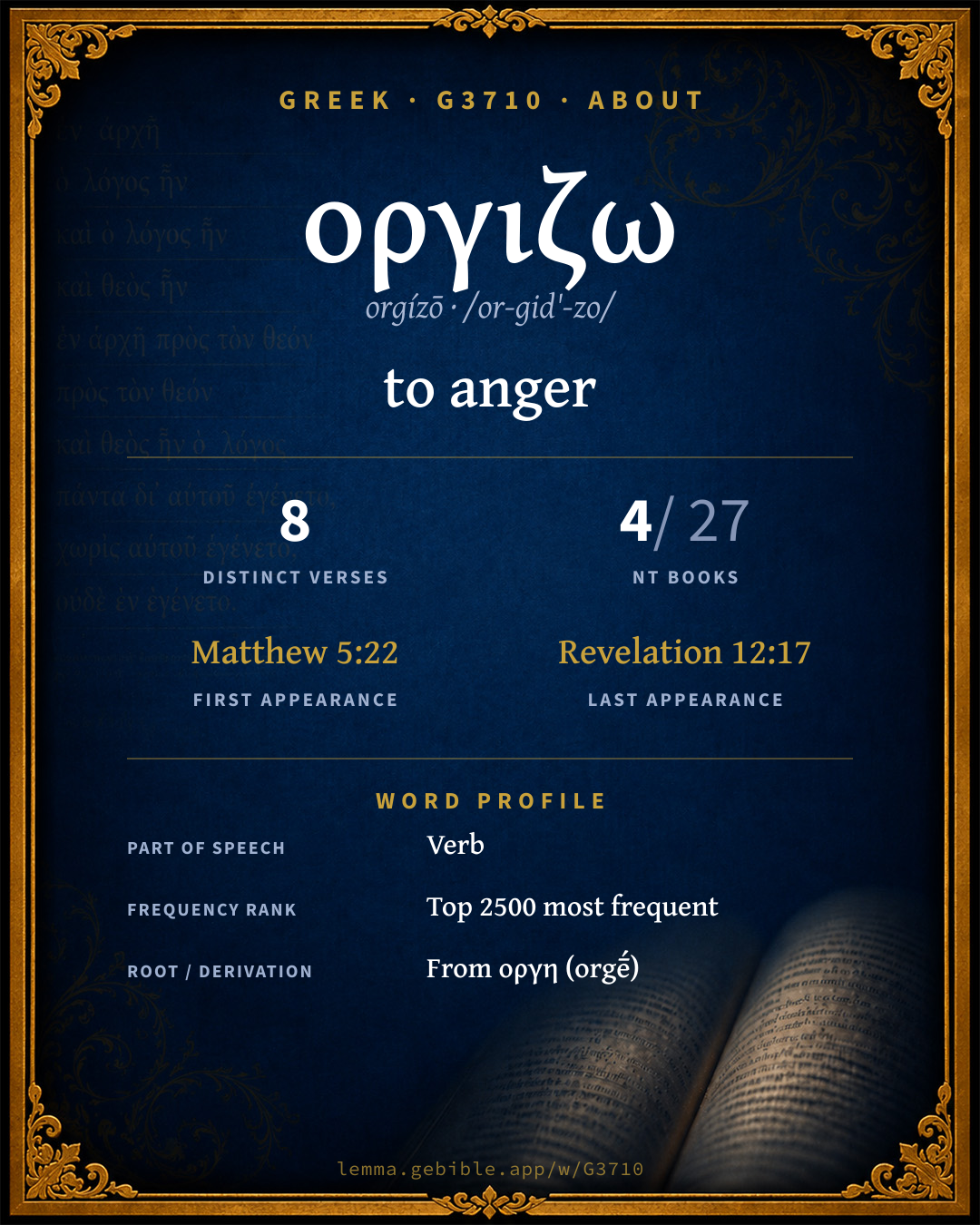
ὀργίζω
to anger
‘to anger’ is one of 2 main senses fuller range ↓
Full lexicon entry — Thayer's Greek Lexicon
From Thayer's Greek Lexicon
Where this word appears
See every Aorist-tense verb in the Greek New Testament →
Grammar key — what these labels mean
Part of speech
- Verb
- An action or state-of-being word.
Tense
- Aorist
- Action viewed as a simple whole, without regard to duration — often past (perfective aspect).
- Present
- Ongoing or general action in present time (imperfective aspect).
Voice
- Passive
- The subject receives the action.
Mood
- Indicative
- States a fact or asks a factual question (the mood of reality).
- Participle
- A verbal adjective (“writing,” “having written”).
- Imperative
- Expresses a command or request.
Case
- Nominative
- The case of the subject (and the predicate nominative).
Person
- 3rd person
- The one spoken about (“he / she / it / they”).
- 2nd person
- The one addressed (“you”).
Gender
- Masculine
- Grammatically masculine.
Number
- Singular
- One.
- Plural
- More than one.
Grammatical forms
- Verb, Aorist, Passive, Indicative, 3rd person, Singular 3 times (38%)
- Verb, Aorist, Passive, Participle, Nominative, Singular, Masculine 2 times (25%)
- Verb, Aorist, Passive, Indicative, 3rd person, Plural 1 time (13%)
- Verb, Present, Passive, Imperative, 2nd person, Plural 1 time (13%)
- Verb, Present, Passive, Participle, Nominative, Singular, Masculine 1 time (13%)
Parsed forms decoded from the imported morphology (Robinson–Tischendorf, public domain), counted across 8 parsed occurrences — not distinct verses.
Every verse where G3710 appears — 8 distinct verses across 4 books. Click any verse to open its interlinear word-by-word view. Verse text shown in the World English Bible for context — . Each verse’s Greek form is shown with its reference; the English is not keyword-highlighted, since the data carries no word-level English alignment. Use “Compare translations” on any verse to read it across multiple English versions. This concordance covers the Greek New Testament; Septuagint (Greek Old Testament) occurrences of this word are not indexed here.
Matthew 3 verses
- Matthew 5:22 ὀργιζόμενος pres pass ptcp nom sg masc But I tell you, that everyone who is angry with his brother without a cause shall be in danger of the judgment; and whoever shall say to his brother, 'Raca!' shall be in danger of the council; and whoever shall say, 'You fool!' shall be in danger of the fire of Gehenna.
- Matthew 18:34 ὀργισθεὶς aor pass ptcp nom sg masc His lord was angry, and delivered him to the tormentors, until he should pay all that was due to him.
- Matthew 22:7 ὠργίσθη aor pass ind 3sg When the king heard that, he was angry, and he sent his armies, destroyed those murderers, and burned their city.
Luke 2 verses
- Luke 14:21 ὀργισθεὶς aor pass ptcp nom sg masc "That servant came, and told his lord these things. Then the master of the house, being angry, said to his servant, 'Go out quickly into the streets and lanes of the city, and bring in the poor, maimed, blind, and lame.'
- Luke 15:28 ὠργίσθη aor pass ind 3sg But he was angry, and would not go in. Therefore his father came out, and begged him.
Ephesians 1 verse
Revelation 2 verses
- Revelation 11:18 ὠργίσθησαν aor pass ind 3pl The nations were angry, and your wrath came, as did the time for the dead to be judged, and to give your bondservants the prophets, their reward, as well as to the saints, and those who fear your name, to the small and the great; and to destroy those who destroy the earth."
- Revelation 12:17 ὠργίσθη aor pass ind 3sg The dragon grew angry with the woman, and went away to make war with the rest of her seed, who keep God's commandments and hold Jesus' testimony.
About this entry
At a glance — auto-summarized from this page’s data, not written by a person. Every figure links to its source below. This summary describes the numbers; it doesn’t interpret them.
οργιζω (orgízō) is a Greek verb most often rendered “to anger.” It first appears in Matthew 5:22. The Greek New Testament uses it across 8 verses — uncommon. Matthew dominates its distribution — 3 of 8 verses. Ranging over 2 senses, it is not a single-sense word. See the sense tree, 8-verse concordance, and the renderings breakdown below.
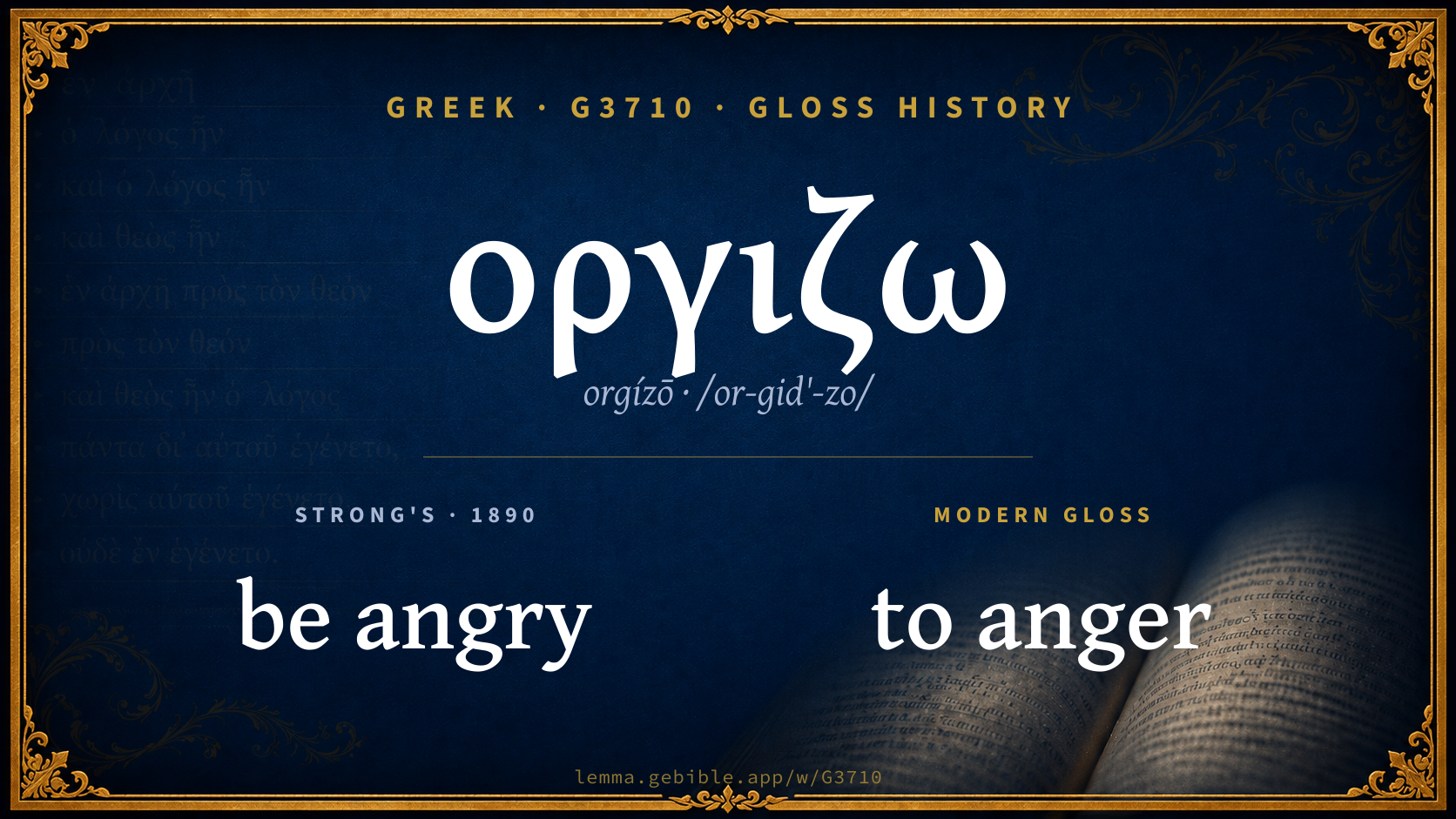
Gloss history
Strong's 1890 vs modern scholarship
About this word
Strong's G3710 catalogs a Greek word from the Greek New Testament.
These counts are not copied from any lexicon or concordance. They are computed here, from the morphology-tagged Greek New Testament. What Lemma adds →
- 8
- distinct verses
- The word appears in 8 distinct verses.
- 4 / 27
- NT books
- The word appears in 4 of 27 New Testament books.
- #1,240
- by frequency
- Top 2500 most frequent Greek words (rank 1,240 of 5,347 Greek words by occurrence).
View all 8 occurrences in the concordance →
Most concentrated in
- Matthew 3 verses 38%
- Luke 2 verses 25%
- Revelation 2 verses 25%
By section of the New Testament
By traditional corpus
Conventional, traditional groupings — biblical authorship is debated, so this is a traditional corpus grouping, not an authorship claim. Some books belong to more than one corpus (Luke is in both the Gospels and the Lukan corpus, and so on), so these shares overlap and need not total 100%. Each figure is a share of the word’s 8 distinct verses.
- Gospels 5 verses · 63%
- Lukan (Luke–Acts) 2 verses · 25%
- Johannine 2 verses · 25%
- Revelation 2 verses · 25%
- Pauline corpus 1 verse · 13%
How translations render this word
Counts come from each version’s own published word-to-Strong’s tagging or interlinear alignment — an approximate guide to how each version renders this word, not a word-level alignment the data otherwise carries. Because each total is that version’s own tagged count, the per-version totals vary from one another and need not match the appearance or distinct-verse counts above. These counts may also differ from a printed concordance because Lemma counts each distinctly tagged rendering and does not collapse phrase taggings into a single head-word total. This is a fixed set of word-tagged versions (KJV, ASV, BSB, ULT) and does not change with the reading translation you choose elsewhere. Each version’s license is shown beside its name below (and on Sources).
- King James Version: Was wroth 2×
- American Standard Version: Be ye angry 1×, Being angry 1×, He was angry 1×
- Berean Standard Bible: Became angry 2×, Was enraged 2×
- unfoldingWord Literal Text: Be angry 1×, Became angry 1×, Becoming angry 1×
King James Version Public Domain
Renders G3710 across 8 tagged occurrences — most commonly:
Plus 6 renderings that appear only once — usually multi-word phrases or single function words the recovered tagging swept in, not distinct renderings.
American Standard Version Public Domain
Renders G3710 across 8 tagged occurrences — most commonly:
Berean Standard Bible Public Domain
Renders G3710 across 8 tagged occurrences — most commonly:
Plus 4 renderings that appear only once — usually multi-word phrases or single function words the recovered tagging swept in, not distinct renderings.
unfoldingWord Literal Text CC BY-SA 4.0
Renders G3710 across 8 tagged occurrences — most commonly:
Senses in Thayer's
The 2 senses Thayer's distinguishes for this word, in lexicon order (not ranked by frequency or importance). The full entry — with sub-senses — is in the Lexicon Entry tab.
- to provoke, to arouse to anger
- to be provoked to anger, be angry, be wroth
Word origin
Derived from οργη (orgḗ) (G3709) — anger.
From G3709 ; to provoke or enrage that is (passively) become exasperated : - be angry (wroth).
— Strong’s Exhaustive Concordance (1890), public domain.
Forms in the corpus
The 5 distinct written forms G3710 takes in the Greek New Testament, most frequent first — each parse links to that tense’s occurrences in the concordance.
| Form | Parsing | Example | Uses |
|---|---|---|---|
| ὠργίσθη ōrgísthē | Verb, Aorist, Passive, Indicative, 3rd person, Singular | Matthew 22:7 | 3 |
| ὀργισθεὶς orgistheìs | Verb, Aorist, Passive, Participle, Nominative, Singular, Masculine | Matthew 18:34 | 2 |
| ὀργίζεσθε orgízesthe | Verb, Present, Passive, Imperative, 2nd person, Plural | Ephesians 4:26 | 1 |
| ὀργιζόμενος orgizómenos | Verb, Present, Passive, Participle, Nominative, Singular, Masculine | Matthew 5:22 | 1 |
| ὠργίσθησαν ōrgísthēsan | Verb, Aorist, Passive, Indicative, 3rd person, Plural | Revelation 11:18 | 1 |
Same root — word family
Other Thayer's entries built from the same root as G3710, grouped by Strong’s listed origin. These share a root / origin per the lexicon — not necessarily a shared meaning. Each links to that word’s own entry.
Derives from
Shares the same root
Proper names from this root
People and places named from this root — a name, not an additional meaning of the word.
Compare all same-root words → 1 of the same-root words is a proper name (a person or place). They share a root, not necessarily a meaning.
Septuagint usage
The same Greek word οργιζω appears 63 times in the Greek Old Testament (Septuagint), across 61 verses in 19 books.
- 63
- LXX occurrences
- Tagged occurrences of this Greek word in the Septuagint.
- 61
- verses
- Distinct Septuagint verses containing this word.
- 19 / 39
- OT books
- The word appears in 19 of the 39 Old Testament books.
Sample Septuagint occurrences
- Genesis 31:36 ὀργίζω
- Exodus 15:14 ὀργίζω
- Numbers 22:22 ὀργίζω
- Deuteronomy 6:15 ὀργίζω
- Judges 2:14 ὀργίζω
- 1 Kings 11:9 ὀργίζω
- 2 Kings 13:3 ὀργίζω
- 2 Chronicles 16:10 ὀργίζω
- Ezra 13:33 ὀργίζω
- Esther 1:12 ὀργίζω
- Job 32:2 ὀργίζω
- Psalms 2:12 ὀργίζω
Septuagint occurrences (same lexeme)
Every verse where the same Strong’s number (G3710) appears in the Greek Septuagint — showing the first 50 of 61. Verse text shown in the World English Bible for context; the Greek form is the matched word — the English is not keyword-highlighted.
- Genesis 31:36 ὀργίζω Jacob was angry, and argued with Laban. Jacob answered Laban, "What is my trespass? What is my sin, that you have hotly pursued after me?
- Genesis 40:2 ὀργίζω Pharaoh was angry with his two officers, the chief cupbearer and the chief baker.
- Genesis 41:10 ὀργίζω Pharaoh was angry with his servants, and put me in custody in the house of the captain of the guard, me and the chief baker.
- Genesis 45:24 ὀργίζω So he sent his brothers away, and they departed. He said to them, "See that you don't quarrel on the way."
- Exodus 15:14 ὀργίζω The peoples have heard. They tremble. Pangs have taken hold on the inhabitants of Philistia.
- Exodus 22:23 ὀργίζω If you take advantage of them at all, and they cry at all to me, I will surely hear their cry;
- Exodus 32:19 ὀργίζω It happened, as soon as he came near to the camp, that he saw the calf and the dancing: and Moses' anger grew hot, and he threw the tablets out of his hands, and broke them beneath the mountain.
- Exodus 32:22 ὀργίζω Aaron said, "Don't let the anger of my lord grow hot. You know the people, that they are set on evil.
- Numbers 22:22 ὀργίζω God's anger was kindled because he went; and the angel of Yahweh placed himself in the way for an adversary against him. Now he was riding on his donkey, and his two servants were with him.
- Numbers 25:3 ὀργίζω Israel joined himself to Baal Peor: and the anger of Yahweh was kindled against Israel.
- Numbers 31:14 ὀργίζω Moses was angry with the officers of the host, the captains of thousands and the captains of hundreds, who came from the service of the war.
- Numbers 32:10 ὀργίζω Yahweh's anger was kindled in that day, and he swore, saying,
- Numbers 32:13 ὀργίζω Yahweh's anger was kindled against Israel, and he made them wander back and forth in the wilderness forty years, until all the generation, who had done evil in the sight of Yahweh, was consumed.
- Deuteronomy 6:15 ὀργίζω for Yahweh your God in the midst of you is a jealous God; lest the anger of Yahweh your God be kindled against you, and he destroy you from off the face of the earth.
- Deuteronomy 7:4 ὀργίζω For he will turn away your son from following me, that they may serve other gods: so will the anger of Yahweh be kindled against you, and he will destroy you quickly.
- Deuteronomy 29:26 ὀργίζω and went and served other gods, and worshiped them, gods that they didn't know, and that he had not given to them:
- Deuteronomy 31:17 ὀργίζω Then my anger shall be kindled against them in that day, and I will forsake them, and I will hide my face from them, and they shall be devoured, and many evils and troubles shall come on them; so that they will say in that day, Haven't these evils come on us because our God is not among us?
- Judges 2:14 ὀργίζω The anger of Yahweh was kindled against Israel, and he delivered them into the hands of spoilers who despoiled them; and he sold them into the hands of their enemies round about, so that they could not any longer stand before their enemies.
- Judges 2:20 ὀργίζω The anger of Yahweh was kindled against Israel; and he said, Because this nation have transgressed my covenant which I commanded their fathers, and have not listened to my voice;
- Judges 3:8 ὀργίζω Therefore the anger of Yahweh was kindled against Israel, and he sold them into the hand of Cushan Rishathaim king of Mesopotamia: and the children of Israel served Cushan Rishathaim eight years.
- Judges 6:39 ὀργίζω Gideon said to God, Don't let your anger be kindled against me, and I will speak but this once: Please let me make a trial just this once with the fleece; let it now be dry only on the fleece, and on all the ground let there be dew.
- Judges 9:30 ὀργίζω When Zebul the ruler of the city heard the words of Gaal the son of Ebed, his anger was kindled.
- Judges 10:7 ὀργίζω The anger of Yahweh was kindled against Israel, and he sold them into the hand of the Philistines, and into the hand of the children of Ammon.
- Judges 14:19 ὀργίζω The Spirit of Yahweh came mightily on him, and he went down to Ashkelon, and struck thirty men of them, and took their spoil, and gave the changes [of clothing] to those who declared the riddle. His anger was kindled, and he went up to his father's house.
- 1 Kings 11:9 ὀργίζω Yahweh was angry with Solomon, because his heart was turned away from Yahweh, the God of Israel, who had appeared to him twice,
- 2 Kings 13:3 ὀργίζω The anger of Yahweh was kindled against Israel, and he delivered them into the hand of Hazael king of Syria, and into the hand of Benhadad the son of Hazael, continually.
- 2 Kings 19:28 ὀργίζω Because of your raging against me, and because your arrogance is come up into my ears, therefore will I put my hook in your nose, and my bridle in your lips, and I will turn you back by the way by which you came.
- 2 Chronicles 16:10 ὀργίζω Then Asa was angry with the seer, and put him in the prison-house; for he was in a rage with him because of this thing. Asa oppressed some of the people at the same time.
- 2 Chronicles 29:8 ὀργίζω Therefore the wrath of Yahweh was on Judah and Jerusalem, and he has delivered them to be tossed back and forth, to be an astonishment, and a hissing, as you see with your eyes.
- 2 Chronicles 35:19 ὀργίζω In the eighteenth year of the reign of Josiah was this Passover kept.
- Ezra 13:33 ὀργίζω
- Esther 1:12 ὀργίζω But the queen Vashti refused to come at the king's commandment by the chamberlains: therefore was the king very angry, and his anger burned in him.
- Job 32:2 ὀργίζω Then the wrath of Elihu the son of Barachel, the Buzite, of the family of Ram, was kindled against Job. His wrath was kindled because he justified himself rather than God.
- Job 32:3 ὀργίζω Also his wrath was kindled against his three friends, because they had found no answer, and yet had condemned Job.
- Psalms 2:12 ὀργίζω Kiss the son, lest he be angry, and you perish in the way, For his wrath will soon be kindled. Blessed are all those who take refuge in him.
- Psalms 4:5 ὀργίζω Offer the sacrifices of righteousness. Put your trust in Yahweh.
- Psalms 17:8 ὀργίζω Keep me as the apple of your eye; Hide me under the shadow of your wings,
- Psalms 59:3 ὀργίζω For, behold, they lie in wait for my soul. The mighty gather themselves together against me, Not for my disobedience, nor for my sin, Yahweh.
- Psalms 73:1 ὀργίζω Surely God is good to Israel, To those who are pure in heart.
- Psalms 78:5 ὀργίζω For he established a testimony in Jacob, And appointed a law in Israel, Which he commanded our fathers, That they should make them known to their children;
- Psalms 79:5 ὀργίζω How long, Yahweh? Will you be angry forever? Will your jealousy burn like fire?
- Psalms 84:6 ὀργίζω Passing through the valley of Weeping, they make it a place of springs. Yes, the autumn rain covers it with blessings.
- Psalms 98:1 ὀργίζω Sing to Yahweh a new song, For he has done marvelous things! His right hand, and his holy arm, have worked salvation for him.
- Psalms 102:9 ὀργίζω For I have eaten ashes like bread, And mixed my drink with tears,
- Psalms 105:40 ὀργίζω They asked, and he brought quails, And satisfied them with the bread of the sky.
- Psalms 111:10 ὀργίζω The fear of Yahweh is the beginning of wisdom. All those who do his work have a good understanding. His praise endures forever!
- Psalms 123:3 ὀργίζω Have mercy on us, Yahweh, have mercy on us, For we have endured much contempt.
- Proverbs 29:9 ὀργίζω If a wise man goes to court with a foolish man, The fool rages or scoffs, and there is no peace.
- Ecclesiastes 5:5 ὀργίζω It is better that you should not vow, than that you should vow and not pay.
- Isaiah 12:1 ὀργίζω In that day you will say, "I will give thanks to you, Yahweh; for though you were angry with me, your anger has turned away and you comfort me.
These are occurrences of the same Greek lexeme (G3710) in the Septuagint — not a translation of any one Hebrew word. The store carries no word-level Hebrew↔Greek alignment, so no Hebrew original is asserted here. Counts come from the recovered LXX Strong's tagging — high-frequency vocabulary is well covered, while rare or late forms may be untagged — so they reflect tagged occurrences and may slightly undercount.