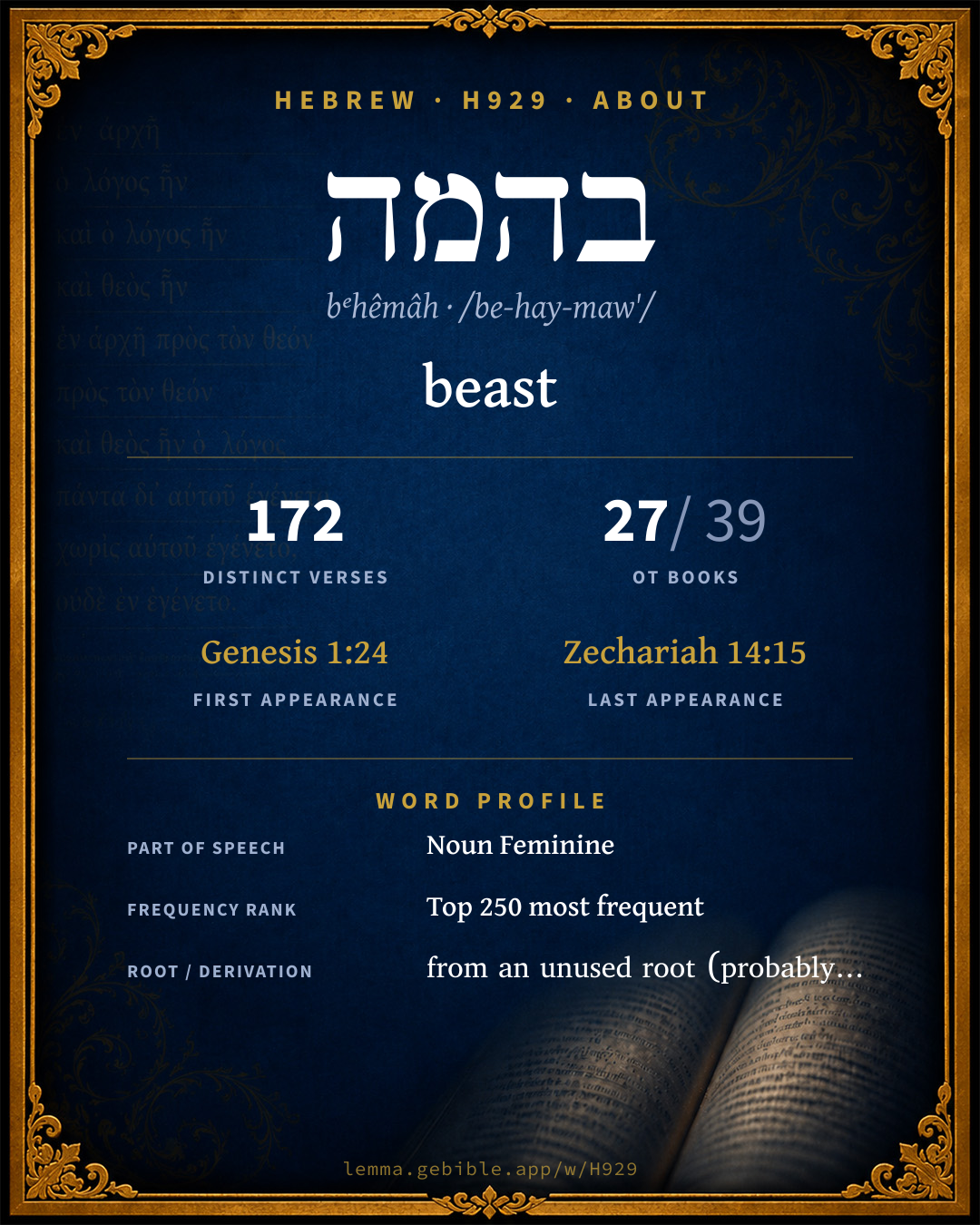
בְּהֵמָה
beast
also: cattle, animal fuller range ↓
Full lexicon entry — Brown-Driver-Briggs (BDB)
From Brown-Driver-Briggs (BDB)
Where this word appears
See every Absolute-state word in the Hebrew Bible →
Grammar key — what these labels mean
Part of speech
- Noun
- A naming word — a person, place, thing, or idea.
Noun type
- Common
- A common noun — a general class of person, place, or thing (“king,” “city,” “water”), not a specific name.
State
- Absolute
- The independent form of a noun, not bound to a following word.
- Construct
- A noun bound to a following noun in a possessive / “of” relationship (the construct chain).
Gender
- Feminine
- Grammatically feminine.
Number
- Singular
- One.
- Plural
- More than one (in Hebrew, generally three or more).
22 verses where H929 appears in the Absolute state in the Book of Leviticus. Filtered view — show all forms. Click any verse to open its interlinear word-by-word view. Verse text shown in the World English Bible for context — . Each verse’s Hebrew form is shown with its reference; the English is not keyword-highlighted, since the data carries no word-level English alignment. Use “Compare translations” on any verse to read it across multiple English versions. This concordance covers the Hebrew Bible; Septuagint (Greek Old Testament) occurrences are not indexed here.
Leviticus
- Leviticus 1:2 הַ/בְּהֵמָ֗ה ptcl def.art + n c fs "Speak to the children of Israel, and tell them, 'When anyone of you offers an offering to Yahweh, you shall offer your offering of the cattle, from the herd and from the flock.
- Leviticus 5:2 בְּהֵמָ֣ה n c fs "'Or if anyone touches any unclean thing, whether it is the carcass of an unclean animal, or the carcass of unclean cattle, or the carcass of unclean creeping things, and it is hidden from him, and he is unclean, then he shall be guilty.
- Leviticus 7:21 בִּ/בְהֵמָ֣ה prep + n c fs When anyone touches any unclean thing, the uncleanness of man, or an unclean animal, or any unclean abomination, and eats some of the flesh of the sacrifice of peace offerings, which belong to Yahweh, that soul shall be cut off from his people.'"
- Leviticus 7:25 הַ֨/בְּהֵמָ֔ה ptcl def.art + n c fs For whoever eats the fat of the animal, of which men offer an offering made by fire to Yahweh, even the soul who eats it shall be cut off from his people.
- Leviticus 7:26 וְ/לַ/בְּהֵמָֽה conj + prep det + n c fs You shall not eat any blood, whether it is of bird or of animal, in any of your dwellings.
- Leviticus 11:2 הַ/בְּהֵמָ֖ה ptcl def.art + n c fs "Speak to the children of Israel, saying, 'These are the living things which you may eat among all the animals that are on the earth.
- Leviticus 11:3 בַּ/בְּהֵמָ֑ה prep det + n c fs Whatever parts the hoof, and is cloven-footed, and chews the cud among the animals, that you may eat.
- Leviticus 11:26 הַ/בְּהֵמָ֡ה ptcl def.art + n c fs "'Every animal which parts the hoof, and is not cloven-footed, nor chews the cud, is unclean to you. Everyone who touches them shall be unclean.
- Leviticus 11:39 הַ/בְּהֵמָ֔ה ptcl def.art + n c fs "'If any animal, of which you may eat, dies; he who touches its carcass shall be unclean until the evening.
- Leviticus 11:46 הַ/בְּהֵמָה֙ ptcl def.art + n c fs "'This is the law of the animal, and of the bird, and of every living creature that moves in the waters, and of every creature that creeps on the earth,
- Leviticus 18:23 בְּהֵמָ֛ה בְהֵמָ֛ה n c fs n c fs "'You shall not lie with any animal to defile yourself with it; neither shall any woman give herself to an animal, to lie down with it: it is a perversion.
- Leviticus 20:15 בִּ/בְהֵמָ֖ה הַ/בְּהֵמָ֖ה prep + n c fs ptcl def.art + n c fs "'If a man lies with an animal, he shall surely be put to death; and you shall kill the animal.
- Leviticus 20:16 בְּהֵמָה֙ הַ/בְּהֵמָ֑ה n c fs ptcl def.art + n c fs "'If a woman approaches any animal, and lies down with it, you shall kill the woman, and the animal: they shall surely be put to death; their blood shall be upon them.
- Leviticus 20:25 הַ/בְּהֵמָ֤ה בַּ/בְּהֵמָ֣ה ptcl def.art + n c fs prep det + n c fs "'You shall therefore make a distinction between the clean animal and the unclean, and between the unclean fowl and the clean: and you shall not make yourselves abominable by animal, or by bird, or by anything with which the ground teems, which I have separated from you as unclean for you.
- Leviticus 24:18 בְּהֵמָ֖ה n c fs He who strikes a animal mortally shall make it good, life for life.
- Leviticus 24:21 בְהֵמָ֖ה n c fs He who kills an animal shall make it good; and he who kills a man shall be put to death.
- Leviticus 27:9 בְּהֵמָ֔ה n c fs "'If it is an animal, of which men offer an offering to Yahweh, all that any man gives of such to Yahweh becomes holy.
- Leviticus 27:10 בְּהֵמָה֙ בִּ/בְהֵמָ֔ה n c fs prep + n c fs He shall not alter it, nor change it, a good for a bad, or a bad for a good: and if he shall at all change animal for animal, then both it and that for which it is changed shall be holy.
- Leviticus 27:11 בְּהֵמָ֣ה הַ/בְּהֵמָ֖ה n c fs ptcl def.art + n c fs If it is any unclean animal, of which they do not offer as an offering to Yahweh, then he shall set the animal before the priest;
- Leviticus 27:26 בִּ/בְהֵמָ֔ה prep + n c fs "'Only the firstborn among animals, which is made a firstborn to Yahweh, no man may dedicate it; whether an ox or sheep, it is Yahweh's.
- Leviticus 27:27 בַּ/בְּהֵמָ֤ה prep det + n c fs If it is an unclean animal, then he shall buy it back according to your valuation, and shall add to it the fifth part of it: or if it isn't redeemed, then it shall be sold according to your valuation.
- Leviticus 27:28 וּ/בְהֵמָה֙ conj + n c fs "'Notwithstanding, no devoted thing, that a man shall devote to Yahweh of all that he has, whether of man or animal, or of the field of his possession, shall be sold or redeemed: every devoted thing is most holy to Yahweh.
About this entry
At a glance — auto-summarized from this page’s data, not written by a person. Every figure links to its source below. This summary describes the numbers; it doesn’t interpret them.
At its core, בהמה (bᵉhêmâh) means “beast.” Older and newer Bibles part ways — “beast” in the King James Version, “livestock” (Berean Standard Bible) and “animal” (unfoldingWord Literal Text) in modern versions. See the renderings breakdown. Spanning 172 verses in 27 books, it ranks among the common words of the Hebrew Bible. Scripture first uses it in Genesis 1:24. Not a single-sense word: its full sense range also takes in “cattle” and “animal”. See the sense tree, 172-verse concordance, and the renderings breakdown below.
Gloss history
Strong's 1890 vs modern scholarship
About this word
Strong's H929 catalogs a Hebrew word from the Hebrew Old Testament.
These counts are not copied from any lexicon or concordance. They are computed here, from the morphology-tagged Hebrew Old Testament. What Lemma adds →
- 172
- distinct verses
- The word appears in 172 distinct verses.
- 27 / 39
- OT books
- The word appears in 27 of 39 Old Testament books.
- #245
- by frequency
- Top 250 most frequent Hebrew words (rank 245 of 8,640 Hebrew words by occurrence).
View all 172 occurrences in the concordance →
By section of the Old Testament
By traditional corpus
Conventional, traditional groupings — biblical authorship is debated, so this is a traditional corpus grouping, not an authorship claim. Each share is this word’s portion of its verses in that division of the Hebrew canon. Each figure is a share of the word’s 172 distinct verses.
- Torah (Pentateuch) 91 verses · 53%
- Prophets (Nevi'im) 55 verses · 32%
- Writings (Ketuvim) 26 verses · 15%
How translations render this word
Counts come from each version’s own published word-to-Strong’s tagging or interlinear alignment — an approximate guide to how each version renders this word, not a word-level alignment the data otherwise carries. Because each total is that version’s own tagged count, the per-version totals vary from one another and need not match the appearance or distinct-verse counts above. These counts may also differ from a printed concordance because Lemma counts each distinctly tagged rendering and does not collapse phrase taggings into a single head-word total. This is a fixed set of word-tagged versions (KJV, ASV, BSB, ULT) and does not change with the reading translation you choose elsewhere. Each version’s license is shown beside its name below (and on Sources).
- King James Version: Beast 61×, Beasts 31×, Cattle 31×
- American Standard Version: Beast 57×, Cattle 31×, Beasts 25×
- Berean Standard Bible: Livestock 40×, Beast 37×, Animal 28×
- unfoldingWord Literal Text: Animal 35×, Beast 35×, Livestock 35×
King James Version Public Domain
Renders H929 across 188 tagged occurrences — most commonly:
Plus other, less common renderings. Plus 37 renderings that appear only once — usually multi-word phrases or single function words the recovered tagging swept in, not distinct renderings. Not rendered by a distinct English word in 1 further occurrence.
American Standard Version Public Domain
Renders H929 across 188 tagged occurrences — most commonly:
Plus other, less common renderings. Plus 45 renderings that appear only once — usually multi-word phrases or single function words the recovered tagging swept in, not distinct renderings.
Berean Standard Bible Public Domain
Renders H929 across 186 tagged occurrences — most commonly:
Plus 23 renderings that appear only once — usually multi-word phrases or single function words the recovered tagging swept in, not distinct renderings. Not rendered by a distinct English word in 4 further occurrences.
unfoldingWord Literal Text CC BY-SA 4.0
Renders H929 across 189 tagged occurrences — most commonly:
Plus other, less common renderings. Plus 22 renderings that appear only once — usually multi-word phrases or single function words the recovered tagging swept in, not distinct renderings.
Senses in the full BDB
What do BDB’s symbols mean?
BDB uses these scholarly abbreviations:
| Symbol | Meaning |
|---|---|
| 𝔊 | the Septuagint (the ancient Greek translation, LXX) |
| 𝔙 | the Vulgate (the Latin translation) |
| 𝔖 | the Syriac version (the Peshitta) |
| 𝔗 | the Targum (the Aramaic translation) |
| ψ | the Psalms |
| √ | root (the underlying root or stem) |
| ‖ | parallel passage (a synonymous or contrasted parallel) |
| † | the dagger: every passage where the word occurs is cited |
The 3 senses and sub-senses the full Brown-Driver-Briggs lexicon distinguishes for this word, in lexicon order (not ranked by frequency), with BDB’s own verbatim wording and sub-sense lettering. Shown in Hebrew script with BDB’s own scholarly abbreviations. The condensed entry is in the Lexicon Entry tab. See also the Forms in the corpus table below.
- 1. of living creatures other than man (אָדָם) Gn 8:1 Ex 8:13, 14; 9:9, 10, 22; 22:18 Lv 18:23(×2) (where בּ׳ is male, S 20:16) Dt 27:21 ψ 36:7 etc.; מֵאָדָם וְעַד בּ׳ (בּ׳ including all the larger animals) Ex 9:25; 12:12 ψ 135:8 Je 50:3 etc.; as inferior to man Jb 18:2 ψ 49:13, 21, so also Ec 3:18, 19(×2), 21; opp. also birds & reptiles Gn 6:7; 7:23; 8:17 cf. Ez 44:31 etc.; also to fishes 1 K 5:13 Jb 12:7 cf. v 8, ψ 8:9 Zp 1:3. e.g. Genesis 8:1
- 2. opp. also to wild beasts חַיַּת הָאָרֶץ, ח׳ הַשָּׂדֶה Gn 1:24, 25, 26; 2:20; 3:14; 7:14, 21; 9:10 ψ 50:10; 148:10 Is 46:1 etc.; especially therefore cattle, as owned and used by man, Gn 47:18 (מִקְנֵה הַבּ׳) Ex 20:10 = Dt 5:14, Lv 19:19; 26:22 Nu 3:41(×2) 45(×2) Dt 2:35; 11:15 Jon 4:11 Zc 2:8; 8:10; 14:15 Ezr 1:4, 6 Ne 9:37; 10:37 etc.; in one (late) passage of animal for riding (horse? mule?) Ne 2:12(×2), 14. e.g. Genesis 1:24
- 3. rarely of wild beasts, especially carnivora, בּ׳ יַעַר Mi 5:7; בּ׳ הָאָרֶץ Dt 28:26 Is 18:6(×2) Je 7:33; 15:3; 16:4; 19:7 34:20; בּ׳ הַשָּׂרֶה 1 S 17:44; alone, Pr 30:30; שֶׁן־בְּהֵמוֹת Dt 32:24; שֹׁד בּ׳ Hb 2:17.—On בְּהֵמוֹת ψ 73:22 cf. infr. e.g. Micah 5:7
Senses from the full Brown-Driver-Briggs lexicon (Brown, Driver, Briggs; Oxford 1906 — public domain), digitized via Sefaria, supplemented by the OpenScriptures HebrewLexicon (CC BY 4.0). Full attribution on Sources.
Word origin
n.f. beast, animal, cattle (Arabic بَهِيمَةٌ )—בּ׳ Gn 1:24 + 137 times; cstr. בֶּהֱמַת Nu 3:41(×2) + 10 times; sf. בְּהֶמְתְּךָ Lv 19:19 + 4 times; בְּהֶמְתֶּ֑ךָ Ex 20:10 + 4 times; בְּהֶמְתּוֹ Gn 36:6 Pr 12:10; pl. abs. בְּהֵמוֹת Dt 32:24 + 6 times + ψ 73:22 (v. infr.); cstr. בַּהֲמוֹת ψ 8:8 + 5 times;—beast, & coll. beasts (Gn 8:1 + very often)
— Brown-Driver-Briggs (Oxford 1906, public domain), digitized via Sefaria, supplemented by the OpenScriptures HebrewLexicon (CC BY 4.0). See Sources.
Origin: from an unused root (probably meaning to be mute)
Jastrow Dictionary
A second Hebrew/Aramaic lexicon for comparison, covering Aramaic and post-biblical (Talmudic, Targumic, Midrashic) usage that the biblical-Hebrew BDB does not. Matched by lemma rather than by Strong’s number, so a lemma may carry more than one Jastrow headword (shown separately below), and the entries cover usage well beyond the Bible.
בְּהֵמָה
- , Æthiop. to be dumb; √בה, v. בהי) cattle, quadruped domestic animal (mostly of the horned race); in gen. dumb beast, opp. to man. Gen. R. s. 20 ב׳ חיה ועופות domestic animals, wild beasts, and birds; a. fr.—ב׳ גסה large cattle (of the bovine race); ב׳ דקה small cattle (sheep, goats &c.). Bekh. 8ᵃ; a. fr.—בֶּהֱמַת מלוג, ב׳ ארנונא &c., v. מְלוּג, אַרְנוֹנָא &c.—Pl. בְּהֵמוֹת Gen. R. s. 86; a. fr.
הָמָה
- , v. המי
המי
- to be noisy, excited, with אחר to rush after, be greedy, envious &c.—Cant. R. to VIII, 11 הָמוּ, v. הָמוֹן a. הֲמוֹנוּת. Part. הוֹמֶה, v. infra; fem. הוֹמִיָּה. Y. M. Kat. III, beg. 81ᶜ (in a riddle) ה׳ בירכתי ביתה she (the soul?) is restless in the corners of her house. Midr. Till. to Ps. LXXVII הוֹמִים are in commotion.
- same, to covet (with אחר). Lev. R. s. 22 (ref. to אוהב בהמון, Koh. V, 9) כל מי שהומה ומְהַמֶּה אחר הממון whosoever is greedy and covetous for money; ib. הומה ומה׳ אחר תורה ambitious to accumulate learning; a. e.—Part. pass. f. מְהוּמָּת anxious. Nidd. 5ᵃ, v. בַּיִת.—Denom. מָמוֹן. e.g. Ecclesiastes 5:9
A Dictionary of the Targumim, the Talmud Babli and Yerushalmi, and the Midrashic Literature (Marcus Jastrow; London, Luzac, 1903) — Public Domain. Digitized via Sefaria. Digitized via Sefaria. Full attribution on Sources.
Forms in the corpus
The 96 distinct written forms H929 takes in the Hebrew Bible, most frequent first — each parse links to that state’s occurrences in the concordance. Hebrew forms include their vowel points and cantillation, so a single lemma takes many written forms.
The 60 most common forms are shown; 36 rarer forms follow in the full concordance.
Same root — word family
Other BDB entries built from the same root as H929, grouped by Strong’s listed origin. These share a root / origin per the lexicon — not necessarily a shared meaning. Each links to that word’s own entry.
Derived from this word
Compare all same-root words → They share a root, not necessarily a meaning.
Septuagint verse parallels
This word appears in 162 verses that also exist in the Greek Old Testament (Septuagint), out of the 172 Hebrew verses it occurs in. You can read those verses in Greek by switching the Old Testament edition to the Septuagint.
Read these verses in the Septuagint
- Genesis 1:24
- Exodus 8:17
- Leviticus 1:2
- Numbers 3:13
- Deuteronomy 2:35
- Joshua 8:2
- Judges 20:48
- 1 Kings 18:5
- 2 Kings 3:9
- 2 Chronicles 32:28
- Ezra 1:4
- Job 12:7
This is a verse-level parallel only — the same verses exist in both the Hebrew and Greek Old Testaments. No word-level Hebrew↔Greek correspondence is claimed: the data carries no such alignment, so no Greek word is shown as this Hebrew word’s translation. Coverage is not total — the Septuagint omits the deuterocanon and renumbers the Psalms, so some Hebrew verses have no direct Greek parallel.