שָׂפָה
lip
also: language, speech, shore, bank fuller range ↓
Full lexicon entry — Brown-Driver-Briggs (BDB)
From Brown-Driver-Briggs (BDB)
Where this word appears
See every Construct-state word in the Hebrew Bible →
Grammar key — what these labels mean
Part of speech
- Noun
- A naming word — a person, place, thing, or idea.
Noun type
- Common
- A common noun — a general class of person, place, or thing (“king,” “city,” “water”), not a specific name.
State
- Construct
- A noun bound to a following noun in a possessive / “of” relationship (the construct chain).
- Absolute
- The independent form of a noun, not bound to a following word.
Gender
- Feminine
- Grammatically feminine.
Number
- Singular
- One.
- Dual
- Exactly two — for natural pairs and some measures of time.
- Plural
- More than one (in Hebrew, generally three or more).
37 verses where H8193 appears in the Construct state in the Book of Proverbs. Filtered view — show all forms. Click any verse to open its interlinear word-by-word view. Verse text shown in the World English Bible for context — . Each verse’s Hebrew form is shown with its reference; the English is not keyword-highlighted, since the data carries no word-level English alignment. Use “Compare translations” on any verse to read it across multiple English versions. This concordance covers the Hebrew Bible; Septuagint (Greek Old Testament) occurrences are not indexed here.
Proverbs
- Proverbs 5:2 שְׂפָתֶ֥י/ךָ n c fd cs + sfx pers 2ms That you may maintain discretion, That your lips may preserve knowledge.
- Proverbs 5:3 שִׂפְתֵ֣י n c fd cs For the lips of an adulteress drip honey. Her mouth is smoother than oil,
- Proverbs 7:21 שְׂ֝פָתֶ֗י/הָ n c fd cs + sfx pers 3fs With persuasive words, she led him astray. With the flattering of her lips, she seduced him.
- Proverbs 8:6 שְׂ֝פָתַ֗/י n c fd cs + sfx pers 1cs Hear, for I will speak excellent things. The opening of my lips is for right things.
- Proverbs 8:7 שְׂפָתַ֣/י n c fd cs + sfx pers 1cs For my mouth speaks truth. Wickedness is an abomination to my lips.
- Proverbs 10:13 בְּ/שִׂפְתֵ֣י prep + n c fd cs Wisdom is found on the lips of him who has discernment, But a rod is for the back of him who is void of understanding.
- Proverbs 10:18 שִׂפְתֵי n c fd cs He who hides hatred has lying lips. He who utters a slander is a fool.
- Proverbs 10:19 שְׂפָתָ֣י/ו n c fd cs + sfx pers 3ms In the multitude of words there is no lack of disobedience, But he who restrains his lips does wisely.
- Proverbs 10:21 שִׂפְתֵ֣י n c fd cs The lips of the righteous feed many, But the foolish die for lack of understanding.
- Proverbs 10:32 שִׂפְתֵ֣י n c fd cs The lips of the righteous know what is acceptable, But the mouth of the wicked is perverse.
- Proverbs 12:19 שְֽׂפַת n c fs cs Truth's lips will be established forever, But a lying tongue is only momentary.
- Proverbs 12:22 שִׂפְתֵי n c fd cs Lying lips are an abomination to Yahweh, But those who do the truth are his delight.
- Proverbs 13:3 שְׂ֝פָתָ֗י/ו n c fd cs + sfx pers 3ms He who guards his mouth guards his soul. One who opens wide his lips comes to ruin.
- Proverbs 14:3 וְ/שִׂפְתֵ֥י conj + n c fd cs The fool's talk brings a rod to his back, But the lips of the wise protect them.
- Proverbs 14:7 שִׂפְתֵי n c fd cs Stay away from a foolish man, For you won't find knowledge on his lips.
- Proverbs 15:7 שִׂפְתֵ֣י n c fd cs The lips of the wise spread knowledge; Not so with the heart of fools.
- Proverbs 16:10 שִׂפְתֵי n c fd cs Inspired judgments are on the lips of the king. He shall not betray his mouth.
- Proverbs 16:13 שִׂפְתֵי n c fd cs Righteous lips are the delight of kings. They value one who speaks the truth.
- Proverbs 16:23 שְׂ֝פָתָ֗י/ו n c fd cs + sfx pers 3ms The heart of the wise instructs his mouth, And adds learning to his lips.
- Proverbs 16:27 שפתי/ו שְׂ֝פָת֗/וֹ n c fd cs + sfx pers 3ms n c fs cs + sfx pers 3ms A worthless man devises mischief. His speech is like a scorching fire.
- Proverbs 16:30 שְׂ֝פָתָ֗י/ו n c fd cs + sfx pers 3ms One who winks his eyes to plot perversities, One who compresses his lips, is bent on evil.
- Proverbs 17:4 שְׂפַת n c fs cs An evil-doer heeds wicked lips. A liar gives ear to a mischievous tongue.
- Proverbs 17:7 שְׂפַת שְׂפַת n c fs cs n c fs cs Arrogant speech isn't fitting for a fool, Much less do lying lips fit a prince.
- Proverbs 17:28 שְׂפָתָ֣י/ו n c fd cs + sfx pers 3ms Even a fool, when he keeps silent, is counted wise. When he shuts his lips, he is thought to be discerning.
- Proverbs 18:6 שִׂפְתֵ֣י n c fd cs A fool's lips come into strife, And his mouth invites beatings.
- Proverbs 18:7 וּ֝/שְׂפָתָ֗י/ו conj + n c fd cs + sfx pers 3ms A fool's mouth is his destruction, And his lips are a snare to his soul.
- Proverbs 18:20 שְׂפָתָ֣י/ו n c fd cs + sfx pers 3ms A man's stomach is filled with the fruit of his mouth. With the harvest of his lips he is satisfied.
- Proverbs 19:1 שְׂ֝פָתָ֗י/ו n c fd cs + sfx pers 3ms Better is the poor who walks in his integrity Than he who is perverse in his lips and is a fool.
- Proverbs 20:15 שִׂפְתֵי n c fd cs There is gold and abundance of rubies; But the lips of knowledge are a rare jewel.
- Proverbs 20:19 שְׂ֝פָתָ֗י/ו n c fd cs + sfx pers 3ms He who goes about as a tale-bearer reveals secrets; Therefore don't keep company with him who opens wide his lips.
- Proverbs 22:11 שְׂ֝פָתָ֗י/ו n c fd cs + sfx pers 3ms He who loves purity of heart and speaks gracefully Is the king's friend.
- Proverbs 22:18 שְׂפָתֶֽי/ךָ n c fd cs + sfx pers 2ms For it is a pleasant thing if you keep them within you, If all of them are ready on your lips.
- Proverbs 23:16 שְׂ֝פָתֶ֗י/ךָ n c fd cs + sfx pers 2ms Yes, my heart will rejoice, When your lips speak what is right.
- Proverbs 24:2 שִׂפְתֵי/הֶ֥ם n c fd cs + sfx pers 3mp For their hearts plot violence, And their lips talk about mischief.
- Proverbs 24:28 בִּ/שְׂפָתֶֽי/ךָ prep + n c fd cs + sfx pers 2ms Don't be a witness against your neighbor without cause. Don't deceive with your lips.
- Proverbs 26:24 ב/שפת/ו בִּ֭/שְׂפָתָי/ו prep + n c fs cs + sfx pers 3ms prep + n c fd cs + sfx pers 3ms A malicious man disguises himself with his lips, But he harbors evil in his heart.
- Proverbs 27:2 שְׂפָתֶֽי/ךָ n c fd cs + sfx pers 2ms Let another man praise you, And not your own mouth; A stranger, and not your own lips.
About this entry
At a glance — auto-summarized from this page’s data, not written by a person. Every figure links to its source below. This summary describes the numbers; it doesn’t interpret them.
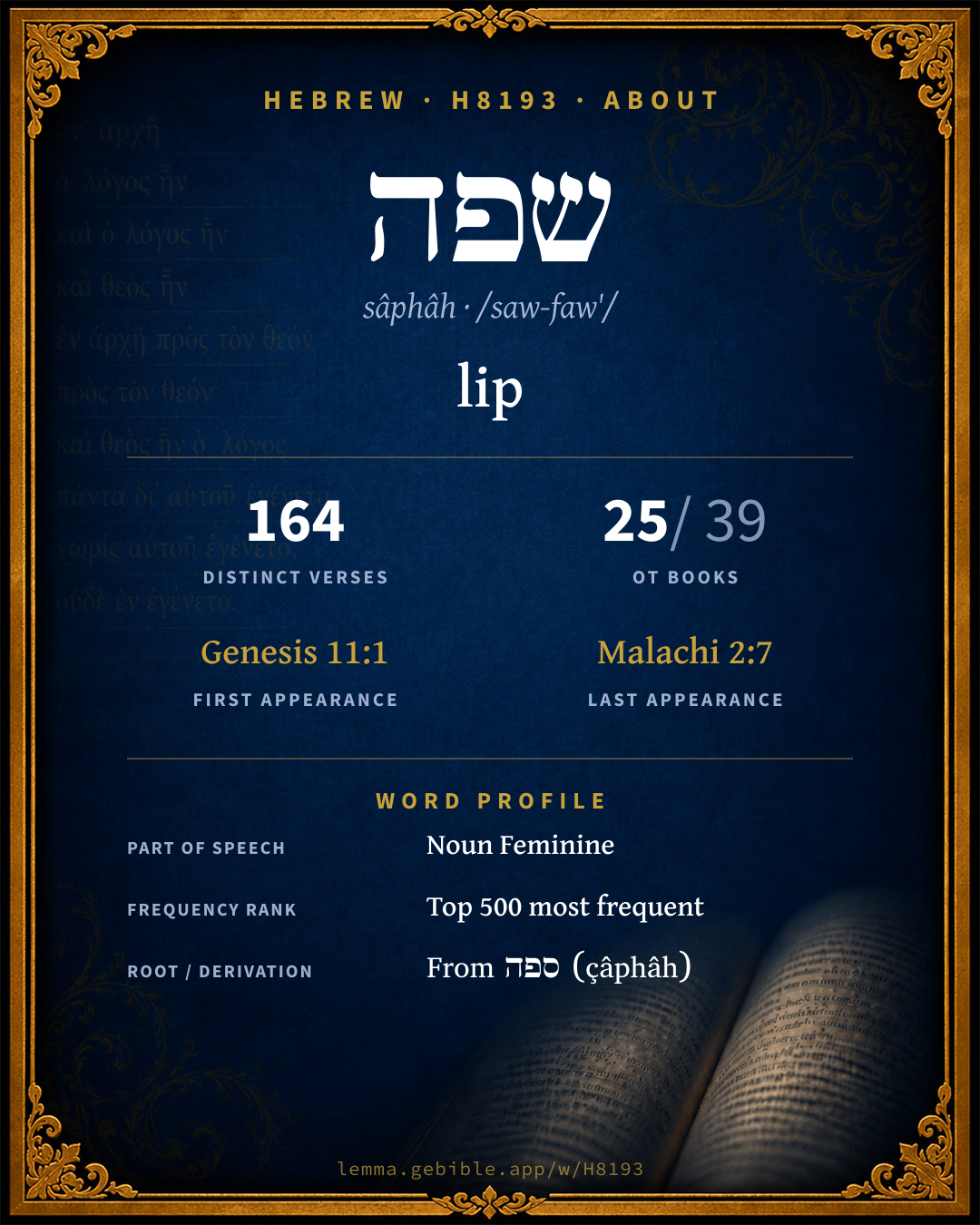
“lip” is the headline sense of the Hebrew noun שפה (sâphâh). Beyond “lip” it also covers “language”, “speech”, and “shore” — see its full sense range. The Hebrew Bible uses it across 164 verses — common. More than a quarter of its appearances fall in Proverbs. Its earliest occurrence is Genesis 11:1. See the sense tree, 164-verse concordance, and the renderings breakdown below.
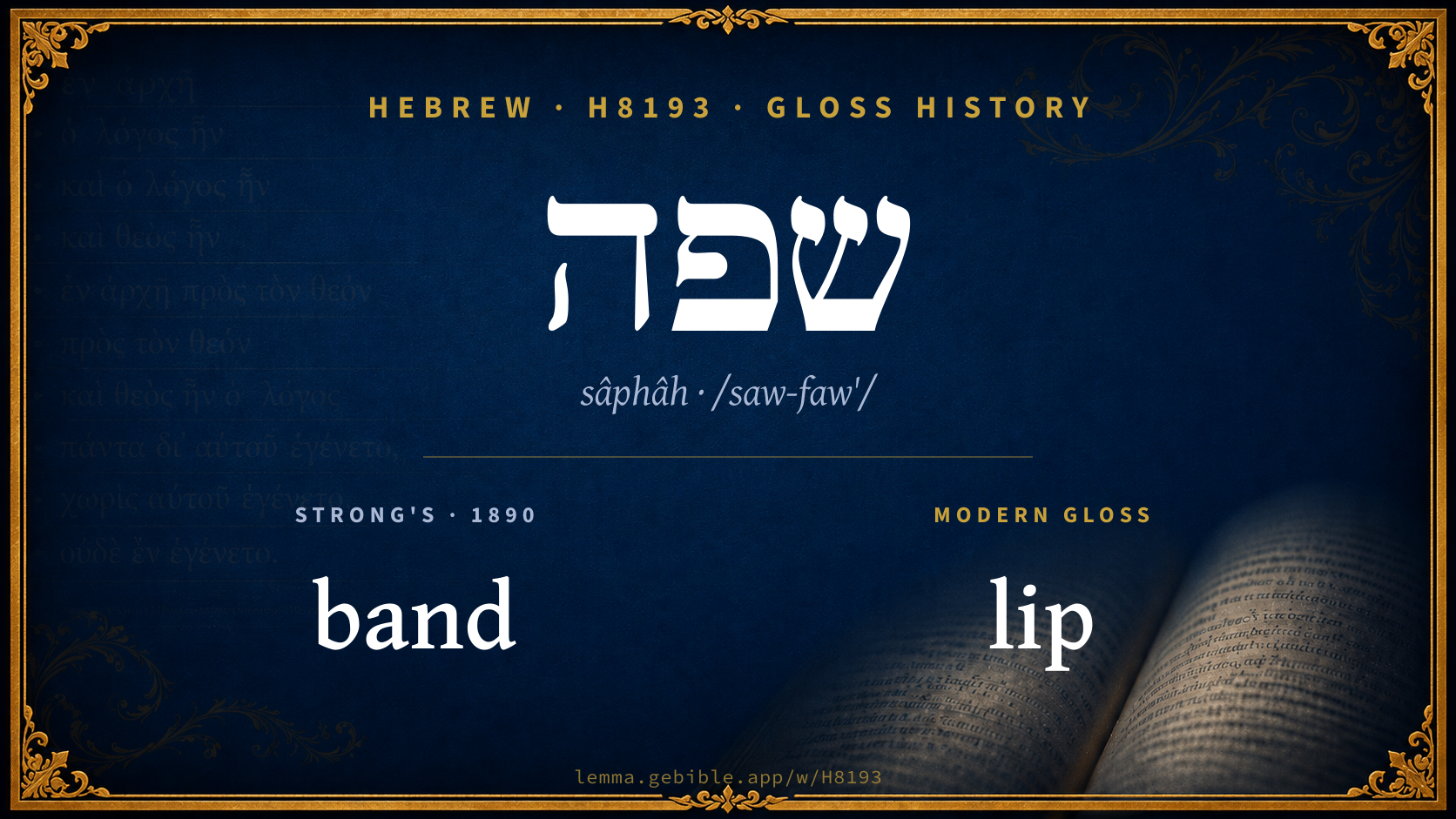
Gloss history
Strong's 1890 vs modern scholarship
About this word
Strong's H8193 catalogs a Hebrew word from the Hebrew Old Testament.
These counts are not copied from any lexicon or concordance. They are computed here, from the morphology-tagged Hebrew Old Testament. What Lemma adds →
- 164
- distinct verses
- The word appears in 164 distinct verses.
- 25 / 39
- OT books
- The word appears in 25 of 39 Old Testament books.
- #262
- by frequency
- Top 500 most frequent Hebrew words (rank 262 of 8,640 Hebrew words by occurrence).
View all 164 occurrences in the concordance →
By section of the Old Testament
By traditional corpus
Conventional, traditional groupings — biblical authorship is debated, so this is a traditional corpus grouping, not an authorship claim. Each share is this word’s portion of its verses in that division of the Hebrew canon. Each figure is a share of the word’s 164 distinct verses.
- Writings (Ketuvim) 96 verses · 59%
- Prophets (Nevi'im) 41 verses · 25%
- Torah (Pentateuch) 27 verses · 16%
How translations render this word
Counts come from each version’s own published word-to-Strong’s tagging or interlinear alignment — an approximate guide to how each version renders this word, not a word-level alignment the data otherwise carries. Because each total is that version’s own tagged count, the per-version totals vary from one another and need not match the appearance or distinct-verse counts above. These counts may also differ from a printed concordance because Lemma counts each distinctly tagged rendering and does not collapse phrase taggings into a single head-word total. This is a fixed set of word-tagged versions (KJV, ASV, BSB, ULT) and does not change with the reading translation you choose elsewhere. Each version’s license is shown beside its name below (and on Sources).
- King James Version: Lips 100×, Language 7×, Edge 6×
- American Standard Version: Lips 85×, Edge 9×, Language 7×
- Berean Standard Bible: Lips 96×, Speech 12×, Rim 10×
- unfoldingWord Literal Text: Lips 87×, Lips of 16×, Lip of 12×
King James Version Public Domain
Renders H8193 across 176 tagged occurrences — most commonly:
Plus other, less common renderings. Plus 24 renderings that appear only once — usually multi-word phrases or single function words the recovered tagging swept in, not distinct renderings.
American Standard Version Public Domain
Renders H8193 across 174 tagged occurrences — most commonly:
Plus other, less common renderings. Plus 34 renderings that appear only once — usually multi-word phrases or single function words the recovered tagging swept in, not distinct renderings.
Berean Standard Bible Public Domain
Renders H8193 across 167 tagged occurrences — most commonly:
Plus other, less common renderings. Plus 7 renderings that appear only once — usually multi-word phrases or single function words the recovered tagging swept in, not distinct renderings. Not rendered by a distinct English word in 8 further occurrences.
unfoldingWord Literal Text CC BY-SA 4.0
Renders H8193 across 188 tagged occurrences — most commonly:
Plus other, less common renderings. Plus 17 renderings that appear only once — usually multi-word phrases or single function words the recovered tagging swept in, not distinct renderings.
11 senses and sub-senses in the full BDB
What do BDB’s symbols mean?
BDB uses these scholarly abbreviations:
| Symbol | Meaning |
|---|---|
| 𝔊 | the Septuagint (the ancient Greek translation, LXX) |
| 𝔙 | the Vulgate (the Latin translation) |
| 𝔖 | the Syriac version (the Peshitta) |
| 𝔗 | the Targum (the Aramaic translation) |
| ψ | the Psalms |
| √ | root (the underlying root or stem) |
| ‖ | parallel passage (a synonymous or contrasted parallel) |
| † | the dagger: every passage where the word occurs is cited |
The 11 senses and sub-senses the full Brown-Driver-Briggs lexicon distinguishes for this word, in lexicon order (not ranked by frequency), with BDB’s own verbatim wording and sub-sense lettering. Shown in Hebrew script with BDB’s own scholarly abbreviations. The condensed entry is in the Lexicon Entry tab. See also the Forms in the corpus table below.
- 1. lip:
- a. usually (c. 108 times) human organ of speech (often ‖ פֶּה לָשׁוֹן, rarely [only late poetry] חֵךְ: 10 times Jb; 25 times ψψ; 45 times Pr): (1) Is 29:13 Lv 5:4 (P), Jb 13:6 Mal 2:6 ψ 12:5 Pr 5:3 +; דַּל שׂ׳ ψ 141:3 (v. דָּל); אִישׁ שׂ׳ Jb 11:2 = a talker, אֱוִיל שׂ׳ Pr 10:8 = one talking folly, so v 10 (MT; but v. Toy); טְמֵא שְׂפָתַיִם Is 6:5(×2) cf. v 7 Dn 10:16; עֲרַל שׂ׳ Ex 6:12, 30 (P; unskilled in speech); עִקֵּשׁ שׂ׳ Pr 19:1; פֹּתֶה שׂ׳ 20:19 v. [פָּתָה]; מוֹצָא שׂ׳ i.e. utterance, Dt 23:24 Je 17:16 Nu 30:13 (P), ψ 89:35, רוּחַ שׂ׳ Is 11:4 (of Mess. kg.), דְּבַר שׂ׳ ψ 59:13 Pr 14:23 +, = mere, empty, word 2 K 18:20 = Is 36:5; תְּבוּאַת שׂ׳ Pr 18:20, נוב שׂ׳ Is 57:19 (thanksgiving), cf. Ho 14:3 𝔊𝔖 and most פְּרִי for פָּרִים); of flattery, חֵלֶק שׂ׳ Pr 7:21, שְׂפַת חֲלָקוֹת ψ 12:3, 4; cf. שִׂפְתֵי מִרְמָה ψ 17:1, שׂ׳ שֶׁקֶר 31:9 + 4 times, שְׂפַת אָוֶן Pr 17:4; poison beneath (cf. לָשׁוֹן) ψ 140:4 (fig.); פֶּשַׁע שׂ׳ Pr 12:13; לְזוּת שׂ׳ 4:24; שׂ׳ אֱמֶת 12:19, שׂ׳ יָ֑תֶר 17:7, שׂ׳ צֶדֶק 16:13, שׂ׳ דַּעַת 14:7; 20:15; חֵן שׂ׳ 22:11; שָׂפָה בְרוּרָה Zp 3:9; שׂ׳ רְנָנוֹת ψ 63:5 i.e. lips that shout for joy; c. vbs.: פָּתַח שׂ׳ (to speak) Jb 11:5; 30:20 (Gi v 21), cf. ψ 51:17, מִפְתַּח שׂ׳ Pr 8:6; פֹּשֵׂק שׂ׳ 13:3 i.e. prate; שׂ׳ מָֽלְאוּ זַעַם Is 30:27; שׂ׳ subj. of דִּבֶּר Is 59:3 Pr 24:2; נָשָׂא עַל־שׂ׳ ψ 16:4; קָרַץ שׂ׳ Pr 16:30 = backbite; אָטַם שׂ׳ 17:28 = keep silence, so חָשַׂךְ שׂ׳ 10:19, שׂ׳ כָּלָא ψ 40:10. †(2) lips moving in speech, c. נוּעַ 1 S 1:13, נִיד Jb 16:5. †(3) transition to meaning speech, עָלָה עַל־שְׂפַת לָשׁוֹן Ez 36:3; = ability to speak Jb 12:20. e.g. Isaiah 29:13
- b. organ of laughter Jb 8:21. e.g. Job 8:21
- c. of insulting grimace הִפְטִיר בְּשׂ׳ ψ 22:8. e.g. Psalms 22:8
- d. quivering in terror Hb 3:16. e.g. Habakkuk 3:16
- e. feature of beauty Ct 4:3 (scarlet). e.g. Song of Solomon 4:3
- f. place of bridle 2 K 19:28 = Is 37:29 (v. מֶתֶג) e.g. 2 Kings 19:28
- g. receiving kiss Pr 24:26 cf. Ct 4:11 and (in fig.) 7:10. e.g. Proverbs 24:26
- h. of divine speech, מִצְוִת שׂ׳ Jb 23:12, דְּבַר שׂ׳ ψ 17:4. e.g. Job 23:12
- 2. language (v. לָשׁוֹן), Gn 11:1, 6, 7(×2), 9 ψ 81:6; עַם עִמְגֵי שׂ׳ Ez 3:5, 6 Is 33:19, לַעֲגֵי שׂ׳ 28:11; שְׂפַת כְּנַעַן 19:18 (i.e. Hebrew). e.g. Genesis 11:1
- 3. edge: shore of sea Gn 22:17 (J) + 7 times; bank of river Gn 41:3, 17 (E) + 5 times, of wady (נַחַל) Dt 2:36 + 7 times; lip (bank) of אָבֵל מְחוֹלָה Ju 7:22 cf. GASmG. 400; brim of vessel 1 K 7:23(×2) + 7 times; edge of altar Ez 43:13; of curtains (in pairs) Ex 26:4(×2) (P) + 6 times; of חֹשֶׁן, toward ephod 28:26 = 39:19 (P); of round opening in robe לְפִיו (יִהְיֶה) שׂ׳ 28:32 = 39:23 (P). e.g. Genesis 22:17
Senses from the full Brown-Driver-Briggs lexicon (Brown, Driver, Briggs; Oxford 1906 — public domain), digitized via Sefaria, supplemented by the OpenScriptures HebrewLexicon (CC BY 4.0). Full attribution on Sources.
Word origin
n.f. [m. Ex 28:32, edge, cf. AlbrZAW xvi (1896), 76], lip, speech, edge;—abs. שׂ׳ Gn 11:1 +, cstr. שְׂפַת v 7 +; sf. שְׂפָתוֹ 1 K 7:23 +, etc.; oftener du. שְׂפָתַיִם Is 6:5 +, cstr. שִׂפְתֵי ψ 12:4 +; sf. שְׂפָתַי Je 17:16 +, sf. 3 mpl. שְׂפָתֵימוֹ ψ 59:13; 140:4, 10, etc.; pl. (poet. and late) cstr. שִׂפְתוֹת Ec 10:12, sf. שִׂפְתוֹתֶיךָ etc. ψ 45:3; 59:8 Is 59:3 Ct 4:3, 11; 5:13;—
— Brown-Driver-Briggs (Oxford 1906, public domain), digitized via Sefaria, supplemented by the OpenScriptures HebrewLexicon (CC BY 4.0). See Sources.
Derived from ספה (çâphâh) (H5595) — to sweep away.
Jastrow Dictionary
A second Hebrew/Aramaic lexicon for comparison, covering Aramaic and post-biblical (Talmudic, Targumic, Midrashic) usage that the biblical-Hebrew BDB does not. Matched by lemma rather than by Strong’s number, so a lemma may carry more than one Jastrow headword (shown separately below), and the entries cover usage well beyond the Bible.
שִׁפָּה
- , v. סִפָּא
שָׂפָה
- v. סְפָי)
- 1. rim, border, binding. B. Bath. II, 1 ארבעה מן הש׳ four handbreadths from the rim of the stove. Ib. 19ᵃ שְׂפַת מחמצן the border of the wash-pit; a. fr.—קמי ש׳, קנה ש׳, v. קָמָה.
- 2. lip; speech. Y. Sabb. VII, 10ᶜ top המאדם אודם בש׳ he who reddens his lips (v. אָדַם; Naḥmanides reads: בטפה). Ib. XIV, 14ᵈ top כל שהוא מן הש׳ ולפנים any wound on the lip and further inside (in the mouth, opp. חָלָל III). Y. Macc. II, end, 32ᵃ, a. fr. בש׳ רפה with lax lips, with low indistinct speech; a. fr.—Pl. שְׂפָתוֹת, שְׂפָיוֹת (סְפָי); Du. שְׂפָתַיִם. Tosef. Kel. B. Kam. VI, 15 שְׂפָתָיו, v. שָׁפַע. M. Kat. 15ᵃ (expl. ועל שפם וכ׳, Lev. XIII, 45) שיהו שִׂפְתוֹתָיו מדובקות וכ׳ his lips should cleave to each other (he must not greet or answer greeting). Koh. R. to XII, 4 בנות השיר אלו הש׳ ‘the daughters of song’, that means the lips; Lev. R. s. 18 שִׂפְתוֹתָיו. Sabb. 152ᵃ שִׂפְתוֹתֵיהֶן וכ׳, v. רָפַט. Ab. Zar. 35ᵃ שִׂפְתוֹתֶיךָ, v. חָשַׁק. Keth. 61ᵇ את השפתים, v. שִׁרְבֵּט; Y. Keth. V, 30ᵃ bot. השפיות, v. שִׁלְבֵּק; a. fr.—Y. Yeb. VI, beg. 7ᵇ בין הש׳ between the lips (of the vagina). e.g. Leviticus 13:45
שָׁפָה
- verb, v. שפי
שָׁפָה ²
- (שָׁפָה II) overflow, additional measure; v. שֶׁפַע.
שפי
- 1. to crush. —Part. pass. שָׁפוּי, pl. שְׁפוּיִין crushed, humble, contrite (= b. h. דַּכָּא). Tosef. Ḥag. II, 9 עניו וש׳ humble and contrite; Tosef. Snh. VII, 1 וש׳ (only); Y. ib. I, 19ᶜ. Gen. R. s. 60 דווין וש׳ Ar. (ed. ושפופין) broken down and crushed (poor); a. e.
- 2. to rub, smooth, plane. —Part. pass. as ab. a) smooth. Koh. R. to XII, 14 two paths אחד ש׳ ואחד מלא וכ׳ one smooth, and the other full of thorns and pebbles.—Yalk. Gen. 62 בור ש׳ (Snh. 109ᵃ שָׁאפֵי; Ar. שפת, corr. acc.) a smooth (blank, empty) pit, v. בּוֹרְסִיף.—b) (cmp. חָלָק) unimpaired, unscathed. Gen. R. s. 45, v. רָתַק.
- 1. to plane, saw, trim. Ḥull. 125ᵃ קולית שש׳ וכ׳ a thigh-bone which one sawed through lengthwise. Ab. Zar. 42ᵃ ישראל שש׳ ע"ז וכ׳ if an Israelite chipped off an idol whether for his own purpose (to use the wood) or for its sake (to improve its appearance). Ib. 49ᵇ. Y. Gitt. V, 47ᵃ bot. גזלו ושִׁיפָּהוּ if he took a block by force and planed it. Tosef. Kel. B. Mets. III, 1 שפת הימנה וכ׳ (read: שפה) if he filed off a part of it and made of it &c.; a. e.—Part. pass. מְשׁוּפֶּה; pl. מְשׁוּפִּים, מְשׁוּפִּין. Y. Gitt. l. c. גזלו מש׳ if he took it planed. Y. Succ. I, 52ᶜ top במש׳ לכלים (not בכלים) when the boards are planed preparatory to making them into utensils; a. e.
- 2. to smooth, polish, Kel. XIV, 5 משׁיְשַׁפֶּנּוּ Ar.; Ned. 56ᵇ משׁיְשַׁפֵּם, v. שׁוּף II.—Trnsf. to pacify, give satisfaction. Y. B. Mets. V, 10ᵇ המבטל … חייב לשַׁפּוֹת לו if a tenant or an agent neglects his neighbor’s field, he must indemnify him; ib. IX, beg. 12ᵃ
- 3. to leave smooth places, (cmp. חָלַק Hif.) to plant wide apart. Y. Orl. I, beg. 60ᶜ לקורות במְשַׁפֶּה (or במַשְׁפֶּה Hif.) when he plants the trees wide apart, it is an indication that he wants to raise them for beams, opp. רָצַף. B. Bath. V, 4 הגדילו לא יְשַׁפֶּה (or יַשְׁפֶּה) if they (the trees bought in a person’s field) grew large, he (the owner of the field) has no right to smooth the field (cut the trees down). Ib. הגדילו ישפה when they are grown large, he (the owner of the trees) may cut them (in order to use the ground they occupy); a. e.
שפי ³
- (v.שָׁפָה I) [to be smooth,] to be quiet, at ease; to be relieved. Nidd. IV, 4 ושָׁפְתָה מעת לעת and was relieved for a full day, opp. קשתה, v. קָשָׁה. Ib. שפתה מן הצער וכ׳ she was relieved from pain, but not from the flux of blood; a. e.—Part. pass. שָׁפוּי quiet, sane. Arakh. 17ᵇ, sq. ש׳ ונשתטה if he was sane and became mad; B. Bath. 128ᵃ.—V. שׁוֹפִי II.
- (of a delirious person) to become quiet, conscious, sane. B. Kam. IV, 4 נש׳ השוטה if the madman became sane again; Tosef. ib. IV, 4. Y. Ter. I, 40ᵇ bot. לכשׁיִשְׁתַּפֶּה when he is sane again (we may write a letter of divorce at his order); Y. Gitt. VII, beg. 48ᶜ. Y. Keth. I, 25ᵇ; a. e.
A Dictionary of the Targumim, the Talmud Babli and Yerushalmi, and the Midrashic Literature (Marcus Jastrow; London, Luzac, 1903) — Public Domain. Digitized via Sefaria. Digitized via Sefaria. Full attribution on Sources.
Forms in the corpus
The 92 distinct written forms H8193 takes in the Hebrew Bible, most frequent first — each parse links to that state’s occurrences in the concordance. Hebrew forms include their vowel points and cantillation, so a single lemma takes many written forms.
The 60 most common forms are shown; 32 rarer forms follow in the full concordance.
Same root — word family
Other BDB entries built from the same root as H8193, grouped by Strong’s listed origin. These share a root / origin per the lexicon — not necessarily a shared meaning. Each links to that word’s own entry.
Derives from
Derived from this word
Compare all same-root words → They share a root, not necessarily a meaning.
Septuagint verse parallels
This word appears in 151 verses that also exist in the Greek Old Testament (Septuagint), out of the 164 Hebrew verses it occurs in. You can read those verses in Greek by switching the Old Testament edition to the Septuagint.
Read these verses in the Septuagint
- Genesis 11:1
- Exodus 2:3
- Leviticus 5:4
- Numbers 30:6
- Deuteronomy 2:36
- Joshua 11:4
- Judges 7:12
- 1 Samuel 1:13
- 1 Kings 7:23
- 2 Kings 2:13
- 2 Chronicles 4:2
- Job 2:10
This is a verse-level parallel only — the same verses exist in both the Hebrew and Greek Old Testaments. No word-level Hebrew↔Greek correspondence is claimed: the data carries no such alignment, so no Greek word is shown as this Hebrew word’s translation. Coverage is not total — the Septuagint omits the deuterocanon and renumbers the Psalms, so some Hebrew verses have no direct Greek parallel.