
Proverbs 16:27

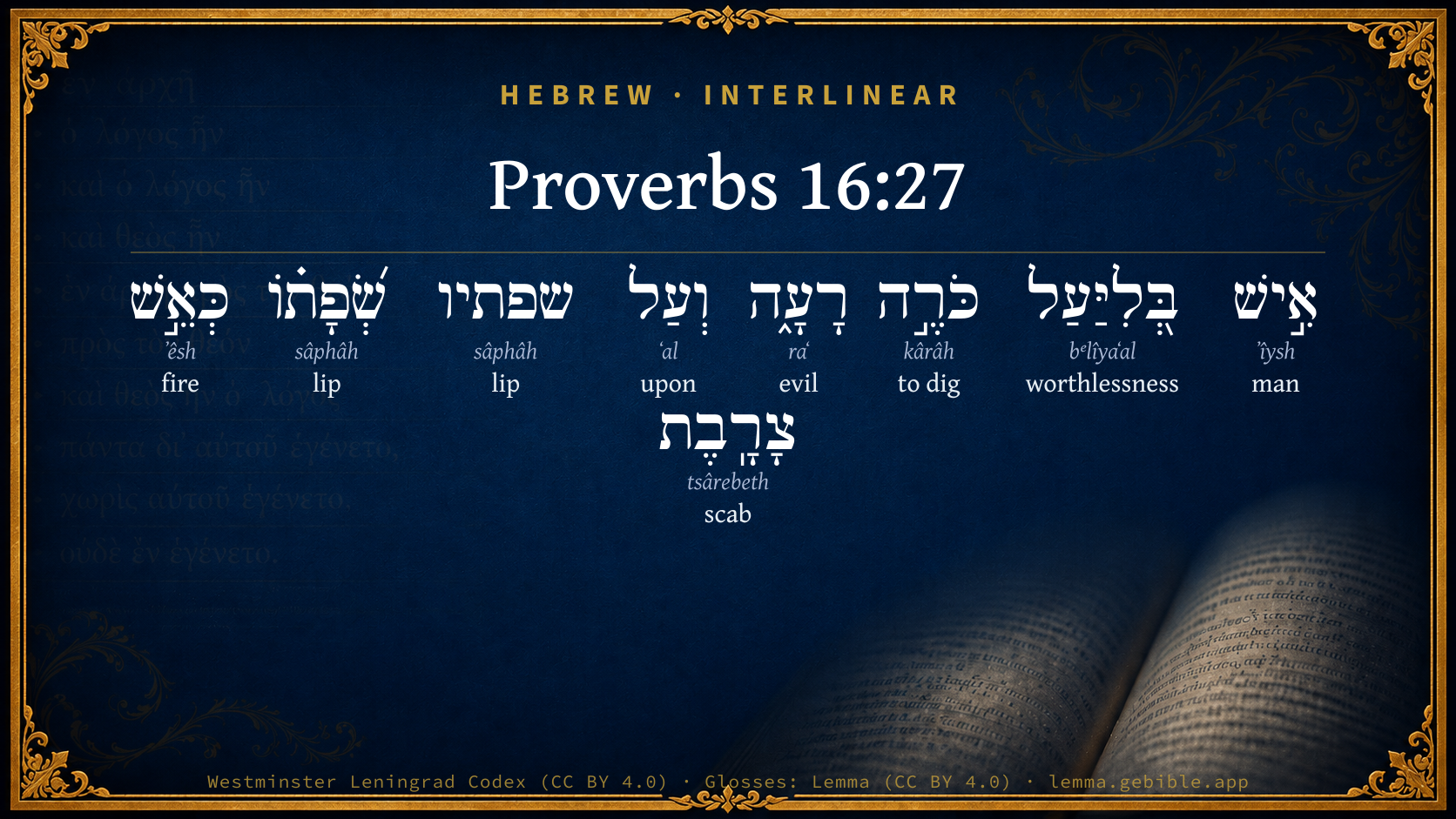
Hebrew (Westminster Leningrad Codex) Proverbs 16:27 appears in the Hebrew Old Testament. The text above is from the Westminster Leningrad Codex. Each word links to its Strong’s number, a concise gloss, and parsing drawn from the Open Scriptures Hebrew Bible morphology. Click any word for its full Brown-Driver-Briggs (BDB) entry.
Download image
Cite this verse

Proverbs 16:27 (World English Bible). Public Domain. Lemma interlinear Bible study tool, https://lemma.gebible.app/v/proverbs/16/27.

Show BibTeX & RIS
BibTeX
RIS
English Translation
A worthless man devises mischief. His speech is like a scorching fire.
World English Bible · Public Domain
Download a study sheet

One document with this verse’s original text, its word-by-word gloss line, the meaning frame, cross-references with their text, attributed commentary, and full source and license credits — printable, and it pastes into notes with its structure intact.

This verse Autodidact and up

Study sheet (.html) Plain text (.txt)

A passage Seminary Student

Up to 50 verses in one chapter. A passage sheet keeps up to 6 commentary sources and 12 cross-references per verse, in the order this page ranks them, and says so on the sheet whenever that leaves anything out. Ask for a single verse and you get the Autodidact verse sheet above.

Everything on this page stays free to read, with no account — the sheet is a download of what is already on screen, not access to it.

Want to remove ads? Support Godless Engineer
Compare translations 3

The same verse in 3 English versions, stacked beneath the original-language interlinear above. Click any original word for its lexicon entry.

Each is an independent rendering of the whole verse — the interlinear is not word-aligned to these translations.

Highlighted words mark where these versions differ — a whole-verse word diff, not a word-by-word alignment.

  • World English Bible Public Domain
    A worthless man devises mischief. His speech is like a scorching fire.
  • King James Version Public Domain
    An ungodly man diggeth up evil: and in his lips there is as a burning fire.
  • unfoldingWord Literal Text CC BY-SA 4.0
    A man of worthlessness digs up evil and on his lips like a scorching fire.

unfoldingWord Literal Text — © unfoldingWord, licensed CC BY-SA 4.0. Word-aligned USFM3 via Door43 (git.door43.org/unfoldingWord/en_ult).

Versions to compare (up to 4)

3 of 4 selected

Show all 18 translations

Every available English version of this verse, each an independent rendering of the whole verse.

  • World English Bible Public Domain
    A worthless man devises mischief. His speech is like a scorching fire.
  • Berean Standard Bible Public Domain
    A worthless man digs up evil, and his speech is like a scorching fire.
  • Majority Standard Bible Public Domain
    A worthless man digs up evil, and his speech is like a scorching fire.
  • King James Version Public Domain
    An ungodly man diggeth up evil: and in his lips there is as a burning fire.
  • American Standard Version (1901) Public Domain
    A worthless man deviseth mischief; And in his lips there is as a scorching fire.
  • Revised Version (1885) Public Domain
    A worthless man deviseth mischief: and in his lips there is as a scorching fire.
  • Geneva Bible (1599) Public Domain
    A wicked man diggeth vp euill, and in his lippes is like burning fire.
  • Douay-Rheims (1899) Public Domain
    The wicked man diggeth evil, and in his lips is a burning fire.
  • Young's Literal Translation Public Domain
    A worthless man is preparing evil, And on his lips -- as a burning fire.
  • Literal Standard Version CC BY-SA 4.0
    A worthless man is preparing evil, || And on his lips [is] as a burning fire.
  • Unlocked Literal Bible CC BY-SA 4.0
    A worthless person digs up mischief and his speech is like a scorching fire.
  • unfoldingWord Literal Text CC BY-SA 4.0
    A man of worthlessness digs up evil and on his lips like a scorching fire.
  • Darby Bible Public Domain
    A man of Belial diggeth up evil, and on his lips there is as a scorching fire.
  • World Messianic Bible Public Domain
    A worthless man devises mischief. His speech is like a scorching fire.
  • Webster's Bible Public Domain
    An ungodly man diggeth up evil: and in his lips there is as a burning fire.
  • Free Bible Version CC BY-SA 4.0
    Worthless people plot evil and their words burn like fire.
  • Bible in Basic English Public Domain
    A good-for-nothing man is a designer of evil, and in his lips there is a burning fire.
  • JPS Tanakh (1917) Public Domain
    An ungodly man diggeth up evil, and in his lips there is as a burning fire.

Literal Standard Version (2020), Covenant Press — licensed CC BY-SA 4.0. Text via the HelloAO Bible API (eBible.org). Unlocked Literal Bible (unfoldingWord) — licensed CC BY-SA 4.0. Text via the HelloAO Bible API (eBible.org). unfoldingWord Literal Text — © unfoldingWord, licensed CC BY-SA 4.0. Word-aligned USFM3 via Door43 (git.door43.org/unfoldingWord/en_ult). Free Bible Version, Dr. Jonathan Gallagher — licensed CC BY-SA 4.0. Text via the HelloAO Bible API (eBible.org).

Word by word

More ways to search: Search by grammar → Find every occurrence → Compare this word →

Practice this passage: Drill this verse → Learn its vocabulary →

About this verse

These counts appear in no published source. They are computed here, from the morphology-tagged text and Lemma’s own curated glosses. What Lemma adds →

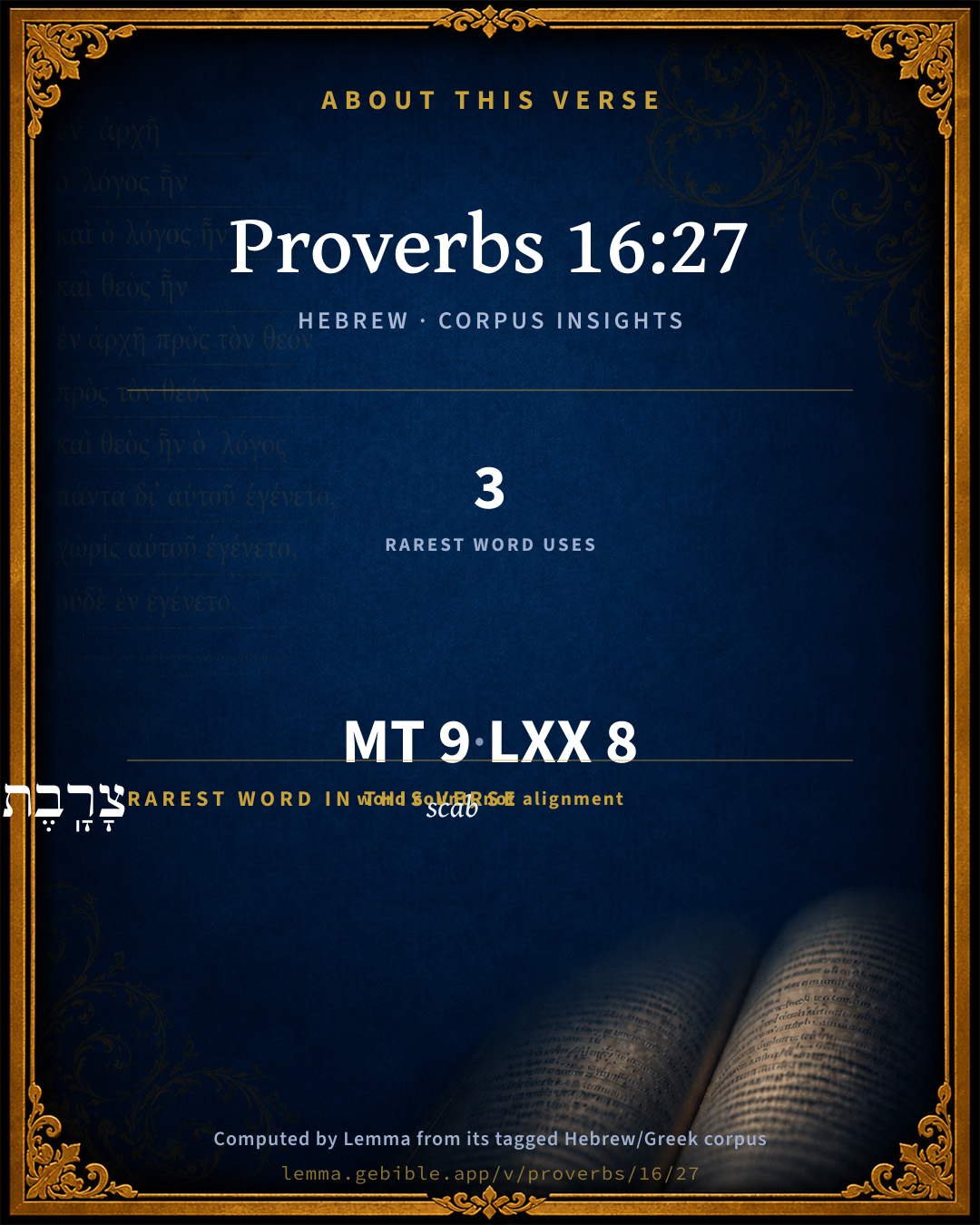
9
words
8
distinct lemmas
Wisdom
section

Notable vocabulary

The rarest word here is צָרָֽבֶת scab H6867 — appearing just 3 times in the whole Hebrew Bible.

Shared distinctive vocabulary

צָרָֽבֶת scab H6867 occurs in 3 verses of the Hebrew Bible. Also found in:

Grammatical profile

  • 1 verb
  • 6 nouns
  • 1 adjective
  • 1 preposition

Verb forms

  • כֹּרֶ֣ה Qal · Participle Active

Repetition

A word recurs within this verse — often emphatic in Hebrew:

  • שפתיו lip H8193 ×2

Hebrew & Septuagint length

In English translation the verse runs 12 words from the Hebrew and 24 from the Septuagint (LXX English) — the Septuagint runs noticeably longer here. See the side-by-side →

A rough comparison of the two English renderings, which tokenize alike — not a word-level alignment.

Word counts can differ between the Hebrew and the Greek without any difference in meaning — e.g. the Hebrew direct-object marker אֵת has no separate Greek word, and Greek often adds the article ὁ.

In the original languages it is 9 Hebrew tokens and 8 Greek tokens — but the two are counted differently (Hebrew bundles its prefixes and suffixes into one token; the Greek is in lemma form), so that isn’t a like-for-like length.

Cross-references

11

Topical passages linked to Proverbs 16:27 in the Treasury of Scripture Knowledge — connected by theme and wording, ordered by reader-vote popularity; previews shown in the World English Bible.

  • James 3:6 And the tongue is a fire. The world of iniquity among our members is the tongue, which defiles the whole body, and sets on fire the course of nature, and is set on fire by Gehenna.
  • Proverbs 6:14 In whose heart is perverseness, Who devises evil continually, Who always sows discord.
  • 1 Samuel 25:17 Now therefore know and consider what you will do; for evil is determined against our master, and against all his house: for he is such a worthless fellow that one can't speak to him.
  • Psalms 17:14–15 From men by your hand, Yahweh, From men of the world, whose portion is in this life. You fill the belly of your cherished ones. Your sons have plenty, And they store up wealth for their children.
  • Psalms 52:2–4 Your tongue plots destruction, Like a sharp razor, working deceitfully.
  • Psalms 57:4 My soul is among lions. I lie among those who are set on fire, Even the sons of men, whose teeth are spears and arrows, And their tongue a sharp sword.
  • Proverbs 6:12 A worthless person, a man of iniquity, Is he who walks with a perverse mouth;
  • Isaiah 5:18 Woe to those who draw iniquity with cords of falsehood, And wickedness as with cart rope;
  • Proverbs 2:4 If you seek her as silver, And search for her as for hidden treasures:
  • 2 Samuel 20:1 There happened to be there a base fellow, whose name was Sheba, the son of Bichri, a Benjamite: and he blew the trumpet, and said, We have no portion in David, neither have we inheritance in the son of Jesse: every man to his tents, Israel.
  • Habakkuk 2:13 Behold, isn't it of Yahweh of Hosts that the peoples labor for the fire, and the nations weary themselves for vanity?

Cross-references courtesy of OpenBible.info (CC BY 4.0).

Hebrew and Greek witnesses Masoretic Hebrew ↔ Greek Septuagint

The same verse in the two great witnesses to the Old Testament, shown verse-for-verse.

Here the Septuagint runs noticeably longer than the Hebrew — LXX2012 (modern English Septuagint) 24 words vs World English Bible 12. A rough length comparison of the two English translations, not a word-level alignment — read both below.

These are two independent witnesses, not word-aligned to each other, and the Septuagint is shown in lemma (dictionary) form.

Hebrew Proverbs 16:27 Masoretic · Westminster Leningrad Codex

אִ֣ישׁ בְּ֭לִיַּעַל כֹּרֶ֣ה רָעָ֑ה וְעַל שפתיו שְׂ֝פָת֗וֹ כְּאֵ֣שׁ צָרָֽבֶת

A worthless man devises mischief. His speech is like a scorching fire.

World English Bible · Public Domain

Greek LXX Proverbs 16:27 Septuagint · lemma form

στέφανος καύχησις γῆρας ἐν δέ ὁδός δικαιοσύνη εὑρίσκω

But the perverse bears destruction upon his own mouth: a foolish man digs up evil for himself, and treasures fire on his own lips.

LXX2012 (modern English Septuagint) · Public Domain

On this verse, The Pulpit Commentary discusses the Septuagint’s reading. Read the note in Commentary ↓

Hebrew: Westminster Leningrad Codex (CC BY 4.0). Greek: Septuagint (public domain); English from LXX2012 (modern English Septuagint) (Public Domain). How the Septuagint differs from the Hebrew →

Commentary

Notes on Proverbs 16:27 from classic Christian and Jewish commentators (each source and its license shown beneath its notes). The classic Christian expositions comment on the surrounding passage and are grouped to its opening verse, so a note may address several verses; the Jewish commentaries on the Tanakh (Rashi and others) are per-verse, so they appear only where the commentator wrote on this verse.

Lemma curates 59 commentaries, every one of them public domain or Creative Commons licensed, each selected and text-cleaned for this edition rather than reprinted as found. About our sources →

Trapp's Complete Commentary

John Trapp

Pro 16:27 An ungodly man diggeth up evil: and in his lips [there is] as a burning fire.

Ver. 27. An ungodly man diggeth up evil,] i.e., He ransacketh and raketh out of the dust, out of the dunghill, such old evils as have long lain hid, to lay in the saints’ dishes, and to upbraid them with. Thus the Manichees dealt by Augustine when they could not answer his arguments, they hit him in the teeth with his youthful follies; whereunto his reply was only this, Quae vos reprehenditis, ego damnavi: What you discommend in me, I have long since condemned. The malicious Papists did the like to reverend Beza, reprinting his wit-wanton poems (put forth in his youth), on purpose to despite him; and objecting to him his former miscarriage which he had sorely repented. This, when one of them did with great bitterness, all the answer he had, was, Hic homo invidet mihi gratiam Christi; This man envies me the grace of Jesus Christ. Neither dealt Aaron and Miriam much more gently with their brother Moses, {Num 12:1} when they "spake against him because of the Ethiopian woman whom he had married." Who was this Ethiopian woman but Zipporah? - for an Ethiopian and a Midianite are all one and the same. And when did he marry her? Many a year ago. {Exo 2:21} But they were resolved to pick a hole in Moses’s coat; and having nothing else to fasten on, they dig up this evil, and throw it as dirt in his face.

In his lips there is a burning fire.] The tongue, in its shape and colour, resembleth a flame of fire. "It is oft set on fire of hell, and itself setteth on fire the whole course of nature." {Jas 3:6} "Their breath, as fire, shall devour you," {Isa 33:10} as the fire of Etna devoured Empedocles, that would needs go too near it. "But what shall be given unto thee, or what shall be done unto thee, thou false tongue?" - false though thou speak the truth, if with a mind to do mischief: - "Sharp arrows of the mighty, with coals of juniper," {Psa 120:3-4} yea, that very fire of hell, from whence thou wast enkindled.

John Trapp, A Commentary or Exposition upon All the Books of the Old and New Testament (1647–1656) — public domain. Text from a community e-Sword module.

The Biblical Illustrator

Joseph S. Exell

Pro_16:27

An ungodly man diggeth up evil.

Digging up evil

An ungodly man is a son of Belial. In the expression diggeth up evil two ideas may be included.

I. Taking pains to devise it. We dig and search for treasure in a mine, or where we fancy it lies concealed; thus the wicked man does in regard to evil. It is his treasure, that on which he sets his heart, and for it, as for treasure, he digs and searches, aye, often deep and long. He is specially laborious and persevering, when any one chances to have become the object of his pique or malice. Marvellous is the assiduity with which he then strains every nerve to produce mischief, plodding and plotting for it, mining and undermining, exploring in every direction, often where no one could think of but himself, and, with savage delight, exulting in the discovery of aught that can be made available for his diabolical purpose.

II. Taking pains to revive it, after it has been buried and forgotten. He goes down into the very grave of old quarrels, brings them up afresh; puts new life into them; wakes up grudges that had long slept; and sets people by the ears again who had abandoned their enmities, and had for years been living in reconciliation and peace. The son of Belial, in relation to evil, is like one in quest of some mine of coal or precious metal. He examines his ground, and wherever he discovers any hopeful symptoms on the surface, he proceeds to drill, and bore, and excavate. The slightest probability of success will be enough for his encouragement to toil and harass himself night and day until he can make something out of it. (R. Wardlaw, D.D.)

The Biblical Illustrator, edited by Joseph S. Exell (c. 1880s–1900s) — public domain. Text from a community e-Sword module.

Joseph Benson's Commentary

Pro 16:27-28. An ungodly man diggeth up evil — Invents or designs mischief to others, and prosecutes his evil designs with great and constant industry; in his lips is as a burning coal — As his thoughts, so also his words, are very vexatious and pernicious; his tongue is set on fire of hell, and sets himself and others on fire, by lies, slanders, and other provoking speeches. A froward man — Or perverse, who perverteth his words and ways; soweth strife — By speaking such things as may provoke one against another; and a whisperer — Who secretly carries tales from one to another; separateth chief friends — Makes a breach between those who were most dear to one another.

Joseph Benson's Commentary on the Old and New Testaments (1811–1818) — public domain. Text from a community e-Sword module.

The Preacher's Complete Homiletical Commentary

Joseph S. Exell (gen. ed.)

CRITICAL NOTES.—

Pro_16:28. A whisperer, i.e., “a backbiter.”

Pro_16:30. Moving, or compressing, indicating resolution, or biting, indicative of scorn and malice.

MAIN HOMILETICS OF THE PARAGRAPH.—Pro_16:27-30

DIFFERENT SPECIES OF THE SAME GENUS

I. Human depravity manifests itself in a variety of forms.—There may be many lawless children in a family, but they may not all sin against the same law—they may all rebel against what is true and good, but some may be preeminent transgressors in one way and some in another. One son may be a notorious liar and another may be a slave to ungovernable passion, while a third may be addicted to another and different vice. It is so in the great human family—all unregenerate men are transgressors against God’s good and righteous law, but their transgressions may take different forms.

II. But all ungodliness is subversive of human happiness.—If a man sets at nought the law of God, he will be a curse to those around him. There are many such men who seem to delight in increasing the misery of mankind, they make it their business to “dig up evil,” they work diligently to bring to light that which it is most desirable should be hidden and forgotten, and so they are like a scorching, consuming fire to the peace of many of their fellow creatures. And if they are not so openly and manifestly bad, if they are untruthful men, they must sow around them seeds of suspicion and discord which hinder men from being bound together in bonds of friendship or break such bonds when they have been formed.

OUTLINES AND SUGGESTIVE COMMENTS

Pro_16:27. “A worthless man.” This is the farthest an impenitent moralist will go in condemning himself. He may be a worthless man (a man of Belial, i.e., of no profit), but he is not a harmful man.… Solomon calls this mild gracelessness a digging up of evil. Recurring to the potency of the tongue, he says, “The lips of such men, sweet as they may seem, fairly scorch and burn.”—Miller.

In the expression “diggeth up evil” two ideas may be included:—

1. Taking pains to devise it. We dig or search for treasure in a mine, or where we fancy it lies concealed: thus the wicked man does in regard to evil. It is his treasure—that on which he sets his heart; and for it, as for treasure, he “digs” and “searches”—ay, often deep and long. His very happiness seems to depend on his reaching and finding it. He is specially laborious and persevering when anyone chances to have become the object of his pique or malice. Marvellous is the assiduity with which he then strains every nerve to produce mischief,—plodding and plotting for it,—mining and undermining,—exploring in every direction, often where no one could think of but himself,—and with savage delight exulting in the discovery of aught that can be made available for his diabolic purpose.

2. Taking pains to revive it after it has been buried and forgotten. He goes down into the very graves of old quarrels; brings them up afresh; puts new life into them; wakes up grudges that had long slept; and sets people by the ears again who had abandoned their enmities, and had been for years in reconciliation and peace. As to “evil,” whether old and new, “the son of Belial” is like one in quest of some mine of coal, or of precious metal. He examines his ground, and wherever he discovers any hopeful symptoms on the surface he proceeds to drill, and bore, and excavate. The slightest probability of success will be enough for his encouragement to toil and harass himself night and day until he can make something of it. The persevering pains of such men would be incredible were they not sadly attested by facts:—“They search, out iniquities; they accomplish a diligent search: both the inward thought of every one of them, and the heart, is deep” (Psa_64:1-6).—Wardlaw.

Whisperers are like the wind that creeps in by the chinks and crevices of a wall, or the cracks in a window, that commonly proves more dangerous than a storm that meets a man in the face upon the plain.—Trapp.

Pro_16:28. The idea is, sin cannot keep silence. In its quiet hour it speaks, rolling out (literally) articulate influences. The very idea is terrible. It separates friends. That is, the world being knit together by the law of love, the impenitent separate it asunder. They separate man from his race, and destroy that highest friendship that he might have with the Almighty.—Miller.

Pro_16:29. Yet though a wicked man be never so violent, he cannot compel thee to his ways, he can but entice thee, he can but lead thee; it is still in thine own power whether thou wilt follow him or no. Wherefore though it agree to his violence to lead, let it be thy care to keep back from his ways.—Jermin.

Unbelief can hardly be libelled, and Solomon’s very thought is to show how violent it is! It is the match even of hell, for it derides it! It is the robber even of God, for it thieves from Him. It takes life without paying for it. It assaults the Maker upon His throne. It stares broadly at the truth each Sunday when it listens, and flouts it as though never heard. Unbelief is “violence;” and yet, as though it were the most seductive charm it “seduces” (entices) one’s neighbour.—Miller.

These sons of Belial are also tempters of others. A fearful employment—a fearful delight! Yet the employment would not be followed were there not pleasure in it. The pleasure is fiendish—laying plans and putting every vile art into practice, to seduce the virtuous and unsuspecting youth from the way of rectitude!… As there is joy in heaven over one sinner that repenteth, so is there a malicious joy in hell when such tempters succeed in turning any from the right to the wrong, from the narrow to the broad way. This is the joy of fiends, the other of angels.—Wardlaw.

Pro_16:30. Wicked men are great students; they beat their brains and close their eyes that they may revolve and excogitate mischief with more freedom of mind. They search the devil’s skull for new devices, and are very intentive to invent that which may do hurt; their wits will better serve them to find out a hundred shifts or carnal arguments, than to yield to one saving truth.—Trapp.

The Preacher's Complete Homiletical Commentary (gen. ed. Joseph S. Exell; Funk & Wagnalls, c. 1892) — public domain (pre-1929). A full-Bible homiletical/sermon-outline anthology covering 65 of 66 books (2 John is absent from the source module). Text from a community e-Sword module.

Tyndale Open Study Notes

Tyndale Open Resources

16:27-29 Scoundrels, a troublemaker, and violent people all disrupt relationships, creating trouble with their harmful actions.

Tyndale Open Study Notes — © Tyndale Open Resources, licensed CC BY-SA 4.0. Text via the HelloAO Bible API.

Geneva Bible (1599)

Geneva Bible translators

For he consumeth himself and others.

Geneva Bible (1599) marginal notes — public domain. Text via Bolls.life.

Matthew Henry's Commentary

There are those that are not only vicious themselves, but spiteful and mischievous to others, and they are the worst of men; two sorts of such are here described: - 1. Such as envy a man the honour of his good name, and do all they can to blast that by calumnies and misrepresentations: They dig up evil; they take a great deal of pains to find out something or other on which to ground a slander, or which may give some colour to it. If none appear above ground, rather than want it they will dig for it, by diving into what is secret, or looking a great way back, or by evil suspicions and surmises, and forced innuendos. In the lips of a slanderer and backbiter there is as a fire, not only to brand his neighbour's reputation, to smoke and sully it, but as a burning fire to consume it. And how great a matter does a little of this fire kindle, and how hardly is it extinguished! Jam 3:5, Jam 3:6. 2. Such as envy a man the comfort of his friendship, and do all they can to break that, by suggesting that on both sides which will set those at variance that are most nearly related and have been long intimate, or at least cool and alienate their affections one from another: A froward man, that cannot find in his heart to love any body but himself, is vexed to see others live in love, and therefore makes it is his business to sow strife, by giving men base characters one of another, telling lies, and carrying ill-natured stories between chief friends, so as to separate them one from another, and make them angry at or at least suspicious of one another. Those are bad men, and bad women too, that do such ill offices; they are doing the devil's work, and his will their wages be.

Matthew Henry's Commentary on the Whole Bible (1708–1710) — public domain (CC PDM 1.0). Text via the HelloAO Bible API.

Jamieson, Fausset & Brown

Robert Jamieson, A. R. Fausset & David Brown

ungodly man--(Compare Pro 6:12).

diggeth up evil--labors for it.

in his lips . . . fire--His words are calumniating (Jam 3:6).

Jamieson, Fausset & Brown — Commentary Critical and Explanatory on the Whole Bible (1871) — public domain (CC PDM 1.0). Text via the HelloAO Bible API.

Adam Clarke's Commentary

Verse 27. An ungodly man diggeth up evil] How will the following suit?

Effodiuntur opes irritamenta malorum

"Wealth, the incitement to all evil, is digged up

out the earth."

A wicked man labours as much to bring about an evil purpose, as the quarryman does to dig up stones.

In his lips-a burning fire.] His words are as inflammable, in producing strife and contention among his neighbours, as fire is in igniting dry stubble.

Adam Clarke's Commentary on the Bible (1810–1826) — public domain. Text from a community e-Sword/MySword module.

Ellicott's Commentary for English Readers

(27) Diggeth up evil.—Digs, as it were, a pit for others by his malicious plottings and slanders (Psa_7:15).

In his lips there is as a burning fire.—“Set on fire of hell” (Jas_3:6).

A Bible Commentary for English Readers, edited by Charles John Ellicott (1878–1897) — public domain. Text from a community e-Sword module.

The Cambridge Bible for Schools and Colleges

gen. ed. J. J. S. Perowne

27. ungodly] Rather, worthless, R.V. See Pro_6:12, note.

diggeth up] This is the literal meaning of the word, but it is here used metaphorically of one who digs pits for his neighbour, as a hunter for his prey, Psa_7:15 [Heb. 16], Psa_57:6 [Hebrews 7]. We may therefore render, deviseth, with R.V.

burning] Rather, scathing, or, as R.V., scorching. His words blight and wither, like the great forest fire, by which “all faces are scorched” (Eze_20:47 [Heb. 21:3], where the Heb. word is the same).

The Cambridge Bible for Schools and Colleges (gen. ed. J. J. S. Perowne; Cambridge University Press, 1878–1918) — public domain. Text from a community e-Sword module.

John Gill's Exposition

A froward man soweth strife,.... Or "a man of perversenesses" (q); in whose heart is frowardness and perverseness; and whose mouth speaketh froward and perverse things, contrary to reason, law, and Gospel; and who has a spirit of contradiction, and is contrary to all men in his principles and practices; such a man sows discord and strife wherever he comes, in families, in neighbourhoods, in churches, in commonwealths, in civil and religious societies; and he seldom fails of finding a soil fit for his purpose, or ground susceptive of the seed he sows, where it takes root and thrives; see Pro 6:19;

and a whisperer separateth chief friends; one that goes from place to place, from house to house, carrying tales, whispering into the ears of persons things prejudicial to the characters of others, mere lies and falsehoods; such a man by his conduct separates one friend from another, even chief friends, that have been for a long time in the closest and most intimate friendship; he alienates their minds one from another, so that they will not come near one another, or keep up any correspondence as before. The word for "chief friends" is in the singular number, and signifies a prince or leader; and such men, according to the station they are in, and the influence they have, separate princes, as the Vulgate Latin version renders it, from their subjects, and stir up the latter to rebel against them; at least alienate their affections from them; and pastors of churches from their flocks, and husbands from their wives: and such a man, at last, when found out, separates his best friends from himself, as well as from one another; who drop him as a worthless person, yea, as dangerous to converse with; so sin, that whisperer and agitator, separates between God and men, Isa 59:2.

(q) "vir perversitatum", Montanus, Baynus, Schultens; "vir perversitatibus deditus", Junius & Tremellius, Piscator.

John Gill's Exposition of the Whole Bible (1746–1763) — public domain (CC PDM 1.0). Text via the HelloAO Bible API.

Albert Barnes' Notes on the Bible

The four verses speak of the same thing, and the well-known opprobrious name, the “man of Belial,” stands at the head as stigmatizing the man who delights in causing the mischief of which they treat.

Diggeth up evil - i. e., Digs an evil pit for others to fall into. Compare Psa 7:15.

Pro 16:30

The physiognomy of the man of Belial, the half-closed eyes that never look you straight in the face, the restlessness or cunning of which biting the lips is the surest indication. Compare Pro 6:13.

Albert Barnes' Notes on the Bible (1834–1885) — public domain. Text from a community e-Sword/MySword module.

Haydock's Catholic Bible Commentary

Diggeth. Earnestly pursues. --- Fire. James iii. 16. (Calmet)

George Leo Haydock (1774–1849), Haydock's Catholic Family Bible and Commentary, 1859 edition — public domain. Excludes Psalms (Douay-Rheims chapter numbering differs from Protestant) and Deuterocanonical books (Catholic canon only).

Matthew Poole's English Annotations

Diggeth up evil; inventeth or designeth mischief to others, and prosecuteth his evil designs with great and constant industry.

In his lips there is as a burning fire; as his thoughts, so also his words are very vexatious and pernicious; his tongue is set on fire of hell, and sets himself and others on fire by lies and slanders, and other provoking speeches.

Matthew Poole's English Annotations on the Holy Bible (1683–1685) — public domain. Text from a community e-Sword/MySword module.

Whedon's Commentary on the Bible

Daniel D. Whedon

27. An ungodly man — אישׁ בליעל, (ish beliyya’hal,) a man of Belial, a bad, vile, or worthless man.

Diggeth up evil — Labours hard to accomplish wickedness, and in or on his lips there is as a burning fire, bad, bitter, burning words, destructive to the reputation of his neighbours. Conant reads: “A vile man is he that devises mischief.” Comp. chap. Pro_26:23; Jas_3:5, et seq.

Daniel D. Whedon (gen. ed.), Commentary on the Old and New Testaments (1874–1909) — public domain. Text from a community e-Sword module.

The Pulpit Commentary

This and the three following verses are concerned with the case of the evil man. An ungodly man a man of Belialdiggeth up evil. A man of Belial (Pro_6:12) is a worthless, wicked person, what the French call a vaurien. Such a one digs a pit for others, (Pro_26:27 Psa_7:15) devises mischief against his neighbour, plots against him by lying and slandering and overreaching. Wordsworth confines the evil to the man himself; he digs it as treasure in a mine, loves wickedness for its own sake. But analogy is against this interpretation. Septuagint, "A foolish man diggeth evils for himself." So Ecc 27:26, "Whoso diggeth a pit shall fall therein; and he that setteth a trap shall be taken therein." As the gnome says H de kakh boulh tw bouleusanti kakisth .

And in his lips there is as a burning fire (Pro_26:23) His words scorch and injure like a devouring flame. Jam_3:6, "The tongue is a fire: the world of iniquity among our members is the tongue, which defileth the whole body, and setteth on fire the wheel of nature, and is set on fire by hell." Septuagint, "And upon his lips he treasureth up fire.

Vers. 27-30. Penal judgments on guilt.

I GODLESS STRIVINGS. Life is full of success and failure. There are successes which cost the soul, and failures in which is contained the reaping of life eternal. The activity of the worthless man (ver. 27).

1. It is mischievous in spirit and in end. He is depicted as one who digs a grave for others. (Pro_26:27 Jer_18:20, sqq.) And his words are like fire that scorches, blasting reputation, withering the buds of opening good in the sentiment of the young, scoffing down the right and true.

2. It is contentious; breeding quarrels, creative of strife, introducing breaches between friends, disuniting households. "Envy and every evil work" is wherever he goes.

3. It is the activity of the tempter, the seducer. Not content with error himself, he would have partners in sorrow and in guilt. It is thus truly diabolical.

4. It is metilated and determined (ver. 30). Very striking is the picture of this verse the eyes bah closed, the bit lips, the firm line about the mouth of one resolved on dark designs and their determined execution. What a power is thought for good or evil! Oh for its right direction by the loving and creative Spirit of all wisdom and goodness, that it may be ever inventive of kind and healing deeds, that may "seal up the avenues of ill," rather than open them more widely to the processions of darkness and hate! J.

The Pulpit Commentary (1880–1919), ed. H.D.M. Spence-Jones & Joseph S. Exell — public domain. Text from a community e-Sword module.

John Wesley's Explanatory Notes

Diggeth up - Prosecutes his evil designs with great industry. His lips - His tongue is set on fire of hell.

John Wesley, Explanatory Notes Upon the Whole Bible (1754–1765) — public domain. Text via the GEBible commentary corpus.

Keil & Delitzsch

C. F. Keil & F. Delitzsch

27 A worthless man diggeth evil;

And on his lips is, as it were, scorching fire.

Regarding אישׁ בּליּעל, vid., Pro 6:12, and regarding כּרה, to dig round, or to bore out, vid., at Gen 49:5; Gen 50:5; here the figure, "to dig for others a pit," Pro 26:27, Psa 7:16, etc.: to dig evil is equivalent to, to seek to prepare such for others. צרבת Kimchi rightly explains as a form similar to קשּׁבת; as a subst. it means, Lev 13:23, the mark of fire (the healed mark of a carbuncle), here as an adj. of a fire, although not flaming (אשׁ להבה, Isa 4:5, etc.); yet so much the hotter, and scorching everything that comes near to it (from צרב, to be scorched, cogn. שׁרב, to which also שׂרף is perhaps related as a stronger power, like comburere to adurere). The meaning is clear: a worthless man, i.e., a man whose disposition and conduct are the direct contrast of usefulness and piety, uses words which, like an iron glowing hot, scorches and burns; his tongue is φλογιζομένη ὑπὸ τῆς γεέννης (Jam 3:6).

Keil & Delitzsch — Biblical Commentary on the Old Testament (1861–1891) — public domain (CC PDM 1.0). Text via the HelloAO Bible API. (Old Testament only.)

Bridges on Proverbs

Charles Bridges

The man of Belial laboureth hard; but not for himself; certainly not for his own good. Yet his labour presents a vivid picture indeed of the energy of sin. He has broken away every yoke of restraint. Every member of his body, every power of his mind, is "a servant of iniquity unto iniquity." (Rom 6:19 .) May we not learn from him in humiliation the true standard of concentration of mind, singleness of object, diligence, delight, and perseverance? His pleasure is to dig up evil; pursuing his evil projects with intense activity,†1 as if he was "searching for hid treasure." The tongue is usually the chief instrument of mischief. In what black colour has the Divine pen set out this vile criminal — a burning fire — "a world of iniquity, set on fire of hell!"†2 And as he diggeth, so he soweth, evil — seed that comes up only with a blast. Strife he soweth in every furrow (Pro 15:18 ); jealousies among nations,†3 war between the Sovereign and his people,†4 divisions among Churches,†5 coldness between Ministers and their flocks,†6 ill-will among friends†7 — a spirit eminently hateful to God. (Pro 6:16, Pro 6:19 .) Where open contentions might not work, whisperings,†8 "evil surmisings," idle and slanderous reports are employed to separate even chief friends. (Pro 6:14 ; Pro 18:8 .)

Truly he is a man of mischief. If he deals not in direct falsehoods, his dark whispers are plain enough to be understood, and sure to be exaggerated. The well-meant word or act may be misinterpreted. He has seen or heard probably only a little. He guesses at the rest to make his story complete. And thus by this report, half true and half false, he plays with his neighbour’s name to his incalculable injury. No wonder, that this mischievous gossiper should be classed with "the thief and murderer." (1Pe 4:15 .) For the man, who thus loosens the closest ties, and breaks up the peace of whole families, sins against those commandments, which charge crime upon the thoughts, the word, the principle, as well as the outward act. (Mat 5:21-22 .) Again, we find him in his father’s native work — a tempter — a violent man indeed; but combining with loud and overbearing speech enticements for his neighbour, to lead the unwary into the way that is not good.†9 His whole soul is filled with this Satanic object. Sometimes we may see him shutting his eyes from outward distractions; moving his lips, as if engaged in deep thought to bring evil to pass;†10 all ’expressing the profound study, with which he contrives his neighbour’s ruin!’†11

Such is the heavy service of the most cruel Master! He wears out both the minds and bodies of his slaves, and gives them at the end only the fearful wages of eternal death.†12 If the way to heaven be narrow, is not "the way of transgressors hard"?†13 Is there not more toil in the way to hell; and that — without one beaming hope of the cheering home, one staff of the heavenly promise, that upholds the servants of God in all their weariness and trial? "Gather not my soul with sinners, in whose hands are mischief," and where "destruction and misery are in their paths." (Psa 26:9-10 . Rom 3:16 .)

Footnotes:

†1 Psa 7:14-15; Saul, 1Sa 18:21-22 ; Ahab, 1Ki 18:10 ; Jeremiah’s Enemies, Jer 18:18 ; the chief priests seeking false witnesses against our Lord, Mat 26:59 .

†2 Jas 3:6-8. Psa 52:1-4 . ’His tongue is a burning firebrand, to set all the world in combustion.’ Bishop Hall. The LXX Version is very strong — ’The perverse carrieth perdition on his own mouth. The foolish man diggeth up evil to himself; he treasureth up fire on his own lips.’

†3 2Sa 10:3 .

†4 2Sa 20:1 .

†5 1Co 1:11-12 ; 1Co 3:3 .

†6 1Co 4:8 . 2Co 12:15 . Gal 4:16 .

†7 2Sa 16:3 .

†8 1Sa 24:9 . Psa 35:15 . 2Co 12:20 . This sin is numbered in the black catalogue of Heathen abominations. Rom 1:29 . Compare Sir 28:13 .

†9 Pro 1:11-14; Pro 4:16-17 . Act 20:30 . 2Pe 2:1-2 .

†10 Pro 6:12-14; Pro 10:10 .

†11 Bishop Patrick — ’A furnace of mischief’ — is the addition of LXX. Compare Isa 32:6-7 .

†12 Rom 6:23.

†13 Mat 7:14, with Pro 13:15 .

Charles Bridges, An Exposition of the Book of Proverbs (1846) — public domain. Text from a community e-Sword module.

Kretzmann's Popular Commentary

Paul E. Kretzmann

v. 27. An ungodly man diggeth up evil, his worthlessness causing him to dig pits for others; and in his lips there is as a burning fire, his words and statements are like a scorching fire or iron, whose searing heat destroys everything.

Paul E. Kretzmann, Popular Commentary of the Bible (1921–1924) — public domain. Text from a community e-Sword module.

unfoldingWord translationNotes

Door43 World Missions Community

A worthless person digs up mischief

The writer speaks of a person trying to find ways to harm other people as if that person were digging in the ground to find something buried. AT: "A worthless person looks for mischief as if he were digging for something in the ground" (See: Metaphor)

worthless

"useless" or "wicked"

mischief

trouble

his speech is like a scorching fire

The writer compares the way this person's words hurt others with the way that fire burns things. AT: "he hurts people with his words, like a fire scorches the things it touches" (See: Simile)

a gossip

a person who gossips or spreads rumors

translationWords

fire

perverse

gossip

unfoldingWord translationNotes — © Distant Shores Media and the Door43 World Missions Community, licensed CC BY-SA 4.0. Source: git.door43.org/Door43/en_tn.

Rashi

Rabbi Shlomo Yitzchaki (Rashi)

digs up evil In his heart, he plots evil.

and on his lips is a kind of searing fire The evil burns on his lips until he expresses it with his mouth and executes it.

a kind of searing fire Heb. צרבת burning, as in (Ezek. 21:3): “And all faces shall be scorched (ונצרבו) by it.”

Rashi on the Tanakh — English translations: “The Judaica Press complete Tanach with Rashi, translated by A. J. Rosenberg” (CC BY 4.0); “Pentateuch with Rashi's commentary by M. Rosenbaum and A.M. Silbermann, 1929-1934” (public domain); “The Metsudah Tanach series, Lakewood, N.J” (CC BY 4.0); and “The Book of Joshua, Metsudah Publications, 1997” (CC BY 4.0). Text via Sefaria.

Lesson kit

Teaching starters — assembled from the data on this page, not authored interpretation. Every prompt links to the verse data it draws on. Edit before teaching.

Proverbs, in the Wisdom, opens this verse with 9 words (8 distinct Hebrew lemmas). Its most distinctive word is tsârebeth (“scab”). The Greek Septuagint runs longer here. A historical commentator’s framing appears above. Read the whole chapter for the surrounding context.

Discussion questions

  1. What does “scab” (tsârebeth) contribute to the verse as a whole?
  2. How does Leviticus 13:23, which shares the word «scab», read alongside this verse?
  3. What does the repetition of “lip” (2× in this one verse) do in this verse?
  4. The Septuagint runs longer here than the Hebrew. What might account for the difference?
  5. These translations render this verse differently. What is at stake in choosing one wording over another?
  6. «כֹּרֶ֣ה» is a Qal Participle Active verb. How does that grammatical form shape the action described?
  7. Compare how Trapp's Complete Commentary and The Biblical Illustrator read this verse. Where do they agree or differ?

Things to notice

Reading settings

Reading text

Shown beneath each verse's original-language words.

Old Testament
Old Testament edition

Read the OT as the Masoretic Hebrew (MT) or the Greek Septuagint (LXX).

English shown for the Greek Septuagint (in the Hebrew ↔ Greek comparison).

Comparing translations? Open the Compare panel on any verse page to stack up to four side by side.