

Proverbs 27:2

Hebrew (Westminster Leningrad Codex) Proverbs 27:2 appears in the Hebrew Old Testament. The text above is from the Westminster Leningrad Codex. Each word links to its Strong’s number, a concise gloss, and parsing drawn from the Open Scriptures Hebrew Bible morphology. Click any word for its full Brown-Driver-Briggs (BDB) entry.
Download image
Cite this verse

Proverbs 27:2 (World English Bible). Public Domain. Lemma interlinear Bible study tool, https://lemma.gebible.app/v/proverbs/27/2.

Show BibTeX & RIS
BibTeX
RIS
English Translation
Let another man praise you, And not your own mouth; A stranger, and not your own lips.
World English Bible · Public Domain
Download a study sheet

One document with this verse’s original text, its word-by-word gloss line, the meaning frame, cross-references with their text, attributed commentary, and full source and license credits — printable, and it pastes into notes with its structure intact.

This verse Autodidact and up

Study sheet (.html) Plain text (.txt)

A passage Seminary Student

Up to 50 verses in one chapter. A passage sheet keeps up to 6 commentary sources and 12 cross-references per verse, in the order this page ranks them, and says so on the sheet whenever that leaves anything out. Ask for a single verse and you get the Autodidact verse sheet above.

Everything on this page stays free to read, with no account — the sheet is a download of what is already on screen, not access to it.

Want to remove ads? Support Godless Engineer
Compare translations 3

The same verse in 3 English versions, stacked beneath the original-language interlinear above. Click any original word for its lexicon entry.

Each is an independent rendering of the whole verse — the interlinear is not word-aligned to these translations.

Highlighted words mark where these versions differ — a whole-verse word diff, not a word-by-word alignment.

  • World English Bible Public Domain
    Let another man praise you, And not your own mouth; A stranger, and not your own lips.
  • King James Version Public Domain
    Let another man praise thee, and not thine own mouth; a stranger, and not thine own lips.
  • unfoldingWord Literal Text CC BY-SA 4.0
    Let a stranger praise you and not your mouth, a foreigner and not your lips.

unfoldingWord Literal Text — © unfoldingWord, licensed CC BY-SA 4.0. Word-aligned USFM3 via Door43 (git.door43.org/unfoldingWord/en_ult).

Versions to compare (up to 4)

3 of 4 selected

Show all 18 translations

Every available English version of this verse, each an independent rendering of the whole verse.

  • World English Bible Public Domain
    Let another man praise you, And not your own mouth; A stranger, and not your own lips.
  • Berean Standard Bible Public Domain
    Let another praise you, and not your own mouth—a stranger, and not your own lips.
  • Majority Standard Bible Public Domain
    Let another praise you, and not your own mouth—a stranger, and not your own lips.
  • King James Version Public Domain
    Let another man praise thee, and not thine own mouth; a stranger, and not thine own lips.
  • American Standard Version (1901) Public Domain
    Let another man praise thee, and not thine own mouth; A stranger, and not thine own lips.
  • Revised Version (1885) Public Domain
    Let another man praise thee, and not thine own mouth; a stranger, and not thine own lips.
  • Geneva Bible (1599) Public Domain
    Let another man prayse thee, and not thine owne mouth: a stranger, and not thine owne lips.
  • Douay-Rheims (1899) Public Domain
    Let another praise thee, and not thy own mouth: a stranger, and not thy own lips.
  • Young's Literal Translation Public Domain
    Let another praise thee, and not thine own mouth, A stranger, and not thine own lips.
  • Literal Standard Version CC BY-SA 4.0
    Let another praise you, and not your own mouth, || A stranger, and not your own lips.
  • Unlocked Literal Bible CC BY-SA 4.0
    Let someone else praise you and not your own mouth; a stranger and not your own lips.
  • unfoldingWord Literal Text CC BY-SA 4.0
    Let a stranger praise you and not your mouth, a foreigner and not your lips.
  • Darby Bible Public Domain
    Let another praise thee, and not thine own mouth; a stranger, and not thine own lips.
  • World Messianic Bible Public Domain
    Let another man praise you, and not your own mouth; a stranger, and not your own lips.
  • Webster's Bible Public Domain
    Let another man praise thee, and not thy own mouth; a stranger, and not thy own lips.
  • Free Bible Version CC BY-SA 4.0
    Let others praise you, not you yourself; someone else, not you personally.
  • Bible in Basic English Public Domain
    Let another man give you praise, and not your mouth; one who is strange to you, and not your lips.
  • JPS Tanakh (1917) Public Domain
    Let another man praise thee, and not thine own mouth; a stranger, and not thine own lips.

Literal Standard Version (2020), Covenant Press — licensed CC BY-SA 4.0. Text via the HelloAO Bible API (eBible.org). Unlocked Literal Bible (unfoldingWord) — licensed CC BY-SA 4.0. Text via the HelloAO Bible API (eBible.org). unfoldingWord Literal Text — © unfoldingWord, licensed CC BY-SA 4.0. Word-aligned USFM3 via Door43 (git.door43.org/unfoldingWord/en_ult). Free Bible Version, Dr. Jonathan Gallagher — licensed CC BY-SA 4.0. Text via the HelloAO Bible API (eBible.org).

Word by word

More ways to search: Search by grammar → Find every occurrence → Compare this word →

Practice this passage: Drill this verse → Learn its vocabulary →

About this verse

These counts appear in no published source. They are computed here, from the morphology-tagged text and Lemma’s own curated glosses. What Lemma adds →

7
words
7
distinct lemmas
Wisdom
section

Shared distinctive vocabulary

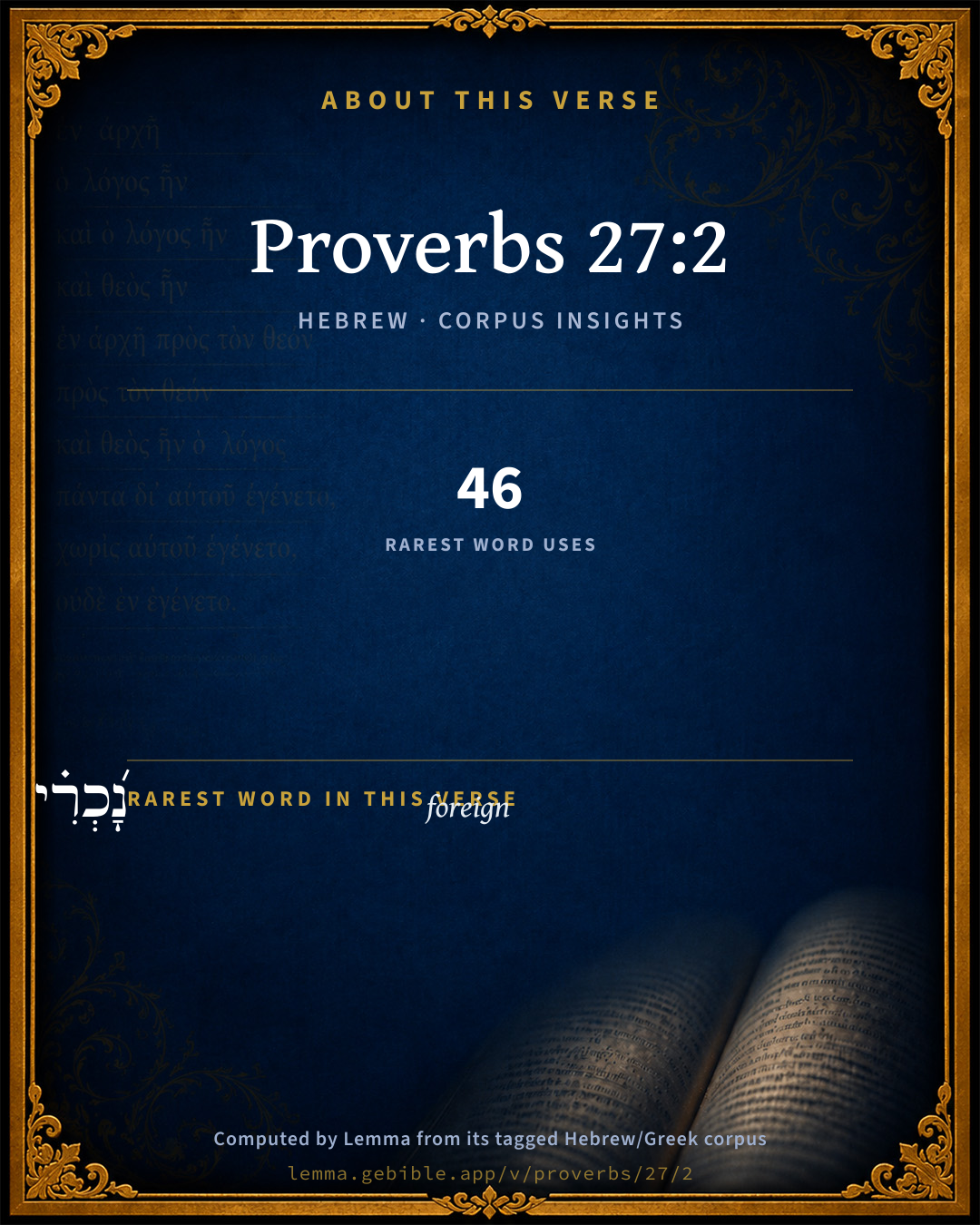
נָ֝כְרִ֗י foreign H5237 occurs in 45 verses of the Hebrew Bible. Also found in:

Grammatical profile

  • 1 verb
  • 2 nouns
  • 2 adjectives
  • 2 particles

Verb forms

  • יְהַלֶּלְךָ֣ Piel · Jussive

Hebrew & Septuagint length

In English translation the verse runs 17 words from the Hebrew and 17 from the Septuagint (LXX English) — the same length.

A rough comparison of the two English renderings, which tokenize alike — not a word-level alignment.

Word counts can differ between the Hebrew and the Greek without any difference in meaning — e.g. the Hebrew direct-object marker אֵת has no separate Greek word, and Greek often adds the article ὁ.

Cross-references

4

Topical passages linked to Proverbs 27:2 in the Treasury of Scripture Knowledge — connected by theme and wording, ordered by reader-vote popularity; previews shown in the World English Bible.

  • 2 Corinthians 10:18 For it isn't he who commends himself who is approved, but whom the Lord commends.
  • Proverbs 25:27 It is not good to eat much honey; Nor is it honorable to seek one's own honor.
  • 2 Corinthians 10:12 For we are not bold to number or compare ourselves with some of those who commend themselves. But they themselves, measuring themselves by themselves, and comparing themselves with themselves, are without understanding.
  • 2 Corinthians 12:11 I have become foolish in boasting. You compelled me, for I ought to have been commended by you, for in nothing was I inferior to the very best apostles, though I am nothing.

Cross-references courtesy of OpenBible.info (CC BY 4.0).

Hebrew and Greek witnesses Masoretic Hebrew ↔ Greek Septuagint

The same verse in the two great witnesses to the Old Testament, shown verse-for-verse.

These are two independent witnesses, not word-aligned to each other, and the Septuagint is shown in lemma (dictionary) form.

Hebrew Proverbs 27:2 Masoretic · Westminster Leningrad Codex

יְהַלֶּלְךָ֣ זָ֣ר וְלֹא פִ֑יךָ נָ֝כְרִ֗י וְאַל שְׂפָתֶֽיךָ

Let another man praise you, And not your own mouth; A stranger, and not your own lips.

World English Bible · Public Domain

Greek LXX Proverbs 27:2 Septuagint · lemma form

ἐνκωμιάζω σύ ὁ πέλας καί μή ὁ σός στόμα ἀλλότριος καί μή ὁ σός χεῖλος

Let your neighbor, and not your own mouth, praise you; a stranger, and not your own lips.

LXX2012 (modern English Septuagint) · Public Domain

On this verse, The Pulpit Commentary discusses the Septuagint’s reading. Read the note in Commentary ↓

Hebrew: Westminster Leningrad Codex (CC BY 4.0). Greek: Septuagint (public domain); English from LXX2012 (modern English Septuagint) (Public Domain). How the Septuagint differs from the Hebrew →

Commentary

Notes on Proverbs 27:2 from classic Christian and Jewish commentators (each source and its license shown beneath its notes). The classic Christian expositions comment on the surrounding passage and are grouped to its opening verse, so a note may address several verses; the Jewish commentaries on the Tanakh (Rashi and others) are per-verse, so they appear only where the commentator wrote on this verse.

Lemma curates 59 commentaries, every one of them public domain or Creative Commons licensed, each selected and text-cleaned for this edition rather than reprinted as found. About our sources →

Trapp's Complete Commentary

John Trapp

Pro 27:2 Let another man praise thee, and not thine own mouth; a stranger, and not thine own lips.

Ver. 2. Let another man praise thee, and not thine own mouth.] Unless it be in defence of thine innocence, as David, {Psa 7:10} or when the concealing of thy goodness may turn to the hindrance of the truth, or to the hurt of the Church, or impairing of God’s glory, as Paul. {2Co 11:1-33; 2Co 12:1-21} Let a man "do worthily in Ephrata," and he shall be "famous in Bethlehem"; {Rth 4:11} he need not be his own trumpeter, as Jehu, the proud Pharisee, and other arrogant, vain glorious braggards. See my Common Place of Arrogance. God will take order that those that honour him be honoured of all, and that fame shall attend virtue, as the shadow doth the body. Say that wicked men will not speak well but ill of us, yet we have a testimony in their consciences, as David had in Saul’s, Daniel in Darius’s, &c. "Demetrius hath a good report of all good men, and of the truth itself"; {3Jn 1:12} and that is enough for him, since "not he that commendeth himself, or hath the world’s applause, is approved, but he whom the Lord and his people commendeth." {2Co 10:18} Haec ego primus vidi, I see these matters first, was a vain glorious brag that Zabarel had better held in. And haec ego feci, I made these things, proves men to be no better than faeces, dregs, saith Luther, wittily. These brags are but dregs; Laus proprio sordeseit in ore; that which had been much to a man’s commendation, if out of another man’s mouth, sounds very slenderly out of his own, saith Pliny. {a} Let her "works," not her words, "praise her in the gates," {Pro 31:31} as they did Ruth. "All the city of my people knows that thou art a virtuous woman." {Rth 3:11} She was so, and she had the credit of it; so had the Virgin Mary, and yet she was troubled when truly praised of the angel. They shall be praised of angels in heaven, who have eschewed the praises of men on earth, and blush when but justly commended, speaking modestly and meanly of their own good parts and practices. Saint Luke saith, "Levi made a great feast." {Luk 5:27-29} But when himself speaks of it, {Mat 9:10} he saith only, that Christ came home and ate bread in Levi’s house, to teach us the truth of this proverb, that another man’s mouth should praise us, and not our own. Like as in the Olympic games, those that overcame did not put the garlands on their own heads, but stayed till others did it for them so here.

{a} Quod magnificum referente alio fuisset, ipso qui gesserat recensente vanescit. - Plin., Eph 8, lib. i.

John Trapp, A Commentary or Exposition upon All the Books of the Old and New Testament (1647–1656) — public domain. Text from a community e-Sword module.

The Biblical Illustrator

Joseph S. Exell

Pro_27:2

Let another man praise thee, and not thine own mouth.

Self-boasting

Self-boasting is always a source of weakness as well as a revelation of vanity. In vanity there is no substance; it is idle breath, it is foolish vapour. When a man is left to praise himself it is evident that he has lived an inverted life, not a life full of blessedness and comfort in relation to other men. The sun does not praise himself, but under his splendour and warmth men look up and say how pleasing a thing it is for the eyes to behold the light. On the other hand, we must beware of a very common and perilous deceit. There is a sense in which every man ought to be able to praise himself; otherwise the applause of the public will be left by him to be a mockery and a lie. Our own heart should not condemn us. The psalmist was wont to glory in his integrity, and to point to it as his refuge in the time of misunderstanding. (J. Parker, D.D.)

The Biblical Illustrator, edited by Joseph S. Exell (c. 1880s–1900s) — public domain. Text from a community e-Sword module.

Joseph Benson's Commentary

Pro 27:2. Let another man praise thee, and not thine own mouth — Except it be really necessary, either for thy own just vindication, or for the honour of God, or for the edification of others, in which cases this hath been allowed and practised by wise and virtuous men, as particularly by St. Paul, 2Co 11:12.

Joseph Benson's Commentary on the Old and New Testaments (1811–1818) — public domain. Text from a community e-Sword module.

The Preacher's Complete Homiletical Commentary

Joseph S. Exell (gen. ed.)

MAIN HOMILETICS OF Pro_27:2

SELF PRAISE

I. Merit will win the praise of others. The light of the sun makes its existence felt by every man who is possessed of vision, and there are but few men who do not acknowledge that it is a good and pleasant thing. The perfume of the flowers cannot be hidden while there are creatures endowed with the sense of smell, and their fragrance is so grateful and refreshing to us, that it is sure to win from us an acknowledgment of its existence and expressions of delight. And as men are endowed with senses which recognise light and fragrance and every form of physical beauty, so there is a moral sense in man which compels him to discern moral excellence or mental superiority. The conscience and the reason stand in the same relation to spiritual worth and intelligence as the sense of sight does to the sunlight, or that of smell to a pleasant odour. It is true that there are men who will refuse to acknowledge the presence of moral worth, but there are also some who will not acknowledge the existence of good in anything. But they know it is there notwithstanding. And although man as fallen may be more ready to praise that which appeals to his senses than that which commands the admiration of his better nature, there will always be found some in every community who will give to real worth its due proportion of praise.

II. Self-praise generally implies a lack of merit. A man of intellectual or moral worth loves knowledge or excellence of any kind for its own sake, and not for the height to which it may raise him in the estimation of his fellows. Although he is or ought to be grateful for the esteem of others, he does not make that the end of his existence; his satisfaction arises not from what people think of him, but from what he is in himself. And just in proportion as a man attains to mental or moral heights, so does he apprehend more truly how little after all he has and is, and so the higher he goes the less value he commonly sets upon his present attainments. It is therefore an inference most commonly drawn that he who praises himself is but little deserving the praise of others, and is not likely to get it. And this conclusion is generally a correct one.

OUTLINES AND SUGGESTIVE COMMENTS

It must never be forgotten that all such passages imply the sincere and earnest cultivation of a real and divinely approved principle. The principle called for in this verse is that of true, self-diffident modesty. Considerations entirely different, and even opposite, may induce the suppression of self-praise:—even the very desire of praise from others. From this arises the danger of holding out—to the young especially—the motive or inducement of getting a character for modesty. This may produce artifice, affectation, simulation, hypocrisy. That which is wanted,—that which God approves and requires,—is honest simplicity, which neither, on the one hand, courts praise, nor, on the other, affects to disdain and undervalue it,—which neither blusters out its own commendation, nor whines and simpers, and depreciates, and makes light of what it is or of what it has done, merely for the purpose of making others say more. The affectation of despising the commendation of others is worse than the self-commendation that is reprehended. It is, in truth, the very same spirit showing itself under another aspect.—Wardlaw.

Praise is a comely garment, but though thyself do wear it, another must put it on, or it will never fit well about thee. Praise is sweet music, but it is never tuneable in thine own mouth, if it come from the mouth of another, it soundeth most tuneably in the ears of all that hear it. Praise is a rich treasure, but it never makes thee rich, unless another tell the sum.—Jermin.

The Preacher's Complete Homiletical Commentary (gen. ed. Joseph S. Exell; Funk & Wagnalls, c. 1892) — public domain (pre-1929). A full-Bible homiletical/sermon-outline anthology covering 65 of 66 books (2 John is absent from the source module). Text from a community e-Sword module.

Tyndale Open Study Notes

Tyndale Open Resources

27:2 The Hebrew word translated praise comes from the same root as “brag” in 27:1. Bragging (self-praise) is foolish.

Tyndale Open Study Notes — © Tyndale Open Resources, licensed CC BY-SA 4.0. Text via the HelloAO Bible API.

Matthew Henry's Commentary

Note, 1. We must do that which is commendable, for which even strangers may praise us. Our light must shine before men, and we must do good works that may be seen, though we must not do them on purpose that they may be seen. Let our own works be such as will praise us, even in the gates, Phi 4:8. 2. When we have done it we must not commend ourselves, for that is an evidence of pride, folly, and self-love, and a great lessening to a man's reputation. Every one will be forward to run him down that cries himself up. There may be a just occasion for us to vindicate ourselves, but it does not become us to applaud ourselves. Proprio laus sordet in ore - Self-praise defiles the mouth.

Matthew Henry's Commentary on the Whole Bible (1708–1710) — public domain (CC PDM 1.0). Text via the HelloAO Bible API.

Jamieson, Fausset & Brown

Robert Jamieson, A. R. Fausset & David Brown

Avoid self-praise.

Jamieson, Fausset & Brown — Commentary Critical and Explanatory on the Whole Bible (1871) — public domain (CC PDM 1.0). Text via the HelloAO Bible API.

Adam Clarke's Commentary

Verse 2. Let another man praise thee, and not thine own mouth] We have a similar proverb, which illustrates this: "Self-praise is no commendation."

Adam Clarke's Commentary on the Bible (1810–1826) — public domain. Text from a community e-Sword/MySword module.

Ellicott's Commentary for English Readers

(2) Let another man (zar) praise thee . . . a stranger (nokhrî).—As to the difference between these words, see above on Pro_2:16. A higher consideration than this is suggested in 2Co_10:18.

A Bible Commentary for English Readers, edited by Charles John Ellicott (1878–1897) — public domain. Text from a community e-Sword module.

John Gill's Exposition

Let another man praise thee, and not thine own mouth,.... Men should do those things which are praiseworthy; and should do them openly, that they may be seen and praised for them: for it is honourable to have such a character as Demetrius had, who had a good report of all men; and as the brother had, whose praise in the Gospel was in all the churches. To be commended by others, by any but a man's self, is to his credit and reputation; but nothing more hurtful to it than self-commendation; see Co2 10:18; in some cases it is right for a man indeed to commend himself, when the glory of God, the credit of religion, the cause of truth and self-vindication, require it; as the prophet Samuel, the Apostle Paul, and others, have been obliged to do, Sa1 12:3, &c.

a stranger, and not thine own lips; a stranger means any other than a man's self; and if it is one that he knows not, or has little acquaintance with; or if a foreigner, that does not personally know him, only has good testimonies of him, or has read his works; and especially if in other respects an enemy; it is greatly to his honour to be praised by him: and such a commendation comes with much better grace than from himself, and from whom indeed it would not come with any.

John Gill's Exposition of the Whole Bible (1746–1763) — public domain (CC PDM 1.0). Text via the HelloAO Bible API.

Albert Barnes' Notes on the Bible

Another - An “alienus” rather than “alius.” Praise to be worth anything must be altogether independent.

Albert Barnes' Notes on the Bible (1834–1885) — public domain. Text from a community e-Sword/MySword module.

Haydock's Catholic Bible Commentary

Lips. All hate affectation and vanity, John v. 51.

George Leo Haydock (1774–1849), Haydock's Catholic Family Bible and Commentary, 1859 edition — public domain. Excludes Psalms (Douay-Rheims chapter numbering differs from Protestant) and Deuterocanonical books (Catholic canon only).

Matthew Poole's English Annotations

Except it be really necessary, either for thy own just vindication, or for the honour of God, or for the edification of others, in which cases this hath been allowed and practised by wise and virtuous men, as particularly by St. Paul, 2Co 11:12.

Matthew Poole's English Annotations on the Holy Bible (1683–1685) — public domain. Text from a community e-Sword/MySword module.

Whedon's Commentary on the Bible

Daniel D. Whedon

2. Let another… praise thee… stranger — Self praise is no commendation. This proverb does not make against any person speaking modestly, when occasion calls for it, of his own acts, but is aimed at all vain boasting. Do worthy deeds which shall compel commendation from others. When necessary, a man not only may, but should, defend his innocence and uprightness. Compare Pro_25:27, latter clause.

Daniel D. Whedon (gen. ed.), Commentary on the Old and New Testaments (1874–1909) — public domain. Text from a community e-Sword module.

The Pulpit Commentary

Let another man praise thee, and not thine own mouth; Septuagint, "Let thy neighbour (o pelav ) laud thee." A stranger; yrikg, properly, "an unknown person from an unknown country;" but, like rz in the former hemistich, used indifferently for "another". (see on Pro_2:16) "If I honour myself," said our Lord, (Joh_8:54) "my honour is nothing" And as St. Paul testifies, (2Co_10:18) "Not he that commendeth himself is approved, but whom the Lord commendeth." Upe frashv egkwmia said the Greek gnomist; and Filwn epainon mallon h sautou lege ..

And a trite maxim runs, "In ore proprio laus sordet;" and an English one decides, "He who praises himself is a debtor to others." Delitzsch quotes a German proverb (which loses the jingle in translation), "Eigen-lob stinkt, Freundes Lob hinkt, fremdes Lob klingt," "Self-praise stinks, friends" praise limps, strangers" praise sounds.

Self-praise.

I SELF-PRAISE IS ILL FOUNDED. It may be true to fact, but we cannot be sure that it is.

1. Possibly it is insincere. So many motives of vanity and self-interest urge a person to pretend to be better than he is, that a certificate of merit given by himself on behalf of himself cannot be taken at a high value.

2. Probably it is delusive. Even when it is perfectly sincere it is likely to be perverted by unconscious misconceptions. It is very easy to be honestly mistaken as to one"s own worth. We are the worst conceivable judges of our own characters and deserts. Even when we can calmly and fairly estimate our powers we are likely to be very wrong in valuing our use of them.

II SELF-PRAISE SPRINGS FROM SELFISHNESS.

1. It reveals a self-regarding habit. If a man is given to expatiate on his own merits, he must be accustomed to turn his thoughts inwards; he must be familiar with the contemplation of himself. Now, this is not wholesome. The less a man thinks about himself the better for his own soul"s health.

2. It implies a desire of self-aggrandizement. There is usually a motive behind the habit of self-praise, and, though this may be nothing worse than childish vanity, it carries with it a desire for exciting the admiration of others; it aims at reaping a harvest of laudation. But possibly the end sought is more far reaching, and the pretentious person indicts his own testimonials with a deliberate intention of securing some tangible advantage thereby. The self-praise is then just an ugly, glaring blossom of selfishness.

III SELF-PRAISE PROVOKES JEALOUSY. It rarely secures the admiration that it seeks. On the contrary, it is generally received with suspicion; and even when it is honest and true, a large discount is taken off its claims.

1. Its defective authority is perceived. This is a point to which vanity is singularly blind. Yet all the weakness of the situation is apparent to every beholder; for it is universally recognized that a man is strongly tempted to make out a good case for himself, and that he is likely to be deceived into an inordinate estimate of his own value. Therefore self-praise is usually wasted.

2. It irritates the vanity of others. The tendency is for the hearer to imagine that the vain speaker desires to exalt himself at the expense of others. A comparison of merit seems to be challenged, and this at once rouses the jealousy of the audience. Thus self-praise does not win friends. What it may perhaps succeed in extracting in the form of admiration is paid for dearly by the dislike that it also creates.

IV SELF-PRAISE IS CONTRARY TO CHRISTIAN HUMILITY. It represent, a wholly alien spirit. Doubtless it is a common weakness of men who are truly Christian and kind hearted, for no man is perfect; but still it is a weakness, and it is foreign to the genius of the religion under which it finds a shelter. The often repeated rule of Christ is that "Whosoever exalteth himself shall be abased;" "The first shall be last." The Due disciple is not to choose the upper seat in the synagogue. Humility, self-forgetfulness, the preference of others, are the Christian graces. Self-praise is useless before God.

V SELF-PRAISE ONLY AIMS AT WHAT CAN BE BETTER ATTAINED WITHOUT IT. "Let another man praise thee." Self-praise silences the lips of admiration from others. The truly humble man will not crave such admiration. But all men of right feeling must desire to stand well with their fellows. It is happy to feel that we have the respect and confidence of those whose opinion we value. Now, these encouragements are better secured by unpretentious merit, and humility in earnest, simple attempts to do right.

Vers. 2, 21. The praise of man.

How far we should go in praising others, and in what spirit we should accept their praise, is a matter of no small importance in the conduct of life.

I THE DUTY OF PRAISING OTHERS. "Let another man praise thee" can hardly be said to be imperative so far as he is concerned. But it suggests the propriety of another man speaking in words of commendation. And the duty of praising those who have done well is a much-forgotten and neglected virtue. I It is the correlative of blame, and if we blame freely (as we do), why should we not freely praise the scholar, the servant, the son or daughter, the workman, etc.?

1. With many hearts, perhaps with moat, a little praise would prove a far more powerful incentive than a large quantity of blame.

2. To praise for doing well is to follow in the footsteps of Jesus Christ and of his apostles; it is to act as the most gracious and the most useful men and women have always acted.

3. It is to do to others as we would they should do to us. We thirst for a measure of approval when we have done our best, and what we crave from others we should give to others.

II THE WISDOM OF ABSTAINING FROM SELF-PRAISE. The injunction of Solomon appeals to our common sense. Yet is it by no means unrequired. Many men are guilty of the unseemliness and the folly of praising themselves their ingenuity, their shrewdness, their persuasiveness, their generosity, etc. Probably if they knew how very little they commend themselves by so doing, how very soon they weary their audience, how often their language becomes positively nauseous, they would abstain. Self-vindication under a false charge is a duty and even a virtue; a very minute modicum of self-commendation may be occasionally allowable; anything beyond this is, at least, a mistake.

III THE NECESSITY OF TESTING PRAISE. "The ordinary interpretation makes the praise try the man, but the words... in the original make the man try the praise" (Wardlaw). What the fining pot is to silver, that a man should be to his praise he should carefully and thoroughly test it. For praise is often offered some part of which should be rejected as dross. The simple minded and the unscrupulous will praise us beyond the bounds of our desert, and to drink too much of this intoxicating cup is dangerous and demoralizing to us.

IV THE PRACTICAL PROOF OF PRAISE. The duties and the difficulties that are before us will be the best possible proof of the sincerity and of the truthfulness of the praise we receive. We shall either be approved as the wise men we are said to be, or we shall be convicted of being less worthy than we are represented to be. Therefore let us be

(1) judicious as well as generous in our praise of others, remembering that they will be thus tested; and let us

(2) be contented with a modest measure of honour, realizing that we have to live up to the esteem in which we are held. But we may learn a valuable lesson from the common (if not the correct) interpretation, and consider

V THE TEST WHICH PRAISE AFFORDS. We stand blame better than praise; though it is right to recollect that we cannot stand more than a certain measure of blame, and few people are more objectionable or more mischievous than the scold. But much praise is a great peril. It elates and exalts; it "puffs up." It too often undermines that humility of spirit and dependence on God which are the very root of a strong and beautiful Christian character.

1. Discourage all excess in this direction; it is dangerous.

2. Care more for the approval of an instructed and well-trained conscience.

3. Care most for the commendation of Christ. C.

The Pulpit Commentary (1880–1919), ed. H.D.M. Spence-Jones & Joseph S. Exell — public domain. Text from a community e-Sword module.

Keil & Delitzsch

C. F. Keil & F. Delitzsch

2 Let another praise thee, and not thine own mouth;

A stranger, and not thine own lips.

The negative לא is with פיך, as in (Arab.) ghyra fyk, bound into one compact idea: that which is not thine own mouth (Fleischer), "not thine own lips," on the other hand, is not to be interpreted as corresponding to it, like אל־מות, Pro 12:28; since after the prohibitive אל, יהללוּך [praise thee] easily supplies itself. זר is properly the stranger, as having come from a distance, and נכרי he who comes from an unknown country, and is himself unknown (vid., under Pro 26:24); the idea of both words, however, passes from advena and alienigena to alius. There is certainly in rare cases a praising of oneself, which is authorized because it is demanded (Co2 11:18), which, because it is offered strongly against one's will, will be measured by truth (Pro 10:13); but in general it is improper to applaud oneself, because it is a vain looking at oneself in a glass; it is indecent, because it places others in the shade; imprudent, because it is of no use to us, but only injures, for propria laus sordet, and as Stobus says, οὐδὲν οὕτως ἄκουσμα φορτικὸν ὡς καθ ̓ αὑτοῦ ἔταινος. Compare the German proverb, "Eigenlob stinkt, Freundes Lob hinkt, fremdes Lob klingt" [= self-praise stinks, a friend's praise is lame, a stranger's praise sounds].

Keil & Delitzsch — Biblical Commentary on the Old Testament (1861–1891) — public domain (CC PDM 1.0). Text via the HelloAO Bible API. (Old Testament only.)

Bridges on Proverbs

Charles Bridges

’Praise’ — says an old expositor — ’is a comely garment. But though thyself doth wear it, another must put it on, or else it will never sit well about thee. Praise is sweet music, but it is never tuneable in thine own mouth. If it cometh from the mouth of another, it soundeth most tuneably in the ears of all that hear it. Praise is a rich treasure, but it will never make thee rich, unless another tell the same.’†1 Indeed — except as the vindication of our character,†2 or our Master’s honor connected with it,†3 may require — nothing so degrades a man with his fellow-men, as setting out his own praise. For though every man is his own flatterer (Pro 20:6 ), yet men usually know how to estimate pride in others, while they cherish it in themselves. "The things that are of good report — think of them to do them." (Php 4:8 .) But "let our works," not our tongues, "praise us in the gates."†4 And while our works shine, see to it, that ourselves be hid. "Confess your faults one to another."†5 But leave to another to speak our praise. ’Scarce any shew themselves to advantage, who are over-solicitous to do so.’†6

Our name will lose nothing by this self-renouncing spirit. If our own mouth be silent, another’s will be opened. John was "unworthy" in his own eyes to "unloose the latchet of his Master’s shoes." Yet did his Lord’s mouth proclaim him as "the greatest of all that had been born of women."†7 The centurion spoke of himself, as "not worthy that Christ should come under his roof." Yet did the elders testify, that "he was worthy, for whom he should do this." Yea — the Savior’s own mouth confirmed the testimony — "I have not found so great faith, no not in Israel."†8 Luke mentions nothing in his records to his own credit. Yet another praises him warmly as "the beloved physician," and his sole faithful companion in his trials.†9

Self-seeking is a shameful blot upon a Christian profession. What! Shall one that has said before God — "Behold, I am vile"! — be ready to say before his fellow-men — "Come, see my zeal for the LORD"†10 — Come, see how humble I am! Oh! for the self-abased spirit of our glorious Master — ever ready to endure reproach: but never "receiving honor from men;" never "seeking his own glory." (Joh 5:41 ; Joh 8:50 .) Contrast what God shews us of ourselves in the closet with our "fair show in the flesh." And will this not put self-complacency to shame? Surely that we are so little really humble, is matter enough for the deepest humiliation.

Footnotes:

†1 Jermin.

†2 1Sa 12:3 . Psa 7:3-5 . 2Co 1:17-19 .

†3 2Co 11:5-12 ; 2Co 12:11 . ’St. Paul was put upon it, to speak of himself more than he chose to do; and when he speaks of things concerning himself, he puts in ever and anon, "I speak as a fool" — intimating, that unless there be very great cause, whoever talks much of himself, talks like a fool.’ — Whichcote’s Sermons.

†4 Pro 31:31. Rth 3:11 .

†5 Pro 25:27. Mat 5:16 . Jas 5:16 .

†6 Bp. Butler.

†7 Mat 3:11. Joh 3:30, with Mat 11:11 . Joh 5:35 .

†8 Mat 8:8; with Luk 7:3-4, Luk 7:9 .

†9 Col 4:14. 2Ti 4:11 . It was a fine touch in Sallust’s portrait of Cato — ’He would rather be, than seem to be, a good man; so that the less he sought glory, the more he obtained it.’

†10 Job 40:4. 2Ki 10:16 .

Charles Bridges, An Exposition of the Book of Proverbs (1846) — public domain. Text from a community e-Sword module.

Lesson kit

Teaching starters — assembled from the data on this page, not authored interpretation. Every prompt links to the verse data it draws on. Edit before teaching.

Proverbs, in the Wisdom, opens this verse with 7 words (7 distinct Hebrew lemmas). Its most distinctive word is nokrîy (“foreign”). A historical commentator’s framing appears above. Read the whole chapter for the surrounding context.

Discussion questions

  1. What does “foreign” (nokrîy) contribute to the verse as a whole?
  2. Genesis 31:15 shares the word «foreign» with this verse. How do the two illuminate each other?
  3. The translations on this page render this verse differently — a whole-verse word diff, not a word-by-word alignment. What might account for the different wordings?
  4. The verb «יְהַלֶּלְךָ֣» is Piel Jussive. How does its form color the action?
  5. Reading how Trapp's Complete Commentary and The Biblical Illustrator read this verse, where do the two commentators agree and where do they part?

Things to notice

Reading settings

Reading text

Shown beneath each verse's original-language words.

Old Testament
Old Testament edition

Read the OT as the Masoretic Hebrew (MT) or the Greek Septuagint (LXX).

English shown for the Greek Septuagint (in the Hebrew ↔ Greek comparison).

Comparing translations? Open the Compare panel on any verse page to stack up to four side by side.