Song of Solomon 4:3

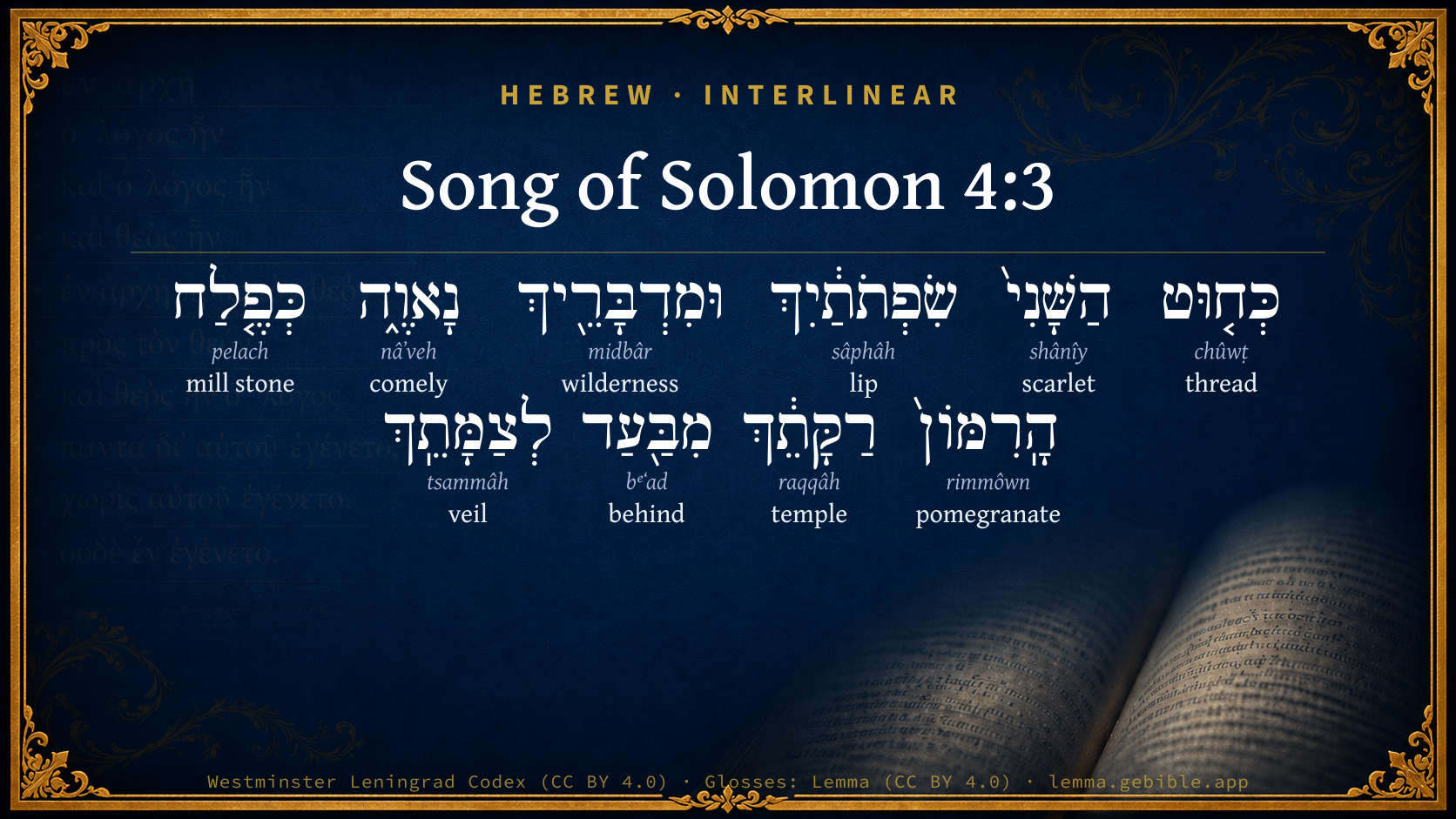
Hebrew (Westminster Leningrad Codex) Song of Solomon 4:3 appears in the Hebrew Old Testament. The text above is from the Westminster Leningrad Codex. Each word links to its Strong’s number, a concise gloss, and parsing drawn from the Open Scriptures Hebrew Bible morphology. Click any word for its full Brown-Driver-Briggs (BDB) entry.
Download image
Cite this verse

Song of Solomon 4:3 (World English Bible). Public Domain. Lemma interlinear Bible study tool, https://lemma.gebible.app/v/song-of-solomon/4/3.

Show BibTeX & RIS
BibTeX
RIS
English Translation
Your lips are like scarlet thread. Your mouth is lovely. Your temples are like a piece of a pomegranate behind your veil.
World English Bible · Public Domain
Download a study sheet

One document with this verse’s original text, its word-by-word gloss line, the meaning frame, cross-references with their text, attributed commentary, and full source and license credits — printable, and it pastes into notes with its structure intact.

This verse Autodidact and up

Study sheet (.html) Plain text (.txt)

A passage Seminary Student

Up to 50 verses in one chapter. A passage sheet keeps up to 6 commentary sources and 12 cross-references per verse, in the order this page ranks them, and says so on the sheet whenever that leaves anything out. Ask for a single verse and you get the Autodidact verse sheet above.

Everything on this page stays free to read, with no account — the sheet is a download of what is already on screen, not access to it.

Want to remove ads? Support Godless Engineer
Compare translations 3

The same verse in 3 English versions, stacked beneath the original-language interlinear above. Click any original word for its lexicon entry.

Each is an independent rendering of the whole verse — the interlinear is not word-aligned to these translations.

Highlighted words mark where these versions differ — a whole-verse word diff, not a word-by-word alignment.

  • World English Bible Public Domain
    Your lips are like scarlet thread. Your mouth is lovely. Your temples are like a piece of a pomegranate behind your veil.
  • King James Version Public Domain
    Thy lips are like a thread of scarlet, and thy speech is comely: thy temples are like a piece of a pomegranate within thy locks.
  • unfoldingWord Literal Text CC BY-SA 4.0
    Like a thread of scarlet your lips, and your mouth lovely. Like a slice of pomegranate your cheeks from behind your veil.

unfoldingWord Literal Text — © unfoldingWord, licensed CC BY-SA 4.0. Word-aligned USFM3 via Door43 (git.door43.org/unfoldingWord/en_ult).

Versions to compare (up to 4)

3 of 4 selected

Show all 18 translations

Every available English version of this verse, each an independent rendering of the whole verse.

  • World English Bible Public Domain
    Your lips are like scarlet thread. Your mouth is lovely. Your temples are like a piece of a pomegranate behind your veil.
  • Berean Standard Bible Public Domain
    Your lips are like a scarlet ribbon, and your mouth is lovely. Your brow behind your veil is like a slice of pomegranate.
  • Majority Standard Bible Public Domain
    Your lips are like a scarlet ribbon, and your mouth is lovely. Your brow behind your veil is like a slice of pomegranate.
  • King James Version Public Domain
    Thy lips are like a thread of scarlet, and thy speech is comely: thy temples are like a piece of a pomegranate within thy locks.
  • American Standard Version (1901) Public Domain
    Thy lips are like a thread of scarlet, And thy mouth is comely. Thy temples are like a piece of a pomegranate Behind thy veil.
  • Revised Version (1885) Public Domain
    Thy lips are like a thread of scarlet, and thy mouth is comely: thy temples are like a piece of a pomegranate behind thy veil.
  • Geneva Bible (1599) Public Domain
    Thy lippes are like a threede of scarlet, and thy talke is comely: thy temples are within thy lockes as a piece of a pomegranate.
  • Douay-Rheims (1899) Public Domain
    Thy lips are as a scarlet lace: and thy speech sweet. Thy cheeks are as a piece of a pomegranate, besides that which lieth hid within.
  • Young's Literal Translation Public Domain
    As a thread of scarlet `are' thy lips, And thy speech `is' comely, As the work of the pomegranate `is' thy temple behind thy veil,
  • Literal Standard Version CC BY-SA 4.0
    As a thread of scarlet [are] your lips, || And your speech [is] lovely, || As the work of the pomegranate [is] your temple behind your veil,
  • Unlocked Literal Bible CC BY-SA 4.0
    Your lips are like a thread of scarlet; your mouth is lovely. Your cheeks are like pomegranate halves behind your veil.
  • unfoldingWord Literal Text CC BY-SA 4.0
    Like a thread of scarlet your lips, and your mouth lovely. Like a slice of pomegranate your cheeks from behind your veil.
  • Darby Bible Public Domain
    Thy lips are like a thread of scarlet, And thy speech is comely; As a piece of a pomegranate are thy temples Behind thy veil.
  • World Messianic Bible Public Domain
    Your lips are like scarlet thread. Your mouth is lovely. Your temples are like a piece of a pomegranate behind your veil.
  • Webster's Bible Public Domain
    Thy lips are like a thread of scarlet, and thy speech is comely: thy temples are like a piece of pomegranate within thy locks.
  • Free Bible Version CC BY-SA 4.0
    Your lips are as red as scarlet thread. Your mouth is gorgeous. Your cheeks are the blushing color of pomegranates behind your veil.
  • Bible in Basic English Public Domain
    Your red lips are like a bright thread, and your mouth is fair of form; the sides of your head are like pomegranate fruit under your veil.
  • JPS Tanakh (1917) Public Domain
    Thy lips are like a thread of scarlet, and thy mouth is comely; thy temples are like a pomegranate split open behind thy veil.

Literal Standard Version (2020), Covenant Press — licensed CC BY-SA 4.0. Text via the HelloAO Bible API (eBible.org). Unlocked Literal Bible (unfoldingWord) — licensed CC BY-SA 4.0. Text via the HelloAO Bible API (eBible.org). unfoldingWord Literal Text — © unfoldingWord, licensed CC BY-SA 4.0. Word-aligned USFM3 via Door43 (git.door43.org/unfoldingWord/en_ult). Free Bible Version, Dr. Jonathan Gallagher — licensed CC BY-SA 4.0. Text via the HelloAO Bible API (eBible.org).

Word by word

More ways to search: Search by grammar → Find every occurrence → Compare this word →

Practice this passage: Drill this verse → Learn its vocabulary →

לְצַמָּתֵֽךְ
tsammâh
H6777
“to/for · veil · your”
Preposition + Noun, Common, Feminine, Singular, Construct + Suffix, Personal, 2nd Person, Feminine, Singular
Part of Speech
Preposition + Noun
Type
Common
Gender
Feminine
Number
Singular
State
Construct
Full BDB Definition

Origin: from an unused root meaning to fasten on

TWOT: 1929a

veil, woman's veil
  1. כְּח֤וּט chûwṭ H2339 “like/as · thread of” Preposition + Noun, Common, Masculine, Singular, Construct
  2. הַשָּׁנִי֙ shânîy H8144 “the · scarlet” Particle, Definite Article + Noun, Common, Masculine, Singular, Absolute
  3. שִׂפְתֹתַ֔יִךְ sâphâh H8193 “lips · your” Noun, Common, Feminine, Plural, Construct + Suffix, Personal, 2nd Person, Feminine, Singular
  4. וּמִדְבָּרֵ֖יךְ midbâr H4057 “and · wilderness · your” Conjunction + Noun, Common, Masculine, Singular, Construct + Suffix, Personal, 2nd Person, Feminine, Singular
  5. נָאוֶ֑ה nâʼveh H5000 “comely” Adjective, Adjective, Masculine, Singular, Absolute
  6. כְּפֶ֤לַח pelach H6400 “like/as · mill stone of” Preposition + Noun, Common, Feminine, Singular, Construct
  7. הָֽרִמּוֹן֙ rimmôwn H7416 “the · pomegranate” Particle, Definite Article + Noun, Common, Masculine, Singular, Absolute
  8. רַקָּתֵ֔ךְ raqqâh H7541 “temple · your” Noun, Common, Feminine, Singular, Construct + Suffix, Personal, 2nd Person, Feminine, Singular
  9. מִבַּ֖עַד bᵉʻad H1157 “from · behind” Preposition + Preposition

About this verse

These counts appear in no published source. They are computed here, from the morphology-tagged text and Lemma’s own curated glosses. What Lemma adds →

10
words
10
distinct lemmas
Wisdom
section

Notable vocabulary

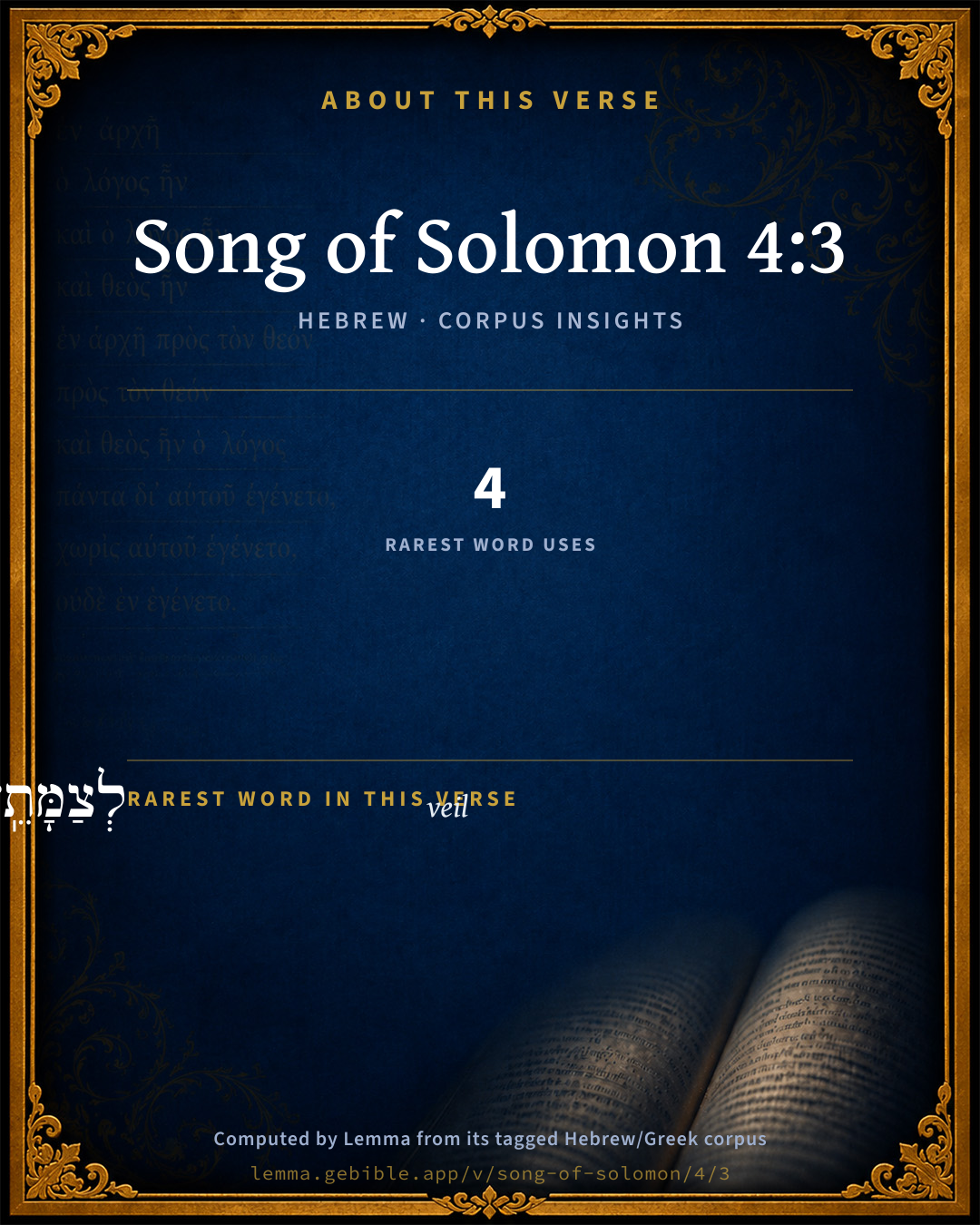
The rarest word here is לְצַמָּתֵֽךְ veil H6777 — appearing just 4 times in the whole Hebrew Bible.

Shared distinctive vocabulary

לְצַמָּתֵֽךְ veil H6777 occurs in 4 verses of the Hebrew Bible. Also found in:

Grammatical profile

  • 8 nouns
  • 1 adjective
  • 1 preposition

Hebrew & Septuagint length

In English translation the verse runs 22 words from the Hebrew and 25 from the Septuagint (LXX English) — closely comparable.

A rough comparison of the two English renderings, which tokenize alike — not a word-level alignment.

Word counts can differ between the Hebrew and the Greek without any difference in meaning — e.g. the Hebrew direct-object marker אֵת has no separate Greek word, and Greek often adds the article ὁ.

Cross-references

28

Topical passages linked to Song of Solomon 4:3 in the Treasury of Scripture Knowledge — connected by theme and wording, ordered by reader-vote popularity; previews shown in the World English Bible.

  • Song of Solomon 6:7 Your temples are like a piece of a pomegranate behind your veil.
  • Joshua 2:18 Behold, when we come into the land, you shall bind this line of scarlet thread in the window which you did let us down by: and you shall gather to you into the house your father, and your mother, and your brothers, and all your father's household.
  • Song of Solomon 5:16 His mouth is sweetness; Yes, he is altogether lovely. This is my beloved, and this is my friend, Daughters of Jerusalem. Friends
  • Genesis 32:10 I am not worthy of the least of all the loving kindnesses, and of all the truth, which you have shown to your servant; for with just my staff I passed over this Jordan; and now I have become two companies.
  • Leviticus 14:4 then the priest shall command them to take for him who is to be cleansed two living clean birds, and cedar wood, and scarlet, and hyssop.
  • Leviticus 14:6 As for the living bird, he shall take it, and the cedar wood, and the scarlet, and the hyssop, and shall dip them and the living bird in the blood of the bird that was killed over the running water.
  • Leviticus 14:49–52 To cleanse the house he shall take two birds, and cedar wood, and scarlet, and hyssop.
  • Numbers 4:8 They shall spread on them a scarlet cloth, and cover the same with a covering of sealskin, and shall put in its poles.
  • Numbers 19:6 and the priest shall take cedar-wood, and hyssop, and scarlet, and cast it into the midst of the burning of the heifer.
  • Ezra 9:6 and I said, my God, I am ashamed and blush to lift up my face to you, my God; for our iniquities are increased over our head, and our guiltiness is grown up to the heavens.
  • Psalms 37:30 The mouth of the righteous talks of wisdom. His tongue speaks justice.
  • Psalms 45:2 You are the most excellent of the sons of men. Grace has anointed your lips, Therefore God has blessed you forever.
  • Psalms 119:13 With my lips, I have declared all the ordinances of your mouth.
  • Proverbs 10:13 Wisdom is found on the lips of him who has discernment, But a rod is for the back of him who is void of understanding.
  • Proverbs 10:20–21 The tongue of the righteous is like choice silver. The heart of the wicked is of little worth.
  • Proverbs 16:21–24 The wise in heart shall be called prudent. Pleasantness of the lips promotes instruction.
  • Proverbs 31:26 She opens her mouth with wisdom. Faithful instruction is on her tongue.
  • Song of Solomon 4:11 Your lips, my bride, drip like the honeycomb. Honey and milk are under your tongue. The smell of your garments is like the smell of Lebanon.
  • Song of Solomon 5:13 His cheeks are like a bed of spices with towers of perfumes. His lips are like lilies, dropping liquid myrrh.
  • Song of Solomon 7:9 Your mouth like the best wine, That goes down smoothly for my beloved, Gliding through the lips of those who are asleep.
  • Ezekiel 16:63 that you may remember, and be confounded, and never open your mouth any more, because of your shame, when I have forgiven you all that you have done, says the Lord Yahweh.
  • Matthew 12:35 The good man out of his good treasure brings out good things, and the evil man out of his evil treasure brings out evil things.
  • Luke 4:22 All testified about him, and wondered at the gracious words which proceeded out of his mouth, and they said, "Isn't this Joseph's son?"
  • 2 Corinthians 5:18–21 But all things are of God, who reconciled us to himself through Jesus Christ, and gave to us the ministry of reconciliation;
  • Ephesians 4:29 Let no corrupt speech proceed out of your mouth, but such as is good for building up as the need may be, that it may give grace to those who hear.
  • Colossians 3:16–17 Let the word of Christ dwell in you richly; in all wisdom teaching and admonishing one another with psalms, hymns, and spiritual songs, singing with grace in your heart to the Lord.
  • Colossians 4:6 Let your speech always be with grace, seasoned with salt, that you may know how you ought to answer each one.
  • Hebrews 9:19 For when every commandment had been spoken by Moses to all the people according to the law, he took the blood of the calves and the goats, with water and scarlet wool and hyssop, and sprinkled both the book itself and all the people,

Cross-references courtesy of OpenBible.info (CC BY 4.0).

Hebrew and Greek witnesses Masoretic Hebrew ↔ Greek Septuagint

The same verse in the two great witnesses to the Old Testament, shown verse-for-verse.

These are two independent witnesses, not word-aligned to each other, and the Septuagint is shown in lemma (dictionary) form.

Hebrew Song of Solomon 4:3 Masoretic · Westminster Leningrad Codex

כְּח֤וּט הַשָּׁנִי֙ שִׂפְתֹתַ֔יִךְ וּמִדְבָּרֵ֖יךְ נָאוֶ֑ה כְּפֶ֤לַח הָֽרִמּוֹן֙ רַקָּתֵ֔ךְ מִבַּ֖עַד לְצַמָּתֵֽךְ

Your lips are like scarlet thread. Your mouth is lovely. Your temples are like a piece of a pomegranate behind your veil.

World English Bible · Public Domain

Greek LXX Song of Solomon 4:3 Septuagint · lemma form

ὡς σπαρτίον ὁ κόκκινος χεῖλος σύ καί ὁ λαλιά σύ ὡραῖος ὡς λέπυρον ὁ ῥοά μῆλον σύ ἐκτός ὁ σιώπησις σύ

Your lips are as a thread of scarlet, and your speech is comely: like the rind of a pomegranate is your cheek without your veil.

LXX2012 (modern English Septuagint) · Public Domain

On this verse, The Pulpit Commentary discusses the Septuagint’s reading. Read the note in Commentary ↓

Hebrew: Westminster Leningrad Codex (CC BY 4.0). Greek: Septuagint (public domain); English from LXX2012 (modern English Septuagint) (Public Domain). How the Septuagint differs from the Hebrew →

Commentary

Notes on Song of Solomon 4:3 from classic Christian and Jewish commentators (each source and its license shown beneath its notes). The classic Christian expositions comment on the surrounding passage and are grouped to its opening verse, so a note may address several verses; the Jewish commentaries on the Tanakh (Rashi and others) are per-verse, so they appear only where the commentator wrote on this verse.

Lemma curates 59 commentaries, every one of them public domain or Creative Commons licensed, each selected and text-cleaned for this edition rather than reprinted as found. About our sources →

Trapp's Complete Commentary

John Trapp

Son 4:3 Thy lips [are] like a thread of scarlet, and thy speech [is] comely: thy temples [are] like a piece of a pomegranate within thy locks.

Ver. 3. Thy lips are like a thread of scarlet.] Which hath two comely properties, small and ruddy. A thin lip is a sign of eloquence; {Job 12:20} Pitho sits upon it. As, on the other side, a thick lip is an uncircumcised lip, {Exo 6:12} a polluted lip. {Isa 6:5} Scarlet or coralline lips are counted a great grace, as white, black, bluish lips are held no small deformity. The Church’s lips are her Christian confessions, whether to God or men. To God, when she acknowledgeth his favours (and so covereth his altar with the calves of her lips), or confesseth her sins with all the aggravations, bringing them forth as they did the vessels of the sanctuary, {Ezr 8:34} by tale and by weight, bewailing and begging pardon for all their transgressions in all their sins, as the words are. {Lev 16:21} To man she confesseth when she makes a wise and bold profession of the truth; not "afraid with any amazement," {1Pe 3:6} but ready to "resist even unto blood." {Heb 12:4} The tabernacle was covered over with red (and the scarlet whore would fain persuade us that she takes up that colour for the same intent), to note that we must stand to the profession of the truth, even to effusion of blood. This confession of the mouth {Rom 10:10} is set forth here by lips red as scarlet, because it must be lively, not fady or frigid, but full of faith, and dyed in Christ’s blood. It is also described by a thread of scarlet, because, as a thread, it must be drawn out to the full length, and not cut off, so long as life lasteth, for any fear or other by respect whatsoever. Surely, as Augustine said of the feast of Pentecost, Gaudet produci haec solennitas; so may we say of Christian confession, It rejoiceth to be held out to the last breath. And as the silk worm stretcheth forth herself before she spin, and ends her life in her long wrought clue, so it is with the faithful confessor.

And thy speech is comely.] Because grave and gracious, framed in Scripture phrase as much as may be, and therefore comely and delectable. Loquamur verba Scripturae, utamur sermone Spiritus Sancti, &c., said that incomparable man Peter Ramus; Let us speak the very words of Scripture, let us make use of the language of the Holy Ghost, and for ever abominate those logodaedali, learned asses, that profanely disdain at the stately plainness of God’s blessed book, and that think to correct the divine wisdom and eloquence with their own infancy and sophistry. It is the Church only that speaks handsomely, because holily, and as the oracles of God. {1Pe 4:11} She is, as one well saith of Basil, suaviter gravis, et graviter suavis, nihil habens affectatae loquacitatis, sweetly grave, and gravely sweet, neither troublesomely talkative nor sinfully silent; verborum parca, sententiarum dives, as another {a} saith of Livy, few words, but full of matter.

Thy temples are like a piece of a pomegranate.] A pomegranate hath many grains within his case, and a little round circle or crown without upon his head. Now these grains being sweet in taste, and red in colour, are orderly set one by another, and point up, and as it were look up altogether unto the crown; to intimate thus much, say Beda and Haimo, that the children of the Church must grow on still toward the mark, not only when they enjoy the sweet taste of pleasant prosperity, but also when they bear the red colour of bloody persecution; and, consenting in a kind of conformity and perfect peace, they must point up altogether with the finger of faith to Christ, and look up continually with the eye of love to their head, Christ, who, being first crossed, is now come to be crowned with honour and glory. Some do explain this "piece of a pomegranate," when it is cut, to signify the reverend and modest countenance of tbe Church, as fearing and taking heed lest she should speak or do amiss, or blushing, if she hath failed. Others expound it of the good works of God’s people - compared to an "orchard of pomegranates" {Son 4:9} - beautiful and comely, but yet imperfect; like as there is no pomegranate that hath not one rotten grain in it.

{a} Casaub.

John Trapp, A Commentary or Exposition upon All the Books of the Old and New Testament (1647–1656) — public domain. Text from a community e-Sword module.

The Pulpit Commentary

Thy lips are like a thread of scarlet, and thy mouth is comely; thy temples are like a piece of a pomegranate behind thy veil. Scarlet; that is, shining, glistening red colour. Thy mouth ( Thy mouth as speaking. So the LXX, Jerome, and Venetian, "thy speech," eloquium, conversation. But this is questioned, as it should then be The word midhbar undoubtedly means "the mouth," from davar, "to speak," with the m preformative, as the name of the instrument. It is the preterite for but perhaps as referring specially to speech. Thy temples; Latin tempora, from the adjective qr, "weak," meaning the thin, piece of skull on each side of the eyes, like the German schlafe, from schlaff, "slack." The inside of the pomegranate is of a red colour mixed and tempered with the ruby colour. Ginsburg, however, thinks that the cheeks are intended, and that the comparison is with the outside of the pomegranate, in which the vermilion colour is mingled with brown, and resembles the round cheek; but then why say, piece of a pomegranate"? tlp, from the root "to cut fruit", (see 1Ki_4:3-9) certainly must refer to the cut fruit and the appearance of the inside. The meaning may be a segment, that is, so as to represent the roundness of the cheek. Possibly the reference may be to blushes on the bride"s cheek, or to ornaments which appeared through the veil. We can scarcely expect to make out every particular in an Eastern description.

The Pulpit Commentary (1880–1919), ed. H.D.M. Spence-Jones & Joseph S. Exell — public domain. Text from a community e-Sword module.

Tyndale Open Study Notes

Tyndale Open Resources

4:3 Pomegranates have a rosy appearance and are one of the lushest Middle Eastern fruits.

Tyndale Open Study Notes — © Tyndale Open Resources, licensed CC BY-SA 4.0. Text via the HelloAO Bible API.

Adam Clarke's Commentary

Verse 3. Thy lips are like a thread of scarlet] Both lips and cheeks were ruddy; sicut fragmen mali punici. - VULGATE. Like the section of a pomegranate, that side cut off on which is the finest blush. This is a good and apt metaphor. But the inside may be referred to, as it is finely streaked with red and white melting into each other. She had beautiful hair, beautiful eyes, beautiful cheeks and lips, and a most pleasing and dulcet voice.

Within thy locks.] See on So 4:1, and on So 4:7.

Adam Clarke's Commentary on the Bible (1810–1826) — public domain. Text from a community e-Sword/MySword module.

Ellicott's Commentary for English Readers

(3) Speech.—Rather, mouth, as the parallelism shows.

Thy temples . . .—Rather, like a piece of pomegranate thy cheeks behind thy veil. (See Note to Son_4:1.) “The pomegranate brings to my mind the blushes of my beloved, when her cheeks are covered with a modest resentment” (Persian Ode, quoted by Ginsburg from Sir Wm. Jones). For the pomegranate see Exo_28:34. It naturally supplied to the Eastern poet the image for which the Western poet goes to the apple. “Her cheeks like apples which the sun hath rudded” (Spenser).

A Bible Commentary for English Readers, edited by Charles John Ellicott (1878–1897) — public domain. Text from a community e-Sword module.

The Cambridge Bible for Schools and Colleges

gen. ed. J. J. S. Perowne

3. like a thread of scarlet] i.e. she has thin red lips. The word for ‘red’ here is shânî=‘cochineal.’ In Arabic its name is qirmiz, hence our word ‘crimson.’

thy speech] thy mouth. The word used here, midhbâr, is an unusual one in this sense.

thy temples are like a piece of a pomegranate within thy locks] Better, thy cheeks are like the rift of a pomegranate behind thy veil. Properly raqqâh means the thin part of the skull, from râqaq=‘to be thin,’ i.e. the temple; but, as in other languages, both cheeks and temple may be included in the one term. The meaning here is either that the temples strictly so called gleam through the slit of the veil, as the mingled white and red of the inside of a pomegranate gleam through the cracks of the rind, or if pelach means ‘a piece,’ the comparison is of the cheeks to the rounded form and ruddy colour of a section of this fruit.

The Cambridge Bible for Schools and Colleges (gen. ed. J. J. S. Perowne; Cambridge University Press, 1878–1918) — public domain. Text from a community e-Sword module.

Albert Barnes' Notes on the Bible

Thy speech is comely - Perhaps, “thy mouth,” i. e., the organ of speech.

Albert Barnes' Notes on the Bible (1834–1885) — public domain. Text from a community e-Sword/MySword module.

Haydock's Catholic Bible Commentary

Scarlet. Preachers of the gospel (St. Gregory) must speak with elegance, and have their lips dyed with the blood of Christ, and purified with coals from the altar. (Calmet) --- So, if we may use the words of a living critic, who is sometimes accurate, "a commentator ought to study at the foot of his crucifix, and write with ink drawn from the heart of Jesus." (Haydock) --- Pomegranate. Plump and ruddy, representing the purity of the Church, and of virgins, who are its "flower," (St. Cyprian) and bring forth fruits of good works. (St. Augustine, de Virg.)

George Leo Haydock (1774–1849), Haydock's Catholic Family Bible and Commentary, 1859 edition — public domain. Excludes Psalms (Douay-Rheims chapter numbering differs from Protestant) and Deuterocanonical books (Catholic canon only).

Matthew Poole's English Annotations

Thy lips are like a thread of scarlet; fine, and smooth, and soft, and round, and red, in which the beauty of the lips consisteth. Thy speech is comely; which is added, partly as another ingredient of an amiable person, and partly to explain the foregoing metaphor. The communication or discourse of believers is edifying, and comfortable, and acceptable to God and to serious men. Compare Psa 45:2; Col 4:6. Thy temples; under which doubtless he comprehends the cheeks, which are joined to them, and in which a great part of beauty lies, which therefore would not have been omitted in this description.

Like a piece of a pomegranate; in which there is a lovely mixture of red and white. This may note both the church’s beauty and her modesty, which showeth itself by blushes in those parts when she hath fallen into any sin, as the highest believers in this world sometimes do.

Within thy locks; a further evidence both of beauty and modesty. See on Son 4:1.

Matthew Poole's English Annotations on the Holy Bible (1683–1685) — public domain. Text from a community e-Sword/MySword module.

Whedon's Commentary on the Bible

Daniel D. Whedon

3. Thread — Better, braid. As literal features are here named, speech might better be mouth.

Thy temples — Hebrew, Thy cheeks. The pomegranate has one side of rich red blushing through its clear brown. Such are the cheeks of this rustic damsel, within her veil, or visible just below its border.

Daniel D. Whedon (gen. ed.), Commentary on the Old and New Testaments (1874–1909) — public domain. Text from a community e-Sword module.

John Wesley's Explanatory Notes

Thy speech - Which is added as another ingredient of an amiable person; and to explain the foregoing metaphor. The discourse of believers is edifying and comfortable, and acceptable to God, and to serious men. Temples - Under which he comprehends the cheeks. Pomegranate - In which there is a lovely mixture of red and white.

John Wesley, Explanatory Notes Upon the Whole Bible (1754–1765) — public domain. Text via the GEBible commentary corpus.

unfoldingWord translationNotes

Door43 World Missions Community

General Information:

The man continues to praise the woman.

are like a thread of scarlet

Scarlet is a beautiful red color, and scarlet thread was very expensive. The woman's lips were red. AT: "are a deep red like scarlet thread" or "are red and very beautiful" (See: Simile)

scarlet

a dark red color that is very similar to the color of blood

is lovely

"is beautiful"

are like pomegranate halves

Pomegranates are smooth, round, and rich red. The man thinks the woman's cheeks are beautiful and show that she is healthy. AT: "are red and round like two halves of a pomegranate" or "are red and full and healthy" (See: Simile)

behind your veil

See how you translated this in Song of Songs 4:1.

translationWords

pomegranate

veil

unfoldingWord translationNotes — © Distant Shores Media and the Door43 World Missions Community, licensed CC BY-SA 4.0. Source: git.door43.org/Door43/en_tn.

Rashi

Rabbi Shlomo Yitzchaki (Rashi)

Your lips are like a scarlet thread beautiful to promise and to keep their promise, as the Spies did to Rahab the harlot, i.e., they said to her, (Josh. 2:18): “you shall bind this line of scarlet thread, etc.,” and they kept their promise.

and your speech Heb. וּמִדְבָּרֵךְ your speech, and this is of the structure of (Ezek. 33:30): “who talk (הַנִדְבָּרִים) about you beside the walls”; (Mal. 3:16): “Then the God-fearing men spoke (נִדְבְּרוּ),” parlediz in Old French; words, speech, talk.

your temple Heb. רַקָתֵךְ. This is the highest part of the face, called pomels or pomials, cheek-bones, [some editions read: tenples or tanples, temples] next to the eyes. And in the language of the Talmud, it is called “the pomegranate of the face,” and it resembles the split half of a pomegranate from the outside, which is red and round. This is a praise in terms of a woman’s beauty, and our Sages explained the allegory to mean: even your worthless ones (רֵיקָנִים, lit. empty ones) are full of mitzvoth as a pomegranate.

from within your kerchief Heb. מִבַּעַד לְצַמָתֵך, from within your kerchief.

Rashi on the Tanakh — English translations: “The Judaica Press complete Tanach with Rashi, translated by A. J. Rosenberg” (CC BY 4.0); “Pentateuch with Rashi's commentary by M. Rosenbaum and A.M. Silbermann, 1929-1934” (public domain); “The Metsudah Tanach series, Lakewood, N.J” (CC BY 4.0); and “The Book of Joshua, Metsudah Publications, 1997” (CC BY 4.0). Text via Sefaria.

Lesson kit

Teaching starters — assembled from the data on this page, not authored interpretation. Every prompt links to the verse data it draws on. Edit before teaching.

Song of Solomon, in the Wisdom, opens this verse with 10 words (10 distinct Hebrew lemmas). Its most distinctive word is tsammâh (“veil”). A historical commentator’s framing appears above. Read the whole chapter for the surrounding context.

Discussion questions

  1. What does “veil” (tsammâh) contribute to the verse as a whole?
  2. Song of Solomon 4:1 shares the word «veil» with this verse. How do the two illuminate each other?
  3. These translations render this verse differently. What is at stake in choosing one wording over another?
  4. Reading how Trapp's Complete Commentary and The Pulpit Commentary read this verse, where do the two commentators agree and where do they part?

Things to notice

Reading settings

Reading text

Shown beneath each verse's original-language words.

Old Testament
Old Testament edition

Read the OT as the Masoretic Hebrew (MT) or the Greek Septuagint (LXX).

English shown for the Greek Septuagint (in the Hebrew ↔ Greek comparison).

Comparing translations? Open the Compare panel on any verse page to stack up to four side by side.