
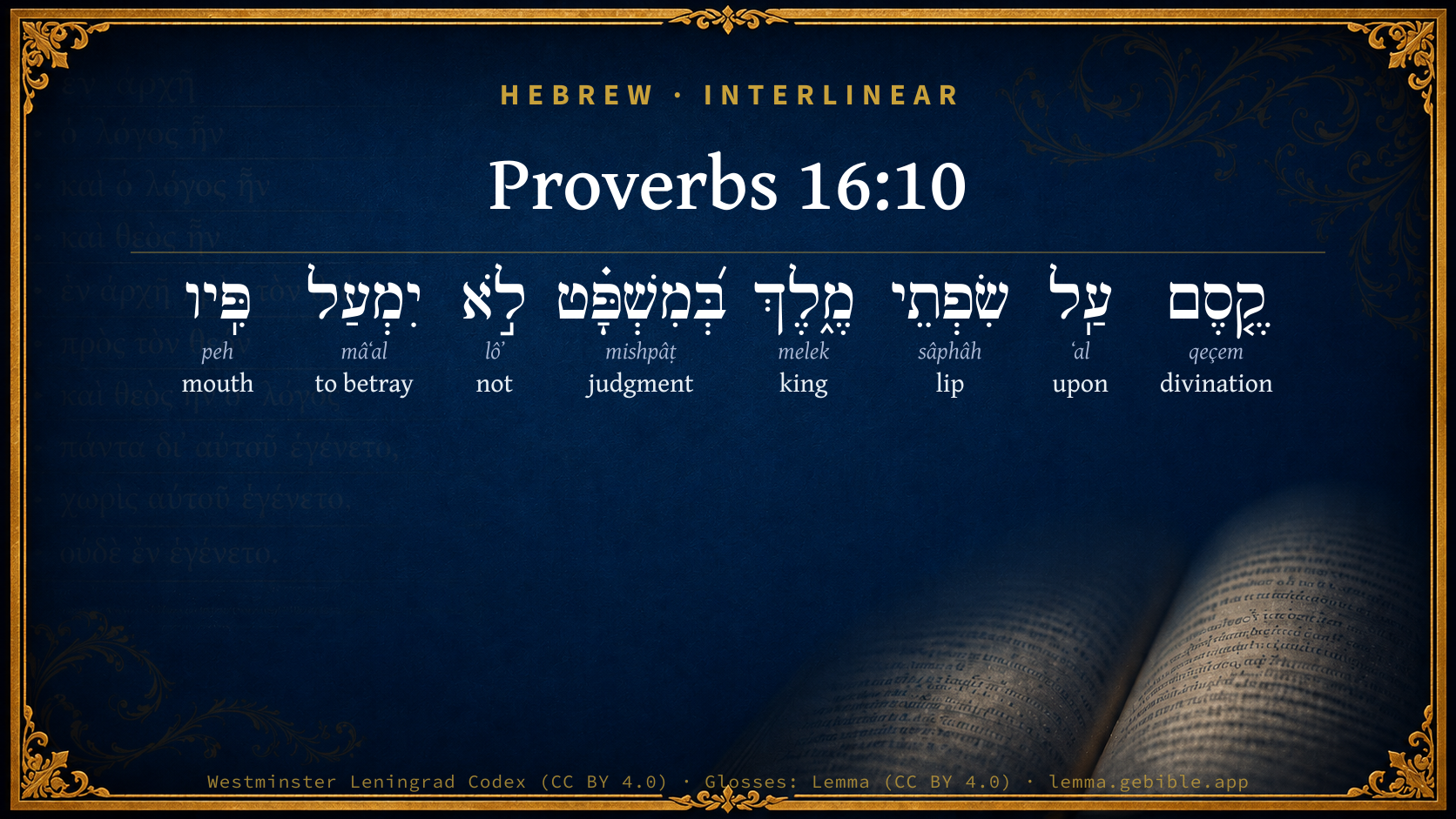
Proverbs 16:10

Hebrew (Westminster Leningrad Codex) Proverbs 16:10 appears in the Hebrew Old Testament. The text above is from the Westminster Leningrad Codex. Each word links to its Strong’s number, a concise gloss, and parsing drawn from the Open Scriptures Hebrew Bible morphology. Click any word for its full Brown-Driver-Briggs (BDB) entry.
Download image
Cite this verse

Proverbs 16:10 (World English Bible). Public Domain. Lemma interlinear Bible study tool, https://lemma.gebible.app/v/proverbs/16/10.

Show BibTeX & RIS
BibTeX
RIS
English Translation
Inspired judgments are on the lips of the king. He shall not betray his mouth.
World English Bible · Public Domain
Download a study sheet

One document with this verse’s original text, its word-by-word gloss line, the meaning frame, cross-references with their text, attributed commentary, and full source and license credits — printable, and it pastes into notes with its structure intact.

This verse Autodidact and up

Study sheet (.html) Plain text (.txt)

A passage Seminary Student

Up to 50 verses in one chapter. A passage sheet keeps up to 6 commentary sources and 12 cross-references per verse, in the order this page ranks them, and says so on the sheet whenever that leaves anything out. Ask for a single verse and you get the Autodidact verse sheet above.

Everything on this page stays free to read, with no account — the sheet is a download of what is already on screen, not access to it.

Want to remove ads? Support Godless Engineer
Compare translations 3

The same verse in 3 English versions, stacked beneath the original-language interlinear above. Click any original word for its lexicon entry.

Each is an independent rendering of the whole verse — the interlinear is not word-aligned to these translations.

Highlighted words mark where these versions differ — a whole-verse word diff, not a word-by-word alignment.

  • World English Bible Public Domain
    Inspired judgments are on the lips of the king. He shall not betray his mouth.
  • King James Version Public Domain
    A divine sentence is in the lips of the king: his mouth transgresseth not in judgment.
  • unfoldingWord Literal Text CC BY-SA 4.0
    Divination on the lips of a king, in judgment, his mouth must not act unfaithfully.

unfoldingWord Literal Text — © unfoldingWord, licensed CC BY-SA 4.0. Word-aligned USFM3 via Door43 (git.door43.org/unfoldingWord/en_ult).

Versions to compare (up to 4)

3 of 4 selected

Show all 18 translations

Every available English version of this verse, each an independent rendering of the whole verse.

  • World English Bible Public Domain
    Inspired judgments are on the lips of the king. He shall not betray his mouth.
  • Berean Standard Bible Public Domain
    A divine verdict is on the lips of a king; his mouth must not betray justice.
  • Majority Standard Bible Public Domain
    A divine verdict is on the lips of a king; his mouth must not betray justice.
  • King James Version Public Domain
    A divine sentence is in the lips of the king: his mouth transgresseth not in judgment.
  • American Standard Version (1901) Public Domain
    A divine sentence is in the lips of the king; His mouth shall not transgress in judgment.
  • Revised Version (1885) Public Domain
    A divine sentence is in the lips of the king: his mouth shall not transgress in judgment.
  • Geneva Bible (1599) Public Domain
    A diuine sentence shalbe in the lips of the King: his mouth shall not transgresse in iudgement.
  • Douay-Rheims (1899) Public Domain
    Divination is in the lips of the king, his mouth shall not err in judgment.
  • Young's Literal Translation Public Domain
    An oath `is' on the lips of a king, In judgment his mouth trespasseth not.
  • Literal Standard Version CC BY-SA 4.0
    An oath [is] on the lips of a king, || In judgment his mouth does not trespass.
  • Unlocked Literal Bible CC BY-SA 4.0
    Insightful decisions are on the lips of a king, his mouth should not betray justice.
  • unfoldingWord Literal Text CC BY-SA 4.0
    Divination on the lips of a king, in judgment, his mouth must not act unfaithfully.
  • Darby Bible Public Domain
    An oracle is on the lips of the king: his mouth will not err in judgment.
  • World Messianic Bible Public Domain
    Inspired judgments are on the lips of the king. He shall not betray his mouth.
  • Webster's Bible Public Domain
    A divine sentence is in the lips of the king: his mouth transgresseth not in judgment.
  • Free Bible Version CC BY-SA 4.0
    The king is inspired in what he says; he is not unreliable in his decisions.
  • Bible in Basic English Public Domain
    Decision is in the lips of the king: his mouth will not go wrong in judging.
  • JPS Tanakh (1917) Public Domain
    A divine sentence is in the lips of the king; his mouth trespasseth not in judgment.

Literal Standard Version (2020), Covenant Press — licensed CC BY-SA 4.0. Text via the HelloAO Bible API (eBible.org). Unlocked Literal Bible (unfoldingWord) — licensed CC BY-SA 4.0. Text via the HelloAO Bible API (eBible.org). unfoldingWord Literal Text — © unfoldingWord, licensed CC BY-SA 4.0. Word-aligned USFM3 via Door43 (git.door43.org/unfoldingWord/en_ult). Free Bible Version, Dr. Jonathan Gallagher — licensed CC BY-SA 4.0. Text via the HelloAO Bible API (eBible.org).

Word by word

More ways to search: Search by grammar → Find every occurrence → Compare this word →

Practice this passage: Drill this verse → Learn its vocabulary →

About this verse

These counts appear in no published source. They are computed here, from the morphology-tagged text and Lemma’s own curated glosses. What Lemma adds →

8
words
8
distinct lemmas
Wisdom
section

Notable vocabulary

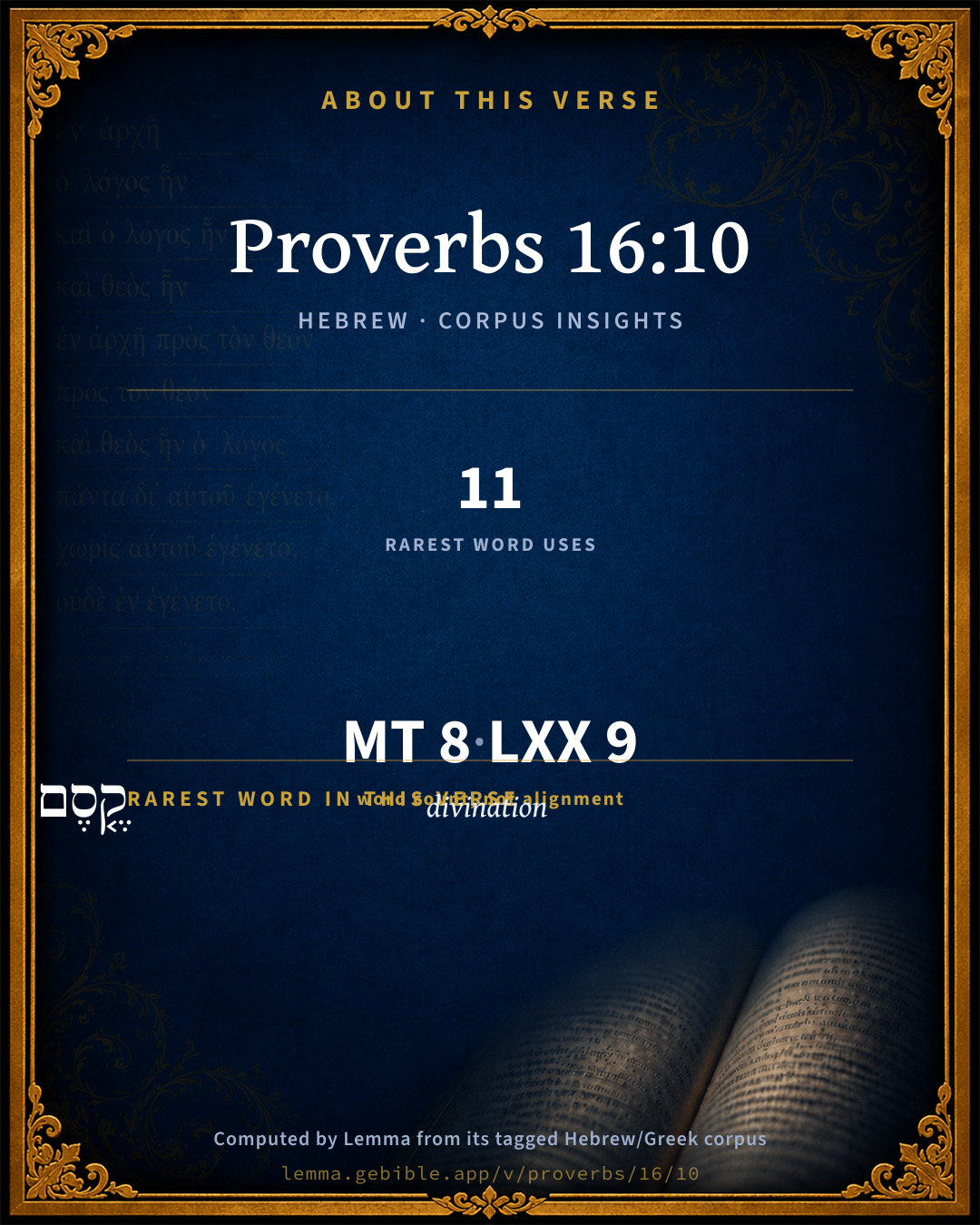
The rarest word here is קֶ֤סֶם divination H7081 — appearing just 11 times in the whole Hebrew Bible.

Shared distinctive vocabulary

קֶ֤סֶם divination H7081 occurs in 11 verses of the Hebrew Bible. Also found in:

Grammatical profile

  • 1 verb
  • 5 nouns
  • 1 preposition
  • 1 particle

Verb forms

  • יִמְעַל Qal · Imperfect

Hebrew & Septuagint length

In English translation the verse runs 15 words from the Hebrew and 18 from the Septuagint (LXX English) — closely comparable.

A rough comparison of the two English renderings, which tokenize alike — not a word-level alignment.

Word counts can differ between the Hebrew and the Greek without any difference in meaning — e.g. the Hebrew direct-object marker אֵת has no separate Greek word, and Greek often adds the article ὁ.

In the original languages it is 8 Hebrew tokens and 9 Greek tokens — but the two are counted differently (Hebrew bundles its prefixes and suffixes into one token; the Greek is in lemma form), so that isn’t a like-for-like length.

Cross-references

14

Topical passages linked to Proverbs 16:10 in the Treasury of Scripture Knowledge — connected by theme and wording, ordered by reader-vote popularity; previews shown in the World English Bible.

  • Isaiah 32:1–2 Behold, a king shall reign in righteousness, and princes shall rule in justice.
  • Genesis 44:5 Isn't this that from which my lord drinks, and by which he indeed divines? You have done evil in so doing.'"
  • Genesis 44:15 Joseph said to them, "What deed is this that you have done? Don't you know that such a man as I can indeed divine?"
  • Deuteronomy 17:18–20 It shall be, when he sits on the throne of his kingdom, that he shall write him a copy of this law in a book, out of [that which is] before the priests the Levites:
  • 2 Samuel 23:3–4 The God of Israel said, The Rock of Israel spoke to me: One who rules over men righteously, Who rules in the fear of God,
  • 1 Kings 3:28 All Israel heard of the judgment which the king had judged; and they feared the king: for they saw that the wisdom of God was in him, to do justice.
  • Psalms 45:6–7 Your throne, God, is forever and ever. A scepter of equity is the scepter of your kingdom.
  • Psalms 72:1–4 God, give the king your justice; Your righteousness to the royal son.
  • Proverbs 16:12–13 It is an abomination for kings to do wrong, For the throne is established by righteousness.
  • Jeremiah 23:5–6 Behold, the days come, says Yahweh, that I will raise to David a righteous Branch, and he shall reign as king and deal wisely, and shall execute justice and righteousness in the land.
  • Hosea 10:4 They make promises, swearing falsely in making covenants. Therefore judgment springs up like poisonous weeds in the furrows of the field.
  • Amos 5:7 You who turn justice to wormwood, And cast down righteousness to the earth:
  • Psalms 99:4 The King's strength also loves justice. You do establish equity. You execute justice and righteousness in Jacob.
  • Amos 6:12 Do horses run on the rocky crags? Does one plow there with oxen? But you have turned justice into poison, And the fruit of righteousness into bitterness;

Cross-references courtesy of OpenBible.info (CC BY 4.0).

Hebrew and Greek witnesses Masoretic Hebrew ↔ Greek Septuagint

The same verse in the two great witnesses to the Old Testament, shown verse-for-verse.

These are two independent witnesses, not word-aligned to each other, and the Septuagint is shown in lemma (dictionary) form.

Hebrew Proverbs 16:10 Masoretic · Westminster Leningrad Codex

קֶ֤סֶם עַֽל שִׂפְתֵי מֶ֑לֶךְ בְּ֝מִשְׁפָּ֗ט לֹ֣א יִמְעַל פִּֽיו

Inspired judgments are on the lips of the king. He shall not betray his mouth.

World English Bible · Public Domain

Greek LXX Proverbs 16:10 Septuagint · lemma form

θυμός βασιλεύς ἄγγελος θάνατος ἀνήρ δέ σοφός ἐκἱλάσκομαι αὐτός

There is an oracle upon the lips of a king; and his mouth shall not err in judgment.

LXX2012 (modern English Septuagint) · Public Domain

On this verse, The Pulpit Commentary discusses the Septuagint’s reading. Read the note in Commentary ↓

Hebrew: Westminster Leningrad Codex (CC BY 4.0). Greek: Septuagint (public domain); English from LXX2012 (modern English Septuagint) (Public Domain). How the Septuagint differs from the Hebrew →

Commentary

Notes on Proverbs 16:10 from classic Christian and Jewish commentators (each source and its license shown beneath its notes). The classic Christian expositions comment on the surrounding passage and are grouped to its opening verse, so a note may address several verses; the Jewish commentaries on the Tanakh (Rashi and others) are per-verse, so they appear only where the commentator wrote on this verse.

Lemma curates 59 commentaries, every one of them public domain or Creative Commons licensed, each selected and text-cleaned for this edition rather than reprinted as found. About our sources →

Trapp's Complete Commentary

John Trapp

Pro 16:10 A divine sentence [is] in the lips of the king: his mouth transgresseth not in judgment.

Ver. 10. A divine sentence is in the lips of the king.] It is, or should be. His words usually pass for oracles, and many times stand for laws. It should be his care, therefore, to "speak as the oracles of God." {1Pe 4:11} Yea, "so to speak, and so to do, as one that shall be judged by the law of liberty," {Jas 2:12} or, as some read it, As they that should judge by the law of liberty. Our old word Koning, and by contraction King, comes of Con, saith Becanus, which comprehends three things, Possum, scio, audeo - I can do it, I know how to do it, and I dare do it. If either he want power, or skill, or courage to do justice, the people, instead of admiring his divinations, will cry out of him, as the Romans did of Pompey, Miseria nostra magnus est: This great one is our great misery.

His mouth transgresseth not in judgment.] Viz, If he ask counsel at God’s mouth, as David did, and execute "justice, justice," as Moses speaks, {Deu 16:20, marg.} that is, pure justice, without mud or mixture of selfish affections sparing neither the great for might, nor the mean for misery.

John Trapp, A Commentary or Exposition upon All the Books of the Old and New Testament (1647–1656) — public domain. Text from a community e-Sword module.

Joseph Benson's Commentary

Pro 16:10. A divine sentence — Hebrew, קסם, divination, (a word which is sometimes taken in a good sense for prudence, as Isa 3:2,) that is, great sagacity, and a piercing judgment to discern dubious and difficult cases; is in the lips of the king — Of a wise king, who only is worthy of the name and office. Thus understood, the assertion was verified by fact in David, 2Sa 14:17; and in Solomon, 1Ki 3:28. “God,” says Bishop Patrick, “is present, in a singular manner, with a pious king, inspiring his mind to divine sagaciously in dubious and obscure things; that his resolutions and decrees may be received like oracles; and all causes be decided by him so justly and exactly, that no man may be wronged in the judgment which he passes.” But as the verb is wanting, and there is nothing for is, in the Hebrew, the clause may be rendered, A divine sentence, or divination, should be in the lips of the king. Thus it speaks not so much of a matter of fact, as if it were thus in all kings, which is notoriously and confessedly untrue, as of the duty of kings, in whom wisdom is a necessary qualification; and thus the two proverbs, Pro 16:12-13, must be understood, otherwise they are repugnant to common experience. His mouth transgresseth not in judgment — That is, does not easily transgress, or go beyond the bounds of justice, or truth, or piety, in pronouncing sentence, if he be truly wise and pious: or, should not transgress, if understood of kings in general.

Joseph Benson's Commentary on the Old and New Testaments (1811–1818) — public domain. Text from a community e-Sword module.

The Preacher's Complete Homiletical Commentary

Joseph S. Exell (gen. ed.)

CRITICAL NOTES.—

Pro_16:10. A Divine sentence, literally “divination,” i.e., “an oracle” or “a decision.” “His mouth transgresseth not.” Stuart and Delitzsch read, “In judgment his mouth should not prevaricate, or err.”

Pro_16:11. A just weight, literally “the scale” “the upright iron in scales which the weigher holds in his hand” (Fausset). Weights, literally “stones” which were anciently used as weights.

Pro_16:13. “They love him,” etc., rather “he who speaketh right, or uprightly, is loved,”

MAIN HOMILETICS OF THE PARAGRAPH.—Pro_16:10-15

KINGS

It is obvious that some of these proverbs as they stand in our authorised version, do not admit of universal application in relation to human monarchs. History and experience both contradict the assertion that a “Divine sentence” is always, or has been generally, in the lips of a human king, but if we understand the verse, as Miller does (see his comment) as an application of the truth set forth in the preceding verse and in Pro_16:1, that God is behind and above all the decrees of earthly potentates, we can at once admit the fact and rejoice in it. Again, it cannot, alas! be said that as a rule “righteous lips are the delight of kings,” or that “in the light of the king’s countenance is life.” Many kings have been themselves incarnations of iniquity, and have bestowed all their favour upon men like themselves, and persecuted often to the death those who have dared to tell them the truth. If this proverb admitted of universal application, Ahab would not have sought to slay Elijah, Jeremiah would not have been imprisoned by Zedekiah, and Herod would not have put to death John the Baptist. And the favour of most of the men who have sat upon the thrones of the world would have had no life in it for some of their subjects. There has been a faithful few in all ages of the world to whom the favour of their wicked rulers would have been very unlike “a cloud of the latter rain.” But the truths taught here are:—

I. That a king ought to be God’s prophet and vicegerent upon the earth. All painters have an ideal in their minds to which they desire to attain in their handiwork. They must place before them the highest model, if they would rise to anything like excellence. And Solomon, as a great theoretic moralist, is here setting before himself, and before all rulers, an ideal king. Kingship among men ought to be a type and symbol of Divine kingship. The loyal obedience which the majority of men have always been ready to yield to those whom they have regarded as their appointed rulers, has its root deep down in the constitution of human nature—it is a prophecy of a need which is only fully met in the rule of the true and perfect King of men—that King whose right it is to reign, and who can do no wrong to any of His subjects. “That was not an inconsiderable moment,” says Carlyle, “when wild armed men first raised their strongest aloft on the buckler-throne, and, with clanging armour and hearts said solemnly, Be thou our acknowledged strongest (well named King, Kön-ning, Canning, or Man that was Able), what a symbol shone now for them—significant with the destinies of the world! A symbol of true guidance in return for loving obedience; properly, if he knew it, the prime want of man. A symbol which might be called sacred, for is there not, in reverence for what is better than we, an indestructible sacredness?” And when a king realises what idea he embodies, and strives to fulfil worthily the duties of his high calling, and in proportion as he does so, he is a representative of God to men. Then he will have a Divine sentence in his mouth because he will be a truth-speaker. His lips will be a reflection of his character. Being a man of truth, he cannot do other than speak the truth. He will be able in a limited sense to use the words of His Divine Ideal, and say, “To this end was I born, and for this cause came I into the world, that I should bear witness of the truth” (Joh_18:37). And as all truth and justice is from God (Pro_16:11), he who is a truth-speaker—he from whose lips come only just decisions, utters a “Divine sentence”—is a representative of Him whose “is a just weight and balance,” whose “work are all the weights of the bag.” To such an one it will be “an abomination to commit wickedness”—any kind of iniquity will be detested by him. He will not—he cannot—be a sinless man; the desires and intentions of every good man are always beyond his deeds—he can always say, “To will is present with me, but how to perform that which is good I find not” (Rom_7:18), but he will not commit sin because he loves it. Such a king will be a real benefactor to his nation by exalting the true and the good, and so blessing all. It is a blessing for all men—whether they be good or bad—when the best men in the nation are in the fore-front—when the righteous fill the highest positions in the State. And a true king will gladly avail himself of the service of men of “righteous lips,” and so will be a source of blessing to all his people. The “latter rain” which refreshes the thirsty earth after a long season of drought lets its life-giving drops fall upon the parched leaves of the humblest weed as well as upon the stately oak. And the influence of a wise and godly monarch is beneficial to all classes of his subjects from the highest to the lowest. All such are types—dim fore shadowings—of that “king who reigns in righteousness and who is as an hiding place from the wind, and a covert from the tempest; as rivers of water in a dry place, as the shadow of a great rock in a weary land” (Isa_32:1-2).

II. That the stability of a throne is in proportion to the moral excellence of him who sits upon it. The power that men have over other men is lasting in proportion as it has its origin in character. The father’s kingship over his children is immutable in proportion to his goodness. If his rule has its foundation only in his position, his children will not be slow to shake it off as they reach manhood; but if it is founded upon his godliness, they will be compelled to acknowledge it to the day of his death and even beyond it. His throne in his family is “established by righteousness,” the consciences of his children consent to his right to reign among them and over them. The throne of the universe is established by righteousness. “Thy throne, O God, is for ever and ever: the sceptre of Thy kingdom is a right sceptre. Thou lovest righteousness and hatest wickedness; therefore God, thy God, hath anointed thee with the oil of gladness above thy fellows” (Psa_45:6-7). This King of Righteousness is now enthroned in the affections and consciences of myriads of His subjects, and He who rules men’s hearts has set his throne upon a firm foundation. And there will come a day when every creature will be compelled by his conscience to yield to “Him that sitteth upon the throne,” the right to reign over them for ever (Rev_5:13), because they will feel that all his ways are and ever have been “just and true” (Rev_15:3). If we read the history of the past or look around us now, we find this truth abundantly illustrated. Thrones which have been backed up by mighty armies, and whose occupants have for a few short years been the arbiters of the destinies of millions, have been overturned in a few weeks. And we have but to look at the steps by which such men came to power to find a reason for their fall. None can doubt from the experience of past ages, and from the very constitution of men, that the thrones of the present are founded upon a rock or upon sand, in proportion as those who sit upon them take as their model the king who “judges His people with righteousness and the poor with judgment” (Psa_72:2).

OUTLINES AND SUGGESTIVE COMMENTS

Pro_16:10. “A Divine sentence” may be understood either as to its character, or as to its authoritative effect. If taken in the former sense, it means a sentence according to perfect equity; if in the latter, the idea is, that as every judgment or “sentence” of God is decisive and effectual, so that the execution of it cannot be evaded or resisted, such, in measure, is the case with the sentence of kings among men, and in the general idea of a Divine sentence may fairly be included both character and efficiency—both equity and power. When understood of equity, the latter part of the verse, according to the principle of Hebrew parallelisms, will be a kind of counterpart or echo to the former, and when understood of power, the verse might be rendered—“A Divine sentence is in the lips of the king; let not his mouth transgress in judgment.” In proportion to the authoritative and efficacious nature of his sentence, ought he to see to it that the sentence be right. He should weigh well his decision ere he pronounces it, seeing it involves consequences so certain, immediate, and important. And the principle of this lesson applies to all in situations of authority and influence, whether more private or more public.—Wardlaw.

The glaring fact of what Solomon avows in Pro_16:9 can be seen in the instance of “a king.” The word of a king can ruin France, and change the whole system of the world. How, possibly, could God govern, unless He could a king? Eternal ages will not get over the edict of a prince, and the banded universe will feel its differences. Must not God control that word? Our passage answers that He does. He may be George III. of the low forehead; his speech is shaped omnisciently. He may be as treacherous as Charles; he does not betray by a hair the counsel of the Almighty. This is a grand thought. A poor princeling may be governed by a girl, and yet, though his utterance might move the globe, we need have no fear. There is “a divination,” i.e., “an oracle,” behind “his lips.” He says what God pleases. And though “his mouth” may have the very treachery of the cup, it has no treachery—even to a grain—to the plans of the All Wise.—Miller.

It cannot be denied but that there is a nearer reference between God and His immediate deputies, the kings of the earth, than any other persons. He that maketh them kings maketh Himself to be their counsel. But then they must make Him the president of their council.—Jermin.

For Homiletics on Pro_16:11, considered by itself, see on chap. Pro_11:1, page 190.

Pro_16:11. The proposition expresses an ownership in Jehovah as the first cause, for, like agriculture (Ecc_7:15), God instituted weights and measures, as an indispensable ordinance and instrument in just business intercourse.—Zöckler.

Weight and measure, as the invisible and spiritual means by which material possessions are estimated and determined for men, according to their value, are holy unto the Lord, a copy of His law in the outer world, taken up by Himself into His sanctuary; and, therefore, as His work, to be regarded as holy also by men.—Von Gerlach.

The heathen poet Hesiod says, “God gave justice to men.”—Fausset.

He is not only just, but justice belongs to Him. He is not only partly just, but “His work” (and we see at a glance that God’s work is the total universe) is in its very self considered, “all the stones of the bag.” Stones, better weights than iron, because not altering by rust. Bag, in which the stone weights were carried, in the peripatetic barter of the old trades-people. No difficulty should be had in understanding all of which the sentence is capable. God’s work is justice, and justice is His work. The very ideas of equity sprang out of the Eternal Mind. If all this were not so how could God govern the creation, for “It is an abomination to kings to commit wickedness, etc. (Pro_16:12).—Miller.

The Jews are said to have kept their standard weights and measures in the sanctuary. The fact might arise from the particularity of the law, and might operate as a remembrancer of the righteousness of Him by whom the law was given, and the weights and measures fixed.… All adulteration of them was therefore a sacrilege. It was not cheating men merely, but defrauding Jehovah, changing what He had fixed.… And from the connection in which the words are here introduced they lead us to observe that while kings are called up to “do justly” themselves in their whole administration and in every department of it, it is, at the same time, a most important part of their official duty to promote among their subjects, to the utmost of their power, the principles and the practice of equity between man and man.—Wardlaw.

Pro_16:12. This is true of earthly monarchies. “A throne,” without some equity in it, could not last an instant. If it were unmitigatedly bad, it would be swept out of existence. A king must be just to his people, or else to his soldiers, who support him against his people. His strength is justice, somewhere. The strength of a bad throne is precisely that part of it that is just. But if this be true of a world’s throne, where it has been seen that God governs as well as the king, how not of a Divine throne, that rests solely on its Maker? It is impossible to conceive of a universe without justice, or of anything so complicated being eternally possible without every sort of harmony, and especially that sort which is highest and best. Hence many of the expressions in the eighth chapter (Pro_16:22; Pro_16:30, etc.), the personage being personified Wisdom, which is holiness or moral light, and which includes all the attributes of justice.—Miller.

The greater men be, the more grievous their faults are when they fall into sin. For—

1. The more bountiful God hath been to them, the more grateful they ought to be to Him, and as He hath increased their wages, so they ought to mend their work; large pay doth duly challenge large pains, and therefore, contrariwise, their great offences must needs deserve the greater punishment.

2. Their sins are very pernicious and pestilent, they bring evil into request, and men by their example will practise it for credit’s sake. When Jeroboam is mentioned, he is usually described by this, that he made Israel to sin.

3. They draw down the plagues and judgments upon the places and people that are under them, as David did. And the strokes which the fearful sins of Manasseh, Jehoiakim, and others brought upon the city and inhabitants of Jerusalem were very lamentable in those days, and very memorable still in these times.… The goodness and justice of men in authority doth better uphold their estate than greatness and riches. “The throne is established by righteousness,” for—

(1) There, and nowhere else, is stability and assurance, where God is a refuge and defence; they stand all firm whom He protecteth, and down they must whom He neglecteth. And whom doth He prefer but the righteous? And what righteous man was ever forsaken?

(2) Equal and upright administration of justice doth knit the hearts of a people to their governors, and the love of the subjects is a strong foot and a mighty munition for the safety of the ruler.

(3) When the magistrate doth right to all and wrong to none, every good and indifferent man will reverence him, and stand in the greater awe of his laws, so that none but such as are desperately rebellious will dare to attempt anything against him.—Dod.

Pro_16:13. There never was a kingdom so corrupt that its courts of justice were not used, in the main, against wickedness. There never was a Nero, or a Borgia, who, on the very account of his own crimes, did not find crime sore, and a trouble to him, in those about him. It is one of the strangest miracles of Omnipotence that a universe can take in transgression and yet last. And, while God has made even the wicked “for his decree” (Pro_16:4), yet “a pleasure to kings are lips of righteousness, and he who speaks right is loved.”—Miller.

We have here in this passage Solomon’s king, and in these words the delight of his king. For, whereas, many are, and well may be, the delights of kings, this one it is, the delight of righteousness, which sweetens all the rest unto them. This is a royal delight indeed, which makes the king of righteousness to delight in them. And surely needful it is that a king’s lips should delight in righteousness. For fear may compel others, but delight must carry him unto it. Needful is it that righteous lips should be a king’s delight, because it is in kings’ courts that there is too much lying. We read of one who said that he would be a lying prophet in the mouths of all Ahab’s prophets (1Ki_22:22), to which the answer of God is, Thou shalt go and prevail. Upon which the note of Cajetan is, “God manifested the efficacy of this means—namely, of lying in the Court.” It is needful, therefore, that the king should delight in lips of righteousness, for he that doth himself delight in them will also love others that speak right; yea, will therefore love them that they also may delight in it. For then is righteousness best spoken when delight openeth the door of the lips.—Jermin.

Pro_16:14. The report of one may be a mistake, but the relation of many carrieth more force with it. The wrath, therefore, of a king is as messengers of death, enough to pull down the stoutest heart; and if his moved spirit send down this message to any, it is sufficient to tell them and to assure them, that they had need to look unto themselves. But well it is that the wrath of a king is as the messengers of death, and not the executioners of it. For so it ought to be, that himself may have time either to alter or recall his message, and they may have time to whom it is sent to answer for themselves. St. Peter was hasty in wrath when he cut off the ear of Malchus, whereupon Tertullian saith, “The patience of God was wounded in Malchus.” And surely the mercy of God is often wounded in the hasty wrath of a king. Plutarch saith well, that as bodies through a cloud, so through anger things seem greater than they are. To put therefore wrath to a journey, is a good way to moderate, if by nothing else, by wearying the hasty fierceness of it. And let a wise man have respite to meet with it, he will with gentle blasts of cool air easily mitigate the violent force of it. Let him be told of a king’s wrath against him, he need not be told that he take care to prevent it. But, though great be the wrath of heaven against careless sinners, and though many be the messengers that He sendeth to them, yet they all cry, “Who hath believed our report?” Did they hear one word of an earthly king’s anger against them, it would more move them than the whole word of God doth, wherein the message of His anger is so often repeated. The answer which they send back to the message of God’s wrath, is obstinate rebellion in their sinful courses.—Jermin.

ILLUSTRATION

Executions in the East are often very prompt and arbitrary. In many cases the suspicion is no sooner entertained, or the cause of offence given, than the fatal order is issued. The messenger of death hurries to the unsuspecting victim, shows his warrant, and executes his orders that instant, in silence and solitude. Instances of this kind are continually occurring in the Turkish and Persian histories. Such executions were not uncommon among the Jews under the government of their kings. Solomon sent Benaiah as his capidgi, or executioner, to put to death Adonijah, a prince of his own family, and Joab, the commander-in-chief of the forces during the reign of his father. A capidgi likewise beheaded John the Baptist, and carried his head to the court of Herod. To such silent and hasty executioners the royal Preacher seems to refer in the proverb. From the dreadful promptitude with which Benaiah executed the commands of Solomon on Adonijah and Joab, it may be concluded that the executioner of the court was as little ceremonious, and the ancient Jews nearly as passive, as the Turks or Persians. The prophet Elisha is the only person on the inspired record who ventured to resist the bloody mandate of the sovereign (2Ki_6:32). But if such mandates had not been too common among the Jews, and in general submitted to without resistance, Jehoram had scarcely ventured to despatch a single messenger to take away the life of so eminent a person as Elisha.—Paxton’s Illustrations.

OUTLINES AND SUGGESTIVE COMMENTS

Pro_16:15. As the wise man before teacheth subjects to fear the king’s wrath, and to seek his favour, so here he teacheth kings to join the light of mercy, the softness of clemency, unto the hardness and severity of wrath. Or else we may thus meditate upon the words—the true favour of a king is not only to shine with a cheerful countenance upon them whom he affecteth, but sometimes to look through a thick cloud upon them. For as the light of the sun giveth life to the fruits of the earth, but the cloud of latter rain giveth bigness and fulness unto them, so the light of the king’s countenance giveth life to the fruits of earthly honour, but it is the dewy cloud of his wise displeasure, when things are amiss, that giveth fulness of worth unto them whom his favour honoureth. The latter rain many times does them more good and sheweth in the king greater favour to them than his former sunshining countenance. But to apply the verse unto a fuller profit. The light of the countenance of the King of heaven is Jesus Christ our Lord, who is the brightness of His glory; and in this light there is life indeed. For as He is light and in Him is no darkness, so He is life, and in Him is no death. It was in the latter time that He was clouded with the veil of our flesh, and that He became a heavenly cloud of the latter rain unto us, pouring out the glorious dew of His precious blood for us, that so, we being watered therewith might even swell in grace, and grow to a fulness of glory in heaven.… In Judea usually about harvest time there are evening clouds which, yielding a sweet rain, do much increase the largeness of the fruits; and in the evening of the world, when the harvest was great, this heavenly cloud was sent unto us, whereby the fruit of God’s Church, confined before to Judea, was enlarged throughout the world.—Jermin.

For Homiletics on Pro_16:16, see chap. Pro_8:10-11, page 107.

OUTLINES AND SUGGESTIVE COMMENTS

Not wisdom, but “to get wisdom.” Wisdom itself is glorious. Wisdom in God is above all praise. It will be the gem of Paradise. It will be the grand opulence of the family of the skies. But what the great Preacher would confine us to in the language of the text is, our getting wisdom as the evangelical condition; our getting it, moreover, in time, like “the latter rain,” so as to be in season for the crop; for, as a former sentence urges (chap. Pro_4:7), “As the chiefest thing in wisdom, get wisdom.” Because, “what shall it profit a man, if he gain the whole world, if God is his “King,” and “the wrath of the King” makes all His providences but as messengers of gloom (Pro_16:14).—Miller.

Let us call to mind in word-outline the scene on a spring morning in the city of David, when David’s son was “king in Jerusalem.” Before the portico of the fragrant cedar-house of Solomon, the royal guards, Cherithites and Pelethites, executioners and messengers of the king’s behests, waited their master’s coming. Impatient steeds from Arabia, or the far-off banks of the Nile, pawed the highway, and shook with pride their plumes and costly accoutrements. Soldiers, with silken standards blazoned with the sacred Name, and throwing back the sunlight from their targets and shields of beaten gold, kept their ranks firm and close, as if the foe were at hand, and the silver trumpets waited but to sound the battle charge. Veterans, grown grey in David’s service, and wearing the laurels of many a hard-fought field, were driven all along the line in their chariots of State, and the grim faces of these old warriors gleamed with satisfaction as they looked about them on the evidences of their nation’s military strength.… But now the trumpets sound, and the echoing shout of welcome rises on the morning air. Solomon, arrayed in all his glory, appears, and the cry, “God save the king!” is heard on every side. Children chanting their sweet hosannahs to David’s son and David’s heir strew the path with the lilies of the field, or the roses of Sharon, and the boughs of palms. Others throw their garments upon the dusty highway as the long procession moves to the soft music of Eastern minstrelsy along the narrow streets, and out upon the broader pathway leading to the royal gardens, or the cool retreats of Olivet, each beaming face by the wayside, or peering from latticed balcony, each welcome shout and song from the daughters of Jerusalem, or the trained singers of the temple choirs, attest the affection of a grateful people, and make of the monarch’s morning progress a triumphal ovation. Such was Solomon in all his glory; such the popular acclaim, and we might go on to tell until the tale were tiresome to tell how “Solomon surpassed all the kings of the earth,” in riches, splendour, fame. But was this the principal thing? Had Solomon in getting all this glory, and in winning all this praise, gained that with which his soul was satisfied, and the cravings of his nobler self appeased. Years before.… “Give me wisdom and knowledge,” was his prayer … Even in the wishes of one so lately invested with royal power, wisdom in its relation to his Maker, knowledge so far as it concerned his fellow-men, seemed the principal thing. And that prayer was heard in heaven … He to whom God gave such gifts may well direct us to the possession of this principal thing. We need not ask for an earthly teacher with higher qualifications.—Bishop Perry.

Gold is the crown of metals, wisdom is the crown of knowledge. Silver beareth the image of an earthly king, understanding beareth the image of the King of heaven. Gold is the treasure of the purse, wisdom the treasure of the soul. Silver is the price of outward commodities, understanding is the price of inward virtues; by that sought, by that bought. Wherefore by how much knowledge is better than metal, virtue than worldly commodities, the image of God than the image of man; by so much wisdom and knowledge are better than silver and gold. But they are not wisdom and understanding that are here compared with them, there being no comparison between them. But the very getting of wisdom and understanding, the very pains taken in procuring of them, the very honour of being a possessor of them, is better than all the gold and silver in the world.—Jermin.

The question only is written in the book; the learner is expected to work out the answer. We, of this mercantile community, are expert in the arithmetic of time. Here is an example to test our skill in casting up the accounts of eternity. Deeper interests are at stake; greater care should be taken to avoid an error, more labour willingly expended in making the balance true.… The question is strictly one of degree. It is not, whether wisdom or gold is the more precious portion for a soul. That question was settled long ago by common consent. All who in any sense make a profession of faith in God, confess that wisdom is better than gold; and this teacher plies them with another problem, How much better? Two classes of persons have experience in this matter—those who have chosen the meaner portion, and those who have chosen the nobler; but only the latter class are capable of calculating the difference suggested by the text. Those who give their heart to money understand only the value of their own portion; those who possess treasures in heaven have tasted both kinds, and can appreciate the difference between them.… As the man born blind cannot tell how much better light is than his native darkness—as the slave born under the yoke of his master cannot tell how much better liberty is than his life-long bondage—so he who has despised treasures at God’s right hand cannot conceive how much more precious they are to a man in his extremity than the riches that perish in the use.… But even these cannot compute the difference. Eye hath not seen it, ear hath not heard it. Wisdom from above, like the love of God, passeth knowledge.… How much better is wisdom than gold? Better by all the worth of a soul—by all the blessedness of heaven—by all the length of eternity. But all these expressions are only tiny lines that children fling into the ocean to measure its depth withal.… In a time of war between two great maritime nations, a ship belonging to one of them is captured upon the high seas by a ship belonging to the other. The captain, with a few attendants, goes on board his prize, and directs the native crew to steer for the nearest point of his country’s shore. The prize is very rich. The victors occupy themselves wholly in collecting and counting the treasure, and arranging their several shares, abandoning the care of the ship to her original owners. These, content with being permitted to handle the helm, allow their rivals to handle the treasure unmolested. After a long night, with a steady breeze, the captured mariners quietly, at dawn, run the ship into a harbour on their own shores. The conquerers are in turn made captives. They lose all the gold which they grasped too eagerly, and their liberty besides. In that case it was much better to have hold of the helm which directed the ship, than of the money which the ship contained. Those who seized the money, and neglected the helm, lost even the money which was in their hands. Those who neglected the money and held the helm, obtained the money which they neglected and liberty too. They arrived at home, and all their wealth with them. Thus they who make money their aim suffer a double loss, and they who seek the wisdom from above secure a double gain. The gold with which men are occupied will profit little, if the voyage of life be not pointed home. If themselves are lost, their possessions are worthless.—Arnot.

The Preacher's Complete Homiletical Commentary (gen. ed. Joseph S. Exell; Funk & Wagnalls, c. 1892) — public domain (pre-1929). A full-Bible homiletical/sermon-outline anthology covering 65 of 66 books (2 John is absent from the source module). Text from a community e-Sword module.

Tyndale Open Study Notes

Tyndale Open Resources

16:10-15 This series of sayings reflects on the king, who represents God’s power on earth.

16:10 Divine wisdom refers to divinely inspired guidance that helps the king make judgments (e.g., 1 Kgs 3:28; see also Ps 72:2).

Tyndale Open Study Notes — © Tyndale Open Resources, licensed CC BY-SA 4.0. Text via the HelloAO Bible API.

Matthew Henry's Commentary

We wish this were always true as a proposition, and we ought to make it our prayer for kings, and all in authority, that a divine sentence may be in their lips, both in giving orders, that they may do that in wisdom, and in giving sentence, that they may do that in equity, both which are included in judgment, and that in neither their mouth may transgress, Ti1 2:1. But it is often otherwise; and therefore, 1. it may be read as a precept to the kings and judges of the earth to be wise and instructed. Let them be just, and rule in the fear of God; let them act with such wisdom and conscience that there may appear a holy divination in all they say or do, and that they are guided by principles supernatural: let not their mouths transgress in judgment, for the judgment is God's. 2. It may be taken as a promise to all good kings, that if they sincerely aim at God's glory, and seek direction from him, he will qualify them with wisdom and grace above others, in proportion to the eminency of their station and the trusts lodged in their hands. When Saul himself was made king God gave him another spirit. 3. It was true concerning Solomon who wrote this; he had extraordinary wisdom, pursuant to the promise God made him, See Kg1 3:28.

Matthew Henry's Commentary on the Whole Bible (1708–1710) — public domain (CC PDM 1.0). Text via the HelloAO Bible API.

Jamieson, Fausset & Brown

Robert Jamieson, A. R. Fausset & David Brown

The last clause depends on the first, expressing the importance of equity in decisions, so authoritative.

Jamieson, Fausset & Brown — Commentary Critical and Explanatory on the Whole Bible (1871) — public domain (CC PDM 1.0). Text via the HelloAO Bible API.

Adam Clarke's Commentary

Verse 10. A divine sentence] קסם kesem, "divination," as the margin has it. Is the meaning as follows? Though divination were applied to a righteous king's lips, to induce him to punish the innocent and spare the guilty, yet would not his lips transgress in judgment; so firmly attached is he to God, and so much is he under the Divine care and influence. Whatever judgment such a one pronounces, it may be considered as a decision from God.

Adam Clarke's Commentary on the Bible (1810–1826) — public domain. Text from a community e-Sword/MySword module.

Ellicott's Commentary for English Readers

(10) His mouth transgresseth not in judgment.—Or, should not transgress, as being the representative of God upon earth, and so distinguished by the title of “God” himself (Psa_82:6). This verse recalls the days of Solomon’s youth, when it was his highest aspiration to judge his people righteously (1Ki_3:9). Comp. David’s noble words (2Sa_23:3).

A Bible Commentary for English Readers, edited by Charles John Ellicott (1878–1897) — public domain. Text from a community e-Sword module.

The Cambridge Bible for Schools and Colleges

gen. ed. J. J. S. Perowne

10. A divine sentence] Lit. divination, A.V. and R.V. marg. The word is generally used in a bad sense, “soothsaying.” See Deu_18:10, where it is positively forbidden, and 1Sa_15:23, where it is called a “sin.” Here, however, it has a good meaning: the true king in judgement, like the true prophet in preaching, “speaks as oracles of God” (1Pe_4:11. See 1Ki_3:28).

The Cambridge Bible for Schools and Colleges (gen. ed. J. J. S. Perowne; Cambridge University Press, 1878–1918) — public domain. Text from a community e-Sword module.

John Gill's Exposition

A divine sentence is in the lips of the king,.... Or "divination" (f), as the word signifies; or what is like to divination, as Aben Ezra and Gersom interpret it (g). What be says is as an oracle, and should be strictly true. Some understand it of the sagacity and penetration of kings, as was in Solomon, and appeared in his judging the two harlots; but such is not to be found in kings in common: rather therefore this expresses and designs what should be, and not what is, in kings. These, as the kings of Israel, ought to have the book of God before them, and read in it, and judge and pronounce sentence in every case according to it; they should speak as the oracles of God; and, when they do, a divine sentence may be said to be in their lips. But it is best to understand this of the King of kings, of the King Messiah; into whose lips grace is poured, and from whence none but words of wisdom, grace, and truth, flow; who taught the way of God in truth; who had the word of God in his heart and in his month continually; and on whom the Spirit of wisdom without measure dwelt; and is the wisdom and word of God, as well as the power of God;

his mouth transgresseth not in judgment; this cannot be said of any earthly king; they ought not indeed to transgress in judgment with their mouths, but it is notorious that they too often do: could this be applied to kings in common, they would have a better claim to infallibility than the pope of Rome has. But this is true of Christ, the King of saints; who is a King that reigns in righteousness, and decrees judgment; sits upon his throne, to order and establish it with judgment: nor does his mouth ever transgress in judgment, or ever say, or he do, a wrong thing; his sceptre is a sceptre of righteousness.

(f) "divinatio", V. L. Pagninus, Montanus, Cocceius, Gejerus, Michaelis, Schultens. (g) So Vatablus, Mercerus, Piscator.

John Gill's Exposition of the Whole Bible (1746–1763) — public domain (CC PDM 1.0). Text via the HelloAO Bible API.

Albert Barnes' Notes on the Bible

A divine sentence - See the margin, i. e., “soothsaying” in its darker aspect as contrasted with prophecy. The true oracle is to be sought, not from soothsayers and diviners, but “at the lips of the king,” who is ideally the representative, the προφήτης prophētēs of Yahweh, in His government of mankind.

Albert Barnes' Notes on the Bible (1834–1885) — public domain. Text from a community e-Sword/MySword module.

Haydock's Catholic Bible Commentary

Judgment. Or "let it not err," as people look upon the decisions of kings as so many oracles. We ought to act in this manner, as long as they are not visibly unjust. God gave a principal spirit (Psalm l. 14.) to Saul, David, Solomon, and to the judges whom he appointed, 1 Kings x. 9., Deuteronomy xxxiv. 9., and Judges iii. 10. (Calmet) --- Solomon was thus enabled to decide difficult cases. (Menochius) (Job xxix. 7.)

George Leo Haydock (1774–1849), Haydock's Catholic Family Bible and Commentary, 1859 edition — public domain. Excludes Psalms (Douay-Rheims chapter numbering differs from Protestant) and Deuterocanonical books (Catholic canon only).

Matthew Poole's English Annotations

A divine sentence, Heb. divination, which is sometimes taken in a good sense for prudence, as it is Isa 3:2. A great sagacity and piercing judgment to discern dubious and difficult cases.

Is; or, should be; for the verb is wanting in the Hebrew, and this may be supplied as well as is. And he seems not so much to speak of the matter of fact, as if it were thus in all kings, which is notoriously and confessedly untrue, as of the duty of kings, in whom wisdom is a necessary qualification. For thus the two following proverbs concerning kings, Pro 16:12,13, must be understood, otherwise they are repugnant to common experience.

Of the king; either,

1. Of wise kings, who only are worthy of that name and office; king being here put for a wise king, as a name is put for a good name, and a woman for a good woman, Ecc 7:28; and then this is true in fact, as it was in David. 2Sa 14:17, and in Solomon, 1Ki 3:28. Or,

2. Of kings in general, in the sense before given; for seeing the word is generally expressed without any limitation, both here and Pro 16:12,13, it may seem presumption to confine it to those few kings which are or were wise and good.

Transgresseth not; or, shall or should not transgress, or go beyond the bounds of religion and justice.

Matthew Poole's English Annotations on the Holy Bible (1683–1685) — public domain. Text from a community e-Sword/MySword module.

Whedon's Commentary on the Bible

Daniel D. Whedon

10. A divine sentence — Or, decision. קסם, (kesem,) an oracle.

The king — מלךְ, ( melekh,) so often used in the following verses, means a sovereign ruler, by whatever name called, whether king, emperor, president, governor, judge, supreme commander, or any other title. The president of the United States, and the governors of the several States, are as truly melakhim, in the scriptural sense, as any sovereign or supreme ruler in the world. The idea implied in the root is that of sovereign authority or rulership. Wherever this is in civil affairs there is, in the Bible sense, a melekh. The word ruler would, indeed, more nearly express the sense of the original than “king,” which by usage is applied to the sovereign of a particular form of government — a monarchy.

His mouth transgresseth not in judgment — Does not swerve or decline from justice. This proverb is spoken of kings as they ought to be — ideal representatives of Jehovah — and is equivalent to saying, that such should be the word of a ruler that his mouth should not prevaricate or speak deceptively in his official acts. Much official lying is sometimes done in high places. All this is condemned. It is the opinion of some that kesem refers to what might be called supernatural sagacity, bestowed upon good rulers, by which they are able to detect fraud and false pretences, unravel the intricacies and difficulties of a case brought before them. “God,” says Bishop Patrick, “is present in a singular manner with a pious king, inspiring his mind to divine sagaciously in dubious and obscure things, that his resolutions and decrees may be received like oracles, and all causes may be decided by him so justly and exactly that no man may be wronged in his judgment which he passes.” Comp. 2Sa_14:17; 1Ki_3:16-28; Psa_82:6; Rom_13:12.

Daniel D. Whedon (gen. ed.), Commentary on the Old and New Testaments (1874–1909) — public domain. Text from a community e-Sword module.

The Pulpit Commentary

A Divine sentence is in the lips of the king. (quesem) is "divination," "soothsaying," oracular utterance. Septuagint, manteion . The king"s words have, in people"s minds, the certainty and importance of a Divine oracle, putting an end to all controversy or division of opinion. It seems to be a general maxim, not especially referring to Solomon or the theocratic kingdom, but rather indicating the traditional view of the absolute monarchy. The custom of deifying kings and invoking them as gods was usual in Egypt and Eastern countries, and made its way to the West. "It is the voice of a god, and not of a man," cried the people, when Herod addressed them in the amphitheatre at Caesarea. (Act_12:22) The Greeks could say Eikw basileuv estin emqucov Yeou . "God"s very living image is the king.

And thus his utterances were regarded as irrefragably true and decisive. His month transgresseth not in judgment. The decisions which he gives are infallible, and, at any rate, irresistible. We may refer to Solomon"s famous verdict concerning the two mothers, (1Ki_3:16, etc.) and such sentences as Pro_8:15, "By me (wisdom) kings reign, and princes decree justice"; (see below on ver. 12; Pro_21:1) and David"s words, (2Sa_23:4) "He that ruleth over men must be just, ruling in the fear of God". (RAPC Wis 9:4, 10, 12) Delitzsch regards the second hemistich as giving a warning (consequent on the former clause), and not stating a fact, "In the judgment his mouth should not err." The present chapter contains many admonitions to kings which a wise father like Solomon may have uttered and recorded for the benefit of his son. If this is the case, it is as strange as it is true that Rehoboam made little use of the counsels, and that Solomon"s latter days gave the lie to many of them.

Vers. 10-15. Divine and human authority.

I THE DERIVATION OF AUTHORITY AND LAW FROM GOD. (Ver. 10) The true ruler is the representative of God. Royal decrees and legal statutes profess to rest, and must rest ultimately, if they are to be binding, upon the moral Law itself. Hence the reverence in old days for "the Lord"s anointed," though in the person of a Charles Stuart, was the popular witness to a deep truth, which lies at the foundation of society.

II PRINCIPLES OF STABLE RULE. (Ver. 11) The pair of scales have ever been viewed as the emblems of justice, and so the expressions, symbolically, of the nature of God. The second allusion is to the stone weights which the Oriental merchant carries in his bag, serving the purpose the more exactly, as not liable to rust. The exact balance and the just weight, then, if symbols of Jehovah, must be the symbols of every righteous human government.

III THE PRINCIPLES OF ROYAL FAVOUR AND DISFAVOUR. (Vers. 12-15)

1. The ruler must be of pure sentiment, abhorring all kinds of immorality, keeping his court pure, "rearing the white flower of a blameless life in the fine light that beats upon the throne." How much we owe in these respects to the example of our sovereign and her husband is written on the thankful heart of every religious Englishman.

2. Strong moral convictions. That the throne securely rests, not upon might, but right; not upon bayonets, but upon the Word of God. The influence proceeding from such a mind will be constantly felt as antipathetic to falsehood and corruption, and the other eating mildews of high places.

3. Sympathy with honest policies. How common is it to assume that politics have little or nothing to do with morality! No one who believes in the teaching of his Bible can accept such a dogma. He who acts upon it is already a traitor to his country and his God. As Greece had its Demosthenes, who has been called a "saint in politics," so we have had, thank God, in our time Inca of eloquent tongue and true heart in the national councils. May their line and tradition never become extinct!

4. Their dread judicial power. (Ver. 14) The authorities who represent the penal powers of law are a terror to evil doers. There must be the power to punish. And a measured and well tempered severity does in a sense "reconcile" numbers, not to be affected otherwise, to a course of law-abiding and just conduct.

5. The attractions of their smile. (Ver. 15) Ever, while human nature continues what it is, the smile of the sovereign, the tokens of his favour the star, the medal, the garter, the uniform will be sought after with eagerness and worn with pride. There may be a side of idle vanity in this, yet equally a side of good. It is good to seek association with greatness, though the ideal of greatness may often be mistaken. Only let us see that there is no real greatness which does not in some way reflect the majesty of God. J.

The Pulpit Commentary (1880–1919), ed. H.D.M. Spence-Jones & Joseph S. Exell — public domain. Text from a community e-Sword module.

John Wesley's Explanatory Notes

A divine sentence - Great sagacity and piercing judgment. Of the king - Of wise kings; who only are worthy of that name and office.

John Wesley, Explanatory Notes Upon the Whole Bible (1754–1765) — public domain. Text via the GEBible commentary corpus.

Keil & Delitzsch

C. F. Keil & F. Delitzsch

10 Oracular decision (belongeth) to the lips of the king;

In the judgment his mouth should not err.

The first line is a noun clause: קסם, as subject, thus needs a distinctive accent, and that is here, after the rule of the sequence of accents, and manuscript authority (vid., Torath Emeth, p. 49), not Mehuppach legarme, as in our printed copies, but Dechi (קסם). Jerome's translation: Divinatio in labiis regis, in judicio non errabit os ejus, and yet more Luther's: "his mouth fails not in judgment," makes it appear as if the proverb meant that the king, in his official duties, was infallible; and Hitzig (Zckler agreeing), indeed, finds here expressed the infallibility of the theocratic king, and that as an actual testimony to be believed, not only is a mere political fiction, like the phrase, "the king can do no wrong." But while this political fiction is not strange even to the Israelitish law, according to which the king could not be brought before the judgment, that testimony is only a pure imagination. For as little as the N.T. teaches that the Pope, as the legitimate vicarius of Christ, is infallible, cum ex cathedra docet, so little does the O.T. that the theocratic king, who indeed was the legitimate vicarius Dei, was infallible in judicio ferendo. Yet Ewald maintains that the proverb teaches that the word of the king, when on the seat of justice, is an infallible oracle; but it dates from the first bright period of the strong uncorrupted kingdom in Israel. One may not forget, says Dchsel also, with von Gerlach, that these proverbs belong to the time of Solomon, before it had given to the throne sons of David who did evil before the Lord. Then it would fare ill for the truth of the proverb - the course of history would falsify it. But in fact this was never maintained in Israel. Of the idolizing flattering language in which, at the present day, rulers in the East are addressed, not a trace is found in the O.T. The kings were restrained by objective law and the recognised rights of the people. David showed, not merely to those who were about him, but also to the people at large, so many human weaknesses, that he certainly appeared by no means infallible; and Solomon distinguished himself, it is true, by rare kingly wisdom, but when he surrounded himself with the glory of an oriental potentate, and when Rehoboam began to assume the tone of a despot, there arose an unhallowed breach between the theocratic kingdom and the greatest portion of the people. The proverb, as Hitzig translates and expounds it: "a divine utterance rests on the lips of the king; in giving judgment his mouth deceives not," is both historically and dogmatically impossible. The choice of the word קסם (from קסם, R. קש קם, to make fast, to take an oath, to confirm by an oath, incantare, vid., at Isa 3:2), which does not mean prediction (Luther), but speaking the truth, shows that 10a expresses, not what falls from the lips of the king in itself, but according to the judgment of the people: the people are wont to regard the utterances of the king as oracular, as they shouted in the circus at Caesarea of King Agrippa, designating his words as θεοῦ φωνὴ καὶ οὐκ ἀνθρώπων (Act 12:22). Hence 10b supplies an earnest warning to the king, viz., that his mouth should not offend against righteousness, nor withhold it. לא ימעל is meant as warning (Umbreit, Bertheau), like לא תבא, Pro 22:24, and ב in מעל is here, as always, that of the object; at least this is more probable than that מעל stands without object, which is possible, and that ב designates the situation.

Keil & Delitzsch — Biblical Commentary on the Old Testament (1861–1891) — public domain (CC PDM 1.0). Text via the HelloAO Bible API. (Old Testament only.)

Bridges on Proverbs

Charles Bridges

10 A divine sentence (Diviniation,†a marg.) is in the lips of the king: his mouth transgresseth not in judgment.

Here is a manual for kings; shewing, not what they are, but what God requires them to be, that they may be a blessing to their people, and benefactors to the world. (2Sa 23:3-4 .) If this standard be neglected, the wisely-arranged ordinance fails of its end. "One man ruleth over another to his own hurt" (Ecc 8:9 ); and ruler and people may each become a curse to the other. (Jdg 9:20 .)

The king is not indeed wiser by birth than his subjects; but he is under stronger obligations to seek wisdom.†1 And when God’s law is his law, a divine sentence is in his lips. Such was the wisdom of Solomon, when in a delicate and difficult cause his mouth transgressed not in judgment.†2

Such a King (and this is the glory of royalty) will have no interest of his own, apart from the public good. The remembrance that the balances and weights are the LORD’s, his work — made by his appointment — dictates an even-handed justice.†3 Not only will he refrain from wickedness; but it will be abomination to him to commit it. Not only will he be careful to remove all evil from his person;†4 but he will surround himself with faithful counselors.†5 Righteous lips will be his delight. Admirable was Eli’s regard to Samuel’s lips, even when they spoke daggers to his heart.†6

Nothing is wanting to such a reign but stability. And thus speaks the word, unnoticed indeed by worldly statesmen, but well-warranted by experience — The throne is established by righteousness.†7 Thus ’the Polity acknowledges itself indebted to religion. Godliness, being the chiefest top and well-spring of all true virtues,’ is the foundation of national prosperity.†8 The righteous are the pillars of the earth,†9 the lions around the King’s throne, his glory and defense.†10

And shall we not plead for our Beloved Queen, that she may embody this royal standard in her personal character and high responsibilities? (1Ti 2:1-2 . Psa 72:1 .) And may we not see here some faint delineation of the glorious King of Zion? What Divine sentences of discriminating judgment dropped from his lips! (Mat 22:15-46 .) How even are the balances of his perfect standard!†11 How fully is his throne established by righteousness!†12 — himself "loving righteousness, and hating iniquity!" And what and who are his delight? — righteous lips — He that speaketh right.†13

Footnotes:

†a Not Divination — strictly so called, which was absolutely forbidden (Deu 18:10); but penetration in discovering truth. See Parkhurst.

†1 Pro 25:2. 1Ki 3:9 . 2Sa 14:17 .

†2 1Ki 3:26-28 . ’Who would have expected to have found in this Proverb a proof of the Pope’s infallibility?’ ’If Kings are infallible, much more Popes.’ ’Arguments must be extremely scarce, when such are alleged.’ — Scott.

†3 Deu 24:15-16. Eze 45:10 . The Jews used to keep their weights in bags. Mic 6:11 .

†4 Pro 20:8, Pro 20:26, contrast Pro 29:12 .

†5 Pro 22:11. Psa 101:6-7 . Dan 3:28-30 ; Dan 6:24-28 . Constantius, the father of Constantine, tested the character of his Christian servants, by the imperative command to offer sacrifices to his gods. Some sunk under the trial. Those, who had really "bought the truth," would sell it for no price. (Pro 23:23 .) They were inflexible. He banished the base compliants from his service. The true confessors he entrusted with the care of his own person. ’These men’ — said he — ’I can trust. I value them more than all my treasures.’ This was sound judgment. For who are so likely to be faithful to their king, as those that have proved themselves faithful to their God?

†6 1Sa 3:15-18 . Contrast 1Ki 22:8 ; 2Ch 15:7-10 ; 2Ch 25:15-16 ; Mar 6:17-18 . Clarendon perhaps was the finest example in modern times of unbending rectitude, boldly reproving his flagitious master, and beseeching him ’not to believe, that he had a prerogative to declare vice to be virtue.’ Well had it been for Charles, had these righteous lips been his delight.

†7 1Ki 2:3 . 2Ch 32:22-23 . Jer 22:13-20 .

†8 Hooker, Eccl. Pol. B. v. c. i. 2. Pro 14:34 .

†9 Psa 75:3.

†10 1Ki 10:19-20 .

†11 Psa 45:6-7. Isa 11:3-4 ; Isa 32:1 .

†12 Isa 9:7. Jer 23:5 .

†13 Pro 11:1; Pro 12:22 ; Psa 15:1-2 ; Psa 24:3-5 .

Charles Bridges, An Exposition of the Book of Proverbs (1846) — public domain. Text from a community e-Sword module.

Kretzmann's Popular Commentary

Paul E. Kretzmann

v. 10. A divine sentence is in the lips of the king, he, in his position as sovereign, makes his decision as the representative of Jehovah; his mouth transgresseth not in judgment, he may not use his power for his own private interests by arbitrarily setting aside true justice.

Paul E. Kretzmann, Popular Commentary of the Bible (1921–1924) — public domain. Text from a community e-Sword module.

Rashi

Rabbi Shlomo Yitzchaki (Rashi)

There is magic on a king’s lips On the lips of a wise man sitting in judgment.

Rashi on the Tanakh — English translations: “The Judaica Press complete Tanach with Rashi, translated by A. J. Rosenberg” (CC BY 4.0); “Pentateuch with Rashi's commentary by M. Rosenbaum and A.M. Silbermann, 1929-1934” (public domain); “The Metsudah Tanach series, Lakewood, N.J” (CC BY 4.0); and “The Book of Joshua, Metsudah Publications, 1997” (CC BY 4.0). Text via Sefaria.

Lesson kit

Teaching starters — assembled from the data on this page, not authored interpretation. Every prompt links to the verse data it draws on. Edit before teaching.

Proverbs, in the Wisdom, opens this verse with 8 words (8 distinct Hebrew lemmas). Its most distinctive word is qeçem (“divination”). A historical commentator’s framing appears above. Read the whole chapter for the surrounding context.

Discussion questions

  1. How does “divination” (qeçem) shape what this verse is saying?
  2. How does Numbers 22:7, which shares the word «divination», read alongside this verse?
  3. The translations on this page render this verse differently — a whole-verse word diff, not a word-by-word alignment. What might account for the different wordings?
  4. «יִמְעַל» is a Qal Imperfect verb. How does that grammatical form shape the action described?
  5. Compare how Trapp's Complete Commentary and Joseph Benson's Commentary read this verse. Where do they agree or differ?

Things to notice

Reading settings

Reading text

Shown beneath each verse's original-language words.

Old Testament
Old Testament edition

Read the OT as the Masoretic Hebrew (MT) or the Greek Septuagint (LXX).

English shown for the Greek Septuagint (in the Hebrew ↔ Greek comparison).

Comparing translations? Open the Compare panel on any verse page to stack up to four side by side.