
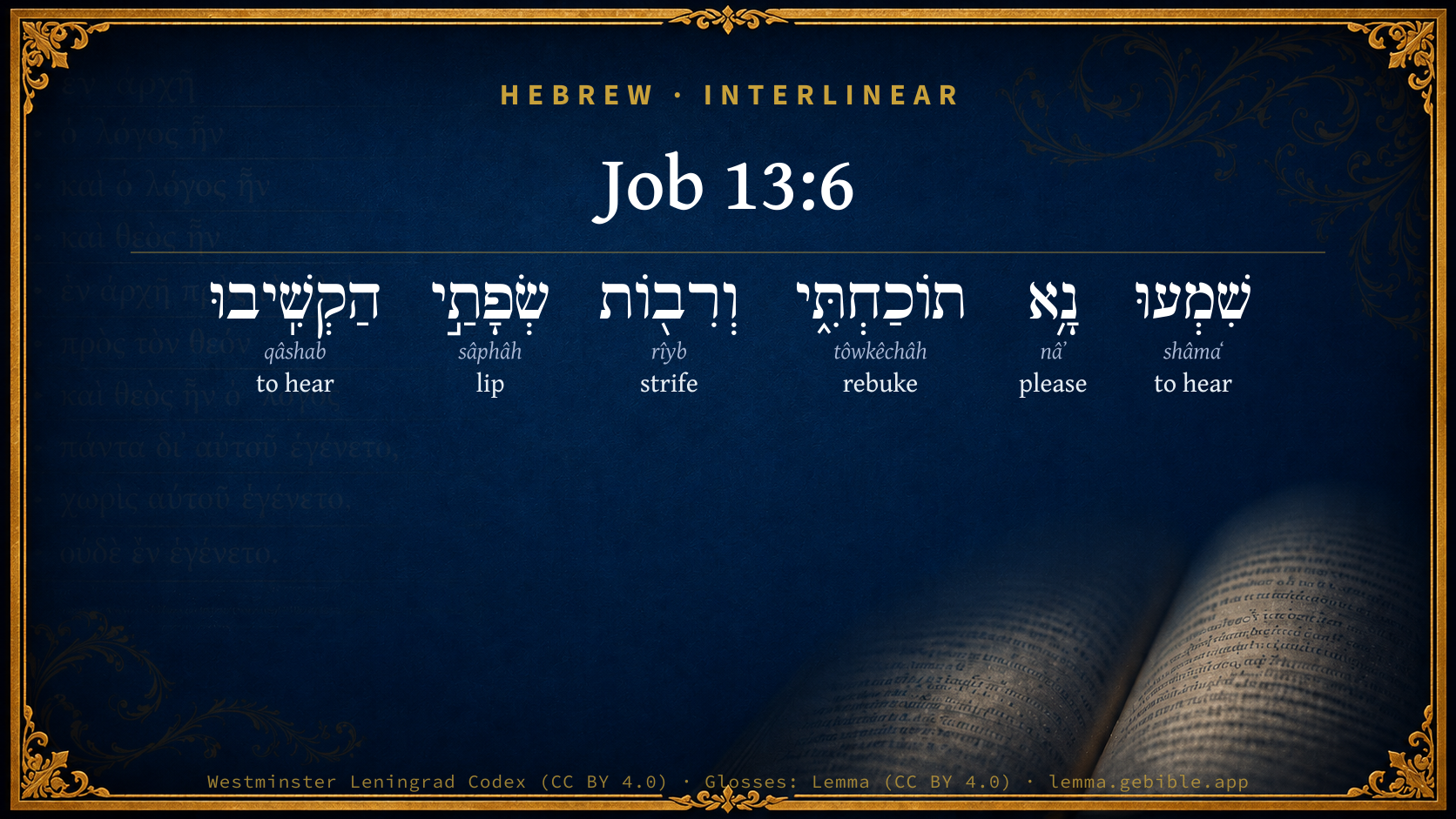
Job 13:6

Hebrew (Westminster Leningrad Codex) Job 13:6 appears in the Hebrew Old Testament. The text above is from the Westminster Leningrad Codex. Each word links to its Strong’s number, a concise gloss, and parsing drawn from the Open Scriptures Hebrew Bible morphology. Click any word for its full Brown-Driver-Briggs (BDB) entry.
Download image
Cite this verse

Job 13:6 (World English Bible). Public Domain. Lemma interlinear Bible study tool, https://lemma.gebible.app/v/job/13/6.

Show BibTeX & RIS
BibTeX
RIS
English Translation
Hear now my reasoning. Listen to the pleadings of my lips.
World English Bible · Public Domain
Download a study sheet

One document with this verse’s original text, its word-by-word gloss line, the meaning frame, cross-references with their text, attributed commentary, and full source and license credits — printable, and it pastes into notes with its structure intact.

This verse Autodidact and up

Study sheet (.html) Plain text (.txt)

A passage Seminary Student

Up to 50 verses in one chapter. A passage sheet keeps up to 6 commentary sources and 12 cross-references per verse, in the order this page ranks them, and says so on the sheet whenever that leaves anything out. Ask for a single verse and you get the Autodidact verse sheet above.

Everything on this page stays free to read, with no account — the sheet is a download of what is already on screen, not access to it.

Want to remove ads? Support Godless Engineer
Compare translations 3

The same verse in 3 English versions, stacked beneath the original-language interlinear above. Click any original word for its lexicon entry.

Each is an independent rendering of the whole verse — the interlinear is not word-aligned to these translations.

Highlighted words mark where these versions differ — a whole-verse word diff, not a word-by-word alignment.

  • World English Bible Public Domain
    Hear now my reasoning. Listen to the pleadings of my lips.
  • King James Version Public Domain
    Hear now my reasoning, and hearken to the pleadings of my lips.
  • unfoldingWord Literal Text CC BY-SA 4.0
    Please hear my reasoning and heed the pleadings of my lips.

unfoldingWord Literal Text — © unfoldingWord, licensed CC BY-SA 4.0. Word-aligned USFM3 via Door43 (git.door43.org/unfoldingWord/en_ult).

Versions to compare (up to 4)

3 of 4 selected

Show all 18 translations

Every available English version of this verse, each an independent rendering of the whole verse.

  • World English Bible Public Domain
    Hear now my reasoning. Listen to the pleadings of my lips.
  • Berean Standard Bible Public Domain
    Hear now my argument, and listen to the plea of my lips.
  • Majority Standard Bible Public Domain
    Hear now my argument, and listen to the plea of my lips.
  • King James Version Public Domain
    Hear now my reasoning, and hearken to the pleadings of my lips.
  • American Standard Version (1901) Public Domain
    Hear now my reasoning, And hearken to the pleadings of my lips.
  • Revised Version (1885) Public Domain
    Hear now my reasoning, and hearken to the pleadings of my lips.
  • Geneva Bible (1599) Public Domain
    Nowe heare my disputation, and giue eare to the arguments of my lips.
  • Douay-Rheims (1899) Public Domain
    Hear ye therefore my reproof, and attend to the judgment of my lips.
  • Young's Literal Translation Public Domain
    Hear, I pray you, my argument, And to the pleadings of my lips attend,
  • Literal Standard Version CC BY-SA 4.0
    Please hear my argument, || And attend to the pleadings of my lips,
  • Unlocked Literal Bible CC BY-SA 4.0
    Hear now my own reasoning; listen to the pleading of my own lips.
  • unfoldingWord Literal Text CC BY-SA 4.0
    Please hear my reasoning and heed the pleadings of my lips.
  • Darby Bible Public Domain
    Hear now my defence, and hearken to the pleadings of my lips.
  • World Messianic Bible Public Domain
    Hear now my reasoning. Listen to the pleadings of my lips.
  • Webster's Bible Public Domain
    Hear now my reasoning, and hearken to the pleadings of my lips.
  • Free Bible Version CC BY-SA 4.0
    Listen to my argument and pay attention to what I have to say.
  • Bible in Basic English Public Domain
    Give ear to the argument of my mouth, and take note of the words of my lips.
  • JPS Tanakh (1917) Public Domain
    Hear now my reasoning, and hearken to the pleadings of my lips.

Literal Standard Version (2020), Covenant Press — licensed CC BY-SA 4.0. Text via the HelloAO Bible API (eBible.org). Unlocked Literal Bible (unfoldingWord) — licensed CC BY-SA 4.0. Text via the HelloAO Bible API (eBible.org). unfoldingWord Literal Text — © unfoldingWord, licensed CC BY-SA 4.0. Word-aligned USFM3 via Door43 (git.door43.org/unfoldingWord/en_ult). Free Bible Version, Dr. Jonathan Gallagher — licensed CC BY-SA 4.0. Text via the HelloAO Bible API (eBible.org).

Word by word

More ways to search: Search by grammar → Find every occurrence → Compare this word →

Practice this passage: Drill this verse → Learn its vocabulary →

About this verse

These counts appear in no published source. They are computed here, from the morphology-tagged text and Lemma’s own curated glosses. What Lemma adds →

6
words
6
distinct lemmas
Wisdom
section

Shared distinctive vocabulary

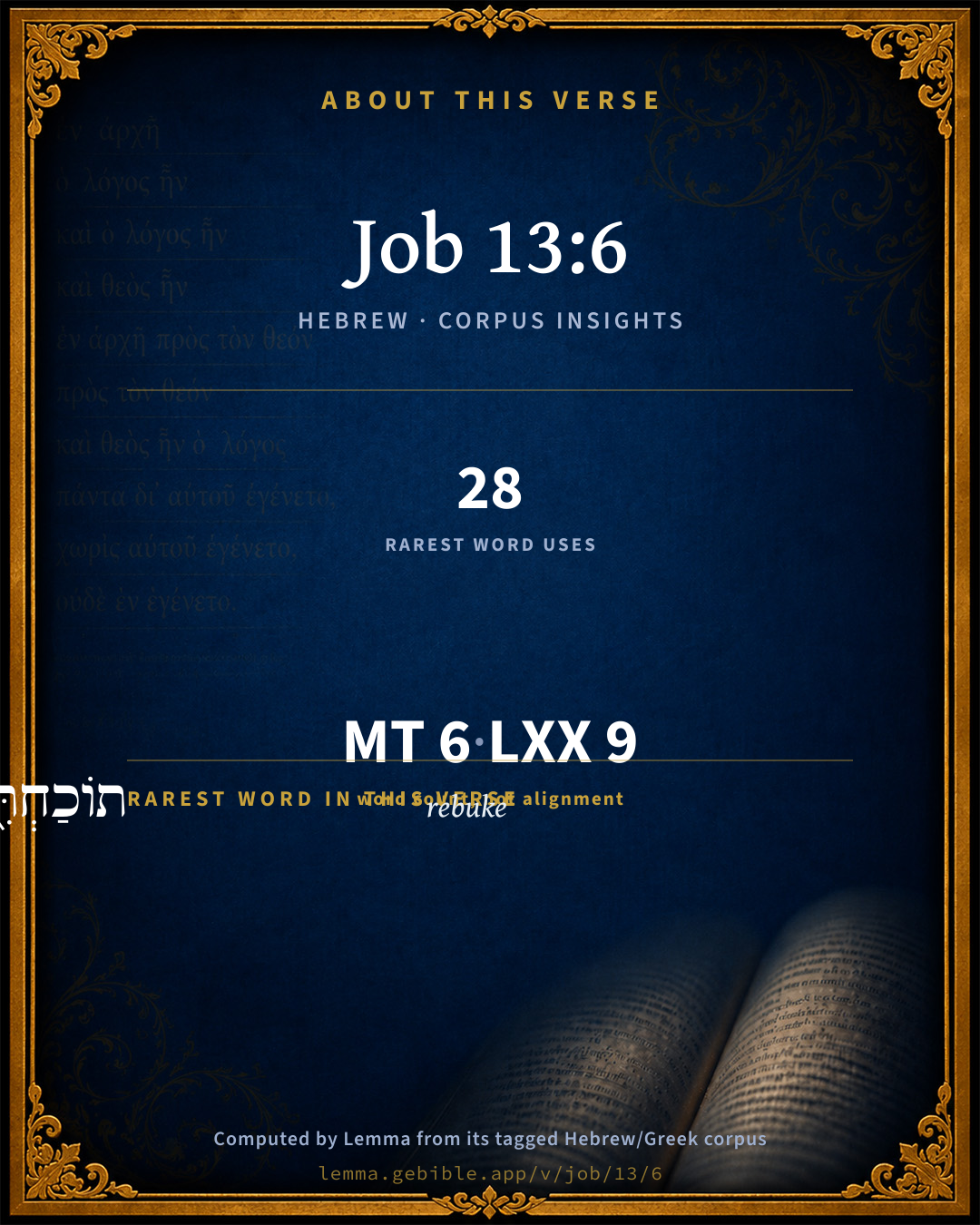
תוֹכַחְתִּ֑י rebuke H8433 occurs in 28 verses of the Hebrew Bible. Also found in:

Grammatical profile

  • 2 verbs
  • 3 nouns
  • 1 particle

Verb forms

  • שִׁמְעוּ Qal · Imperative
  • הַקְשִֽׁיבוּ Hiphil · Imperative

Hebrew & Septuagint length

In English translation the verse runs 11 words from the Hebrew and 16 from the Septuagint (LXX English) — the Septuagint runs noticeably longer here. See the side-by-side →

A rough comparison of the two English renderings, which tokenize alike — not a word-level alignment.

Word counts can differ between the Hebrew and the Greek without any difference in meaning — e.g. the Hebrew direct-object marker אֵת has no separate Greek word, and Greek often adds the article ὁ.

In the original languages it is 6 Hebrew tokens and 9 Greek tokens — but the two are counted differently (Hebrew bundles its prefixes and suffixes into one token; the Greek is in lemma form), so that isn’t a like-for-like length.

Cross-references

5

Topical passages linked to Job 13:6 in the Treasury of Scripture Knowledge — connected by theme and wording, ordered by reader-vote popularity; previews shown in the World English Bible.

  • Job 34:2 "Hear my words, you wise men; Give ear to me, you who have knowledge.
  • Judges 9:7 When they told it to Jotham, he went and stood on the top of Mount Gerizim, and lifted up his voice, and cried, and said to them, Listen to me, you men of Shechem, that God may listen to you.
  • Job 21:2–3 "Listen diligently to my speech. Let this be your consolation.
  • Job 33:1–3 "However, Job, Please hear my speech, And listen to all my words.
  • Proverbs 8:6–7 Hear, for I will speak excellent things. The opening of my lips is for right things.

Cross-references courtesy of OpenBible.info (CC BY 4.0).

Hebrew and Greek witnesses Masoretic Hebrew ↔ Greek Septuagint

The same verse in the two great witnesses to the Old Testament, shown verse-for-verse.

Here the Septuagint runs noticeably longer than the Hebrew — LXX2012 (modern English Septuagint) 16 words vs World English Bible 11. A rough length comparison of the two English translations, not a word-level alignment — read both below.

These are two independent witnesses, not word-aligned to each other, and the Septuagint is shown in lemma (dictionary) form.

Hebrew Job 13:6 Masoretic · Westminster Leningrad Codex

שִׁמְעוּ נָ֥א תוֹכַחְתִּ֑י וְרִב֖וֹת שְׂפָתַ֣י הַקְשִֽׁיבוּ

Hear now my reasoning. Listen to the pleadings of my lips.

World English Bible · Public Domain

Greek LXX Job 13:6 Septuagint · lemma form

ἀκούω ἔλεγχος στόμα ἐγώ κρίσις δέ χεῖλος ἐγώ προςἔχω

But hear you⌃ the reasoning of my mouth, and attend to the judgment of my lips.

LXX2012 (modern English Septuagint) · Public Domain

Hebrew: Westminster Leningrad Codex (CC BY 4.0). Greek: Septuagint (public domain); English from LXX2012 (modern English Septuagint) (Public Domain). How the Septuagint differs from the Hebrew →

Commentary

Notes on Job 13:6 from classic Christian and Jewish commentators (each source and its license shown beneath its notes). The classic Christian expositions comment on the surrounding passage and are grouped to its opening verse, so a note may address several verses; the Jewish commentaries on the Tanakh (Rashi and others) are per-verse, so they appear only where the commentator wrote on this verse.

Lemma curates 59 commentaries, every one of them public domain or Creative Commons licensed, each selected and text-cleaned for this edition rather than reprinted as found. About our sources →

The Cambridge Bible for Schools and Colleges

gen. ed. J. J. S. Perowne

6. hear now my reasoning] Rather, hear now my rebuke. The reference is not to Job’s cause with God, this is not resumed till Job_13:13. He utters a formal indictment against his friends which he commands them to hear.

the pleadings of my lips] i. e. the reproofs of my lips, their pleadings against you, or their controversy with you, cf. Deu_17:8. These reproofs now follow, Job_13:7-9.

6–12. Severe rebuke of the three friends, in which (1) they are charged with partiality for God, and with acting the advocate for Him (Job_13:6-8); and (2) they are threatened with the chastisement of God for their insincerity, and for falsely pleading even in God’s behalf (Job_13:9-12).

The Cambridge Bible for Schools and Colleges (gen. ed. J. J. S. Perowne; Cambridge University Press, 1878–1918) — public domain. Text from a community e-Sword module.

Trapp's Complete Commentary

John Trapp

Job 13:6 Hear now my reasoning, and hearken to the pleadings of my lips.

Ver. 6. Hear now my reasoning, &c.] Or, hear, I pray you. Be swift to hear, slow to speak, slow to wrath; suffer the word of exhortation and of reprehension; sharp though it be, and to the flesh irksome, yet suffer it, since it is for your good. Quintilian testifieth of Vespasian, that he was patientissimus veri, one that could well endure to be told the truth; but there are few Vespasians. Many people are like the nettle: touch it never so gently, it will sting you.

And hearken to the pleadings of my lips] Heb. The contention of my lips. See that you not only hear, but hearken to it with attention of body, intention of mind, and retention of memory: neither God nor man can bear it, to speak, and not be heard. "See that ye refuse not him that speaketh," &c., Heb 12:25. See that ye slight not, shift not off Christ speaking to you in his ministers and messengers; for if they escaped not who refused him that spake on earth, much more shall not we escape if we turn away from him that speaketh from heaven.

John Trapp, A Commentary or Exposition upon All the Books of the Old and New Testament (1647–1656) — public domain. Text from a community e-Sword module.

Joseph Benson's Commentary

Job 13:6-8. Hear now my reasoning — Attend to it, and consider it more seriously than you have done; and hearken to the pleadings of my lips — That is, to the arguments which I shall produce. Will ye speak wickedly for God? — Will you utter falsehoods upon pretence of pleasing God, or of maintaining God’s honour or righteousness? Doth he need such defences? Will ye accept his person? — Not judging according to the right of the cause, but the quality of the person, as corrupt judges do. Will ye contend with God? — Or, will ye plead, as the word, תריבון, teribun, is rendered, Jdg 6:31. He means, is his cause so bad as to call for your assistance to defend it? Will you plead for him, as one person pleads for another, making use of little arts and subtle contrivances in his defence? He wants no such crafty, unprincipled advocates. “Job here convicts his friends of wickedness, in taking upon them to defend God in an improper manner, as if he needed their rash censures to vindicate the ways of his providence. This was such a fault, as they had but too much reason to fear might one time or other draw down his severe chastisements on their own heads.” See Peters.

Joseph Benson's Commentary on the Old and New Testaments (1811–1818) — public domain. Text from a community e-Sword module.

Adam Clarke's Commentary

Verse 6. Hear now my reasoning] The speeches in this book are conceived as it delivered in a court of justice, different counsellors pleading against each other. Hence most of the terms are forensic.

Adam Clarke's Commentary on the Bible (1810–1826) — public domain. Text from a community e-Sword/MySword module.

John Gill's Exposition

Hear now my reasoning,.... Job entreats his friends that they would be no longer speakers, but hearers; that they would vouchsafe to sit still, and hear what he had to say; though he was greatly afflicted, he had not lost his reason, wisdom was not driven out from him, Job 6:13; he had still with him his reasoning powers, which he was capable of making use of, and even before God, and desires that they would attend to what he had to say on his own behalf:

and hearken to the pleadings of my lips; he was capable of pleading his own cause, and he was desirous of doing it before God as his Judge; and begs the favour of his friends to be silent, and hear him out, and then let judgment be given, not by them, but by God himself.

John Gill's Exposition of the Whole Bible (1746–1763) — public domain (CC PDM 1.0). Text via the HelloAO Bible API.

Haydock's Catholic Bible Commentary

Judgment. Hebrew, "pleading" before our common judge. (Haydock)

George Leo Haydock (1774–1849), Haydock's Catholic Family Bible and Commentary, 1859 edition — public domain. Excludes Psalms (Douay-Rheims chapter numbering differs from Protestant) and Deuterocanonical books (Catholic canon only).

Matthew Poole's English Annotations

i.e. Attend to it, and consider it more seriously than you have done.

The pleadings of my lips, i.e. the arguments which I shall produce.

Matthew Poole's English Annotations on the Holy Bible (1683–1685) — public domain. Text from a community e-Sword/MySword module.

Whedon's Commentary on the Bible

Daniel D. Whedon

6. Reasoning — Better, reproof.

Daniel D. Whedon (gen. ed.), Commentary on the Old and New Testaments (1874–1909) — public domain. Text from a community e-Sword module.

The Pulpit Commentary

Hear now my reasoning. As his friends have not kept silence, but have spoken, Job claims a right to be heard in his turn. If it be thought that he is somewhat impatient, it must be remembered that his opponents are three to one, all eager to catch him in a fault, and not very mild in their reprimands. And hearken to the pleadings of my lips. Job"s "pleadings" are addressed, not to his friends, but to God, and are contained in vers. 14-28 of the present, and the whole of the succeeding chapter.

The Pulpit Commentary (1880–1919), ed. H.D.M. Spence-Jones & Joseph S. Exell — public domain. Text from a community e-Sword module.

unfoldingWord translationNotes

Door43 World Missions Community

Connecting Statement:

Job continues to speak to his friends.

listen to the pleading of my own lips

Here "lips" represent the person who is speaking. AT: "listen to what I myself plead for" (See: Synecdoche)

Will you speak unrighteously ... deceitfully for him?

Job uses these two questions to rebuke his friends for speaking unrighteously. AT: "You think that you are speaking for God, but you are speaking unrighteously. You are speaking deceitfully." (See: Rhetorical Question and Parallelism and Irony)

talk deceitfully

"lie" or "tell lies"

Will you show him partiality? Will you argue the case for God?

Showing kindness to God represents helping God or defending God against Job's complaints. Job uses these questions to rebuke his friends for thinking that they can defend God. AT: "You think that God need you to defend him? You think that you can argue for God like attorneys in court." (See: Rhetorical Question and Parallelism and Irony)

translationWords

righteous

deceive

court

unfoldingWord translationNotes — © Distant Shores Media and the Door43 World Missions Community, licensed CC BY-SA 4.0. Source: git.door43.org/Door43/en_tn.

Rashi

Rabbi Shlomo Yitzchaki (Rashi)

the contentions The proofs.

Rashi on the Tanakh — English translations: “The Judaica Press complete Tanach with Rashi, translated by A. J. Rosenberg” (CC BY 4.0); “Pentateuch with Rashi's commentary by M. Rosenbaum and A.M. Silbermann, 1929-1934” (public domain); “The Metsudah Tanach series, Lakewood, N.J” (CC BY 4.0); and “The Book of Joshua, Metsudah Publications, 1997” (CC BY 4.0). Text via Sefaria.

Lesson kit

Teaching starters — assembled from the data on this page, not authored interpretation. Every prompt links to the verse data it draws on. Edit before teaching.

Job, in the Wisdom, opens this verse with 6 words (6 distinct Hebrew lemmas). Its most distinctive word is tôwkêchâh (“rebuke”). The Greek Septuagint runs longer here. A historical commentator’s framing appears above. Read the whole chapter for the surrounding context.

Discussion questions

  1. What does “rebuke” (tôwkêchâh) contribute to the verse as a whole?
  2. How does 2 Kings 19:3, which shares the word «rebuke», read alongside this verse?
  3. The Septuagint runs longer here than the Hebrew. What might account for the difference?
  4. The translations on this page render this verse differently — a whole-verse word diff, not a word-by-word alignment. What might account for the different wordings?
  5. «שִׁמְעוּ» is a Qal Imperative verb. How does that grammatical form shape the action described?
  6. Compare how The Cambridge Bible for Schools and Colleges and Trapp's Complete Commentary read this verse. Where do they agree or differ?

Things to notice

Reading settings

Reading text

Shown beneath each verse's original-language words.

Old Testament
Old Testament edition

Read the OT as the Masoretic Hebrew (MT) or the Greek Septuagint (LXX).

English shown for the Greek Septuagint (in the Hebrew ↔ Greek comparison).

Comparing translations? Open the Compare panel on any verse page to stack up to four side by side.