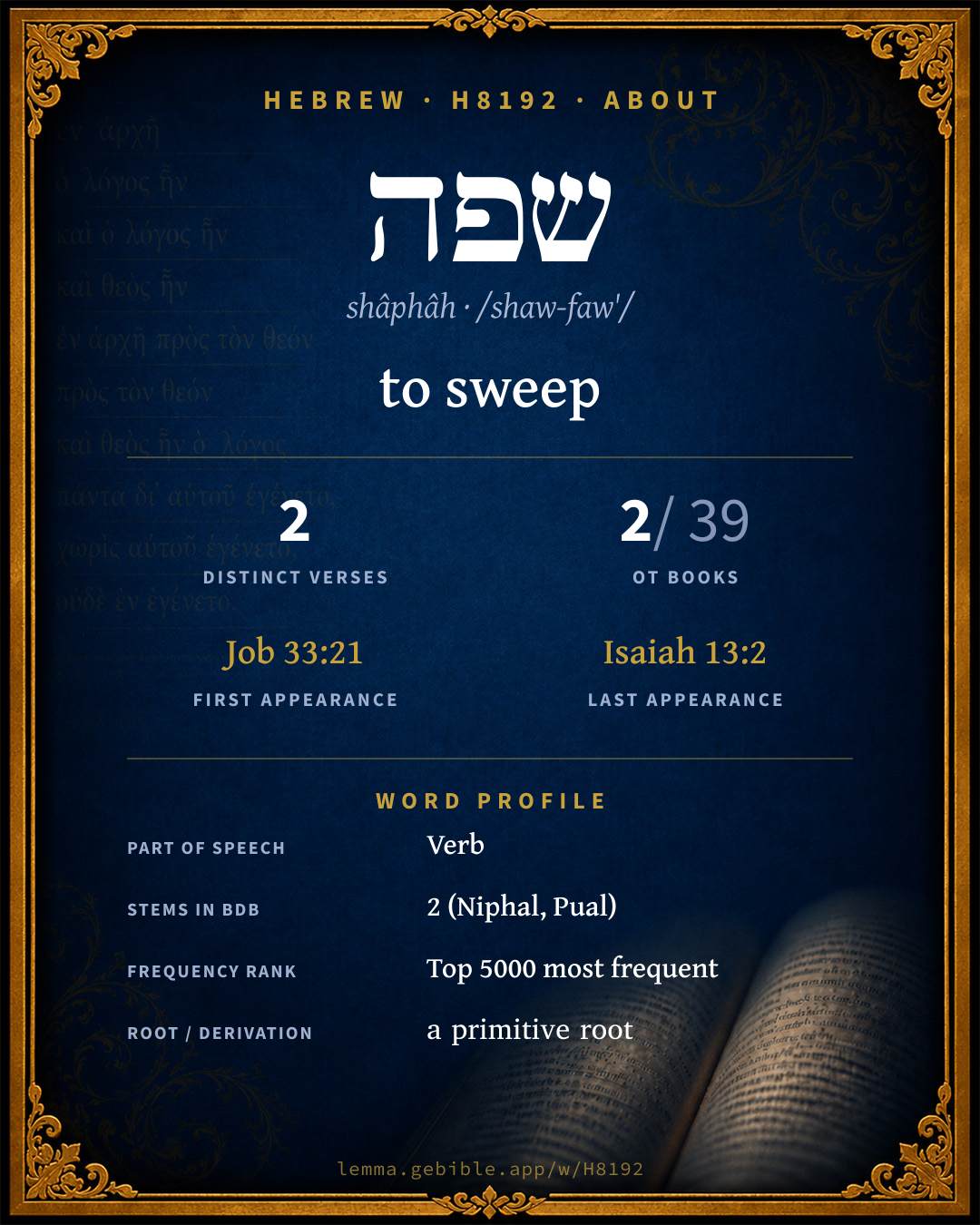
שָׁפָה
to sweep
‘to sweep’ is one of 3 main senses fuller range ↓
Full lexicon entry — Brown-Driver-Briggs (BDB)
From Brown-Driver-Briggs (BDB)
Where this word appears
See every Niphal verb in the Hebrew Bible →
Grammar key — what these labels mean
Part of speech
- Verb
- An action or state-of-being word.
Stem
- Pual
- The passive counterpart of the Piel.
- Niphal
- Usually the simple passive or reflexive of the Qal (“he was written”).
Form
- Sequential Perfect
- A perfect with prefixed waw continuing a preceding imperfect or command (waw-consecutive perfect).
- Participle Active
- A verbal adjective expressing ongoing or characteristic action (“writing / one who writes”).
State
- Absolute
- The independent form of a noun, not bound to a following word.
Person
- 3rd Person
- The one spoken about (“he / she / it / they”).
Gender
- Common
- Either gender — not distinguished for this form.
- Masculine
- Grammatically masculine.
Number
- Plural
- More than one (in Hebrew, generally three or more).
- Singular
- One.
Grammatical forms
- Verb, Pual, Sequential Perfect, 3rd Person, Common, Plural 1 time (50%)
- Verb, Niphal, Participle Active, Masculine, Singular, Absolute 1 time (50%)
Parsed forms decoded from the imported morphology (morphhb / Westminster Leningrad Codex — WLC text public domain, morphhb tagging CC BY 4.0), counted across 2 parsed occurrences — not distinct verses.
Every verse where H8192 appears — 2 distinct verses across 2 books. Click any verse to open its interlinear word-by-word view. Verse text shown in the World English Bible for context — . Each verse’s Hebrew form is shown with its reference; the English is not keyword-highlighted, since the data carries no word-level English alignment. Use “Compare translations” on any verse to read it across multiple English versions. This concordance covers the Hebrew Bible; Septuagint (Greek Old Testament) occurrences are not indexed here.
Job 1 verse
Isaiah 1 verse
About this entry
At a glance — auto-summarized from this page’s data, not written by a person. Every figure links to its source below. This summary describes the numbers; it doesn’t interpret them.
“to sweep” is the headline sense of the Hebrew verb שפה (shâphâh). It occurs a mere 2 verses across Scripture. More than half of its appearances fall in Job. Scripture first uses it in Job 33:21. The verb spans 2 stems, from Niphal to Pual. The sections below give every sense, occurrence, and version rendering.
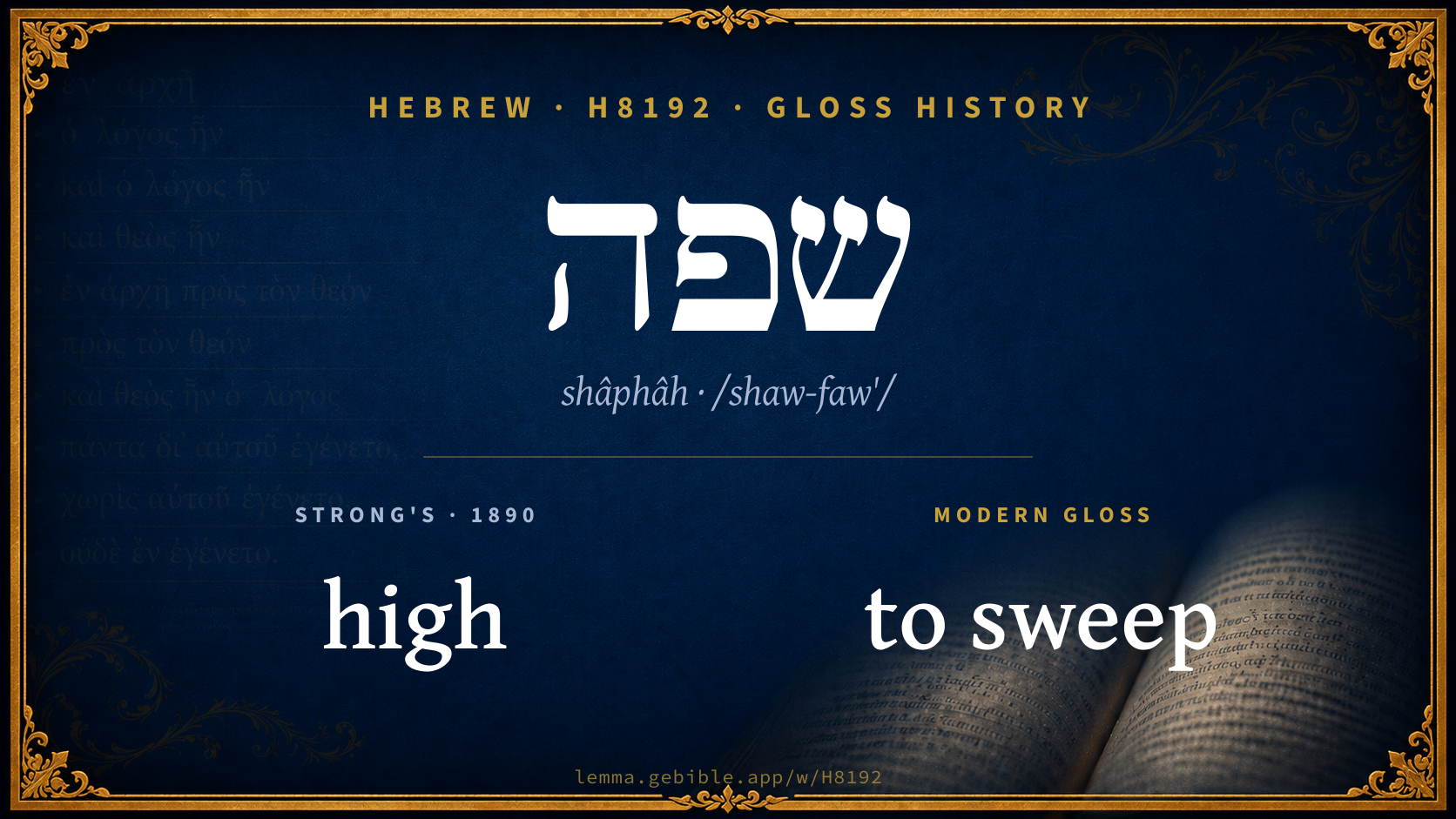
Gloss history
Strong's 1890 vs modern scholarship
About this word
Strong's H8192 catalogs a Hebrew word from the Hebrew Old Testament.
These counts are not copied from any lexicon or concordance. They are computed here, from the morphology-tagged Hebrew Old Testament. What Lemma adds →
- 2
- distinct verses
- The word appears in 2 distinct verses.
- 2 / 39
- OT books
- The word appears in 2 of 39 Old Testament books.
- #4,807
- by frequency
- Top 5000 most frequent Hebrew words (rank 4,807 of 8,640 Hebrew words by occurrence).
View all 2 occurrences in the concordance →
By traditional corpus
Conventional, traditional groupings — biblical authorship is debated, so this is a traditional corpus grouping, not an authorship claim. Each share is this word’s portion of its verses in that division of the Hebrew canon. Each figure is a share of the word’s 2 distinct verses.
- Prophets (Nevi'im) 1 verse · 50%
- Writings (Ketuvim) 1 verse · 50%
How translations render this word
Counts come from each version’s own published word-to-Strong’s tagging or interlinear alignment — an approximate guide to how each version renders this word, not a word-level alignment the data otherwise carries. Because each total is that version’s own tagged count, the per-version totals vary from one another and need not match the appearance or distinct-verse counts above. These counts may also differ from a printed concordance because Lemma counts each distinctly tagged rendering and does not collapse phrase taggings into a single head-word total. This is a fixed set of word-tagged versions (KJV, ASV, BSB, ULT) and does not change with the reading translation you choose elsewhere. Each version’s license is shown beside its name below (and on Sources).
- King James Version: High 1×, Stick out 1×
- American Standard Version: Bare 1×, Stick out 1×
- Berean Standard Bible: Barren 1×
- unfoldingWord Literal Text: And 1×, Are exposed 1×, Bared 1×
King James Version Public Domain
Renders H8192 across 2 tagged occurrences — most commonly:
American Standard Version Public Domain
Renders H8192 across 2 tagged occurrences — most commonly:
Berean Standard Bible Public Domain
Renders H8192 across 1 tagged occurrence — most commonly:
unfoldingWord Literal Text CC BY-SA 4.0
Renders H8192 across 3 tagged occurrences — most commonly:
Senses in the full BDB
Hebrew verbs can shift meaning by stem (binyan): Qal is the basic action, Niphal is often passive or reflexive, Piel often intensifies or makes it factitive, and Hiphil is typically causative. The senses below are grouped under the stem BDB assigns to each. This entry also uses Pual (the passive of Piel).
What do BDB’s symbols mean?
BDB uses these scholarly abbreviations:
| Symbol | Meaning |
|---|---|
| 𝔊 | the Septuagint (the ancient Greek translation, LXX) |
| 𝔙 | the Vulgate (the Latin translation) |
| 𝔖 | the Syriac version (the Peshitta) |
| 𝔗 | the Targum (the Aramaic translation) |
| ψ | the Psalms |
| √ | root (the underlying root or stem) |
| ‖ | parallel passage (a synonymous or contrasted parallel) |
| † | the dagger: every passage where the word occurs is cited |
The 2 senses and sub-senses the full Brown-Driver-Briggs lexicon distinguishes for this word, in lexicon order (not ranked by frequency), with BDB’s own verbatim wording and sub-sense lettering. Shown in Hebrew script with BDB’s own scholarly abbreviations. The condensed entry is in the Lexicon Entry tab. See also the Forms in the corpus table below.
Niphal
- . be wind-swept, bare
Pual
- . his bones are laid bare
Senses from the full Brown-Driver-Briggs lexicon (Brown, Driver, Briggs; Oxford 1906 — public domain), digitized via Sefaria, supplemented by the OpenScriptures HebrewLexicon (CC BY 4.0). Full attribution on Sources.
Word origin
[ שָׁפָה ] vb. sweep bare
— Brown-Driver-Briggs (Oxford 1906, public domain), digitized via Sefaria, supplemented by the OpenScriptures HebrewLexicon (CC BY 4.0). See Sources.
Origin: a primitive root
Jastrow Dictionary
A second Hebrew/Aramaic lexicon for comparison, covering Aramaic and post-biblical (Talmudic, Targumic, Midrashic) usage that the biblical-Hebrew BDB does not. Matched by lemma rather than by Strong’s number, so a lemma may carry more than one Jastrow headword (shown separately below), and the entries cover usage well beyond the Bible.
שִׁפָּה
- , v. סִפָּא
שָׂפָה
- v. סְפָי)
- 1. rim, border, binding. B. Bath. II, 1 ארבעה מן הש׳ four handbreadths from the rim of the stove. Ib. 19ᵃ שְׂפַת מחמצן the border of the wash-pit; a. fr.—קמי ש׳, קנה ש׳, v. קָמָה.
- 2. lip; speech. Y. Sabb. VII, 10ᶜ top המאדם אודם בש׳ he who reddens his lips (v. אָדַם; Naḥmanides reads: בטפה). Ib. XIV, 14ᵈ top כל שהוא מן הש׳ ולפנים any wound on the lip and further inside (in the mouth, opp. חָלָל III). Y. Macc. II, end, 32ᵃ, a. fr. בש׳ רפה with lax lips, with low indistinct speech; a. fr.—Pl. שְׂפָתוֹת, שְׂפָיוֹת (סְפָי); Du. שְׂפָתַיִם. Tosef. Kel. B. Kam. VI, 15 שְׂפָתָיו, v. שָׁפַע. M. Kat. 15ᵃ (expl. ועל שפם וכ׳, Lev. XIII, 45) שיהו שִׂפְתוֹתָיו מדובקות וכ׳ his lips should cleave to each other (he must not greet or answer greeting). Koh. R. to XII, 4 בנות השיר אלו הש׳ ‘the daughters of song’, that means the lips; Lev. R. s. 18 שִׂפְתוֹתָיו. Sabb. 152ᵃ שִׂפְתוֹתֵיהֶן וכ׳, v. רָפַט. Ab. Zar. 35ᵃ שִׂפְתוֹתֶיךָ, v. חָשַׁק. Keth. 61ᵇ את השפתים, v. שִׁרְבֵּט; Y. Keth. V, 30ᵃ bot. השפיות, v. שִׁלְבֵּק; a. fr.—Y. Yeb. VI, beg. 7ᵇ בין הש׳ between the lips (of the vagina). e.g. Leviticus 13:45
שָׁפָה
- verb, v. שפי
שָׁפָה ²
- (שָׁפָה II) overflow, additional measure; v. שֶׁפַע.
שפי
- 1. to crush. —Part. pass. שָׁפוּי, pl. שְׁפוּיִין crushed, humble, contrite (= b. h. דַּכָּא). Tosef. Ḥag. II, 9 עניו וש׳ humble and contrite; Tosef. Snh. VII, 1 וש׳ (only); Y. ib. I, 19ᶜ. Gen. R. s. 60 דווין וש׳ Ar. (ed. ושפופין) broken down and crushed (poor); a. e.
- 2. to rub, smooth, plane. —Part. pass. as ab. a) smooth. Koh. R. to XII, 14 two paths אחד ש׳ ואחד מלא וכ׳ one smooth, and the other full of thorns and pebbles.—Yalk. Gen. 62 בור ש׳ (Snh. 109ᵃ שָׁאפֵי; Ar. שפת, corr. acc.) a smooth (blank, empty) pit, v. בּוֹרְסִיף.—b) (cmp. חָלָק) unimpaired, unscathed. Gen. R. s. 45, v. רָתַק.
- 1. to plane, saw, trim. Ḥull. 125ᵃ קולית שש׳ וכ׳ a thigh-bone which one sawed through lengthwise. Ab. Zar. 42ᵃ ישראל שש׳ ע"ז וכ׳ if an Israelite chipped off an idol whether for his own purpose (to use the wood) or for its sake (to improve its appearance). Ib. 49ᵇ. Y. Gitt. V, 47ᵃ bot. גזלו ושִׁיפָּהוּ if he took a block by force and planed it. Tosef. Kel. B. Mets. III, 1 שפת הימנה וכ׳ (read: שפה) if he filed off a part of it and made of it &c.; a. e.—Part. pass. מְשׁוּפֶּה; pl. מְשׁוּפִּים, מְשׁוּפִּין. Y. Gitt. l. c. גזלו מש׳ if he took it planed. Y. Succ. I, 52ᶜ top במש׳ לכלים (not בכלים) when the boards are planed preparatory to making them into utensils; a. e.
- 2. to smooth, polish, Kel. XIV, 5 משׁיְשַׁפֶּנּוּ Ar.; Ned. 56ᵇ משׁיְשַׁפֵּם, v. שׁוּף II.—Trnsf. to pacify, give satisfaction. Y. B. Mets. V, 10ᵇ המבטל … חייב לשַׁפּוֹת לו if a tenant or an agent neglects his neighbor’s field, he must indemnify him; ib. IX, beg. 12ᵃ
- 3. to leave smooth places, (cmp. חָלַק Hif.) to plant wide apart. Y. Orl. I, beg. 60ᶜ לקורות במְשַׁפֶּה (or במַשְׁפֶּה Hif.) when he plants the trees wide apart, it is an indication that he wants to raise them for beams, opp. רָצַף. B. Bath. V, 4 הגדילו לא יְשַׁפֶּה (or יַשְׁפֶּה) if they (the trees bought in a person’s field) grew large, he (the owner of the field) has no right to smooth the field (cut the trees down). Ib. הגדילו ישפה when they are grown large, he (the owner of the trees) may cut them (in order to use the ground they occupy); a. e.
שפי ³
- (v.שָׁפָה I) [to be smooth,] to be quiet, at ease; to be relieved. Nidd. IV, 4 ושָׁפְתָה מעת לעת and was relieved for a full day, opp. קשתה, v. קָשָׁה. Ib. שפתה מן הצער וכ׳ she was relieved from pain, but not from the flux of blood; a. e.—Part. pass. שָׁפוּי quiet, sane. Arakh. 17ᵇ, sq. ש׳ ונשתטה if he was sane and became mad; B. Bath. 128ᵃ.—V. שׁוֹפִי II.
- (of a delirious person) to become quiet, conscious, sane. B. Kam. IV, 4 נש׳ השוטה if the madman became sane again; Tosef. ib. IV, 4. Y. Ter. I, 40ᵇ bot. לכשׁיִשְׁתַּפֶּה when he is sane again (we may write a letter of divorce at his order); Y. Gitt. VII, beg. 48ᶜ. Y. Keth. I, 25ᵇ; a. e.
A Dictionary of the Targumim, the Talmud Babli and Yerushalmi, and the Midrashic Literature (Marcus Jastrow; London, Luzac, 1903) — Public Domain. Digitized via Sefaria. Digitized via Sefaria. Full attribution on Sources.
Forms in the corpus
The 2 distinct written forms H8192 takes in the Hebrew Bible, most frequent first — each parse links to that stem’s occurrences in the concordance. Hebrew forms include their vowel points and cantillation, so a single lemma takes many written forms.
| Form | Parsing | Example | Uses |
|---|---|---|---|
| וְ/שֻׁפּ֥וּ | Verb, Pual, Sequential Perfect, 3rd Person, Common, Plural | Job 33:21 | 1 |
| נִשְׁפֶּה֙ | Verb, Niphal, Participle Active, Masculine, Singular, Absolute | Isaiah 13:2 | 1 |
Same root — word family
Other BDB entries built from the same root as H8192, grouped by Strong’s listed origin. These share a root / origin per the lexicon — not necessarily a shared meaning. Each links to that word’s own entry.
Derived from this word
- משפחה mishpâchâh H4940 family
- משפת mishpâth H4942 ash
- שפה shâphâh H8194 cheese
- שפי shᵉphîy H8205 bareness
Proper names from this root
People and places named from this root — a name, not an additional meaning of the word.
Compare all same-root words → Showing 4 of 8 — not the complete family. 3 of the same-root words are proper names (people or places). They share a root, not necessarily a meaning.
Septuagint verse parallels
This word appears in 2 verses that also exist in the Greek Old Testament (Septuagint), out of the 2 Hebrew verses it occurs in. You can read those verses in Greek by switching the Old Testament edition to the Septuagint.
Read these verses in the Septuagint
This is a verse-level parallel only — the same verses exist in both the Hebrew and Greek Old Testaments. No word-level Hebrew↔Greek correspondence is claimed: the data carries no such alignment, so no Greek word is shown as this Hebrew word’s translation. Coverage is not total — the Septuagint omits the deuterocanon and renumbers the Psalms, so some Hebrew verses have no direct Greek parallel.