
Proverbs 24:26

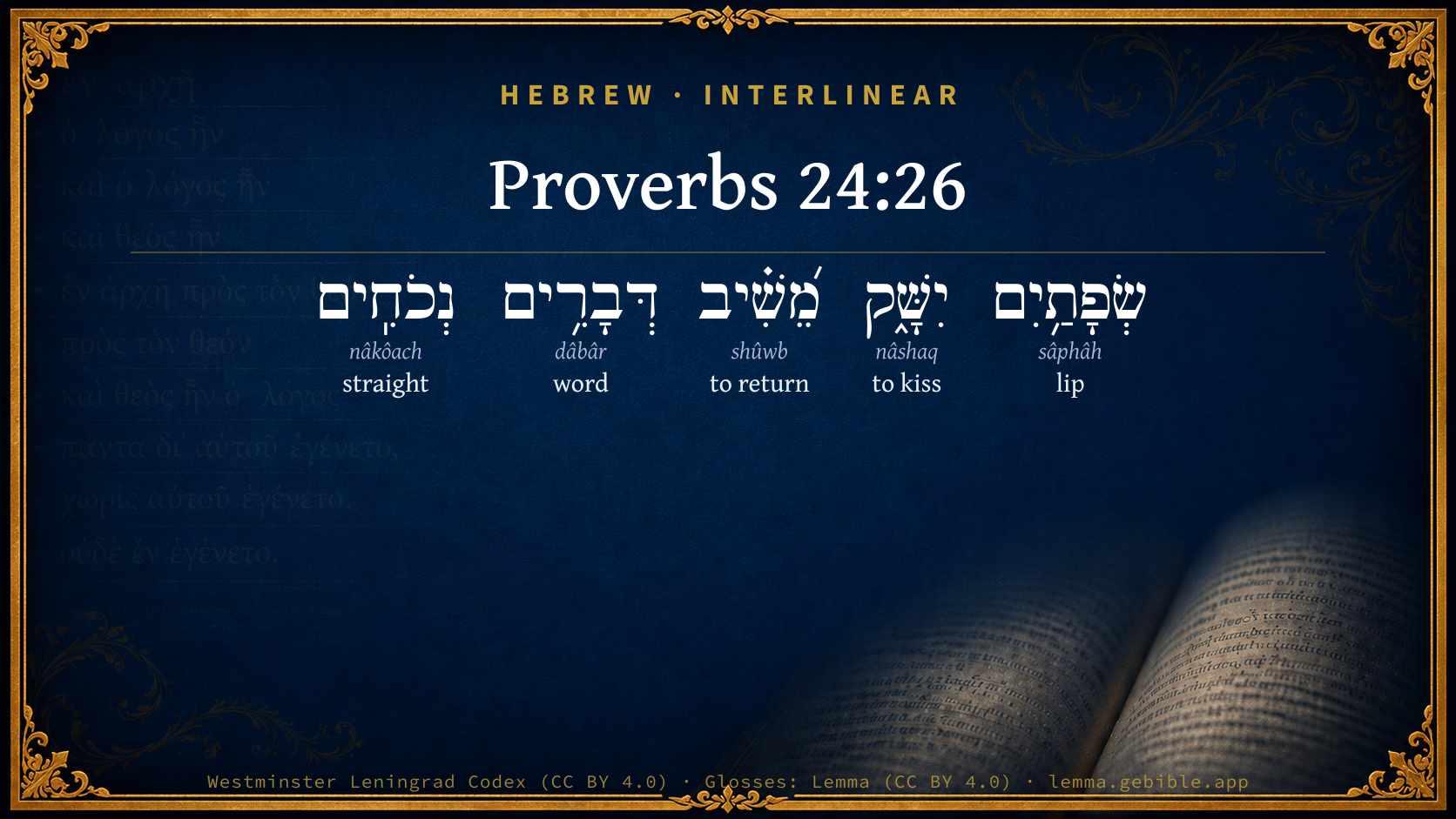
Hebrew (Westminster Leningrad Codex) Proverbs 24:26 appears in the Hebrew Old Testament. The text above is from the Westminster Leningrad Codex. Each word links to its Strong’s number, a concise gloss, and parsing drawn from the Open Scriptures Hebrew Bible morphology. Click any word for its full Brown-Driver-Briggs (BDB) entry.
Download image
Cite this verse

Proverbs 24:26 (World English Bible). Public Domain. Lemma interlinear Bible study tool, https://lemma.gebible.app/v/proverbs/24/26.

Show BibTeX & RIS
BibTeX
RIS
English Translation
An honest answer Is like a kiss on the lips.
World English Bible · Public Domain
Download a study sheet

One document with this verse’s original text, its word-by-word gloss line, the meaning frame, cross-references with their text, attributed commentary, and full source and license credits — printable, and it pastes into notes with its structure intact.

This verse Autodidact and up

Study sheet (.html) Plain text (.txt)

A passage Seminary Student

Up to 50 verses in one chapter. A passage sheet keeps up to 6 commentary sources and 12 cross-references per verse, in the order this page ranks them, and says so on the sheet whenever that leaves anything out. Ask for a single verse and you get the Autodidact verse sheet above.

Everything on this page stays free to read, with no account — the sheet is a download of what is already on screen, not access to it.

Want to remove ads? Support Godless Engineer
Compare translations 3

The same verse in 3 English versions, stacked beneath the original-language interlinear above. Click any original word for its lexicon entry.

Each is an independent rendering of the whole verse — the interlinear is not word-aligned to these translations.

Highlighted words mark where these versions differ — a whole-verse word diff, not a word-by-word alignment.

  • World English Bible Public Domain
    An honest answer Is like a kiss on the lips.
  • King James Version Public Domain
    Every man shall kiss his lips that giveth a right answer.
  • unfoldingWord Literal Text CC BY-SA 4.0
    He kisses lips who returns straightforward words.

unfoldingWord Literal Text — © unfoldingWord, licensed CC BY-SA 4.0. Word-aligned USFM3 via Door43 (git.door43.org/unfoldingWord/en_ult).

Versions to compare (up to 4)

3 of 4 selected

Show all 18 translations

Every available English version of this verse, each an independent rendering of the whole verse.

  • World English Bible Public Domain
    An honest answer Is like a kiss on the lips.
  • Berean Standard Bible Public Domain
    An honest answer given is like a kiss on the lips.
  • Majority Standard Bible Public Domain
    An honest answer given is like a kiss on the lips.
  • King James Version Public Domain
    Every man shall kiss his lips that giveth a right answer.
  • American Standard Version (1901) Public Domain
    He kisseth the lips Who giveth a right answer.
  • Revised Version (1885) Public Domain
    He kisseth the lips that giveth a right answer.
  • Geneva Bible (1599) Public Domain
    They shall kisse the lippes of him that answereth vpright wordes.
  • Douay-Rheims (1899) Public Domain
    He shall kiss the lips, who answereth right words.
  • Young's Literal Translation Public Domain
    Lips he kisseth who is returning straightforward words.
  • Literal Standard Version CC BY-SA 4.0
    He who is returning straightforward words kisses lips.
  • Unlocked Literal Bible CC BY-SA 4.0
    The one who gives an honest answer gives a kiss on the lips.
  • unfoldingWord Literal Text CC BY-SA 4.0
    He kisses lips who returns straightforward words.
  • Darby Bible Public Domain
    He kisseth the lips who giveth a right answer.
  • World Messianic Bible Public Domain
    An honest answer is like a kiss on the lips.
  • Webster's Bible Public Domain
    Every man shall kiss his lips that giveth a right answer.
  • Free Bible Version CC BY-SA 4.0
    An honest answer is a kiss on the lips.
  • Bible in Basic English Public Domain
    He gives a kiss with his lips who gives a right answer.
  • JPS Tanakh (1917) Public Domain
    He kisseth the lips that giveth a right answer.

Literal Standard Version (2020), Covenant Press — licensed CC BY-SA 4.0. Text via the HelloAO Bible API (eBible.org). Unlocked Literal Bible (unfoldingWord) — licensed CC BY-SA 4.0. Text via the HelloAO Bible API (eBible.org). unfoldingWord Literal Text — © unfoldingWord, licensed CC BY-SA 4.0. Word-aligned USFM3 via Door43 (git.door43.org/unfoldingWord/en_ult). Free Bible Version, Dr. Jonathan Gallagher — licensed CC BY-SA 4.0. Text via the HelloAO Bible API (eBible.org).

Word by word

More ways to search: Search by grammar → Find every occurrence → Compare this word →

Practice this passage: Drill this verse → Learn its vocabulary →

About this verse

These counts appear in no published source. They are computed here, from the morphology-tagged text and Lemma’s own curated glosses. What Lemma adds →

5
words
5
distinct lemmas
Wisdom
section

Notable vocabulary

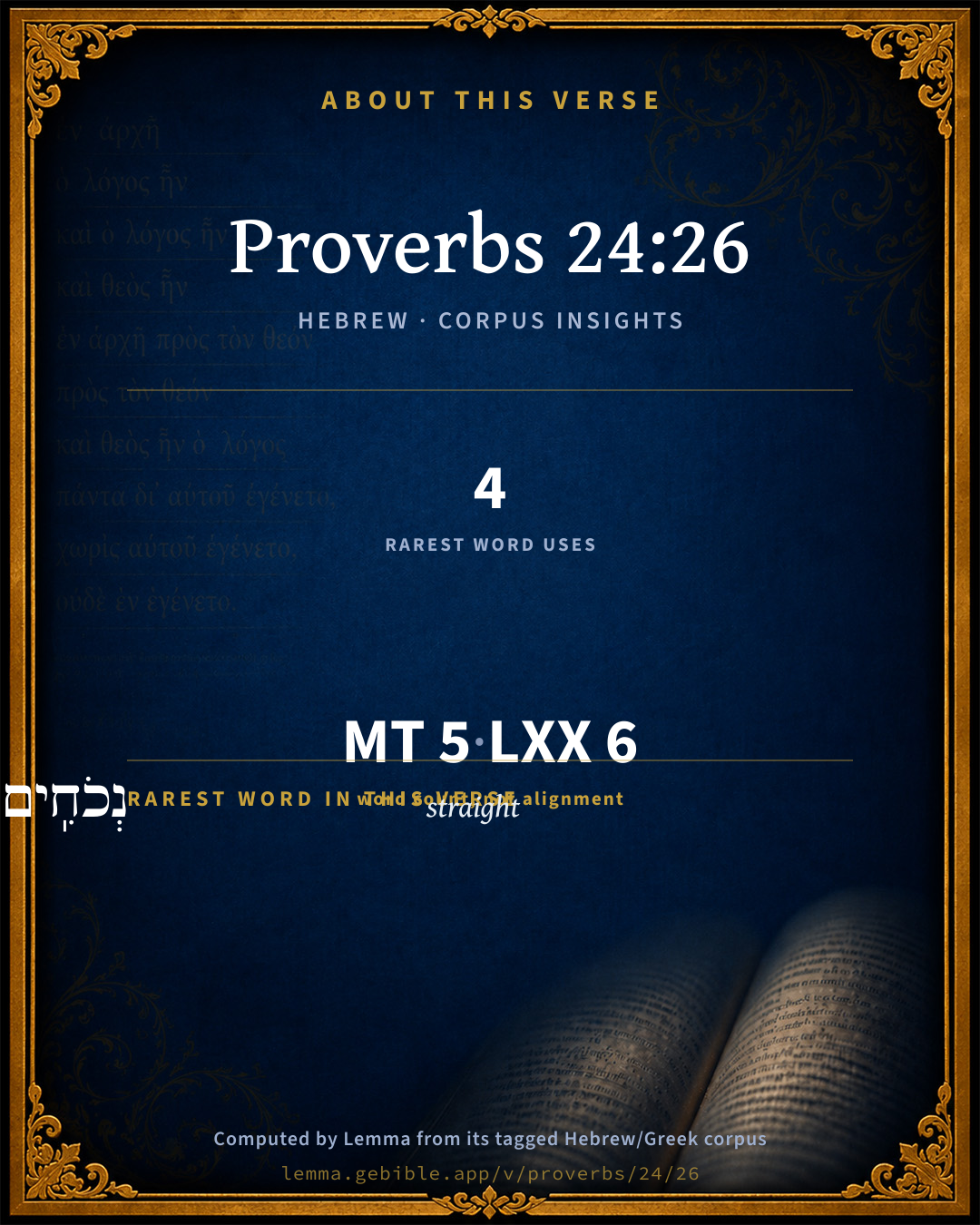
The rarest word here is נְכֹחִֽים straight H5228 — appearing just 4 times in the whole Hebrew Bible.

Shared distinctive vocabulary

נְכֹחִֽים straight H5228 occurs in 4 verses of the Hebrew Bible. Also found in:

Grammatical profile

  • 2 verbs
  • 2 nouns
  • 1 adjective

Verb forms

  • יִשָּׁ֑ק Qal · Imperfect
  • מֵ֝שִׁ֗יב Hiphil · Participle Active

Hebrew & Septuagint length

In English translation the verse runs 10 words from the Hebrew and 8 from the Septuagint (LXX English) — closely comparable.

A rough comparison of the two English renderings, which tokenize alike — not a word-level alignment.

Word counts can differ between the Hebrew and the Greek without any difference in meaning — e.g. the Hebrew direct-object marker אֵת has no separate Greek word, and Greek often adds the article ὁ.

In the original languages it is 5 Hebrew tokens and 6 Greek tokens — but the two are counted differently (Hebrew bundles its prefixes and suffixes into one token; the Greek is in lemma form), so that isn’t a like-for-like length.

Cross-references

8

Topical passages linked to Proverbs 24:26 in the Treasury of Scripture Knowledge — connected by theme and wording, ordered by reader-vote popularity; previews shown in the World English Bible.

  • Proverbs 15:23 Joy comes to a man with the reply of his mouth. How good is a word at the right time!
  • Genesis 41:38–57 Pharaoh said to his servants, "Can we find such a one as this, a man in whom is the Spirit of God?"
  • Proverbs 25:11–12 A word fitly spoken Is like apples of gold in settings of silver.
  • Job 6:25 How forcible are words of uprightness! But your reproof, what does it reprove?
  • Proverbs 16:1 The plans of the heart belong to man, But the answer of the tongue is from Yahweh.
  • Daniel 2:46–48 Then the king Nebuchadnezzar fell on his face, and worshiped Daniel, and commanded that they should offer an offering and sweet odors to him.
  • Mark 12:17–18 Jesus answered them, "Render to Caesar the things that are Caesar's, and to God the things that are God's." They marveled greatly at him.
  • Mark 12:32–34 The scribe said to him, "Truly, teacher, you have said well that he is one, and there is none other but he,

Cross-references courtesy of OpenBible.info (CC BY 4.0).

Hebrew and Greek witnesses Masoretic Hebrew ↔ Greek Septuagint

The same verse in the two great witnesses to the Old Testament, shown verse-for-verse.

These are two independent witnesses, not word-aligned to each other, and the Septuagint is shown in lemma (dictionary) form.

Hebrew Proverbs 24:26 Masoretic · Westminster Leningrad Codex

שְׂפָתַ֥יִם יִשָּׁ֑ק מֵ֝שִׁ֗יב דְּבָרִ֥ים נְכֹחִֽים

An honest answer Is like a kiss on the lips.

World English Bible · Public Domain

Greek LXX Proverbs 24:26 Septuagint · lemma form

χεῖλος δέ φιλέω ἀποκρίνω λόγος ἀγαθός

and men will kiss lips that answer well.

LXX2012 (modern English Septuagint) · Public Domain

On this verse, Whedon's Commentary on the Bible discusses the Septuagint’s reading. Read the note in Commentary ↓

Hebrew: Westminster Leningrad Codex (CC BY 4.0). Greek: Septuagint (public domain); English from LXX2012 (modern English Septuagint) (Public Domain). How the Septuagint differs from the Hebrew →

Commentary

Notes on Proverbs 24:26 from classic Christian and Jewish commentators (each source and its license shown beneath its notes). The classic Christian expositions comment on the surrounding passage and are grouped to its opening verse, so a note may address several verses; the Jewish commentaries on the Tanakh (Rashi and others) are per-verse, so they appear only where the commentator wrote on this verse.

Lemma curates 59 commentaries, every one of them public domain or Creative Commons licensed, each selected and text-cleaned for this edition rather than reprinted as found. About our sources →

Trapp's Complete Commentary

John Trapp

Pro 24:26 [Every man] shall kiss [his] lips that giveth a right answer.

Ver. 26. Every man shall kiss his lips.] That is, Shall do him honour, as Gen 41:40. All the people shall kiss at thy mouth, saith Pharaoh to Joseph; and Samuel kissed Saul when he anointed him king; {1Sa 10:1} and, "Kiss the Son," saith David. {Psa 2:12} That is, Give unto him the honour due unto his name.

John Trapp, A Commentary or Exposition upon All the Books of the Old and New Testament (1647–1656) — public domain. Text from a community e-Sword module.

Tyndale Open Study Notes

Tyndale Open Resources

24:26 Saying 2: A true friend does not cover up problems but honestly points out areas for improvement. A wise person welcomes the correction of a friend.

Tyndale Open Study Notes — © Tyndale Open Resources, licensed CC BY-SA 4.0. Text via the HelloAO Bible API.

Jamieson, Fausset & Brown

Robert Jamieson, A. R. Fausset & David Brown

kiss his lips--love and obey, do homage (Psa 2:12; Sol 8:1).

right answer--literally, "plain words" (compare Pro 8:9), opposed to deceptive, or obscure.

Jamieson, Fausset & Brown — Commentary Critical and Explanatory on the Whole Bible (1871) — public domain (CC PDM 1.0). Text via the HelloAO Bible API.

Adam Clarke's Commentary

Verse 26. Kiss his lips] Shall treat him with affection and respect.

Adam Clarke's Commentary on the Bible (1810–1826) — public domain. Text from a community e-Sword/MySword module.

Ellicott's Commentary for English Readers

(26) Every man shall kiss his lips . . . Rather, He kisseth the lips that giveth right answers. His words are as pleasant as if he had kissed the inquirer’s lips.

A Bible Commentary for English Readers, edited by Charles John Ellicott (1878–1897) — public domain. Text from a community e-Sword module.

The Cambridge Bible for Schools and Colleges

gen. ed. J. J. S. Perowne

26. Every man shall kiss his lips] Rather, he kisseth the lips, or with the lips: i.e. a right answer is as grateful and conciliating as a friendly salutation.

The Cambridge Bible for Schools and Colleges (gen. ed. J. J. S. Perowne; Cambridge University Press, 1878–1918) — public domain. Text from a community e-Sword module.

John Gill's Exposition

Be not a witness against thy neighbour without cause,.... Unless forced unto it, except there is some urgent reason for it; not upon any trivial account, or in any frivolous matter; never appear forward and eager to bear witness against him, and, whenever obliged to it, be not a false witness, but speak truth, whether thy neighbour be a friend or a foe;

and deceive not with thy lips; by bearing a false testimony, the judge, thy neighbour and thyself; for though men may be deceived, God cannot: or, shouldest thou do so, "thou wouldest break" and cut him to pieces "with thy lips" (x); which is the sense of the words according to R. Judah, as Ben Melech relates.

(x) "et ne atteras labiis tuis", Vatablus; "et ne comminuas eum labiis tuis", Syriac version.

John Gill's Exposition of the Whole Bible (1746–1763) — public domain (CC PDM 1.0). Text via the HelloAO Bible API.

Albert Barnes' Notes on the Bible

Better, He shall kiss lips that giveth a right answer, i. e., he shall gain the hearts of men as much as by all outward signs of sympathy and favor. Compare 2Sa 15:1-6.

Albert Barnes' Notes on the Bible (1834–1885) — public domain. Text from a community e-Sword/MySword module.

Haydock's Catholic Bible Commentary

Lips. And be deemed a friend. (Menochius)

George Leo Haydock (1774–1849), Haydock's Catholic Family Bible and Commentary, 1859 edition — public domain. Excludes Psalms (Douay-Rheims chapter numbering differs from Protestant) and Deuterocanonical books (Catholic canon only).

Matthew Poole's English Annotations

Every man shall kiss his lips, shall highly respect and love him, of which kissing was a sign,

that giveth a right answer; who being called to speak, either as a judge, or witness, or otherwise, in weighty matters, speaks pertinently, and plainly, and truly, to the conviction and satisfaction of the hearers.

Matthew Poole's English Annotations on the Holy Bible (1683–1685) — public domain. Text from a community e-Sword/MySword module.

Whedon's Commentary on the Bible

Daniel D. Whedon

26. Shall kiss lips that giveth a right answer — When a judge speaks upright words — gives a just decision — men salute him with respect and affection. Zockler says: Faithful and truthful answers affect one as favourably as the most agreeable caress. It is probable that there is here an allusion to the Eastern custom of kissing the writing which contains the order of a ruler or a judge. The passage is rendered by the Septuagint thus: “Lips shall kiss those things that answer (to) right words:” that is, those writings or decrees which correspond to the principles of equity and justice shall be treated with the utmost reverence. Compare Gen_27:26, Gen_29:11; Gen_29:13; Gen_33:4; Gen_48:10; Gen_50:1; 1Sa_10:1; 1Sa_20:41; 2Sa_20:9; 2Sa_15:5; Luk_9:38; Luk_15:20; Acts 20:39, etc.

Daniel D. Whedon (gen. ed.), Commentary on the Old and New Testaments (1874–1909) — public domain. Text from a community e-Sword module.

The Pulpit Commentary

A distich connected with the subject of the preceding paragraph. Every man shall kiss his lips that giveth a right answer; or better, he kisseth the lips who giveth a right answer. An answer that is fair and suitable to the circumstances is as pleasant and assuring to the bearers as a kiss on the lips. Such a salutation would be a natural sign of sympathy and affection. Thus Absalom won the hearts of the people by kissing those who came to court with their suits. (2Sa_15:5) In Gen_41:40, where the Authorized Version has, "According to thy word shall all my people be ruled," the Hebrew runs, "Thy mouth shall all my people kiss," i.e. they shall do homage to thee, which is another signification of this action. This, however, would not be suitable here, as the kiss is supposed to be given by the speaker, though the LXX mistakenly translates, "But men will kiss lips that answer good words.

Vers. 26-29. Just conduct to our neighbour.

I TRUE WITNESS. (Ver. 26) He who gives true and faithful answers especially in courts of justice delights, even as the sweetest kiss upon the mouth delights. The poet alludes to the effect upon the ear. The understanding can no more be delighted with a lie than the will can choose an apparent evil. "Strange as it may seem," says one playfully, "the human mind loses truth." We may add, "when passion does not blind the intellect to its beauty." In the court of justice, all but the guilty and those interested in his fate see the beauty of truth, and prize it above all things. Hence to speak the truth, the whole truth, and nothing but the truth, is the solemn oath of witnesses.

II FALSE AND UNCALLED-FOR WITNESS. (Ver. 28) To bear false witness strikes at the very root of conscience and moral obligation. But criminal, though in a less degree, is the volunteering of evidence without cause against another; i.e. when no object but private hatred and revenge is to be served. Compare the case of Doeg; (1Sa_22:9, 1Sa_22:10) the Pharisees with the wretched sinner in John 8; the words of the Lord in Joh_15:25. Speak evil of no man, not only that evil which is altogether false and groundless, but that which is true, when speaking of it will do more harm than good (Matthew Henry).

III DELIBERATE DECEPTION. About a court of justice, which represents truth, there gathers a dark shade of roguery and falsehood; "persons that are full of sinister tricks and shifts, whereby they pervert the plain and direct courses of courts, and bring justice into oblique lines and labyrinths.

IV BLIND INDULGENCE OF VINDICTIVE TEMPER. (Ver. 29; comp. Pro_20:22) Nothing is more deeply impressed in the Bible than the truth of compensation or retribution. But men must not take the law into their own hands. "Vengeance is mine, I will repay, saith Jehovah." "Revenge is a kind of wild justice, which the more man"s nature runs to, the more ought law to weed it out. In taking revenge a man is but even with his enemy; but in passing it over he is superior. It is the glory of a man to pass by an offence. The man who studies revenge keeps his own wounds green, which otherwise would heal and do well" (Bacon). J.

The Pulpit Commentary (1880–1919), ed. H.D.M. Spence-Jones & Joseph S. Exell — public domain. Text from a community e-Sword module.

John Wesley's Explanatory Notes

Shall kiss - Shall respect him. A right answer - That speaks pertinently and plainly, and truly.

John Wesley, Explanatory Notes Upon the Whole Bible (1754–1765) — public domain. Text via the GEBible commentary corpus.

Keil & Delitzsch

C. F. Keil & F. Delitzsch

Then follows a distich with the watchword נצחים:

26 He kisseth the lips

Who for the end giveth a right answer.

The lxx, Syr., and Targ. translate: one kisseth the lips who, or: of those who...; but such a meaning is violently forced into the word (in that case the expression would have been שׂפתי משׁיב or שׂפתים משׁיבים). Equally impossible is Theodotion's χείλεσι καταφιληθήσεται, for ישּׁק cannot be the fut. Niph. Nor is it: lips kiss him who... (Rashi); for, to be thus understood, the word ought to have been למשׁיב. משׁיב is naturally to be taken as the subj., and thus it supplies the meaning: he who kisseth the lips giveth an excellent answer, viz., the lips of him whom the answer concerns (Jerome, Venet., Luther). But Hitzig ingeniously, "the words reach from the lips of the speaker to the ears of the hearer, and thus he kisses his ear with his lips." But since to kiss the ear is not a custom, not even with the Florentines, then a welcome answer, if its impression is to be compared to a kiss, is compared to a kiss on the lips. Hitzig himself translates: he commends himself with the lips who...; but נשׁק may mean to join oneself, Gen 41:40, as kissing is equivalent to the joining of the lips; it does not mean intrans. to cringe. Rather the explanation: he who joins the lips together...; for he, viz., before reflecting, closed his lips together (suggested by Meri); but נשׁק, with שׂפתים, brings the idea of kissing, labra labris jungere, far nearer. This prevails against Schultens' armatus est (erit) labia, besides נשׁק, certainly, from the primary idea of connecting (laying together) (vid., Psa 78:9), to equip (arm) oneself therewith; but the meaning arising from thence: with the lips he arms himself... is direct nonsense. Fleischer is essentially right, Labra osculatur (i.e., quasi osculum oblatum reddit) qui congrua respondet. Only the question has nothing to do with a kiss; but if he who asks receives a satisfactory answer, an enlightening counsel, he experiences it as if he received a kiss. The Midrash incorrectly remarks under דּברים נצחים, "words of merited denunciation," according to which the Syr. translates. Words are meant which are corresponding to the matter and the circumstances, and suitable for the end (cf. Pro 8:9). Such words are like as if the lips of the inquirer received a kiss from the lips of the answerer.

Keil & Delitzsch — Biblical Commentary on the Old Testament (1861–1891) — public domain (CC PDM 1.0). Text via the HelloAO Bible API. (Old Testament only.)

Kretzmann's Popular Commentary

Paul E. Kretzmann

v. 26. Every man shall kiss his lips that giveth a right answer, rather, "A kiss upon the lips does he bestow who returns well-pleasing words," that is, a faithful and favorable answer, especially before a court of justice, is like a most agreeable caress.

Paul E. Kretzmann, Popular Commentary of the Bible (1921–1924) — public domain. Text from a community e-Sword module.

unfoldingWord translationNotes

Door43 World Missions Community

gives a kiss on the lips

A kiss was a sign of respect and devotion in that culture. AT: "shows true friendship" (See: Idiom)

translationWords

kiss

house

unfoldingWord translationNotes — © Distant Shores Media and the Door43 World Missions Community, licensed CC BY-SA 4.0. Source: git.door43.org/Door43/en_tn.

Rashi

Rabbi Shlomo Yitzchaki (Rashi)

Lips should kiss It is fitting that all lips kiss him.

Rashi on the Tanakh — English translations: “The Judaica Press complete Tanach with Rashi, translated by A. J. Rosenberg” (CC BY 4.0); “Pentateuch with Rashi's commentary by M. Rosenbaum and A.M. Silbermann, 1929-1934” (public domain); “The Metsudah Tanach series, Lakewood, N.J” (CC BY 4.0); and “The Book of Joshua, Metsudah Publications, 1997” (CC BY 4.0). Text via Sefaria.

Lesson kit

Teaching starters — assembled from the data on this page, not authored interpretation. Every prompt links to the verse data it draws on. Edit before teaching.

Proverbs, in the Wisdom, opens this verse with 5 words (5 distinct Hebrew lemmas). Its most distinctive word is nâkôach (“straight”). A historical commentator’s framing appears above. Read the whole chapter for the surrounding context.

Discussion questions

  1. What does “straight” (nâkôach) contribute to the verse as a whole?
  2. How does 2 Samuel 15:3, which shares the word «straight», read alongside this verse?
  3. These translations render this verse differently. What is at stake in choosing one wording over another?
  4. «יִשָּׁ֑ק» is a Qal Imperfect verb. How does that grammatical form shape the action described?
  5. Compare how Trapp's Complete Commentary and Tyndale Open Study Notes read this verse. Where do they agree or differ?

Things to notice

Reading settings

Reading text

Shown beneath each verse's original-language words.

Old Testament
Old Testament edition

Read the OT as the Masoretic Hebrew (MT) or the Greek Septuagint (LXX).

English shown for the Greek Septuagint (in the Hebrew ↔ Greek comparison).

Comparing translations? Open the Compare panel on any verse page to stack up to four side by side.