
Proverbs 5:2

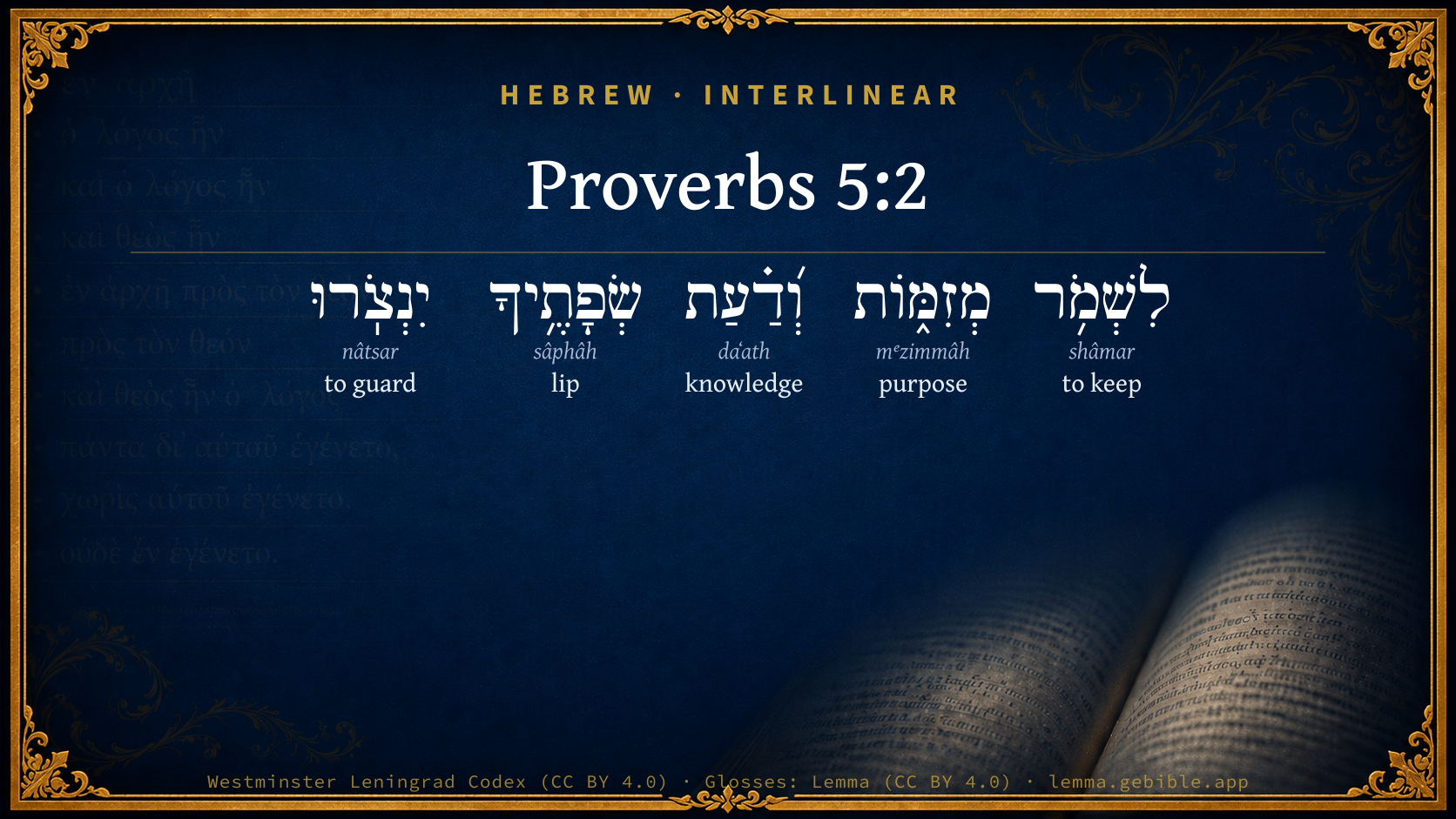
Hebrew (Westminster Leningrad Codex) Proverbs 5:2 appears in the Hebrew Old Testament. The text above is from the Westminster Leningrad Codex. Each word links to its Strong’s number, a concise gloss, and parsing drawn from the Open Scriptures Hebrew Bible morphology. Click any word for its full Brown-Driver-Briggs (BDB) entry.
Download image
Cite this verse

Proverbs 5:2 (World English Bible). Public Domain. Lemma interlinear Bible study tool, https://lemma.gebible.app/v/proverbs/5/2.

Show BibTeX & RIS
BibTeX
RIS
English Translation
That you may maintain discretion, That your lips may preserve knowledge.
World English Bible · Public Domain
Download a study sheet

One document with this verse’s original text, its word-by-word gloss line, the meaning frame, cross-references with their text, attributed commentary, and full source and license credits — printable, and it pastes into notes with its structure intact.

This verse Autodidact and up

Study sheet (.html) Plain text (.txt)

A passage Seminary Student

Up to 50 verses in one chapter. A passage sheet keeps up to 6 commentary sources and 12 cross-references per verse, in the order this page ranks them, and says so on the sheet whenever that leaves anything out. Ask for a single verse and you get the Autodidact verse sheet above.

Everything on this page stays free to read, with no account — the sheet is a download of what is already on screen, not access to it.

Want to remove ads? Support Godless Engineer
Compare translations 3

The same verse in 3 English versions, stacked beneath the original-language interlinear above. Click any original word for its lexicon entry.

Each is an independent rendering of the whole verse — the interlinear is not word-aligned to these translations.

Highlighted words mark where these versions differ — a whole-verse word diff, not a word-by-word alignment.

  • World English Bible Public Domain
    That you may maintain discretion, That your lips may preserve knowledge.
  • King James Version Public Domain
    That thou mayest regard discretion, and that thy lips may keep knowledge.
  • unfoldingWord Literal Text CC BY-SA 4.0
    in order to keep discretion, and your lips may guard knowledge.

unfoldingWord Literal Text — © unfoldingWord, licensed CC BY-SA 4.0. Word-aligned USFM3 via Door43 (git.door43.org/unfoldingWord/en_ult).

Versions to compare (up to 4)

3 of 4 selected

Show all 18 translations

Every available English version of this verse, each an independent rendering of the whole verse.

  • World English Bible Public Domain
    That you may maintain discretion, That your lips may preserve knowledge.
  • Berean Standard Bible Public Domain
    that you may maintain discretion and your lips may preserve knowledge.
  • Majority Standard Bible Public Domain
    that you may maintain discretion and your lips may preserve knowledge.
  • King James Version Public Domain
    That thou mayest regard discretion, and that thy lips may keep knowledge.
  • American Standard Version (1901) Public Domain
    That thou mayest preserve discretion, And that thy lips may keep knowledge.
  • Revised Version (1885) Public Domain
    That thou mayest preserve discretion, and that thy lips may keep knowledge.
  • Geneva Bible (1599) Public Domain
    That thou maiest regarde counsell, and thy lippes obserue knowledge.
  • Douay-Rheims (1899) Public Domain
    That thou mayst keep thoughts, and thy lips may preserve instruction. Mind not the deceit of a woman.
  • Young's Literal Translation Public Domain
    To observe thoughtfulness, And knowledge do thy lips keep.
  • Literal Standard Version CC BY-SA 4.0
    To observe thoughtfulness, || And your lips keep knowledge.
  • Unlocked Literal Bible CC BY-SA 4.0
    so you may learn about discretion and your lips may protect knowledge.
  • unfoldingWord Literal Text CC BY-SA 4.0
    in order to keep discretion, and your lips may guard knowledge.
  • Darby Bible Public Domain
    that thou mayest keep reflection, and that thy lips may preserve knowledge.
  • World Messianic Bible Public Domain
    that you may maintain discretion, that your lips may preserve knowledge.
  • Webster's Bible Public Domain
    That thou mayest regard discretion, and that thy lips may keep knowledge.
  • Free Bible Version CC BY-SA 4.0
    so you can make good decisions and protect knowledge with your lips.
  • Bible in Basic English Public Domain
    So that you may be ruled by a wise purpose, and your lips may keep knowledge.
  • JPS Tanakh (1917) Public Domain
    That thou mayest preserve discretion, and that thy lips may keep knowledge.

Literal Standard Version (2020), Covenant Press — licensed CC BY-SA 4.0. Text via the HelloAO Bible API (eBible.org). Unlocked Literal Bible (unfoldingWord) — licensed CC BY-SA 4.0. Text via the HelloAO Bible API (eBible.org). unfoldingWord Literal Text — © unfoldingWord, licensed CC BY-SA 4.0. Word-aligned USFM3 via Door43 (git.door43.org/unfoldingWord/en_ult). Free Bible Version, Dr. Jonathan Gallagher — licensed CC BY-SA 4.0. Text via the HelloAO Bible API (eBible.org).

Word by word

More ways to search: Search by grammar → Find every occurrence → Compare this word →

Practice this passage: Drill this verse → Learn its vocabulary →

About this verse

These counts appear in no published source. They are computed here, from the morphology-tagged text and Lemma’s own curated glosses. What Lemma adds →

5
words
5
distinct lemmas
Wisdom
section

Notable vocabulary

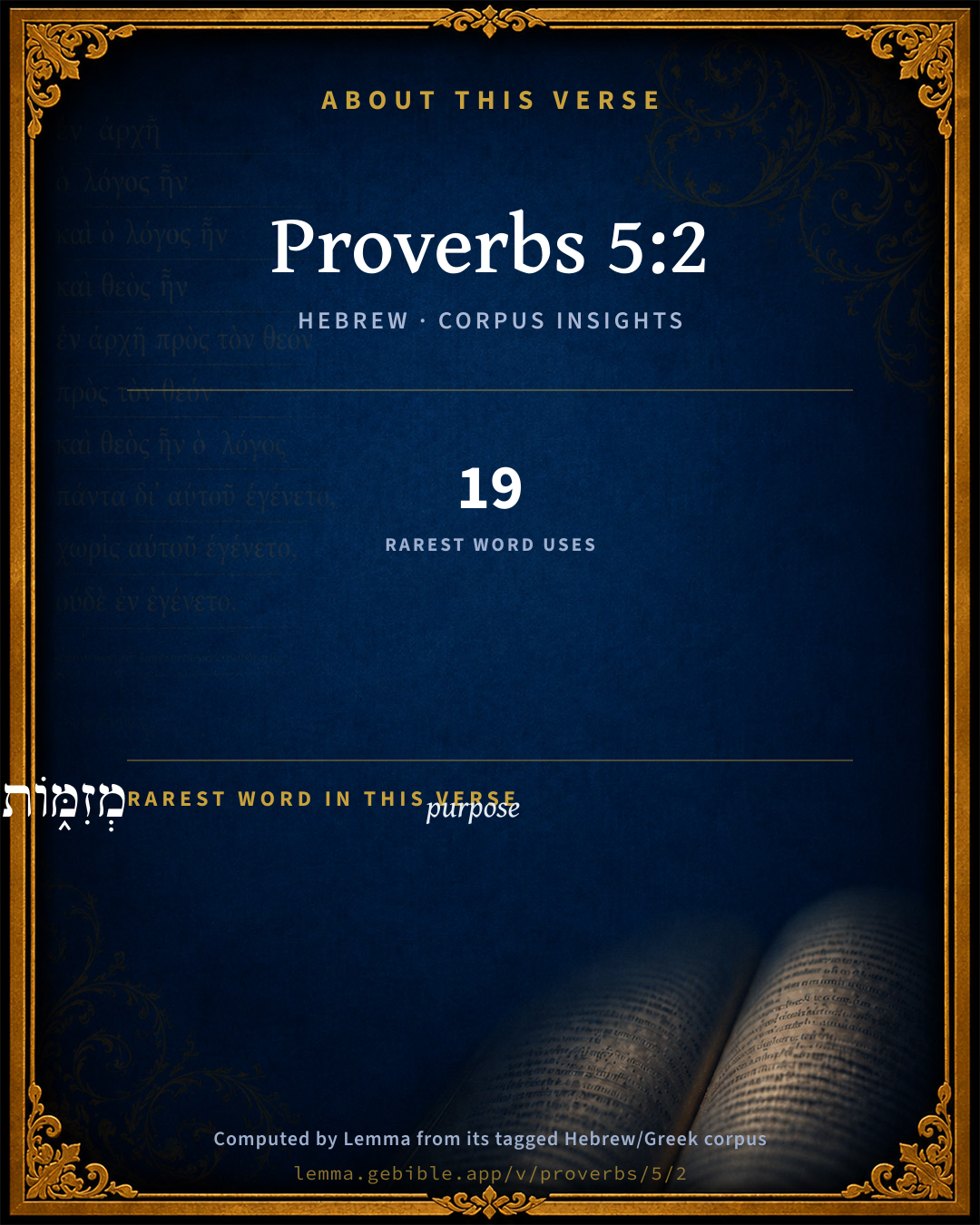
The rarest word here is מְזִמּ֑וֹת purpose H4209 — appearing just 19 times in the whole Hebrew Bible.

Shared distinctive vocabulary

מְזִמּ֑וֹת purpose H4209 occurs in 19 verses of the Hebrew Bible. Also found in:

Grammatical profile

  • 2 verbs
  • 3 nouns

Verb forms

  • לִשְׁמֹ֥ר Qal · Infinitive Construct
  • יִנְצֹֽרוּ Qal · Imperfect

Hebrew & Septuagint length

In English translation the verse runs 11 words from the Hebrew and 23 from the Septuagint (LXX English) — the Septuagint runs noticeably longer here. See the side-by-side →

A rough comparison of the two English renderings, which tokenize alike — not a word-level alignment.

Word counts can differ between the Hebrew and the Greek without any difference in meaning — e.g. the Hebrew direct-object marker אֵת has no separate Greek word, and Greek often adds the article ὁ.

Cross-references

10

Topical passages linked to Proverbs 5:2 in the Treasury of Scripture Knowledge — connected by theme and wording, ordered by reader-vote popularity; previews shown in the World English Bible.

  • Proverbs 15:7 The lips of the wise spread knowledge; Not so with the heart of fools.
  • Proverbs 16:23 The heart of the wise instructs his mouth, And adds learning to his lips.
  • Malachi 2:6–7 The law of truth was in his mouth, and unrighteousness was not found in his lips. He walked with me in peace and uprightness, and turned many away from iniquity.
  • Song of Solomon 4:11 Your lips, my bride, drip like the honeycomb. Honey and milk are under your tongue. The smell of your garments is like the smell of Lebanon.
  • Psalms 45:2 You are the most excellent of the sons of men. Grace has anointed your lips, Therefore God has blessed you forever.
  • Psalms 71:15 My mouth will tell about your righteousness, And of your salvation all day, Though I don't know its full measure.
  • Psalms 119:13 With my lips, I have declared all the ordinances of your mouth.
  • Proverbs 10:21 The lips of the righteous feed many, But the foolish die for lack of understanding.
  • Proverbs 15:2 The tongue of the wise commends knowledge, But the mouth of fools gush out folly.
  • Proverbs 20:15 There is gold and abundance of rubies; But the lips of knowledge are a rare jewel.

Cross-references courtesy of OpenBible.info (CC BY 4.0).

Hebrew and Greek witnesses Masoretic Hebrew ↔ Greek Septuagint

The same verse in the two great witnesses to the Old Testament, shown verse-for-verse.

Here the Septuagint runs noticeably longer than the Hebrew — LXX2012 (modern English Septuagint) 23 words vs World English Bible 11. A rough length comparison of the two English translations, not a word-level alignment — read both below.

These are two independent witnesses, not word-aligned to each other, and the Septuagint is shown in lemma (dictionary) form.

Hebrew Proverbs 5:2 Masoretic · Westminster Leningrad Codex

לִשְׁמֹ֥ר מְזִמּ֑וֹת וְ֝דַ֗עַת שְׂפָתֶ֥יךָ יִנְצֹֽרוּ

That you may maintain discretion, That your lips may preserve knowledge.

World English Bible · Public Domain

Greek LXX Proverbs 5:2 Septuagint · lemma form

ἵνα φυλάσσω ἔννοια ἀγαθός αἴσθησις δέ ἐμός χεῖλος ἐντέλλομαι σύ

that you may keep good understanding, and the discretion of my lips gives you a charge. Give no heed to a worthless woman;

LXX2012 (modern English Septuagint) · Public Domain

On this verse, John Gill's Exposition discusses the Septuagint’s reading. Read the note in Commentary ↓

Hebrew: Westminster Leningrad Codex (CC BY 4.0). Greek: Septuagint (public domain); English from LXX2012 (modern English Septuagint) (Public Domain). How the Septuagint differs from the Hebrew →

Commentary

Notes on Proverbs 5:2 from classic Christian and Jewish commentators (each source and its license shown beneath its notes). The classic Christian expositions comment on the surrounding passage and are grouped to its opening verse, so a note may address several verses; the Jewish commentaries on the Tanakh (Rashi and others) are per-verse, so they appear only where the commentator wrote on this verse.

Lemma curates 59 commentaries, every one of them public domain or Creative Commons licensed, each selected and text-cleaned for this edition rather than reprinted as found. About our sources →

Trapp's Complete Commentary

John Trapp

Pro 5:2 That thou mayest regard discretion, and [that] thy lips may keep knowledge.

Ver. 2. That thou mayest regard discretion.] Or, That thou mayest keep in thy thoughts, as Job did, {Job 31:1} "Why then should I think upon a maid?" "Out of the hearts of men proceed evil thoughts, adulteries, fornications," &c., saith our Saviour. {Mar 7:21} Many men’s hearts are no better than stews and brothel houses, by reason of base and beastly thoughts and lusts that muster and swarm there, like the flies of Egypt. "There is that leviathan, and there are creeping things innumerable." {Psa 104:25-26} Yea, the hypocrite, who outwardly abstains from gross sins, yet inwardly consenteth with the thief, and partaketh with the adulterer, {Psa 50:18-19} that is, in his heart and fancy, supposing himself with them, and desiring to do what they do. This is mental adultery, this is contemplative wickedness. So it is also to recall former filthiness with delight. She multiplied her whoredoms in calling to remembrance the days of her youth, wherein she had played the harlot. {Eze 23:21} Surely as a man may die of an inward bleeding, so may he be damned for these inward boilings of lust and concupiscence, if not bewailed and mortified. {Jer 4:14} "The thoughts of the wicked are abominable to the Lord." {Pro 15:26} To look and lust is to commit adultery. {Mat 5:28} Therefore "desire not her beauty in thy heart." {Pro 6:25}

And that thy lips may keep knowledge.] As Joseph did in answering his wanton mistress; {Gen 39:7-9} as he in Augustine did, that replied to his minions, Ego sum - It is I, at ego non sum - but it it is not I.

John Trapp, A Commentary or Exposition upon All the Books of the Old and New Testament (1647–1656) — public domain. Text from a community e-Sword module.

The Biblical Illustrator

Joseph S. Exell

Pro_5:2

That thou mayest regard discretion.

The wise mans intention in giving advice

Some knit these words to what follows, and understand them thus: I wish thee to hearken to wise counsels, that thy heart may not admit thoughts of the beauty of strumpets, nor thy lips talk of such wanton objects as they talk of, but that thy thoughts and words may be sober and honest. Others knit them to the words before, as if he had said, Observe my wise precepts, that thou mayest well ruminate of them, and be so full of good thoughts in thy heart, that thou mayest be able to produce them copiously in thy words for the good of others, as I do for thine. But especially that thou mayest know what to think and speak of strumpets fair words and alluring carriage.

I. A readiness to attend will bring a store of knowledge.

II. Let us get ready ears and hearts to get knowledge.

III. Good things heard must be seriously thought on, then and after.

IV. We must labour to know so as not only to understand, but also to utter what we know in fit words. That we may profit others. (Francis Taylor, B. D.)

The Biblical Illustrator, edited by Joseph S. Exell (c. 1880s–1900s) — public domain. Text from a community e-Sword module.

Jamieson, Fausset & Brown

Robert Jamieson, A. R. Fausset & David Brown

regard--or, "observe."

keep--preserve constantly.

Jamieson, Fausset & Brown — Commentary Critical and Explanatory on the Whole Bible (1871) — public domain (CC PDM 1.0). Text via the HelloAO Bible API.

The Cambridge Bible for Schools and Colleges

gen. ed. J. J. S. Perowne

2. regard] Rather, preserve, R.V. Comp. keep in the parallel clause of the verse.

The Cambridge Bible for Schools and Colleges (gen. ed. J. J. S. Perowne; Cambridge University Press, 1878–1918) — public domain. Text from a community e-Sword module.

John Gill's Exposition

That thou mayest regard discretion,.... Observe it; retain it in thine heart, as Aben Ezra adds, and use it; think, speak, and act discreetly, and so avoid the bad woman afterwards described: the Vulgate Latin version is, "that thou mayest keep the thoughts"; and so Gersom interprets the word; "good thoughts", according to the Septuagint version; the thoughts of the heart are to be observed. A man of spiritual wisdom will take notice of them; evil thoughts, which lead to uncleanness, are to be repressed and kept in; good ones to be cherished and improved; wise and sagacious ones (such the word here used signifies) are to be attended to, as being of great advantage in the various affairs and business of life; and spiritual and evangelical wisdom helps to such thoughts, and directs to the observance and exercise of them;

and that thy lips may keep knowledge; may be able to speak of things worthy to be known, and communicate the knowledge of them to others; by which means useful knowledge will be kept and preserved, and be continued in successive ages; see Mal 2:7; even the knowledge of God and of Christ, and of the Gospel and its doctrines; and which will be a means of preserving men, as from false doctrine, error, and heresy, so from profaneness and immorality; and particularly from the adulterous woman, next described.

John Gill's Exposition of the Whole Bible (1746–1763) — public domain (CC PDM 1.0). Text via the HelloAO Bible API.

Albert Barnes' Notes on the Bible

And that thy lips may keep - literally, “and thy lips shall keep.”

Albert Barnes' Notes on the Bible (1834–1885) — public domain. Text from a community e-Sword/MySword module.

Haydock's Catholic Bible Commentary

Thoughts. Or wisdom; and act with discretion. --- Mind, &c., is omitted in Hebrew and St. Jerome. (Calmet) --- By woman all concupiscence, or the inducement to sin, is commonly understood. We must not think of such things. (Worthington)

George Leo Haydock (1774–1849), Haydock's Catholic Family Bible and Commentary, 1859 edition — public domain. Excludes Psalms (Douay-Rheims chapter numbering differs from Protestant) and Deuterocanonical books (Catholic canon only).

Matthew Poole's English Annotations

Regard, or, keep, i.e. hold fast, as it is in the next clause. Discretion; spiritual wisdom for the conduct of thy life, as this word is used Pro 1:4, and elsewhere in this book.

That thy lips may keep knowledge; that by wise and pious discourses thou mayst preserve and improve thy wisdom for thine own and others’ good.

Matthew Poole's English Annotations on the Holy Bible (1683–1685) — public domain. Text from a community e-Sword/MySword module.

Whedon's Commentary on the Bible

Daniel D. Whedon

2. Discretion — Or, counsels.

That thy lips may keep — Thy lips shall keep.

Daniel D. Whedon (gen. ed.), Commentary on the Old and New Testaments (1874–1909) — public domain. Text from a community e-Sword module.

The Pulpit Commentary

This verse expresses the purposes or results of the preceding admonition. The first is, that thou mayest regard discretion (Hebrew, lishmor m"zimmoth); literally, to guard reflection; i.e. in other words, that thou mayest maintain thoughtfulness, observe counsel, set a proper guard or control over thy thoughts, and so restrain them within proper and legitimate limits, or form such resolutions which, being well considered and prudential, may result in prudent conduct. The word m"zimmoth, however, does not travel beyond the sphere of what is conceived in the mind, and consequently does not mean conduct (as Holden conceives), except in a secondary sense, as that thoughts and plans are the necessary preliminaries to action and conduct. Muffet, in loc., explains, "that thou mayest not conceive in mind any evil or vanity." The word m"zimmoth is the plural of m"zimmmah, which occurs in Pro_1:4. This word generally means any plan, project, device, either in a good or bad sense. In the latter sense it is applied to intrigue and deceitful conduct, as in Pro_24:8. It is here used in a good sense. Indeed, Delitzsch remarks that the use of the word in a good sense is peculiar to the introductory part of the Proverbs (ch. 1-9). The Vulgate renders. "That thou mayest guard thy thoughts or reflection (ut custodias cogitationes)." So the LXX, Ina fulaxhv ennoian agayhn , "That thou mayest guard good reflection," the adjective agayh being introduced to note the sense in which the ennoia , i.e. act of thinking, properly, is to be understood. The prefix li ("to") before shamar, "to guard," in lishmor, expresses the purpose, as in Pro_1:5 Pro_2:2, et alia. The second end in view is, that thy lips may keep knowledge; literally, and thy lips shall keep knowledge. Those lips keep or preserve knowledge which literally retain the instruction of Wisdom (Zockler), or which allow nothing to pass them which does not proceed from the knowledge of God (Delitzsch), and which, when they speak, give utterance to sound wisdom. The meaning may be illustrated by Psa_17:3, "I am purposed that my mouth shall not transgress." The same expression occurs Mal_2:7, "For the priest"s lips should keep knowledge," i.e. preserve and give utterance to it. Where "the lips keep knowledge," there they are protected against the lips of the strange woman, i.e. against her allurements, because they will be fortified with purity. Thy lips; s"phatheyka is the dual of the feminine noun saphah, "a lip." The teacher designedly uses this word instead of "thy heart", (cf. Pro_3:1) because of the contrast which he has in mind, and which be produces in the next verse. The LXX, Vulgate. and Arabic add, "Attend not to the deceitful woman," which Houbigant and Schleusner think is required by the context. The addition, however, is without authority (Holden).

The Pulpit Commentary (1880–1919), ed. H.D.M. Spence-Jones & Joseph S. Exell — public domain. Text from a community e-Sword module.

Lesson kit

Teaching starters — assembled from the data on this page, not authored interpretation. Every prompt links to the verse data it draws on. Edit before teaching.

Proverbs, in the Wisdom, opens this verse with 5 words (5 distinct Hebrew lemmas). Its most distinctive word is mᵉzimmâh (“purpose”). The Greek Septuagint runs longer here. A historical commentator’s framing appears above. Read the whole chapter for the surrounding context.

Discussion questions

  1. What does “purpose” (mᵉzimmâh) contribute to the verse as a whole?
  2. Job 21:27 shares the word «purpose» with this verse. How do the two illuminate each other?
  3. Compared with the Hebrew, the Septuagint runs longer here. What questions does that raise?
  4. The translations on this page render this verse differently — a whole-verse word diff, not a word-by-word alignment. What might account for the different wordings?
  5. The verb «לִשְׁמֹ֥ר» is Qal Infinitive Construct. How does its form color the action?
  6. Reading how Trapp's Complete Commentary and The Biblical Illustrator read this verse, where do the two commentators agree and where do they part?

Things to notice

Reading settings

Reading text

Shown beneath each verse's original-language words.

Old Testament
Old Testament edition

Read the OT as the Masoretic Hebrew (MT) or the Greek Septuagint (LXX).

English shown for the Greek Septuagint (in the Hebrew ↔ Greek comparison).

Comparing translations? Open the Compare panel on any verse page to stack up to four side by side.