
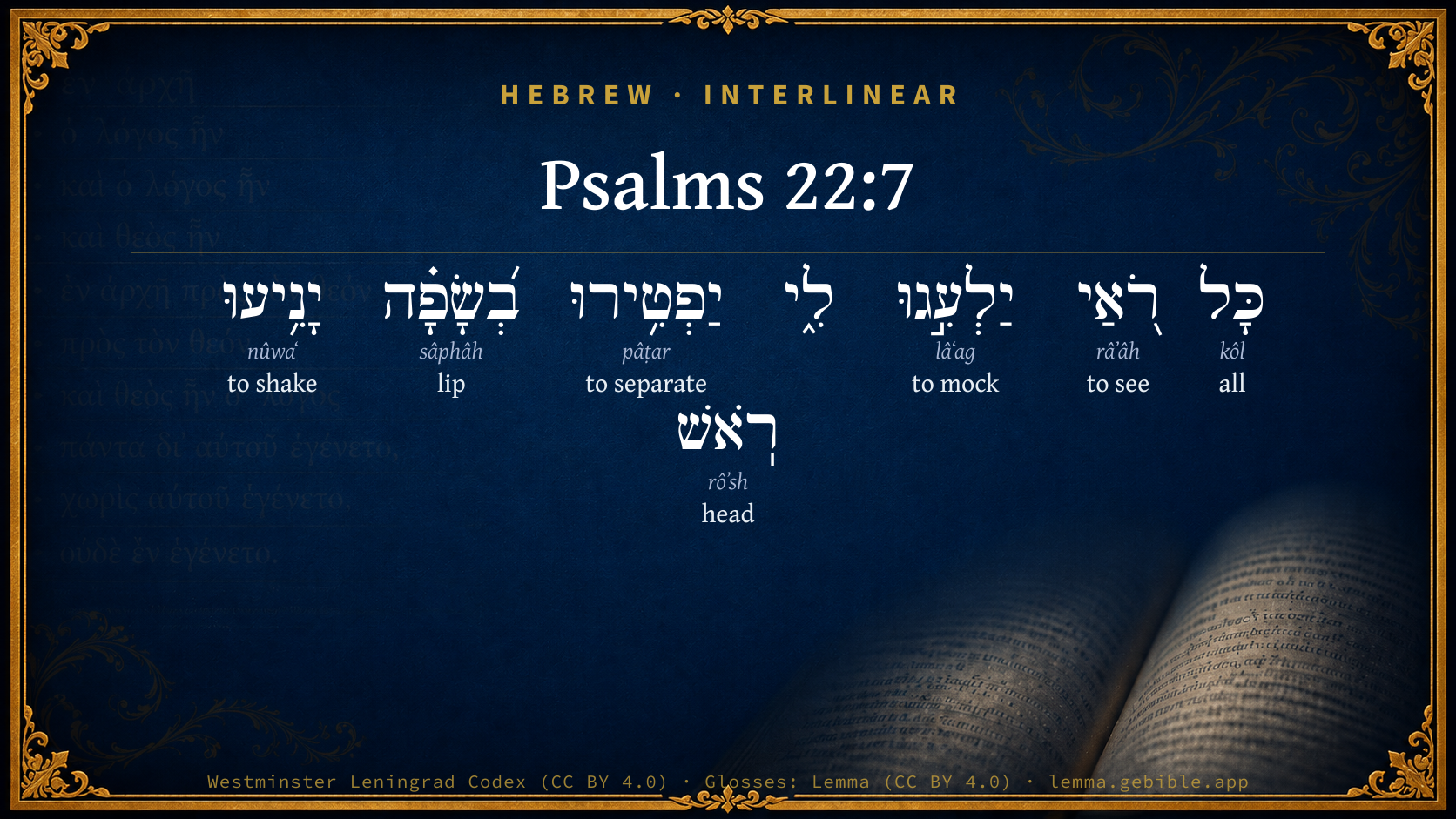
Psalms 22:7

Hebrew (Westminster Leningrad Codex) Psalms 22:7 appears in the Hebrew Old Testament. The text above is from the Westminster Leningrad Codex. Each word links to its Strong’s number, a concise gloss, and parsing drawn from the Open Scriptures Hebrew Bible morphology. Click any word for its full Brown-Driver-Briggs (BDB) entry.
Download image
Cite this verse

Psalms 22:7 (World English Bible). Public Domain. Lemma interlinear Bible study tool, https://lemma.gebible.app/v/psalms/22/7.

Show BibTeX & RIS
BibTeX
RIS
English Translation
All those who see me mock me. They insult me with their lips. They shake their heads, saying,
World English Bible · Public Domain
Download a study sheet

One document with this verse’s original text, its word-by-word gloss line, the meaning frame, cross-references with their text, attributed commentary, and full source and license credits — printable, and it pastes into notes with its structure intact.

This verse Autodidact and up

Study sheet (.html) Plain text (.txt)

A passage Seminary Student

Up to 50 verses in one chapter. A passage sheet keeps up to 6 commentary sources and 12 cross-references per verse, in the order this page ranks them, and says so on the sheet whenever that leaves anything out. Ask for a single verse and you get the Autodidact verse sheet above.

Everything on this page stays free to read, with no account — the sheet is a download of what is already on screen, not access to it.

Want to remove ads? Support Godless Engineer
Compare translations 3

The same verse in 3 English versions, stacked beneath the original-language interlinear above. Click any original word for its lexicon entry.

Each is an independent rendering of the whole verse — the interlinear is not word-aligned to these translations.

Highlighted words mark where these versions differ — a whole-verse word diff, not a word-by-word alignment.

  • World English Bible Public Domain
    All those who see me mock me. They insult me with their lips. They shake their heads, saying,
  • King James Version Public Domain
    All they that see me laugh me to scorn: they shoot out the lip, they shake the head, saying,
  • unfoldingWord Literal Text CC BY-SA 4.0
    All of the ones seeing me mock me; they open wide with the lip. They shake the head,

unfoldingWord Literal Text — © unfoldingWord, licensed CC BY-SA 4.0. Word-aligned USFM3 via Door43 (git.door43.org/unfoldingWord/en_ult).

Versions to compare (up to 4)

3 of 4 selected

Show all 18 translations

Every available English version of this verse, each an independent rendering of the whole verse.

  • World English Bible Public Domain
    All those who see me mock me. They insult me with their lips. They shake their heads, saying,
  • Berean Standard Bible Public Domain
    All who see me mock me; they sneer and shake their heads:
  • Majority Standard Bible Public Domain
    All who see me mock me; they sneer and shake their heads:
  • King James Version Public Domain
    All they that see me laugh me to scorn: they shoot out the lip, they shake the head, saying,
  • American Standard Version (1901) Public Domain
    All they that see me laugh me to scorn: They shoot out the lip, they shake the head, `saying',
  • Revised Version (1885) Public Domain
    All they that see me laugh me to scorn: they shoot out the lip, they shake the head, saying,
  • Geneva Bible (1599) Public Domain
    All they that see me, haue me in derision: they make a mowe and nod the head, saying,
  • Douay-Rheims (1899) Public Domain
    But I am a worm, and no man: the reproach of men, and the outcast of the people.
  • Young's Literal Translation Public Domain
    All beholding me do mock at me, They make free with the lip -- shake the head,
  • Literal Standard Version CC BY-SA 4.0
    All beholding Me mock at Me, || They make free with the lip—shake the head,
  • Unlocked Literal Bible CC BY-SA 4.0
    All those who see me taunt me; they mock me; they shake their heads at me.
  • unfoldingWord Literal Text CC BY-SA 4.0
    All of the ones seeing me mock me; they open wide with the lip. They shake the head,
  • Darby Bible Public Domain
    All they that see me laugh me to scorn; they shoot out the lip, they shake the head, [saying:]
  • World Messianic Bible Public Domain
    All those who see me mock me. They insult me with their lips. They shake their heads, saying,
  • Webster's Bible Public Domain
    \\22:6\\But I am a worm, and no man; a reproach of men, and despised by the people.
  • Free Bible Version CC BY-SA 4.0
    People who see me mock me. They laugh at me and shake their heads, saying,
  • Bible in Basic English Public Domain
    I am laughed at by all those who see me: pushing out their lips and shaking their heads they say,
  • JPS Tanakh (1917) Public Domain
    (22-8) All they that see me laugh me to scorn; they shoot out the lip, they shake the head:

Literal Standard Version (2020), Covenant Press — licensed CC BY-SA 4.0. Text via the HelloAO Bible API (eBible.org). Unlocked Literal Bible (unfoldingWord) — licensed CC BY-SA 4.0. Text via the HelloAO Bible API (eBible.org). unfoldingWord Literal Text — © unfoldingWord, licensed CC BY-SA 4.0. Word-aligned USFM3 via Door43 (git.door43.org/unfoldingWord/en_ult). Free Bible Version, Dr. Jonathan Gallagher — licensed CC BY-SA 4.0. Text via the HelloAO Bible API (eBible.org).

Word by word

More ways to search: Search by grammar → Find every occurrence → Compare this word →

Practice this passage: Drill this verse → Learn its vocabulary →

About this verse

These counts appear in no published source. They are computed here, from the morphology-tagged text and Lemma’s own curated glosses. What Lemma adds →

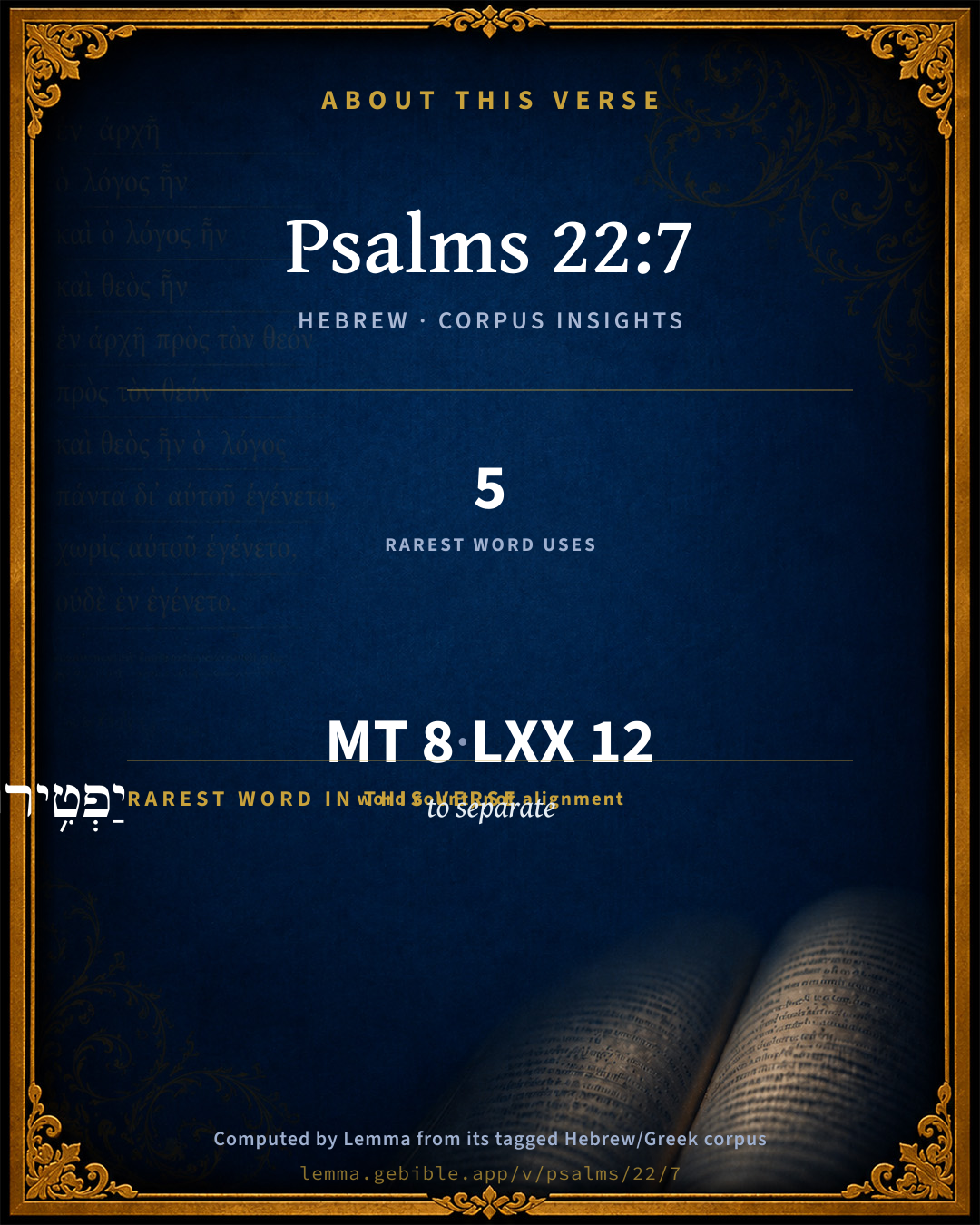
8
words
7
distinct lemmas
Wisdom
section

Notable vocabulary

The rarest word here is יַפְטִ֥ירוּ to separate H6362 — appearing just 5 times in the whole Hebrew Bible.

Shared distinctive vocabulary

יַפְטִ֥ירוּ to separate H6362 occurs in 5 verses of the Hebrew Bible. Also found in:

Grammatical profile

  • 4 verbs
  • 3 nouns
  • 1 preposition

Verb forms

  • רֹ֭אַי Qal · Participle Active
  • יַלְעִ֣גוּ Hiphil · Imperfect
  • יַפְטִ֥ירוּ Hiphil · Imperfect
  • יָנִ֥יעוּ Hiphil · Imperfect

Hebrew & Septuagint length

In English translation the verse runs 18 words from the Hebrew and 16 from the Septuagint (LXX English) — closely comparable.

A rough comparison of the two English renderings, which tokenize alike — not a word-level alignment.

Word counts can differ between the Hebrew and the Greek without any difference in meaning — e.g. the Hebrew direct-object marker אֵת has no separate Greek word, and Greek often adds the article ὁ.

In the original languages it is 8 Hebrew tokens and 12 Greek tokens — but the two are counted differently (Hebrew bundles its prefixes and suffixes into one token; the Greek is in lemma form), so that isn’t a like-for-like length.

Cross-references

19

Topical passages linked to Psalms 22:7 in the Treasury of Scripture Knowledge — connected by theme and wording, ordered by reader-vote popularity; previews shown in the World English Bible.

  • Mark 15:29 Those who passed by blasphemed him, wagging their heads, and saying, "Ha! You who destroy the temple, and build it in three days,
  • Matthew 27:39–40 Those who passed by blasphemed him, wagging their heads,
  • Psalms 109:25 I have also become a reproach to them. When they see me, they shake their head.
  • Luke 23:11 Herod with his soldiers humiliated him and mocked him. Dressing him in luxurious clothing, they sent him back to Pilate.
  • Matthew 26:66–68 What do you think?" They answered, "He is worthy of death!"
  • Matthew 27:29 They braided a crown of thorns and put it on his head, and a reed in his right hand; and they kneeled down before him, and mocked him, saying, "Hail, King of the Jews!"
  • Mark 15:20 When they had mocked him, they took the purple off of him, and put his own garments on him. They led him out to crucify him.
  • Psalms 44:14 You make us a byword among the nations, A shaking of the head among the peoples.
  • Isaiah 53:3 He was despised, and rejected by men; a man of suffering, and acquainted with disease: and as one from whom men hide their face he was despised; and we didn't respect him.
  • Job 16:4 I also could speak as you do. If your soul were in my soul's place, I could join words together against you, And shake my head at you.
  • Job 16:10 They have gaped on me with their mouth; They have struck me on the cheek reproachfully. They gather themselves together against me.
  • Job 30:9–11 "Now I have become their song. Yes, I am a byword to them.
  • Psalms 31:18 Let the lying lips be mute, Which speak against the righteous insolently, with pride and contempt.
  • Psalms 35:15–16 But in my adversity, they rejoiced, and gathered themselves together. The attackers gathered themselves together against me, and I didn't know it. They tore at me, and didn't cease.
  • Isaiah 57:4 Against whom do you sport yourselves? against whom make you a wide mouth, and put out the tongue? Aren't you children of disobedience, a seed of falsehood,
  • Matthew 9:24 he said to them, "Make room, because the girl isn't dead, but sleeping." They were ridiculing him.
  • Mark 11:29–32 Jesus said to them, "I will ask you one question. Answer me, and I will tell you by what authority I do these things.
  • Luke 16:14 The Pharisees, who were lovers of money, also heard all these things, and they scoffed at him.
  • Luke 23:35–39 The people stood watching. The rulers with them also scoffed at him, saying, "He saved others. Let him save himself, if this is the Christ of God, his chosen one!"

Cross-references courtesy of OpenBible.info (CC BY 4.0).

Hebrew and Greek witnesses Masoretic Hebrew ↔ Greek Septuagint

The same verse in the two great witnesses to the Old Testament, shown verse-for-verse.

You’re reading Greek Psalm 21 (Hebrew Psalm 22). The Septuagint counts the superscription, so verse numbers can differ from the Hebrew — chapter-level alignment, not verse-by-verse. Numbering follows Rahlfs.

These are two independent witnesses, not word-aligned to each other, and the Septuagint is shown in lemma (dictionary) form.

Hebrew Psalms 22:7 Masoretic · Westminster Leningrad Codex

כָּל רֹ֭אַי יַלְעִ֣גוּ לִ֑י יַפְטִ֥ירוּ בְ֝שָׂפָ֗ה יָנִ֥יעוּ רֹֽאשׁ

All those who see me mock me. They insult me with their lips. They shake their heads, saying,

World English Bible · Public Domain

Greek LXX Greek Psalm 21:7 Septuagint · lemma form

ἐγώ δέ εἰμί σκώληξ καί οὐ ἄνθρωπος ὄνειδος ἄνθρωπος καί ἐξουδένημα λαός

All that saw me mocked me: they spoke with their lips, they shook the head, saying,

LXX2012 (modern English Septuagint) · Public Domain

On this verse, Ellicott's Commentary for English Readers discusses the Septuagint’s reading. Read the note in Commentary ↓

Hebrew: Westminster Leningrad Codex (CC BY 4.0). Greek: Septuagint (public domain); English from LXX2012 (modern English Septuagint) (Public Domain). How the Septuagint differs from the Hebrew →

Commentary

Notes on Psalms 22:7 from classic Christian and Jewish commentators (each source and its license shown beneath its notes). The classic Christian expositions comment on the surrounding passage and are grouped to its opening verse, so a note may address several verses; the Jewish commentaries on the Tanakh (Rashi and others) are per-verse, so they appear only where the commentator wrote on this verse.

Lemma curates 59 commentaries, every one of them public domain or Creative Commons licensed, each selected and text-cleaned for this edition rather than reprinted as found. About our sources →

Trapp's Complete Commentary

John Trapp

Psa 22:7 All they that see me laugh me to scorn: they shoot out the lip, they shake the head, [saying],

Ver. 7. All they that see me laugh me to scorn] Contemptus populi ludibriis et opprobriis declaratur, Luk 22:63. The apostle speaketh of cruel mockings, Heb 11:36. The Pharisees, who were covetous, derided him, Luk 16:14, and set his people on the stage, as it were, for mocking stocks, Heb 10:36. Now, post Carthaginem vinci neminem puduit, saith the historian. If Christ, David, and other precious men were so disgraced and abused by the world, what matter is it for us?

They shoot out the lip, they shake the head] God is sensible of any the least affront or offence done to his people, be it but in an unseemly gesture, as Laban’s lowerings, {Mat 27:39} and sets them upon record against the day of account.

John Trapp, A Commentary or Exposition upon All the Books of the Old and New Testament (1647–1656) — public domain. Text from a community e-Sword module.

The Treasury of David

Charles H. Spurgeon

Ver. 7. All they that see me laugh me to scorn. Read the evangelistic narrative of the ridicule endured by the Crucified One, and then consider, in the light of this expression, how it grieved him. The iron entered into his soul. Mockery has for its distinctive description "cruel mockings; "those endured by our Lord were of the most cruel kind. The scornful ridicule of our Lord was universal; all sorts of men were unanimous in the derisive laughter, and vied with each other in insulting him. Priests and people, Jews and Gentiles, soldiers and civilians, all united in the general scoff, and that at the time when he was prostrate in weakness and ready to die. Which shall we wonder at the most, the cruelty of man or the love of the bleeding Saviour? How can we ever complain of ridicule after this?

They shoot out the lip, they shake the head. These were gestures of contempt. Pouting, grinning, shaking of the head, thrusting out of the tongue, and other modes of derision were endured by our patient Lord; men made faces at him before whom angels vail their faces and adore. The basest signs of disgrace which disdain could devise were maliciously cast at him. They punned upon his prayers, they made matter for laughter of his sufferings, and set him utterly at nought. Herbert sings of our Lord as saying,

"Shame tears my soul, my body many a wound; Sharp nails pierce this, but sharper that confound;

Reproaches which are free, while I am bound.

Was ever grief like mine?"

Ver. 7. All they that see me laugh me to scorn, etc. Imagine this dreadful scene. Behold this motley multitude of rich and poor, of Jews and Gentiles! Some stand in groups and gaze. Some recline at ease and stare. Others move about in restless gratification at the event. There is a look of satisfaction on every countenance. None are silent. The velocity of speech seems tardy. The theme is far too great for one member to utter. Every lip, and head, and finger, is now a tongue. The rough soldiers, too, are busied in their coarse way. The work of blood is over. Refreshment has become necessary. Their usual beverage of vinegar and water is supplied to them. As they severally are satisfied, they approach the cross, hold some forth to the Saviour, and bid him drink as they withdraw it. Lu 23:36. They know he must be suffering an intense thirst, they therefore aggravate it with the mockery of refreshment. Cruel Romans! and ye, O regicidal Jews! Was not death enough? Must mockery and scorn be added? On this sad day Christ made you one indeed! Dreadful unitywhich constituted you the joint mockers and murderers of the Lord of glory! John Stevenson.

Ver. 7. All they that see me, laugh me to scorn, etc. There have been persons in our own days, whose crimes have excited such detestation that the populace would probably have torn them in pieces, before, and even after their trial, if they could have had them in their power. Yet when these very obnoxious persons have been executed according to their sentence, if, perhaps, there was not one spectator who wished them to escape, yet neither was one found so lost to sensibility as to insult them in their dying moments. But when Jesus suffers, all that see him laugh him to scorn; they shoot out the lip, they shake the head; they insult his character and his hope. John Newton.

Ver. 7. They shoot out the lip. To protrude the lower lip is, in the East, considered a very strong indication of contempt. Its employment is chiefly confined to the lower orders. Illustrated Commentary.

Ver. 7-8. It was after his crucifixion, and during the hours that he hung upon the cross, that his sufferings in this waythe torment of beholding and hearing the scorn and mockery which was made of the truth of his person and doctrineexceedingly abounded, and in such and so many kinds of mockery and insult that some consider this to have been the chiefest pain and sorrow which he endured in his most sacred passion. For as, generally, those things are considered the most painful to endure of which we are most sensible, so it seems to these persons, that sufferings of this kind contain in them more cause for feeling than any other sufferings. And, therefore, although all the torments of the Lord were very great, so that each one appears the greatest, and no comparison can be made between them; yet, nevertheless, this kind of suffering appears to be the most painful. Because in other troubles, not only the pain and suffering of them, but the troubles themselves, in themselves, may be desired by us, and such as we suffer for love's sake, in order by them to evince that love. Wherefore, the stripes, the crown of thorns, the buffetings, the cross, the gall, the vinegar, and other bodily torments, besides that they torment the body, are often a means for promoting the divine honour, which it holds in esteem above all else. But to blaspheme God, to give the lie to eternal truths, to deface the supreme demonstration of the divinity and majesty of the Son of God (although God knoweth how to extract from these things the good which he intends), nevertheless are, in their nature, things, which, from their so greatly affecting the divine honour, although they may be, for just considerations, endured, can never be desired by any one, but must be abhorrent to all. Our Lord then, being, of all, the most zealous for the divine honour, for which he also died, found in this kind of suffering, more than in all other, much to abhor and nothing to desire. Therefore with good reason it may be held to be the greatest of all, and that in which, more than in all other, he exhibited the greatest suffering and patience. Fra Thome de Jesu, in "The Sufferings of Jesus, "1869.

Ver. 7-9. All that see me made but a laughynge stocke on me, they mocked me wyth their lyppes, and wagged theyr heades at me. Sayenge, thys vyllayne referred all thynges to the Lord, let him now delyver hym yf he wyll, for he loveth hym well. But yet thou arte he whyche leddest me oute of my mother's wombe myne own refuge, even from my mother's teats. As sone as I came into this worlde, I was layde in thy lappe, thou art my God even from my mother's wombe. From "The Psalter of David in English, truly translated out of Latyn, "in "Devout Psalms, "etc., by E. Whitchurche, 1547.

Ver. 7-8. See Psalms on "Ps 22:7" for further information.

Ver. 7-9. See Psalms on "Ps 22:7" for further information.

Ver. 7-9. See Psalms on "Ps 22:7" for further information.

Charles H. Spurgeon's The Treasury of David (1869–1885) — public domain. Psalms only. Text from a community e-Sword/MySword module.

Joseph Benson's Commentary

Psa 22:7. All they that see me laugh me to scorn — Instead of pitying, or helping, they deride and insult over me: such is their inhumanity; they shoot out the lip — They gape with their mouths, and put forth their tongues in mockery; they shake the head — Another custom of scoffers. This and the next verse are applied to Christ, (Mat 27:39; Mat 27:43,) in whom they were literally fulfilled when he hung upon the cross; and the priests and elders used the very words that had been put into their mouths by the spirit of prophecy so long before. “O the wisdom and knowledge of God,” exclaims Dr. Horne, “and the infatuation and blindness of man! The same are too often the sentiments of those who live in times when the church and her righteous cause, with their advocates, are under the clouds of persecution, and seem to sink beneath the displeasure of the powers of the world. But such do not believe, or do not consider, that in the Christian economy death is followed by a resurrection, when it will appear that God forsaketh not them that are his, but they are preserved for ever.”

Joseph Benson's Commentary on the Old and New Testaments (1811–1818) — public domain. Text from a community e-Sword module.

J. A. Alexander on Psalms

Joseph Addison Alexander

8. (Psa 22:7). All seeing me mock at me; they pout with the lip; they shake the head. This is an amplification of the last clause of the verse preceding. The verb in the second member of the sentence is of doubtful meaning. It may either mean to stretch the mouth, or to part the lips with a derisive grin. (See Psa 35:21, Job 16:10.) The shaking of the head may be either a vague gesture of contempt, or the usual expression of negation, by a lateral or horizontal motion, equivalent to saying "No, no!" i.e. there is no hope for him. Either of these explanations is more probable than that which applies the words to a vertical movement of the head or nodding, in token of assent, and acquiescence in the sufferings of the sufferer, as just and right. The peculiar gesture here described is expressly attributed by the evangelists to the spectators of our Saviour's crucifixion (Mat 27:39, Mar 15:29). It is one of those minor coincidences, which, although they do not constitute the main subject of the prophecy, draw attention to it, and help us to identify it.

Joseph Addison Alexander, The Psalms Translated and Explained (1850) — public domain. Text from a community e-Sword module.

Tyndale Open Study Notes

Tyndale Open Resources

22:7 Everyone mocks the psalmist’s confidence in the Lord (see 3:2; Matt 27:43), which shames him (Pss 44:13-14; 74:10; 89:50; 109:25).

Tyndale Open Study Notes — © Tyndale Open Resources, licensed CC BY-SA 4.0. Text via the HelloAO Bible API.

Jamieson, Fausset & Brown

Robert Jamieson, A. R. Fausset & David Brown

For the Jews used one of the gestures (Mat 27:39) here mentioned, when taunting Him on the cross, and (Mat 27:43) reproached Him almost in the very, language of this passage.

shoot out--or, "open."

the lip--(Compare Psa 35:21).

Jamieson, Fausset & Brown — Commentary Critical and Explanatory on the Whole Bible (1871) — public domain (CC PDM 1.0). Text via the HelloAO Bible API.

Adam Clarke's Commentary

Verse 7. Laugh me to scorn] They utterly despised me; set me at naught; treated me with the utmost contempt. Laugh to scorn is so completely antiquated that it should be no longer used; derided, despised, treated with contempt, are much more expressive and are still in common use.

They shoot out the lip, they shake the head] This is applied by St. Matthew, Mt 27:39, to the conduct of the Jews towards our Lord, when he hung upon the cross; as is also the following verse. But both are primarily true of the insults which David suffered from Shimei and others during the rebellion of Absalom; and, as the cases were so similar, the evangelist thought proper to express a similar conduct to Jesus Christ by the same expressions. These insults our Lord literally received, no doubt David received the same.

Adam Clarke's Commentary on the Bible (1810–1826) — public domain. Text from a community e-Sword/MySword module.

John Calvin's Commentaries

7. All those who see me mock at me, etc., Bishop Horsley reads these words, “All who see me insult [me] with gestures of derision:” and says, “I can no otherwise render the verb לעג, than by this periphrasis. Bishop Mant translates the whole verse thus,

“All who to slaughter see me led, Deride my state distrest; They curl the lip, they shake the head, They point the taunting jest:”

And observes, “The distinctness and colouring of the prophetic picture here are as striking to the imagination, as the subject is painful to the heart.”

“To protrude the lower lip is, in the East, considered a very strong indication of contempt. Its employment is chiefly confined to the lower orders.” — Illustrated Commentary upon the Bible.

בשפה, besaphah, with the lip.

“Qu’il avoit Dieu au ciel pour garent qui s’avoir bien faire la vengence de ses mesdisans.” — Fr.

John Calvin's Commentaries (1540-1563) — public domain. Text from the Calvin Translation Society English edition (1840s-50s) via the Christian Classics Ethereal Library (ccel.org). Calvin's coverage is partial (roughly two-thirds of the Bible); uncommented books and verses are honest gaps, never fabricated. The 19th-century editor's footnotes and remarks are omitted so the notes are faithfully Calvin's own voice.

Ellicott's Commentary for English Readers

(7) Laugh me to scorn.—LXX., ἐξεμυκτήρισάν, the verb used by St. Luke in his description of the crucifixion (Luk_23:35).

Shoot out the lip.—Literally, open with the lip (Psa_35:21; Job_16:10). We use the expression, “curl the lip.”

A Bible Commentary for English Readers, edited by Charles John Ellicott (1878–1897) — public domain. Text from a community e-Sword module.

The Cambridge Bible for Schools and Colleges

gen. ed. J. J. S. Perowne

7. laugh me to scorn] LXX. ἐξεμυκτήρισαν, the word used by St Luke (Luk_23:35) of the rulers scoffing at Christ. They gape with their lips (Job_16:10; Psa_35:21); they shake the head (Psa_109:25; Lam_2:15; Job_16:4), gestures partly of contempt, partly of feigned abhorrence. Comp. Mat_27:39.

The Cambridge Bible for Schools and Colleges (gen. ed. J. J. S. Perowne; Cambridge University Press, 1878–1918) — public domain. Text from a community e-Sword module.

John Gill's Exposition

All they that see me laugh me to scorn,.... To the afflicted pity should be shown; but instead or pitying him in his distresses they laughed at him; this must be understood of the soldiers when they had him in Pilate's hall, and of the Jews in general when he hung upon the cross; some particular persons must be excepted, as John the beloved disciple, the mother of our Lord, Mary Magdalene, and some other women, who stood afar off beholding him;

they shoot out the lip; or "open with the lip" (y); they made mouths at him, they put out their lips, or gaped upon him with their mouths, and in a way of sport and pastime made wide mouths and drew out their tongues, as in Job 16:10;

they shake the head, saying; in a way of scorn and derision, as in Lam 2:15. This was fulfilled in the Jews, Mat 27:39.

(y) "hiatum fecerunt labiis suis", Grotius; "they make a mow with their lip", Ainsworth.

John Gill's Exposition of the Whole Bible (1746–1763) — public domain (CC PDM 1.0). Text via the HelloAO Bible API.

Albert Barnes' Notes on the Bible

All they that see me laugh me to scorn - They deride or mock me. On the word used here - לעג lâ‛ag - see the notes at Psa 2:4. The meaning here is to mock, to deride, to treat with scorn. The idea of laughing is not properly in the word, nor would that necessarily occur in the treatment here referred to. How completely this was fulfilled in the case of the Saviour, it is not necessary to say. Compare Mat 27:39, “And they that passed by, reviled him.” There is no evidence that this literally occurred in the life of David.

They shoot out the lip - Margin, “open.” The Hebrew word - פטר pâṭar - means properly “to split, to burst open;” then, as in this place, it means to open wide the mouth; to stretch the mouth in derision and scorn. See Psa 35:21, “They opened their mouth wide against me.” Job 16:10, “they have gaped upon me with their mouth.”

They shake the head - In contempt and derision. See Mat 27:39, “Wagging their heads.”

Albert Barnes' Notes on the Bible (1834–1885) — public domain. Text from a community e-Sword/MySword module.

Matthew Poole's English Annotations

Laugh me to scorn; instead of pitying or helping, deride me, and insult over me; such is their inhumanity.

They shoot out the lip; they gape with their mouths, and put forth their tongues, in mockery. See Job 16:10; Isa 57:4.

They shake the head; another posture of scoffers. See Job 16:4; Psa 44:14; Isa 37:22. This and the next verse are applied to Christ, Mat 27:39,43.

Saying: this supplement is very usual, and here it is necessary, because the next words are the expressions of his insulting enemies.

Matthew Poole's English Annotations on the Holy Bible (1683–1685) — public domain. Text from a community e-Sword/MySword module.

Whedon's Commentary on the Bible

Daniel D. Whedon

7. Laugh me to scorn—Literally, mock at me; deride me by mimic imitations of my acts, words, or professions. See Mat_27:29-31.

They shoot out the lip—The idea is, a protrusion of the lips as an expression of scorn. Mendelssohn says: “It does not signify an opening of the mouth, as if for laughter, but a slight motion of the lips according to the way of mockers. Our old English word pout pretty well gives the force of the word.”—Phillips.

They shake the head—Swaying the head to and fro in scorn. Psa_109:25. The idea is literally given in Mat_27:39

Daniel D. Whedon (gen. ed.), Commentary on the Old and New Testaments (1874–1909) — public domain. Text from a community e-Sword module.

The Pulpit Commentary

All they that see me laugh me to scorn; exemukthrisan me , LXX"). (comp. Luk_23:35, "The people stood beholding; and the rulers also with them derided him (exemukthrizoN ) they shoot out the lip, they shake the head, saying. (see Mat_27:39 Mar_15:29: "They that passed by railed on him, wagging their heads," where the expression of the Septuagint is again used)

The Pulpit Commentary (1880–1919), ed. H.D.M. Spence-Jones & Joseph S. Exell — public domain. Text from a community e-Sword module.

John Wesley's Explanatory Notes

Shoot out - They gape with their mouths, in mockery. This and the next verse are applied to Christ, Matt. xxvii, 39, 43.

John Wesley, Explanatory Notes Upon the Whole Bible (1754–1765) — public domain. Text via the GEBible commentary corpus.

Scofield Reference Notes

C. I. Scofield

All they that see me

Psalms 22. is a graphic picture of death by crucifixion. The bones (of the hands, arms, shoulders, and pelvis) out of joint (Psa 22:14) the profuse perspiration caused by intense suffering (Psa 22:14); the action of the heart affected (v .14); strength exhausted, and extreme thirst (Psa 22:15); the hands and feet pierced (Psa 22:16) partial nudity with hurt to modesty (Psa 22:17), are all incidental to that mode of death. The accompanying circumstances are precisely those fulfilled in the crucifixion of Christ. Psa 22:14-17. The desolate cry of; Psa 22:1; Mat 27:46, the periods of light and darkness of; Psa 22:2; Mat 27:45 the contumely of; Psa 22:6-8; Psa 22:12; Psa 22:13; Psa 22:18; Mat 27:29-43 the casting lots of verse Psa 22:18 (Mat 27:35), all were literally fulfilled. When it is remembered that crucifixion was a Roman, not Jewish form of execution, the proof of inspiration is irresistible.

The Scofield Reference Bible (1917 edition), notes by C. I. Scofield — public domain. Text from a community e-Sword module.

Rashi

Rabbi Shlomo Yitzchaki (Rashi)

But I am a worm He refers to all Israel as one man.

Rashi on the Tanakh — English translations: “The Judaica Press complete Tanach with Rashi, translated by A. J. Rosenberg” (CC BY 4.0); “Pentateuch with Rashi's commentary by M. Rosenbaum and A.M. Silbermann, 1929-1934” (public domain); “The Metsudah Tanach series, Lakewood, N.J” (CC BY 4.0); and “The Book of Joshua, Metsudah Publications, 1997” (CC BY 4.0). Text via Sefaria.

Radak

Rabbi David Kimhi (Radak)

But I am a worm: – I am despised in the sight of the nations as the worm,

and no man: – and I am not a man in their sight, but

A reproach of men and the despised of the people: – (Thus are) we in exile;

Radak on the Tanakh — English translations: “Sefaria Community Translation” (CC0 1.0 (public-domain dedication)); “Eliyahu Munk, HaChut Hameshulash” (CC BY 4.0); “Rabbi Mike Feuer, Jerusalem Anthology” (CC BY 4.0); and “R. David Kimhi on the first book of Psalms, Translated by R.G. Finch, London, 1919” (public domain). Text via Sefaria.

Lesson kit

Teaching starters — assembled from the data on this page, not authored interpretation. Every prompt links to the verse data it draws on. Edit before teaching.

Psalms, in the Wisdom, opens this verse with 8 words (7 distinct Hebrew lemmas). Its most distinctive word is pâṭar (“to separate”). A historical commentator’s framing appears above. Read the whole chapter for the surrounding context.

Discussion questions

  1. The word pâṭar carries the sense “to separate.” How does it shape the verse?
  2. How does 1 Samuel 19:10, which shares the word «to separate», read alongside this verse?
  3. The translations on this page render this verse differently — a whole-verse word diff, not a word-by-word alignment. What might account for the different wordings?
  4. «רֹ֭אַי» is a Qal Participle Active verb. How does that grammatical form shape the action described?
  5. Compare how Trapp's Complete Commentary and The Treasury of David read this verse. Where do they agree or differ?

Things to notice

Reading settings

Reading text

Shown beneath each verse's original-language words.

Old Testament
Old Testament edition

Read the OT as the Masoretic Hebrew (MT) or the Greek Septuagint (LXX).

English shown for the Greek Septuagint (in the Hebrew ↔ Greek comparison).

Comparing translations? Open the Compare panel on any verse page to stack up to four side by side.