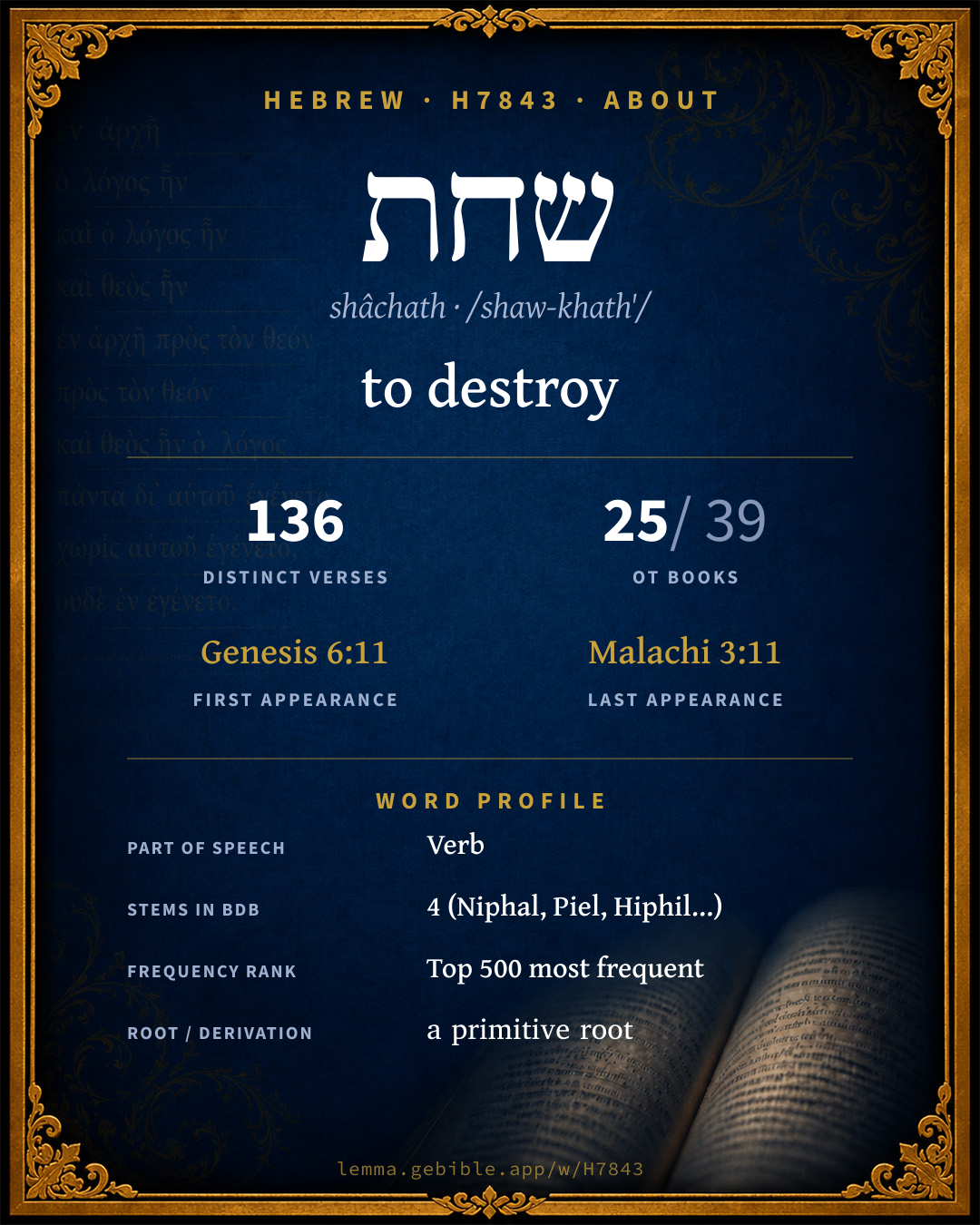
שָׁחַת
to destroy
also: corrupt, go to ruin, decay fuller range ↓
Full lexicon entry — Brown-Driver-Briggs (BDB)
From Brown-Driver-Briggs (BDB)
Where this word appears
See every Hiphil verb in the Hebrew Bible →
Grammar key — what these labels mean
Part of speech
- Verb
- An action or state-of-being word.
- Noun
- A naming word — a person, place, thing, or idea.
Noun type
- Common
- A common noun — a general class of person, place, or thing (“king,” “city,” “water”), not a specific name.
Stem
- Piel
- An intensive or resultative active stem. Here: ‘spoil’
- Hiphil
- The causative active stem (“he caused / brought about”). Here: ‘spoil’
- Hophal
- The passive counterpart of the Hiphil (“he was caused to…”).
- Niphal
- Usually the simple passive or reflexive of the Qal (“he was written”). Here: ‘be marred’
Form
- Infinitive Construct
- A bound verbal noun, frequently with prepositions (“to write / in writing”).
- Participle Active
- A verbal adjective expressing ongoing or characteristic action (“writing / one who writes”).
- Sequential Imperfect
- An imperfect with prefixed waw — the standard past-narrative form (waw-consecutive imperfect).
- Imperfect
- An incomplete, ongoing, or future action (“he will / would write”).
- Perfect
- A completed action or state — Hebrew marks aspect (completeness) more than strict tense (“he wrote”).
- Sequential Perfect
- A perfect with prefixed waw continuing a preceding imperfect or command (waw-consecutive perfect).
- Imperative
- A direct command (“write!”).
- Participle Passive
- A verbal adjective expressing action received (“written”).
- Jussive
- A third- or second-person volitional form expressing wish or command (“let him write”).
- Cohortative
- A first-person volitional form expressing wish or resolve (“let me / let us write”).
- Infinitive Absolute
- An unbound verbal noun, often intensifying or standing in for a finite verb.
State
- Absolute
- The independent form of a noun, not bound to a following word.
- Construct
- A noun bound to a following noun in a possessive / “of” relationship (the construct chain).
Person
- 3rd Person
- The one spoken about (“he / she / it / they”).
- 1st Person
- The speaker (“I / we”).
- 2nd Person
- The one addressed (“you”).
Gender
- Masculine
- Grammatically masculine.
- Common
- Either gender — not distinguished for this form.
- Feminine
- Grammatically feminine.
Number
- Plural
- More than one (in Hebrew, generally three or more).
- Singular
- One.
Every verse where H7843 appears in the Book of Jeremiah — 21 distinct verses. Click any verse to open its interlinear word-by-word view. Verse text shown in the World English Bible for context — . Each verse’s Hebrew form is shown with its reference; the English is not keyword-highlighted, since the data carries no word-level English alignment. Use “Compare translations” on any verse to read it across multiple English versions. This concordance covers the Hebrew Bible; Septuagint (Greek Old Testament) occurrences are not indexed here.
Jeremiah
- Jeremiah 2:30 מַשְׁחִֽית Hiphil ptcp.act ms In vain have I struck your children; they received no correction: your own sword has devoured your prophets, like a destroying lion.
- Jeremiah 4:7 וּ/מַשְׁחִ֣ית conj + Hiphil ptcp.act ms cs A lion is gone up from his thicket, and a destroyer of nations; he is on his way, he is gone forth from his place, to make your land desolate, that your cities be laid waste, without inhabitant.
- Jeremiah 5:10 וְ/שַׁחֵ֔תוּ conj + Piel impv 2mp Go up on her walls, and destroy; but don't make a full end: take away her branches; for they are not Yahweh's.
- Jeremiah 6:5 וְ/נַשְׁחִ֖יתָה conj + Hiphil coh 1cp Arise, and let us go up by night, and let us destroy her palaces.
- Jeremiah 6:28 מַשְׁחִיתִ֖ים Hiphil ptcp.act mp They are all grievous rebels, going about with slanders; they are brass and iron: they all of them deal corruptly.
- Jeremiah 11:19 נַשְׁחִ֨יתָה Hiphil coh 1cp But I was like a gentle lamb that is led to the slaughter; and I didn't know that they had devised devices against me, [saying], Let us destroy the tree with the fruit of it, and let us cut him off from the land of the living, that his name may be no more remembered.
- Jeremiah 12:10 שִֽׁחֲת֣וּ Piel pf 3cp Many shepherds have destroyed my vineyard, they have trodden my portion under foot, they have made my pleasant portion a desolate wilderness.
- Jeremiah 13:7 נִשְׁחַ֣ת Niphal pf 3ms Then I went to the Euphrates, and dug, and took the belt from the place where I had hid it; and, behold, the belt was marred, it was profitable for nothing.
- Jeremiah 13:9 אַשְׁחִ֞ית Hiphil impf 1cs Thus says Yahweh, After this manner will I mar the pride of Judah, and the great pride of Jerusalem.
- Jeremiah 13:14 מֵ/הַשְׁחִיתָֽ/ם prep + Hiphil inf.cs + sfx pers 3mp I will dash them one against another, even the fathers and the sons together, says Yahweh: I will not pity, nor spare, nor have compassion, that I should not destroy them.
- Jeremiah 15:3 וּ/לְ/הַשְׁחִֽית conj + prep + Hiphil inf.cs I will appoint over them four kinds, says Yahweh: the sword to kill, and the dogs to tear, and the birds of the sky, and the animals of the earth, to devour and to destroy.
- Jeremiah 15:6 וָֽ/אַשְׁחִיתֵ֔/ךְ conj + Hiphil wimpf 1cs + sfx pers 2fs You have rejected me, says Yahweh, you are gone backward: therefore have I stretched out my hand against you, and destroyed you; I am weary with repenting.
- Jeremiah 18:4 וְ/נִשְׁחַ֣ת conj + Niphal pf 3ms When the vessel that he made of the clay was marred in the hand of the potter, he made it again another vessel, as seemed good to the potter to make it.
- Jeremiah 22:7 מַשְׁחִתִ֖ים Hiphil ptcp.act mp I will prepare destroyers against you, everyone with his weapons; and they shall cut down your choice cedars, and cast them into the fire.
- Jeremiah 36:29 וְ/הִשְׁחִית֙ conj + Hiphil wpf 3ms Concerning Jehoiakim king of Judah you shall say, Thus says Yahweh: You have burned this scroll, saying, Why have you written therein, saying, The king of Babylon shall certainly come and destroy this land, and shall cause to cease from there man and animal?
- Jeremiah 48:18 שִׁחֵ֖ת Piel pf 3ms You daughter who dwells in Dibon, come down from your glory, and sit in thirst; for the destroyer of Moab is come up against you, he has destroyed your strongholds.
- Jeremiah 49:9 הִשְׁחִ֥יתוּ Hiphil pf 3cp If grape-gatherers came to you, would they not leave some gleaning grapes? if thieves by night, wouldn't they destroy until they had enough?
- Jeremiah 51:1 מַשְׁחִֽית Hiphil ptcp.act ms Thus says Yahweh: Behold, I will raise up against Babylon, and against those who dwell in Lebkamai, a destroying wind.
- Jeremiah 51:11 לְ/הַשְׁחִיתָ֑/הּ prep + Hiphil inf.cs + sfx pers 3fs Make sharp the arrows; hold firm the shields: Yahweh has stirred up the spirit of the kings of the Medes; because his purpose is against Babylon, to destroy it: for it is the vengeance of Yahweh, the vengeance of his temple.
- Jeremiah 51:20 וְ/הִשְׁחַתִּ֥י conj + Hiphil wpf 1cs You are my battle-axe and weapons of war: and with you will I break in pieces the nations; and with you will I destroy kingdoms;
- Jeremiah 51:25 הַ/מַּשְׁחִ֖ית ptcl def.art + Hiphil ptcp.act ms Behold, I am against you, destroying mountain, says Yahweh, which destroy all the earth; and I will stretch out my hand on you, and roll you down from the rocks, and will make you a burnt mountain.
About this entry
At a glance — auto-summarized from this page’s data, not written by a person. Every figure links to its source below. This summary describes the numbers; it doesn’t interpret them.
שחת — transliterated shâchath — is a Hebrew verb carrying the sense “to destroy.” Read the stem: it spans 4 stems, including Niphal and Piel. It appears 136 verses across 25 books of the Hebrew Bible, among its common vocabulary. Its earliest occurrence is Genesis 6:11. It shares a root with משחית, משחת and שחת. See the sense tree, 136-verse concordance, and the renderings breakdown below.
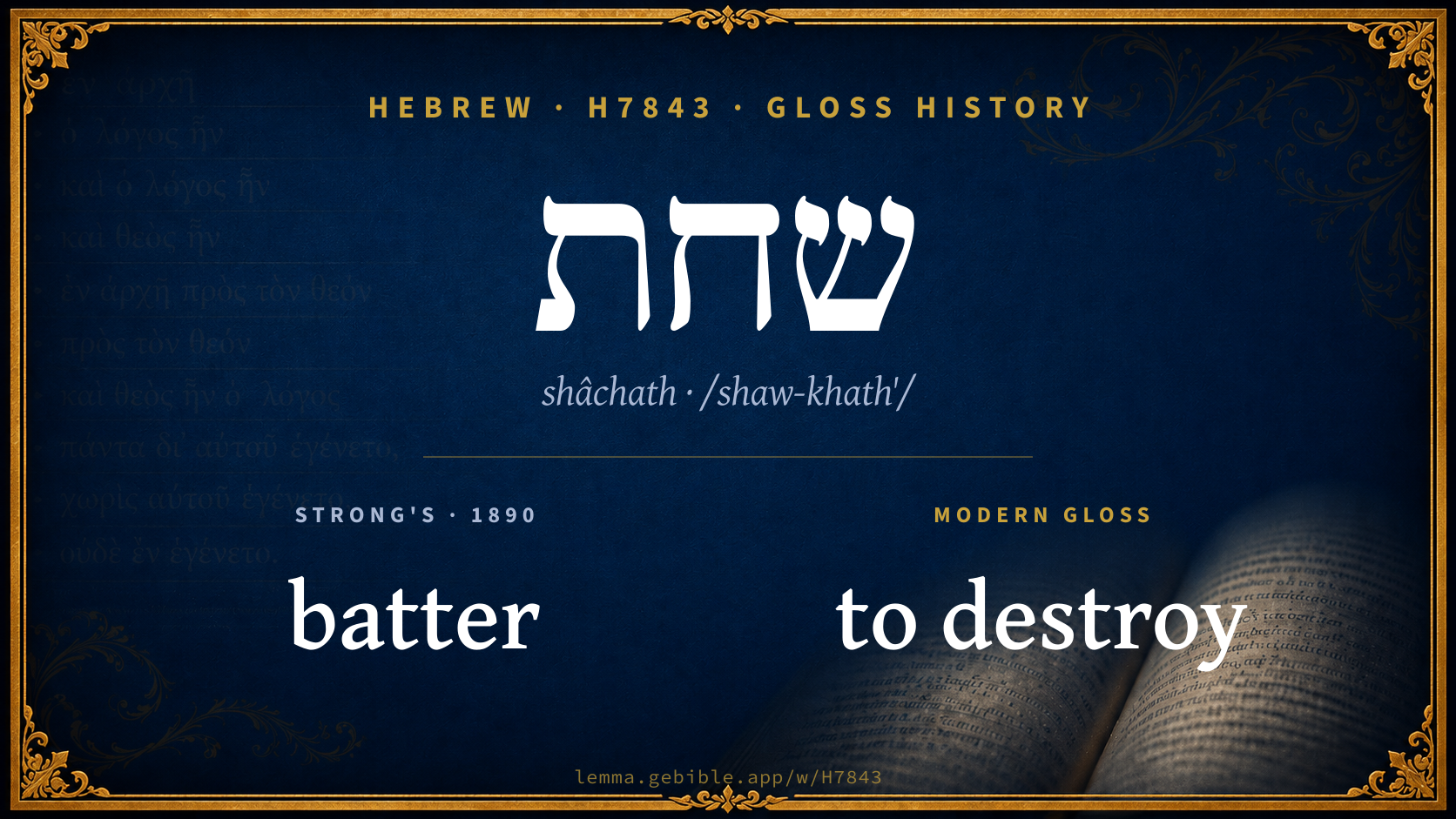
Gloss history
Strong's 1890 vs modern scholarship
About this word
Strong's H7843 catalogs a Hebrew word from the Hebrew Old Testament.
These counts are not copied from any lexicon or concordance. They are computed here, from the morphology-tagged Hebrew Old Testament. What Lemma adds →
- 136
- distinct verses
- The word appears in 136 distinct verses.
- 25 / 39
- OT books
- The word appears in 25 of 39 Old Testament books.
- #305
- by frequency
- Top 500 most frequent Hebrew words (rank 305 of 8,640 Hebrew words by occurrence).
View all 136 occurrences in the concordance →
By section of the Old Testament
By traditional corpus
Conventional, traditional groupings — biblical authorship is debated, so this is a traditional corpus grouping, not an authorship claim. Each share is this word’s portion of its verses in that division of the Hebrew canon. Each figure is a share of the word’s 136 distinct verses.
- Prophets (Nevi'im) 74 verses · 54%
- Writings (Ketuvim) 32 verses · 24%
- Torah (Pentateuch) 30 verses · 22%
How translations render this word
Counts come from each version’s own published word-to-Strong’s tagging or interlinear alignment — an approximate guide to how each version renders this word, not a word-level alignment the data otherwise carries. Because each total is that version’s own tagged count, the per-version totals vary from one another and need not match the appearance or distinct-verse counts above. These counts may also differ from a printed concordance because Lemma counts each distinctly tagged rendering and does not collapse phrase taggings into a single head-word total. This is a fixed set of word-tagged versions (KJV, ASV, BSB, ULT) and does not change with the reading translation you choose elsewhere. Each version’s license is shown beside its name below (and on Sources).
- King James Version: Destroy 37×, Destroyed 9×, Corrupt 3×
- American Standard Version: Destroy 32×, Destroyed 7×, Destroy it 4×
- Berean Standard Bible: Destroy 27×, Destroy it 7×, Destroyed 7×
- unfoldingWord Literal Text: Destroy 26×, Destroy it 13×, Destroyed 7×
King James Version Public Domain
Renders H7843 across 146 tagged occurrences — most commonly:
Plus other, less common renderings. Plus 59 renderings that appear only once — usually multi-word phrases or single function words the recovered tagging swept in, not distinct renderings. Not rendered by a distinct English word in 1 further occurrence.
American Standard Version Public Domain
Renders H7843 across 146 tagged occurrences — most commonly:
Plus other, less common renderings. Plus 71 renderings that appear only once — usually multi-word phrases or single function words the recovered tagging swept in, not distinct renderings.
Berean Standard Bible Public Domain
Renders H7843 across 145 tagged occurrences — most commonly:
Plus other, less common renderings. Plus 71 renderings that appear only once — usually multi-word phrases or single function words the recovered tagging swept in, not distinct renderings. Not rendered by a distinct English word in 1 further occurrence.
unfoldingWord Literal Text CC BY-SA 4.0
Renders H7843 across 161 tagged occurrences — most commonly:
Plus other, less common renderings. Plus 60 renderings that appear only once — usually multi-word phrases or single function words the recovered tagging swept in, not distinct renderings.
8 senses and sub-senses in the full BDB
Hebrew verbs can shift meaning by stem (binyan): Qal is the basic action, Niphal is often passive or reflexive, Piel often intensifies or makes it factitive, and Hiphil is typically causative. The senses below are grouped under the stem BDB assigns to each. This entry also uses Hophal (the passive of Hiphil).
What do BDB’s symbols mean?
BDB uses these scholarly abbreviations:
| Symbol | Meaning |
|---|---|
| 𝔊 | the Septuagint (the ancient Greek translation, LXX) |
| 𝔙 | the Vulgate (the Latin translation) |
| 𝔖 | the Syriac version (the Peshitta) |
| 𝔗 | the Targum (the Aramaic translation) |
| ψ | the Psalms |
| √ | root (the underlying root or stem) |
| ‖ | parallel passage (a synonymous or contrasted parallel) |
| † | the dagger: every passage where the word occurs is cited |
The 8 senses and sub-senses the full Brown-Driver-Briggs lexicon distinguishes for this word, in lexicon order (not ranked by frequency), with BDB’s own verbatim wording and sub-sense lettering. Shown in Hebrew script with BDB’s own scholarly abbreviations. The condensed entry is in the Lexicon Entry tab. See also the Forms in the corpus table below.
Niphal
- be marred, spoiled, Pf. 3 ms. נִשְׁחַת, of waistcloth Je 13:7, vessel 18:4; be injured, or even (hyperb.) ruined, Impf. 3 fs. תִּשָּׁחֵת Ex 8:20 (J) of land (מִפְּנֵי הֶעָרֹב); be corrupted, corrupt, in morals and rel., of earth, Pf. 3 fs. נִשְׁחָ֑תָה Gn 6:12 (P), Impf. 3 fs. וַתִּשּׁ׳ לִפְנֵי הָא׳ v 11 (P); so Pt. fpl. as adj. נִשְׁחָתוֹת Ez 20:44. e.g. Jeremiah 13:7
Piel
- Pf. 3 ms. שִׁחֵת Ex 32:7 +, sf. שִׁחֶתְךָ Ho 13:9; 2 ms. שִׁחַתָּ Is 14:20 +, etc.; Imv. mpl. שַׁחֵ֑תוּ Je 5:10; Inf. cstr. שַׁחֵת Gn 13:10 +, etc.;— e.g. Exodus 32:7
- 1. spoil, ruin, acc. of eye Ex 21:26 (E), vineyard Je 12:10 (fig.), branches Na 2:3 (fig.), also = destroy, acc. pers. 2 S 1:14; 14:11 (acc. om.), Ez 5:16; 20:17, כָּל־בָּשָׂר Gn 6:17; 9:15 (P), city, fortress, etc., Gn 13:10; 19:13, 29 (all J); 2 S 24:16; Je 5:10 (acc. om.) 48:18; Ez 26:4; 43:3; La 2:5, ruin temple v 6, nation Ho 11:9; 13:9 (read perhaps שִׁחַתִּךָ Oort Now), land 2 K 19:12 (Hiph. in ‖ Is 37:12), Ju 6:5 Jos 22:33 (P), Ez 22:30; 30:11, earth Gn 9:11 (P); c. ל obj. (ל 3 b), city 1 S 23:11, pers. Nu 32:15 (P); c. acc. רַחֲמָיו Am 1:11, destroyed (stifled) his compassion (or, RSK 28 al., the bonds of kinship, v. רַחֲמִים), בְּרִית Mal 2:8, i.e. violate it, v. especially וְשׁ׳ אַרְצָה (sc. semen) Gn 38:9 (J) he spoiled (it) upon the ground, made it ineffective, = waste words Pr 23:8. e.g. Exodus 21:26
- 2. pervert, corrupt, acc. wisdom Ez 28:17, abs. = deal corruptly, חֶעֱמִיקוּ שִׁחֵתוּ Ho 9:9 (cf. [עָמֹק], p. 770b; but We Now read שַׁחְתּוֹ, √ שׁוח), Ex 32:7 (JE), Dt 9:12, so שׁ׳ לוֹ 32:5. e.g. Ezekiel 28:17
Hiphil
- Pf. 3 ms. הִשְׁחִית Gn 6:12 +; 1 s. וְהִשְׁחַתִּ֫י Je 51:20, etc.; Impf. 3 ms. יַשְׁחִית Dn 8:24 +, יַשְׁחִת Mal 3:11 +, וַיַּשְׁחֵת 1 Ch 20:1; 2 fs. וַתַּשְׁחִתִי Ez 16:47, 2 mpl. תַּשְׁחִתוּן Dt 4:16; 31:29; Imv. ms. sf. הַשְׁחִיתָהּ 2 K 18:25 = Is 36:10; Inf. abs. הַשְׁחֵת Dt 31:29; cstr. הַשְׁחִית 1 S 26:15 +, etc.; Pt. מַשְׁחִית Gn 19:14 +, etc.;— e.g. Genesis 6:12
- 1. spoil, ruin, acc. crop Ju 6:4; Mal 3:11, trees Dt 20:19, 20; Je 11:19 (fig.), vessels 2 Ch 36:19, houses 34:11, palaces Je 6:5, cf. Is 65:8; Lv 19:27 (H), Ru 4:6; הִשׁ׳ דַּיָּם Je 49:9 thieves damage as much as they want; acc. pers. = ruin, destroy, 1 S 26:9, 15 Ju 20:21, 25 (+ אַ֫רְצָה), v 35, 42; 2 K 13:23; 2 Ch 24:23 (+ מִן separ.), + 12 times, + (acc. pers. om.) Is 51:13 + 4 times, acc. בֵּית דָּוִד 2 Ch 21:7, abs. Is 11:9 = 65:25; also ruin one (by words) Pr 11:9; acc. עַם 2 S 24:16; Dt 9:26; land 1 S 6:5; Je 36:29; Dn 11:17 (v. Dr); city wall 2 S 20:15 (Ew Th here denom. from שַׁחַת they were making a pit; מְהַשְּׁבִים were devising), La 2:8, cities and nations Gn 18:28(×2) (J, acc. om.), 19:13, 14 (J), Is 37:12 (Pi. in ‖ 2 K 19:12), 36:10(×2) = 2 K 18:25(×2) + 11 times + (Israel personif.) Dt 4:31; 10:10; 2 K 8:19, pride of Judah Je 13:9, earth Je 51:1; abs. c. adv. acc. Dn 8:24 (v. Dr; Bev conj. יְשׂחֵחַ or יָשִׂיחַ utter monstrous things), cf. 1 Ch 21:12; Pt. as adj., of lion Je 2:30, angel 1 Ch 21:15; = destroyer Ex 12:23 (J), Je 22:7; Is 54:16, מ׳ גּוֹיִם Je 4:7, רוּח מ׳ 51:1; sg. coll. (הַמּ׳ Ges§ 126 i; the destroying band, cf. Dr Bu Now) 1 S 13:17; 14:15 (spoilers, ravagers); fig. for snare, trap, Je 5:26. e.g. Judges 6:4
- 2. pervert, corrupt, morally, acc. דֶּרֶךְ Gn 6:12 (P; v. דֶּרֶךְ 6), נַפְשׁוֹ Pr 6:32, cf. Zp 3:7; Ez 23:11 (מִן comp.); הִשׁ׳ הִתְעִיבוּ עֲלִילָה ψ 14:1 = 53:2; הַשְׁהֵת תַּשְׁח׳ (+ vb. of particular act) Dt 4:16; 31:29; declar. = act corruptly, Is 1:4; Dt 4:25 (+ vb. of act), 2 Ch 27:2, + מִן comp. Ju 2:19; Ez 16:47; Pt. as subst. Je 6:28, אִישׁ מַשׁ׳ Pr 28:24 (18:9 v. infra).—אַל־תַּשְׁחֵת destroy not (catchword of old song or melody?) in ψ-titles: †57:1; 58:1; 59:1; 75:1. e.g. Genesis 6:12
Hophal
- Pt. מָשְׁחָת spoiled, ruined, of a spring, מָקוֹר Pr 25:26 (‖ מַעְיָן נִרְפָּשׂ); as subst. Mal 1:14 sacrificing a spoiled thing. e.g. Proverbs 25:26
Senses from the full Brown-Driver-Briggs lexicon (Brown, Driver, Briggs; Oxford 1906 — public domain), digitized via Sefaria, supplemented by the OpenScriptures HebrewLexicon (CC BY 4.0). Full attribution on Sources.
Word origin
vb. go to ruin (?), only der. spec. (NH Hiph. = BH, Ecclus. שחיתה 30:11 corrupt act; Arabic سَحَتَ extirpate; Ethiopic ሰሐጠ: injure, violate; TelAm. šaḫâtu is fall (especially of city), be prostrate (? of land), perhaps Canaanism (v. WklTelAm. Vocab.), Assyrian poss. šêtu, flee, escape (cf. אבד); Old Aramaic (Zinj.) שחת destroy Lzb374, Aramaic שְׁחַת, ܫܰܚܶܛ (assim. of ܬ), mutilate;—very improb. Gerber179 denom. from שַׁחַת);—
— Brown-Driver-Briggs (Oxford 1906, public domain), digitized via Sefaria, supplemented by the OpenScriptures HebrewLexicon (CC BY 4.0). See Sources.
Origin: a primitive root
Jastrow Dictionary
A second Hebrew/Aramaic lexicon for comparison, covering Aramaic and post-biblical (Talmudic, Targumic, Midrashic) usage that the biblical-Hebrew BDB does not. Matched by lemma rather than by Strong’s number, so a lemma may carry more than one Jastrow headword (shown separately below), and the entries cover usage well beyond the Bible.
שָׁחַת
- (b. h.) to be low, bent.
- (cmp. חָבַל) to pervert, ruin, do harm. Ex. R. s. 8 ש׳ לנפשו he did harm to himself; a. e.—Ab. d. R. N. ch. I, end וירדו … לשַׁחֲתוֹ ed. Schechter (ed. לשרתו, corr. acc.) and the ministering angels came down to destroy him (Adam). Kidd. 24ᵇ (ref. to Ex. XXI, 26) עד שיתכוין לשַׁחְתָהּ when he intended to destroy it. Naz. 4ᵇ לשַׁחֵת, v. שֵׂעָר; a. e. e.g. Exodus 21:26
- 1. same. same. Ex. R. l. c. ה׳ לנפשו, v. supra. Tanḥ. Tol’d. 6 לילך … להַשְׁחִיתוֹ to go to Nabal to ruin him; a. fr.—Esp. בַּל תַּשְׁחִית (v. בַּל) the law forbidding to ruin anything wantonly (derived from Deut. XX, 19). Sabb. 129ᵃ והא קעבר מר משום בל ת׳ in doing so, do you not disregard the law which forbids wilful destruction? בל ת׳ דגופאי עדיף לי not to do injury to myself is a higher duty to me; ib. 140ᵇ; a. fr. e.g. Deuteronomy 20:19
- 2. to commit a nuisance. Y. Succ. V, 55ᶜ (play on משתחויתם, Ez. VIII, 16) [read:] שהיו משתחוים לחמה ומַשְׁחִיתִים להיכל they prostrated themselves in worship of the sun, and committed nuisance towards the Temple (v. Bab. Succ. 53ᵇ; Yoma 77ᵃ). e.g. Ezekiel 8:16
שְׁחַת
- ; part. pass. שְׁחִית mutilated. Targ. Y. Lev. XXII, 24 (h. text נתוק).
שַׁחַת I
- pit, grave. Pesik. R. s. 10 (ref. to Ps. LXXV, 8) זה שהשפיל לישראל לבאר ש׳ וכ׳ as zeh (Neh. IX, 18) brought Israel down to the lowest pit, so did zeh (Ex. XXX, 13) lift it up &c.; a. e. e.g. Psalms 75:8
שַׁחַת II
- (preced.) low growth, corn in its earliest stage used instead of grass. Peah II, 1 הקוצר לש׳ he who cuts young corn to be used as fodder; Tosef. ib. I, 8. Men. X, 8 (71ᵃ) קוצר לש׳ ומאכיל לבהמה (Bab. ed. מאכל, corr. acc.) one may cut barley as shaḥath and give it to the cattle (before the ʿOmer has been offered); Tosef. ib. X, 32 קוצר לש׳ עד שלא וכ׳ as to cutting barley for fodder: before it has approached maturity by one third, one may begin &c. Men. 71ᵇ כל לש׳ לא וכ׳ whatever is for fodder is not considered as harvesting. Sabb. XXIV, 2. Kidd. 62ᵇ; a. e.
A Dictionary of the Targumim, the Talmud Babli and Yerushalmi, and the Midrashic Literature (Marcus Jastrow; London, Luzac, 1903) — Public Domain. Digitized via Sefaria. Digitized via Sefaria. Full attribution on Sources.
Forms in the corpus
The 125 distinct written forms H7843 takes in the Hebrew Bible, most frequent first — each parse links to that stem’s occurrences in the concordance. Hebrew forms include their vowel points and cantillation, so a single lemma takes many written forms.
The 60 most common forms are shown; 65 rarer forms follow in the full concordance.
Same root — word family
Other BDB entries built from the same root as H7843, grouped by Strong’s listed origin. These share a root / origin per the lexicon — not necessarily a shared meaning. Each links to that word’s own entry.
Derived from this word
Compare all same-root words → They share a root, not necessarily a meaning.
Septuagint verse parallels
This word appears in 133 verses that also exist in the Greek Old Testament (Septuagint), out of the 136 Hebrew verses it occurs in. You can read those verses in Greek by switching the Old Testament edition to the Septuagint.
Read these verses in the Septuagint
- Genesis 6:11
- Exodus 8:24
- Leviticus 19:27
- Numbers 32:15
- Deuteronomy 4:16
- Joshua 22:33
- Judges 2:19
- Ruth 4:6
- 1 Samuel 6:5
- 2 Samuel 1:14
- 2 Kings 8:19
- 1 Chronicles 20:1
This is a verse-level parallel only — the same verses exist in both the Hebrew and Greek Old Testaments. No word-level Hebrew↔Greek correspondence is claimed: the data carries no such alignment, so no Greek word is shown as this Hebrew word’s translation. Coverage is not total — the Septuagint omits the deuterocanon and renumbers the Psalms, so some Hebrew verses have no direct Greek parallel.