
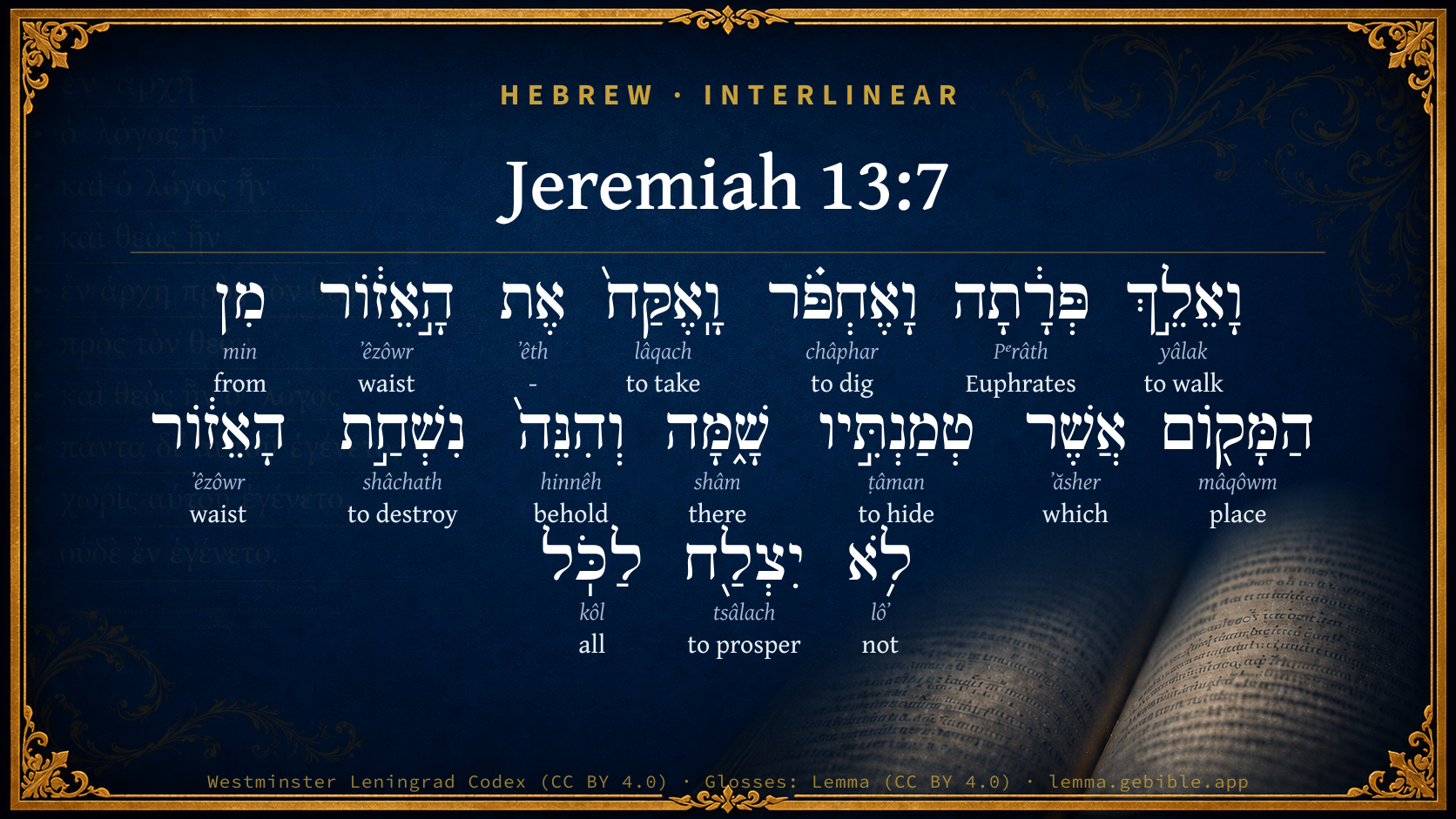
Jeremiah 13:7

Hebrew (Westminster Leningrad Codex) Jeremiah 13:7 appears in the Hebrew Old Testament. The text above is from the Westminster Leningrad Codex. Each word links to its Strong’s number, a concise gloss, and parsing drawn from the Open Scriptures Hebrew Bible morphology. Click any word for its full Brown-Driver-Briggs (BDB) entry.
Download image
Cite this verse

Jeremiah 13:7 (World English Bible). Public Domain. Lemma interlinear Bible study tool, https://lemma.gebible.app/v/jeremiah/13/7.

Show BibTeX & RIS
BibTeX
RIS
English Translation
Then I went to the Euphrates, and dug, and took the belt from the place where I had hid it; and, behold, the belt was marred, it was profitable for nothing.
World English Bible · Public Domain
Download a study sheet

One document with this verse’s original text, its word-by-word gloss line, the meaning frame, cross-references with their text, attributed commentary, and full source and license credits — printable, and it pastes into notes with its structure intact.

This verse Autodidact and up

Study sheet (.html) Plain text (.txt)

A passage Seminary Student

Up to 50 verses in one chapter. A passage sheet keeps up to 6 commentary sources and 12 cross-references per verse, in the order this page ranks them, and says so on the sheet whenever that leaves anything out. Ask for a single verse and you get the Autodidact verse sheet above.

Everything on this page stays free to read, with no account — the sheet is a download of what is already on screen, not access to it.

Want to remove ads? Support Godless Engineer
Compare translations 3

The same verse in 3 English versions, stacked beneath the original-language interlinear above. Click any original word for its lexicon entry.

Each is an independent rendering of the whole verse — the interlinear is not word-aligned to these translations.

Highlighted words mark where these versions differ — a whole-verse word diff, not a word-by-word alignment.

  • World English Bible Public Domain
    Then I went to the Euphrates, and dug, and took the belt from the place where I had hid it; and, behold, the belt was marred, it was profitable for nothing.
  • King James Version Public Domain
    Then I went to Euphrates, and digged, and took the girdle from the place where I had hid it: and, behold, the girdle was marred, it was profitable for nothing.
  • unfoldingWord Literal Text CC BY-SA 4.0
    Then I went to Perath and dug and I took the loincloth from the place that I had hidden it, and behold, the loincloth was ruined, it was not good for anything.

unfoldingWord Literal Text — © unfoldingWord, licensed CC BY-SA 4.0. Word-aligned USFM3 via Door43 (git.door43.org/unfoldingWord/en_ult).

Versions to compare (up to 4)

3 of 4 selected

Show all 18 translations

Every available English version of this verse, each an independent rendering of the whole verse.

  • World English Bible Public Domain
    Then I went to the Euphrates, and dug, and took the belt from the place where I had hid it; and, behold, the belt was marred, it was profitable for nothing.
  • Berean Standard Bible Public Domain
    So I went to Perath and dug up the loincloth, and I took it from the place where I had hidden it. But now it was ruined—of no use at all.
  • Majority Standard Bible Public Domain
    So I went to Perath and dug up the loincloth, and I took it from the place where I had hidden it. But now it was ruined—of no use at all.
  • King James Version Public Domain
    Then I went to Euphrates, and digged, and took the girdle from the place where I had hid it: and, behold, the girdle was marred, it was profitable for nothing.
  • American Standard Version (1901) Public Domain
    Then I went to the Euphrates, and digged, and took the girdle from the place where I had hid it; and, behold, the girdle was marred, it was profitable for nothing.
  • Revised Version (1885) Public Domain
    Then I went to Euphrates, and digged, and took the girdle from the place where I had hid it: and, behold, the girdle was marred, it was profitable for nothing.
  • Geneva Bible (1599) Public Domain
    Then went I to Perath, and digged, and tooke the girdle from the place where I had hid it, and behold, the girdle was corrupt, and was profitable for nothing.
  • Douay-Rheims (1899) Public Domain
    And I went to the Euphrates, and digged, and took the girdle out of the place where I had hid it: and behold the girdle was rotten, so that it was fit for no use.
  • Young's Literal Translation Public Domain
    and I go to Phrat, and dig, and take the girdle from the place where I had hid it; and lo, the girdle hath been marred, it is not profitable for anything.
  • Literal Standard Version CC BY-SA 4.0
    and I go to the Euphrates, and dig, and take the girdle from the place where I had hid it; and behold, the girdle has been marred, it is not profitable for anything.
  • Unlocked Literal Bible CC BY-SA 4.0
    So I went back to Perath and dug out the undergarment where I had hid it, and behold, it was destroyed and completely useless.
  • unfoldingWord Literal Text CC BY-SA 4.0
    Then I went to Perath and dug and I took the loincloth from the place that I had hidden it, and behold, the loincloth was ruined, it was not good for anything.
  • Darby Bible Public Domain
    And I went to the Euphrates, and digged, and took the girdle from the place where I had hid it; and behold, the girdle was spoiled, it was good for nothing.
  • World Messianic Bible Public Domain
    Then I went to the Euphrates, and dug, and took the belt from the place where I had hidden it; and behold, the belt was ruined. It was profitable for nothing.
  • Webster's Bible Public Domain
    Then I went to Euphrates, and digged, and took the girdle from the place where I had hid it: and behold, the girdle was marred, it was profitable for nothing.
  • Free Bible Version CC BY-SA 4.0
    I went to Perath and dug up the loincloth, and removed it from where I'd hidden it. Obviously it was ruined—completely useless.
  • Bible in Basic English Public Domain
    So I went to Parah and, uncovering the hole, took the band from the place where I had put it away: and the band was damaged and of no use for anything.
  • JPS Tanakh (1917) Public Domain
    Then I went to Perath, and digged, and took the girdle from the place where I had hid it; and, behold, the girdle was marred, it was profitable for nothing.

Literal Standard Version (2020), Covenant Press — licensed CC BY-SA 4.0. Text via the HelloAO Bible API (eBible.org). Unlocked Literal Bible (unfoldingWord) — licensed CC BY-SA 4.0. Text via the HelloAO Bible API (eBible.org). unfoldingWord Literal Text — © unfoldingWord, licensed CC BY-SA 4.0. Word-aligned USFM3 via Door43 (git.door43.org/unfoldingWord/en_ult). Free Bible Version, Dr. Jonathan Gallagher — licensed CC BY-SA 4.0. Text via the HelloAO Bible API (eBible.org).

Word by word

More ways to search: Search by grammar → Find every occurrence → Compare this word →

Practice this passage: Drill this verse → Learn its vocabulary →

הָ֣אֵז֔וֹר
ʼêzôwr
H232
“the · waist”
Particle, Definite Article + Noun, Common, Masculine, Singular, Absolute
Part of Speech
Particle + Noun
Type
Common
Gender
Masculine
Number
Singular
State
Absolute
Full BDB Definition

Origin: from H246

TWOT: 59a

waist-cloth, the innermost piece of clothing - of God's power over kings (figuratively) - of faithfulness (metaphorically) - waistband
  1. וָאֵלֵ֣ךְ yâlak H3212 “and · to walk” Conjunction + Verb, Qal, Sequential Imperfect, 1st Person, Common, Singular
  2. פְּרָ֔תָה Pᵉrâth H6578 “Euphrates · toward” Noun, Proper + Suffix, Demonstrative
  3. וָאֶחְפֹּ֗ר châphar H2658 “and · to dig” Conjunction + Verb, Qal, Sequential Imperfect, 1st Person, Common, Singular
  4. וָֽאֶקַּח֙ lâqach H3947 “and · to take” Conjunction + Verb, Qal, Sequential Imperfect, 1st Person, Common, Singular
  5. אֶת ʼêth H853 “-” Particle, Direct Object
  6. מִן min H4480 “from” Preposition
  7. הַמָּק֖וֹם mâqôwm H4725 “the · place” Particle, Definite Article + Noun, Common, Masculine, Singular, Absolute
  8. אֲשֶׁר ʼăsher H834 “which” Particle, Relative
  9. טְמַנְתִּ֣יו ṭâman H2934 “to hide · him” Verb, Qal, Perfect, 1st Person, Common, Singular + Suffix, Personal, 3rd Person, Masculine, Singular
  10. שָׁ֑מָּה shâm H8033 “there · toward” Adverb + Suffix, Demonstrative
  11. וְהִנֵּה֙ hinnêh H2009 “and · behold” Conjunction + Particle, Demonstrative
  12. נִשְׁחַ֣ת shâchath H7843 “to destroy” Verb, Niphal, Perfect, 3rd Person, Masculine, Singular
  13. הָאֵז֔וֹר ʼêzôwr H232 “the · waist” Particle, Definite Article + Noun, Common, Masculine, Singular, Absolute
  14. לֹ֥א lôʼ H3808 “not” Particle, Negative
  15. יִצְלַ֖ח tsâlach H6743 “to prosper” Verb, Qal, Imperfect, 3rd Person, Masculine, Singular
  16. לַכֹּֽל kôl H3605 “to/for the · all” Preposition, Determined + Noun, Common, Masculine, Singular, Absolute

About this verse

These counts appear in no published source. They are computed here, from the morphology-tagged text and Lemma’s own curated glosses. What Lemma adds →

17
words
16
distinct lemmas
Prophets
section

Notable vocabulary

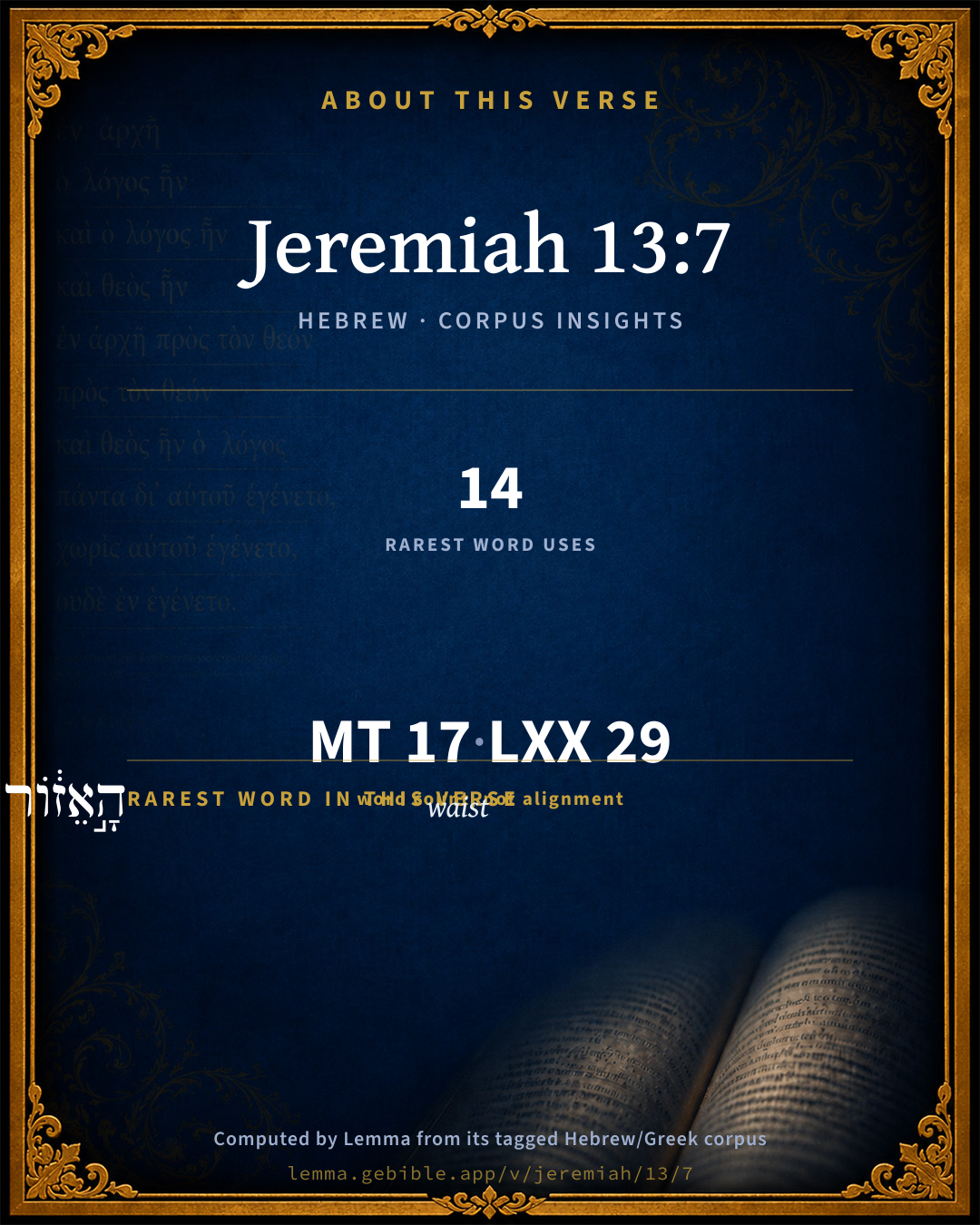
The rarest word here is הָ֣אֵז֔וֹר waist H232 — appearing just 14 times in the whole Hebrew Bible.

Shared distinctive vocabulary

הָ֣אֵז֔וֹר waist H232 occurs in 12 verses of the Hebrew Bible. Also found in:

Grammatical profile

  • 6 verbs
  • 5 nouns
  • 1 preposition
  • 1 adverb
  • 4 particles

Verb forms

  • וָאֵלֵ֣ךְ Qal · Sequential Imperfect
  • וָאֶחְפֹּ֗ר Qal · Sequential Imperfect
  • וָֽאֶקַּח֙ Qal · Sequential Imperfect
  • טְמַנְתִּ֣יו Qal · Perfect
  • נִשְׁחַ֣ת Niphal · Perfect
  • יִצְלַ֖ח Qal · Imperfect

Repetition

A word recurs within this verse — often emphatic in Hebrew:

  • הָ֣אֵז֔וֹר waist H232 ×2

Hebrew & Septuagint length

In the original languages it is 17 Hebrew tokens and 29 Greek tokens — but the two are counted differently (Hebrew bundles its prefixes and suffixes into one token; the Greek is in lemma form), so that isn’t a like-for-like length.

Cross-references

8

Topical passages linked to Jeremiah 13:7 in the Treasury of Scripture Knowledge — connected by theme and wording, ordered by reader-vote popularity; previews shown in the World English Bible.

  • Isaiah 64:6 For we are all become as one who is unclean, and all our righteousness are as a polluted garment: and we all do fade as a leaf; and our iniquities, like the wind, take us away.
  • Romans 3:12 They have all turned aside. They have together become unprofitable. There is no one who does good, No, not, so much as one."
  • Jeremiah 13:10 This evil people, who refuse to hear my words, who walk in the stubbornness of their heart, and are gone after other gods to serve them, and to worship them, shall even be as this belt, which is profitable for nothing.
  • Jeremiah 24:1–8 Yahweh shown me, and, behold, two baskets of figs set before the temple of Yahweh, after that Nebuchadrezzar king of Babylon had carried away captive Jeconiah the son of Jehoiakim, king of Judah, and the princes of Judah, with the craftsmen and smiths, from Jerusalem, and had brought them to Babylon.
  • Ezekiel 15:3–5 Shall wood be taken of it to make any work? or will men take a pin of it to hang any vessel thereon?
  • Zechariah 3:3–4 Now Joshua was clothed with filthy garments, and was standing before the angel.
  • Luke 14:34–35 Salt is good, but if the salt becomes flat and tasteless, with what do you season it?
  • Philemon 1:11 who once was useless to you, but now is useful to you and to me.

Cross-references courtesy of OpenBible.info (CC BY 4.0).

Hebrew and Greek witnesses Masoretic Hebrew ↔ Greek Septuagint

The same verse in the two great witnesses to the Old Testament, shown verse-for-verse.

These are two independent witnesses, not word-aligned to each other, and the Septuagint is shown in lemma (dictionary) form.

Hebrew Jeremiah 13:7 Masoretic · Westminster Leningrad Codex

וָאֵלֵ֣ךְ פְּרָ֔תָה וָאֶחְפֹּ֗ר וָֽאֶקַּח֙ אֶת הָ֣אֵז֔וֹר מִן הַמָּק֖וֹם אֲשֶׁר טְמַנְתִּ֣יו שָׁ֑מָּה וְהִנֵּה֙ נִשְׁחַ֣ת הָאֵז֔וֹר לֹ֥א יִצְלַ֖ח לַכֹּֽל

Then I went to the Euphrates, and dug, and took the belt from the place where I had hid it; and, behold, the belt was marred, it was profitable for nothing.

World English Bible · Public Domain

Greek LXX Structure differs

In the Septuagint, Jeremiah is about an eighth shorter than the Hebrew and arranges its material differently — the Oracles Against the Nations (Hebrew chapters 46–51) appear in the middle of the Greek book, after 25:13. Because the chapter and verse boundaries do not line up, a verse-for-verse comparison with the Hebrew is not shown.

A verse-for-verse comparison isn’t shown here because the chapters and verses don’t line up. Switch to the LXX edition with the MT / LXX toggle above to read the Greek directly.

Hebrew: Westminster Leningrad Codex (CC BY 4.0). Greek: Septuagint (public domain); English from a public-domain English Septuagint. How the Septuagint differs from the Hebrew →

Targum (Aramaic paraphrase)

1

The Targum is the ancient Jewish Aramaic paraphrase of the Hebrew Scriptures — an interpretive translation, not the Hebrew text itself. Onkelos (literal) and Pseudo-Jonathan (expansive) render the Torah, and Jonathan the Prophets. Coverage is partial: where no permissively-licensed English translation exists for a verse, only the Aramaic is shown. This is verse-level text, not a word-by-word alignment to the Hebrew.

  1. Targum Jonathan Prophets (Joshua–Malachi)
    וַאֲזָלֵית לִפְרָת וַחֲפָרֵית וּנְסִיבֵית יַת זַרְזָא מִן אַתְרָא דִטְמַרְתֵּיהּ תַּמָן וְהָא אִתְחַבֵּיל זַרְזָא לֵית בֵּיהּ צְרוֹךְ לְכָל מִדַעַם:

    (no public-domain English translation for this verse)

    Targum Jonathan — Aramaic: “Mikraot Gedolot” (public domain). English: “Sefaria Community Translation” (CC0 1.0 (public-domain dedication)); “London "Chaldee Paraphrase," 1871” (public domain). Text via Sefaria.

Commentary

Notes on Jeremiah 13:7 from classic Christian and Jewish commentators (each source and its license shown beneath its notes). The classic Christian expositions comment on the surrounding passage and are grouped to its opening verse, so a note may address several verses; the Jewish commentaries on the Tanakh (Rashi and others) are per-verse, so they appear only where the commentator wrote on this verse.

Lemma curates 59 commentaries, every one of them public domain or Creative Commons licensed, each selected and text-cleaned for this edition rather than reprinted as found. About our sources →

Trapp's Complete Commentary

John Trapp

Jer 13:7 Then I went to Euphrates, and digged, and took the girdle from the place where I had hid it: and, behold, the girdle was marred, it was profitable for nothing.

Ver. 7. Then I went to Euphrates.] See on Jer 13:4. Those that are for an actual journey allege that Jeremiah might do this without danger in the days of Jehoiakim, who was the King of Babylon’s vassal, and paid him tribute.

And, behold, the girdle was rotted, it was profitable for nothing.] This showed that the Jews should in that country lie rotting, as it were, in baseness, and servility, and sin together many years, so that God might justly have left them there still in misery, as a man leaves his rotten girdle to become dung.

John Trapp, A Commentary or Exposition upon All the Books of the Old and New Testament (1647–1656) — public domain. Text from a community e-Sword module.

Adam Clarke's Commentary

Verse 7. And behold, the girdle was marred; it was profitable for nothing.] This symbolically represented the state of the Jews: they were corrupt and abominable; and God, by sending them into captivity, "marred the pride of Judah, and the great pride of Jerusalem," Jer 13:9.

Adam Clarke's Commentary on the Bible (1810–1826) — public domain. Text from a community e-Sword/MySword module.

John Calvin's Commentaries

The Prophet, by saying that he went to the Euphrates, confirms what he had narrated: he did not indeed mean that he actually went there, but his object was to give the Jews a vivid representation. It is then what Rhetorians call a scene presented to the view; though the place is not changed, yet the thing is set before the eyes by a lively description. Thus the Prophet, as the Jews were deaf, exhibited to their view what they would not hear. This is the reason why he says that he went. For the same purpose is what follows, that at the end of many days God had bidden him to take out the girdle Here also is signified the length of the exile. As to the hole in a rock, what is meant is disgrace; for without honor and esteem the Jews lived in banishment, in the same manner as though they were cast into a cavern. Hence by the hole is signified their ignoble and base condition, that they were like persons removed from the sight of all men and from the common light of day. By the end of many days, is meant, as I have said, the length of their exile, for in a short time they would not have become putrified, and except indeed this had been distinctly expressed, they would have never been convinced of the grievousness of the calamity which was nigh them. Hence he says that the days would be many, so that they might contract putridity while hidden in the hole.

John Calvin's Commentaries (1540-1563) — public domain. Text from the Calvin Translation Society English edition (1840s-50s) via the Christian Classics Ethereal Library (ccel.org). Calvin's coverage is partial (roughly two-thirds of the Bible); uncommented books and verses are honest gaps, never fabricated. The 19th-century editor's footnotes and remarks are omitted so the notes are faithfully Calvin's own voice.

Ellicott's Commentary for English Readers

(7) The girdle was marred.—The symbolism is explained in Jer_13:9. The girdle stained, decayed, worthless, was a parable of the state of Judah after the exile, stripped of all its outward greatness, losing the place which it had once occupied among the nations of the earth.

A Bible Commentary for English Readers, edited by Charles John Ellicott (1878–1897) — public domain. Text from a community e-Sword module.

John Gill's Exposition

Then I went to Euphrates,.... In a vision; this is the second journey, of which See Gill on Jer 13:5,

and digged; the hole, in process of time, being stopped up with soil or sand, that were thrown up over it; this digging was in a visionary way; see Eze 8:8,

and took the girdle from the place where I had hid it; which he knew again by some token or another:

and, behold, the girdle was marred; or "corrupted" (q); it was become rotten by the washing of the water over it, and its long continuance in such a place:

it was profitable for nothing; it could not be put upon a man's loins, or be wore any more; nor was it fit for any other use, it was so sadly spoiled and so thoroughly rotten. It is in the Hebrew text, "it shall not prosper to all" (r) things; that is, not "to anything" (s), as many render it.

(q) "corruptum erat", Munster, Montanus, Schmidt; "computruerat", Pagninus. (r) "non proficiet omnibus", Vatablus. (s) "Non prosperabitur cuiquam", Montanus; "ad ullam rem", Junius & Tremellius, Piscator.

John Gill's Exposition of the Whole Bible (1746–1763) — public domain (CC PDM 1.0). Text via the HelloAO Bible API.

Matthew Poole's English Annotations

Whether the prophet really made such a journey, or all this was but a vision, is very uncertain. When he came to the place, or in his vision, he thought, when he came to the place, that he saw all the girdle rotted; and good for nothing but to be thrown upon a dunghill.

Matthew Poole's English Annotations on the Holy Bible (1683–1685) — public domain. Text from a community e-Sword/MySword module.

Whedon's Commentary on the Bible

Daniel D. Whedon

7. Digged — Showing that Jeremiah had filled in with gravel or earth above the girdle, and so concealed it.

Daniel D. Whedon (gen. ed.), Commentary on the Old and New Testaments (1874–1909) — public domain. Text from a community e-Sword module.

The Pulpit Commentary

I went... and digged. The apron, then, had been covered with a thick layer of earth.

The Pulpit Commentary (1880–1919), ed. H.D.M. Spence-Jones & Joseph S. Exell — public domain. Text from a community e-Sword module.

Rashi

Rabbi Shlomo Yitzchaki (Rashi)

it was of no use for anything It was not fit for anything.

Rashi on the Tanakh — English translations: “The Judaica Press complete Tanach with Rashi, translated by A. J. Rosenberg” (CC BY 4.0); “Pentateuch with Rashi's commentary by M. Rosenbaum and A.M. Silbermann, 1929-1934” (public domain); “The Metsudah Tanach series, Lakewood, N.J” (CC BY 4.0); and “The Book of Joshua, Metsudah Publications, 1997” (CC BY 4.0). Text via Sefaria.

Lesson kit

Teaching starters — assembled from the data on this page, not authored interpretation. Every prompt links to the verse data it draws on. Edit before teaching.

Jeremiah, in the Prophets, opens this verse with 17 words (16 distinct Hebrew lemmas). Its most distinctive word is ʼêzôwr (“waist”). A historical commentator’s framing appears above. Read the whole chapter for the surrounding context.

Discussion questions

  1. The word ʼêzôwr carries the sense “waist.” How does it shape the verse?
  2. 2 Kings 1:8 shares the word «waist» with this verse. How do the two illuminate each other?
  3. “waist” occurs 2× in this one verse. What is the effect of the repetition?
  4. The translations on this page render this verse differently — a whole-verse word diff, not a word-by-word alignment. What might account for the different wordings?
  5. The verb «וָאֵלֵ֣ךְ» is Qal Sequential Imperfect. How does its form color the action?
  6. Reading how Trapp's Complete Commentary and Adam Clarke's Commentary read this verse, where do the two commentators agree and where do they part?

Things to notice

Reading settings

Reading text

Shown beneath each verse's original-language words.

Old Testament
Old Testament edition

Read the OT as the Masoretic Hebrew (MT) or the Greek Septuagint (LXX).

English shown for the Greek Septuagint (in the Hebrew ↔ Greek comparison).

Comparing translations? Open the Compare panel on any verse page to stack up to four side by side.