Jeremiah 6:28

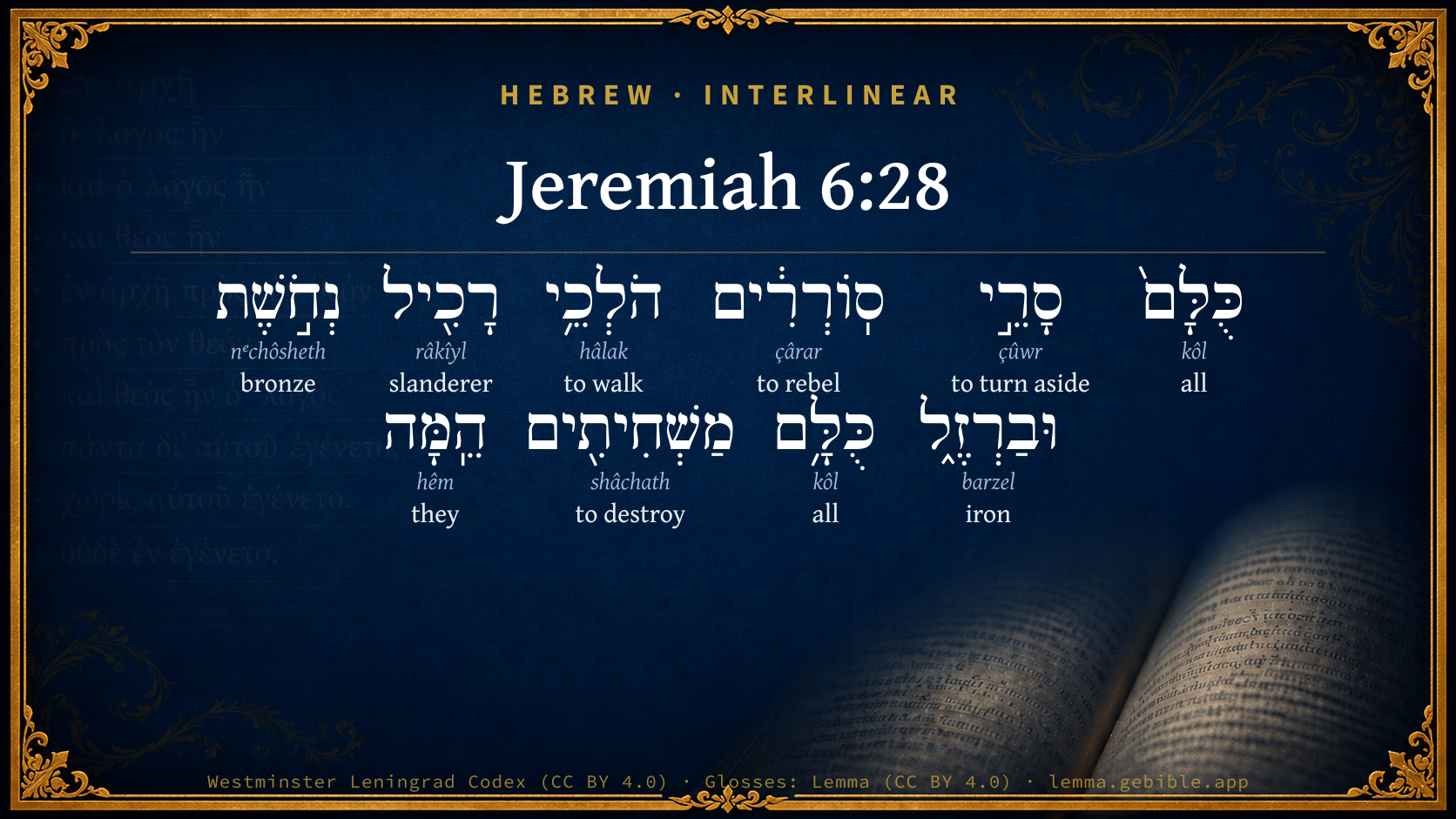
Hebrew (Westminster Leningrad Codex) Jeremiah 6:28 appears in the Hebrew Old Testament. The text above is from the Westminster Leningrad Codex. Each word links to its Strong’s number, a concise gloss, and parsing drawn from the Open Scriptures Hebrew Bible morphology. Click any word for its full Brown-Driver-Briggs (BDB) entry.
Download image
Cite this verse

Jeremiah 6:28 (World English Bible). Public Domain. Lemma interlinear Bible study tool, https://lemma.gebible.app/v/jeremiah/6/28.

Show BibTeX & RIS
BibTeX
RIS
English Translation
They are all grievous rebels, going about with slanders; they are brass and iron: they all of them deal corruptly.
World English Bible · Public Domain
Download a study sheet

One document with this verse’s original text, its word-by-word gloss line, the meaning frame, cross-references with their text, attributed commentary, and full source and license credits — printable, and it pastes into notes with its structure intact.

This verse Autodidact and up

Study sheet (.html) Plain text (.txt)

A passage Seminary Student

Up to 50 verses in one chapter. A passage sheet keeps up to 6 commentary sources and 12 cross-references per verse, in the order this page ranks them, and says so on the sheet whenever that leaves anything out. Ask for a single verse and you get the Autodidact verse sheet above.

Everything on this page stays free to read, with no account — the sheet is a download of what is already on screen, not access to it.

Want to remove ads? Support Godless Engineer
Compare translations 3

The same verse in 3 English versions, stacked beneath the original-language interlinear above. Click any original word for its lexicon entry.

Each is an independent rendering of the whole verse — the interlinear is not word-aligned to these translations.

Highlighted words mark where these versions differ — a whole-verse word diff, not a word-by-word alignment.

  • World English Bible Public Domain
    They are all grievous rebels, going about with slanders; they are brass and iron: they all of them deal corruptly.
  • King James Version Public Domain
    They are all grievous revolters, walking with slanders: they are brass and iron; they are all corrupters.
  • unfoldingWord Literal Text CC BY-SA 4.0
    All of them stubborn ones who rebel, going about gossip All of them bronze and iron; they act corruptly.

unfoldingWord Literal Text — © unfoldingWord, licensed CC BY-SA 4.0. Word-aligned USFM3 via Door43 (git.door43.org/unfoldingWord/en_ult).

Versions to compare (up to 4)

3 of 4 selected

Show all 18 translations

Every available English version of this verse, each an independent rendering of the whole verse.

  • World English Bible Public Domain
    They are all grievous rebels, going about with slanders; they are brass and iron: they all of them deal corruptly.
  • Berean Standard Bible Public Domain
    All are hardened rebels, walking around as slanderers. They are bronze and iron; all of them are corrupt.
  • Majority Standard Bible Public Domain
    All are hardened rebels, walking around as slanderers. They are bronze and iron; all of them are corrupt.
  • King James Version Public Domain
    They are all grievous revolters, walking with slanders: they are brass and iron; they are all corrupters.
  • American Standard Version (1901) Public Domain
    They are all grievous revolters, going about with slanders; they are brass and iron: they all of them deal corruptly.
  • Revised Version (1885) Public Domain
    They are all grievous revolters, going about with slanders; they are brass and iron: they all of them deal corruptly.
  • Geneva Bible (1599) Public Domain
    They are all rebellious traitours, walking craftily: they are brasse, and yron, they all are destroyers.
  • Douay-Rheims (1899) Public Domain
    All of these princes go out of the way, they walk deceitfully, they are brass and iron: they are all corrupted.
  • Young's Literal Translation Public Domain
    All of them are turned aside by apostates, Walking slanderously -- brass and iron, All of them are corrupters.
  • Literal Standard Version CC BY-SA 4.0
    All of them are turned aside by apostates, || Walking slanderously—bronze and iron, || All of them are corrupters.
  • Unlocked Literal Bible CC BY-SA 4.0
    They are all the most stubborn of people, who go about slandering others. All of them are bronze and iron, acting corruptly.
  • unfoldingWord Literal Text CC BY-SA 4.0
    All of them stubborn ones who rebel, going about gossip All of them bronze and iron; they act corruptly.
  • Darby Bible Public Domain
    They are all the most rebellious of rebels, going about with slander: they are bronze and iron; they are all corrupters.
  • World Messianic Bible Public Domain
    They are all grievous rebels, going around to slander. They are bronze and iron. All of them deal corruptly.
  • Webster's Bible Public Domain
    They are all grievous revolters, walking with slanders: they are brass and iron; they are all corrupters.
  • Free Bible Version CC BY-SA 4.0
    They're all stubborn rebels going around talking slander. They are hard as bronze and iron; they are all corrupt.
  • Bible in Basic English Public Domain
    All of them are turned away, going about with false stories; they are brass and iron: they are all workers of deceit.
  • JPS Tanakh (1917) Public Domain
    They are all grievous revolters, going about with slanders; they are brass and iron; they all of them deal corruptly.

Literal Standard Version (2020), Covenant Press — licensed CC BY-SA 4.0. Text via the HelloAO Bible API (eBible.org). Unlocked Literal Bible (unfoldingWord) — licensed CC BY-SA 4.0. Text via the HelloAO Bible API (eBible.org). unfoldingWord Literal Text — © unfoldingWord, licensed CC BY-SA 4.0. Word-aligned USFM3 via Door43 (git.door43.org/unfoldingWord/en_ult). Free Bible Version, Dr. Jonathan Gallagher — licensed CC BY-SA 4.0. Text via the HelloAO Bible API (eBible.org).

Word by word

More ways to search: Search by grammar → Find every occurrence → Compare this word →

Practice this passage: Drill this verse → Learn its vocabulary →

רָכִ֖יל
râkîyl
H7400
“slanderer”
Noun, Common, Masculine, Singular, Absolute
Part of Speech
Noun
Type
Common
Gender
Masculine
Number
Singular
State
Absolute
Full BDB Definition

Origin: from H7402 a scandal-monger (as travelling about)

TWOT: 2165b

slander, slanderer, tale bearer, informer
  1. כֻּלָּם֙ kôl H3605 “all · their” Noun, Common, Masculine, Singular, Construct + Suffix, Personal, 3rd Person, Masculine, Plural
  2. סָרֵ֣י çûwr H5493 “turning aside” Verb, Qal, Participle Active, Masculine, Singular, Construct
  3. סֽוֹרְרִ֔ים çârar H5637 “rebelling” Verb, Qal, Participle Active, Masculine, Plural, Absolute
  4. הֹלְכֵ֥י hâlak H1980 “walking” Verb, Qal, Participle Active, Masculine, Plural, Construct
  5. נְחֹ֣שֶׁת nᵉchôsheth H5178 “bronze” Noun, Common, Feminine, Singular, Absolute
  6. וּבַרְזֶ֑ל barzel H1270 “and · iron” Conjunction + Noun, Common, Masculine, Singular, Absolute
  7. כֻּלָּ֥ם kôl H3605 “all · their” Noun, Common, Masculine, Singular, Construct + Suffix, Personal, 3rd Person, Masculine, Plural
  8. מַשְׁחִיתִ֖ים shâchath H7843 “destroying” Verb, Hiphil, Participle Active, Masculine, Plural, Absolute
  9. הֵֽמָּה hêm H1992 “they” Pronoun, Personal, 3rd Person, Masculine, Plural

About this verse

These counts appear in no published source. They are computed here, from the morphology-tagged text and Lemma’s own curated glosses. What Lemma adds →

10
words
9
distinct lemmas
Prophets
section

Notable vocabulary

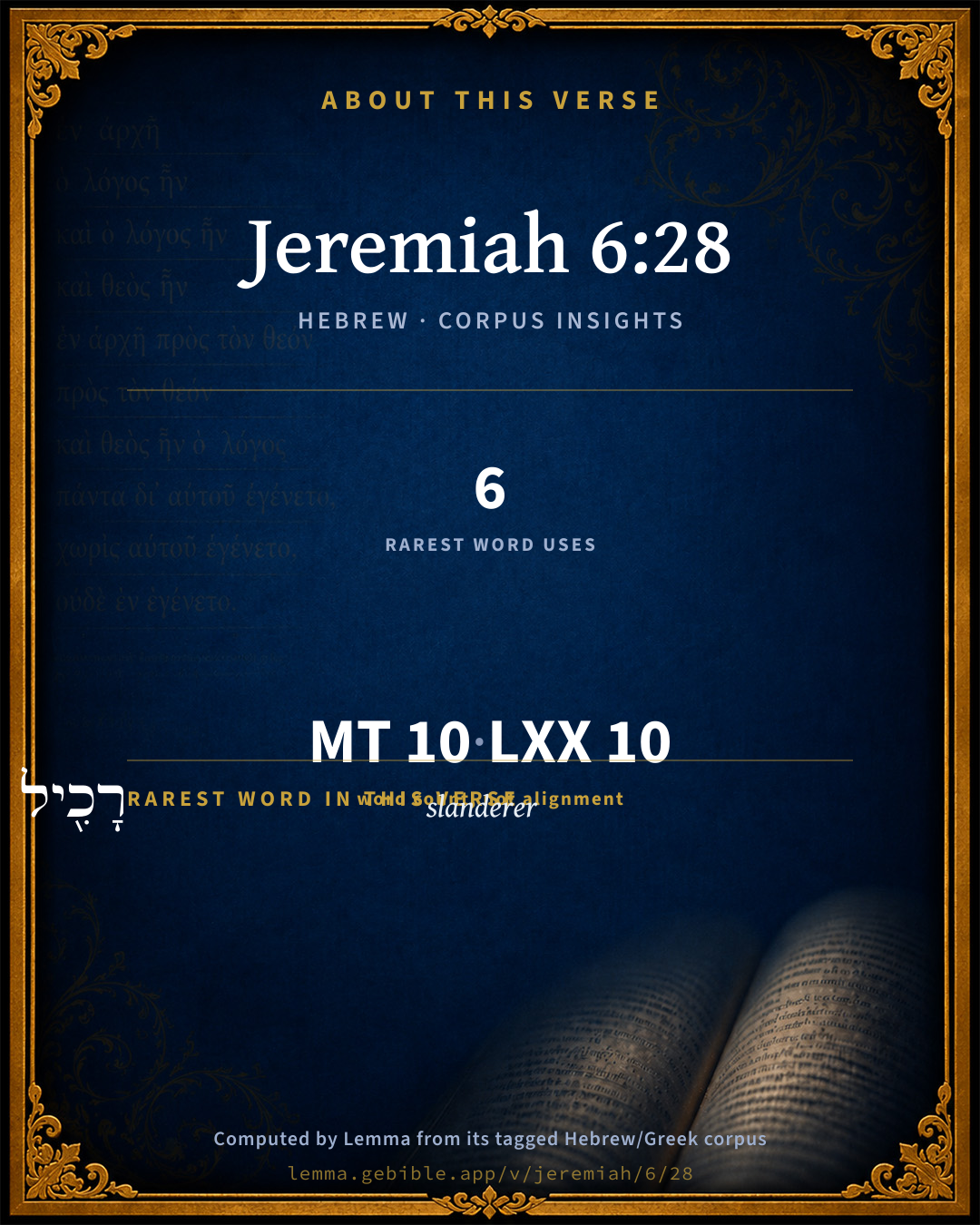
The rarest word here is רָכִ֖יל slanderer H7400 — appearing just 6 times in the whole Hebrew Bible.

Shared distinctive vocabulary

רָכִ֖יל slanderer H7400 occurs in 6 verses of the Hebrew Bible. Also found in:

Grammatical profile

  • 4 verbs
  • 5 nouns
  • 1 pronoun

Verb forms

  • סָרֵ֣י Qal · Participle Active
  • סֽוֹרְרִ֔ים Qal · Participle Active
  • הֹלְכֵ֥י Qal · Participle Active
  • מַשְׁחִיתִ֖ים Hiphil · Participle Active

Repetition

A word recurs within this verse — often emphatic in Hebrew:

  • כֻּלָּם֙ all H3605 ×2

Hebrew & Septuagint length

In the original languages it is 10 Hebrew tokens and 10 Greek tokens — but the two are counted differently (Hebrew bundles its prefixes and suffixes into one token; the Greek is in lemma form), so that isn’t a like-for-like length.

Cross-references

11

Topical passages linked to Jeremiah 6:28 in the Treasury of Scripture Knowledge — connected by theme and wording, ordered by reader-vote popularity; previews shown in the World English Bible.

  • Jeremiah 9:4 Take you heed everyone of his neighbor, and don't you trust in any brother; for every brother will utterly supplant, and every neighbor will go about with slanders.
  • Jeremiah 5:23 But this people has a revolting and a rebellious heart; they are revolted and gone.
  • Jeremiah 18:18 Then said they, Come, and let us devise devices against Jeremiah; for the law shall not perish from the priest, nor counsel from the wise, nor the word from the prophet. Come, and let us strike him with the tongue, and let us not give heed to any of his words.
  • Ezekiel 22:18–22 Son of man, the house of Israel is become dross to me: all of them are brass and tin and iron and lead, in the midst of the furnace; they are the dross of silver.
  • Psalms 50:20 You sit and speak against your brother. You slander your own mother's son.
  • Isaiah 1:4–5 Ah sinful nation, A people loaded with iniquity, A seed of evil-doers, Children who deal corruptly! They have forsaken Yahweh. They have despised the Holy One of Israel. They are estranged and backward.
  • Isaiah 31:6 Turn you to him from whom you have deeply revolted, children of Israel.
  • Jeremiah 6:30 Refuse silver shall men them, because Yahweh has rejected them.
  • Jeremiah 20:10 For I have heard the defaming of many, terror on every side. Denounce, and we will denounce him, [say] all my familiar friends, those who watch for my fall; peradventure he will be persuaded, and we shall prevail against him, and we shall take our revenge on him.
  • Revelation 11:18 The nations were angry, and your wrath came, as did the time for the dead to be judged, and to give your bondservants the prophets, their reward, as well as to the saints, and those who fear your name, to the small and the great; and to destroy those who destroy the earth."
  • Revelation 19:2 for true and righteous are his judgments. For he has judged the great prostitute, who corrupted the earth with her sexual immorality, and he has avenged the blood of his servants at her hand."

Cross-references courtesy of OpenBible.info (CC BY 4.0).

Hebrew and Greek witnesses Masoretic Hebrew ↔ Greek Septuagint

The same verse in the two great witnesses to the Old Testament, shown verse-for-verse.

These are two independent witnesses, not word-aligned to each other, and the Septuagint is shown in lemma (dictionary) form.

Hebrew Jeremiah 6:28 Masoretic · Westminster Leningrad Codex

כֻּלָּם֙ סָרֵ֣י סֽוֹרְרִ֔ים הֹלְכֵ֥י רָכִ֖יל נְחֹ֣שֶׁת וּבַרְזֶ֑ל כֻּלָּ֥ם מַשְׁחִיתִ֖ים הֵֽמָּה

They are all grievous rebels, going about with slanders; they are brass and iron: they all of them deal corruptly.

World English Bible · Public Domain

Greek LXX Structure differs

In the Septuagint, Jeremiah is about an eighth shorter than the Hebrew and arranges its material differently — the Oracles Against the Nations (Hebrew chapters 46–51) appear in the middle of the Greek book, after 25:13. Because the chapter and verse boundaries do not line up, a verse-for-verse comparison with the Hebrew is not shown.

A verse-for-verse comparison isn’t shown here because the chapters and verses don’t line up. Switch to the LXX edition with the MT / LXX toggle above to read the Greek directly.

Hebrew: Westminster Leningrad Codex (CC BY 4.0). Greek: Septuagint (public domain); English from a public-domain English Septuagint. How the Septuagint differs from the Hebrew →

Targum (Aramaic paraphrase)

1

The Targum is the ancient Jewish Aramaic paraphrase of the Hebrew Scriptures — an interpretive translation, not the Hebrew text itself. Onkelos (literal) and Pseudo-Jonathan (expansive) render the Torah, and Jonathan the Prophets. Coverage is partial: where no permissively-licensed English translation exists for a verse, only the Aramaic is shown. This is verse-level text, not a word-by-word alignment to the Hebrew.

  1. Targum Jonathan Prophets (Joshua–Malachi)
    כָּל רַבְרְבֵיהוֹן מָרְדִין מְהַלְכִין בִּנְכִילוּ כְּמָא דִמְעָרֵב נְחָשׁ עִם פַּרְזְלָא כּוּלְהוֹן מְחַבְּלִין אִינוּן:

    (no public-domain English translation for this verse)

    Targum Jonathan — Aramaic: “Mikraot Gedolot” (public domain). English: “Sefaria Community Translation” (CC0 1.0 (public-domain dedication)); “London "Chaldee Paraphrase," 1871” (public domain). Text via Sefaria.

Commentary

Notes on Jeremiah 6:28 from classic Christian and Jewish commentators (each source and its license shown beneath its notes). The classic Christian expositions comment on the surrounding passage and are grouped to its opening verse, so a note may address several verses; the Jewish commentaries on the Tanakh (Rashi and others) are per-verse, so they appear only where the commentator wrote on this verse.

Lemma curates 59 commentaries, every one of them public domain or Creative Commons licensed, each selected and text-cleaned for this edition rather than reprinted as found. About our sources →

Trapp's Complete Commentary

John Trapp

Jer 6:28 They [are] all grievous revolters, walking with slanders: [they are] brass and iron; they [are] all corrupters.

Ver. 28. They are all grievous revolters.] Heb., Revolters of revolters. Chald., Princes of revolters, archrebels. Jeremiah, God’s champion, such as was wont to be set forth completely armed at the coronation of a king in this nation, findeth and reporteth them such here, and proveth it.

Walking with slanders.] Trotting up and down as pedlars, dropping a tale here and another there, contrary to Lev 19:16.

They are brass and iron.] Base and drossy, false and feculent metals. Silver and gold they would seem to be, a sincere and holy people; but they are malae monetae, base coinage, a degenerate and hypocritical generation. Adulterini sunt, nihil habentes probi, as Theodoret hath it here; naught, and good for nought; not unlike those stones brought home in great quantity by Captain Frobisher in the reign of Queen Elizabeth. He thought them to be minerals and of good worth; but when there could be drawn from them neither gold nor silver, nor any other metal, they were cast forth to repair the highways. {a}

They are all corrupters.] Of themselves and of others.

{a} Camden’s Elisabeth, 189.

John Trapp, A Commentary or Exposition upon All the Books of the Old and New Testament (1647–1656) — public domain. Text from a community e-Sword module.

Joseph Benson's Commentary

Jer 6:28-29. They are all grievous revolters — Obstinate and refractory; walking with slanders — Making it their business to detract from thee and the other prophets. Blaney translates the clause, They are all of them the dross of revolters, passing with a fraudulent currency; an interpretation for which he assigns plausible reasons. They are brass and iron — They have basely degenerated. It appears, upon trial, that they have nothing in them of the purity of silver or gold, but their impudence resembles brass, and their obstinacy iron. They are all corrupters — Hebrew, משׁחיתים, corrupting, or adulterating; or, as Blaney renders it, instruments of adulteration, alluding to brass and iron, or any base metals, being used to adulterate the pure silver. The bellows are burned, &c. — All methods to purify and amend them are ineffectual. All the expressions to the end of the chapter are metaphorical. The lead is consumed of the fire — Before the use of quicksilver was known, the refiners used lead to separate the silver from the other substances mixed with it. Thus Pliny, Nat. Hist., lib. 31. sec. 31, “Excoqui (argentum) non potest, nisi cum plumbo nigro, aut cum vena plumbi.” The founder melteth in vain — Or, as Houbigant reads it, heapeth up fire in vain. For the wicked are not plucked away — Or rather, The dross of iniquity is not purged away. The word רעים, meaning here, it seems, the base ingredients among the metals; that is, the bad principles and habits, which prevailed so much, and adhered so closely, that all endeavours and pains used to purge them away and get clear of them proved ineffectual; so that, as it follows in the next verse, nothing remained but to throw them aside, as metal disallowed, and cried down by authority; counterfeiting silver, but not capable of being brought to the sterling standard. See Blaney. In other words: As base money is refused by every one, because it cannot bear the touchstone; so should these hypocrites and evil-doers be rejected both by God and man.

Joseph Benson's Commentary on the Old and New Testaments (1811–1818) — public domain. Text from a community e-Sword module.

Keil & Delitzsch

C. F. Keil & F. Delitzsch

Jer 6:28 gives a statement as to the moral character of the people. "Revolters of revolters" is a kind of superlative, and סרי is to be derived from סרר, not from סוּר, perverse of perverse; or, as Hitz., imitating the Heb. phrase, rebels of the rebellious. Going about as slanderers, see on Lev 19:16, in order to bring others into difficulties; cf. Eze 22:9. To this is subjoined the figurative expression: brass and iron, i.e., ignoble metal as contrasted with gold and silver, cf. Eze 22:18; and to this, again, the unfigurative statement: they are all dealing corruptingly. משׁחיתים, cf. Isa 1:4; Deu 31:29. There is no sufficient reason for joining כּלּם with the preceding: brass and iron, as Hitz. and Graf do in defiance of the accents.

Keil & Delitzsch — Biblical Commentary on the Old Testament (1861–1891) — public domain (CC PDM 1.0). Text via the HelloAO Bible API. (Old Testament only.)

Tyndale Open Study Notes

Tyndale Open Resources

6:28 The people’s dross was spiritual; it included rebellion against God, slander of other people, a hard and stubborn attitude, and a disposition to lead others into corruption (Ezek 22:18).

Tyndale Open Study Notes — © Tyndale Open Resources, licensed CC BY-SA 4.0. Text via the HelloAO Bible API.

Jamieson, Fausset & Brown

Robert Jamieson, A. R. Fausset & David Brown

grievous revolters--literally "contumacious of the contumacious," that is, most contumacious, the Hebrew mode of expressing a superlative. So "the strong among the mighty," that is, the strongest (Eze 32:21). See Jer 5:23; Hos 4:16.

walking with slanders-- (Jer 9:4). "Going about for the purpose of slandering" [MAURER].

brass, &c.--that is, copper. It and "iron" being the baser and harder metals express the debased and obdurate character of the Jews (Isa 48:4; Isa 60:17).

Jamieson, Fausset & Brown — Commentary Critical and Explanatory on the Whole Bible (1871) — public domain (CC PDM 1.0). Text via the HelloAO Bible API.

John Calvin's Commentaries

The Prophet now shews what he found the Jews to be, whose manners and proceedings he had been commanded to observe. Had he said this at first, either the fury of the people would have been kindled, or his judgment would have been treated with contempt: but when God shewed what he had known through his servant, it had more weight, and then the fury of the people was also repressed, when they understood that it would avail them nothing to fight against God.

He says, that they were all the apostates of apostates, or the transgressors of transgressors. Some read סרי, sari, with a ש, shin, and render the words, “the princes of transgressors.” But I adopt the first as the more approved reading. They who read “princes, “elicit a meaning from the words which appears strange, but not the true one: they say that they were the princes of transgressors, because the people were no better than their rulers, and because servants imitated their masters in all kinds of wickedness. But this, as all must see, is a strained meaning. Why then should anything be changed, since the sentence, as it is, has a most suitable meaning? They are then called the apostates of apostates, or the transgressors of transgressors, סרי סררים, sari sarerim The Hebrews, we know, express the superlative degree by doubling the word, as, the heaven of heavens, the holy of holies, the God of gods. He then says, that they were not only wicked, but most wicked, who had reached the extreme point of depravity. For when impiety reaches its summit, then justly may men be called the apostates of apostates. This, I have no doubt, is what the Prophet means.

He afterwards adds, that they walked in slander The same mode of speaking, if I mistake not, is found in Leviticus 19:16,

“Go not,” or walk not, “among thy people with slander.”

Yet this phrase may be otherwise explained, that is, that they walked in calumnies, or that they perverted everything. But in this place, the word slander, seems too feeble, as the Prophet, in my judgment, means more, even the audacity of the people, so that they allowed themselves every liberty in sinning, and thus walked in their own wickedness.

He adds, Brass and iron Many render the words, “Brass mixed with iron;” that is, that the noble and the vulgar were mingled together, so that there was a common consent among them. Of this meaning I do not wholly disapprove: but as it is rather refined, I know not whether it be well — founded. I therefore prefer to regard this as designating their hardness: They were like brass and iron, for they were inflexible. The Prophet then after having called them transgressors who had alienated themselves from God, and after having said, that they walked in their own depravity, now adds, that they were untamable, not capable of any improvements; and hence he compares them to brass and iron.

He at last adds, that they were all corrupters This, as I think, is to be referred to their habits: for thus are enemies called, who plunder everything, and commit all excesses. But they are corrupters here, who not only like thieves plunder the goods of all, but who are leaders to others in wickedness: so that all things were in confusion, as it is wont to be said, from the head to the feet. He afterwards adds —

John Calvin's Commentaries (1540-1563) — public domain. Text from the Calvin Translation Society English edition (1840s-50s) via the Christian Classics Ethereal Library (ccel.org). Calvin's coverage is partial (roughly two-thirds of the Bible); uncommented books and verses are honest gaps, never fabricated. The 19th-century editor's footnotes and remarks are omitted so the notes are faithfully Calvin's own voice.

Ellicott's Commentary for English Readers

(28) Grievous revolters . . .—Literally, rebels of rebels, as a Hebraism for the worst type of rebellion.

Walking with slanders.—The phrase was a common one (Lev_19:16; Pro_11:13; Pro_20:19), and pointed to the restless eagerness of the tale-bearer to spread his falsehoods. (Comp. 1Ti_5:13, “wandering about . . . idle tattlers.”)

Brass and iron.—Base metals serving for vile uses, no gold or silver in them. The imagery, which carries on the thought of the previous verse, had been made familiar by Isaiah (Isa_1:22; Isa_1:25), and was reproduced afterwards by Ezekiel (Eze_22:18-22) and Malachi (Mal_3:3).

Corrupters.—Better, workers of destruction.

A Bible Commentary for English Readers, edited by Charles John Ellicott (1878–1897) — public domain. Text from a community e-Sword module.

The Cambridge Bible for Schools and Colleges

gen. ed. J. J. S. Perowne

28. grievous revolters] Heb. revolters of revolters, one of the ways of expressing the superlative. Cp. Gen_9:25; Eze_32:21 (see note in C. B.).

they are brass and iron] an awkward expression in this place, and perhaps a later insertion, suggested by Eze_22:18-22.

The Cambridge Bible for Schools and Colleges (gen. ed. J. J. S. Perowne; Cambridge University Press, 1878–1918) — public domain. Text from a community e-Sword module.

John Gill's Exposition

They are all grievous revolters,.... From the right way of God and his worship: or,

they are all revolters of revolters (e); of all, the greatest revolters, the greatest sinners and transgressors, the most stubborn and disobedient; or sons of revolters; fathers and children are alike. The Targum, is,

"all their princes rebel;''

and so the Vulgate Latin and Syriac versions: "walking with slanders": of one another; or with deceit, as the Targum; in a hypocritical and fraudulent manner; playing the hypocrite with God, or tricking and deceiving their neighbours. They are "brass and iron"; as vile and mean as those metals, and not as gold and silver; or as hard and inflexible as they are; or they deal as insincerely

"as he that mixes brass with iron;''

so the Targum:

they are all corrupters; as such that mix metals are; they are corrupters of themselves and of others, of the doctrines and manners of men, and of the ways and worship of God.

(e) "refractarii refractariorum", Schmidt; "contumacium contumacissimi", Junius & Tremellius.

John Gill's Exposition of the Whole Bible (1746–1763) — public domain (CC PDM 1.0). Text via the HelloAO Bible API.

Matthew Poole's English Annotations

Grievous revolters; obstinate and refractory, Isa 31:6; Jer 5:3,23.

Walking with slanders; being their main business to detract from thee and the other prophets, Jer 18:18; 20:10; a sin expressly forbidden, Lev 19:16.

They are brass and iron: this to the end of the chapter is all metaphorical; either they are impudent, as brass doth sometimes signify, or they are obstinate and inflexible, as iron notes: see both Isa 48:4; or it signifies their corrupt estate; they are not pure metal, as silver or gold, but base and mean, as brass and iron mixed together, Eze 22:18.

They are all corrupters: this relates to their manners; they propagate their corruption, Isa 1:4; they strengthen one another in wickedness.

Matthew Poole's English Annotations on the Holy Bible (1683–1685) — public domain. Text from a community e-Sword/MySword module.

Whedon's Commentary on the Bible

Daniel D. Whedon

28. The reasons: The people are revolters, walking with slanders,…

brass and iron (ignoble)… corrupters.

Daniel D. Whedon (gen. ed.), Commentary on the Old and New Testaments (1874–1909) — public domain. Text from a community e-Sword module.

The Pulpit Commentary

Grievous revolters; literally, rebels of rebels. Walking; rather, going about, as a peddler with his wares. (so Pro_11:13 Lev_19:16) Jeremiah had good reason to specify this characteristic of his enemies. (see Jer_18:18) Brass and Iron; rather, copper and iron, in short, base metal,

The Pulpit Commentary (1880–1919), ed. H.D.M. Spence-Jones & Joseph S. Exell — public domain. Text from a community e-Sword module.

Rashi

Rabbi Shlomo Yitzchaki (Rashi)

extremely perverse Turning away from the road.

going tale bearing between copper and iron. They introduce hatred between two princes who have the power to provoke one another. That is what I heard. But I say, they are tale bearers, and they are as strong as copper and iron to maintain their falsehood. Jonathan, however, renders this word רכיל as an expression of guile (נוכל). They go with guile as one mixes copper with iron. נוכל is an expression of plot. Comp. (Gen. 37:18) “And they plotted (ויתנכלו) against him to slay him.”

Rashi on the Tanakh — English translations: “The Judaica Press complete Tanach with Rashi, translated by A. J. Rosenberg” (CC BY 4.0); “Pentateuch with Rashi's commentary by M. Rosenbaum and A.M. Silbermann, 1929-1934” (public domain); “The Metsudah Tanach series, Lakewood, N.J” (CC BY 4.0); and “The Book of Joshua, Metsudah Publications, 1997” (CC BY 4.0). Text via Sefaria.

Lesson kit

Teaching starters — assembled from the data on this page, not authored interpretation. Every prompt links to the verse data it draws on. Edit before teaching.

Jeremiah, in the Prophets, opens this verse with 10 words (9 distinct Hebrew lemmas). Its most distinctive word is râkîyl (“slanderer”). A historical commentator’s framing appears above. Read the whole chapter for the surrounding context.

Discussion questions

  1. How does “slanderer” (râkîyl) shape what this verse is saying?
  2. How does Leviticus 19:16, which shares the word «slanderer», read alongside this verse?
  3. What does the repetition of “all” (2× in this one verse) do in this verse?
  4. These translations render this verse differently; the difference is in the English rendering, not the original. What questions does that raise?
  5. «סָרֵ֣י» is a Qal Participle Active verb. How does that grammatical form shape the action described?
  6. Compare how Trapp's Complete Commentary and Joseph Benson's Commentary read this verse. Where do they agree or differ?

Things to notice

Reading settings

Reading text

Shown beneath each verse's original-language words.

Old Testament
Old Testament edition

Read the OT as the Masoretic Hebrew (MT) or the Greek Septuagint (LXX).

English shown for the Greek Septuagint (in the Hebrew ↔ Greek comparison).

Comparing translations? Open the Compare panel on any verse page to stack up to four side by side.