
Ezekiel 20:44

Hebrew (Westminster Leningrad Codex) Ezekiel 20:44 appears in the Hebrew Old Testament. The text above is from the Westminster Leningrad Codex. Each word links to its Strong’s number, a concise gloss, and parsing drawn from the Open Scriptures Hebrew Bible morphology. Click any word for its full Brown-Driver-Briggs (BDB) entry.
Download image
Cite this verse

Ezekiel 20:44 (World English Bible). Public Domain. Lemma interlinear Bible study tool, https://lemma.gebible.app/v/ezekiel/20/44.

Show BibTeX & RIS
BibTeX
RIS
English Translation
You shall know that I am Yahweh, when I have dealt with you for my name's sake, not according to your evil ways, nor according to your corrupt doings, you house of Israel, says the Lord Yahweh.
World English Bible · Public Domain
Download a study sheet

One document with this verse’s original text, its word-by-word gloss line, the meaning frame, cross-references with their text, attributed commentary, and full source and license credits — printable, and it pastes into notes with its structure intact.

This verse Autodidact and up

Study sheet (.html) Plain text (.txt)

A passage Seminary Student

Up to 50 verses in one chapter. A passage sheet keeps up to 6 commentary sources and 12 cross-references per verse, in the order this page ranks them, and says so on the sheet whenever that leaves anything out. Ask for a single verse and you get the Autodidact verse sheet above.

Everything on this page stays free to read, with no account — the sheet is a download of what is already on screen, not access to it.

Want to remove ads? Support Godless Engineer
Compare translations 3

The same verse in 3 English versions, stacked beneath the original-language interlinear above. Click any original word for its lexicon entry.

Each is an independent rendering of the whole verse — the interlinear is not word-aligned to these translations.

Highlighted words mark where these versions differ — a whole-verse word diff, not a word-by-word alignment.

  • World English Bible Public Domain
    You shall know that I am Yahweh, when I have dealt with you for my name's sake, not according to your evil ways, nor according to your corrupt doings, you house of Israel, says the Lord Yahweh.
  • King James Version Public Domain
    And ye shall know that I am the LORD when I have wrought with you for my name's sake, not according to your wicked ways, nor according to your corrupt doings, O ye house of Israel, saith the Lord GOD.
  • unfoldingWord Literal Text CC BY-SA 4.0
    So you will know that I am Yahweh when I do this to you because of my name’s sake, and not because of your evil deeds, and not because of your corrupt deeds, house of Israel—this is the Lord Yahweh’s declaration.’”

unfoldingWord Literal Text — © unfoldingWord, licensed CC BY-SA 4.0. Word-aligned USFM3 via Door43 (git.door43.org/unfoldingWord/en_ult).

Versions to compare (up to 4)

3 of 4 selected

Show all 18 translations

Every available English version of this verse, each an independent rendering of the whole verse.

  • World English Bible Public Domain
    You shall know that I am Yahweh, when I have dealt with you for my name's sake, not according to your evil ways, nor according to your corrupt doings, you house of Israel, says the Lord Yahweh.
  • Berean Standard Bible Public Domain
    Then you will know, O house of Israel, that I am the LORD, when I have dealt with you for the sake of My name and not according to your wicked ways and corrupt acts, declares the Lord GOD.”
  • Majority Standard Bible Public Domain
    Then you will know, O house of Israel, that I am the LORD, when I have dealt with you for the sake of My name and not according to your wicked ways and corrupt acts, declares the Lord GOD.”
  • King James Version Public Domain
    And ye shall know that I am the LORD when I have wrought with you for my name's sake, not according to your wicked ways, nor according to your corrupt doings, O ye house of Israel, saith the Lord GOD.
  • American Standard Version (1901) Public Domain
    And ye shall know that I am Jehovah, when I have dealt with you for my name's sake, not according to your evil ways, nor according to your corrupt doings, O ye house of Israel, saith the Lord Jehovah.
  • Revised Version (1885) Public Domain
    And ye shall know that I am the LORD, when I have wrought with you for my name’s sake, not according to your evil ways, nor according to your corrupt doings, O ye house of Israel, saith the Lord GOD.
  • Geneva Bible (1599) Public Domain
    And ye shall knowe, that I am the Lord, when I haue respect vnto you for my Names sake, and not after your wicked wayes, nor according to your corrupt workes, O ye house of Israel, saith the Lord God.
  • Douay-Rheims (1899) Public Domain
    And you shall know that I am the Lord, when I shall have done well by you for my own name's sake, and not according to your evil ways, nor according to your wicked deeds, O house of Israel, saith the Lord God.
  • Young's Literal Translation Public Domain
    And ye have known that I `am' Jehovah, In My dealing with you for My name's sake, Not according to your evil ways, And according to your corrupt doings, O house of Israel, An affirmation of the Lord Jehovah.'
  • Literal Standard Version CC BY-SA 4.0
    And you have known that I [am] YHWH, || In My dealing with you for My Name’s sake, || Not according to your evil ways, || And according to your corrupt doings, O house of Israel, || A declaration of Lord YHWH.”
  • Unlocked Literal Bible CC BY-SA 4.0
    So you will know that I am Yahweh when I do this to you because of my name's sake, and not because of your evil deeds, and not because of your corrupt deeds, house of Israel—this is the Lord Yahweh's declaration.'”
  • unfoldingWord Literal Text CC BY-SA 4.0
    So you will know that I am Yahweh when I do this to you because of my name’s sake, and not because of your evil deeds, and not because of your corrupt deeds, house of Israel—this is the Lord Yahweh’s declaration.’”
  • Darby Bible Public Domain
    And ye shall know that I [am] Jehovah, when I have wrought with you for my name's sake, not according to your wicked ways, nor according to your corrupt doings, O house of Israel, saith the Lord Jehovah.
  • World Messianic Bible Public Domain
    You will know that I am the LORD, when I have dealt with you for my name’s sake, not according to your evil ways, nor according to your corrupt doings, you house of Israel,” says the Lord GOD.’”
  • Webster's Bible Public Domain
    And ye shall know that I am the LORD, when I have wrought with you for my name's sake, not according to your wicked ways, nor according to your corrupt doings, O ye house of Israel, saith the Lord GOD.
  • Free Bible Version CC BY-SA 4.0
    Then you people of Israel will acknowledge that I am the Lord, because I have treated you well because of who I am, and not because of your evil ways and terrible things you've done, declares the Lord God.”
  • Bible in Basic English Public Domain
    And you will be certain that I am the Lord, when I take you in hand for the honour of my name, and not for your evil ways or your unclean doings, O children of Israel, says the Lord.
  • JPS Tanakh (1917) Public Domain
    And ye shall know that I am the LORD, when I have wrought with you for My name's sake, not according to your evil ways, nor according to your corrupt doings, O ye house of Israel, saith the Lord GOD.'

Literal Standard Version (2020), Covenant Press — licensed CC BY-SA 4.0. Text via the HelloAO Bible API (eBible.org). Unlocked Literal Bible (unfoldingWord) — licensed CC BY-SA 4.0. Text via the HelloAO Bible API (eBible.org). unfoldingWord Literal Text — © unfoldingWord, licensed CC BY-SA 4.0. Word-aligned USFM3 via Door43 (git.door43.org/unfoldingWord/en_ult). Free Bible Version, Dr. Jonathan Gallagher — licensed CC BY-SA 4.0. Text via the HelloAO Bible API (eBible.org).

Word by word

More ways to search: Search by grammar → Find every occurrence → Compare this word →

Practice this passage: Drill this verse → Learn its vocabulary →

וְכַעֲלִילֽוֹתֵיכֶ֤ם
ʻălîylâh
H5949
“and · like/as · deeds · your”
Conjunction + Preposition + Noun, Common, Feminine, Plural, Construct + Suffix, Personal, 2nd Person, Masculine, Plural
Part of Speech
Conjunction + Preposition + Noun
Type
Common
Gender
Feminine
Number
Plural
State
Construct
Full BDB Definition

Origin: from H5953 in the sense of effecting

TWOT: 1627c

wantonness, deed, doing - wantonness - deed - practices, evil deeds
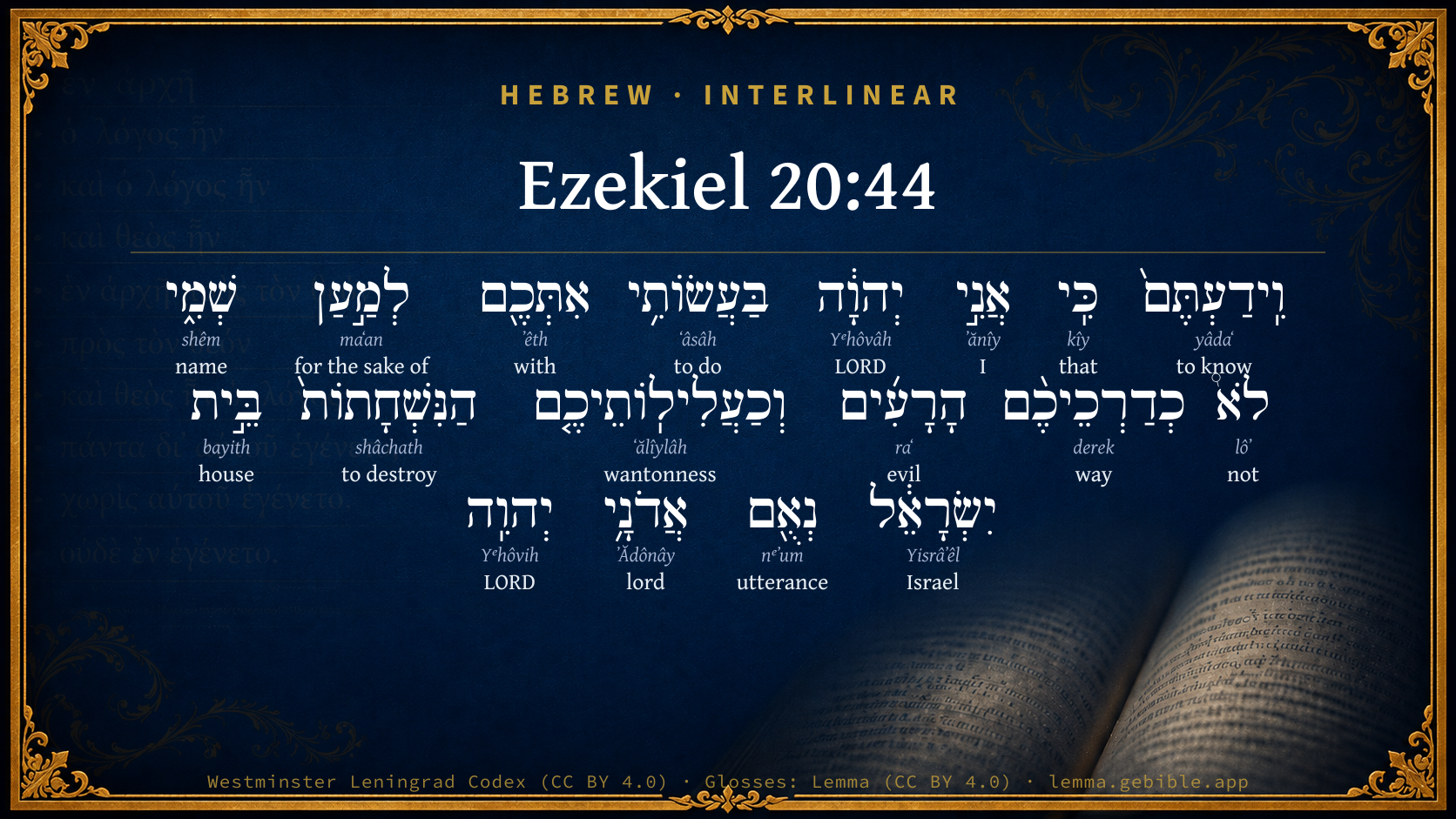
  1. וִֽידַעְתֶּם֙ yâdaʻ H3045 “and · to know” Conjunction + Verb, Qal, Sequential Perfect, 2nd Person, Masculine, Plural
  2. כִּֽי kîy H3588 “that” Conjunction
  3. אֲנִ֣י ʼănîy H589 “I” Pronoun, Personal, 1st Person, Common, Singular
  4. יְהוָ֔ה Yᵉhôvâh H3068 “LORD” Noun, Proper
  5. בַּעֲשׂוֹתִ֥י ʻâsâh H6213 “in/at · to do · me” Preposition + Verb, Qal, Infinitive Construct + Suffix, Personal, 1st Person, Common, Singular
  6. אִתְּכֶ֖ם ʼêth H854 “with · you” Preposition + Suffix, Personal, 2nd Person, Masculine, Plural
  7. לְמַ֣עַן maʻan H4616 “for the sake of” Preposition
  8. שְׁמִ֑י shêm H8034 “name · my” Noun, Common, Masculine, Singular, Construct + Suffix, Personal, 1st Person, Common, Singular
  9. לֹא֩ lôʼ H3808 “not” Particle, Negative
  10. כְדַרְכֵיכֶ֨ם derek H1870 “like/as · ways · your” Preposition + Noun, Common, Both, Plural, Construct + Suffix, Personal, 2nd Person, Masculine, Plural
  11. הָרָעִ֜ים raʻ H7451 “the · evil” Particle, Definite Article + Adjective, Adjective, Masculine, Plural, Absolute
  12. הַנִּשְׁחָתוֹת֙ shâchath H7843 “the · destroyed” Particle, Definite Article + Verb, Niphal, Participle Passive, Feminine, Plural, Absolute
  13. בֵּ֣ית bayith H1004 “house of” Noun, Common, Masculine, Singular, Construct
  14. יִשְׂרָאֵ֔ל Yisrâʼêl H3478 “Israel” Noun, Proper
  15. נְאֻ֖ם nᵉʼum H5002 “utterance of” Noun, Common, Masculine, Singular, Construct
  16. אֲדֹנָ֥י ʼĂdônây H136 “Lord · my” Noun, Common, Masculine, Plural, Construct + Suffix, Personal, 1st Person, Common, Singular
  17. יְהוִֽה Yᵉhôvih H3069 “LORD” Noun, Proper

About this verse

These counts appear in no published source. They are computed here, from the morphology-tagged text and Lemma’s own curated glosses. What Lemma adds →

18
words
18
distinct lemmas
Prophets
section

Notable vocabulary

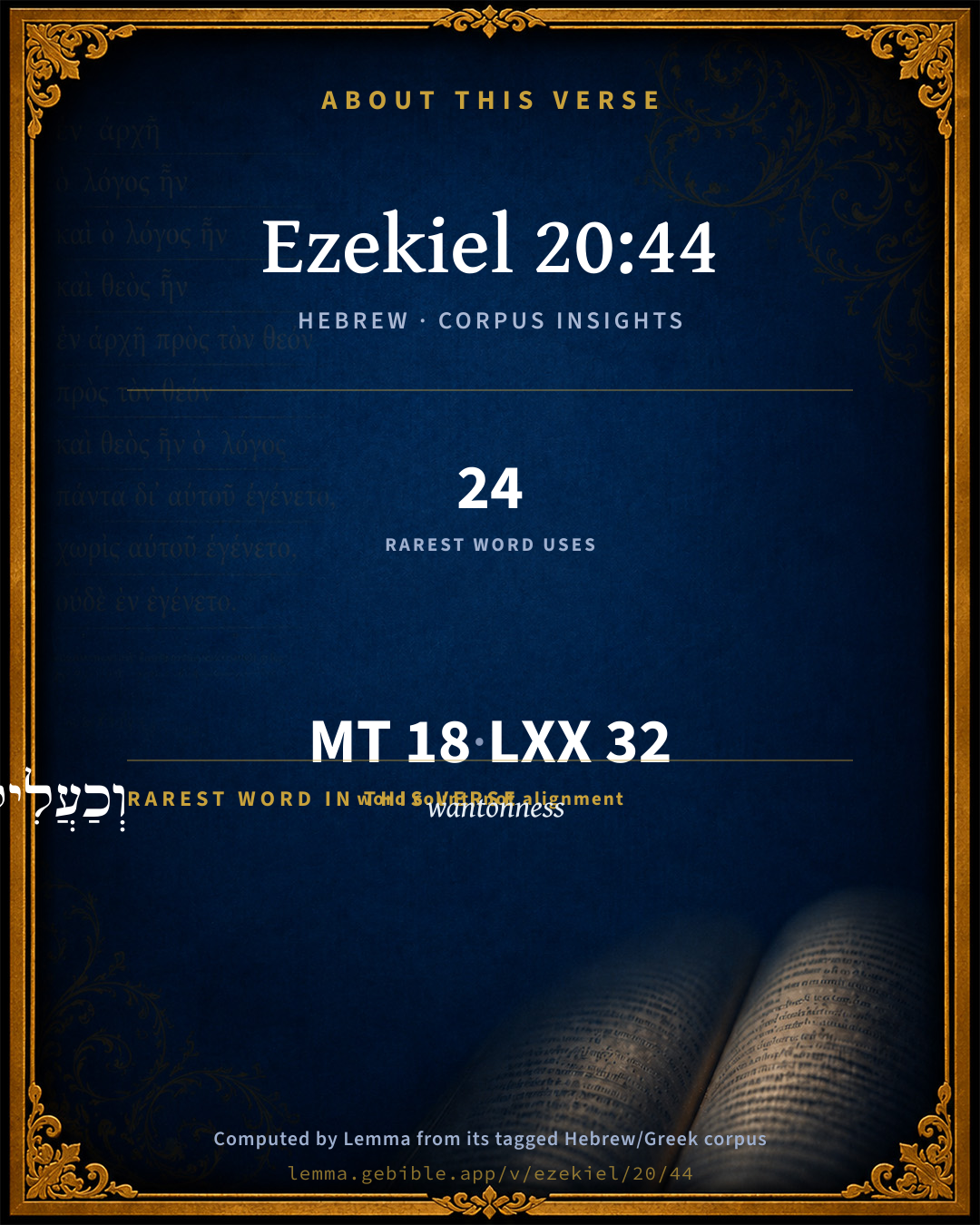
The rarest word here is וְכַעֲלִילֽוֹתֵיכֶ֤ם wantonness H5949 — appearing just 24 times in the whole Hebrew Bible.

Shared distinctive vocabulary

וְכַעֲלִילֽוֹתֵיכֶ֤ם wantonness H5949 occurs in 24 verses of the Hebrew Bible. Also found in:

Grammatical profile

  • 3 verbs
  • 9 nouns
  • 1 adjective
  • 1 pronoun
  • 2 prepositions
  • 1 conjunction
  • 1 particle

Verb forms

  • וִֽידַעְתֶּם֙ Qal · Sequential Perfect
  • בַּעֲשׂוֹתִ֥י Qal · Infinitive Construct
  • הַנִּשְׁחָתוֹת֙ Niphal · Participle Passive

Hebrew & Septuagint length

In English translation the verse runs 37 words from the Hebrew and 35 from the Septuagint (LXX English) — closely comparable.

A rough comparison of the two English renderings, which tokenize alike — not a word-level alignment.

Word counts can differ between the Hebrew and the Greek without any difference in meaning — e.g. the Hebrew direct-object marker אֵת has no separate Greek word, and Greek often adds the article ὁ.

In the original languages it is 18 Hebrew tokens and 32 Greek tokens — but the two are counted differently (Hebrew bundles its prefixes and suffixes into one token; the Greek is in lemma form), so that isn’t a like-for-like length.

Cross-references

10

Topical passages linked to Ezekiel 20:44 in the Treasury of Scripture Knowledge — connected by theme and wording, ordered by reader-vote popularity; previews shown in the World English Bible.

  • Ezekiel 24:24 Thus shall Ezekiel be to you a sign; according to all that he has done shall you do: when this comes, then shall you know that I am the Lord Yahweh.
  • Psalms 115:1 Not to us, Yahweh, not to us, But to your name give glory, For your loving kindness, and for your truth's sake.
  • Ezekiel 20:9 But I worked for my name's sake, that it should not be profaned in the sight of the nations, among which they were, in whose sight I made myself known to them, in bringing them forth out of the land of Egypt.
  • Ezekiel 20:14 But I worked for my name's sake, that it should not be profaned in the sight of the nations, in whose sight I brought them out.
  • Ezekiel 20:22 Nevertheless I withdrew my hand, and worked for my name's sake, that it should not be profaned in the sight of the nations, in whose sight I brought them forth.
  • Ezekiel 36:21–22 But I had regard for my holy name, which the house of Israel had profaned among the nations, where they went.
  • Ephesians 1:6 to the praise of the glory of his grace, by which he freely bestowed favor on us in the Beloved,
  • 1 Timothy 1:16 However, for this cause I obtained mercy, that in me first, Jesus Christ might display all his patience, for an example of those who were going to believe in him for eternal life.
  • Psalms 79:9 Help us, God of our salvation, for the glory of your name. Deliver us, and forgive our sins, for your name's sake.
  • Ezekiel 20:38 and I will purge out from among you the rebels, and those who disobey against me; I will bring them forth out of the land where they sojourn, but they shall not enter into the land of Israel: and you shall know that I am Yahweh.

Cross-references courtesy of OpenBible.info (CC BY 4.0).

Hebrew and Greek witnesses Masoretic Hebrew ↔ Greek Septuagint

The same verse in the two great witnesses to the Old Testament, shown verse-for-verse.

These are two independent witnesses, not word-aligned to each other, and the Septuagint is shown in lemma (dictionary) form.

Hebrew Ezekiel 20:44 Masoretic · Westminster Leningrad Codex

וִֽידַעְתֶּם֙ כִּֽי אֲנִ֣י יְהוָ֔ה בַּעֲשׂוֹתִ֥י אִתְּכֶ֖ם לְמַ֣עַן שְׁמִ֑י לֹא֩ כְדַרְכֵיכֶ֨ם הָרָעִ֜ים וְכַעֲלִילֽוֹתֵיכֶ֤ם הַנִּשְׁחָתוֹת֙ בֵּ֣ית יִשְׂרָאֵ֔ל נְאֻ֖ם אֲדֹנָ֥י יְהוִֽה

You shall know that I am Yahweh, when I have dealt with you for my name's sake, not according to your evil ways, nor according to your corrupt doings, you house of Israel, says the Lord Yahweh.

World English Bible · Public Domain

Greek LXX Ezekiel 20:44 Septuagint · lemma form

καί ἐπιγιγνώσκω διότι ἐγώ κύριος ἐν ὁ ποιέω ἐγώ οὕτως σύ ὅπως ὁ ὄνομα ἐγώ μή βεβηλόω κατά ὁ ὁδός σύ ὁ κακός καί κατά ὁ ἐπιτήδευμα σύ ὁ διαφθείρω λέγω κύριος

And you⌃ shall know that I am the Lord, when I have done thus to you, that my name may not be profaned in your evil ways, and in your corrupt devices, says the Lord.

LXX2012 (modern English Septuagint) · Public Domain

Hebrew: Westminster Leningrad Codex (CC BY 4.0). Greek: Septuagint (public domain); English from LXX2012 (modern English Septuagint) (Public Domain). How the Septuagint differs from the Hebrew →

Targum (Aramaic paraphrase)

1

The Targum is the ancient Jewish Aramaic paraphrase of the Hebrew Scriptures — an interpretive translation, not the Hebrew text itself. Onkelos (literal) and Pseudo-Jonathan (expansive) render the Torah, and Jonathan the Prophets. Coverage is partial: where no permissively-licensed English translation exists for a verse, only the Aramaic is shown. This is verse-level text, not a word-by-word alignment to the Hebrew.

  1. Targum Jonathan Prophets (Joshua–Malachi)
    וְתֵידְעוּן אֲרֵי אֲנָא יְיָ כַּד אַעְבֵּיד עִמְכוֹן בְּדִיל שְׁמִי לָא כְאוֹרְחָתְכוֹן בִּישְׁתָא וּכְעוֹבָדֵיכוֹן מְחַבְּלַיָא בֵּית יִשְׂרָאֵל אֲמַר יְיָ אֱלֹהִים:

    (no public-domain English translation for this verse)

    Targum Jonathan — Aramaic: “Mikraot Gedolot” (public domain). English: “Sefaria Community Translation” (CC0 1.0 (public-domain dedication)); “London "Chaldee Paraphrase," 1871” (public domain). Text via Sefaria.

Commentary

Notes on Ezekiel 20:44 from classic Christian and Jewish commentators (each source and its license shown beneath its notes). The classic Christian expositions comment on the surrounding passage and are grouped to its opening verse, so a note may address several verses; the Jewish commentaries on the Tanakh (Rashi and others) are per-verse, so they appear only where the commentator wrote on this verse.

Lemma curates 59 commentaries, every one of them public domain or Creative Commons licensed, each selected and text-cleaned for this edition rather than reprinted as found. About our sources →

Trapp's Complete Commentary

John Trapp

Eze 20:44 And ye shall know that I [am] the LORD, when I have wrought with you for my name’s sake, not according to your wicked ways, nor according to your corrupt doings, O ye house of Israel, saith the Lord GOD.

Ver. 44. And ye shall know that I am the Lord.] A sin pardoning and heart sanctifying God; a rich rewarder of all that diligently seek me. {Heb 11:6}

John Trapp, A Commentary or Exposition upon All the Books of the Old and New Testament (1647–1656) — public domain. Text from a community e-Sword module.

Jamieson, Fausset & Brown

Robert Jamieson, A. R. Fausset & David Brown

The English Version chapter ought to have ended here, and the twenty-first chapter begun with "Moreover," &c., as in the Hebrew Bible.

for my name's sake-- (Eze 36:22). Gratuitously; according to My compassion, not your merits. After having commented on this verse, CALVIN was laid on his death bed, and his commentary ended.

Jamieson, Fausset & Brown — Commentary Critical and Explanatory on the Whole Bible (1871) — public domain (CC PDM 1.0). Text via the HelloAO Bible API.

John Calvin's Commentaries

Here at length God pronounces that his glory would be chiefly conspicuous in the pity which he bestowed upon those who were desperate and abandoned, gratuitously and solely with respect to his own name. Hence Paul so specially celebrates; the grace of God in the first chapter of the epistle to the Ephesians, as that mercy by which God deigns to call his own elect in a peculiar sense — his glory; for his glory extends farther than his pity. (Ephesians 1:6, 12, 14.)

As thy name, so thy praise is extended through all lands, (Psalm 48:10)

for God deserves no less glory when he destroys the wicked than when he pities his own people. But Paul calls that gratuitous favor glory par excellence, by which God embraced his own elect when he adopted them. So also it is said in this passage, then you shall know that I am Jehovah, since I shall deal with you on behalf of my name, and not according to your sins. But when God wishes his glory to shine conspicuously in gratuitous pity, hence we gather that the enemies of his glory were too gross and open, who obscure his mercy, or extenuate it, or as far as they can, endeavor to reduce it to nothing. But we know the teaching of the papacy to be that God’s gratuitous goodness either is buried or enfolded in dark obscurity, or utterly vanish away: for they have invented a system of general merits which they oppose to God’s gratuitous favor. For they distinguish merits into preparations, good works acquiring God’s favor, and satisfactions, by which they buy off the penalties to which they were subjected. Afterwards they add what they call the suffrages of the saints; for they fabricate for themselves numberless patrons, and various reasonings are concocted for the purpose of obscuring God’s glory, or at least of allowing only a few sparks to be visible. Since therefore the whole papacy tends that way, we see that they professedly oppose God’s glory, and those who defend such abominations are sworn enemies of God’s glory.

For ourselves, then, let. us learn that we cannot otherwise worship God with acceptance unless we adopt whatever pleases him as pertaining to our salvation. For if we wish to come to a debtor and creditor account, or to consider that he is in the slightest degree indebted to us, we in this way diminish his glory, and as far as is in our power we despoil ourselves of that inestimable privilege which the Prophet now commends. Hence let us desire to acknowledge God in this way, since he treats us with amazing clemency and pity out of regard for his own name, and not according to our sins. And since that was said to his ancient people because they returned to the land of Canaan, how much more ought God’s gratuitous goodness to be extolled by us, when his heavenly kingdom is at this day open to us, and when he openly calls us to himself in heaven, and to the hope of that happy immortality which has been obtained for us through Christ?

John Calvin's Commentaries (1540-1563) — public domain. Text from the Calvin Translation Society English edition (1840s-50s) via the Christian Classics Ethereal Library (ccel.org). Calvin's coverage is partial (roughly two-thirds of the Bible); uncommented books and verses are honest gaps, never fabricated. The 19th-century editor's footnotes and remarks are omitted so the notes are faithfully Calvin's own voice.

The Cambridge Bible for Schools and Colleges

gen. ed. J. J. S. Perowne

44. And the final issue of all shall be that the people will know that he is Jehovah. Jew and Gentile shall alike know that the God of Israel is God alone. Cf. Isa_40:5 “the glory of the Lord shall be revealed and all flesh shall see it together,” Psa_102:15-16; Psa_102:22.

Eze_20:45-49 belong to ch. 21.

On the prophet’s philosophy of history, his idea that history is Jehovah operating for “his name’s sake,” cf. Introduction.

The Cambridge Bible for Schools and Colleges (gen. ed. J. J. S. Perowne; Cambridge University Press, 1878–1918) — public domain. Text from a community e-Sword module.

John Gill's Exposition

Moreover, the word of the Lord came unto me, saying. Or the word of prophecy, as the Targum. Here begins a new prophecy, and most properly a new chapter should here begin; for the next chapter is of the same argument with this, and an explanation of it, and an enlargement upon it. And here Ben Melech begins one; and so Junius and Tremellius, Piscator, and Castalio.

Moreover, the word of the Lord came unto me, saying. Or the word of prophecy, as the Targum. Here begins a new prophecy, and most properly a new chapter should here begin; for the next chapter is of the same argument with this, and an explanation of it, and an enlargement upon it. And here Ben Melech begins one; and so Junius and Tremellius, Piscator, and Castalio.

Ezekiel 20:46

eze 20:46

eze 20:46

eze 20:46Son of man, set thy force toward the south,.... The land of Judea, which lay south of Babylon, where the prophet now was, as Babylon lay north of that, Jer 1:14 to set his face was to speak freely and boldly, with courage and constancy, and without fear and dread, to the inhabitants of it; and as a token of the Lord's face being set against them for their sins. The Targum is,

"take a prophecy towards the way of the south.''

And drop thy word toward the south; or prophesy, as the Targum; doctrine or prophecy being compared to rain, and the delivery of it to the dropping or distilling of rain; which falls gently, gradually, successively, and oftentimes with weight, and to good purpose; see Deu 32:2, which metaphorical phrase is explained in the next clause:

and prophesy against the forest of the south field; the city of Jerusalem, in the land of Judea, which was very full of people, as a forest of trees; but these barren and unfruitful, as the trees of the wood generally are; and a rendezvous of wicked persons, comparable to beasts of prey, that haunt in woods and forests.

John Gill's Exposition of the Whole Bible (1746–1763) — public domain (CC PDM 1.0). Text via the HelloAO Bible API.

Matthew Poole's English Annotations

This 44th verse doth summarily acquaint us that all Goa did for this people was of free, mere mercy, and for his own sake, not theirs.

Ye shall know; experimentally, with affection and obedience. The hypocrite secretly thinks somewhat in himself and works that God had regard to, but an honest, good heart, when God hath wrought, owneth the mercy wrought to be free and undeserved.

Matthew Poole's English Annotations on the Holy Bible (1683–1685) — public domain. Text from a community e-Sword/MySword module.

Whedon's Commentary on the Bible

Daniel D. Whedon

44. Ye shall know that I am the Lord — When the Hebrews are able to look back and see that every calamity was for their good they will loathe themselves for their sins (Eze_20:43) and know that their God is indeed Jehovah, “long-suffering, and abundant in kindness and truth” (Exo_34:6; Num_14:18).

Daniel D. Whedon (gen. ed.), Commentary on the Old and New Testaments (1874–1909) — public domain. Text from a community e-Sword module.

The Pulpit Commentary

For my Name"s sake.

The grounds of the Divine action are not man"s deserts, but considerations in regard to God himself. This is the secret of our hope. "He hath not dealt with us after our sins". (Psa_103:10) He hath dealt with us alter his Name. God"s Name stands for what is known of him his revelation of himself; it also represents his fame, and then his honour as we should say, his "good name." No doubt the latter is the meaning of God"s Name in the present instance, although this rests upon the former meaning, and in a measure includes it. Our word "character" has this twofold meaning what is known to be in a person and the reputation he bears the subjective and the objective characters. We may say that God saves us for the sake of his own character in both senses.

I HIS PUBLIC CHARACTER.

1. God is honoured by his fidelity. His name is pledged to his word. His promise involves his Name. When a man has put his name to a deed, he is bound to fulfil its conditions. If he fails, his name is dishonoured. Promoters make great efforts to secure for their enterprises names that will inspire confidence. God will keep his word for the sake of his credit for this at least, though we know also for deeper reasons.

2. God is honoured by his success. The name of the artist goes with his work. If he sends out a bad piece of work, his name suffers. Now, Israel was God"s rescued people. All the world gazed in wonder and admiration when the poor helpless slaves were wrested by Divine power from the iron grip of Pharaoh. They were seen to be a nation made by God, his workmanship. If they came to ruin after this, God would seem to have failed. Moses used this argument. (Exo_32:12)

3. God is honoured by his mercy. Cruel earthly monarchs of the old heathen type were proud to record on their tablets the number of kings they had slain, and the number of cities they had sacked. We have learnt to see a greater royal dignity in the saying of William Ill. concerning a certain nonjuror, "The man has determined to be a martyr, but I have determined to prevent him." God is more honoured by saving the world than he would be by damning it.

II HIS PERSONAL CHARACTER.

1. God acts from regard to truth. After all, it is but as an accommodation to human views that God can be said to keep his promises for the sake of his reputation, that his Name may not be dishonoured. He is essentially true and eternally constant. Though men may provoke him to change, he is firm and holds on to his purpose. Thus Christ persisted in his saving work, even when those whom he came to bless rejected him. He had a great purpose, and no action of man would turn him from it.

2. God acts from regard to righteousness. He desires to establish righteousness, and to extend its domain. For this purpose it will not be well that sin should be left to run its own fatal course unchecked, nor will it be best simply to visit the sin with vengeance, and to cut down the evil tree root and branch, sweeping the sinner with his sin into utter destruction. A silent desolation, in which every enemy lies low, smitten to death, is not the noblest victory. The conquest of the foe by his conversion to friendship is far higher. This is God"s method. His righteousness is most honoured by the regeneration of sinners.

3. God acts from regard to love. His name is love. When we penetrate to the heart of God, love is what we see there. If, then, his Name expresses his inmost character, when God acts for his Name"s sake he acts in love. Therefore, though he might smite, extirpate, and destroy them, he redeems. saves, and restores his unworthy children.

The Pulpit Commentary (1880–1919), ed. H.D.M. Spence-Jones & Joseph S. Exell — public domain. Text from a community e-Sword module.

Lesson kit

Teaching starters — assembled from the data on this page, not authored interpretation. Every prompt links to the verse data it draws on. Edit before teaching.

Ezekiel, in the Prophets, opens this verse with 18 words (18 distinct Hebrew lemmas). Its most distinctive word is ʻălîylâh (“wantonness”). A historical commentator’s framing appears above. Read the whole chapter for the surrounding context.

Discussion questions

  1. How does “wantonness” (ʻălîylâh) shape what this verse is saying?
  2. How does Deuteronomy 22:14, which shares the word «wantonness», read alongside this verse?
  3. These translations render this verse differently; the difference is in the English rendering, not the original. What questions does that raise?
  4. «וִֽידַעְתֶּם֙» is a Qal Sequential Perfect verb. How does that grammatical form shape the action described?
  5. Compare how Trapp's Complete Commentary and Jamieson, Fausset & Brown read this verse. Where do they agree or differ?

Things to notice

Reading settings

Reading text

Shown beneath each verse's original-language words.

Old Testament
Old Testament edition

Read the OT as the Masoretic Hebrew (MT) or the Greek Septuagint (LXX).

English shown for the Greek Septuagint (in the Hebrew ↔ Greek comparison).

Comparing translations? Open the Compare panel on any verse page to stack up to four side by side.