Isaiah 36:10

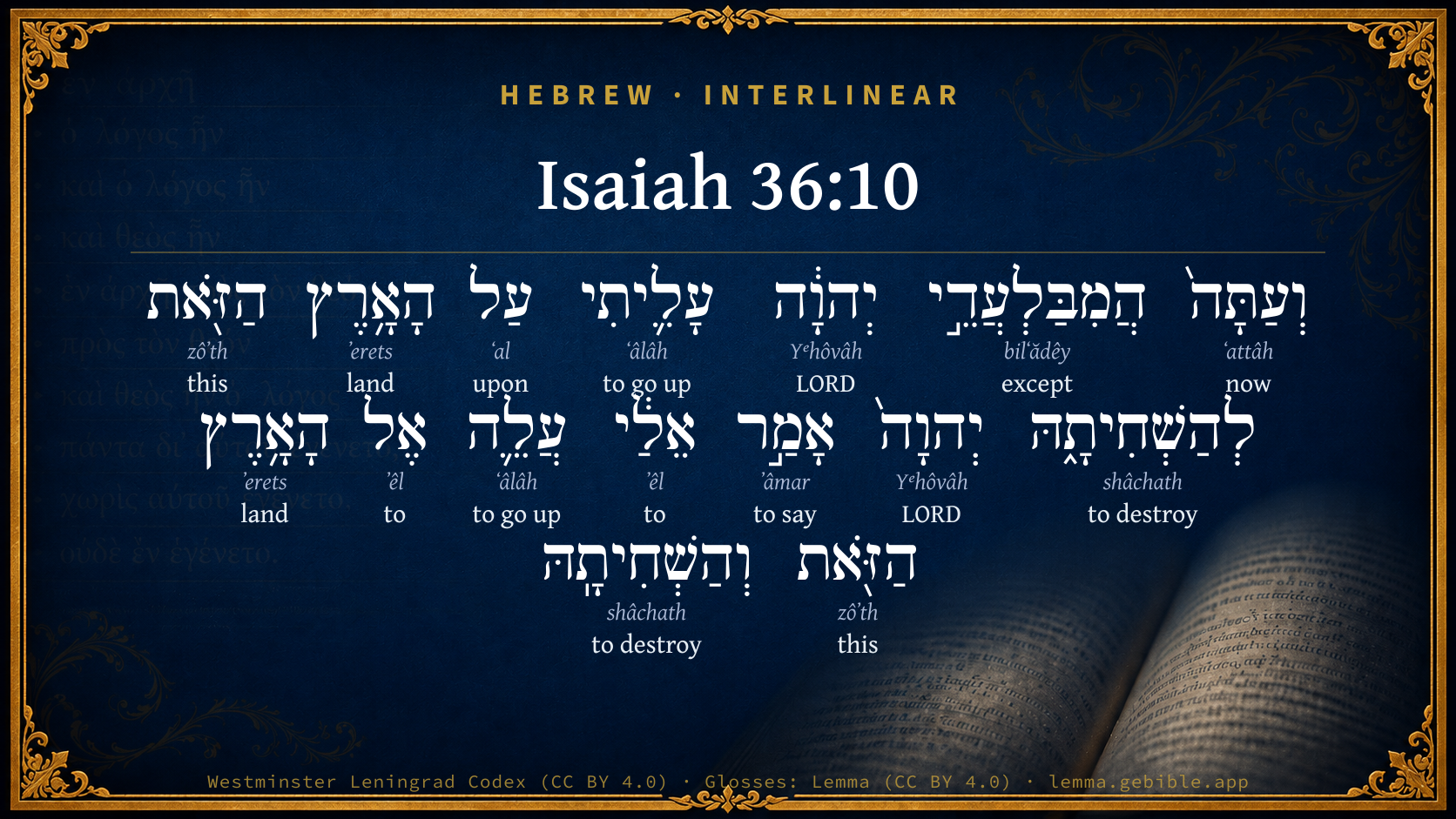
Hebrew (Westminster Leningrad Codex) Isaiah 36:10 appears in the Hebrew Old Testament. The text above is from the Westminster Leningrad Codex. Each word links to its Strong’s number, a concise gloss, and parsing drawn from the Open Scriptures Hebrew Bible morphology. Click any word for its full Brown-Driver-Briggs (BDB) entry.
Download image
Cite this verse

Isaiah 36:10 (World English Bible). Public Domain. Lemma interlinear Bible study tool, https://lemma.gebible.app/v/isaiah/36/10.

Show BibTeX & RIS
BibTeX
RIS
English Translation
Am I now come up without Yahweh against this land to destroy it? Yahweh said to me, Go up against this land, and destroy it.
World English Bible · Public Domain
Download a study sheet

One document with this verse’s original text, its word-by-word gloss line, the meaning frame, cross-references with their text, attributed commentary, and full source and license credits — printable, and it pastes into notes with its structure intact.

This verse Autodidact and up

Study sheet (.html) Plain text (.txt)

A passage Seminary Student

Up to 50 verses in one chapter. A passage sheet keeps up to 6 commentary sources and 12 cross-references per verse, in the order this page ranks them, and says so on the sheet whenever that leaves anything out. Ask for a single verse and you get the Autodidact verse sheet above.

Everything on this page stays free to read, with no account — the sheet is a download of what is already on screen, not access to it.

Want to remove ads? Support Godless Engineer
Compare translations 3

The same verse in 3 English versions, stacked beneath the original-language interlinear above. Click any original word for its lexicon entry.

Each is an independent rendering of the whole verse — the interlinear is not word-aligned to these translations.

Highlighted words mark where these versions differ — a whole-verse word diff, not a word-by-word alignment.

  • World English Bible Public Domain
    Am I now come up without Yahweh against this land to destroy it? Yahweh said to me, Go up against this land, and destroy it.
  • King James Version Public Domain
    And am I now come up without the LORD against this land to destroy it? the LORD said unto me, Go up against this land, and destroy it.
  • unfoldingWord Literal Text CC BY-SA 4.0
    ‘“And now, have I come up against this land to destroy it without Yahweh? Yahweh said to me, ‘Go up against this land and destroy it.’”’”

unfoldingWord Literal Text — © unfoldingWord, licensed CC BY-SA 4.0. Word-aligned USFM3 via Door43 (git.door43.org/unfoldingWord/en_ult).

Versions to compare (up to 4)

3 of 4 selected

Show all 18 translations

Every available English version of this verse, each an independent rendering of the whole verse.

  • World English Bible Public Domain
    Am I now come up without Yahweh against this land to destroy it? Yahweh said to me, Go up against this land, and destroy it.
  • Berean Standard Bible Public Domain
    So now, was it apart from the LORD that I have come up against this land to destroy it? The LORD Himself said to me, ‘Go up against this land and destroy it.’”
  • Majority Standard Bible Public Domain
    So now, was it apart from the LORD that I have come up against this land to destroy it? The LORD Himself said to me, ‘Go up against this land and destroy it.’”
  • King James Version Public Domain
    And am I now come up without the LORD against this land to destroy it? the LORD said unto me, Go up against this land, and destroy it.
  • American Standard Version (1901) Public Domain
    And am I now come up without Jehovah against this land to destroy it? Jehovah said unto me, Go up against this land, and destroy it.
  • Revised Version (1885) Public Domain
    And am I now come up without the LORD against this land to destroy it? The LORD said unto me, Go up against this land, and destroy it.
  • Geneva Bible (1599) Public Domain
    And am I now come vp without the Lord to this land to destroy it? The Lord sayd vnto me, Goe vp against this land and destroy it.
  • Douay-Rheims (1899) Public Domain
    And am I now come up without the Lord against this land to destroy it? The Lord said to me: Go up against this land, and destroy it.
  • Young's Literal Translation Public Domain
    And now, without Jehovah have I come up against this land to destroy it? Jehovah said unto me, Go up unto this land, and thou hast destroyed it.'
  • Literal Standard Version CC BY-SA 4.0
    And now, without YHWH have I come up against this land to destroy it? YHWH said to me, Go up to this land, and you have destroyed it.”
  • Unlocked Literal Bible CC BY-SA 4.0
    Now then, have I traveled up here without Yahweh to fight against this land and destroy it? Yahweh said to me, “Attack this land and destroy it.”'”
  • unfoldingWord Literal Text CC BY-SA 4.0
    ‘“And now, have I come up against this land to destroy it without Yahweh? Yahweh said to me, ‘Go up against this land and destroy it.’”’”
  • Darby Bible Public Domain
    And now am I come up without Jehovah against this land to destroy it? Jehovah said to me, Go up against this land and destroy it.
  • World Messianic Bible Public Domain
    Have I come up now without the LORD against this land to destroy it? The LORD said to me, “Go up against this land, and destroy it.”’”
  • Webster's Bible Public Domain
    And am I now come up without the LORD against this land to destroy it? the LORD said to me, Go up against this land, and destroy it.
  • Free Bible Version CC BY-SA 4.0
    More than that—would I have come to attack this place without the Lord's encouragement? It was the Lord himself who told me, ‘Go and attack this land and destroy it.’”
  • Bible in Basic English Public Domain
    And have I now come to send destruction on this land without the Lord's authority? It was the Lord himself who said to me, Go up against this land and make it waste.
  • JPS Tanakh (1917) Public Domain
    And am I now come up without the LORD against this land to destroy it? The LORD said unto me: Go up against this land, and destroy it.'

Literal Standard Version (2020), Covenant Press — licensed CC BY-SA 4.0. Text via the HelloAO Bible API (eBible.org). Unlocked Literal Bible (unfoldingWord) — licensed CC BY-SA 4.0. Text via the HelloAO Bible API (eBible.org). unfoldingWord Literal Text — © unfoldingWord, licensed CC BY-SA 4.0. Word-aligned USFM3 via Door43 (git.door43.org/unfoldingWord/en_ult). Free Bible Version, Dr. Jonathan Gallagher — licensed CC BY-SA 4.0. Text via the HelloAO Bible API (eBible.org).

Word by word

More ways to search: Search by grammar → Find every occurrence → Compare this word →

Practice this passage: Drill this verse → Learn its vocabulary →

הֲמִבַּלְעֲדֵ֣י
bilʻădêy
H1107
“from · except”
Particle, Interrogative + Preposition + Preposition
Part of Speech
Particle + Preposition + Preposition
Full BDB Definition

Origin: constructive pl. from H1077 and H5703

TWOT: 246h

apart from, except, without, besides
  1. וְעַתָּה֙ ʻattâh H6258 “and · now” Conjunction + Adverb
  2. יְהוָ֔ה Yᵉhôvâh H3068 “LORD” Noun, Proper
  3. עָלִ֛יתִי ʻâlâh H5927 “to go up” Verb, Qal, Perfect, 1st Person, Common, Singular
  4. עַל ʻal H5921 “upon” Preposition
  5. הָאָ֥רֶץ ʼerets H776 “the · land” Particle, Definite Article + Noun, Common, Both, Singular, Absolute
  6. הַזֹּ֖את zôʼth H2063 “the · this” Particle, Definite Article + Pronoun, Demonstrative, Feminine, Singular
  7. לְהַשְׁחִיתָ֑הּ shâchath H7843 “to destroy · her” Preposition + Verb, Hiphil, Infinitive Construct + Suffix, Personal, 3rd Person, Feminine, Singular
  8. יְהוָה֙ Yᵉhôvâh H3068 “LORD” Noun, Proper
  9. אָמַ֣ר ʼâmar H559 “to say” Verb, Qal, Perfect, 3rd Person, Masculine, Singular
  10. אֵלַ֔י ʼêl H413 “to · me” Preposition + Suffix, Personal, 1st Person, Common, Singular
  11. עֲלֵ֛ה ʻâlâh H5927 “go up” Verb, Qal, Imperative, 2nd Person, Masculine, Singular
  12. אֶל ʼêl H413 “to” Preposition
  13. הָאָ֥רֶץ ʼerets H776 “the · land” Particle, Definite Article + Noun, Common, Both, Singular, Absolute
  14. הַזֹּ֖את zôʼth H2063 “the · this” Particle, Definite Article + Pronoun, Demonstrative, Feminine, Singular
  15. וְהַשְׁחִיתָֽהּ shâchath H7843 “and · destroy · her” Conjunction + Verb, Hiphil, Imperative, 2nd Person, Masculine, Singular + Suffix, Personal, 3rd Person, Feminine, Singular

About this verse

These counts appear in no published source. They are computed here, from the morphology-tagged text and Lemma’s own curated glosses. What Lemma adds →

16
words
10
distinct lemmas
Prophets
section

Notable vocabulary

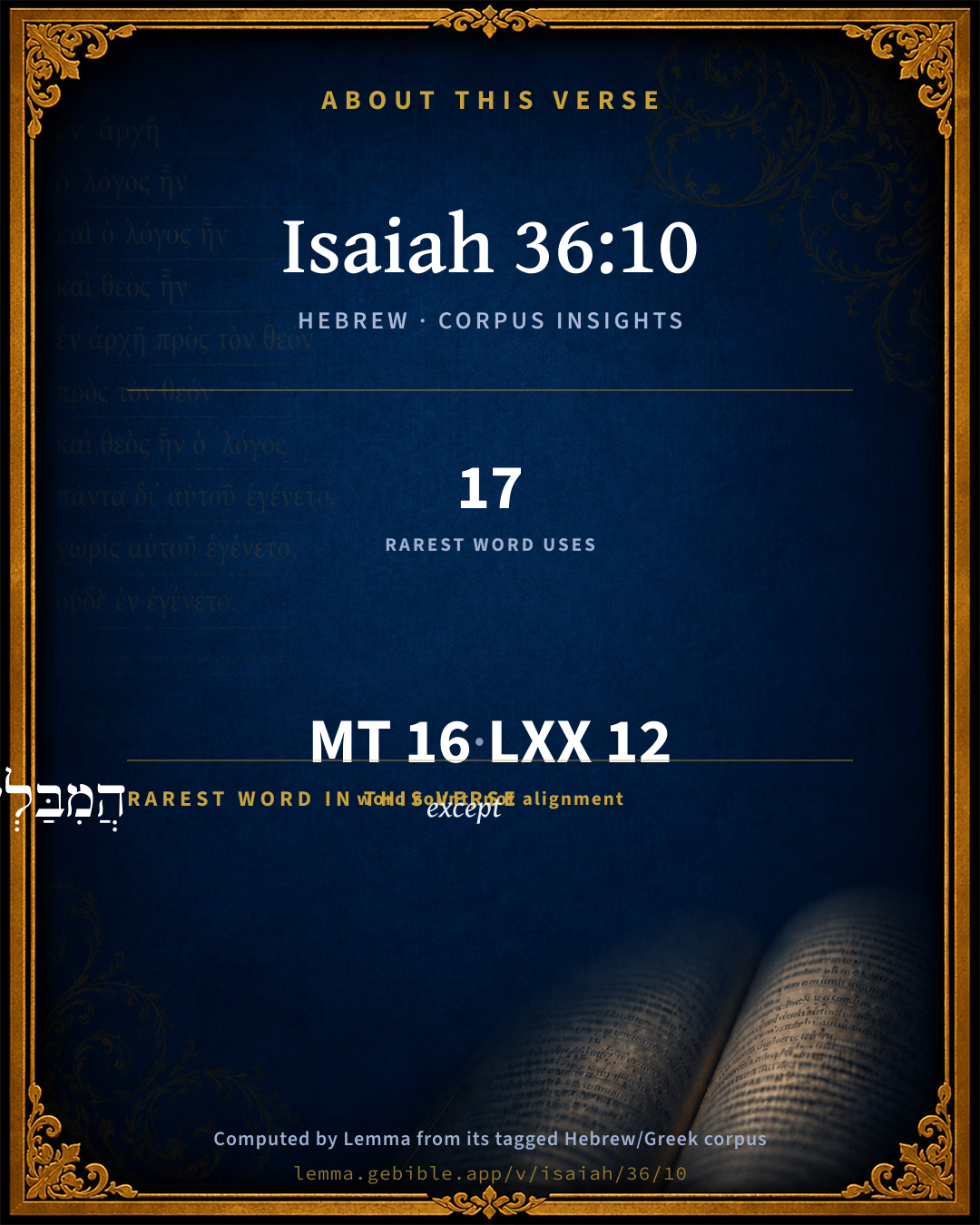
The rarest word here is הֲמִבַּלְעֲדֵ֣י except H1107 — appearing just 17 times in the whole Hebrew Bible.

Shared distinctive vocabulary

הֲמִבַּלְעֲדֵ֣י except H1107 occurs in 16 verses of the Hebrew Bible. Also found in:

Grammatical profile

  • 5 verbs
  • 4 nouns
  • 2 pronouns
  • 4 prepositions
  • 1 adverb

Verb forms

  • עָלִ֛יתִי Qal · Perfect
  • לְהַשְׁחִיתָ֑הּ Hiphil · Infinitive Construct
  • אָמַ֣ר Qal · Perfect
  • עֲלֵ֛ה Qal · Imperative
  • וְהַשְׁחִיתָֽהּ Hiphil · Imperative

Repetition

Words recur within this verse — often emphatic in Hebrew:

  • יְהוָ֔ה LORD H3068 ×2
  • עָלִ֛יתִי to go up H5927 ×2
  • הָאָ֥רֶץ land H776 ×2
  • לְהַשְׁחִיתָ֑הּ to destroy H7843 ×2
  • הַזֹּ֖את this H2063 ×2
  • אֵלַ֔י to H413 ×2

Hebrew & Septuagint length

In English translation the verse runs 25 words from the Hebrew and 29 from the Septuagint (LXX English) — closely comparable.

A rough comparison of the two English renderings, which tokenize alike — not a word-level alignment.

Word counts can differ between the Hebrew and the Greek without any difference in meaning — e.g. the Hebrew direct-object marker אֵת has no separate Greek word, and Greek often adds the article ὁ.

In the original languages it is 16 Hebrew tokens and 12 Greek tokens — but the two are counted differently (Hebrew bundles its prefixes and suffixes into one token; the Greek is in lemma form), so that isn’t a like-for-like length.

Cross-references

6

Topical passages linked to Isaiah 36:10 in the Treasury of Scripture Knowledge — connected by theme and wording, ordered by reader-vote popularity; previews shown in the World English Bible.

  • 2 Kings 18:25 Am I now come up without Yahweh against this place to destroy it? Yahweh said to me, Go up against this land, and destroy it.
  • Isaiah 10:5–7 Ho Assyrian, the rod of my anger, the staff in whose hand is my indignation!
  • 1 Kings 13:18 He said to him, I also am a prophet as you are; and an angel spoke to me by the word of Yahweh, saying, Bring him back with you into your house, that he may eat bread and drink water. [But] he lied to him.
  • 2 Chronicles 35:21 But he sent ambassadors to him, saying, What have I to do with you, you king of Judah? [I come] not against you this day, but against the house with which I have war; and God has commanded me to make haste: forbear you from [meddling with] God, who is with me, that he not destroy you.
  • Isaiah 37:28 But I know your sitting down, and your going out, and your coming in, and your raging against me.
  • Amos 3:6 Does the trumpet alarm sound in a city, Without the people being afraid? Does evil happen to a city, And Yahweh hasn't done it?

Cross-references courtesy of OpenBible.info (CC BY 4.0).

Hebrew and Greek witnesses Masoretic Hebrew ↔ Greek Septuagint

The same verse in the two great witnesses to the Old Testament, shown verse-for-verse.

These are two independent witnesses, not word-aligned to each other, and the Septuagint is shown in lemma (dictionary) form.

Hebrew Isaiah 36:10 Masoretic · Westminster Leningrad Codex

וְעַתָּה֙ הֲמִבַּלְעֲדֵ֣י יְהוָ֔ה עָלִ֛יתִי עַל הָאָ֥רֶץ הַזֹּ֖את לְהַשְׁחִיתָ֑הּ יְהוָה֙ אָמַ֣ר אֵלַ֔י עֲלֵ֛ה אֶל הָאָ֥רֶץ הַזֹּ֖את וְהַשְׁחִיתָֽהּ

Am I now come up without Yahweh against this land to destroy it? Yahweh said to me, Go up against this land, and destroy it.

World English Bible · Public Domain

Greek LXX Isaiah 36:10 Septuagint · lemma form

καί νῦν μή ἄνευ κύριος ἀναβαίνω ἐπί ὁ χώρα οὗτος πολεμέω αὐτός

And now, Have we come up against this land to fight against it without the Lord? The Lord said to me, Go up against this land, and destroy it.

LXX2012 (modern English Septuagint) · Public Domain

Hebrew: Westminster Leningrad Codex (CC BY 4.0). Greek: Septuagint (public domain); English from LXX2012 (modern English Septuagint) (Public Domain). How the Septuagint differs from the Hebrew →

Targum (Aramaic paraphrase)

1

The Targum is the ancient Jewish Aramaic paraphrase of the Hebrew Scriptures — an interpretive translation, not the Hebrew text itself. Onkelos (literal) and Pseudo-Jonathan (expansive) render the Torah, and Jonathan the Prophets. Coverage is partial: where no permissively-licensed English translation exists for a verse, only the Aramaic is shown. This is verse-level text, not a word-by-word alignment to the Hebrew.

  1. Targum Jonathan Prophets (Joshua–Malachi)
    וּכְעַן הֲבַּר מִמֵימְרָא דַייָ סַלְקֵית לְאַרְעָא הָדָא לְחַבְּלוּתָא יְיָ אֲמַר לִי סַק עַל אַרְעָא הָדָא וְחַבְּלָהּ:

    Am I now come up without the WORD of the Lord against this land to destroy it? The Lord said unto me, Go up against this land, and destroy it.

    Targum Jonathan — Aramaic: “Mikraot Gedolot” (public domain). English: “Sefaria Community Translation” (CC0 1.0 (public-domain dedication)); “London "Chaldee Paraphrase," 1871” (public domain). Text via Sefaria.

Commentary

Notes on Isaiah 36:10 from classic Christian and Jewish commentators (each source and its license shown beneath its notes). The classic Christian expositions comment on the surrounding passage and are grouped to its opening verse, so a note may address several verses; the Jewish commentaries on the Tanakh (Rashi and others) are per-verse, so they appear only where the commentator wrote on this verse.

Lemma curates 59 commentaries, every one of them public domain or Creative Commons licensed, each selected and text-cleaned for this edition rather than reprinted as found. About our sources →

Tyndale Open Study Notes

Tyndale Open Resources

36:10 The Lord himself told us: It was common for a king to claim the approval of a deity in destroying other kingdoms. This claim was consistent with Isaiah’s prophecy in 10:5-6.

Tyndale Open Study Notes — © Tyndale Open Resources, licensed CC BY-SA 4.0. Text via the HelloAO Bible API.

Geneva Bible (1599)

Geneva Bible translators

Thus the wicked to deceive us, will pretend the Name of the Lord: but we must try the spirits, whether they be of God or no.

Geneva Bible (1599) marginal notes — public domain. Text via Bolls.life.

Jamieson, Fausset & Brown

Robert Jamieson, A. R. Fausset & David Brown

A boastful inference from the past successes of Assyria, designed to influence the Jews to surrender; their own principles bound them to yield to Jehovah's will. He may have heard from partisans in Judah what Isaiah had foretold (Isa 10:5-6).

Jamieson, Fausset & Brown — Commentary Critical and Explanatory on the Whole Bible (1871) — public domain (CC PDM 1.0). Text via the HelloAO Bible API.

Adam Clarke's Commentary

Verse 10. Am I now come up without the Lord] Probably some apostate Israelitish priest might have encouraged the king of Assyria by telling him that JEHOVAH had given him a commission against Jerusalem.

Adam Clarke's Commentary on the Bible (1810–1826) — public domain. Text from a community e-Sword/MySword module.

Ellicott's Commentary for English Readers

(10) Am I now come up without the Lord . . .—The words may be simply an empty boast. Possibly, however, Isaiah’s teaching that it was Jehovah who brought the King of Assyria into Judah, and used him as an instrument (Isa_7:17-18), had become known, or Sennacherib may have dreamt, or have said that he had dreamt, that the God of Judah, irritated with the destruction of the high places, had given him this mission. He assumes the character of a defender of the faith. The inscriptions of Sennacherib are, it may be noted, conspicuous for like assertions. He delights, apparently, to claim a Divine sanction for the wars in which he is engaged (Records of the Past, i. 25, 9:23).

A Bible Commentary for English Readers, edited by Charles John Ellicott (1878–1897) — public domain. Text from a community e-Sword module.

The Cambridge Bible for Schools and Colleges

gen. ed. J. J. S. Perowne

10. That the Assyrian should represent himself as commissioned by Jehovah to avenge the desecration of his sanctuaries is not by any means incredible. A precisely similar sentiment is put into the mouth of Cyrus in his account of the conquest of Babylon. It expresses no serious religious conviction (see Isa_36:20); and the resemblance to Isaiah’s teaching (ch. Isa_10:5 ff.) is either accidental, or is due to a Jewish colouring unconsciously imparted to the narrative by the writer.

For this land, in the first half of the verse, we read in 2Ki_18:25 “this place,” i.e. Jerusalem.

The Cambridge Bible for Schools and Colleges (gen. ed. J. J. S. Perowne; Cambridge University Press, 1878–1918) — public domain. Text from a community e-Sword module.

John Gill's Exposition

And am I now come up without the Lord against this land to destroy it?.... He would insinuate that he had a commission from the Lord God, and that it was by his will and order that he came up to destroy the land; which he said to intimidate Hezekiah and his subjects, as knowing that nothing was more likely to do it than that so far it was true, that he did not come up without the knowledge of the Lord, nor without his will to chastise, but not to destroy, as the event showed:

the Lord said unto me: by the impulse of his Spirit, or by one of his prophets, as he would suggest:

go up against this land, and destroy it; which was a lie of his own making; he knew that the Lord had said no such thing to him, nor had sent him on such an errand; unless he concluded it from his success in taking the fenced cities of Judah, and from Samaria, and the ten tribes, being delivered up in time past into the hands of the king of Assyria, and so was confident this would be the fate of Judah and Jerusalem.

John Gill's Exposition of the Whole Bible (1746–1763) — public domain (CC PDM 1.0). Text via the HelloAO Bible API.

Albert Barnes' Notes on the Bible

And am I now come up without the Lord - Am I come up without his permission or command? Rabshakeh here speaks in the name of his master; and he means to say that he had the express command of Yahweh to inflict punishment on the Jews. It is possible that there had been conveyed to Sennacherib a rumour of what Isaiah had said (see Isa 10:5-6) that God would bring the Assyrians upon the Jewish people to punish them for their sins, and that Rabshakeh now pleads that as his authority, in order to show them that resistance would be vain. Or it may be that he uses the name Yahweh here as synonymous with the name of God, and means to say that he had been divinely directed to come up in that expedition. All the ancient warriors usually consulted the gods, and endeavored by auguries to obtain the divine approbation of their plans of conquest, and Rabshakeh may mean simply to say that his master came now under the divine sanction and direction. Or, which is more probable, he made use of this as a mere pretence for the purpose of influencing the people who heard him, and to whom he said he was sent Isa 36:12, in order to alienate their minds from Hezekiah, and to induce them to surrender. He knew that it was one of the principles of the Jews, however little they regarded it in practice, to yield to his authority. Wicked people will be glad to plead divine authority for their purposes and plans when they can have the slightest pretence for it.

Albert Barnes' Notes on the Bible (1834–1885) — public domain. Text from a community e-Sword/MySword module.

Haydock's Catholic Bible Commentary

CHAPTER XXXVI.

George Leo Haydock (1774–1849), Haydock's Catholic Family Bible and Commentary, 1859 edition — public domain. Excludes Psalms (Douay-Rheims chapter numbering differs from Protestant) and Deuterocanonical books (Catholic canon only).

Whedon's Commentary on the Bible

Daniel D. Whedon

10. Am I now come up without the Lord — The adroitness of Rabshakeh’s speech is still manifest. It is to terrify the outside hearers on the walls. To disaffect them, and the whole population of Jerusalem through them, is his entire drift. His last dodge is a religious one. He claims a commission for Sennacherib from Jehovah, the Jews’ own deity, to sack and destroy, and thus aims to incite the people to revolt and surrender. Except the better class of Jews, who held to pure Monotheism, all the nations at this time held to the divinity of each other’s national gods, which explains Rabshakeh’s claim of Jehovah’s support.

Daniel D. Whedon (gen. ed.), Commentary on the Old and New Testaments (1874–1909) — public domain. Text from a community e-Sword module.

The Pulpit Commentary

The Lord said unto me, Go up against this land, and destroy it; literally, Jehovah said unto me, Go up, etc. (comp. 2Ch_35:21, where Necho tells Josiah that "God commanded" his expedition against Carchemish) The heathen monarchs frequently represented themselves as directed to make war on a nation by God, or by some particular god. Piankhi Mer-amman says, "I am born of the loins. created from the egg, of the Deity... I have not acted without his knowing; he ordained that I should act" ("Records of the Past," vol. 2. p. 91). Mesha, King of Moab, declares, "Chemosh said to me, Go and take Nebo in war against Israel" (ibid., vol. 11. p. 166). Asshur is generally represented as commanding the expeditions of the Assyrian kings (ibid., vol. 1. pp. 21, 48, 60, etc.). Still, it is surprising that Sennacherib should mention "Jehovah" as the God from whom he had received the order to attack Hezekiah, and we may suspect that the term which he actually employed was Ilu, "God," and that either Rahshakeh, or the reporter of the speech, substituted "Jehovah" as more intelligible to the Jews.

The false boastings of the wicked confuted by the event.

The Goliaths and Sennacheribs of the world are rarely content with silent endeavours to accomplish the ends that they set before them. They delight in boasting beforehand of their coming achievements, and are not very scrupulous as to the language they employ, so that it seems to exalt them above their fellows. "Come to me," said the Philistine champion to David, "and I will give thy flesh unto the fowls of the air, and to the beasts of the field". (1Sa_17:44) "With the multitude of my chariots," said Sennacherib, "I am come up to the height of the mountains, to the sides of Lebanon, and will cut down the tall cedar trees thereof, and the choice fir trees thereof: and I will enter into the lodgings of his borders, and into the forest of his Carmel"; (2Ki_19:23) and again, "Shall I not, as I have done to Samaria and her idols, so do to Jerusalem and her idols?". (Isa_10:11) It was of a piece with these boasts to give the Jews to understand that the voice of God had ordered the expedition, which, therefore, was certain to be successful. In all probability this boast was a purely gratuitous one, not grounded upon any even supposed oracle or announcement. It was hoped that it might alarm some of the Jews, and induce them to go over to the enemy, or at least stand aloof from the contest. A few weeks perhaps a few days showed the baselessness of the assertion. Had God ordered the expedition, he would have prospered it; had he "given the Assyrians a charge," he would have caused them "to take the spoil, and to take the prey, and to tread Judah down like the mire of the streets". (Isa_10:6) But the boast was wholly false. God had, in fact, declared himself against the expedition, (Isa_31:8) and had promised his protection to Jerusalem. (Isa_31:5) The event was in the fullest accord with these announcements, and put to shame the Assyrian, with his vain boasts. (Isa_37:36) In all ages, boasters havedeclared that they would destroy the Church. Epiphanes, Galerius, Julian, Mohammed, designed and attempted the extirpation of true religion. They boasted beforehand that they would succeed. In the event they egregiously failed. So, in our own day, pseudo-science declares that it is just about to sweep away Christianity front the earth. The wretched effete religion is, the scientists maintain, on its last legs, dwindling, dying, just about to disappear. But year by year, month by month, day by day, facts give their predictions the lie. The Church remains firm upon its Rock, against which the gates of hell will never prevail. Christianity declines to disappear at the scientist"s bidding, and, as time goes on, seems continually to obtain a firmer grasp upon the mind of the age. Scientific extravagance provokes a religious reaction, and these are signs in various quarters of a real "Nemesis of Faith." If the tree has contracted its shadow, it has struck its roots more deeply; and is more capable of resisting storms and tempests than of yore. Christians may calmly await the verdict which events will pronounce, and meanwhile will do well not to let themselves be greatly alarmed by the proud boasts and confident predictions of their adversaries. Sennachcrib"s boasts had an unsatisfactory issue.

Claims to speak for God.

"The Lord said unto me, Go up against this land, and destroy it." The inscriptions of Sennacherib are remarkable for similar assertions to this. He delights, apparently, to claim a Divine sanction for the wars in which he was engaged. Some think that he may have heard of Isaiah"s declaration, that Jehovah was using the King of Assyria as his instrument. (see Isa_7:17, Isa_7:18) We are bound to receive the messages of God, in whatsoever form they may come to us; but we are bound also to test the credentials of every messenger who brings them. For testing the messengers, adequate provisions have been made. We can "prove all things, and hold fast that which is good." A suggestive illustration may be found in the narrative of the disobedient prophet. (1Ki 13) The old prophet claimed to speak in the name of God, and so over-persuaded the younger man. But that young man might reasonably have argued thus: "I have my instructions direct from God; they are definite and, clear, and I must have the most convincing evidence before I turn aside from fulfilling the instructions given me." It was right to doubt even Christ so far as to require satisfactory signs and proofs that he had come from God. Men may make claims, as fanatics and enthusiasts do in every age; we shall not heed until they prove the claim. Illustrate by Johanna Southcote, Swedenborg, Irving, etc. We suggest some tests for judging claims to speak for God.

I REASONABLE PROBABILITY. We suspect many things because they are not likely. It was very suspicious to assume that Jehovah had given direct and audible commands to Sennacherib. Many of the visions and mysteries of Swedenborg are judged by their unreasonableness and improbability. God"s ways may be beyond reason, but they are not foolish to the view of reason. The test of reason is carried too far when a full and accurate understanding is demanded, but it may fairly be applied to decide what is probable.

II BOOK OF THE LAW. The Israelites were required to test all who claimed to be prophets by the harmony between their spoken word and the existing written Word. "To the Law and to the testimony: if they speak not according to this Word, it is because there is no light in them." The Scriptures have a tone and character which is even more important than their precise details. Apply these to claimants, and they will test, as do chemical solvents. All who know and love God"s Word become sensitive to that which is in harmony with it.

III RESPONSE OF CONSCIENCE. This test may be illustrated by Jonah"s mission to Nineveh. Jonah had no credentials. He might have been treated as an impostor. But the conscience of Nineveh responded to his message, and conscience guaranteed faith. All messages from God that come as warnings, reproaches, awakenings, threatenings, can be tried by conscience, and its "accusings and excusings." So none of us need be uncertain whom to believe. R.T.

The Pulpit Commentary (1880–1919), ed. H.D.M. Spence-Jones & Joseph S. Exell — public domain. Text from a community e-Sword module.

J. A. Alexander on Isaiah

Joseph Addison Alexander

“And now (is it) without Jehovah I have come up against this land to destroy it? Jehovah said to me, go up to (or against) this land and destroy it.” This is a bold attempt to terrify the Jews by pleading the authority of their own tutelary deity for this invasion.

Joseph Addison Alexander, The Prophecies of Isaiah (1846–1847; New York: Scribner, 1870–1878) — public domain. Text from a community e-Sword module.

Rashi

Rabbi Shlomo Yitzchaki (Rashi)

is it [with] other than the Lord Without His permission?

The Lord said to me The prophets have already prophesied (supra 8:4): “The wealth of Damascus and the plunder of Samaria shall be carried off before the king of Assyria.” But he erred, saying (supra 10:11), “Indeed, as I did to Samaria..., so will I do to Jerusalem...”

Rashi on the Tanakh — English translations: “The Judaica Press complete Tanach with Rashi, translated by A. J. Rosenberg” (CC BY 4.0); “Pentateuch with Rashi's commentary by M. Rosenbaum and A.M. Silbermann, 1929-1934” (public domain); “The Metsudah Tanach series, Lakewood, N.J” (CC BY 4.0); and “The Book of Joshua, Metsudah Publications, 1997” (CC BY 4.0). Text via Sefaria.

Lesson kit

Teaching starters — assembled from the data on this page, not authored interpretation. Every prompt links to the verse data it draws on. Edit before teaching.

Isaiah, in the Prophets, opens this verse with 16 words (10 distinct Hebrew lemmas). Its most distinctive word is bilʻădêy (“except”). A historical commentator’s framing appears above. Read the whole chapter for the surrounding context.

Discussion questions

  1. The word bilʻădêy carries the sense “except.” How does it shape the verse?
  2. How does Genesis 14:24, which shares the word «except», read alongside this verse?
  3. What does the repetition of “LORD” (2× in this one verse) do in this verse?
  4. These translations render this verse differently; the difference is in the English rendering, not the original. What questions does that raise?
  5. «עָלִ֛יתִי» is a Qal Perfect verb. How does that grammatical form shape the action described?
  6. Compare how Tyndale Open Study Notes and Geneva Bible (1599) read this verse. Where do they agree or differ?

Things to notice

Reading settings

Reading text

Shown beneath each verse's original-language words.

Old Testament
Old Testament edition

Read the OT as the Masoretic Hebrew (MT) or the Greek Septuagint (LXX).

English shown for the Greek Septuagint (in the Hebrew ↔ Greek comparison).

Comparing translations? Open the Compare panel on any verse page to stack up to four side by side.