
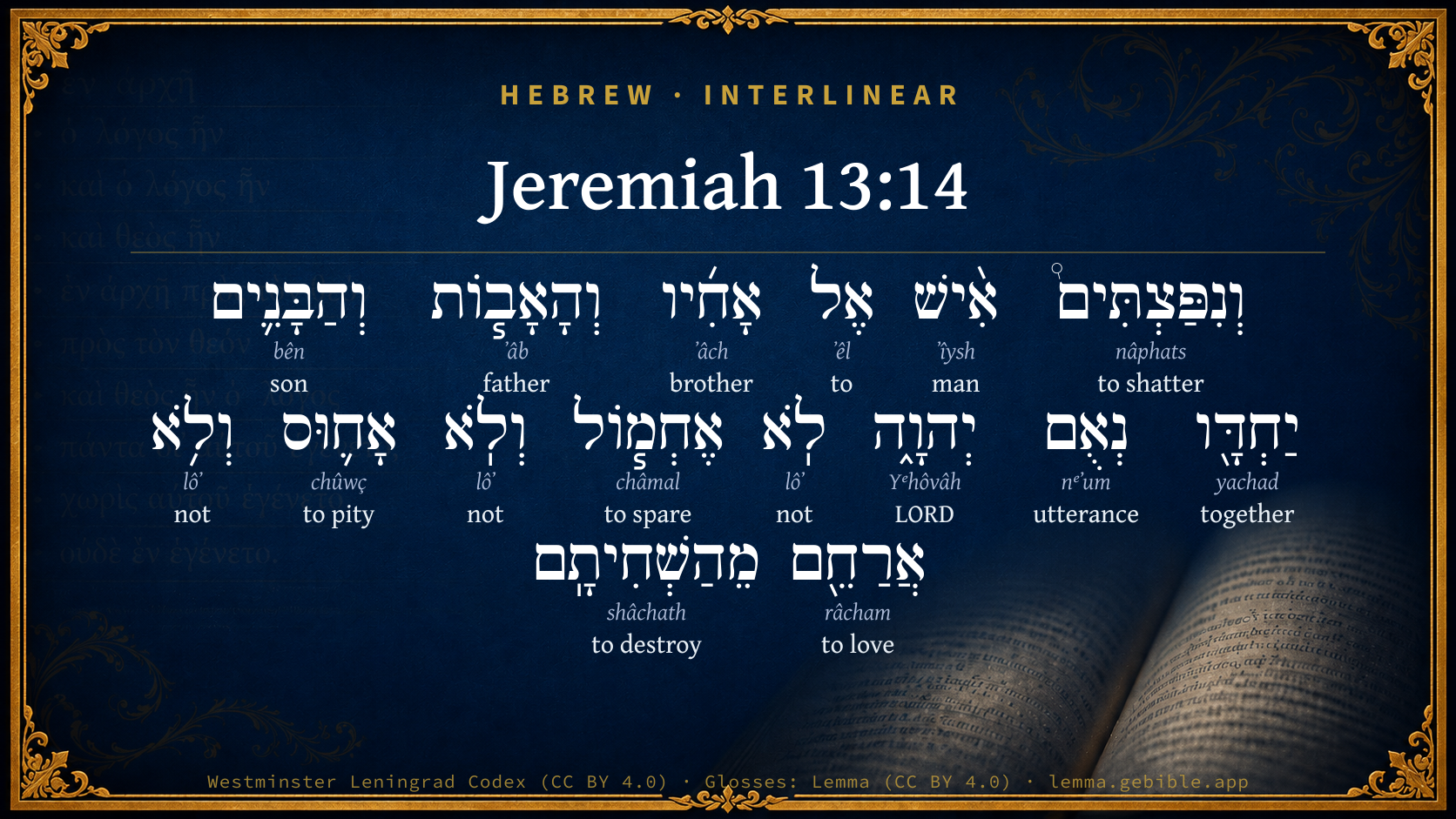
Jeremiah 13:14

Hebrew (Westminster Leningrad Codex) Jeremiah 13:14 appears in the Hebrew Old Testament. The text above is from the Westminster Leningrad Codex. Each word links to its Strong’s number, a concise gloss, and parsing drawn from the Open Scriptures Hebrew Bible morphology. Click any word for its full Brown-Driver-Briggs (BDB) entry.
Download image
Cite this verse

Jeremiah 13:14 (World English Bible). Public Domain. Lemma interlinear Bible study tool, https://lemma.gebible.app/v/jeremiah/13/14.

Show BibTeX & RIS
BibTeX
RIS
English Translation
I will dash them one against another, even the fathers and the sons together, says Yahweh: I will not pity, nor spare, nor have compassion, that I should not destroy them.
World English Bible · Public Domain
Download a study sheet

One document with this verse’s original text, its word-by-word gloss line, the meaning frame, cross-references with their text, attributed commentary, and full source and license credits — printable, and it pastes into notes with its structure intact.

This verse Autodidact and up

Study sheet (.html) Plain text (.txt)

A passage Seminary Student

Up to 50 verses in one chapter. A passage sheet keeps up to 6 commentary sources and 12 cross-references per verse, in the order this page ranks them, and says so on the sheet whenever that leaves anything out. Ask for a single verse and you get the Autodidact verse sheet above.

Everything on this page stays free to read, with no account — the sheet is a download of what is already on screen, not access to it.

Want to remove ads? Support Godless Engineer
Compare translations 3

The same verse in 3 English versions, stacked beneath the original-language interlinear above. Click any original word for its lexicon entry.

Each is an independent rendering of the whole verse — the interlinear is not word-aligned to these translations.

Highlighted words mark where these versions differ — a whole-verse word diff, not a word-by-word alignment.

  • World English Bible Public Domain
    I will dash them one against another, even the fathers and the sons together, says Yahweh: I will not pity, nor spare, nor have compassion, that I should not destroy them.
  • King James Version Public Domain
    And I will dash them one against another, even the fathers and the sons together, saith the LORD: I will not pity, nor spare, nor have mercy, but destroy them.
  • unfoldingWord Literal Text CC BY-SA 4.0
    And I will smash a man against his brother, and the fathers and the sons together”—the declaration of Yahweh—“I will not pity and I will not spare and I will not have compassion so as not to destroy them.”’”

unfoldingWord Literal Text — © unfoldingWord, licensed CC BY-SA 4.0. Word-aligned USFM3 via Door43 (git.door43.org/unfoldingWord/en_ult).

Versions to compare (up to 4)

3 of 4 selected

Show all 18 translations

Every available English version of this verse, each an independent rendering of the whole verse.

  • World English Bible Public Domain
    I will dash them one against another, even the fathers and the sons together, says Yahweh: I will not pity, nor spare, nor have compassion, that I should not destroy them.
  • Berean Standard Bible Public Domain
    I will smash them against one another, fathers and sons alike, declares the LORD. I will allow no mercy or pity or compassion to keep Me from destroying them.’”
  • Majority Standard Bible Public Domain
    I will smash them against one another, fathers and sons alike, declares the LORD. I will allow no mercy or pity or compassion to keep Me from destroying them.’”
  • King James Version Public Domain
    And I will dash them one against another, even the fathers and the sons together, saith the LORD: I will not pity, nor spare, nor have mercy, but destroy them.
  • American Standard Version (1901) Public Domain
    And I will dash them one against another, even the fathers and the sons together, saith Jehovah: I will not pity, nor spare, nor have compassion, that I should not destroy them.
  • Revised Version (1885) Public Domain
    And I will dash them one against another, even the fathers and the sons together, saith the LORD: I will not pity, nor spare, nor have compassion, that I should not destroy them.
  • Geneva Bible (1599) Public Domain
    And I wil dash them one against another, euen the fathers and the sonnes together, sayeth the Lord: I will not spare, I will not pitie nor haue compassion, but destroy them.
  • Douay-Rheims (1899) Public Domain
    And I will scatter them every man from his brother, and fathers and sons in like manner, saith the Lord: I will not spare, and I will not pardon: nor will I have mercy, but to destroy them.
  • Young's Literal Translation Public Domain
    And have dashed them one against another, And the fathers and the sons together, An affirmation of Jehovah, I do not pity, nor spare, nor have I mercy, So as not to destroy them.
  • Literal Standard Version CC BY-SA 4.0
    And have dashed them against one another, || And the fathers and the sons together,” || A declaration of YHWH, || “I do not pity, nor spare, nor do I have mercy, || So as not to destroy them.”
  • Unlocked Literal Bible CC BY-SA 4.0
    Then I will smash each man against the other, fathers and children together—this is Yahweh's declaration—I will not pity them or have compassion, and I will not spare them from destruction.'”
  • unfoldingWord Literal Text CC BY-SA 4.0
    And I will smash a man against his brother, and the fathers and the sons together”—the declaration of Yahweh—“I will not pity and I will not spare and I will not have compassion so as not to destroy them.”’”
  • Darby Bible Public Domain
    And I will dash them one against another, both the fathers and the sons together, saith Jehovah; I will not pity, nor spare, nor have mercy so as not to destroy them.
  • World Messianic Bible Public Domain
    I will dash them one against another, even the fathers and the sons together,” says the LORD: “I will not pity, spare, or have compassion, that I should not destroy them.”’”
  • Webster's Bible Public Domain
    And I will dash them one against another, even the fathers and the sons together, saith the LORD: I will not pity, nor spare, nor have mercy, but destroy them.
  • Free Bible Version CC BY-SA 4.0
    I'm going to smash them against each other like wine jars, both parents and children, declares the Lord. I won't let any mercy or pity or compassion stop me from destroying them.
  • Bible in Basic English Public Domain
    I will have them smashed against one another, fathers and sons together, says the Lord: I will have no pity or mercy, I will have no feeling for them to keep me from giving them to destruction.
  • JPS Tanakh (1917) Public Domain
    And I will dash them one against another, even the fathers and the sons together, saith the LORD; I will not pity, nor spare, nor have compassion, that I should not destroy them.

Literal Standard Version (2020), Covenant Press — licensed CC BY-SA 4.0. Text via the HelloAO Bible API (eBible.org). Unlocked Literal Bible (unfoldingWord) — licensed CC BY-SA 4.0. Text via the HelloAO Bible API (eBible.org). unfoldingWord Literal Text — © unfoldingWord, licensed CC BY-SA 4.0. Word-aligned USFM3 via Door43 (git.door43.org/unfoldingWord/en_ult). Free Bible Version, Dr. Jonathan Gallagher — licensed CC BY-SA 4.0. Text via the HelloAO Bible API (eBible.org).

Word by word

More ways to search: Search by grammar → Find every occurrence → Compare this word →

Practice this passage: Drill this verse → Learn its vocabulary →

וְנִפַּצְתִּים֩
nâphats
H5310
“and · to shatter · them”
Conjunction + Verb, Piel, Sequential Perfect, 1st Person, Common, Singular + Suffix, Personal, 3rd Person, Masculine, Plural
Part of Speech
Conjunction + Verb
Stem
Piel
Form
Sequential Perfect
Person
1st Person
Gender
Common
Number
Singular
Full BDB Definition

Origin: a primitive root

TWOT: 1394

to shatter, break, dash, beat in pieces - (Qal) - to shatter - shattering (infinitive) - (Piel) to dash to pieces - (Pual) to pulverise - to scatter, disperse, overspread, be scattered - (Qal) - to be scattered - dispersed (participle)
  1. אִ֨ישׁ ʼîysh H376 “man” Noun, Common, Masculine, Singular, Absolute
  2. אֶל ʼêl H413 “to” Preposition
  3. אָחִ֜יו ʼâch H251 “brother · his” Noun, Common, Masculine, Singular, Construct + Suffix, Personal, 3rd Person, Masculine, Singular
  4. וְהָאָב֧וֹת ʼâb H1 “and · the · fathers” Conjunction + Particle, Definite Article + Noun, Common, Masculine, Plural, Absolute
  5. וְהַבָּנִ֛ים bên H1121 “and · the · sons” Conjunction + Particle, Definite Article + Noun, Common, Masculine, Plural, Absolute
  6. יַחְדָּ֖ו yachad H3162 “together” Adverb
  7. נְאֻם nᵉʼum H5002 “utterance of” Noun, Common, Masculine, Singular, Construct
  8. יְהוָ֑ה Yᵉhôvâh H3068 “LORD” Noun, Proper
  9. לֹֽא lôʼ H3808 “not” Particle, Negative
  10. אֶחְמ֧וֹל châmal H2550 “to spare” Verb, Qal, Imperfect, 1st Person, Common, Singular
  11. וְלֹֽא lôʼ H3808 “and · not” Conjunction + Particle, Negative
  12. אָח֛וּס chûwç H2347 “to pity” Verb, Qal, Imperfect, 1st Person, Common, Singular
  13. וְלֹ֥א lôʼ H3808 “and · not” Conjunction + Particle, Negative
  14. אֲרַחֵ֖ם râcham H7355 “to love” Verb, Piel, Imperfect, 1st Person, Common, Singular
  15. מֵהַשְׁחִיתָֽם shâchath H7843 “from · to destroy · them” Preposition + Verb, Hiphil, Infinitive Construct + Suffix, Personal, 3rd Person, Masculine, Plural

About this verse

These counts appear in no published source. They are computed here, from the morphology-tagged text and Lemma’s own curated glosses. What Lemma adds →

16
words
14
distinct lemmas
Prophets
section

Notable vocabulary

The rarest word here is וְנִפַּצְתִּים֩ to shatter H5310 — appearing just 22 times in the whole Hebrew Bible.

Shared distinctive vocabulary

וְנִפַּצְתִּים֩ to shatter H5310 occurs in 17 verses of the Hebrew Bible. Also found in:

Grammatical profile

  • 5 verbs
  • 6 nouns
  • 1 preposition
  • 1 adverb
  • 3 particles

Verb forms

  • וְנִפַּצְתִּים֩ Piel · Sequential Perfect
  • אֶחְמ֧וֹל Qal · Imperfect
  • אָח֛וּס Qal · Imperfect
  • אֲרַחֵ֖ם Piel · Imperfect
  • מֵהַשְׁחִיתָֽם Hiphil · Infinitive Construct

Repetition

A word recurs within this verse — often emphatic in Hebrew:

Cross-references

22

Topical passages linked to Jeremiah 13:14 in the Treasury of Scripture Knowledge — connected by theme and wording, ordered by reader-vote popularity; previews shown in the World English Bible.

  • Deuteronomy 29:20 Yahweh will not pardon him, but then the anger of Yahweh and his jealousy will smoke against that man, and all the curse that is written in this book shall lie on him, and Yahweh will blot out his name from under the sky.
  • Psalms 2:9 You shall break them with a rod of iron. You shall dash them in pieces like a potter's vessel."
  • Isaiah 9:20–21 One shall snatch on the right hand, and be hungry; and he shall eat on the left hand, and they shall not be satisfied: they shall eat every man the flesh of his own arm:
  • Isaiah 27:11 When the boughs of it are withered, they shall be broken off; the women shall come, and set them on fire; for it is a people of no understanding: therefore he who made them will not have compassion on them, and he who formed them will show them no favor.
  • Jeremiah 6:21 Therefore thus says Yahweh, Behold, I will lay stumbling-blocks before this people; and the fathers and the sons together shall stumble against them; the neighbor and his friend shall perish.
  • Jeremiah 19:9–11 I will cause them to eat the flesh of their sons and the flesh of their daughters; and they shall eat everyone the flesh of his friend, in the siege and in the distress, with which their enemies, and those who seek their life, shall distress them.
  • Jeremiah 21:7 Afterward, says Yahweh, I will deliver Zedekiah king of Judah, and his servants, and the people, even such as are left in this city from the pestilence, from the sword, and from the famine, into the hand of Nebuchadrezzar king of Babylon, and into the hand of their enemies, and into the hand of those who seek their life: and he shall strike them with the edge of the sword; he shall not spare them, neither have pity, nor have mercy.
  • Judges 7:20–22 The three companies blew the trumpets, and broke the pitchers, and held the torches in their left hands, and the trumpets in their right hands with which to blow; and they cried, The sword of Yahweh and of Gideon.
  • 1 Samuel 14:16 The watchmen of Saul in Gibeah of Benjamin looked; and, behold, the multitude melted away, and they went [here] and there.
  • 2 Chronicles 20:23 For the children of Ammon and Moab stood up against the inhabitants of Mount Seir, utterly to kill and destroy them: and when they had made an end of the inhabitants of Seir, everyone helped to destroy another.
  • Jeremiah 16:5 For thus says Yahweh, Don't enter into the house of mourning, neither go to lament, neither bemoan them; for I have taken away my peace from this people, says Yahweh, even loving kindness and tender mercies.
  • Jeremiah 47:3 At the noise of the stamping of the hoofs of his strong ones, at the rushing of his chariots, at the rumbling of his wheels, the fathers don't look back to their children for feebleness of hands;
  • Jeremiah 48:12 Therefore, behold, the days come, says Yahweh, that I will send to him those who pour off, and they shall pour him off; and they shall empty his vessels, and break their bottles in pieces.
  • Ezekiel 5:10–11 Therefore the fathers shall eat the sons in the midst of you, and the sons shall eat their fathers; and I will execute judgments on you; and the whole remnant of you will I scatter to all the winds.
  • Ezekiel 7:4 My eye shall not spare you, neither will I have pity; but I will bring your ways on you, and your abominations shall be in the midst of you: and you shall know that I am Yahweh.
  • Ezekiel 7:9 My eye shall not spare, neither will I have pity: I will bring on you according to your ways; and your abominations shall be in the midst of you; and you shall know that I, Yahweh, do strike.
  • Ezekiel 8:18 Therefore will I also deal in wrath; my eye shall not spare, neither will I have pity; and though they cry in my ears with a loud voice, yet will I not hear them.
  • Ezekiel 9:5 To the others he said in my hearing, Go you through the city after him, and strike: don't let your eye spare, neither have you pity;
  • Ezekiel 9:10 As for me also, my eye shall not spare, neither will I have pity, but I will bring their way on their head.
  • Ezekiel 24:14 I, Yahweh, have spoken it: it shall happen, and I will do it: I will not go back, neither will I spare, neither will I repent; according to your ways, and according to your doings, shall they judge you, says the Lord Yahweh.
  • Matthew 10:21 "Brother will deliver up brother to death, and the father his child. Children will rise up against parents, and cause them to be put to death.
  • Mark 13:12 "Brother will deliver up brother to death, and the father his child. Children will rise up against parents, and cause them to be put to death.

Cross-references courtesy of OpenBible.info (CC BY 4.0).

Hebrew and Greek witnesses Masoretic Hebrew ↔ Greek Septuagint

The same verse in the two great witnesses to the Old Testament, shown verse-for-verse.

These are two independent witnesses, not word-aligned to each other, and the Septuagint is shown in lemma (dictionary) form.

Hebrew Jeremiah 13:14 Masoretic · Westminster Leningrad Codex

וְנִפַּצְתִּים֩ אִ֨ישׁ אֶל אָחִ֜יו וְהָאָב֧וֹת וְהַבָּנִ֛ים יַחְדָּ֖ו נְאֻם יְהוָ֑ה לֹֽא אֶחְמ֧וֹל וְלֹֽא אָח֛וּס וְלֹ֥א אֲרַחֵ֖ם מֵהַשְׁחִיתָֽם

I will dash them one against another, even the fathers and the sons together, says Yahweh: I will not pity, nor spare, nor have compassion, that I should not destroy them.

World English Bible · Public Domain

Greek LXX Structure differs

In the Septuagint, Jeremiah is about an eighth shorter than the Hebrew and arranges its material differently — the Oracles Against the Nations (Hebrew chapters 46–51) appear in the middle of the Greek book, after 25:13. Because the chapter and verse boundaries do not line up, a verse-for-verse comparison with the Hebrew is not shown.

A verse-for-verse comparison isn’t shown here because the chapters and verses don’t line up. Switch to the LXX edition with the MT / LXX toggle above to read the Greek directly.

Hebrew: Westminster Leningrad Codex (CC BY 4.0). Greek: Septuagint (public domain); English from a public-domain English Septuagint. How the Septuagint differs from the Hebrew →

Targum (Aramaic paraphrase)

1

The Targum is the ancient Jewish Aramaic paraphrase of the Hebrew Scriptures — an interpretive translation, not the Hebrew text itself. Onkelos (literal) and Pseudo-Jonathan (expansive) render the Torah, and Jonathan the Prophets. Coverage is partial: where no permissively-licensed English translation exists for a verse, only the Aramaic is shown. This is verse-level text, not a word-by-word alignment to the Hebrew.

  1. Targum Jonathan Prophets (Joshua–Malachi)
    וֶאֱגָרִינוּן גְבַר בַּאֲחוּהִי וַאֲבָהָן וּבְנִין כַּחֲדָא אֲמַר יְיָ לָא אֶחְמוֹל וְלָא אֵיחוּס וְלָא אֲרַחֵם מִלְחַבָּלוּתְהוֹן:

    (no public-domain English translation for this verse)

    Targum Jonathan — Aramaic: “Mikraot Gedolot” (public domain). English: “Sefaria Community Translation” (CC0 1.0 (public-domain dedication)); “London "Chaldee Paraphrase," 1871” (public domain). Text via Sefaria.

Commentary

Notes on Jeremiah 13:14 from classic Christian and Jewish commentators (each source and its license shown beneath its notes). The classic Christian expositions comment on the surrounding passage and are grouped to its opening verse, so a note may address several verses; the Jewish commentaries on the Tanakh (Rashi and others) are per-verse, so they appear only where the commentator wrote on this verse.

Lemma curates 59 commentaries, every one of them public domain or Creative Commons licensed, each selected and text-cleaned for this edition rather than reprinted as found. About our sources →

Trapp's Complete Commentary

John Trapp

Jer 13:14 And I will dash them one against another, even the fathers and the sons together, saith the LORD: I will not pity, nor spare, nor have mercy, but destroy them.

Ver. 14. And I will dash them one against another.] As so many earthen bottles, brittle and soon broken. Si collidimur frangimur, If smashed and broken said those in the fable.

John Trapp, A Commentary or Exposition upon All the Books of the Old and New Testament (1647–1656) — public domain. Text from a community e-Sword module.

Geneva Bible (1599)

Geneva Bible translators

It shall be as easy for me to destroy the greatest and the strongest, as it is for a man to break earthen bottles.

Geneva Bible (1599) marginal notes — public domain. Text via Bolls.life.

Jamieson, Fausset & Brown

Robert Jamieson, A. R. Fausset & David Brown

dash-- (Psa 2:9). As a potter's vessel (Rev 2:27).

Jamieson, Fausset & Brown — Commentary Critical and Explanatory on the Whole Bible (1871) — public domain (CC PDM 1.0). Text via the HelloAO Bible API.

John Calvin's Commentaries

It may now be asked, What was this drunkenness which the Prophet announces? It may be understood in two ways, — either that God would give them up to a reprobate mind, — or that he would make them drunk with evils and calamities; for when God deprives men of a right mind, it is to prepare them for extreme vengeance. But the Prophet seems to have something further in view — that this people would be given up to the most grievous evils, which would wholly fill them with amazement. Yet it appears from the context that the former evil is intended here; for he says, I will dash them one against another, every one against his brother, even the fathers and sons together; and thus they were all to be broken as it were in pieces. God then not only points out the calamity which was nigh the Jews, but also the manner of it; that is, that every one would draw his own brethren to ruin, as though they inflicted wounds on one another. But God says first generally, I will fill all the inhabitants of the land with drunkenness, and then he explains the effect, such as I have stated.

But he afterwards speaks of the whole people, including the kings, priests, and prophets, so that he excepts no order of men, however honorable; and this express mention of different orders was altogether necessary, for kings thought that they ought not to have been blended with the common people. The priests also regarded themselves as sacred, and a similar pride possessed the false prophets. But Jeremiah includes them all, without exception, in the same bundle, as though he had said, — “The majesty of kings shall not deliver them from God’s judgment, nor shall the priests be safe on account of their dignity, nor shall it avail the false prophets to boast of that noble and illustrious office which they discharge.” This prediction was no doubt regarded as very unjust; for we know with what high commendations God had spoken of the kingdom of David. As to the priesthood, we also know that it was a type of the priesthood of Christ, and also that the whole tribe of Levi was counted sacred to God. It could not therefore be but that Jeremiah must have greatly exasperated the minds of all by thus threatening kings as well as priests.

But we hence gather, — that there is nothing so high and so illustrious on earth, which ought not to be made to submit, when the power and glory of God, and the authority of celestial truth, are to be vindicated. Whatever then is precious and excellent in the world must come to nothing, if it derogates even in the least degree from the glory of God or from the authority of his truth: and yet kings and priests dared to oppose the word of God. No wonder then, that the Prophet should thrust them down from their elevations and compare them to bottles: he thus treads under foot that frail glory by which they sought to obscure God himself. And as the name of David was, as it were, sacred among that people, in order to shake off this vain confidence, the Prophet says, — “Though kings sit on the throne of David and be his successors and posterity, yet God will not spare them.” And hence also it appears how foolishly the Papal clergy at this day bring forward against us their privileges and their dignity. Doubtless, whatever these unprincipled men may claim for themselves, they cannot yet make themselves equal to the Levitical priests: and yet we see that it availed them nothing, that God had set them apart for himself, because they had abused their power. There is, therefore, no reason for the Pope and his clergy, the very filth of the world, to be at this day so proud. We now perceive the design of the words, when mention is made of kings, priests, and prophets.

It must, however, be observed, that, he does not speak here of faithful prophets, but of those who wore the mask, while yet they brought nothing but chaff instead of wheat, as we shall hereafter see. He then uses the word prophets in an improper sense, for he applies it to false teachers, as we do at this day, when we speak of those savages who boast that they are bishops and prelates and governors: we indeed concede to them these titles, but it does not follow that they justly deserve to be counted bishops, though they are so called. In the same way then does Jeremiah speak here of those who were called prophets, who yet were wholly unworthy of the office.

He then speaks of the collision to which we have referred, — I will cause them to tear or break one another in pieces. Some render the word “scatter;” but scattering does by no means comport with the words, every one, against his brother, etc. We hence see that the meaning is much more suitable when we render the words, I will dash them, every one against his brother, and then, even the fathers and the sons together; so that they might tear one another by a mutual conflict. And hence, as I have said, Jeremiah not only foretells the destruction of the people, but also points out the manner of it; for they would become so void of common prudence, that they would willfully destroy one another, as though they were given up to mutual slaughter. They gloried, we know, in their number, but the Prophet shews that this would be no protection to them, but, on the contrary, the cause of their ruin; for the Lord would so blind them, that they would fight with one another, and thus perish without any foreign enemy.

He then adds, I will not spare, I will not spare, I will not have mercy He repeats three times that he would not be propitious to them. It would have been sufficient to declare this once, were they so teachable and attentive as really to consider the threatenings announced to them; but being so torpid as they were, it was necessary to repeat the same thing often; not as though there was anything ambiguous or obscure in the message itself, but because hardly any vehemence was sufficient to rouse hearts so obstinate. We hence see why the Prophet repeated the same thing so often. He, however, does not employ words uselessly: whenever God repeats the promises of his favor, he does not utter words heedlessly and without reason; but since he sees that there is in us so much dulness, that one promise is not sufficient, he confirms it by repetitions; so also when he sees that men, owing to their stupidity, cannot be moved nor terrified by his threatenings, he repeats them, that they may have more weight. He in short declares, that it was all over with that people, so that he does not now call the wicked and the rebellious to repentance, but speaks to them as to men past remedy. This is the meaning.

And he adds, Until I shall consume them This refers to the whole body of the people. God, in the meantime, still preserved, in a wonderful manner and by hidden means, a remnant, as it has appeared elsewhere: but yet God took that vengeance, which is here denounced on the people as a body; for it was as it were a general death, when they were all driven into exile and everywhere scattered. Now as the Lord in so great a ruin never forgot his covenant, but some seed still remained safe and secure; so what is said here, I will not have mercy until I shall consume them, is not inconsistent with the promise of mercy elsewhere given, when he declares that he is long-suffering and plenteous in mercy. (Numbers 14:18; Psalm 103:8) Though God then destroyed his people in so dreadful a manner, yet he did not divest himself of his own nature, nor cast away his mercy; but he executed his judgments on the reprobate in a way so wonderful, that he yet lost nothing of his eternal mercy and remained still faithful as to his election. It follows —

John Calvin's Commentaries (1540-1563) — public domain. Text from the Calvin Translation Society English edition (1840s-50s) via the Christian Classics Ethereal Library (ccel.org). Calvin's coverage is partial (roughly two-thirds of the Bible); uncommented books and verses are honest gaps, never fabricated. The 19th-century editor's footnotes and remarks are omitted so the notes are faithfully Calvin's own voice.

Ellicott's Commentary for English Readers

(14) One against another.—The rendering answers to the Hebrew idiom, but that idiom, as in the margin, a man against his brother, has a force which is lacking in the English, and forms a transition from the symbol to the reality. The words point to what we should call the “crash” of a falling kingdom, when all bonds that keep society together are broken.

A Bible Commentary for English Readers, edited by Charles John Ellicott (1878–1897) — public domain. Text from a community e-Sword module.

The Cambridge Bible for Schools and Colleges

gen. ed. J. J. S. Perowne

14. And I will dash them one against another] Seized with the giddiness which accompanies intoxication, they shall be a source of mutual destruction.

even the fathers and the sons together] The overthrow shall be of the most harrowing description.

The Cambridge Bible for Schools and Colleges (gen. ed. J. J. S. Perowne; Cambridge University Press, 1878–1918) — public domain. Text from a community e-Sword module.

John Gill's Exposition

Hear ye, and give ear,.... Both to what goes before, and what follows after. The words doubled denote the closest and strictest attention:

be not proud; haughty, scornful, as above all instruction, and needing no advice and counsel, self-conceited, despising the word of God, and his messages by his prophets; or, "do not lift up yourselves" (x); above others, and against God:

for the Lord hath spoken; it is not I, but the Lord; and what he has said shall certainly come to pass; so the Targum,

"for in the word of the Lord it is so decreed;''

it is in vain to oppose him; his counsel shall stand, and he will do all his pleasure; none ever hardened themselves against him, and prospered.

(x) "ne elevetis vos", Montanus, Pagninus; "exaltetis", Junius & Tremellius.

John Gill's Exposition of the Whole Bible (1746–1763) — public domain (CC PDM 1.0). Text via the HelloAO Bible API.

Albert Barnes' Notes on the Bible

All orders and degrees of men in the state would be broken in indiscriminate destruction.

Albert Barnes' Notes on the Bible (1834–1885) — public domain. Text from a community e-Sword/MySword module.

Matthew Poole's English Annotations

And I will set them one against another, raising up an evil spirit of division amongst them, that they shall be like earthen bottles dashed one against another, which are easily broken in pieces. I will have no pity on them, therefore let them not presume upon my mercy, and pity, and compassion; for I am resolved to show them no mercy, but to bring them to utter ruin and destruction.

Matthew Poole's English Annotations on the Holy Bible (1683–1685) — public domain. Text from a community e-Sword/MySword module.

Whedon's Commentary on the Bible

Daniel D. Whedon

14. Dash them one against another — See Psa_2:9, and Rev_2:27. Not civil war, but indiscriminate destruction, is here foretold.

Daniel D. Whedon (gen. ed.), Commentary on the Old and New Testaments (1874–1909) — public domain. Text from a community e-Sword module.

Rashi

Rabbi Shlomo Yitzchaki (Rashi)

And I will dash them one against the other I will dash one against the other until they break into small pieces. Cf (Psalms 2:9) “Like a potter’s vessel shall you shatter them (תנפצם)” (ibid. 137: 9). “And dash ונפץ your babes”; and so is every expression of נפוץ in Scripture.

and the fathers and the sons I will dash one against the other.

Rashi on the Tanakh — English translations: “The Judaica Press complete Tanach with Rashi, translated by A. J. Rosenberg” (CC BY 4.0); “Pentateuch with Rashi's commentary by M. Rosenbaum and A.M. Silbermann, 1929-1934” (public domain); “The Metsudah Tanach series, Lakewood, N.J” (CC BY 4.0); and “The Book of Joshua, Metsudah Publications, 1997” (CC BY 4.0). Text via Sefaria.

Lesson kit

Teaching starters — assembled from the data on this page, not authored interpretation. Every prompt links to the verse data it draws on. Edit before teaching.

Jeremiah, in the Prophets, opens this verse with 16 words (14 distinct Hebrew lemmas). Its most distinctive word is nâphats (“to shatter”). A historical commentator’s framing appears above. Read the whole chapter for the surrounding context.

Discussion questions

  1. What does “to shatter” (nâphats) contribute to the verse as a whole?
  2. Genesis 9:19 shares the word «to shatter» with this verse. How do the two illuminate each other?
  3. “not” occurs 3× in this one verse. What is the effect of the repetition?
  4. These translations render this verse differently; the difference is in the English rendering, not the original. What questions does that raise?
  5. The verb «וְנִפַּצְתִּים֩» is Piel Sequential Perfect. How does its form color the action?
  6. Reading how Trapp's Complete Commentary and Geneva Bible (1599) read this verse, where do the two commentators agree and where do they part?

Things to notice

Reading settings

Reading text

Shown beneath each verse's original-language words.

Old Testament
Old Testament edition

Read the OT as the Masoretic Hebrew (MT) or the Greek Septuagint (LXX).

English shown for the Greek Septuagint (in the Hebrew ↔ Greek comparison).

Comparing translations? Open the Compare panel on any verse page to stack up to four side by side.