Jeremiah 13:9

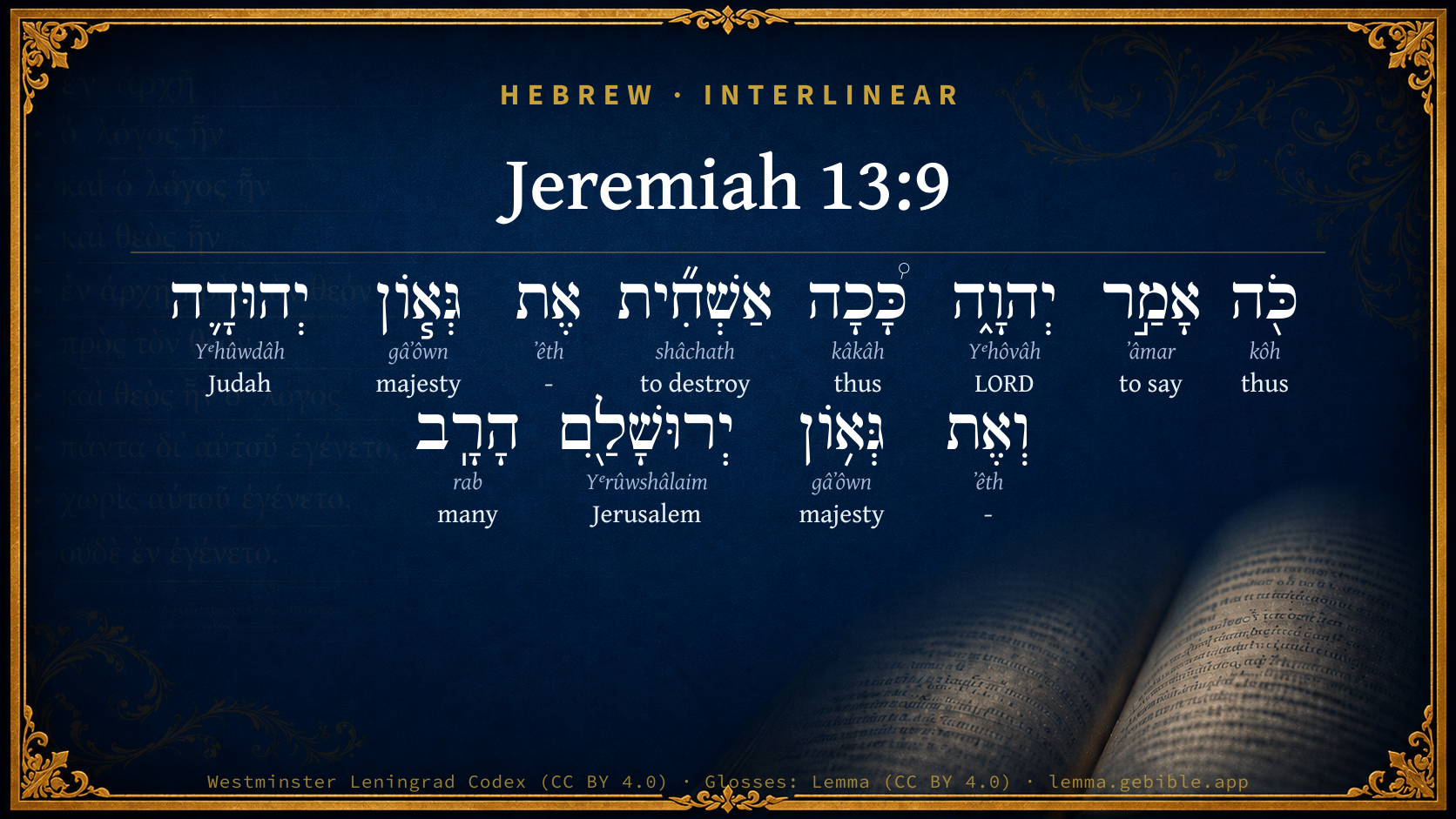
Hebrew (Westminster Leningrad Codex) Jeremiah 13:9 appears in the Hebrew Old Testament. The text above is from the Westminster Leningrad Codex. Each word links to its Strong’s number, a concise gloss, and parsing drawn from the Open Scriptures Hebrew Bible morphology. Click any word for its full Brown-Driver-Briggs (BDB) entry.
Download image
Cite this verse

Jeremiah 13:9 (World English Bible). Public Domain. Lemma interlinear Bible study tool, https://lemma.gebible.app/v/jeremiah/13/9.

Show BibTeX & RIS
BibTeX
RIS
English Translation
Thus says Yahweh, After this manner will I mar the pride of Judah, and the great pride of Jerusalem.
World English Bible · Public Domain
Download a study sheet

One document with this verse’s original text, its word-by-word gloss line, the meaning frame, cross-references with their text, attributed commentary, and full source and license credits — printable, and it pastes into notes with its structure intact.

This verse Autodidact and up

Study sheet (.html) Plain text (.txt)

A passage Seminary Student

Up to 50 verses in one chapter. A passage sheet keeps up to 6 commentary sources and 12 cross-references per verse, in the order this page ranks them, and says so on the sheet whenever that leaves anything out. Ask for a single verse and you get the Autodidact verse sheet above.

Everything on this page stays free to read, with no account — the sheet is a download of what is already on screen, not access to it.

Want to remove ads? Support Godless Engineer
Compare translations 3

The same verse in 3 English versions, stacked beneath the original-language interlinear above. Click any original word for its lexicon entry.

Each is an independent rendering of the whole verse — the interlinear is not word-aligned to these translations.

Highlighted words mark where these versions differ — a whole-verse word diff, not a word-by-word alignment.

  • World English Bible Public Domain
    Thus says Yahweh, After this manner will I mar the pride of Judah, and the great pride of Jerusalem.
  • King James Version Public Domain
    Thus saith the LORD, After this manner will I mar the pride of Judah, and the great pride of Jerusalem.
  • unfoldingWord Literal Text CC BY-SA 4.0
    “Thus says Yahweh, ‘Thus I will ruin the majesty of Judah and the great majesty of Jerusalem.

unfoldingWord Literal Text — © unfoldingWord, licensed CC BY-SA 4.0. Word-aligned USFM3 via Door43 (git.door43.org/unfoldingWord/en_ult).

Versions to compare (up to 4)

3 of 4 selected

Show all 18 translations

Every available English version of this verse, each an independent rendering of the whole verse.

  • World English Bible Public Domain
    Thus says Yahweh, After this manner will I mar the pride of Judah, and the great pride of Jerusalem.
  • Berean Standard Bible Public Domain
    “This is what the LORD says: In the same way I will ruin the pride of Judah and the great pride of Jerusalem.
  • Majority Standard Bible Public Domain
    “This is what the LORD says: In the same way I will ruin the pride of Judah and the great pride of Jerusalem.
  • King James Version Public Domain
    Thus saith the LORD, After this manner will I mar the pride of Judah, and the great pride of Jerusalem.
  • American Standard Version (1901) Public Domain
    Thus saith Jehovah, After this manner will I mar the pride of Judah, and the great pride of Jerusalem.
  • Revised Version (1885) Public Domain
    Thus saith the LORD, After this manner will I mar the pride of Judah, and the great pride of Jerusalem.
  • Geneva Bible (1599) Public Domain
    Thus sayth the Lord, After this maner will I destroy the pride of Iudah, and the great pride of Ierusalem.
  • Douay-Rheims (1899) Public Domain
    Thus saith the Lord: after this manner will I make the pride of Juda, and the great pride of Jerusalem to rot.
  • Young's Literal Translation Public Domain
    Thus do I mar the excellency of Judah, And the great excellency of Jerusalem.
  • Literal Standard Version CC BY-SA 4.0
    Thus I mar the excellence of Judah, || And the great excellence of Jerusalem.
  • Unlocked Literal Bible CC BY-SA 4.0
    “Yahweh says this: In the same way I will destroy the great arrogance of Judah and Jerusalem.
  • unfoldingWord Literal Text CC BY-SA 4.0
    “Thus says Yahweh, ‘Thus I will ruin the majesty of Judah and the great majesty of Jerusalem.
  • Darby Bible Public Domain
    Thus saith Jehovah: After this manner will I spoil the pride of Judah, and the great pride of Jerusalem.
  • World Messianic Bible Public Domain
    “The LORD says, ‘In this way I will ruin the pride of Judah, and the great pride of Jerusalem.
  • Webster's Bible Public Domain
    Thus saith the LORD, After this manner will I mar the pride of Judah, and the great pride of Jerusalem.
  • Free Bible Version CC BY-SA 4.0
    This is what the Lord says: I will ruin the arrogance of Judah and the great arrogance of Jerusalem in exactly the same way.
  • Bible in Basic English Public Domain
    The Lord has said, In this way I will do damage to the pride of Judah and to the great pride of Jerusalem.
  • JPS Tanakh (1917) Public Domain
    Thus saith the LORD: After this manner will I mar the pride of Judah, and the great pride of Jerusalem,

Literal Standard Version (2020), Covenant Press — licensed CC BY-SA 4.0. Text via the HelloAO Bible API (eBible.org). Unlocked Literal Bible (unfoldingWord) — licensed CC BY-SA 4.0. Text via the HelloAO Bible API (eBible.org). unfoldingWord Literal Text — © unfoldingWord, licensed CC BY-SA 4.0. Word-aligned USFM3 via Door43 (git.door43.org/unfoldingWord/en_ult). Free Bible Version, Dr. Jonathan Gallagher — licensed CC BY-SA 4.0. Text via the HelloAO Bible API (eBible.org).

Word by word

More ways to search: Search by grammar → Find every occurrence → Compare this word →

Practice this passage: Drill this verse → Learn its vocabulary →

About this verse

These counts appear in no published source. They are computed here, from the morphology-tagged text and Lemma’s own curated glosses. What Lemma adds →

12
words
10
distinct lemmas
Prophets
section

Shared distinctive vocabulary

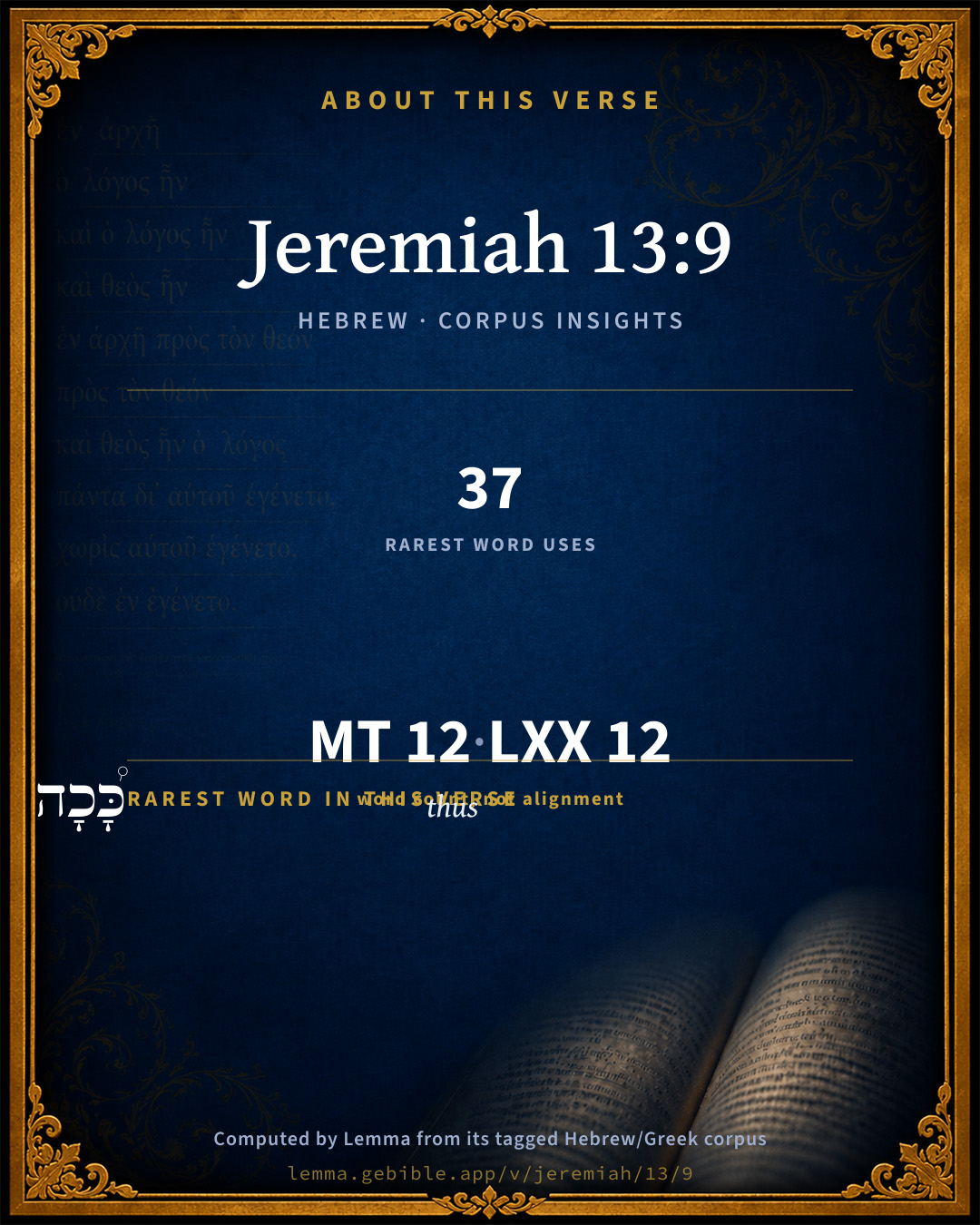
כָּ֠כָה thus H3602 occurs in 35 verses of the Hebrew Bible. Also found in:

Grammatical profile

  • 2 verbs
  • 5 nouns
  • 1 adjective
  • 2 adverbs
  • 2 particles

Verb forms

  • אָמַ֣ר Qal · Perfect
  • אַשְׁחִ֞ית Hiphil · Imperfect

Repetition

A word recurs within this verse — often emphatic in Hebrew:

  • גְּא֧וֹן majesty H1347 ×2

Hebrew & Septuagint length

In the original languages it is 12 Hebrew tokens and 12 Greek tokens — but the two are counted differently (Hebrew bundles its prefixes and suffixes into one token; the Greek is in lemma form), so that isn’t a like-for-like length.

Cross-references

17

Topical passages linked to Jeremiah 13:9 in the Treasury of Scripture Knowledge — connected by theme and wording, ordered by reader-vote popularity; previews shown in the World English Bible.

  • Leviticus 26:19 I will break the pride of your power, and I will make your sky like iron, and your soil like brass;
  • Proverbs 16:18 Pride goes before destruction, And a haughty spirit before a fall.
  • Isaiah 2:10–17 Enter into the rock, And hide in the dust, From before the terror of Yahweh, And from the glory of his majesty.
  • Isaiah 23:9 Yahweh of hosts has purposed it, to stain the pride of all glory, to bring into contempt all the honorable of the earth.
  • Jeremiah 13:15–17 Hear you, and give ear; don't be proud; for Yahweh has spoken.
  • Zephaniah 3:11 In that day you will not be disappointed for all your doings, in which you have transgressed against me; for then I will take away out of the midst of you your proudly exulting ones, and you will no more be haughty in my holy mountain.
  • Job 40:10–12 "Now deck yourself with excellency and dignity. Array yourself with honor and majesty.
  • Isaiah 16:6 We have heard of the pride of Moab, [that] he is very proud; even of his arrogance, and his pride, and his wrath; his boastings are nothing.
  • Jeremiah 18:4–6 When the vessel that he made of the clay was marred in the hand of the potter, he made it again another vessel, as seemed good to the potter to make it.
  • Jeremiah 48:29 We have heard of the pride of Moab, [that] he is very proud; his loftiness, and his pride, and his arrogance, and the haughtiness of his heart.
  • Lamentations 5:5–8 Our pursuers are on our necks: We are weary, and have no rest.
  • Ezekiel 16:50 They were haughty, and committed abomination before me: therefore I took them away as I saw [good].
  • Ezekiel 16:56 For your sister Sodom was not mentioned by your mouth in the day of your pride,
  • Nahum 2:2 For Yahweh restores the excellency of Jacob, as the excellency of Israel; for the destroyers have destroyed them, and ruined their vine branches.
  • Luke 18:14 I tell you, this man went down to his house justified rather than the other; for everyone who exalts himself will be humbled, but he who humbles himself will be exalted."
  • James 4:6 But he gives more grace. Therefore it says, "God resists the proud, but gives grace to the humble."
  • 1 Peter 5:5 Likewise, you younger ones, be subject to the elder. Yes, all of you gird yourselves with humility, to subject yourselves to one another; for "God resists the proud, but gives grace to the humble."

Cross-references courtesy of OpenBible.info (CC BY 4.0).

Hebrew and Greek witnesses Masoretic Hebrew ↔ Greek Septuagint

The same verse in the two great witnesses to the Old Testament, shown verse-for-verse.

These are two independent witnesses, not word-aligned to each other, and the Septuagint is shown in lemma (dictionary) form.

Hebrew Jeremiah 13:9 Masoretic · Westminster Leningrad Codex

כֹּ֖ה אָמַ֣ר יְהוָ֑ה כָּ֠כָה אַשְׁחִ֞ית אֶת גְּא֧וֹן יְהוּדָ֛ה וְאֶת גְּא֥וֹן יְרוּשָׁלִַ֖ם הָרָֽב

Thus says Yahweh, After this manner will I mar the pride of Judah, and the great pride of Jerusalem.

World English Bible · Public Domain

Greek LXX Structure differs

In the Septuagint, Jeremiah is about an eighth shorter than the Hebrew and arranges its material differently — the Oracles Against the Nations (Hebrew chapters 46–51) appear in the middle of the Greek book, after 25:13. Because the chapter and verse boundaries do not line up, a verse-for-verse comparison with the Hebrew is not shown.

A verse-for-verse comparison isn’t shown here because the chapters and verses don’t line up. Switch to the LXX edition with the MT / LXX toggle above to read the Greek directly.

Hebrew: Westminster Leningrad Codex (CC BY 4.0). Greek: Septuagint (public domain); English from a public-domain English Septuagint. How the Septuagint differs from the Hebrew →

Targum (Aramaic paraphrase)

1

The Targum is the ancient Jewish Aramaic paraphrase of the Hebrew Scriptures — an interpretive translation, not the Hebrew text itself. Onkelos (literal) and Pseudo-Jonathan (expansive) render the Torah, and Jonathan the Prophets. Coverage is partial: where no permissively-licensed English translation exists for a verse, only the Aramaic is shown. This is verse-level text, not a word-by-word alignment to the Hebrew.

  1. Targum Jonathan Prophets (Joshua–Malachi)
    כִּדְנַן אֲמַר יְיָ כְּדֵין אֲחַבֵּיל יַת תְּקוֹף אֱנַשׁ יְהוּדָה וְיַת תְּקוֹף יַתְבֵי יְרוּשְׁלֵם דַהֲוָה סַגִי:

    (no public-domain English translation for this verse)

    Targum Jonathan — Aramaic: “Mikraot Gedolot” (public domain). English: “Sefaria Community Translation” (CC0 1.0 (public-domain dedication)); “London "Chaldee Paraphrase," 1871” (public domain). Text via Sefaria.

Commentary

Notes on Jeremiah 13:9 from classic Christian and Jewish commentators (each source and its license shown beneath its notes). The classic Christian expositions comment on the surrounding passage and are grouped to its opening verse, so a note may address several verses; the Jewish commentaries on the Tanakh (Rashi and others) are per-verse, so they appear only where the commentator wrote on this verse.

Lemma curates 59 commentaries, every one of them public domain or Creative Commons licensed, each selected and text-cleaned for this edition rather than reprinted as found. About our sources →

The Cambridge Bible for Schools and Colleges

gen. ed. J. J. S. Perowne

9–11. These vv. have been thought (so Co.) to contain, as they stand, two explanations, mutually exclusive, of the symbol, Jer_13:9 making the marring to denote exile, but Jer_13:10-11 Judah’s disobedience and idolatry, and it has been concluded that the latter is the original application intended and that the supposed inconsistency has come about through the introduction of some modification of the text. Thus Co. omits the whole passage except from “as the girdle” to “house of Israel” (Jer_13:11). The omission, however, seems scarcely warranted. We should notice that it is in consequence of the prophet’s action that the girdle is spoiled, and that Jeremiah, as wearing the girdle, represents Jehovah, the action by which the girdle’s beauty is destroyed corresponding thus to exile (to which the mention of Euphrates as the place of hiding further alludes), but not to apostasy. Accordingly it is the pride of Judah and Jerusalem that shall be humbled by transportation, and it is this humbling that the symbol represents, and not moral corruption, although it is of course the latter (Jer_13:10) which is the cause of the humiliation.

The Cambridge Bible for Schools and Colleges (gen. ed. J. J. S. Perowne; Cambridge University Press, 1878–1918) — public domain. Text from a community e-Sword module.

Trapp's Complete Commentary

John Trapp

Jer 13:9 Thus saith the LORD, After this manner will I mar the pride of Judah, and the great pride of Jerusalem.

Ver. 9. After this manner will I mar the pride.] Their pomp and power, wherein they pride themselves.

John Trapp, A Commentary or Exposition upon All the Books of the Old and New Testament (1647–1656) — public domain. Text from a community e-Sword module.

Joseph Benson's Commentary

Jer 13:9. After this manner will I mar the pride of Judah, &c. — Or, as some translate the verse, “Will I mar the glory of Judah, and the great honour of Jerusalem.” I will bring down their pride and stubbornness, by making them slaves and vassals to strangers, Lam 5:8; Lam 5:13. Or, alluding to the transaction about the girdle, “I will transport them beyond the Euphrates; I will bide them in Babylon, as in the hole of a rock, whence they cannot come out. They shall be marred in the midst of the nations, without temple, without sacrifice, without priests, without external worship. I will humble their presumption, and teach them to acknowledge and adore my mercy.”

Joseph Benson's Commentary on the Old and New Testaments (1811–1818) — public domain. Text from a community e-Sword module.

Jamieson, Fausset & Brown

Robert Jamieson, A. R. Fausset & David Brown

(Lev 26:19).

Jamieson, Fausset & Brown — Commentary Critical and Explanatory on the Whole Bible (1871) — public domain (CC PDM 1.0). Text via the HelloAO Bible API.

John Calvin's Commentaries

As to the application of the Prophecy, the Prophet then distinctly describes it; but he sets forth with sufficient clearness the main point, when he says, Thus will I mar the stateliness (altitudinem, the altitude or height) of Judah and the great stateliness of Jerusalem Other interpreters unanimously render the word, pride; but as גאון gaun, may be taken in two senses, it means here, I have no doubt, excellency, and this will appear more fully from what follows. The word then signifies here that dignity with which God had favored the seed of Abraham, when he intended them to be an ornament to himself. So it is said in Exodus 15:7,

“In thy greatness thou wilt destroy the nations.”

And in Isaiah he says,

“I will make thee the excellency of ages.” (Isaiah 60:15)

There no doubt it is to be taken in a good sense. And these things harmonize together, — that God had prepared the Jews for himself as a belt, and then that he cast them from him into a cavern, where they would be for a time without any light and without any glory.

The import of this clause then is, “Though the dignity of Judah and Jerusalem has been great, (for the people whom God had adopted were renowned according to what is said in Deuteronomy 4) though then the stateliness of Judah and Jerusalem has been great, yet I will mar it.” We see how the Prophet takes from the Jews that false confidence by which they deceived themselves. They might indeed have gloried in God, had they acted truly and from the heart: but when they arrogated all things to themselves, and deprived God of his authority, whose subjects they were, how great was their vanity and folly, and how ridiculous always to profess his sacred name, and to say, We are God’s people? for he was no God to them, as they esteemed him as nothing; nay, they disdainfully and reproachfully rejected his yoke. We hence see that the word גאון gaun, is to be taken here in a good sense. The Prophet at the same time reproachfully taunts them, that they abused the name of God and falsely pretended to be his people and heritage. The rest we cannot finish; we shall go on with the subject to-morrow.

John Calvin's Commentaries (1540-1563) — public domain. Text from the Calvin Translation Society English edition (1840s-50s) via the Christian Classics Ethereal Library (ccel.org). Calvin's coverage is partial (roughly two-thirds of the Bible); uncommented books and verses are honest gaps, never fabricated. The 19th-century editor's footnotes and remarks are omitted so the notes are faithfully Calvin's own voice.

Ellicott's Commentary for English Readers

(9) The pride of Judah.—As the girdle was the part of the dress on which most ornamental work was commonly lavished, so that it was a common gift among princes and men of wealth (1Sa_18:4; 2Sa_18:11), it was the natural symbol of the outward glory of a kingdom. As Jeremiah was a priest, we may, perhaps, think of the embroidered girdle “for glory and for beauty “of the priestly dress (Exo_28:40; Eze_44:17).

A Bible Commentary for English Readers, edited by Charles John Ellicott (1878–1897) — public domain. Text from a community e-Sword module.

John Gill's Exposition

This evil people, which refuse to hear my words,.... Sent by the prophets, to whom they turned a deaf ear; and though they pressed them, and importunately desired them to give them a hearing, they refused it; and this showed them to be a bad people, very degenerate and wicked; and which further appears by what follows:

which walk in the imagination of their heart; which was evil, stubborn, and rebellious, see Jer 7:24,

and walk after other gods, to serve them, and to worship them; went to Egypt and Assyria to pay their adoration to those who were not by nature gods; and this was the cause of their ruin and destruction:

shall even be as this girdle, which is good for nothing: as they were corrupt in their practices, and were become useless and unserviceable to God; so they would be carried captive into a foreign country, where they would be inglorious, and unprofitable, uncomfortable in themselves, and of no use to one another.

John Gill's Exposition of the Whole Bible (1746–1763) — public domain (CC PDM 1.0). Text via the HelloAO Bible API.

Haydock's Catholic Bible Commentary

Rot. I will bring them low. (Menochius) --- They shall see that all their dependance must be on the divine mercy.

George Leo Haydock (1774–1849), Haydock's Catholic Family Bible and Commentary, 1859 edition — public domain. Excludes Psalms (Douay-Rheims chapter numbering differs from Protestant) and Deuterocanonical books (Catholic canon only).

Matthew Poole's English Annotations

By this it appears that God commanded Jeremiah to do this, not only as a representation of the rotten and corrupt state of this people, but of his vengeance, which should suddenly be brought upon them, though they were a proud people, lifted up and swelled in the opinion of themselves, from the favour which God had showed them, in making them a people near unto him, and as it were wearing them upon his loins; yet, they having corrupted themselves by mixing their streams with the streams of Euphrates, corrupting themselves with the superstitions, corruptions, and idolatries of heathens, God would make use of some of those nations to abate their pride and pluck their feathers, and they should rot amongst those people and in some of those nations with whom and by whose example they had sinned against the Lord. This sense of these words is much confirmed by the following words.

Matthew Poole's English Annotations on the Holy Bible (1683–1685) — public domain. Text from a community e-Sword/MySword module.

Whedon's Commentary on the Bible

Daniel D. Whedon

9. Mar the pride of Judah — This was fulfilled in her physical decay — the loss of her temporal greatness.

Daniel D. Whedon (gen. ed.), Commentary on the Old and New Testaments (1874–1909) — public domain. Text from a community e-Sword module.

Lesson kit

Teaching starters — assembled from the data on this page, not authored interpretation. Every prompt links to the verse data it draws on. Edit before teaching.

Jeremiah, in the Prophets, opens this verse with 12 words (10 distinct Hebrew lemmas). Its most distinctive word is kâkâh (“thus”). A historical commentator’s framing appears above. Read the whole chapter for the surrounding context.

Discussion questions

  1. How does “thus” (kâkâh) shape what this verse is saying?
  2. Exodus 12:11 shares the word «thus» with this verse. How do the two illuminate each other?
  3. “majesty” occurs 2× in this one verse. What is the effect of the repetition?
  4. These translations render this verse differently; the difference is in the English rendering, not the original. What questions does that raise?
  5. The verb «אָמַ֣ר» is Qal Perfect. How does its form color the action?
  6. Reading how The Cambridge Bible for Schools and Colleges and Trapp's Complete Commentary read this verse, where do the two commentators agree and where do they part?

Things to notice

Reading settings

Reading text

Shown beneath each verse's original-language words.

Old Testament
Old Testament edition

Read the OT as the Masoretic Hebrew (MT) or the Greek Septuagint (LXX).

English shown for the Greek Septuagint (in the Hebrew ↔ Greek comparison).

Comparing translations? Open the Compare panel on any verse page to stack up to four side by side.