Jeremiah 2:30

Hebrew (Westminster Leningrad Codex) Jeremiah 2:30 appears in the Hebrew Old Testament. The text above is from the Westminster Leningrad Codex. Each word links to its Strong’s number, a concise gloss, and parsing drawn from the Open Scriptures Hebrew Bible morphology. Click any word for its full Brown-Driver-Briggs (BDB) entry.
Download image
Cite this verse

Jeremiah 2:30 (World English Bible). Public Domain. Lemma interlinear Bible study tool, https://lemma.gebible.app/v/jeremiah/2/30.

Show BibTeX & RIS
BibTeX
RIS
English Translation
In vain have I struck your children; they received no correction: your own sword has devoured your prophets, like a destroying lion.
World English Bible · Public Domain
Download a study sheet

One document with this verse’s original text, its word-by-word gloss line, the meaning frame, cross-references with their text, attributed commentary, and full source and license credits — printable, and it pastes into notes with its structure intact.

This verse Autodidact and up

Study sheet (.html) Plain text (.txt)

A passage Seminary Student

Up to 50 verses in one chapter. A passage sheet keeps up to 6 commentary sources and 12 cross-references per verse, in the order this page ranks them, and says so on the sheet whenever that leaves anything out. Ask for a single verse and you get the Autodidact verse sheet above.

Everything on this page stays free to read, with no account — the sheet is a download of what is already on screen, not access to it.

Want to remove ads? Support Godless Engineer
Compare translations 3

The same verse in 3 English versions, stacked beneath the original-language interlinear above. Click any original word for its lexicon entry.

Each is an independent rendering of the whole verse — the interlinear is not word-aligned to these translations.

Highlighted words mark where these versions differ — a whole-verse word diff, not a word-by-word alignment.

  • World English Bible Public Domain
    In vain have I struck your children; they received no correction: your own sword has devoured your prophets, like a destroying lion.
  • King James Version Public Domain
    In vain have I smitten your children; they received no correction: your own sword hath devoured your prophets, like a destroying lion.
  • unfoldingWord Literal Text CC BY-SA 4.0
    For futility I have struck your sons. They would not accept discipline. Your sword has devoured your prophets like a destructive lion!

unfoldingWord Literal Text — © unfoldingWord, licensed CC BY-SA 4.0. Word-aligned USFM3 via Door43 (git.door43.org/unfoldingWord/en_ult).

Versions to compare (up to 4)

3 of 4 selected

Show all 18 translations

Every available English version of this verse, each an independent rendering of the whole verse.

  • World English Bible Public Domain
    In vain have I struck your children; they received no correction: your own sword has devoured your prophets, like a destroying lion.
  • Berean Standard Bible Public Domain
    “I have struck your sons in vain; they accepted no discipline. Your own sword has devoured your prophets like a voracious lion.”
  • Majority Standard Bible Public Domain
    “I have struck your sons in vain; they accepted no discipline. Your own sword has devoured your prophets like a voracious lion.”
  • King James Version Public Domain
    In vain have I smitten your children; they received no correction: your own sword hath devoured your prophets, like a destroying lion.
  • American Standard Version (1901) Public Domain
    In vain have I smitten your children; they received no correction: your own sword hath devoured your prophets, like a destroying lion.
  • Revised Version (1885) Public Domain
    In vain have I smitten your children; they received no correction: your own sword hath devoured your prophets, like a destroying lion.
  • Geneva Bible (1599) Public Domain
    I haue smitten your children in vaine, they receiued no correction: your owne sworde hath deuoured your Prophets like a destroying lyon.
  • Douay-Rheims (1899) Public Domain
    In vain have I struck your children, they have not received correction: your sword hath devoured your prophets, your generation is like a ravaging lion.
  • Young's Literal Translation Public Domain
    In vain I have smitten your sons, Instruction they have not accepted, Devoured hath your sword your prophets, As a destroying lion.
  • Literal Standard Version CC BY-SA 4.0
    “I have struck your sons in vain, || They have not accepted instruction, || Your sword has devoured your prophets, || As a destroying lion.
  • Unlocked Literal Bible CC BY-SA 4.0
    I have punished your people in vain. They would not accept discipline. Your sword has devoured your prophets like a destructive lion!
  • unfoldingWord Literal Text CC BY-SA 4.0
    For futility I have struck your sons. They would not accept discipline. Your sword has devoured your prophets like a destructive lion!
  • Darby Bible Public Domain
    In vain have I smitten your children: they received no correction. Your own sword hath devoured your prophets, like a destroying lion.
  • World Messianic Bible Public Domain
    “I have struck your children in vain. They received no correction. Your own sword has devoured your prophets, like a destroying lion.
  • Webster's Bible Public Domain
    In vain have I smitten your children; they have received no correction: your own sword hath devoured your prophets, like a destroying lion.
  • Free Bible Version CC BY-SA 4.0
    It was pointless of me to punish your children because they refused to accept any discipline. You used your own swords to kill your prophets, destroying them like a ferocious lion.
  • Bible in Basic English Public Domain
    I gave your children blows to no purpose; they got no good from training: your sword has been the destruction of your prophets, like a death-giving lion.
  • JPS Tanakh (1917) Public Domain
    In vain have I smitten your children — they received no correction; your sword hath devoured your prophets, like a destroying lion.

Literal Standard Version (2020), Covenant Press — licensed CC BY-SA 4.0. Text via the HelloAO Bible API (eBible.org). Unlocked Literal Bible (unfoldingWord) — licensed CC BY-SA 4.0. Text via the HelloAO Bible API (eBible.org). unfoldingWord Literal Text — © unfoldingWord, licensed CC BY-SA 4.0. Word-aligned USFM3 via Door43 (git.door43.org/unfoldingWord/en_ult). Free Bible Version, Dr. Jonathan Gallagher — licensed CC BY-SA 4.0. Text via the HelloAO Bible API (eBible.org).

Word by word

More ways to search: Search by grammar → Find every occurrence → Compare this word →

Practice this passage: Drill this verse → Learn its vocabulary →

מוּסָ֖ר
mûwçâr
H4148
“discipline”
Noun, Common, Masculine, Singular, Absolute
Part of Speech
Noun
Type
Common
Gender
Masculine
Number
Singular
State
Absolute
Full BDB Definition

Origin: from H3256

TWOT: 877b

discipline, chastening, correction - discipline, correction - chastening
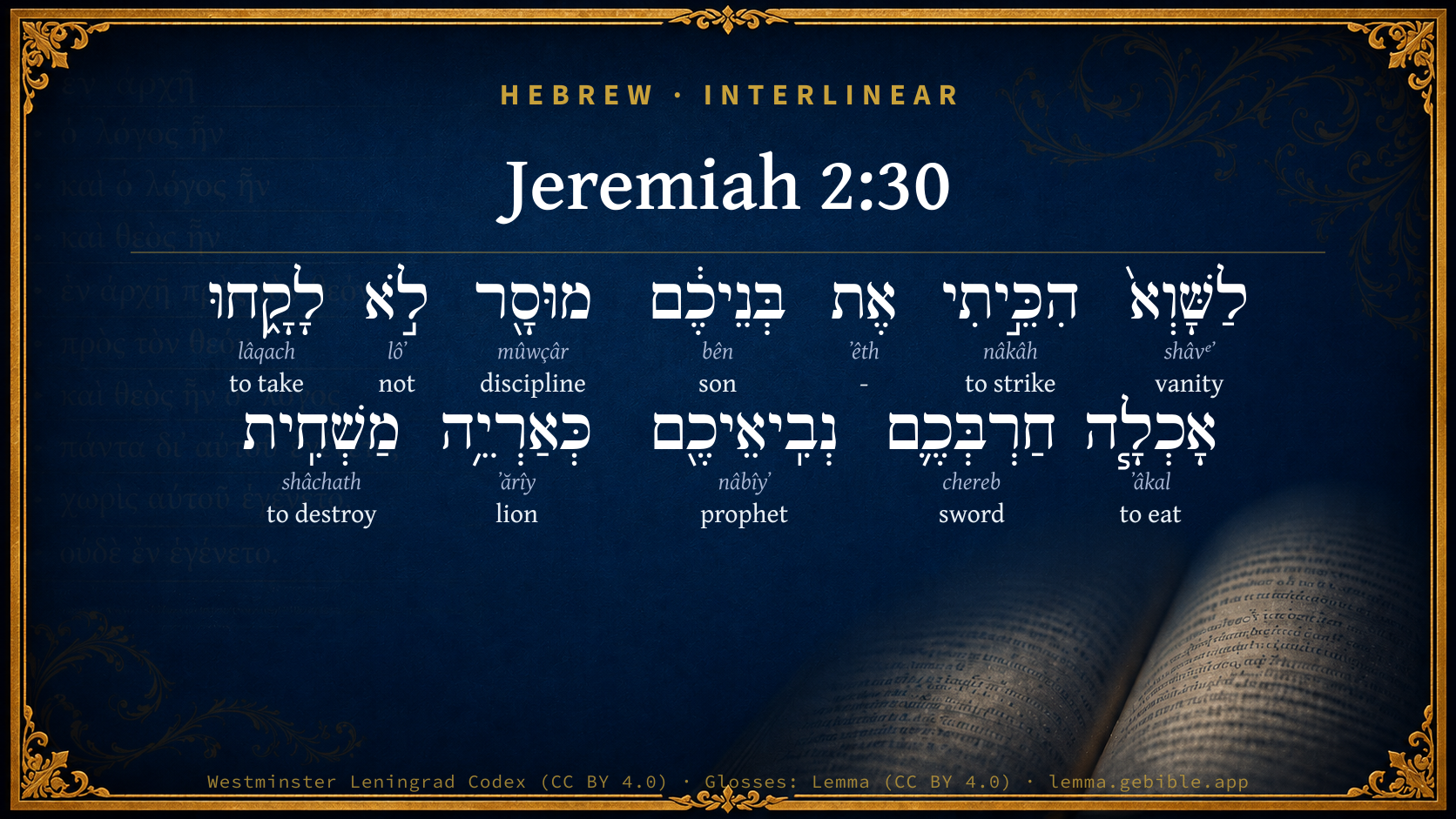
  1. לַשָּׁוְא֙ shâvᵉʼ H7723 “to/for the · vanity” Preposition, Determined + Noun, Common, Masculine, Singular, Absolute
  2. הִכֵּ֣יתִי nâkâh H5221 “to strike” Verb, Hiphil, Perfect, 1st Person, Common, Singular
  3. אֶת ʼêth H853 “-” Particle, Direct Object
  4. בְּנֵיכֶ֔ם bên H1121 “sons · your” Noun, Common, Masculine, Plural, Construct + Suffix, Personal, 2nd Person, Masculine, Plural
  5. לֹ֣א lôʼ H3808 “not” Particle, Negative
  6. לָקָ֑חוּ lâqach H3947 “to take” Verb, Qal, Perfect, 3rd Person, Common, Plural
  7. אָכְלָ֧ה ʼâkal H398 “to eat” Verb, Qal, Perfect, 3rd Person, Feminine, Singular
  8. חַרְבְּכֶ֛ם chereb H2719 “sword · your” Noun, Common, Feminine, Singular, Construct + Suffix, Personal, 2nd Person, Masculine, Plural
  9. נְבִֽיאֵיכֶ֖ם nâbîyʼ H5030 “prophets · your” Noun, Common, Masculine, Plural, Construct + Suffix, Personal, 2nd Person, Masculine, Plural
  10. כְּאַרְיֵ֥ה ʼărîy H738 “like/as · lion” Preposition + Noun, Common, Masculine, Singular, Absolute
  11. מַשְׁחִֽית shâchath H7843 “destroying” Verb, Hiphil, Participle Active, Masculine, Singular, Absolute

About this verse

These counts appear in no published source. They are computed here, from the morphology-tagged text and Lemma’s own curated glosses. What Lemma adds →

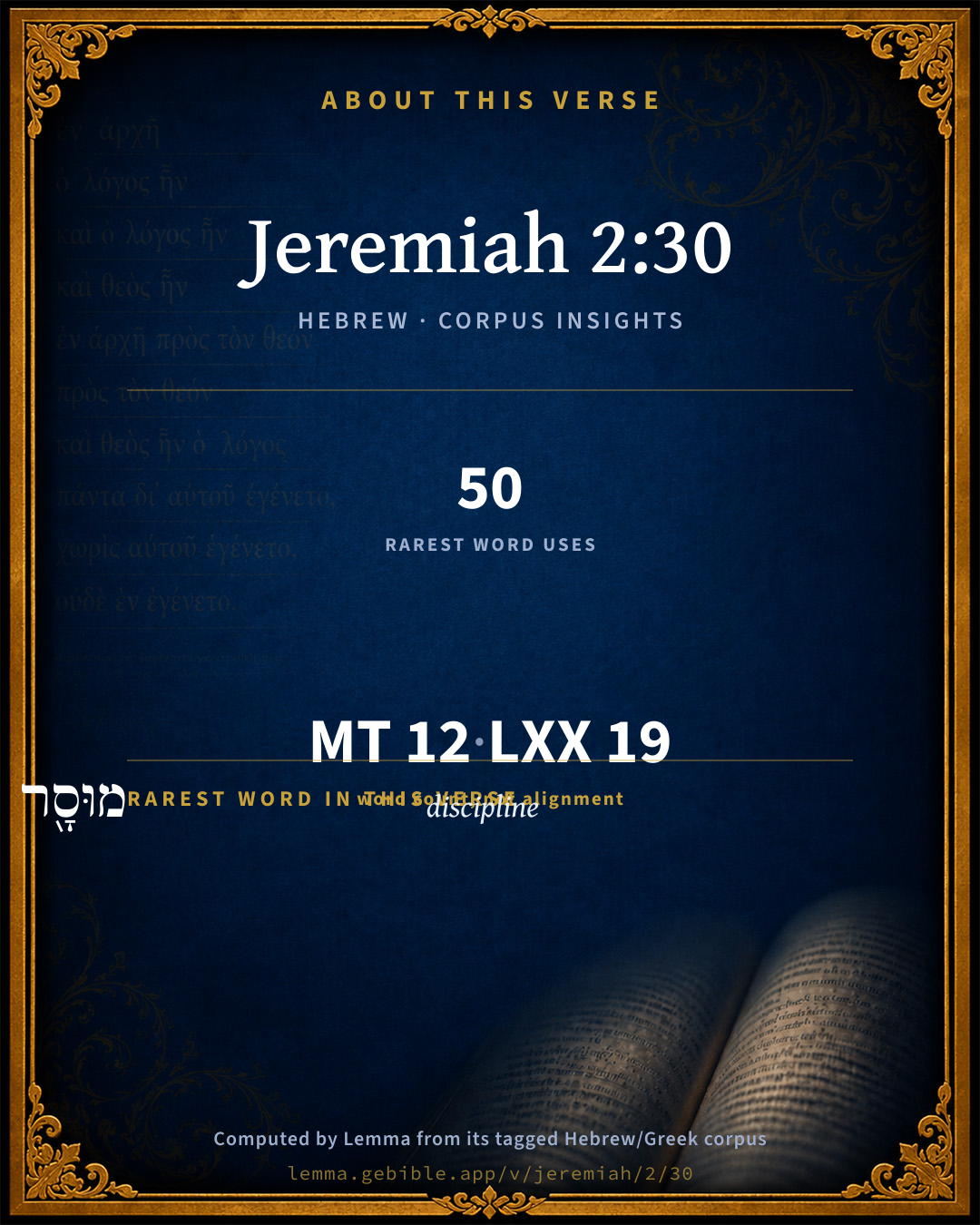
12
words
12
distinct lemmas
Prophets
section

Shared distinctive vocabulary

מוּסָ֖ר discipline H4148 occurs in 50 verses of the Hebrew Bible. Also found in:

Grammatical profile

  • 4 verbs
  • 6 nouns
  • 2 particles

Verb forms

  • הִכֵּ֣יתִי Hiphil · Perfect
  • לָקָ֑חוּ Qal · Perfect
  • אָכְלָ֧ה Qal · Perfect
  • מַשְׁחִֽית Hiphil · Participle Active

Hebrew & Septuagint length

In the original languages it is 12 Hebrew tokens and 19 Greek tokens — but the two are counted differently (Hebrew bundles its prefixes and suffixes into one token; the Greek is in lemma form), so that isn’t a like-for-like length.

Cross-references

25

Topical passages linked to Jeremiah 2:30 in the Treasury of Scripture Knowledge — connected by theme and wording, ordered by reader-vote popularity; previews shown in the World English Bible.

  • Nehemiah 9:26 Nevertheless they were disobedient, and rebelled against you, and cast your law behind their back, and killed your prophets that testified against them to turn them again to you, and they committed awful blasphemies.
  • Acts 7:52 Which of the prophets didn't your fathers persecute? They killed those who foretold the coming of the Righteous One, of whom you have now become betrayers and murderers.
  • 1 Thessalonians 2:15 who killed both the Lord Jesus and their own prophets, and drove us out, and didn't please God, and are contrary to all men;
  • Isaiah 1:5 Why should you be beaten more, That you revolt more and more? The whole head is sick, And the whole heart faint.
  • Jeremiah 5:3 O Yahweh, don't your eyes look on truth? you have stricken them, but they were not grieved; you have consumed them, but they have refused to receive correction: they have made their faces harder than a rock; they have refused to return.
  • Jeremiah 26:20–24 There was also a man who prophesied in the name of Yahweh, Uriah the son of Shemaiah of Kiriath Jearim; and he prophesied against this city and against this land according to all the words of Jeremiah:
  • Isaiah 9:13 Yet the people have not turned to him who struck them, neither have they sought Yahweh of Hosts.
  • Jeremiah 7:28 You shall tell them, This is the nation that has not listened to the voice of Yahweh their God, nor received instruction: truth is perished, and is cut off from their mouth.
  • Matthew 23:29 "Woe to you, scribes and Pharisees, hypocrites! For you build the tombs of the prophets, and decorate the tombs of the righteous,
  • 1 Kings 19:10 He said, I have been very jealous for Yahweh, the God of hosts; for the children of Israel have forsaken your covenant, thrown down your altars, and slain your prophets with the sword: and I, even I only, am left; and they seek my life, to take it away.
  • 1 Kings 19:14 He said, I have been very jealous for Yahweh, the God of hosts; for the children of Israel have forsaken your covenant, thrown down your altars, and slain your prophets with the sword; and I, even I only, am left; and they seek my life, to take it away.
  • 2 Chronicles 24:21 They conspired against him, and stoned him with stones at the commandment of the king in the court of the house of Yahweh.
  • 2 Chronicles 28:22 In the time of his distress did he trespass yet more against Yahweh, this same king Ahaz.
  • 2 Chronicles 36:16 but they mocked the messengers of God, and despised his words, and scoffed at his prophets, until the wrath of Yahweh arose against his people, until there was no remedy.
  • Jeremiah 6:29–30 The bellows blow fiercely; the lead is consumed of the fire: in vain do they go on refining; for the wicked are not plucked away.
  • Jeremiah 31:18 I have surely heard Ephraim bemoaning himself [thus], You have chastised me, and I was chastised, as a calf unaccustomed [to the yoke]: turn you me, and I shall be turned; for you are Yahweh my God.
  • Ezekiel 24:13 In your filthiness is lewdness: because I have cleansed you and you weren't cleansed, you shall not be cleansed from your filthiness any more, until I have caused my wrath toward you to rest.
  • Zephaniah 3:2 She didn't obey the voice. She didn't receive correction. She didn't trust in Yahweh. She didn't draw near to her God.
  • Matthew 21:35–36 The farmers took his servants, beat one, killed another, and stoned another.
  • Matthew 23:34–37 Therefore, behold, I send to you prophets, wise men, and scribes. Some of them you will kill and crucify; and some of them you will scourge in your synagogues, and persecute from city to city;
  • Mark 12:2–8 When it was time, he sent a servant to the farmer to get from the farmer his share of the fruit of the vineyard.
  • Luke 11:47–51 Woe to you! For you build the tombs of the prophets, and your fathers killed them.
  • Luke 13:33–34 Nevertheless I must go on my way today and tomorrow and the next day, for it can't be that a prophet perish outside of Jerusalem.'
  • Revelation 9:20–21 The rest of mankind, who were not killed with these plagues, didn't repent of the works of their hands, that they wouldn't worship demons, and the idols of gold, and of silver, and of brass, and of stone, and of wood; which can neither see, nor hear, nor walk.
  • Revelation 16:9 People were scorched with great heat, and people blasphemed the name of God who has the power over these plagues. They didn't repent and give him glory.

Cross-references courtesy of OpenBible.info (CC BY 4.0).

Hebrew and Greek witnesses Masoretic Hebrew ↔ Greek Septuagint

The same verse in the two great witnesses to the Old Testament, shown verse-for-verse.

These are two independent witnesses, not word-aligned to each other, and the Septuagint is shown in lemma (dictionary) form.

Hebrew Jeremiah 2:30 Masoretic · Westminster Leningrad Codex

לַשָּׁוְא֙ הִכֵּ֣יתִי אֶת בְּנֵיכֶ֔ם מוּסָ֖ר לֹ֣א לָקָ֑חוּ אָכְלָ֧ה חַרְבְּכֶ֛ם נְבִֽיאֵיכֶ֖ם כְּאַרְיֵ֥ה מַשְׁחִֽית

In vain have I struck your children; they received no correction: your own sword has devoured your prophets, like a destroying lion.

World English Bible · Public Domain

Greek LXX Structure differs

In the Septuagint, Jeremiah is about an eighth shorter than the Hebrew and arranges its material differently — the Oracles Against the Nations (Hebrew chapters 46–51) appear in the middle of the Greek book, after 25:13. Because the chapter and verse boundaries do not line up, a verse-for-verse comparison with the Hebrew is not shown.

A verse-for-verse comparison isn’t shown here because the chapters and verses don’t line up. Switch to the LXX edition with the MT / LXX toggle above to read the Greek directly.

On this verse, John Gill's Exposition discusses the Septuagint’s reading. Read the note in Commentary ↓

Hebrew: Westminster Leningrad Codex (CC BY 4.0). Greek: Septuagint (public domain); English from a public-domain English Septuagint. How the Septuagint differs from the Hebrew →

Targum (Aramaic paraphrase)

1

The Targum is the ancient Jewish Aramaic paraphrase of the Hebrew Scriptures — an interpretive translation, not the Hebrew text itself. Onkelos (literal) and Pseudo-Jonathan (expansive) render the Torah, and Jonathan the Prophets. Coverage is partial: where no permissively-licensed English translation exists for a verse, only the Aramaic is shown. This is verse-level text, not a word-by-word alignment to the Hebrew.

  1. Targum Jonathan Prophets (Joshua–Malachi)
    לְמַגָן אַלְקֵיתִי יַת בְּנֵיכוֹן אוּלְפַן לָא קַבִּילוּ קַטְלֵת חַרְבְּכוֹן נְבִיֵיכוֹן כְּאַרְיָא דִמְחַבֵּל:

    (no public-domain English translation for this verse)

    Targum Jonathan — Aramaic: “Mikraot Gedolot” (public domain). English: “Sefaria Community Translation” (CC0 1.0 (public-domain dedication)); “London "Chaldee Paraphrase," 1871” (public domain). Text via Sefaria.

Commentary

Notes on Jeremiah 2:30 from classic Christian and Jewish commentators (each source and its license shown beneath its notes). The classic Christian expositions comment on the surrounding passage and are grouped to its opening verse, so a note may address several verses; the Jewish commentaries on the Tanakh (Rashi and others) are per-verse, so they appear only where the commentator wrote on this verse.

Lemma curates 59 commentaries, every one of them public domain or Creative Commons licensed, each selected and text-cleaned for this edition rather than reprinted as found. About our sources →

Trapp's Complete Commentary

John Trapp

Jer 2:30 In vain have I smitten your children; they received no correction: your own sword hath devoured your prophets, like a destroying lion.

Ver. 30. In vain have I smitten your children.] My hammers have but beaten cold iron; ye are incorrigible, irreformable. See Isa 1:5. {See Trapp on "Isa 1:5"}

Your own sword hath devoured your prophets.] As it did in the days of Ahaz, Joash, Manasseh, of whom Josephus {a} saith, that he slew some prophet of God every day.

Like a destroying lion.] Cum saevitia summa, exuta omni humanitate. Ye have pulled them limb meal, and caused them to die piece meal.

{a} Lib. x. cap. 4.

John Trapp, A Commentary or Exposition upon All the Books of the Old and New Testament (1647–1656) — public domain. Text from a community e-Sword module.

Tyndale Open Study Notes

Tyndale Open Resources

2:30 killed your prophets: See 26:20-23.

Tyndale Open Study Notes — © Tyndale Open Resources, licensed CC BY-SA 4.0. Text via the HelloAO Bible API.

Geneva Bible (1599)

Geneva Bible translators

That is, you have killed your Prophets, that exhorted you to repentance, as Zechariah, Isaiah, etc.

Geneva Bible (1599) marginal notes — public domain. Text via Bolls.life.

Jamieson, Fausset & Brown

Robert Jamieson, A. R. Fausset & David Brown

(Jer 5:3; Jer 6:29; Isa 1:5; Isa 9:13).

your children--that is, your people, you.

your . . . sword . . . devoured . . . prophets-- (Ch2 36:16; Neh 9:26; Mat 23:29, Mat 23:31).

Jamieson, Fausset & Brown — Commentary Critical and Explanatory on the Whole Bible (1871) — public domain (CC PDM 1.0). Text via the HelloAO Bible API.

John Calvin's Commentaries

Some expound the beginning of this verse as though the meaning were, — that God chastised the Jews on account of their folly, because they habituated themselves to falsehoods: but the latter clause does not correspond. There is therefore no doubt but that God here expostulates with the Jews, because he had tried to bring them to the right way and found them wholly irreclaimable. A similar expostulation is found in Isaiah,

“In vain,” he says, “have I chastised you; for from the sole of the foot to the crown of the head there is no soundness.” (Isaiah 1:6)

There God shews that he had tried every remedy, but that the Jews, being wholly refractory in their spirit, were wholly incurable. Jeremiah speaks now on the same subject: and God thus exaggerates the wickedness of the people; for he testifies that he had tried whether they would be taught, not only by words, but also by scourges and chastisements, but that his labor in both instances had been in vain. He spoke before of teaching, “Keep thy foot from being unshod, and thy throat from thirst.” The Prophets, then, had exhorted the Jews by God’s command to rest quietly. This teaching had been useless and unfruitful. God now adds, that he had tried in another way to bring them back to a right mind; but this effort had been also useless and in vain: In vain have I chastised you; for ye have not received correction

But he speaks of children, in order to shew that the whole people were unteachable: for though lusts boil more in youth, yet their obduracy is not so great as in the old; as he who has through his whole life hardened himself in the contempt of God, can hardly be ever healed and be amended by correction; for old age is of itself morose and difficult to be pleased, and the old also think, that wrong is in a manner done them when they are reproved: but when the insolence and obduracy of the young are so great that they reject all correction, it is more strange and monstrous. The Prophet then shews that there was nothing sound or right in that people, since their very children refused correction.

We now perceive his object, — that, as God had sent his prophets, and as their labor availed nothing, he now shews, that not only the ears of the people had been deaf to wholesome teaching, but that they were hard — necked and untamable; for he had tried to correct them by scourges, but effected nothing. It follows, their sword has devoured the prophets But I cannot finish now.

John Calvin's Commentaries (1540-1563) — public domain. Text from the Calvin Translation Society English edition (1840s-50s) via the Christian Classics Ethereal Library (ccel.org). Calvin's coverage is partial (roughly two-thirds of the Bible); uncommented books and verses are honest gaps, never fabricated. The 19th-century editor's footnotes and remarks are omitted so the notes are faithfully Calvin's own voice.

Ellicott's Commentary for English Readers

(30) Your own sword hath devoured your prophets.—So in the long reign of Manasseh, the prophets who rebuked him had to do so at the risk of their lives. Isaiah, as the tradition ran, had been foremost among the sufferers. Much innocent blood had been shed from one end to another of Jerusalem (2Ki_21:11-16).

A Bible Commentary for English Readers, edited by Charles John Ellicott (1878–1897) — public domain. Text from a community e-Sword module.

The Cambridge Bible for Schools and Colleges

gen. ed. J. J. S. Perowne

30. your children] not literally such, nor yet young men slain in battle, but equivalent to the frequent expression “children of thy people” (e.g. Eze_3:11; Eze_33:2; Eze_33:12; Eze_33:17; Eze_33:30), i.e. the people considered individually, as contrasted with the aggregate.

your prophets] Some commentators make the reference to be to such events as those recorded in 1Ki_18:4-13, or to some unknown outbreak of violence. But the passage may well point to the comparatively recent massacres by Manasseh, traditionally including Isaiah (Isa_21:16).

The Cambridge Bible for Schools and Colleges (gen. ed. J. J. S. Perowne; Cambridge University Press, 1878–1918) — public domain. Text from a community e-Sword module.

John Gill's Exposition

O generation, see ye the word of the Lord,.... Take notice of it, consider it; or, hear it, as the Septuagint, Syriac, and Arabic versions. Jarchi and Kimchi think (i) the pot of manna was brought out, and shown them, to be looked at by them, for the conviction of them, and confirmation of what follows:

have I been a wilderness unto Israel? no: the Israelites were plentifully supplied by him when in the wilderness, and since they were brought into a land flowing with milk and honey; so that they stood in need of nothing; they had a constant supply of all good things:

or a land of darkness? of misery, distress, and poverty; where no light of joy, comfort, and prosperity, is; a land that never sees the light, or enjoys the benefit of the sun, and so is barren and unfruitful; "a land of thorns", as the Septuagint version; or, "a desert and uncultivated land", as the Targum, and Syriac and Arabic versions. It may be rendered, "a land of the darkness of God" (k); that is, of the greatest darkness, of thick and gross darkness, alluding to that in Egypt; as the flame of God, and mountains of God, Sol 8:6, as Ben Melech and Kimchi observe:

wherefore say my people, we are lords; and can reign without thee; or we have kings and princes, and have no need of thee, so Kimchi; but the word used seems to have another meaning, and to require another sense. The Targum is, "we are removed"; and the Vulgate Latin version, "we have gone back"; to which agrees the Jewish Midrash (l), mentioned by Jarchi, and confirmed with a passage out of the Misna (m), "we are separated from thee"; we have departed from thee, turned our backs on thee, have forsaken thee, and left thy ways and worship; and to do so was very ungrateful, when the Lord had so richly supplied them, that they had not lacked any good thing; and this sense agrees with what follows:

we will come no more unto thee? some render it, "we have determined" (n); as having the same sense with the Arabic word, which signifies to "will" or determine anything; and then the meaning is, we are determined, we are resolved to come no more to thee, to attend thy worship and service any more; and so the Targum,

"we will not return any more to thy worship.''

(i) So Mechilta apud Yalkut in loc. (k) "terra caliginis Dei", Gataker, Gussetius; "caliginis Jah", Montanus. (l) Midrash R. Tanchuma, apud Jarchi in loc. Vid. Yalkut Simeoni, in Ioc. (m) Misn. Trumot, c. 10. sect. 3. & Machshirin, c. 3. sect. 3. (n) "voluimus non veniemus", &c, De Dieu; "decrevimus non veniemus", Cocceius.

John Gill's Exposition of the Whole Bible (1746–1763) — public domain (CC PDM 1.0). Text via the HelloAO Bible API.

Albert Barnes' Notes on the Bible

Your own sword hath detoured your prophets - An allusion probably to Manasseh 2Ki 21:16. Death was the usual fate of the true prophet Neh 9:26; Mat 23:37.

Albert Barnes' Notes on the Bible (1834–1885) — public domain. Text from a community e-Sword/MySword module.

Haydock's Catholic Bible Commentary

Prophets; Zacharias, (2 Paralipomenon xxiv. 21.) Isaias, &c., Matthew xxiii. 34. (Calmet) --- Punishment is designed by God to cause people to repent. (Worthington)

George Leo Haydock (1774–1849), Haydock's Catholic Family Bible and Commentary, 1859 edition — public domain. Excludes Psalms (Douay-Rheims chapter numbering differs from Protestant) and Deuterocanonical books (Catholic canon only).

Matthew Poole's English Annotations

Your children; either your posterity, that you breed up like yourselves; or rather, your inhabitants in every city, they being frequently called the children of such a city, or such a place: children of Seir, 2Ch 25:14, children, of the province, Ezr 2:1, and children of thy people, Lev 19:18, and abundance more the like; and thus it is comprehensive both of parents and children.

Correction, i.e. The fruit of correction, viz. instruction. The same word is rendered correction, Pro 23:13, which signifies instruction, Pro 5:12, and in other places; and so to be taken here: it notes their refractoriness, that though they were corrected, yet they would not be instructed; though God did smite them, yet the rod prevailed as little with them as the word.

Your own sword hath devoured your prophets; either the sword that I have sent to destroy you hath destroyed your false prophets together with you, Hos 4:5, and so it is both a prophecy and a threatening; or rather, you have been so far from receiving counsel and instruction, that you have, by the sword, and other ways of destruction, (which is to be understood by the sword,) murdered those that I sent to reprove your follies in the days of Asa, Joash, Manasseh, &c., Neh 9:26. See Mat 23:34,35.

Devoured; or, eaten up; a metaphor. Hence we read of the edge of the sword, which both in Hebrew and Greek is called the mouth of the sword, Jer 21:7; Luk 21:24. Like a destroying lion; without respect or pity; with all manner of savage usage; see Psa 7:2; laying aside all humanity.

Matthew Poole's English Annotations on the Holy Bible (1683–1685) — public domain. Text from a community e-Sword/MySword module.

Whedon's Commentary on the Bible

Daniel D. Whedon

ISRAEL’S GUILT AND PUNISHMENT, Jer_2:29-35.

30. Sword hath devoured — See 1Ki_18:4; 1Ki_18:13; 1Ki_19:10; 2Ki_21:16, etc.

Daniel D. Whedon (gen. ed.), Commentary on the Old and New Testaments (1874–1909) — public domain. Text from a community e-Sword module.

The Pulpit Commentary

Have I smitten your children. The cities and towns of Judah are represented as so many mothers, and the populations as their children. It would, no doubt, be more natural to take "children" literally; but then we must read the verb in the next clause, "Ye have received," as the Septuagint actually renders. In the former case the "smiting" will refer to all God"s "sore judgments sword, drought, famine, pestilence; in the latter, to the loss of life in battle. Your own sword hath devoured your prophets. (comp. 2Ch_24:21 2Ki_21:16) Manasseh"s persecution (which extended, according to Josephus, especially to the prophets) may account for the preponderance of "false prophets" referred to in ver. 8. (cf. Mat_23:29)

Rejecting the chastisements of God.

The spiritual benefits of pain, calamity, etc., are contingent for the most part upon their being received in a right way as from God, and not by accident. They are intended to discover our sins to us, and to lead us to the love and righteousness of God. Where this result is not effected, "chastisement is not accepted.

I THE POSSIBILITY OF REFUSING CHASTISEMENT.

II MISERY AND PAIN ARE NOT OF THEMSELVES MINISTERS OF GRACE.

III RIGHTLY RECEIVED, OUR GREATEST GRIEFS MAY BECOME OUR GREATEST MERCIES.

The Pulpit Commentary (1880–1919), ed. H.D.M. Spence-Jones & Joseph S. Exell — public domain. Text from a community e-Sword module.

John Wesley's Explanatory Notes

Children - Your inhabitants in every city, they being frequently called the children of such a city. Correction - Instruction: though they were corrected, yet they would not be instructed. Your sword - You have been so far from receiving instruction, that you have, by the sword, and other ways of destruction, murdered those that I have sent to reprove you.

John Wesley, Explanatory Notes Upon the Whole Bible (1754–1765) — public domain. Text via the GEBible commentary corpus.

Rashi

Rabbi Shlomo Yitzchaki (Rashi)

In vain have I smitten For no purpose, for it did not avail that they should receive correction.

Your sword devoured your prophets, Zechariah and Isaiah.

Rashi on the Tanakh — English translations: “The Judaica Press complete Tanach with Rashi, translated by A. J. Rosenberg” (CC BY 4.0); “Pentateuch with Rashi's commentary by M. Rosenbaum and A.M. Silbermann, 1929-1934” (public domain); “The Metsudah Tanach series, Lakewood, N.J” (CC BY 4.0); and “The Book of Joshua, Metsudah Publications, 1997” (CC BY 4.0). Text via Sefaria.

Lesson kit

Teaching starters — assembled from the data on this page, not authored interpretation. Every prompt links to the verse data it draws on. Edit before teaching.

Jeremiah, in the Prophets, opens this verse with 12 words (12 distinct Hebrew lemmas). Its most distinctive word is mûwçâr (“discipline”). A historical commentator’s framing appears above. Read the whole chapter for the surrounding context.

Discussion questions

  1. The word mûwçâr carries the sense “discipline.” How does it shape the verse?
  2. Deuteronomy 11:2 shares the word «discipline» with this verse. How do the two illuminate each other?
  3. The translations on this page render this verse differently — a whole-verse word diff, not a word-by-word alignment. What might account for the different wordings?
  4. The verb «הִכֵּ֣יתִי» is Hiphil Perfect. How does its form color the action?
  5. Reading how Trapp's Complete Commentary and Tyndale Open Study Notes read this verse, where do the two commentators agree and where do they part?

Things to notice

Reading settings

Reading text

Shown beneath each verse's original-language words.

Old Testament
Old Testament edition

Read the OT as the Masoretic Hebrew (MT) or the Greek Septuagint (LXX).

English shown for the Greek Septuagint (in the Hebrew ↔ Greek comparison).

Comparing translations? Open the Compare panel on any verse page to stack up to four side by side.