
Jeremiah 18:4

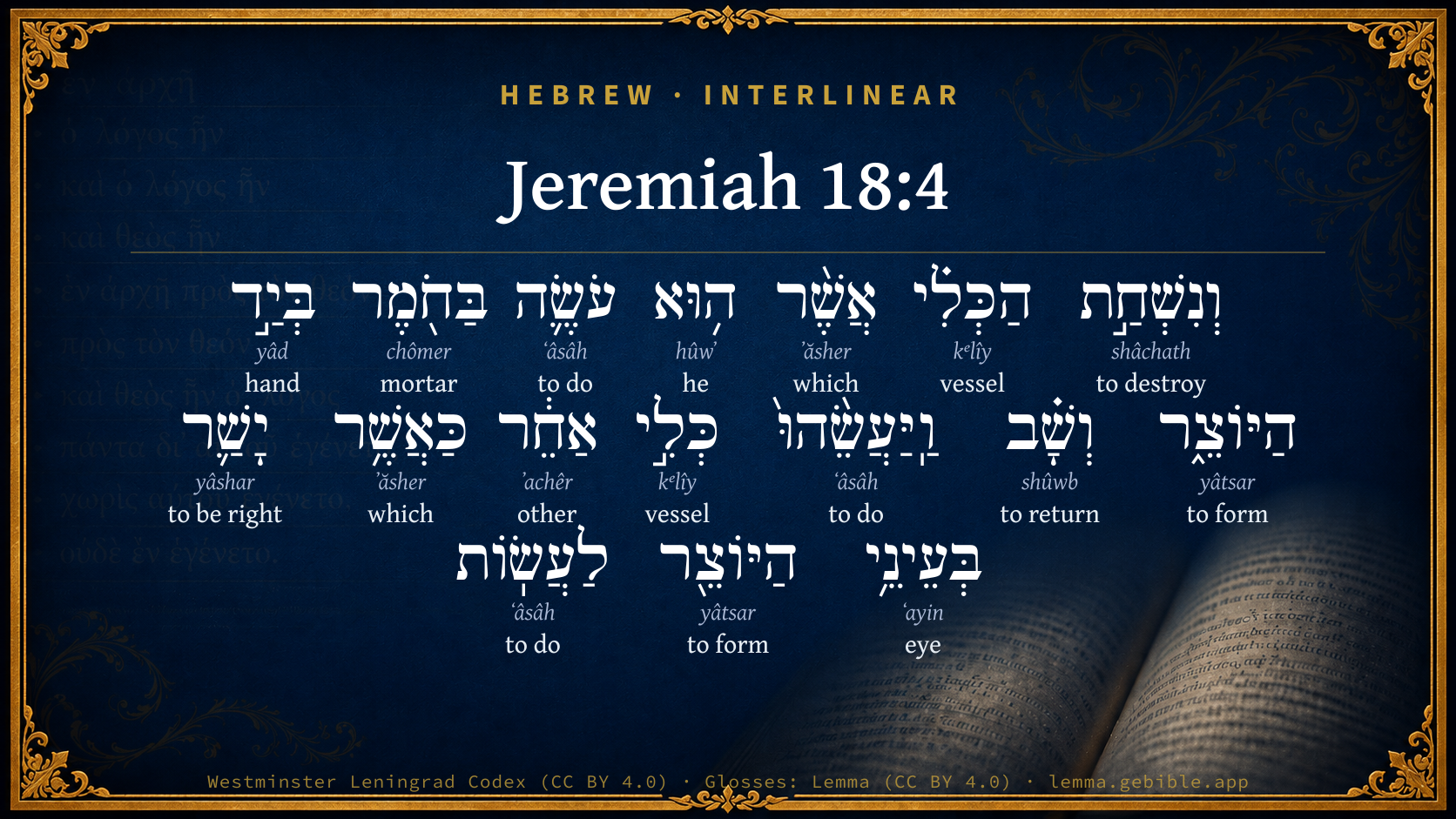
Hebrew (Westminster Leningrad Codex) Jeremiah 18:4 appears in the Hebrew Old Testament. The text above is from the Westminster Leningrad Codex. Each word links to its Strong’s number, a concise gloss, and parsing drawn from the Open Scriptures Hebrew Bible morphology. Click any word for its full Brown-Driver-Briggs (BDB) entry.
Download image
Cite this verse

Jeremiah 18:4 (World English Bible). Public Domain. Lemma interlinear Bible study tool, https://lemma.gebible.app/v/jeremiah/18/4.

Show BibTeX & RIS
BibTeX
RIS
English Translation
When the vessel that he made of the clay was marred in the hand of the potter, he made it again another vessel, as seemed good to the potter to make it.
World English Bible · Public Domain
Download a study sheet

One document with this verse’s original text, its word-by-word gloss line, the meaning frame, cross-references with their text, attributed commentary, and full source and license credits — printable, and it pastes into notes with its structure intact.

This verse Autodidact and up

Study sheet (.html) Plain text (.txt)

A passage Seminary Student

Up to 50 verses in one chapter. A passage sheet keeps up to 6 commentary sources and 12 cross-references per verse, in the order this page ranks them, and says so on the sheet whenever that leaves anything out. Ask for a single verse and you get the Autodidact verse sheet above.

Everything on this page stays free to read, with no account — the sheet is a download of what is already on screen, not access to it.

Want to remove ads? Support Godless Engineer
Compare translations 3

The same verse in 3 English versions, stacked beneath the original-language interlinear above. Click any original word for its lexicon entry.

Each is an independent rendering of the whole verse — the interlinear is not word-aligned to these translations.

Highlighted words mark where these versions differ — a whole-verse word diff, not a word-by-word alignment.

  • World English Bible Public Domain
    When the vessel that he made of the clay was marred in the hand of the potter, he made it again another vessel, as seemed good to the potter to make it.
  • King James Version Public Domain
    And the vessel that he made of clay was marred in the hand of the potter: so he made it again another vessel, as seemed good to the potter to make it.
  • unfoldingWord Literal Text CC BY-SA 4.0
    And the vessel that he was making with the clay was ruined in the hand of the potter, and he returned and made it another vessel, as was right in the eyes of the potter to make.

unfoldingWord Literal Text — © unfoldingWord, licensed CC BY-SA 4.0. Word-aligned USFM3 via Door43 (git.door43.org/unfoldingWord/en_ult).

Versions to compare (up to 4)

3 of 4 selected

Show all 18 translations

Every available English version of this verse, each an independent rendering of the whole verse.

  • World English Bible Public Domain
    When the vessel that he made of the clay was marred in the hand of the potter, he made it again another vessel, as seemed good to the potter to make it.
  • Berean Standard Bible Public Domain
    But the vessel that he was shaping from the clay became flawed in his hand; so he formed it into another vessel, as it seemed best for him to do.
  • Majority Standard Bible Public Domain
    But the vessel that he was shaping from the clay became flawed in his hand; so he formed it into another vessel, as it seemed best for him to do.
  • King James Version Public Domain
    And the vessel that he made of clay was marred in the hand of the potter: so he made it again another vessel, as seemed good to the potter to make it.
  • American Standard Version (1901) Public Domain
    And when the vessel that he made of the clay was marred in the hand of the potter, he made it again another vessel, as seemed good to the potter to make it.
  • Revised Version (1885) Public Domain
    And when the vessel that he made of the clay was marred in the hand of the potter, he made it again another vessel, as seemed good to the potter to make it.
  • Geneva Bible (1599) Public Domain
    And the vessell that he made of clay, was broken in the hand of the potter. so he returned, and made it another vessel, as seemed good to the potter to make it.
  • Douay-Rheims (1899) Public Domain
    And the vessel was broken which he was making with clay with his hands: and turning he made another vessel, as it seemed good in his eyes to make it.
  • Young's Literal Translation Public Domain
    and marred is the vessel that he is making, as clay in the hand of the potter, and he hath turned and he maketh it another vessel, as it was right in the eyes of the potter to make.
  • Literal Standard Version CC BY-SA 4.0
    and the vessel that he is making is marred, as clay in the hand of the potter, and he has turned and he makes it another vessel, as it was right in the eyes of the potter to make.
  • Unlocked Literal Bible CC BY-SA 4.0
    But the object of clay that he was molding was ruined in his hand, so he changed his mind and made another object that seemed good in his eyes to do.
  • unfoldingWord Literal Text CC BY-SA 4.0
    And the vessel that he was making with the clay was ruined in the hand of the potter, and he returned and made it another vessel, as was right in the eyes of the potter to make.
  • Darby Bible Public Domain
    And the vessel that he made was marred, as clay, in the hand of the potter; and he made it again another vessel, as seemed good to the potter to make.
  • World Messianic Bible Public Domain
    When the vessel that he made of the clay was marred in the hand of the potter, he made it again another vessel, as seemed good to the potter to make it.
  • Webster's Bible Public Domain
    And the vessel that he made of clay was marred in the hand of the potter: so he made it again another vessel, as it seemed good to the potter to make it.
  • Free Bible Version CC BY-SA 4.0
    But the pot that he was making from the clay went wrong. So he made it into something different as he thought best.
  • Bible in Basic English Public Domain
    And when the vessel, which he was forming out of earth, got damaged in the hand of the potter, he made it again into another vessel, as it seemed good to the potter to make it.
  • JPS Tanakh (1917) Public Domain
    And whensoever the vessel that he made of the clay was marred in the hand of the potter, he made it again another vessel, as seemed good to the potter to make it.

Literal Standard Version (2020), Covenant Press — licensed CC BY-SA 4.0. Text via the HelloAO Bible API (eBible.org). Unlocked Literal Bible (unfoldingWord) — licensed CC BY-SA 4.0. Text via the HelloAO Bible API (eBible.org). unfoldingWord Literal Text — © unfoldingWord, licensed CC BY-SA 4.0. Word-aligned USFM3 via Door43 (git.door43.org/unfoldingWord/en_ult). Free Bible Version, Dr. Jonathan Gallagher — licensed CC BY-SA 4.0. Text via the HelloAO Bible API (eBible.org).

Word by word

More ways to search: Search by grammar → Find every occurrence → Compare this word →

Practice this passage: Drill this verse → Learn its vocabulary →

יָשַׁ֛ר
yâshar
H3474
“to be right”
Verb, Qal, Perfect, 3rd Person, Masculine, Singular
Part of Speech
Verb
Stem
Qal
Form
Perfect
Person
3rd Person
Gender
Masculine
Number
Singular
Full BDB Definition

Origin: a primitive root

TWOT: 930

to be right, be straight, be level, be upright, be just, be lawful, be smooth - (Qal) - to go straight - to be pleasing, be agreeable, be right (figuratively) - to be straightforward, be upright - (Piel) - to make right, make smooth, make straight - to lead, direct, lead straight along - to esteem right, approve - (Pual) to be made level, be laid smoothly out - (Hiphil) to make straight, look straight
  1. וְנִשְׁחַ֣ת shâchath H7843 “and · to destroy” Conjunction + Verb, Niphal, Perfect, 3rd Person, Masculine, Singular
  2. הַכְּלִ֗י kᵉlîy H3627 “the · vessel” Particle, Definite Article + Noun, Common, Masculine, Singular, Absolute
  3. אֲשֶׁ֨ר ʼăsher H834 “which” Particle, Relative
  4. ה֥וּא hûwʼ H1931 “he” Pronoun, Personal, 3rd Person, Masculine, Singular
  5. עֹשֶׂ֛ה ʻâsâh H6213 “doing” Verb, Qal, Participle Active, Masculine, Singular, Absolute
  6. בַּחֹ֖מֶר chômer H2563 “in/at the · mortar” Preposition, Determined + Noun, Common, Masculine, Singular, Absolute
  7. בְּיַ֣ד yâd H3027 “in/at · hand of” Preposition + Noun, Common, Both, Singular, Construct
  8. הַיּוֹצֵ֑ר yâtsar H3335 “the · forming” Particle, Definite Article + Verb, Qal, Participle Active, Masculine, Singular, Absolute
  9. וְשָׁ֗ב shûwb H7725 “and · to return” Conjunction + Verb, Qal, Perfect, 3rd Person, Masculine, Singular
  10. וַֽיַּעֲשֵׂ֨הוּ֙ ʻâsâh H6213 “and · to do · him” Conjunction + Verb, Qal, Sequential Imperfect, 3rd Person, Masculine, Singular + Suffix, Personal, 3rd Person, Masculine, Singular
  11. כְּלִ֣י kᵉlîy H3627 “vessel” Noun, Common, Masculine, Singular, Absolute
  12. אַחֵ֔ר ʼachêr H312 “other” Adjective, Adjective, Masculine, Singular, Absolute
  13. כַּאֲשֶׁ֥ר ʼăsher H834 “like/as · which” Preposition + Particle, Relative
  14. בְּעֵינֵ֥י ʻayin H5869 “in/at · eyes of” Preposition + Noun, Common, Both, Dual, Construct
  15. הַיּוֹצֵ֖ר yâtsar H3335 “the · forming” Particle, Definite Article + Verb, Qal, Participle Active, Masculine, Singular, Absolute
  16. לַעֲשֽׂוֹת ʻâsâh H6213 “to do” Preposition + Verb, Qal, Infinitive Construct

About this verse

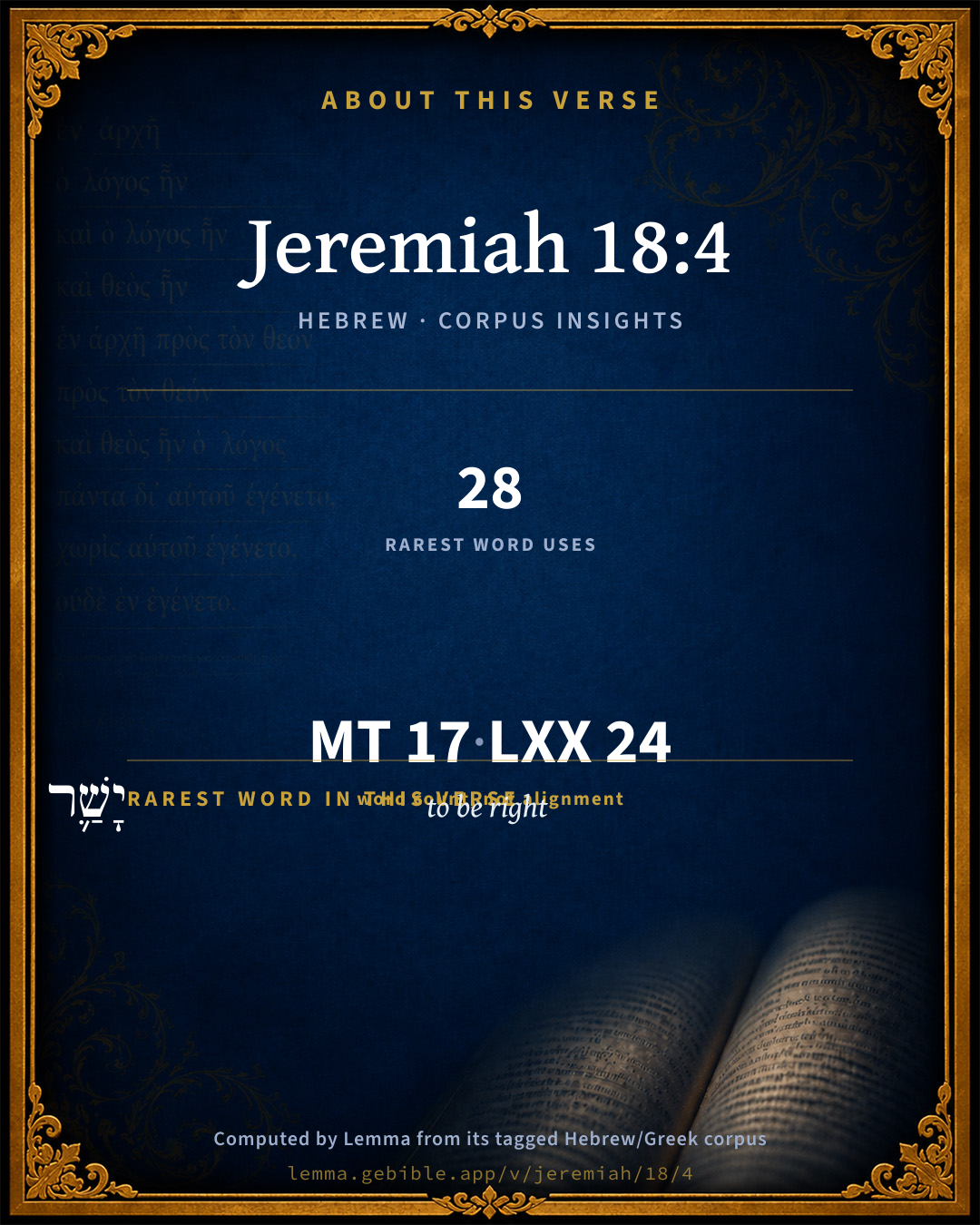
These counts appear in no published source. They are computed here, from the morphology-tagged text and Lemma’s own curated glosses. What Lemma adds →

17
words
12
distinct lemmas
Prophets
section

Shared distinctive vocabulary

יָשַׁ֛ר to be right H3474 occurs in 26 verses of the Hebrew Bible. Also found in:

Grammatical profile

  • 8 verbs
  • 5 nouns
  • 1 adjective
  • 1 pronoun
  • 2 particles

Verb forms

  • וְנִשְׁחַ֣ת Niphal · Perfect
  • עֹשֶׂ֛ה Qal · Participle Active
  • הַיּוֹצֵ֑ר Qal · Participle Active
  • וְשָׁ֗ב Qal · Perfect
  • וַֽיַּעֲשֵׂ֨הוּ֙ Qal · Sequential Imperfect
  • יָשַׁ֛ר Qal · Perfect
  • הַיּוֹצֵ֖ר Qal · Participle Active
  • לַעֲשֽׂוֹת Qal · Infinitive Construct

Repetition

Words recur within this verse — often emphatic in Hebrew:

  • עֹשֶׂ֛ה to do H6213 ×3
  • הַכְּלִ֗י vessel H3627 ×2
  • הַיּוֹצֵ֑ר to form H3335 ×2
  • אֲשֶׁ֨ר which H834 ×2

Hebrew & Septuagint length

In the original languages it is 17 Hebrew tokens and 24 Greek tokens — but the two are counted differently (Hebrew bundles its prefixes and suffixes into one token; the Greek is in lemma form), so that isn’t a like-for-like length.

Cross-references

3

Topical passages linked to Jeremiah 18:4 in the Treasury of Scripture Knowledge — connected by theme and wording, ordered by reader-vote popularity; previews shown in the World English Bible.

  • Romans 9:20–23 But indeed, O man, who are you to reply against God? Will the thing formed ask him who formed it, "Why did you make me like this?"
  • Jeremiah 18:6 House of Israel, can't I do with you as this potter? says Yahweh. Behold, as the clay in the potter's hand, so are you in my hand, house of Israel.
  • Isaiah 45:9 Woe to him who strives with his Maker--a potsherd among the potsherds of the earth! Shall the clay ask him who fashions it, "What are you making?" or your work, "He has no hands?"

Cross-references courtesy of OpenBible.info (CC BY 4.0).

Hebrew and Greek witnesses Masoretic Hebrew ↔ Greek Septuagint

The same verse in the two great witnesses to the Old Testament, shown verse-for-verse.

These are two independent witnesses, not word-aligned to each other, and the Septuagint is shown in lemma (dictionary) form.

Hebrew Jeremiah 18:4 Masoretic · Westminster Leningrad Codex

וְנִשְׁחַ֣ת הַכְּלִ֗י אֲשֶׁ֨ר ה֥וּא עֹשֶׂ֛ה בַּחֹ֖מֶר בְּיַ֣ד הַיּוֹצֵ֑ר וְשָׁ֗ב וַֽיַּעֲשֵׂ֨הוּ֙ כְּלִ֣י אַחֵ֔ר כַּאֲשֶׁ֥ר יָשַׁ֛ר בְּעֵינֵ֥י הַיּוֹצֵ֖ר לַעֲשֽׂוֹת

When the vessel that he made of the clay was marred in the hand of the potter, he made it again another vessel, as seemed good to the potter to make it.

World English Bible · Public Domain

Greek LXX Structure differs

In the Septuagint, Jeremiah is about an eighth shorter than the Hebrew and arranges its material differently — the Oracles Against the Nations (Hebrew chapters 46–51) appear in the middle of the Greek book, after 25:13. Because the chapter and verse boundaries do not line up, a verse-for-verse comparison with the Hebrew is not shown.

A verse-for-verse comparison isn’t shown here because the chapters and verses don’t line up. Switch to the LXX edition with the MT / LXX toggle above to read the Greek directly.

On this verse, The Cambridge Bible for Schools and Colleges discusses the Septuagint’s reading. Read the note in Commentary ↓

Hebrew: Westminster Leningrad Codex (CC BY 4.0). Greek: Septuagint (public domain); English from a public-domain English Septuagint. How the Septuagint differs from the Hebrew →

Targum (Aramaic paraphrase)

1

The Targum is the ancient Jewish Aramaic paraphrase of the Hebrew Scriptures — an interpretive translation, not the Hebrew text itself. Onkelos (literal) and Pseudo-Jonathan (expansive) render the Torah, and Jonathan the Prophets. Coverage is partial: where no permissively-licensed English translation exists for a verse, only the Aramaic is shown. This is verse-level text, not a word-by-word alignment to the Hebrew.

  1. Targum Jonathan Prophets (Joshua–Malachi)
    וְאִתְחַבֵּל מָנָא דַהֲוָה עָבֵיד דְטִינָא בְּיַד פַּחֲרָא וְתַב וְעָבְדִי מָן אוֹחֲרָן כְּמָא דְכְשַׁר בְּעֵינֵי פַּחֲרָא לְמֶעְבַּד:

    (no public-domain English translation for this verse)

    Targum Jonathan — Aramaic: “Mikraot Gedolot” (public domain). English: “Sefaria Community Translation” (CC0 1.0 (public-domain dedication)); “London "Chaldee Paraphrase," 1871” (public domain). Text via Sefaria.

Commentary

Notes on Jeremiah 18:4 from classic Christian and Jewish commentators (each source and its license shown beneath its notes). The classic Christian expositions comment on the surrounding passage and are grouped to its opening verse, so a note may address several verses; the Jewish commentaries on the Tanakh (Rashi and others) are per-verse, so they appear only where the commentator wrote on this verse.

Lemma curates 59 commentaries, every one of them public domain or Creative Commons licensed, each selected and text-cleaned for this edition rather than reprinted as found. About our sources →

Trapp's Complete Commentary

John Trapp

Jer 18:4 And the vessel that he made of clay was marred in the hand of the potter: so he made it again another vessel, as seemed good to the potter to make [it].

Ver. 4. And the vessel which he made of clay was marred.] Or, The vessel which he was making miscarried, as clay in the potter’s hand.

“ Non semper feriet quodcunque minabitur arcus. ”

John Trapp, A Commentary or Exposition upon All the Books of the Old and New Testament (1647–1656) — public domain. Text from a community e-Sword module.

Geneva Bible (1599)

Geneva Bible translators

As the potter hath power over the clay to make what pot he will, or to break them, when he hath made them: so have I power over you to do with you as seemeth good to me, Isa. 45:9; Rom. 9:20, 21.

Geneva Bible (1599) marginal notes — public domain. Text via Bolls.life.

Jamieson, Fausset & Brown

Robert Jamieson, A. R. Fausset & David Brown

marred--spoiled. "Of clay" is the true reading, which was corrupted into "as clay" (Margin), through the similarity of the two Hebrew letters, and from Jer 18:6, "as the clay."

Jamieson, Fausset & Brown — Commentary Critical and Explanatory on the Whole Bible (1871) — public domain (CC PDM 1.0). Text via the HelloAO Bible API.

Adam Clarke's Commentary

Verse 4. The vessel - was marred in the hands of the potter] It did not stand in the working; it got out of shape; or some gravel or small stone having been incorporated with the mass of clay, made a breach in that part where it was found, so that the potter was obliged to knead up the clay afresh, place it on the wheel, and form it anew; and then it was such a vessel as seemed good to the potter to make it.

Adam Clarke's Commentary on the Bible (1810–1826) — public domain. Text from a community e-Sword/MySword module.

John Calvin's Commentaries

He then relates what had been enjoined him, that he descended into the potter’s house; and then he relates what he saw there — that when the potter formed a vessel it was marred, and that he then made another vessel from the same clay, and, as it seems, one of a different form; for there is a peculiar emphasis in these words, as it seemed right in his eyes. The application is afterwards added — cannot I, as the potter, change you, O house of Israel? Doubtless, ye are in my hand as the clay in the hand of the potter; that is, I have no less power over you than the potter over his work and his earthen vessels.

We now see what this doctrine contains — that men are very foolish when they are proud of their present prosperous condition, and think that they are as it were fixed in a state of safety; for in a single moment God can cast down those whom he has raised up, and also raise up on high those whom he has before brought down to the ground. This is even well known by heathens, for moderation is commended by them, which they describe thus — “That no one ought to be inflated in prosperity, nor succumb in adversity.” But no one is really influenced by this thought, except he who acknowledges that we are ruled by the hand of God: for they who dream that fortune rules in the world set up their own wisdom, their own wealth, and their own strongholds. It must then necessarily be, that they always delude themselves with some vain hope or another. Until then men are brought to know that they are so subject to God’s power that their condition can in a single moment be changed, according to his will, they will never be humble as they ought to be. This doctrine therefore was entitled to special notice, especially when we consider how foolishly the Jews had abused the privilege with which God had favored Abraham and all his posterity; it was therefore an admonition altogether necessary. Besides, if we come to ourselves, we shall find that it requires a great effort to learn to humble ourselves, as Peter reminds us, under the mighty hand of God. (1 Peter 5:6.)

With regard to the words we must observe that האבנים eabenim, is a word in the dual number. The Prophet no doubt meant the moulds, des moules; for they who render it “wheel” seem not to understand the subject. The Prophet evidently refers to the moulds, made either of stone, or of wood, or of white clay; and this the number sufficiently proves. He then saw the potter with his moulds, avec ses moules, so that when he had formed one vessel it was marred; then he took the same clay and formed another vessel, and that according to his own will. I have already stated why it was necessary for the Prophet to go down to the potter’s house: he did so that he might afterwards lead the Jews to see their own case in a more vivid manner; for we know what a powerful effect a representation of this kind produces, when a scene like this is set before our eyes. Naked doctrine would have been frigid to slothful and careless men; but when a symbol was added, it had much greater effect. This then was the reason why God ordered the Prophet to see what the potter was doing.

John Calvin's Commentaries (1540-1563) — public domain. Text from the Calvin Translation Society English edition (1840s-50s) via the Christian Classics Ethereal Library (ccel.org). Calvin's coverage is partial (roughly two-thirds of the Bible); uncommented books and verses are honest gaps, never fabricated. The 19th-century editor's footnotes and remarks are omitted so the notes are faithfully Calvin's own voice.

Ellicott's Commentary for English Readers

(4) Of clay.—The reading in the margin, which gives “as clay,” must be regarded as a clerical error, originating, probably, in the desire to bring the text into conformity with Jer_18:6, that in the text of the Authorised Version being confirmed by many MSS. and Versions.

He made it again.—Literally, and more vividly, he returned and made. As we read, we have to remember that what is narrated in a few words implied a long train of thoughts. The prophet went by the impulse which he knew to be from God to the “field” in the valley of Hinnom; he stood and gazed, and then as he watched he was led to see in the potter’s work a parable of the world’s history: God as the great artificer, men and nations as the vessels which He makes for honourable or dishonourable uses (2Ti_2:20; Rom_9:21).

A Bible Commentary for English Readers, edited by Charles John Ellicott (1878–1897) — public domain. Text from a community e-Sword module.

The Cambridge Bible for Schools and Colleges

gen. ed. J. J. S. Perowne

4. in the hand of the potter] rather, as LXX, in his hands, thus avoiding harshness. “The potter” has doubtless crept into MT. from being a marginal gloss. Its admission to the MT. drew with it, through the influence of the wording of Jer_18:6, the addition of the Hebrew for “of the clay,” which accordingly is also absent from LXX. For illustrations drawn from the potter’s art cp. Isa_29:16; Isa_45:9; Isa_64:8; Wis_15:7; Sir_33:13. Pe. also compares Browning’s Rabbi Ben-Ezra (25 to end). St Paul’s employment of the figure (Romans 9-11) is quite different from Jeremiah’s, as the former uses it in application to God’s absolute right to dispose the fortunes of his creatures for good or evil.

The Cambridge Bible for Schools and Colleges (gen. ed. J. J. S. Perowne; Cambridge University Press, 1878–1918) — public domain. Text from a community e-Sword module.

John Gill's Exposition

Then the word of the Lord came unto me, saying. While he was in the potter's house, and after he had observed his manner of working, and the change he had made in his work, the Lord spoke to him, and applied it in the following manner.

Then the word of the Lord came unto me, saying. While he was in the potter's house, and after he had observed his manner of working, and the change he had made in his work, the Lord spoke to him, and applied it in the following manner.

Jeremiah 18:6

jer 18:6

jer 18:6

jer 18:6O house of Israel, cannot I do with you as this potter? saith the Lord,.... Make, and mar, and remake at pleasure? certainly he could. God is a sovereign Being, and has a sovereign and uncontrollable power over his creatures; he has an indisputable right unto them, and can dispose of them as he pleases; he has as good a right to them, and as great power over them, as the potter has to and over his clay, and a better and greater; since they are made by him, and have their all from him, their being, life, and motion; whereas the clay is not made by the potter; it is only the vessel that is made of the clay by him, which has its form from him; if therefore the potter has such power over the clay, which he did not make, as to cast it into another forth as it pleases him, and especially when marred; the Lord has an undoubted power over men, and a just right to change their, state and circumstances as he pleases; nor have they any reason to complain of him, especially when they have marred themselves by their own sins and transgressions; which was the present case of the house of Israel, or the Jews; see Isa 29:16;

behold, as the clay is in the potter's hand; and he can form and fashion it as he pleases, and it is not in the power of the clay to resist and hinder him:

so are ye in mine hand, O house of Israel; and I can dispose of you as I please, and put you in what circumstances it seems good unto me, drive you from your land, and scatter you among the nations; nor can you hinder me from doing this, or whatever else is my pleasure. And this his sovereign power and pleasure, and as exercised in a way of mercy and equity, are exemplified in the following cases.

John Gill's Exposition of the Whole Bible (1746–1763) — public domain (CC PDM 1.0). Text via the HelloAO Bible API.

Haydock's Catholic Bible Commentary

Broken. So Providence ordered it. (St. Jerome) --- How should this idea humble man! (Calmet) --- A potter may mould afresh the clay as long as it is soft, but God can change the hardest heart. (Worthington)

George Leo Haydock (1774–1849), Haydock's Catholic Family Bible and Commentary, 1859 edition — public domain. Excludes Psalms (Douay-Rheims chapter numbering differs from Protestant) and Deuterocanonical books (Catholic canon only).

Matthew Poole's English Annotations

That which we read

of clay may be read, (as our margin tells us,) as clay; that is, while it was yet clay it was spoiled in the potter’s hand, so as he did not think fit to go on with his design as to the form of the vessel, but made it into another form, such as he liked best.

Matthew Poole's English Annotations on the Holy Bible (1683–1685) — public domain. Text from a community e-Sword/MySword module.

Whedon's Commentary on the Bible

Daniel D. Whedon

4. The vessel… was marred, etc. — The meaning simply is: If the vessel was marred, he made again another vessel of it. Some MSS., instead of the reading of clay — literally, in clay — have as clay, and this reading, which is given in the margin of the Authorized Version, is adopted by Nagelsbach. But on no ground whatever is it to be preferred.

Daniel D. Whedon (gen. ed.), Commentary on the Old and New Testaments (1874–1909) — public domain. Text from a community e-Sword module.

The Pulpit Commentary

And the vessel that he made, etc.; rather, And whensoever the vessel... was marred in the hand of the potter, he made it again another vessel

The Pulpit Commentary (1880–1919), ed. H.D.M. Spence-Jones & Joseph S. Exell — public domain. Text from a community e-Sword module.

Rashi

Rabbi Shlomo Yitzchaki (Rashi)

that he was making of clay That he was making of the clay was spoiled in the potter’s hand while it was still wet, and this is an inverted verse.

Rashi on the Tanakh — English translations: “The Judaica Press complete Tanach with Rashi, translated by A. J. Rosenberg” (CC BY 4.0); “Pentateuch with Rashi's commentary by M. Rosenbaum and A.M. Silbermann, 1929-1934” (public domain); “The Metsudah Tanach series, Lakewood, N.J” (CC BY 4.0); and “The Book of Joshua, Metsudah Publications, 1997” (CC BY 4.0). Text via Sefaria.

Lesson kit

Teaching starters — assembled from the data on this page, not authored interpretation. Every prompt links to the verse data it draws on. Edit before teaching.

Jeremiah, in the Prophets, opens this verse with 17 words (12 distinct Hebrew lemmas). Its most distinctive word is yâshar (“to be right”). A historical commentator’s framing appears above. Read the whole chapter for the surrounding context.

Discussion questions

  1. What does “to be right” (yâshar) contribute to the verse as a whole?
  2. Numbers 23:27 shares the word «to be right» with this verse. How do the two illuminate each other?
  3. “to do” occurs 3× in this one verse. What is the effect of the repetition?
  4. The translations on this page render this verse differently — a whole-verse word diff, not a word-by-word alignment. What might account for the different wordings?
  5. The verb «וְנִשְׁחַ֣ת» is Niphal Perfect. How does its form color the action?
  6. Reading how Trapp's Complete Commentary and Geneva Bible (1599) read this verse, where do the two commentators agree and where do they part?

Things to notice

Reading settings

Reading text

Shown beneath each verse's original-language words.

Old Testament
Old Testament edition

Read the OT as the Masoretic Hebrew (MT) or the Greek Septuagint (LXX).

English shown for the Greek Septuagint (in the Hebrew ↔ Greek comparison).

Comparing translations? Open the Compare panel on any verse page to stack up to four side by side.