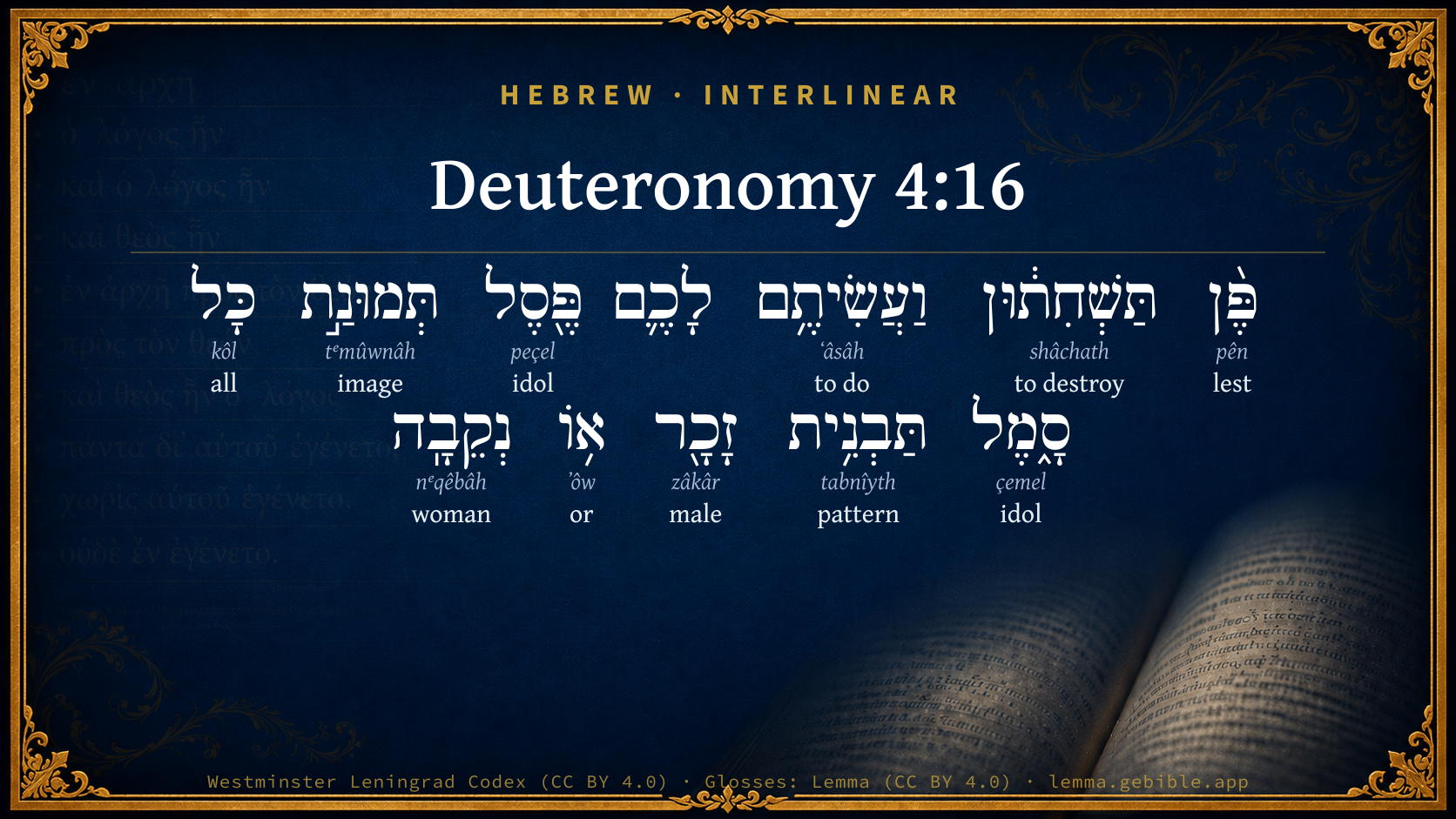
Deuteronomy 4:16

Hebrew (Westminster Leningrad Codex) Deuteronomy 4:16 appears in the Hebrew Old Testament. The text above is from the Westminster Leningrad Codex. Each word links to its Strong’s number, a concise gloss, and parsing drawn from the Open Scriptures Hebrew Bible morphology. Click any word for its full Brown-Driver-Briggs (BDB) entry.
Download image
Cite this verse

Deuteronomy 4:16 (World English Bible). Public Domain. Lemma interlinear Bible study tool, https://lemma.gebible.app/v/deuteronomy/4/16.

Show BibTeX & RIS
BibTeX
RIS
English Translation
Lest you corrupt yourselves, and make yourself an engraved image in the form of any figure, the likeness of male or female,
World English Bible · Public Domain
Highlights
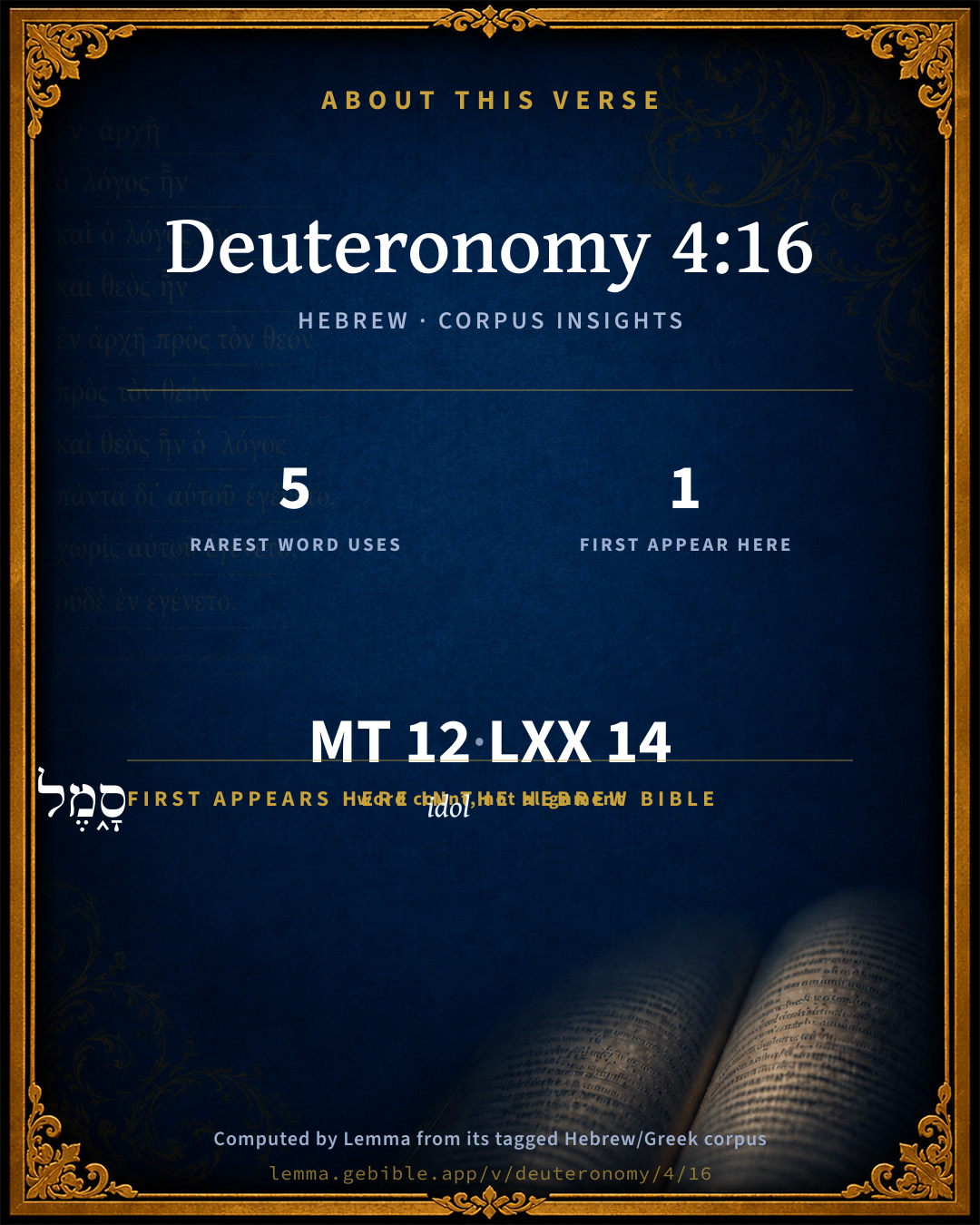
  • 1 first appearance in the Hebrew Bible
Full analysis ↓
Download a study sheet

One document with this verse’s original text, its word-by-word gloss line, the meaning frame, cross-references with their text, attributed commentary, and full source and license credits — printable, and it pastes into notes with its structure intact.

This verse Autodidact and up

Study sheet (.html) Plain text (.txt)

A passage Seminary Student

Up to 50 verses in one chapter. A passage sheet keeps up to 6 commentary sources and 12 cross-references per verse, in the order this page ranks them, and says so on the sheet whenever that leaves anything out. Ask for a single verse and you get the Autodidact verse sheet above.

Everything on this page stays free to read, with no account — the sheet is a download of what is already on screen, not access to it.

Want to remove ads? Support Godless Engineer
Compare translations 3

The same verse in 3 English versions, stacked beneath the original-language interlinear above. Click any original word for its lexicon entry.

Each is an independent rendering of the whole verse — the interlinear is not word-aligned to these translations.

Highlighted words mark where these versions differ — a whole-verse word diff, not a word-by-word alignment.

  • World English Bible Public Domain
    Lest you corrupt yourselves, and make yourself an engraved image in the form of any figure, the likeness of male or female,
  • King James Version Public Domain
    Lest ye corrupt yourselves, and make you a graven image, the similitude of any figure, the likeness of male or female,
  • unfoldingWord Literal Text CC BY-SA 4.0
    lest you act corruptly, and make for yourselves an idol of the form of any image, a likeness of male or female,

unfoldingWord Literal Text — © unfoldingWord, licensed CC BY-SA 4.0. Word-aligned USFM3 via Door43 (git.door43.org/unfoldingWord/en_ult).

Versions to compare (up to 4)

3 of 4 selected

Show all 18 translations

Every available English version of this verse, each an independent rendering of the whole verse.

  • World English Bible Public Domain
    Lest you corrupt yourselves, and make yourself an engraved image in the form of any figure, the likeness of male or female,
  • Berean Standard Bible Public Domain
    that you do not act corruptly and make an idol for yourselves of any form or shape, whether in the likeness of a male or female,
  • Majority Standard Bible Public Domain
    that you do not act corruptly and make an idol for yourselves of any form or shape, whether in the likeness of a male or female,
  • King James Version Public Domain
    Lest ye corrupt yourselves, and make you a graven image, the similitude of any figure, the likeness of male or female,
  • American Standard Version (1901) Public Domain
    Lest ye corrupt yourselves, and make you a graven image in the form of any figure, the likeness of male or female,
  • Revised Version (1885) Public Domain
    lest ye corrupt yourselves, and make you a graven image in the form of any figure, the likeness of male or female,
  • Geneva Bible (1599) Public Domain
    That ye corrupt not your selues, and make you a grauen image or representation of any figure: whither it be the likenes of male or female,
  • Douay-Rheims (1899) Public Domain
    Lest perhaps being deceived you might make you a graven similitude, or image of male or female,
  • Young's Literal Translation Public Domain
    lest ye do corruptly, and have made to you a graven image, a similitude of any figure, a form of male or female --
  • Literal Standard Version CC BY-SA 4.0
    lest you do corruptly, and have made for yourselves a carved image, a likeness of any figure: a form of male or female,
  • Unlocked Literal Bible CC BY-SA 4.0
    that you do not corrupt yourselves and by making a carved image in the form of any figure, in the likeness of male or female,
  • unfoldingWord Literal Text CC BY-SA 4.0
    lest you act corruptly, and make for yourselves an idol of the form of any image, a likeness of male or female,
  • Darby Bible Public Domain
    lest ye corrupt yourselves, and make you a graven image, the form of any figure, the pattern of male or female,
  • World Messianic Bible Public Domain
    lest you corrupt yourselves, and make yourself a carved image in the form of any figure, the likeness of male or female,
  • Webster's Bible Public Domain
    Lest ye corrupt yourselves, and make to you a graven image, the similitude of any figure, the likeness of male or female,
  • Free Bible Version CC BY-SA 4.0
    that you don't spoil your relationship with the Lord by making an idol for yourselves in any shape or form, whether it looks like a male or female,
  • Bible in Basic English Public Domain
    So that you may not be turned to evil ways and make for yourselves an image in the form of any living thing, male or female,
  • JPS Tanakh (1917) Public Domain
    lest ye deal corruptly, and make you a graven image, even the form of any figure, the likeness of male or female,

Literal Standard Version (2020), Covenant Press — licensed CC BY-SA 4.0. Text via the HelloAO Bible API (eBible.org). Unlocked Literal Bible (unfoldingWord) — licensed CC BY-SA 4.0. Text via the HelloAO Bible API (eBible.org). unfoldingWord Literal Text — © unfoldingWord, licensed CC BY-SA 4.0. Word-aligned USFM3 via Door43 (git.door43.org/unfoldingWord/en_ult). Free Bible Version, Dr. Jonathan Gallagher — licensed CC BY-SA 4.0. Text via the HelloAO Bible API (eBible.org).

Word by word

More ways to search: Search by grammar → Find every occurrence → Compare this word →

Practice this passage: Drill this verse → Learn its vocabulary →

סָ֑מֶל
çemel
H5566
“idol”
Noun, Common, Masculine, Singular, Absolute
Part of Speech
Noun
Type
Common
Gender
Masculine
Number
Singular
State
Absolute
Full BDB Definition

Origin: from an unused root meaning to resemble

TWOT: 1515

image, statue, idol
  1. פֶּ֨ן pên H6435 “lest” Conjunction
  2. תַּשְׁחִת֔וּן shâchath H7843 “to destroy” Verb, Hiphil, Imperfect, 2nd Person, Masculine, Plural + Suffix, n
  3. וַעֲשִׂיתֶ֥ם ʻâsâh H6213 “and · to do” Conjunction + Verb, Qal, Sequential Perfect, 2nd Person, Masculine, Plural
  4. פֶּ֖סֶל peçel H6459 “idol” Noun, Common, Masculine, Singular, Absolute
  5. תְּמוּנַ֣ת tᵉmûwnâh H8544 “image of” Noun, Common, Feminine, Singular, Construct
  6. כָּל kôl H3605 “all of” Noun, Common, Masculine, Singular, Construct
  7. תַּבְנִ֥ית tabnîyth H8403 “pattern of” Noun, Common, Feminine, Singular, Construct
  8. זָכָ֖ר zâkâr H2145 “male” Adjective, Adjective, Masculine, Singular, Absolute
  9. א֥וֹ ʼôw H176 “or” Conjunction
  10. נְקֵבָֽה nᵉqêbâh H5347 “woman” Noun, Common, Feminine, Singular, Absolute

About this verse

These counts appear in no published source. They are computed here, from the morphology-tagged text and Lemma’s own curated glosses. What Lemma adds →

12
words
11
distinct lemmas
Pentateuch
section

Notable vocabulary

The rarest word here is סָ֑מֶל idol H5566 — appearing just 5 times in the whole Hebrew Bible.

First appearance in Scripture

This word makes its first canonical appearance in the Hebrew Bible here:

  • סָ֑מֶל idol H5566

Shared distinctive vocabulary

סָ֑מֶל idol H5566 occurs in 5 verses of the Hebrew Bible. Also found in:

Grammatical profile

  • 2 verbs
  • 6 nouns
  • 1 adjective
  • 1 preposition
  • 2 conjunctions

Verb forms

  • תַּשְׁחִת֔וּן Hiphil · Imperfect
  • וַעֲשִׂיתֶ֥ם Qal · Sequential Perfect

Hebrew & Septuagint length

In English translation the verse runs 22 words from the Hebrew and 20 from the Septuagint (LXX English) — closely comparable.

A rough comparison of the two English renderings, which tokenize alike — not a word-level alignment.

Word counts can differ between the Hebrew and the Greek without any difference in meaning — e.g. the Hebrew direct-object marker אֵת has no separate Greek word, and Greek often adds the article ὁ.

In the original languages it is 12 Hebrew tokens and 14 Greek tokens — but the two are counted differently (Hebrew bundles its prefixes and suffixes into one token; the Greek is in lemma form), so that isn’t a like-for-like length.

Cross-references

13

Topical passages linked to Deuteronomy 4:16 in the Treasury of Scripture Knowledge — connected by theme and wording, ordered by reader-vote popularity; previews shown in the World English Bible.

  • Acts 17:29 Being then the offspring of God, we ought not to think that the Divine Nature is like gold, or silver, or stone, engraved by art and design of man.
  • Exodus 20:4–5 "You shall not make for yourselves an idol, nor any image of anything that is in the heavens above, or that is in the earth beneath, or that is in the water under the earth:
  • Deuteronomy 4:23 Take heed to yourselves, lest you forget the covenant of Yahweh your God, which he made with you, and make you an engraved image in the form of anything which Yahweh your God has forbidden you.
  • Deuteronomy 5:8 "You shall not make an engraved image for yourself, [nor] any likeness [of anything] that is in heaven above, or that is in the earth beneath, or that is in the water under the earth:
  • Romans 1:22–24 Professing themselves to be wise, they became fools,
  • Exodus 32:7 Yahweh spoke to Moses, "Go, get down; for your people, who you brought up out of the land of Egypt, have corrupted themselves!
  • Deuteronomy 4:8–9 What great nation is there, that has statutes and ordinances so righteous as all this law, which I set before you this day?
  • Deuteronomy 4:25 When you shall father children, and children's children, and you shall have been long in the land, and shall corrupt yourselves, and make an engraved image in the form of anything, and shall do that which is evil in the sight of Yahweh your God, to provoke him to anger;
  • Psalms 106:19–20 They made a calf in Horeb, And worshiped a molten image.
  • Isaiah 40:18 To whom then will you liken God? or what likeness will you compare to him?
  • John 4:24 God is spirit, and those who worship him must worship in spirit and truth."
  • Acts 20:4–5 These accompanied him as far as Asia: Sopater of Beroea; Aristarchus and Secundus of the Thessalonians; Gaius of Derbe; Timothy; and Tychicus and Trophimus of Asia.
  • 1 Timothy 1:17 Now to the King eternal, immortal, invisible, to God who alone is wise, be honor and glory forever and ever. Amen.

Cross-references courtesy of OpenBible.info (CC BY 4.0).

Hebrew and Greek witnesses Masoretic Hebrew ↔ Greek Septuagint

The same verse in the two great witnesses to the Old Testament, shown verse-for-verse.

These are two independent witnesses, not word-aligned to each other, and the Septuagint is shown in lemma (dictionary) form.

Hebrew Deuteronomy 4:16 Masoretic · Westminster Leningrad Codex

פֶּ֨ן תַּשְׁחִת֔וּן וַעֲשִׂיתֶ֥ם לָכֶ֛ם פֶּ֖סֶל תְּמוּנַ֣ת כָּל סָ֑מֶל תַּבְנִ֥ית זָכָ֖ר א֥וֹ נְקֵבָֽה

Lest you corrupt yourselves, and make yourself an engraved image in the form of any figure, the likeness of male or female,

World English Bible · Public Domain

Greek LXX Deuteronomy 4:16 Septuagint · lemma form

μή ἀνομέω καί ποιέω σύ ἑαυτοῦ γλυπτός ὁμοίωμα πᾶς εἰκών ὁμοίωμα ἀρσενικός ἤ θηλυκός

lest you⌃ transgress, and make to yourselves a carved image, any kind of figure, the likeness of male or female,

LXX2012 (modern English Septuagint) · Public Domain

Hebrew: Westminster Leningrad Codex (CC BY 4.0). Greek: Septuagint (public domain); English from LXX2012 (modern English Septuagint) (Public Domain). How the Septuagint differs from the Hebrew →

Targum (Aramaic paraphrase)

2

The Targum is the ancient Jewish Aramaic paraphrase of the Hebrew Scriptures — an interpretive translation, not the Hebrew text itself. Onkelos (literal) and Pseudo-Jonathan (expansive) render the Torah, and Jonathan the Prophets. Coverage is partial: where no permissively-licensed English translation exists for a verse, only the Aramaic is shown. This is verse-level text, not a word-by-word alignment to the Hebrew.

  1. Targum Onkelos Torah (Genesis–Deuteronomy)
    דִילְמָא תְּחַבְּלוּן וְתַעְבְּדוּן לְכוֹן צֶלֶם דְמוּת כָּל צוּרָא דְמוּת דְכַר אוֹ נֻקְבָא

    (no public-domain English translation for this verse)

    Targum Onkelos — Aramaic: “Onkelos Genesis” (public domain); “Onkelos Exodus” (public domain); “Onkelos Leviticus” (public domain); “Onkelos Numbers” (public domain); “Onkelos Deuteronomy” (public domain). English: “Sefaria Community Translation” (CC0 1.0 (public-domain dedication)); “J.W. Etheridge. The Targums of Onkelos and Jonathan Ben Uzziel on the Pentateuch. London: Longmans, Green, 1862” (public domain). Text via Sefaria.

  2. Targum Pseudo-Jonathan Torah (Genesis–Deuteronomy)
    הֲווֹ זְהִירִין דְּלָא תְחַבְּלוּן עוֹבָדֵיכוֹן וְתַעַבְדוּן לְכוֹן צְלַם דְּמוּ דְּכָל טָעוּ דְמוּ דִדְכַר אוֹ דְנוּקְבָא

    Be admonished, lest you corrupt your works, and make to you an image or likeness of any idol, the likeness either male or female

    Targum Pseudo-Jonathan — Aramaic: “Targum Jonathan on Genesis” (public domain); “Targum Jonathan on Exodus” (public domain); “Targum Jonathan on Leviticus” (public domain); “Targum Jonathan on Numbers” (public domain); “Targum Jonathan on Deuteronomy” (public domain). English: “The Targum of Jonathan ben Uzziel, trans. J. W. Etheridge, London, 1862” (public domain). Text via Sefaria.

Commentary

Notes on Deuteronomy 4:16 from classic Christian and Jewish commentators (each source and its license shown beneath its notes). The classic Christian expositions comment on the surrounding passage and are grouped to its opening verse, so a note may address several verses; the Jewish commentaries on the Tanakh (Rashi and others) are per-verse, so they appear only where the commentator wrote on this verse.

Lemma curates 59 commentaries, every one of them public domain or Creative Commons licensed, each selected and text-cleaned for this edition rather than reprinted as found. About our sources →

Trapp's Complete Commentary

John Trapp

Deu 4:16 Lest ye corrupt [yourselves], and make you a graven image, the similitude of any figure, the likeness of male or female,

Ver. 16. The likeness of male or female.] As the blind Ethnics did, concluding their petitions with that general, Dii, Deaeque omnes. {a}

{a} Servius.

John Trapp, A Commentary or Exposition upon All the Books of the Old and New Testament (1647–1656) — public domain. Text from a community e-Sword module.

Joseph Benson's Commentary

Deu 4:16-17. Lest ye corrupt yourselves — Corrupt your minds with mean thoughts of God, your hearts by suffering any creature to alienate your affections from him, or your ways by worshipping him in a corrupt manner, or by falling into idolatry. And make you a graven image — For worship, or for the representation of God; which he forbids under the penalty of his displeasure. The likeness of any beast, &c. — Dr. Chandler observes, that “this is the very picture of Egypt, which had gods of all sorts; dead persons deified, male and female, and numerous images of them; who worshipped as deities bulls, cows, sheep, goats, dogs, cats, birds, the ibis and hawk, serpents, crocodiles, river-horses, together with the sun, moon, and stars of heaven.”

Joseph Benson's Commentary on the Old and New Testaments (1811–1818) — public domain. Text from a community e-Sword module.

Tyndale Open Study Notes

Tyndale Open Resources

4:16 idol: Idolatry inherently confined the Lord to the artist’s imagination. Israel was not to make idols in the form of any of his creatures (4:17-18). Idols and images could lead to worship of the creature rather than the Creator (5:8-9; Rom 1:23-25).

Tyndale Open Study Notes — © Tyndale Open Resources, licensed CC BY-SA 4.0. Text via the HelloAO Bible API.

Jamieson, Fausset & Brown

Robert Jamieson, A. R. Fausset & David Brown

Lest ye corrupt yourselves, and make you a graven image--The things are here specified of which God prohibited any image or representation to be made for the purposes of worship; and, from the variety of details entered into, an idea may be formed of the extensive prevalence of idolatry in that age. In whatever way idolatry originated, whether from an intention to worship the true God through those things which seemed to afford the strongest evidences of His power, or whether a divine principle was supposed to reside in the things themselves, there was scarcely an element or object of nature but was deified. This was particularly the case with the Canaanites and Egyptians, against whose superstitious practices the caution, no doubt, was chiefly directed. The former worshipped Baal and Astarte, the latter Osiris and Isis, under the figure of a male and a female. It was in Egypt that animal-worship most prevailed, for the natives of that country deified among beasts the ox, the heifer, the sheep, and the goat, the dog, the cat, and the ape; among birds, the ibis, the hawk, and the crane; among reptiles, the crocodile, the frog, and the beetle; among fishes, all the fish of the Nile; some of these, as Osiris and Isis, were worshipped over all Egypt, the others only in particular provinces. In addition they embraced the Zabian superstition, the adoration of the Egyptians, in common with that of many other people, extending to the whole starry host. The very circumstantial details here given of the Canaanitish and Egyptian idolatry were owing to the past and prospective familiarity of the Israelites with it in all these forms.

Jamieson, Fausset & Brown — Commentary Critical and Explanatory on the Whole Bible (1871) — public domain (CC PDM 1.0). Text via the HelloAO Bible API.

Adam Clarke's Commentary

Verse 16. The likeness of male or female] Such as Baal-peor and the Roman Priapus, Ashtaroth or Astarte, and the Greek and Roman Venus; after whom most nations of the world literally went a whoring.

Adam Clarke's Commentary on the Bible (1810–1826) — public domain. Text from a community e-Sword/MySword module.

Ellicott's Commentary for English Readers

(16) Lest ye corrupt . . . and make.—The connection between idolatry and corruption is twofold. First, it changes “the glory of the incorruptible God” into an image of His corruptible creatures. Secondly, it always ends in corrupting the idolater. Man was made to have dominion over the works of God’s hands. He cannot worship anything in creation, which he was not intended to rule. He can only fulfil his destiny when he strives after the Divine likeness, rising to that which is above him, instead of stooping to that which is below.

(17,18) Likeness of any beast . . . fowl . . .—There may be an allusion to the animal idolatry of Egypt here.

A Bible Commentary for English Readers, edited by Charles John Ellicott (1878–1897) — public domain. Text from a community e-Sword module.

The Cambridge Bible for Schools and Colleges

gen. ed. J. J. S. Perowne

16. lest ye corrupt yourselves] Act perniciously.

a graven image] Heb. pesel: any idol carved in stone or wood.

figure] Heb. semel, only here; Eze_8:3; Eze_8:5; 2Ch_33:7; 2Ch_33:15, the Phoen. apparently for a statue, ἀνδριάς (CIS i. i. 41, line i.; 88, lines 2, 5; 91, 1). So here of the human figure as the following words show.

the likeness, etc.] Rather, the build or mould, Heb. tabnîth, of male or female.

The Cambridge Bible for Schools and Colleges (gen. ed. J. J. S. Perowne; Cambridge University Press, 1878–1918) — public domain. Text from a community e-Sword module.

John Gill's Exposition

Lest ye corrupt yourselves,.... And not themselves only, but the word and worship of God, by idolatry, than which nothing is more corrupting and defiling, nor more abominable to God:

and make you a graven image, the similitude of any figure; a graven image, in the likeness of any figure, an idea of which they had formed in their minds:

the likeness of male or female; of a man or a woman; so some of the Heathen deities were in the likeness of men, as Jupiter, Mars, Hercules, Apollo, &c. and others in the likeness of women, as Juno, Diana, Venus, &c. Some think Osiris and Isis, Egyptian deities, the one male, the other female, are respected; but it is not certain that these were worshipped by them so early.

John Gill's Exposition of the Whole Bible (1746–1763) — public domain (CC PDM 1.0). Text via the HelloAO Bible API.

Matthew Poole's English Annotations

i.e. Lest ye corrupt your minds with mean and carnal thoughts of God. Or, corrupt your ways or courses, by worshipping God in a corrupt manner, or by falling into idolatry.

A graven image, to wit, for worship, or for the representation of God, as it is explained Deu 4:19, for otherwise it was not simply unlawful to draw the picture or make a figure of a man or a beast.

Matthew Poole's English Annotations on the Holy Bible (1683–1685) — public domain. Text from a community e-Sword/MySword module.

The Pulpit Commentary

Graven image (lsp), carved work or sculpture, whether of wood, or metal, or stonethe similitude of any figure the form of any idol (lms, form, statue, idol)the likeness figure (tynibt, a building, a model, a form, or figure)of male or female in apposition to graven image, and illustrative of it.

The Pulpit Commentary (1880–1919), ed. H.D.M. Spence-Jones & Joseph S. Exell — public domain. Text from a community e-Sword module.

John Wesley's Explanatory Notes

Lest ye corrupt yourselves - Your ways, by worshipping God in a corrupt manner.

John Wesley, Explanatory Notes Upon the Whole Bible (1754–1765) — public domain. Text via the GEBible commentary corpus.

Rashi

Rabbi Shlomo Yitzchaki (Rashi)

סמל means “form”.

Rashi on the Tanakh — English translations: “The Judaica Press complete Tanach with Rashi, translated by A. J. Rosenberg” (CC BY 4.0); “Pentateuch with Rashi's commentary by M. Rosenbaum and A.M. Silbermann, 1929-1934” (public domain); “The Metsudah Tanach series, Lakewood, N.J” (CC BY 4.0); and “The Book of Joshua, Metsudah Publications, 1997” (CC BY 4.0). Text via Sefaria.

Lesson kit

Teaching starters — assembled from the data on this page, not authored interpretation. Every prompt links to the verse data it draws on. Edit before teaching.

Deuteronomy, in the Pentateuch, opens this verse with 12 words (11 distinct Hebrew lemmas). Its most distinctive word is çemel (“idol”). A historical commentator’s framing appears above. Read the whole chapter for the surrounding context.

Discussion questions

  1. What does “idol” (çemel) contribute to the verse as a whole?
  2. The word “idol” first appears here in Scripture. What is being introduced at this debut?
  3. 2 Chronicles 33:7 shares the word «idol» with this verse. How do the two illuminate each other?
  4. These translations render this verse differently; the difference is in the English rendering, not the original. What questions does that raise?
  5. The verb «תַּשְׁחִת֔וּן» is Hiphil Imperfect. How does its form color the action?
  6. Reading how Trapp's Complete Commentary and Joseph Benson's Commentary read this verse, where do the two commentators agree and where do they part?

Things to notice

Reading settings

Reading text

Shown beneath each verse's original-language words.

Old Testament
Old Testament edition

Read the OT as the Masoretic Hebrew (MT) or the Greek Septuagint (LXX).

English shown for the Greek Septuagint (in the Hebrew ↔ Greek comparison).

Comparing translations? Open the Compare panel on any verse page to stack up to four side by side.